I teach English in a Bring Your Own Device (BYOD) school, and that means that there is  wireless for all kinds of devices: notebooks, Kindles, laptops, and phones. Internet access is also open for social media sites, except Facebook, since many teachers use them for resources or to communicate with students. There is a school policy  requiring a 7″ screen on a device for classroom use, but students access their cell phones throughout the day.

Once class has begun, students can be online for tasks assigned by a teacher. What is not surprising is that, like students of previous generations, they might drift. For example, while their parents may have passed notes on bits of paper, this generation texts their notes. Their phones are a continuous source of temptation, the same way that their phones will be a temptation in the real world when they leave school. Educators recognize that students must be trained in the effective and appropriate use of technology, yet, with the exponential changes in the use of technology in education, educators may not know or practice the best strategies.

Students, however, often develop best practices in the use of technology themselves. Students can surprise us.

The good example of this sort of surprise is the message of recent holiday ad by Apple. In the ad, a Christmas family reunion begins with the arrival of a family including a teenager preoccupied with his iPhone.  He looks to be missing out on all the festivities: the sled-riding, the cookie-decorating, the dinners, the snowman-building (although he does have the carrot for a snowman’s nose in his pocket). But, on Christmas morning he presents his family with a video he has filmed to celebrate the reunion. In a twist of perception, the video shows that he has not been distracted by the phone; he has recorded and edited all the family events in making the “Harris Family Holiday”. He even makes Grandma cry in gratitude.

The short commercial is brilliantly cast; the teenager looks like any one of a number of my students. His head is constantly bent over the glowing screen; he looks up only briefly to acknowledge a word or gesture thrown in his direction. He could be in my classroom…so is he an example of the distracted  student or is he an example of creativity in my classroom?

The commercial is both an attempt to sell iPhones as well as justify the perception of distraction. “You are mistaken,” Apple is telling the viewer, “the iPhone is not a distraction; the iPhone is a tool.” In an advertising paradox, Apple is telling the truth…the iPhone is both.

I have witnessed students in my class be completely distracted by the cell phone  and other digital tools. I have also witnessed them use these tools to complete assignments beyond my expectations. I have been as surprised as the family in the holiday video. 

Perhaps the most important lesson from Apple is that the “every-teenager” featured in the commercial does the video on his own. There is no assignment. The video is his gift to his family. His choice to use this particular tool for a specific purpose illustrates the goal of a 21st Century education. The commercial also provides teachers with an example of a student practicing 21st Century skills.

The word surprise is derived from the past participle of Old French surprendre meaning “to overtake”. There is no surprise that Apple’s promotion of the iPhone in this commercial overtakes the heart in an attempt to overtake the competitive cell phone market. There should be no surprise that a cell phone is already in most students’ pockets or book bags. Those cell phones need not overtake the classroom if educators encourage their use as a tool and let the students surprise us with what they can do.


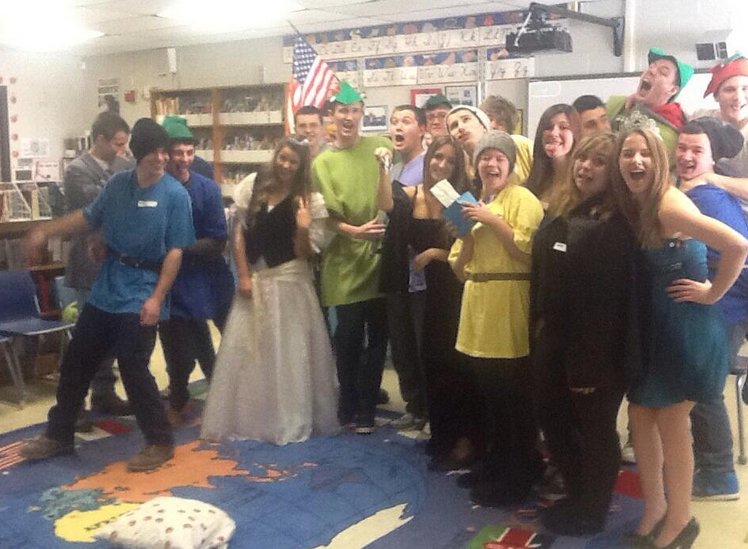
Screen Shot 2013-12-22 at 10.51.28 PMSeveral of the 12th graders had taken the elective of Drama Class for their English IV because they did not think they would have to read. They were wrong; they read Our Town. A few of the 12th graders had taken the elective of Drama for their English class because they did not think they would have to write. They were wrong. They had journals. What was most surprising was the number of 12th graders who did not think that they had to act…or memorize lines.

As a precaution, the drama class teacher chose the play Snow White and the Seven Dwarves as their final production in the hopes that since the students already knew the plot, “They could always ad-lib.”

The play was cast with some additional dwarves (“Shorty” and “Weepy”) increasing the company to accommodate the number of students in the class. Rehearsals began, but the progress was slow. The principal parts were invested, but the dwarves were not, and their large numbers cluttered the small classroom stage area. They missed entrances, missed cues, missed lines, and when they were on set, they stood swaying or whispered so loudly as to drown out the lines of others. They were collectively the most awkward set of gigantic dwarves ever to inhabit a stage.

Nevertheless, the production was scheduled for appearances at three local elementary schools two days before the winter break. Props were prepared, costumes fitted, and sound cues burned onto a CD. Then, an ice storm two weeks before performance caused a car pile-up, and the drama club teacher was left with a concussion. She could not be in school; the students were on their own, and I was left to supervise.

There was a “dress rehearsal” the morning of the show; it was, as all dress rehearsals go, a disaster. “I don’t think you should take them,” advised a student who was watching. I had a sinking feeling; perhaps she was right. But, as the adage says, “The show must go on!”

Our first stop was in the elementary school gym, a cavernous space.
“You are going to have to be loud,” I cautioned, as members of the cast set up the magic mirror. Just then the announcements came on.

“Good morning,” chirped a little voice over the speakers, “Today is Thursday, December 19th…..” The announcements continued with students from the elementary school listing off birthdays, lunch menu details, and finally, the Pledge of Allegiance.

“Guys,” interrupted the most uncooperative dwarf to the other cast members, “listen to them….I mean…they’re so innocent! We can’t screw up now!” The others looked startled. There was no turning back; there was only forward movement, and that forward movement was going to have to be kid-friendly. For the first time since the auditions, they were quiet, and in that moment of recognition, the 22 students in drama class became a theatre troupe. I was certainly not a factor; this was entirely their decision. They had been prepared by their drama teacher for this moment, but they had never truly risen to the occasion. As they watched the audience of elementary school students file in, the gravity of their roles became real. The show was going on…

“Once upon a time….” the narrator began, and each cast member found their place on the gym floor stage. They recalled lines locked in the file drawers of recent memory or ad-libbed as needed. The Mirror told the Evil Queen she was no longer the most beautiful, the huntsman let Snow White run away, the dwarves found Snow White in their cottage, and the Evil Queen tricked Snow White with a poisoned apple.

There were plenty of errors. The sound cue for the Evil Queen (never used before) drowned out her entrance, the poisoned apple rolled into the hands of some smaller audience members, and when the Prince first kissed Snow White on the hand, there was a critique from an audience member who called out, “Now, that was lame.” But when the Prince finally kissed Snow White with “love’s first kiss”, there were cheers from the crowd, and an astonished cast stood together, hand in hand, taking their first (and again, unrehearsed) bow.

Piling on the bus to perform at the next elementary school, the cast was all business. During the 30 minute ride, they practiced lines and advised each other on what should happen for the next show. They were serious.

The next two performances at other elementary schools became more polished as students internalized their roles. They naturally changed their staging moving from gym floor to library floor. The Evil Queen tossed her hair with anger and the Prince strode onto the stage with more confidence. The dwarves were still cluttering the stage, and each time Doc announced the “death” of Snow White, they were unconcerned. While they were not “actors”, they were a source of comic relief, intentionally or not.

So, I watched the holiday miracle of 2013 repeated three times that day. The students in drama class at each school were applauded, and later that afternoon there were e-mails from the principals that offered praise.

The holiday season is a time for miracles. Their drama teacher should have been there to witness this one, but for now the videos will have to suffice. The end of 2013 has ended on a high note for those seniors. Heigh-ho to 2014!

Cast photo!

Cast photo!

Today is the 25th anniversary of the terrorist bombing of PAN AM #103 over Lockerbie, Scotland.

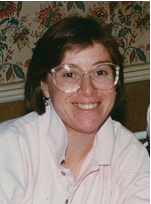
Elizabeth "Liz" Marek

Elizabeth “Liz” Marek

My friend Elizabeth Marek, Liz, was on that plane. She was killed along with 270 other people that evening when a bomb planted onboard the plane exploded before it crashed into a small Scottish town. Her sudden death left an enormous hole in the lives of my family. She was smart, quick-witted, and loved film and theatre. Her most outstanding quality was her laughter. There are not enough synonyms to describe Liz’s laughter: she chuckled, she chortled, she guffawed, she cackled, she giggled,she tittered, she sniggered, she snickered. She would make us roar/hoot/howl with laughter, crack up, and roll on the floor, Liz supplied the laugh-track of our youth.

That laugh track came to a sudden and uprupt end four days before Christmas. The priest who eulogized her spoke about the “not so silent night” of December 21st, 1988, the night our world became a little quieter.

My world also became a great deal smaller. Suddenly, I knew someone who had been killed by terrorist for a reason that was not clear. Some ideologue had chosen the plane my friend was on to make a statement, to get revenge, or possibly to demonstrate power. Regardless, the bombing connected me and my family to terrorism in a personal way.

Much speculation has been given to level on connection each person has to another in the world. One theory postulated by Frigyes Karinthy is that there are six degrees of separation that separate any two people in the world. This theory suggests that everyone and everything is six or fewer steps away, by way of introduction, from any other person in the world. The idea was central to a 1990 play by American playwright John Guare, Six Degrees of Separation where one of the characters states:

I read somewhere that everybody on this planet is separated by only six other people. Six degrees of separation between us and everyone else on this planet. The President of the United States, a gondolier in Venice, just fill in the names. I find it A) extremely comforting that we’re so close, and B) like Chinese water torture that we’re so close because you have to find the right six people to make the right connection… I am bound to everyone on this planet by a trail of six people.

The accuracy of this theory has been tested using multiple social media platforms, and speculations have been made that there are even fewer than six degrees. In 2011, Facebook’s data team, using 721 million users with 69 billion friendships, averaged the distance of 4.74 between users. With this one social network platform, 1.19 billion monthly users out of a world population of 7.2 billion (as of September 30, 2013) are connected.

Sadly, my connections to other cataclysmic events have also continued. I live less than a five minute drive from Sandy Hook in Newtown, Connecticut, site of last year’s (2012) deadly school shooting. My family knew some of the victims there as well. The press coverage touched us all in our respective homes across the United States. We watched film footage of the famous flagpole in the center of town, the familiar Edmond Town Hall, and interviews with people we knew. We again felt the world become even smaller as our connections expanded.

These two horrific incidents are not the only ways that my family and I can measure connections with others in the world, but they illustrate how interconnected we are on our small blue planet in the larger universe. As 2013 comes to a close, the levels of human connection remind me of what author and scientist Carl Sagan had to say about humanity on Earth in his book Pale Blue Dot: A Vision of the Human Future in Space:

“Look again at that dot. That’s here. That’s home. That’s us. On it everyone you love, everyone you know, everyone you ever heard of, every human being who ever was, lived out their lives. The aggregate of our joy and suffering, thousands of confident religions, ideologies, and economic doctrines, every hunter and forager, every hero and coward, every creator and destroyer of civilization, every king and peasant, every young couple in love, every mother and father, hopeful child, inventor and explorer, every teacher of morals, every corrupt politician, every “superstar,” every “supreme leader,” every saint and sinner in the history of our species lived there-on a mote of dust suspended in a sunbeam……To me, it underscores our responsibility to deal more kindly with one another, and to preserve and cherish the pale blue dot, the only home we’ve ever known.”

On this 25th anniversary of the bombing of PAN AM#103, I imagine that we are more connected to each other than ever before. I know that Liz would agree that we should deal more kindly with one another.

Christmas storyThe holidays are here and network television takes full advantage of our want to replay our favorites, to stir memories, or to remind us of our childhood. Perhaps no film is more nostalgic than the 1983 film A Christmas Story based on a novel by Jean Shepard, In God We Trust, All Others Pay Cash. Director Bob Clark and writer Leigh Brown also collaborated on the screenplay for this time piece of the 1940s that highlights one family’s battles with Oldsmobiles, coal-burning furnaces, and spotty electrical wiring. The film is also a timeless story of a young boy’s obsession for toy, a Red Ryder B.B. gun, for Christmas from Santa Claus, the guarantor of all secret wishes.

The casting of actor Darren McGavin (The Old Man), actress Melinda Dillon (Mother), and the young Peter Billingsley, as the bespectacled Ralphie, was perfect, but it is the voice of Shepard himself narrating the story that makes the movie so memorable. The viewer sees the events through Shepard’s eyes and hears his emotional range as he reflects on this one momentous Christmas season. In recalling his youth, he is at turns indignant (“Ovaltine? A crummy commercial?”)  terrified (“Scut Farkus staring out at us with his yellow eyes. He had yellow eyes! So, help me, God! Yellow eyes!”), and determined (“No! No! I want an Official Red Ryder Carbine-Action Two-Hundred-Shot Range Model Air Rifle!”)

The visual laughs abound in the story: Flick’s tongue stuck frozen to the flagpole, Miss Shields’ morphing into a witch, and the camera closing in on Santa’s boot as he shoves Ralphie down the slide into a soft pile of cloth snowballs. But it is the language, Shephard’s script, that gives the film its enduring appeal. Long after December, I have heard people quote lines from the film such as:

  • Fra-gee-lay. That must be Italian.
  • It… It ’twas… soap poisoning!
  • Only I didn’t say “Fudge.” I said THE word, the big one, the queen-mother of dirty words, the “F-dash-dash-dash” word!
  • But those who did it know their blame, and I’m sure that the guilt you feel is far worse than any punishment you might receive.
  • You’ll shoot your eye out, kid.

Not only are the lines marvelous in construction, but the vocabulary in Shepard’s recounting is of the highest caliber, with many words worthy of an SAT rating, for example:

“We plunged into the cornucopia quivering with desire and the ecstasy of unbridled avarice.”

“Over the years I got to be quite a connoisseur of soap. My personal preference was for Lux, but I found Palmolive had a nice, piquant after-dinner flavor – heady, but with just a touch of mellow smoothness.”

“Sometimes, at the height of our revelries, when our joy is at its zenith, when all is most right with the world, the most unthinkable disasters descend upon us.”

“Mothers know nothing about creeping marauders burrowing through the snow toward the kitchen where only you and you alone stand between your tiny, huddled family and insensate evil.”

When a word is not suitable, Shephard turns Shakespeare-like and creates his own:

“Gradually, I drifted off to sleep, pranging ducks on the wing and getting off spectacular hip shots.”

Shephard also preserves the language of a different, perhaps more polite, time when a more conscious effort was made to create substitutes for profanity. The actor McGavin peppers the “Old Man’s” frustration with all things mechanical: nincompoop, dadgummit, keister, and for cripes sake, as well as more colorful expletive sound-a-likes: You wart mundane noodle! You shotten shifter paskabah! You snort tonguer! Lame monger snaffa shell cocker!

The script is also filled with a myriad of examples of figurative language guaranteed to please any English teacher. Here is an opportunity to teach students the power of similes:

“My kid brother looked like a tick about to pop!”
“Randy lay there like a slug! It was his only defense!”
“He looks like a deranged Easter Bunny.”

Shephard’s metaphors are also exceptional. These are constructions of “dictional elegance”, the rare combination of the sacred and profane:

“In the heat of battle my father wove a tapestry of obscenities that as far as we know is still hanging in space over Lake Michigan.”

“Lovely, glorious, beautiful Christmas, upon which the entire kid year revolved.”

“First-nighters, packed earmuff-to-earmuff, jostled in wonderment before a golden, tinkling display of mechanized, electronic joy!”

“Next to me in the blackness lay my oiled blue steel beauty.”

122208lampleg

My personal favorite metaphor of all time centers on the infamous lamp, a prize won by Ralphie’s father who in one hilarious sequence, digs wild-eyed through packing material in a large wood carton. He uncovers a tribute to all things burlesque:  a glass leg adorned with a fishnet stocking and a fringe shade covering the upper thigh. As Ralphie stands, slack-jawed in admiration staring at the lamp, his alarmed mother shoves him back into the kitchen. Ruefully Shephard intones:

Only one thing in the world could’ve dragged me away from the soft glow of electric sex gleaming in the window.

So, during the next 24 hour marathon showing of A Christmas Story, when you tune in for the memories, to watch the exceptional acting and the period piece visuals, pay attention to the language that makes the film so unforgettable. You may even develop an appreciation for Ralphie’s theme essay on “A Red Ryder BB gun with a compass in the stock, and this thing which tells time.

Poetry. Sheer poetry, Ralph! An A+!

Expecting allusions to Herman Melville’s Moby Dick during the National Teachers of English Conference (NCTE) is like (pardon the pun) shooting fish in a barrel. Okay, I know…the whale is a mammal, but once this white whale has been sighted, he keeps surfacing!

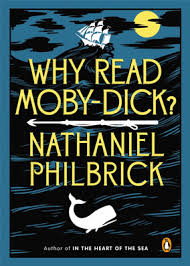
First Sighting: Nathaniel Philbrick’s 2011 slim book Why Read Moby-Dick?

Moby DickThe exhibitors at the NCTE conference were interested in putting books into the hands of teachers who would then put books into the hands of student readers. Once such vendor enthusiastically suggested the book based on its size; “See. you could carry this  book around the convention and hardly know it’s in your bag!”

He was right.  Philbrick’s 127 page argument as to why “this classic tale waits to be discovered anew” fit nicely in my convention bag and was perfect for reading during breaks between sessions.

The book is divided into 28 short chapters each devoted to topics such as setting, characters, or themes. Chapter titles include:

  • Nantucket
  • The View from the Masthead
  • A Mighty Messy Book
  • Queequeg
  • Pulling Dictatorship Out of a Hat

Philbrick is already familiar with the real life incident that was the inspiration for Herman Melville’s literary classic. His non-fiction book In the Heart of the Sea: The Tragedy of the Whaleship Essex in 2000 recounts the loss of the whaling ship Essex in the Pacific Ocean in 1820.  Heart of the Sea won the National Book Award for non-fiction that year, fleshing out the details of the whale attack on the boat, the fateful decision to avoid islands allegedly populated by cannibals, and the ironic turn to cannibalism that claimed the lives of several surviving crew members.

In Why Read Moby Dick?, Philbrick turns to the literary contributions Melville gave American literature, particularly in the creation of Captain Ahab, who in a pre-appearance had been rumored by other sea captains to have “been in colleges as well as ‘mong the cannibals.” In one chapter, “The Anatomy of a Demagogue”, Philbrick analyzes Ahab’s rhetorical craftiness in convincing the crew to hunt and kill the white whale. In discussing first mate Starbuck’s stunned realization that the Pequod is not out on a commercial venture, but rather a mission to settle the score of Ahab’s lost limb, Philbrick engages in a cross-culture reference that is both humorous and insightful:

Starbuck responds by asking what Ahab’s vengence will get ‘in our Nantucket market?’ It’s then, to borrow from the film This is Spinal Tap, that Ahab dials his charisma to eleven. ‘But come closer, Starbuck,’ he says, ‘thou requirest a little lower layer?’ It’s not about the money, he explains; this is personal. Thumping his chest he cries out. ‘My vengeance will fetch a great premium here!’ “(40)

Philbrick also aligns the story as a metaphor for the political turmoil of the United States. In discussing the chapter where Stubbs, the second mate, raises a shiver of sharks by cutting into a whale for a steak, Philbrick writes,

“The job of government, of civilization, is to keep the shark at bay….Here lies the source of the Founding Fathers’ ultimately unforgivable ommission. They refused to contain the great, ravaging shark of slavery, and more than two generations later, their grandchildren and great-grandchildren were about to suffer the consequences.” (78)

Philbrick moves between cultures, between ideologies, between philosophies, and theories in order to encourage more people to actually read Melville’s great American novel. A encouragement that may be necessary, because soon after I received the book, I had whale sighting #2.

Whale sighting #2:  A statement during a key note address at the Conference for English Leadership (CEL):

“We all know the opening line of Moby Dick, but how many of us have actually read the book?” posed speaker Donalyn Miller to the crowd of English teachers. There was a murmur of agreement, and more than a few guilty looks. Miller was discussing her passion and the topic of her two books: how to get students to read for school and independently.

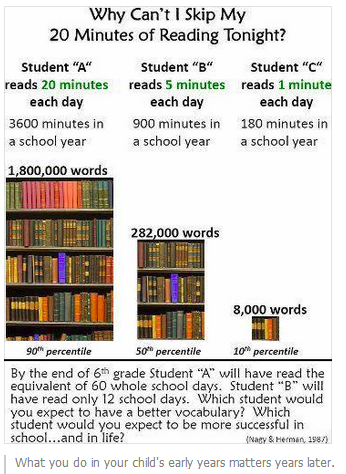
20-minMost notably, Miller is known as the author of The Book Whisperer and the recently released Reading in the Wild. Her keynote address was to encourage students to become the independent readers that could-on their own- pick up a tome like Moby Dick. She discussed the characteristics of “wild readers” and pushed teachers to engage students in examining their reading lives. She advocated for literacy rich environments for students to develop the habits to make them life-long readers. Miller’s assertion that preparing students to read independently is the best guarantor of standardized test success was supported with the graphic she presented. (see left: Nagy & Herman study).

Her point about Moby Dick was that most people know the first line, “Call me Ishmael,” but only those who live literate lives know why the book is so critical to understanding American literature. Students who have not developed the reading endurance necessary for the book may be turned off by both the intimidating size and the 19th Century styled language of the text. Considering that most high schools shy away from teaching Moby Dick to anyone but their best students means that the novel will most likely be an independent choice book for a student who develops into a life-long reader. Miller wants them to be prepared so they can will have the pleasure of sitting back in a comfy chair, perhaps with a cup of coffee, to read.

Whale sighting #3: Coffee at Starbucks.
starbucks

Named for the First Mate of the “Pequod”

Speaking of coffee, I am not sure why I never realized this before, but this coffee company is named for the first mate of the Pequod, Starbuck. I Googled this fact while waiting in the long line of English teachers eager to fuel up before attending the day of sessions at NCTE. According to the company’s website, “The name, inspired by Moby Dick, evoked the romance of the high seas and the seafaring tradition of the early coffee traders.” How did I not put this together?

Whale sightings, continued…….

Once I returned home from NCTE and CEL, the white whale sightings did not stop. A blog post on To Make a Prairie by Edblog award nominee Vicky Vinton summarized a session she had attended at NCTE called “Reading the Visual and Visualizing the Reading” chaired by Tom Newkirk and presented by Louise Wrobleski, Tomasen Carey, and Terry Mohera. Vinton explains the ideas based their mentor text, Moby-Dick in Pictures by the self-taught artist Matt Kish were “too inspiring not to spread around.” Their presentation highlighted the amazing results in student work when students chose one quote from each chapter of the The Scarlet Letter and create an image for it. Vinton notes that, “Mohera was surprised by the depth of the students’ thinking and how, once she’d gotten them started, they took full ownership of the book, the assignments and the whole process.”  The richness of their illustrations shows how literature can inspire new creations, just as Kish’s illustrations were inspired by Melville.

As if on cue, as in the final pages of Melville’s drama, the white whale surfaced dramatically again this morning when I came across another artist who is under Melville’s spell. While perusing the December 16th issue of The New Yorker, there was Mick Stevens’s cartoon of the whale himself (p56), a cross expression behind his spectacles, with his front fins holding a copy of Moby Dick. The caption underneath read, “Oh, C’mon, I wasn’t that terrible!”

Coincidence? I think not. Melville’s white whale is everywhere, but to appreciate him? You have to read the book.

No sooner are essays on Mary Shelley’s Frankenstein handed in, then the copies of Paradise Lost are handed out to the Advanced Placement English Literature Students. Yes, there are over 10,000 lines of blank verse in the poem, but don’t shudder for them…they will be fine. This epic poem is a trip to the “dark side” like no other in literature. All it takes is a reading of Book One; a reading that says “Welcome to Hell”!

The connection is obvious. In her novel, Shelley has Frankenstein’s Monster explain how he gained his knowledge, not with the help of his “father”, but instead by reading several books while he hid from humanity. One of the books in his possession was the epic poem Paradise Lost. When the Monster finally confronts his creator, Victor Frankenstein, on a mountain glacier on Mount Montanvert, the Monster dramatically intones:

“I ought to be thy Adam, but I am rather the fallen angel, whom thou drivest from joy for no misdeed.”

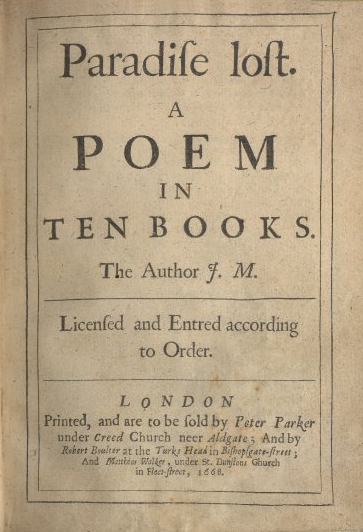
Originally published as 10 books, Milton expanded the epic poem to 12 books in later printings.

Originally published as 10 books, Milton expanded the epic poem to 12 books in later printings.

The “fallen angel” the Monster references is a hero/anti-hero of Paradise Lost: Satan, aka Lucifer, aka the  “infernal serpent”, aka the ‘Arch-fiend’ (and a myriad of other Miltonic epithets).

Students in previous classes have always found Satan the most memorable character in this epic poem since he is given the most memorable lines. They have been particularly intrigued that John Milton’s purpose in writing the poem, “to justify the ways of God to man,” is soon drowned out by the creation of Pandemonium (Hell’s Seat).  From the moment in Book One of Paradise Lost when Satan frees himself from the adamantine chains that bind him to a burning lake, students are taken with his attitude and his defiance as read in his great challenge:

Here at least
we shall be free; the Almighty hath not built
Here for his envy, will not drive us hence:
Here we may reign secure, and in my choice
to reign is worth ambition though in Hell:
Better to reign in Hell, than serve in Heaven. (PL 1 258-263)

No matter that in Book Six’s battle scenes in heaven are an exercise in futility, known as  the “great pie fight in the sky”, students root for the former archangel. They understand the sentiment in his statement,

‘The mind is its own place, and in itself can make a heaven of hell, a hell of heaven…” (PL 211-214).

Paradise Lost was only one of Milton’s great contributions to literature. He was not only a brilliant poet, but he was also a powerful statesman and a Puritan. He became associated with the Puritan partisanship in Parliament, which was credited with banning Christmas in England in 1644. This would seem to be a contradiction since he was already known for the beautiful Christmas Ode, “On the Morning of Christs Nativity Compos’d 1629”. Perhaps it was the general Puritan aversion to Christmas carols that could be blamed for such a heinous act!.

His political career experienced the extreme highs of an appointment as Secretary for Foreign Tongues (1648) and his association with Oliver Cromwell in the execution of Charles I (1649). In contrast there were the lows of an imposed exile upon the return of Charles II and the arrival of the Restoration in 1660. One of the reasons he was not executed for his implicit participation in Charles I’s regicide was that he was struck blind in 1654, and there were many who argued that this blindness was punishment enough. Milton was used to pain and suffering as the deaths of his first and second wives and several children were tragic interludes throughout his life.

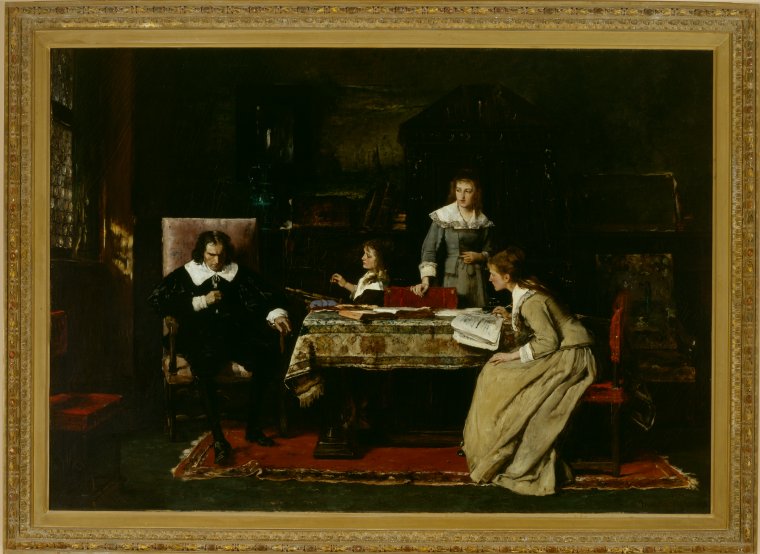
Like another blind poet, Homer, Milton achieved greatness with an “inner sight”. Critics generally agree that his best poetry came after he became blind and dictated all the lines of verse to his remaining daughters. A painting by Mihály Munkácsy (1877) hangs in the New York Public Library (NYPL) and depicts a scene of a head-bowed Milton reciting to one daughter who is scribing lines into a book.

Milton & daughtersThe picture is an apt illustration for his opening thesis in Paradise Lost:

What in me is dark
Illumine, what is low raise and support;
That to the height of this great argument
I may assert eternal Providence,
And justify the ways of God to men. (PL I:18-22)

In 2008, the NYPL held an exhibition, “John Milton at 400: ‘A Life Beyond Life'” which featured illustrated etchings by Gustave Doré for Paradise Lost. One illustration was of Satan on his flight to the Garden of Eden. As he travels, Satan pauses to tell the Sun how conflicted he is over his fallen state:

O Sun, to tell thee how I hate thy beams
That bring to my remembrance from what state
I fell, how glorious once above thy Spheare;
Till Pride and worse Ambition threw me down
Warring in Heav’n against Heav’ns matchless King:
Ah wherefore! he deservd no such return
From me, whom he created what I was
In that bright eminence, and with his good
Upbraided none; nor was his service hard. (PL IV:37-41)

Speaking these lines is a tragic Satan, fully aware that he has brought himself to ruin, as told by a poet, who had also come to political ruin. The reader can sympathize with such a character, and isn’t that the role of great literature? To draw on the reader’s empathy?

By the end of the poem, however, Milton restores the balance of sympathy towards Adam and Eve. They walk bravely, hand-in-hand, out of the Garden, into the sunset, ready to begin “his-story”.  In contrast, the character of Satan is reduced to a hollow hero, receiving accolades from a hissing mob of demi-devils. He is cursed, and like the Monster in Frankenstein, he is unreconciled with his creator.

So happy Birthday, John Milton, (December 9th), but let us not forget, that while your character Satan may dwell in evil, it was you who helped to cancel Christmas!

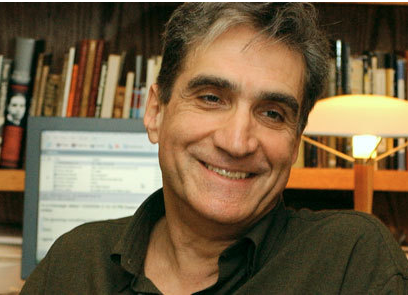
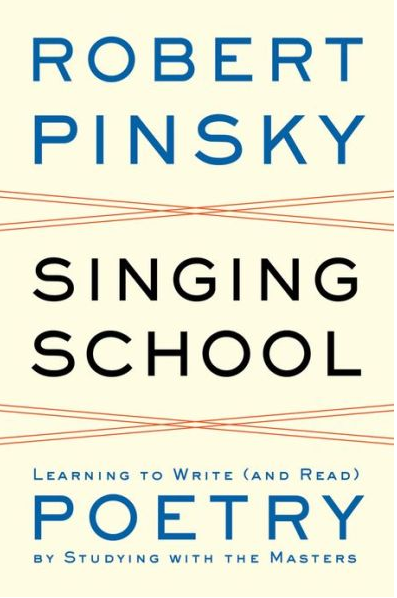
Screen Shot 2013-12-05 at 11.08.36 PMThe sonorous voice delivering the keynote address at the Conference on English Leadership (CEL) on Sunday, November 24, 2013, belonged to the poet Robert Pinsky. He was there to promote his latest book Singing School, which is promoted as, “A bold new approach to writing (and reading) poetry based on great poetry of the past.” This collection of 80 poems includes selections from  Sappho to Allen Ginsberg, Shakespeare to Emily Dickinson. In an interview on NPR,  Pinsky explained that the poems for the book were selected “because of the music of the language, and not from the meaning of the words.” In the interview he explained:

“Even just the cadence of pauses,” he explains. “I stop. I think. I wait. I wait a little longer. Then less. … Something like that generates the poem. And for me, if anything I do is any good, it’s carried by that kind of cadence or melody.”

To prove his point, Pinsky filled his address with reciting lines of poetry, once challenging the crowd of English teachers in attendance to identify the poet; “That was Robert Frost, your New England poet,” he gently chastised when no one responded correctly. (To give you a taste of the experience, you can hear Pinskey read Frost’s poem “Mowing” courtesy of Slate Magazine by clicking here.)

As we listened, I heard someone remark that Pinsky could make a parking ticket sound lyrical.

Screen Shot 2013-11-29 at 2.27.16 PM

Pinsky’s voice was not the only one reciting poems in his keynote. He turned to the presentation screen to show videos from the Favorite Poem Project website. This project  is “dedicated to celebrating, documenting and encouraging poetry’s role in Americans’ lives.”

Pinsky founded the project when he served as the 39th Poet Laureate of the United States, from 1997-2000. The Favorite Poem Project website details how,

“During the one-year open call for submissions, 18,000 Americans wrote to the project volunteering to share their favorite poems — Americans from ages 5 to 97, from every state, of diverse occupations, kinds of education and backgrounds.

Pinsky purposely selected a video to show as a tribute to the City of Boston, host of the CEL. The selected video featured John Ulrich, a student from South Boston, MA, reading Gwendolyn Brooks’s  “We Real Cool”:

We Real Cool
by Gwendolyn Brooks

THE POOL PLAYERS.
SEVEN AT THE GOLDEN SHOVEL.

We real cool. We
Left school. We

Lurk late. We
Strike straight. We

Sing sin. We
Thin gin. We

Jazz June. We
Die soon.

Each video available on the Favorite Poem Project’s website begins with the reader’s reason for choosing the a particular poem. Ulrich provided a touching admission of how Brooks’s short poem reminds him about several childhood friends he lost to suicide. He read her 1950s tribute to the players in a pool hall in the South Side of Chicago with a heavy South Boston accent twice. The defiance on his face during the second reading is visible in the video.

I have taught this poem in my classes, and inevitably one of the more musical students, usually a drummer, will notice, “Hey, this is written in jazz!” The brevity of Brooks’s verse belies the amount of discussion the poem generates for students, particularly with the ending line, “We/ Die soon.”

Pinsky shared other videos: Nick and the Candlestick by Sylvia Plath read by Seph Rodney and Poem by Frank O’Hara read by Richard Samuel. The production quality of these videos garnered admiration from the crowd.

“Are you still taking entries for this project?” one teacher asked.
“We may be,” replied Pinsky.

His final comment sent a ripple that went through the audience as people considered, “What poem could I read for the project?”

Continue Reading…

“A bad dress rehearsal foretells a great performance.”

red curtain

This theatrical superstition is a great comfort to those who botch lines, drop lines, break props, or miss entrance cues before performing in front of an audience. Rehearsals are for practice, to fix what could go wrong so that the performance before a critical audience is perfect.

In contrast, there are no “rehearsals” in the classroom, yet the language of teacher evaluation standards repeatedly uses the word “perform” and “performance”.  There are teacher performance standards, and there are student performance measurements.

Perhaps the most authentic way to describe what happens in any classroom is that each lesson is a dress rehearsal. A teacher can plan the elements of a lesson, ( objective, resources/materials, directions, and assessment), and those scripted elements can look good on paper. A teacher can design a lesson for for a particular audience,  but what can happen in the classroom is a guess. Sometimes, a lesson plan fails; a teacher has a bad dress rehearsalEven if that lesson plan is repeated over the course of a day, there was a first audience of students that was engaged in that dress rehearsal of a lesson.

What teachers do is practice teaching, and practice is another word repeated in teacher evaluation. There are, however,  two meanings of the word practice, each depending on its syntactical use. When the word practice is used as a noun, as in the “practice of teaching”, then the word means:

  • the actual application or use of an idea, belief, or method as opposed to theories about such application or use.

When the word practice is used as a verb, it means:

  • to do something again and again in order to become better at it
  • to do (something) regularly or constantly as an ordinary part of your life

The language of teacher evaluation focuses on the word practice as a noun. There is limited use of the word practice as a verb except as an expectation. A teacher is expected to have practiced, or rehearsed, teaching strategies with a group of students. For this reason, teachers try to schedule a “no-fail” lesson plan for a formal observation, perhaps a lesson that has been practiced successfully in previous classes. This small advantage means that an evaluator will see a lesson with all the bells and whistles, a kind of performance.

But what about the “drop-in” evaluation? What kind of teaching practice will an evaluator see in the raw rehearsal environment of the classroom? What happens when a lesson goes horribly wrong, and an evaluator is in the room?

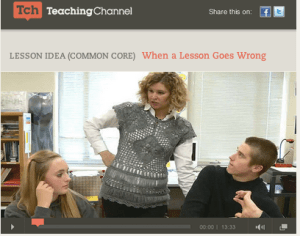
At a session offered by the Council of English Leadership at the National Council of Teachers of English Conference held last month in Boston, Massachusetts, nationally recognized teacher of the year Sarah Brown Wessling openly admitted to lesson failure. Wessling, a English/Language Arts teacher in Johnston, Iowa, was being filmed by The Teaching Channel when the lesson she designed went wrong, a true bad dress rehearsal taking place in real time in front of the cameras.

“I knew they (Teaching Channel) would want this footage,” she admitted laughing to crowded room of teachers, “Oh, I knew they would want this failure!”

The videos that resulted from her failure are some of the most popular on The Teaching Channel website. There are uncut versions plus the final production video (16 mins) that records how she quickly reconfigures the lesson for a different class. The transcript from the video is included on the website. 

Wessling’s voice-over begins:

For a teacher, some days you win, some days you lose.  My third hour tenth-grade English class came completely unhinged, and I had five minutes in which to repurpose it for fourth hour.

She readily admits that even the most veteran teachers experience problems:

No matter how accomplished you are or how effective you are as a teacher, I think these days are going to happen, so when they do, you have to make adjustments.

In her narration, she noted that, “By the time we get to this point, I’ve been in front of the class almost the whole class period, and that was not my intention.”

The video shows her trying to re-engage students in her planned activity. She considers:

Then there was this moment where I realized that I had completely misfired because one of my students did start to read when I asked them to, and she read the first paragraph, and she raised her hand and she said, “I don’t know what any of these words mean.”

Wessling’s final analysis of the lesson’s failure is her admission that:

I opted to try to meet the standards, make sure that the common assessment that I share with the rest of my department meets the criteria of what we had talked about earlier in this year.  In thinking about the adults, I compromised the needs of the kids.

The power of this video is that while this nationally recognized teacher’s bad dress rehearsal informed her practice, it is her training in classrooms that allowed her to redesign the lesson on the fly. Wessling’s second attempt, five minutes after the first class left, is much smoother, as she admits:

We have to be careful with our expectations and realize that we can still teach to these heightened expectations, but it’s going to have to come at a pace that makes sense to the kids who are in front of us.

So how would an evaluator who dropped in on Wessling’s first attempt rate her as a teacher? Would there be a consideration of this first lesson as a “dress rehearsal”?More important, what is the possibility that an evaluator could have stayed to watch the redesign of the lesson to see how her repeated and authentic training in the classroom, her practice, helped her with her teaching practice, her application of teaching methods? Wessling’s first attempt would not meet the criteria in the higher ratings (proficient, exemplary) of many teacher evaluation programs, but her training allowed her to address the needs of the students in subsequent efforts.

The video captures Wessling and her students a rehearsal of learning, which is what happens in every classroom everyday, to nationally ranked teachers, to veterans, and  to novices. Teachers and their students are always rehearsing. Evaluators must consider that the language of teacher evaluation should not be misconstrued. 

There is no performance in the classroom, and even a bad dress rehearsal can still be a great lesson.

Screen Shot 2013-11-29 at 12.50.41 PMThe National Council of Teachers of English (NCTE) and the Council on English Leadership (CEL) met for a convention last week (11/21-26/13) at the Hynes Convention Center in Boston, Massachusetts. Thousands of English teachers and educators (happily) put aside their piles of essays and their red pens in order to attend to participate in a nationwide conversation on teaching English/Language Arts at all grade levels. This annual conference runs the weekend before the Thanksgiving holiday, and this year there were many reasons to be thankful that such a great opportunity exists. Here are our specific thanks to all of those who made this conference amazing.

Thanks to our Regional School District #6 in Connecticut for allowing us to attend:

Our first and most important thanks is to the administration, Board of Education, and staff from Regional School District #6 that allowed five members of the English Department at Wamogo Middle/High School to attend the conference and select from over 700 sessions offered from Thursday night-Sunday afternoon.  District support for such great professional development is truly appreciated!

Thanks to the program chairs who selected our proposals:

Members of Wamogo Middle/High School English/Language Arts department submitted a variety of proposals last year to demonstrate how we use technology in our classrooms. We are grateful that four of our proposals were chosen to share as presentations for other educators. The explanations of our presentations with links to these presentations are included below:

The Blog’s the Thing! (NCTE) roundtable discussion

This presentation demonstrated the use of the blog platform for students to engage in thoughtful discussion on characters and themes from Hamlet by having students “stop the action” of the play to offer advice to characters during different scenes.

Reinventing the Writing Workshop with Digital Literacy to Improve Student Engagement (NCTE)

Technology has reinvented the Writing Workshop in meeting the needs of 21st Century learners with the addition of digital literacies. This presentation features open source software platforms appropriate to the different tasks, purposes and audiences for writing instruction along with examples of student work and grading criteria.

How We Mooo-ved Our District from Cows to Computer (CEL)

This presentation illustrated how professional development in our district was organized on the ED Camp model to allow any teacher who would like to share their expertise or simply discuss a problem with fellow staff or faculty members.These technology initiatives have allowed members of the English Department to help teachers assess, organize, deliver context materials and related readings (fiction and non-fiction) that improve students’ digital literacy as well as foster independence in each student’s growth in reading.

Digital Writing with Collaboration (CEL)

This presentation showed how preparing students to write for the real world  (21st Century skills) must include the collaborative experience, from the initial creation to the final product. The use of digital platforms allows students to be college and career ready through the production and distribution of collaborative writing.

Thanks to the many teachers and educators who presented:

We are also thankful that so many other classroom teachers and educators from all over the USA shared their best classrooms practices. Our collective regret is that we could not attend every session that appealed to us; the jam-packed schedule defied our best attempts at strategic selection. We agreed, however, that quality of the presentations we did get to attend was amazing and relevant to what we do every day. The conference reinforced the importance of teacher-to-teacher professional development.

Thanks to the book publishers who made books available for classroom libraries:

The NCTE Convention offers book publishers opportunity to put advanced reader copies of fiction and non-fiction into the hands of teachers at every grade level. While publishers hope to catch the attention of teachers who will recommend the book to students, teachers look for books to add to their classroom library collection. Many publishers also make books available at a reduced cost  for the same reason. For example, I picked up several copies of books in the “After the Dust Settled” series (apocalyptic young adult literature) by Jonathan Mary-Todd for $2/copy, a purchase made necessary because these books keep disappearing off our classroom library shelves.

Screen Shot 2013-11-29 at 12.51.29 PM

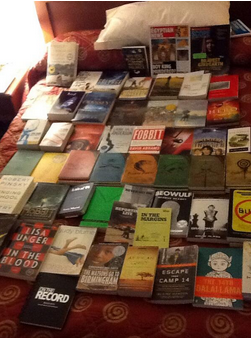
Our “haul” from the NCTE Convention from book publishers and authors…headed for our classroom libraries.


Thanks to the authors who gave away signed copies of their books:

The tote bags distributed free to all registrants bore popular author Nicholas Spark’s imprimatur, a visual testament to the celebrity draw of authors at this convention. Authors are the rock stars at this convention: the children’s book authors rock, the young adult authors rock, and the educator trade book authors rock. Attendees stood in lines snaking around booths on the convention floor waiting to meet authors and have books signed. In the past, my request to an author is to have the book signed with the phrase “READ ME!” on the inside cover. I had the same done this year, so when a student asks what to read, I will point that the author has already made a suggestion to read the book.

There were also a number of authors representing a variety of genres who served as keynote speakers including: Neal ShustermanTeri Lesesne, Laurie Halse AndersonKelly Gallagher, Walter Dean MyersIshmael Beah, and Robert Pinsky. 

We are so thankful to have the opportunity to personally meet and mingle with the rock stars of the convention!

Thanks for the Tweeters:

Finally, the fingers of dedicated Tweeters attending the convention kept us abreast of all the events at the conference. There was a steady stream of information from sessions we could not attend, summaries of keynotes addresses, and updates as to upcoming book signings. The hashtags #NCTE13 and #CEL13 were invaluable sources for notes and quotes during the convention and for well after we left Boston.  For example, some Friday session tweets were archived onto the Storify platform for later use.

Next year, the NCTE Convention is scheduled for Washington, D.C., which gives me one more reason to be thankful…the convention is within driving distance!

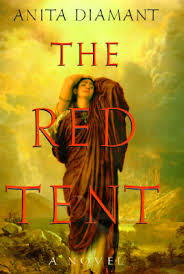
red tentMany of my students do not know Old Testament stories other than “Noah’s Ark” and “Adam and Eve”. There is the occasional biblical teen scholar who may be able to recount the origin a pillar of salt (Lot’s wife) or maybe there will be a student who saw the musical Joseph and the Amazing Technicolor Dreamcoat and make a patriarchal connection. For the most part, students are not up to date on Methuselah or even which of the brothers killed the other (Cain or Abel). They are far more likely to ask, “So, where did all the other people come from if Eve was the only woman?”

Fortunately, The Red Tent, a novel by Anita Diamant (1997) does address other women of the Old Testament. Her fictionalized version of the story of Dinah, daughter of Leah and Jacob, is based on in a brief but particularly violent and gruesome incident in the Book of Genesis. In the King James Version of the Bible, Dinah is known as the daughter who is “defiled” by Shechem, a prince, who then wanted to marry her (Genesis 34: 1-3):

1 And Dinah the daughter of Leah, which she bare unto Jacob, went out to see the daughters of the land.

2 And when Shechem the son of Hamor the Hivite, prince of the country, saw her, he took her, and lay with her, and defiled her.

3 And his soul clave unto Dinah the daughter of Jacob, and he loved the damsel, and spake kindly unto the damsel.

Dinah’s brothers, sought vengeance for the attack on their sister. They tricked Shechem and his family, claiming to come in peace, and exacted their punishment by killing the royal family and all males in the city:

26 And they slew Hamor and Shechem his son with the edge of the sword, and took Dinah out of Shechem’s house, and went out.

27 The sons of Jacob came upon the slain, and spoiled the city, because they had defiled their sister.

This horrific incident is explained very differently in the Diamant’s fictional retelling, as are many other familial incidents, from Dinah’s point of view. The rivalry between Rachel and Leah, the rivalry between Jacob and Esau, and the rivalry between the sons of Joseph, Dinah’s younger brother, are rich with detail and dialogue. The sparse accounts given in the Old Testament are fleshed out in this compelling narrative, with the women center stage, a striking contrast to the male-dominated biblical text.

Several of my female students in Advanced Placement English Literature choose to read The Red Tent as an independent choice, and their response is not unlike other female student responses chronicled in the article “The Wandering Womb at Home in The Red Tent: An Adolescent Bildungsroman in a Different Voice” by Holly Blackford. In this review, Blackford writes about the female students’ enthusiasm for the book:

So emotional about the story of The Red Tent that they can barely speak, and indeed continually interrupt one another, they cite the way in which the contemporary novel revises the patriarchal story of Jacob; represents the concerns of girls in terms of emotion and relationship; and details the entire lifecycle of girl-to-woman through engaging first-person narration:
  Carol: There are certain books I just can’t put down.
      Laticia: Seriously, I’ll read until like three in the morning . . .
      Interviewer: Like what?
      Carol: Like The Red Tent!

Blackford also points out that this revision of an ancient text  comes at a time when girls are, “hungering for an exploration of female-centered myths, deities, worlds, and power-structures.” Her claim in The Alan Review (March, 2005) is that books like The Red Tent:

“… appeal to adolescent women and grow their appreciation for contemporary women’s literature that speaks “in a different voice” (Gilligan) from the more masculine canon they expect in their school curriculum.”

There are about 20 copies of The Red Tent on the class independent book cart, all purchased at book sales for $1.00 each. Picador USA publishers produced an oversized text, about 2″ taller than a standard trade paperback; on the AP English Lit book cart’s top shelf, these copies stick out. The cover art, designed and illustrated by Honi Werner, is also eye-catching. Students always pick up the book with interest.

“What’s this about?” one asks.
“Read the back,” I reply.
“‘...told in Dinah’s voice, this novel reveals the traditions and turmoil of ancient womanhood-the world of the red tent,’ (*pause suspiciously*)…is this a ‘chick book’?”
“Yes,” I chuckle, “this is most definitely a chick book….probably the ultimate chick book, of ALL chick books.”

How else to describe a story that centers on celebrating the onset of womanhood?

After they read any independent book, the AP students are required to write an essay. The essay prompt this quarter for any book they choose is taken from the AP released exam list of questions:

In retrospect, the reader often discovers that the first chapter of a novel or the opening scene of a drama introduces some of the major themes of the work. Write an essay about the opening of the first chapter of a novel in which you explain how it functions in this way. *hint: the lens you use is the lens from the conclusion of the novel*

Students who choose to read Diamant’s The Red Tent will certainly want to return to the beginning to explain how Dinah’s life story begins and ends with the women who loved and supported her.  They will also have had a “crash course” on the Book of Genesis, which is the source of many other literary allusions. While The Red Tent is not great literature, this novel sets many female students looking for equally compelling contemporary novels about women, with or without that “chick book” label.