Go Away. I’m Reading.

December 30, 2012 — 2 Comments

Perhaps you received a book this past holiday, or perhaps you had some time to catch up on book you have been waiting to read. You might need one of these signs:
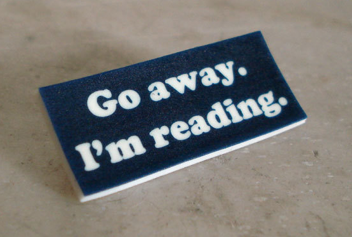
Why might you need a “Go Away. I’m Reading” sign? Because reading is often interrupted by people. The sign could stop those interruptions by others that inevitably occur at a critical moment in a book or article. You would use the sign to ward off those who are blind to the obvious and ask, “What are you doing?” You might even use the sign to stymie those who intrude to ask, “What are you reading?” But you would most certainly wave the sign to stop those who interrupt to ask, “Is what you’re doing so important?”

Reading is a very quiet, sedentary activity, an activity that requires concentration. You cannot multi-task reading. An interruption in that concentration disrupts comprehension, and there are studies that look to measure the effects of interruptions on comprehension. There was the 2002 study from the University of North Carolina at Chapel Hill titled, “The Effect of Interruption on Working Memory During Discourse Processing ” by Kerry Ledoux and Peter C. Gordon.

Ledoux and Gordon conducted separate experiments using the same narrative and expository passages, but they varied who read the narrative and who read the narrative and expository passages. They gathered evidence to prove that comprehension of similar (narrative) passages was more disrupted by interruption in the first experiment, and than with dissimilar (narrative/expository) passages  in the second experiment:

This supports the notion that the maintenance of text information in working memory is affected by interruption. Second, we found that the initial reading of the second passage in a pair is disrupted more if the first passage in the pair is of a similar type than if it is of a dissimilar type.

Their two experiments looked directly at the systems of language processing necessary for comprehension:

 Our results support the view of the role of working memory in language processing as a system whose function comprises the creation and maintenance of an elaborate, semantic representation of a text and the efficient retrieval of this representation from long-term memory.

They determined that interruptions had an adverse impact on the role of working memory, but could not determine the magnitude of these interruptions because of differences in texts.

Another more recent study concluded that visual clues are helpful to resume reading after an interruption. An abstract from the 2012 study by JE Cane, F Couchard, and UW Weger from the University of Kent, UK titled, “The Time-Course of Recovery from Interruption During Reading: Eye Movement Evidence for the Role of Interruption Lag and Spatial Memory” centered on the impotence of visual cues. Locating where one stopped reading is important to recovering comprehension:

Two experiments examined how interruptions impact reading and how interruption lags and the reader’s spatial memory affect the recovery from such interruptions. Participants read paragraphs of text and were interrupted unpredictably by a spoken news story while their eye movements were monitored. Time made available for consolidation prior to responding to the interruption did not aid reading resumption. However, providing readers with a visual cue that indicated the interruption location did aid task resumption substantially.

Predictably, cuing the place where the interruption took place is helpful to comprehension, but there is also considerably conversation about the amount of time it takes a reader to return to a full involvement with a text. Consider that research in the business communities has determined that many interruptions are costly and hurt business productivity. A 2005 NYTimes Magazine article by Clive Thompson titled Meet the Life Hackers  described a study by Gloria Mark, a professor at the University of California at Irvine. Mark looked at interruptions in the average 21st Century office worker. She developed a series of timed tasks that mimic work in the business day. Her research was organized so that,

 Each employee spent only 11 minutes on any given project before being interrupted and whisked off to do something else. What’s more, each 11-minute project was itself fragmented into even shorter three-minute tasks, like answering e-mail messages, reading a Web page or working on a spreadsheet. And each time a worker was distracted from a task, it would take, on average, 25 minutes to return to that task.

Although 25 minutes may not be the same amount of time required for the average reader to return to a text, Mark’s research does demonstrate the serious loss of time interruptions cause to work productivity. If one of these activities involved reading, then reading productivity was adversely effected.

One other interesting view on uninterrupted reading has been offered by the Telecommunications Information Networking Architecture Consortium (TINAC). In 1988, they published a “manifesto” on writing hypertext, those texts that feature embedded links for the reader. What is surprising is how they began the “manifesto” by focusing not on the writing of such texts starting from the reading of such texts.  Their first statement:

I) No interruptions.

Reading should be a seamless and uninterrupted experience. Its choices proceed from the expression of possibilities as a narrative medium and depend upon the complicity of the reader in the creation of a narrative. Reading is design enacted.

Reading is “design enacted”, meaning that even the distractions in hypertexts are meant to be done in a sitting without distractions, without interruption.

Ultimately, conveying the importance of uninterrupted reading may be necessary. But if the little sign, “Go Away. I’m Reading.” doesn’t work, you might want to try other strategies. A quick survey on the Internet reveals available like-minded products.
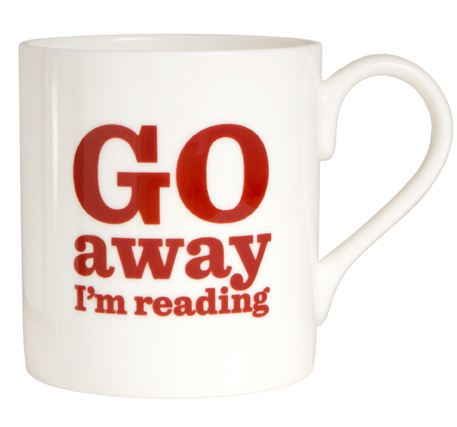

There are plans for free “Go Away. I’m Reading” Book Covers in several different styles. There are also “Go Away. I’m Reading” coffee mugs handy for uninterrupted newspaper reading in the morning.

However, the ultimate solution may still be the most simple: find a quiet spot in the house, and lock the door.

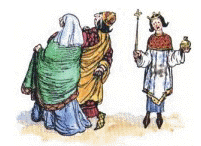
I had been looking over the compendium of lists touting the top news events of 2012, when a line spoken by the character Death in Terry Prachett’s novel The Hogfather came to mind:,

Humans need fantasy to *be* human.

Prachett often reflects on the role of fiction in his fantasy novels, the Diskworld series, which are set in a world shaped like a disk that floats on the backs of four elephants standing on top of a giant turtle that slowly swims through space. While Prachett’s stories are particularly fantastic, all stories require some willing suspension of disbelief: a talking Cat in the Hat, a journey to the century of the earth, a tea party on the ceiling, a raft down the Mississippi, a beanstalk.

Stories are what prepare us for the complexities of life and death. We tell stories, we create myths, we perpetuate lies. Stories give us a language to express our triumphs and our failures, to respond to our morality and our immorality, to explore our future and remember our past.

Prachett’s 21th Diskworld novel is a Christmas tale of sorts which was developed as a film by the British media Sky One and shown in two installments in 2006. The title character The Hogfather, the diskworld’s equivalent of Santa Claus, has become the target of a assassin and goes missing. In a Gothic turn, the character Death opts to fill the role of the Hogfather by donning a fur-trimmed red suit, practicing his “ho, ho, hos”, and distributing inappropriate toys. Death’s granddaughter, Susan Sto Helit, joins him and upset the forces of the evil Auditors by rescuing the Hogfather just before the world goes dark.

As the rescued Hogfather flys off in his hog-drawn sleigh, Death and Susan are reunited and reconciled. She questions why their efforts to maintain the elaborate fantasies that surround the Hogfather are even necessary:

Death: Humans need fantasy to *be* human. To be the place where the falling angel meets the rising ape.
Susan: With tooth fairies? Hogfathers?
Death: Yes. As practice, you have to start out learning to believe the little lies.
Susan: So we can believe the big ones?
Death: Yes. Justice, mercy, duty. That sort of thing.
Susan: They’re not the same at all.
Death: You think so? Then take the universe and grind it down to the finest powder, and sieve it through the finest sieve, and then show me one atom of justice, one molecule of mercy. And yet, you try to act as if there is some ideal order in the world. As if there is some, some rightness in the universe, by which it may be judged.
Susan: But people have got to believe that, or what’s the point?
Death: You need to believe in things that aren’t true. How else can they become?


Ultimately stories allow us to imagine with an author how those “big lies” of justice, mercy, duty play out in different ways, in different settings, with different characters. For our willing suspension of disbelief, fiction gives us practice in imagining other qualities of truth, faithfulness, and love so that we may be better prepared to recognize and develop these qualities in our real world. Stories prepare us for the times when our real world turns unimaginably cruel or fraught with despair.

At the end of every December, when different media organizations publish the top stories of the year, they rank news stories in order of importance. These are events that over the course of 365 days reflect virtue and triumph along with cruelty and despair. There are always stories of senseless tragedy countered with acts of great compassion, and this year has been no different. There have been cataclysmic disasters, some by nature and some man made, and again, this year has been no different. For each of these very real stories, there are fiction counterparts that can help us to recognize what Prachett suggests are part of “some rightness in the universe.” Moreover, from these real events will come new stories, new fictions, that will be written because writing and telling stories is what makes us human. The news stories of 2012 are a record of what has happened, but the stories we create make us human and help us to believe in the possibility of a New Year where qualities of justice, mercy and duty can “become” real, not fantasy.

Here is a “re-post” from last year, “At this festive time of the year…”

There has been some chatter on blogs that I follow that  centers on discussions of the many film versions of Charles Dickens’s novel A Christmas Carol. The networks always feature these films during the holidays. Additionally,  Dickens’s  200th birthday will be celebrated in  2012. A website dedicated to the celebrations marking his birthday is at http://www.dickens2012.org/

Dickens’s association with Christmas is best known through his characterization of Scrooge, a cultural icon whose name conjures visions of a cold-hearted, seemingly unredeemable money-lender.

For many film critics, the best portrayal of Dickens’s Ebenezer Scrooge was by Alistair Sims in the 1951 version Scrooge (Re-released as A Christmas Carol) filmed at Nettlefold Studios, Walton-on-Thames, Surrey, England.  Sims, a Scot by birth, was an elocution and drama lecturer at the University of Edinburgh before leaving for the stage as a character actor; his low voice was often described as critics as particularly “ghoulish”.

So why is his portrayal the best?

Watch Sims’s performance in black and white (heavens, not the colorized version!) and see how his Scrooge takes thrift to a new low in a pub where he huddles over a bowl of thin soup:

Ebenezer: Waiter! More bread.
Waiter: Ha’penny extra, sir.
Ebenezer: [pauses] No more bread.

Watch a terrified Sims, wedged protectively into a tufted high-backed chair, challenge the ghost of Jacob Marley who has come to chide Scrooge’s avarice:

Ebenezer: You see that toothpick?
Jacob Marley: I do.
Ebenezer: But you’re not looking at it!
Jacob Marley: Yet I see it, notwithstanding.
Ebenezer: Well, then, I’ll just swallow this and be tortured by a legion of hobgoblins, all of my own creation! It’s all HUMBUG, I tell you, HUMBUG!

Watch Sims, barefoot, shivering, and exceedingly rumpled, stumble out of bed to reluctantly confront the gentle Spirit of Christmas Past:
Ebenezer: Are you the spirit whose coming was foretold to me?
Spirit of Christmas Past: I am.
Ebenezer: Who and what are you?
Spirit of Christmas Past: I am the Ghost of Christmas Past.
Ebenezer: Long past?
Spirit of Christmas Past: No, your past.
Watch Sims, stunned by the largess celebrating the arrival of the Spirit of Christmas Present, rub his eyes in disbelief:
Spirit of Christmas Present: So! Is your heart still unmoved towards us, then?
Ebenezer: I’m too old and beyond hope! Go and redeem some younger, more promising creature, and leave me to keep Christmas in my own way!

And watch the following two minutes of the most touching moments in the film. Here, a redeemed Scrooge travels to his nephew Fred’s home on a snowy Christmas night. He is greeted by a wide-eyed maid who takes his hat, scarf and coat. Without saying a word, Sims shifts from his characterization of a brusque Scrooge to a Scrooge who is hesitant, filled with trepidation. The ballad of Barbra Allen plays in the background when Sims turns to the maid and pauses for several seconds; she nods to encourage him. A sheepish smile passes his lips as he reluctantly turns and opens the double doors to Fred’s parlour. The party inside immediately stops, all eyes turn to Sims, who with a new found grace and humility charms all with the following apology:

Dickens understood Christmas, and  he brilliantly committed to paper the emotional tug the holiday has on those who celebrate. In The Pickwick Papers, he writes “And numerous indeed are the hearts to which Christmas brings a brief season of happiness and enjoyment. How many families, whose members have been dispersed and scattered far and wide, in the restless struggles of life, are then reunited, and meet once again in that happy state of companionship and mutual goodwill, which is a source of such pure and unalloyed delight; and one so incompatible with the cares and sorrows of the world, that the religious belief of the most civilized nations, and the rude traditions of the roughest savages, alike number it among the first joys of a future condition of existence, provided for the blessed and happy! How many old recollections, and how many dormant sympathies, does Christmas time awaken!”

Merry Christmas, Charles Dickens. Merry Christmas, Alistair Sims. Thank you for A Christmas Carol and for Scrooge. My holiday favorite, hands down.

How to create indelible memories? Read aloud to children. Too much attention is focused on what to give to make a holiday meaningful, when this inexpensive and simple choice is available to anyone who can read: poem, picture book, story. I clearly remember my father reading “King John’s Christmas”  during the holidays on several occasions. So powerful is this memory, that I can hear his voice as I re-read the poem myself:

King John was not a good man —
He had his little ways.
And sometimes no one spoke to him
For days and days and days.

My father would always begin reading the poem by reciting the first four lines from memory. While his read alouds were not frequent, they were memorably dramatic. He had a gift for animating  words. Most of the stories he chose were something from his childhood. “King John’s Christmas” came from the collection Now We Are Six by the noted children’s author A.A.Milne, creator of Winnie the Pooh. King John was less than popular with his subjects, but he was hardly a villain:

And men who came across him,
When walking in the town,
Gave him a supercilious stare,
Or passed with noses in the air —
And bad King John stood dumbly there,
Blushing beneath his crown.

Screen Shot 2012-12-22 at 7.53.15 AM

Ernest Shepard’s illustration of King John, “blushing beneath his crown”

I remember how my father would stress the five syllables of “supercilious”; while we had never heard that word, his intonation told us that no one liked King John. He was a king so disliked that he was forced to send himself Christmas cards:

King John was not a good man,
And no good friends had he.
He stayed in every afternoon …
But no one came to tea.
And, round about December,
The cards upon his shelf
Which wished him lots of Christmas cheer,
And fortune in the coming year,
Were never from his near and dear,
But only from himself.

A.A. Milne was already an experienced writer before he created the children’s classic Winnie-the-Pooh. He had been an editor for Punch Magazine  and a playwright. He also had served in World War I from 1914-1919 as a signaling officer who saw his fair share of the frontlines. He was dismissed from the army after a fever, and during his recuperation he returned to playwriting. In 1920, his son Christopher Robin Milne was born, and Milne turned to writing for children. After some success with  poetry published in children’s poetry magazines, Milne sought out an illustrator from his days at Punch, Ernest Shepard. The collaboration produced When We Were Very Young and within the first eight weeks of publication, over 50,000 copies were sold here and in the UK.

Milne’s next effort featured short stories involving the childhood toys of Christopher Robin. The book was titled Winnie-the-Pooh, and recognizing how important Shepard’s illustrations were to the book, Milne offered him an unprecedented share in the royalties. The second book of poetry, Now We Are Six, was published in 1927, and “King John’s Christmas” is one of the 31 poems in that book. The illustrations again were Shepard’s.

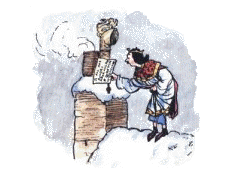
In stanza five of the poem, King John writes a lengthy Christmas wish list to Old Father Christmas, just before “He stole away upstairs and hung, A hopeful stocking out.”

Screen Shot 2012-12-22 at 7.52.46 AM

Shepard’s rendering of King John leaving his list, “..up the roof…
propped against the chimney stack”

King John’s list was full of things none of us would have requested, but my father would enthusiastically recite the list making each item seem so desirable:

“I want some crackers,
And I want some candy;
I think a box of chocolates
Would come in handy;
I don’t mind oranges,
I do like nuts!
And I SHOULD like a pocket-knife
That really cuts.
And, oh! Father Christmas, if you love me at all,
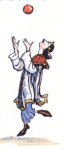
Bring me a big, red India-rubber ball!”

The desire for the “big, red India-rubber ball” was the clincher. Why a toy? Had King John never had this simple toy? Had all his Christmas lists been unanswered? Had Father Christmas never visited the king? Milne’s King John was characterized as “not a good man”, but would Father Christmas be so cruel as to withhold a gift at Christmas?

Sadly, yes. King John goes to his stocking on Christmas morning only to find an empty stocking. We imagined the already pathetic king holding a flat limp stocking as my father intoned:

King John said grimly: “As I feared,
Nothing again for me!”

My father would pause to let this discovery sink in. The poem was unimaginably sad to us, especially during the holiday, finding an empty stocking. Then he would read on as King John dismissed all the things on his list. He confesses he had not really wanted anything, all he wanted was the “big red, India-rubber ball”. Milne’s reference to the pocket knife was not the only “cut” delivered when King John comes to the conclusion he cannot be loved, even by the beneficent Father Christmas.

I haven’t got a pocket-knife —
Not one that cuts.
And, oh! if Father Christmas had loved me at all,
He would have brought a big, red India-rubber ball!”

Does Milne leave the reader with the memory of the pathetic king, abandoned by all at a magical time of the year? Of course not! King John “frowns” as he looks out his window at all the “happy bands of boys and girls all playing in the snow.” He stands alone, abandoned, and jealous of their joy, when suddenly, a small miracle occurs:

When through the window big and red
There hurtled by his royal head,
And bounced and fell upon the bed,
An India-rubber ball!

Screen Shot 2012-12-22 at 7.52.23 AM

“A big red, India-rubber ball!”

The final stanza is written in capital letters, as if shouted from the rooftops. My father would raise his voice as well in reading the poem’s conclusion:

AND OH, FATHER CHRISTMAS,
MY BLESSINGS ON YOU FALL
FOR BRINGING HIM
A BIG, RED
INDIA-RUBBER
BALL!

So, my thanks to the genius of A.A.Milne for writing the wonderful poem “King John’s Christmas” and to my father who read the poem and made such a powerful memories with all his read-alouds. MY BLESSINGS ON YOU FALL!

forbesFobes recently published a feature article/photo spread, 30 Educators under 30:The Millennials Overhauling Education And Leaving No Child (Or Teacher) Behind by Meghan Casserly, 12/7/2012. The lead in for the article read:

The 30 Gen-Yers on our list are innovators, advocates, thought-leaders and reformers. Through outreach initiatives and engineering they’re committed, like my mom, to giving kids everywhere the best chance at success. They’re committed to making the lives of teachers like her just a little bit easier, whether through technology that saves them precious minutes communicating with parents or helps them use data analytics to track performance more efficiently than traditional paper grade books ever could.

A series of slick, glossy photos of well-dressed, smiling bright-eyed entrepreneurs and CEOs followed. Readers were advised to, “Click through the gallery for the 30 men and women who are disrupting education from top to bottom.” Disrupting? Is that what needs to happen to education? To disrupt? To disrupt means:

1. To throw into confusion or disorder;
2. To interrupt or impede the progress, movement, or procedure of;
3. To break or burst; rupture.

Disrupting is a perplexing choice if the purpose of the article is to praise the contributions these individuals are making to the business of education. When students disrupt a class, they are given detentions. The choice of the verb is contradictory because in the next sentence readers are encouraged “to visit their websites and reach out to congratulate them, to give them well-deserved credit for their hard work.” Are we being asked to congratulate disruption?

I did visit some of the websites mentioned in the photospread, and I do want to express my thanks to the CEOs who provide free and well-designed software programs. Specifically, I noted the photos of  Nic Borg, 26, Cofounder and CEO, Edmodo; Sam Chaudhary, 26, and Liam Don, 26, Co-founders of ClassDojo; and Andrew Sutherland, 23, Founder, Quizlet.  I will agree that these products contribute positively to my classroom environment. None of their products are “disruptive”.

The photos of these four product founders and their 26 smiling cohorts confirmed that all were vibrantly under 30, so I concede the “30 under 30” part of the headline. And yes, all 30 individuals are associated with the business of education, but they are not educators. These 30 individuals are educreators. The difference? Educators are in classrooms….Educreators are not.

Educators are in the classroom designing lessons, developing assessments, grading papers, contacting parents, posting bulletin boards, collecting data, analyzing data, meeting with teachers, collaborating with special education teachers, organizing supplies, selecting resources, and adjusting plans every minute of ever school day, and in most cases, for hours before or after school. In short, educators teach.

All Edu-creators have been in classrooms…as students. One edu-creator featured in the article spent three years in a classroom for Teach for America, one year more than the required two years of service. Each of the edu-creators has a product to improve education, but that does not make them educators. They are not in the classroom teaching; many are marketing a product for the classroom.

There has been an explosion of educreations that parallels the expansion of technology in the classroom. Many of these educreations from educreators are offered free or in “lite” versions. Ultimately, these products will make money for their founders and CEOs; there will be subscriptions or advertisements that generate revenue for these ’30 under 30″, and that is how capitalism works. A good product will sell, and many of these are good products. However, these products are tools for educators to use, not replacements for educators themselves.

Other members of the “30 under 30” are contributing to education policy by serving on boards, writing books, or being advocates for non-profits. These roles are also important, but again, these educreators have little practical experience to anticipate the problems that even the smallest changes in policy can have in the classroom. For example, a change in a state endorsed teacher evaluation system can result in thousands of hours for training evaluators and teachers  to meet new requirements, and those new requirements will be modified numerous times until an evaluation system proves effective. The effect of policy on the individual teacher or classroom is rarely witnessed; instead, policymakers are focused on the collection of “data”, not the hundreds of personal stories policy creates.

Comments under the article decry the lack of teachers. As Becky D succinctly  states:

I think it an egregious oversight that this list doesn’t include a single practicing educator.

Meghan Casserly’s response?

Educators obviously impact hundreds if not thousands of students over the course of their careers–and I looked for ways to weigh that against some of the other people on this list. Particularly for teachers under 30, it was extremely difficult to compare them in any apples-to-apples way. That said, there were some amazing teachers nominated who I was sure fit the bill—only to find out they were already 30!

So, are we to take from this comment that there are no real educators under 30 who are overhauling education and leaving no child behind? Perhaps there are no “amazing teachers” under 30 immediately visible to Casserly because they are so busy designing lessons, developing assessments, grading papers, contacting parents, posting bulletin boards, collecting data, analyzing data, meeting with teachers, collaborating with special education teachers, organizing supplies, selecting resources, and adjusting plans every minute of every school day that they simply do not have the time to create new educational software programs, run advocacy groups, or write educational policy. They are teachers, and they are real educators. They will not be featured in a Forbes magazine article about overhauling education because they are engaged in the time-consuming and productive activity of building skills and improving understanding for students of all ages.

What did Casserly get right with this article? She suggests that if the reader does get to meet one of the featured “30 under 30”, that the reader should ask, “…what teacher they have to thank for helping them land on our pages.” I agree;  their educators would be proud of the success of their former students, their own educreations.

tragedy“On Friday noon, July the twentieth, 1714, the finest bridge in all Peru broke and precipitated five travelers into the gulf below.”

That is the opening sentence from Thornton Wilder’s novel The Bridge of San Luis Rey. A monk who witnesses the fall of those travelers searches for answers as to whether the accident was simply chance or an act of the Divine. In writing The Bridge of San Luis Rey, Wilder was addressing the genre of tragedy which was defined by Aristotle in his Poetics as “an imitation of a serious act” in literature. The purpose of tragedy is to provide the reader, or viewer in the case of drama, an experience of loss without having to suffer what a fictional character suffers. Through his literature, Wilder, like the authors and playwrights before him, provided the experience and language to us to respond when there is a tragedy. Great literature does this well which may be why the literature taught in high school classrooms is, more often than not, tragedy.

Of course, tragedy is not always a popular curriculum choice. I am always being confronted by students,  “Why do we have to read such depressing books?” or “Why does every book we read in English have to be so sad?” Predictably, when I hand out a book for a whole class read, student will examine the cover, the length of the text, and ask, “So, who dies?” Through literature, students learn a number of different approaches or definitions of  tragedy. In grades 9-12, students are taught about Greek tragedy (Oedipus, Antigone, Medea) where fate or Nemesis cannot be avoided. They learn about catharsis, the purging of pity and fear, and pathos, the empathy one has for the tragic hero. Students are taught about how the Shakespearean tragedy (King Lear, Macbeth, Richard III) centers on the willful downfall of a character who brings about the destruction of others. We have also included a modern interpretation of tragedy by Otto Reinherdt as students read contemporary works of literature (Death of a Salesman, The Road):

“Tragic Man demands that an imperfect world conform to his notions of right and good, and he is defeated because discord, injustice, pain, and moral evil are the world’s warp and woof. The final paradox is man in his tragic vision saying, ‘I do not believe in the invincibility of evil but in the inevitability of defeat’.. . . But in the absoluteness of his commitment, the tragic hero triumphs in the very inevitability of his defeat.”

The indoctrination to tragedy as a “serious action imitated” begins early in the student’s educational career. In grade 5, whole class reads can be The Giver, a dystopian novel that features the euthanasia of a small child. In grade 6, students may read The Devil’s Arithmetic, a book that brings students closer to an authentic understanding of the Holocaust and the deaths of six million Jews. In young adult (YA) literature, there are so many stories about the deaths of pet dogs  (Old Yeller, Where the Red Fern Grows, Love that Dog) that author Gordon Korman fought back against that literary trope with his  YA novel, No More Dead Dogs. Our 7th grade reads that book as an opening bonding experience in September, but they also read Pearl Buck’s short story “The Big Wave” about a tsunami that wipes out a small coastal village in Japan. The recent tsunami in Japan gave our young readers a new appreciation for the tragedy caused by nature.

In high school curriculums everywhere, students decry the death of a character, “Why does the author make us like him and then kill him?” They rail against the death of Johnny in The Outsiders (grade 8); the death of Lenny in Of Mice and Men (grade 9); the death of Kat in All Quiet on the Western Front (Grade 10); the death of John Proctor in The Crucible  (Grade 11); and the death of Hamlet (Grade 12). They claim to want a happy ending.

But do English teachers force an unwanted genre on students? Do students hate tragedy? Not really. Look at the two most popular series of books students chose to read independently. The Harry Potter series began with two deaths, the sacrifice of Lily and James Potter for their infant son, Harry. Seven books later,  JR Rowling had bumped off over 50 characters, and one beloved owl Hedwig (although, admittedly the death of Bellatrix Lestrange was satisfying). Student loved these novels. In Suzanne Collin’s The Hunger Games trilogy, killing and death is a form of entertainment, an entertainment made even more horrific when teenagers are the assassins. In the first book, eleven “tributes” are killed on the first day of the games. The protagonist Katniss kills four tributes herself before she “wins” this round of games with Peeta; the deaths pile up as the series continues with Collins disposing of major characters at a furious clip. I cannot keep these books on my classroom shelf.

Ultimately, tragedy in literature prepares a reader for the experience of tragedy in life. My own first experience with death was from Louisa May Alcott in Little Women when the sickly Beth March finally succumbed to illness:

“As Beth had hoped, the `tide went out easily’, and in the dark hour before dawn, on the bosom where she had drawn her first breath, she quietly drew her last, with no farewell but one loving look, one little sigh.”

I remember reading and re-reading that passage over and over and thinking: “Had I read correctly? Were there only three March sisters left? How could Alcott do this to me?” Well, she did this to me and millions of other readers because in real life people die. Nice people. Good people. Young people. Beth’s death was not a tragedy in the literary sense, but the hole left by her death for the fictional family was “a serious act imitated in literature” like the many real deaths that leave holes in the lives of real families.

Our society confronts news that is tragic everyday.  The recent death of 20 schoolchildren and six teachers in a school shooting not far from where I teach just before the Christmas holiday season is a tragedy so horrific that many have been left speechless; I hear, “There are no words.” But there are words, words in great literature written to prepare us, from a young age through high school and beyond, for exactly this experience. Thornton Wilder’s fictional story of The Bridge of San Luis Rey concludes with a paragraph that offers his response to a tragedy. Through literature, Wilder provides a language for readers to respond to a tragedy such as the one in Newtown, Connecticut, and other heartbreaking events:

“We ourselves shall be loved for awhile and forgotten. But the love will have been enough; all those impulses of love return to the love that made them. Even memory is not necessary for love. There is a land of the living and a land of the dead and the bridge is love, the only survival, the only meaning.”

As the first semester begins to draw to a close, I need to check in and see what progress the 9th grade students are making with Silent Sustained Reading (SSR). Our school’s move to a block schedule (A/B) days of 83 minute classes has given us the opportunity to provide students with 10-20 minutes of SSR every English class period. I try very hard not to put any restriction on what students read, although I still urge them to try and “read up” to more complicated texts. I wrote about the rationale for this program in a previous post, “Be Vewy, Vewy Quiet…We’re Reading”.

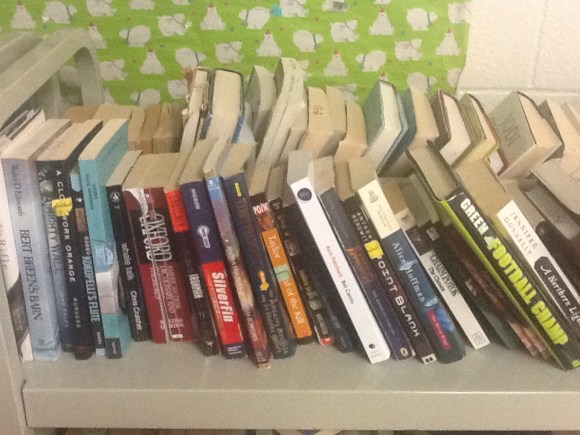
To facilitate the SSR program, there are two carts in the room with books I have purchased through the secondary market, mostly thrift stores and public library book sales (hence the title of the blog “Used Books in Class”). Each cart holds about 150 books; at $1-$2 a book, I have spent about $500 on the 300 books available for SSR.

A wide selection

A wide selection

The most popular titles in circulation these past few months have been:

Lauren Myracle’s TTFN and TTYL
John Flanagan’s Ranger’s Apprentice (any one in the series)
Catherine Gilbert Murdock ‘s Dairy Queen
Gabrielle Zevin’s Elsewhere
Alice Sebold’s The Lovely Bones
Patricia McCormack’s Cut
Carl Deuker’s Gym Candy
S. A. Bodeen’s The Compound
Sarah Dressen’s  Dreamland
Nicholas Sparks’s Dear John
Suzanne Collins’s The Hunger Games Trilogy (pick any one of these; they are on EVERYONE’S shelf)

The students are keeping their responses to the books they read on the Shelfari website this year. This is a commercial site tied to the retail giant Amazon, but there are ways to lock down the private groups we have established for each class. Last year, we used Blogger, but there were some glitches with Internet Explorer and Blogger; unless we used a browser like Firefox, the pages kept jumping and commenting was impossible. When students are on the Shelfari site, they can see what other students in the class are reading, and posting titles they have read or plan on reading is really easy. In addition, there are already reviews of the books, so students are forced to add something original to a review of the book. They can read recommendations (for and against the text) and they can participate in a discussion.

This morning I posted the following discussion prompt on Shelfari:

Hello,
You have had 16 weeks of SSR in class-most of the time with your choice of reading materials.
Tell me how you are progressing as a reader. Are you finding enough materials to read? Have you read at least ONE good book? Are you a better reader now that you were in September? Why or why not?

Some of the responses made my teacher’s heart pound proudly:

Over the past 16 weeks of SSR, I’ve probably read 5 or 6 books. Some of them were short, but some were a reasonable length. I’ve really been enjoying the SSR time we’ve been getting because the quiet period of time we get is really beneficial to my reading skills.

I am progressing in my reading. So far I have read three books this year. I am finding plenty to read. I have found many good books, including “Prom & Prejudice” and “Awkward”. I feel I am a better reader than I was in September because I am reading more difficult books than I was before and in September.

Yes I am better reader because last year I read even slower than I do now and I understand more because of the vocabulary words. I am finding enough materials to read. A good book I read this year was Miracle on 49th Street, this was good because it was a very suspenseful book.

But then, there are the honest appraisals that make me concerned about how students select books and a student’s ability to stay focused in a class for 10-20 minutes:

I’m an average speed reader, but I tend to get distracted. I’ve read a lot of good books, but they were in a lot of different genres. It’s hard for me to find books that interest me lately. I feel that my reading skills have changed a little, I’ve been able to understand things a little more.

During the past 16 weeks of SSR I haven’t really improved very much with my reading. I have only finished one book and I am working on another the first was a pretty good length and didn’t take long to read and the other is pretty long. I am a slow reader and I also just never find the time to sit down and read my book. Also, I get distracted while reading my book sometimes, so I haven’t progressed very much in the weeks of SSR.

And then, there are the even more painfully honest appraisals:

I’m a really really slow reader, and tend to get very distracted while reading, so I have a hard time making lots of progress in books. Books that are available to me don’t interest me. There was only one book that I’ve read and liked in my whole life; but there are no sequels. No I’m not a better reader, my reading skills never change, I’m always a slow and easily distracted reader.

The quiet time in SSR may not be “quiet” enough for some students, so I need to think about the physical space being more reader friendly. Apparently, I also need to have some students develop an understanding of what they like to read, and see how I can get those books onto my book carts.

Success with SSR is monitored through student self-appraisal, so I will be checking back in a few months to see if students note any changes in how they are reading. If nothing else, I know that there is power in the shared quiet reading experience we have twice or three times a week. When their heads are bent down in a book, I can feel them read.

Here is how to add an informational text to appease the Common Core State Standards without throwing out literature. Find an exceptionally well-written piece of non fiction and use that informational text as a centerpiece for a thematic unit.

Here is my example: On January 13, 1982, Air Florida Flight 90 crashed into Washington DC’s 14th Street Bridge and plunged into the Potomac River. There had been a heavy snowstorm which had closed National Airport earlier that day. Improper de-icing procedures were credited as a major reason for the crash; 78 people were killed, four of these fatalities were motorists from the bridge who had been caught in the traffic jam caused by the storm. Only five people were rescued from the icy waters, and their rescue was broadcast live during the evening news. A news media crew, stuck in traffic only a few hundred yards away from the plane crash, filmed one rescuer’s memorable plunge to pull a flight attendant  from the icy water. I remember; I watched that happen live on the evening news.

Twelve days later Roger Rosenblatt’s piece The Man in the Water appeared in TIME magazine (January 25, 1982). His opening paragraph starts with an ordinary sentence, “As disasters go, this one was terrible but not unique, certainly not among the worst on the roster of U.S. air crashes” He continues to comment on the setting, “There was the unusual element of the bridge, of course, and the fact that the plane clipped it at a moment of high traffic, one routine thus intersecting another and disrupting both.” But then, there is a shift; Rosenblatt suddenly shifts into the kind of figurative imagery usually reserved for poetry:

“Washington, the city of form and regulations, turned chaotic, deregulated, by a blast of real winter and a single slap of metal on metal. The jets from Washington National Airport that normally swoop around the presidential monuments like famished gulls were, for the moment, emblemized by the one that fell; so there was that detail. And there was the aesthetic clash as well—blue-and-green Air Florida, the name a flying garden, sunk down among gray chunks in a black river.”

Rosenblatt’s purpose was not to comment of the disaster itself, but rather to focus on the actions of one individual who rescued other crash survivors floundering amid the frozen chunks of ice and crash debris floating in the Potomac. This individual Rosenblatt christened “The Man in the Water.”

“Balding, probably in his 50s, an extravagant moustache.) He was seen clinging with five other survivors to the tail section of the airplane. This man was described by Usher and Windsor as appearing alert and in control. Every time they lowered a lifeline and flotation ring to him, he passed it on to another of the passengers.”

Rosenblatt called attention to the other resuers in this disaster including, Donald Usher and Eugene Windsor, a park-police helicopter team and Lenny Skutnik who jumped from shore to drag flight attendant Priscilla Tirado to shore. But it is the “Man in the Water” that Rosenblatt immortalizes in the essay:

“When the helicopter came back for him, the man had gone under. His selflessness was one reason the story held national attention; his anonymity another. The fact that he went unidentified invested him with a universal character. For a while he was Everyman, and thus proof (as if one needed it) that no man is ordinary.”

I use this essay, which is anthologized in an English literature textbook, as the thematic centerpiece for the senior elective Hero or Monster. The essay sets up the essential question: What makes a hero?

There are other resources to use with this text. A National Geographic Video Plane Crash in the Potomac (credit – Discovery/ National Geographic channel Seconds From Disaster)

After reading this essay and watching the video, student are charged to consider what makes a hero in literature. The required reading for the thematic unit will including selections from the Iliad, James Thurber’s short story The Greatest Man in the World, Ken Kesey’s One Flew Over the Cuckoo’s Nest, and an independent reading book. Students will also read about the monomyth or hero’s journey and trace the journey of a hero in a book of their choice.

While Rosenblatt’s essay never identifies the man in the water, forensic experts determined that his name was Arland Dean Williams Jr. Of course, by not naming the man in the water, Rosenblatt suggests anyone can be a hero,and concludes in a memorable last line, “He was the best we can do.” Similarly, if informational texts are required in the Common Core State Standards, than including an essay of this caliber for our students is also the best we can do.

Screen Shot 2012-12-02 at 10.44.58 AM

What SHOULD be a tenet of the Common Core State Standards.

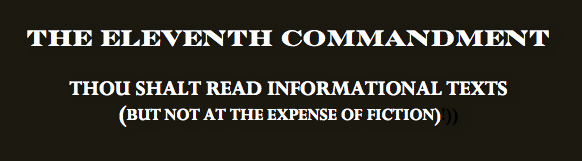
The 11th Commandment from Common Core State Standards (CCSS)? Thou Shalt Read Informational Texts.

This edict from on high, from current College Board President and co-architect/promoter of the CCSS David Coleman, has had a seismic shift in curriculum at all grade levels. English/Language Arts Curriculum directors and teachers are jettisoning fiction from their lesson plans in the mistaken belief that they alone are responsible for addressing this new found commandment. For the uninitiated, informational texts in the CCSS replaces the genre previously known as non-fiction and includes many other genres including essays, speeches, and reports.

Columnist Joel Stein exposes the foolishness of this effort in his commentary “How I Replaced Shakespeare” in the 12/10/12 issue of Time Magazine when he discovered that his writing was being analyzed by students. (Note: Diane Ravitch, education activist has the full post on her blog) His response to students who were assigned his articles and who were parsing them for literary devices or thesis?

“Transfer high schools immediately! To one that teaches Shakespeare and Homer instead of the insightful commentary of a first-rate, unconventionally handsome modern wit! Also, don’t do drugs!”

Stein readily admits that students should have some exposure to different genres and explains that he learns how to write in different genres by looking at examples. Similarly English/Language Arts curriculum require students to write in various genres as well through models as well; for example, students are taught with models as to how to write in the genres of essay, business or friendly letter, book review, and poetry.

However, Stein refutes one of Coleman’s most quoted talking points. Coleman said, “It is rare in a working environment that someone says, ‘Johnson, I need a market analysis by Friday, but before that I need a compelling account of your childhood.’” Stein’s response? “I agree with this, but only because no one has ever asked me for a market analysis.”

Stein points out that fiction provides the models that makes writers better. “No nonfiction writer can teach you how to use language like William Faulkner or James Joyce can,” he continues. Stein also mentions how the themes in fiction, and he mentions Shakespeare specifically, prepare students for real life choices. Othello, he notes, can help students make better choices about choices in working partnerships.

Instead, the shared blame for students not knowing how to write well or be able to read non-fiction lies with other disciplines such as history and science, a charge echoed by Gene Wilhoit, executive director of the Council of Chief State School Officers who, along the National Governors Association, created the Common Core. Stein quotes Wilhoit saying, “History class assignments tend to be short textbook summaries, not primary sources.” Indeed the CCSS anticipated that reading across the disciplines is the most effective way to increase student understanding, so the CCSS made clear that a student’s diet of reading should be 70% informational texts and 30% fiction. Unfortunately, the explanation as to how this percentage would play out in the average student’s school day was relegated to two footnotes. On page 5 of the CCSS English Language Arts (down load) is the footnote that illuminates the 11th commandment of how Thou Shalt Read Informational Texts:

1
The percentages on the table reflect the sum of student reading, not just reading in ELA settings. Teachers of senior English classes, for example, are not required to devote 70
percent of reading to informational texts. Rather, 70 percent of student reading across the grade should be informational.
2
As with reading, the percentages in the table reflect the sum of student writing, not just writing in ELA settings.

When the CCSS were announced, the misreadings of this the English/Language Arts standards began immediately. The footnote was largely ignored. Instead, the movement to jam informational texts into English classes began. Literature was dumped in order to meet the set ratio in English classes alone rather than a move to increase the reading of informational texts in all other disciplines.Stein recounts how Wilhoit highlights the reaction of the small, vocal group who objected. “It (CCSS) upset people who love literature. That happens to be a lot of high school teachers,” Wilhoit said.

In How I Replaced Shakespeare, Stein adds his voice to the small vocal group who love literature.  He is a former writer for the Los Angeles Times and now is a regular contributor to Time. He is a good writer who recognizes that all students would be far better served to read great literature (Shakespeare,Faulkner, Joyce)  rather than his column of “informational texts.” The loss of literature at every grade level in an attempt to serve ratios-50% fiction/50% informational text in elementary and 30% fiction/70% in high school- is too great a price to be paid to meet the goals of the yet unproven Common Core.

My two boys were raised on a steady diet of musicals and plays. I selected what we would attend with great care:

Annie, Get Your Gun
Les Miserables ( remember the Battle at the Barricades?)
The Pirates of Penzance
Oklahoma (the song-“Oh the Cowboy and the Rancher Should Be Friends”)

Do you see a pattern? When we first started to expose our sons to live theatre, my choices all had weapons or professions that could be deemed interesting to six and eight year olds. We graduated to other pieces, including A Midsummer Night’s Dream (“What was funny in this comedy?”) and A Servant of Two Masters (“Now, that is comedy!”) They became effective young theatre critics: Showboat was good, Cats was awful (“P-U”).

Their first big theatre experience was Miss Saigon on Broadway.  We sat up in the nose-bleed section, which turned out to be a blessing as the opening number takes place in a brothel with scatily clad singers and dancers. We did not rent the binoculars; we were really there for the helicopter scene. The overblown sound system did not disappoint; we could feel the whirr of the chopper blades in our bones.

I thought of these choices when I read Dwight Garner’s commentary in his NYTimes piece, “Going Beyond Cultural Kid Stuff With a Wary Sense of Adventure”. He had taken his 15 and 13 year old children to see Who’s Afraid of Virginia Woolfe? and reviewed their reaction to the play. They liked the set, the action and the performances; he was happy they had gotten so much from the “witty but sinister play, stocked like a nightmare bodega with adult themes.”

He also posed a good question, “When is it O.K. to introduce challenging cultural material — whether it is sexy or profane, creepy or violent, or simply adult and intense — to your children?” My response to him would be what I told to my own children when they asked to see adult or intense and violent films: “If you want to see it, read about it first.”

Saving Private RyanThe Longest Day CoverMichael was 13 when the film Saving Private Ryan came out in theaters in 1998. He begged to go. I was very hesitant, I had heard that the first 27 minutes of the film depicted the landing on the beaches of Normandy (Omaha Beach) very realistically; that director Stephen Spielberg was not interested in sugarcoating the gruesome damage machine gun and explosions can exact on a soldier’s body. But Michael had a keen interest in history.
“Come on, Mom, this is supposed to be just like the landing,” he argued.
That was what worried me.
“The only way you can see this film is if you read about the landing first,” I agreed.
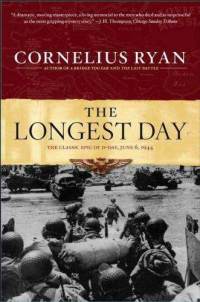
“Ok, no problem,” he replied confidently, “done.” So he read The Longest Day by Cornelius Ryan; 362 pages of historical prose.

There are many opportunities for a student to read a book in advance of watching a film. Reading the book or background materials prepares students for many of the adult themes in a film or play. For example, students who read books from the Harry Potter series were prepared for the dark themes or the twisted violence that was wrought upon many of the characters. I cannot imagine how confusing the series must have been for those students who had not prepared themselves by reading about characters, spells, or the magic elements at Hogwarts. Likewise, the students who read books from The Hunger Games trilogy were certainly more prepared for scale of the brutality of the society that “sacrifices” children for entertainment. In fact, I felt the book was far less gruesome than many of the moments from the film. When books are in circulation before the film is announced (Twilight, The Life of Pi), parents should take the opportunity to hold out for a little reading before letting a child see a film with a mature rating.

Granted, there are sometimes when a parent may have no control over what other parents deem acceptable. Michael already read Edith Hamilton’s brutal explanation of Roman life in her classic The Roman Way when Gladiator (2000) was released on DVD. That Thanksgiving, we were invited to our friend’s home for dinner. After dinner, I was forced into an awkward agreement when I found that our hosts had a copy of the film in the downstairs “playroom” for the boys to watch with their son while we socialized. I cringed that my younger son, Kevin, then age 12, would also be watching, too late for me to assign the required background reading. Of course, the boys were both thrilled to have me in such an uncomfortable position, and both we delighted we reluctantly agreed they could watch the film.

“Now, you have to read The Roman Way,” Michael told Kevin as we drove home that night, “or read Marcus Aurelius’s letters.”

I was duly impressed; perhaps I had not failed parenting.