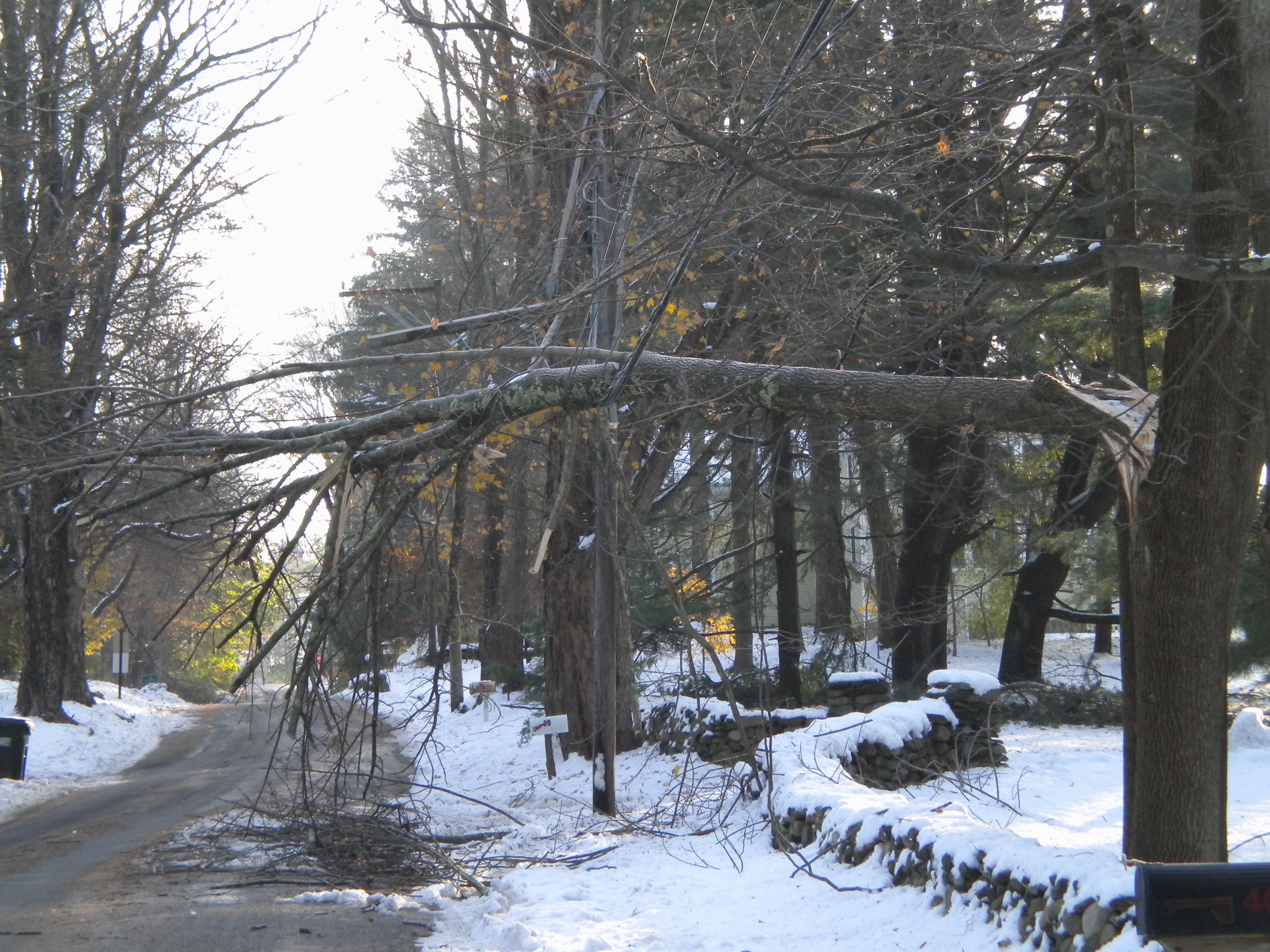
Damage to neighborhood trees and power lines

By now, most of the US knows about the damage caused in the Northeast by Winter Storm Albert. On October 29th, the entire state of Connecticut was WWF’d by a heavy wet snow. That night tree limbs snapped with M80 sound effects. By morning, residents were powerless-literally and figuratively.

Teachers, like their students, generally love a snow day. A sudden snowstorm can provide an opportunity to grade a stack of papers, plan lessons, or catch up on reading. A snow day grants a leisurely reading of the morning paper and an extra cup of coffee. A snow day permits the wearing pajamas and and the testing of a new soup recipe. A snow day is a collective opportunity to “catch one’s breath.”

Unless the power goes out. Winter Storm Albert knocked out the power in our area for five…six…seven…eight days, depending on the local street address.

Of course, when the power goes out, the sudden separation from all modern conveniences seems to put the 21st Century brain on hold. Habits of convenience, the flicking of on/off switches or pushing reheat on microwaves, are hard to break. But I have discovered that the disconnect from the Internet, however, is almost intolerable…particularly if one lives in an area without cell towers for 3G, and the power, phone and cable lines are down.

Our school has a 1:1 initiative for English classrooms. We have netbooks in our classes. Students are also encouraged to bring their digital devices to class in order to participate. Responses to prompts are uploaded to one open source software program (we use Edmodo.com), essays and vocabulary sentences are uploaded to a subscription software program (we use turnitin.com), and information is delivered to students by way of a wiki, another software program (we use PBWorks.com). When the power went out, I was unable to access student work or lessons….for five whole days!
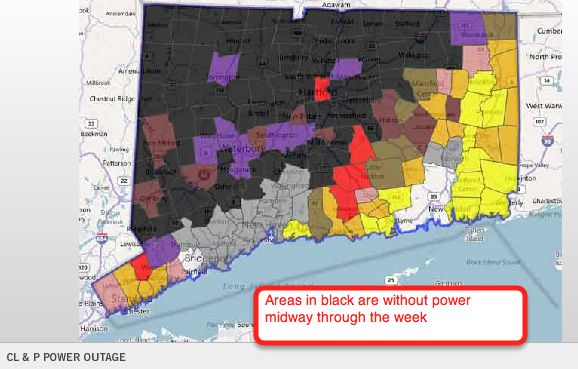
Map of Connecticut's Winter Storm Albert power outages

The storm came at the end of a marking period, a time when there is always too much to do, and I had no access to any student work. I found myself driving many, many miles out of town to set up in areas of the state, and out of state, that had power and free wi-fi. I scouted and found seats in malls, Panera’s restaurants, Starbucks, and 24-hour diners. Once I found the free wi-fi, I would set up my computer and read student work. I was not alone. I met many teachers who have also moved student work into a digital format who were in search of a signal in order to stay on track with student work. Several woefully admitted that they actually longed for a pile of actual papers to correct. The expression “digital divide” took on new meaning; we were divided from our students’ work in cyberspace.

When school reopened this past week (11/7), I was already behind. I had lost precious classroom time, but that time will be recovered by adding more five school days to the calendar, the harsh retribution for the aforementioned pleasures of a snow day. I mourn instead grading and planning time that was lost due to a growing dependance on the Internet.

The use of technology in the classroom is required in education; all students should be engaged in 21st Century skills. There are standards developed by the International Society for Technology in Education (ISTE) that must be met in districts throughout the state. My lessons almost always require some form of technology, from word-processing to Internet research. The assignments that can be create with technology are engaging, and the use of technology to post assignments can promote student independence and responsibility. Technology in the classroom is necessary if teachers are to prepare students for the future…unless the power goes out, and the Internet is not accessible.

The use of technology in the classroom will certainly increase as the amount of technology adults and students use in the real world is on the rise. These trends will not change, but some consideration should be given to the perplexing problem of what happens when the power goes down for an extended time. How can the business of educating students continue without the hiccups caused by Mother Nature?

Winter Storm Albert may be the harbinger of winter in the 2011-2012 school year and for those school years yet to come. There will be snowstorms, hurricanes, and other natural disasters in our state’s future that will separate students and teachers from the technology that joins them in 21st Century education.

And when that happens, when the power goes out for an extended time, I find myself parodying Shakespeare’s interpretation of the 15th Century Richard III. There I am, struggling along on my snow-covered Bosworth Field crying out, “A signal! A signal! My kingdom for a wi-fi signal!”

Next week, English II students will begin reading All Quiet on the Western Front by Erich Maria Remarque in tandem with the World War I unit on taught in social studies classes. This collaboration is a great opportunity to have the context of a WWI novel explained from another point of view. The social studies classes cover the causes of WWI, many of the battles, and the results of WWI on Europe and American foreign policy while the English classes follow the lives of a few soldiers engaged in the conflict. Social studies can cover the macrocosm setting, the geography of WWI, while we can cover the microcosms of the novel-the intimate settings   of Paul and Kat feasting on a goose they caught or Paul visiting the bedside of Franz Kemmerich, his mortally wounded companion.

The older edition cover; copies are always found in the YA section of a book sale

Our copies of the book are fairly old, so I am always looking for additional books to replace those who have become too worn for use in class. The e-book (through Questia) is only available as a free trial. There are always copies of the novel in used book sales including the more recent edition, and the book is almost always located in the young adult section rather than on a table or section dedicated to military history or adult fiction. This placement could be attributed  to the popularity of this novel in curriculum around the country; obviously, the person placing the book on the YA table read the book in high school.  The popularity of the book in schools defies many conventions. First, the novel is a translation from German, which distinguishes it from the multitude of British and American titles that crowd middle school and high school reading lists. Second, the point of view is from an enemy combatant; the French, English and American troops are the enemy. Including this novel acknowledges Remarque’s universal message that the consequence of war is devastation, a message that may be even more important for a nation that has been at war for over 10 years.

The new edition cover

Many technological advances made WWI a brutal war: aerial combat, machine guns, mustard gas. Last year, we were reading one of the passages that described a mustard gas attack,  looking for language that described how lethal this weapon was for the foot soldiers.  Suddenly a startled look came across the face of a  student. His hand shot up as he blurted,  “Ms. P told us that the more technology that’s used in war, the further a soldier gets away from the enemy in combat.”  There was a pause-other students had heard the same in class, and the consequence of increasingly sophisticated weaponry used against Paul and his companions was suddenly very real. His point hung there until another student chimed in, “And now we use drones.”  Suddenly, the WWI novel was not dated. The students understood that military drones currently used in combat would certainly have targeted Paul and his companions if they had been available to Allied forces in 1917.

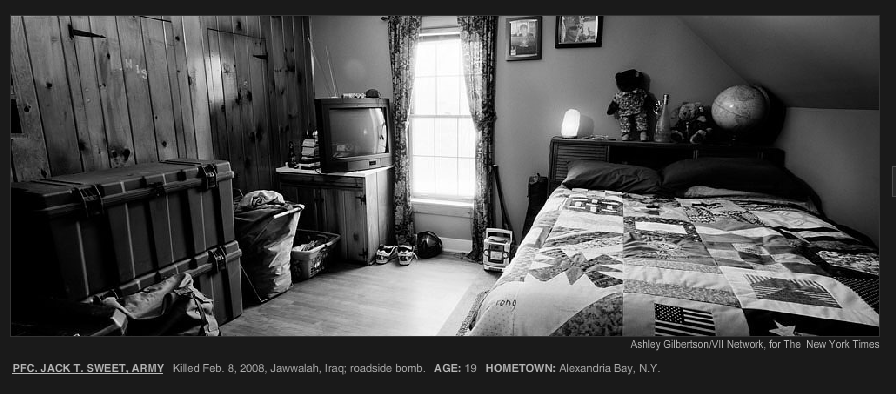
There are several activities that we pair with reading the text, but the most powerful for students is the NY Times Magazine photo essay (Ashley Gilbertson)  of soldier’s bedrooms titled “The Shrine Down the Hall” (there is a video clip as well) In the novel, Paul returns for a visit home. Instead of being a sanctuary, however, the bedroom is a painful reminder of the innocence he has lost after months of combat of the Western Front. Our assignment is to compare the elements of Paul’s bedroom (items, his feelings, his memories) to the elements in the photos of the bedrooms of American soldiers who had been killed in Iraq or Afghanistan. This photo essay brings the impact of war’s devastation to an intense personal level. Many of the students have bedrooms with the same posters, layouts, or furniture, and they note these similarities in their responses.

A photo from Ashley Gilbertson's "The Shrine Down the Hall" photo essay in the NY Times Magazine section

Students are instructed to choose one of the soldier’s bedrooms from the photo essay, and make a connection with text from Chapter 7 (Paul’s visit home) by answering the following questions:

  • How are the text of the novel and the photo alike?
  • How do the text and the photo differ?
  • What is the photographer’s message? What is Remarque’s message? How are they the same? How do they differ?

The students’ responses included:

I chose picture 15, of Matthew J. Emerson’s bedroom. His room is just waiting for him to come home but it never happens. The room also has pictures cut out on the wall, from what appears high school sports, as well as trophies on the shelf. Paul gets to return home one last time, unlike the soldier who was killed in Iraq who returned in a casket with an American Flag on it. Paul feels like a stranger in his own room. War changes people; you can’t go blasting heads off for 2 years and come home and live the normal everyday life again.They come home, changed, forever.

I choose photo 17. The man who died was Sergeant Gilbert who was killed in 2006.  The photographers message is saying that an ordinary young person, even a teenager, can go to war and be killed. The photographer expresses the loneliness, silence, and emptiness that the room has. Remarque’s message is saying that the average soldier has a very hard time coming back because he or she has to make decisions that don’t involve killing, that don’t involve defusing a bomb. These two messages are the same because they both describe the difficulty of coming back home, but they are different because these two messages are set in different times with different technology of warfare.

When I see picture #3 I think of Paul the most. Here are a bunch of pictures everywhere on the walls of all different kinds of things, like “Then below are periodicals, papers, and letters all jammed together with drawings and rough sketches.” When I read this it makes me think of a cluster of a bunch of different things, also when I look at room #3 I see a cutter of a bunch of posters, hats, books, and many other things. I think the picture and Remarque’s  are both saying that life is not the same when you get home and many of the soldiers cannot come home and have everything be the same as when they left.

I chose photo 14 because it is surprisingly similar to the book. The text talks about Paul’s book shelf and his school books all thumbed through. the room has a book shelf and other references to school. What looks like a degree is hanging on his desk. This room however has a poster of the marines in the background which shows that this boy was obviously thinking of joining the military before hand. Paul has no mention to wanting to join the army before Kantorek takes them down to the recruiting office. I think the photographer’s message is to show how innocent the soldier was before.

He was on a sports team and appeared to be quite good, he won a trophy. Remarque’s message is very similar. The soldier is changed after war, he cannot go home and just drink some beers and pretend everything is all right. It’s not.

I chose picture 14. This room was occupied by Nathanial D. Windsor who died on March 11, 2007. He was only 20 years old (about the same age as Paul). T. The photographer said was trying to portray a lonely room that is not occupied anymore. Remarque’s trying to portray that Paul’s room is lonely too. They are both alike because they are lonely.

Christopher Scherer’s room reminded me of when Paul went home. Paul had a nice life before the war he felt at home, when he returned from the war he felt like he was looking through a veil. He tried on his clothes, his civilian clothes, that made him feel like he had nothing. After the two years of war he cannot have that connection to his home, he relates everything back to the war. The war has given him the thought of death and destruction, Paul is no longer himself, he cannot connect to his home, where he is supposed to be.

In the picture a bookshelf was not full which could mean that the soldier was as Paul was did, collecting them gradually.  The solider also has a clear view of the outside that he can sit and watch, just as Paul has in the story. Remarque and the photographer have different views. Remarque tries to display that after the soldiers return home they are never the same people and their rooms do not represent them. While the photographer’s message is that all the pieces of  soldiers’ lives are preserved in their rooms and are now gone forever because they have died.

Remarque’s novel transcends time perhaps because of the intensity the reader feels for one soldier caught up in a conflict beyond his control.  While the social studies classes are required to cover the history of World War I, the English classes are free to cover Paul and “his”-story.

There are a surprising number of students who have never seen The Wizard of Oz, and so as an introduction to the freshman (9th grade) unit dedicated to the power of “The Story”, we showed the film in class. However, in order to keep students engaged and focused on the lessons objective, a software program (G-snap) was set up to allow students the opportunity to live blog during the film.

Our students are fortunate enough to have the use of net books in class or they may bring their own digital device in order to access the materials used in class. G-snap is a free website that allows anyone to set up a live blogging event; access to the event can be posted by a link or directly embedded on a webpage. There is no registration required, comments can be saved, and the event can run for several days. During an event, questions can be posted and participant responses can be moderated before they are shared.

Students were engaged in the film from the moment the opening soundtrack began and several students joined Dorothy in singing Somewhere Over the Rainbow.  Then Almeria Gulch appeared to take Toto away in her bicycle basket and, despite my best efforts to keep everyone quiet, the comments began:

“I was so scared of her on her bike!”
“She is so mean!”
“I can’t watch her change into the witch…I just can’t watch!”

The tornado scene that followed kept them speechless. When the house landed, there was an audible “oh!” from Dorothy. Students flinched as well; they had arrived in OZ.

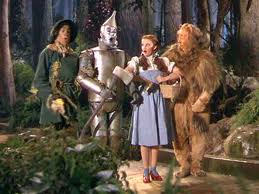
"We're off to See the Wizard" as a way to study character motivation

The lesson’s objective was to have students identify character motivation, specifically motivation that reveals a character’s weaknesses and strengths. We wanted students to recognize that in very often in stories, the qualities that character thinks he or she lacks is exactly the unrecognized quality the character possesses. Of course, the film makes this objective easy to meet.  Frank Baum’s story is all about motivation and character qualities.

For some students, there was a sense of nostalgia as they watched the film. Lines that they missed as children suddenly made sense (“Oil can? Oil can what?”). Other students finally caught on that the doorman, carriage driver, doorman and Wizard were played by one actor. As for the students who had never seen the film, they were both engaged with the film and the enthusiasm of their more knowledgeable peers.

Using G-snap software, I posed a series of questions at different times during the film

What motivates Glinda to place the ruby slippers on Dorothy’s feet? Is this in Dorothy’s best interest?

What happens when one strays off the path of The Yellow Brick Road?

What qualities does the Scarecrow exhibit? How is this connected to his motivation?

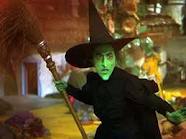
Margaret Hamilton Played The Wicked Witch of the West. Was her performance too frightening for small children?

I also wanted them also to reflect on the intensity of the Wicked Witch’s dialogue.  For example: “those slippers will never come off . . . as long as you’re alive!” or “The last to go will see the first three go before her.”

I posted:  Was this film appropriate for children? Was the film too scary?

In responding to this question, their responses were mixed.  Many felt the film was fine for children, but some students had second thoughts as they considered that the dialogue was really much more frightening then they had remembered:

“I do think some parts are scary for children. I think I was about 5 years old and I remember hiding under a blanket when the flying monkeys came on TV.”

“No I don’t think that children should be protected from watching this movie. There are many violent movies that children shouldn’t see but this movie is classic.”

“Well most Disney movies kill the parents so this isn’t too bad compared to that plus a lot of people saw this when they were really little and didn’t scare them.”

“I was about 6. I think they should watch it. It is ok if they learn about death because it is a part of everybody’s life at any age.”

“I saw this film when I was a little kid, and I was frightened for days, I had nightmares about this horrible witch, so I think it might be a little extreme for little kids.”

“I saw it when was like 4 and no its not that bad, they will get over it. It’s not like a death threat, well it kinda is but never mind. I don’t think it’s that bad.”

“I saw this film first when I was 4 and it was my favorite movie, EVER.”

Overall, the screening of the film was a success and the use of live-blogging allowed students to stay focused on noting character motivation.  Their responses included:

“The Tinman does have a heart. He is the most ‘emo’ character of them all!”

“Scarecrow has a brain and when Dorothy says she will miss him the most she means being smart is what people should look for in friends.”

“The companions represent different things: Lion-Courage, Tin Man-Heart/Love. So it shows that even though you don’t think you have it you still do because the Lion still stood up for himself. And Tin Man loved his friends, so they just thought they did not have them when they really did.”

The power of The Wizard of Oz makes it an ideal classroom tool, and character motivation is only one of the lessons that can be learned. Is it any surprise than that Margaret Hamilton who played the Wicked Witch of the West was a school teacher by profession?

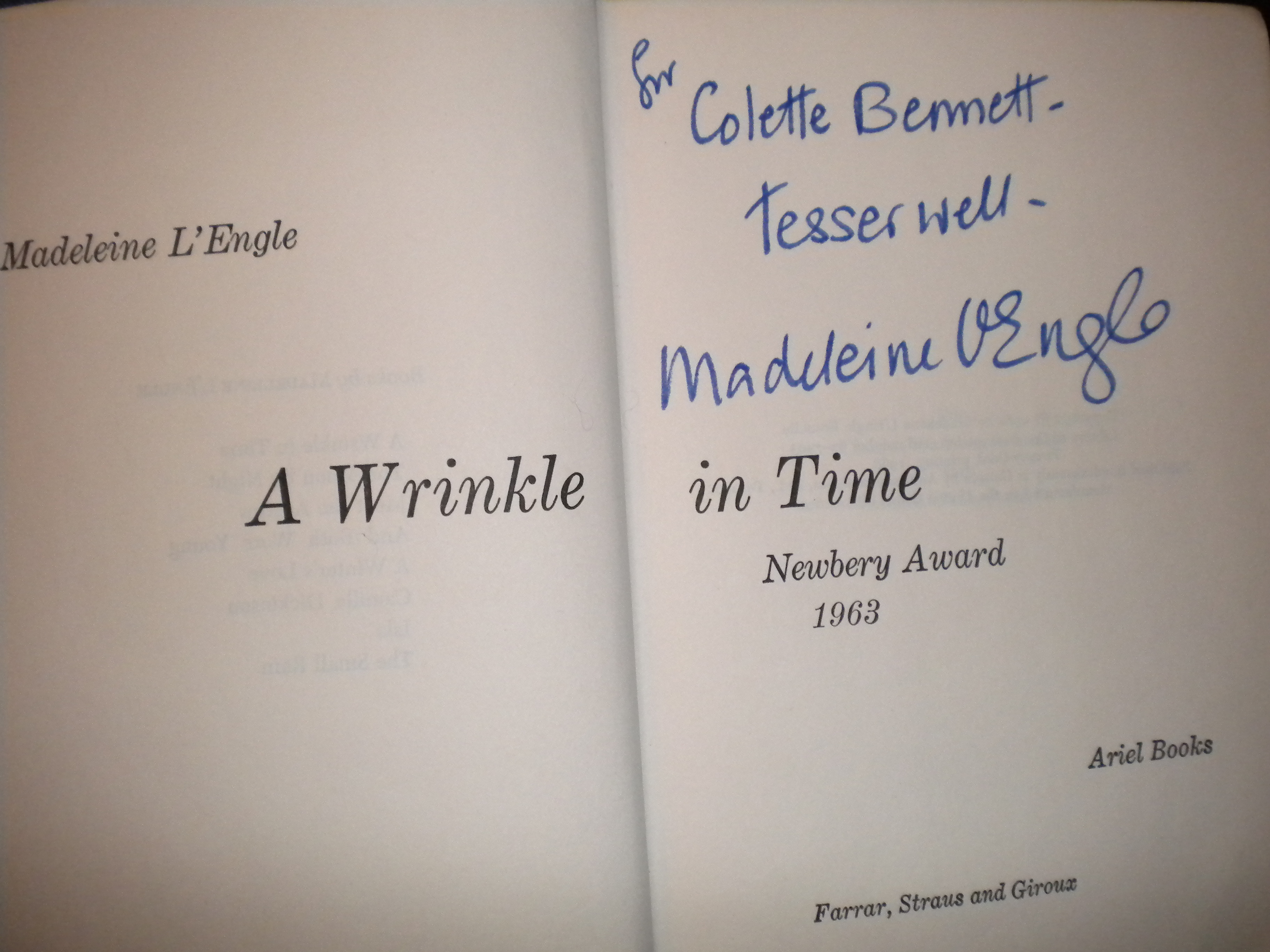
I recently read that Leonard Marcus, a childrens literature historian, is completing a book about Madeleine L’Engle, called Listening for Madeleine. He explains that the book will be “a ‘portrait in many voices’ of the author A Wrinkle in Time, presented through a series of interviews with fifty friends, family members, and colleagues who knew her well.”

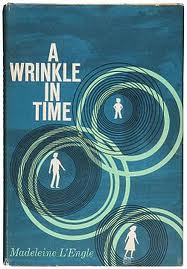
My 1963 copy of A Wrinkle in Time had this cover

A Wrinkle in Time was one of my favorite young adult reads, a fact I have noted in earlier blogs. I discovered my hardcover copy  under the Christmas tree, and although I finished reading the book that same day, I spent wonderful hours rereading the story of Meg Murray, her “boyfriend” Calvin,  and her younger brilliant brother Charles Wallace who “tesser” to the planet Camazotz to save Meg’s father. I loved the story.

But I have never confessed publicly how on one occasion twenty years ago, my love for the book completely undermined my sensibilities.

In 1991, a local bookstore advertised that they would host authors for book signings. To my great joy, one of the authors invited was Madeline L’Engle. I was delighted; my favorite YA literature author was coming to a local bookstore!

I immediately called my mother in Boise, Idaho, to see if she could locate my childhood copy of A Wrinkle in Time and mail it to me so that I could have the book signed? She spent several hours looking through boxes of books that had been shipped from Connecticut two years earlier when the family relocated to Boise. Once she located the book, she called to tell me that my copy was really in a very worn condition.
“I’m not sure that the author is going to want to see how badly you treated this book,” she chuckled.
I assured her that the condition of this text was confirmation of my love of the book. I even recited a few lines over the phone could recite lines from the book (“Wild nights are my glory!” and “‘Mrs. Whatsit hates you,’Charles Wallace said”). I recounted L’Engle’s  literary joke, “It was a dark and stormy night….!”
She mailed the book back to me.

I marked the date for the author’s visit on my calendar. No appointment, soccer game, or relative get-together would keep me from this meeting. I would tell Madeline L’Engle how she had been such an influence on me. I would recount to her how I imagined myself as Meg, a brilliant outsider, fighting for the return of her equally brilliant father and brother. In reality, I was not brilliant, and my family was rather average in intelligence, but I very definitely felt like an outsider. I even rehearsed how I would greet her, “Ms. L’Engle? When I was a teen, I read your book a thousand times!”
The day before the author visit, I was suddenly seized with the notion that reservation were required for the event. I panicked. Did I miss something in the notice? I quickly called the bookstore to make sure I would not be shut out of this event.

“Oh, I am so sorry to tell you that Ms. L’Engle will not be coming,” said the voice at the end of the phone.
“What? Why not?” I was immediately upset.
“Ms. L’Engle was in a serious car accident this past week and has been hospitalized.”
There was a pause.

Ms. L’Engle was not coming? I would not get my book signed? I had the book! I had the book sent from Boise, Idaho!
“Well,” I stammered, “when will she be be here? I mean..will you reschedule?  I wanted to get….”

WAIT! What was I saying?? My favorite author was nearly killed, and I was still worried about having a book signed?
Where was my sense of compassion?
Where was my sympathy?

“I mean…I…I am so sorry!” I finally blurted out a proper sentiment. “I mean, I hope she she will get better soon.”
I hung up quickly, lest the call be traced back to me.
I was terribly disappointed, but I became increasingly distressed about my reaction. I could not believe how selfish and clueless I must have sounded on the phone.
My mother called later that week.
“Well, what did the author say about your copy of the book?” she asked.
I had to confess my inappropriate behavior to my mother… to my mother, for goodness sakes!
She offered her sympathy for Ms. L’Engle, scolded my lack of compassion, and reminded me to take better care of my books.

Several months later, as an anniversary gift, my husband sent my copy to Ms. L’Engle, who was still recuperating, to have the book signed.

On the title page, in large curvasive script is the inscription, “for Colette Bennett-Tesser well-Madeline L’Engle”

I never did meet her. I hope the condition of my copy showed how much I cared.

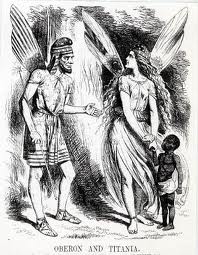
"Ill met by Moonlight, proud Titania"

Ill met by moonlight, proud Titania,” reads Karl off the script. He looks confused, “I’m ill?” he looks puzzled. “Am I sick?”

“You’re not sick…We are having a fight!” responds an irritated Nicole, who is playing the fairy queen. She continues to read: “What, jealous Oberon! Fairies, skip hence:/I have forsworn his bed and company.”

“Whoa, looks like someone is sleeping on the couch tonight!” chimes in Sam from the audience.

Students in English II are acting out scenes from William Shakespeare’s A Midsummer Night’s Dream in preparation for a field trip. Their response to the play is not unlike the response of Shakespeare’s original audiences; there is no high browed reverence here but rather a steady stream of commentary coming from the “groundlings” sitting in desks.

A fight between a fairy queen and a fairy king as part of a comedy by Shakespeare is a break from the too serious literature of adventure, war, and tragedy (Animal Farm, Night, Beowulf, All Quiet on the Western Front, Lord of the Flies) that is usually featured in the sophomore curriculum. For two weeks, the students are wrapping themselves in costume tulle, strapping on  wings, donning crowns while they stumble through the language of Elizabethan comedy. Their experience is not a singular one. Today, a student’s first introduction to the bard usually takes takes place in the classroom. On any given day, at any school hour in classrooms all over this country, students from elementary grades through high school are struggling with iambic pentameter in decoding Shakespeare’s poetic language. This indoctrination is part of a long standing American tradition.  Since the beginning of America’s history, Shakespeare has lived on American soil.

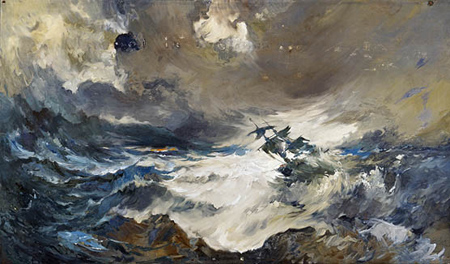
W. H. Harrington. Wreck of Sea Venture. Painting, 1981. Courtesy of Bermuda National Trust and Bermuda Maritime Museum.

Perhaps it was Shakespeare’s fascination with the new colonies in the Americas that initiated the relationship. His play, The Tempest, is loosely based on the 1609  wreck of the Sea Venture near the Bermudas on its way to Jamestown. Prospero and his daughter Miranda are shipwrecked on a island for many years. When visitors arrive after a storm to break their exile, Miranda marvels at the meeting by proclaiming “O brave new world/ that has such people in it.” In the play, Miranda’s line is ironic; she is unaware that several of these visitors were less than desirable types. However, for the British and people in the countries of Europe, the American colonies were the brave New World, full of hope and promise laced with a tantalizing dash of danger and adventure.  Americans reciprocated this compliment with a slavish devotion to Shakespeare that continues to this day.

This relationship between Americans and Shakespeare is detailed on the National Endowment for the Arts (NEA) website, “The earliest known staging of Shakespeare’s plays in the colonies was in 1750. By the time of the American Revolution, more than a dozen of his plays had been performed hundreds of times in thriving New England port cities and nascent towns and villages hewn from the wilderness.” By the 1830’s, Alexis de Tocqueville, visiting from France, wrote extensively about his travels in the United States (Democracy in America) noting, “There is hardly a pioneer’s hut that does not contain a few odd volumes of Shakespeare. I remember that I read the feudal drama of Henry V for the first time in a log cabin.”

Shakespeare was embraced by the Americans through their nation’s rapid expansion beyond the original 13 colonies, and the NEA states that “plays were produced in large and opulent theaters and on makeshift stages in saloons, churches, and hotels. From big cities on the East Coast to mining camps in the West, his plays were performed prominently and frequently.”  Mark Twain took advantage of American’s familiarity with the troupes of English actors who traveled to the colonies, and incorporated Shakespeare into his classic Huckleberry Finn. Twain’s Huck travels with a pair of con men who practice the balcony scene from Romeo and Juliet and the sword fight from Richard III on the raft while they botch Hamlet’s “to be or not to be” soliloquy. Twain counted on his audience’s acquaintance with Shakespeare’s texts in order to set up this parody.

Interesting historical trivia about Shakespeare in America includes the casting of Lieut. Ulysses S. Grant on the eve of the Mexican War into the role of Desdemona from the play Othello. Apparently he never performed, lacking “the proper sentiment”, and a female was recruited at the last minute to replace him. Edwin Booth, the elder bother of John Wilkes Booth, toured the Western United States during the Gold Rush, and enjoyed enormous acclaim performing plays by Shakespeare. Apparently, the best theaters in the East were not as profitable as performing in the raucous camps where theater tickets were paid for in gold nuggets and bags of gold dust. Edwin is also credited with saving the life of Abraham Lincoln’s son, Robert, on a train platform the same year his brother John Wilkes assassinated Lincoln in 1865.

Contemporary Americans have a deep love for Shakespeare by producing his plays in theaters and in film with more frequency than any other playwright. Almost every state has a theater dedicated to exclusively performing Shakespeare’s plays.  Films of his plays, most recently The Tempest starring Helen Mirren as as a female Prospero, or with remakes of his material. The Taming of the Shrew was memorably relocated to an urban high school in Ten Things I Hate about You with Julia Stiles as the intractable Kate, a film that remains popular with American audiences. The Common Core Standards in Language Arts require his plays be taught in classrooms at the high school level. All this attention explains why students willingly (or unwillingly) wrap themselves in costume tulle, wear wings, don crowns and stumble through the language of Elizabethan drama. Like Kyle and Nicole, they may fight in the roles of the Fairy King and Fairy Queen, or they may analyze the reasons  Macbeth usurps the throne. They may research the origins for Henry the V’s “Band of Brothers” speech, or  memorize the prologue to Romeo and Juliet. Because watching, performing, and learning Shakespeare is an American classroom tradition.

As I shop for used books in area thrift stores and local book sales, I cannot help but notice when a book title “jumps the shark”, a term coined by the TV series Happy Days to mean when something has lost its “cool” factor.  The first book in the Millennium series, The Girl with the Dragon Tattoo, by Swedish journalist and writer Stieg Larsson illustrates this phenomenon. Books lose their "cool" factorMultiple copies of Larssen’s trilogy The Girl with the Dragon Tattoo are now appearing on used book tables. While the book currently remains on the New York Times best seller lists at #17 , copies are available for $1.00-2.00 in the used book market, sometimes available well into day two or three of a library book sale. Simply put, the book has reached a critical mass saturation of readers, and like Dan Brown’s uber-popular The DaVinci Code, this series has become disposable.
Beginning in 2006, people were purchasing copies of The Girl with the Dragon Tattoo in Britain and Europe where publishers released copies earlier than here in the US. The Girl with the Dragon Tattoo and its sequels, The Girl Who Played with Fire and The Girl Who Kicked the Hornet’s Nest, were almost required reading in airports from 2008-2011; they were de rigor on beaches as summer reads.
The trilogy followed Lizbeth Salander, a fiercely independent computer savant, a grown-up Pippi Longstocking with attitude, and her involvement with the disgraced magazine editor Mikael Blomkvist, in solving a series of crimes. Larsson’s had the ability to place the reader in suspense with unexpected plot twists featuring a plethora of vile characters intent on eliminating Salander and Blomkvist.
Although there were critically acclaimed Swedish films made for the series, a US movie version will be released this year which will most likely result in an uptick of book sales with movie-tie in editions.
Despite their compelling plots and character, I have not put any of these texts into classroom libraries for students. Some of the language and plot points include disturbing sexual violence towards women; the original title was Men Who Hate Women. That said, I have not banned the book should a student choose to read one of the books independently.
In shopping for used books, I have watched other titles “jump the shark”, and my classroom libraries have benefited from these swings in popular reading trends. Entire classrooms have been outfitted with $1.00 copies of books that were initially embraced by the general reading public, and then just as quickly, disposed into the used book market. These fiction and non-fiction titles include:
The Kite Runner by Khaled Hossani
The Secret Life of Bees by Sue Monk Kidd
Cold Mountain by Charles Frazier
Snow Flower and the Little Fan by Lisa See
The Lovely Bones by Alice Sebold
The Memory Keeper’s Daughter by Kim Edwards
Three Cups of Tea by Greg Mortenson and David Oliver Relin
The Devil in the White City by Erik Larson
Nickle and Dimed by Barbara Ehrenreich
The Blind Side by Michael Lewis
A Walk in the Woods by Bill Bryson
The Glass Castle by Jeanette Walls

The most recent titles currently on the best seller list that have “jumped the shark” have been added as independent reading choices. These books are usually placed in grades 11 and 12:
The Art of Racing in the Rain by Garth Stein
Water for Elephants by Sara Gruen
Little Bee by Chris Cleave

Young adult literature (YA Lit) also experiences these ebbs and flows in book titles. Three summers ago, finding a copy of Twilight on a used book table was a coup. Today, one could fill a classroom with copies of any one of Twilight trilogy. Similarly, any one of the titles in JK Rowling’s Harry Potter series can be located as a used book, however, it should be noted that these used copies show much more wear and tear than any other series of books. Whether their condition is an indicator of the careless nature of adolescents towards the care of books or the degree to which Harry Potter books were read and re- read, it is hard to determine.

As I write this, I am impatiently waiting for The Help by Katherine Stockett which I want to pair with To Kill a Mockingbird or place in a unit focused on Civil Rights in Literature. This fictional account of interviews conducted with maids of Jackson, Mississippi, during 1960s is ideal for placing readers into the mindsets of households contending with the demands for racial equality which dominated the culture of the time.
Based on the 34 weeks this book has spent at the top of the best seller list (where it still is #1 in paperback trade books), I know there are copies in a multitude of households. When copies of The Help are finally discarded into the used book market, I will jump for them….like a shark.

Danbury, Connecticut, is the closest metropolitan area near me (population 80893), and this past weekend, the Friends of the Danbury Public Library held their annual sale. The first remarkable fact about this event is that the 80,000 books available to the public for sale, transported several miles from the library location to the Danbury PAL building at the other side of town, arrived in alphabetical order! This was a very well-organized sale; browsing the fiction tables was a breeze.

The second remarkable fact about this event would be the surprisingly large number of biographies, auto-biographies, and memoirs donated by Danbury residents. Three long tables laid end to end were laden with all manner of biographical materials, and under these tables, there were boxes filled to overflowing with additional selections. Interestingly enough, most of these books were “solo” copies; duplicates, with the exception of  Angela’s Ashes by Frank McCourt (an area favorite) and The Glass Castle by Jeanette Walls, were hard to find. A cultural anthropologist attending the sale could speculate as to what the fascination biographies, auto-biographies, and memoirs have for Danbury readers. Are the residents “people”-people? Is there a strain of  voyeurism running through their veins? Or are they simply curious about the lives of the rich and/or famous? (Did former Danbury resident Robin Leach have anything to do with this trend?)

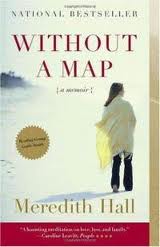
One of the many titles available to add to Memoir class

The plethora of memoir titles provided the following as selections for independent reading for the 12th grade memoir class:
Madhur Jaffrey– Climbing The Mango Trees: A Memoir Of A Childhood In India.
Gail Caldwell- A Strong West Wind
Ann Patchett- Truth and Beauty
Lucy Grealy- Autobiography of a Face
Meredith Hall –Without a Map: A Memoir
Patrick Moore-Tweaked: A Crystal Meth Memoir
Rory Stewart- The Prince of the Marshes: And Other Occupational Hazards of a Year in Iraq
Janice Erlbaum- Girlbomb: A Halfway Homeless Memoir
Claire Fontaine and Mia Fontaine- Come Back: A Mother and Daughter’s Journey Through Hell and Back (P.S.)
Linda Greenlaw- The Hungry Ocean: A Swordboat Captain’s Journey 

For Grade 11, there were multiple copies of  Louise Erdrich’s Love Medicine Sebastian Junger’s War, and Michael Sharra’s The Killer Angels.

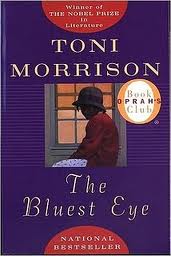
Multiple copies of The Bluest Eye were available. This text is under a book challenge by a neighboring community

There were also multiple copies of Nobel prize winning author Toni Morrison’s The Bluest Eye, an indication that the book is on a Danbury school or local book club’s reading list. Currently, this book is being challenged by parents in the neighboring town of Brookfield. According to the local media, the Brookfield challenge to have the book removed (Honors Grade 11 class) is largely led by individuals who have not read the book but who have read, and are circulating, excerpts of some graphic scenes; one complainant does claim to have read the SparkNotes.

For grade 10, there were multiple copies of Ishmael Baeh’s A Long Way Gone, Paulo Coelho’s The Alchemist, Mark Haddon’s The Curious Incident of the Dog in the Night-Time, and Deborah Rodriguez and Kristin Ohlson’s Kabul Beauty School.  There also multiple copies of William Golding’s Lord of the Flies and  Erich Maria Remarque’s All Quite on the Western Front in the same editions we have in our classroom libraries.

For Grade 12 independent reading, usually Creative Writing classes, I found multiple copies of Garth Stein’s The Art of Racing in the Rain, and enough copies of Melissa Bank’s The GirlsGuide to Hunting and Fishing as a “test” to see what students think.

I located some “hard to find” titles of books that are always needed including Persepolis: The Story of a Childhood by Marjane Satrapi, Bobbi Ann Mason’s In Country, Cormac McCarthy’s All the Pretty Horses, Joseph Bruchec’s Codetalker, and Laurie Halse Andersen’s Chains. Since we are a vocational-agriculture school, an elective under consideration for seniors is Animals in Literature.  Both of Ken Foster’s books Dogs I Have Met: And the People They Found and his other book Dogs Who Found Me will be added to that bookshelf.

I have noticed that a number of books that currently occupy positions on the NY Times best seller lists have been available at these local library sales. At Danbury’s sale, these titles included Like Water for Elephants by Sara Gruen, Little Bee by Chris Cleave, and The Kite Runner by Khaled Hossani. The Girl with the Dragon Tatoo by Stieg Larsson, and its sequels The Girl Who Played with Fire, and The Girl Who Kicked the Hornet’s Nest escaped the stigma of being limited to the mystery table; all three were placed for readers of fiction who may want to “cross-over” for a thrilling mystery.

An entire side wall was dedicated to VHS tapes. Given the current state of technology, I wonder how much longer VHS will be featured at these sales; their value must be falling as the popularity of online movie streaming or DVD/Blu-ray grows. There were also two tables of audio books, CDs and DVDs. The organizers of the sale had a rather uncoventional approach to the literary canon; the classic literature section was divided from the poetry section with an expansive section of books devoted to humor. Was this placement a commentary on humor as the offspring of the classics? Or was this partition a statement about the lack of humor in the classics? I am not sure.

Unlike other area sales, there was no admission charge for early arriving buyers, so shopping during the first hours of the sale meant contending with book dealers and their ISBN readers. Fortunately, the aisles were wide enough to accommodate people carrying large bags filled with books. Prices ranged from $.50-$2.00;rare books had their own section and were priced accordingly. Volunteers wearing blue shirts and aprons were plentiful. By noon many were engaged in re-stacking tables and filling in gaps created by eager shoppers. Checkout was a breeze. The bill for five large bags of books, roughly 87 books, came to $101.00. The Friends of the Danbury Public Library will reduce the number of books to pack up by having a “bag sale” on Monday, 10/17.

80,000 books donated by residents in a city of 80893 means at least one donated book for each person. That is also remarkable; make this 80,000 Books and Three Remarkable Facts.


Honestly? I am not surprised about the recent drop in the verbal SAT scores. At least once a day, I will hear a student grouse,”I hate to read.” I hear students whine about the length of books. I have students ask in class, “Are Spark Notes available for this book?” Too many students skim the first and last pages to feign understanding. Too many students admit they have not finished a book they started. Too many students prefer to watch the movie than read the book.
Teachers in my English Department are not surprised when we get the results of reading check quizzes. Sadly, we have come to realize that student would rather fail a quiz then spend time reading to prepare themselves.

Why?

Well, reading is a sedentary and solitary activity. Reading demands attention. Reading contends with the demands for student time in and out of school including sports, school club activities, employment. Reading requires uninterrupted blocks of time.

Technology now complicates how reading is accomplished. Students can be engaged in reading through any one of a multitude of digital devices. These platforms, however, are not exclusively reading platforms. A book needs time to “hook” a reader; a device can interrupt that introductory period.  A student can simply click over to another stream of graphics and information should there be a hiccup in reading attentiveness.

In short, with all the demands and digital distractions, many students are experts at gathering information, but simply have not practiced reading.

According the the Washington Post article, What the Decline in SAT Scores Really Means by Valerie Strauss, “Newly released SAT scores [2011] show that scores in reading, writing and even math are down over last year and have been declining for years. And critical reading scores are the lowest in 40 years.” the total drop in critical reading was three points. Even more alarming was the statistic that, “critical reading scores in 1972 were 530; today they are 514.”

So, how do teachers combat this trend? What steps can teachers implement to try to correct the falling scores and move them in the opposite direction? Since teachers cannot control those factors outside our classrooms, I suggest teachers control reading in our classrooms. Against the cacophony of today’s hyper-connected world, teachers must carve out class time for quiet reading. Teachers, especially language arts teachers, must also allow for student choice.

Quiet time in the classroom may be the only time a student can read without distractions, and teacher supervision can contribute to creating this atmosphere.  Quiet time in the classroom can provide an opportunity for a book to capture a student’s interest, for a author’s voice to take hold of the imagination. Even short periods of time, 10-20 minutes a day twice a week, will yield roughly 15-30 hours of quiet reading time during school year. More time means more practice, and there is a well-established correlation of reading time with high standardized tests scores.  Equally important is allowing students to have the authentic experience of choosing  what they read.

As early as 1988, a seminal study titled Growth in Reading and How Children Spend Their Time Outside of School published in the Reading Research Quarterly followed the the academic success of  5th grade students who read voluntarily (Anderson, R., Fielding, L., & Wilson, P.). The study noted that “It was also discovered through these same interviews that students who were in schools where they were given opportunities to read self-selected materials and were given access to materials that they were personally interested in reading were more likely to engage in voluntary reading than those in classrooms where these practices were not evident.” A follow-up article to this study by Linda G. Fielding and P. David Peterson offered a layman’s argument for voluntary reading in the article Reading Comprehension: What Works (Fielding_Pearson_1994). The 1988 study and follow up in 1994 made the argument that the critical time to create voluntary readers was in grades 5 and 6. However, with the trend of decreasing reading scores, all grades should adopt the recommendations of the study.

So, while teachers may not be surprised in the drop in the SAT reading score, they may be surprised to find out that the solution was outlined in the research published 23 years ago. That solution is to give students the chance to read in class, the chance to choose a book to read. To practice reading is critical to the practice of teaching.

Sophomore English is centered on the study of World Literature and is organized to complement Modern World History classes taught by members of the Social Studies Department. This means, when students are taught about World War I, the English classes read All Quiet on the Western Front.

One of the goals this year for every member of the English Department is to increase the amount of reading opportunities. To meet this goal, the EnglishII classes have just completed a unit where they chose books written by world (not American) authors or books about world events. The unit ran for 18 days-11 days class periods designed with 20 minutes of silent sustained reading combined with lit circles for a total of 3 hours and 40 minutes of in-class reading time.
Students choose the book they wanted to read after researching book titles with reviews (from Amazon) promoted in a prepared folder on Livebinders. Literature circles were organized by student selection of titles; teachers made recommendations for low-level readers.

80% of the texts offered in this unit were added to the classroom library as used books. Books were purchased for $.50-$4.00 each over the period of two years through visits to thrift stores, public library sales, and online used book vendors. The remaining 20% of texts were already purchased for classroom libraries through the retail market. The most popular titles selected by the students included: A Day in the Life of Ivan Denisovich, The Alchemist, Hiroshima, and The Life of Pi (titles initially purchased at retail price); Like Water for Chocolate, City of Thieves, The Girl with the Pearl Earring, The God of Small Things and Ella Minnow Pea (all titles added through used book markets).

Literature activities were designed to encourage student creativity and to be simple enough so that students could complete the tasks during the period. Students were continually reminded that they need to read for homework as well as in class.
Once the literature circles were organized, students kept all group work in folders. Literature circles were not divided with assigned roles; all members of the group participated in the daily scheduled activity.

Daily activities included:

  • Members of the group developed five questions each which were shared in the group. All members chose three question from this pool and responded to them;
  • Members of the group each located a passage with figurative imagery and used that passage to create a found poem;
  • Members of the group illustrated a scene from the book as a six-panel comic strip;
  • Members of the group researched 14 facts about the text they chose, the author, and the context when the book was published;
  • Members of the group each wrote three character haikus;
  • Members of the group created one timeline of 10 events from the text and organized these on Timetoast.com interactive software.

Once students had chosen their texts, they were given an index card to record data about their reading habits. Students recorded their progress on these cards with the following data: page # at the beginning of a reading session, page # at the conclusion of a reading session; the number of minutes for the reading session; the location of the reading session. At the conclusion of the unit, this card was used as a self-reflection exercise, and the data card attached to a sheet with the following questions:

1. According to the data you recorded on the card, how long did it take you to read this book?
2. What was your average reading rate (pages per minute)?
3. In which location did you read most frequently?
4. If you had to take a detailed multiple choice quiz or test on this book, would you have scored well? WHY or WHY NOT?
5. Who would you recommend should read this book?

As a final assessment, students completed a dialectical journal of 10 quotes (5 from the beginning of the book; 5 from the end of the book).

The unit was successful in having students engage with their texts daily; students would enter the classroom saying, “We get to read first, right?” while literature circles allowed for student centered activities. Assessments of responses collected in literature circles allowed teachers an opportunity to monitor student understanding. Several students completed their chosen text early. These students were given one page book review sheets to complete for extra credit; no other assessments were given for extra credit reading.

The goal was to increase student engagement in texts with SSR and literature circles while exposing students to author voices from around the world. This unit has proven to be flexible and teachers will schedule this unit with some changes to literature circle activities during standardized state testing and again at the end of of the school year. The 20 minutes a day also provided time for teachers to familiarize themselves with many of the texts as well. Why should students be the only ones enjoying a book? What teacher wouldn’t want a little reading time for themselves?

One of my first jobs was as a waitress. The job was physically demanding. The variety of customers meant that no one day was like any other day. There were usually three “waves” during mealtimes. The hourly rate was a little below minimum wage, but there were tips.

My job now is to teach. The job is physically and mentally demanding. The variety of students means that no one day will be like any other. But there are four to six “waves” a day depending on a school’s schedule, and I certainly make more now than the minimum wage an hour.

In a recent discussion about teacher training, I made the observation that being a waitress was great training for preparing a teacher for managing the classroom. My colleagues were surprised, so I made the following argument.

Picture this. In a restaurant customers arrive and are seated at tables with every expectation of a great meal. Hopefully, the arrivals are staggered, but quite often there is a rush of customers who are presented with a menu to make selections. The waitress manages several tables at once.

In contrast, in the classroom, students arrive en masse with a variety of expectations. They seat themselves at desks or tables and are given an opening set of instructions. The teacher engages every student in the activity at once.

Back at the restaurant, customers make their selections from the menu; their individual requests are recorded by the waitress. The clock is “running” once the order is taken.

Back in the classroom, the students’ attendance is recorded, homework collected, and lesson materials distributed by the teacher. The length of class is fixed; once the bell rings, the clock is running.

At the restaurant, the waitress delivers the meals in the order the patrons arrived, the patrons eat accordingly at their own pace. Their progress in monitored by the attentive waitress. Once the patrons are done, the meals are cleared away….leisurely.

In the classroom, the lesson is delivered to an entire group of students, perhaps the students participate together or perhaps there is differentiated instruction. The attentive teacher monitors the students’ progress while keeping all students on pace to complete the lesson. At the end of the lesson, the materials are put away….in haste!

In completing the meal, the customers pay their bills and leave, planning to return soon because of their great experience at the restaurant. Because of the waitress, they have been served good food and provided good service.

In contrast, at the bell, the students scramble to leave the classroom. They are required to return for another learning experience in the classroom. Hopefully, because of the teacher, student learning has been accomplished and good academic habits reinforced.

In retrospect, being a waitress was a great way to develop the skills of timing and monitoring, the skill of delivering materials, and the skill of closure that are needed in the management of a classroom. I did enjoy being a waitress. I liked the busy pace and interaction with people, but I love teaching as a profession much more. However, I  miss the tips.