The impending arrival of Hurricane Irene made many of the good people of Fairfield County a little insane. I have watched Connecticut, the “land of steady habits”, develop a paranoid streak since the advent of 24/7 weather coverage. Media hyped hysteria ensues whenever a storm-summer or winter- approaches. So, there was no surprise in witnessing gridlock for the gas stations and deteriorating conditions in grocery aisles this weekend.

Instead of confronting the hysteria, I traveled to the Friends of the Bethel Public Library’s annual summer sale (August 27-29, 2011) where I found calm and order among the patrons quietly shopping for books, videos, records, DVDs and other media.

This sale was held in a large room in the municipal center across the street from the Bethel Public Library. I know the room as the “GP” room (general purpose) since I attended grades 7 & 8 in this building; I even performed on the stage which housed the young adult collection of books for sale!

The books were organized on tables by genres, and there were signs on each table that indicated genre. There were very few “misplaced” books; obviously the organizers know their titles.  The fiction tables were a mix of hardcover and trade copies, and they were not in any particular order. I was an early attendee of the sale, and there were several boxes of fiction trade books under the tables. I imagine the volunteers planned on filling in the tables with these books as the sale went on, and there were many volunteers already busy at work. These volunteers demonstrated a remarkable resistance to apocalyptic predictions of  weathermen; one even was quite confident that the sale would go on as scheduled on Sunday despite the predictions of tropical storm winds and steady rain.
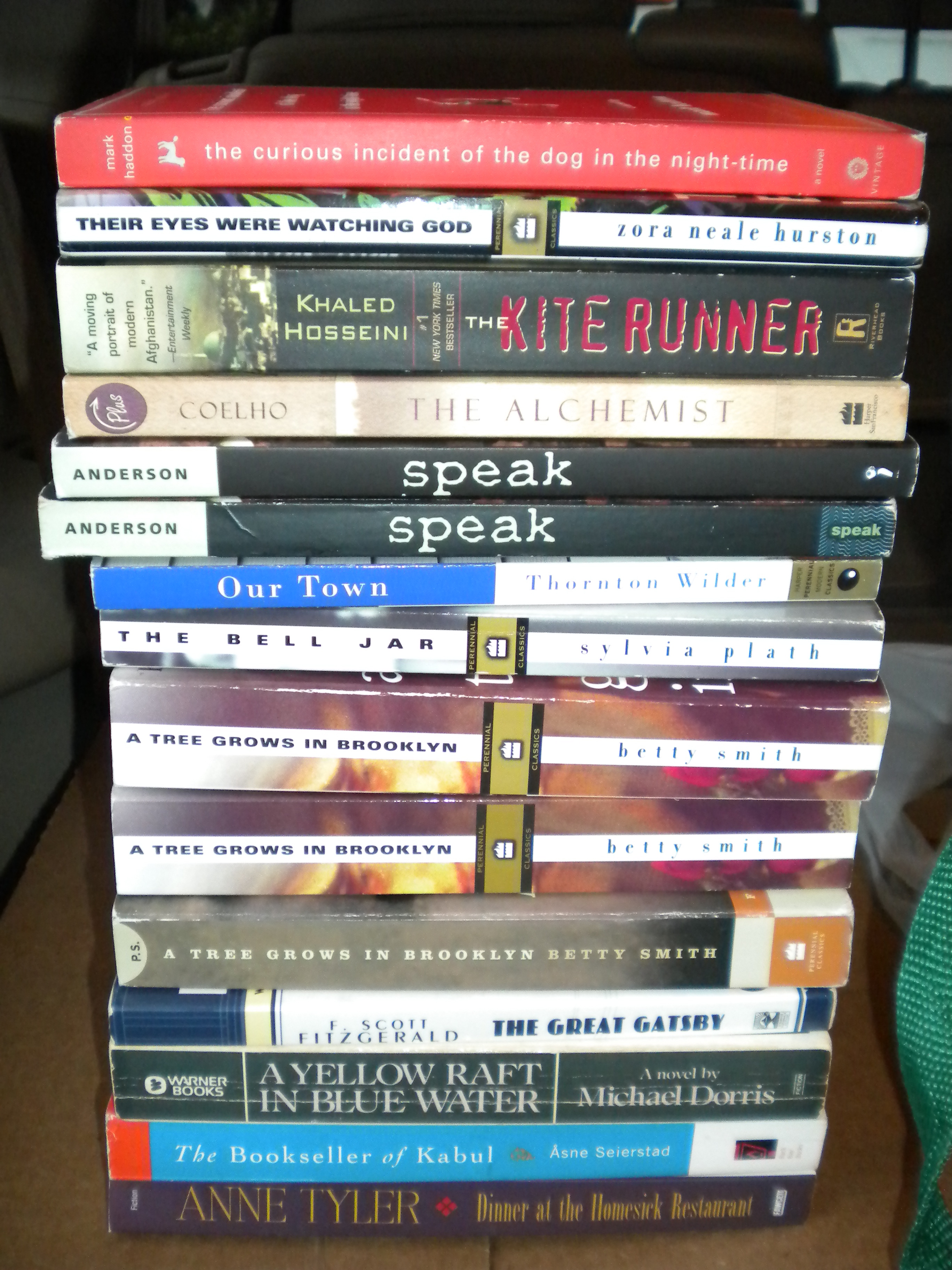
Books for the Wamogo classroom libraries from the Bethel Library Book Sale

There were many good books at the sale that I can add to the classroom libraries. There were three new copies of A Tree Grows in Brooklyn by Betty Smith, a copy of Yellow Raft in Blue Water by Michael Dorris, and a copy of Anne Tyler’s Dinner at the Homesick Restaurant for independent reading by juniors. There were also copies of books that we teach including:

Speak by Laurie Halse Anderson
The Kite Runner by Khaled Houssani
The Curious Incident of the Dog in the Night-Time by Mark Haddon
The Great Gatsby by F. Scott Fitzgerald
Our Town by Thornton Wilder

There were also five copies of classic story The Light in the Forest by Conrad Richter which we use in our Native American unit in Grade 8. The coming of age story was published in 1953, and combines historical places and incidents centered in Northeastern Ohio in the 1750s. The book has been in continued use in middle school curriculum largely due to Richter’s ability to  portray the consequences of hostilities between the Native Americans and early European settlers of the American Midwest.

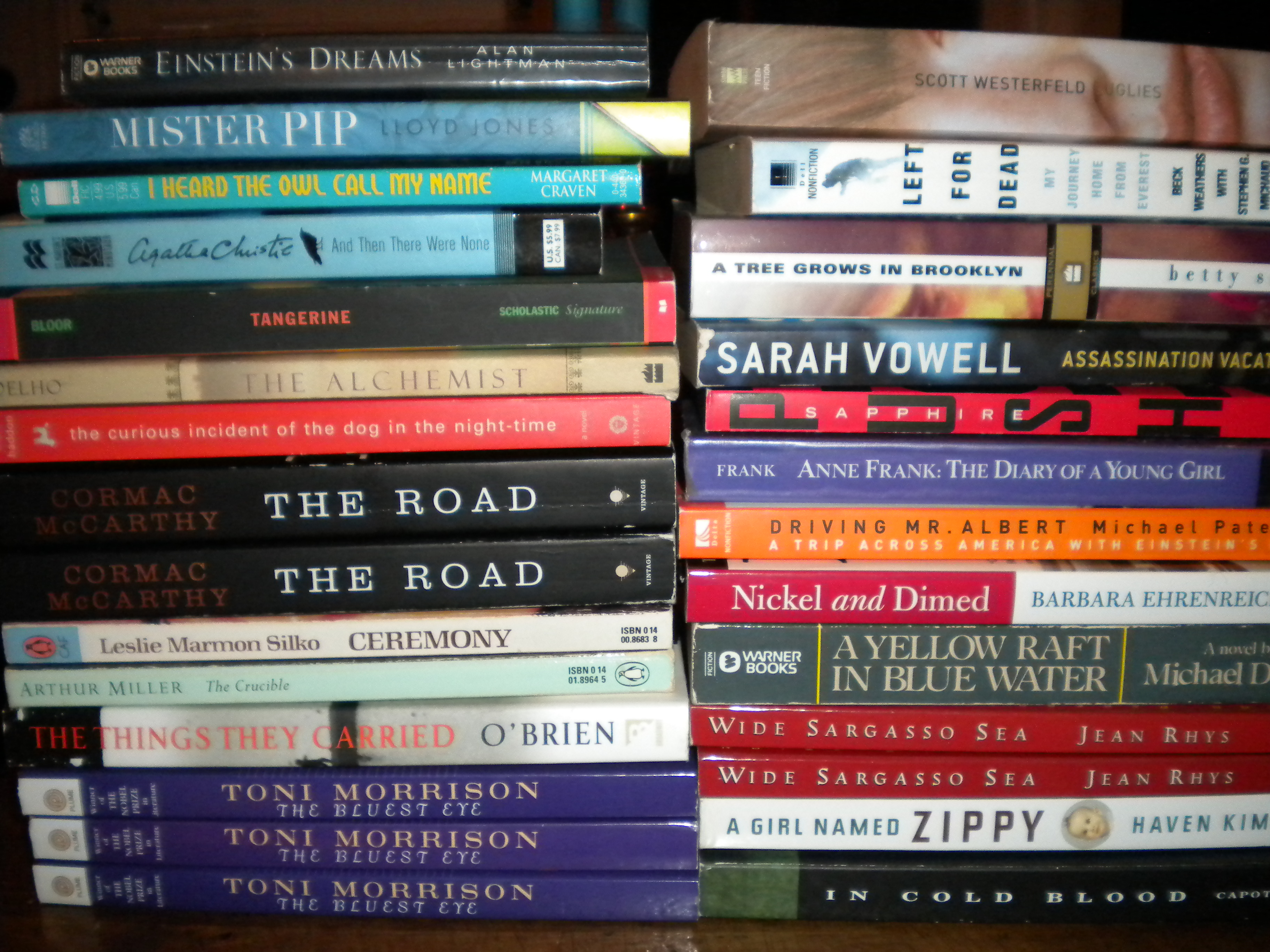
In little under 30 minutes, I picked up 72 books for $105.00; prices ranged from .50 -$2.00. The retail price at Amazon for the 15 books in the picture above would have been $158.38. My cost for these 15 books PLUS  57 other books was $105.00.

Community book sales provide an opportunity for a buyer to do a little cultural study on the reading habits of its residents. Obviously, Bethel residents enjoy fiction and the number of cookbooks was greater than the number of military history books. However, the biggest surprise was the number of tables dedicated to the genre of romance novels. I grew up in Bethel (on Grand Street from 1972-1980), and I would never have suspected that the town has developed such “passionate” interests!

I received a postcard to remind me of the upcoming sale, but I had already planned to attend since the sale was also listed on BookSaleFinder.com . Even Hurricane Irene could not stop the calm and dedicated volunteers of the Friends of the Bethel Public Library from succeeding in putting on a great sale with donated books.

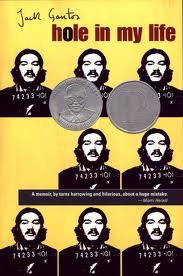
Two years ago, the senior English classes at Wamogo High School were reorganized to provide student choice in electives. One of the choices offered is Memoir, a class where students read two or three assigned memoirs and create their own memoirs in response to prompts-ex: “My Favorite Food Memory” or “That’s Me in the Photo”. Students are also required to read memoirs independently. Because of the used book market, we are able to offer a wide selection of memoirs and allow for student choice.

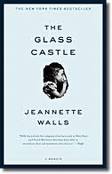
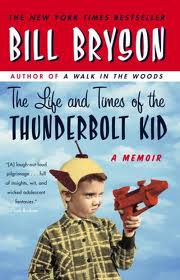
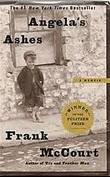
The department had previously purchased a class set  (20-30 copies) of A Hole in My Life by Jack Gantos, Angela’s Ashes by Frank McCourt, The Glass Castle by Jeanette Walls, and The Life and Times of the Thunderbolt Kid by Bill Bryson. These memoirs have been assigned as the course texts over the past two years. I have added at least 10 additional copies of each of these titles through the secondary market.

I have also purchased a minimum of 4 to 20 copies of the following books in the secondary market to offer students to read independently:

Lucky by Alice Sebold
Running with Scissors by Augusten Burroughs
Lost in Place by Mark Salzman
Iron and Silk by Mark Salzman
A Girl Named Zippy by Haven Kimmel
A Million Little Pieces by James Frey
Ambulance Girl: How I Saved Myself By Becoming an EMT by Jane Stern
Beautiful Boy: A Father’s Journey Through His Son’s Addiction by David Sheff
West with the Night by Beryl Markham
This Boy’s Life: A Memoir by Tobias Wolff
A Heartbreaking Work of Staggering Genius by Dave Eggers
The Liar’s Club by Mary Karr
Heat: An Amateur’s Adventures as Kitchen Slave, Line Cook, Pasta-Maker, and Apprentice to a Dante-Quoting Butcher in Tuscany  by Bill Buford
All over but the Shoutin’ by Rick Bragg
The Tender Bar: A Memoir by J. R. Moehringer
A Child Called “It”: One Child’s Courage to Survive by Dave J. Pelzer
Don’t Let’s Go to the Dogs Tonight: An African Childhood by Alexandra Fuller
Merle’s Door: Lessons from a Freethinking Dog by Ted Kerasote
Marley & Me  by John Grogan
Hypocrite in a Pouffy White Dress
by Susan Jane Gilman
The Road to Coorain by Jill Ker Conway
Waiting For Snow in Havana by Carlos Eire
It’s Not about the Bike: My Journey Back to Life by Lance Armstrong

If the average cost of each of the above books is around $12.00 (trade copy), four new copies of each of the 23 titles above would have cost $1,104.00. In contrast, by purchasing four of the 23 titles above for $1.00, our total cost is $92.00. That marks a savings of $1012.00. Furthermore, students have the opportunity to try out texts that might interest them at little expense to the department.

I have started to collect other titles that are starting to find their way onto used book tables:
Lit by Mary Karr
Infidel by Ayaan Hirsi Ali
Look Me in the Eye: My Life with Asperger’s by John Elder Robison
Escape by Carolyn Jessop and Laura Palmer
The Other Wes Moore: One Name, Two Fates by Wes Moore
Autobiography of a Face by Lucy Grealy and Ann Patchett

Investment so far on these six titles? $11.00 total.

12th graders are particularly interested in authors that discuss life-changing decisions since they themselves are in the process of making many life-changing decisions. Many of my students are already adults (18 years or older), so I am comfortable providing memoirs that would not be recommended for younger students. The variety of personal experience offered in memoirs informs students about the real world; for some students, authentic voices are more credible than standard high school fiction selections.

Little Women was my first book relationship. My copy came to me one Christmas, and I spent most of my pre-teenage years rereading the novel, casting myself in the role of Jo, and waiting for Mr. Bhaer to find me and kiss me under the umbrella in the rain.  Louisa May Alcott wooed me with her dialogue and strong characterization. She did not coddle me as a reader. Beth’s tragic death was devastating and real; Jo’s rejection of Laurie which was so quickly followed by Amy’s acceptance was shocking. Alcott did not write to please me, she wrote what she found genuine, and I loved every moment spent reading her story. The opening dialogue established the characters of the four March girls. I still have it memorized by heart:

“Christmas won’t be Christmas without any presents,” grumbled Jo, lying on the rug.
“It’s so dreadful to be poor!” sighed Meg, looking down at her old dress.
“I don’t think it’s fair for some girls to have plenty of pretty things, and other girls nothing at all,” added little Amy, with an injured sniff.
“We’ve got Father and Mother, and each other,” said Beth contentedly from her corner.

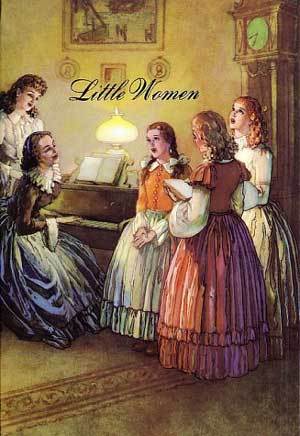
My copy of Little Women with the Louis Jambor illustrations

My copy was the Deluxe Illustrated Edition, January 28, 1947 Penguin Group  with Louis Jambor illustrations. I loved the illustrated color plates and the pen and ink drawings that accompanied many of the chapters. I clearly remember a little bird drawing that accompanied a chapter about Beth’s recovery from illness, but the cover was my favorite. This color painting shows all the girls gathered around the little spinet singing while Marmee played. Jo stands behind Marmee, while Amy and Beth sing opposite her with Meg’s back to the viewer.

So, it was with some concern that I noted that the Common Core recently released their language arts curriculum standards with suggested reading lists for grades 6-8. Little Women is on that list. I was hoping that Little Women was a just a suggestion, perhaps as an independent reading text, but a recent seminar I attended at the ISTE 2011 Conference (International Society of Technology in Education) in Philadelphia  confirmed a great fear that some educators will consider the novel a “teachable text”. The presenter at the seminar enthusiastically explained how many interesting links to Louisa May Alcott and her books could be researched by students. She demonstrated several different web quests dedicated to the study of Little Women and explained how these might be incorporated in language arts curriculum. I sat there horrified. I have no argument against a student choosing to research this novel or the author on her own. Perhaps the information will even deepen a reader’s love for the story. But to assign the Little Women?  Please, no!

If I had been assigned Little Women, would I have lingered over every page? Would I have felt that sense that Louisa May (she was too familiar to me to be called Alcott) was speaking to me, or would I have been looking for theme and symbols? Could I have been Jo if I was competing with other young girls who felt that same kinship with Jo? Would Little Women have been the same learning experience with an assigned vocabulary list? Would I have passed the multiple choice quiz or essay test?  Actually, my multiple readings would have assured a decent passing score, but would testing have assessed my deep relationship with the text?

Sadly, if well-intended educators are using the Common Core suggestions as texts to teach, Little Women will be placed in some curriculum. The novel is in the public domain, so digital texts can be accessed at no cost which makes the text attractive for low budgets. However, I shudder to think a student will be forced to read the novel rather than discover the story on her own. And although I am not gender-biased with literature, I would not assign this novel to pre-teen boys.

There are nine other texts suggested by the Common Core. The selection of these texts is an indication of the variety and the level of complexity that students should be reading in grades 6-8:
The Adventures of Tom Sawyer,
Mark Twain
A Wrinkle in Time, Madeleine L’Engle
The Dark Is Rising, Susan Cooper
Dragonwings, Laurence Yep
Roll of Thunder, Hear My Cry, Mildred D. Taylor
The People Could Fly,  Virginia Hamilton
The Tale of the Mandarin Ducks, Katherine Paterson
Eleven, Sandra Cisneros
Black Ships Before Troy: The Story of the Iliad, Rosemary Sutcliff

This list does offer variety, and the inclusion of The Adventures of Tom Sawyer offers a more challenging read for this level. I would also advocate that A Wrinkle in Time should be a suggestion for independent reading as well. But, please, teachers, assign any of the above texts and leave Little Women to the young reader who chooses to read the novel. The unforgettable story of  Meg, Jo, Beth and Amy March is for a reader to discover, not for the lesson plan.

The pressure is on. School starts in another two weeks. Summer reading still needs to be done!

Right about this time, there are some parents who are reminding (nagging?) students about their summer reading assignments, there are librarians and book stores scrambling to locate books posted on reading list, there are some students trying to cram in a little reading, while there are some students trying to cram in a few Spark Notes instead of the summer reading book. Is this commotion necessary? Is all this activity to have students read books over the summer vacation a worthwhile endeavor?

Yes. Yes, it is.

On the New York State Department of Education website, there is a summary of research on summer reading:

“In a 2009 government web cast, Secretary of Education Arne Duncan described summer learning loss as ‘devastating.’ This is what researchers have often referred to as the “summer slide.” It is estimated that school summer breaks will cause the average student to lose up to one month of instruction, with disadvantaged students being disproportionately affected (Cooper, 1996).”

“Researchers conclude that two-thirds of the 9th grade reading achievement gap can be explained by unequal access to summer learning opportunities during the elementary school years, with nearly one-third of the gap present when children begin school (Alexander, Entwistle & Olsen, 2007).”

“The body of existing research demonstrates the critical importance that the early development of summer reading habits can play in providing the foundation for later success.”

We assign summer reading for all grades 7-12. Academic level students in grades 7-11 have a choice of books, fiction and non-fiction, from suggested lists. Our excellent media specialist is a great resource for making recommendations and coordinating these lists for distribution. Honors level students are required to read specific titles; Advanced Placement students are assigned four to five books. Seniors read books that are directly connected to the elective they have chosen. All summer reading is due the first week of school.

We use the dialectical journal as an assessment tool. Students are required to find passages (5 from the first half of the book, 5 from the second half) that they think help them better understand the bigger issues of the book– theme, characterization, narrative voice, the author’s attitude towards his subject (tone), etc. The passages can be either narration or dialogue. Students respond to each passage in one of several ways such as:
1. Make a connection
2. Interpret/make a prediction
3. Ask a question (attempt to answer it)
4. Extend the meaning
5. Challenge the text

Dialectical_Journal Instructions
The first weeks of school are all about assessing individual student and evaluating class learning. Reading student responses in dialectical journals is one method a teacher can use to quickly assess a student’s comprehension and writing skills at the beginning of the school year.

I have located many of the required texts for summer reading in the used book market to make access easier for honors level students. We are able to offer gently used copies of all of the assigned texts including:
Grade 9 Honors: The Alchemist, Paul Coehlo
Grade 10 Honors: Nectar in a Sieve, Kamala Markandaya OR The God of Small Things by Arundhati Roy OR The Life of Pi by Yann Martel
Grade 11 AP Language: On the Road, by Jack Kerouac AND The Memory Keeper’s Daughter by Kim Edwards AND On Writing by Stephen King AND The Grapes of Wrath by John Steinbeck
Grade 12 AP Literature: The Grapes of Wrath by John Steinbeck AND The Tempest Shakespeare AND The Story Of Edgar Sawtelle by David Wroblewski OR The Poisonwood Bible by Barbara Kingsolver AND Reservation Blues by Sherman Alexie OR Ceremony by Leslie Marmon Silko
Grade 11 & 12 Journalism:
Zeitoun by Dave Eggers OR Firehouse by David Halberstam
Grade 12 Drama
: Our Town, Thornton Wilder
Grade 12 Creative Writing: On Writing, Stephen King
Grade 12 Memoir: A Girl Named Zippy by Haven Kimmel OR Lost in Place by Mark Salzman OR Running with Scissors by Augusten Burroughs OR Lucky by Alice Sebold

Unfortunately, the agrarian school calendar has created summer months where many students do not engage in any academic activity. Summer reading requirements for students at any grade level, choice or assigned, are speed bumps in slowing down the “summer slide.”

One statement from the article by Alan Jacobs titled “We Can’t Teach Students to Love Reading” published in The Chronicle of Higher Education on July 31, 2011, grabbed my attention: “No novel or play or long poem will offer its full rewards to someone who consumes it in small chunks and crumbs. The attention it demands is the deep kind.”

I wonder if the authors of novels, plays, or long poems write with the intent of the reader receiving “full rewards”? What does “full rewards” mean anyway? I assume from the publication The Chronicle of Higher Education that Jacobs is talking about literature of the canon usually taught in at the college or college-prep level. At these levels, does “full rewards” mean the analysis, deconstruction and/or the synthesis of literature? Is the examination of his or her literature the goal of an author? I believe Jacobs cannot qualify what he means by “full rewards” because that quality cannot be standardized. I am also not convinced authors are seeking readers who read for “full rewards”. I think authors are seeking readers-all readers-any readers. Authors write for an audience.

There are audiences of middle and high school students who are required to read novels, plays, and long poems. The length and complexity of many of these works (ex: Catcher in the Rye, The Giver, Huckleberry Finn, All Quiet on the Western Front, Great Expectations, Of Mice and Men, The Scarlet Letter, The Odyssey, Death of a Salesman) in a curriculum means that units dedicated to a text can go for several weeks as teachers try to develop the kind of deep attention in their students for the “full rewards” that Jacob admires. For example, Shakespeare’s Macbeth takes a minimum of four weeks to teach. Consequently, by the end of the unit, everyone wants to kill Macbeth: characters, students and teacher alike. Yet, in those four weeks of intense study, students still will have not received the “full rewards” of the play according to Jacobs; they will have only grazed the surface of the tragedy in the “small chunks and crumbs” afforded by the school day calendar. Honestly, Shakespeare must roll in his grave over the plodding of innumerable classes trudging endlessly “To-morrow, and to-morrow, and to-morrow, Creeps in this petty pace from day to day…”. Was “full rewards” Shakespeare’s intent?

The goal of education should be to develop reading skills so that students should read successfully. Once students read successfully, measured by understanding the author’s message and appreciating the author’s style, then students may choose to read what they like, perhaps even what they love.

Teachers, myself included, tend to “over-teach” literature. Kelly Gallagher discusses the “over-teaching” of texts in his book Readicide, and poses the following question, “When you curl up with a book, do you do so with the idea of state mandated multiple choice tests? Do you pause at the end of every chapter so you can spend an hour answering a worksheet with mind-numbing answers?” He continues that adult readers would “never buy a book at Barnes and Noble if it came with mandated chapter by chapter exams….And we [adults] would never feel compelled to read if we [adults] had to complete a project after every book.” Gallagher maintains that these are the practices that are killing the love of reading; so, it is no wonder Jacobs can make the statement that the love of reading has been the pursuit of a limited number of adults.

I will concede that Jacobs does have a point, the “deep attention” that leads to his meaning of “full rewards” may be impossible to implement in a typical middle school/high school setting, but I would also venture that authors are not as concerned with “full rewards” as they are with communicating a message to an audience. By week two of Macbeth, most, if not all, students recognize that Macbeth has brought about his own tragic fall, that his wife is riddled with guilt, and the kingdom they have usurped cannot last. Shakespeare’s enduring legacy is his ability to communicate to a universal audience; “full rewards” may not necessary for students to appreciate the play, although “full rewards” could be an individual pursuit of a student who makes that choice.

Alan Jacobs’ theory of wringing the “full rewards” from a text is the reason middle school and high school students cannot be taught to love reading. Such teaching is fragmented and frustratingly slow for the teacher and student in school. Jacobs also recognizes that the love of reading has always been built on the choice of the reader; he discusses his own progress as an adult to develop his deep attention to reading. In contrast, Kelly Gallagher offers strategies to limit “over-teaching” and provide student choice earlier at the middle and high school level that may allow students to develop a love of reading on their own much earlier rather than later to develop “deep attention” to reading as adults. Love of reading should not be an out-of-school experience.

In my inbox this past week was an article by Alan Jacobs titled “We Can’t Teach Students to Love Reading” published July 31, 2011, in The Chronicle of Higher Education. The title grabbed my attention; I rankled seeing the combination of “We Can’t Teach” with the word “Reading.” I have been reflecting on his argument and on one statement in particular:  “No novel or play or long poem will offer its full rewards to someone who consumes it in small chunks and crumbs. The attention it demands is the deep kind.”
But first, let me address the title.
The “We” in the title could  mean many different stakeholders: parents, teachers, administrators, education policy makers, academics. For the purposes of this response, however, I will generalize “We” to mean the teachers in the classrooms; those “boots on the ground” educators.
We can’t teach students to love reading does not mean that we cannot teach students to read, or to read better, or to appreciate what they read. I would argue that no one can teach anyone to love something or someone; love is a choice of the heart or the mind.
But that is not Jacob’s argument. He argues that there have always been people who read deeply as opposed to the shallow readers or grazers of information. He suggests that literacy today is not altogether different than the practice of literacy from the Middle Ages through the 20th Century. There have always been few readers in the past who engaged in long and focused reading, states Jacobs,  “Serious ‘deep attention’ reading has always been and will always be a minority pursuit.”
As a high school English teacher, I confront readers and non-readers every day in the classroom. Most students do not read with “serious deep attention.” I also appreciate how difficult deep reading is for my students given the hyperactive environments of school and the hyper-connected environments after school: digital devices are distracting; sports are demanding; jobs may be necessary. However, reading is the skill that is paramount in education.
So, I believe schools must carve out time for reading. I believe that teachers and administrators need to set aside time for reading in all disciplines. I believe adjustments must be made to schedules in order to provide quiet time for students to read, and for teachers to demonstrate how one can read deeply in such environments. Once students have developed the skills to read and acquired a positive attitude towards reading through practice, they may choose to read out-of-school. They may read for fun.
The National Assessment of Educational Progress (NAEP) found that “students who read for fun almost every day outside of school scored higher on NAEP assessment of reading achievement than children who read for fun only once or twice a month,” and much higher than students who did not read for fun at all.
I also believe that teachers should offer student choice in reading as suggested in Kelley Gallagher’s Readicide (a philosophy which is the driving force behind this blog) at every opportunity.  We should allow for student choice in reading coupled with reading for fun, as Gallagher says, “not for analyzing the author’s tone…not for the multiple choice question. Reading for fun.”
At the middle school and high school levels, we can offer students a choice of contemporary coming of age novels when they are assigned JD Salinger’s Catcher in the Rye. We can offer students a chance to read real life adventures when they are assigned Homer’s The Odyssey. Or, we can simply let students pick a book they want to read. These combination of factors can help improve student reading.
Jacobs himself admits he has “retrained his brain” and recovered his ability to read deeply through the technology of the e-book; he speculates that students who have, “never seriously read for information or for understanding, or even for delight—can learn how.” Yet, we owe our students the opportunity to develop a desire to read for fun beyond the school day, since Jacobs notes that, “Slow and patient reading…. properly belongs to our leisure hours.”
There are many factors which lead Jacobs to his conclusion, “All this is to say that the idea that many teachers hold today, that one of the purposes of education is to teach students to love reading—or at least to appreciate and enjoy whole books—is largely alien to the history of education.” While Jacobs may be correct about teachers and education’s historical role in contributing to the love of reading, there are teachers today who are promoting choice, providing time, and welcoming new technologies in improving student reading. Perhaps their response to Jacobs could be in an article titled, “We Can Make Students Better Readers Who Have Developed ‘Deep Attention’ By Offering Time and Choice.” Deep reading should not be a minority pursuit.

While not exactly on vacation in Idaho, I have a little free time to read or to look for book bargains for the English Department back home. Since I will have to mail purchases (media mail at the US Post Office), the books must be a hard to find titles and/or be in excellent condition at extremely low cost to qualify as a bargain out-of-state. In a short time, I found many bargains at the Idaho Youth Ranch Thrift Stores, with several books selling for as little as $.25.

According to the web site, The Idaho Youth Ranch is a non-profit corporation that services troubled children ages 8-18 by providing “long-term residential care to young people who are traumatized by abuse and/or neglect or an adverse experience, and as a result, this trauma interferes with their ability to control behavior and manage emotions. The program is based on an early intervention model to help at-risk youth who are in the beginning stages of behavior problems. The sliding fee schedule, coupled with donor-based support, accommodates youth and families who are not served through county or state-funded programs, and/or can’t afford the cost of care.” The program began working with children in 1957 and currently has three residential homes.

The thrift stores are part of a network “located throughout Idaho to provide substantial revenue, work opportunities, and goodwill for The Ranch and its nearby citizens and communities.” I shopped at three locations:

  • 1417 Main Street, Boise
  • 3840 Chinden Blvd. Garden City
  • 250 N. Orchard, Boise

All three stores were well organized with cheerful staff who were quite chatty as I checked out. Books were separated by genre in each store, and in the N. Orchard location, the fiction books were alphabetized by author. All three stores had impressive children’s picture  book collections.

28 books for $29.25; all copies in excellent condition and heading East!

Visiting the Idaho Youth Ranch Thrift Stores,  I picked up 28 books altogether for the department’s libraries, and I left a copy of Pride and Prejudice and Zombies with my niece. There were three copies of The Bluest Eye by Toni Morrison,  two copies of The Road by Cormac McCarthy, and a copy of The Things They Carried by Tim O’Brien for grade 11. The retail price at Amazon for these six texts alone would be $68.98; the entire cost for 28 books purchased at the Idaho Youth Ranch Store? $29.25. The best find? A brand new copy of In Cold Blood by Truman Capote for the Advanced Placement Language class for $1.50.

What is most interesting about finding donated books is speculating about the communities that have used books for sale. In many ways, the reading communities of Boise, Idaho, are very similar to reading communities in the western part of Connecticut. There must be some common interests to see the same titles offered in thrift stores separated by 2,500 miles. More likely, there must be common reading assignments given to students from coast to coast.

Back in Connecticut, Wamogo High School has an agricultural program which offers equine classes; many of our students own their own horses as well. The Idaho Youth Ranch Thrift Stores support a horse program for the students who attend school at their ranch.  The website notes that, “An important adjunct to therapy and a regular part of the school day at The Ranch, residents learn about all aspects of life with horses–from grooming, feeding, and tack to animal psychology, biology and riding. Classes are held on breeding and care of a horse. Residents experience ‘hands on’ training in foaling, imprinting, and halter breaking, as well as preparing young foals for sale.”

The books that are going to Connecticut were donated to support a horse program for students in Idaho. My horse loving students will be happy to know that.

Elie Wiesel’s memoir Night is taught in coordination with a social studies unit on the Holocaust.  The 10th grade English curriculum attempts to capitalize on teaching world literature through historical contexts; Night is one text that bridges the educational objectives of English and social studies.

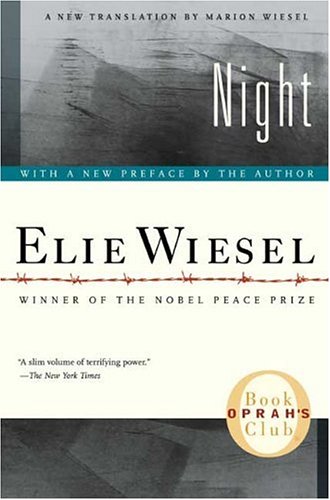
The new translation by Marion Wiesel made popular by Oprah's Book Club

The memoir begins as the Jews of the little town of Sighet, Hungary, are rounded up and taken in cattle cars to the camps at Auschwitz and Buchenwald in 1944–1945. Wiesel remembers how the prison guard called out and separated the incoming Jews:


“Eight short, simple words… Men to the left, women to the right.”
To the left meant assignment in the prison labor camp; to the right meant extermination in the gas chambers and ovens.
Wiesel continues:
“For a part of a second I glimpsed my mother and my sisters moving away to the right. Tzipora held Mother’s hand. I saw them disappear into the distance; my mother was stroking my sister’s fair hair … and I did not know that in that place, at that moment, I was parting from my mother and Tzipora forever.”

At 15 years old, Wiesel endured starvation, injury, and disease, conflicted by his need to protect his father and his frustration with his father’s deteriorating condition.  He was tormented by the relief he felt when his father passed away. The final image of Wiesel’s ghostly reflection in a mirror shortly after liberation is haunting.

Students living in rural Connecticut have a difficult time comprehending the horrors of the Holocaust; they are safely separated by time, circumstance, and geography from this event. Night helps to personalize the experience of genocide; while the book itself is slender, the impact on our students is tremendous.

Last year, students were given the chance to select an independent book to read with Night. These books varied in reading level and genre. They chose from the following list:
Fiction
Soldier Boys by Dean Hughes
The Boy in Striped Pajamas by John Boyne
Briar Rose by Jane Yolan
Milkweed by Jerry Spinelli
The Book Thief by Markus Zusak
Non-fiction
Anne Frank: Diary of a Young Girl
Maus: A Survivor’s Tale by Art Spiegelman (graphic novel)
I Have Lived a Thousand Years by Livia Bitton-Jackson

All of the books offered were added through used book sales except for Maus and The Boy in Striped Pajamas, which we borrowed from the Connecticut Library Council, and The Book Thief which we purchased new (30 copies).

There are two best selling books related to the Holocaust that have begun to show up in used book sales. The Guernsey Literary and Potato Peel Pie Society by Mary Ann Shaffer and Annie Barrows; and Sarah’s Key by Tatiana de Rosnay have been popular with book clubs. I also have several copies of Stones from the River by Ursula Hegi for Advanced Placement students.  I have picked up a few copies of each and could also offer these  books to the more experienced readers.

During the Holocaust unit, students had four weeks to complete their independent book and Night. We offered silent sustained reading twice weekly, and there was a showing of the film Schindler’s List (parental permission required). When students completed both the independent reading and Night, they wrote essays that compared a section of the independent reading to a section from Night.

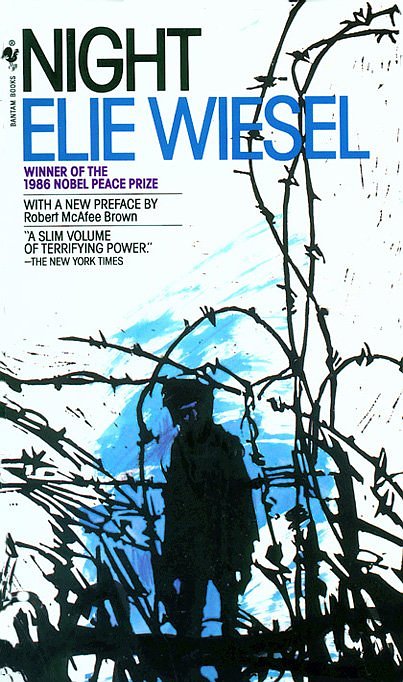
The older edition of Night; we have switched over to the newer edition pictured above

We are moving from the older Bantam paperback edition to the recent translation by Marion Wiesel which was made popular when Oprah chose Night for her book club. Oprah also filmed a visit to Auschwitz with Wiesel; his narration is so quiet I need to put the audio setting on close captioned.

This summer I have located about 20 copies of the recent translation of  Night, many of which were brand new, in the CT book sales in Westport, New Milford, Newtown and in Boise, Idaho. In addition, I recently placed an order with Better World Books for 46 “gently used” copies of Night.  Combining the 20 copies I have located at summer book sales and used book stores with the 46 used copies, the department library now has 66 copies of the latest edition of the text for a total of  $311.53 which is roughly $4.72/text.

Night is an important book in our curriculum, at any price. Elie Wiesel makes that important connection beyond geography, beyond time, and beyond circumstances for my students; his voice against genocide is eloquent and memorable.

If you happen to find yourself in Boise, Idaho, as I frequently do, and you need a used book, check out Rainbow Books at 1310 West State Street. My family lives in Boise, and I have driven past Rainbow Books for about 20 years. I am sorry it took so long for me to discover this little  book store.

Rainbow Book Store in Boise, Idaho....in case you are ever in Boise!

According to its website, “Rainbow Books was moved to its current location at 1310 West State Street in 1993 and continues to add more shelves for more books all the time. Rainbow Books was chosen ‘Best of Treasure Valley’ in 2003 not only for its incredible selection, but also because of the staff’s unbelievable knowledge of its stock.”

On this very hot afternoon, the store had several “browsers” including a young couple canoodling in the air-conditioned book stacks. They were quite preoccupied and paid little attention to me as I crawled along the expansive classic section. The store is a reconverted house, and there are many different rooms to explore; all are well lit, and there is no musty odor one sometimes associates with used books.

I found the shelves very well organized by genre. The children’s literature was appropriately divided into sections: picture books, chapter books and YA literature; and there were many “finds” for my classroom. The military section was small, but there was an entire room shelving unit devoted to Westerns. Should I discover that my students would like to read Westerns, I will certainly be in touch with Rainbow Books! The biography and memoir section also had a wide range of titles. I did ask if they had a copy of October Sky by Homer Hickam, but I was informed that if there was a copy available, it would be shelved under a section called “Men’s Books”; apparently, most people do not look for this title as a memoir, so the staff adopted a genre change!

There were nearly all of the trade books I pick up at used book sales (The Bean Trees, The Road, The Kite Runner), but since I am traveling, all  purchases will be mailed to the school, so I was careful to select books that were both “hard to find” and in excellent condition.

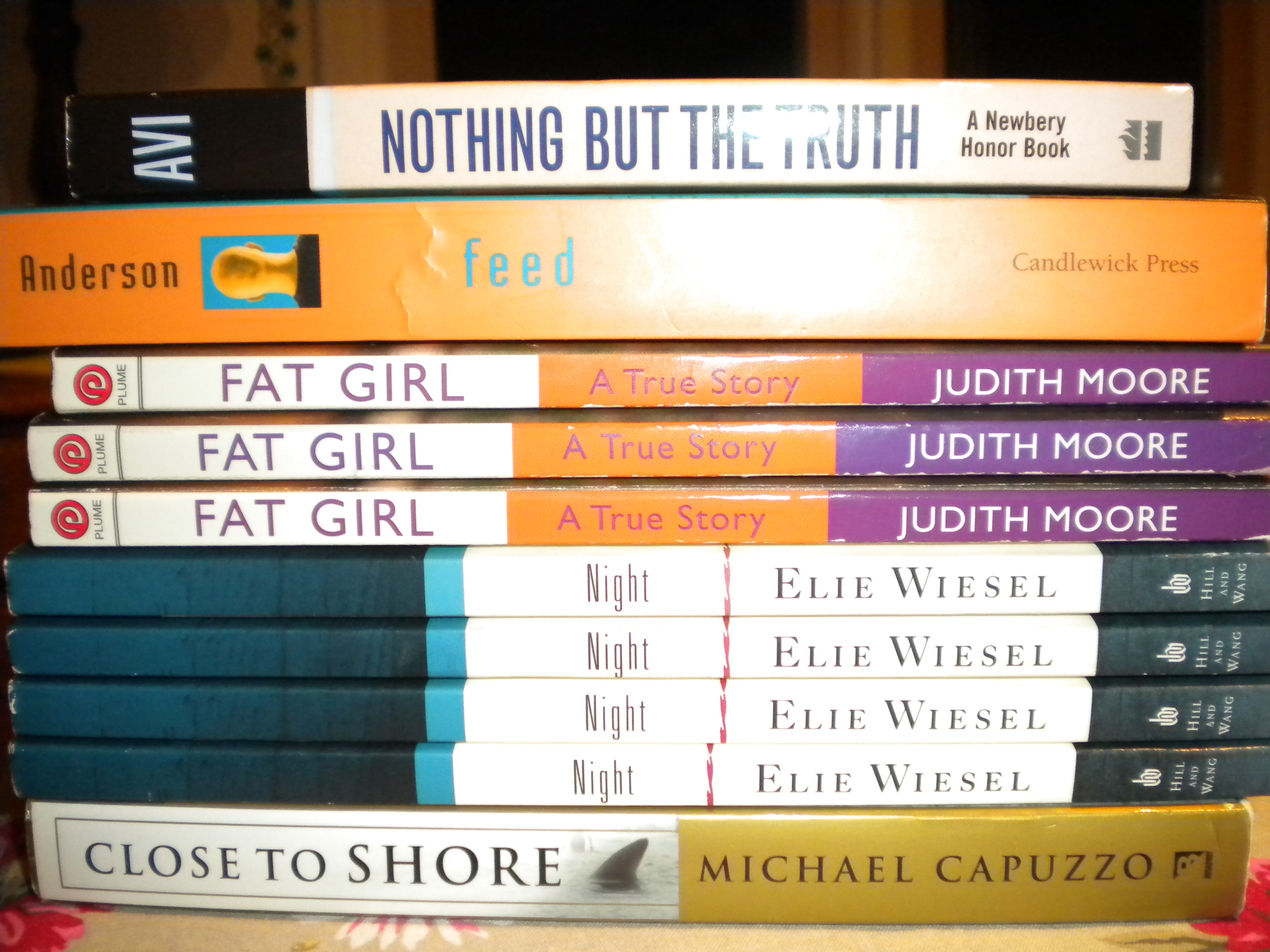
What books go into the used book classroom? I found a copy of Feed by M.T. Anderson (9th grade), Nothing but the Truth by Avi (8th grade), and Close to Shore by Michael Capuzzo (summer reading). All these titles are hard to find.

Books purchased at Rainbow Books for $44.30

The best discovery was locating four copies of the newest edition of  Night by Elie Wiesel which is a required reading text in grade 10. I also picked up three copies of Fat Girl: A True Story by Judith Moore to add to the independent reading selections for the 12th grade memoir class.

These 10 books cost $44.30 with a 10% teacher’s discount, or a little under $5.00 per book. I will have to spend $7.99 in postage (USPO media mail), bringing total expenses to $52.29. What did I save by shopping at Boise’s oldest, friendliest, and most generous used bookstore? Well, the retail price for these texts $108.60; so, including the postage, my total savings $56.31.

There are buying, trading, and selling policies listed on the Rainbow Books website; a sign at the register also indicated they sell through Amazon as well.  However, shopping online means you miss a great opportunity to shop in this pleasant used book store….or buy doughnuts next door….or ice cream up the street!

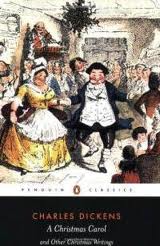
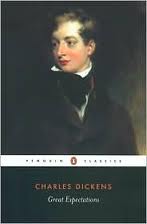
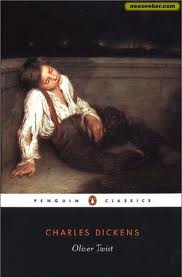
A Christmas Carol and Great Expectations by Charles Dickens are in the 9th grade honors curriculum at Wamogo High School.  Selections (chapters 1 -3) of Oliver Twist are in the 10th grade college prep curriculum to complement the Industrial Revolution unit taught by the Social Studies Department.

A Christmas Carol: 9th Grade Honors Reading

Great Expectations: 9th Grade Honors Reading

Oliver Twist: 10th Grade College Prep Reading

Our student do like the novels by Dickens…once the book is completed.  They enjoy the complicated plot twists…once the twists have ended. They remember the quirky characters…once the book has been turned in.

A problem with all novels by Dickens is the length. Simply, he got paid by the word. A problem with Dickens is the vocabulary. He liked to use long and complicated words. A problem with Dickens is his sentence structure. He used complex sentences.

The problem of length is difficult to address. His novels cannot be satisfactorily shortened; abridged editions lack his satire and comic touch.  The problems of vocabulary and complicated sentence structure, however, are reasons to teach any Dickens novel. There hundreds of  SAT/ACT words in any Dickens’ text. A quick review of a several words from Oliver Twist should prove my point:
panegyric- a formal expression of praise
asseverate-state categorically
asperity- something hard to endure
rapacity– extreme gluttony
myrmidon-a follower who carries out orders without question
pule-cry weakly or softly
postilion-someone who rides the near horse of a pair in order to guide the horses pulling a carriage (especially a carriage without a coachman)
seneschal-the chief steward or butler of a great household
imprecation-the act of calling down a curse that invokes evil (and usually serves as an insult)
saveloy-a ready-cooked and highly seasoned pork sausage (probably not an SAT/ACT word, but fun to know!)

Dickens sentences are complex:

“The evening arrived; the boys took their places. The master, in his cook’s uniform, stationed himself at the copper; his pauper assistants ranged themselves behind him; the gruel was served out; and a long grace was said over the short commons. The gruel disappeared; the boys whispered each other, and winked at Oliver; while his next neighbours nudged him. Child as he was, he was desperate with hunger, and reckless with misery. He rose from the table; and advancing to the master, basin and spoon in hand, said: somewhat alarmed at his own temerity:
‘Please, sir, I want some more'” (Oliver Twist)

From a student’s point of view,  sentences like these appear puzzling.  Young Oliver’s adventures are just starting in  Chapter 2…and there are 51 more chapters like this one! Reading a Dickens’ novel or a passage requires focus and determination.

There is much to be gained by sticking with Dickens, to pushing students out of their comfort zone of 21st Century twittering and texting. Students can develop skills in following the main idea in a selected passage of text. Students can rephrase Dickens’ sentences to better understand his satire. Students can imitate his writing the way painters imitate great artists using his work as “mentor texts”. Finally, students can comment on Dickens’ characters and make connections of these characters to contemporary people, because that is exactly what Dickens did to his own contemporaries.

Since all literature by Dickens is in the public domain, students have access to an e-text; I do not need copies for each student when students choose to download the book to an e-reader device, and digital copies are excellent when students need to read only a few passages or chapters. The classroom libraries already do contain enough copies of Great Expectations, Oliver Twist, and A Christmas Carol for those students who choose a paper copy. The copies of Dickens’ novels that are available in used book sales are often quite old and musty, but Oprah’s recent selection of Great Expectation and A Tale of Two Cities for her book club may result in newer editions entering the used book market

To date, the cost for these titles? Nothing. The results of teaching the most popular English novelist of the Victorian Era? Priceless.