Archives For November 30, 1999

English teachers are seduced by literature. We fell in love with an author’s language, a fascinating plot turn, or a well-developed character, and we are bold in our love. While students may roll their eyes when we proclaim The Great Gatsby  or Great Expectations as  a favorite book, or snicker when we dramatically recite lines from Shakespeare’s Macbeth, we hardly pause in our attempts to introduce 1984 into 2012 brains. They may groan while we happily distribute Lord of the Flies and assure them they will “love” the book; they may find us positively deranged when we weep at the death of Lenny (Of Mice and Men), or the Man (The Road) or Willie Loman (Death of a Salesman). However, nothing makes an English teacher happier than the conversion of our reluctant readers into admirers of an author’s work. The teaching of literature as a record of man’s humanity sums up our purpose, our raison d’etre. For writing and grammar, we will roll up our sleeves and revise, and conference, and edit, edit, edit. For the newer standards in listening and speaking, we support presentations in class and incorporate technology when necessary, but the joy of teaching English is in the literature, in the wealth of stories told by others.

Now, the adoption of Common Core Standards has many English Language Arts teachers concerned. Why? According to one of a number of  Common Core websites, (NOT the Common Core State Standards website) the standards are designed around the “basic idea” of a “utilitarian education.” David Coleman, one of the architects of the Common Core, supports the expansion of informational texts, a genre formally known as non-fiction, into all disciplines, “For example, students are asked to read a variety of texts. In 4th grade, they must read 50% literary text and 50% informational texts; by high school, they read only 30% literary texts and 70% informational texts.” Of course, English teachers have always included exceptionally well written pieces of non-fiction into their teaching. For example, Jonathan Swift’s A Modest Proposal illustrates power of satire, Elie Wiesel’s Night is a haunting memoir, and Roger Rosenblatt’s The Man in the Water is a memorable personal essay, and all have found homes in English curriculums. But the disproportionate ratio of 30% fiction to 70% informational text? That ratio for lovers of literature is alarming.

In order to achieve the inclusion of informational texts, The Common Core of Standards for English/Language Arts includes a separate set of standards that address reading and writing in history, science, math and the technical areas. While these standards were developed to expand reading and writing in these disciplines in order to advance core knowledge, these standards still fall under the umbrella of the English/Language Arts Standards. Note that these standards have not been developed by the respective disciplines of history, science, math and the technical areas. Moreover, there is no mechanism for enforcing these standards through history, science, math and the technical areas except through the English/Language Arts Standards. English teachers are understandably concerned that they will ultimately be responsible for the increase in the reading of informational texts at the expense of the literature they so dearly love.

So, it is with great delight that I read in an informational text (aka news article) that science supports the reading of fiction.
According to an article in the New York Times, Your Brain on Fiction (3/17/12) by Annie Murphy Paul, neuroscience is riding to the English teacher’s rescue! The article is centered on research that demonstrates “Brain scans are revealing what happens in our heads when we read a detailed description, an evocative metaphor or an emotional exchange between characters. Stories, this research is showing, stimulate the brain and even change how we act in life.” Apparently, our brains cannot differentiate between the fictional experience and the real life experience, “in each case, the same neurological regions are stimulated.” Furthermore, the simulation of social experience in fiction through a character’s point of view  helps prepare our brains for real-life social interactions.

Researchers Dr. Oatley (University of Toronto)  and Dr. Mar (York University-Canada), in collaboration with several other scientists, reported in two studies, published in 2006 and 2009, that because of these fictional experiences, readers were more empathetic.

Fiction, Dr. Oatley notes, ‘is a particularly useful simulation because negotiating the social world effectively is extremely tricky, requiring us to weigh up myriad interacting instances of cause and effect. Just as computer simulations can help us get to grips with complex problems such as flying a plane or forecasting the weather, so novels, stories and dramas can help us understand the complexities of social life.’

Dear Common Core, take note. Science has the research to prove that the reading of fiction is equally critical to the development of our social life skills; fiction is not limited to a ratio of 30% importance. The usefulness of fiction in social development is not an arbitrary argument from the heart, but a means by which our brains experience our world.  Yes, informational texts can deliver content and support core knowledge, but fiction is what develops our humanity. Which is why we English teachers fell in love with stories in the first place.


In order to familiarize English teachers with the Common Core Language Arts Standards, education policy expert David Coleman has been making the rounds with sample lessons and explanations. A video taken in NY , Close Reading of Text: Letter from Birmingham Jail, Martin Luther King, Jr. from EngageNY on Vimeo, has been posted on the English Companion Ning with the caption, “David Coleman leads a sample exploration of a complex text utilizing strategies outlined within the six shifts in instruction.” The text he discusses is Martin Luther King’s Letter from a Birmingham Jail; the video takes 15 1/2 minutes to watch. One point he makes about extended close reading is particularly alarming. But first, a quick bio on David Coleman (supplied for seminar):

David Coleman is a Founding Partner of Student Achievement Partners, a non-profit  organization that assembles leading thinkers and researchers to design actions to substantially improve student achievement. Most recently, Mr. Coleman and Jason Zimba of Student Achievement Partners played a lead role in developing the Common Core State Standards in math and literacy. Mr. Coleman and Jason Zimba also founded the Grow Network – acquired by McGr aw-Hill in 2005 – with the mission of making assessment results truly useful to teachers, school leaders, parents, and students. Mr. Coleman spent five years at McKinsey & Company, where his work focused on health care, financial institutions, and pro bono service to education. He is a Rhodes Scholar and a graduate of Yale University, Oxford University, and Cambridge University.

Coleman is also on the board of directors of The Equity Project Charter School (TEP), a 480-student middle school in the Washington Heights neighborhood of New York City that opened in September 2009. The school has received much attention because of the  $125,000 salaries paid to teachers. The 2010-2011 results of NY English-Language Arts Assessment given to 5th graders saw a passing rate of  31.3%, below average for comparable schools. The school, however, has moved up 127 ranking points from 2009-2010, and its current standing in ELA assessment is 1972 out of 2291 NY state schools.

I think it is important to note that Coleman is not a teacher. He has not taught in a classroom.
Back to Letter from a Birmingham Jail.

Coleman spends a great deal of time using a New Criticism approach, which is defined at the Bedford St. Martin VirtuaLit website as one that, “…stresses close textual analysis and viewing the text as a carefully crafted, orderly object containing formal, observable patterns…New Critics are more likely than certain other critics to believe and say that the meaning of a text can be known objectively.” This marks a shift from Reader Response Criticism, defined by proponent Stanley Fish as recognizing that the reader is active, and that “Literature exists and signifies when it is read,and its force is an affective one. Furthermore, reading is a temporal process, not a spatial one as formalists assume when they step back and survey the literary work as if it were an object spread out before them.”

Paragraph by paragraph, Coleman analyzes the language and structure of King’s letter, occasionally suggesting  that the letter can be a jumping off point for further study into historical injustice or to Socrates. Exactly how a teacher positions the students to make the intellectual jump to recognizing the strategies of King’s moral argument is not explained in Coleman’s video.  Instead, Coleman offers his possible interpretations of King’s letter. He models a lesson he would give, but he is not providing a strategy. Strategy is a plan of action designed to achieve a vision; Coleman provides an example, not a plan of action. To be clear, critical thinking is a strategy and students need to have critical thinking skills. For example, at the Critical Thinking Community, there are eight elements of reasoning that could serve as strategy, a plan of action, for analyzing King’s letter:

  • What is the text’s purpose?
  • What questions does the text generate or try to answer?
  • What information is contained in this text to answer these questions?
  • What inferences are being made in the text?
  • What key concepts does the reader need to know when reading the text?
  • What assumptions can the reader make about the text (and its author, purpose)?
  • What are the consequences of having read this text?
  • Whose point of view is seen in the text? Whose point of view would be different?

I have not taught King’s letter, but I have taught challenging texts of similar length and complexity. I have taught Elie Wiesel’s 1999 speech to Congress The Perils of Indifference and George Orwell’s 1946 essay, Politics and the English Language. Both pieces were taught in conjunction with a work of fiction rather than “stand alone” pieces. Both texts took one or two periods to have students understand the purpose of the text and the information in the texts. I did not take students through all of the elements of reasoning; these were supplemental texts I chose to support fiction were we studying.

So when I heard Coleman’s position that a teacher should spend six to eight days on this letter, I was taken aback. Really? Six to eight days is two weeks in “school time”, the same amount of time I usually spend teaching the entire memoir Night by Elie Wiesel. Six to eight days represents the class time used for several grammar mini-lessons and two polished essays. Six to eight days represents a unit on (8) sonnets, or a unit on (5) short stories, or the in-class reading of three acts of Shakespeare’s Macbeth.

Again, I must reiterate that Coleman is not a teacher. He has not taught in a classroom.

Back to Letter from a Birmingham Jail.

The genius of King’s letter is how he combines the political and moral argument in an emotional appeal that is, like all great literature, immediately evident. I see the protracted dissection of his letter as akin to tearing a delicious muffin apart in order to reduce the muffin to its ingredients, all that is left are the (still delicious) crumbs. Furthermore, focusing so much attention on this one letter  could be construed as a little insulting to King. I sense he, like any author, did not intend for his work to be parsed in classrooms for such extended periods of time. Close reading is important, but inspection is another. Students generally are not interested in the minutiae of rhetorical composition. I also envision a cadre of dead American authors similarly frustrated rolling in their graves as students are forced to slog through weeks upon weeks of literature study…”Once upon a  midnight dreary…” .

In my classrooms, Coleman’s suggested time of processing extended reading over six to eight days would be met with frustration by many of my students, regardless of reading level. I speak from experience in the classroom where three days (reading, responding, discussing, and writing) in a 9th grade classroom spent on Edgar Allen Poe’s Cask of the Amontillado is sufficient; a fourth day would make them as mad as Montresor. Furthermore, his blithe remark that extended time will better allow all students to participate and make contributions again places the emphasis on time rather than on the engaging strategies that need to be in place.Yes, close reading is a skill, but that skill must be practiced with a multitude of texts. The application of close reading skills from one selection to another is where many students falter.  Strategies that improve a student’s close reading skills from one selection to another, from one genre to another, from one discipline to another should be the focus of teachers implementing Common Core standards. The disproportioned allotment of time to one text reduces the amount of time practicing with other texts. While Coleman could argue that a close reading of six to eight days would be taught only once in order to model close reading skills, the likelihood that students would replicate that lengthy  process on their own is unlikely.

A student’s level of appreciation of a text is still often tied to personal experience. Deep engagement with a text for student is,  as with many adults, a personal experience that cannot be forced. Coleman’s six to eight day formula may make a student aware of elements in a text but not necessarily personally engage in the same manner he espouses. His personal engagement with King’s letter is obviously one of reverence; his video explaining King’s letter borders on proselytizing. In comparison, King did that better-and he didn’t take six days.

One statement in Grant Wiggins’s review of the survey he gave to 7300 students from middle and high school students nationally was particularly infuriating to me. He had posed the question, “What was the most interesting work/task/project you had last year in school?” In reviewing the student responses, (73 of which were posted on the blog), Wiggins casually noted that  “..almost nothing from English or Math was highlighted.”

How can this be?

English and math classes did not offer interesting tasks or projects? Really? I cannot speak for math, but as an English teacher,  I feel bit defensive. English teachers of the students in this study could not find “interesting” ways to teach grammar or literature or writing skills?

Wiggins does state that the “results do not reflect a ‘normal’ national sample” since the schools that participated were either directly involved with his Understanding by Design workshops or requested to be involved in the survey. Sadly, the evidence from the students posted on the blog does seem to support this point; a class project, a series of responses dedicated to Lord of the Flies, was one of only several English/Language Arts assessments that made the list of the ” most interesting work/task/project you had last year in school?”

Familiarity breeds contempt? Do students enjoy disciplines other than English because these disciplines are more active?

I wonder if this a problem of familiarity. Students are programmed what to expect in English/Language Arts classes, and according to this study, so are the teachers.

Consider that every one of the students responding has had to take an English/Language Arts class for each year he or she is in school. The focus of curriculum in these classes, regardless of grade level, is the improvement of student skills in reading, writing, and speaking. That’s it. Year after year of  reading, writing, and speaking. Yes, the work becomes more complex, but the work in English is fairly routine. Students read. Students write. Students speak.

There are other disciplines that are sequential, a series of prescribed steps that build on knowledge. For example,  a student must understand addition before moving onto multiplication.  The acquisition of reading, writing, and speaking skills, however, is measured differently. A student will encounter the comma long before he or she understands its function in a sentence. A student will decode a metaphor well before he or she knows what the literary term means. A student will decipher the meaning of a word in context in reading without the aid of a dictionary.

English is not really sequential set of knowledge steps but a weave-a continuous layering of warp and woof. Students are initiated in improving the skills of  reading, writing, and speaking in pre-school and continue to develop these skills at each grade level.

Could students simply be tired of the “same old same old”? Do they not appreciate the importance of the skills they learned in the English/Language Arts classroom?

The standards in the Language Arts Common Core follow a sequence of growing complexity, but ultimately is the Kindergarten Standard (K.RL.1) “With prompting and support, ask and answer questions about key details in a text” that much different from the Grade 12 Standard (12.RL.1) ” Cite strong and thorough textual evidence to support analysis of what the text says explicitly as well as inferences drawn from the text, including determining where the text leaves matters uncertain”?

These standards require that during a student’s 13 years in education, there must be multiple opportunities to cite, analyze, respond, write, and speak. English/Language Arts teachers must develop assessments that move students to meeting these standards. Other disciplines may assess a student’s ability to build, demonstrate, create, or illustrate with a “hands on” approach. Certainly, English/Langauge Arts can have students build (a character), demonstrate (a vocabulary word’s meaning), create (a film), illustrate (a chapter), but ultimately the student skill assessed is aligned with standards that measure continued improvement on the skills of reading, writing, and speaking. Ultimately the conundrum English /Language Arts teachers face is the skill used is the skill being tested; including a 3rd dimension- engaging in the physicality of English/Language Arts- is not required by Common Core standards. One could simply meet each standard with pen and paper, with “words, words, words”…

Take for example, some of the student responses to the survey’s prompt “what was the most interesting work/task/project you had last year in school?”:

  • Building a house. This was interesting because I had to make something new everyday and the project always had soemthing[sic] to work on and i never got bored.
  • We are currently dissecting a fetal pig in Biology.  It is interesting because dissections are a very good chance to see how an organism works firsthand.
  • A mock trial in my Business and Personal Law course was the most interesting work I’ve had to do.
  • Made a rocket car for Metal
  • The lemonade game in economics. We got to run a sim of a lemonade company.
  • testing the PH levels of water of the pond at our school.
In reading the responses to the survey, students exude an obvious enjoyment that comes from engaging in assessments in which they worked “hands-on”; many times their engagement was physical and interactive. Of course, the lessons learned in English/Language Arts classrooms, the skills of reading, writing, and speaking, contribute directly to success in all other disciplines. But, students do not consider these important skills when rating “interesting work”.
So what can English/Language Arts teachers do to move up on the scale of the most “interesting work” in high school? Obviously, we need to think about making our assessments meaningful beyond the (hand?) printed word. We need to consider how our students will write, read, and speak after high school, and in this relatively new century, digital mediums offer up a myriad of possibilities. Communication can extend beyond the classroom walls, work can be more collaborative, and speech is not limited to reading from index cards at a podium in class. Reading is now done in the “real world” on multiple platforms and support with diverse technologies (text-to-speech, definitions in context, etc) can level the reading in a classroom. Film and audio resources are plentiful for both viewing, but more importantly, for student production. Research can be accomplished without the limitations (24/7 access to material) that have stymied past generations. Simply put, English/Language Arts teachers have the resources to increase student engagement in new ways and to use the digital platforms that are increasingly used for education and business in the real world. If not, the pen is still mightier than the (_____)-you fill in the blank.
Studies in psychology show that on the vast majority of occasions, the less familiar we are with someone or something, the more we are inclined to like them. The “new” is almost always more exciting than the “routine”. So, students may become biased with “familiarity” against English/Language Arts class because they are continuously acquainted with the objectives of improving reading, writing, and speaking skills. Perhaps it is this familiarity that keeps English off the “most interesting work” list as students jettison literature studies, grammar games, and speeches for new experiences in less familiar disciplines.
Regardless, English teachers everywhere can take some small comfort knowing that  there would not be a list at all if it was not for the English/Language Arts classroom…after all, students had to use “word, words, words” to write their responses. If only the students would spell correctly!

Little Women was my first book relationship. My copy came to me one Christmas, and I spent most of my pre-teenage years rereading the novel, casting myself in the role of Jo, and waiting for Mr. Bhaer to find me and kiss me under the umbrella in the rain.  Louisa May Alcott wooed me with her dialogue and strong characterization. She did not coddle me as a reader. Beth’s tragic death was devastating and real; Jo’s rejection of Laurie which was so quickly followed by Amy’s acceptance was shocking. Alcott did not write to please me, she wrote what she found genuine, and I loved every moment spent reading her story. The opening dialogue established the characters of the four March girls. I still have it memorized by heart:

“Christmas won’t be Christmas without any presents,” grumbled Jo, lying on the rug.
“It’s so dreadful to be poor!” sighed Meg, looking down at her old dress.
“I don’t think it’s fair for some girls to have plenty of pretty things, and other girls nothing at all,” added little Amy, with an injured sniff.
“We’ve got Father and Mother, and each other,” said Beth contentedly from her corner.

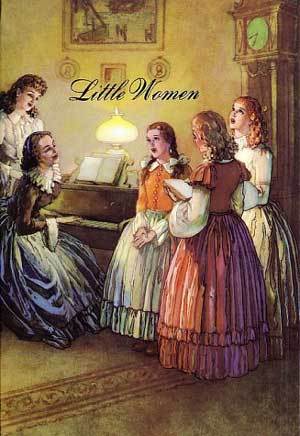
My copy of Little Women with the Louis Jambor illustrations

My copy was the Deluxe Illustrated Edition, January 28, 1947 Penguin Group  with Louis Jambor illustrations. I loved the illustrated color plates and the pen and ink drawings that accompanied many of the chapters. I clearly remember a little bird drawing that accompanied a chapter about Beth’s recovery from illness, but the cover was my favorite. This color painting shows all the girls gathered around the little spinet singing while Marmee played. Jo stands behind Marmee, while Amy and Beth sing opposite her with Meg’s back to the viewer.

So, it was with some concern that I noted that the Common Core recently released their language arts curriculum standards with suggested reading lists for grades 6-8. Little Women is on that list. I was hoping that Little Women was a just a suggestion, perhaps as an independent reading text, but a recent seminar I attended at the ISTE 2011 Conference (International Society of Technology in Education) in Philadelphia  confirmed a great fear that some educators will consider the novel a “teachable text”. The presenter at the seminar enthusiastically explained how many interesting links to Louisa May Alcott and her books could be researched by students. She demonstrated several different web quests dedicated to the study of Little Women and explained how these might be incorporated in language arts curriculum. I sat there horrified. I have no argument against a student choosing to research this novel or the author on her own. Perhaps the information will even deepen a reader’s love for the story. But to assign the Little Women?  Please, no!

If I had been assigned Little Women, would I have lingered over every page? Would I have felt that sense that Louisa May (she was too familiar to me to be called Alcott) was speaking to me, or would I have been looking for theme and symbols? Could I have been Jo if I was competing with other young girls who felt that same kinship with Jo? Would Little Women have been the same learning experience with an assigned vocabulary list? Would I have passed the multiple choice quiz or essay test?  Actually, my multiple readings would have assured a decent passing score, but would testing have assessed my deep relationship with the text?

Sadly, if well-intended educators are using the Common Core suggestions as texts to teach, Little Women will be placed in some curriculum. The novel is in the public domain, so digital texts can be accessed at no cost which makes the text attractive for low budgets. However, I shudder to think a student will be forced to read the novel rather than discover the story on her own. And although I am not gender-biased with literature, I would not assign this novel to pre-teen boys.

There are nine other texts suggested by the Common Core. The selection of these texts is an indication of the variety and the level of complexity that students should be reading in grades 6-8:
The Adventures of Tom Sawyer,
Mark Twain
A Wrinkle in Time, Madeleine L’Engle
The Dark Is Rising, Susan Cooper
Dragonwings, Laurence Yep
Roll of Thunder, Hear My Cry, Mildred D. Taylor
The People Could Fly,  Virginia Hamilton
The Tale of the Mandarin Ducks, Katherine Paterson
Eleven, Sandra Cisneros
Black Ships Before Troy: The Story of the Iliad, Rosemary Sutcliff

This list does offer variety, and the inclusion of The Adventures of Tom Sawyer offers a more challenging read for this level. I would also advocate that A Wrinkle in Time should be a suggestion for independent reading as well. But, please, teachers, assign any of the above texts and leave Little Women to the young reader who chooses to read the novel. The unforgettable story of  Meg, Jo, Beth and Amy March is for a reader to discover, not for the lesson plan.