Archives For November 30, 1999

While my freshmen students knew Romeo and Juliet is a tragedy, the details on the relationship of the “star-crossed lovers” were a little fuzzy.  Romeo and Juliet is often a student’s first introduction to Shakespeare for not so surprising reasons. The characters Romeo and Juliet  are young-she is 13 years old. They are in love. Their families stand in the way of their love. They must meet in secret. They defy the authority of their parents. Many of these elements appealed to my 9th grade students. But there were surprises everyday when we performed scenes from the play in class.
The biggest surprise for me was the willingness of my students to take on the difficult meter and vocabulary of Shakespeare in order to play one of the parts in the play. Hands would go up, “I want to be Mercutio!” or “Can I be the Messenger?” and “Can’t a guy play the Nurse?”

Of course, they were almost always terrible. Shakespeare’s verse is difficult to read “cold”.

Billy stumbled but persisted in his reading Benvolio’s  lines while we patiently waited:

The fiery Tybalt, with his sword prepared,
Which, as he breathed defiance to my ears,
He swung about his head and cut the winds,
Who nothing hurt withal hiss’d him in scorn.

Each of the students stumbled over the strange vocabulary: prolixity, holp, God gi’ god-den, tetchy, sirrah, obsequy. Matthew wondered aloud why Capulet is always saying, “What? ho!” Michael regularly referred to the language of the play as Old English; he would not be convinced otherwise.

When we turned the page to Act Two, scene 3,  I saw Logan take big breath, visibly steeling himself to read Friar Lawrence’s lengthy speech. In Act Three Scene 5,  completely unaware of pace and more interested in finishing the scene before the bell rang, Malia raced through the Nurse’s teasing of Juliet. Not one of them (thankfully) really understood the allusions in Mercutio’s “Queen Mab” speech in Act One scene 5. Yet, everyday they entered the classroom asking, “Are we acting out the play today?”

We played the balcony scene three times in the large hallway on the stairs to the auditorium’s upper level seating. Students paired up to read a reduced script, so several Juliets had the chance to meet their Romeos that class period. Back in the classroom, I played the soundtrack to the Zefferelli film (“A Time for Us”) during Act Three scene 5 as Alexa asked her Romeo:

Wilt thou be gone? it is not yet near day:
It was the nightingale, and not the lark,

They memorized the Prologue; they wrote haikus to summarize each act to review the action of the play:

Act I:
Annoying Prologue
Romeo met Juliet,
Romeo loves her

Act II:
Balcony kisses,
They are married secretly,
The nurse keeps it quiet

Act III:
Tybalt is now dead,
Romeo must run away,
Juliet is scared

Act IV:
Juliet fakes death
Capulets are deeply hurt
Marriage is off

Act Five began last week, and the students were following the complicated plans of  Friar Lawrence and making predictions as to the plan’s success. There was a brief discussion about what an apothecary was in Shakespeare’s time, and the actual distance from Verona to Mantua, Italy. It was obvious, they all wanted the plan to work.

Then, Nick as Romeo entered Juliet’s “tomb” and  several lines later, he stepped over Chase who lay on the floor, slain as Paris.  Nick began his soliloquy with great seriousness. Holding the  dry erase marker, our stage prop for the vial, high in one hand, he read the verse aloud, “Here’s to my love! O true apothecary!/Thy drugs are quick.” He dramatically uncorked the marker, and then “drank”.  He gasped, ” Thus, with a kiss,” he leaned down to the sleeping Juliet, and quietly said,” I die.” Staggering, he fell to the ground.

Several students following along in the text, started and then sat in a palpable stunned realization.“He dies?”

“But Juliet’s still alive!”started as a murmur.

The chorus of voices grew louder. “He’s dead!” “She doesn’t know!”

There was a collective pause, followed by an audible, “This sucks.”

I was surprised. I thought they knew.

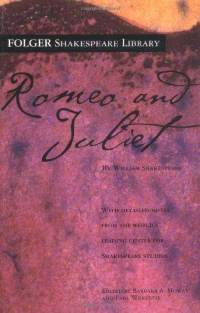
The final speech of the play begins, “A glooming peace this morning with it brings”; that speech captured the mood of my students. Of course they understood at some literal level that the play was a tragedy; this fact was clearly stated on the back cover of their text: This is the tragedy of Romeo and Juliet. However, until that moment of Romeo’s willful self-destruction, followed by Juliet’s suicide, my students did not appreciate the  play’s heartbreaking conclusion.

I was surprised by the level of their reaction. Ours was not a polished performance, the staging was clumsy and the actors read the lines without understanding much of what was being said. However, they did feel for the characters, always willing to summarize what had just happened or wanting to give advice. Despite our failures to interpret the language, the result was that the play made them grow up a little.

No one should ever be surprised at the ability of this Shakespeare play-however rudimentary in performance- to engage an audience.


Advice to Hamlet, “The main point here is you over think everything. You get deeper and deeper into these brilliant plans, but without execution they truly mean nothing!”

“Hamlet, you yourself had said that to dwell on an act too long leaves one part good, and ‘three parts cowardice;’ please, Hamlet, PLEASE learn to follow your own advice,” pleads TJ in his advice to Hamlet.

The Advanced Placement English Literature students are posting their advice to characters from Hamlet by responding to “Stop the Action!” prompts on a blog. Students “advise” Hamlet, Gertrude, Claudius, Laertes, and Ophelia in response to lines from the play. Students discuss whether the Ghost is from Heaven, Purgatory, or Hell; whether Hamlet is mad or acting mad; or choose between the soldier Fortinbras and the scholar Hamlet. Their online discussion is equitable and collaborative, and the format allows me the opportunity to assess student understanding of this play.

I organized the “Stop the Action, Hamlet” on the Google Blogger platform, an easy platform for posting comments or replies. I invited students by email to the site, and they needed only a minute or two to learn to navigate through the 10 prompts that I posted. The  “comment” feature on the Blogger dashboard was helpful in assessing their time stamped responses.

The advice my students gave to each character in the play makes for entertaining reading, but more importantly, each student  was able to share his or her ideas online in an academic manner that cannot be duplicated in class. Class discussions are notoriously short, limited in scope, or marginalize quiet students, unless they are moderated. The class period is limited in time, whereas online discussions can continue for weeks, 24/7 with students posting when they have time to focus. When my students blog online, they respond to each other thoughtfully, post citations to support their positions, and choose their words carefully. The blogging platform elvated the class discussion.

For example, Colleen’s first entry was on whether the Ghost is from Purgatory or from Hell:

“If the ghost was from heaven, I feel as if he would not ask Hamlet to commit such a foul crime. It is through hell that the Ghost is speaking like this. As the play continues on, the Ghost does not seem to leave his demon thoughts but rather continues to carry them out. It is clear that through these actions, the Ghost is from hell.”

Devin later responded to this post,

” I was re-reading the conversation that Hamlet had with the spirit, and another line I found interesting was when the Ghost says to Hamlet, ‘taint not thy mind.’ I think this is interesting because it suggests to the audience that the Ghost cares about Hamlet. If the Ghost was from Hell this wouldn’t make sense and if the Ghost was from Heaven he wouldn’t be there in the first place. The only compromise to this situation is if the Ghost was from Purgatory, then he could care about himself and Hamlet at the same time.”

Annie’s  post followed this argument when she posted a question for Shakespeare:

“Why if the controversy for the ghost is so divided between heaven and hell not bring up any religion? There are very few if any religious references except this whole ghost thing. ..I do think your choice to ignore religion is a reason for your timelessness. By discussing certain religious topics, you may only appeal to one audience. You doesn’t even hint as to what your own opinions are. Choosing not to discuss such controversial topics was a smart decision on your part, and is perhaps why you are so popular even today.”

Colette had advice for Gertrude and Claudius. To Gertrude, she posted, “Your son is clearly in pain and instead of stopping and trying to communicate personally with Hamlet, you’re taking Claudius’ advice to hire spies to keep ‘watch’ over Hamlet when in fact, that’s a mother’s duty. Your maternal switch is definitely shut off.” Her advice to Claudius was equally blunt, “Murder cannot simply be ‘washed’ away. Much like in Shakespeare’s Macbeth, you [Claudius] are searching for a way to wash the blood red off of your hands. However, they are forever stained. No matter how much you clean your hands, they will forever be tarnished and filthy.”

TJ humorously advised Polonius indicting him on the line, “Beware/ Of entrance to a quarrel; but being in, /Bear’t that the opposed may beware of thee” (I.iii.69-71). “Hey, Polonius,” TJ writes, “remember when you were hiding behind that curtain? Remember when Hamlet pulled out a knife on you and you screamed for help instead of present yourself so that ‘the opposed may beware of thee?'”

Kelsey begged Laertes to walk away from Claudius, She recalled his line, “And yet ’tis almost ‘gainst my conscience,” and argued:

“What I want you to do right now, Laertes, is just stop and think. Why would Claudius actually want to help you? He is a manipulative man that just wants power…. Some advice- stop and let Claudius fall to his own fate! He already basically showed that he knew the cup was poisoned by calling out. He is guilty to everyone in the room. Let him take the downfall and WALK AWAY MAN! Gah! Your pride is not worth your life!….you will realize your mistake in about 30 lines in the play….just thought I would let you know…”

Finally, Sara posed a question for Shakespeare:

“As we continue reading through the play, we notice how Hamlet is struggling with avenging his father – yet, he knows he must complete the task of murdering his uncle, as his father had ordered. I leave you with this question – do you [Shakespeare] believe we were all born to complete a task? Does this apply to other plays ? Romeo and Juliet? Macbeth? King Lear?”

In addition, the Hamlet blogs are a means for me to directly address educational technology standards that have been developed by different educational organizations.
Using the standards for the Partnership for 21st Century Skills, these blogs allow the students to:

  • Articulate thoughts and ideas clearly and effectively through writing
  • Be open and responsive to new and diverse perspectives

Using the standards for NCREL(North Central Regional Educational Laboratory)/engage, the blogs promote:

  • Teaming and collaboration to create to solve problems and master content
  • Willingness to make mistakes, advocate unconventional positions, or take on challenging problems to enhance growth.

Finally, using ISTE ( International Society for Technology in Education) standards, the blogs provide an opportunity for students to:

  • Interact, collaborate and publish with peers, experts and others employing a variety of digital tools and media
  • Communicate information and ideas effectively to multiple audiences
  • Apply existing knowledge to generate new ideas, products, or processes and diverse perspectives to explore alternate solutions.

More importantly, the “Stop the Action” blogs have allowed my students to function much like Horatio in the play whose advice to Hamlet, “If your mind dislike any thing, obey it…” goes unheeded. The characters also do not heed the advice of my students, but my students have become proficient in their ability to “tell my story” of Hamlet.

In the film Looking for Richard, his tribute to Shakespeare’s historical play Richard III, Al Pacino asks a tourist standing on a street in Manhattan, “What do you know about Shakespeare?”

“Shakespeare? He’s our greatest export!” replies the Brit reaching into his wallet for a credit card. On the credit card was the Flower portrait of  Shakespeare as a security hologram. Rotating the card allowed the camera to pick up the image of Shakespeare, who appeared to be winking at the viewer.

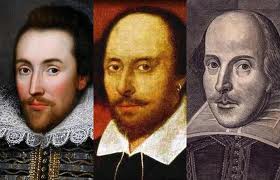
Choose your favorite portrait for a T-shirt, mug, or I-phone cover!

As an export, Shakespeare sells. His image, in any one of three possible portraits, is plastered on mugs, teapots, coasters, coins, rugs, and notebooks. His verses are truncated to fit the length of garden stones, pens, bracelets, Ipad cases, and T-shirts.  I personally own six scarves with images from his plays or verses from his poems.

There are some more unusual, and certainly less dignified, items available as well for those bard-idolators:

Shakespeare Insult Gum-each box contains two gum balls and a wonderful Shakespearean insult;

Rubber Duckie Shakespeare: Celebriduck

A Shakespeare Celebriduck-Yes, Shakespeare has been turning into a quacking bard;

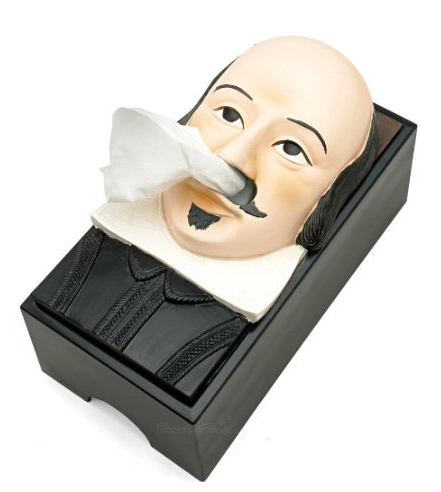
Shakespeare Tissue Box cover

A Shakespeare Tissue box cover-Tissue fly from his nose as fast as verses from his pen.

As a product, Shakespeare appeals to a niche market, but given the amount of Shakespeare paraphernalia on the web, that niche market must be very profitable.

Today marks Shakespeare’s 448th birthday. This past month, I have been sell-a-brating Shakespeare in each of my English classes.

Selling Shakespeare is one of the pleasures of teaching English at the high school level. This year, I have “sold” OthelloKing Lear, and Hamlet to the Advanced Placement English Literature class, and I am presently selling Macbeth to sophomores while at the same time selling Romeo and Juliet to freshmen.

Once students get past the Prologue; past witches meeting on a heath; past the Ghost’s appearance on the ramparts; past Act I, scene i;  I am on auto-pilot. English teachers accumulate Shakespeare materials in the form of lesson plans, essay prompts, quizzes, audio-tapes, film clips and activities that be pulled out at a moment’s notice. In addition, there are numerous clever resources or plans on the web to access. This past year, I added lesson plans from the websites that featured The Macbeth TangoRomeo and Juliet on Facebook, and  Stick Figure Hamlet.

Of course, the best way to sell Shakespeare to students is to have them attend a well-acted live performance . If there is no performance in the area, a DVD or video streamed production, and they are readily available on Netflix, Amazon, and PBS,  of one of the many adaptations of Shakespeare’s plays helps engage students. There are websites that list over 400 feature length films or TV shows that bear his name, so there are many options as to which versions might be used.

However, nothing can replace having students reading  and acting out the play in class. Without equivocation, all  students are initially  terrible at reading Shakespeare cold. Nevertheless, almost every student eventually wants  a chance to “strut and fret their hour upon the stage.” Even the brilliant Kenneth Branaugh, now instantly recognizable to my students as “that guy who plays all those characters” in film productions of Hamlet,Othello,  and Much Ado About Nothing, recalls in an interview how his first exposure to Shakespeare came in a class where everyone read from The Merchant of Venice. Kenneth remembered being terrified doing it, and that he “didn’t understand the language.” But having survived that experience, he quickly developed the acting bug.

All this exposure to Shakespeare in high school  does have an effect on his “brand” or name recognition. Recent reports estimate that Shakespeare’s brand is worth over $600 million, twice the amount of Elvis and Marilyn combined. According to the website Campaign Brief, Shakespeare is the best-selling author of all time, with book sales estimated between two and four billion. In contrast, J.K. Rowling’s unit sales are estimated to be less than 450 million. The company Brand Finance was commissioned to determine the commercial value of Shakespeare’s name. Tim Heberden, managing director of Brand Finance in Australia reported: “Not only do these figures make the Shakespeare brand one of the strongest in the world, but it also shows the potential commercial value the Shakespeare name has garnered.” His firm awarded Shakespeare a triple AAA rating noting that the brand could potentionally rise to 1 billion.

I believe that high school English teachers have had a direct hand in this industry. Shakespeare sells very well, because we have sold him very well. For us, the reward is spreading the poetry and drama of the bard, but for those who are literally selling Shakespeare, we have most certainly “put money in thy purse!”

Nothing beats a top-notch live performance for selling Shakespeare to students. While there are plenty of quality performances on DVD, streaming from  Netflix or the PBS website, or available piecemeal on Youtube, there is nothing quite like the collective heartbeat one experiences sitting in an audience. In live theatre, there is the moment of an audience-wide hypnosis; the palpable moment when the audience loses self-consciousness and synchronizes its breathing to watch and hear the play. The dramatist Shakespeare provided many opportunities for those moments.

Every year I try to organize a field trip so that my students have an opportunity to attend a live performance of one of Shakespeare’s plays.  Since our school is fortunate to be located an hour away from New Haven, CT, our students can attend matinees at Yale Repertory Theatre. For several years, I have arranged for field trips to see Shakespeare performed at the Yale Rep with Ruth Feldman, the Director of Education and Accessibility Services at the Yale School of Drama.  These plays are funded as part of the National Endowment for the Arts (NEA) initiative Shakespeare in American Communities:

“Yale Rep offers young people in the community two significant youth theater programs: WILL POWER! and the Dwight/Edgewood Project. WILL POWER! Arts-and-education initiative is designed to build on existing English and Theatre curricula for middle- and high- school educators and their students. The company continues as a leader for it community outreach and accessibility programs that promote audience diversity and participation. “

This year, 40 students attended Yale Rep’s production of The Winter’s Tale, one of the more difficult plays to teach, a “problem” play. On this particular trip, there were honors 9th graders who had been prepared for the production having used a prepared study guide sent in advance of the trip.  The 12th graders, in the throes of “senioritis”, came cold to the production.

No matter. The combination of elegant set and stage movement conveyed the plot-a jealous husband, a wronged wife, a betrayed friend in the opening scenes kept all students rapt. The famous stage direction, “exit pursued by a bear” was brilliantly executed with puppetry, and suddenly the audience was transported into the land of Bohemia with its rainfalls of tiny blossoms, colorful costumes, and infectious country dancing. One student leaned into me, “I would rather live in Bohemia,” she whispered.  The final stage trick of bringing the statue of Hermione to life was met with audible gasps-“She’s real?” The packed house of students cheered predictably louder for the “clowns”from the performance, and with nothing less than genuine admiration for the lead roles as the cast took their final bows. The Winter’s Tale was a hit!

Immediately after the performance, as they have for the entire WILL-POWER series, the cast and production team at Yale Rep offered a talk-back where students can ask questions for about 20 minutes after the show. Seeing the performers in street clothes, without costumes and make-up, sitting on the edge of the stage, tousled but charged up after the 3 hours of performing, is a bit unsettling…the illusion of theatre is laid bare. Awkwardly, for the first five minutes, students stammered out questions: How long did they rehearse? (8 weeks) How old are you (to a 10 year old actress)? Have you been on TV (yes)? Actors responded amiably enough.

Then, a teacher asked, “What was your first Shakespeare experience?” There was a momentary pause and then one actress offered her first memory of Shakespeare…a memory from  high school. “Shakespeare was supposed to be only for the smart kids, which really wasn’t fair,” she recounted, “He’s really for everyone, not just the smart kids.”  Another actor agreed, explaining that members of his class had acted out Shakespeare-very badly, stumbling over the words, but loving the experience. Then another actor spoke. “My mother took me to see Shakespeare when I was seven, so I was always around them[plays]. I grew up loving to watch the plays.” Another actor recounted his initial dislike of Shakespeare’s plays in high school,”I just didn’t get it,” but that an experience in college changed his mind, “Was this the same boring play? Yes! Why was it better now? I don’t know, maybe I was ready then.” Still another spoke of his love of the plays, his love of the language, and his ability “to speak the words really well because I understand them…which means that I have been able to stay employed!” One by one, each actor spoke of an initial Shakespeare experience, good or bad, and how each of them had been changed by that experience. There was such power in their personal stories, an English teacher could not have scripted better confessions. Their passion for Shakespeare and desire to pass that passion on to my students was inspiring; they were the better teachers!

A final question, posed again by an adult audience member, served  the play’s recap: “What was your favorite moment in the play?”she called out. The actors brightened and each took a turn, speaking about a favorite moment. One recounted a scene she could see from the wings, another a moment he shared on stage with another actor. The cast recapped the events of the play -out of sequence-the statue coming to life, the clown stealing the wallet, the dance, a set of choral lines shared between two actors, the moment when the newborn babe is brought before her dismissive father, and the magical transformation of the shepherd into Father Time. But it was the actor who spoke about the stage direction “pursued by a bear” that brought new understanding to one of my students as to how to look at one of Shakespeare’s seemingly improbable plot devices. “Why would Antigonus leave a baby alone on a beach unless he was trying to protect her?” asked the actor, ” Who would do that? Who would do that unless he was convinced he could save the baby? The bear chases him to his death, but the baby lives,” he continued, “I think amid so many acts of selfishness, this is one of the most selfless acts in the play.” Later, sitting at a local pizzeria, a student repeated his explanation word for word, “Seriously, who would leave a baby on a beach? Who would do that unless he was convinced…. That’s so true!”

Live theatre can engage students. Live Shakespeare -performed well-can enrich students. Talkbacks with actors and their experiences with Shakespeare can enlighten students. Perhaps one day my students may have the opportunity to share their first experience with Shakespeare. They may choose Yale Rep’s The Winter’s Tale.

"Ill met by Moonlight, proud Titania"

Ill met by moonlight, proud Titania,” reads Karl off the script. He looks confused, “I’m ill?” he looks puzzled. “Am I sick?”

“You’re not sick…We are having a fight!” responds an irritated Nicole, who is playing the fairy queen. She continues to read: “What, jealous Oberon! Fairies, skip hence:/I have forsworn his bed and company.”

“Whoa, looks like someone is sleeping on the couch tonight!” chimes in Sam from the audience.

Students in English II are acting out scenes from William Shakespeare’s A Midsummer Night’s Dream in preparation for a field trip. Their response to the play is not unlike the response of Shakespeare’s original audiences; there is no high browed reverence here but rather a steady stream of commentary coming from the “groundlings” sitting in desks.

A fight between a fairy queen and a fairy king as part of a comedy by Shakespeare is a break from the too serious literature of adventure, war, and tragedy (Animal Farm, Night, Beowulf, All Quiet on the Western Front, Lord of the Flies) that is usually featured in the sophomore curriculum. For two weeks, the students are wrapping themselves in costume tulle, strapping on  wings, donning crowns while they stumble through the language of Elizabethan comedy. Their experience is not a singular one. Today, a student’s first introduction to the bard usually takes takes place in the classroom. On any given day, at any school hour in classrooms all over this country, students from elementary grades through high school are struggling with iambic pentameter in decoding Shakespeare’s poetic language. This indoctrination is part of a long standing American tradition.  Since the beginning of America’s history, Shakespeare has lived on American soil.

W. H. Harrington. Wreck of Sea Venture. Painting, 1981. Courtesy of Bermuda National Trust and Bermuda Maritime Museum.

Perhaps it was Shakespeare’s fascination with the new colonies in the Americas that initiated the relationship. His play, The Tempest, is loosely based on the 1609  wreck of the Sea Venture near the Bermudas on its way to Jamestown. Prospero and his daughter Miranda are shipwrecked on a island for many years. When visitors arrive after a storm to break their exile, Miranda marvels at the meeting by proclaiming “O brave new world/ that has such people in it.” In the play, Miranda’s line is ironic; she is unaware that several of these visitors were less than desirable types. However, for the British and people in the countries of Europe, the American colonies were the brave New World, full of hope and promise laced with a tantalizing dash of danger and adventure.  Americans reciprocated this compliment with a slavish devotion to Shakespeare that continues to this day.

This relationship between Americans and Shakespeare is detailed on the National Endowment for the Arts (NEA) website, “The earliest known staging of Shakespeare’s plays in the colonies was in 1750. By the time of the American Revolution, more than a dozen of his plays had been performed hundreds of times in thriving New England port cities and nascent towns and villages hewn from the wilderness.” By the 1830’s, Alexis de Tocqueville, visiting from France, wrote extensively about his travels in the United States (Democracy in America) noting, “There is hardly a pioneer’s hut that does not contain a few odd volumes of Shakespeare. I remember that I read the feudal drama of Henry V for the first time in a log cabin.”

Shakespeare was embraced by the Americans through their nation’s rapid expansion beyond the original 13 colonies, and the NEA states that “plays were produced in large and opulent theaters and on makeshift stages in saloons, churches, and hotels. From big cities on the East Coast to mining camps in the West, his plays were performed prominently and frequently.”  Mark Twain took advantage of American’s familiarity with the troupes of English actors who traveled to the colonies, and incorporated Shakespeare into his classic Huckleberry Finn. Twain’s Huck travels with a pair of con men who practice the balcony scene from Romeo and Juliet and the sword fight from Richard III on the raft while they botch Hamlet’s “to be or not to be” soliloquy. Twain counted on his audience’s acquaintance with Shakespeare’s texts in order to set up this parody.

Interesting historical trivia about Shakespeare in America includes the casting of Lieut. Ulysses S. Grant on the eve of the Mexican War into the role of Desdemona from the play Othello. Apparently he never performed, lacking “the proper sentiment”, and a female was recruited at the last minute to replace him. Edwin Booth, the elder bother of John Wilkes Booth, toured the Western United States during the Gold Rush, and enjoyed enormous acclaim performing plays by Shakespeare. Apparently, the best theaters in the East were not as profitable as performing in the raucous camps where theater tickets were paid for in gold nuggets and bags of gold dust. Edwin is also credited with saving the life of Abraham Lincoln’s son, Robert, on a train platform the same year his brother John Wilkes assassinated Lincoln in 1865.

Contemporary Americans have a deep love for Shakespeare by producing his plays in theaters and in film with more frequency than any other playwright. Almost every state has a theater dedicated to exclusively performing Shakespeare’s plays.  Films of his plays, most recently The Tempest starring Helen Mirren as as a female Prospero, or with remakes of his material. The Taming of the Shrew was memorably relocated to an urban high school in Ten Things I Hate about You with Julia Stiles as the intractable Kate, a film that remains popular with American audiences. The Common Core Standards in Language Arts require his plays be taught in classrooms at the high school level. All this attention explains why students willingly (or unwillingly) wrap themselves in costume tulle, wear wings, don crowns and stumble through the language of Elizabethan drama. Like Kyle and Nicole, they may fight in the roles of the Fairy King and Fairy Queen, or they may analyze the reasons  Macbeth usurps the throne. They may research the origins for Henry the V’s “Band of Brothers” speech, or  memorize the prologue to Romeo and Juliet. Because watching, performing, and learning Shakespeare is an American classroom tradition.