Archives For December 31, 2012

Ode on Grading (Earned)

January 28, 2013 — 2 Comments

The semester just ended, and there are papers to grade. In addition, the midterms are done, and there are essays and papers to grade. I am surrounded by paper. A recent article titled “Why Teachers Secretly Hate to Grade Papers” by John T. Tierney in The Atlantic received quite a bit of buzz, with most teachers flat out saying, “Secretly? There is nothing secret about our hating to grade!”

The article discussed the inability to be fair when grading, but I particularly enjoyed the following paragraph:

The sheer drudgery and tedium. When you’re two-thirds of the way through 35 essays on why the Supreme Court’s decision in the case of McCulloch v. Maryland is important for an understanding of the development of American federalism, it takes a strong spirit not to want to poke your eyes out with a steak knife rather than read one more. I have lots of friends who are teachers and professors. Their tweets and Facebook status updates when they’re in the midst of grading provide glimpses into minds on the edge of the abyss — and, in some cases, already deranged.

Since several of my classes are deep in the Odyssey, the “poke your eyes out” reference kicked all my Greek allusions into high gear. Consequently, instead of full-fledged blog post that will drain me of the minutes I have before grades are due, I leave you with a quick poetic attempt to capture my grading frustration:

Tantalus Has It Easy

My desk is piled high
with papers and essays that had been assigned
during the Christmas break,
when Dawn spread her rosy fingers on the
new year calendar empty of responsibilities.

Sing in me, Muse, and tell me
What was I thinking? an invocation I repeat
with each carefully completed grading rubric
stapled to a hastily penned paper.

More than one paper bears the correcting
suggestions I had made days ago without
the corrections I suggested. I am Cassandra,
unhappy prophetess whose warnings
go unheeded.

I hear a teacher’s scantron sheets
click noisely in the teacher’s room next door.
“Grading’s done,” he chortles, while I am
caught between the Scylla of unintelligible answers
and the Charybdis of illegible handwriting.

I see the PE teacher leaving early to workout
the stress of the week at the local fitness club.
Apparently, fate favors
the Olympically-sculpted

While I, like Sisyphus,upload_6i2s45k8nordin9cemradc8sv7249883.jpeg-final
reach for another paper to roll up
the grading curve.

Busines_heroThe association of midterm exams with freezing is both literal (I teach in the Northeast) and figurative  (many students “freeze up” during an exam), so at the end of this semester, I took one of the writing standards from the Common Core State Standards  hoping at the very least to stop the “freeze” in the classroom during the exam. Instead of a multiple choice exam with essay questions, I prepared my 12th grade students to write an inquiry paper that would be due the morning of the exam. Yes, even those seniors who had repeatedly assured me that they will never go to college would be tasked with a three to five page paper academic paper that touched on the material that we had read over the course of the semester.

The Common Core State Standard I had in mind was ELA Literacy Standard W.11-12.7:

Conduct short as well as more sustained research projects to answer a question (including a self-generated question) or solve a problem; narrow or broaden the inquiry when appropriate; synthesize multiple sources on the subject, demonstrating understanding of the subject under investigation.

I admit, the draw for me was the “self-generated question”. We had started the “Hero or Monster” English elective brainstorming the following questions:

  • What is the difference between a hero or monster?
  • What criteria do we use to determine who or what is a hero?
  • What criteria do we use to determine who or what is a monster?

We read about monsters in Louis Stevenson’s  Dr. Jekyll and Mr. Hyde and Mary Shelley’s Frankenstein. We read excerpts from Milton’s  Paradise Lost, and we  studied the monsters of mythology (Cyclops, Widiego, Fenris, Leviathan).

We read about heroes in the Iliad and in Roger Rosenblatt’s essay The Man in the Water. We looked at Joseph Campbell’s study of The Hero’s Journey, and we created our own superheroes. Students also read an independent book and determined the hero (or anti-hero) in that text. Finally, we used current events to discuss the monsters and heroes in everyday life.

As the quarter came to a close,  each student had to come up with a “self-generated” question. I was happy to see how these texts had served to inform their line of inquiry. Questions included:

  • Was the hero really a hero before the monsters came along? Does the Hero need a Monster to be a hero?
  • How does our exposure to monsters when we are children inform our views of monsters when we grow up?
  • How does “bad parenting” figure in the development of a monster?
  • How has the criteria of strength in a hero changed since ancient times?

The students had two weeks to frame their questions and find evidence that would support their positions. Our “Bring Your Own Digital Device” (BYOD) policy was an important part of the organization and writing of the paper. Students had access to e-texts, and they had links to sources or discussions that we had placed on the class wiki during the semester. I created a Google doc folder and their papers were available for peer editing or for my comments as they worked. One night, I popped in on a few papers to see their progress. As I was leaving comments on one paper,  I saw the following text appear, “Mrs. Bennett, you are on my paper as I am writing….this is creeping me out.”  Creeping them out or not, I was able to provide guidance as they incorporated citations from the texts we had read in class into their arguments.

I am pleased to write that my gambit for this midterm exam worked. The papers are in, and many exceeded my expectations, proving that the writing standard 7 for grades 11 and 12 that requires a self-generated question is appropriate for this grade level.The self-generated question kept them more engaged because this was their inquiry, and as they wrote,  they came to conclusions that they incorporated into their papers:

Throughout the course of writing this paper, I have come to a surprising realization. It has come to my attention that the heroes that we idolize and fawn over (Hector, Achilles, etc.) are not always as heroic as the everyday, ordinary people who rise to the occasion when chaos ensues.

When Hector went into battle in the Iliad in ancient times, he may have had the same thought as the “Man in the Water” in 1982, the thought that “I might die doing this.” That thought did not stop either of them, and both men are still talked about; they are held high and admired. Time does not change our appreciation of heroes.

Some of these true monsters, (Satan of Paradise Lost and Victor of Frankenstein) have used their cunning ways to confuse or deceive the reader so they cannot be seen as the monsters they are.

The inquiry paper, which does permit the use of the pronoun “I”, has been a much easier way to teach academic research and improve a student’s understanding of an author’s intent. Furthermore, the research students included in their papers reflected a wide range of texts; papers were longer, and the evidence was organized according to information rather than the ubiquitous five-paragraph framework.  More than one student remarked how their fingers seemed to know what to write; more than one told me how the inquiry gave them ideas they found surprising.

While I may not yet know the impact of all the standards from the Common Core, I will state unequivocally that the self-generated question allowed me to successfully measure what students learned about heroes and monsters in both literature and in real-life. Correcting these papers has been less of an “ARRRG!” (insert monster voice) and more of a “Hurray!” (insert heroic cheer!).

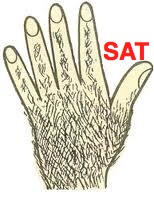
hairy handSince many college applications are due between January 1 and February 1, I know that many of my students are fretting about their SAT scores. I wish I could tell them to relax, that the score is just a score, and that they will never have to hear the words SAT again, but that would not be telling them the truth. The hairy hand of the SAT can reach far forward into their future. An SAT score is a brand, locking academic potential in a data point where we are forever 17 years old.

When I took the test, it was known as the Scholastic Aptitude Test, and that was before it became known as the Scholastic Assessment Test. At that time, the top score was a 1600, and there was no writing section. There were no pre-tutoring sessions from pricey tutors available after school or on Saturdays to practice for the SAT. I think I glanced through a practice book.

That Saturday morning, I was dropped off by my father in our 68 VW van along with hundreds of equally bleary-eyed seniors. I think I paid that day because I waited for him to write out a check. About two hours later in the middle of the math section, I remember thinking “Whoa…maybe I should have studied for this.” I had approached this milestone in my life with a little too much confidence and too little breakfast. I came out of that ordeal exhausted and starved.

Some 38 years later, I am still reminded about the results from that day. For example, on applications to graduate school, there is always a question on my score on the SATs taken back in 1974.

“Really?” I think to myself, “I am so much better a student today. I have two graduate degrees, and I am gainfully employed in the field of education. I am a very differently educated person from my 17 year old self. Then I was financially strapped, working part-time in a pizza restaurant, and I had yet to attend my first rock concert. Yet, you still want to know what my high school SAT score was?”

While I am not ashamed of my score, I am not posting it, either. Fortunately, because of my SAT score, I have been able to waive out of other standardized tests, for example, the Praxis I in Connecticut which requires a combined minimum score of 1000. You can be content to know I met this minimum standard with several hundred points to spare. I did very well on the verbal, but in retrospect, I probably could have done better had I prepared for the math section a little more.

So when I come to that question on an application, I think how that score taken when I was 17 one cold spring morning cannot accurately reflect who I am today. Nor do I think that an SAT score accurately reflects who my students are either. At this time of year, I hear them discuss numbers as they explain why they may or may not, or did or did not, get into a college of their choice. Sometimes I am surprised to hear particularly high or low scores, however, this information never changes my opinion of the student I have seated in my class. A student with a particularly high SAT score may never turn a paper in on time and have a failing grade while a student with a low SAT score may have an “A” in my class because every assignment is done on time or revised when recommended. The SATs may be an “indicator”, but these are students, not numbers. The score on an SAT can still fall subject to human error.

I do not think at age 17 that I fully understood how far forward into my future the hairy hand of the SAT would travel. I doubt my students understand, but I hope they know that their future will not depend on their 17 year old academic selves.

I suppose I should be grateful that when I am asked for my SAT score, that there is not also a request for   additional identification, say, a picture of me in that decade. That thought is chilling. The hiphuggers, bell bottoms, velvet jackets, and ubiquitous leotards of my high school decade are positively comical.My yellow chiffon prom dress is particularly hilarious. On the whole, I’d rather they see my SAT score.

"Dawn spread her rosy fingers..."

“Dawn spread her rosy fingers…”

Our 9th grade classes have been reading Robert Fitzgerald’s excellent translation of The Odyssey. At the beginning of every book, “young Dawn spreads her fingertips of rose to make heaven bright”. My students have heard this phrase so often that they chorus back to me “fingertips of rose” when we read aloud. One morning this past week, I raced up the hill to school to get my iPad so I could capture this picture of the “rosy fingers” and put it on the class wiki.

We dutifully started The Odyssey with the “Invocation to the Muse” and Books 1-4, but the Telemachus “coming of age” story did not really capture their interest. Meeting Odysseus in Book 5 did not improve their respect for the “worthy man of twists and turns.” Once we read Book 9,  the meeting with the Cyclops, Polyphemus, their interest was revived. Apparently, they enjoy a good story of man-eating monster as much as previous generations from 2020 years ago.

I have only been able to locate about a dozen copies of this translation in the secondary market, so we did have to buy a class set. These replaced a worn set of the Richmond Lattimore translation. There will be an audio version of the Fitzgerald translation available in November 2013 I will be ordering so I will finally be able to hear how to pronounce all those Greek names!.

Our final project for the Odyssey is a narrative that students complete called “The Wamogossey: A Day in the Life of a Freshman at Wamogo High School.” Happily,  writing narratives are once again favored in curriculum aligned to the Common Core State Standards:

CCSS.ELA-Literacy.W.9-10.3 Write narratives to develop real or imagined experiences or events using effective technique, well-chosen details, and well-structured event sequences.

The inclusion of the narrative confirms what most writing teachers recognize, that writing a narrative gives a students a better appreciation for reading a narrative.

In writing The Wamogossey, we allow students to organize themselves as individual narrators or in groups of two or three. Our instructions to the students are based on the following premise:

You and your partners are to create a modern equivalent of The Odyssey. The setting is Wamogo High School; the hero a 9th grader – Fresheus or Freshiope.

Your character must make their way through a day at school, facing modern equivalents of the Lotus Eaters, Cyclops, Sirens, and all that Odysseus encountered. The goal is simply to get home alive, where the or she can relax and feel safe.You must mirror Odysseus’ adventures, including how he solves the problems (trickery, patience, skill, self-control, etc).  The essential nature of the obstacles must be the same, in the same order, but set in modern Wamogo.

Each student in a group working on The Wamogossey is required to write three adventures: a single narrator needs three (3) adventures; two people writing the Wamogossey need six (6) adventures; three members of the group need nine (9) adventures. This organization assures that there is an equal sharing of responsibilities regardless as to the size of the group. They compose the narrative on Google Docs; each narrator writing in a different color ink.

In addition, to assure fairness in grading, we allow students to have some feedback on the distribution of points. The project is assigned a base grade (EX: 40 points) Once the project is graded based, that number is multiplied by the number of students in group. For example a project worth 40 points may be awarded only 34 points. If there were three members of the group, then there are 34 X 3 points available, or a total of 102 points. The members of the group then determine a fair distribution of points; slackers are usually “outed” by members of their group. We rarely need to intervene.

The Wamogossey narratives must begin with an invocation to their muse. These are usually very personal and often reflect that we have a vocational agricultural program. For example, from this year’s submissions:

Sing in me, Brandon,
and help me tell the story of tractors, you, skilled in all ways of contending,
the fixing, harried for hours on end,
after the break downs and endless driving in the field.
I saw the end of the last row of corn
and learned that good crops come slowly
and weathered many bitter days
in the early morning cold, while I fought only
to save my life, to get home to the barn.
But not by will nor valor could I save all the gas I use,
Of these adventures, Brandon, tell about me in my school day, lift the great song again.
Begin when the alarm rang, calling me to adventure, when all I hungered for was for home, my  Farm All tractors, and being ready…

In addition to the modernized twists of Homer’s plot, each adventure needs an epithet (“grey-eyed goddess”) and one Homeric simile. My students call these similes “enough already; we get the point” similes.There is also extra credit for using vocabulary from The Odyssey.

So far, several of The Wamogossey entries parallel Odysseus’s adventure very nicely. One student’s encounter with “Eaganphemus” (the Cyclops/our principal) is clever:

Encounter with the Cyclops- Book 9
I was hurrying to class, I was going so fast, I felt like I was in a race car, and the people around me are in a fuzz.  All of a sudden, I saw the huge Eaganphemus standing in my way. I almost slammed into him, my wheels spinning so fast. I tried to get around him, but I couldn’t  But, I happened to have M&M’s in my pocket, so I threw them at him. He seemed overwhelmed! He tried to catch all of them at once!! Once he was trying to gobble them down I raced past, now that he was distracted. I somehow survived getting past him.

As the semester ends next week, the students will have finished their hero’s journey. Odysseus will return to Ithaka and to Penelope, and, yes, another “Dawn will spread her rosy fingers…”.  I may get to run up the hill again to snap another picture.

Screen Shot 2013-01-09 at 4.41.58 PM

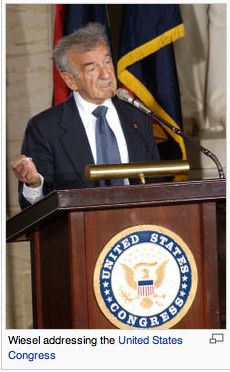
Wikipedia photo -Elie Wiesel

By my calculations, at the mid-point of the school year, many World History classes are studying World War II. Should these classes want to increase their use of an informational text in English or Social Studies curriculum, I suggest Elie Wiesel’s noteworthy speech The Perils of Indifference.

Wiesel delivered this speech to Congress on April 12, 1999. The speech is 1818 words long and connects Wiesel’s experience at the concentration camp at Aushwitcz with the genocides of the late 20th Century using a single powerful word: indifference.

In his speech, Weisel states clearly:

Indifference, then, is not only a sin, it is a punishment. And this is one of the most important lessons of this outgoing century’s wide-ranging experiments in good and evil.

Our English Department has used this speech in the past as a complement to Wiesel’s memoir Night which has been a used as a whole class read.  This year, we are giving Night to the Social Studies classes. They will adopt this memoir in order to increase the assigned informational text reading in their discipline mandated by the Literacy Common Core State Standards in History and Social Studies (CCSS). The English Department will still offer supplemental texts  that students can choose to read independently.

When he gave this speech, Wiesel had come before the US Congress to thank the American soldiers and the American people for liberating the camps at the end of World War II. Wiesel had spent nine months in the Buchewald/Aushwitcz complex. His mother and sisters had been separated from him when they first arrived: “Eight short, simple words… Men to the left, women to the right”; these family members were killed in the ovens. He and his father survived starvation, disease, and the deprivation of spirit. His father eventually succumbed, and Wiesel guiltily admits at the end of the memoir that at his father’s death he felt relieved.

Eventually, Wiesel felt compelled to testify against the Nazi regime, and he wrote the memoir Night to bear witness against the genocide which killed his family and six million Jews. His speech was delivered 54 years after he was liberated by American forces.

His gratitude to these American forces is what opens the speech, but after the opening paragraph, Wiesel seriously admonishes America to do more to halt genocides all over the world. By not intervening on behalf of those victims of genocide, he states clearly, we are indifferent to their suffering:

Indifference, after all, is more dangerous than anger and hatred. Anger can at times be creative. One writes a great poem, a great symphony, one does something special for the sake of humanity because one is angry at the injustice that one witnesses. But indifference is never creative.

My students have always been struck by Wiesel’s juxtaposition of anger and creativity. More than one has agreed pointing to making a “good” creation: an amazing song about an ex-boyfriend or a painting slapped together with passion. They also do not want to be treated indifferently. Yet, Wiesel makes them think beyond themselves:

Indifference is not a beginning, it is an end. And, therefore, indifference is always the friend of the enemy, for it benefits the aggressor — never his victim, whose pain is magnified when he or she feels forgotten. The political prisoner in his cell, the hungry children, the homeless refugees — not to respond to their plight, not to relieve their solitude by offering them a spark of hope is to exile them from human memory. And in denying their humanity we betray our own.

I remember several years ago, one student in my English 10 class, Rick, was particularly bright, fun, and full of daring. He also had an exceptional understanding of math and statistics. That January, I introduced the memoir Night as I had in previous years by providing a little background information.

“Six million Jews were killed during the Holocaust,” I recited off from my list of facts.

“What?” a startled Rick looked up. “Six million?” He was aghast. “That can’t be right.” He looked around at his classmates. “Six million?” They looked at him blankly. “Come on,” he was looking for some support, “That can’t be right.”

“Why?” I asked.

“Do you know how many six million things are?” He was indignant.

“Six million people,” I responded.

“People, yes. People, six million is a lot of people….” Rick was clearly operating with a different level of understanding from his more placid classmates. He understood six million as quantity; he did understand what six million things would look like if stacked up. Other students stirred in their seats.  “No way….six million,” he repeated growing more agitated. “How? How did anyone let this happen?” he asked; he was half-rising out of his seat. “Did we know?”

“Yes,” I remember saying. I do remember explaining that, yes, America did know that Hitler had concentration camps, and that more documentation collected after the war indicated that many of our military and political leaders knew about these camps. That is one of the points from Wiesel’s speech.

I pointed out to the class that the Holocaust was only one example of genocide; that there were others. In fact, that there was recently a genocide in Darfur. Rick sat down; he was overwhelmed. He was capable of understanding numerically the devastation of the Holocaust, and he was clearly upset. “Why do we let this happen?” he asked. I remember his voice was so sad, so full of disbelief.

In The Perils of Indifference, Wiesel asks

Does it mean that we have learned from the past? Does it mean that society has changed? Has the human being become less indifferent and more human? Have we really learned from our experiences? Are we less insensitive to the plight of victims of ethnic cleansing and other forms of injustices in places near and far?

Wiesel’s rhetorical questions echo Rick’s “Did we know?” In trying to respond, Wiesel makes the reader uncomfortable the way Rick was uncomfortable. Creating this kind of emotional impact on a reader is the reason Wiesel’s speech should be taught.

The Common Core State Standards (CCSS) demand that students read informational texts but does not require specific texts. Wiesel’s The Perils of Indifference contains the information and rhetorical devices that meet the text complexity criteria of the CCSS. More specifically, Wiesel’s message is necessary if we want our students to confront the conflicts in this new 21st Century. Our students must be prepared to question why “deportation, the terrorization of children and their parents be allowed anywhere in the world?“

Our humanity should demand nothing less.

brainwith contentThis winter, I am discontented. I see less of the “click” of recognition in a student’s eyes when he or she “knows something”. At the risk of sounding like a fuddy-duddy (“old-fashioned person,” 1871, American English, of uncertain origin), my students used to come to class pre-loaded with information; they had a predictable set of stories in their brains. These were often fairy tales such as Cinderella or Jack and the Beanstalk or folktales such as Rip Van Winkle or Johnny Appleseed. And speaking of apple seed, students used to know many of the Biblical stories as well. They may have been misinformed that the fruit of the Tree of Knowledge in the Garden of Eden was an apple and did not know that they could thank John Milton’s Paradise Lost for that substitution, but at the very least students used to be familiar with the Garden of Eden stories, the genesis of multiple allusions.

Today’s students’ lack of content, specifically story content, means that a good deal of class time is spent on a “back story” so they can better understand all the allusions or references in a particular text. Allusions are critical to understanding almost anything taught in English: Chaucer, Shakespeare, Bronte, Hawthorne, Faulkner, Steinbeck, etc. For example, our 10th grade is beginning Beowulf this week, and we read the Burton Raffel’s translation. He opens with the monster Grendel down in his cave howling at the sound of men singing the song of creation. Grendel swears vengeance against the “Almighty” for the exile of his ancestor Cain:

He was spawned in that slime,
Conceived by a pair of those monsters born
Of Cain, murderous creatures banished
By God, punished forever for the crime
Of Abel’s death.

“Can anyone tell me who Cain or Abel is?” we ask.
This year, only two out of 27 students had any idea about the story of Cain and Abel. Cain’s relationship to Grendel is part of the monster’s motivation, and so we were forced to do a little “Bible as literature” storytelling. Unfortunately, the number of students who have no information about the most basic Old Testament stories, which happen to be the same stories in Torah and the Koran, grows every year.

Fortunately, we are a 1:1 district and our students are equipped to quickly use their devices to learn who Cain and Abel are, so we can stop and have them quickly research any allusion, but this immediate research on a digital device disrupts the flow of the story of Beowulf. Moreover, the need to constantly look up information ultimately turns every text into a hyper-text.

This constant researching could be reflected in measuring the lack of information our students have when they approach a task. Last December (2012), the results of the Trends in International Mathematics and Science Study were released and, despite significant improvements,  students in the United States did not rank as high as did students from other countries. The results were discussed at a forum at the Washington Post where  David Conley, CEO of the Education Policy Improvement Center noted,

“One of the great ironies is that we are headed into an age where students can get almost any piece of information off their phones, yet, what we are doing is getting more and more information into their heads. The goal is to go beyond that and make them understand that they have to own their own learning.” (Conley, Ed Policy Improvement Center)

I agree; students need to own content for successful recall and application. I have no objection to students improving their research skills; even Wikipedia is acceptable for quick textual reference research, but students must understand the content in their brains in order to apply that information when they encounter a text. Employing content and applying information is different from employing the skill of accessing information. Owning content is critical to understanding an author’s use of allusions or references. Owning content contributes to fluid reading and better understanding. However, not all owned content is equal.

My admiration for the plethora of animated cartoon sources that do provide story content with a modernized twist is a bit mixed. For example, the popular Shrek series is riddled with storybook allusions. Unfortunately, students often do not understand allusions in these modern re-tellings as parodies. Students need to be disavowed from a belief that Puss ‘n Boots is fat and wears a pink bow or that Snow White is very proud and vain. One could argue the same modernized treatment was done for the original Grimm’s Fairy Tales which have been made more palatable and child-friendly. However, these gruesome original stories were the allusions for writers in earlier centuries. When the Common Core State Standards suggested reading list is filled with the literature and informational texts from centuries past, the recently released cartoon parodies of the originals may not be particularly helpful in understanding these allusions.

While the students today are exposed to information from a myriad of sources, they need to own information to be educated. Students need content, stories and information that they understand, to apply to a text or problem without relying on a digital device. So, this winter, the heightened level of my discontent is measured by the increase of fingering for information on devices. I miss the light that would go off in the students’ eyes when they “knew something,” particularly if that “something” was a story.

I miss content.

The fiction selected for standardized testing is notorious for its singular ability not to challenge; these stories do not challenge political or religious beliefs, and  I have long suspected they are selected because they do not challenge academically.
My state of Connecticut has had great success locating and incorporating some of the blandest stories ever written for teens to use in the “Response to Literature” section of the Connecticut Academic Performance Test (CAPT).
The CAPT was first administered to students in grade 10 in the spring of 1994, and the quality of the “literature” has less than challenging. For example:
  • Amanda and the Wounded Birds: A radio psychologist is too busy to notice the needs of her teen-age daughter;
  • A Hundred Bucks of Happy: An unclearly defined narrator finds a $100 bill and decides to share the money with his/her family (but not his/her dad);
  • Catch the Moon: A young man walks a fine line between delinquency and a beautiful young woman (to be fair, there was a metaphor in this story)
At least three of the stories have included dogs:
  • Liberty-a dog cannot immigrate to the USA with his family;
  • Viva New Jersey-a lost dog makes a young immigrant feel better;
  • The Dog formally known as Victor Maximilian Bonaparte Lincoln Rothbaum– not exactly an immigrant story, but a dog emigrates from family to family in custody battle.
We are always on the lookout for a CAPT-like story of the requisite forgettable quality for practice when we came upon the story, A View from a Bridge by Cherokee Paul McDonald. The story was short, with average vocabulary, average character development, and average plot complexity. I was reminded about this one particular story last week when Sean, a former student, stopped by the school for a visit during his winter break from college.

The short story "A View from the Bridge" was used as a practice CAPT test prompt

The short story “A View from the Bridge” was used as a practice CAPT test prompt

Sean was a bright student who through his own choice remained seriously under challenged in class. For each assignment. Sean met the minimum requirement: minimum words required, minimum reading level in independent book, minimum time spent on project. I knew that Sean was more capable, but he was not going to give me the satisfaction of finding out, that is until A View from the Bridge.
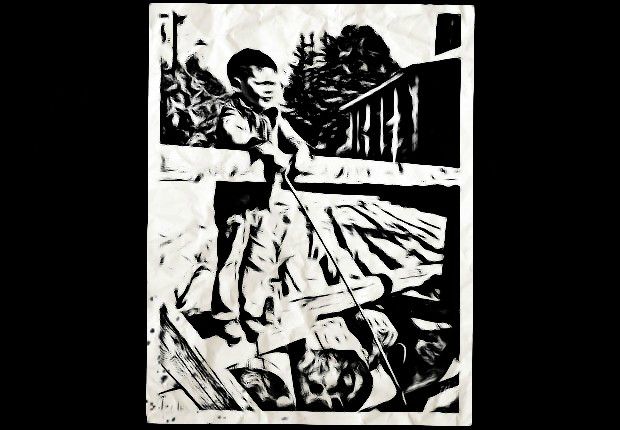
The story featured a runner out for his jog who stopped on a bridge to take a break near a young boy who was fishing, his tackle nearby. After a brief conversation, the jogger realizes that the young boy was blind. The story concludes with the jogger describing a fish the blind boy had caught but could not see. At the story’s conclusion, the boy is delighted, and the jogger reaffirmed that he should help his fellow man/boy.
“The story A View from the Bridge by McDonald is the most stupid story I have ever read,” wrote Sean in essay #1 in his Initial Response to Literature.
“I mean, who lets a blind boy fish by himself on a bridge? He could fall off into the water!”
I stopped reading. How had I not thought about this?
Sean continued, “Also, fishhooks are dangerous. A blind kid could put a fishhook right into a finger. How would he get that out? A trip to the emergency room, that’s how, and emergency rooms are expensive. I know, because I had to go for stitches and the bill was over $900.00.”
Wow! Sean was “Making a Connection”, and well over his minimum word count. I was very impressed, but I had a standardized rubric to follow. Sean was not addressing the details in the story. His conclusion was strong:
“I think that  kid’s mother should be locked up!”
I was in a quandary. How could I grade his response against the standardized rubric? Furthermore, he was right. The story was ridiculous, but how many other students had seen that? How many had addressed this critical flaw in the plot ? Only Sean was demonstrating critical thinking, the other students were all writing like the trained seals we had created .
One theory of grading suggests that teachers should reward students for what they do well, regardless of a rubric.So Sean received a passing grade on this essay assignment.  There were other students who scored higher because they met the criteria, but I remember thinking how Sean’s response communicated a powerful reaction to a story beyond the demands of the standardized test. In doing so, he reminded me of the adage, “There are none so blind as those who cannot see.”