Archives For April 30, 2015

That letter “O” morphing on your search engine for Mother’s Day?
That spinning Globe for Earth Day?
Those jigging leprechauns for St. Patrick’s Day?
These are all the Google Doodles from 2015 to celebrate holidays.

There are also Google doodle tributes to individuals. Emmy Noether (physicist), Laura Ingalls Wilder (author), and Anna Atkins (botonist), have been featured in doodles this year (2015) as individuals whose work was celebrated as having made an impact in our lives today. Each of the doodles represents the individual artistically using elements that best represent their work.

Some of the Google doodles are interactive. The Google doodle for Martha Graham is a 15 second celebration of dance. The Google doodle for Robert Moog provides a miniature electronic analog Moog Synthesizer (keyboard) that the viewer can play. The tribute to journalist Nellie Bly features a Youtube video scored with an original song (Music: “Nellie” by Karen O).

There are also international tributes not seen here in the United States with Google doodles for surrealist artist Leonora Carrington (Latin America/Australia); the oldest primary grade student at 84 years old, Kimani Maruge (Kenya); and womens’ rights activist, Henrietta Edwards (Canada).
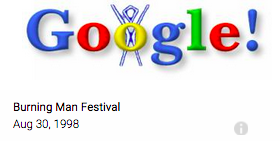
The first Google Doodle celebrating a vacation at the Burning Man Festival

The first Google doodle celebrated a vacation by Google founders Larry and Sergey at the Burning Man Festival

The first Google Doodle (right) was a comical message that the Google founders Larry Page and Sergey Brin were out of the office attending the Burning Man Festival. The Google Doodle Archive houses the entire collection (1998-present). A scroll through the graphics shows how Google’s primary colored logo is changed in a way that is often surprising or magical. Clicking on the Google doodle takes the reader to a page with information about the event or person, and information about the graphic design and artist for the page.

There are hundreds of doodles, and information on the archive states:

Creating doodles is now the responsibility of a team of talented illlustrators (we call them doodlers) and engineers. For them, creating doodles has become a group effort to enliven the Google homepage and bring smiles to the faces of Google users around the world.

Now, consider that a key shift of the Common Core State Standards (CCSS) is to build knowledge through content-rich nonfiction. The explanation on the CCSS website is:

Students must be immersed in information about the world around them if they are to develop the strong general knowledge and vocabulary they need to become successful readers and be prepared for college, career, and life. Informational texts play an important part in building students’ content knowledge. Further, it is vital for students to have extensive opportunities to build knowledge through texts so they can learn independently.

Students at all grade levels can independently develop an interpretation of the Google doodle graphic. After studying the logo created by Google illustrators (doodlers), teachers can determine if the link that takes students information on the holiday, the anniversary, or the biography is appropriate for age or grade level reading. Each link contains general information that aligns to the CCSS shift to “build knowledge through content-rich nonfiction.” There is information on these links that might lead students to investigate the person or topic on the doodle even further.

Should a student have an idea for a Google doodle, “The doodle team is always excited to hear ideas from users – they can email proposals@google.com with ideas for the next Google doodle.” There are hundreds of suggestions daily, but the information of the website assures students that, “…rest assured that we’re reading them :)”

Another opportunity for students to submit ideas for a Google doodle (Doodle 4 Google) will be available in September 2015. The details for the 8th annual US competition will be announced then, and examples of student entry winners in 2014 are available for viewing on the website as well.

A quick click on the Google doodle can be an engaging mini-lesson for students in building background knowledge….especially when the information is offered in a logo that is dancing, leaping, morphing, twisting, falling, jumping, running, exploding, singing, growing….

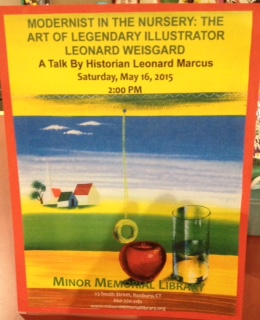
“You can’t swing a teddy bear around here without hitting an artist,” quipped Lane Smith, a children’s picture book artist (It’s a Book, The True Story of the Three Little Pigs) with two Caldecott Medal awards to his credit. Smith was sitting next to my friend Catherine at the Roxbury Minor Memorial Public Library in Litchfield County, Connecticut.

He was correct. The illustrator Wendall Minor  (Nibble Nibble; The Eagles Are BackIf You Spent a Day with Thoreau at Walden Pond) was sitting only a few seats away.

The geographical map of Northwest Connecticut is an “Area of Maximum Artist Density” where artists of all kinds reside. Catherine and I were spending Saturday afternoon in the small library conference room listening to a lecture by Leonard S. Marcus one of the world’s leading authorities on children’s books and their illustration. (See Catherine’s post here).

FullSizeRender

The subject of his talk was illustrator Leonard Weisgard who (no surprise here) had also lived in Roxbury until the late 60’s. The title of the talk was “Modernist in the Nursery: The Art of Legendary Illustrator Leonard Weisgard” and Marcus came prepared with multiple slides that highlighted the influences and illustrations in Weisgard’s long career as both a picture book artist and author and as a commercial artist (New Yorker).  In offering this talk, Marcus was surrounded by members of Weisgard’s family and former Roxbury neighbors. For them, this was a reunion; for us, this was a star-studded affair.

Marcus is an author himself including: Show Me a Story!; Golden Legacy: How Golden Books Won Children’s Hearts, Changed Publishing Forever, and Became an American Icon Along the Way). He was the curator of the New York Public Library 2014 exhibit, “The A,B,C of It: Why Children’s Books Matter” (which I wrote about in a post here).

Introducing Weisgard as a Modernist, Marcus discussed the development of children’s picture books as separating into those “Once upon a time…” stories of morals and lessons or those stories in which a child could insert himself or herself. Weisgard illustrated the later, and he often paired with Margaret Wise Brown to create books that appealed to a child’s sense of play and imagination, including:

In his 1947 Caldecott Acceptance speech, Weisgard spoke of this approach in his illustrations:

“We experimented with color for sound and shapes for emotion, letting the child bring the magic of movement, in a series of Noisy books. So that a radiator would be placed in a shape suggested by the hissing noise it makes, and the round sound of a ticking clock would put it into a circle.”

He also spoke of the brilliant colors in his pictures and pages filled with movement in this speech:

“There are times in illustrating when the artist of today must rub his nose against the reality of things and try to catch with the honesty of a child a yellow sun like a pat of butter in the sky, with clouds of cottage cheese and the smoke of boats flying in all directions, with no concern for north or east. Houses with windows gaping and people like raisins on the street, a fire engine tearing off the page and a policeman stopping everything.”

His appreciation and respect for his young audience is also summed up in this speech:

“Children are never as disturbed as grown-ups by contemporary arts, a streamlined plane, or a gallery of modern painting. They see an image with real meaning and vitality and sometimes with incongruous humor giving it a sharper reality.”

Weisgard’s acceptance speech contradicts some of the practices that have come about as a result of educators trying to increase rigor by choosing complex texts that are too often inaccessible for their young readers.  Here in his Caldecott acceptance speech some 68 years earlier, was Weisgard defending the ability of young children to read his illustrations that are very complex but also accessible.

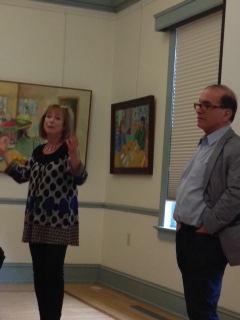
Leonard Marcus with Leonard Weisgard's daughter Abby at the discussion "Modernist in the Nursery"

Leonard Marcus with Leonard Weisgard’s daughter Abby at the discussion “Modernist in the Nursery”

The only wrinkle in an otherwise perfect afternoon was the slight delay caused by a technology glitch. Marcus’s Powerpoint presentation was stuck in presentation mode, and try as he and the other artists might, they could not change out of the presenter’s view of showing several slides simultaneously.

“Oh, well, sighed Marcus, “You’ll get a chance to see what slide is coming up…”

While the artists Minor, Smith, and Marcus struggled together with  uncooperative technology for those minutes, I did come up with this riddle:

Q: How many artists does it take to set up a powerpoint?

A: It doesn’t matter. Only their art does.

Oliver Wendell Holmes Jr, a Civil War veteran and a future Supreme Court Justice, delivered a Memorial Day Speech on May 30, 1884, at Keene, New Hampshire, as a tribute to fallen soldiers from the War Between the States. Educators can take an opportunity to use this speech, a primary source document, with their students to study both the historical events that Holmes references as well as his rhetorical style.

First page of Holmes's speech published in book format

First page of Holmes’s speech published in book format

In the first part of the speech, Holmes lays out his belief that twenty years after the Civil War, reunification of the States was possible because of the respect each side had for the other’s convictions:

We believed that it was most desirable that the North should win; we believed in the principle that the Union is indissoluable; we, or many of us at least, also believed that the conflict was inevitable, and that slavery had lasted long enough. But we equally believed that those who stood against us held just as sacred conviction that were the opposite of ours, and we respected them as every men with a heart must respect those who give all for their belief.

Knowing that many in the audience where from the John Sedgwick Post No. 4, Grand Army of the Republic and they had also served in the war, Holmes connected his battlefield memories to theirs, “But you all have known such; you, too, remember!

Holmes poetically recalled his fallen comrades who were killed on the battlefield: a 19-year-old 2nd lieutenant, a fair-haired lad, a surgeon, a captain:

I see them now, more than I can number, as once I saw them on this earth. They are the same bright figures, or their counterparts, that come also before your eyes; and when I speak of those who were my brothers, the same words describe yours.

Holmes then paid tribute to those women who suffered the loss of their husbands, fathers, and brothers; those “…whose sex forbade them to offer their lives, but who gave instead their happiness.” His rhetorical question about the women left behind because of the consequences of war is timeless:

Which of us has not been lifted above himself by the sight of one of those lovely, lonely women, around whom the wand of sorrow has traced its excluding circle–set apart, even when surrounded by loving friends who would fain bring back joy to their lives?

In concluding the speech, Holmes recalls the passion of those young men who entered the Civil War when their “hearts were touched with fire” only to learn that life is “a profound and passionate thing.”

For Social Studies teachers, the speech references different locations where battles took place: Petersburg, Antietam, Port Hudson, and the White Oak Swamp. Holmes also mentions the men killed at those battles: Col. Paul Revere, Jr.; Lt. James. J. Lowell; William L. Putnam; and the suicidal charge of the 20th Massachusetts Regiment. Each location, each name provides students an opportunity for research.

For English Language Arts teachers, the speech is filled with rhetorical devices that students can identify, and then evaluate each devices’s effectiveness in supporting Holmes’s message:

  • Comrades, some of the associations of this day are not only triumphant, but joyful. (direct address)
  • Such hearts–ah me, how many!–were stilled twenty years ago. (caesura-any interruption or break.)
  • Not all of those with whom we once stood shoulder to shoulder–not all of those whom we once loved and revered–are gone.(Anaphora – repeats a word or phrase in successive phrases)
  • Who does not remember the leader of the assault of the mine at Petersburg? (rhetorical question)

In the final lines of the speech, Holmes leans heavily on a literary conceit (elaborate metaphor) of life as music:

Our dead brothers still live for us, and bid us think of life, not death–of life to which in their youth they lent the passion and joy of the spring. As I listen , the great chorus of life and joy begins again, and amid the awful orchestra of seen and unseen powers and destinies of good and evil our trumpets sound once more a note of daring, hope, and will.

Of the 3600 words in Holmes’s speech, the most frequently used words are man, life, and day. By repeating these words, his tribute on Memorial Day in 1884 calls attention to the sacrifices of fallen soldiers in his century, and in ours.

The first 10 days in the National Day Calendar of May 2015 have been crowded with days of tributes and appreciation. A few of the more notable days include:Screenshot 2015-05-10 14.59.14

While several of these day are associated with historical events: (May Day, Cinco de Mayo, VE WWII Day) or other worthwhile causes (World Press Freedom, National Day of Prayer, World Red Cross/Red Crescent) many of the other days have been designated as tribute those who occupy professions dedicated to serving others.

According to the Online Etymological Dictionary,  the word “service” originates from the verb “to serve” (v.) in the late 12th Century originating from the Old French verb servir meaning “minister, give aid, give help,” and from the Latin servus “to do duty toward” or “show devotion to.” This verb took on a sense of “be useful, be beneficial, be suitable for a purpose or function” before shifting to that sense of “take the place or meet the needs of, be equal to the task” during the 14th Century.

By the mid-13th Century, the noun service meant the “state of being bound to undertake tasks for someone or at someone’s direction; labor performed or undertaken for another” which eventually led to its association with military service. In keeping with this theme of service, please note the May 9th calendar date above dedicated to appreciating military spouses.public-service

Today’s definition of service as a verb is “to provide (someone) with something that is needed or wanted,” or as a noun, “the occupation or function of serving.” This definition of service is at the heart of the efforts of teachers, nurses, and those in the military. Everyday, men and women in these professions “give aid” or “help”; everyday they provide what is needed in “labor performed or undertaken for another.”

Teacher DayAs as teacher, I am pleased that there was an entire week for Teacher Appreciation (May 3-9th) with National Teacher’s Day on May 5th. May 6th of this week was designated as National Nurses Day, including school nurses, celebrated during National Nurses Week (May 6-12).   Perhaps it is not so strange that these weeks should have overlapped in paying tribute to those who help or serve others. I am often reminded by how much the fields of education and nursing attract people drawn to similar service, and as an example, I offer the following story.

Several years ago, when my two sons were attending the United States Naval Academy at Annapolis, my husband and I took a number of midshipmen out to dinner. There were 13 young men and women seated around us that night, and the conversation turned to what their parents did for a living.

“What does your mother do?” I asked one of the midshipmen.
“She’s a nurse,” he replied.
“So is mine,” added the young women next to him; she seemed surprised.
“Mine is in education, a special ed teacher,” stated the young man opposite me.

And so it went around the dinner table: “a nurse’s aide” or “a teacher” or “a teacher’s aide” or “a nurse.” Out of the 13 young men and women who would be entering the military service (US Navy or United States Marine Corps) after graduating the Naval Academy, all 13 had mothers who were either in nursing or education. I am convinced that 13 for 13 is not coincidence, but rather an illustration of how one life dedicated to public service in nursing or in education influences other lives to enter public service.

The informal survey taken around the dinner table that night also illustrated the influence of mothers, and so it should come as no surprise that paying tribute to those who serve during the month of May would culminate in the ultimate day of appreciation to the paramount profession of service called Mother’s Day. Literally and figuratively, mothers are those who have served in “labor performed or undertaken for another”!Screenshot 2015-05-10 14.56.40

While National Holiday Calendar sets up days to appreciate the indispensable efforts of teachers, nurses, and mothers in the first weeks of May, it also had designated May 4th as National Star Wars Day.

How fitting that we take time to celebrate the efforts of teachers, of nurses, and of mothers everywhere….May the Fourth be with them all throughout the year!