Archives For November 30, 2015

The Best Persuasive Argument of 2015 was not presented in the form of the standard five paragraph essay.

Instead, the best persuasive argument made this year featured 1000 musicians playing the song “Learn to Fly” in a field in order to persuade the rock band Foo Fighters to play a concert in a small town in Italy.

The entire project was the brainchild of Fabio Zaffagnini and his creative team. They named themselves the Rockin’1000 with the tag line: Romanga Calling the Foo Fighters and they extended an invitation to the band perform in Cesena, Italy.

The diary on their website chronicles how they raised $45,000 in order to film their appeal.Screenshot 2015-12-31 22.13.39

Their effort began in May 2014 (“The idea pops out”), and the diary records their emotional responses as the team met each challenge:

  • September 2014-“a miracle is needed!”

  • March 2015-“we launched a cartoon spoken in our regional dialect that explains how to donate and be part of Rockin’1000  (no translations for that, sorry, but we assure you: it’s very funny!)”

  • July 30 2015-KABOOOOOM! “The Rockin’1000 video is out and in a few hours it becomes a worldwide success with more than 10 million views. We’re literally overwhelmed by email, interviews, social media just go crazy!”

  • August 2015-“The Rockin’1000 people just made it, with little money and a lot of passion.”

Consider that a standard argumentative essay has five critical parts, and then consider how the argument made by the Rockin’1000 in creating their video meets each requirement:

PART #1  Introduce the topic of the paper and the thesis statement.

“We needed a crazy idea. We had to organize something that kicks ass worldwide and can be seen by Dave Grohl [of the Foo Fighters]: we will ask one thousand rockers to play one of their songs, all together and at the same time.”

PART #2  Presents the facts of the case:

“The Foo Fighters have not been in Romagna since 1997, ‘it’s time to get them back.'”

PART #3 Prove the thesis with your arguments.

“We got the money, so now we cannot back out, there are no more excuses.”

“Italy is a country where dreams cannot easily come true, but it’s a land of passion and creativity…”

PART #4  Disprove your opponent’s arguments.

“…the budget is extremely tight and we cannot afford many expenses, we borrow anything that is available, we implore technicians to work for free or to be under paid. We need experienced professionals, but the challenge is so cool that we are able to recruit real bigwigs.”

PART #5  End the essay. 

The video: (Fabio speaking) “To be true…this (gestures to musicians) is just to 5 people They just did for one song…your song. Our call is to ask you, the Foo Fighters, to come and play for us…Please… (begging motion)….Make noise!….

(CROWD) Foo Fighters! Foo Fighters!

The video can be seen here:

Meeting the requirements of an argumentative essay is not the reason for writing an argumentative essay, although there are students who are convinced that requirements = reasons.

Moreover, the reason this is the BEST argumentative essay for 2015 is that David Grohl of the Foo Fighters did see the video, and he posted his own video response:

“Hello, Cesena. It’s David,” Grohl said, “Hi. I am sorry I don’t speak Italian, just a bit, a bit. This video was good! Super nice. Thank you so much. We’re coming, I swear. We’ll see each other soon. Thank you so much. I love you. Ciao.” (BBC News)

On November 4, 2015, the Foo Fighters performed in Cesena, Italy, for an audience of 3,000 donors and musicians from Rockin’1000. They opened with  “Learn to Fly,” and invited one of the drummers from the video onto the stage to perform. According to the New York Times review of the 11/4/15 show, Grohl told the audience, “The whole world saw what you did…Millions and millions of people saw what you did. It’s a beautiful thing.”

The 26 million views of this video on YouTube confirms the truth in Grohl’s statement. There will be more views as this video appeal was included in many of the end of the year “best” moments for 2015 (Google). The standard 5 paragraph essay never reaches that kind of audience.

Consider, then, if this was the best argument for 2015, what can students do to persuade someone to take action in 2016…and what format would make the best persuasive argument?

December’s flower is the Narcissus, a perennial plant that gained its name and reputation from a Greek myth.

The story of the Narcissus is described by Ovid in his Metamorphoses (3. 339-509). In his re-telling, Ovid describes how the beautiful young man Narcissus happened to catch a glimpse of himself in a pool of water and fell so intensely in love with his own reflection that he was fixed to that spot:

“…Surely he desires my love and my embraces, for as oft I strive to kiss him, bending to the limpid stream my lips, so often does he hold his face fondly to me, and vainly struggles up…” (3.433 Brookes More translation).

According to Ovid, Narcissus, captured by his own reflection, spent his days gazing at his reflection. He eventually wasted away:

“…and those bright eyes, which had so loved to gaze, entranced, on their own master’s beauty, sad Night closed…And in his body’s place a sweet flower grew, golden and white, the white around the gold” (3.540)

NarcissusThe myth ends as the little flower grows in the spot where Narcissus died; it also bends down towards the water.

Perhaps it is no coincidence then, that the last month of the year, in December, is when we all reflect back on the past year’s memories.  The word reflection itself comes from the Latin, literally “a bending back,” “to bend back, bend backwards, turn away,” from re- “back” (see re-) + flectere “to bend”.

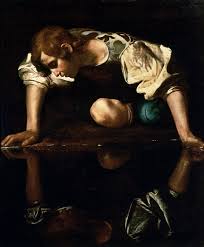
Narcissus by Caravaggio

Narcissus by Caravaggio (1599) Galleria Borghese: Rome, Italy

That act of bending by Narcissus to catch a glimpse of himself in the pool is almost the the same act of “bending back” when we engage in reflection.

Today, the ability to “bend back” and reflect is surprisingly easy. Social media will aggregate anyone’s photos and posts. For example, on numerous occasions, Facebook has invited me to review “Your Memories on Facebook” telling me that “we care about you and the memories you share here. We thought you’d like to look back on this post.” Such offers are a kind of Narcissistic indulgence.

There are also end of year reflections are made available on a larger scale such as the “Year in Review” compilations for larger audiences. The following videos recap the top events for 2015 as recorded on different social media:

Google’s Year in Review:

Twitter’s Year in Review:

Facebook’s Year in Review:

Go Pro’s Year in Review

Most of the footage for each the videos came from the camera lenses of ordinary people who captured extraordinary moments across the globe over the course of the year and who posted these images on websites or social media. We all now have the chance to reflect on their contributions, and in this sense, we are all Narcissus, gazing into a pool of our collective memories.

There is one final link between Narcissus and the practice of reflection at the end of the year that can be found in the flower’s naturally occurring chemical called Galanthamine. Research has discovered that this chemical is capable of easing the symptoms of dementia among those suffering Alzheimer’s. This means that the Narcissus flower is associated chemically with memory as well as being associated mythologically with reflection.

In Ovid’s story, the beautiful youth Narcissus was loved by the nymph Echo. While his curse was beauty, her curse was to repeat the words of others:

“As he faded, he breathed a sad `farewell!’

`Farewell!’ sighed Echo.”

“Farewell,” we echo as we reflect, “farewell to 2015.”

It’s December, and in keeping with the season,  I had planned on a post celebrating Robert Frost’s poem “Christmas Trees”. Instead, however, I found myself on an inquiry path on a Frost holiday tradition.

I first inquired, what is the story behind Frost’s poem Christmas Trees?

The poem opens:

The city had withdrawn into itself  
And left at last the country to the country;  
When between whirls of snow not come to lie  
And whirls of foliage not yet laid, there drove  
A stranger to our yard, who looked the city,   
Yet did in country fashion in that there  
He sat and waited till he drew us out,  
A-buttoning coats, to ask him who he was.  
He proved to be the city come again  
To look for something it had left behind   
And could not do without and keep its Christmas.

The stranger asks to purchase Frost’s trees:

 He said, “A thousand.”  
  
“A thousand Christmas trees!—at what apiece?”  
  
He felt some need of softening that to me:       
“A thousand trees would come to thirty dollars.”  

Rather than sell them, Frost conclusion is more metaphorical:

A thousand Christmas trees I didn’t know I had!  
Worth three cents more to give away than sell,  
As may be shown by a simple calculation.  
Too bad I couldn’t lay one in a letter.       
I can’t help wishing I could send you one,  
In wishing you herewith a Merry Christmas.

I found (on Poets.org) that beginning in 1929, Frost and the printer Joseph Blumenthal partnered up to produce beautifully illustrated Christmas cards featuring Frost’s poetry.  I was surprised to discover, as reported in the NYTimes, Blumenthal, who ran the Spiral Press of New York, created the first card without Frost’s knowledge:

“…he printed 250 copies—for his wife and a small group of colleagues—of a letterpress chapbook of Frost’s early poem “Christmas Trees.”

When the poet saw the publication, his first response was to contact Blumenthal and request a few copies to send out to his own family members: ‘My sympathies have been enlisted on the side of small presses and hand setting. My heart will be with you in your work’.”

A slideshow of the cards is available on the NYTimes website. This tradition continued for another 30 years, and the Frost-Blumenthal productions were holiday “greetings” in the form of chapbooks.

I then needed to inquire, why a chapbook?

I discovered that a chapbook was historically “a small pamphlet containing tales, ballads, or tracts, sold by peddlers” in contrast to its current contemporary meaning, “a small paperback booklet, typically containing poems or fiction.” These chapbooks are very simple, stapled in the center, with some illustrated covers.

The Blog Poetry and Popular Culture posted their inquiry about the chapbooks as well:

  • What was the annual press run?
  • Did the press have a list of subscribers committed to buying a set every year, and how much money did Blumenthal and Frost eventually make off of the limited editions?

I did find out on the Poets.org site that Blumenthal printed 275 copies of the first greeting, and the last, “The Prophets Really Prophesy as Mystics, the Commentators Merely by Statistics”  had an edition run of 16,555 copies. There was no collective information on the money exchanged, other than the note that the cards can sometimes be found for purchase on E-bay (example).

That led me to inquire, what other poems did Frost place into chapbooks?

Oher poems sent as chapbooks were “Birches,” “A Boy’s Will,” and “The Wood-Pile”. There was an exhibit of the chapbooks in 2012 at the Pequot Library in Southport, CT. The exhibit was titled “Good Wishes from Robert Frost” – a set of 19 chapbooks loaned by Elinor Wilber, granddaughter of the celebrated American poet Robert Frost. Several have a personal inscription from Frost to Elinor and her husband. A video showing these chapbooks is available here:

The video ends with a copy handwritten by Frost of his poem “Stopping by Woods on a Snowy Evening”.

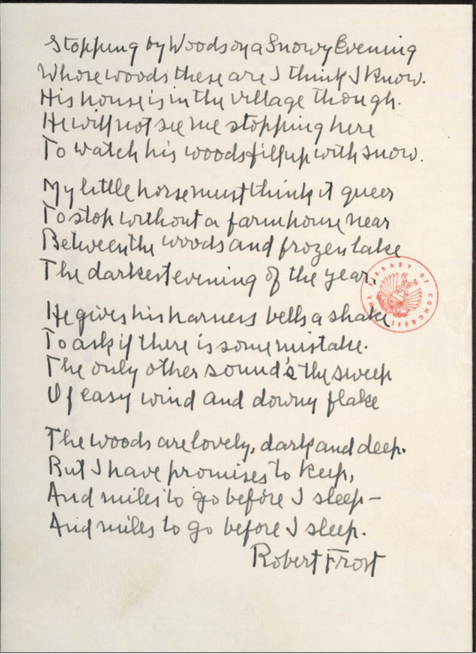
That led me to seek out a better copy of this manuscript, and my path of inquiry took me to the Library of Congress where there is a photo of the poem in its entirety:

Screenshot 2015-12-18 19.02.41

Robert Frost. “Stopping by Woods on a Snowy Evening.” Holograph manuscript, n.d. Manuscript Division, Library of Congress (195C)


This inquiry led me a different publisher. Frost’s Snow to Snow, was issued by in 1936 by Henry Holt & Company. They published twelve of Frost’s  verses, each one corresponding to a month of the year and ending with December’s “Stopping by Woods on a Snowy Evening”.

So how does one find out what the poem “Stopping by Woods on a Snowy Evening” means?

I then decided to chase down the popular story (one that I have often repeated without checking its veracity) that Frost was in the audience of group of people listening to a lecture about the meaning of this poem.

I had heard that “The poem is about death,” the lecturer supposedly reported, and he continued for many minutes pointing out all the images related to death:”darkest evening” and  “sleep”. At the end of the lecture, there was an opportunity for questions and comments from the audience. Now (according to the rumor), Frost patiently waited his turn, and then firmly stated: “I wrote that poem. It is not about death. I was going home in the snow.”

As much fun as that rumored story is….I could not find anything to confirm it happening. I am chagrined that I have kept the rumor going.

However, I was relieved to find some form of confirmation in quotes from a book: Robert Frost an introduction: poems, reviews, criticism with quotes from Reginald Cook regarding this poem:

  •  “it’s all very nice but I must be getting along, getting home.”…
  •  “I always thought,” he explains, “it was the product of autointoxication coming from tiredness.”
  • When a friendly critic asked if the last two lines in “Stopping by Woods” referred to going to Heaven, and, by implication, death, the poet replied, “No, all that means is to get the hell out of there.”

On this path of inquiry, I also discovered a video of Frost reading this poem. The introduction is by the radio host Garrison Keillor:


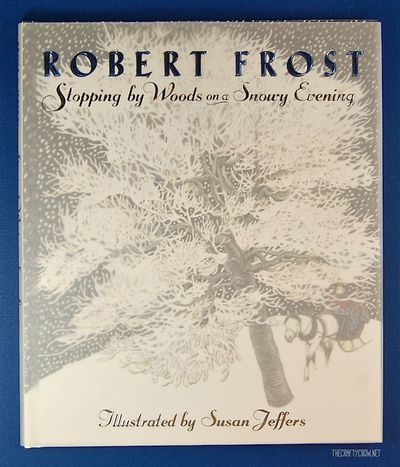
Susan Jeffers on Frost

My final thought on Frost’s poem “Stopping by Woods on a Snowy Evening” was of the picture book illustrated by Susan Jeffers that I read to my boys as part of our holiday preparation. The man in her rendition bears a striking resemblance to Santa Claus and the little harness bells look very festive. I know Jeffers makes the poem more child-friendly than alternative interpretations!

Finally, to sum up Frost’s attitude towards analysis, in a letter to Louis Untermeyer (1964) in Robert Frost: A Backward Look, Frost writes:

You’ve often heard me say – perhaps too often – that poetry is what is lost in translation. It is also what is lost in interpretation. That little poem means just what it says and it says what it means, nothing less but nothing more.

Or, here is a more unceremonious statement in his own voice:

“….What are the promises?….If I wanted you to know, I would have told you in the poem.”

Therefore, on this post I offer no translations…and no interpretations. Here are discoveries-and at least one correction- on my inquiry journey of the winter poems of the aptly named Frost.

Happy Holidays!

The best holiday scenes in novels are sometimes unexpected. While some of these scenes may seem incidental, the Christmas tree scene in Betty Smith’A Tree Grows in Brooklyn (1943) is anything but ancillary. Smith uses the sentimentality of Christmas to highlight the novel’s theme of tenacity.

Smith’s protagonist is the 10-year-old Mary Frances “Francie” Nolan, who is determined to rise above challenging circumstances of poverty, social class, and her father’s alcoholism. Coming of age novels like A Tree Grows in Brooklyn are good choices to use with students, but educators may be dissuaded from assigning the novel as a whole class read because of its length (443 pages). The reading level (Lexile), however, is 810, a reading level appropriate for readers grade 5 and up, although some of situations and language are more suited for grades 8 and up.

With all the attention to the practice of “close reading” to improve comprehension, it is possible to have students read a single chapter, such as this Christmas chapter (Ch. 27), independent of the novel. Sharing this chapter can help students appreciate Smith’s storytelling.

For purposes of brevity, the text has been truncated into sequential sections below along with four questions that educators can use.

  1. So what does Smith “say” in the opening of the chapter?

“Christmas was a charmed time in Brooklyn…You have to be a child to know how wonderful is a store window filled with dolls and sleds and other toys. And this wonder came free to Francie. It was nearly as good as actually having the toys to be permitted to look at them through the glass window. Oh, what a thrill there was for Francie when she turned a street corner and saw another store all fixed up for Christmas!…”

Possible responses:

  • The setting is in borough of Brooklyn; city streets
  • Toys (dolls and sleds) for Christmas were in the store windows
  • Francie did not have the money to pay for the toys she saw

2. What interesting or unusual words does Smith use is explaining Francie’s challenge ?

“There was a cruel custom in the neighborhood. It was about the trees still unsold when midnight of Christmas Eve approached. There was a saying that if you waited until then, you wouldn’t have to buy a tree; that “they’d chuck ’em at you.” This was literally true. At midnight on the Eve of our dear Saviour’s birth, the kids gathered where there were unsold trees. The man threw each tree in turn, starting with the biggest….If a boy didn’t fall down under the impact, the tree was his. If he fell, he forfeited his chance at winning a tree.”

Possible responses:

  • “Cruel custom” taking place on the “Eve of our dear Saviour’s birth”
  • “they’d chuck ‘em at you”
  • Forfeit; impact

3. How does the Smith play with language in the following section?

“Francie stepped forward. ‘Me, Mister.’

A spurt of derisive laughter came from the tree man. The kids snickered. A few adults who had gathered to watch the fun, guffawed.

‘Aw g’wan. You’re too little,’ the tree man objected.

‘Me and my brother-we’re not too little together.’ She pulled Neeley forward. The man looked at them a thin girl of ten with starveling hollows in her cheeks but with the chin still baby-round.

‘Two ain’t fair,’ yelped Punky.

‘Shut your lousy trap,’ advised the man who held all power in that hour. ‘These here kids is got nerve.’

The others made a wavering lane… a human funnel with Francie and her brother making the small end of it. The man flexed his great arms to throw the great tree. He noticed how tiny the children looked at the end of the short lane.

Possible responses:

  • “Aw g’wan” captures the dialect of the tree vendor; the man who held all power in that hour
  • “it was a human funnel”-metaphor
  • “a girl with with starveling hollows in her cheeks”-descriptive imagery

4. So, what does Smith want the reader to understand?

For the split part of a moment, the tree thrower went through a kind of Gethsemane. “Oh, Jesus Christ,” his soul agonized, “why don’t I just give ’em the tree, say Merry Christmas and let ’em go? …..”But then,” he rationalized, “if I did that, all the others would expect to get ’em handed to ’em. They’d all wait to get ’em handed to ’em on a silver plate…I ain’t big enough to do a thing like that. I gotta think of myself and my own kids.” He finally came to his conclusion….”Them two kids is gotta live in this world. They got to learn to give and to take punishment….”

At this point in the text, Chapter 27 is not an incidental Christmas event; instead, it stands as representing the novel writ large. Smith choses to use the internal monologue of a man heaving the last of unsold trees at two small children in a perverse act of charity on Christmas Eve to represent all the challenges Francie faces in the novel:

“As he threw the tree with all his strength, his heart wailed out, ‘It’s a God-damned, rotten, lousy world!’

But Francie does not buckle:

“Francie saw the tree leave his hands. There was a split bit of being when time and space had no meaning. The whole world stood still as something dark and monstrous came through the air. The tree came towards her blotting out all memory of her ever having lived. There was nothing-nothing but pungent darkness and something that grew and grew as it rushed at her. She staggered as the tree hit them. Neeley went to his knees but she pulled him up fiercely before he could go down. There was a mighty swishing sound as the tree settled. Everything was dark, green and prickly. Then she felt a sharp pain at the side of her head where the trunk of the tree had hit her. She felt Neeley trembling. When some of the older boys pulled the tree away, they found Francie and her brother standing upright, hand in hand.”

Students cannot help but admire Francie’s tenacity in confronting the physical force of the tree. Her determination is so powerful that she stands for two, “pulling him [Neeley] up fiercely” and standing “hand in hand”.

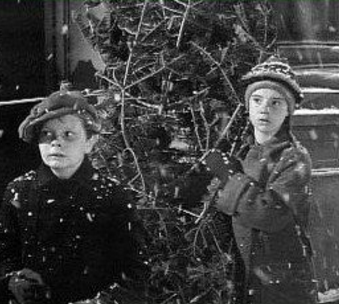
Film still from the Christmas tree scene from the film "A Tree Grows in Brooklyn"

Film still from the Christmas tree scene from the film “A Tree Grows in Brooklyn” (1945)

Francie wins the great tree and as she drags the enormous prize home with Neeley, they are cheered on by well-wishers from the neighborhood.

Smith closes the chapter by reminding the readers that this victory for Francie’s will be short-lived; the challenges of poverty will still be with her:

“There was no money to buy tree decorations or lights. But the great tree standing there was enough. The room was cold. It was a poor year, that one-too poor for them to buy the extra coal for the front room stove. The room smelled cold and clean and aromatic. ….. she sat there and enjoyed the smell and the dark greenness of it.”

True to type, Chapter 27 shares what all Christmas stories share, a miracle…with its element of mystery:

“Oh, the mystery of a great tree, a prisoner in a tin wash bucket in a tenement front room!”

In reading this chapter, students may want to continue to read about Francie, who will, unlike the great tree, not be a prisoner of the tenement…her determination stands.

“We are not used to live with such bewildering uncertainty,” wrote Jessica Stern in a New York Times editorial How Terror Hardens Us on Sunday (12/6/15) after the San Bernardino, California, shootings.

Stern, an adult, was writing about adults collectively when she used the pronoun”we.”

That same bewildering uncertainty also confronts our children, our students in schools. That bewildering uncertainty is happening at a vulnerable time, just when they are just learning to be citizens in our democracy. That same state of terror, a state of intense fear, has an impact on their state of mind as each terrorist attack, Stern notes, “evokes a powerful sense of dread.”

 Stern, a professor at Boston University’s Pardee School of Global Studies, co-authored ISIS: The State of Terror. She noted in her editorial:

“It [terrorism] is exactly that kind of psychological warfare that It is a form of psychological warfare whose goal is to bolster the morale of its supporters and demoralize and frighten its target audience — the victims and their communities. Terrorists aim to make us feel afraid, and to overreact in fear.”

Students in our classrooms today attend schools where terrorism or home-grown violence is a possibility; the term “lockdown” is part of their vocabulary. At every grade level, they have every reason to believe that they could be a target audience. while motives for violence have differed, many students are aware that high-profile incidents have happened in schools: Columbine (1999) and Sandy Hook (2012).

As educators in all disciplines at every grade level struggle to help students deal with recent events that are identified as terrorism, perhaps the discipline of social studies is the subject where educators can best counter a terrorist’s goal to have our students “afraid and overreact in fear.”

That academic responsibility to help students cope was claimed 14 years ago by the president of the National Council of Social Studies (NCSS) in 2001, months after the attacks on the Pentagon and the Twin Towers at the World Trade Center.

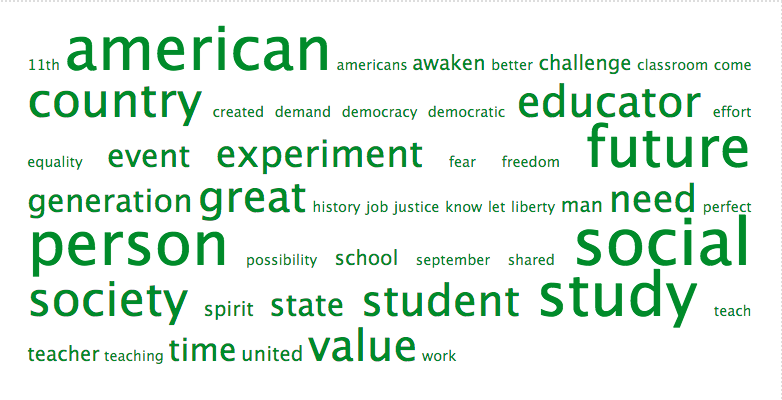
Most frequent words in the speech given by Aiden Davis in 2011 to the National Council of Social Studies after 9/11 (www.wordsift.com)

The most frequent words enlarged from the speech given by Aiden Davis, President of National Council of Social Studies after 9/11/2001 (www.wordsift.com)


When Adrian Davis delivered his 2001 NCSS Presidential Address to the nation’s social studies teachers, he explained their role as educators included efforts to “to work to reconstruct schools to become laboratories for democratic life” by saying:

“Schools do not exist in a vacuum. They are not isolated from their neighborhoods and communities. Schools and teaching reflect society, and they participate in constructing the future society.”

When Davis gave this address, he was making the case that terrorism had made the discipline of social studies more relevant to future societies than ever before. He anticipated that there would be people who could “overreact in fear”; his address hoped to point out that students would need guidance so that democracy would survive the bewildering uncertainty after 9/11:

 As social studies educators, we need to reinforce the ideals of equality, equity, freedom, and justice against a backlash of antidemocratic sentiments and hostile divisions. As social studies educators, we need to teach our students not only how to understand and tolerate but also how to respect others who are different, how to cooperate with one another, and to work together for the common good.

Davis’s concerns about teaching respect and how to cooperate are even more important today when there is heated rhetoric conflating terrorism with religion. His reason to encourage social studies teachers to reinforce the ideals of equality, equity, freedom, and justice provides a solution to the concerns in Stern raised in her How Terror Hardens Us.

Stern’s editorial concludes, “If we are to prevail in the war on terrorism, we need to remember that the freedoms we aspire to come with great responsibilities.”

On behalf of all social studies educators, Davis accepted those responsibilities. As he concluded, he made clear the commitment he was making for teachers, “We have an opportunity to teach the coming generations to preserve and extend the United States as an experiment in building a democratic community….teaching is where we touch the future.”

The future is always uncertain, but educators, especially social studies educators, can provide students the skills of citizenship to deal with uncertainty so that they will not overreact in fear.

Last month, I travelled to Minneapolis, Minnesota, to attend the 2015 National Council of Teachers of English (NCTE) Convention with two fellow teachers to participate in poster sessions under the topic Digital Pedagogies and Approaches to Media. 

One of the poster session was titled  “Every Picture Tells a Story”  and offered by Catherine Flynn, the Literacy Specialist at the K-8 elementary school in Sherman, Connecticut. Her presentation promoted the use of art as a literacy strategy in English/Language Arts classrooms as well as other content area classrooms. She offered examples of lessons on using art to enhance academic background knowledge at multiple grade levels. Background knowledge is critical to improving literacy since students who literally have  “pictures in their heads” of an idea, time period, or event are better able to comprehend the pictures created by words in a text. Flynn illustrated how abstract concepts of point of view, context, and perspective can be made understandable by using art to engage students in conversations across time and place. She also provided viewers with research that supports the use of art  to improve student inferential skills and in analyzing interpretations. Her materials can be accessed on this Google Doc and she can be contacted through her Twitter:@flynn_catherine and her excellent blog https://readingtothecore.wordpress.com/

The other presentation was offered by Caitlin Pinto, a 7th grade English Language Arts teacher at Harry Bailey Middle School in West Haven, Connecticut. I had already posted about Caitlin’s presentation at Here We Go, Pinto. Her lesson had students respond to reading on social media platforms or using social media templates to develop many of the skills that we want our students: analyzing, summarizing, researching, and making text to text connections. The social media platforms she uses are familiar to students who can transfer the strategies of each and apply them to the more traditional roles in literature circles. Her Twitter handle is @cpinto_iteach.

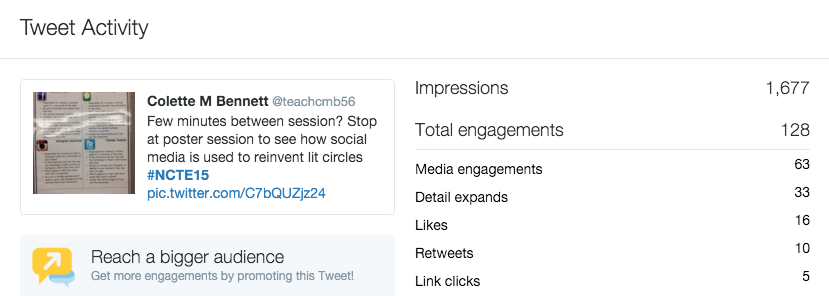
Over 30 educators stopped to speak one-to-one with Catherine or Caitlin, and the conversations about the different lessons they taught were each several minutes long. Both were engaged sharing with peers for the entire 90 minutes.  Moreover, as an example of the effectiveness in using social media, a tweet I posted about Caitlin’s use of showing how she uses the Twitter format for some roles in literature circles has been viewed 1,677 times (see below).

Screenshot 2015-12-02 20.37.13


A poster session is not given in a dedicated room. The number of people who stopped to talk, however, exceeded expectations. At each display, we received more response from attendees than several of the 20-minute presentations held elsewhere during the convention. In this context, poster sessions were great way for these new presenters to become comfortable and network personally with other teachers.

I have written about the word context and this convention in a previous post where I mentioned that the etymology of the word context comes from the 15th C. Latin contextus meaning “a joining together”. The word context was originally the past participle of contexere, which means to “to weave together,” from com- “together” + texere “to weave, to make”.

The poster sessions are an example of how teachers “join together” in opportunities to show how they “make” lessons that help students improve their literacy skills. Catherine’s lessons using art to improve student inferential skills and in analyzing interpretations and Caitlin’s lessons using social media to help students with analyzing, summarizing, researching, and making text to text connections are both evidence of how best practices can be shared peer-to-peer at the NCTE convention.

NCTE poster sessions = contextus=an example of joining [educators] together.