Archives For November 30, 1999

In the spirit of all end of the year reviews, I have condensed the year 2013 by offering month by month posts from this blog that illustrated the best student (and subsequently, teacher) learning:

January 2013: A Freshman’s Modern Odyssey in the Style of Homer

"Dawn spread her rosy fingers..."

“Dawn spread her rosy fingers…”

The Freshmen final project after reading The Odyssey is a narrative that students complete called “The Wamogossey: A Day in the Life of a Freshman at Wamogo High School.” Writing narratives are once again favored in  Common Core State Standards, and this post explained how students made their own attempt at an epic adventure.

February 2013:  Spilling Over the Corners of a Six Word Text
Short Story in 6 words

Short Story in 6 words

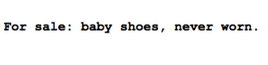
This exercise proves that keeping students “within the four corners of the text” is impossible, even when the text, attributed to Ernest Hemingway, is only six words long. This post also serves as evidence that that admonitions on best practices should be limited to those with actual classroom experience, not to the “architects of the Common Core.”

March 2013 If You Want to Watch the Cow Give Birth
Watching the arrival of our latest calf

Watching the arrival of our latest calf

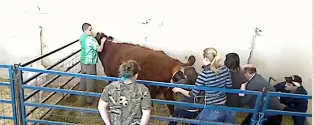
Yes, “If you want to watch the cow give birth, turn on U-stream now!” was an announcement over the PA system. Normally, I am irritated by interruptions to class time, but this announcement cued students about opportunity watch the birth of a calf in the Agricultural Science wing of our high school. The combination of technology in broadcasting and recording the birth of the newest member of the agricultural program with old-fashioned “hands on” physical labor illustrates 21st Century authentic learning.

April 2013 You Never Forget Your First Hamlet

Members of the senior class were fortunate enough to see Paul Giamatti’s “Hamlet” at Yale Repertory Theatre. I’ll let their words speak for the experience:

The performance was a wonderful experience, especially since it was my first time to see Shakespeare.

I wouldn’t mind going to another because it was so enjoyable that I didn’t even realize the 4 hours passing by.

I like the way that a play has a certain kind of vibe. It’s like a live concert, where there’s a certain kind of energy.

It was like seeing a live performance of a film. I would especially like to see another Shakespeare because it is the way that he intended his works to be portrayed.

After seeing Hamlet so well done, it would definitely be worth going to see another one whether it be Shakespeare or a different kind of performance.

May 2013 Kinesthetic Greek and Latin Roots
Spelling "exo"=outside

Spelling “exo”=outside

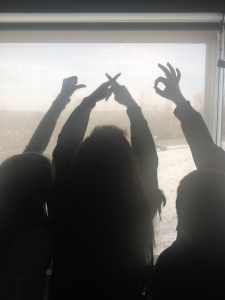
Understanding Greek and Latin roots is critical to decoding vocabulary, so when the freshman had a long list of roots to memorize, we tried a kinesthetic approach. The students used their fingers to spell out Greek roots: ant (against), tech (skill), exo (outside).  They twisted their bodies into letters and spread out against the wall spelling out xen (foreign), phob (fear). They also scored very well on the quizzes as a result!

June 2013 Superteachers!
Superteacher!

Superteacher!

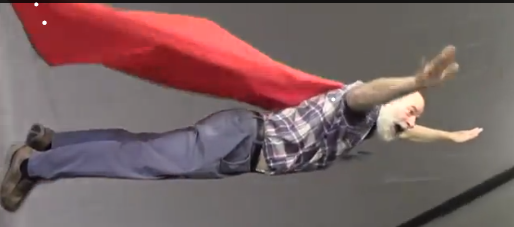
At the end of the 2012-2013 school year, teachers rose to a “friendship and respect” challenge to make a video. With a little help from a green screen, 27 members of the faculty representing a wide variety of disciplines jumped into the nearby closet wearing the big “W” (for Wamogo). Students in the video production class watched and filmed in amazement as, bearing some artifact from a particular subject area, each teacher donned a flowing red cape.

July 2013 Library Book Sales: Three Bags Full!

The original purpose of this blog was to show how I filled classroom libraries with gently used books. The Friends of the C.H. Booth Library Book Sale in Newtown, Connecticut, is one of the premier books sales in the state: well-organized tables filled with excellent quality used books, lots of attentive check-out staff, and great prices. This year, I added three large bags of books to our classroom libraries for $152.00, a discount of 90% off retail!

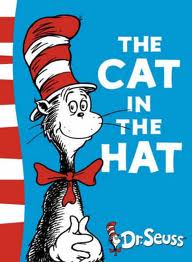
August 2013 Picture Books Are not for Kindergarten Any More!Cat in Hat book cover
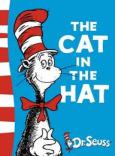
At used book sales, I am always looking for picture books I can use in high school classrooms. For example, I use The Cat in the Hat to explain Freud’s theory of the Id, Ego and Superego . Thing #1 and Thing #2 represent Id, and that righteous fish? The Superego. Yes, Dr. Seuss is great for psychological literary criticism, but he is not the only picture book in my repertoire of children’s literature used in high school. This post features a few of my favorite picture books to use and why.

September 2013 Close Reading with Saki and the Sophomores

Saki’s short stories open our World Literature course in which our students will be reading complex texts required by the English Language Arts Common Core State Standards (CCSS). After a “close reading” the conversations in the room showed the text’s complexity. Saki’s The Interlopers has all the elements suggested by the CCSS:  figurative language, the ironic wish, and multiple meaning in the revenge sought by man versus the revenge exacted by Nature. Our close reading should have been “textbook”. The evidence proved the characters’ demise…or did it? The ensuing discussion forced the class to consider other positions.

October 2013 Close Reading Art
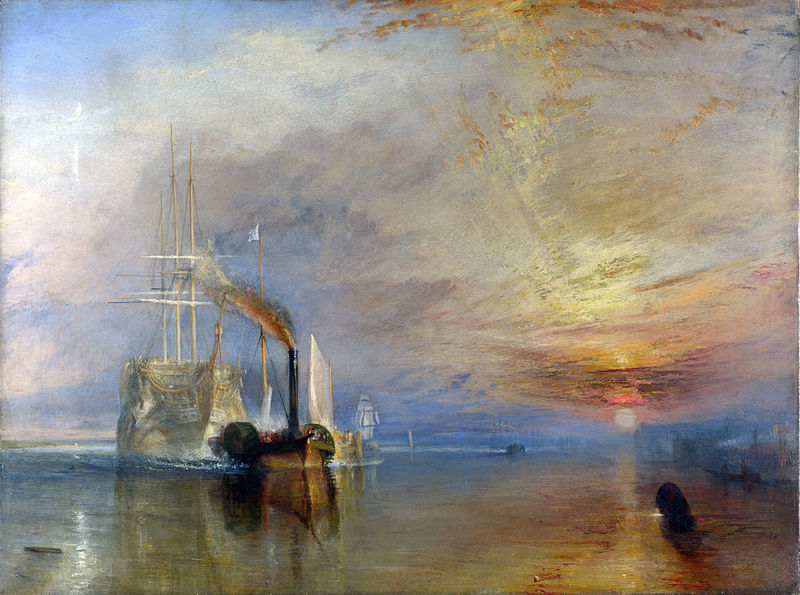
The Fighting Temeraire

The Fighting Temeraire

After “close reading” short stories, the sophomores were asked to use the same skills to “close read” several paintings that thematically connected to the Industrial Revolution. They studied a Constable pastoral painting, before J.M.W. Turner’s famous painting, The Fighting Temeraire. While some called attention to the the dirty smoke stack, others saw the energetic paddling as a sign of progress. They noticed the ghost-like ship hovering in the background, the light created by the sunset which gave the painting “warmth”or “light extinguishing”. When they were asked to use these elements as evidence to determine the artist’s message, there were some succinct responses to the painting’s “text.”

November 2013 Thanks for the NCTE Conference

Five members of the English Department attended the conference and selected from over 700 sessions at the National Council of Teachers of English and the Conference on English Leadership.  District support for such great professional development is truly appreciated. We are also grateful that four of our proposals were chosen to share as presentations for other educators. The explanations of our presentations with links to these presentations are included in this post.

December 2013 Drama Class Holiday Miracle
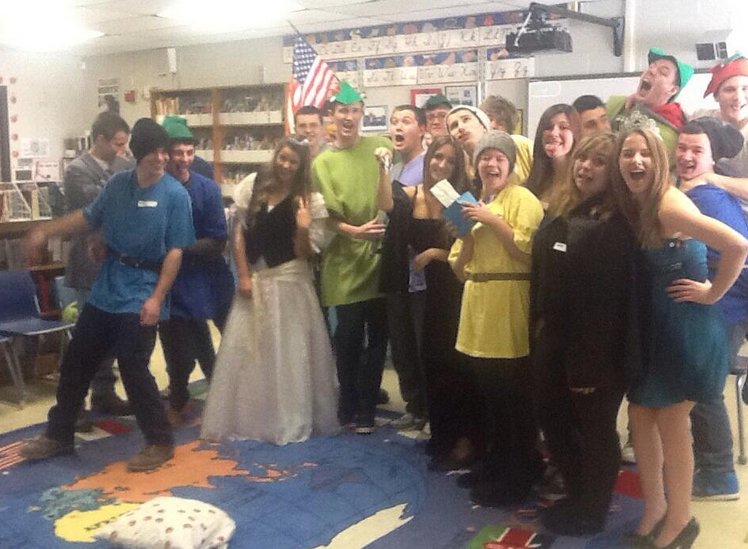
Cast photo!

Cast photo!

An ice storm two weeks before performance caused a car pile-up, and the drama club teacher was left with a concussion. She could not be in school; the students were on their own, and I was left to supervise their performances of Snow White and the Seven Dwarves at three local elementary schools.

Their “dress rehearsal” was a disaster, but, as the adage says, “The show must go on!” and once they arrived at the elementary schools, the students were anxious to do well. They naturally changed their staging moving from gym floor to library floor, the Evil Queen tossed her hair with anger, and the Prince strode onto the stage with more confidence. The dwarves were a source of comic relief, intentionally or not. I watched the holiday miracle of 2013 repeated three times that day. The students in drama class at each school were applauded, with congratulatory e-mails from the principals that offered praise.

End of the year note:

I am grateful to be an educator and to have the privilege to work with students that I learn from everyday. In this retrospective, I can state unequivocally that 2013 was a memorable year… as you can see from many of the reasons listed above.

Welcome to 2014! May this coming year be even more productive!

No sooner are essays on Mary Shelley’s Frankenstein handed in, then the copies of Paradise Lost are handed out to the Advanced Placement English Literature Students. Yes, there are over 10,000 lines of blank verse in the poem, but don’t shudder for them…they will be fine. This epic poem is a trip to the “dark side” like no other in literature. All it takes is a reading of Book One; a reading that says “Welcome to Hell”!

The connection is obvious. In her novel, Shelley has Frankenstein’s Monster explain how he gained his knowledge, not with the help of his “father”, but instead by reading several books while he hid from humanity. One of the books in his possession was the epic poem Paradise Lost. When the Monster finally confronts his creator, Victor Frankenstein, on a mountain glacier on Mount Montanvert, the Monster dramatically intones:

“I ought to be thy Adam, but I am rather the fallen angel, whom thou drivest from joy for no misdeed.”

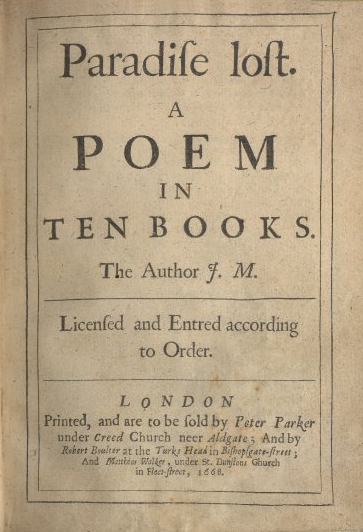
Originally published as 10 books, Milton expanded the epic poem to 12 books in later printings.

Originally published as 10 books, Milton expanded the epic poem to 12 books in later printings.

The “fallen angel” the Monster references is a hero/anti-hero of Paradise Lost: Satan, aka Lucifer, aka the  “infernal serpent”, aka the ‘Arch-fiend’ (and a myriad of other Miltonic epithets).

Students in previous classes have always found Satan the most memorable character in this epic poem since he is given the most memorable lines. They have been particularly intrigued that John Milton’s purpose in writing the poem, “to justify the ways of God to man,” is soon drowned out by the creation of Pandemonium (Hell’s Seat).  From the moment in Book One of Paradise Lost when Satan frees himself from the adamantine chains that bind him to a burning lake, students are taken with his attitude and his defiance as read in his great challenge:

Here at least
we shall be free; the Almighty hath not built
Here for his envy, will not drive us hence:
Here we may reign secure, and in my choice
to reign is worth ambition though in Hell:
Better to reign in Hell, than serve in Heaven. (PL 1 258-263)

No matter that in Book Six’s battle scenes in heaven are an exercise in futility, known as  the “great pie fight in the sky”, students root for the former archangel. They understand the sentiment in his statement,

‘The mind is its own place, and in itself can make a heaven of hell, a hell of heaven…” (PL 211-214).

Paradise Lost was only one of Milton’s great contributions to literature. He was not only a brilliant poet, but he was also a powerful statesman and a Puritan. He became associated with the Puritan partisanship in Parliament, which was credited with banning Christmas in England in 1644. This would seem to be a contradiction since he was already known for the beautiful Christmas Ode, “On the Morning of Christs Nativity Compos’d 1629”. Perhaps it was the general Puritan aversion to Christmas carols that could be blamed for such a heinous act!.

His political career experienced the extreme highs of an appointment as Secretary for Foreign Tongues (1648) and his association with Oliver Cromwell in the execution of Charles I (1649). In contrast there were the lows of an imposed exile upon the return of Charles II and the arrival of the Restoration in 1660. One of the reasons he was not executed for his implicit participation in Charles I’s regicide was that he was struck blind in 1654, and there were many who argued that this blindness was punishment enough. Milton was used to pain and suffering as the deaths of his first and second wives and several children were tragic interludes throughout his life.

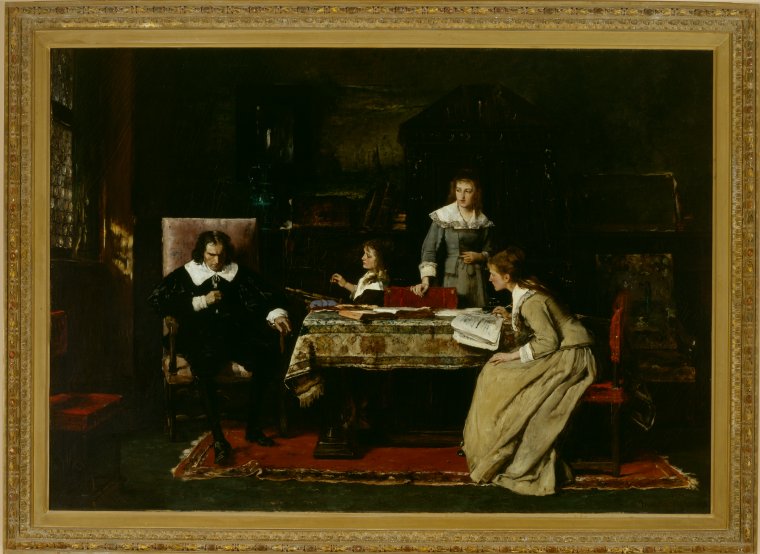
Like another blind poet, Homer, Milton achieved greatness with an “inner sight”. Critics generally agree that his best poetry came after he became blind and dictated all the lines of verse to his remaining daughters. A painting by Mihály Munkácsy (1877) hangs in the New York Public Library (NYPL) and depicts a scene of a head-bowed Milton reciting to one daughter who is scribing lines into a book.

Milton & daughtersThe picture is an apt illustration for his opening thesis in Paradise Lost:

What in me is dark
Illumine, what is low raise and support;
That to the height of this great argument
I may assert eternal Providence,
And justify the ways of God to men. (PL I:18-22)

In 2008, the NYPL held an exhibition, “John Milton at 400: ‘A Life Beyond Life'” which featured illustrated etchings by Gustave Doré for Paradise Lost. One illustration was of Satan on his flight to the Garden of Eden. As he travels, Satan pauses to tell the Sun how conflicted he is over his fallen state:

O Sun, to tell thee how I hate thy beams
That bring to my remembrance from what state
I fell, how glorious once above thy Spheare;
Till Pride and worse Ambition threw me down
Warring in Heav’n against Heav’ns matchless King:
Ah wherefore! he deservd no such return
From me, whom he created what I was
In that bright eminence, and with his good
Upbraided none; nor was his service hard. (PL IV:37-41)

Speaking these lines is a tragic Satan, fully aware that he has brought himself to ruin, as told by a poet, who had also come to political ruin. The reader can sympathize with such a character, and isn’t that the role of great literature? To draw on the reader’s empathy?

By the end of the poem, however, Milton restores the balance of sympathy towards Adam and Eve. They walk bravely, hand-in-hand, out of the Garden, into the sunset, ready to begin “his-story”.  In contrast, the character of Satan is reduced to a hollow hero, receiving accolades from a hissing mob of demi-devils. He is cursed, and like the Monster in Frankenstein, he is unreconciled with his creator.

So happy Birthday, John Milton, (December 9th), but let us not forget, that while your character Satan may dwell in evil, it was you who helped to cancel Christmas!

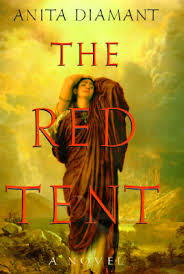
red tentMany of my students do not know Old Testament stories other than “Noah’s Ark” and “Adam and Eve”. There is the occasional biblical teen scholar who may be able to recount the origin a pillar of salt (Lot’s wife) or maybe there will be a student who saw the musical Joseph and the Amazing Technicolor Dreamcoat and make a patriarchal connection. For the most part, students are not up to date on Methuselah or even which of the brothers killed the other (Cain or Abel). They are far more likely to ask, “So, where did all the other people come from if Eve was the only woman?”

Fortunately, The Red Tent, a novel by Anita Diamant (1997) does address other women of the Old Testament. Her fictionalized version of the story of Dinah, daughter of Leah and Jacob, is based on in a brief but particularly violent and gruesome incident in the Book of Genesis. In the King James Version of the Bible, Dinah is known as the daughter who is “defiled” by Shechem, a prince, who then wanted to marry her (Genesis 34: 1-3):

1 And Dinah the daughter of Leah, which she bare unto Jacob, went out to see the daughters of the land.

2 And when Shechem the son of Hamor the Hivite, prince of the country, saw her, he took her, and lay with her, and defiled her.

3 And his soul clave unto Dinah the daughter of Jacob, and he loved the damsel, and spake kindly unto the damsel.

Dinah’s brothers, sought vengeance for the attack on their sister. They tricked Shechem and his family, claiming to come in peace, and exacted their punishment by killing the royal family and all males in the city:

26 And they slew Hamor and Shechem his son with the edge of the sword, and took Dinah out of Shechem’s house, and went out.

27 The sons of Jacob came upon the slain, and spoiled the city, because they had defiled their sister.

This horrific incident is explained very differently in the Diamant’s fictional retelling, as are many other familial incidents, from Dinah’s point of view. The rivalry between Rachel and Leah, the rivalry between Jacob and Esau, and the rivalry between the sons of Joseph, Dinah’s younger brother, are rich with detail and dialogue. The sparse accounts given in the Old Testament are fleshed out in this compelling narrative, with the women center stage, a striking contrast to the male-dominated biblical text.

Several of my female students in Advanced Placement English Literature choose to read The Red Tent as an independent choice, and their response is not unlike other female student responses chronicled in the article “The Wandering Womb at Home in The Red Tent: An Adolescent Bildungsroman in a Different Voice” by Holly Blackford. In this review, Blackford writes about the female students’ enthusiasm for the book:

So emotional about the story of The Red Tent that they can barely speak, and indeed continually interrupt one another, they cite the way in which the contemporary novel revises the patriarchal story of Jacob; represents the concerns of girls in terms of emotion and relationship; and details the entire lifecycle of girl-to-woman through engaging first-person narration:
  Carol: There are certain books I just can’t put down.
      Laticia: Seriously, I’ll read until like three in the morning . . .
      Interviewer: Like what?
      Carol: Like The Red Tent!

Blackford also points out that this revision of an ancient text  comes at a time when girls are, “hungering for an exploration of female-centered myths, deities, worlds, and power-structures.” Her claim in The Alan Review (March, 2005) is that books like The Red Tent:

“… appeal to adolescent women and grow their appreciation for contemporary women’s literature that speaks “in a different voice” (Gilligan) from the more masculine canon they expect in their school curriculum.”

There are about 20 copies of The Red Tent on the class independent book cart, all purchased at book sales for $1.00 each. Picador USA publishers produced an oversized text, about 2″ taller than a standard trade paperback; on the AP English Lit book cart’s top shelf, these copies stick out. The cover art, designed and illustrated by Honi Werner, is also eye-catching. Students always pick up the book with interest.

“What’s this about?” one asks.
“Read the back,” I reply.
“‘...told in Dinah’s voice, this novel reveals the traditions and turmoil of ancient womanhood-the world of the red tent,’ (*pause suspiciously*)…is this a ‘chick book’?”
“Yes,” I chuckle, “this is most definitely a chick book….probably the ultimate chick book, of ALL chick books.”

How else to describe a story that centers on celebrating the onset of womanhood?

After they read any independent book, the AP students are required to write an essay. The essay prompt this quarter for any book they choose is taken from the AP released exam list of questions:

In retrospect, the reader often discovers that the first chapter of a novel or the opening scene of a drama introduces some of the major themes of the work. Write an essay about the opening of the first chapter of a novel in which you explain how it functions in this way. *hint: the lens you use is the lens from the conclusion of the novel*

Students who choose to read Diamant’s The Red Tent will certainly want to return to the beginning to explain how Dinah’s life story begins and ends with the women who loved and supported her.  They will also have had a “crash course” on the Book of Genesis, which is the source of many other literary allusions. While The Red Tent is not great literature, this novel sets many female students looking for equally compelling contemporary novels about women, with or without that “chick book” label.

We have been discussing loss a great deal in English class. In order to begin our  study of King Lear, students had to create lists of their 10 favorite things while I played the song “My Favorite Things” from The Sound of Music. After they made their lists, I  had them “lose” -one at a time- an item off the list.

“Cross off #7,” I announced with great seriousness.
There were immediate groans from students.
“That’s Starbucks!” one whined.
“My truck!” claimed another, “How will I drive?”
“Cross off #3,” I called out.
More protestations. More groans.
“No way I am crossing off my dog,” another retorted.

Soon, their lists were down to two items each. They stirred uncomfortably; they were unsettled by the mere thought of being separated from things or people they valued.

“Maybe I value my stuff over people too much,” mused one thoughtfully looking over her list.

In this short exercise, my students conveyed some of the same sentiments that are expressed in Elizabeth Bishop’s poem “One Art”:

One Art

by Elizabeth Bishop

The art of losing isn’t hard to master;
so many things seem filled with the intent
to be lost that their loss is no disaster,

Lose something every day. Accept the fluster
of lost door keys, the hour badly spent.
The art of losing isn’t hard to master. (continued…)

My students were struck by the repetition of the words “master” and “disaster” in the poem, a result of the villanelle* (see below) format. They noted the progression of items lost in the poem: the car keys, the watch, the houses, the cities, rivers, and finally, the loss of continents.

They noted the choice of hyphens and parentheses in the poem. The hyphen at the beginning of the final stanza was a “hesitation” according to one student, “because she doesn’t even want to write the last stanza.”

“How do you know?” I asked.

“Because she has to command herself,” the student replied, “See the parentheses and the words ‘(Write it!)’ on the last line?”

“Why? What is she losing in the last stanza?” I asked. They called out their ideas:
“Love.”
“You.”
“Her life…”

“So is the art of losing hard to master or not?” I asked them. They thought, and wrote the following in their notebooks:

  • “No one wants to  master losing things…who wants to be a loser, literally?”
  • “She is taking about the loss of physical objects in comparison to the loss of people, and no one wants to lose people…like a friend or lover.”
  • “The speaker is rushing towards the end, speaking faster with ‘shan’t’ and ‘losing’s’ as if things are slipping away, and out of control, until she writes down the losses….and commits them to memory.”
  • “She is trying to convince herself.”

Elizabeth Bishop’s poem brought my class back to the many themes we had been discussing in our unit on King Lear. We had spent several classes focused on the tragedy of a king who in dividing his kingdom, upends the order of the realm. In the process, he loses his daughters, his knights (protectors), his friends, his mind, and finally, his life. The students concluded that Lear was no “master of disaster.”

“Pretty cool that 19 lines can say almost the same thing as Shakespeare’s five act play,” concluded one student as he wrapped up his books  to leave.

Pretty cool, Elizabeth Bishop.

*villanelle: The villanelle has 19 lines, 5 stanzas of three lines and 1 stanza of four lines with two rhymes and two refrains. The 1st, then the 3rd lines alternate as the last lines of stanzas 2, 3, and 4, and then stanza 5 (the end) as a couplet. It is usually written in tetrameter (4 feet) or pentameter.

The recent invitation to respond to the statement “Don’t Teach the Test” was under discussion in the New York Times: Invitation to a Dialogue series. The question was posed by Peter Schmidt,  the director of studies at Gill St. Bernard’s School, and he singled out two tests in particular: the SAT and the Advanced Placement Tests.

Schmidt suggested that the SAT should be eliminated as a requirement for college on the basis of economic inequality.  Students who have the finances to take prep courses or hire tutors have an advantage, and Schmidt suggests that, “our colleges are further promoting the inequities of our society.”

Schmidt also called for the end to  Advanced Placement  (A.P.) courses in high school, saying that they

“too often fail to prepare students adequately for college-level course work. They also put pressure on students to perform well on the A.P. exams in the spring, leaving them exhausted and lacking a spirit of intellectual curiosity.”

Full disclosure: I teach Advanced Placement English Literature, and I have served as an A.P. Reader.

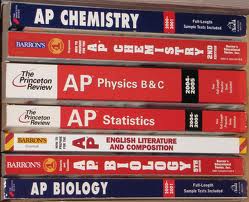
AP TestsThat said, I believe Schmidt is right about the pressure the testing for these courses places on students. I agree that these students are exhausted the first two weeks of May since students who take A.P. courses often take more than one A.P. class. Many students are scheduled for two separate tests on the same day. But as to his assessment that the A.P. courses do not prepare students for college level work, I must respectfully disagree.

Students who take A.P. courses recognize that they may or may not receive college credit for the course. College credit is given based on a student’s test score (minimum a level “3” on the A.P. English Language or Literature) and the willingness of the college to accept that score in lieu of an undergraduate course.  As a result, there are no guarantees of college credit in an A.P. class; however, colleges do look to see if students are taking A.P. classes as an indication of their academic ambitions.

The A.P. exams in all subject areas are a mix of multiple choice questions and essay responses questions.  In the A.P. English Literature exam, there are 55 challenging questions on five or six literature selections. Students need a command of vocabulary and the ability to “close read”, a skill that was the hallmark of A.P. courses long before the Common Core State Standards. But the most demanding part of the AP English Literature exam is the essay section where students write three essays in response to three prompts in two hours. 

My students practice writing to these prompts throughout the school year.  They learn to read, annotate, and draft quickly, but Schmidt raises a good question.

Does the A.P. test prepare students for college?

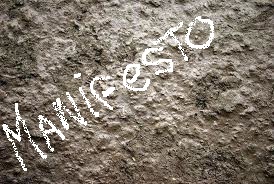
In responding to Schmidt’s concern, I have thought about how my student’s responses to the essay test questions are not the only measure for determining student understanding. A good A.P. course incorporates the practice of revising drafts written for a practice test. There is always a gem of an idea in these hasty constructions. There is always some hypothesis that student will discover as he or she “writes into” the prompt, something I have previously referred to as a “manifesto in the muck.” A good A.P. course provides a student with the chance to take that essay draft, and expand and revise. A good A.P. course gives students the chance to start again with the end of the draft in order to begin a better essay.

Schmidt complains about “the  lack of  imagination and creativity” that “are the cornerstones of genuine learning,”but these generalizations are not true.  I know first-hand that there is nothing to stop a student’s imagination or creativity in responding to a work of literature in an A.P. course. Some of the most amazing statements or ideas I have read have come from students undergoing the intellectual crucible of writing an organized essay in under 40 minutes. In reading these practice drafts, some ripe with grammatical errors and misspellings,  I will pause with my red pen suspended, repeating to myself, “First do no harm”, as I leave a draft untouched. A.P. advises instructors to “reward the student for what they do well”, even on a practice test.

There are too many reasons to not like the standardized tests that are choking education today; the limited data that standardized testing yields is often not worth the time and expense. Frankly, I am no fan of the College Board. The limitations of the A.P. test, however, does not mean that an A.P. course is not valuable.

The A.P. test, like all standardized tests, is a single metric measure, but an A.P. course is a much broader experience.  So, yes, I teach to the test, but I also teach the A.P. course as a preparation for the rigors of college level work, and in particular, I teach the course so that my students will have the option to waive a 100 level composition class giving them the option to take a course in their major field of study.

Schmidt concluded his invitation with an impassioned plea,

As E. M. Forster wrote more than a century ago in Howards End, in addressing the shortcomings of British universities: “Oh yes, you have learned men who collect … facts, and facts, and empires of facts. But which of them will rekindle the light within?”

I would argue that my A.P. class is the only place in my curriculum where I can offer the writings of E.M Forster, if for no other reason than to see how students would respond to that literary prompt.  I know that in their responses, there could be one from a student who, writing under intense pressure, could draft a sentence or two that would reveal a “kindle of light within.”  Whether that student response would be in a test booklet written during the A.P. test or not does not matter.

muckRight about now, the last week of April, my Advanced Placement English Literature students are noticing a frantic tone creeping into my voice.

“No, finish this multiple choice practice FIRST, then complete the essay prompts. Any questions? No? Let’s go, now. Hurry….hurry….HURRY!!”
“Geez, you are so crabby lately,” notes one.

I am crabby; I understand the pressure they will be under during the AP exam in May, and I want them prepared. In contrast, they just want to be fourth quarter seniors.

These weeks are the “boot camp” weeks before the exam, and I am trying to improve their ability to respond quickly and decisively to a prompt. They will be writing three separate essays; each read by an audience of one, a reader who will grade hundreds of essays a day. They need to make a clear argument.

For practice, I offered a choice of four prompts to students. We just finished reading Eugene O’Neil’s A Long Day’s Journey into Night, and each prompt touched on one aspect of the play: the text, the characters, the theme. Rather than have them write a full essay response to a specific prompt, I had them write two separate opening and concluding paragraphs for their two chosen prompts. I gave them forty minutes to do both. The whining began immediately:

“I have a hard time just writing a beginning and an opening.”
“I always start in one place and end in another.”
“I need to write the middle or I can’t write the end!”

“That’s because you write to find out what you think,” I respond, “and that should show up in the introduction or the conclusion.”

Since the AP exam is a timed test, 120 minutes for three prompt analysis and response questions, timed practices are helpful. These truncated practice essays are incomplete and rough, but they do help students practice how to reconcile an introduction with a conclusion in a short time. In these hastily written drafts of beginnings and endings, I can help them distinguish their good ideas from linguistic clutter so an AP reader will better appreciate their argument. I do not want my students to make a thesis so hidden that the AP Reader is hunting for the “manifesto in the muck”.

What “muck” you ask? Essays cluttered with empty words:  a lot, kind of, sort of, actually, stuff, thing, very, really, quite

Essays cluttered with the muck of empty phrases:

  • Because of the fact of
  • The reason…is because

Essays cluttered with the muck of statements of the obvious:

  • The author uses diction and syntax to communicate his meaning.
  • The theme is the message the author is trying to communicate.
  • Words have meaning.

In one block period, the students wrote the truncated essays of introductions and conclusions in response to O’Neill’s semi-autobiographical play,  A Long Day’s Journey into Night.  We reviewed each draft to find the one powerful statement that publicly declared that student’s view, a statement that could get an AP reader’s attention. The prompts are in bold; student’s statements below each prompt:

PROMPT #1: Select a line you find especially memorable; analyze the reasons for its effectiveness.

  • When I read about this family, it reminded me of the advice, “only the strong survive’; the Tyrone family lives like a pack of animals, not a family.
  • If the characters in the play had the ability to leave behind their past, forget the things that made them lesser, they would be better off.

PROMPT #2: Describe how the author manages to give internal awakenings, discoveries, changes in consciousness the sense of excitement, suspense, and climax usually associated with external action.

  • James is struck with the conflict of having someone say his greatest fear is being in a class he does not think he belongs. 
  • The choice presented to each character is which moral or ethical barrier to shatter in order to overcome the cycle of insanity.
  •  Literature is an extension of human understanding and comes from our musings, our curiosities, and our imaginations.

PROMPT #3: Discuss the contribution scenes of social occasions reveal about the values of the characters and the society in which they live.

  • Whether these experiences dealt with alcohol abuse, substance abuse, or general unhappiness in life, all topics were acted out to be ignored or forgotten about, yet these [experiences] remained the most memorable. O’Neill wanted the conflicts to be pushed aside, which then caused the audience to latch on and never forget.
  • We seek out the approval and forgiveness of others when our own soul’s condition is purely of our own pilot.

PROMPT #4: Explain how the tragic figure functions as an instrument of the suffering of others and that the suffering brought upon others by that figure contributes to the tragic vision of the work.

  • In this way, each individual’s poisoned action spreads like a virus and affects all those in its proximity devouring them to the point of self destruction.
  • Edmund’s sickness is not just  source of unwanted strains on the family; it is an object to represent the family relationship.

When I come upon one of the above statements, in the beginning or the end of the draft, I can almost hear the “clink” that went on in the student’s head (and hand) as he or she drafted the essay.  At a point in the writing conferences that followed, a student will agree, “Yeah, that was when I figured out what I was writing about.” My experience is that students write their way into a thesis, and it is important for the student to recognize that statement, so he or she can parse away the clutter, removing the muck so that the AP Reader can find that statement too.

During this last week of AP English Literature practice, students will work at drafting responses to prose and poetry prompts. They will be writing their responses quickly, and I will still be crabby. But because of the practice, there will be less muck that covers a student’s manifesto in an AP literature essay response. After that, they can go back to being 4th quarter seniors.

60 of my students met their first Hamlet on stage at Yale Repertory Theatre in New Haven, Connecticut, this past week. Their Hamlet was the actor Paul Giamatti, who after speaking 40% of the play’s 4,042 lines (roughly 1,440), came out onto the stage for an audience talkback to speak a few more words to them.paul giamatti

“He looks tired,” on student remarked to me. The play had begun at 10:15 AM, and we were still sitting three and a half hours later as the actors and crew began to respond to questions.

If we thought they looked tired, the actors seemed surprised to see us still sitting there.
“Wow!” Polonius (Gerry Bamman) said as he sat, “You stayed!”

Students were curious about how the sets moved (“The stage has a large fly space.“). Students wondered how long the cast had rehearsed (“Eight weeks, a real luxury…”). Students wondered who was most like his or her character (“I understand Gertrude much more since I have a son”). Students asked about the creation of set pieces including a large portrait (“That’s an oil painting from a  photograph”).

Of course, there was no stopping the students from calling attention to Giamatti’s role in Big Fat Liar, a film from their youthOne student stood to ask, “Did Hamlet remind you of Marty Wolf?” Giamatti laughed in response, “Well, maybe,…a little… except for the blue crap!”

Hamlet is a 12th grade text, and I asked students to take a survey after they returned to the school to see what they thought of this production. While the survey indicated that the teachers in our English department had done their job, the students indicated that seeing the play performed was very different that studying the play in class:

Shakespeare was meant to be live. Although the “perfection” of a movie is enhancing to the performance, it is unrealistic. I believe that watching a play live is important to seeing the different styles and methods possible.

It was fun and a lot better than just reading it in class, it made it come alive.

I did not think it was going to be as entertaining as it was. I also did not think I would find parts humorous, but I did.

This Hamlet was part of the WILLPOWER! series (funded by the National Endowment of the Arts). The website states:

WILL POWER! is Yale Repertory Theatre’s annual educational initiative in conjunction with one of its productions and features specially-priced tickets and early school-time matinees for middle and high school student groups. The program also includes free professional development for educators, study guides and post-performance discussions with members of the company.

One of the objectives of the WILLPOWER! series is to create new audiences, specifically younger audiences, for Shakespeare. Students who have attended a Shakespeare play may be more willing to attend another play when they are older; in other words, a favorable dramatic experience will yield future audiences for Yale Drama School graduates!

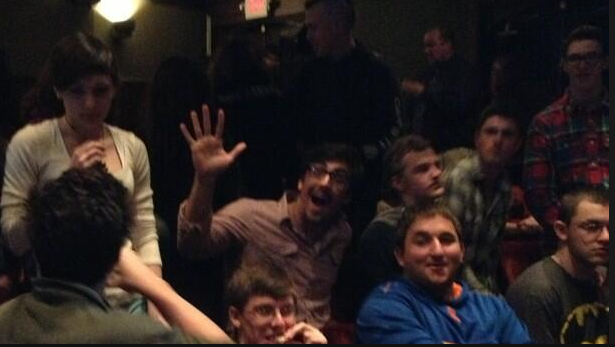
Seniors at intermission watching Hamlet at Yale Rep

Seniors at intermission watching Hamlet at Yale Rep

The survey indicated that this goal is being met with the WILLPOWER! series; my students are certainly willing to try another play:

The performance was a wonderful experience, especially since it was my first time to see Shakespeare.

I wouldnt mind going to another because it was so enjoyable that I didn’t even realize the 4 hours passing by.

I like the way that a play has a certain kind of vibe. It’s like a live concert, where there’s a certain kind of energy. It was like seeing a live performance of a film. I would especially like to see another Shakespeare because it is the way that he intended his works to be portrayed.

After seeing Hamlet so well done, it would definitely be worth going to see another one whether it be Shakespeare or a different kind of performance.

Perhaps the most satisfying moments of the actor’s talkback for teachers is hearing the actors say things that we wish our students would pay attention to in class. When Giammati was asked about how he felt about memorizing all those lines, he explained that he enjoyed learning the lines and playing on the open space of the stage.

When one student asked, “What part of the play did you like best?” Giamatti responded, “I enjoy the end, when Hamlet returns to the graveyard, until the end.” Then, thoughtfully, he added, “Shakespeare’s words begin to come through you if you let them.” (Honestly…you could hear the teachers in the audience swoon!)

But nothing was better than hearing the young Remsen Welsh (Player Prologue) explain how the director, James Bundy, had prepared her for her role. “It’s simple,” the actress gestured enthusiastically from the front of the stage. Facing the crowd of students twice her age, she cheerfully acknowledged, “He told me, ‘Suit the action to the word, the word to the action..’ and I did!”

Exactly.

A first Hamlet they will remember.

003-Great-Gatsby

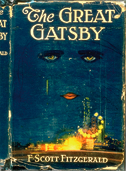
Charles Scribner’s and Son issued the first hardback edition in April 1925, adorning its cover with a painting of a pair of eyes and lips floating on a blue field above a cityscape.

The Great Gatsby film is coming out soon….” the English teacher said to me, “Can you believe Gatsby is almost 90?”

Wait, 90? The Great Gatsby is almost 90? That debonair, handsome American icon we met in his 30’s could be well over 100 years old?

“He had one of those rare smiles with a quality of eternal reassurance in it, that you may come across four or five times in life. It faced, or seemed to face, the whole external world for an instant and then concentrated on you with an irresistible prejudice in your favor. It understood you just as far as you wanted to be understood, believed in you as you would like to believe in yourself.”

F. Scott Fitzgerald began writing his great American novel in 1922, with some of the elements surfacing in the story “Absolution” in the June 1924 issue of the magazine The American Mercury.  During the years 1923–1924, Fitzgerald, his wife Zelda, and their baby daughter, Frances “Scottie”,  traveled from New York to the French Riviera, where the novel was finished. Fitzgerald went through several revisions between 1923 to 1925 before the  novel was finally published.

According to Brant Mangum in a publication from Virginia Commonwealth University: 

Fitzgerald’s ambitious goal as he approached the composition of The Great Gatsby was to “write something new–something extraordinary and beautiful and simple + intricately patterned.”

The reaction of the critics was harsh; one early review ran with the headline:

 “F. SCOTT FITZGERALD’S LATEST DUD.”

Praise, however came from recognized writers T. S. Eliot, Edith Wharton and Willa Cather. Ten days after the book came out, Maxwell Perkins, Fitzgerald’s editor, sent the telegram: “SALES SITUATION DOUBTFUL EXCELLENT REVIEWS.” The first printing of 20,870 copies was a slow seller; Scribner’s printed another 3,000 copies four months late and finished the run. According to an article Living on $500,000 a Year: What F. Scott Fitzgerald’s tax returns reveal about his life and times by William J. Quirk in American Scholar over 12 million copies have been sold, with approximately 300-400 hundred thousand sold annually. However, Fitzgerald never did match his famous protagonist’s wealth:

“Royalties from The Great Gatsby totaled only $8,397 during Fitzgerald’s lifetime. Today Gatsby is read in nearly every high school and college and regularly produces $500,000 a year in [F. Scott Fitzgerald’s daughter] Scottie’s trust for her children.”

Fitzgerald died young, age 44, in December of 1940.

“His estate was solvent but modest—around $35,000, mostly from an insurance policy. The tax appraisers considered the copyrights worthless. Today, even multiplying Fitzgerald’s estate by 30, it would not require an estate tax return.”

He did write other novels, stories, essays, but The Great Gatsby remains his most important addition to the canon. So why call this work the great American novel?

Jonathan Yardley makes his case by calling attention to the distinctively American elements in the novel in the Washington Post book review Gatsby”: The Greatest Of Them All (1/2/07) writes:

In an extraordinarily compressed space — the novel is barely 50,000 words long — Fitzgerald gives us a meditation on some of this country’s most central ideas, themes, yearnings and preoccupations: the quest for a new life, the preoccupation with class, the hunger for riches and “the last and greatest of all human dreams…”

Our contemporary American obsession with celebrity and wealth is obvious to students who are assigned The Great Gatsby. Our nation’s economy  from boom through a recent recession, echoes the experience the heady times of the  Roaring 20’s before the Great Depression. The narrative style is engaging and packed with imagery. Anyone who spent time in a high school literature classroom over the past 50 years can recall taking notes on Fitzgerald’s metaphors and complex symbols. Mangum discusses these in his essay:

 The green light, which carries meaning at every level of the story–as Gatsby’s go-ahead sign, as money, as the “green breast of the new world,” as springtime–is strategically placed in chapters one, five, and nine. The eyes of T.J. Eckleburg “brood on over the solemn dumping ground,” which is the wasteland that America has become (514).

The appeal of Jay Gatsby’s character is explained in a chapter in America: A Self-Made Country by political commentator Chris Matthews. He writes:

“The reader, like Nick Carraway, comes to like this guy. We love his dream  because we have, all of us, shared something very much like it. Gatsby for me is undeniably the great American novel. We celebrate its hero and his “heightened sensitivity” to the promise of life. his “extraordinary gift for hope”, his “romantic readiness” because we as a country share every bit of it” (20).

The final passage of the novel is Fitzgerald’s commentary on the American dream. Nick’s final stream of consciousness:

“Gatsby believed in the green light, the orgastic future that year by year recedes before us. It eluded us then, but that’s no matter—tomorrow we will run faster, stretch out our arms farther. . . . And then one fine morning—
So we beat on, boats against the current, borne back ceaselessly into the past.”

Such imagery naturally lends itself to the movie screen, and The Great Gatsby has had more than its fair share of remakes:

  • 2000:  Mira Sorvino, Toby Stephens, Paul Rudd (made for TV)
  • 1974: Robert Redford, Mia Farrow, Bruce Dern
  • 1949: Alan Ladd, Betty Field, Macdonald Carey
  • 1926: Warner Baxter, Lois Wilson, Neil Hamilton 

Now, the latest version is coming May (2013), when the Australian film director Baz Lurhman will put his spin on this American story:

Once more, Jay Gatsby will be glamorously immortalized in his youth; this time digitally mastered rather than in celluoid.

However, should someone want to try an even newer genre in order to experience a 21st Century Gatsby, there is the Nintendo Great Gatsby Game that can be played on a computer. While Gatsby is fixed forever as young and ambitious, he now is also amazingly spry for his years! ( “to jump, move arrow keys together right and left”)

For an “Old Sport”, Gatsby wears his age well.

What better way to celebrate International Women’s Day 2013 but to pay tribute to Canadian author Margaret Atwood? Poet, novelist, lecturer, inventor, tweeter, and celebrity ice hockey goalie, Atwood’s achievements in each of these roles is accomplished with wit, grace, and aplomb.

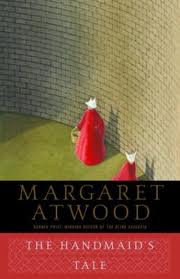
Handmaid's tale

There are other earlier covers, but this one is my personal favorite.

My Advanced Placement English Literature class just finished reading her novel, The Handmaid’s Tale. The novel is set in the dystopia of Gilead, where in response to political and ecological upheaval, a quasi-Christian theocracy is organized in the eastern section of the United States. Astute Sparknote writers, graduates of Harvard, recognized many of the landmarks in the novel’s setting (the brick wall, the gymnasium) as that of their alma mater, an indication of Atwood’s wry sense of irony. In the novel, fertility is an obsession. Rituals and “ceremonies” are enforced; offenders and outliers are publicly executed or sent to labor in toxic waste dumps. The main character Offred, who had a daughter before the establishment of the Republic of Gilead, is valued only for her ability to reproduce.

Because of the mature themes, The Handmaid’s Tale is often taught in senior high school classes. The title is often suggested on the exam for the open-ended Question #3 on the AP Literature exam which means other schools assign the book. There are always plenty of copies available in the secondary market. Our classroom library has over 60 copies from a variety of library book sales and thrift stores. I have spent under $100.00 in adding this title to our curriculum; I’d like to think that Atwood might be pleased with this “ecological” way to have students read the text despite her loss of possible retail revenue. However, if one wanted a new copy, they are available at Amazon for $10.20 paperback or an audio recording by Claire Danes is available  at Audible.com  for $24.95.

When we discuss the clothing that marks the different “castes” of people in Gilead,  I always use the endpaper story Atwood published in the New York Times Magazine published “When Afghanistan Was at Peace”

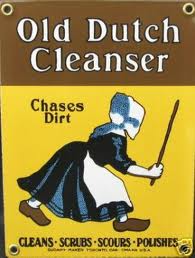
Six years after our trip, I wrote ”The Handmaid’s Tale,” a speculative fiction about an American theocracy. The women in that book wear outfits derived in part from nuns’ costumes, partly from girls’ schools’ hemlines and partly — I must admit — from the faceless woman on the Old Dutch Cleanser box, but also partly from the chador I acquired in Afghanistan and its conflicting associations. As one character says, there is freedom to and freedom from. But how much of the first should you have to give up in order to assure the second? All cultures have had to grapple with that, and our own — as we are now seeing — is no exception. Would I have written the book if I never visited Afghanistan? Possibly. Would it have been the same? Unlikely.”

Dutch Cleanser

The combination of the Dutch Cleanser girl with the chador is the inspiration for Offred’s clothing; the story and the visual always sparks a discussion on the symbolic effect of clothing.

My students always argue about the genre of The Handmaid’s Tale. This year there were a number of votes for political science book, others for a dystopian love story; no one said science fiction. Atwood would be relieved; she has always drawn the distinction between science fiction and her writing which she calls “speculative fiction”. Several of my students also read the other books Oryx and Crake and The Year of The Flood that are speculative fiction.

Here is Atwood with her take on the genre of specultive fiction.

The conclusion of The Handmaid’s Tale ends in an allusion to the story of Orpheus and Eurydice:

“We may call Eurydice forth from the world of the dead, but we cannot make her answer; and when we turn to look at her we glimpse her only for a moment, before she slips from our grasp and flees.”

After we finished the novel, the class read Atwood’s poem Eurydice. I asked them what they thought.

  • “There is a sense of longing in both.”
  • “The language is so similar. There is the white curtain…the gauze.”
  • “‘It is not through him you will get your freedom’ is just like
    from and freedom to…that is Offred’s problem”
  • “We could have just read the poem! They’re almost the same!”

One other area of speculative fiction where Atwood has shared her thoughts is on the topic of modernity…and Zombies. In an interview on George Stroumboulopoulos Tonight, Atwood was quite clear on the limits of Zombie stories:

“No zombie story is ever told from the zombie point of view… they’re not narrative…they don’t have language and that impedes one from telling a story.”

Outside of fiction, Atwood has also written about debt. Her non-fiction book Payback: Debt and the Shadow Side of Wealth came from her 2008 Massey Lectures. Not surprisingly, her interest in debt began in from her study of Victorian Literature. In an interview with Suzanne Ellis, CityLine “Margaret Atwood On Payback And The Concept Of Debt”  Atwood discussed how the Victorian stories that are on the surface about love and romance are really all about financial arrangements:

“In [Jane Austen’s] Sense and Sensibility, Marianne can’t marry the love of her life because he needs to marry a rich person. He doesn’t have any money. She’s devastated by that and gets a bad cold,” Atwood muses. “You start following the money in these novels and it takes you to the most amazing places. Where did Heathcliff get the money that he uses to buy Wuthering Heights, or I should say to gamble the owner of it out of it? How does he do that? We’re not quite sure but it’s something pretty shady.”

The book was made into a documentary and released in the spring of 2012. The New York Times critic A.O. Scott opens his film review with the premise of the documentary:

A glance at the headlines from Europe, the news from Washington or this month’s bills will confirm that we live in an age of debt. Debt, a concept at once straightforward and almost metaphysically complex, is a source of personal, national and global anxiety, and forms a link between the individual and the worldwide economic system.

While the film did not receive critical acclaim, Atwood’s ability to connect herself and link to the world through Twitter is often lauded.  She is an avid twitterer with 383,430 followers and over 15,000 tweets of her own. She links to political issues, comments on travels, and gives recipe advice:

Screen Shot 2013-03-08 at 11.06.17 AM Screen Shot 2013-03-08 at 11.07.07 AM Screen Shot 2013-03-08 at 11.08.58 AM Screen Shot 2013-03-08 at 11.09.56 AM

She also is the inventor of the “long pen”, a device that allows her to attend book signings from distances and sign books “virtually”. When she is tired of traveling to sign books, she can now meet her adoring public in virtual space and provide them with an authentic signature. Fortunately, I saw her before the “long pen” at a Barnes and Noble reading/book signing for her short story collection Moral Disorder. She was amazingly articulate; in the 40 minute talk, she never hesitated or once said “um”.

And just when you thought that Atwood could not be more accomplished, she starred in a video explaining “How to Stop a Hockey Puck” for the comedian reporter Rick Mercer. I put the video below. (Too bad her “Dance Party Video” was removed from YOUTube for copyright violations.)

So, on this International Woman’s Day, let’s hear a cheer for Margaret Atwood!

She writes. She tweets. She scores!

According to literary legend, Ernest Hemingway wrote a six word short story in response to a bet:

Screen Shot 2013-02-26 at 3.58.31 PM

So when my Advanced Placement English Literature class was suddenly shortened one day last week due to a  delayed opening, I thought that I would do a close reading on this famous short story. After all, how long could a discussion on six words last? I was confident there would certainly be enough time for each of them to craft an essay as well.

The usual procedure for close readings in class is to have a volunteer “read aloud” while students annotate their copies of the text. The text is also displayed on the SMARTboard so that notes can be added and shared with all members of the class.

After they settled down with copies, Sam volunteered to read. We listened and paused. I started to ask, “So how did Ernest Hemingway, the author of this short story, convey his meaning?” when I was cut off.

“Whose baby died?” asked Alexis. She had no notes on her page.

“The baby died?” Connor responded, “I thought this was about a tag sale.”

“Why do you say that?” I asked, “Look at the evidence in the text.”

“Because people who have tag sales put in ads, and the ads are short,” replied Connor.

“But that is why the ad is short,” Alexis retorted, “the parents are so upset, they cannot write a long ad to sell the baby’s shoes.”

“Where are parents in the text?” I demanded.

“I agree with Alexis,” said Sam, “the shoes were ‘never worn’. The baby is dead.”

“OK,” I agreed, ” the words ‘never worn’ are in the text, but…”

“But the baby shoes could have been a gift that was the wrong size,” interrupted Natalie.

We were drifting off in our discussion. I had chosen the story because of its brevity, but I also had considered how well the text responded to the Publisher’s Criteria for the English/Language Arts Common Core Standards:

The Common Core State Standards place a high priority on the close, sustained reading of complex text, beginning with Reading Standard 1. Such reading focuses on what lies within the four corners of the text. It often requires compact, short, self-contained texts that students can read and re-read deliberately and slowly to probe and ponder the meanings of individual words, the order in which sentences unfold, and the development of ideas over the course of the text.

This was a “compact, short, self-contained texts that students can read and re-read deliberately.” The students were beginning to probe the meanings of individual words, but they were drifting.  They were bringing up tag sales, upset parents, and poor present gifting;  we were far off the four corners of this text.

For a moment, a very brief moment, I consider that we were moving away from the goals of the Common Core to work with the text. However, they were so quickly engaged, that I grew far more interested in listening to how close to they were to determining Hemingway’s purpose. Hemingway had selected six specific words to excite the reader’s imagination. My students were not wrong in their suggestions, they were using his text to understand, to create meaning. They were working with Hemingway’s language and responding to his inferences.

Their written drafts also leapt beyond the evidence, much like the discussion:

  • “They have waited nine months in anticipation for this day, and that morning a pair of shoes, no larger than the size of a plum, arrived in the mail, a gift from an aunt. They run to the hospital; they cry, they yell, they cry, but their baby is dead. ‘Get rid of those shoes.’ He writes in the paper, “For sale: baby shoes, never worn.’ Auntie will be sad.”
  • “…whether it’s a parent/ guardian or a thief trying to make money, it is obvious from the syntax that the shoes need to go.”
  • “‘For sale’ is a general coupling of words that comes from a particular type of person….a person low on monetary resources or one who wants to get rid of something…”
  • “…by saying the word ‘never’, that means the parents have never had a baby and will never have a baby…never is finite”
  • “In reality, Hemingway’s story is less of a story and more of a jumping off point. The six words are a choke point, like that of an hourglass stretching of in infinity in either direction.”

These drafts, hastily written in response to the story, ranged from 2-3 handwritten pages; far more than the six words that stimulated their ideas. The students wrote furiously until the bell rang, and then begged for more time to finish.

Certainly, their responses could be judged by the CCSS criteria, “Student knowledge drawn from the text is demonstrated when the student uses evidence from the text to support a claim about the text.” However, their responses in discussion and in essays offer significant proof that the ideas that started in text cannot be limited by clocks or “four corners”.