Archives For November 30, 1999

In keeping my classroom libraries filled with books, the trends I notice are not necessarily trends in book buying, but trends in book discarding. After exams, midterms or finals, assigned titles are discarded to make room on a bookshelf or in a school locker for new required reading. Following trends means knowing that three to four months after the curriculum unit ended, an assigned title begins to crowd its way onto the bookshelves of thrift stores such as Goodwill or St. Vincent’s or the Salvation Army.
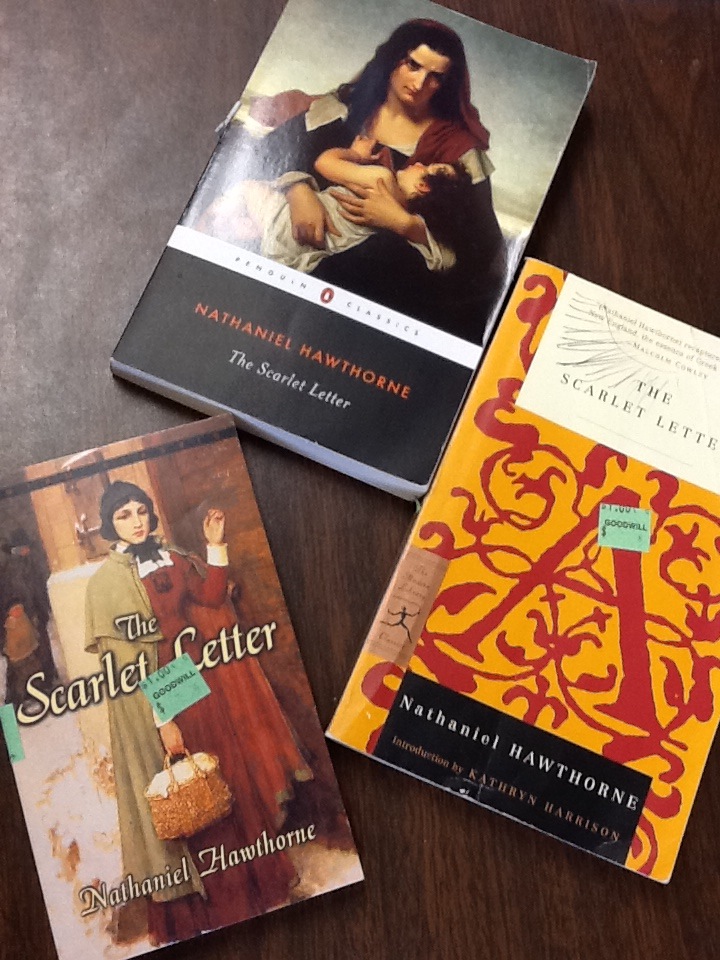
Three copies of "The Scarlet Letter" on the shelf at Goodwill. All new; never opened!

Three copies of “The Scarlet Letter” on the shelf at Goodwill this past week. All new; never opened, bearing their $1.00 each price tags.

Since Puritans are usually up for discussion in September in American History coursework, many English departments turn to Nathaniel Hawthorne’s novel The Scarlet Letter for their Advanced Placement or college bound students as a complementary read. Therefore, I was not surprised when, during this last week of January, copies of The Scarlet Letter began appearing, not in single copies, but in droves. I expected as much. The Scarlet Letter represents the “not keeping” trend. While a student may hesitate for a millisecond before placing The Great Gatsby or To Kill a Mockingbird or Catcher in the Rye in the “throw away” pile, I imagine there is universal delight in discarding The Scarlet Letter, a delight only exacerbated by discarding its equally loathed curriculum companion, Arthur Miller’s The Crucible.

The mention of The Scarlet Letter may set off groans. Woe to the teacher who attempts this book without the iron cast-backbone or the determination of an evangelist. Readers of The Scarlet Letter will need to be converted, and it is only the fear and damnation of another scarlet letter that keeps them plodding on, the scarlet “F”!

The tone of the book is set immediately with the opening line:

A throng of bearded men, in sad-colored garments and gray, steeple-crowned hats, intermixed with women, some wearing hoods, and others bareheaded, was assembled in front of a wooden edifice, the door of which was heavily timbered with oak, and studded with iron spikes.

Looking further down the page for some relief from the gloom, the reader should notice that he or she is being directly addressed, as if from a pulpit delivering a parable or allegory:

Finding it so directly on the threshold of our narrative, which is now about to issue from that inauspicious portal, we could hardly do otherwise than pluck one of its flowers and present it to the reader. It may serve, let us hope, to symbolize some sweet moral blossom, that may be found along the track, or relieve the darkening close of a tale of human frailty and sorrow.

Yes, Hawthorne will be delivering this sermon for 192 pages in the Dover Thrift Edition ($3.15).

Students are aware that this classic will improve SAT scores with the challenging vocabulary and complex structures of 19th Century prose, but they still seek help beyond the classroom. There are Sparknotes, Schmoop notes, E-Notes, Cliff Notes, and Bookrags available for this text, so as a result, the paperback text on the thrift store shelf may never have been opened. The copies available at thrift stores are generally pristine copies. I imagine they were purchased by parents who dutifully picked up the book because of a syllabus of some sort. Maybe this was a summer reading choice, a particularly deadening assignment. Actually, the effort in purchasing this text could have been avoided, because the text itself is online at no less than six places:

And there are free audio versions at:

But we still teach The Scarlet Letter, and our paperback collection of The Scarlet Letter distributed in class is comprised of at least 10 different editions. No student is on the same page number when the text is read aloud in class in order to share the conflicts between Dimmesdale, Hester Prynne, and Chillingsworth. Interestingly, what seems initially complex to the student is eventually understood as a really a ripping good love triangle of sex, intrigue, and irony. Once they see Hawthorne laying out hypocrisies of the Puritan society, they are more genuinely engaged. Plus, there is the lovely child Pearl, and they grow to sympathize for her.

In order to engage students in assessments, our Grade 11 teacher has organized “self-directed” projects for students to choose  and some of these have included:

  • Create a song telling the ballad of Hester Pyrnne.  You may compose the song, or write new words for an existing melody.  Share the song with the class either live or via audio or videotape.
  • Think of a sin associated with Dimmesdale and Chillingworth.  Create a badge that uses a letter or other symbol to represent the sin.  In addition, use art, needlework, or some other craft to make the badge reveal something about the man’s character, interests, or profession.  Write an explanatory caption or paragraph to accompany the badge.
  • Choose music to be the score for a film version of the novel.  Choose music for at least five major scenes.  Write explanatory notes for each selection

The harvesting of The Scarlet Letter texts from thrift store shelves is best from January-March. I can add as many as 10-12 copies during these months. Competition for the title grows during the summer, and the books are often more dog-earred by then.

But with all the negativity, why teach The Scarlet Letter? Because Hawthorne provides a bridge from this historical period to ours by using the empathy that is generated in fiction. Our brains are wired for stories more than facts, and reading The Scarlet Letter helps our students identify with characters in order to understand the politics and policies of this turbulent time when our nation was still in its infancy. Additionally, his story serves as a springboard for other stories. According to Canadian author Margaret Atwood, “The roots of totalitarianism in America are found, I discovered, in the theocracy of the 17th Century. The Scarlet Letter is not that far behind [the novel] The Handmaid’s Tale, my take on American Puritanism.”

Oh, and yes. We also assign The Handmaid’s Tale.

Today is Digital Learning Day! To mark the occasion, let me take you through a quick walkthrough of the halls of Wamogo Regional Middle/High School and give you a snapshot on how digital learning looks in the English classrooms grades 7-12. We have 1:1 computers in grades 7 & 8; in grades 9-12, we have a “bring your own digital device” policy. Here are the digital learning activities on Wednesday, February 6, 2013:

Grade 7: Students responded to a short story they read, “The Amigo Brothers”. They accessed the wiki (www.PBworks.com) in order to respond to “close reading” questions on the author’s use of figurative language. (Students are required to use evidence in their responses; digital copies of text helps student correctly add and cite evidence).

Grade 8: Students uploaded their reviews of the books (Mississippi Trial, 1955; Chains; The Greatest) they have been reading in literature circles to www.edmodo.com. These reviews are connected to the Common Core Writing Standard #6:

CCSS.ELA-Literacy.W.8.6 Use technology, including the Internet, to produce and publish writing and present the relationships between information and ideas efficiently as well as to interact and collaborate with others.

Grade 9: Students responded to a “writing on demand” journal prompt in preparation for the novel Of Mice and Men. This prompt is connected to the theme of hopes and dreams, and the students were asked:

What is your hope for life, your goal, or even your dream?  What do you think you want from the future? What would you live without, dream-wise?  What couldn’t you live without?

The students also posted their responses on a www.Edmodo.com discussion thread. Selections from responses included:

  • Something I couldn’t live with out would be my grandparents because they are like another set of parent to me, just better. They mean so much to me, that I really couldn’t see my life without them.
  • I hope to be a plant geneticist in the future, that is my hope but no matter what happens I would like to have a career involving plants and even if I can’t get a career in genetics I know it will always be a hobby of mine.
  • My house will be by the ocean, so close I can see it out of my kitchen window. I will grow old and drink coffee on my porch, while I read the paper and wave to my neighbors who walk by!
  • I could live without being famous around the world but I would like to be known town wise. I cannot live without family and their support in my decisions. They help me to stay confident and get through whatever I want to accomplish in life.
  • I think I could live without wanting a huge house or a huge boat “dream-wise”, but that still doesn’t mean I don’t want those things. I couldn’t live without music or my family.
  • My biggest hope and dream is to have a really big plot of land and have the world’s biggest tractor and a bunch of snowmobiles and ATV’s.
  • I want to be able to adopt kids from Uganda but also have my own, and I want to live in a nice house with a big yard. I want to work with little kids as a job.

10th grade Honors English students are reading Great Expectations. They took a quiz on www.quia.com, a software platform for timed quizzes. The College Prep English classes are reading Animal Farm. Today, they had to access “The International” MP3 and the www.youtube.video of the Beatle’s song “Revolution.

For homework tonight, students will write their own “protest” song.

Grade 11: Students can access the vocabulary list from the film The Great Debaters through the class wiki (www.pbworks.com) while the Advanced Placement English Language students watched a YouTube video of a Langston Hughes poem “I, Too, Sing America” read by Denzel Washington:

They prepared responses to the following questions which were posted on the class wiki:

  1.  To whom is the poet writing?  How do you know?
  2.  Choose one stanza and discuss what you feel is the key word in this stanza and explain why you chose this word?
  3.  What feelings does the poem create?  Which words create this feeling?

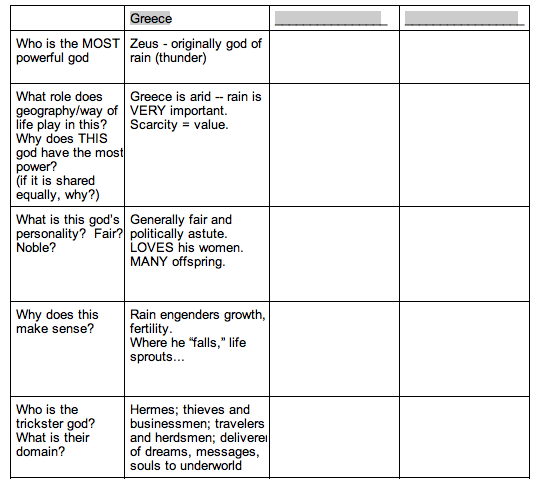
Grade 12: Students in the Grade 12 Mythology class accessed the following Google Doc Template and filled in the chart with their own research about the mythologies of different cultures. This activity meets the CCSS writing:

CCSS.ELA-Literacy.W.11-12.7 Conduct short research projects to answer a question; narrow or broaden the inquiry when appropriate; synthesize multiple sources on the subject

Screen Shot 2013-02-06 at 11.43.41 AM

The Film and Literature class “flips” the content by having students watch films for homework in order to discuss them during class. Tonight’s assignment? Watch the following YouTube clip and be ready for an open note quiz:

Students in the Advanced Placement English Literature class read the short story “Barn Burning” by William Faulkner that was embedded with a quiz on www.quia.com. They then created a list of four themes from the short story on a Google Doc. Each student selected a theme and placed his/her responses in the Google Drive folder to share with other members of the class. Examples included:

  • Actions we take with the grotesque: Shun? Avoid?

This story embodies an ultimate grotesque atmosphere. Even Colonel Satorius Snopes’ sisters are described as, “hulking sisters in their Sunday dresses” (2). These sisters are emulated throughout the story as disgusting, rotund, lethargic, and hog-like beings. This grotesque physical trait emulates the family’s condition in society. Satorius’ clothes are described as, “patched and faded jeans even too small for him.” (1).

  • Family over law or law over family

For the boy to go against his family in the end further proves his actions of courage and strength, and portrays the theme of law over family. “Then he began to struggle. His mother caught him in both arms, he jerking and wrenching at them. He would be stronger in the end, he knew that. But he had no time to wait for it” (10). His whole family is holding him back, but he chooses to go against all of them and do what is right.

This quick walkthrough demonstrating the use of technology in the English classrooms on one day demonstrates that for the teachers and students at Wamogo, everyday is a Digital Learning Day!

It’s Halloween…what is the most frightening story you have ever read?

“I busied myself to think of a story, — a story to rival those which had excited us to this task. One which would speak to the mysterious fears of our nature, and awaken thrilling horror — one to make the reader dread to look round, to curdle the blood, and quicken the beatings of the heart. ……. I thought and pondered — vainly. I felt that blank incapability of invention which is the greatest misery of authorship, when dull Nothing replies to our anxious invocations. Have you thought of a story?” (Shelley, Preface)

Yes. Frankenstein. Mary Shelley’s masterpiece drafted when she was18 years old.  Teaching Mary Shelley’s “ghost story” always elicits the most interesting responses from my students. I have taught the novel every year for the past 12 years to students in grades 10-12, in AP or unleveled curriculums, and the results are always satisfying.

Note: I did not say easy.

Since I am now familiar enough with the text and the pitfalls that catch most students, I know that I will need to summon an enormous amount of energy to begin teaching Frankenstein. First, there is the baggage of the pop culture monster with its green skin, bolted neck and squared boots. That baggage must be “unpacked” first. Then, there is Robert Walton’s epistolary start of the novel, coupled with Victor Frankenstein’s lengthy autobiography.  References to Cornelius Agrippa, Lake Geneva, and Galvanism are more stumbling blocks.

  • “So, where is the Monster?”
  • “When does this book get good?”
  • “I’m sorry, but this is just boring!”

Okay, Chapter Five.  On a dark and stormy night,

“With an anxiety that almost amounted to agony, I collected the instruments of life around me, that I might infuse a spark of being into the lifeless thing that lay at my feet. It was already one in the morning; the rain pattered dismally against the panes, and my candle was nearly burnt out, when, by the glimmer of the half-extinguished light, I saw the dull yellow eye of the creature open; it breathed hard, and a convulsive motion agitated its limbs”(Shelley, 5).

The Monster lives! Like the Creator in Genesis who “formed the man of dust from the ground and breathed into his nostrils the breath of life, and the man became a living creature” (Genesis 2:8), Shelley breathes life into her creation without regard to hard science.  In both stories, the empirical data or formulas, which led to these creations, express leaps of faith understood by the reader. The spark of life is imbued; the creation lives and breathes. The Creator of Genesis differs immediately from Victor when he, “planted a garden in Eden, in the east, and there he put the man whom he had formed”(Genesis 2:8), In contrast, the reader can hear Victor’s sudden gasp, “Beautiful!–Great God!” so repulsed is he once the creature comes to life. Victor weakly admits that all this work has been a failure, and comments almost apologetically, “The different accidents of life are not so changeable as the feelings of human nature” (Shelley, 5). Unfortunately, the creation has been loosed upon the earth; he will not easily be unmade simply because his creator has changed his mind.

Exhausted, Victor sleeps only to be wakened by

“when, by the dim and yellow light of the moon, as it forced its way through the window shutters, I beheld the wretch — the miserable monster whom I had created… His jaws opened, and he muttered some inarticulate sounds, while a grin wrinkled his cheeks. He might have spoken, but I did not hear; one hand was stretched out, seemingly to detain me, but I escaped, and rushed down stairs” (Shelley, 5).

Rejection! Abandonment! Isolation.

The Creator in Genesis does not abandon his creations, despite their disastrous decision to disobey. Rather, the reader finds this Creator “made for Adam and for his wife garments of skins and clothed them (Genesis 3:21) before banishing them from the Garden.Victor, in contrast, flees from the sound and the touch of the Monster who was trying to say….what? Creator?….Father?

  • Daddy.”
  • “Victor is a jerk.”
  • “He ran away because he didn’t want the responsibility.”

Exactly. And that is why Frankenstein gets to the heart of so many of the issues that our students, our culture, our world must deal with today. There are questions of responsibility. The responsibilities of a creator for the created can be extended to include the responsibilities of parents to children, of scientists to inventions, of writers to literature, of politicians to policies, and of pundits to sound bytes. What happens when the “creation” goes bad?

  • “If Victor kills the Monster, is it murder?”
  • “It’s Victor’s fault that the Monster is a murderer.”

Is the Monster a human? Shelley allows that the Monster eats, reads, and pines for a companion; he is alone, and miserable. A critical scene has the Monster pleading with Victor for a friend, a companion, a mate. Shelley has her Monster claim to have a soul; is the Monster a human? What makes a human a human?

  • Having a mate will mean monster babies!”
  • “Why didn’t Victor think about what the Monster would do?”
  • “This is just like Jurassic Park !”

Shelley’s novel also considers related ethical questions. These include what is the result of unleashing a new technology on earth? Because the technology exists to create, should the technology be used? How far should technology go in helping humanity?

In our brave new world, the “lyger” has been created because geographically separated tigers and lions can be crossbred in labs. Genetically altered crops are in the mainstream food source. These technological advancements have moved into our world with a ripple. But what of the advancements that will follow? Will human cloning become a reality, and will society deal ethically with clones? How far are we from artificial intelligence and should-or can- this intelligence be controlled? What does Frankenstein teach the reader about making ethical decisions today or in the near future? Why is literature such a great predictor for what will happen in the future?

We feel pathos. The Monster’s story is one of tragedy.

  • “Victor is the real monster.”
  • “I feel bad for the Monster…he didn’t want to be a Monster.”

By the end of the novel, my students have dealt with some very profound ideas. They have asked some very important questions about responsibility, humanity, and ethical behavior. They feel a sense of accomplishment in reading a difficult 19th Century text. They have confronted contemporary issues through literature, and isn’t that what is supposed to happen in the classroom?

Mary Shelley was only 18 years old when she attempted to answer some of the questions about the limits of man.  She was young and ambitious, like many of our students. Her “hideous progeny” is extraordinarily prescient; then novel is in every way a Modern Prometheus-a modern myth. Mary Shelley’s Frankenstein is a must read, and a cautiously frightening tale, for Halloween or for any other day.

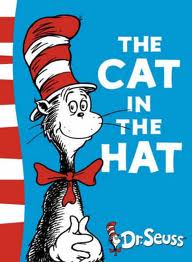
One of my favorite units from the National Council of Teachers of English website (NCTE-http://www.readwritethink.org/) is the unit,“Id, Ego, and the Superego in Dr. Seuss’s The Cat in the Hat” by Junius Wright of Charleston, South Carolina. The lessons in this unit use The Cat in the Hat “as a primer to teach students how to analyze a literary work using the literary tools of plot, theme, characterization, and psychoanalytical criticism.” The unit is stretched over eight 50 minute sessions, complete with handouts and worksheets for grades 9-12. I have completed the unit with my Advanced Placement English Literature students, however, in a shorter period of time of two 80 minute sessions, since many of my seniors are taking psychology or took psychology as juniors, and they are already familiar with Freud’s seminal work The Interpretation of Dreams.

The premise is that students will read The Cat in the Hat and analyze the development of characters (Narrator, Cat in the Hat, Fish) from the picture book through the stages of id, ego, and superego or analyze the static nature of characters (Thing 1 & Thing 2) locked in one stage.

Wright provides student friendly definitions and commentary for each psychoanalytic stage in one of the handouts on the Read, Write, Think website:

Id
The id is the part of the personality that contains our primitive impulses—such as thirst, anger, hunger—and the desire for instant gratification or release. According to Freud, we are born with our id. The id is an important part of our personality because as newborns, it allows us to get our basic needs met. Freud believed that the id is based on our pleasure principle. The id wants whatever feels good at the time, with no consideration for the other circumstances of the situation. The id is sometimes represented by a devil sitting on someone’s shoulder. As this devil sits there, he tells the ego to base behavior on how the action will influence the self, specifically how it will bring the self pleasure.
Superego
The superego is the part of the personality that represents the conscience, the moral part of us. The superego develops due to the moral and ethical restraints placed on us by our caregivers. It dictates our belief of right and wrong. The superego is sometimes represented by an angel sitting on someone’s shoulder, telling the ego to base behavior on how the action will influence society.
Ego
The ego is the part of the personality that maintains a balance between our impulses (our id) and our conscience (our superego). The ego is based on the reality principle. The ego understands that other people have needs and desires and that sometimes being impulsive or selfish can hurt us in the end. It is the ego’s jobto meet the needs of the id, while taking into consideration the reality of the situation. The ego works, in other words, to balance the id and superego. The ego is represented by a person, with a devil (the id) on one shoulder and an angel (the superego) on the other.

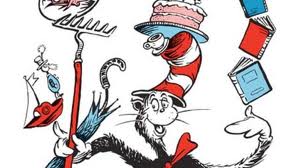
I usually read the story aloud, although there are several websites that have The Cat and the Hat with audio read-aloud for teachers who do not want to get swept up in Seuss iambic rhythms and rhymes. I have collected about 30 copies of The Cat in the Hat at used book sales over the past two years; each copy has cost between $.50-$2.00, so the total investment has been $25.00. Making sure each student has a copy of the text is tremendously important, because it is through the illustrations that the students can successfully analyze the characters.

“So we sat in the house. We did nothing at all. So all we could do was to Sit! Sit! Sit! Sit! And we did not like it. Not one little bit.”

“Look how bland their faces are,” notes Alex, “I think this is really the ego stage.”

“I know some good games we could play,” Said the cat. “I know some new tricks,” Said the Cat in the Hat. “A lot of good tricks. I will show them to you. Your mother Will not mind at all if I do.”

“Now, that’s just creepy!” says Skye. “The Cat walks in and starts convincing them that their Mother won’t mind?”
“That Cat is in id,” replies Mike, “he’s going to do what ever he wants.”

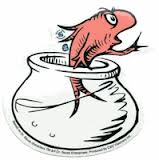
 “No! Not in the house!” Said the fish in the pot. “They should not fly kites In a house! They should not. Oh, the things they will bump! Oh, the things they will hit! Oh, I do not like it! Not one little bit!”

“Look at the Fish,” laughs Nancy, “He is out of the water, risking his life for the kids.”
There is a chorus of “Superego.” Everyone agrees.

After the unit, and once the students have a clear sense of how to analyze the characters in this story, I ask them to take this idea and analyze a different piece of literature. My students have just completed a reading of Antigone, so I asked them to psychoanalyze the actions of one character. Not surprisingly, most of them chose to study Creon’s movement from ego on his first day on the job as the King of Thebes, through his dissolution into id when he fights with both Antigone and his son Haemon.

“But, isn’t he really in superego?” asks Tom, “I mean, Creon is trying to uphold the law as king; he is trying to do what is right, or at least what is politically smart.” Other students consider his point….and this is the reason I love teaching this lesson. The use of psychological criticism humanizes literary characters, and our discussions after this lesson are always more informed by our deepening understanding of human nature. Students will use their understanding of id, ego, and superego from this lesson and apply these understandings to Frankenstein, Paradise Lost, Dr. Jekyll and Mr. Hyde, Richard III, and other important works of literature.

So, thank you, Junius Wright, for a wonderful unit on psychological criticism, but more importantly, thank you, Dr. Seuss. Not only did you teach my students to read, but you continue to teach them to think. And what did they think of the ending of The Cat in the Hat?

Should we tell her The things that went on there that day? She we tell her about it? Now, what SHOULD we do? Well… what would YOU do If you mother asked YOU?

Not one would confess. Sadly, there is not one superego in the entire class.

This past semester, each of my Advanced Placement English Literature students adopted one word as the subject of blog posts for ten weeks. After careful consideration, TJ chose the word “insanity”. For ten weeks , he wrote about insanity in literature, in science, in crime and in Dr. Who episodes. His final submission on insanity was written during the second week of May, when he was taking one AP exam after another. He was delighted to share the text of his final blog with the public, and hopefully, the College Board:

Dear College Board:
As a taker of two AP exams in the past (and 3 more in the near future), such challenging tests are nothing new to me. However, some tests have reached a new level of difficulty. This level can only be described as ludicrous, absurd, ridiculous, hysterical and, most importantly, completely and utterly insane.

Now, one may at first think that I am overreacting. Let that person read the following AP question:

At approximately what temperature will 40.0 grams of argon gas at 2.0 atmospheres occupy a volume of 22.4 liters?

A. 1,200 K
B. 600 K
C. 550 K
D. 270 K
E. 140 K

Now, before any taker of Junior level chemistry mocks me for using the simple question as an example, keep in mind that all chemistry multiple choice are WITHOUT A CALCULATOR. Now, most students know that to find the temperature of a gas, they would use the equation T=(PV)/(nR). Now, the formula mass of argon is approximately 40, and since we have 40 grams, n=1. The equation is now T=(PV)/R. With all other variables put in, T=((2)(22.4))/.0821=44.8/.0821. So, good luck doing that without a calculator. If one rounds these numbers to 45 and .1 respectively, however, their answer will still come out to 450. While closest to C, this leaves a huge margin of error. Not only does this test expect too much from the student, but it leaves doubt in any answer containing the words “Approximately, About, Closest To,” or “Near.”

The only reasonable explanation is that the good folks at College Board are complete lunatics. Who else would require a student to know specific uses of every single compound known to man (in addition to all other aspects of chemistry), charge $30.00 to have SAT scores rush-shipped ELECTRONICALLY (and still have it show up late), and all at the same time still think itself the world leader on college affairs?

We must stop this madness. Fellow Highschooligans, we must take up in arms against this insane, rogue organization. Like a precursor to Skynet, College Board is ruthless and will stop at nothing until full world domination is reached. Join me in the fight against insanity!

TJ is a senior graduating this June. I will miss his essays.

Advice to Hamlet, “The main point here is you over think everything. You get deeper and deeper into these brilliant plans, but without execution they truly mean nothing!”

“Hamlet, you yourself had said that to dwell on an act too long leaves one part good, and ‘three parts cowardice;’ please, Hamlet, PLEASE learn to follow your own advice,” pleads TJ in his advice to Hamlet.

The Advanced Placement English Literature students are posting their advice to characters from Hamlet by responding to “Stop the Action!” prompts on a blog. Students “advise” Hamlet, Gertrude, Claudius, Laertes, and Ophelia in response to lines from the play. Students discuss whether the Ghost is from Heaven, Purgatory, or Hell; whether Hamlet is mad or acting mad; or choose between the soldier Fortinbras and the scholar Hamlet. Their online discussion is equitable and collaborative, and the format allows me the opportunity to assess student understanding of this play.

I organized the “Stop the Action, Hamlet” on the Google Blogger platform, an easy platform for posting comments or replies. I invited students by email to the site, and they needed only a minute or two to learn to navigate through the 10 prompts that I posted. The  “comment” feature on the Blogger dashboard was helpful in assessing their time stamped responses.

The advice my students gave to each character in the play makes for entertaining reading, but more importantly, each student  was able to share his or her ideas online in an academic manner that cannot be duplicated in class. Class discussions are notoriously short, limited in scope, or marginalize quiet students, unless they are moderated. The class period is limited in time, whereas online discussions can continue for weeks, 24/7 with students posting when they have time to focus. When my students blog online, they respond to each other thoughtfully, post citations to support their positions, and choose their words carefully. The blogging platform elvated the class discussion.

For example, Colleen’s first entry was on whether the Ghost is from Purgatory or from Hell:

“If the ghost was from heaven, I feel as if he would not ask Hamlet to commit such a foul crime. It is through hell that the Ghost is speaking like this. As the play continues on, the Ghost does not seem to leave his demon thoughts but rather continues to carry them out. It is clear that through these actions, the Ghost is from hell.”

Devin later responded to this post,

” I was re-reading the conversation that Hamlet had with the spirit, and another line I found interesting was when the Ghost says to Hamlet, ‘taint not thy mind.’ I think this is interesting because it suggests to the audience that the Ghost cares about Hamlet. If the Ghost was from Hell this wouldn’t make sense and if the Ghost was from Heaven he wouldn’t be there in the first place. The only compromise to this situation is if the Ghost was from Purgatory, then he could care about himself and Hamlet at the same time.”

Annie’s  post followed this argument when she posted a question for Shakespeare:

“Why if the controversy for the ghost is so divided between heaven and hell not bring up any religion? There are very few if any religious references except this whole ghost thing. ..I do think your choice to ignore religion is a reason for your timelessness. By discussing certain religious topics, you may only appeal to one audience. You doesn’t even hint as to what your own opinions are. Choosing not to discuss such controversial topics was a smart decision on your part, and is perhaps why you are so popular even today.”

Colette had advice for Gertrude and Claudius. To Gertrude, she posted, “Your son is clearly in pain and instead of stopping and trying to communicate personally with Hamlet, you’re taking Claudius’ advice to hire spies to keep ‘watch’ over Hamlet when in fact, that’s a mother’s duty. Your maternal switch is definitely shut off.” Her advice to Claudius was equally blunt, “Murder cannot simply be ‘washed’ away. Much like in Shakespeare’s Macbeth, you [Claudius] are searching for a way to wash the blood red off of your hands. However, they are forever stained. No matter how much you clean your hands, they will forever be tarnished and filthy.”

TJ humorously advised Polonius indicting him on the line, “Beware/ Of entrance to a quarrel; but being in, /Bear’t that the opposed may beware of thee” (I.iii.69-71). “Hey, Polonius,” TJ writes, “remember when you were hiding behind that curtain? Remember when Hamlet pulled out a knife on you and you screamed for help instead of present yourself so that ‘the opposed may beware of thee?'”

Kelsey begged Laertes to walk away from Claudius, She recalled his line, “And yet ’tis almost ‘gainst my conscience,” and argued:

“What I want you to do right now, Laertes, is just stop and think. Why would Claudius actually want to help you? He is a manipulative man that just wants power…. Some advice- stop and let Claudius fall to his own fate! He already basically showed that he knew the cup was poisoned by calling out. He is guilty to everyone in the room. Let him take the downfall and WALK AWAY MAN! Gah! Your pride is not worth your life!….you will realize your mistake in about 30 lines in the play….just thought I would let you know…”

Finally, Sara posed a question for Shakespeare:

“As we continue reading through the play, we notice how Hamlet is struggling with avenging his father – yet, he knows he must complete the task of murdering his uncle, as his father had ordered. I leave you with this question – do you [Shakespeare] believe we were all born to complete a task? Does this apply to other plays ? Romeo and Juliet? Macbeth? King Lear?”

In addition, the Hamlet blogs are a means for me to directly address educational technology standards that have been developed by different educational organizations.
Using the standards for the Partnership for 21st Century Skills, these blogs allow the students to:

  • Articulate thoughts and ideas clearly and effectively through writing
  • Be open and responsive to new and diverse perspectives

Using the standards for NCREL(North Central Regional Educational Laboratory)/engage, the blogs promote:

  • Teaming and collaboration to create to solve problems and master content
  • Willingness to make mistakes, advocate unconventional positions, or take on challenging problems to enhance growth.

Finally, using ISTE ( International Society for Technology in Education) standards, the blogs provide an opportunity for students to:

  • Interact, collaborate and publish with peers, experts and others employing a variety of digital tools and media
  • Communicate information and ideas effectively to multiple audiences
  • Apply existing knowledge to generate new ideas, products, or processes and diverse perspectives to explore alternate solutions.

More importantly, the “Stop the Action” blogs have allowed my students to function much like Horatio in the play whose advice to Hamlet, “If your mind dislike any thing, obey it…” goes unheeded. The characters also do not heed the advice of my students, but my students have become proficient in their ability to “tell my story” of Hamlet.

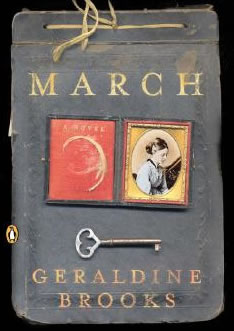
A series of miscommunications left the eight members of the local Burnham Library Book Club wondering which book they should prepare to read for the next meeting. The month before, a decision was made to read a novel that shared the name of the next meeting; we would read a book titled  The March by E.L Doctorow for our March meeting date. How clever! Unfortunately, our plans went awry when the librarian posted the selection as March by Geraldine Brooks. Members arrived with copies of one or the other novel.

No matter. As it turned out, we could discuss both books easily, not only because of the similarity of each fictional story arc but because of the numerous historical references to people and the events in the Civil War.  What struck all members of the book club during the discussion was the amount of research that had gone into creating these works of historical fiction, since both contained a notable fidelity to events, customs, and manners of the Civil War era.

March-Geraldine Brooks

In March, Geraldine Brooks borrows her title character, Peter March, from Louisa May Alcott’s story Little Women. Her narrative is told from the alternating point of views of Marmee and the father of the March girls: Meg, Jo, Beth and Amy. In her explanation for his prolonged absence, the idealistic March enlists as a Union clergyman in 1861, at the beginning of the Civil War.

E. L. Doctorow’s The March is centered on real-life Union General William Tecumseh Sherman in his infamous “march to the sea”, as he burns Atlanta before pivoting north into the Carolinas. Multiple narrators are employed in this novel including a Union regimental surgeon, Colonel Sartorius; Emily Thompson, a daughter of a Southern judge; and Arly and Will, two soldiers who care little about loyalty and more about staying alive.  The scope of  this novel is epic as Sherman’s sixty thousand troops burn, pillage, and choke to death the final throes of the Civil War in 1864.

The similarity of major characters from each novel was uncanny: the mixed-race beautiful protagonist Pearl in The March and the strikingly attractive, educated slave Grace who captivates the title character in March. There were historical figures to people each novel: John Brown, the famous abolitionist; Henry David Thoreau; and Ralph Waldo Emerson make appearances in March. General Sherman, General Joseph E. Johnson, and Abraham Lincoln are present in The March. Both novels also extensively featured field hospitals as settings. March is a a Union chaplain who is wounded and ends up in a Civil War hospital; The March features a Union regimental surgeon, Colonel Sartorius  who curiously employs a number gruesome surgical procedures.

The novels reflected the tumult of a civil war, the hair-raising escapes from danger and the chaos and brutality that ensued from bitter and divided rivalries. Both novels highlighted the technological advancements that made each side more efficient killing machines, and Doctorow in particular noted the historical progress of mechanized warfare:

 “This in America was to be seen with one’s own eye’s. And as bloody and brutal were the contests of the Lancasters and York, they were hand to hand- battle-aves, pikes, maces. These chaps were industrial age killers: they had repeating rifles that could kill at a thousand yards, grape that could decimate an advancing line, cannon, field-pieces, munitions that could bring down entire cities. Their war was so impersonally murderous as to make quaint anything that had gone on before. (214)

Another element of comparison was the reflection in both novels on ancient wars that had preceded the Civil War. Brooks has her narrator, the cerebral Peter March, contemplate the historical continuum, from the Ancient World to the present, noting the how painful is the loss of loved one due to war:

“The waste of it. I sit here, and I look at him, and it is as if a hundred women sit beside me: the revolutionary farm wife, the English peasant woman, the Spartan mother-‘Come back with your shield or on it,’ she cried, because that was what she was expected to cry. And then she leaned across the broken body of her son and the words turned to dust in her throat.” (211)

In contrast, Doctorow uses a visiting English journalist in order to comment on how the echoes of  ancient conflicts are heard in the progression of battles he sees:

“Yet some of the ancient military culture endured. The brutal romance of war was still possible in the taking of spoils. Each town the army overran was a prize. In this village was an amazing store of wine, in that granary brimming to the rafters, a herd of beef here, an armory there, homes to loot, slaves to incorporate. There was something undeniably classic about it, for how else did the armies of Greece and Rome supply themselves? How else had Alexander’s soldiers made an empire? The invading army, when it camped, sat on the land as its owners, with all the elements of domesticity, including women, enlarging the purely martial function of their social order” (215)

The reasons for the Civil War are addressed more clearly in Brook’s tale. She incorporates the arguments offered by the real-life American Transcendentalist Branson Alcott in her creation of the  character of the naive March who is just beginning to doubt his involvement with the conflict he little understands:

“If war can ever be said to be just, then this war is so; it is action for a moral cause, with the most rigorous of intellectual underpinnings. And yet everywhere I turn, I see injustice done in the waging of it…”(65).

In contrast , Doctorow’s characterization of the West Point educated General Sherman suggests his weary recognition that while the physical act of war will run to its exhausted conclusion, the battlefield will move to another plane where the dispute will continue:

“And so the war had come down to words. It was fought now in terminology across a table. It was contested in sentences. Entrenchments and assaults, drum taps and bugle calls, marches, ambushes, burnings and pitched battles were transmogrified into nouns and verbs.  It is all turned very quiet, Sherman said to Johnson, who, not understanding, lifted his head to listen.

No cannonball or canister but has becomes the language here spoke, the words written down, Sherman thought. Language is war by other means” (348).

Ultimately, the members of book group determined that both books provided a fascinating blend of historical fact with fiction. As an educator, I was impressed about how much more effective both novels were in communicating the experiences of living through the Civil War from its beginning (1861) to its inevitable end concluding with Lincoln’s assassination in 1865. A textbook would have covered the information, but not provided the visceral quality a reader gains through a story….both novels succeeded in recreating history using a “his story” model. Both novels complement the study of the Civil War by blending each author’s thematic development and literary technique with historical fact. As a result, both novels will be placed on the 11th grade classroom shelves along with two other wonderful Civil War novels The Killer Angels by Michael Shaara (Gettysburg) and Cold Mountain by Charle Frazier.

All these books appeal to the imagination in recreating the  particulars in the  time and places of the Civil War. As a bonus,  how serendipitous that despite the near duplication of titles, both novels were so similar in subject matter as to allow for a great discussion? How surprising that the story of two “Marches” would ultimately be so similar?

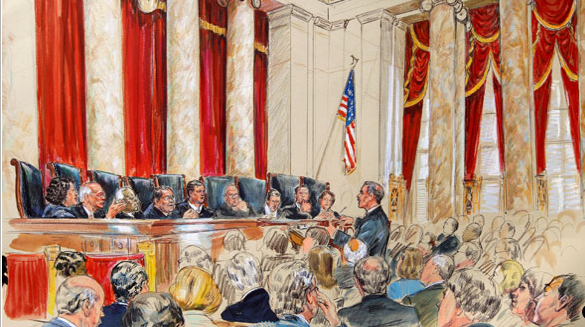
Deputy Solicitor General Edwin Kneedler was before the Supreme Court arguing on behalf of the Health Care Bill when he stated that the  Supreme Court Justices would need to look at “the structure and the text” of the 2,700-page law. Justice Antonin Scalia cut into his argument asking, “Mr. Kneedler, what happened to the Eighth Amendment?” Scalia asked. “You really want us to go through these 2,700 pages?” (audio-video link).

Artist rendering of Supreme Court listening to arguments about the Health Care Bill- from the Politico Website

Well, yes. Speaking as a citizen of the United States of America, yes, I do. Speaking as a high school English teacher, I want you, Justice Antonin Scalia, to do your homework. I expect no less from my 17-19 year old students enrolled in my Advanced Placement English Literature class. I want them to read at least 2,700 pages of the world’s great literature because I am trying to prepare them for the rigors of college. I know that reading  great literature is also critical to help prepare my student’s brains for real-life social interaction. Similarly, I want you, Justice Scalia, to read 2,700 pages to make a determination about the real-life Health Care Bill that will effect every citizen.

As I listened to the radio broadcast report of the court session, it was the number of pages, 2,700, that caught my attention.  2,700 pages sounded intimidating at first, but I began to mentally check off the number of books I require my Advanced Placement English Literature high school students to read. I decided to check, and determined that this school year, my students have read:

Hamlet, King Lear, Othello (roughly 80 pages each)=320 pages; The Handmaid’s Tale-312 pages; Beloved-275 pages; Paradise Lost (roughly) 200 pages; The Story of Edgar Sawtell-576 pages; The Grapes of Wrath-464 pages; Frankenstein-256 pages; Medea-50 pages; Antigone-46 pages; A Thousand Acres-384. Total? 2803 pages. A full 103 more pages than the legislation for the Health Care Act! My students will have read more pages than the bill that Justice Scalia or the other Supreme Court Justices would have to read, and that does not count the numerous poems, essays, and short stories they have also read in class. They have read more than 2803 pages for only one of their high school classes.

According to the transcripts, Scalia’s interrogation of Kneedler was interrupted several times by laughter from the gallery. “You really want us to go through these 2,700 pages?” Scalia interjected, “And do you really expect the court to do that? (*laughter*)  Or do you expect us to — to give this function to our law clerks? (*laughter*) Is this not totally unrealistic? That we are going to go through this enormous bill item by item and decide each one?”(*laughter*)

His rhetorical questions were met by comments by Supreme Court Jutice Elana Kagan, who chimed in, “For some people, we look only at the text,” she said. “It should be easy for Justice Scalia’s clerks.”

“I don’t care whether it’s easy for my clerks,” Scalia retorted,  channeling the spirit of the demanding Justice William O. Douglas, “I care whether it’s easy for me.”

The use of the law clerks-the youngest, best and the brightest lawyers-to do the bulk of the reading and preparation for each case is widely understood. In many ways, law clerks are to the Supreme Court Justices what Sparknotes are to students.

Sparknotes are written by top students or recent graduates who specialize in the subjects they cover. According to the SparkNotes website, their “writers approach literature with a passion and an enthusiasm that inspires students and has won over parents and teachers worldwide”,  which means they read the novels, poems, and plays they analyze- every single word. What is interesting about the Scalia-Keegan exchange is that many of the writers for Sparknotes have graduated from Harvard, as has Justice Scalia who received his LL.B. from Harvard Law School where he was a Sheldon Fellow of Harvard University from 1960–1961. Justice Elena Kagan is also a Harvard graduate; she earned  a J.D. from Harvard Law School in 1986, and was appointed the 11th dean of Harvard Law School in 2003.

How proud Harvard University must be to have six out of the nine current Justices as graduates. What must Harvard University think, however, when a graduate complains that he does not want to read the very legislation that he will rule on because it is too long.  To heap humiliation onto the the graduates of this prestigious university, Chief Justice Roberts, who also received his A.B. from Harvard College in 1976 and a J.D. from Harvard Law School in 1979,  acknowledged during the proceedings that he had not read the legislation either, “Where is this line?” he asked Kneedler, “I looked through the whole Act, I didn’t read …”Perhaps the graduates of Harvard who have successfully written for Sparknotes, and helped thousands of high school students in their hours of need,  could be called on to help these jurists in their hour of need.

Frankly, the idea that members of the Supreme Court have come to decide the fate of the Health Care bill  without doing the reading is as frustrating to me as when students arrive unprepared for a reading comprehension quiz. School is their job, their grades are how they are paid, so  students are paid for their lack of preparation with a bad grade. What will be the result of Justice Scalia and Justice Roberts’s lack of preparation, and moreover, what examples are they setting?

Students often complain about the reading they have been assigned. Mary Shelley’s Frankenstein is “hard to read”; John Milton’s Paradise Lost  has “too many footnotes in the poem”; Toni Morrison’s Beloved  is “confusing”. I push on despite the numerous complaints I hear everytime I bring out a text  forcing students to engage in difficult texts because I know each text will eventually hook the reader-Shakespeare has 400 plus years of success for a reason.  Unfortunately, this is the age of education where a literary work is too often judged by a student by its length, not by its content. How sad to have that thinking reinforced by some of the top minds in our judiciary.

The Health Care Act is certainly drier than Steinbeck’s Grapes of Wrath, but there will be sections that require an expert eye in order to make a fair judicial ruling. The Health Care Act will probably drive a reader into King Lear’s madness, but the fact that the document is too long should not be used as an excuse for completing the assignment.

So, Justice Scalia, and all other justices of the Supreme Court, show students everywhere that doing the assigned work is important before you write the paper. Do not whine or make jokes in public about the length of the assignment in the hopes of gaining sympathy. My students have already read 103 more pages than the 2,700 pages of the Health Care Bill for only one of their classes. Show them that you can read all 2,700 pages because that is your job.

Student: “Is this another unhappy book?”
Me:*sigh* “Yes.”

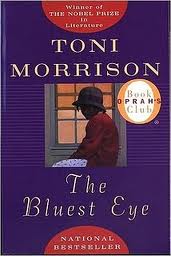
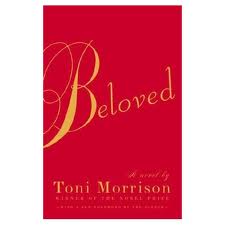
Toni Morrison is on my mind. The Advanced Placement English Literature Class (12th grade) has just finished reading her novel Beloved; the Advanced Placement English Language Class (11th grade) is currently offering The Bluest Eye. These are most certainly not written from a happy Ken and Barbie point of view. These novels are complex and difficult reads because the Nobel Prize winning Morrison makes the reader uncomfortable…yes, even unhappy.

In an interview on Oprah,  Morrison explained how she began her first novel, The Bluest Eye:

“Things were going very fast in 1965, so I decided I wanted to write a novel that was not a warning but was just literature, and I wanted to put at the center of that story the most helpless creature in the world—a little black girl who doesn’t know anything, who has never been center stage. I wanted it to be about a real girl, and how that girl hurts, and how we are all complicitous in that hurt. I didn’t care what white people thought, because they didn’t know anything about this. This was the age of ‘black is beautiful,’ and, well, yeah, that is certainly the case; however, let us not forget why that became a necessary statement.”

The Bluest Eye is set in Post-Depression America, 1941, in the author’s hometown of Lorain, Ohio.  Eleven year-old Pecola Breedlove, a black girl, longs to be a white child with blonde hair and blue eyes. In a particularly graphic scene, the reason the book is so controversial, she is raped and impregnated by her own father.  Much of the book centers on the ideal of beauty and Pecola’s inability to accept herself. She is exposed to the perfect life portrayed in the Dick and Jane series of reading primers at school which increases her conflict about her self-image as seen in an excerpt from The Bluest Eye:

 “I destroyed white baby dolls. But the dismembering of dolls was not the true horror. The truly horrifying thing was the transference of the same impulses to little white girls. The indifference with which I could have axed them was shaken only by my desire to do so. To discover what eluded me, the secret of the magic they weaved on others. What made people look at them and say, ‘Awwwww,’ but not for me.”

The other book, Beloved, is based on the true story of Margaret Garner, a runaway slave who crossed the frozen Ohio River to Cincinnati in January 1856 with her four children. Confronted by a slave catcher, Garner killed her daughter rather than have her returned to be a slave. In the novel, Sethe escapes with her newborn daughter, Denver, to meet up with her other three children, one of them the already-crawling? toddler who is known as Beloved. Sethe has 28 days of freedom where she is able to love her children for the first time:

“I was big, Paul D, and deep and wide and when I stretched out my arms all my children could get in between. I was that wide. Look like I loved em more after I got here. Or maybe I couldn’t love em proper in Kentucky because they wasn’t mine to love. But when I got here, when I jumped down off that wagon-there wasn’t nobody in the world I couldn’t love if I wanted to. You know what I mean?”

Soon after, the plantation owner School Teacher and a slave catcher arrive to claim their property, Sethe and her children. In an act of savage desperation taken in order to keep her children from a life of slavery, Sethe uses a saw to slice open the toddler’s neck , but she is prevented from killing her other children. In addition to this gruesome scene, the novel is also rife with rape, mutilations, and the supernatural. These elements  make its choice for a school curriculum as controversial as The Bluest Eye. However, both texts are often listed on the Advanced Placement Open Essay list, an indication that these books are exactly the kind of complex texts students should be reading. The demanding Advanced Placement prompts from past years are not answerable with less weighty books.

Teachers themselves struggle with complex and demanding texts, and the English Companion Ning often features posts from teachers who are looking for information on a topic or lesson plans on a text. There are always several posts about the use of Toni Morrison books in the high school curriculum. Many of these posts discuss the controversy these books cause for teachers who want to teach Morrison’s complex and compelling literature while addressing the concerns of  parents about the appropriateness of each novel’s content.

One teacher posted:

“I think it’s funny how we sometimes find things more shocking as adults than as kids.  I read The Bluest Eye in 11th grade and never thought about it being objectionable or age-inappropriate.  I actually read quite a bit of Toni Morrisson in HS.  As an adult, I think The Bluest Eye should be taught.  That said, any book with sensitive subject matter does need to be introduced in a thoughtful, open, and contextualized manner.”

While another offered a very balanced approach:

“Just want to mention that it is the parents’ responsibility to train up their children. It is not the responsibility of the school or the state. I worry that we teachers tend to forget that, making our relations with parents far more adversarial than they ought to be. Why not let the parents choose the appropriate novel for their child? Focus the classwork on skills that can be used with any novel, on practicing the thinking that will help students get through tough texts more independently, rather than on specific-novel content.

That said, strong instruction and discussion on what distinguishes great literature from not-so-great literature — literary fiction from commercial fiction, will help students see the difference between the great novels we English teachers want them to read and the … um, lightweight? novels they want to read.”

Morrison novels are demanding. They do not depict happiness. Their settings depict a world in stark contrast to the world of Ken and Barbie. While Ken and Barbie as fictional characters are perfectly formed, coiffed representatives of all that is perfect in the world, they have have not been marginalized as the fictional characters who people Morrison’s work; they have not experienced rejection, brutality, pain or suffering.

In the Oprah interview, Morrison attempts to explain a human’s want for acceptance by others but more importantly, by the self:

“I think a lot has changed since the ’60s in terms of self-image. But there’s still a lot of pain young girls feel because the bar is always being raised. The stakes are always higher….We don’t have the vocabulary to tell children what to value. We do say, “Oh, you’re so beautiful. Oh, you’re so pretty. Oh—that’s not really what we really ought to be saying. What do you tell a child when you want to say, “You are good, and I like that. You are honest and I like that. [Y]ou are courageous. I really like that. I really like the way you behave. I like the way you do yourself. Now. The way you are.’ That’s the vocabulary we need.”

Morrison’s admits that when she first started writing, she was writing for a different audience:
 “I guess I was just that arrogant. Nobody was going to judge me, because they didn’t know what I knew. No African-American writer had ever done what I did—none of the writers I knew, even the ones I admired—which was to write without the White Gaze. My writing wasn’t about them.”
 Morrison’s  The Bluest Eye and Beloved unapologetically stand in stark contrast to the world of Dick and Jane or Ken and Barbie. Her writing has received national and international praise for exactly that reason.

The original purpose of this blog was to explain how used books were purchased in order to increase the classroom libraries at Wamogo Middle and High School, grades 7-12. The name of the blog, “Used Books in Class”, was initially chosen to indicate the condition of the texts. The term “used”, however, can also serve to mean how the text are used in class. In other words, how are the used books being used in the English Language Arts Classrooms at each grade level?

A carload of Used Books after a summer book sale!

In writing this blog, I have found myself increasingly commenting on English/language arts curriculum, lesson plans, and current issues in education. This means the purpose of the blog has grown to include topics that are all related to the use of reading materials in the classroom, and reading is the most important skill that students will need to be successful students at every grade level. Providing a wide variety of books-new and used- is critical to engaging readers.

To date, the used books purchased in the secondary markets have helped in four specific ways:

Used books have replaced copies at each grade level. Used books have been used to replace lost or damaged copies of books assigned to a particular curriculum. For example, there have been replacement copies of The Giver for Grade 7, Of Mice and Men in 9th grade, and Animal Farm in Grade 10. These titles are taught in almost every school system in Connecticut, and are titles that are relatively easy to find locally in the secondary market. These are also titles that are readily available in large quantities online on used book dealer sites such as Better World Books.

-Used books have increased selections for independent reading in classrooms. The English Department has incorporated more time for silent sustained reading (SSR) in class at each grade level, and classroom libraries have been increased to allow students the opportunity to choose books to read. For example, students in grade 9 are provided 40-45 minutes each week to read self-selected books during the school year. Students may choose a book from the school’s library media center, or choose a book from one of the carts in the classroom.  Titles vary in genre, subject and reading level in order to meet student interest. Students are responsible for blogging reviews about the books they read at least twice a quarter.

Other classes that take advantage of independent reading are the Advanced Placement English Language and English Literature classes. Students select independent reading that meets the critical standards of the Advanced Placement program. These selections range from the classics (Dostoevsky’s Crime and Punishment) to more contemporary titles (Roth The Plot Against America) and write responses to these books.

-Used books are added titles as “satellite texts”. English teachers have extended thematic units to include titles that complement a text from the literary canon. For example, the 11th grade thematic unit “Coming of Age” is usually associated with Salinger’s Catcher in the Rye. Purchasing used books have increased selections to include Sittenfield’s Prep, Cormier’s The Chocolate War, Lamb’s She’s Come Undone, Gibbons’s Ellen Foster, and Chbosky’s Perks of Being a Wallflower. Students select a text to explore the thematic idea through the lens of another author.

Score! A set of books for Grade 10

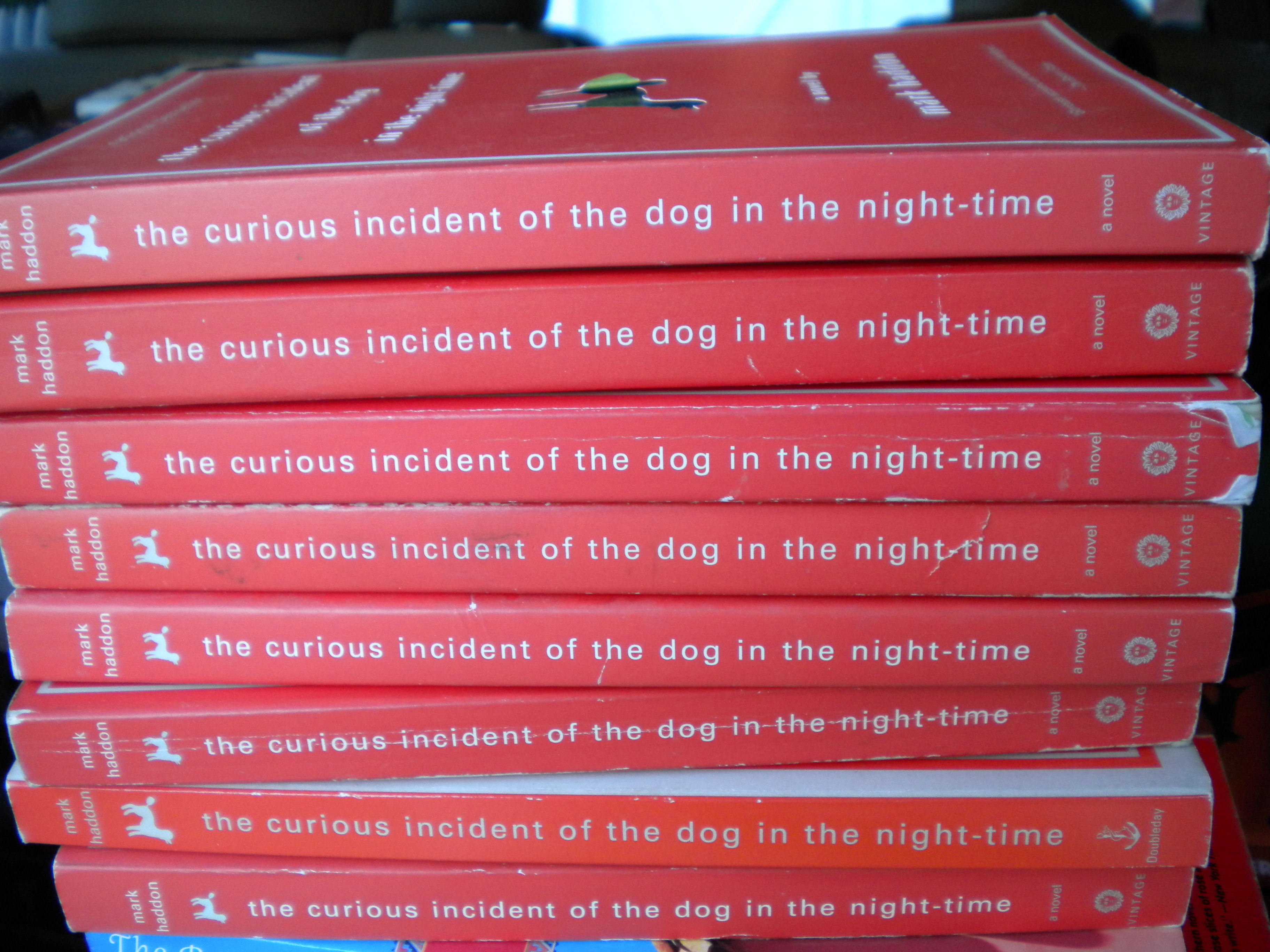
-Used books have allowed for the addition of new texts. The purchase of used books has expanded curriculum at several grade levels with high interest titles.  For example, Hosseini’s The Kite Runner, Coelho’s The Alchemist and Haddon’s The Curious Incident of the Dog in the Night-time (see picture) have been added to the World Literature curriculum in grade 10. In addition, Walls’s The Glass Castle has been added to Grade 12 Memoir class while Farmer’s The House of the Scorpion will be added to grade 7.

Ultimately, the re-stated purpose of this blog will be to continue to discuss the inclusion of specific used book titles in English/language arts classrooms as well as discuss how we are working to improve reading in and out of the classroom  at every grade level. Used books in class is also about using books in class to improve reading!