Archives For November 30, 1999

There are waves from England that reach America’s shores.

There are literary waves.
George Orwell’s Animal Farm was published in America in 1946.

There are musical waves.
The Beatles came to America in 1964.

George Orwell used satire as a commentary on Communism in the USSR and the rise of Stalin in his allegory Animal Farm.

John Lennon used the lyrics in the song Revolution as a response to the increase of protests against the Vietnam War, specifically student riots in Paris in May of 1968.

Satire, politics, protests….so many connections. Why not share them in class?
Why not share the Beatles’ song Revolution while students read Orwell’s Animal Farm?

“Revolution”

You say you want a revolution
Well you know
We all want to change the world
You tell me that it’s evolution
Well you know
We all want to change the world
But when you talk about destruction
Don’t you know you can count me out

Don’t you know it’s gonna be alright
Alright, alright

You say you got a real solution
Well you know
We don’t love to see the plan
You ask me for a contribution
Well you know
We’re doing what we can
But if you want money for people with minds that hate
All I can tell you is brother you have to wait (Revolution lyrics continued…)

After we read first chapter of Animal Farm aloud in class, I played the video of the Beatles performing the song Revolution. For some, this was the first time they had ever heard the song; for some, this was the first time they had seen the Beatles perform.

After watching the video, I posted an assignment to use the power of music – “to write a song for your cause.” The directions given to the students were:

You say you want a Revolution….?
Well, you have to write your song!! (for extra credit)

Step 1: Identify your cause. What makes you angry? What do you see as a problem in society? What is your Pet Peeve? What would you like to change about your world? This can be something big or little.

Step 2: The power of music! To persuade people to join your revolution, (like Major’s Beasts of England) you have to write a song.

Step 3: Share your lyrics, and we will join you in song (karaoke tunes preferred)

Their protest songs came in. In their songs the students protested: homework, English class (*sigh*), the school parking lot ban on underclassmen, bad weather, cafeteria food, Twilight movies, dirt clods in the hallways from steel-toed boots, the ban on cupcakes in class, and (and there were several of these), Justin Bieber.

While their songs were unlikely to inspire a revolution, they did appreciate the power of music in communicating a message. Their reactions to their own songs of protest were positive, but they admitted that their songs did not have the same power as the Beatle’s Revolution. They recognized Orwell’s statement on the power of song in Animal Farm “The Beasts of England” sung at the end of Chapter One. That song (sung to the tune of My Darling Clementine) was a take-off on the famous socialist anthem, The Internationale:

Beasts of England, Beasts of Ireland,
Beasts of every land and clime,
Hearken to my joyful tidings
Of the Golden future time.

Soon or late the day is coming,
Tyrant Man shall be o’erthrown,
And the fruitful fields of England
Shall be trod by beasts alone…….(continued )

 “…The singing of this song threw the animals into the wildest excitement…. And then, after a few preliminary tries, the whole farm burst out into Beasts of England in tremendous unison….” (Ch1:Orwell)

Orwell was demonstrating how the lyrics in a song could motivate. The student protest songs, however, were more entertaining than motivating. The Beatle’s song Revolution is both entertaining and motivating, a song written four years after their momentous arrival in America.

From the moment the Beatles disembarked from Pan-Am flight 101 on February 7, 1964, they were a force in American music. Yet, according to TIME magazine’s story, Beatlemania Begins: The Beatles First U.S. Visit to Play Ed Sullivan, the Beatles were surprised by how their music had made thousands of frenetic fans:

Just before 1:30 p.m., Flight 101 taxied to a stop outside the terminal and the aircraft door popped open. An explosion of cheers and screams rang out as the crowd stormed forward….

“We heard that our records were selling well in America,” George [Harrison] noted, “but it wasn’t until we stepped off the plane … that we understood what was going on. Seeing thousands of kids there to meet us made us realize just how popular we were there.”

Their first appearance on The Ed Sullivan Show (February 9) featured a set list that set fans shrieking:

  • All My Loving 
  • Till There Was You (Sue Raney cover)
  • She Loves You 
  • I Saw Her Standing There 
  • I Want to Hold Your Hand

Those five songs began the domination of pop music charts, coined the term “Beatlemania”, and changed the culture of a generation. The Beatles proved the power of music, so our protest song assignment capitalized on student awareness of this power. The students shared what they would protest if given the opportunity. They had a chance to make connections between two genres, between a set of music lyrics and a set of lyrics from a novel-both of which were penned by Englishmen.

This was also an opportunity for me to highlight the Beatles. Students watched and listened to a recording of the “Fab Four” who created a revolution in music here in America; they saw those “lads from Liverpool” who invaded America from England many Yesterday’s ago.

In the spirit of all end of the year reviews, I have condensed the year 2013 by offering month by month posts from this blog that illustrated the best student (and subsequently, teacher) learning:

January 2013: A Freshman’s Modern Odyssey in the Style of Homer

"Dawn spread her rosy fingers..."

“Dawn spread her rosy fingers…”

The Freshmen final project after reading The Odyssey is a narrative that students complete called “The Wamogossey: A Day in the Life of a Freshman at Wamogo High School.” Writing narratives are once again favored in  Common Core State Standards, and this post explained how students made their own attempt at an epic adventure.

February 2013:  Spilling Over the Corners of a Six Word Text

Short Story in 6 words

Short Story in 6 words

This exercise proves that keeping students “within the four corners of the text” is impossible, even when the text, attributed to Ernest Hemingway, is only six words long. This post also serves as evidence that that admonitions on best practices should be limited to those with actual classroom experience, not to the “architects of the Common Core.”

March 2013 If You Want to Watch the Cow Give Birth

Watching the arrival of our latest calf

Watching the arrival of our latest calf

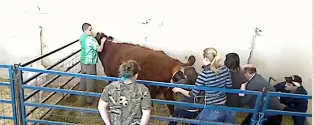
Yes, “If you want to watch the cow give birth, turn on U-stream now!” was an announcement over the PA system. Normally, I am irritated by interruptions to class time, but this announcement cued students about opportunity watch the birth of a calf in the Agricultural Science wing of our high school. The combination of technology in broadcasting and recording the birth of the newest member of the agricultural program with old-fashioned “hands on” physical labor illustrates 21st Century authentic learning.

April 2013 You Never Forget Your First Hamlet

Members of the senior class were fortunate enough to see Paul Giamatti’s “Hamlet” at Yale Repertory Theatre. I’ll let their words speak for the experience:

The performance was a wonderful experience, especially since it was my first time to see Shakespeare.

I wouldn’t mind going to another because it was so enjoyable that I didn’t even realize the 4 hours passing by.

I like the way that a play has a certain kind of vibe. It’s like a live concert, where there’s a certain kind of energy.

It was like seeing a live performance of a film. I would especially like to see another Shakespeare because it is the way that he intended his works to be portrayed.

After seeing Hamlet so well done, it would definitely be worth going to see another one whether it be Shakespeare or a different kind of performance.

May 2013 Kinesthetic Greek and Latin Roots

Spelling "exo"=outside

Spelling “exo”=outside

Understanding Greek and Latin roots is critical to decoding vocabulary, so when the freshman had a long list of roots to memorize, we tried a kinesthetic approach. The students used their fingers to spell out Greek roots: ant (against), tech (skill), exo (outside).  They twisted their bodies into letters and spread out against the wall spelling out xen (foreign), phob (fear). They also scored very well on the quizzes as a result!

June 2013 Superteachers!

Superteacher!

Superteacher!

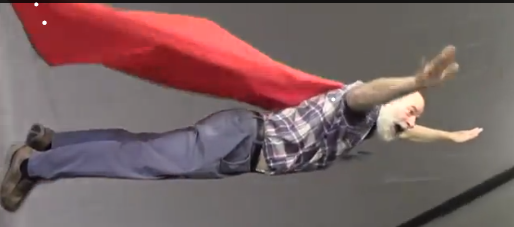
At the end of the 2012-2013 school year, teachers rose to a “friendship and respect” challenge to make a video. With a little help from a green screen, 27 members of the faculty representing a wide variety of disciplines jumped into the nearby closet wearing the big “W” (for Wamogo). Students in the video production class watched and filmed in amazement as, bearing some artifact from a particular subject area, each teacher donned a flowing red cape.

July 2013 Library Book Sales: Three Bags Full!

The original purpose of this blog was to show how I filled classroom libraries with gently used books. The Friends of the C.H. Booth Library Book Sale in Newtown, Connecticut, is one of the premier books sales in the state: well-organized tables filled with excellent quality used books, lots of attentive check-out staff, and great prices. This year, I added three large bags of books to our classroom libraries for $152.00, a discount of 90% off retail!

August 2013 Picture Books Are not for Kindergarten Any More!Cat in Hat book cover

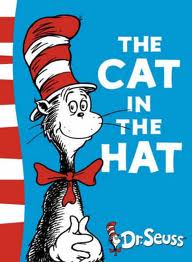
At used book sales, I am always looking for picture books I can use in high school classrooms. For example, I use The Cat in the Hat to explain Freud’s theory of the Id, Ego and Superego . Thing #1 and Thing #2 represent Id, and that righteous fish? The Superego. Yes, Dr. Seuss is great for psychological literary criticism, but he is not the only picture book in my repertoire of children’s literature used in high school. This post features a few of my favorite picture books to use and why.

September 2013 Close Reading with Saki and the Sophomores

Saki’s short stories open our World Literature course in which our students will be reading complex texts required by the English Language Arts Common Core State Standards (CCSS). After a “close reading” the conversations in the room showed the text’s complexity. Saki’s The Interlopers has all the elements suggested by the CCSS:  figurative language, the ironic wish, and multiple meaning in the revenge sought by man versus the revenge exacted by Nature. Our close reading should have been “textbook”. The evidence proved the characters’ demise…or did it? The ensuing discussion forced the class to consider other positions.

October 2013 Close Reading Art

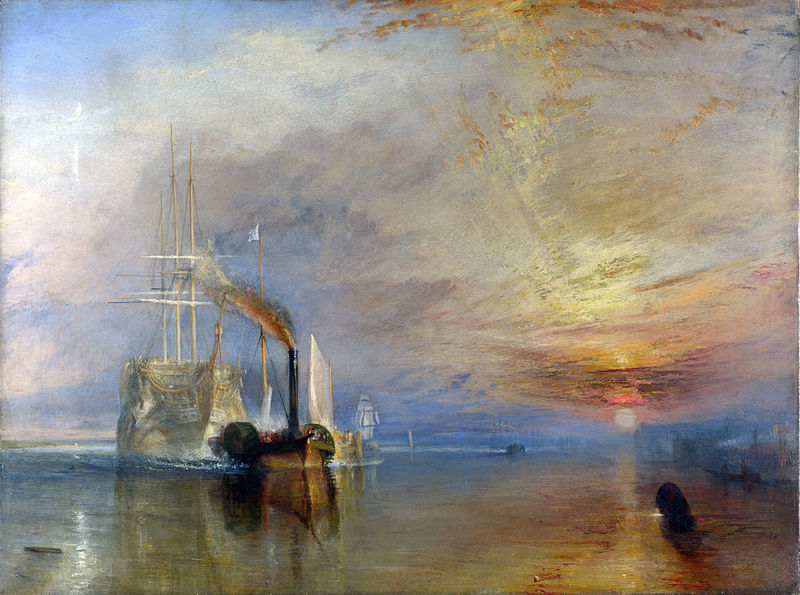
The Fighting Temeraire

The Fighting Temeraire

After “close reading” short stories, the sophomores were asked to use the same skills to “close read” several paintings that thematically connected to the Industrial Revolution. They studied a Constable pastoral painting, before J.M.W. Turner’s famous painting, The Fighting Temeraire. While some called attention to the the dirty smoke stack, others saw the energetic paddling as a sign of progress. They noticed the ghost-like ship hovering in the background, the light created by the sunset which gave the painting “warmth”or “light extinguishing”. When they were asked to use these elements as evidence to determine the artist’s message, there were some succinct responses to the painting’s “text.”

November 2013 Thanks for the NCTE Conference

Five members of the English Department attended the conference and selected from over 700 sessions at the National Council of Teachers of English and the Conference on English Leadership.  District support for such great professional development is truly appreciated. We are also grateful that four of our proposals were chosen to share as presentations for other educators. The explanations of our presentations with links to these presentations are included in this post.

December 2013 Drama Class Holiday Miracle

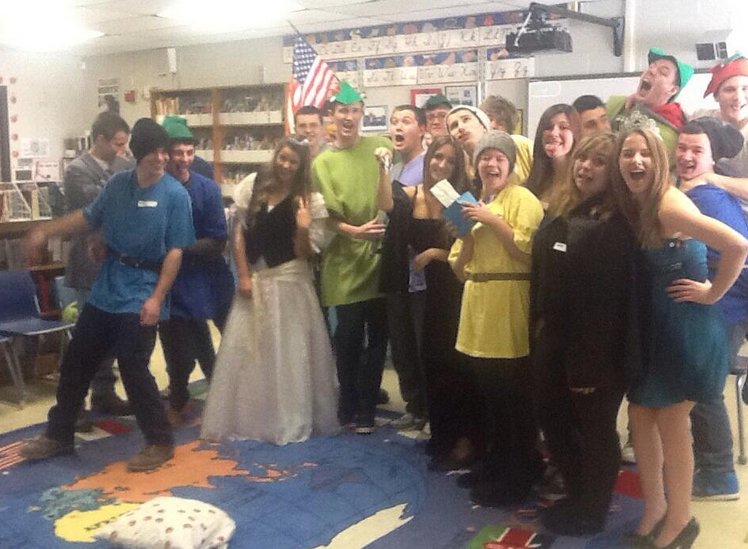
Cast photo!

Cast photo!

An ice storm two weeks before performance caused a car pile-up, and the drama club teacher was left with a concussion. She could not be in school; the students were on their own, and I was left to supervise their performances of Snow White and the Seven Dwarves at three local elementary schools.

Their “dress rehearsal” was a disaster, but, as the adage says, “The show must go on!” and once they arrived at the elementary schools, the students were anxious to do well. They naturally changed their staging moving from gym floor to library floor, the Evil Queen tossed her hair with anger, and the Prince strode onto the stage with more confidence. The dwarves were a source of comic relief, intentionally or not. I watched the holiday miracle of 2013 repeated three times that day. The students in drama class at each school were applauded, with congratulatory e-mails from the principals that offered praise.

End of the year note:

I am grateful to be an educator and to have the privilege to work with students that I learn from everyday. In this retrospective, I can state unequivocally that 2013 was a memorable year… as you can see from many of the reasons listed above.

Welcome to 2014! May this coming year be even more productive!

No sooner are essays on Mary Shelley’s Frankenstein handed in, then the copies of Paradise Lost are handed out to the Advanced Placement English Literature Students. Yes, there are over 10,000 lines of blank verse in the poem, but don’t shudder for them…they will be fine. This epic poem is a trip to the “dark side” like no other in literature. All it takes is a reading of Book One; a reading that says “Welcome to Hell”!

The connection is obvious. In her novel, Shelley has Frankenstein’s Monster explain how he gained his knowledge, not with the help of his “father”, but instead by reading several books while he hid from humanity. One of the books in his possession was the epic poem Paradise Lost. When the Monster finally confronts his creator, Victor Frankenstein, on a mountain glacier on Mount Montanvert, the Monster dramatically intones:

“I ought to be thy Adam, but I am rather the fallen angel, whom thou drivest from joy for no misdeed.”

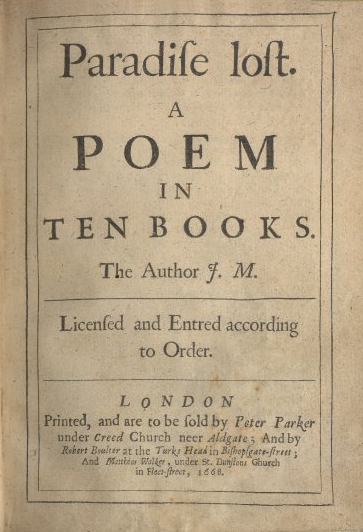
Originally published as 10 books, Milton expanded the epic poem to 12 books in later printings.

Originally published as 10 books, Milton expanded the epic poem to 12 books in later printings.

The “fallen angel” the Monster references is a hero/anti-hero of Paradise Lost: Satan, aka Lucifer, aka the  “infernal serpent”, aka the ‘Arch-fiend’ (and a myriad of other Miltonic epithets).

Students in previous classes have always found Satan the most memorable character in this epic poem since he is given the most memorable lines. They have been particularly intrigued that John Milton’s purpose in writing the poem, “to justify the ways of God to man,” is soon drowned out by the creation of Pandemonium (Hell’s Seat).  From the moment in Book One of Paradise Lost when Satan frees himself from the adamantine chains that bind him to a burning lake, students are taken with his attitude and his defiance as read in his great challenge:

Here at least
we shall be free; the Almighty hath not built
Here for his envy, will not drive us hence:
Here we may reign secure, and in my choice
to reign is worth ambition though in Hell:
Better to reign in Hell, than serve in Heaven. (PL 1 258-263)

No matter that in Book Six’s battle scenes in heaven are an exercise in futility, known as  the “great pie fight in the sky”, students root for the former archangel. They understand the sentiment in his statement,

‘The mind is its own place, and in itself can make a heaven of hell, a hell of heaven…” (PL 211-214).

Paradise Lost was only one of Milton’s great contributions to literature. He was not only a brilliant poet, but he was also a powerful statesman and a Puritan. He became associated with the Puritan partisanship in Parliament, which was credited with banning Christmas in England in 1644. This would seem to be a contradiction since he was already known for the beautiful Christmas Ode, “On the Morning of Christs Nativity Compos’d 1629”. Perhaps it was the general Puritan aversion to Christmas carols that could be blamed for such a heinous act!.

His political career experienced the extreme highs of an appointment as Secretary for Foreign Tongues (1648) and his association with Oliver Cromwell in the execution of Charles I (1649). In contrast there were the lows of an imposed exile upon the return of Charles II and the arrival of the Restoration in 1660. One of the reasons he was not executed for his implicit participation in Charles I’s regicide was that he was struck blind in 1654, and there were many who argued that this blindness was punishment enough. Milton was used to pain and suffering as the deaths of his first and second wives and several children were tragic interludes throughout his life.

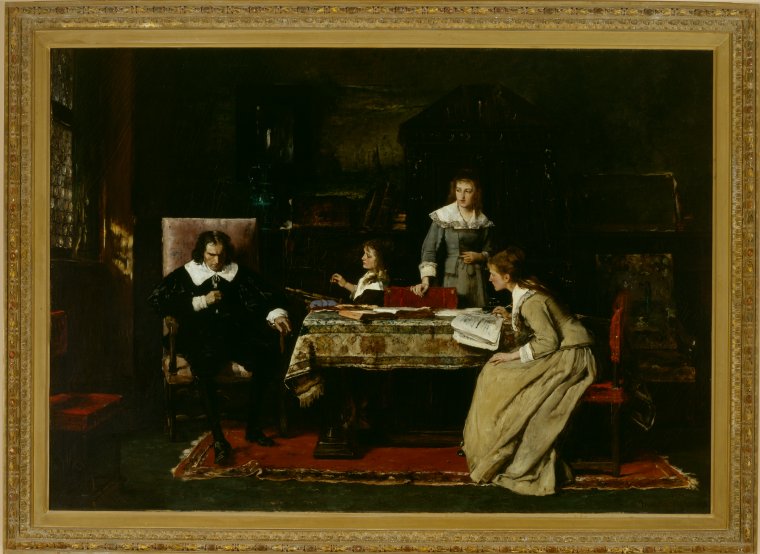
Like another blind poet, Homer, Milton achieved greatness with an “inner sight”. Critics generally agree that his best poetry came after he became blind and dictated all the lines of verse to his remaining daughters. A painting by Mihály Munkácsy (1877) hangs in the New York Public Library (NYPL) and depicts a scene of a head-bowed Milton reciting to one daughter who is scribing lines into a book.

Milton & daughtersThe picture is an apt illustration for his opening thesis in Paradise Lost:

What in me is dark
Illumine, what is low raise and support;
That to the height of this great argument
I may assert eternal Providence,
And justify the ways of God to men. (PL I:18-22)

In 2008, the NYPL held an exhibition, “John Milton at 400: ‘A Life Beyond Life'” which featured illustrated etchings by Gustave Doré for Paradise Lost. One illustration was of Satan on his flight to the Garden of Eden. As he travels, Satan pauses to tell the Sun how conflicted he is over his fallen state:

O Sun, to tell thee how I hate thy beams
That bring to my remembrance from what state
I fell, how glorious once above thy Spheare;
Till Pride and worse Ambition threw me down
Warring in Heav’n against Heav’ns matchless King:
Ah wherefore! he deservd no such return
From me, whom he created what I was
In that bright eminence, and with his good
Upbraided none; nor was his service hard. (PL IV:37-41)

Speaking these lines is a tragic Satan, fully aware that he has brought himself to ruin, as told by a poet, who had also come to political ruin. The reader can sympathize with such a character, and isn’t that the role of great literature? To draw on the reader’s empathy?

By the end of the poem, however, Milton restores the balance of sympathy towards Adam and Eve. They walk bravely, hand-in-hand, out of the Garden, into the sunset, ready to begin “his-story”.  In contrast, the character of Satan is reduced to a hollow hero, receiving accolades from a hissing mob of demi-devils. He is cursed, and like the Monster in Frankenstein, he is unreconciled with his creator.

So happy Birthday, John Milton, (December 9th), but let us not forget, that while your character Satan may dwell in evil, it was you who helped to cancel Christmas!

Screen Shot 2013-11-29 at 12.50.41 PMThe National Council of Teachers of English (NCTE) and the Council on English Leadership (CEL) met for a convention last week (11/21-26/13) at the Hynes Convention Center in Boston, Massachusetts. Thousands of English teachers and educators (happily) put aside their piles of essays and their red pens in order to attend to participate in a nationwide conversation on teaching English/Language Arts at all grade levels. This annual conference runs the weekend before the Thanksgiving holiday, and this year there were many reasons to be thankful that such a great opportunity exists. Here are our specific thanks to all of those who made this conference amazing.

Thanks to our Regional School District #6 in Connecticut for allowing us to attend:

Our first and most important thanks is to the administration, Board of Education, and staff from Regional School District #6 that allowed five members of the English Department at Wamogo Middle/High School to attend the conference and select from over 700 sessions offered from Thursday night-Sunday afternoon.  District support for such great professional development is truly appreciated!

Thanks to the program chairs who selected our proposals:

Members of Wamogo Middle/High School English/Language Arts department submitted a variety of proposals last year to demonstrate how we use technology in our classrooms. We are grateful that four of our proposals were chosen to share as presentations for other educators. The explanations of our presentations with links to these presentations are included below:

The Blog’s the Thing! (NCTE) roundtable discussion

This presentation demonstrated the use of the blog platform for students to engage in thoughtful discussion on characters and themes from Hamlet by having students “stop the action” of the play to offer advice to characters during different scenes.

Reinventing the Writing Workshop with Digital Literacy to Improve Student Engagement (NCTE)

Technology has reinvented the Writing Workshop in meeting the needs of 21st Century learners with the addition of digital literacies. This presentation features open source software platforms appropriate to the different tasks, purposes and audiences for writing instruction along with examples of student work and grading criteria.

How We Mooo-ved Our District from Cows to Computer (CEL)

This presentation illustrated how professional development in our district was organized on the ED Camp model to allow any teacher who would like to share their expertise or simply discuss a problem with fellow staff or faculty members.These technology initiatives have allowed members of the English Department to help teachers assess, organize, deliver context materials and related readings (fiction and non-fiction) that improve students’ digital literacy as well as foster independence in each student’s growth in reading.

Digital Writing with Collaboration (CEL)

This presentation showed how preparing students to write for the real world  (21st Century skills) must include the collaborative experience, from the initial creation to the final product. The use of digital platforms allows students to be college and career ready through the production and distribution of collaborative writing.

Thanks to the many teachers and educators who presented:

We are also thankful that so many other classroom teachers and educators from all over the USA shared their best classrooms practices. Our collective regret is that we could not attend every session that appealed to us; the jam-packed schedule defied our best attempts at strategic selection. We agreed, however, that quality of the presentations we did get to attend was amazing and relevant to what we do every day. The conference reinforced the importance of teacher-to-teacher professional development.

Thanks to the book publishers who made books available for classroom libraries:

The NCTE Convention offers book publishers opportunity to put advanced reader copies of fiction and non-fiction into the hands of teachers at every grade level. While publishers hope to catch the attention of teachers who will recommend the book to students, teachers look for books to add to their classroom library collection. Many publishers also make books available at a reduced cost  for the same reason. For example, I picked up several copies of books in the “After the Dust Settled” series (apocalyptic young adult literature) by Jonathan Mary-Todd for $2/copy, a purchase made necessary because these books keep disappearing off our classroom library shelves.

Screen Shot 2013-11-29 at 12.51.29 PM

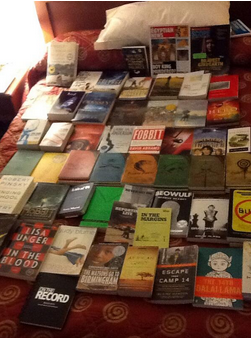
Our “haul” from the NCTE Convention from book publishers and authors…headed for our classroom libraries.


Thanks to the authors who gave away signed copies of their books:

The tote bags distributed free to all registrants bore popular author Nicholas Spark’s imprimatur, a visual testament to the celebrity draw of authors at this convention. Authors are the rock stars at this convention: the children’s book authors rock, the young adult authors rock, and the educator trade book authors rock. Attendees stood in lines snaking around booths on the convention floor waiting to meet authors and have books signed. In the past, my request to an author is to have the book signed with the phrase “READ ME!” on the inside cover. I had the same done this year, so when a student asks what to read, I will point that the author has already made a suggestion to read the book.

There were also a number of authors representing a variety of genres who served as keynote speakers including: Neal ShustermanTeri Lesesne, Laurie Halse AndersonKelly Gallagher, Walter Dean MyersIshmael Beah, and Robert Pinsky. 

We are so thankful to have the opportunity to personally meet and mingle with the rock stars of the convention!

Thanks for the Tweeters:

Finally, the fingers of dedicated Tweeters attending the convention kept us abreast of all the events at the conference. There was a steady stream of information from sessions we could not attend, summaries of keynotes addresses, and updates as to upcoming book signings. The hashtags #NCTE13 and #CEL13 were invaluable sources for notes and quotes during the convention and for well after we left Boston.  For example, some Friday session tweets were archived onto the Storify platform for later use.

Next year, the NCTE Convention is scheduled for Washington, D.C., which gives me one more reason to be thankful…the convention is within driving distance!

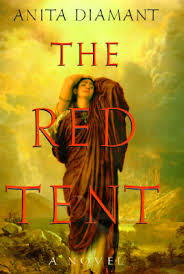
red tentMany of my students do not know Old Testament stories other than “Noah’s Ark” and “Adam and Eve”. There is the occasional biblical teen scholar who may be able to recount the origin a pillar of salt (Lot’s wife) or maybe there will be a student who saw the musical Joseph and the Amazing Technicolor Dreamcoat and make a patriarchal connection. For the most part, students are not up to date on Methuselah or even which of the brothers killed the other (Cain or Abel). They are far more likely to ask, “So, where did all the other people come from if Eve was the only woman?”

Fortunately, The Red Tent, a novel by Anita Diamant (1997) does address other women of the Old Testament. Her fictionalized version of the story of Dinah, daughter of Leah and Jacob, is based on in a brief but particularly violent and gruesome incident in the Book of Genesis. In the King James Version of the Bible, Dinah is known as the daughter who is “defiled” by Shechem, a prince, who then wanted to marry her (Genesis 34: 1-3):

1 And Dinah the daughter of Leah, which she bare unto Jacob, went out to see the daughters of the land.

2 And when Shechem the son of Hamor the Hivite, prince of the country, saw her, he took her, and lay with her, and defiled her.

3 And his soul clave unto Dinah the daughter of Jacob, and he loved the damsel, and spake kindly unto the damsel.

Dinah’s brothers, sought vengeance for the attack on their sister. They tricked Shechem and his family, claiming to come in peace, and exacted their punishment by killing the royal family and all males in the city:

26 And they slew Hamor and Shechem his son with the edge of the sword, and took Dinah out of Shechem’s house, and went out.

27 The sons of Jacob came upon the slain, and spoiled the city, because they had defiled their sister.

This horrific incident is explained very differently in the Diamant’s fictional retelling, as are many other familial incidents, from Dinah’s point of view. The rivalry between Rachel and Leah, the rivalry between Jacob and Esau, and the rivalry between the sons of Joseph, Dinah’s younger brother, are rich with detail and dialogue. The sparse accounts given in the Old Testament are fleshed out in this compelling narrative, with the women center stage, a striking contrast to the male-dominated biblical text.

Several of my female students in Advanced Placement English Literature choose to read The Red Tent as an independent choice, and their response is not unlike other female student responses chronicled in the article “The Wandering Womb at Home in The Red Tent: An Adolescent Bildungsroman in a Different Voice” by Holly Blackford. In this review, Blackford writes about the female students’ enthusiasm for the book:

So emotional about the story of The Red Tent that they can barely speak, and indeed continually interrupt one another, they cite the way in which the contemporary novel revises the patriarchal story of Jacob; represents the concerns of girls in terms of emotion and relationship; and details the entire lifecycle of girl-to-woman through engaging first-person narration:
  Carol: There are certain books I just can’t put down.
      Laticia: Seriously, I’ll read until like three in the morning . . .
      Interviewer: Like what?
      Carol: Like The Red Tent!

Blackford also points out that this revision of an ancient text  comes at a time when girls are, “hungering for an exploration of female-centered myths, deities, worlds, and power-structures.” Her claim in The Alan Review (March, 2005) is that books like The Red Tent:

“… appeal to adolescent women and grow their appreciation for contemporary women’s literature that speaks “in a different voice” (Gilligan) from the more masculine canon they expect in their school curriculum.”

There are about 20 copies of The Red Tent on the class independent book cart, all purchased at book sales for $1.00 each. Picador USA publishers produced an oversized text, about 2″ taller than a standard trade paperback; on the AP English Lit book cart’s top shelf, these copies stick out. The cover art, designed and illustrated by Honi Werner, is also eye-catching. Students always pick up the book with interest.

“What’s this about?” one asks.
“Read the back,” I reply.
“‘...told in Dinah’s voice, this novel reveals the traditions and turmoil of ancient womanhood-the world of the red tent,’ (*pause suspiciously*)…is this a ‘chick book’?”
“Yes,” I chuckle, “this is most definitely a chick book….probably the ultimate chick book, of ALL chick books.”

How else to describe a story that centers on celebrating the onset of womanhood?

After they read any independent book, the AP students are required to write an essay. The essay prompt this quarter for any book they choose is taken from the AP released exam list of questions:

In retrospect, the reader often discovers that the first chapter of a novel or the opening scene of a drama introduces some of the major themes of the work. Write an essay about the opening of the first chapter of a novel in which you explain how it functions in this way. *hint: the lens you use is the lens from the conclusion of the novel*

Students who choose to read Diamant’s The Red Tent will certainly want to return to the beginning to explain how Dinah’s life story begins and ends with the women who loved and supported her.  They will also have had a “crash course” on the Book of Genesis, which is the source of many other literary allusions. While The Red Tent is not great literature, this novel sets many female students looking for equally compelling contemporary novels about women, with or without that “chick book” label.

Kate DiCamillo stood in the nave of Riverside Cathedral, her curly hair barely visible over the podium, her voice clear and strong as she delivered the keynote address for the 85th Teacher’s College Reading and Writing Project Reunion (October 19, 2013).

She was exactly as advertised from the information on her website, “I am short. And loud.”

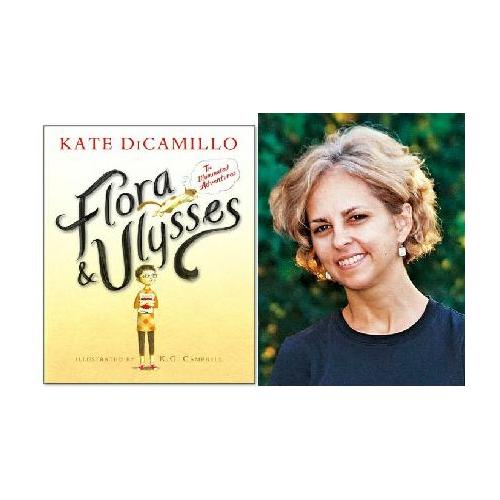
kate-dicamillo-floraandulyssestheilluminatedadvent-68She addressed the packed house of literacy teachers, some 2000 strong, who knew her as the author of Because of Winn-Dixie (a Newbery Honor book), The Tiger Rising (a National Book Award finalist), and The Tale of Despereaux (winner of the 2003 Newbery Medal), but her morning speech was about her latest book, Flora and Ulysses. She set the stage with her opening proclamation:

“This story begins as stories often do with a vacuum cleaner.”

Not just any vacuum cleaner. The vacuum at the center of this story was a 1952 tank Electrolux 2000, a treasured appliance belonging to DiCamillo’s mother. How treasured? DiCamillo joked that when her mother who was ill moved to be with her in Minneapolis, Minnesota, she worried more about the safe delivery of the Electrolux to the new home more than her own personal safety.”I want you to know that you can have the Electrolux when I am gone,” her mother told her. “It’s a really good vacuum cleaner,” she said and added, “The cord is extra long…and its retractable.”

The audience of teachers laughed; DiCamillo’s dry delivery in describing her mother’s attachment to a housecleaning appliance was part retrospective for the older teachers and part kitsch for the newer ones. “Remember the Hoover?” DiCamillo quoted her mother as saying, “that Hoover was useless!” But as she recounted how her mother’s illness progressed, the appreciation for this appliance took on new significance. “I really hope you will take the Electrolux,” her mother told her, “that makes me feel better.” So when her mother passed way, DiCamillo did take the Electrolux, but put it in the garage through that winter.

She spoke how in those dark days after her mother’s death, she found comfort in a poem by Rainer Maria Rilke, from Rilke’s Book of Hours: Love Poems to God and she read the lines from the short poem:

“God speaks to each of us as he makes us,
then walks with us silently out of the night.
These are the words we dimly hear:

You, sent out beyond your recall,
go to the limits of your longing.
Embody me.

Flare up like a flame
and make big shadows I can move in.
Let everything happen to you: beauty and terror.
Just keep going. No feeling is final.
Don’t let yourself lose me.

Nearby is the country they call Life.
You will know it by its seriousness.

Give me your hand.”

She reflected that when her mother was dying, she had held her mother’s hand in comfort, an action profoundly different from all the ways her mother had taken her hand when she was younger. The crowd was visibly moved by this retelling of the loss of her mother, but in typical DiCamillo storytelling fashion, her speech then veered off to include the death of a squirrel.

Shifting from the pathos for her mother, DiCamillo recounted that one day, a dying squirrel had chosen the front steps of her home as the last stop on his final journey. His eyes were open, yet unseeing; his chest dramatically heaving with his last breaths.
“I didn’t want him to suffer and die on my front steps,” she bemoaned.
So, she called a friend.
“‘There’s a squirrel on my front steps…He’s dying’,” she told her friend (Carla), “‘what should I do?'”
The advice she received from her gentle and humane friend appalled her.
“‘Do you have a shovel…and a tee shirt?'” asked Carla.
DiCamillo admitted that she had a shovel, but that she “moved away from the front door so the squirrel would not hear what was being said.”
“‘Put the tee shirt over the squirrel, and I will come over and hit him with the shovel,’ replied Carla.”

Fortunately, before that plan could be executed, the squirrel had crawled away.
“He may have heard us, or he had moved to get away from my presence,” said DiCamillo. The same people who had been tearing up from from the death of her mother and the power of the Rilke poem were now laughing out loud; the cathartic shift in emotions had been seamless.

DiCamillo then told the audience that she considered her reaction to the dying squirrel was not unlike the reaction of E.B.White in an essay he published in The Atlantic, “The Death of a Pig”:

 “He came out of the house to die. When I went down, before going to bed, he lay stretched in the yard a few feet from the door. I knelt, saw that he was dead, and left him there: his face had a mild look, expressive neither of deep peace nor of deep suffering, although I think he had suffered a good deal. I went back up to the house and to bed, and cried internally – deep hemorrhagic intears.”

“White claimed that his novel Charlotte’s Web was not connected to this essay…but could this event,” DiCamillo speculated, “have been more?”
She paused to consider their mutual despair over loss.
“He wanted to keep the pig alive….I wanted to keep the squirrel alive.”

And in that instant, a cathedral full of teachers understood that great ideas do not happen in (pardon the pun) a vacuum. DiCamillo’s speech illustrated how the three seemingly unconnected elements in her keynote address were the elements of story she combined in her latest book Flora and Ulysses.

In this story, there is a vacuum, a squirrel, a shovel, and several lines of the Rilke poem.
To be more specific, there is the near death experience of the squirrel, mistakenly sucked up by the Ulysses 2000; there is a comic-book superhero aficionado who intervenes; and there are several drafts of meta-physical squirrel poetry.  The story has the “beauty and terror” from the Rilke poem as well as the giving of a hand for comfort. There are what DiCamillo terms, “eccentric, endearing characters” presented in a format that combines print with comic book styled illustrations. Like the keynote address, the novel plucks at both the heart and the funny bone; it is a wonderful story.

The biography on DiCamillo’s website reads, “I write for both children and adults, and I like to think of myself as a storyteller.” Listening to her speak, I cannot think of her as anything else.

Banned Book Week is held annually during the last week of September in order to bring attention to the controversial practice of banning books, but an exhibit at the New York Public Library is proclaiming the same message through March 24, 2014. The exhibit “The ABCs of It: Why Children’s Books Matter”  celebrates the development of children’s literature in picture books, in chapter books, and in young adult literature.

The exhibit which opened on June 24th, is curated by Leonard S. Marcus who has also curated exhibitions at the Eric Carle Museum of Picture Book Art in Massachusetts, where he is also a founding trustee. This comprehensive exhibit is a must see and does not shy away from controversies in providing…

an examination of why children’s books are important: what and how they teach children, and what they reveal about the societies that produced them. Through a dynamic array of objects and activities, the exhibition celebrates the extraordinary richness, artistry, and diversity of children’s literature across cultures and time.

The differences in opinion on the role of children’s literature are raised at the exhibit’s entrance. Should children’s literature be foremost a means to deliver lessons of morality? (as Cotton Mather urged the Bible on young Puritans) Should children’s literature “delight and entertain”? (as John Locke believed with Aesop’s fables) Or should children’s literature tell the bare truth, not tales that “cover truth with a veil”? (Jean-Jacques Rousseau). From fairy tales to the Suzanne Collins’s The Hunger Games Trilogy, the controversy rages on, and the exhibit presents them all.

Screen Shot 2013-10-01 at 11.01.32 PM

A life-size set of “Goodnight, Moon” at the New York Public Library

There are tributes to William Blake’s poetry, Lewis Carroll’s Through the Looking Glass, and a original copy of Janette Sebring Lowrey’s The Pokey Little Puppy. One large panel features the rhyming words (Sam I am & green eggs and ham) of Theodore Geisel (Dr. Seuss). Along another long wall are the serial contributions of publisher Edward Stratemeyer: Bobbsey Twins, Hardy Boys, Tom Swift, and Nancy Drew. There is a tribute to comic books complete with silhouettes of Marvel and DC heroes, and tribute to books successfully made into films. A glass case holds the original Pooh, Piglet, Kanga, Roo, and Tigger from A.A Milne’s 100 Acre Woods; Eric Carle’s colorful panels (Brown Bear, Brown Bear and others) glow brightly in the cases. Pictures of the exhibit are on the New York Public Library’s Facebook Page and the NYTimes slide show review.

There is a wall that bears the distinctive outline of one of Maurice Sendak’s “Wild Things” around the corner from a life-size set of Margaret Wise Brown’s Good Night, Moon, waiting for the quiet old lady to whisper “hush”. You can listen to E.B. White read the last chapter of Charlotte’s Web, and try not to sob when hearing him say the line, “It is not often that someone comes along who is a true friend and a good writer. Charlotte was both.”

The exhibit also points out the role of children’s literature in politics or in nation building.  On one wall of the exhibit, there is a sculpted relief of the world surrounded by three quotes; each quote makes an important point about the significance of children’s literature. The first quote is by Noah Webster from an essay titled “On the Education of Youth in America,” American Magazine, New York, December 1787:

“The Education of youth is, in all governments, an object of the first consequence. The impressions received in early life usually form the character of individuals, a union of which forms the general character of a nation.”

Political writer, author, and developer of the dictionary, Webster was an early advocate for education as key to America’s growth and development.  The next quote, however, gives the viewer pause…and a few chills:

“Education is a weapon whose effects depend on who holds it in his hands and at whom it is aimed.”
Interview with H. G. Wells -September 1937- said by Joseph Stalin

Similarly, the last quote does demonstrate how in astute political hands, children’s literature can be a powerful propaganda tool:

“Rise up children and learn to be free independent children of China, learn how to wrest this freedom from the yoke of Japanese imperialism, and transform yourself into masters of a new era.”
Mao Zedong from the Journal Children of the Border Areas- 1938

These voices provide a serious reminder that children’s literature is more than board books, rhymes, and fairy tales. There are powerful messages in these stories; some so powerful that they have banned. For example, there is Munro Leaf’s story of the peace loving Ferdinand, the Bull which “caused an international controversy” when it was first published; banned in Spain the book was burned in Nazi Germany. Exposing those horrors of the Holocaust is a copy of Art Spiegelman’s breakthrough graphic novel Maus.

Marcus’s exhibit presents the questions and controversies about children’s literature, but does not provide answers. The exhibit has examples of how this genre of literature can contain both powerful political tools and playful trivial entertainment. There is no answer to the exhibit’s opening questions as to whether children’s literature is a means to educate, a means to enforce a moral code, or a source of joy. On seeing the stories of childhood so beautifully arranged, I opt for joy.

At the end, a large screen posts a continuing stream of Jeopardy-styled quiz questions in an interactive, and serious time-killing, activity.
I stood answering questions (“curiouser and curiouser= Cheshire Cat” or “Lyle, Lyle Crocodile= The House on 88th Street“) for some time before a young boy noted, “Hey, you’re pretty good at this..”

“Thanks,” I said, “I really like these books.”

“So do I,” he responded before leaving.

Thanks for making that moment possible, New York Public Library. Continue Reading…

“Are you upstairs hiding with a book?” my mother was exasperated as she called up the stairs.
“No-oo..” I would reply, stashing the copy of The Sign of the Twisted Candles, The Password to Larkspur Lane or The Secret in the Old Attic under the covers.
My mother would be looking for me for some chore I had left undone, but the lure of those yellow-spined mystery books was so hard for me to combat. I would succumb and lose track of time, and responsibilities, the minute I picked up one of the mysteries.

I was Nancy Drew addicted.

From the day I found my first copy at age eight under the Christmas tree, I read every Nancy Drew title available, a total 46 titles by the time I completed eighth grade.

“So, how’s that little blue roadster?” my father would ask, passing me while I was lost in a mystery.
“Oh! You are going to ruin your eyes,” my mother would complain finding me reading by hall light.

The contradictory message from my parents to read or not to read while feeding my addiction with new editions of Nancy Drew for birthdays and other holidays only heightened my regard for the series. Nancy Drew was the dessert to my reading diet, the forbidden fruit during Saturday chores, the delicious temptation to finish “just one more chapter” before falling asleep.

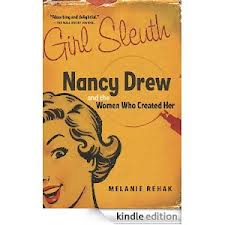
Girl SleuthSo, I was delighted when at a public library book sale I came across a “used” brand new copy of Girl Sleuth, Nancy Drew and the Women Who Created Her by Melanie Rehak.

Here was the story of Nancy’s origins, the brainchild of Edward Stratemeyer (1862-1930) who developed and ran a syndicate of writers of children’s fiction. I have only recently come to understand how much Stratemeyer influenced generations of young readers, myself included, by producing book series specifically geared to their interests.

He created the Tom Swift and The Hardy Boys series. He was responsible for the adventures of Nan, Bert, Flossie and Freddie in The Bobbsey Twins. Early in his writing career, Stratemeyer recognized that writing under different pseudonyms and with different publishers, he could offer more books each year. Unable to keep up with the demand for his stories, he began to outsource his work by hiring writers to complete stories he had outlined. By 1905, his book publishing syndicate mirrored the Henry Ford model of assembly linewriting; Stratemeyer editing the work of other writers who filled in the details from his summary notes.

It was Edward Stratemeyer that conceived of the young girl detective, and he developed five plots that he could offer a writer who could meet his exacting standards. Originally, the character Nancy Drew was named Stella Strong, and one of the plots that Stratemeyer developed was for Stella Strong at Mystery Towers:

How Stella visited the old Tower House and met the rich and eccentric maiden ladies, Patricia and Hildegarde Forshyne, who were much disturbed by unusual happenings about the place. She learns that some relatives are trying to get possession of the Forshyne fortune  Stella was once made a prisoner, but turned the tables and made a startling exposure (112).

Stratemeyer suggested other names for his new sleuth: Nell Cody, Nan Nelson, Diana Dare, Helen Hale, Nan Drew. The decision to expand Nan to Nancy was made by the publishing company Grosset & Dunlap who were enthused by this chance to have books for the growing market for young female readers. Stratemeyer had already decided that the pseudonym Carolyn Keene would be used for the series; each book would sell for fifty cents with two cents royalty going to his syndicate. From a number of applicants, he selected Mildred Wirt Benson, a “convention-flouting journalist” and agreed to pay her $125 for each manuscript (114). She, like all other writers in the Stratemeyer syndicate, signed away all rights to the stories and character.

Rehak’s extensive research clearly shows that Wirt was responsible for developing the character of Nancy Drew from the beginning. When Edward Stratemeyer passed away suddenly after the launch of the first Nancy Drew mystery, his daughter Harriet Stratemeyer Adams, took over the editing and eventually, the supervision of all things Nancy Drew. It was Wirt, however, who fleshed out the Nancy’s character against the backdrop of the Great Depression in 1930. Her Nancy was popular in school with two devoted friends, Bess and George. She was intelligent and attractive, moving stylishly between tweed suits and a “party frock of blue crepe which matched her eyes”. Blue was also the color of her little shiny roadster, a gift from her supportive father, Carson Drew. The mother figure, housekeeper Hannah Gruen, was also Wirt’s idea; the boyfriend Ned Nickerson came later in the series.

In recounting the success of the Nancy Drew series, Rehak notes that Wirt “later confessed  that Nancy Drew was “everything she -or any girl, in fact-wanted to be, and then some” (117). Rehak’s recounting of the success of the series is dampened by the deteriorating relationships in the Stratemeyer family, reduced pay for Wirt, and Harriet’s demands to keep the syndicate’s ghost writers from claiming their authorship.

Rehak also explores the other media ventures that featured Nancy Drew: TV series, movies, graphic novels, and a sordid connection to Playboy magazine.  Harriet’s control of her family’s publishing company’s intellectual property kept many of the writers like Wirt from claiming authorial attribution.

Subsequent revisions of Nancy Drew get less exploration by Rehak, who has little praise for the “loud flashy plots and clothing and crushes” that recent publishers have tried in order to “revamp the sleuth” (311). Nancy Drew’s back story is well organized by Rehak and a must read for all her fans who knew that it was not the plot that made the book exciting, but rather the “pleasure comes from her [Nancy Drew’s] autonomy, her taking events into her own hands”(307).

Rehak concludes with the feminist view that Nancy Drew was a guide for the ages as many of the problems for women (equal pay, inadequate day care, etc) still exist:

Nancy DrewThanks to Mildred and Harriet and the generation of women and girls who glimpsed in Nancy Drew a vision of what they might be someday, it doesn’t look like the sleuth is going away anytime soon, which is a good thing. There are fighting days still ahead of us, and we’re going to need her (314).

Perhaps this is why my memories of Nancy Drew are so salient, and my addiction forgivable. While my chores waited, Mildred Wirt Benson and Harriet Stratemeyer Addams offered me, and thousands of young girls like me, a role model.

So, Mom, I really was not hiding upstairs with a book…I was growing up.

I hold up the book I will be reading aloud, Dr. Seuss’s The Cat in the Hat. The students start commenting:

This is one of my favorite books…
I love Thing #1 and Thing #2!
I (loved) or I (hated) the movie!
Can we read Green Eggs and Ham, too?

Cat in Hat book coverI settle the students down and begin,

“The sun did not shine.
It was too wet to play.
Just sit in the house all that cold, cold wet day.”

32 eyes blink brightly up at the pages as I turn them.
Several mouths move without sound to recite along with me.
The students are mesmerized.

Oh, did I mention that these are seniors in high school?

I am using a picture book to explain Freud’s theory of the Id, Ego and Superego (see post). Thing #1 and Thing #2 represent Id, and that righteous fish? The Superego. Yes, Dr. Seuss is great for psychological literary criticism, but he is not the only picture book in my repertoire of children’s literature used in high school. Here are a few of my favorites to use and why:

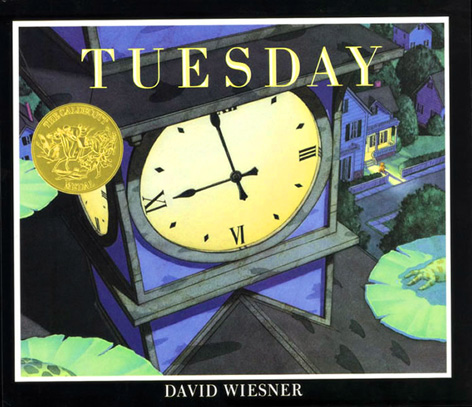
Tuesday by David Wiesner_CoverTuesday by David Weisner. We use this text for our 9th grade mythology unit because a myth explains the unexplainable. Our students have to create a myth for why frogs might lift off from a local pond and terrorize some inhabitants of a small town (see post).

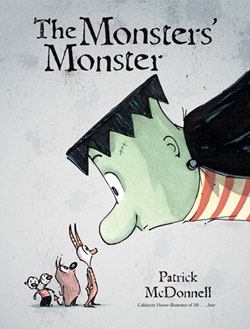
The Monsters’ Monster by Patrick McDonnell. This mash-up of the 1931 film Frankenstein and Mary Shelley’s 1818 novel is ideal to stimulate discussion on the relationship between a creator and the created. In McDonnell’s version, however, the Monster is sensitive, compassionate, with more of an interest in warm, powdered jelly doughnuts than in seeking vengeance…a nice break from the rigors of Advanced Placement English Literature.coverbook_monsters-monster

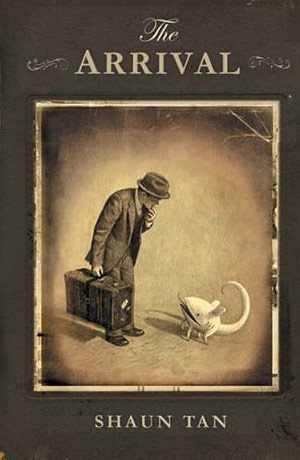
the-arrival-by-shaun-tanThe Arrival by Shaun Tan. Surreal images capture the point of view of an immigrant experience which makes this wordless text ideal for students who are studying Ellis Island or Angel Island. Many of the illustrations are available on the website so students can look at the haunting pictures on their own devices as well.

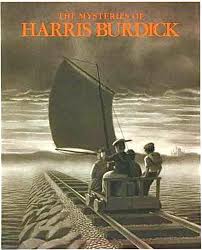
Harris BurdickThe Mysteries of Harris Burdick by Chris Van Allsburg. A book full of provocative images that has inspired thousands of stories explaining the mysteries in each sepia toned drawing. This book is wonderful for writing classroom, and there have been contests for the best stories written by children. Celebrated children’s authors have also taken an opportunity to try their imaginations using the pictures as story prompts in The Chronicles of Harris Burdick.

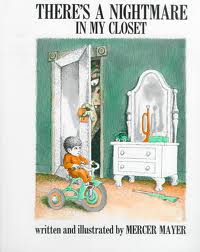
The Monster at the End of this Book by Jon Stone; illustrated by Mark Smollin and There’s a Nightmare in My Closet by Mercer Mayer. Both of these books have been incorporated into our Heroes and Monsters English IV (grade 12) elective. I use them as a starting point for an inquiry project about images of monsters given to children contrasted with the images of monsters we know as adults. Most students discuss the “fuzzy factor” with cute, loveable old Grover as something they remember fondly. They also remember very clearly the monster that lived in their closets. The anxiety of Mayer’s “Nightmare”, sobbing at the foot of the bed, usually brings about a discussion of facing fears.

grover

There are YouTube Videos for students to watch in advance of class (flipped classroom):  The Monster at the End of this Book and There’s a Nightmare in My Closet

Nightmare

Fredrick

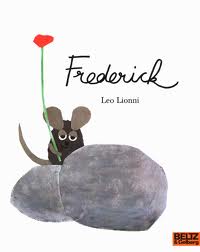
Fredrick by Leo Lionni. What does the poet do for society? This little fable answers that question and works well in any poetry unit. Frederick’s use of language paints pictures in the minds of the other mice who are struggling through a particularly bleak winter season. There is a delightful video recording of this to share in class or to have students watch on their own (flipped classroom).

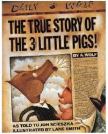
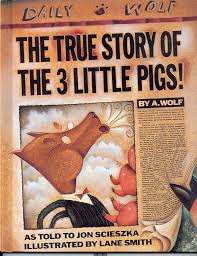
The True Story of the Three Little Pigs by Jon Scieszka; illustrated by Lane Smith. Want a lesson on point of view? This retake of the three little pigs is one of the best ways to present the advantages of this literary device to students of all ages. In his explanation of the story, A. Wolf comes across the first little pig after the house of straw caved in. With culinary justification, he says,

True story“It seemed like a shame to leave a perfectly good ham dinner lying there in the straw. So I ate it up. Think of it as a cheeseburger just lying there.”
The story presents opportunities to use other fairy tales for students to practice retelling stories from another point of view once they buy into Scieszka’s formula.

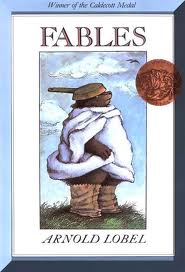
Fables by Arnold Lobel. Here are modern little fables that are one page long with morals such as “It is the high and mighty that have the farthest to fall.” One year, I used these fables with my drama class as short sketches. My favorite sketch to watch was the story of the Lobster and the Crab where the insanely spirited Lobster took timid Crab out for a ride in a boat during a tremendous storm. When the boat capsized, the student playing Crab cried out in despair, “Horrors!” while the student playing Lobster jumped and shouted with glee.”Down we go!” she yelled at the top of her lungs.
FablesLobel writes:

The Crab was shaken and upset.
The Lobster took him for a relaxing walk along the ocean floor.
“How brave we are,” said the Lobster. “What a wonderful adventure we have had!”

The moral? “Even the taking of small risks will add to the excitement of life.”

The same can be said for using children’s literature in high school.
The use of a well-chosen picture book will add to the excitement of a lesson! Continue Reading…

Read picture books.

Yes, I am talking to you.

(No, not you kids….)

I am talking to you….you, Advanced Placement English Literature teacher, pretentiously waving me off with your worn cover of Thomas Hardy’s Tess of the D’Urbevilles. Yes, you too..the one taking notes on Nathaniel Hawthorne’s The Scarlet Letter, the book you assigned for summer reading?

Time to do some other kind of reading.

Time to read for pleasure.

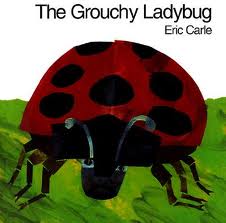
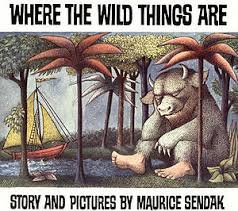
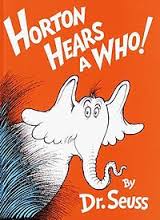
It’s time to wallow in Sendack (Maurice), Carle (Eric), and Seuss (Dr.).

Max Horton Ladybug

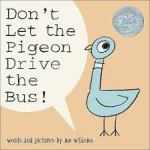
It’s time to discover Mo Williams’s Pigeon, Jon Scieszka’s Big Bad Wolf, and Jon Klassen’s hatless bear.

BearPigspigon

Why?

Primarily because teachers, all teachers, who are familiar with children’s literature can be positive role models for their students. They can engage students by making references to these books or they can make suggestions to young readers. They may even use them in lessons. But a new compelling reason has come out of a study by Jo Bowers and Dr Susan Davis, senior lecturers in primary education at Cardiff Metropolitan University. A review of responses by teacher trainees for primary grades indicates that reading children’s literature is good for your well-being.

An article in the British paper The Guardian Why Teachers Should Read More Children’s Books explains the study and promotes a paper Reflecting on Teacher Wellbeing that Bowers and Davis will give at Issues and Changing Perceptions conference in December 2013.

They had set up a year-long blog where teacher trainees could post reviews for three books they used with children over the course of the year. They then asked a focus group of these blog contributors a series of questions about their own reading experiences, such as, “What made you become a reader?”

The joys of reading became apparent, namely, how they had enjoyed “getting totally lost in a book” or “absorbed” by the narrative. It also became evident that they had close personal associations with certain texts from their own childhoods, and the fact that they could turn the page of a book and by knowing what was on that page gave them comfort and confidence to share that book with their class.

Trainee teachers reported they were using children’s books of all genres as a form of escapism from the stresses and strains of teaching in the primary classrooms. Researchers concluded that trainee teachers were using the book as a form of bibliotherapy, a therapy “increasingly moving away from its original medical model– whereby practitioners ‘prescribed’ self-help books to patients suffering from depression or eating disorders.” While the teacher trainees had to read the children’s literature selections as part of their professional development, they also found the experience pleasurable:

We have also found that trainee teachers often don’t read purely for pleasure, citing time constraints as the reason. Our blog project forced them to read as part of their professional development, and because they wanted to improve their subject knowledge. Wellbeing was secondary, but nonetheless became part of the project, almost by default. One of our students summed it up nicely: “Books are like best friends during stressful times.”

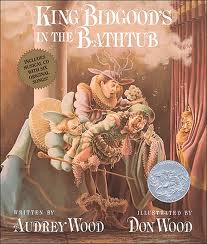
So, go ahead and pick up that copy of King Bidgood’s in the Bathtub and chant loudy the refrain “…and he won’t get out!”
Listen to the poetic wisdom of a small mouse who notes that everyone has a gift to bring in Leo Lionni’s Fredrick.
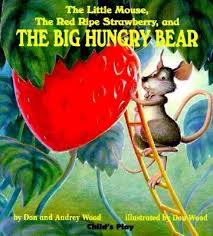
Or, share a red, ripe strawberry in The Little Mouse, The Big Hungry Bear and The Red Ripe Stawberry.

king Fredrick mouse

You will be reading for pleasure. You will be reading quickly, and you will probably feel better, things Thomas Hardy and Nathaniel Hawthorne may not do for you.

References according to The Guardian:

Jo Bowers and Dr Susan Davis are senior lecturers in primary education at Cardiff Metropolitan University. Follow them on Twitter: @Jo_Bowersand @drsuzyw. Reflecting on Teacher Wellbeing – Issues and Changing Perceptions conference will be held at Cardiff Metropolitan University on Wednesday 4 December 2013. For further information please contact:cseenterprise@cardiffmet.ac.uk.