Archives For November 30, 1999

Literally….David Coleman

August 24, 2013 — 2 Comments

Literally added a new meaning this past month….literally.

A quick look at the Cambridge Dictionaries Online indicates that while the meaning of literally as ” having the real or original meaning of a word or phrase” will now include use of the word “to emphasize what you are saying”. A similar entry from an authority across the pond, Oxford Dictionaries notes:

In recent years an extended use of literally (and also literal) has become very common, where literally (or literal) is used deliberately in non-literal contexts, for added effect, as in they bought the car and literally ran it into the ground. This use can lead to unintentional humorous effects (we were literally killing ourselves laughing) and is not acceptable in formal contexts, though it is widespread.

This chatter about literally and literalness came to mind when I read the Frizzleblog on the Scholastic website ten “takeaways” from a presentation given by David Coleman, an architect of the Common Core State Standards (CCSS) and the current College Board president, to a group of New York City teachers. The blog entry was titled 10 Things Worth Doing in Your Classroom by  Suzanne McCabe, Editor in Chief at Scholastic, and she listed ten summaries from Coleman’s presentation on how to enrich classroom instruction.

Her summary statement #4 stopped me cold…literally.
4. Only draw conclusions that can be substantiated by the words on the page. Scrape away terms like “metaphorical,” and talk as simply as possible. Once you bring up metaphor and meaning, kids are out of the game.
McCabe may be misrepresenting Coleman in this statement, however, the Common Core State Standards promoted by Coleman centers on textual evidence, so the “conclusions substantiated by the words on the page” summarizes his preferred reading strategy.  In addition, his lack of classroom experience at any grade level explains why he may have said something akin to “kids are out of the game” when metaphors are discussed.
To the contrary, children of all ages understand metaphor according to Maria Popova in her post The Magic of Metaphor: What Children’s Minds Teach Us about the Evolution of the Imagination on her Brain Picking’s blog:

During pretend play, children effortlessly describe objects as other objects and then use them as such. A comb becomes a centipede; cornflakes become freckles; a crust of bread becomes a curb.

The combination of life experience and practice with similes (“pancakes are like nickels,”  “A roof is like a hat,”“Plant stems are like drinking straws,”) builds a student’s understanding of metaphors that are more complex (“”I am the good shepherd; I know my sheep and my sheep know me” John 10:14). 

So why would a teacher want to “scrape” away metaphorical terms at this important stage in developing a student’s understanding of more sophisticated metaphors?
Furthermore, how could Coleman reconcile an author’s choice in using a metaphor if that metaphor is scraped away in order to talk as “simply as possible”? McCabe’s summary of Coleman’s position reduces students to reading “literally”, rendering them unable to appreciate an author’s craft .
For example, if students had to scrape away the  metaphorical ideas in some of Shakespeare’s most recognized literary comparisons, what would they say?

“All the world’s a stage, and all the men and women merely players. They have their exits and their entrances.” As You Like It

Students may determine through textual evidence that Shakespeare was literally referring to the stage.

Night’s candles are burnt out, and jocund day
Stands tiptoe on the misty mountain tops.” Romeo and Juliet

Students may determine through textual evidence that Shakespeare was literally writing about candles.

Smiling sunStudents are more creative than Coleman recognizes in his untested design of the CCSS. From the beginning of their academic careers, they draw their metaphors: smiling suns, hearts in hands, trees with large red dots. They start simply “Freddie is a pig when he eats,” before moving to more sophisticated constructs on their own such as “Love is a chocolate fountain that never runs out.” They are capable of sustaining elaborate metaphors to explain the writing process:

I choose my audience very carefully when playing for an audience for the first time. I want constructive criticism, and therefore I prefer to have my peer musicians as well as my conductor or private instructor hear me play aloud for the first time. . . .When I have read and reread [the paper] so many times that I am unable to find any mistakes, I then like to read my paper aloud to my family or a group of my close friends in order to get their reactions. Maria, National Writing Project website

These students knew they were not writing about a pig, chocolate fountains, or conducting music. If Coleman had classroom experience, he would have first hand evidence about student creativity.

Finally, many of the most beloved children stories are saturated with metaphor.  Lewis Carroll’s Alice in Wonderland is filled with metaphors that address life’s absurdities, and one specific metaphor brings me back to an entry I wrote titled  David Coleman, the Cheshire Cat of Education.

While I did not mean that Coleman is a cat literally, I do mean that his philosophy of education is as contradictory as the character in Carroll’s imaginative classic. “Curiouser and curiouser,” wonders Alice, when the enigmatic Cheshire Cat appears and reappears at critical moments in the story. Likewise, Coleman’s curious contradictions may be the reason for any inaccuracies in McCabe’s summary of his presentation. On the other hand McCabe may have accurately recorded these contradictions and illustrated how Coleman’s inexperience makes his statements about how to teach in a classroom ridiculous…literally.

No common coreOne of the underlying problems in educational reform today is that so few reformers have any hands-on classroom experience. Reading about teaching is academic and informative, but the hands-on experience of standing in front of a class of 9, 14, 24, or (heaven forbid!) 31 students at any grade level is irreplaceable. Developing lesson plans is an academic exercise, however monitoring and adjusting that lesson plan for real time problems (fire drill, student absences, material shortage, technology glitch) during instruction is irreplaceable. Reading assessment data is an academic enterprise, but understanding that data in the context of the classroom with all the personalities, abilities, disabilities, and socio-economic influences is irreplaceable. Hands-on experience should be a major factor in education reform, but the education reform efforts in the  Common Core State Standards (CCSS) have little to no classroom credibility.

A recent entry on Twitter from Randi Weingarten, current president of the American Federation of Teachers, was an attempt to address the classroom experience of the creators of the CCSS. Weingarten herself does have hands-on experience in the classroom, but that experience is spotty.  From 1991 until 1997, and with the exception of a six month full time teaching load in the fall of 1994, Weingarten taught on per diem basis (substitute?) at Clara Barton High School in Crown Heights, NY. Total experience? Six years, but this short experience is six more than many of the educational reformers who participated in the creation of the CCSS.

Weingarten tweeted the following on June 29, 2013:

Teachers were part of the development of #CCSS from the beginning http://youtu.be/y1DlNpaKW38

She was posting a link that was supposed to demonstrate that teachers, real classroom teachers with hands-on experience, had been involved in the standards from the beginning. The link led to a YouTube video featuring an ELL classroom teacher Lisa Fretzin who reflects how she “…was part of the review process starting in August looking at the the first draft”:

While Ms. Fretzin certainly has classroom credibility necessary for developing the CCSS, her participation was not exactly at the “beginning” of this process. According to her statement on the video, she was not present at the creation; she was asked to “review” which is different than “from the beginning”. Furthermore, her name is not on the list of participants who did create the CCSS for English Language Arts (or feedback group) which clearly identifies only four of the 50 participants (8%) as “teachers”. The remaining 46 participants (92%) are identified with titles such as: “author”, “consultant”, “specialist”, “professor”,  “supervisor”, “director” or “senior fellow.” In all fairness, perhaps many of these participants had worked in the classroom before moving into higher ranking positions as one would hope, but their hands-on classroom work experience is unclear.

The most glaring examples of classroom incredibility are the lead authors for the CCSS, Susan Pimentel and David Coleman; their collective classroom experience is zero. Pimentel has a law degree and a B.S in Early Childhood Education from Cornell University. Coleman’s, (termed “Architect of the Common Core”) classroom experience is limited to tutoring selected students in a summer program at Yale. He later founded Student Achievement Partners and is currently serving as the President of the College Board.

Weingarten must also know that classroom teachers for PreK-Grade 3 and grade level experts were not included in the creation of the CCSS at all. Many of these educators have express concerns that students are not cognatively ready for many of the standards in math and reading. Valerie Strauss of The Washington Post put up an editorial (1/29/13) “A Tough Critique of Common Core on Early Childhood Education” by Edward Miller, teacher and co-author of Crisis in the Kindergarten: Why Children Need to Play in School, and Nancy Carlsson-Paige is Professor Emerita of Early Childhood Education at Lesley University in Cambridge, Massachusetts and author of Taking Back Childhood. They note that when the standards were first revealed in March 2010, “many early childhood educators and researchers were shocked. “

The promoters of the standards claim they are based in research. They are not. There is no convincing research, for example, showing that certain skills or bits of knowledge (such as counting to 100 or being able to read a certain number of words) if mastered in kindergarten will lead to later success in school. Two recent studies show that direct instruction can actually limit young children’s learning. At best, the standards reflect guesswork, not cognitive or developmental science.

Miller and Carlsson-Paige also include links to the Joint Statement of Early Childhood Health and Education Professionals on the Common Core Standards Initiative and summarize their statement:

 We have grave concerns about the core standards for young children…. The proposed standards conflict with compelling new research in cognitive science, neuroscience, child development, and early childhood education about how young children learn, what they need to learn, and how best to teach them in kindergarten and the early grades….

At all grade levels, therefore, there are concerns about how inclusive the creators of the CCSS were in engaging classroom teachers. The entire initiative, by its own admission, began politically, coming from the nation’s governors and education commissioners, “through their representative organizations the National Governors Association (NGA) and the Council of Chief State School Officers (CCSSO).”

Weingarten’s tweet was more than a little disingenuous when she indicated that “teachers were part of the development” when, to the contrary, there is much more evidence to prove that the ratio of teachers to individuals bearing education titles was disproportionate in favor of reformers and academics without classroom experience.

Real teachers, those with hands-on experience gained in the classroom, have had a limited say in the CCSS that they will be implementing day in and day out in their classrooms at every grade level. Excluding this important faction is why there has been pushback from teachers who recognize the difficulties in implementing many of the standards. Furthermore, there are growing concerns about the level of accountability for teachers in having students meet these same standards.

Ultimately, Weingarten should not tweet out misinformation about teachers developing the CCSS, especially when the evidence demonstrates that teachers were a only a tiny percentage in creating these standards. Weingarten must know that for any educational initiative to succeed, teachers must be engaged from the very beginning.

In these days of education reform, classroom credibility counts.

Connecticut had an average of over nine inches of rain this June, a mixed blessing. The cool temperatures and constant downpours had a direct impact on the dress code, and the beach attire favored by high school females (and appreciated by young high school males) was not a distraction. Furthermore, the temperatures in the classroom were cool, and the dark skies meant that lighting in the classroom was ideal for showing films to wrap up the year.

The weather, however, did dampen opportunities to teach one of my favorite poems by William Wordsworth, The Tables Turned. The poem is a plea to the reader to throw down the books with poems that try to capture nature, the art that mimics nature, or the science that tries to explain nature:

The Tables Turned

AN EVENING SCENE ON THE SAME SUBJECT (1798)

Up! up! my Friend, and quit your books;
Or surely you’ll grow double:
Up! up! my Friend, and clear your looks;
Why all this toil and trouble?

The sun above the mountain’s head,
A freshening lustre mellow
Through all the long green fields has spread,
His first sweet evening yellow.

Books! ’tis a dull and endless strife:
Come, hear the woodland linnet,
How sweet his music! on my life,
There’s more of wisdom in it.

And hark! how blithe the throstle sings!
He, too, is no mean preacher:
Come forth into the light of things,
Let Nature be your teacher.

She has a world of ready wealth,
Our minds and hearts to bless—
Spontaneous wisdom breathed by health,
Truth breathed by cheerfulness.

One impulse from a vernal wood
May teach you more of man,
Of moral evil and of good,
Than all the sages can.

Sweet is the lore which Nature brings;
Our meddling intellect
Mis-shapes the beauteous forms of things:—
We murder to dissect.

Enough of Science and of Art;
Close up those barren leaves;
Come forth, and bring with you a heart
That watches and receives.

When I teach the poem, I do what is now called “close reading”, a strategy favored by the Common Core State Standards, by having students pay attention to particular images, text structure, and word choice in order to determine an author’s purpose. The process can be a bit tedious, but in this case, I want them to feel a little hostile about “dissecting” the poem.

“What does the poem mean?” I will press them, “What is Wordworth’s purpose?”

“Nature is good?”  (Maybe)

“Poems can make us appreciate nature?” (Perhaps)

“We cannot capture Nature in books?” (Possibly)

“We should ditch our books and go outside?” Absolutely! 

And to the delight of everyone, I instruct my students to close up their books and go outside so that we can “let Nature be your Teacher”. That is the entire lesson. A poem, an analysis, and a trip outdoors that obeys the author’s intent.

Hopefully, next June will give us the day when the  “sun above the mountain’s head/A freshening lustre mellow” lets us upend the tables and go outside to engage with Nature in order to “watch and receive” and leave close reading overturned.

 I hear the chatter from elementary school teachers: 
  • They can’t wait for reading!
  • Oh, they love to read!
  • When we have to cancel reading, they are so disappointed.

Yet, what happens when I get the ninth graders in my class? I hear:

  • Reading is so boring.
  • I hate to read.
  • I don’t like reading.

What caused the change in students’ attitude towards reading?
97%

Reading Speed Limit?

I have been attending graduate courses on reading instruction for pre-K-6 in order to find out the reason for the shift in attitudes. One of the textbooks used was Guiding Readers and Writers (Grades 3-6), a 672 page tome packed with information written by authors Irene Fountas and Gay Su Pinnell. The 2001 edition reflected the ideal reading and writing workshop schedule; 3.5 hours of uninterrupted reading and writing daily.So, how did the instructional strategies for elementary students in the Fountas and Pinnell book prepare students for grades 7-12 ?

The Fountas and Pinnell strategies use a Benchmark Assessment System that allowed for leveled literacy intervention for very early readers. Texts were rated (A to K) on their difficulty for the reader in fluency and comprehension at instructional or independent levels. Each level suggests a percentage of accuracy that a student should achieve before moving to the next level, for example:

 For levels A to K, a text read at 90%-94% accuracy (with satisfactory or excellent comprehension) is considered an instructional level text. That means that the student can read it effectively with teacher help–a good introduction, prompting, and discussion).

For levels A to K, a text read at 95%-100% accuracy (with satisfactory or excellent comprehension) is considered to be an independent level text. That means that the student can read it without help. Reading at the independent level is extremely valuable because the reader gains fluency, reading “mileage,” new vocabulary, and experience thinking about what texts mean (comprehension).

Fountas and Pinnel are very clear that these percentages should not be fixed, stating:

We wouldn’t want anyone to interpret these percentages in a rigid way, of course. A child might read one text at 91% and then experience a few tricky words in the next book and read it with 89%.

They also note that reading broadly increases a student’s vocabulary, and they suggest that schools could mandate their own policies in insuring that students reading smoothly and easily with satisfactory accuracy and comprehension before moving to the next level.

I heard, however, a number of literacy specialists/instructors from elementary schools in my classes representing different districts in the state explaining, “We hold students to a 97% accuracy rate before moving them on” or “I would not move a student who isn’t reading at a 95%-97% accuracy rate.” Are these literacy specialists/instructors misreading the Fountas and Pinnell book? Furthermore, is a district’s adherence to this 97% accuracy rule hurting students as they transition to the higher grade levels? If a student is directed to read only those books that can be read at 97% or even a 91% or 89% accuracy, what happens when he or she is handed a required text that is above his or her reading level?

The problems in reading accuracy are clearly evident in when students enter middle school, and they are handed textbooks and whole class novels from the literary canon. Richard Allington, a past president of the International Reading Association and the National Reading Conference, wrote an article that directly addressed the problem of difficult texts for the journal Voices from the Middle (May 2007, NCTE) titled, “Intervention All Day Long: New Hope for Struggling Readers “ In this article, Allington makes the argument that districts should not mandate the same grade level texts for readers of varying ability:

This means that districts cannot continue to rely on one-size-fits-all curriculum plans and a single-period, daily supplemental intervention to accelerate struggling readers’ academic development. Districts cannot simply purchase grade-level sets of materials—literature anthologies, science books, social studies books—and hope to accelerate the academic development of students who struggle with schooling. There is no scientific evi- dence that distributing 25 copies of a grade-level text to all students will result in anything other than many students being left behind.

He argues for an extension of the 97% accuracy rate using easier texts and explains that the more difficult texts at the middle and high school levels will have many more words per page than the texts in elementary school. He notes that in a book of 250 and 300 running words on each page, 97% accuracy would mean 7–9 words will be misread or unreadable on every page:

 In a 20-page chapter, the student would encounter 140–180 words he or she cannot read. And typical middle school textbooks have twice as many words per page, creating the possibility that a reader reading at 97% accuracy would be unable to correctly read 14–20 words per page or 250–400 words per chapter.

As a result, Allington argues that struggling readers will not be helped by reading these texts, regardless as to the amount of support.
The very texts that are supposed to be a resource for a discipline’s content, “won’t help them learn to read.”  Many upper grade level texts are  textbooks are  heavy, difficult to read with all the subject specific vocabulary embedded in passages; the different fonts, pictures, and information boxes may confuse a poor reader.

I am, however, a little skeptical about Allington’s point regarding students who miss words in texts. I am not sure that the multiplication factor Allington uses to calculate the number of words missed since words are repeated in a novel.  Yes, a student may miss “purloined” on page 12, and on page 17, but should that word be counted twice? There is a context that eventually brings about an understanding; by the third “purloined” a student may have a better understanding of the word because of that context. As an additional concern, requiring a 97% accuracy rate would stop most middle/high school literature programs that use whole class texts. For example, we teach Romeo and Juliet to our 9th graders, and the accuracy rate for Shakespeare, even for teachers with Master degrees in English, is about 80%. Yet, year after year, as we read the play aloud, students do understand generally what is going on. Perhaps some literature is as the poet T.S. Eliot wrote, “Poetry communicates before it is understood.”

On the other hand, Allington has every reason to be concerned that students entering middle school and high school will encounter texts that are complex with high exile levels.  These texts will not be modified to accommodate struggling readers, instead the Common Core State Standards (CCSS) are moving in the opposite direction with Lexile levels being raised at all grade levels. Allington’s concerns are not the concerns for publishers who want to meet the CCSS in order to sell as many textbooks as possible. Ultimately, a 97% accuracy rate is not realistic with the materials in each subject area at the middle school and high school levels.

The students who have been swimming in the shallow end of the reading pool throughout their elementary school experience are suddenly tossed into the deep end of literature and informational texts when they hit middle school. The aforementioned elementary literacy specialists/instructor’s adherence to the 97% accuracy with Fountas and Pinnell benchmark assessments limit students to highly filtered reading experiences as opposed to challenging students to develop their own strategies when they encounter difficult texts. More practice with difficult reading materials should be part of an elementary school literacy regimen, just like a batter at the plate who must learn how to swing at a number of different kinds of pitches; not every pitch comes in the strike zone over the plate, and not every book is at a prescribed accuracy rate.

Requiring every student read at a 97% accuracy rate was not the intention of the Fountas and Pinnell directives, but the directives of others may be contributing to the comments I hear from my grade 9 students that “Reading is so boring” or “I hate to read.” A steady diet of the same level of reading caused by requirements to achieve a 97% (or A+) accuracy may hem in or deaden a student’s independent nature or curiosity. Furthermore, when a student gets to middle school, the requirement to read at 97%, or any literacy rate, is not enforced in all disciplines; students who have been spoon-fed reading materials may feel betrayed. Their 97% or A+ reading excellence is suddenly plunged to lower percentiles, which ultimately results in much lower grades. Any confidence or trust a struggling reader may have developed with purified texts is quickly lost, and “I hate to read” is the result.

Maybe they don’t hate to read; maybe with years of preparation at 97%, they are unprepared for any other speed.


ScantronThe New York State Department of Education’s new standardized tests were administered last week. The tests for grades 3-8 were developed by the educational testing company Pearson and contained new “authentic” passages aligned to the new Common Core State Standards. State tests might have been routine news had not several teachers also noticed that the English Language Arts “authentic” passages mentioned products and trademark names including Mug ©Root Beer and Lego ©.

Product placement on standardized tests in elementary schools is bigger news. The public has grown accustomed to advertisements on webpages, before videos, on scoreboards, and with the well-placed beverage during a movie. Subtle and direct advertising to the youth market to develop brand loyalty at an early age is the goal of almost every corporation.

Consider a survey by Piper Jaffray, a leading investment bank and asset management firm, the  “Taking Stock With Teens” survey (taken March 1–April 3, 2013), that gathered input from approximately 5,200 teens (average age of 16.3 years). The survey is used to determine trends, and the most recent results note:

“Spending has moderated across discretionary categories for both upper-income and average-income teens when compared to the prior year and prior season. Yet nearly two-thirds of respondents view the economy as consistent to improving, and just over half signaled an intent to spend ‘more’ on key categories of interest, particularly fashion and status brand merchandise.”

Much attention, therefore, is placed on the youth market, and product placement on standardized testing could be a new marketing strategy. For example, corporations in the fashion industry could read this report and be inclined to offer some news stories or commission a short story that mentioned clothing brand names in the future to Pearson or another testing company in order to provide “authentic” passages. What better opportunity for corporations to build brand loyalty then to an audience, captive in a classroom during a state-mandated test?

The education reporter for the Washington Post, Valerie Strauss, reported on the “authentic” passages that mentioned products as “author’s choices”; Pearson’s response to her query:

As part of our partnership with NYSED, Pearson searches for previously published passages that will support grade-level appropriate items for use in the 3-8 ELA assessments. The passages must meet certain criteria agreed upon by both NYSED and Pearson in order to best align to Common Core State Standards and be robust enough to support the development of items. Once passages are approved, Pearson follows legal protocols to procure the rights to use the published passages on the assessment on behalf of NYSED. If a fee is required to obtain permission, Pearson pays this fee. NYSED has ultimate approval of passages used on the assessment.

Strauss’s report, “New Standardized Tests Feature Plugs for Commercial Products” also indicated that this practice is not exclusive to NY, and that “several different assessment programs have instances of brand names included due to use of authentic texts.” There were no specifics mentioned.

Following up with the NY Department of Education, Beth Fertig from the blog Schoolbook (WNYC),  Stories from the Front Line of Testing asked about the recent product placement:

“This is the first time we have had 100 percent authentic texts on the assessments,” said spokesman Tom Dunn. “They were selected as appropriate to measure the ELA standards. Any brand names that occurred in them were incidental and were cited according to publishing conventions. No one was paid for product placements.”

Perhaps no one was paid this year, but an unwritten taboo was broken with these standardized test. The New York Post reported one teacher response in the article  “Learn ABC’s – & IBM’s: Products in Kid Exams” by Yoav Gonen and Georgett Roberts

“I’ve been giving this test for eight years and have never seen the test drop trademarked names in passages — let alone note the trademark at the bottom of the page,” said one teacher who administered the exam.

They also reported that other commercial enterprises including the TV show “Teen Titans” and the international soccer brand FIFA  were also included on the tests.

While gaining the loyalty of the youth market is a necessary step for major corporations, the appearance of these brands on standardized tests brings our students one step closer to the future as envisioned by Stephen Spielberg in the film Minority Report. In one scene, the fugitive John Anderton (Tom Cruise) walks along a corridor while animated billboards market directly to him by calling his name:

The possibility of this kind of marketing exists and perhaps personalized advertising will call to us everyday; a cacophony of advertisements designed to keep brand names in our consciousness. Similarly, even the youngest students are the target of marketing campaigns as part of any corporation’s long term economic strategy; advertisements on multiple platforms are the “white noise” of their lives. So frequent are advertisements in students’ lives that any product placement, paid or unpaid, on these standardized tests may contribute to the definition of what is “authentic”. Students are exposed to ads so frequently and in so many genres that a text is not real without some brand name mentioned.

And if that product placement is a small part of what makes a passage “authentic” on a standardized test, can talking “authentic” billboards in the school hallways be far behind?

Here is an educational policy riddle: How much background knowledge does a student need to read a historical text?

According to New York Engage website: None.

The Common Core State Standards (CCSS) are being implemented state by state, and there is an emphasis from teaching students background knowledge to teaching students skills, specifically the skill of close reading.

The pedegogy is explained by The Partnership for Assessment of Readiness for College and Careers (PARCC):

Close, analytic reading stresses engaging with a text of sufficient complexity directly and examining meaning thoroughly and methodically, encouraging students to read and reread deliberately. Directing student attention on the text itself empowers students to understand the central ideas and key supporting details. It also enables students to reflect on the meanings of individual words and sentences; the order in which sentences unfold; and the development of ideas over the course of the text, which ultimately leads students to arrive at an understanding of the text as a whole. (PARCC, 2011)

There are many lessons that strongly advocate the use of close reading in teaching historical texts on the EngageNY.com website, including a set of exemplar lessons for Lincoln’s Gettysburg Address promoted by CCSS contributor and now College Board President, David Coleman. The lesson’s introduction states:

The idea here is to plunge students into an independent encounter with this short text. Refrain from giving background context or substantial instructional guidance at the outset. It may make sense to notify students that the short text is thought to be difficult and they are not expected to understand it fully on a first reading–that they can expect to struggle. Some students may be frustrated, but all students need practice in doing their best to stay with something they do not initially understand. This close reading approach forces students to rely exclusively on the text instead of privileging background knowledge, and levels the playing field for all students as they seek to comprehend Lincoln’s address.

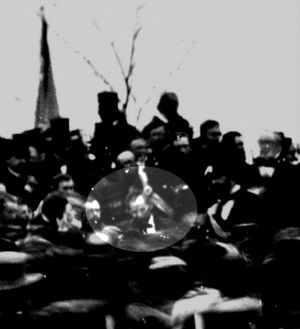
Photo of Lincoln delivering Gettysburg Address- (www.wikipedia.org)

Photo of Lincoln delivering
Gettysburg Address- (www.wikipedia.org)

The lesson plan is organized in three sections. In the first, students are handed a copy of Lincoln’s Gettysburg Address and perform several “cold” readings, to themselves and then with the class.

Lesson Plan SECTION 1 What’s at stake: a nation as a place and as an idea

Students silently read, then the teacher reads aloud the text of the Gettysburg Address while students follow along.

  • Students translate into their own words the first and second paragraph. 
  • Students answer guiding questions regarding the first two paragraphs

Please note, there is no mention of any historical context for the speech. Students will come to this 273-word speech without the background knowledge that the Battle of Gettysburg was fought from July 1 to July 3, 1863, and this battle is considered the most important engagement of the American Civil War. They will not know that the battle resulted in “Union casualties of 23,000, while the Confederates had lost some 28,000 men–more than a third of Lee’s army” (History.com). They will not know how the Army of Northern Virginia achieved an apex into Union territory with “Pickett’s Charge,” a failed attempt by General George Pickett  to break through the Union line in South Central Pennsylvania, and that the charge resulted in the death of thousands of rebel soldiers. They will not know how the newly appointed Major General George Gordon Meade of the Army of the Potomac met the challenges of General Robert E. Lee by ordering responses to skirmishes on Little Round Top, Culp’s Hill, and in the Devil’s Den. They will not know that Meade would then be replaced by General Ulysses S. Grant in part because Meade did not pursue Lee’s troops in their retreat to Virginia.

Instead of referencing any of this historical background, the guding questions in the lesson’s outline imagine the students as blank slates and mention another historical event:

A. When was “four score and seven years ago”? B. What important thing happened in 1776?

The guiding responses for teachers seem to begrudge an acknowledgement that keeping students bound to the four corners of a text is impossible, and that, yes, a little prior knowledge of history is helpful when reading a historical text:

This question, of course, goes beyond the text to explore students’ prior knowledge and associations. Students may or may not know that the Declaration of Independence was issued in 1776, but they will likely know it is a very important date – one that they themselves have heard before. Something very important happened on that date.  It’s OK to mention the Declaration, but the next step is to discover what students can infer about 1776 from Lincoln’s own words now in front of them.

In addition, there are admonishments in Appendix A of the lesson not to ask questions such as, “Why did the North fight the civil war?”

Answering these sorts of questions require students to go outside the text, and indeed in this particular instance asking them these questions actually undermine what Lincoln is trying to say. Lincoln nowhere in the Gettysburg Address distinguishes between the North and South (or northern versus southern soldiers for that matter). Answering such questions take the student away from the actual point Lincoln is making in the text of the speech regarding equality and self-government.

The lesson plan continues:

Lesson Plan SECTION 2  From funeral to new birth

  • Students are re-acquainted with the first two paragraphs of the speech.
  • Students translate the third and final paragraph into their own words.
  • Students answer guiding questions regarding the third paragraph of the Gettysburg Address.

Please note this does not provide the context of the speech that was given that crisp morning of November 19, 1863, at the dedication of the National Cemetery on a damp battlefield that only months before had been dampened red with the blood of tens of thousands of soldiers from either side. The students would be unaware that Lincoln had taken the train from Washington the day before and was feeling slightly feverish on the day of the speech. There is some speculation that he may have been suffering from the early stages of smallpox when he delivered the speech reading from a single piece of paper in a high clear voice. The students would not know that Lincoln’s scheduled time at the podium followed a two hour (memorized) speech by Edward Everett, who later wrote to Lincoln stating, “I should be glad if I could flatter myself that I came as near the central idea of the occasion in two hours as you did in two minutes.” The students would not know that many of the 15,000 crowd members did not hear Lincoln’s two minute speech; the 10 sentences were over before many audience members realized Lincoln had been speaking. The students would not know that this speech marked Lincoln’s first public statement about principles of equality, and they would not know that he considered the speech to be a failure.

Lesson Plan SECTION 3  Dedication as national identity and personal devotion

  • Students trace the accumulated meaning of the word “dedicate” through the text
  • Students write a brief essay on the structure of Lincoln’s argument

The lesson provides links to the five handwritten copies of the text, in the “Additional ELA Task #1: Comparison of the drafts of the speech” so that students can see drafts of the speech and the inclusion of “under God” in the latter three versions. There is also an additional Social Studies task that incorporates the position of respected historian Gary Wills from his book Lincoln at Gettysburg: The Worlds that Remade America. This activity suggests students use excerpts from Wills’s book and an editorial from the Chicago Times (November 23, 1863) to debate “Lincoln’s reading of the Declaration of Independence into the Constitution”. One excerpt from Wills’s book includes the statement,”The stakes of the three days’ butchery are made intellectual, with abstract truths being vindicated.” Finally, here is information about the battle itself; the battle lasted three days and soldiers died.

The enterprise of reading the Gettysburg Address without context defeats PARRC’s stated objective of having the students “arrive at an understanding of the text as a whole”. The irony is that in forwarding their own interpretation of the speech, David Coleman and the lesson plan developers have missed Lincoln’s purpose entirely; Lincoln directs the audience to forget the words of the speech, but never to forget the sacrifices made by the soldiers during that brutal conflict:

The world will little note, nor long remember what we say here, but it can never forget what they did here.

Lincoln wrote and delivered the Gettysburg Address to remind his audience “that these dead shall not have died in vain”. Analyzing the language of the address isolated from the Civil War context that created the tone and message is a hollow academic exercise. Instead, students must be taught the historical context so that they fully understand Lincoln’s purpose in praising those who, “gave the last full measure of devotion.”

“It is altogether fitting and proper that we should do this.”

Continue Reading…

According to literary legend, Ernest Hemingway wrote a six word short story in response to a bet:

Screen Shot 2013-02-26 at 3.58.31 PM

So when my Advanced Placement English Literature class was suddenly shortened one day last week due to a  delayed opening, I thought that I would do a close reading on this famous short story. After all, how long could a discussion on six words last? I was confident there would certainly be enough time for each of them to craft an essay as well.

The usual procedure for close readings in class is to have a volunteer “read aloud” while students annotate their copies of the text. The text is also displayed on the SMARTboard so that notes can be added and shared with all members of the class.

After they settled down with copies, Sam volunteered to read. We listened and paused. I started to ask, “So how did Ernest Hemingway, the author of this short story, convey his meaning?” when I was cut off.

“Whose baby died?” asked Alexis. She had no notes on her page.

“The baby died?” Connor responded, “I thought this was about a tag sale.”

“Why do you say that?” I asked, “Look at the evidence in the text.”

“Because people who have tag sales put in ads, and the ads are short,” replied Connor.

“But that is why the ad is short,” Alexis retorted, “the parents are so upset, they cannot write a long ad to sell the baby’s shoes.”

“Where are parents in the text?” I demanded.

“I agree with Alexis,” said Sam, “the shoes were ‘never worn’. The baby is dead.”

“OK,” I agreed, ” the words ‘never worn’ are in the text, but…”

“But the baby shoes could have been a gift that was the wrong size,” interrupted Natalie.

We were drifting off in our discussion. I had chosen the story because of its brevity, but I also had considered how well the text responded to the Publisher’s Criteria for the English/Language Arts Common Core Standards:

The Common Core State Standards place a high priority on the close, sustained reading of complex text, beginning with Reading Standard 1. Such reading focuses on what lies within the four corners of the text. It often requires compact, short, self-contained texts that students can read and re-read deliberately and slowly to probe and ponder the meanings of individual words, the order in which sentences unfold, and the development of ideas over the course of the text.

This was a “compact, short, self-contained texts that students can read and re-read deliberately.” The students were beginning to probe the meanings of individual words, but they were drifting.  They were bringing up tag sales, upset parents, and poor present gifting;  we were far off the four corners of this text.

For a moment, a very brief moment, I consider that we were moving away from the goals of the Common Core to work with the text. However, they were so quickly engaged, that I grew far more interested in listening to how close to they were to determining Hemingway’s purpose. Hemingway had selected six specific words to excite the reader’s imagination. My students were not wrong in their suggestions, they were using his text to understand, to create meaning. They were working with Hemingway’s language and responding to his inferences.

Their written drafts also leapt beyond the evidence, much like the discussion:

  • “They have waited nine months in anticipation for this day, and that morning a pair of shoes, no larger than the size of a plum, arrived in the mail, a gift from an aunt. They run to the hospital; they cry, they yell, they cry, but their baby is dead. ‘Get rid of those shoes.’ He writes in the paper, “For sale: baby shoes, never worn.’ Auntie will be sad.”
  • “…whether it’s a parent/ guardian or a thief trying to make money, it is obvious from the syntax that the shoes need to go.”
  • “‘For sale’ is a general coupling of words that comes from a particular type of person….a person low on monetary resources or one who wants to get rid of something…”
  • “…by saying the word ‘never’, that means the parents have never had a baby and will never have a baby…never is finite”
  • “In reality, Hemingway’s story is less of a story and more of a jumping off point. The six words are a choke point, like that of an hourglass stretching of in infinity in either direction.”

These drafts, hastily written in response to the story, ranged from 2-3 handwritten pages; far more than the six words that stimulated their ideas. The students wrote furiously until the bell rang, and then begged for more time to finish.

Certainly, their responses could be judged by the CCSS criteria, “Student knowledge drawn from the text is demonstrated when the student uses evidence from the text to support a claim about the text.” However, their responses in discussion and in essays offer significant proof that the ideas that started in text cannot be limited by clocks or “four corners”.

Of course, I received multiple links to the NY TimesMacbeth Mashup“from fellow English teachers, and yes, I thought that Claire Needell Hollander wrote a very funny piece. Yes, I believe students should be exposed to Shakespeare regularly, with or without the recommendations of the Common Core State Standards (CCSS). But, Macbeth for seventh and eighth graders? No!  That is just wrong. Wrong on theme, wrong for content, and very wrong for 11 and 12 year olds.

Hollander began her feature article making a great point about classroom dynamics:

“We say the classroom, as if an ideal classroom exists that somehow resembles every other classroom in America. In reality, every classroom has its own dynamic, and every class I’ve ever taught looks different from every other class. Perhaps more important, they also sound different.”

She is right. A chemistry of personalities creates a different dynamic in every classroom. The age of those personalities is also a factor. As I read the piece, however, I grew more and more frustrated. Macbeth features witches, warfare, murder, and, like most Shakespeare plays, sexual language. The word “blood” is repeated 41 times over the course of the play. Even the play itself is cursed; actors will not say the name of the play in the theatre. Many critics consider this Shakespeare’s “darkest play”.

Hollander herself questioned the appropriateness of this play for middle school students. She writes:

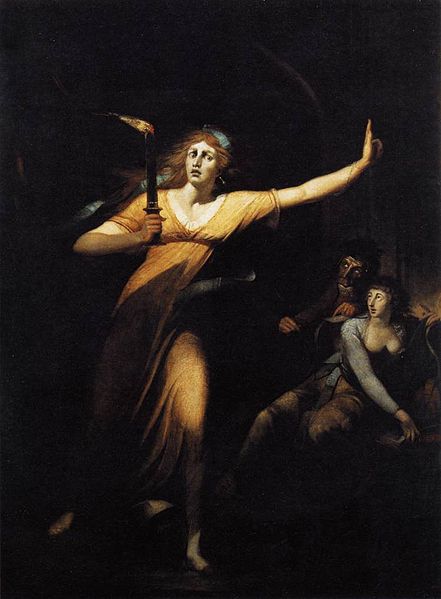
Lady Macbeth

John Henry Fuseli/ Johann Heinrich Füssli, Lady Macbeth Sleepwalking. Musée du Louvre, Paris Date: 1784. Creative Commons. Lady Macbeth driven to madness and suicide because her guilt in participating in the murder of King Duncan which leads to the murder of the guards, Macduff’s family, Banquo, and others…the stuff that nightmares are made upon.

“The kids have copies of the play with a modern English version on one side, but this isn’t easy either.”

“Tears of hilarity. Maybe middle school is too young for “Macbeth.”

Maybe? Definitely! So, why choose Macbeth?

Apparently, Hollander was attempting to satisfy a recommendation for archaic language for the secondary level in the English Language Arts Common Core. This is explained in Appendix A Language Conventionality and Clarity:

Texts that rely on literal, clear, contemporary, and conversational language tend to be easier to read than texts that rely on figurative, ironic, ambiguous, purposefully misleading, archaic, or otherwise unfamiliar language (such as general academic and domain-specific vocabulary).

In other words, the CCSS state that students should be exposed to complex diction, and the CCSS has made specific recommendations for grade 8 including:

  • Little Women by Louisa May Alcott (1869)
  • The Adventures of Tom Sawyerby Mark Twain (1876)
  • “The Road Not Taken” by Robert Frost (1915)

Hollander could consider the how the wording in CCSS Reading Standard 8  should guide her in selecting material for her combined seventh and eighth graders:

Analyze how a modern work of fiction draws on themes, patterns of events, or character types from myths, traditional stories, or religious works such as the Bible, including describing how the material is rendered new.

So many students come to high school without the necessary content to understand many of Shakespeare’s allusions. Perhaps the students know little about King Arthur and the Knights of the Round Table; why not Malory’s Morte d’Arthur? Or understanding the Pantheon of Greek Gods and Goddesses would be helpful; why not Edith Hamilton’s Greek Mythology?  Beowulf is usually taught in grade 10; the opening begins, “He was spawned in that slime, /Conceived by a pair of those monsters born/ Of Cain, murderous creatures banished/ By God, punished forever for the crime/ Of Abel’s death” (Raffel). Student should know this Biblical story of Cain and Abel. Students must come to high school prepared with the content needed to understand increasingly complex texts.

So why choose Macbeth? In fact, why choose Shakespeare at all? Ultimately, by not considering the recommendations of the CCSS to saturate students with the grade appropriate texts in our rich literary tradition, Hollander leaves them ill-prepared for Shakespeare at the high school level, when they are more mature to appreciate his themes.

So please, leave Macbeth, with his nihlism, his “...tale/Told by an idiot, full of sound and fury,/Signifying nothing” for older students.  Please leave Lady Macbeth with “…the smell of the blood still” where “all the perfumes of Arabia will not sweeten this little hand”, and leave Macbeth for high school. Besides, if Hollander is trying to meet the recommendations of the Common Core, she should leave Macbeth where the Common Core placed it, as a complex texts for 9th and 10th grades. The noisy mashup of Macbeth will still be crude and rowdy and demanding; but the students will be older, and these few additional years of maturity are necessary for dark tragedy in “the Scottish play”.

Today is Digital Learning Day! To mark the occasion, let me take you through a quick walkthrough of the halls of Wamogo Regional Middle/High School and give you a snapshot on how digital learning looks in the English classrooms grades 7-12. We have 1:1 computers in grades 7 & 8; in grades 9-12, we have a “bring your own digital device” policy. Here are the digital learning activities on Wednesday, February 6, 2013:

Grade 7: Students responded to a short story they read, “The Amigo Brothers”. They accessed the wiki (www.PBworks.com) in order to respond to “close reading” questions on the author’s use of figurative language. (Students are required to use evidence in their responses; digital copies of text helps student correctly add and cite evidence).

Grade 8: Students uploaded their reviews of the books (Mississippi Trial, 1955; Chains; The Greatest) they have been reading in literature circles to www.edmodo.com. These reviews are connected to the Common Core Writing Standard #6:

CCSS.ELA-Literacy.W.8.6 Use technology, including the Internet, to produce and publish writing and present the relationships between information and ideas efficiently as well as to interact and collaborate with others.

Grade 9: Students responded to a “writing on demand” journal prompt in preparation for the novel Of Mice and Men. This prompt is connected to the theme of hopes and dreams, and the students were asked:

What is your hope for life, your goal, or even your dream?  What do you think you want from the future? What would you live without, dream-wise?  What couldn’t you live without?

The students also posted their responses on a www.Edmodo.com discussion thread. Selections from responses included:

  • Something I couldn’t live with out would be my grandparents because they are like another set of parent to me, just better. They mean so much to me, that I really couldn’t see my life without them.
  • I hope to be a plant geneticist in the future, that is my hope but no matter what happens I would like to have a career involving plants and even if I can’t get a career in genetics I know it will always be a hobby of mine.
  • My house will be by the ocean, so close I can see it out of my kitchen window. I will grow old and drink coffee on my porch, while I read the paper and wave to my neighbors who walk by!
  • I could live without being famous around the world but I would like to be known town wise. I cannot live without family and their support in my decisions. They help me to stay confident and get through whatever I want to accomplish in life.
  • I think I could live without wanting a huge house or a huge boat “dream-wise”, but that still doesn’t mean I don’t want those things. I couldn’t live without music or my family.
  • My biggest hope and dream is to have a really big plot of land and have the world’s biggest tractor and a bunch of snowmobiles and ATV’s.
  • I want to be able to adopt kids from Uganda but also have my own, and I want to live in a nice house with a big yard. I want to work with little kids as a job.

10th grade Honors English students are reading Great Expectations. They took a quiz on www.quia.com, a software platform for timed quizzes. The College Prep English classes are reading Animal Farm. Today, they had to access “The International” MP3 and the www.youtube.video of the Beatle’s song “Revolution.

For homework tonight, students will write their own “protest” song.

Grade 11: Students can access the vocabulary list from the film The Great Debaters through the class wiki (www.pbworks.com) while the Advanced Placement English Language students watched a YouTube video of a Langston Hughes poem “I, Too, Sing America” read by Denzel Washington:

They prepared responses to the following questions which were posted on the class wiki:

  1.  To whom is the poet writing?  How do you know?
  2.  Choose one stanza and discuss what you feel is the key word in this stanza and explain why you chose this word?
  3.  What feelings does the poem create?  Which words create this feeling?

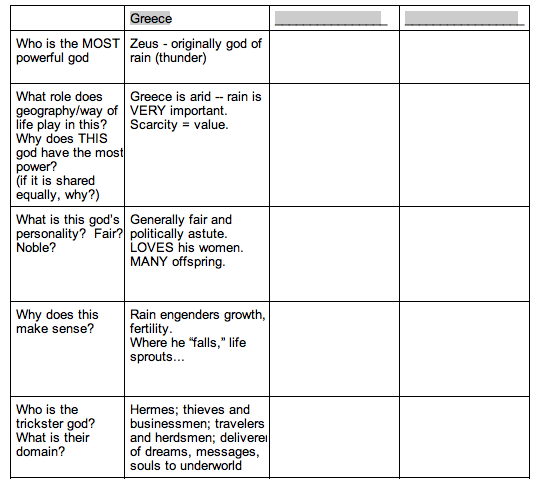
Grade 12: Students in the Grade 12 Mythology class accessed the following Google Doc Template and filled in the chart with their own research about the mythologies of different cultures. This activity meets the CCSS writing:

CCSS.ELA-Literacy.W.11-12.7 Conduct short research projects to answer a question; narrow or broaden the inquiry when appropriate; synthesize multiple sources on the subject

Screen Shot 2013-02-06 at 11.43.41 AM

The Film and Literature class “flips” the content by having students watch films for homework in order to discuss them during class. Tonight’s assignment? Watch the following YouTube clip and be ready for an open note quiz:

Students in the Advanced Placement English Literature class read the short story “Barn Burning” by William Faulkner that was embedded with a quiz on www.quia.com. They then created a list of four themes from the short story on a Google Doc. Each student selected a theme and placed his/her responses in the Google Drive folder to share with other members of the class. Examples included:

  • Actions we take with the grotesque: Shun? Avoid?

This story embodies an ultimate grotesque atmosphere. Even Colonel Satorius Snopes’ sisters are described as, “hulking sisters in their Sunday dresses” (2). These sisters are emulated throughout the story as disgusting, rotund, lethargic, and hog-like beings. This grotesque physical trait emulates the family’s condition in society. Satorius’ clothes are described as, “patched and faded jeans even too small for him.” (1).

  • Family over law or law over family

For the boy to go against his family in the end further proves his actions of courage and strength, and portrays the theme of law over family. “Then he began to struggle. His mother caught him in both arms, he jerking and wrenching at them. He would be stronger in the end, he knew that. But he had no time to wait for it” (10). His whole family is holding him back, but he chooses to go against all of them and do what is right.

This quick walkthrough demonstrating the use of technology in the English classrooms on one day demonstrates that for the teachers and students at Wamogo, everyday is a Digital Learning Day!

"Dawn spread her rosy fingers..."

“Dawn spread her rosy fingers…”

Our 9th grade classes have been reading Robert Fitzgerald’s excellent translation of The Odyssey. At the beginning of every book, “young Dawn spreads her fingertips of rose to make heaven bright”. My students have heard this phrase so often that they chorus back to me “fingertips of rose” when we read aloud. One morning this past week, I raced up the hill to school to get my iPad so I could capture this picture of the “rosy fingers” and put it on the class wiki.

We dutifully started The Odyssey with the “Invocation to the Muse” and Books 1-4, but the Telemachus “coming of age” story did not really capture their interest. Meeting Odysseus in Book 5 did not improve their respect for the “worthy man of twists and turns.” Once we read Book 9,  the meeting with the Cyclops, Polyphemus, their interest was revived. Apparently, they enjoy a good story of man-eating monster as much as previous generations from 2020 years ago.

I have only been able to locate about a dozen copies of this translation in the secondary market, so we did have to buy a class set. These replaced a worn set of the Richmond Lattimore translation. There will be an audio version of the Fitzgerald translation available in November 2013 I will be ordering so I will finally be able to hear how to pronounce all those Greek names!.

Our final project for the Odyssey is a narrative that students complete called “The Wamogossey: A Day in the Life of a Freshman at Wamogo High School.” Happily,  writing narratives are once again favored in curriculum aligned to the Common Core State Standards:

CCSS.ELA-Literacy.W.9-10.3 Write narratives to develop real or imagined experiences or events using effective technique, well-chosen details, and well-structured event sequences.

The inclusion of the narrative confirms what most writing teachers recognize, that writing a narrative gives a students a better appreciation for reading a narrative.

In writing The Wamogossey, we allow students to organize themselves as individual narrators or in groups of two or three. Our instructions to the students are based on the following premise:

You and your partners are to create a modern equivalent of The Odyssey. The setting is Wamogo High School; the hero a 9th grader – Fresheus or Freshiope.

Your character must make their way through a day at school, facing modern equivalents of the Lotus Eaters, Cyclops, Sirens, and all that Odysseus encountered. The goal is simply to get home alive, where the or she can relax and feel safe.You must mirror Odysseus’ adventures, including how he solves the problems (trickery, patience, skill, self-control, etc).  The essential nature of the obstacles must be the same, in the same order, but set in modern Wamogo.

Each student in a group working on The Wamogossey is required to write three adventures: a single narrator needs three (3) adventures; two people writing the Wamogossey need six (6) adventures; three members of the group need nine (9) adventures. This organization assures that there is an equal sharing of responsibilities regardless as to the size of the group. They compose the narrative on Google Docs; each narrator writing in a different color ink.

In addition, to assure fairness in grading, we allow students to have some feedback on the distribution of points. The project is assigned a base grade (EX: 40 points) Once the project is graded based, that number is multiplied by the number of students in group. For example a project worth 40 points may be awarded only 34 points. If there were three members of the group, then there are 34 X 3 points available, or a total of 102 points. The members of the group then determine a fair distribution of points; slackers are usually “outed” by members of their group. We rarely need to intervene.

The Wamogossey narratives must begin with an invocation to their muse. These are usually very personal and often reflect that we have a vocational agricultural program. For example, from this year’s submissions:

Sing in me, Brandon,
and help me tell the story of tractors, you, skilled in all ways of contending,
the fixing, harried for hours on end,
after the break downs and endless driving in the field.
I saw the end of the last row of corn
and learned that good crops come slowly
and weathered many bitter days
in the early morning cold, while I fought only
to save my life, to get home to the barn.
But not by will nor valor could I save all the gas I use,
Of these adventures, Brandon, tell about me in my school day, lift the great song again.
Begin when the alarm rang, calling me to adventure, when all I hungered for was for home, my  Farm All tractors, and being ready…

In addition to the modernized twists of Homer’s plot, each adventure needs an epithet (“grey-eyed goddess”) and one Homeric simile. My students call these similes “enough already; we get the point” similes.There is also extra credit for using vocabulary from The Odyssey.

So far, several of The Wamogossey entries parallel Odysseus’s adventure very nicely. One student’s encounter with “Eaganphemus” (the Cyclops/our principal) is clever:

Encounter with the Cyclops- Book 9
I was hurrying to class, I was going so fast, I felt like I was in a race car, and the people around me are in a fuzz.  All of a sudden, I saw the huge Eaganphemus standing in my way. I almost slammed into him, my wheels spinning so fast. I tried to get around him, but I couldn’t  But, I happened to have M&M’s in my pocket, so I threw them at him. He seemed overwhelmed! He tried to catch all of them at once!! Once he was trying to gobble them down I raced past, now that he was distracted. I somehow survived getting past him.

As the semester ends next week, the students will have finished their hero’s journey. Odysseus will return to Ithaka and to Penelope, and, yes, another “Dawn will spread her rosy fingers…”.  I may get to run up the hill again to snap another picture.