Archives For November 30, 1999

English teachers, defend literature in the classroom!

I teach English, and I am feeling a little defensive lately. In the past week, I have had two separate “literature-threatening” incidents.

The first came from a reader to an opinion piece I wrote that was featured in Education Weekly, 21st Century Students Need Books, Not Textbooks. The responder was repeating the myth that English classrooms need to abandon teaching literature in favor of teaching math and science texts:

“You need to look at the Common Core ELA [English Language Arts] standards and realize you now have a responsibility to teach reading and writing for STEM subjects. That is why this discussion is so wrong. Start reading math and science textbooks and start teaching what your students need, not what you love. I learned early on: the most boring subject is the world is another person’s hobby. Your hobby is reading “literature.” Your students need to learn to read and write STEM [science, technology, engineering, and math] topics, and those are found in textbooks. PERIOD!!”-Ebasco

This kind of response comes from the mistaken interpretation that the 70% of informational texts suggested by the Common Core State Standards (CCSS) need to be taught in English class; even the CCSS devotes a clarification to this on page 5 of their document in a footnote. Instead, reading is to be a critical part of all disciplines, generally 70% informational texts in all subjects and 30% fiction in English classrooms. However, English teachers can assign informational texts just as history/social studies can assign historical fiction; the genre assignment is fluid. An entire section of the ELA CCSS titled “Reading in History/Social Studies, Science, Math and the Technical Areas” is a guide devoted to improving the reading and writing standards in all disciplines. The push for reading informational texts is certainly a result of STEM, but literature is not being jettisoned out of the curriculum because it is a “hobby”.

Indeed, the benefits of reading literature is rooted in the second of the “literature threatening” incidents, in a WNYC Schoolbook blog post a piece titled Never Mind Algebra, Is Literature Necessary?  In this post, Tim Clifford made a compelling case regarding the stripping of literature from English classrooms in favor of Common Core, and again, the roots of this anti-literature movement are found in mistaken interpretations of the CCSS.

Clifford began his post with a multiple choice quiz based on the following quote:

“Now, what I want is facts. Teach these boys and girls nothing but facts. Facts alone are wanted in life. Plant nothing else, and root everything else out.”

Clifford posed the question “Who said the above?” and then offered three responses:

a. Bill Gates, Microsoft founder and educational gadfly
b. Michelle Rhee, staunch proponent of standardized testing
c. David Coleman, author of the Common Core standards

Then he offered the real answer,
d. Thomas Gradgrind, a fictional character created by Charles Dickens in the 1854 novel Hard Times.

The quote expressed the publicized sentiment of standardized testing advocates David Coleman, Bill Gates and Michelle Rhee. (I had chosen David Coleman as my answer). In discussing the correct answer, Gradgrind, Clifford explained that Dickens’s character was an attempt to skewer those utilitarian values in the mid 19th Century. Like today, there was a push for informational facts and statistics at the expense of creativity and imagination in public education.

Dickens’s novel Hard Times expressed his belief that an over-emphasis on facts over creativity promoted contempt between mill owners and workers.  Gradgrind’s name, like other Dickens creations, immediately expresses to the reader that he is an altogether unpleasant man, espousing that all one needs is “facts and statistics.” His daughter Louisa’s breakdown towards the conclusion of the novel brings him to the realization that fiction, poetry and other pursuits are not “destructive nonsense.”   Oh, if only Gates, Rhee, and Coleman were characters that could be similarly convinced.

In his post, Clifford described how his 6th grade curriculum has been altered to fit the ELA CCSS. He bemoaned the earlier loss of vocabulary and grammar in context and the most recent loss of creative writing which, “has been chopped clean away, to be replaced with unending persuasive essays that are the darlings of the Common Core standards.” He continues:

“Even reading has not been left unscathed. Many schools teach reading as a set of skills to be mastered rather than as a journey to be embarked upon. Children are taught how to predict, to connect, to draw inferences, and so forth, but they are rarely allowed the leisure to savor what they read or to reflect on the art of good writing.”

Clifford wrote about a successful novel writing project that, “engaged students on many levels and taught them story structure, characterization, use of dialogue, and exposition.” Unfortunately the project, “was jettisoned last year because of the national shift to the Common Core. It was replaced with an eight-page (for sixth graders!) research project.” He sadly noted, “The results were predictably dull and uninspired, but Gradgrind certainly would have approved. The papers were filled with facts but devoid of imagination.” In Clifford’s scenario, a successful unit of reading and writing was eliminated to favor lesson plans that do not have the evidence to prove success.

Where is the evidence that eliminating writing literature in favor of writing research papers will serve a mission statement of educating  “productive problem solvers and decision makers” who are “personally fulfilled, interdependent, socially responsible adults” ? Why are so many interpretations of the ELA CCSS rigidly eliminating what does work in favor of what might work? More to the point, why is there even a 70% vs. 30% split in reading genres, and why do stakeholders keep missing the point that the increase in informational texts must come by increasing reading in other content areas?

The positive impact of reading literature was discussed in the NYTimes article by Annie Paul Murray, “The Neuroscience of Your Brain on Fiction”. Reading fiction, “is an exercise that hones our real-life social skills, another body of research suggests. Dr. Oatley and Dr. Mar, in collaboration with several other scientists, reported in two studies, published in 2006 and 2009, that individuals who frequently read fiction seem to be better able to understand other people, empathize with them and see the world from their perspective.” To summarize, the data using neuroscience proves that reading fiction is good for you.

I teach literature, and my students make connections to the real word (Macbeth to Afghan Warlords; Frankenstein to the science of cloning) in my class everyday. Literature helps my students make sense of the world; they do not need to suffer under a despot, but they can experience a corrupt political system in Orwell’s  Animal Farm. They do not need to crash on a deserted island to understand how quickly very civilized young people can tun into savages when they read William Golding’s  Lord of the Flies. They can contemplate how precious is the relationship between a father and son who cling to decency and humanity without having to survive an apocalyptic nightmare  from Cormac McCarthy’s The Road.  They  can better understand the historical context of Jim Crow laws from Harper Lee’s To Kill a Mockingbird and in Kathryn Stockett’s more recent novel The Help.

And they can also learn about the utilitarian movement in England during the Industrial Revolution, the rise of the middle class, the frightening system of government-run workhouses, and the dangers of child labor in another Dicken’s novel,  Oliver Twist. Dickens’s literature demonstrates the power of fiction as a means of providing background information. Read a textbook of facts and statistics explaining the Industrial Revolution, and then read Oliver Twist. Which version will you vividly remember?

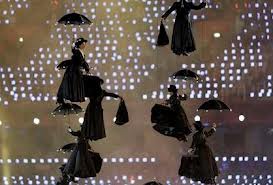
Mary Poppins to the rescue:
Photo from A Guide to the London 2012 Summer Olympics Opening Ceremonies
theblaze.com

The London 2012 Olympic Games Opening Ceremony was broadcast at 9pm on 27 July 2012 (EST). As a platoon of  Mary Poppins clones decended clutching their iconic umbrellas to vanquish the Lord Voldemort mid-ceremony, I was suddenly struck by an idea. How would the Common Core English Language Arts Standards view this production? The extravanganza developed by world-class directors Danny BoyleBradley Hemmings and Jenny Sealey and their teams was an eclectic mix of information  and fiction that “celebrated contributions the UK has made to the world through innovation and revolution.”

What grade, however, would the Common Core State Standards (CCSS) give London’s Olympic Games Opening Ceremonies? To make this assessment, a set of criteria needs to be established.  Informational texts are factual and real. Add a touch of whimsy or artistic interpretation and informational texts blur into that fuzzy blend of the literary genre of fiction. Lyrics in music are often considered poetry, so music also falls in the realm of fiction, and for the purposes of this assessment, so will an artistic dance that expresses a story.

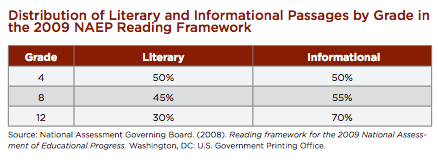
Recommended ratios of informational texts to fiction by grade level.

The CCSS suggest a decreasing ratio of fiction  to an increasing ratio of informational texts  for students in grade 4, grade 8, and grade 12. (see chart) This does not mean that English/Language Arts classes must drop literary fiction, but that other disciplines (History/Social Studies, Math, Science, Health, etc) should include more informational texts in their instruction in order to achieve the suggested ratios. The London 2012 Opening Ceremony was a blend of information and fiction (literally!).

Did London’s “Isles of Wonder” Opening Ceremony meet the recommended ratios of fiction to informational text according to Common Core State Standards?

A quick tally of the highlights as they appeared as either  fiction or informational text:
  • James Bond at Buckingham Palace escorting Queen and Corgis-fiction
  •  Skydiving Queen Elizabeth II-fiction
  • Thames River origin marker, Thames waders, Thames rowers, Thames boat traffic, Thames on a Google map -informational text
  • A flyby of Mr. Rat and Mr. Toad from Kenneth Grahame’s Wind in the Willows arguing in a boat on the Thames-fiction
  • The Pink Floyd Tribute pig  seen floating above the Battersea Power Station-fiction
  • London landmarks Big Ben and London Bridge-informational text
  • Big Ben’s hour and minute hand rapidly spinning and time traveling in London’s Tube- fiction
  • Posters of past Olympics contrasted with posters advertising 2012 Games-informational texts
  • Fluffy White Clouds held with string on a set of an English meadow –fiction
  • Tribute to the Agrarian Society featuring a very busy sheepdog with livestock -informational text
  • Tribute to the Industrial Revolution with Kenneth Branagh as Isambard Kingdom Brunel, the man who was responsible for England’s Industrial Revolution-informational text
  • Kenneth Branagh as Kenneth Branagh reading Caliban’s speech from Shakespeare’s The Tempestfiction
  • Forging of Tolkien’s “One Ring to rule them all” leading to the Forging of the Olympic Rings-fiction
  • Song by Scotland singer Emeli Sandé  and  dance British choreographer Akram Khan: fiction; their performance pre-empted by a silly interview by Ryan Seacrest of Michael Phelps-informational text
  • Tribute to National Health Service replete with backlit hospital beds filled with bouncy children, and dancing nurses and orderlies-informational text
  • Arrival of villainous characters from children’s literature (Including The Child Catcher from Chitty Chitty Bang-Bang, The Queen of Hearts Alice in Wonderland, and an inflated Voldemort from Harry Potter) chased away by PT Traver’s famous nanny, and all replaced by one giant sleeping baby-fiction
  • Rowan Atkinson’s,  (Mr. Bean), imagination running amuck in Chariots of Fire –fiction
  • A “Tube” made of tubes to highlight a contemporary romance: boy meets girl via cell phone-fiction
  • Musical hits from the 60′s, 70′s, 80′s, 90′s with unnecessary extended rap performance-fiction
  • Clothing from  the 60′s, 70′s, 80′s, 90′s (with the exception of the fictional Sgt. Pepper Costumes and Freddie Mercury Bobbleheads)  informational text
  • The big reveal of the creator of Sir Timothy John “Tim” Berners-Lee also known as “TimBL”, computer scientist, MIT professor and the inventor of the World Wide Web -informational text
  • Soccer great David Beckham arriving in a speedboat to hand the torch to Steve Redgrave, a five-time Olympic champion in rowing-informational text
  • The Olympic Cauldron, formed of 205 copper petals (one for each country) ignited by seven young torchbearers nominated by Britain’s past and present Olympic and sporting greats-informational text
  • Paul McCartney’s appearance for a British pound -informational text;  Lyrics of “Hey, Jude” sung by all athletes and audience –fiction
  • Pyrotechnics exploding from every conceivable platform in and around the stadium-informational text

My quick tally of 25 selected moments of the opening games comes to a total of 15 fictional texts (55% ) compared to 13 informational texts (48%)-(including two “blended information and fiction”). These percentages indicate that the production was too heavy in fiction. However, perhaps this high number of fictional texts is not really a surprise as Danny Boyle was hired specifically for his talents with stories (Slumdog Millionaire). According to a CNN report, Bill Morris, director of Ceremonies for the London Games said, “His ability as a storyteller, as a creator of spectacle, his background in both theater and film and the passion he has for this city and this project — they all just screamed at us. It wasn’t a difficult choice.”

Ultimately, London’s Opening Ceremony would not meet the suggested ratio of genres for the Common Core State Standards. According to my criteria and chosen highlights, the elements of the Opening Ceremony would not meet the suggested ratio of 50%  fictional texts to 50% informational texts in Grade 4, and certainly would not meet the ratio of fiction (30%) to informational texts (70%)  for students by grade 12.

There is one more informational fact that could be added to tilt the ratio.  The cost of the opening ceremonies was  27 million British pounds. That cold economic fact could be assessed against the joy of watching the Danny Boyle’s frenetic and spectacular celebration of Great Britain, both real and imagined. However, even this ratio would still not satisfy the recommendations for reading genres. When judging Olympic Opening Ceremonies, the Common Core is not the gold medal standard.

One of my favorite final exam questions to assign is a creative narrative assigned to sophomores who are challenged with reading World Literature. The prompt is  based on an imaginary literary awards ceremony that celebrates all of the literature read during the year. I cannot claim this is an original idea; a fellow teacher, Trish,  gave me the prompt several years ago when we both taught sophomores, and the results have never disappointed.

What our imaginary literary awards ceremony might look like!

The prompt asks the student to chose any three characters from the literature read in class as candidates for “The Most Interesting Character of the Year”Award, the coveted MIC. This question is provided to the students at least one day before the exam so that students have time to select the characters and collect evidence.When the students spend a class period preparing for the exam, they are provided a 3X5 index card to write down the quotes and any other evidence they may wish to incorporate in the essay. The card is stapled onto the essay; students who do not use a card lose five points on the essay response.

The student must write a self-nomination speech in the voice of each character in which the character discusses his or her motivations; relationships with other characters; and accomplishments and/or failures.  Each character must also compares/contrasts himself or herself against the other nominees. The name of the work (underlined or in quotes), the author of the work, and at least one quote from the literary work said by or about each nominee is also required. Students are cautioned that they must use MLA style for the integration and and citation of evidence.

While I hate grading a stack of final exam essays, this particular prompt always provides some interesting responses. Rarely is there a combination of characters repeated. Furthermore, although there are plenty of Macbeths, Beowulfs and Paul Bauers, there are an equal number of minor or obscure characters. For example, there have been nominating speeches from the Porter in Macbeth, the airman in Yeat’s An Irish Airman Foresees His Death; one student even wrote from the perspective of Bulleye, Bill Sykes’s dog in Oliver Twist.

There have been students who include details from the ceremony itself (“Live from Hollywood!”), decribing the location or decorations. Several students have had the nominees deliver their nomination speeches from a red carpet area, and many students choose another character, classmate, celebrity act as the evening’s emcee; others use a twist on the American Idol model. Students have included dialogue between characters during the ceremony, while other students have had characters hurl insults at each other.

For example, one student had the witches from Macbeth serving as the evening’s emcees who introduced each nominated character saying, “By the pricking of my thumbs, one more wicked than the other comes.” Another had a “fierce and reckless Grendel” prowling in the audience in order “to snatch thirty audience members from their slumber” when he was suddenly called up to the podium to deliver his own nomination. His monosyllabic charming and tearful self- nomination speech (“You like me!”) was interrupted when the band began to play, and the student wrote that Grendel once again became that “powerful monster, living down/ In the darkness, [who]  growled in pain, impatient/ As day after day the music rang /Loud In that hall,” and charged off the stage with his prey. Another student had Fagin from Oliver Twist give his nomination speech performing magic and juggling tricks while the Artful Dodger led a group of pickpockets through the audience.

My favorite response came two years ago when a student nomintaed Napoleon from Animal Farm and placed him on the dias where he was heckling Heathcliff  from Wuthering Heights and Jack from Lord of the Flies as each gave a self-nominating speech. Suddenly, a flash of lightning blinded the audience for several seconds, and when they had regained a view of the dias, only two nominees remained. Napoleon, like so many of Stalin’s government officials, had mysteriously vanished!

Students never have any trouble filling three full pages of content for this essay response. I grade each of the three essays holistically with special attention given to the incorporation of quotes as evidence and the motivations of each of the nominees. An “A” response would:

  • Demonstrate a clear understanding of the assignment’s purpose (writes in each character’s voice)
  •  Evaluate relevant significant points of view (character, audience)
  • Gather and integrate sufficient, credible, relevant evidence (minimum on quality quote) and cites evidence correctly (MLA)
  • Use standards of English correctly (particular attention to mini-lesson topics) including spelling and capitalization (titles, character names)

Recently, we were aligning our curriculum with the 10th Grade Language Arts Common Core Standards when we came upon standard W.9-10.3: Write narratives to develop real or imagined experiences or events using effective technique, well-chosen details, and well-structured event sequences. The narrative is not a form we generally use in grade 10, so as we were puzzled if we addressed this standard at any point in our curriculum, we remembered the Most Interesting Character Award essay. We determined that this essay allows us to meet standard W.9-10.3 without designing a new lesson/assignment.

I do not require students to pick a winner for this exam question, in fact, I think it is easier for them to write with no winner in mind. No pre-determined winner allows them to write the ultimate cliff-hanger….”and the award goes to_____?”

When I asked a question in class this year, I had to directly address a student: “Christina, what do you think….” or “Patrick, how does…”. I could not just toss out a question to the entire class. In fact, if I failed to individualize the Socratic method, the result was a chorus of dissonance, a cacophony of responses, a gabble of student voices directed towards no particular audience.  I also noted this year that a great number of students would reason aloud rather than think  before speaking.  This year my students did not discuss as much as transmit. What I was hearing was the  sound of student voices broadcasting as individual program streams. I needed to train my students in the art of discussion, when to contribute to conversation, and how to share communal air time.

I wondered how to account for this phenomenon and concluded my students had an “I” problem. They are the “I” tech pioneers students who grew up with multiple digital devices marketed to that 1st person singular pronoun.

Consider that the I-pod was released to the public on November 10, 2001. My 9th grade students who have proven incapable of clicking into a shared conversational stream were two or three years old at that time. My students have grown up listening to a self-selected soundtrack piped through earphones singularly and directly into their ears. They have had complete control over each musical track all of their lives. There has been no “B” side option to their playlist.

My students have been able to control all other forms of media as well, choosing to watch video content commercial-free selected  from multiple streaming websites. They watch TV shows from any  number of platforms (Hulu, Netflix, Amazon), yet few admit to watching TV during regular broadcasting on a TV screen at all.  They design their own video channels or post their own videos online. Pronoun marketing abounds for this generation: YouTube’s use of the 2nd person singular has been an invitation for them to post their content since they were 8-11 years old. How individualized my students’ experiences are from the collective experiences of their elder siblings, their parents, and their grandparents.

They have “friends” they have never met, they play games against people without regards to age or gender, and they cannibalize photos and files from other sources to create “personal” websites. They were 6-9 years old when My Space came online; now they now have a plethora of choices: Facebook, Tumblr, Pinterest, etc.

Yet, for all of their posting and tweeting, they are still communication-impaired. They have difficulty in developing or engaging in a discussion in class. Of course, students in previous years have required guidance on class discussion rules, but this past year was substantively different.  I believe all of this “I”-serving technology has led an increase in personalized content but a decline in knowing how to share “we”-time.

By way of contrast, I am a child of AM radio. I was one pair of the million ears that heard the DJ chatter of Harry Harrison or Cousin Bruce Morrow. I grew up to a prescribed soundtrack that would reverberate in pop record synchronicity on city streets, sidewalks, parks and beaches. In 1970 the air pulsed hourly with The Carpenters Close to You even though I hated the song. I was part of a collective experience whether I wanted that experience or not. I am a child of network television who remembers when one evening’s broadcast of Ed Sullivan or Walter Cronkite would be the following week’s discussion.  I played with peers I could touch; I could see my friends. We talked in person, and we had long extensive conversations. I was in an environment that conditioned me to wait my turn and share my time. I knew I was in a collective, and for good or for bad, I was connected but “unconnected.”

So when I read Sherry Turkle’s opinion piece “The Flight from Conversation” in the NYTimes on Sunday, April 12, 2012, I saw one line that described a symptom I recognize in my students, “A 16-year-old boy who relies on texting for almost everything says almost wistfully, ‘Someday, someday, but certainly not now, I’d like to learn how to have a conversation.’

 In the piece, Turkle describes how an increasing reliance on technology reflects the “I” centered experience:
“We want to customize our lives. We want to move in and out of where we are because the thing we value most is control over where we focus our attention. We have gotten used to the idea of being in a tribe of one, loyal to our own party.”

The daily environment for the “tribes of one”, my students,  in and out of school is filled with digitally enhanced communication, but there is little serious conversation.  My students have few opportunities outside of the classroom to practice the art of discussion without a digital device in hand. So I have been taking “baby steps” in the classroom by first asking them to respond to each other.

“Do you agree with Mackenzie?” ”
“Can you add to what Matt said?”
“Please restate what Breanne said.”

There are popsicle sticks with each name to insure I have each member of the class speak during the day. On some questions,  I also ask them to pause 30 seconds before responding and remind them they are graded on not only what they say but by the attention they give to others. These techniques have helped control the immediate response impulse- the noisy nonsense of 25 incomplete thoughts spark-plugging aloud in the room. Only recently, however, have  I asked them to look at each other when they respond. The first three exchanges were awkward, but Nick’s full on attention to Logan was so comical that  “making eye contact” became fun. I hope that continuing eye contact will help the interchange of ideas which is the basis for conversation.

Turkle’s concern is that, “We are tempted to think that our little ‘sips’ of online connection add up to a big gulp of real conversation. But they don’t. E-mail, Twitter, Facebook, all of these have their places — in politics, commerce, romance and friendship. But no matter how valuable, they do not substitute for conversation.”

I agree with Turkle and recognize that teaching the “I” generation requires changing the way we, teachers and students, communicate in the classroom. Successful participation in conversation and discussion are the critical skills students need to counterbalance the social media that Turkle says continually asks us what’s “on our mind,” but allows us  “little motivation to say something truly self-reflective.” Our students need to move from the digital ease of self-expression to a stage of self-reflection in order to demonstrate understanding and to share that understanding with others. To insure all student have these skills, the recently adopted Common Core Standards in English Language Arts will require teachers to improve the speaking and listening skills from K-12 grades. For example, requirements for grades 9 and 10:

CCSS  SL.9-10.1.Propel conversations by posing and responding to questions that relate the current discussion to broader themes or larger ideas; actively incorporate others into the discussion; and clarify, verify, or challenge ideas and conclusions.

Our students cannot continue the experience of dancing solo to the selected soundtrack of their own “I”-device in the classroom without learning how to either share that experience with others or reflect on how that experience defines them. Educators need to teach all students that they should appreciate the many ways we now communicate but learn to recognize that the limitations “I” center devices have in communicating. We need to encourage those who are like Turkle’s 16 year old student example,  a student who wants “someday”to participate in conversation “but, certainly not now,” to see themselves as social beings.They must learn that their use of technology’s social media can not replace the in-person interaction that happens in social and academic conversation. They need to practice the act of conversation now rather than “someday,” and the classroom is a great starting place. Oh, and we need to remind everyone  to make eye contact.

A question was posed on the Education Week column run by Larry Ferrlazzo. On this particular posting, he asked the question, “How Can We Teach Social Studies More Effectively?”

This year, I am the interim Social Studies Department Chair in addition to my role as English Department Chair.  As an academic interloper, I have had the opportunity to study how the scope and sequence of our middle/high school social studies program (7-12)  is delivered. I humbly offered  the following suggestions to Ferrlazzo’s question:

To be an effective Social Studies teacher, a teacher must be inter-disciplined.  The definition of social studies adopted by the National Council of Social Studies (NCSS)  in 1992 addresses the broad reach of the subject:

“Social studies provides coordinated, systematic study drawing upon such disciplines as anthropology, archaeology, economics, geography, history, law, philosophy, political science, psychology, religion, and sociology, as well as appropriate content from the humanities, mathematics, and natural sciences.”

In other words, social studies is the most interdisciplinary subject in our curriculum, therefore:

1. Collaborate:

Although English is  natural fit, social studies teachers should not stop there, but look to collaborate with all disciplines. Some subjects pair well (Renaissance=science+art), but do not discount the math necessary for economics and statistics needed to understand any period of history.Social studies teachers have the opportunity to collaborate with other departments in delivering curriculum using either the familiar chronological approach or by using a thematic approach (“Revolutions”). These teachers can help students make the connections between subject areas rather than see each information limited to four classroom walls.  For example, students in grade 10 were reading All Quiet on the Western Front in English at the same time when WWI was being studied in Modern World History. I was trying to make a point about how the narrator was confronting the shift from the man to man combat to the  battlefield which featured increasing mechanized warfare when a student interrupted me, “Mrs. P says that WWI showed that the increasing the technology and machines in war gets you get farther and farther from your enemy.” There was a pause, and then another student chimed in ,“And now we use drones in Afghanistan and we are farther from the enemy than ever before.”  I didn’t have to make my point at all. Mrs. P, 10th grade social studies teacher, had already covered weapons introduced in WWI and  was making connections from WWI to the war in Afghanistan. She was providing the setting while I was introducing the emotional impact on people/characters, and our collaboration made for greater student understanding.

2. Ditch the Textbook and Increase Non-Fiction Reading:

I have come to view the social studies textbooks as heavy…too heavy and too costly. I suggest social studies teachers use these in a classroom as a resource for note-taking only. These textbooks are ideal for teaching students about sub-headings, how to read charts and maps, and information sidebars in class, but there are other resources for delivering content. Use Livebinders.com to create online textbooks for reading home, perhaps in a flipped model, with a variety of reading materials-newspaper articles, magazine links, and websites. Use wikis to post links, upload materials, and receive comments from students. Check out the amazing amount of materials on Larry Ferrlazzo’s blog and Richard Byrne’s blog (updated almost hourly!) or Greg Kulowiec’s blog to see what software can be used for research or content delivery.  Place materials in Google Docs for student access and collaboration. After looking at all the new software available today, I am fully in favoring of ditching the textbook!
Of course, losing the textbook means a teachers can also assign more authentic reading. The Common Core State Standards require 70% informational texts for students by grade 12. The anchor standards and high school standards for reading and writing in social studies (history) in literacy work in tandem to define college and career readiness expectations. Increasing student access to reading materials is key to meeting increased requirements in reading of informational texts. I would suggest organizing classroom libraries with non-fiction materials and providing time in class to read these materials. Coordinate with the school librarian to pull books that deal with a topic currently studied and suggest students  choose a book off the cart. For example, we have added numerous popular trade non-fiction titles in the English classroom libraries that could be easily used in a social studies classroom such as:

Longitude: The True Story of a Lone Genius Who Solved the Greatest Scientific Problem of His Time by Dava Sobel
Patriots by Joseph J. Ellis
Hiroshima by John Hershey
Salt: A World History by Mark Kurlansky
Kaffir Boy: The Story of a Black Youth’s Coming of Age in Apartheid South Africa by Mark Mathebane
The Devil in the White City by Erik Larsson
Kon Tiki by Thor Heyerdahl

3. Increase the Project Based Learning:

There’s a lot to be said for the diorama. Every student has made at least one, and despite the loss of precious classroom real estate to 30 shoebox recreations of a medieval castle, these projects are incredibly powerful learning experiences because they are “hands-on”.  Debate, trials, and simulations are also all ways that project based learning can be used. Our 8th grade recreated the Ellis Island experience in the gym and hallways last month.  Teachers were “medical inspectors” and  Ellis Island staff asking questions about employment possibilities and each immigrant’s finances.  Each 8th grade student had prepared an immigration profile based on research on the Ellis Island website http://www.ellisisland.org/ and was “processed” individually or in family “groups.” This experience was only one of several simulations our teachers have used to immerse students in a historical context.

Project based learning can be delivered as games, in role-playing, or in developing living museums. Students need to BE the people of history to better understand how people and events from the past effect and connect to their present circumstances in their “study of the social sciences and humanities to promote civic competence.” (NCSS, 1992)

I have enjoyed this year of working with my social studies colleagues. They are responsible for many of the skills that are necessary for literacy, specifically writing and note-taking. They are critical to successfully implementing the newly adopted Common Core State Standards at every grade level. What joins our disciplines in English and social studies are the fundamental elements of story; while English teachers are centered on the individual character and “his-story”, the social studies teachers are responsible for what happens to the individual in “history”. Ours can be the continuing of a “beautiful friendship” in education.

GOAL -School districts want to report their students to read great literature.
GOAL-School districts want to report good reading test scores.

Unfortunately, these two goals are currently incompatible; great literature’s complexity can be challenging to read, and schools can ill afford to have students get low test scores on reading because of great literature’s complexity.

Concerns about the removal of great literature from classrooms have been raised before, but NY public school English teacher Claire Needall Hollander passionately argues how intellectually damaging this practice has become in state testing. Her  op-ed piece in 4/21/12  NYTimes Teach the Books, Touch the Heart decries the elimination of great literature in the classroom in order to incorporate practice materials to prepare students to take the standardized tests. Hollander described her role as a reading enrichment teacher as an opportunity to provide great literature as academic equity for her students. She described several of her students as  the sons and daughters of immigrants or incarcerated parents; she noted some students lived in crowded, violent, or abusive homes. Great literature, she believed, was “cultural capital” that could help her students compete against more affluent peers. However, when the lackluster data from standardized reading tests came in, she felt pressured to abandon great literature and curtailed her efforts for the majority of these students in order to teach materials prescribed for the state test.  While the reading selections on the state tests did have some syntactical complexity, she eventually decided that these reading materials lacked the literary qualities that make literature great. Texts that are “symbolic, allusive or ambiguous are more or less absent from testing materials.” Hollander writes, “It is ironic, then, that English Language exams are designed for ‘cultural neutrality.'”

In one sense, great literature is already culturally neutral. The themes or characters in a great piece of literature are not limited to one decade or one millennium. The elements that make a work of literature great can transcend culture and context, can speak to a universal audience, can be read by any tradition and still connect to a reader. Ms. Hollander’s concerns about cultural neutrality are akin to concerns about cultural acceptability. Creators of standardized tests are particularly sensitive in selecting texts that are cultural acceptable because great literature  intentionally confronts morality, questions society’s rules, or challenges tradition. Great literature gives voice to the outsider, and authors of great literature are often on the margins of society or write to unsettle the status quo. For these reasons, selections from great literature may not be considered culturally acceptable.

I have some experience on what goes onto a standardized state test as I had a seat one year as a member of the text selection committee for the reading and writing sections of the Connecticut Academic Performance Test (CAPT)  given to grade 10 students. Much time was spent reviewing materials for inclusion on a future Response to Literature exam. Out of a number of mediocre short stories, the only selection given to educators that could meet some standards of great literature was a chapter from Lois Lowry’s Number the Stars, a young adult novel that is usually read in Grade 5.  That selection was eliminated not only because of the low reading level (5.1; Lexile 670) but because the manner in which Lowry portrayed the terrifying rounding up of Jews. One committee member actually wondered aloud if Lowry could be persuaded to “reword the chapter” to address the concern. Fortunately, that debate ended with the decision that the chapter was not “acceptable” for the committee.

One problem in great literature is difficult vocabulary; for example, the simple conversations between the Man and the Boy in Cormac McCarthy’s The Road (RL 4) are interspersed with diction describing the apocalyptic setting:  “rachitic “, “miasma”, “escarpment”, “crozzled”.  Another problem is vocabulary  considered vulgar or profane that has eliminated a number of literary pieces from standardized testing and even from school libraries. According to the American Library Association (ALA) website which  lists challenges to classic literature that Hollander might teach: To Kill a Mockingbird- “contains  racial slurs”;  Of Mice and Men – “takes God’s name in vain 15 times and uses Jesus’s name lightly.” Finally,  great literature almost always contains themes that can be considered dangerous  or offensive to someone in society:  The Color Purple is “sexually graphic and violent”;  1984 is “pro-communist”; and Catcher in the Rye– is infamously “blasphemous and undermines morality.”

Engineering English language tests in order to make them culturally neutral or culturally acceptable encourages intellectual dishonesty. Take the reading section on the Connecticut Academic Performance Test (CAPT)  where every 10th grader is required to read a short story and evaluate the quality of the story, “How successful was the author in creating a good piece of literature?” in a one page essay. I have spent over 10 years preparing students for this  question on the Response to Literature standardized test, and I know how students struggle with this question. Many students do not read challenging texts outside of the classroom, limiting their experience to develop critical evaluation skills. However, the more distressing problem is that year after year, the quality of the story on the CAPT pales in comparison to the classic short stories a student could encounter in even the most limited literature anthology. Classic short stories available in the public domain by Saki, Anton Chekhov, Kate Chopin, Stephen Crane, and Jack London, to name a few, are considered too difficult for independent reading by 3rd quarter 10th grade students. Copy-write requirements or an author’s unwillingness to truncate a story to comply with a maximum word requirement or to make textual changes to make the subject palatable to a text selection committee, prevents other literary materials from being used.   As a result, more recent selections have come from Teen Ink (stories written by teens) and Boy’s Life magazine, both publications not known for superior literary content. While some stories may meet a sentence complexity standard and have been vetted for acceptable content, most lack the literary depth that should generate thoughtful critical responses to a prompt that asks about “good literature.”

To further complicate the choice a student makes in a response, released materials from previous exams used to prepare students how to respond to “How successful was the author in creating a good piece of literature?” include student responses, and all of the exemplars, good and bad, argue that the story was “good”.  The  lack of reader experience coupled with the year to year see-saw quality of the text on the exam places  students in the uncomfortable position of defending a merely average quality story as good literature; therefore, the prompt promotes intellectual dishonesty.

Perhaps the problem of including good literature on a standardized test may be addressed with the adoption of the English Language Arts Common Core State Standards where text complexity is standard #10: “By the end of grade 9, read and comprehend literature, including stories, dramas, and poems, in the grades 9–10 text complexity band proficiently, with scaffolding as needed at the high end of the range.”

In other words, the use of good literature on a CCSS English Language Arts exam might be substantively different than the texts used on the Response to Literature section of the CAPT. This could make the response about the quality of text more authentic since a complex literary text can be analyzed as “good literature.” How this more complex literary text will be used in testing, however, remains to be seen since history demonstrates that cultural opposition to a story will often trump quality.

Comprehending and evaluating a text are desirable skills, and measuring those skills will still be difficult.  Multiple choice questions are quickly corrected, but they are limited to measuring reading comprehension, and a student essay response to a complex text will require considerably more time to write and correct. Anticipating this, Hollander calls for an assessment that is more reflective of student learning:

 “Instead, we should move toward extensive written exams, in which students could grapple with literary passages and books they have read in class, along with assessments of students’ reports and projects from throughout the year. This kind of system would be less objective and probably more time-consuming for administrators, but it would also free teachers from endless test preparation and let students focus on real learning.”

The CCSS should consider Hollander’s proposal as states develop assessments.  All stakeholders should also recognize that using anything less then quality literature to measure a student reading comprehension and evaluation skill on an English/Language Arts exam is intellectually dishonest.