Archives For November 30, 1999

Screenshot 2014-03-21 21.09.03Our school has been preparing for an accreditation by the New England Association of Schools & Colleges, Inc. (NEASC), and that means two things:

Housecleaning and housekeeping.

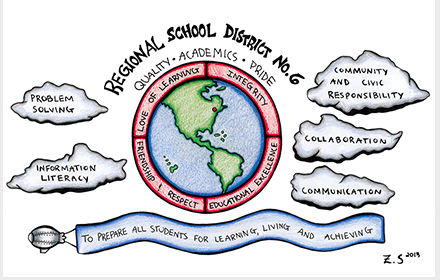
The housecleaning is the easy part. A great deal of time and effort has been spent on making the school look nice to the accreditation team. Considering that our campus is in the bucolic Litchfield Hills of Connecticut, we had a great start. Our building is extremely well maintained, and our maintenance staff has been recognized for their “green” maintenance policies. The final details to housecleaning were the addition of student art on the walls and a large canvas featuring the student designed logo that centers on the motto “Quality, Academics, Pride.”

Preparing the housekeeping was different. Housekeeping required that all stakeholders in our school community reflect on how well do we keep our “house”-our school- running. There have been meetings for the past two years: meetings with community members,  meetings with students, meetings with teachers across disciplines. There have been committees to research eight topics:

  • Core Values, Beliefs, and Learning Expectations
  • Curriculum
  • Instruction
  • Assessment of and for Student Learning
  • School Culture and Leadership
  • School Resources for Learning
  • Community Resources for Learning

After all the meetings came the writing of the reports, and after all the reports came the gathering of the evidence. Finally, the evidence sits in eight bins in a room in the agricultural wing of the school ready for the volunteer accreditation team to review.

What is most striking about the collected evidence is the variety. The evidence today contrasts to the evidence from the accreditation several years ago.  For each lesson plan on paper, there is a digital lesson plan. For each student essay drafted, peer-reviewed, and handwritten on composition paper, there is a Google Doc with peer comments, and to see each draft, one need only check “see revision history.” Whether or not members of the NEASC committee check the revision histories of individual documents is not as important as how they will check the history we have provided in the evidence bins and websites. In looking at the evidence, the NEASC committee will note our academic housekeeping, and they will make recommendations as to how we should proceed in the future.

The entire school community has every right to be proud of Wamogo Regional High School, and recommendations from NEASC will help guide us in the future. But for tonight, the housecleaning and housekeeping is over.  

A message from the Vice Principal arrived by e-mail tonight; she sums up the experience:

When driving home from school this evening, I was thinking about the arduous process we have all been engaged in over the past two years.  I don’t believe there is a single member of our school community that hasn’t played a part in this important preparation.  Many of you worked tirelessly on committees, writing reports, culling evidence, hanging student work, etc., etc., etc.  I just wanted to take a moment and  thank the entire Wamogo community for the rally we have all engaged in to prepare for this important visit.  I know that the visiting school will easily see what a special place Wamogo is and the obvious talents of our staff and students.  I am extremely proud of our school and want you to enjoy showing the visiting committee what wonderful work you are doing with our students.

Welcome, NEASC. Our house is ready.

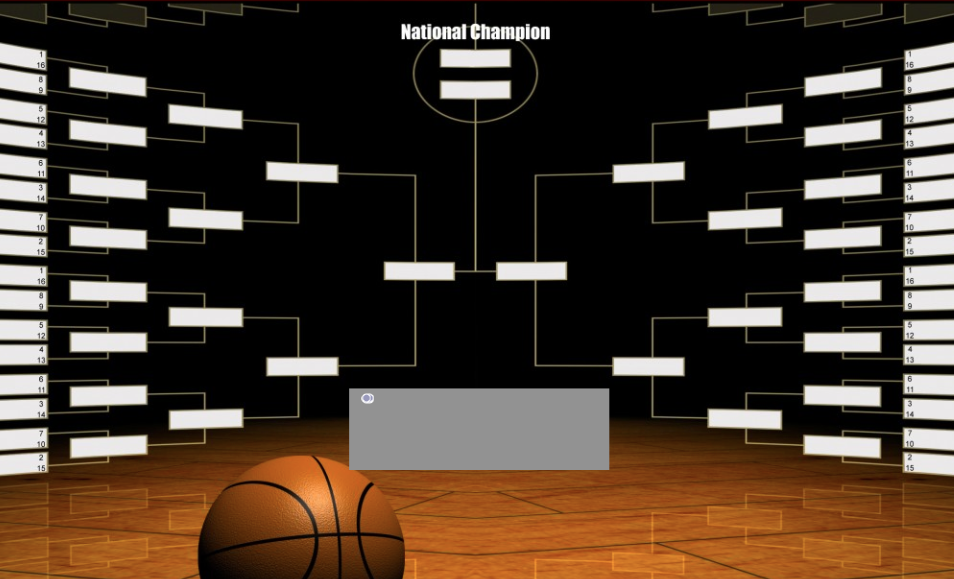
March Madness is not exclusive to basketball.Screen Shot 2014-03-15 at 1.38.50 PM

March Madness signals the season for standardized testing season here in Connecticut.
March Madness signals the tip-off for testing in 23 other states as well.

All CT school districts were offered the opportunity to choose the soon-to-be-phased-out pen and paper grades 3-8 Connecticut Mastery Tests (CMT)/ grade 10 Connecticut Academic Performance Test (CAPT) OR to choose the new set of computer adaptive Smarter Balanced Tests developed by the federally funded Smarter Balanced Assessment Consortium (SBAC). Regardless of choice, testing would begin in March 2014,

As an incentive, the SBAC offered the 2014 field test as a “practice only”, a means to develop/calibrate future tests to be given in 2015, when the results will be recorded and shared with students and educators. Districts weighed their choices based on technology requirements, and many chose the SBAC field test. But for high school juniors who had completed the pen and paper CAPT in 2013, this is practice; they will receive no feedback. This 2014 SBAC field test will not count.

Unfortunately, the same can not be said for counting the 8.5 hours of testing in English/language arts and mathematics that had to be taken from 2014 academic classes. The elimination of 510 minutes of instructional time is complicated by scheduling students into computer labs with hardware that meets testing  specifications. For example, rotating students alphabetically through these labs means that academic classes scheduled during the testing windows may see students A-L one day, students M-Z on another. Additional complications arise for mixed grade classrooms or schools with block schedules. Teachers must be prepared with partial lessons or repeating lessons during the two week testing period; some teachers may miss seeing students for extended periods of time. Scheduling madness.

For years, the state standardized test was given to grade 10, sophomore students. In Connecticut, the results were never timely enough to deliver instruction to address areas of weakness during 10th grade, but they did help inform general areas of weakness in curriculum in mathematics, English/language arts, and science. Students who had not passed the CAPT had two more years to pass this graduation requirement; two more years of education were available to address specific student weaknesses.

In contrast, the SBAC is designed to given to 11th graders, the junior class. Never mind that these junior year students are preparing to sit for the SAT or ACT, national standardized tests. Never mind that many of these same juniors have opted to take Advanced Placement courses with testing dates scheduled for the first two full weeks of May. On Twitter feeds, AP teachers from New England to the mid-Atlantic are already complaining about the number of delays and school days already lost to winter weather (for us 5) and the scheduled week of spring break (for us, the third week of April) that comes right before testing for these AP college credit exams. There is content to be covered, and teachers are voicing concerns about losing classroom seat time. Madness.

Preparing students to be college and career ready through the elimination of instructional time teachers use to prepare students for college required standardized testing (SAT, ACT) is puzzling, but the taking of instructional time so students can take state mandated standardized tests that claim to measure preparedness for college and career is an exercise in circular logic. Junior students are experiencing an educational Catch 22, they are practicing for a test they will never take, a field test that does not count. More madness.

In addition, juniors who failed the CT CAPT in grade 10 will still practice with the field test in 2014. Their CAPT graduation requirement, however, cannot be met with this test, and they must still take an alternative assessment to meet district standards. Furthermore, from 2015 on, students who do not pass SBAC will not have two years to meet a state graduation requirement; their window to meet the graduation standard is limited to their senior year. Even more madness.

Now, on the eve of the inaugural testing season, a tweet from SBAC itself (3/14):

Screen Shot 2014-03-15 at 1.28.22 PM

This tweet was followed by word from CT Department of Education Commissioner Stefan Pryor’s office sent out on to superintendents from Dianna Roberge-Wentzell, DRW, that the state test will be delayed a week:

Schools that anticipated administering the Field Test during the first week of testing window 1 (March 18 – March 24) will need to adjust their schedule. It is possible that these schools might be able to reschedule the testing days to fall within the remainder of the first testing window or extend testing into the first week of window 2 (April 7 – April 11).

Education Week blogger Stephen Sawchuk provides more details in his post  Smarter Balanced Group Delays in the explanation for the delay:

The delay isn’t about the test’s content, officials said: It’s about ensuring that all the important elements, including the software and accessibility features (such as read-aloud assistance for certain students with disabilities) are working together seamlessly.

“There’s a huge amount of quality checking you want to do to make sure that things go well, and that when students sit down, the test is ready for them, and if they have any special supports, that they’re loaded in and ready to go,” Jacqueline King, a spokeswoman for Smarter Balanced, said in a March 14 interview. “We’re well on our way through that, but we decided yesterday that we needed a few more days to make sure we had absolutely done all that we could before students start to take the field tests.”

A few more days is what teachers who carefully planned alternative lesson plans during the first week of the field test probably want in order to revise their lessons. The notice that districts “might be able to reschedule” in the CT memo is not helpful for a smooth delivery of curriculum, especially since school schedules are not developed empty time slots available to accommodate “willy-nilly testing” windows. There are field trips, author visits, assemblies that are scattered throughout the year, sometimes organized years in advance. Cancellation of activities can be at best disappointing, at worst costly. Increasing madness.

Added to all this madness, is a growing “opt-out” movement for the field test. District administrators are trying to address this concern from the parents on one front and the growing concerns of educators who are wrestling with an increasingly fluid schedule. According to Sarah Darer Littman on her blog Connecticut News Junkie, the Bethel school district offered the following in a letter parents of Bethel High School students received in February:

“Unless we are able to field test students, we will not know what assessment items and performance tasks work well and what must be changed in the future development of the test . . . Therefore, every child’s participation is critical.

For actively participating in both portions of the field test (mathematics/English language arts), students will receive 10 hours of community service and they will be eligible for exemption from their final exam in English and/or Math if they receive a B average (83) or higher in that class during Semester Two.”

Field testing as community service? Madness. Littman goes on to point out that research shows that a student’s GPA is a better indicator of college success than an SAT score and suggests an exemption raises questions about a district’s value on standardized testing over student GPA, their own internal measurement. That statement may cause even more madness, of an entirely different sort.

Connecticut is not the only state to be impacted by the delay. SBAC states include: California, Delaware,  Hawaii, Idaho, Iowa, Maine, Michigan, Missouri, Montana, Nevada, New Hampshire, North Carolina, North Dakota, Oregon, Pennsylvania, South Carolina, South Dakota, U.S. Virgin Islands, Vermont, Washington, West Virginia, Wisconsin, Wyoming.

In the past, Connecticut has been called “The Land of Steady Habits,” “The Constitution State,” “The Nutmeg State.” With SBAC, we could claim that we are now a “A State of Madness,” except for the 23 other states that might want the same moniker. Maybe we should compete for the title? A kind of Education Bracketology just in time for March Madness.

Perplexed: adj.

1. bewildered; puzzled.
2. complicated; involved; entangled.

(o _ 0 )  ?

I am perplexed as to why this word is on the EngageNY first grade vocabulary list, and again perplexed when I review the first grade units for English Language Arts (ELA) on this website. I am perplexed because I can see that several units in our current grade five curriculum (Early Settlers and the American Revolution) and our entire grade six curriculum (Ancient World History) have  been bundled into a series of units that will be taught in first grade.Did I mention that EngageNY complicates these areas of study with content area lessons on the human body and astronomy in first grade?

All these complications have me even more perplexed as to why so many people are recommending that educators visit and use EngageNY resources. In two separate incidents over the past two weeks, I have heard educators from the State of Connecticut recommend the site. One recommendation was made directly to the Commissioner in the State Department of Education, Stephan Pryor, during a roll-out of the state’s Common Core website. I hope he does not take these recommendations seriously.

Remember that the Common Core State Standards (CCSS) were supposed to guide teachers to teach less and focus more. The CCSS were promoted as a means to stop instruction that is “a mile wide and an inch deep.” The CCSS were promoted to allow teachers to select their own materials, an opportunity to move away from scripted programs, stating,”Teachers are thus free to provide students with whatever tools and knowledge their professional judgment and experience identify as most helpful for meeting the goals set out in the Standards.”

Engage NY curriculum contrasts with these both of these goals; it is both staggering in its breadth and it is highly scripted.

A look at the Grade One English Language Arts curriculum in the “Listening and Learning Strand” demonstrates the breadth in a curriculum that is organized into 11 separate content area Domains. An examination into Domain 4, titled “Early World Civilizations” shows a unit that is 21 days in length for 6 year-old students using  a Tell It Again! Read-Aloud Anthology. Engage NY explains that this unit:

“….for Early World Civilizations contains background information and resources that the teacher will need to implement Domain 4, including an alignment chart for the domain to the Common Core State Standards; an introduction to the domain including necessary background information for teachers, a list of domain components, a core vocabulary list for the domain, and planning aids and resources; 16 lessons including objectives, read-alouds, discussion questions, and extension activities; a Pausing Point; a domain review; a domain assessment; culminating activities; and teacher resources.”

A further examination of Domain 4 means reviewing its 81 student objectives. That number is not as intimidating as the language in the content area objectives. The first ten objectives state that “by the end of this unit, students will be able to….”:
  1. Locate the area known as Mesopotamia on a world map or globe and identify it as part of Asia;
  2. Explain the importance of the Tigris and Euphrates Rivers and the use of canals to support farming and the development of the city of Babylon;
  3. Describe the city of Babylon and the Hanging Gardens;
  4. Identify cuneiform as the system of writing used in Mesopotamia;
  5. Explain why a written language is important to the development of a civilization;
  6. Explain the significance of the Code of Hammurabi;
  7. Explain why rules and laws are important to the development of a civilization;
  8. Explain the ways in which a leader is important to the development of a civilization;
  9. Explain the significance of gods/goddesses, ziggurats, temples, and priests in Mesopotamia;
  10. Describe key components of a civilization…
Consider the readiness for first graders to meet these content objectives, and consider their readiness in meeting  other content area objectives in this unit including:
#16 Explain the significance of gods/goddesses in ancient Egypt;
#26 Define monotheism as the belief in one God….

The problem with these content area objectives is that the response, (and remember this is a six year old’s response), is limited to a shallow or cursory understanding to any of these larger questions. Entire courses at higher grade levels, middle and high school, have been developed around these objectives, and many of these objectives will be repeated again in these higher grade levels.

Next, consider that the unit that follows Domain 5-Early American Civilizations, is dedicated to a study of the Aztec, Mayan, and Incan societies. These first 10 objectives for Domain 5 state that “the student will be able to….”

  1. Explain that a shift occurred from hunting and gathering to farming among early peoples; compare and contrast hunter-gatherer societies and Mayan society;
  2. Explain the importance of extended family to the Maya;
  3. Identify the areas in which the Maya/Aztec/Inca lived;
  4. Explain that the Maya/Aztec/Inca farmed;
  5. Explain that the Maya/Aztec/Inca developed large cities or population centers, or empires, many, many years ago;
  6. Explain that the Maya/Aztec/Inca had leaders (kings or emperors); identify by name the emperor of the Aztec, Moctezuma;
  7. Explain that the Maya/Aztec/Inca each had a religion;
  8. Describe the significance of the stars and planets to the Maya;
  9. Explain the significance of the Mayan calendar;
  10. Identify the Aztec capital as Tenochtitlan; identify that Machu Picchu is an Incan city…
There are 32 more objectives for students in Domain 5, and there are nine other domains with an equally daunting number of “the student will” objectives in the Listening and Learning strands. There are more objectives, with overlap, in the Skill strands for each of remaining nine Domains. According to the curriculum in EngageNY, a first grader would be expected to have a basic understanding of Early World Civilizations and Early American Civilizations as well as these remaining nine domains:

Domain #1: Fables and Stories
Domain #2: The Human Body
Domain #3: Different Lands/Similar Stories
Domain #6: Astronomy
Domain #7: The History of the Earth
Domain #8: Animals and Habitats
Domain #9: Fairy Tales
Domain #10: A New Nation: American Independence
Domain #11: Frontier Explorers

The most striking characteristic of this list of domains is the breadth of content area material that a first grader (remember, these are 6 year-olds), is required to “explain” or “identify” or “describe.” These are at best low level comprehension skills in Bloom’s taxonomy. This list clashes with the CCSS objective to become “more focused and coherent” especially when this list of domains does not appear to be connected by any central theme; their inclusion appears random.

All this content will be important to developing a student’s background knowledge over the course of several years, but how critically important is this material at the first grade level when instruction time is at a premium? Practice in reading and writing should be a priority, and the content used for in the development of reading and writing skills should not overwhelm students, but rather complement student cognitive ability.

Nevertheless, EngageNY provides equally dense ELA curriculum at each grade level. Students often “revisit” content that they may not have understood earlier, an enterprise that could be unnecessary given the cursory treatment that may given a topic at an earlier grade level (example: studying War of 1812 in grade 2).

Like any other website with lessons aligned to the CCSS, teachers may find value in some resources on EngageNY. A cautionary note, however, is that these are not “teacher-tested” lessons, but highly scripted lessons from the juggernaut of publishing and testing, the UK based Pearson. This raises a frightening scenario of having the creators of student achievement tests (Pearson) hold teachers and students accountable for the content they (Pearson) have also created in the lessons.

Connecticut’s adoption of the CCSS should remain true to its stated goals of allowing teachers to select their own materials in the development of focused curriculum at each grade level. The damage may already be done, however, since the website Pryor was offering in the state rollout of the Common Core already contains numerous links to EngageNY resources.

Which brings me to another 1st grade word on the EngageNY vocabulary list.
Apoplexy.

The English I Honors teacher in my department recently suffered a serious concussion; no reading or writing for several weeks. Her classes must go on, however, and the new unit on John Steinbeck’s Of Mice and Men is next in the curriculum.  A long term substitute is scheduled for next week, and the students could easily read the novel before her arrival.

Moreover, there is a packet of information and worksheets in the file cabinet with background information on the 1930s and the author, John Steinbeck. The practice of providing such a lengthy introduction, however, is associated with “over-teaching”, a practice now discouraged in the Common Core English Language Arts Standards. In statewide tests students will have to meet the standards of the Common Core, and they will encounter texts from many different sources. The recommendation is that students should practice “close reading” where they can independently mine the language of the text for meaning:

“Students who meet the Standards readily undertake the close, attentive reading that is at the heart of understanding and enjoying complex works of literature. They habitually perform the critical reading necessary to pick carefully through the staggering amount of information available today in print and digitally” (ELA Common Core)

The 9th graders could be staggering indeed; they have just completed a unit on Greek tragedy using Oedipus the King. Some students might suffer whiplash in the jump from 5th Century BCE Ancient Greece to 20th Century California in the Salinas Valley. There needed to be a powerful “bridge” to prepare students for this leap in time and ensuing debate between free will and fate.  What could be accomplished without the teacher directed lecture, especially if the teacher is not available? What format could saturate students in an environment of the 1930s?

A few minutes of research on YouTube provided an answer; I could have a substitute show students several versions of the Bing Crosby’s song recording of Yip Harburg and Jay Gorney’s anthem for the Great Depression, “Brother, Can You Spare a Dime?”

The historical accuracy of some of the photos in this first rendition may be questionable, but the message of an average man’s struggle to find employment in the early 1930s is made very clear. The second version below is a sing-a-long-version that is particularly good as a karaoke opportunity. After watching the first version, all students sang along, some with more gusto than others, following Crosby’s cadence in the second version:

After singing, the students reviewed the lyrics:

“Brother, Can You Spare a Dime”

lyrics by Yip Harburg, music by Jay Gorney (1931)

They used to tell me I was building a dream, and so I followed the mob,
When there was earth to plow, or guns to bear, I was always there right on the job.
They used to tell me I was building a dream, with peace and glory ahead,
Why should I be standing in line, just waiting for bread?

Once I built a railroad, I made it run, made it race against time.
Once I built a railroad; now it’s done. Brother, can you spare a dime?
Once I built a tower, up to the sun, brick, and rivet, and lime;
Once I built a tower, now it’s done.

Brother, can you spare a dime?

Once in khaki suits, gee we looked swell,
Full of that Yankee Doodly Dum,
Half a million boots went slogging through Hell,
And I was the kid with the drum!

Say, don’t you remember, they called me Al; it was Al all the time.
Why don’t you remember, I’m your pal?

Buddy, can you spare a dime?

Once in khaki suits, gee we looked swell,
Full of that Yankee Doodly Dum,
Half a million boots went slogging through Hell,
And I was the kid with the drum!

Say, don’t you remember, they called me Al; it was Al all the time.
Say, don’t you remember, I’m your pal?

Buddy, can you spare a dime?

These lyrics provided students an opportunity to “close read” the context of the Great Depression, particularly in the lyrics “Once in khaki suits, gee we looked swell” and “Half a million boots went slogging through Hell.” While they understood that after the stock market crash there were unemployed men who had helped in the building of railroads and towers, more than one student made the connection that there are currently soldiers who have returned from serving in Iraq or Afghanistan who have not found employment either. Their brief discussion was enough to set up Steinbeck’s tale of Lennie and George, who share a dream of finding employment to be independent farmers raising rabbits.

Once the background was established, students could then read the novel independently, the way the Common Core recommends in the reading standards. Additionally, the long-term substitute can now complete the leap from classical to contemporary tragedy without having to dwell on historical context. The only downside might be getting rid of “Brother, Can You Spare a Dime?”… a song-worm now in their brains!

I admit that I am the first to have heart palpitations the moment I hear a problem begin, “Say, a train leaves a station 500 miles east of the city traveling at 60 m.p.h…..”.

Yet, given time, I am confident I can calculate the answer to a word problem, in part because my early teaching career included two years in a grade 8 pre-algebra class. At that time, I feared my expertise in English/Language Arts was not helpful for covering the math curriculum, so I taught as close to the textbook as anyone can imagine. I depended on worksheets. I was inflexible in my methods. I did exactly what the book suggested I do.

Several weeks into the pre-algebra class, I told a fellow faculty member that I was concerned I could be doing more harm then good. Ms. C had graduate degrees in math, and she was responsible for the more advanced math classes.

keep-calm-and-persevere-13“Nonsense,” she advised, “just make sure they know their math facts; students who do not know their multiplication tables will never succeed in higher math.”
I nodded.
Multiplication tables…I could do that.
“That, and never, ever let them give up.” She was firm, “all problems have a solution.” 

Ms. C was right. I could never let them give up, which meant that I could never give up either. Her prescience about the Common Core State Standards, adopted some 20 years later, is reflected in Mathematic Practice Standard #1:

CCSS.Math.Practice.MP1 Make sense of problems and persevere in solving them.

I now understand that this standard should not be not limited to applications in math classes; I believe this standard should be shared with multiple academic disciplines.  As evidence, I offer a “retranslation” of this standard’s descriptors, explained on the Common Core Website, that I use in every lesson everyday:

Mathematically proficient students start by explaining to themselves the meaning of a problem and looking for entry points to its solution.

If you drop the word “mathematically”, this standard measures any student’s ability to comprehend a problem, or question, in any subject area, and encourages students to be self-selective on determining the best way to solve a problem. In the English/Language Arts class, this “entry point for a solution” could be anything from selecting an independent book to read, to choosing a thesis for a research paper, or to picking a presentation software for an oral report to name a few examples.

Mathematically proficient students analyze givens, constraints, relationships, and goals.

In the English Language Arts classrooms, I teach students to analyze literary texts, fiction and non-fiction, for givens and constraints crafted by an author; to analyze the relationships between characters or author and audience; and to evaluate the goals these characters or authors achieve or fail to achieve.

Mathematically proficient students monitor and evaluate their progress and change course if necessary.

In the English/Language Arts classrooms, a student often begins writing with one idea or thesis, but by the end of the paper, the idea has changed; the thesis must be re-written. Students must monitor the progression of their ideas, and when the ideas cannot be supported or expressed, then they must change course in their writing.

Mathematically proficient students can explain correspondences between equations, verbal descriptions, tables, and graphs or draw diagrams of important features and relationships, graph data, and search for regularity or trends.

In the English Language Arts classroom, students should be able to explain the correspondence created with parts of speech in each sentence construction; they should understand the features and relationships created with punctuation; they should look for patterns in rhetoric; and they should be able to recognize the purpose of a selected genre used to communicate.

Mathematically proficient students check their answers to problems using a different method, and they continually ask themselves, “Does this make sense?”

English Language Arts students must read their writing and the writings of others while keeping in mind the question, “Does this make sense?”For the record, I add the question, “So what?” as well.

The particulars in the MP#1 standard are not limited to mathematics as demonstrated in this almost line by line interpretation. All academic disciplines incorporate the ideas in this standard which, when combined, are the tools of perseverance. Teaching students to persevere is the ultimate goal of MP#1, and there are plenty of opportunities to practice perseverance in the classroom. The incorporation of technology in lessons at any grade level and in any subject can be such an opportunity.

My school has a B.Y.O.D. (Bring Your Own Digital Device) policy for grades 9-12. Our grading system is online, assignments are visible to stakeholders, and almost all of my lessons incorporate some technology during the class period. I have learned first hand, however, that the use of any technology in the classroom requires perseverance because no matter how well a lesson is planned, SOMETHING WILL GO WRONG!

For example: a link on a web page will not work; a platform selected by a student might need Java, which is not available on every device; another student will forget a password; or the network becomes overloaded when 30 students try and access a program at the same time.

I think of the MP#1 when I work on these problems everyday, and I know I am modeling perseverance for my students when I persevere and deal with each problem. I cannot give up and blame technology; I cannot blame the Internet. I must model how to problem solve, how to look for solutions, and show how I regularly ask myself if what I am doing “makes sense.”

“Use a different browser,” I suggest when a link does not work.
“Let’s reset your password,” I advise a student.
“OK, Row 3? You will have to wait a minute before trying to log on…we can’t all access this site at once,” I might recommend.
Sometimes I discover the problem is simply the power supply,
“Wait….is this even plugged in?”

Every day, I consider what Ms. C told me years ago as I model the MP#1 standard in my English/Language Arts classroom. From her words to the Common Core Mathematical Practice Standard #1: “Never, ever let them give up. All problems have a solution.”

In the spirit of all end of the year reviews, I have condensed the year 2013 by offering month by month posts from this blog that illustrated the best student (and subsequently, teacher) learning:

January 2013: A Freshman’s Modern Odyssey in the Style of Homer

"Dawn spread her rosy fingers..."

“Dawn spread her rosy fingers…”

The Freshmen final project after reading The Odyssey is a narrative that students complete called “The Wamogossey: A Day in the Life of a Freshman at Wamogo High School.” Writing narratives are once again favored in  Common Core State Standards, and this post explained how students made their own attempt at an epic adventure.

February 2013:  Spilling Over the Corners of a Six Word Text

Short Story in 6 words

Short Story in 6 words

This exercise proves that keeping students “within the four corners of the text” is impossible, even when the text, attributed to Ernest Hemingway, is only six words long. This post also serves as evidence that that admonitions on best practices should be limited to those with actual classroom experience, not to the “architects of the Common Core.”

March 2013 If You Want to Watch the Cow Give Birth

Watching the arrival of our latest calf

Watching the arrival of our latest calf

Yes, “If you want to watch the cow give birth, turn on U-stream now!” was an announcement over the PA system. Normally, I am irritated by interruptions to class time, but this announcement cued students about opportunity watch the birth of a calf in the Agricultural Science wing of our high school. The combination of technology in broadcasting and recording the birth of the newest member of the agricultural program with old-fashioned “hands on” physical labor illustrates 21st Century authentic learning.

April 2013 You Never Forget Your First Hamlet

Members of the senior class were fortunate enough to see Paul Giamatti’s “Hamlet” at Yale Repertory Theatre. I’ll let their words speak for the experience:

The performance was a wonderful experience, especially since it was my first time to see Shakespeare.

I wouldn’t mind going to another because it was so enjoyable that I didn’t even realize the 4 hours passing by.

I like the way that a play has a certain kind of vibe. It’s like a live concert, where there’s a certain kind of energy.

It was like seeing a live performance of a film. I would especially like to see another Shakespeare because it is the way that he intended his works to be portrayed.

After seeing Hamlet so well done, it would definitely be worth going to see another one whether it be Shakespeare or a different kind of performance.

May 2013 Kinesthetic Greek and Latin Roots

Spelling "exo"=outside

Spelling “exo”=outside

Understanding Greek and Latin roots is critical to decoding vocabulary, so when the freshman had a long list of roots to memorize, we tried a kinesthetic approach. The students used their fingers to spell out Greek roots: ant (against), tech (skill), exo (outside).  They twisted their bodies into letters and spread out against the wall spelling out xen (foreign), phob (fear). They also scored very well on the quizzes as a result!

June 2013 Superteachers!

Superteacher!

Superteacher!

At the end of the 2012-2013 school year, teachers rose to a “friendship and respect” challenge to make a video. With a little help from a green screen, 27 members of the faculty representing a wide variety of disciplines jumped into the nearby closet wearing the big “W” (for Wamogo). Students in the video production class watched and filmed in amazement as, bearing some artifact from a particular subject area, each teacher donned a flowing red cape.

July 2013 Library Book Sales: Three Bags Full!

The original purpose of this blog was to show how I filled classroom libraries with gently used books. The Friends of the C.H. Booth Library Book Sale in Newtown, Connecticut, is one of the premier books sales in the state: well-organized tables filled with excellent quality used books, lots of attentive check-out staff, and great prices. This year, I added three large bags of books to our classroom libraries for $152.00, a discount of 90% off retail!

August 2013 Picture Books Are not for Kindergarten Any More!Cat in Hat book cover

At used book sales, I am always looking for picture books I can use in high school classrooms. For example, I use The Cat in the Hat to explain Freud’s theory of the Id, Ego and Superego . Thing #1 and Thing #2 represent Id, and that righteous fish? The Superego. Yes, Dr. Seuss is great for psychological literary criticism, but he is not the only picture book in my repertoire of children’s literature used in high school. This post features a few of my favorite picture books to use and why.

September 2013 Close Reading with Saki and the Sophomores

Saki’s short stories open our World Literature course in which our students will be reading complex texts required by the English Language Arts Common Core State Standards (CCSS). After a “close reading” the conversations in the room showed the text’s complexity. Saki’s The Interlopers has all the elements suggested by the CCSS:  figurative language, the ironic wish, and multiple meaning in the revenge sought by man versus the revenge exacted by Nature. Our close reading should have been “textbook”. The evidence proved the characters’ demise…or did it? The ensuing discussion forced the class to consider other positions.

October 2013 Close Reading Art

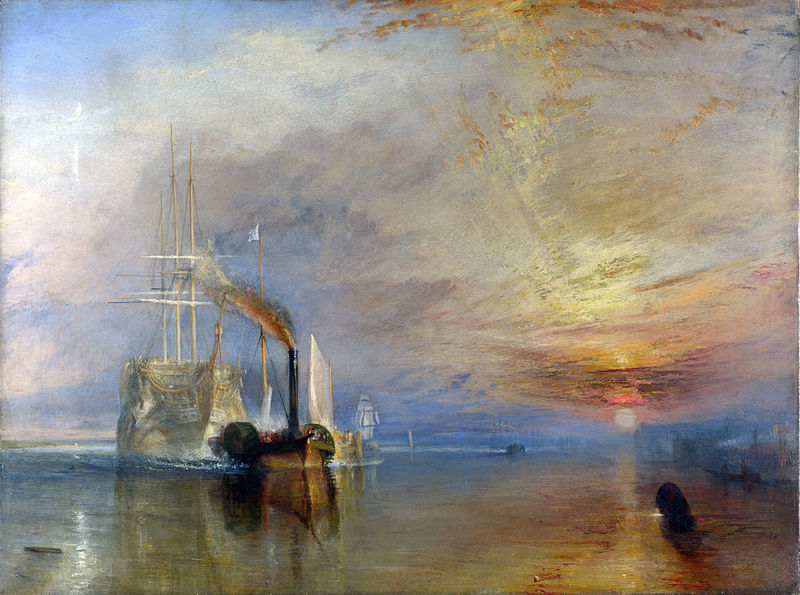
The Fighting Temeraire

The Fighting Temeraire

After “close reading” short stories, the sophomores were asked to use the same skills to “close read” several paintings that thematically connected to the Industrial Revolution. They studied a Constable pastoral painting, before J.M.W. Turner’s famous painting, The Fighting Temeraire. While some called attention to the the dirty smoke stack, others saw the energetic paddling as a sign of progress. They noticed the ghost-like ship hovering in the background, the light created by the sunset which gave the painting “warmth”or “light extinguishing”. When they were asked to use these elements as evidence to determine the artist’s message, there were some succinct responses to the painting’s “text.”

November 2013 Thanks for the NCTE Conference

Five members of the English Department attended the conference and selected from over 700 sessions at the National Council of Teachers of English and the Conference on English Leadership.  District support for such great professional development is truly appreciated. We are also grateful that four of our proposals were chosen to share as presentations for other educators. The explanations of our presentations with links to these presentations are included in this post.

December 2013 Drama Class Holiday Miracle

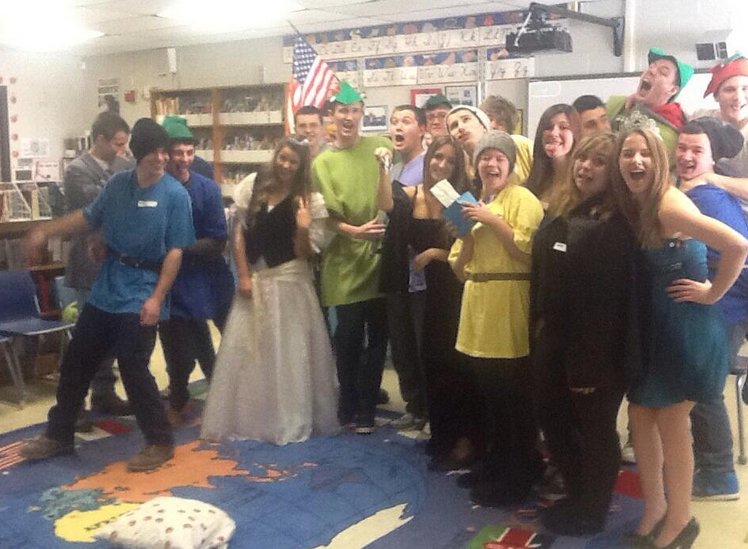
Cast photo!

Cast photo!

An ice storm two weeks before performance caused a car pile-up, and the drama club teacher was left with a concussion. She could not be in school; the students were on their own, and I was left to supervise their performances of Snow White and the Seven Dwarves at three local elementary schools.

Their “dress rehearsal” was a disaster, but, as the adage says, “The show must go on!” and once they arrived at the elementary schools, the students were anxious to do well. They naturally changed their staging moving from gym floor to library floor, the Evil Queen tossed her hair with anger, and the Prince strode onto the stage with more confidence. The dwarves were a source of comic relief, intentionally or not. I watched the holiday miracle of 2013 repeated three times that day. The students in drama class at each school were applauded, with congratulatory e-mails from the principals that offered praise.

End of the year note:

I am grateful to be an educator and to have the privilege to work with students that I learn from everyday. In this retrospective, I can state unequivocally that 2013 was a memorable year… as you can see from many of the reasons listed above.

Welcome to 2014! May this coming year be even more productive!

Every student can learn and perform differently in any given classroom. A hypothetical classroom of 24 hypothetical students is still a hypothetical classroom of diversity, with 24 individual combinations of learning styles.  Teachers should differentiate for a wide variety of learners and prepare for all students, especially those who have with dissimilar interests and abilities. How dissimilar? Consider this video of a toddler’s dance recital that went viral as an example:

There is obviously a “lesson plan” for this recital. The dance instructor’s objective for the recital is to have all the dancers perform the same dance routine to the song “Broadway Baby”. The routine has been choreographed, as evidenced by the photos, with simple arm movements and tap steps.

Screen Shot 2013-11-03 at 10.14.41 AM

Dancer #3 loosely following the routine…

At the stage right section of the chorus line, the four little girls in their festive tutus catch the attention of the videographer in the audience. He records the performance in which three out of four dancers are dedicated to staying in step and following the routine they had practiced.

Three of the four dancers synchronize their arm and toe-tapping movements; they obviously know the steps of dance routine.  Their performance, in contrast, is juxtaposed with the animated interpretation of another dancer whose enthusiasm for performance is both charming and comical.

Screen Shot 2013-11-03 at 10.15.39 AM

…singing and dancing her interpretation…

This dancer, let’s call her Dancer #3 (third from the left), is whole-heartedly performing her own distinctive dance steps and arm movements while still loosely following the choreographed routine. As the other dancers in the chorus line follow and conform according to scripted direction, Dancer #3 dances to her own distinctive beat.

Screen Shot 2013-11-03 at 10.10.11 AM

….expressing herself in movement…

The members of the audience are heard laughing in the background of the video. It is probably safe to say that in the audience watching the recital were the anxious parents, relatives, and friends of all the little girls in the chorus line.

Screen Shot 2013-11-03 at 10.10.58 AM

…and celebrating her difference…

Each audience member was rooting for their special dancer on stage, and depending on the point of view, each dancer was wonderful. Dancer #3’s family and friends, however, have the evidence to prove that their little girl’s performance was matchless.

Now consider how every classroom has has at least one Dancer #3. All teachers must be prepared to instruct a student or set of students like her who may differ in how they learn and perform. These differences are usually addressed under the educational theory of  learning styles, and there are numerous different theories about how these styles impact how individuals learn.. One theory (Fleming, 2001) suggests that all learners use one of three common learning styles: visual, auditory, and kinesthetic. Another theory  (Gardner) suggests that there are seven different learning styles for learners:

  • Visual (spatial): learning using pictures, images, and spatial understanding.
  • Aural (auditory-musical): learning using sound and music.
  • Verbal (linguistic): learning using words, both in speech and writing.
  • Physical (kinesthetic): learning using your body, hands and sense of touch.
  • Logical (mathematical): learning using logic, reasoning and systems.
  • Social (interpersonal): learning in groups or with other people.
  • Solitary (intrapersonal): learning alone through self-study.

Education theorists may suggest even more learning styles, but whatever the learning style, teachers must be prepared to meet all the needs of all the learners in their classrooms. The most recent discussion about learning styles provides the evidence that that all learners benefit when a multitude of learning styles are addressed in a classroom. The education reformer John Hattie uses many studies in his work Visible Learning, and he places little regard on the practice of individually matching a learning style to each learner. He notes that such a practice is only is 41% effective. That effectiveness of addressing learning styles is increased, however, when all there are a multitude of learning styles used regularly in a classroom for all learning styles. There is a positive result when all students are stimulated to listen (aural), to watch (visual), and to move (kinesthetic) in class whenever there is new learning. Since addressing all the learning styles is the basis for differentiation in the classroom, teachers must be prepared with activities that stimulate all students.

Screen Shot 2013-11-03 at 10.13.00 AM

…while drawing admiration from fellow dancers

Going back to the video and watching the energy of Dancer #3, her teacher would be well-advised to increase kinesthetic learning activities in class whenever possible. Perhaps because of her young age, Dancer #3 is not self-conscious about herself, providing the clearest example of a kinesthetic learner whose learning style is expressed through movement. That expression made a positive contribution to the recital if it is measured by the reaction of the audience and measured by the littlest dancer to the right who had been watching Dancer #3 out of the corner of her eye.  The final frames show this small dancer turn in admiration to the other dancers at a job well done; she holds her hand out as if to congratulate the exuberant Dancer #3. They smile at each other in delight.

Key to understanding the importance of celebrating student differences is recognizing that this video would not have been the viral hit viewed by millions if Dancer #3 had danced the routine exactly as her dancing teacher had choreographed. Instead, Dancer #3 tapped and sang what she learned and demonstrated her own learning style; she elevated the group’s performance to a different level by dancing to a different beat.

Her dance is a celebration of difference, and also a “heads up” to her teacher(s)…. better get ready!

Our English II World Literature course complements the World History course, so when the students are learning about the Industrial Revolution, our English course has students read the opening chapters to Charles Dickens’s Oliver Twist.

Reading Dickens, however, is a challenge for many students, particularly if they lack background knowledge on the story’s setting. In order to help them better understand the context of England during the Industrial Revolution, we incorporated several famous paintings to illustrate the shift from the pastoral setting to the urban setting.

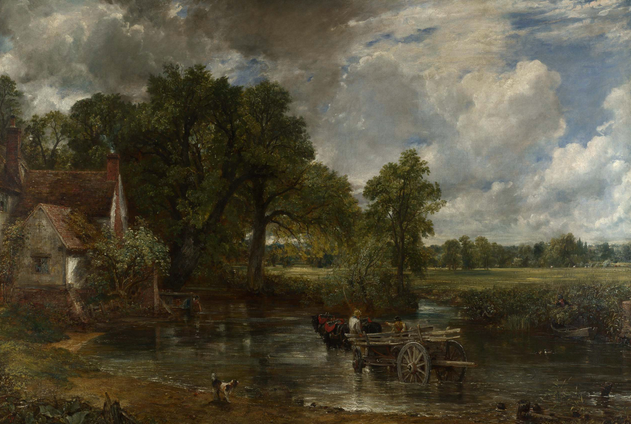
Rather than show a painting in its entirety at first, we made screenshots of different sections of each painting and had the students “read” what they saw. For example, we began with John Constable’s painting The Hay Wain (1821) which hangs in the National Gallery in London, England.

Screen Shot 2013-10-02 at 9.23.04 PM

upper left corner of Constable’s “The Hay Wain”

Students looked at the information communicated in the upper left quadrant  of the painting and discussed the architecture of the roof and the large empty tree branches. They noted the gathering storm clouds in the background; “a tone of danger” noted one student. 

We then had students look at the lower right quadrant of the painting where a farmer’s cart was being driven along a stream bed. They noted the details of the team of horses and speculated as to why the men would be walking upstream. 

Screen Shot 2013-10-02 at 9.23.46 PM

lower right corner of Constables “The Hay Wain”

They speculated that there might be no road because a road might not have been necessary if transportation was easier by water, and one student called attention to a small canoe on the stream’s bank. They called attention to the earth tone colors that contrasted with the red harnesses of the horses.

Then we showed the students the full painting.

Screen Shot 2013-10-02 at 9.49.07 PM

Constable’s painting is based on a site in Suffolk. The hay wain, a type of horse-drawn cart, stands in the water in the foreground. (National Gallery Picture Library
St Vincent House, 30 Orange Street, London)

When the students saw the entire painting, they were already familiar with some of the smaller details. They were able to locate these smaller details and suggest how they contributed to the larger “story” of the painting. They determined Constable’s painting celebrated the pastoral life outside London, a striking contrast from the setting of Oliver Twist where impoverished street children were placed in workhouses or recruited by criminals.

The painting that best illustrates the cultural shift caused by the Industrial Revolution, however,  is J. M. W. Turner’s The Fighting Temeraire. The oil painting depicts the gunship with her sails tightly wrapped to the rigging being tugged  by a steam powered paddle-wheel to the shipyard before being broken up for scrap. Turner painted the tribute to the end of sailing ships in 1838, the same year that Dickens published Oliver Twist. Both works brought attention to the drastic change in the way of life as a result of the Industrial Revolution.

“The Fighting Temeraire”, an oil painting by the English artist J. M. W. Turner (1938) National Gallery, London

Since the students had practiced close reading the Constable pastoral painting, they were ready to close read Turner’s painting. While some called attention to the the dirty smoke stack, others saw the energetic paddling as a sign of progress. One noticed the ghost-like ship hovering in the background; another noted a potential danger of a submerged obstacle in the foreground floating in the right corner of the painting. Most commented on the light created by the sunset which gave the painting “warmth”or “a glow” for some or a “light extinguishing” for others. When they were asked to use these elements as evidence to determine the artist’s message, there were some succinct responses:

  • “It’s out with the old!”
  • “The coal fire is the new light; the sun is the old light”
  • “Coal power, not wind power”
  • “Beauty fades”

Turner’s The Fighting Temeraire was voted England’s favorite painting in a 2005 poll organized by BBC Radio 4’s Today.  The painting was also highlighted in the recent James Bond film Skyfall. In the scene in the National Gallery, Bond meets his new handler, Q, while both sit on a bench opposite the painting:

Q: It always makes me feel a bit melancholy. Grand old war ship. being ignominiously haunted away to scrap… The inevitability of time, don’t you think? What do you see?
Bond:  A bloody big ship. Excuse me.
Q: 007. I’m your new Quartermaster.
Bond: You must be joking.
Q:  Why, because I’m not wearing a lab coat?
Bond: Because you still have spots.
Q: My complexion is hardly relevant.
Bond: Your competence is.
Q: Age is no guarantee of efficiency.
Bond:  And youth is no guarantee of innovation.

Skyfall (http://www.imdb.com/title/tt1074638/quotes)

After watching the film clip, the students were in agreement that they are living in a new digital revolution, and that technology has changed their culture from that of their parents. If they want a sunset, they don’t need a painting by Turner….they have Instagram.

Open House: OMG!

September 15, 2013 — 1 Comment

September is Open House Month, and the welcoming speech from a teacher could sound like this:

“Welcome, Parents! Let me show you how to access my website on the SMARTboard where you can see how the CCSS are aligned with our curriculum. You can monitor your child’s AYP by accessing our SIS system, Powerschool. In addition, all of our assignments are on the class wiki that you can access 24/7.  As we are a BYOD school, your child will need a digital device with a 7″ screen to use in class.”

OMG!

How parents may feel during Open House listening to education acronyms

The result of such a speech is that parents may feel like students all over again. The same people who sat in desks, perhaps only a few years ago, now are on another side of the classroom experience, and the rapid changes caused by the use of technology in education necessitate a need for education primer, a list of important terms to know. While attending the Open House, parents can observe that there are still bulletin boards showcasing student work. They can note how small the desks appear now, if there are desks. Perhaps the lunch lady is the same individual who doled out applesauce and tater tots onto their school lunch trays.  Yet, listening to how instruction is delivered, monitored, and accessed may make parents feel that they are in some alien experience with instructors and administrators spouting a foreign language. Just what is a wiki? they may wonder, and what does BYOD stand for?

So, let’s begin with some of the acronyms.  At Open House, educators may casually throw around some of the following terms to explain what they teach or how they measure what they teach:

  • PBL (Project Based Learning) a hands-on lesson;
  • SIS (Student Information System);
  • Bloom’s Taxonomy: a sequence of learning based on complication of task and level of critical thinking which is being replaced by the DOK;
  • DOK (Depths of Knowledge) complication of task and level of critical thinking required
  • ESL (English as a Second Language);
  • AYP (Adequate Yearly Progress);
  • WIKI: a web application which allows people to add, modify, or delete content in a collaboration with others; and
  • SMARTboard: interactive white board

Subject area names may also seem unfamiliar since they now reflect a different focus on areas in education. English is now ELA (English/Language Arts) while science and math have merged like the Transformers into the mighty STEM (Science, Technology, Engineering, and Math). The old PE class may now bear the moniker Physical Activity and Health (PAH), but  History has already dealt with the shift to the more inclusive term Social Studies coined in the 1970s.

Assessment (testing) brings about another page in the list of education acronyms that parents may hear on Open House, including these few examples:

DRP (Degrees of Reading Power) reading engagement, oral reading fluency, and comprehension younger elementary students;
DRA (Developmental Reading Assessment) reading engagement, oral reading fluency, and comprehension in elementary and middle grade students;
STAR: new skills-based test items, and new in-depth reports for screening, instructional planning, progress monitoring;
PSAT/SAT/ACT:designed to assess student academic readiness for college 

Parents, however, should be aware that they are not alone in their confusion. Educators often deal with acronym duplication, and  state by state the abbreviations may change. In Connecticut, some students have IEPs (Individual Education Plans), but all students have SSP (Student Success Profiles) which shares the same acronym with the SSP (Strategic School Profile). Connecticut introduced the teacher evaluation program SEED known as the System for Educator Evaluation and Development, which is an acronym not to be confused with SEED, a partnership with urban communities to provide educational opportunities that prepare underserved students for success in college and career.

Federal programs only add to the list of abbreviations. Since 1975, students have been taught while IDEA (Individuals with Disabilities Education Act) has been implemented. NCLB (No Child Left Behind) has been the dominating force in education for the length of the Class of 14’s time in school, along with its partner SSA (Student Success Act) which is similar to, but not exactly like, the SSP mentioned earlier. The latest initiative to enter the list of reform movements that parents should know  is known as the CCSS the Common Core State Standards.

The CCSS are academic standards developed in 2009 and adopted by 45 states in order to provide “a consistent, clear understanding of what students are expected to learn, so teachers and parents know what they need to do to help them.” Many of the concepts in the CCSS will be familiar to parents, however, the grade level at which they are introduced may be a surprise. Just as their parents may have been surprised to find the periodic tables in their 5th grade science textbooks, there are many concepts in math (algebra) and English (schema) that are being introduced as early as Kindergarten.

So when a student leaves in the morning with a digital device for school, BYOD or BYOT (Bring Your Own Technology) and sends a “text” that they will be staying late for extra help or extra-curricular activities, parents should embrace the enhanced communication that this Brave New World of technology in education is using. If at Open House a parent needs a quick explanation of the terms being used by a teacher, he should raise his hand;  in spite of all these newfangled terms and devices, that action still signals a question.

Above all, parents should get to know the most important people in the building: the school secretary (sorry, the Office Coordinator) and the school custodian (sorry, FMP: Facility Maintenance Personnel). They know where your child left her backpack.

Saki

Author H.H. Munro also known as Saki

H.H. Munro was the NYTimes crossword across clue last week, and as it so often happens, I just happened to be talking about H.H. Munro to the sophomore English class these first days of school. Just name dropping Saki, his pseudonym, caught their attention.
“What kind of a name is that?” they asked.
When I told them he might have been referring to the Saki monkey, a small South American primate, they concurred that he had chosen a cool pen name. 

Saki’s short stories open our World Literature course which complements the Modern World History course offered the same year. Our students will be reading complex texts required by the English Language Arts Common Core State Standards (CCSS), and  complex texts are those that meet four criteria:

1) Meaning: Multiple levels of meaning (such as satires, in which the author’s literal message is intentionally at odds with his or her underlying message).
(2)  Structure: Complex, implicit, and (particularly in literary texts) unconventional structures.
(3) Language: Figurative, ironic, ambiguous, purposefully misleading, archaic or otherwise unfamiliar language
(4) Knowledge Demands: Everyday knowledge and familiarity with genre conventions required; cultural and literary knowledge useful.

Saki’s work meets the CCSS criteria above, but I have learned that the practice of close reading never follows the lengthy tortuous path suggested by Common Core developers who have no classroom experience. My students stray.

The text selected was “The Interlopers”. (SPOILER ALERT For those of you who are unfamiliar with the story and want to read it before I reveal the plot twist, link to the text. There is also an audio-text.)

To prepare students, but careful not to “overteach” before reading, I gave students slips of paper with 25 words from the story. The slips including some of the more difficult vocabulary (languor, succor, marauder) and some plot details (woodland, feud, detest). Some of the students sorted the words alphabetically, but others grouped words that shared some commonality. After a few minutes of discussion, we joined together to predict what the story would be about using the grouped words; there would be a dispute in the forest that was linked to some feud, just like the feud in Romeo and Juliet.
Then we read the story.

Thirteen minutes later, some heads shot up. They had reached Saki’s iconic last word…”wolves!”

“Wolves!” one student questioned, “does that mean they die?”
There was much stirring. Some seemed surprised; others seemed confused.
In contrast, I thought the ending was obvious. Two men, trapped under a tree, end a bitter feud over forest land only to eaten by wolves.

Several, but not all, of my students thought differently.

“They weren’t rescued?” asked Kailey, “but one of them said he had men that would be there to rescue them in the forest.”
“He was bluffing,” responded Logan. “He was trying to scare the other guy when they first met.”
“But there was a gun,” pointed out Stephan, “one could have used the gun.”
“They had their arms ‘pinioned’,” I responded, trying to slip in another vocabulary word, “pinioned means to tie up the arms of…”
“They could have wriggled out when they saw the wolves,” insisted Stephan, “the rush of adrenaline would make them so strong, they could un-pinion their arms.”
“But there is no evidence to show that,” I responded. “The last word is their last word because the wolves come upon them.”

I had thought the story was straightforward. There were no flashbacks, and no change in setting. This was, according to Aristotle, a story that demonstrated unity of time, unity of place, and unity of action.

Yet the conversations in the room showed the text’s complexity. Saki’s The Interlopers has all the elements suggested by the CCSS. There is the figurative language in the character Ulrich’s statement, “We have quarrelled like devils all our lives over this stupid strip of forest, where the trees can’t even stand upright in a breath of wind.” There is the ironic wish, “If only on this wild night, in this dark, lone spot, he might come across Georg Znaeym, man to man, with none to witness – that was the wish that was uppermost in his thoughts.” There is also the multiple meaning in the revenge sought by man and the revenge exacted by Nature. Our close reading should have been “textbook”. The evidence proved the characters’ demise…or did it? I began to consider the renegade students’ position.

“See,” insisted Kailey, “look at the text, Georg says he has seven men out with him before the tree fell. These seven men would hear their screaming.”
“Yes, there would be screaming. Their last words were, ‘AHHH!!! OUCH!!! THAT HURTS!!'”Jay yelled.
“But that does not mean they were definitely eaten,” corrected Kai, “this guy Saki wants you to make up your mind.”

Which is true. Saki does not end the story with screams of pain or with tales of rescue. He trusts the reader to use evidence to make up his or her own mind. Several of my students did not want to see Ulrich and Georg meet their demise, especially when they had settled their long standing feud.

The class discussion continued with each piece of evidence for the “eaten by wolves” side being countered by evidence from the “escaped with their lives” side. The students were definitely close reading, but they were exploiting Saki’s ambiguity to defend their differing positions. A case could be made for both.

Yes, they understood the importance of irony in the story, and yes, they were familiar with plot twists, but they still held out hope. Saki had made them care for these characters in the 2100 words of this short story. He had given just the right amount of contradictory information to leave room for just a sliver of hope. A 99 and 44/100’s sort of hope.

Did they hold out hope because of their youth? Aristotle suggests that, “Youth is easily deceived because it is quick to hope.” Yet, Aristotle is also credited with saying, “Hope is the dream of a waking man.” 

In retrospect, Saki himself would probably have enjoyed their commentary. I discovered too late for the discussion that Saki has been quoted as saying, “A little inaccuracy sometimes saves a ton of explanation.”

Continue Reading…