Archives For November 30, 1999

This post completes a trilogy of reflections on the Connecticut Academic Performance Test (CAPT) which will be terminated once the new Smarter Balance Assessments tied to the Common Core State Standards (CCSS) are implemented. There will be at least one more year of the same CAPT assessments, specifically the Interdisciplinary Writing Prompt (IW) where 10th grade students write a persusive essay in response to news articles. While the horribly misnamed Response to Literature (RTL) prompt confuses students as to how to truthfully evaluate an story and drives students into “making stories up” in order to respond to a question, the IW shallowly addresses persuasive writing with prompts that have little academic value.

According to the CAPT Handbook (3rd Generation) on the CT State Department of Eduction’s website, the IW uses authentic nonfiction texts that have been:

“… published and are informational and persuasive, 700-1,000 words each in length, and at a 10th-grade reading level.  The texts represent varied content areas (e.g., newspaper, magazine, and online articles, journals, speeches, reports, summaries, interviews, memos, letters, reviews, government documents, workplace and consumer materials, and editorials).  The texts support both the pro and con side of the introduced issue.  Every effort is made to ensure the nonfiction texts are contemporary, multicultural, engaging, appropriate for statewide implementation, and void of any stereotyping or bias.  Each text may include corresponding maps, charts, graphs, and tables.”

Rather than teach this assessment in English, interdisciplinary writing is taught in social studies because the subject of social studies is already interdisciplinary. The big tent of social studies includes elements of economics, biography, law, statistics, theology, philosophy, geography, sociology, psychology, anthropology, political science and, of course, history. Generally, 9th and 10 grade students study the Ancient World through Modern European World (through WWII) in social studies. Some schools may offer civics in grade 10.

Social studies teachers always struggle to capture the breadth of history, usually Western Civilization, in two years. However, for 15 months before the CAPT, social studies teachers must also prepare students to write for the IW test. But does the IW reflect any of the content rich material in social studies class? No, the IW does not. Instead the IW prompt is developed on some “student centered” contemporary issue. For example, past prompts have included:

  • Should students be able to purchase chocolate milk in school?
  • Should utility companies construct wind farms in locations where windmills may impact scenery or wildlife?
  • Should ATVs be allowed in Yellowstone Park?
  • Should the school day start later?
  • Should an athlete who commits a crime be allowed to participate on a sports team?
  • Should there be random drug testing of high school students?

On the English section of the test, there are responses dealing with theme, character and plot. On the science section, the life, physical and earth sciences are woven together in a scientific inquiry. On the math section, numeracy is tested in problem-solving. In contrast to these disciplines, the social studies section, the IW, has little or nothing to do with the subject content. Students only need to write persuasively on ANY topic:

For each test, a student must respond to one task, composed of a contemporary issue with two sources representing pro/con perspectives on the issue.  The task requires a student to take a position on the issue, either pro or con.  A student must support his or her position with information from both sources.  A student, for example, may be asked to draft a letter to his or her congressperson, prepare an editorial for a newspaper, or attempt to persuade a particular audience to adopt a particular position.  The task assesses a student’s ability to respond to five assessed dimensions in relationship to the nonfiction text: (1) take a clear position on the issue, (2) support the position with accurate and relevant information from the source materials, (3) use information from all of the source materials, (4) organize ideas logically and effectively, and (5) express ideas in one’s own words with clarity and fluency.

The “authentic” portions of this test are the news articles, but the released materials illustrate that these news articles are never completely one-sided; if they are written well, they already include a counter-position.  Therefore, students are regurgitating already highly filtered arguments. Secondly, the student responses never find their way into the hands of the legislators or newspaper editors, so the responses are not authentic in their delivery. Finally, because these prompts have little to do with social studies, valuable time that could be used to improve student content knowledge of history is being lost.  Some teachers use historical content to practice writing skills, but there is always instructional time used to practice with released exam materials.

Why are students asked to argue about the length of a school day when, if presented with enough information, they could argue a position that reflects what they are learning in social studies? If they are provided the same kinds of newspaper, magazine, and online articles, journals, speeches, reports, summaries, interviews, memos, letters, reviews, government documents, workplace and consumer materials, and editorials, could students write persuasive essays with social studies content that is measurable? Most certainly. Students could argue whether they would support a government like Athens or a government like Sparta. Students could be provided brief biographies and statements of belief for different philosophers to argue who they would prefer as a teacher, DesCartes or Hegel. Students could write persuasively about which amendment of the United States Constitution they believe needs to be revisited, Amendment 10 (State’s Rights) or Amendment 27 (Limiting Changes to Congressional Pay).

How unfortunate that such forgettable issues as chocolate milk or ATVs are considered worthy of determining a student’s ability to write persuasively. How inauthentic to encourage students to write to a legislator or editor and then do nothing with the students’ opinions. How depressing to know that the time and opportunity to teach and to measure a student’s understanding of the rich content of social studies is lost every year with IW test preparation.

coffeetalkMaybe the writers of the CAPT IW prompt should have taken a lesson from the writers of Saturday Night Live with the Coffee Talk with Michael Myers. In these sketches, Myers played Linda Richmond, host of the call-in talk show “Coffee Talk”. When s(he) would become too emotional (or feclempt or pheklempt ) to talk, s(he) would “give a topic” to talk “amoungst yourselves”.  Holding back tears, waving red nails in front of his face furiously, Myers would gasp out one of the following:

“The Holy Roman Empire was neither holy, Roman, nor an empire….Discuss…”

“Franklin Delano Roosevelt’s New Deal was neither new nor a deal…. Discuss…”

“The radical reconstruction of the South was neither radical nor a reconstruction…. Discuss…”

“The internal combustion engine was neither internal nor a combustion engine…. Discuss…”

If a comedy show can come up with these academic topics for laughs, why can’t students answer them for real? At least they would understand what made the sketches funny, and that understanding would be authentic.


As the Connecticut State Standardized tests fade into the sunset, teachers are learning to say “Good-bye” to all those questions that ask the reader to make a personal connection to a story. The incoming  English Language Arts Common Core Standards (ELA- CCSS) are eradicating the writing of responses that begin with, “This story reminds me of…..” Those text to self, text to text, and text to world connections that students have made at each grade level are being jettisoned. The newly designed state assessment tests will tolerate no more fluff; evidence based responses only, please.

sunsetPerhaps this hard line attitude towards literacy is necessary correction. Many literacy experts had promoted connections to increase a reader’s engagement with a text. For example,

 “Tell about the connections that you made while reading the book. Tell how it reminds you of yourself, of people you know, or of something that happened in your life. It might remind you of other books, especially the characters, the events, or the setting” (Guiding Readers and Writers Grades 3-6, Fountas and Pinnell) 

Unfortunately, the question became over-used, asked for almost every book at each grade level. Of course, many students did not have similar personal experiences to make a connection with each and every text. (Note: Given some of the dark literature-vampies, zombies- that adolescents favor, not having personal experience may be a good sign!) Other students did not have enough reading experience or the sophistication to see how the themes in one text were similar to themes in another text.  Some of the state assessment exemplars revealed how students often made limited or literal connections, for example:”The story has a dog; I have a dog.”

The requirement to make a connection to each and every story eventually led to intellectual dishonesty.  Students who were unable to call to mind an authentic connection faked a relationship or an experience. Some students claimed they were encouraged by their teachers to “pretend” they knew someone just like a character they read about. “Imagine a friend had the same problem,” they were told.   Compounding this problem was the inclusion of this connection question on the state standardized tests, the CAPT (grade 10) and the CMT (grades 3-8). So, some  students traded story for story in their responses, and they became amazingly creative in answering this question. I mentioned this in a previous post when a student told me that the sick relative he had written about in a response didn’t really exist. “Don’t worry,” he said brightly after I offered my condolences, “I made that up!”

Last week, our 9th grade students took a practice standardized test with the “make a connection question” as a prompt. They still need to practice since there is one more year of this prompt before ELA CCSS assessments are in place. The students wrote their responses to a story where the relationship between a mother and daughter is very strained. One of the students wrote about her deteriorating and very difficult relationship with her mother. I was surprised to read how this student had become so depressed and upset about her relationship with her mother. I was even more surprised that afternoon when that same mother called to discuss her daughter’s grade. I hesitated a little, but I decided to share what was written in the essay as a possible explanation. The next day, I received the following e-mail,

“I told M___that I read the practice test where she said I didn’t have time to talk and other things were more important. She just laughed and said that she had nothing in common with the girl in the story so she just made that up because she had to write something. We had a good laugh over that and I felt so relieved that she didn’t feel that way.”

After reading so many student “make a connection” essays, I should have seen that coming!

Good-bye, “Make a Connection” question. Ours was an inauthentic relationship; you were just faking it.

Screen Shot 2013-03-10 at 11.08.07 AMMarch in Connecticut brings two unpleasant realities: high winds and the state standardized tests. Specifically, the Connecticut Academic Performance Tests (CAPT) given to Grade 10th are in the subjects of math, social studies, sciences and English.

There are two tests in the English section of the CAPT to demonstrate student proficiency in reading. In one, students are given a published story of 2,000-3,000 words in length at a 10th-grade reading level. They have 70 minutes to read the story and draft four essay responses.

What is being tested is the student’s ability to comprehend, analyze, synthesize, and evaluate. While these goals are properly aligned to Bloom’s taxonomy, the entire enterprise smacks of intellectual dishonesty when “Response to Literature” is the title of this section of the test.

Literature is defined online as:

“imaginative or creative writing, especially of recognized artistic value: or writings in prose or verse; especially writings having excellence of form or expression and expressing ideas of permanent or universal interest.”

What the students read on the test is not literature. What they read is a story.

A story is defined as:

“an account of imaginary or real people and events told for entertainment.”

While the distinction may seem small at first, the students have a very difficult time responding to the last of the four questions asked in the test:

How successful was the author in creating a good piece of literature? Use examples from the story to explain your thinking.

The problem is that the students want to be honest.

When we practice writing responses to this question, we use the released test materials from previous years: “Amanda and the Wounded Birds”, “A Hundred Bucks of Happy”, “Machine Runner” or “Playing for Berlinsky”.  When the students write their responses, they are able to write they understood the story and that they can make a connection. However, many students complain the story they just read is not “good” literature.

I should be proud that the students recognize the difference. In Grades 9 & 10, they are fed a steady diet of great literature: The Odyssey, Of Mice and Men, Romeo and Juliet, All Quiet on the Western Front, Animal Farm, Oliver Twist. The students develop an understanding of characterization. They are able to tease out complex themes and identify “author’s craft”. We read the short stories “The Interlopers” by Saki, “The Sniper” by Liam O´Flaherty, or “All of Summer in a Day” by Ray Bradbury. We practice the CAPT good literature question with these works of literature. The students generally score well.

But when the students are asked to do the same for a CAPT story like the 2011 story “The Dog Formerly Known as Victor Maximilian Bonaparte Lincoln Rothbaum”, they are uncomfortable trying to find the same rich elements that make literature good. A few students will be brave enough to take on the question with statements such as:

  • “Because these characters are nothing like Lenny and George in Of Mice and Men…”
  • “I am unable to find one iota of author’s craft, but I did find a metaphor.”
  • “I am intelligent enough to know that this is not ‘literature’…”

I generally caution my students not to write against the prompt. All the CAPT released exemplars are ripe with praise for each story offered year after year. But I also recognize that calling the stories offered on the CAPT “literature” promotes intellectual dishonesty.

Perhaps the distinction between literature and story is not the biggest problem that students encounter when they take a CAPT Response to Literature. For at least one more year students will handwrite all responses under timed conditions: read a short story (30 minutes) and answer four questions (40 minutes). Digital platforms will be introduced in 2014, and that may help students who are becoming more proficient with keyboards than pencils.
But even digital platforms will not halt the other significant issue with one other question, the “Connection question (#3)” on the CAPT Response to Literature:

 What does this story say about people in general? In what ways does it remind you of people you have known or experiences you have had?  You may also write about stories or books you have read or movies, works of art, or television programs you have seen.  Use examples from the story to explain your thinking.

Inevitably, a large percentage of students write about personal experiences when they make a connection to the text. They write about “friends who have had the same problem” or “a relative who is just like” or “neighbors who also had trouble”.  When I read these in practice session, I sometimes comment to the student, “I am sorry to hear about____”.

However, the most frequent reply I get is often startling.

“No, that’s okay. I just made that up for the test.”

At least they know that their story, “an account of imaginary or real people and events told for entertainment,” is not literature, either.

The teachers at the professional development session were visibly frustrated; I could hear the irritation in their comments. The presentation on the use of digital technology was to help them improve digital literacy across the content areas, but many of the sites in the demonstration were blocked by the school’s Internet filter. I sympathized with their frustration because just three years ago, I was like them. Three years ago, our school’s Internet filter blocked everything.blocked youtube

Back then, members of my English department were finding excellent resources to use to teach the novels All Quiet on the Western Front, The Crucible, and the memoir Night. Unfortunately, many of these resources were unavailable because they were on YouTube or had descriptors such as “witchcraft in Salem, Massachusetts” or “Nazi” that were blocked by our filters. The filters were useless to a large degree since many of the students knew a variety of different strategies to get around each filter. So, the irony was that the students had access where the teachers did not.

Furthermore, the students were having a rich and very authentic experience of using the Internet outside of school. Once they came into our building, however, they were detached from the very technology that they would need to use in their future. Our school web filters  created an “un-authentic” web experience for our students. We were losing the opportunity to teach them digital citizenship because they were not digital citizens.

Fortunately, our administration took the position that teaching our students 21st Century skills meant that they should have access to the Internet in a technology rich learning experience. The filters were minimized. Our acceptable use policy was enforced, and teachers and students had access to the Internet resources.

We moved from exclusively computer lab use to 1:1 netbooks in English/Social Studies to a “Bring Your Own Digital Device” (BYOD) over the course of the next two years, and now, two years later, I can testify that unblocking the Internet has not created a problem for teachers or students. Yes, the students can watch YouTube videos, but they also make videos and share them with other students. They make videos for our “Friendship and Respect” Assemblies and share these on YouTube; they watch Oscar winning films for Film and Literature Class that are on YouTube; they embed YouTube videos into their blogs.

Furthermore, our students have access to the Internet to meet the state adopted Common Core Literacy Standard:

CCSS.ELA-Literacy.CCRA.W.6 Use technology, including the Internet, to produce and publish writing and to interact and collaborate with others.

Of course, our students are not perfect, and their behaviors using the Internet at school are not always tied to curriculum. I once came upon a group of young men huddled around a computer screen one morning. They were watching a video, and as I grew closer, I could hear a voice say, “She’s a beauty…” and another agree, “Oh, I want her!” I feared the worst, but when  I came up behind them to see what was on the screen, I got a eyeful of a 2006 Ford F250 XLT Powerstroke Turbo Diesel Pick Up Truck. Curriculum? No. Authentic experience? Yes.

The frustrated teachers who were sitting in the professional development asked what steps they could take to have their administrators review acceptable use policies and open the Internet filters for their students. They discussed looking at other school districts’ acceptable use policies. Perhaps there might be some testimony about the success of unlocking an Internet filter?

This post is one such testimony, and I offer this to any teacher that is looking to “unblock” the Internet in order to engage students in developing 21st Century skills. We are already in the second decade of this 21st Century, and the skills necessary to use the Internet are becoming more valuable in this Information Age. According to the 2012 data, using the Internet is a real world experience for 2,405,518,376 people. That is 1/3 of the world’s population, and there has already been a 566% increase in use since the beginning of the new millenium.

Our students are counted in those numbers already. While they use the Internet outside of school for social media; they should be taught to use the Internet for education and productivity in school. So once they have access to YouTube, they can never go back…they will only go forward.

forbesFobes recently published a feature article/photo spread, 30 Educators under 30:The Millennials Overhauling Education And Leaving No Child (Or Teacher) Behind by Meghan Casserly, 12/7/2012. The lead in for the article read:

The 30 Gen-Yers on our list are innovators, advocates, thought-leaders and reformers. Through outreach initiatives and engineering they’re committed, like my mom, to giving kids everywhere the best chance at success. They’re committed to making the lives of teachers like her just a little bit easier, whether through technology that saves them precious minutes communicating with parents or helps them use data analytics to track performance more efficiently than traditional paper grade books ever could.

A series of slick, glossy photos of well-dressed, smiling bright-eyed entrepreneurs and CEOs followed. Readers were advised to, “Click through the gallery for the 30 men and women who are disrupting education from top to bottom.” Disrupting? Is that what needs to happen to education? To disrupt? To disrupt means:

1. To throw into confusion or disorder;
2. To interrupt or impede the progress, movement, or procedure of;
3. To break or burst; rupture.

Disrupting is a perplexing choice if the purpose of the article is to praise the contributions these individuals are making to the business of education. When students disrupt a class, they are given detentions. The choice of the verb is contradictory because in the next sentence readers are encouraged “to visit their websites and reach out to congratulate them, to give them well-deserved credit for their hard work.” Are we being asked to congratulate disruption?

I did visit some of the websites mentioned in the photospread, and I do want to express my thanks to the CEOs who provide free and well-designed software programs. Specifically, I noted the photos of  Nic Borg, 26, Cofounder and CEO, Edmodo; Sam Chaudhary, 26, and Liam Don, 26, Co-founders of ClassDojo; and Andrew Sutherland, 23, Founder, Quizlet.  I will agree that these products contribute positively to my classroom environment. None of their products are “disruptive”.

The photos of these four product founders and their 26 smiling cohorts confirmed that all were vibrantly under 30, so I concede the “30 under 30” part of the headline. And yes, all 30 individuals are associated with the business of education, but they are not educators. These 30 individuals are educreators. The difference? Educators are in classrooms….Educreators are not.

Educators are in the classroom designing lessons, developing assessments, grading papers, contacting parents, posting bulletin boards, collecting data, analyzing data, meeting with teachers, collaborating with special education teachers, organizing supplies, selecting resources, and adjusting plans every minute of ever school day, and in most cases, for hours before or after school. In short, educators teach.

All Edu-creators have been in classrooms…as students. One edu-creator featured in the article spent three years in a classroom for Teach for America, one year more than the required two years of service. Each of the edu-creators has a product to improve education, but that does not make them educators. They are not in the classroom teaching; many are marketing a product for the classroom.

There has been an explosion of educreations that parallels the expansion of technology in the classroom. Many of these educreations from educreators are offered free or in “lite” versions. Ultimately, these products will make money for their founders and CEOs; there will be subscriptions or advertisements that generate revenue for these ’30 under 30″, and that is how capitalism works. A good product will sell, and many of these are good products. However, these products are tools for educators to use, not replacements for educators themselves.

Other members of the “30 under 30” are contributing to education policy by serving on boards, writing books, or being advocates for non-profits. These roles are also important, but again, these educreators have little practical experience to anticipate the problems that even the smallest changes in policy can have in the classroom. For example, a change in a state endorsed teacher evaluation system can result in thousands of hours for training evaluators and teachers  to meet new requirements, and those new requirements will be modified numerous times until an evaluation system proves effective. The effect of policy on the individual teacher or classroom is rarely witnessed; instead, policymakers are focused on the collection of “data”, not the hundreds of personal stories policy creates.

Comments under the article decry the lack of teachers. As Becky D succinctly  states:

I think it an egregious oversight that this list doesn’t include a single practicing educator.

Meghan Casserly’s response?

Educators obviously impact hundreds if not thousands of students over the course of their careers–and I looked for ways to weigh that against some of the other people on this list. Particularly for teachers under 30, it was extremely difficult to compare them in any apples-to-apples way. That said, there were some amazing teachers nominated who I was sure fit the bill—only to find out they were already 30!

So, are we to take from this comment that there are no real educators under 30 who are overhauling education and leaving no child behind? Perhaps there are no “amazing teachers” under 30 immediately visible to Casserly because they are so busy designing lessons, developing assessments, grading papers, contacting parents, posting bulletin boards, collecting data, analyzing data, meeting with teachers, collaborating with special education teachers, organizing supplies, selecting resources, and adjusting plans every minute of every school day that they simply do not have the time to create new educational software programs, run advocacy groups, or write educational policy. They are teachers, and they are real educators. They will not be featured in a Forbes magazine article about overhauling education because they are engaged in the time-consuming and productive activity of building skills and improving understanding for students of all ages.

What did Casserly get right with this article? She suggests that if the reader does get to meet one of the featured “30 under 30”, that the reader should ask, “…what teacher they have to thank for helping them land on our pages.” I agree;  their educators would be proud of the success of their former students, their own educreations.

Screen Shot 2012-12-02 at 10.44.58 AM

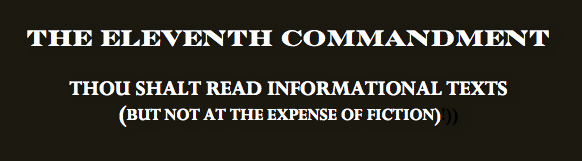
What SHOULD be a tenet of the Common Core State Standards.

The 11th Commandment from Common Core State Standards (CCSS)? Thou Shalt Read Informational Texts.

This edict from on high, from current College Board President and co-architect/promoter of the CCSS David Coleman, has had a seismic shift in curriculum at all grade levels. English/Language Arts Curriculum directors and teachers are jettisoning fiction from their lesson plans in the mistaken belief that they alone are responsible for addressing this new found commandment. For the uninitiated, informational texts in the CCSS replaces the genre previously known as non-fiction and includes many other genres including essays, speeches, and reports.

Columnist Joel Stein exposes the foolishness of this effort in his commentary “How I Replaced Shakespeare” in the 12/10/12 issue of Time Magazine when he discovered that his writing was being analyzed by students. (Note: Diane Ravitch, education activist has the full post on her blog) His response to students who were assigned his articles and who were parsing them for literary devices or thesis?

“Transfer high schools immediately! To one that teaches Shakespeare and Homer instead of the insightful commentary of a first-rate, unconventionally handsome modern wit! Also, don’t do drugs!”

Stein readily admits that students should have some exposure to different genres and explains that he learns how to write in different genres by looking at examples. Similarly English/Language Arts curriculum require students to write in various genres as well through models as well; for example, students are taught with models as to how to write in the genres of essay, business or friendly letter, book review, and poetry.

However, Stein refutes one of Coleman’s most quoted talking points. Coleman said, “It is rare in a working environment that someone says, ‘Johnson, I need a market analysis by Friday, but before that I need a compelling account of your childhood.’” Stein’s response? “I agree with this, but only because no one has ever asked me for a market analysis.”

Stein points out that fiction provides the models that makes writers better. “No nonfiction writer can teach you how to use language like William Faulkner or James Joyce can,” he continues. Stein also mentions how the themes in fiction, and he mentions Shakespeare specifically, prepare students for real life choices. Othello, he notes, can help students make better choices about choices in working partnerships.

Instead, the shared blame for students not knowing how to write well or be able to read non-fiction lies with other disciplines such as history and science, a charge echoed by Gene Wilhoit, executive director of the Council of Chief State School Officers who, along the National Governors Association, created the Common Core. Stein quotes Wilhoit saying, “History class assignments tend to be short textbook summaries, not primary sources.” Indeed the CCSS anticipated that reading across the disciplines is the most effective way to increase student understanding, so the CCSS made clear that a student’s diet of reading should be 70% informational texts and 30% fiction. Unfortunately, the explanation as to how this percentage would play out in the average student’s school day was relegated to two footnotes. On page 5 of the CCSS English Language Arts (down load) is the footnote that illuminates the 11th commandment of how Thou Shalt Read Informational Texts:

1
The percentages on the table reflect the sum of student reading, not just reading in ELA settings. Teachers of senior English classes, for example, are not required to devote 70
percent of reading to informational texts. Rather, 70 percent of student reading across the grade should be informational.
2
As with reading, the percentages in the table reflect the sum of student writing, not just writing in ELA settings.

When the CCSS were announced, the misreadings of this the English/Language Arts standards began immediately. The footnote was largely ignored. Instead, the movement to jam informational texts into English classes began. Literature was dumped in order to meet the set ratio in English classes alone rather than a move to increase the reading of informational texts in all other disciplines.Stein recounts how Wilhoit highlights the reaction of the small, vocal group who objected. “It (CCSS) upset people who love literature. That happens to be a lot of high school teachers,” Wilhoit said.

In How I Replaced Shakespeare, Stein adds his voice to the small vocal group who love literature.  He is a former writer for the Los Angeles Times and now is a regular contributor to Time. He is a good writer who recognizes that all students would be far better served to read great literature (Shakespeare,Faulkner, Joyce)  rather than his column of “informational texts.” The loss of literature at every grade level in an attempt to serve ratios-50% fiction/50% informational text in elementary and 30% fiction/70% in high school- is too great a price to be paid to meet the goals of the yet unproven Common Core.

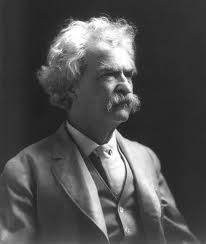
The health of the American Public school system is under debate in many different arenas: political, financial, social, ideological, and now, technological. At the root of these debates is our collective recognition or understanding confirmed by the author Mark Twain (Samuel Clemens):

“We believe that out of the public school grows the greatness of a nation.”

I have used this quote many times myself, but I had never researched the quotation’s context until recently. This quote comes from an address given to the Public Education Association at a Meeting of the Berkeley Lyceum, New York, November 23, 1900. The speech was given the title, “I am a Boxer”, and its brief 588 word composition means that Twain spoke onstage for all of six minutes, applause aside.

The historical background for the speech deals with European colonization in Africa and Asia, and the American efforts to annex the Philippines.  Predictably, there was resistance by the natives of a country resulting in serious and costly conflicts such as the Boer War in South Africa and the Boxer Rebellion in China. Twain had joined with a number of other Americans including William Jennings Bryan, Andrew Carnegie, John Dewey, and William James in an effort to stop a new rush to colonize. They formed the Anti-Imperialist League, and for a short time they coordinated efforts to stop the developing American Empire. Twain’s speech also referenced Russia’s involvement in the Boxer Rebellion in joint operations with US Marines and British troops.

On that Friday, Twain opened the speech to the Public Education Association with his familiar self-deprecating humor:

“I don’t suppose that I am called here as an expert on education, for that would show a lack of foresight on your part and a deliberate intention to remind me of my shortcomings.”

He explains that his extensive travels had improved his understanding of other cultures, and that may be a primary reason for the invitation to have him speak. His best seller The Innocents Abroad had been published the previous year (1899), and he was lecturing extensively on this travelogue. But he also considered his audience and noted another reason for this address:

“The other reason that I can see is that you have called me to show by way of contrast what education can accomplish if administered in the right sort of doses.”

His argument against Anti-Imperialism was satirically addressed in the next two paragraphs suggesting if the Public Education Association’s pictures that had been sent to an exhibition in Paris could convince Russia and France to withdraw troops from colonial conflict-how quickly world peace could be achieved!

He then illustrated his Anti-Imperialistic philosophy using the Boxer Rebellion by opening with a rhetorical question:

“Why should not China be free from the foreigners, who are only making trouble on her soil? If they would only all go home, what a pleasant place China would be for the Chinese! We do not allow Chinamen to come here, and I say in all seriousness that it would be a graceful thing to let China decide who shall go there.”

The last sentences in this section of the speech are the source for the title of this speech, “The Boxer believes in driving us out of his country. I am a Boxer too, for I believe in driving him out of our country.”

The anti-immigrant declaration of “I believe in driving him out of our country” is surprising coming from the liberal Twain. One hopes he was playing to the sentiments of his audience rather than some xenophobic desire to keep America free of the Chinese. The Boxers’s fierce opposition to Christianity did not make them popular in the United States. However, the statement could also be read as a converse to the statement that the Boxer is “driving us out of his country”, a form of quid pro quo.

So how does Twain get from the Boxer Rebellion to public schools? In the paragraph that follows the declaration of commonality with the Boxer, Twain updates his satirical comments to note that, sadly, Russia would not be withdrawing its troops; there would be no world peace. Russia could choose to  have an army or public schools, and as it could not afford both, Russia had chosen the army. Twain decries the choice:

“This is a monstrous idea to us. We believe that out of the public school grows the greatness of a nation.”

In using the pronouns “us” and “we” Twain joins the service of the Public Education Association. As he committed himself to the cause of the Boxer, Twain commits himself to the cause of the educator. Immediately after this statement, Twain includes a paragraph so prescient, a reader might think it came out of a recent town hall meeting:

“It is curious to reflect how history repeats itself the world over. Why, I remember the same thing was done when I was a boy on the Mississippi River. There was a proposition in a township there to discontinue public schools because they were too expensive. An old farmer spoke up and said if they stopped the schools they would not save anything, because every time a school was closed a jail had to be built.”

Twain wryly commented on his own anecdote with a familiar “Twain-ism”, commenting that the practice of not funding schools was  “like feeding a dog on his own tail. He’ll never get fat. I believe it is better to support schools than jails.”

He ended the speech with an off-handed compliment to the Public Education Association:

“The work of your association is better and shows more wisdom than the Czar of Russia and all his people. This is not much of a compliment, but it’s the best I’ve got in stock.”

Twain’s short address connected two unlikely ideas: the Boxer Rebellion and the American public school system. The speech is humorous, highly political, and frighteningly prescient. The thesis of his argument is not found in the title, but is found in the concerns he has about the funding of public education in America and abroad. In summary, Twain believed that nations who choose to fund armies over education will not be great. Education is necessary for world peace.

Mark Twain may have claimed that “I am a Boxer” in this short address, but he communicated quite clearly “I am an Educator.” Public education already had wonderful resources in the literature of Twain with The Adventures of Tom Sawyer and Huckleberry Finn. This speech solidly affirms his belief in the importance of our public education system. His contributions to the profession of education have not been matched since.

Bond.

James Bond.

007.

On Her Majesty’s Secret Service, and (surprise!) a metaphor for why relying on the standardized test is flawed.

Honestly, I was not expecting Skyfall, the latest James Bond blockbuster, to resonate with issues being discussed in educational reform today, but sitting in the darkened theatre, I suddenly heard the same concerns about the validity of tests used in assessing secret agents that I hear in assessing students.

Apparently, M-I 6 wrestles with the question: Do tests really measure ability?

Spoiler Alert! If you are someone who intends to see the film, I may be giving away a few facts; not major plot points, but a few incidental pieces of information. Bond Purists-stop reading now, please.

Before Bond (Daniel Craig) returns to work for M (Dame Judi Dench), he needs to pass a set of standardized performance tests. He is first put through a series of grueling fitness tests. He is tested on his ability to shoot a pistol at various distances in a firing range. Finally, he faces a series of psychological tests. The results of how well he succeeded in this battery of objective tests is initially kept from the audience, but the viewers are not surprised when he eventually returns to service.

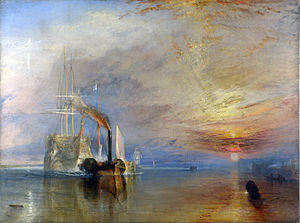
Painting at the National Gallery in London

The film’s screenwriters saw fit to combine the concerns about the results of these tests with M-I 6’s concerns about Bond’s age. No scene is more direct in confronting Bond’s age than in his first meeting with the young gadget supplier “Q”. The filmmakers placed Bond at a British National Gallery sitting on a bench looking at J.M.W. Turner’s painting Fighting Temeraire Tugged to Her Last Berth To Be Broken Up, 1838 .

Turner’s symbolic message of the painting depicts the shift from sail power to coal engine, the billowing white clouds swirling like sails a stark contrast to the blackened smokestack of the tug in the forefront of the painting.  Q enters, sits next to Bond, and strikes up a conversation:

Q: It always makes me feel a bit melancholy. Grand old war ship. being ignominiously haunted away to scrap… The inevitability of time, don’t you think? What do you see?
Bond:  A bloody big ship. Excuse me.
Q: 007. I’m your new Quartermaster.
Bond: You must be joking.
Q:  Why, because I’m not wearing a lab coat?
Bond: Because you still have spots.
Q: My complexion is hardly relevant.
Bond: Your competence is.
Q: Age is no guarantee of efficiency.
Bond:  And youth is no guarantee of innovation.

Skyfall (http://www.imdb.com/title/tt1074638/quotes)

Of course, the M-I 6 tests are designed to determine if Bond is too old, if his brand of “boots on the ground” spying should be replaced by agents in command of newer technologies. And of course, M is obligated to submit Bond to the required standardized tests, tests given on one particular day. However, she is not obligated to act on the results of the tests.

M’s response, therefore, is to weigh what audiences know are the 50 years of evidence on Bond’s unconventional performance as a creative problem solver. She recognizes that Bond possesses those intangible qualities of initiative and drive, and while a standardized test does measure a level of ability, what makes Bond a valuable British agent is his ability to confound a standard.

Watching James Bond puzzle the test-driven establishment is a large part of the enjoyment for the audience. Agent 007 cannot be limited by a test score if he is going to save the free world.

Which brings me back to the shared message about testing from Skyfall and its application to education reform. The audience understands that the testing in Skyfall is flawed because of the limited results; standardized testing in education is similarly limited. Like M, educators should not let their students be defined by test scores from standardized tests, those single metric assessments given on one day. Like M, educators should pay more attention to having students develop problem-solving skills and to consider other assessments that measure students’ critical thinking skills.  Students should have the opportunity to be evaluated on the intangible qualities of initiative and drive through project-based learning. Like Agent 007, students should be allowed the opportunity to confound those standards measured by objective testing.

Oh, and maybe they could also ask for their chocolate milk shaken, not stirred.

The impending Hurricane Sandy did little to stop over 2000 teachers from attending the 83rd Saturday Reunion at Teacher’s College at Columbia University on Saturday, October 27. Taking up the microphone in a set of informal welcoming remarks, Lucy Calkins complimented the crowd that had gathered in the Nave in Riverside Church, “So many of you have come here…instead of clearing out storm drains or without stocking up on toilet paper. You have weathered the trip despite the predictions of this ‘Franken-storm’.” The crowd laughed appreciatively.

“Yes. We are in a storm,” she continued with growing seriousness. “Today, we are in a ‘Perfect Storm’ in education, and we must learn to travel these hurricane winds and sail.”

Calkins was referencing the convergence of the Common Core State Standards with educational reform efforts that emphasize standardized testing. Newly designed teacher evaluations tied to single metric tests combined with cuts in funding for public school education because of a stagnent economy have also contributed to this ‘Perfect Storm’. This audience understood her metaphor.

Lucy Calkins is the Founding Director of the Reading and Writing Project LLC and the Teachers College Reading and Writing Project as well as the Robinson Professor in Children’s Literature at Teachers College where she co-directs the Literacy Specialist Program.

Co-authors Lucy Calkins, Mary Ehrenworth and Christopher Lehman all led sessions at the 83rd Saturday Reunion of the Teachers College Reading and Writing Project on Saturday, October 27, 2012

At a session that followed her welcoming remarks titled, “Implementing the Common Core: What’s Working, in Big Exciting Ways, to Engine Dramatic Reforms,” Calkins explained that she would not be delivering a big keynote at this conference on the Common Core, despite her belief that she considers this “most important document in the history of American education.” Instead, she plans to take time off from teaching to tour the country speaking on the Common Core and the book she co-authored, Pathways to the Common Core, in ordercto help school districts with the real work of accelerating students to perform at the level required by the Common Core, noting that “85% of our students are not there.”

Calkins also expressed her concerns that our nation’s history of large-scale educational reform is not good. “We have been sent many times to reform school,” she continued, “we have to be worried that this [Common Core] may be just one more reform.” However, Calkins stated that what works in this particular reform’s effort is the “absolute and total appreciation that what will make the difference is the teacher.” She directly confronted all the teachers in attendance and directed, “You need to be knowledgeable, and read the actual Common Core, not the ‘Publisher’s Guide to the Common Core’.” Her concerns at this conference echo her remarks in March 2012 at the 82nd Saturday reunion where she specifically called out David Coleman, co-founder and CEO of Student Achievement Partners  and who, according to Pathways to the Common Core, “received a  four-year 18 million dollar grant from the GE Foundation to develop materials and do teacher training around the CCSS” (6). Coleman has since moved on to take a position as the President of the College Board. Pathways to the Common Core, co- authored with Mary Ehrenworth and Christopher Lehman, details concerns that this enormous grant and any additional grant money will result supporting those who are “spelling out implications and specifying what they wish the Common Core had said,”(5). Already there has been a growing body of materials that contradict the intentions of the standards:

“There will certainly be additional materials and documents that emerge following this new round of money, with the potential to make similar claims as the Publisher’s Criteria for the Common Core Standards in English Language Arts and Literacy, Grades 3-12 (Coleman and Pimentel 2011)  and the Rubrics for Evaluating Open Education Resources (OER) Objects (Achieve 2011). When documents are presented as if they’ve gone through the process of review and been ratified by the states on subcommittees, it is troubling”(6).

Calkins reminded participants that the crucial difference will be the professional teachers who bring colleagues into their work to build a community of teachers, and that this community should know the Common Core standards.

Turning to the topic of her session, Calkins also explained that some of the most exciting work that was recently taking place on the Common Core  at the Teachers College was with their work with students in argument and debate.

She described the success teachers at the Reading and Writing Project were having with students who participated in read-aloud by gathering evidence for one position or another. For example, students had listened to a reading of The Stray and took notes on different positions. Following the basic rules of debate, students were given the opportunity to caucus with those who held their opinions before debating or refuting their debate partner’s position. In order to model the process with Shel Silverstein’s The Giving Tree, teachers taking one position that the tree was strong stood to caucus with like-minded participants, while those seated conferred with those who agreed with the different opinion that the tree was weak. Calkins directed teachers to stand, sit, debate or caucus, modeling how this might work in a classroom in one 45-50 minute period. She showed several video clips showed students participating in the same process demonstrating the success of using these techniques. “The results were fantastic,” Calkins exclaimed as the videos played, “so exciting to see the students gathering evidence and using the text in their arguments.”

What was evident during her sessions at this conference was that during this ‘Perfect Storm’ in education, Calkins is confidently empowering teachers to sail through what seems to feel like hurricane force changes in the profession. Her efforts in preparing teachers to navigate these new challenges can help insure that while these controversial storms may rage outside, inside the classroom day after day, the teacher is prepared to be the captain of the ship.

Educational reform is on the minds of many business leaders and several have weighed in with their concerns:

“We know we are facing a transition, and we must take this opportunity to provide today’s students with the tools and the thinking that is required for the future” ( John Chambers, Cisco Systems).

“….our high schools – even when they’re working exactly as designed – cannot teach our kids what they need to know today,” (Bill Gates, Microsoft).

“The fact is, too many graduating seniors are unprepared for what will be required to succeed in college or in the workplace,” (William G. Jurgensen, CEO, Nationwide)

These business leaders have every right to express their interest in improving education for the nation. After all, their businesses will require an educated work force. However, too often business leaders speak about educational reform using a business model that is radically different from the public education model.

Funding-Private equity vs. Tax Dollar

A business is funded by an individual or a group of investors, and additional revenue for a business can be added through profits, loans, or the selling of additional shares. In contrast, public school education is funded by taxpayers at the local, state, and federal level; ultimately, politicians control the purse strings for school districts. This manner of funding can be grossly inequitable: On the blog CT news.com, in 2011, Ansonia, Connecticut, spent $10,520 per student while the nearby district Region 9 (Easton/Redding) spent $18,426 per student that same year. Funding can often be capricious as tax revenues depend on the general economy and political agendas; funding can change annually with revenue that cannot be transfered year to year or invested. There are always political promises to reduce taxes despite rising operating and capital costs in educating our nation’s youth to develop 21st Century skills for our future workforce.

Business Loss-Cutting Poor Performers?

Another problem with using the business model for education is the business loss. A clear definition of a business loss is on Investopedia.com:

A business practice that seeks to detect, identify, investigate and prevent events that cause a drop in value of any of an organization’s revenues, assets and services. Loss-management improvements may involve changes in a business’s operating policies and business model in order to limit instances of accidental and/or intentional loss.

A business with a business loss must be flexible. A business may change operating policies (hours, locations, retail policies, purchasing policies, etc).  In contrast, a public school system that deals with a loss in funding or facilities or student enrollment cannot change hours, locations, or policy arbitrarily or with the speed that business has to react to changes in the market.  Furthermore, a business is free to drop a product line or drop poor performing employees. In contrast, schools cannot drop specific programs (core subjects of math, language arts, science, social studies) or poor performing students. Dropping poor performing students would certainly help test score results but that is not the purpose of public education. In this nation we  educate every student.

Competition-Winners vs. Losers

Business is built on competition and products and services go head to head for the public’s dollar. Economists believe that the market will crowd out inferior products and services using this competitive model. However, employing this model of competition in education would result in a tiered system of inequity. Education reform efforts to introduce competition have included choice through charter schools, but the results of these competitive efforts have not been any more successful than the efforts expended by the public schools. In the inital pilot study (2003) The National Assessment of Educational Progress (NAEP), considered  population differences and reported that “the mathematics performance of White, Black, and Hispanic fourth-graders in charter schools was not measurably different from the performance of fourth-graders with similar racial/ethnic backgrounds in other public schools.” The study also reported that, “In reading, there was no measurable difference in performance between charter school students in the fourth grade and their public school counterparts as a whole.” What this means is that competition with other schools is not a factor in school success. Furthermore, the students cannot be part of a competitive market with winners and losers if the goal is to educate every student. Every student must be a winner.

The Single Metric Test

A business with a single product is limited, so many businesses diversify.  Businesses measure success on products or services with monthly, quarterly, and annually produced data through a variety of measurements. Education in contrast is being forced to measure student achievement through standardized tests. Each standardized test “snapshot” is taken one day during a school year, and the results establish a school as being a success or failure. Reform efforts fron No Child Left Behind and Race to the Top exploit this one test metric. Judging a school with this system of measurement is like measuring retail business’s success by one day of sales. Many states are using these single metric tests for teacher evaluations. Would a company’s CEO be judged by one day’s stock price or a salesman by one day of sales? Additionally, the calls listed above ask for “tools and the thinking” that our business leaders want for their future workforce; an increased focus on single metric tests is not a solution for 21st Century skill development and critical problem solving.

Business leaders should have a great deal to say about education since they will be hiring the product of the nation’s education system. But the tenets of business do not match the tenets of education, and business policy does not always have a comparative counterpart in education. Public education is a very specialized institution and the reform of education must come from those who have both the training and classroom experience, beyond the just “being in the classroom” experience of many successful business leaders.