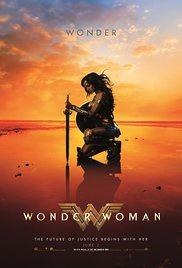
The most recent iteration of Wonder Woman (2017) on the big screen has received much attention because of its woman director Patty Jenkins and its attractive and agile star at her most womanliness. Actress Gal Gadot admitted she was 3-5 months pregnant for the role of Diana during much of the filming. The film also offers a similar message to the one that reverberates from the young adult novel, A Wrinkle in Time by one of my favorite woman authors, Madeleine L’Engle
Sitting in the dark, above the explosive noise in an action packed sequence, I heard the argument posed by the villain of the film, Ares, the god of War. At the climax of the film (and I do not believe the following is much of a spoiler), Ares admits to seeding treachery into the souls of mankind and bellows for Diana to destroy mankind, to give into her rage saying:
Ares: “They do not deserve your protection.”
But, remembering the sacrifice of others, Diana makes a different choice:
Diana: “It’s not about what you deserve, it’s about what you believe, and I believe in love.”
That same argument Ares makes is the argument made in the climax of A Wrinkle in Time. Teen-aged Meg, the awkward nerdish heroine, confronts IT, a grotesque villainous mass that has taken a sinister control over the mind of her beloved younger brother Charles Wallace:
Mrs. Whatsit hates you,” Charles Wallace said.
And that was where IT made ITs fatal mistake, for as Meg said, automatically, “Mrs. Whatsit loves me; that’s what she told me, that she loves me,” suddenly she knew.
She knew!
Love.
That was what she had that IT did not have. (12.135-140)
Of course, Wonder Woman has supernatural powers that help her defeat her foe. She is also not above using violence to achieve an end….she is an Amazon after all.
Meg in contrast is bookish and insecure; without sword, shield, or lasso. Meg realizes that she is incapable of directly defeating IT:
But she, in all her weakness and foolishness and baseness and nothingness, was incapable of loving IT. Perhaps it was not too much to ask of her, but she could not do it. (12.141-143)
Meg must use her wits rather than physical strength, and she cleverly defeats IT in a confrontation with lines so deeply etched in my literary memory files that I can still recite them, as I did watching the film:
But she could love Charles Wallace.
She could stand there and she could love Charles Wallace. (12.144-145)
Perhaps it is not surprising that in both stories, and against impossible odds, Diana and Meg find the same elixir on their hero’s journey to be the power of love. Their stories follow that archetypal journey: the call to adventure, leaving the known world, meeting the mentor(s), the test, the sacrifice, the ordeal, and the return with the elixir.
Please understand that although I enjoyed the film, I am not elevating the screenplay, production, or even the performances in Wonder Woman to the high regard for which I hold A Wrinkle in Time. Although they are both fiction, the D.C. Comic heroine does not hold the same place in my literary heart as does Meg.
My 9-year-old self identified with Meg, and I longed for a Mrs. Which to blow into my life with an adventure. My own copy of the novel, a mottled blue hardcover signed by L’Engle, is a treasured possession.(see story here) In my current role as an educator, I continue to encourage others to read the book. L’Engle tells a wonderful story.
I do not think, however, that L’Engle would be unhappy with my comparison. The similarities in comparing the message of Meg’s story to Diana’s story in the film is what Madeleine L’Engle meant when she said:
“Stories make us more alive, more human, more courageous, more loving.”
There are different ways to become familiar with our nation’s founding documents: reading, memorizing, studying, reciting are a few. But in our keyboard- swipe-click-centered world, rewriting by hand is not one that immediately comes to mind.
A story feature in the NYTimesThe Constitution, By Hand (6/30/17) written by Morgan O’Hara explained her process for copying the United States Constitution out by hand with a few sharpies. She noted that:
Hand copying a document can produce an intimate connection to the text and its meaning. The handwriter may discover things about this document that they never knew, a passage that challenges or moves them. They may even leave with a deeper connection to the founders and the country, or even a sense of encouragement.
Whatever her original intent for deciding to hand copy the lengthy document, her explanation for discovering things about a text echoes the arguments put forth about close reading that were initiated with the Common Core. Close reading requires students to read and reread a text several times; each time for a different purpose.
The first reading is to understand what the text says. The first reading is for comprehension: Who (character); What (events); Where/When (setting); Why (plot or information) questions asked.
It is the second reading, however, that asks a reader to become familiar with how the text operates:
-What does _____ this word mean in this context? -How is the text organized? (sequence. cause and effect, compare/contrast, description)? -What ways does the author use punctuation to control the reading of the text?
Asking students to write out by hand the United States Constitution with the Bill of Rights is akin to having them perform a second close read. In copying the words and the punctuation and imitating the structure (sequence), they could, like O’Hara, focus on how the text operates. How this particular text operates is exactly what constitutional scholars, lawyers, and judges debate regularly in courts.
How the Text Operates
For example, if you copy out the First Amendment in the Bill of Rights, you will notice that the framers used three commas and two semi-colons in order to to separate clauses:
Amendment I
Congress shall make no law respecting an establishment of religion, or prohibiting the free exercise thereof; or abridging the freedom of speech, or of the press; or the right of the people peaceably to assemble, and to petition the Government for a redress of grievances.
Recently, the first semicolon after thereof was at the heart of the case (January 2010) Citizens United . The Supreme Court determined that this semicolon links the free exercise of religion and the free exercise of speech and that the framers did not mean that each clause of the First Amendment should be interpreted separately. The decision gave corporations the same free speech rights as people, and that corporations should have the same free religious exercise rights as people as well. Handwriting the First Amendment and pausing to consider that semicolon can bring attention as to how the author(s) or Founding Fathers used punctuation to control the reading of the text.
Punctuation in the Declaration of Independence is also recently under scrutiny. Danielle Allen, then a professor at the Institute for Advanced Study in Princeton, N.J., caused a stir when she located an extra period on an original copy of the document at the National Archives after the phrase “life, liberty and the pursuit of happiness” (see photo clip)
National Archive copy of the Declaration of Independence (with questionable period)
Allen suggested that this period -which could be an ink blot- might be misinterpreted to mean that that the list of self-evident truths ends with the right to “life, liberty and the pursuit of happiness.” Ink blot or intentional sentence stop, Allen argues that Thomas Jefferson did not intend to separate the phrase using a period, but had intended a continuation with the phrase that follows:
“— That to secure these rights, Governments are instituted among Men, deriving their just powers from the consent of the governed, –That whenever any Form of Government becomes destructive of these ends, it is the Right of the People to alter or to abolish it, and to institute new Government, laying its foundation on such principles and organizing its powers in such form, as to them shall seem most likely to effect their Safety and Happiness.”
“The logic of the sentence moves from the value of individual rights to the importance of government as a tool for protecting those rights…You lose that connection when the period gets added.”
Legislators and scholars have argued about the intent of Thomas Jefferson since the release of the first draft of the Declaration of Independence. Students should have the opportunity to add their voices to the impact of different interpretations on their lives as well.
Muscle Memory
Outside of noting the punctuation in primary source documents, there is a fair amount of research that promotes the writing by hand as a great instructional tool in developing muscle memory, which is described on the Logic of English research blog as meaning “the students can write quickly and legibly with little conscious attention.” Writing by hand helps students as a multi-sensory approach to reading and spelling. This understanding contradicts long held beliefs that copying does not improve understanding. There may have been examples of monks who copied Ancient Christian manuscripts who were unable to even read, but in these cases the goal was artistic, not literacy. Moreover, in the 21st Century, there is an increase in attention being paid to the loss of writing by hand in our tech obsessed culture.
New research shows that a multi-sensory approach that combines the finger movements (kinesthetic) with the sensorimotor part of the brain shows how writing by hand helps us recognize letters. Researcher Anne Mangen (The University of Stavanger-2011) explained the connection between reading and writing and how the sensorimotor system plays a role in the process of visual recognition during reading, saying:
“The process of reading and writing involves a number of senses. When writing by hand, our brain receives feedback from our motor actions, together with the sensation of touching a pencil and paper. These kinds of feedback is significantly different from those we receive when touching and typing on a keyboard.”
Feedback like this may be helpful to students. Of course copying the primary documents such as the United States Constitution or the Declaration of Independence in their entirety would be a lengthy commitment. Copying entire sections or even phrases, however, can give students that same kind of motor action and brain feedback and help them better appreciate a passage for what it says (meaning) and how it says it (text structure).
At the very least, they will experience the same process of duplicating these documents in the authentic way they were created by our Founding Fathers….by hand.
My letter to the Social Studies Department Chair at West Haven High School
Dear Mark …and to every other Civics or AP Government Teacher in the USA:
Sorry to interrupt your well-deserved summer vacation.
But I have a resource that I think you should use next year in the Advanced Placement American Government class. You should share this resource with the Issues in Government classes.
This Sunday’s NY Times (7/2/17) magazine has special section devoted to a single spread layout, four pages long, that features an annotated United States Constitution.
Before celebrating the Fourth of July, get our print-only Annotated Constitution, available in Sunday's paper. pic.twitter.com/WMZCcj1LGQ
You will note that on the front of the section is the editors’ statement about the Constitution, that “Schoolchildren are sometimes forced to read it.” You have mentioned several times that students at every level sometimes have difficulty reading a primary source document like the Constitution. They are not alone. The editors of the section also note that scholars “pore over it,” inferring they too are reading the text to better understand this primary source document:
“For most Americans, the United States Constitution remains a distant and archaic text, a relic to be revered but rarely consulted.”
In presenting this annotated document, the editors have given teachers a tool to help students better understand our country’s basic rules. They have implemented a literary strategy known as “chunking the text” which means breaking down a difficult text into more manageable pieces so that students can close read for better comprehension. Chunking helps students identify key words and ideas, develops their ability to paraphrase, and makes it easier for them to organize and synthesize information. Close reading requires students to read and reread a text multiple times for what the text says and how the text works in order to determine how the text has an impact on their lives.
Several sections of this annotated Constitution have commentary from a lawmaker or a scholar or an author or a NYTimes editor. Over 30 individuals offered commentaries printed in the margins including: Representative John Conyers (Michigan), Representative Adam B. Schiff (California), Senator Mike Lee (Utah), Senator Lamar Alexander (Tennessee), Senator Patty Murray (Washington) Janet Napolitanto (former Secretary of Homeland Security), Jamal Green (Columbia Law Professor), Lawrence Tribe (Harvard Law Professor) as well as staff writers Adam Liptak and Emily Bazelon.
Each short commentary, about one or two short paragraphs long, serves as a model for students to follow. Students can be asked to imitate what the contributors have done and chunk the text of the Constitution in order to rewrite text in their own words. By chunking the text, students are better able to identify key words, to analyze ideas, to paraphrase, and to synthesize information.
Each commentary is connected by an arrow imposed on the section being annotated. For several sections Amendment 14 -Civil Rights) there are several commentaries. In total, there are 40 commentaries offering multiple points of view on our founding charter.
For example, Senator John McCain writes about the “common defense”(Article I: Section 8):
“With the powers given to us by our founders, it must be the urgent work of Congress to meet our sacred obligations to give our service members everything they need to defend our nation and our liberty.”
Vanita Gupta, former assistant attorney general at the Department of Justice writes about the 14th Amendment,
“The struggle to realize the promise of this brief but important clause has been at the heart of every movement for civil rights in this country and continues to animate social justice activism of today.”
Their examples serve as models to show students how to analyze and to synthesize the language of the document.
What teachers have with this annotated Constitution are 40 mini-lessons they can share with students sequentially or by order of a trending topic (capital punishment, freedom of the press, etc.)
But that’s not all!
There is a prologue to the inside spread, a two page essay by author Garry Wills, who has written about James Madison, framer of Constitution. His essay, titled “Child of the Enlightenment,” discusses the principles derived from the the Age of Reason that guided the “secular miracle” of the Constitutional Convention over the course of a year: convened in 1787 and ratified 13 months later in June 1788.
Wills considers what he calls the “myth” of the checks and balances built into the Constitution, suggesting that:
James Madison was not so much as wanting to encourage “competing interests but to arrive at a ‘disinterested’ view of a common purpose, what Enlightenment philosophers call ‘virtue’ – or public spiritedness.”
Wills argues that such virtue was-and still is -the key component of all government.
Finally, at the the bottom of Wills’ prologue, there is a timeline marking several Constitutional milestones, beginning with its origins in Ancient Greece and ending with today.
Taken as a whole, the special section this Sunday eliminates the need for civics textbooks, which I have often suggested are dated. We both know that students are more motivated when they respond to the issues being discussed today.
This four page spread of newsprint is an entire civics course. ..you just have to get a copy! (or you can borrow mine).
The term vocabulary is defined as “a list or collection of words or of words and phrases usually alphabetically arranged and explained or defined.” There are a number of reasons to think about these lists of words and phrases as things that are consumable. Consider how often references to words or phrases are framed in metaphors of food:
Food for thought;
Digesting what was said;
Chew on it for a while;
Difficult to swallow.
These metaphors continue in today’s digital age, where words and phrases are encoded over “feeds” or electronic transmission of news, as from a broadcaster or an Internet newsgroup.
All these food metaphors signal how important vocabulary is to a student’s developing academic life. Just as food is metabolized and turned into the building blocks and fuel that the body needs, educators should see vocabulary to be part of the building blocks of critical thinking. Just as any student must internalize food for energy, research shows that for vocabulary to be effective, students must internalize words to use them correctly in both receptive and verbal language. And just as food is necessary every day for physical growth and stamina, vocabulary is necessary every day, in all subject areas, for a student’s academic growth and stamina.
These food metaphors also support the idea that vocabulary should not be an isolated activity, but a daily requirement that teachers need to incorporate in all lessons. The teaching of vocabulary is too important to be left to workbooks or worksheets; teaching words and word meanings must be part of speaking, listening, reading and writing in every day’s lesson.
While the first step in a successful vocabulary program is explicit instruction, the steps of continued exposure and direct practice are also important. According to the U.S. Department of Education, in teaching vocabulary educators should:
“Use repeated exposure to new words in multiple oral and written contexts and allow sufficient practice sessions.”
In their article posted on Adlit.org,Explicit Vocabulary Instruction, researchers have found that “Words are usually learned only after they appear several times.” Words that appear infrequently may not be the words that should be targeted for explicit instruction.
Provide a description, explanation, or example of the new term.
Ask students to restate the description, explanation, or example in their own words.
Ask students to construct a picture, pictograph, or symbolic representation of the term.
Engage students periodically in activities that help them add to their knowledge of the terms in their vocabulary notebooks.
Periodically ask students to discuss the terms with one another.
Involve students periodically in games that enable them to play with terms.
There are many ways that students at every ability level can be independently engaged on digital platforms that support vocabulary activities. There are multiple software programs with “feeds” that can help student practice vocabulary with games or flashcards on different devices. Examples of these platforms include:
Research suggests that it is the repeated exposure to words that is most effective, especially if they appear over an extended period of time. Researchers estimate that it could take as many as 17 exposures for a student to learn a new word.
This kind of repeated exposure echoes the practice of the Pulitzer Prizewinning Los Angeles Times food critic Jonathan Gold, who is featured in the (2015) documentary City of Gold. In the film, Gold explains that before writing a review on its food, he will visit a restaurant sometimes a dozen or more times, often tasting the same dish several times “to make sure I get it right.” Gold’s multiple visits to a restaurant “to be sure to get it right” can serve as an example of how educators need to recognize the need for repeated exposure in vocabulary so that students can “get it right” as they ingest and digest vocabulary words.
Students must regularly read their vocabulary words the same way they eat three meals a day, and a possible snack before bed. They must write their vocabulary words, listen to their vocabulary words, and speak their vocabulary words. In offering an academic diet that is rich in vocabulary, educators should know “students are what they eat.”
Click bait headlines, such as the one above, may not have been “liked” instantaneously around the 13 original American colonies, but the spreading of fake news and misinformation was still a factor in the news cycle of 1776. A close look at American history reveals that fake news has been around since the country’s inception, and even the honorable George Washington had to confront the repercussions of intentional misinformation.
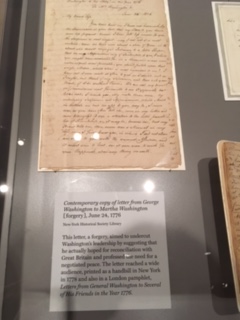
There are forgeries at the New York Historical Society known as The Letters from General Washington to Several of HisFriends, written by a British sympathizer who planted the letters to create doubts about Washington’s commitment to the cause of the American Revolution. One of the circulated letters, included the following statement:
“Thus circumstanced, can you point out a way in which it is possible for me to resign, just now, as it were on the eve of action, without the imputation of cowardice ? I think not.”
The discovery and then release of this misinformation in these documents would have certainly delighted the hearts of British loyalists. In fact, the timing of this faked correspondence as news in November of 1776, soon after the disastrous military decisions Washington made in New York, was meant to encourage Tories in America and in Britain.
A forgery: “Contemporary Letter from George Washington to Martha Washington, June 24, 1776” on exhibit at the NY Historical Society.
These forgeries, reported to be in Washington’s hand, were supposedly found in a large trunk, a portmanteau, that had been left behind while during the General’s hasty retreat to Fort Lee, New Jersey. The crafted propaganda pieces were intended to question the integrity of that upstart who was leading the American revolution.
Circulation of this fake news and misinformation was furthered when a London bookseller published the contents of the handwritten fakes in a pamphlet titled Letters from General Washington to Several of HisFriends in the Year 1776. According to Edward G Lengelmarch (March 21, 2011) in the first chapter of his book, Inventing George Washington:
“British reviewers panned the clumsy fraud, but it sold moderately well, and a year later the letters reappeared in newspapers in British-occupied New York City.”
These letters portray Washington very different from how he is viewed today. While historians acknowledge that Washington was keenly aware of the many obstacles the faced in opposing the British, they are unanimous in saying that he was unwavering in his commitment to the American Revolution. In contrast, the forged letters suggest Washington was a man plagued with doubt. One fake letter states:
“At length, however, when a Continental army came to be voted for, my fears returned with redoubled force; for then, for the fifth time, I clearly saw our aims reached farther than we cared to avow. It was carried with an unanimity that really astonished me; because I knew, many who voted for it were as adverse to the independency of America as I was.”
The forgeries also impugn Washington as an individual who secretly remained loyal to King George:
“I love my King; you know I do: a soldier, a good man cannot but love him. How peculiarly hard then is our fortune to be deemed traitors to so good a King! But, I am not without hopes, that even he will yet see cause to do me justice: posterity, I am sure, will.”
The letters may not have had the desired effect at their release, but they caused considerable problems when they resurfaced again twenty years later in 1795. In that summer, Washington was in his second term as president when the Jay Treaty, which sought to normalize the new government’s relationship with Britain, turned into a political hot topic. Federalists Alexander Hamilton and the architect of the treaty, John Jay, supported the treaty. They were fiercely opposed by leading Republicans Thomas Jefferson and James Madison who believed the treaty was betrayal of America’s relationship with France, who was at war with Great Britain.
According to Lengelmarch, Republicans wanted to “humiliate the president” and in a move that was calculated to “shatter the air of noble authority”:
“…they reprinted the fake letters from 1776 and cited them as proof that Washington had always been a British sympathizer. What had been a half-forgotten old joke now became a dangerously real slander.”
In his retelling, Lengelmarch suggests that Washington initially underestimated the power of such misinformation. Even though there were Federalists who decried the letters’ authenticity, the letters were repeatedly reproduced in Republican sympathizing newspapers. Washington finally broke his silence and repudiated the letters on March 3, 1797, his last day in office.
In 1799, Congress posthumously decreed that Washington was “first in war, first in peace, and first in the hearts of his countrymen.” We also know that he was the first American president who had to confront fake news and misinformation.
Other American presidents have had to deal with fake news. During his Presidential reelection campaign in 1864, President Abraham Lincoln was challenged by the news circulated by The New York World that claimed Lincoln and his Republicans advocated intermarriage between the white working class and blacks. Later that year, the Journal of Commerce ran a story that Lincoln was going to conscript a number of men. The origin of the fake news was a Brooklyn speculator who was trying to move the money markets, and a frustrated Lincoln had to shut down the Journal of Commerce for a couple of days.
The difference today is that the fake news and misinformation that Washington and Lincoln had to confront in their lifetimes was somewhat limited to the platforms of print media. They did not have to compete against a 24 hour news cycle fed by an increasing number of platforms that disseminate a crush of raw or unvetted information daily.
What is the same, however, is the challenge any American president faces in countering the efforts of a single individual, who with a handwritten letter, a text, or a tweet, can create fake news. Whether it be the pen or the keyboard, such misinformation can undermine the processes of democracy.
We should know that fake news and misinformation in American history is not a recent phenomenon. Therefore, we need to train ourselves -and our students- to be more skeptical. We need to consider who may benefit from a salacious headline or tempting tagline. When the clickbait seems too promising to resist, we must be ready to stop and ask who is promoting that information… and why? Without healthy skepticism, we may be just like those British sympathizers who were duped by tools of propaganda.
Washington reportedly never told a lie, but as for the charge of being a coward? History has the evidence to prove that charge was most definitely fake news.
A few days after John Glenn orbited our Earth three times, Mrs. Murphy gave each of us a lollipop to make an astronaut.
I was in kindergarten when she counted out three pipe cleaners and showed us how to carefully, carefully, carefully wrap them:
one fuzzy wire around the middle, three times for arms;
one fuzzy wire around the bottom, three times for legs;
one fuzzy wire bent in circle around the top for the space helmet.
We were a classroom of John Glenns in different favors, with white pipe cleaner arms waving, cheering, pointing, celebrating.
We could not understand the vastness of space or the feats of engineering that had launched him into history, but we all imagined with our spacemen.
We were six; we understood the world was suddenly different.
My John Glenn, spaceman and lollipop, was orange, and I gave him to my father,
My father took this tribute and put it in his brief case, a high honor for a craft project. For years after, I would look to find my John Glenn in the brief case, buried beneath files and papers.
His arms and legs were always bent in celebration, and he still wore his space helmet.
Only his candy head showed his age, the clear cellophane wrapper protecting the orange-white powder and tiny shards of sparkling sugar.
“Space dust,” my father assured me, “he is made of space dust.”
If you Google the explorer John Cabot, you could get a web page from the website All About Explorers that states:
“In 1484, the explorerJohn Cabot moved back to England with his wife and eleven sons. He developed his own website and became quite famous for his charts and maps depicting a new route to the Far East. At this time he also introduced his half-brother Richard (whom the family always called “Ringo”) to his best friends, John, Paul, and George.”
While some facts in this information that might set off bells and whistles to educators- or fans of The Beatles- there is recent research to suggest that many students in our middle school, high school, or college would not question the intrusion of technology into the life of this 15th Century explorer. After all, this website looks like a great source!
A report released November 2016 tracked the research skills of students in middle, high school or college using a series of prompts. The study was conducted by the Stamford History Education Group (SHEG) that “prototyped, field tested, and validated a bank of assessments that tap civic online reasoning.” The report, titled Evaluating Information: The Cornerstone of Civic Online Reasoning, details the methods SHEG used in order to test civic reasoning as well as:
“…the [students’] ability to judge the credibility of information that floods young people’s smartphones, tablets, and computers.”
The results of SHEG’s study indicated that many students are not prepared to distinguish accurate from inaccurate accounts or decide when a statement is relevant or irrelevant to a given point. SHEG noted:
“Our ‘digital natives’ may be able to fit between Facebook and Twitter while simultaneously uploading a selfie to Instagram and texting a friend. But when it comes to evaluating information that flows through social media channels, they are easily duped.”
The report concluded that students at all grade levels were unable to distinguish well-evidenced accounts from those unsupported by reasons and evidence or to tell good reasons from bad. In short, SHEG pronounced pronounced our nation’s students’ ability to research as “bleak”:
“For every challenge facing this nation, there are scores of websites pretending to be something they are not. Ordinary people once relied on publishers, editors, and subject matter experts to vet the information they consumed. But on the unregulated Internet, all bets are off.”
Educators should be concerned about this growth of fake information and how to keep this misinformation from spreading into student research. Even if the Internet gets better at shutting down fake news or inaccurate information, there will always be some bogus websites that will escape being shutdown.
Yes, there is plenty of misinformation on site. For example, on the Christopher Columbus page:
“Columbus knew he had to make this idea of sailing, using a western route, more popular. So, he produced and appeared on infomercials which aired four times daily. Finally, the King and Queen of Spain called his toll-free number and agreed to help Columbus.
Turns out that the misinformation on AllAboutExplorers is INTENTIONAL and all the misinformation on the site was created to serve an important educational purpose. The Aboutpage on the site states:
“AllAboutExplorerswas developed by a group of teachers as a means of teaching students about the Internet. Although the Internet can be a tremendous resource for gathering information about a topic, we found that students often did not have the skills to discern useful information from worthless data.”
The educator authors Gerald Aungst,( Supervisor of Gifted and Elementary Mathematics in the Cheltenham School District in Elkins Park, PA) and Lauren Zucker,(Library Media Specialist in Centennial School District) created the site in 2006. Their collaboration has proven to be a prescient effort given the SHEG findings this month.
They created AllAboutExplorers, “to develop a series of lessons for elementary age students in which we would demonstrate that just because it is out there for the searching does not mean it is worthwhile.”
These educators wanted to make a point about finding useless information on a site that was designed to look believable. They note that “all of the Explorer biographies here are fictional” and that they purposefully mixied facts with “inaccuracies, lies, and even downright absurdities.”
Some of the absurdities that have been mixed with facts on famous explorers include pages for:
Lewis & ClarkTheir dream didn’t become reality right away, however. It wasn’t until 1803, when Thomas Jefferson saw an intriguingly brief posting by Napoleon Bonaparte on Craig’s List for a large tract of land;
Sir Francis Drake: here he discovered an uncharted island called Java. The local drink, kofie (which we know as “coffee”) was rich and strong, and Drake soon fell in love with it. The locals also baked a cinnamon cake that was often paired with the drink;
Ferdinand Magellan: In 1519, at the age of only 27, he was supported by several wealthy businessmen, including Marco Polo, Bill Gates, and Sam Walton, to finance an expedition to the Spice Islands.
The authors have provided cautions not to use this site as a source of reference for research. There is even an “update” on the site that satirically mentions a lawsuit settlement on a claim that the information unfairly caused failing grades for students who used the information via the website. The authors can be followed on Twitter: @aaexplorers. Their website confirms SHEG report’s that states there “are scores of websites pretending to be something they are not.” There are also lesson plans designed to introduce students to the skills and concepts of good Internet researching:
The SHEG report should set off alarms for all educators who ask students to “look something up” in any discipline. The AllAboutExplorers website provides educators, particularly social studies educators, an opportunity to helping students to learn how to negotiate the Internet in research. Teaching students to explore the web appropriately and accurately can be improved by introducing students to the AllAboutExplorers website.
Dear National Council of Teachers of English (NCTE):
The 2016 NCTE Conference in Atlanta, Georgia, just concluded. This year the theme was “Faces of Advocacy”.
I would like to take this opportunity to do a little advocacy of my own.
The #NCTE Atlanta 2016 conference gave the nation’s English teachers an opportunity to exchange “words”….
have a word with…
get a word in edgewise…
hang on some one’s words…
or have the last word.
Every year, the NCTE conference brings together the nations’s (pre-school, primary, secondary, college) English teachers who traffic in words (vocabulary, root words, parts of speech, synonyms, figurative language, suffixes, etc.),
This conference began eleven days after the 2016 presidential election.
In several state, local and national campaigns, there were many words used by candidates on both sides of the aisle that were hurtful, that were fallacious, that were offensive. These words were highly visible on social media platforms and in the media; these words were highly visible to our students.
The multiple challenges to the use of hurtful, fallacious, or offensive words during the election was often met with derision by candidates, by candidate surrogates, or by media pundits on both sides of the aisle. Challengers were often told that candidates were “only joking” or just being “sarcastic.” There were publicized non-apologies :”I’m sorry if…” or “I’m sorry, but…”.
On occasion, words were retracted. “That meaning is not what I meant.”
Such retractions are linguistically precarious; a challenge to word’s “meaning” does not negate what was expressed.
The “not what I meant” response conflicts with the definition of what a word means as “a unit of language, consisting of one or more spoken sounds or their written representation, that functions as a principal carrier of meaning.”
In the 2016 election, many words were separated from their meanings.
Unfortunately, at this conference, NCTE, you did not offer any specific post-election guidance on this separation of word from meaning. At this conference you did not advocate for words and word meaning.
In all fairness, your conference theme (The Many Faces of Advocacy) was set years ago; its was months ago when the presenters were selected for sessions and the rooms assigned. In making these decisions, your organizing committee could not possibly have anticipated the current climate where the real political loser in this election would be words.
How then could NCTE support teachers as they proceed to teach words and their meanings to their students after this election?
How might NCTE prepare teachers in secondary schools to discuss understanding words that are spoken without meaning?
For example, how should NCTE guide teachers to help primary students understand the word meaning of a mean word?
There could have been formal or informal opportunities for teachers to discuss their concerns about hurtful words that were tossed about so publicly.
There could have been formal or informal opportunities for teachers to share strategies to deal with offensive words at multiple grade levels.
Finally, there could have been formal or informal opportunities for teachers to help their students in the future determine when, why, or how words are used to support fallacies.
NCTE, your oversight in not providing these opportunities is particularly ironic given the nation’s push for standards based curricula, where teachers of English are required to place emphasis at every grade level for evidence-based reading, writing, speaking, and listening. Students are expected to produce evidence-based responses that demonstrate precision in word choice (“Use precise language and domain-specific vocabulary to manage the complexity of the topic.”) Word choice is explicit; students must comprehend and apply word meaning.
Instead, the campaigns of the 2016 election would have failed on any rubric that used evidence requirements for most state standards-based performance assessments.
In November 2017, when the conference moves to the City of St. Louis, NCTE, you could reaffirm your commitment to the mission statement which states:
“The Council promotes the development of literacy, the use of language to construct personal and public worlds and to achieve full participation in society, through the learning and teaching of English and the related arts and sciences of language.“
The phrase “use of language” in this mission statement refers to the use of words in a structured and conventional way. You should be prepared to defend the use of words in structured and conventional ways.
In summary,dear NCTE, when words are divorced from their meaning, they lose their power to communicate.
In 2017, we need to advocate for words.
Without word meaning, there is no reason to teach English.
Why should students be the only ones who have the opportunity to play games in class?
Game application programs are just as powerful an instructional tool for teachers as they are for their students because game apps can deliver content to educators in an engaging and challenging way. Instead of sitting in professional development sessions, teachers can be like their students ….out of their seats trying to “beat the buzzer” with their response!
Teams of teachers can challenge other teams of teachers on everything from best practices to trivia hidden in the student handbook, (just how well does everyone know the school dress code?) to organizing performance based assessments ( Choose: debate or poetry smack-down for Shakespeare?)
There are now multiple game applications that can easily deliver different kinds of content to teachers in grades K-12 and make professional development sessions memorable.
Kahoot!is just one of the game applications that can motivate teachers to participate. Teachers, like their students, can be highly motivated by the immediate competition these game apps create. Like their students, educators at all grade levels do respond well to the points/rewards that game apps provide. And like their students, they can enjoy the immediate feedback the apps provided. This free, interactive platform records the results to the presenters, which can be used to design the next level of professional development.
The Kahoot! website explains that their software allows educators the opportunity to:
“Create a fun learning game in minutes (called ‘kahoots’), made from a series of multiple choice questions.”
Once a game is made, it can be individualized with videos and images. Then, “Players answer on their own devices, while games are displayed on a shared screen.”
Another game application that can be used is Quizizz, another quiz, poll, or survey program that uses game graphics with feedback to promote learning. Like Kahoot!, this game app can be individualized for content with videos and images. The promotional material for Quizizz explains that, “Players answer on their own devices, while games are displayed on a shared screen to unite the lesson encouraging players to look up.”
I have used both the Kahoot! and Quizizz apps with teachers for professional development sessions.
Before using the game apps there were more than a few teachers who, exhausted from a day of teaching, would unenthusiastically go through the scheduled activity.
But when they learned they could pull out their phones as a part of the presentation, they immediately became more engaged. The teachers enrolled by using their phone for the quiz and began entering responses on their cell phones or tablets. In less than 20 minutes, I had covered the material that I wanted teachers to know and they remained highly engaged the entire time. They also learned how effective this tool could be if it was used in class on laptops or mobile devices.
When a quiz or survey or poll is created on the game platform, a PIN code is assigned so that everyone can join the activity. Then, the quiz is projected (LCD, Smartboard, Eno board, etc) at the front of the classroom where it can be seen by the whole class so the audience can play together in real-time. The game applications can be used on laptops or personal devices. Depending on which game application is used, devices can display color and symbol choices; the actual answer is viewed on the classroom screen.
A presenter can control the pace of the activity by setting a time limit for each question, which also allows time for information to process or for discussions to take place. As teachers answer questions, they are awarded points for correct answers and the timeliness of their responses. A scoreboard is displayed on the teacher’s screen. Watching that scoreboard with highly engaged teachers proves that nothing is better to incentivize others than a competition with inconsequential rewards!
Game applications can be used for all levels of ability, and the multiple choice option can be set for more than one correct answer. There are options to create discussion questions (“Which of these texts are best used for close reading ?”) or to create surveys (“What percentage of the midterm should contain objective-type questions?”)
I have used the game apps in particular to begin presentations on literacy by taking information from a research study such as Data from Kids Wireless Use Facts:
% of teenagers,13 -17, who “occasionally” access the Internet with tablets & mobile devices? (91%)
Over ___ % of parents said schools should make more use of mobile devices for education? (50%)
The data available in research studies can better inform teachers about the growing impact of technology on their students and the academic environment.
Digital apps like Kahoot!and Quizizzgame platforms are the kind of technology that David Lassner, President of the University of Hawaii and informational technology expert, meant when he said,
“The real power of interactive technologies is that they let us learn in ways that aren’t otherwise possible or practical.”
The “us” in Lassner’s statement should not limited to the students. Teacher professional development with interactive technologies can be a critical part of a successful education program. It can be engaging. It can be challenging. It is practical, and it is certainly possible.
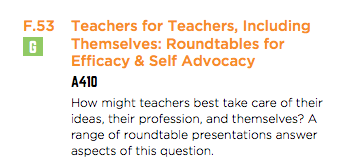
I will be presenting both of these game apps at the National Council of Teachers of English this coming Saturday, November 19th in Atlanta, Georgia. I will be basing the Kahoot! and Quizziz using information on teenagers and literacy. If you are down at NCTE, stop in at Table 7!
F Sessions / 8:00–9:15 a.m. TABLE 7: “Get Your Phone App On!”
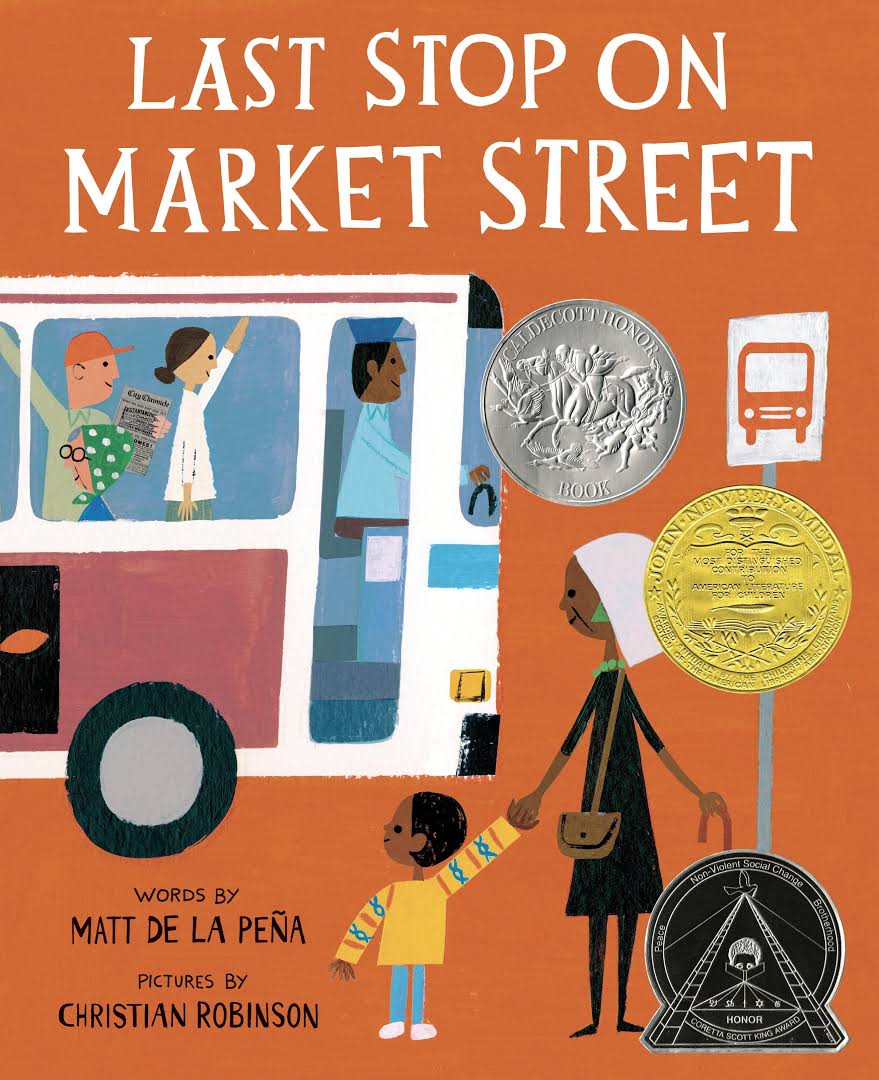
The boy was pointing to a black medallion, pasted under the silver foil award marking the 2016 Caldecott Honor and under the gold foil award marking the 2016 Newbery Medal. He was pointing to the shiny black circle that marked the Coretta Scott King Illustrator Honor, that lists the qualities of peace, non-violent social change, and brotherhood on its emblem.
“It has so many awards….and it’s only a few months old,” his classmate noted.
This fall, I have been reading Matt de la Peña’s story to students in different elementary grade levels.
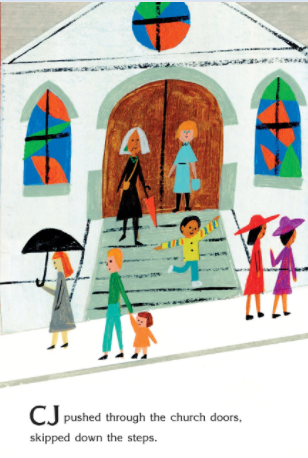
The students are hooked from the beginning when the picture book’s hero CJ bursts through the church doors, and into the rain that “smells like freedom.”
They notice the white trunks of the birch trees, drawn to look like they are “drinking through straw.” They like Nana’s sharp retort as she grows irritated with CJ’s questions.
“Boy, what do we need a car for? We got a bus that breathes fire.”
These repeated readings have made me aware that that CJ’s journey is a sophisticated journey. CJ travels through an urban landscape, a setting that is familiar to these students, but combined with same fantastic elements of an archetypal narrative pattern known as The Hero’s Journey.
“A hero ventures forth from the world of common day into a region of supernatural wonder: fabulous forces are there encountered and a decisive victory is won: the hero comes back from this mysterious adventure with the power to bestow boons on his fellow man.”
This narrative pattern of myth and legend has been followed by other characters on journeys. In the literary canon there are many examples such as Odysseus (The Odyssey) and Bilbo Baggins (The Hobbit). The same narrative pattern is seen also in film with Dorothy in the Wizard of Oz and Luke Skywalker in the Star Wars trilogy.
Campbell drew parallels between these journeys of legend in literature and mythology with the journeys that everyday heroes make. He suggested that the everyone in life meets complications and obstacles, but it is the individual who goes through each of the stages and completes them successfully who society regards as a hero of any kind.
The Hero’s Journey follows a pattern of adventures that are generally organized in 12 stages. There is evidence that de la Peña’s little hero CJ experiences each stage, even in the short text (32 pages) of this picture book:
1. Beginning in the Ordinary World
This is where the hero CJ begins his journey, oblivious of the adventures to come. We learn his his shortcomings; he complains (“How come we don’t got a car?”) and he lacks the imagination of his Nana (“…he never saw a straw.”).
2. Call To Adventure
CJ’s adventure is a call to action, but the action is not clear until the end of the story.
3. Refusal Of The Call
Standing at the bus stop, CJ is uncomfortable.“How come we gotta…?” he complains to his Nana.
4. Meeting The Mentor
CJ’s mentor figure is his Nana. She gives him whatever he needs: wise advice and self-confidence. She dispels his doubts and fears and gives him the strength and courage to continue his journey.
“Nana gave everyone a great big smile and a ‘good afternoon.’ She made sure CJ did the same.”
5. Crossing The Threshold
Climbing into the bus, CJ crosses the threshold between the world he is familiar with and that fantastic world which he is not. He climbs into the “…bus that breathes fire” and immediately the bus driver performs a magic trick with a coin.
6. Tests, Allies, Enemies
As every hero on a journey, CJ needs to find out who can be trusted and who can not, and these characters on the bus initially seem a little sketchy.
“They sat right up front.
The man across the way was tuning a guitar.
An old woman with curlers was holding butterflies in a jar.”
CJ is out of his comfort zone and is confronted with challenges that help the reader gain a deeper insight into his character. The characters he meets are illustrated: the guitar player, Bobo, and the lady with butterflies, the boys with earphones, the blind man, and the blind man’s dog.
7. Approach To The Inmost Cave
In the mono-myth, the hero must make final preparations before taking that final leap into the great unknown. That comes about when the man with the guitar begins to play, and CJ follows the advice of a blind man:
“To feel the magic of music,” the blind man whispered, “I like to close my eyes.”
8. Ordeal
By closing his eyes, CJ experiences the mono-myth’s “metaphorical resurrection” that (literally) grants him the hero’s insight:
“And in the darkness, the rhythm lifted CJ out of the bus, out of the busy city.
He saw sunset colors swirling over crashing waves.”
9. Reward
During this stage, CJ is transformed into a new state, emerging with the prize or elixir. The background illustration by Robinson is not an urban landscape, but a full page spread of CJ’s imaginings. The prize or elixir is magic of music that activates his imagination.
“CJ’s chest grew full and he was lost in the sound and the sound gave him the feeling of magic.”
10. The Road Back
At this stage in this hero’s journey, CJ returns with his reward. According to the pattern, he may still need one last push back into the Ordinary World. This is the moment before the Hero finally commits to the last stage of his journey, moment in which he must choose some higher cause. Here, CJ notices the “Crumbling sidewalks and broken-down doors, graffiti-tagged windows and boarded-up stores,” a stark contrast to the beauty that the elixir of music provided.
11. Resurrection
This is the climax of the picture book, the “a-ha” moment. Responding to his disappointment, CJ’s Nana tells him,
“Sometimes, when you’re surrounded by dirt, you’re a better witness for what’s beautiful.”
Her knowledge has far-reaching consequences to his ordinary world.
“He wondered how his Nana always found beautiful where he never thought to look.”
12. Return With The Elixir
This is the final stage of the Hero’s Journey, which is now revealed to have been a journey to a soup kitchen. On this journey, CJ has grown as a person; he has learned many things. He is a fresh hope to others, and, like his Nana, can offer a solution to problems.
“I’m glad we came.”
The final reward that he obtains may be literal or metaphoric. Ultimately the hero CJ will return to where he started, but he has a new point of view, one of empathy.
You can see Matt de la Peña reading selections from the book here:
In proposing The Hero’s Journey, mythologist Joseph Campbell suggested that everyone goes through a series of challenges in life, but it is only the hero who successfully meets each challenge at each stage of the journey. CJ is the literal and archetypal hero of Last Stop on Market Street, reminding all audiences, young 2nd graders and adults, that the hero can be anyone who makes that challenging journey and who returns to bring hope to his or her community.
CJ’s reward is Nana’s approval to his statement, “I’m glad we came.”
She responds, “Me too, CJ. Now come on.”
CJ’s reward as a hero in completing his journey is captured for all audiences in a picture book by Matt de la Peña and Christian Robinson, in a picture book that is decorated with book awards.

 That same argument Ares makes is the argument made in the climax of A Wrinkle in Time. Teen-aged Meg, the awkward nerdish heroine, confronts IT, a grotesque villainous mass that has taken a sinister control over the mind of her beloved younger brother Charles Wallace: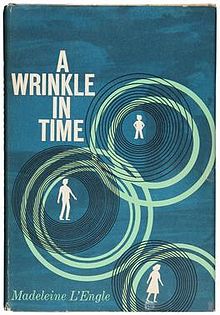










 Used Books in Class