Archives For November 30, 1999

Wordpress Reader for Freshly Pressed

festival-crowd-cynthia-cagenello-cropped-copy

Photo on Sunken Garden Poetry website: http://sunkengardenpoetry.org/

Last Wednesday night, the rain held off for Sunken Garden Poetry at Hill-Stead Museum in Farmington, Connecticut, and the largest crowd of the year heard the former United States Poet Laureate (2001–2003) Billy Collins read his poetry for a little more than an hour. His casual demeanor and the context of the garden setting, peopled with picnickers, contributed to a informal, intimate listening experience, a tone he tries to strike with his poetry:

 “I have one reader in mind, someone who is in the room with me, and who I’m talking to, and I want to make sure I don’t talk too fast, or too glibly. Usually I try to create a hospitable tone at the beginning of a poem. Stepping from the title to the first lines is like stepping into a canoe. A lot of things can go wrong.” (http://www.poetryfoundation.org/bio/billy-collins)

Based on the reaction from the crowd, his concerns about a wrong step was unfounded. Since most of his poems are fairly short, he was able to offer a broad range of topics and observations. There were mice, glistening bars of soap, ill-fitting dinner jackets, a few “frog-less” haikus, and commentaries on adolescent behavior. Screen Shot 2013-08-09 at 2.57.00 PM

He began the reading with You Reader:

I wonder how you are going to feel
when you find out
that I wrote this instead of you

He followed that up with the hilarious Another Reason Why I Don’t Keep a Gun in the House where the opening line explains “another reason why”…

The neighbors’ dog will not stop barking.

Over the course of the evening, Collins read his poems to the appreciative audience. His themes ranged from comical to heartbreaking. You can click the following links to the published texts or video recordings in the order he read them to “attend” your own Billy Collin’s reading:

The Sand Hill Cranes of Nebraska
Drinking Alone after Li Po
Cheerios
After the Funeral (p. 62)
Orient
Dress Code (pg.19)
To My Favorite 17-year-old High School Girl
The Dog on His Master and The Reverent
Oh My God (audio poor)
Divorce
Flock (poem read in interview)
Hippos on Holiday
Aimless Love
The Lanyard
Japan
I Chop Some Parsley While Listening To Art Blakey’s Version Of “Three Blind Mice”
Forgetfulness
The Dead
Aristotle
Nightclub

Collins delivered each of his poems in his conversational tone- dry, wry, and understated. Leaving the poetry reading, I could not help but start to “think” in Collins’s cadence. Later that evening, my thoughts matched his tempo:

I had heard the poet at a reading once before,
when he read the blind mice poem that made me laugh.

I bought the book Sailing Alone Around the Room
and found inside the poems Sonnet and Aristotle that I now use
with my Advanced Placement students, but I do not teach
Taking Off Emily Dickenson’s Clothes.

They do not appreciate the Belle of Amherst the way Billy and I do.

 and

The standing ovation
became a mass migration,
some to their cars and some to the table
where the poet scrawled his signature
repeatedly into book after book after book.

Later when I crushed my bedroom pillow
up to the headboard, I wondered
if he was still held hostage to his adoring fans?

Sunken Garden Poetry should be commended for organizing a memorable summer evening. This coming winter, I suspect that a number of those who attended will turn to a companion, and quote Billy Collins and say, “Too bad you couldn’t have been here six months ago.”


Read picture books.

Yes, I am talking to you.

(No, not you kids….)

I am talking to you….you, Advanced Placement English Literature teacher, pretentiously waving me off with your worn cover of Thomas Hardy’s Tess of the D’Urbevilles. Yes, you too..the one taking notes on Nathaniel Hawthorne’s The Scarlet Letter, the book you assigned for summer reading?

Time to do some other kind of reading.

Time to read for pleasure.

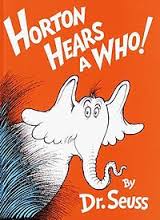
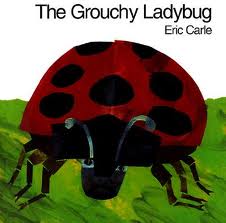
It’s time to wallow in Sendack (Maurice), Carle (Eric), and Seuss (Dr.).

Max Horton Ladybug

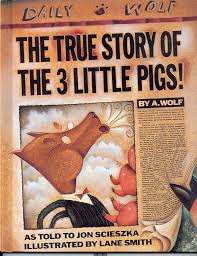
It’s time to discover Mo Williams’s Pigeon, Jon Scieszka’s Big Bad Wolf, and Jon Klassen’s hatless bear.

BearPigspigon

Why?

Primarily because teachers, all teachers, who are familiar with children’s literature can be positive role models for their students. They can engage students by making references to these books or they can make suggestions to young readers. They may even use them in lessons. But a new compelling reason has come out of a study by Jo Bowers and Dr Susan Davis, senior lecturers in primary education at Cardiff Metropolitan University. A review of responses by teacher trainees for primary grades indicates that reading children’s literature is good for your well-being.

An article in the British paper The Guardian Why Teachers Should Read More Children’s Books explains the study and promotes a paper Reflecting on Teacher Wellbeing that Bowers and Davis will give at Issues and Changing Perceptions conference in December 2013.

They had set up a year-long blog where teacher trainees could post reviews for three books they used with children over the course of the year. They then asked a focus group of these blog contributors a series of questions about their own reading experiences, such as, “What made you become a reader?”

The joys of reading became apparent, namely, how they had enjoyed “getting totally lost in a book” or “absorbed” by the narrative. It also became evident that they had close personal associations with certain texts from their own childhoods, and the fact that they could turn the page of a book and by knowing what was on that page gave them comfort and confidence to share that book with their class.

Trainee teachers reported they were using children’s books of all genres as a form of escapism from the stresses and strains of teaching in the primary classrooms. Researchers concluded that trainee teachers were using the book as a form of bibliotherapy, a therapy “increasingly moving away from its original medical model– whereby practitioners ‘prescribed’ self-help books to patients suffering from depression or eating disorders.” While the teacher trainees had to read the children’s literature selections as part of their professional development, they also found the experience pleasurable:

We have also found that trainee teachers often don’t read purely for pleasure, citing time constraints as the reason. Our blog project forced them to read as part of their professional development, and because they wanted to improve their subject knowledge. Wellbeing was secondary, but nonetheless became part of the project, almost by default. One of our students summed it up nicely: “Books are like best friends during stressful times.”

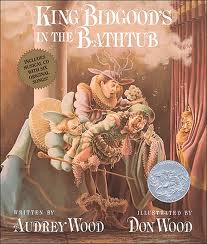
So, go ahead and pick up that copy of King Bidgood’s in the Bathtub and chant loudy the refrain “…and he won’t get out!”
Listen to the poetic wisdom of a small mouse who notes that everyone has a gift to bring in Leo Lionni’s Fredrick.
Or, share a red, ripe strawberry in The Little Mouse, The Big Hungry Bear and The Red Ripe Stawberry.

king Fredrick mouse

You will be reading for pleasure. You will be reading quickly, and you will probably feel better, things Thomas Hardy and Nathaniel Hawthorne may not do for you.

References according to The Guardian:

Jo Bowers and Dr Susan Davis are senior lecturers in primary education at Cardiff Metropolitan University. Follow them on Twitter: @Jo_Bowersand @drsuzyw. Reflecting on Teacher Wellbeing – Issues and Changing Perceptions conference will be held at Cardiff Metropolitan University on Wednesday 4 December 2013. For further information please contact:cseenterprise@cardiffmet.ac.uk.


JaneEyre-300x253

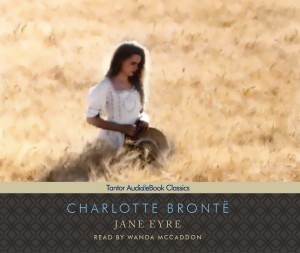
Jane Eyre audio offered by SYNC YA

This summer I have been visiting the family estate at Gateshead, the harsh boarding school Lowood, and the Gothic mansion called Thornfield Hall through the audio download of Charlotte Bronte’s Jane Eyre courtesy of SYNC YA. This free audiobook uses Overdrive software which is on both my computer and my mobile phone. As the recording of Jane Eyre is about eight hours long, the ability to move from device to device has proved most helpful in finishing the book.

This is not my first experience with this novel. I read the book when I was a teenager, and, like Jane, I fell in love with Mr. Rochester. Years later, I taught the book later to Advanced Placement students and marveled at Jane’s independence, her morality, and her ability to emphatically say “No” to the persistently persuasive Rochester.  Now, I am struck by Jane’s role as a governess and how Bronte characterizes attitudes towards that profession in Victorian England.

At one of Rochester’s soirees, Bronte has the spoiled but beautiful Blanche Ingram recount how she and her brother and sister, tormented their governesses and tutors as as they grew up. The incident begins when Blanche’s mother, Mrs. Ingram, calls the guests’ attention to Jane, isolated in a corner of the room. “I have just one word to say of the whole tribe,” whispers Blanche’s mother loud enough for Jane to hear, “they are a nuisance.”

Blanche cheerfully counters:

Not that I ever suffered much from them; I took care to turn the tables. What tricks Theodore and I used to play on our Miss Wilsons, and Mrs. Greys, and Madame Jouberts! Mary was always too sleepy to join in a plot with spirit. The best fun was with Madame Joubert: Miss Wilson was a poor sickly thing, lachrymose and low-spirited, not worth the trouble of vanquishing, in short; and Mrs. Grey was coarse and insensible; no blow took effect on her.

Not satisfied with those affronts to those poor teachers, Bronte has Blanche continue the list the indignities inflicted on one particular governess who was subjected to especially bad behavior from the Ingram children:

But poor Madame Joubert! I see her yet in her raging passions, when we had driven her to extremities–spilt our tea, crumbled our bread and butter, tossed our books up to the ceiling, and played a charivari with the ruler and desk, the fender and fire-irons. Theodore, do you remember those merry days?”

Blanche’s condemnation of those who tried to educate her backfires; Bronte’s desire to have the reader dislike this rival for Rochester’s affection is deliberate. Jane’s quiet moral intelligence wins out in the end.

Listening to the story, I considered that Bronte was making a case for the importance of education as a means to rise out of poverty. Jane’s education at the Lowood Institute, a boarding school, was hazardous and purchased at a terrible price. Her classmate, Helen, dies because of the stark conditions at Lowood, mirroring the real-life death of Bronte’s sister, Maria, who died from tuberculosis contracted because of hunger, cold, and privation at Cowan Bridge School. Despite the treacherous conditions, however, Bronte revisits the theme of education’s importance as it provided the character Jane with an independent profession. She is hired to teach Rochester’s ward Adele, and she proves to be a successful governess.

The conflict between Bronte’s belief that education was one way for a young woman to earn a small income, to have a marketable profession, clashes with the upper classes’s view of the teaching profession in 1847. Therefore, how disappointing to read polls (2009-2012) about contemporary economics of the teaching profession that demonstrate that a century and a half later, not much has changed. According to The Economix blog on the NYTimes, “Does it Pay to Become a Teacher?”, salary  may reduce attracting high quality graduates to the teaching profession:

The average primary-school teacher in the United States earns about 67 percent of the salary of a average college-educated worker in the United States. The comparable figure is 82 percent across the overall Organization for Economic Cooperation and Development (O.E.C.D.). For teachers in lower secondary school (roughly the years Americans would call middle school), the ratio in the United States is 69 percent, compared to 85 percent across the O.E.C.D. The average upper secondary teacher earns 72 percent of the salary for the average college-educated worker in the United States, compared to 90 percent for the overall O.E.C.D.

The findings also point out that teachers in the USA teach over 1000 hours annually, an amount well over the hours of their international peers. That number does not include time for preparation, training, or assessing. The article concludes:

Given the opportunity costs of becoming a teacher instead of using your college degree to enter another, more remunerative field, are the psychic rewards of teaching great enough to convince America’s best and brightest to become educators?

Bronte was one of England’s best and brightest who advocated education, but Bronte knew that teaching was not an economically successful profession. Jane Eyre only becomes financially independent when a relative leaves her a fortune; she only becomes wealthy when she confesses, “Reader, I married him.”

Over 150 years after Charlotte Bronte’s novel, the teaching profession still has its critics; there are real life Mrs. Ingrams and Blanches who hold the profession in contempt. There are also economic drawbacks to choosing the profession, as demonstrated in the O.E.C.D poll.

In the 21st Century, the teaching profession should be desirable to those who aspire to teach, but who, like Jane, want to be financially independent. Teachers should not have to wait for a Mr. Rochester in order to prosper.

Browsing at the Southport Pequot Library Book Sale, I overheard the following conversation:

“Why, here’s another book by Thackeray….”Pendennis”. Have you read that?”
“That’s a lovely read, but I’m not reading Thackeray this year; I told you that this is the summer I am reading Trollope.”
“Yes, you did..(*pause*)…Oh!…do we have a nice copy of “Ethan Frome”?”

Behind the two people conversing was a sign with an appropriate message:

Old (but Interesting) Books.

“Yes,”I thought, “that certainly was an interesting conversation about old books,”

The Pequot Library Book Sale
720 Pequot Avenue  Southport, CT 06890-1496  |  203.259.0346

Pequot library

Friday, July 26 to Tuesday, July 30, 2013
OVER 140,000 BOOKS, CDs, DVDs, RECORDS, etc.
Admission is FREE and all Sale proceeds benefit Pequot Library.
HOURS AND PRICING
Friday, July 26 9am to 8pm DOUBLE the marked price
Saturday, July 27 9am to 5:30pm Priced as marked
Sunday, July 28 9am to 5:30pm Priced as marked
Monday, July 29 9am to 6pm HALF the marked price
Tuesday, July 30 9am to 2pm $5 PER BAG DAY!
High quality books at reasonable prices
Visa, MasterCard, Discover, and American Express Accepted

Going to the Pequot Library in this small Fairfield County town reminds me of visiting my Grandma Rosie; she was eclectic, tousled and conversational with books and crosswords stacked around her armchair. This sale is equally eclectic, housed partially in a venerable mansion that is the main library and partially under the large white tents that cover the lawn.  Inside both the library and under the tents the books are laid out onto tables in rows, in stacks, in mounds; many tables bend with the weight and some books spill over to the boxes or tarps below.

As you shop, there are surprising little gems mixed in every genre. Admittedly, some of these surprises are probably due to volunteer book sorters who, when faced with the daunting task of organizing the 140,000 plus books, may have been a little unclear about the divide between fiction and non-fiction. What else could explain the placement of several copies of Mark Haddon’s The Curious Incident of the Dog in the Night Time on both the Fiction and the Animals and Nature Table? Or why would Dodie Smith’s I Capture the Castle be on the Art and Architecture table? But I quibble. Be polite and pretend that you are sorting though the library in Grandma Rosie’s house. Notice and enjoy the rich variety of texts available for purchase, regardless as to where they have been placed. Tidy the piles as you go, and you will be a welcome guest.

I secured a dozen hardly used copies of Cormac McCarthy’s All the Pretty Horses. The first time I read the book, I was so annoyed by the lack of punctuation for dialogue that I complained to several of my students. One student thoughtfully replied, “It’s like he is breaking down the walls between what is thought and what is spoken.” I have not complained about the lack of punctuation since.

New copies of All the Pretty Horses retail for $12.29 each and my 12 copies would have cost $147.48; I spent a total of $132.00 for four bags of books in addition to these copies. The titles I selected were mostly “replacement” books such as Harper Lee’s To Kill a Mockingbird, Cormac McCarthy’s The Road, Coehlo’s The Alchemist, Andersen’s Speak and Kesey’s One Flew over the Cuckoo’s Nest. I even purchased a number of copies of John Knowles A Separate Peace; I dislike the book, but the copies were too new to pass up, and the English I honors classes like the story. There were no copies of my target book The Help to be had, but I could have purchased a class set of 30 or more copies of Kidd’s The Secret Life of Bees.

Other notable qualities of the sale that provide hints to the character of Southport’s residents include:

  • an amazing array of cookbooks, many in pristine condition (may not be a good thing in a cookbooks; shouldn’t they be falling apart?)
  • well organized audio texts (someone knew his/her stuff!)
  • award-winning fiction seriously represented  (the Booker Prize, the National Book Award, the National Book Critics Circle Award, Pulitzer Prize, Newbery Medal, Nobel Prize for Literature, PEN/Faulkner Award, etc.)
  • a tremendously large section of biographies in the main library (My Grandma Rosie loved biographies as well…)
  • teachers from area schools are given vouchers (wish my school could be included??)

The drawbacks?

  • books under the table are hard to access and bending and straightening leads to awkward collisions of heads/buttocks/stomachs/elbows;
  • the children’s section was ransacked by…you guessed it…children;
  • not enough room around paperback fiction, while the romance section sat forlorn with wide aisle surrounding it;
  • the smell of the cookout is hard to bear on an empty stomach…be warned.

At the checkout line, the volunteers were characteristically more gracious than efficient. Your choice of books could be the start of a lovely conversation, but you should hasten the end of the pleasantries as long lines could be building behind you.
Like my Grandma Rosie, they understand, just as long as you promise to visit next year as well.

CT Stae flagThe other day, I made a scan of my teaching and administrative certificates and sent them to my school office in order to update my records. If you teach in the State of Connecticut, as I do, you are required to provide the necessary transcripts and payments to secure and maintain a teaching or administrative certificate. The Connecticut Department of Education (CT SDE) has always been one of those great equaling institutions: no paperwork=no certificate.

Until now. Until Paul Vallas, Interim Superintendent of Schools in Bridgeport, Connecticut.

Vallas has served 17 months as Interim Superintendent of Schools for Bridgeport, Connecticut, a 21,000-student school system. Before coming to Connecticut, Vallas had served as the Superintendent of the Recovery School District of Louisiana; and the CEO of Chicago Public Schools and the School District of Philadelphia. Vallas, however, was ousted by a Connecticut Superior Court Judge Judge Barbara Bellis’s weeks ago because he lacked graduate coursework and that the “alternative program” created for Vallas by the State Commissioner of Education, Stefan Pryor, fell far short. Pryor’s letter certifying Vallas’s credentials, according to Jacqueline Rabe Thomas writing (6/28/13) in the Connecticut Mirror, was not accepted by the judge who ruled:

“’There is no doubt that Vallas received preferential treatment,’ the judge wrote in her 27-page decision.The judge also noted that Vallas lacked the required prerequisites to enroll in the regular UConn [University of Connecticut] program in the first place, and that such an independent study hadn’t been approved for anyone else in the last decade. Additionally, the university’s governing board had never approved an independent study program.’Ultimately, the course standards were reduced,’ the judge wrote. ‘The court accepts Vallas’ testimony that the work, although done over the course of 10 weeks while fulfilling his employment as acting superintendent, could have been completed in a week.'”

Ultimately, the judge ruled that Vallas’s BS in Political Science/History and MA Political Science from Western Illinois University were not comparable for a certification in education according to Connecticut’s Department of Education (CT SDE). While his experience as the Executive Director of the Illinois Economic and Fiscal Commission, revenue director and budget director for the City of Chicago provided him the experience to deal with Bridgeport’s financial woes, he lacked training as an educator.

Vallas has a number of supporters on the Bridgeport Board of Education, and his ouster has received the attention from the state and national press. There are articles and editorials, mostly positive about his work in Bridgeport. The editorial headline from the Hartford Courant (7/25/13) was particularly sympathetic: Why Make It So Hard For Paul Vallas To Help Bridgeport Schools? Qualifications shouldn’t obstruct a promising superintendent

It would be a blow to the city of Bridgeport’s school system and its 21,000 students if Paul Vallas is not permitted to stay on as superintendent. Someone of Mr. Vallas’ experience and gravitas is just what the doctor ordered for the city’s ailing school system.

While I know little about Vallas’s efforts to improve the school system in Bridgeport, I was particularly attentive to several comments that followed this editorial discussing the role of the state’s colleges and university programs. These comments made clear that academic institutions should be concerned when their undergraduate and graduate education certificate programs are being discounted at the highest level.

Educators in the Constitution State spend time and money at state colleges and universities to meet the requirements for teacher and administrator certifications. Even the state-run Alternate Route to Certification (ARC) for those entering the profession with degrees other than education has been made more demanding. There are special graduate certificate programs offered at different institutions (Administrator-092, Literacy Specialist-097, Superintendent-093) each with requirements of extensive coursework of 30 credits or more.

In addition, CT SDE requires that educators provide all transcripts and results from subject area texts (PRAXIS II); these cost educators time and money. CT SDE website also states:

All prospective administrators enrolled in Connecticut administrator preparation programs seeking a recommendation for the Initial Educator Certification for Intermediate Administration or Supervision (#092) must pass the CAT (Connecticut Administrators Test) in order to be certified.

All administrators prepared outside of Connecticut with fewer than 3 years within the last 10 years of administration experience who apply for the Initial Educator Certification for Intermediate Administration or Supervision (#092) must pass the CAT. An applicant recommended by an out-of-state institution may be eligible for a one-year deferral of the CAT.

Paul Vallas did not meet these requirements.

The controversy has captured the opinions of state politicians, educators, and reached the federal level with the Secretary of Education, Arne Duncan, siding with Vallas. They argue in the press over what Vallas has done for Bridgeport, or what he has accomplished outside of the state.

A more serious far reaching problem, however, is this example of the State of Connecticut’s unequal application of certification requirements to educators. If a certificate is not necessary for a high-profile educator to work as an administrator in the state, why have the requirement at all? If education course work is unnecessary, why should the state’s colleges and universities offer courses at all? And if there is no need for certificates or coursework, why have I paid money to the state to keep my teaching and administration certificates updated?

In Connecticut, the land of steady habits, inequalities in certification requirements make the state a little less steady.

I love books.

While that is not the most eloquent statement about reading, the three word sentence communicates my desire to spend time with the writings of another.

In contrast to my simple declaration, there are are a number of very eloquent statements about the importance of books.  On my e-mail correspondence, I have a quote from the Victorian Scottish born essayist and historian Thomas Carlyle (1795-1881)

 “All that mankind has done, thought, gained, or been; it is lying as in magic preservation in the pages of books.”

I enjoy sharing that quote and two other facts about Thomas Carlyle:

Carlyle

Thomas Carlyle

1. He invented the word Eleutheromania: A mania or frantic zeal for freedom. If I were to use this word in a sentence, I would write, “At the conclusion of every school year, I suffer a serious case of Eleutheromania.”

2. He and his wife were very unhappy. They were so unhappy that the author Samuel Butler said of their marriage: “It was very good of God to let Carlyle and Mrs Carlyle marry one another, and so make only two people miserable and not four.”

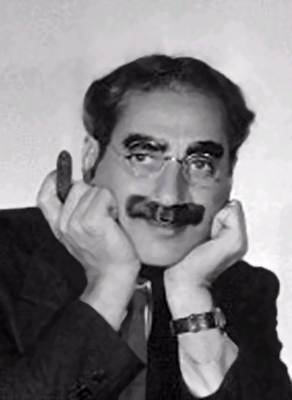
I also have a favorite funny quote about reading books. This quote is by the brilliant comedian Groucho Marx (1890-1977) and is spelled out in big gold letters on one of my book bags:

groucho-marx-on-reading-21664922

Groucho Marx

”Outside a dog, a book is man’s best friend. Inside a dog, it’s too dark to read.”

I get a number of people who look at my bag from a distance, I see their lips move as they read the joke aloud…and then I see them smile when they understand. Groucho’s humor is timeless.

Sagan

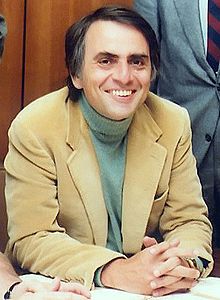
Carl Sagan

By far the most eloquent comment I have ever read about reading books, however, comes from Carl Sagan (1934-1996).  Sagan was was an American astronomer, astrophysicist, cosmologist, and author who relentless promoted science. His brilliant TV series in the 1980s Cosmos received critical acclaim and gave over a reported 500 million viewers a new perspective on the size and scope of the universe and the relative size of planet Earth in comparison.  The 11th episode was titled “The Persistence of Memory” and in this episode Sagan stated the following:

“What an astonishing thing a book is. It’s a flat object made from a tree with flexible parts on which are imprinted lots of funny dark squiggles. But one glance at it and you’re inside the mind of another person, maybe somebody dead for thousands of years. Across the millennia, an author is speaking clearly and silently inside your head, directly to you. Writing is perhaps the greatest of human inventions, binding together people who never knew each other, citizens of distant epochs. Books break the shackles of time. A book is proof that humans are capable of working magic.”

A book reaches across the millennia. An author is in your head speaking to you. Books bind people together.

Astonishing indeed, and reason enough to say, “I love books.”

Rosetta

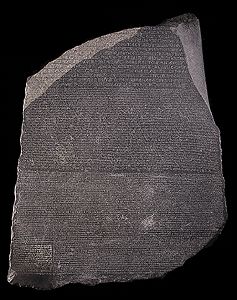
The Rosetta Stone currently located in The British Museum in London, England.

When I stood in front of the Rosetta Stone in the British Museum in London, I had to wiggle my way through the blockade of tourists who were trying to photograph the small black tablet. Since the stone was encased in glass, I knew the reflections from the camera flashes would result in poor quality photos. Once I had my few seconds before the 2200 year old tablet, I headed off to the gift shop to secure a clear photo of the Rosetta Stone and a small plaster recast of the dark black stone; both yielded far more details than I saw when I was squeezed by the crowd.

The face of the Rosetta Stone, one of two tablets, is etched with three different scripts, each spelling out the same decree issued by King Ptolemy V from Memphis (Egypt) in 196 BCE. These inscriptions translate Ptolemy’s decree in three scripts: the upper text is Ancient Egyptian hieroglyphs, the middle portion Demotic script, and the lowest Ancient Greek. Because the Rosetta Stone presented the same text in each script (with a few minor differences among them), the tablet provided the key to our modern understanding of Egyptian hieroglyphs.

Since the Rosetta Stone is often used as a metaphor for using an essential clue to a new field of knowledge, why not use the Rosetta Stone as a metaphor for explaining the role of data, specifically standardized test data, in informing classroom instruction? Imagine that different stakeholders, (school administrators, teachers, students, parents and test creators ) who look at the results of standardized tests are like those who crowd before the Rosetta Stone trying to decipher its meaning.

The first linguists who worked with the Rosetta Stone were able to look closely, touch and take rubbings of the different alphabets and hieroglyphics as they translated each of the texts. They spent time puzzling over the different alphabets, and they constructed primers to help decode each of the languages. They could see the variations in the engraver’s strokes; they could examine nuances in chisel marks that formed the symbols. As to the contents of the missing or damaged sections, the linguists made educated guesses.

Likewise, in education there are those who are knowledgeable in translating the information from standardized tests, those who have spent time examining data looking for patterns of trends comparing collective or individual student progress over time or perhaps comparing student cohorts. The metaphor of the Rosetta Stone, however, fails in directly comparing the different forms of data collected in the multitude of standardized tests. Each test or assessment is constructed as a single metric; the translations of one standardized test to another are not the same. For example, the state mandated Connecticut Mastery Tests (CMT-grades 3-8)  are not correlated to a diagnostic test for reading such as a diagnostic reading assessment (DAR). The Connecticut Academic Performance Test (CAPT Grade 10) cannot be directly compared to the PSAT or ACT or the NAEP, and none of these standardized tests are comparable to each other.

Consider also how the linguists who studied the Rosetta Stone spent time and lingered over the different interpretations in order to translate the symbols in the differing alphabets. They studied a finite number of symbols that related to a finite statement fixed in time.

In contrast, standardized testing associated with education reform is on the upswing, and today’s educators must review continuous waves of incoming data. Often, when the results are finally released, their value to inform classroom instruction has been compromised. These results serve only to inform educators of what student could do months earlier, not what they are doing in real time. Just like the time stamped images each tourist’s camera records of the Rosetta Stone, standardized tests are just time stamped snapshots of past student performance.

How ironic, then, that so much media attention is given over to the results of the standardized tests in informing the public about student progress. How like the crowds snapping blurry photos around the Rosetta Stone are those who do not understand what exactly what each standardized test measures.

What they should appreciate is that prioritizing the streams of data is key to improving instruction, and the day to day collection of information in a classroom is arguably a more accurate snapshot of student ability and progress.

There are the classroom assessments that teachers record on progress reports/report cards: homework, quizzes, tests, projects that measure student achievement in meeting grade level standards and requirements. Then there is the “third leg” of data, the anecdotal data that can be used to inform instruction. The anecdotal data may be in the form of noting a student sleeping in class (“Has she been up late?”), reviewing a lesson plan that did not work (“I should have used a picture to help them understand”), or reporting a fire drill during testing (“Interruptions distracted the students”). Here the multiple forms of data collected to measure student progress are fluid and always changing, and translating these results is like the linguists’ experience of the hands-on translation of the Rosetta Stone noting the variations and nuances and making educated guesses.

The standardized tests results are most useful in determining trends, and if translated correctly, these results can help educators adjust curriculum and/or instructional strategies. But these test results are antiquated in relation to tracking student learning. Students are not the same day to day, week to week, semester to semester. Their lives are not prescribed in flat symbols, rather students live lives of constant change as they evolve, grow, and learn.

As the Rosetta Stone was critical to understanding texts of the Ancient World, our standardized tests are the “ancient texts” of contemporary education. Standardized tests cannot be the only measurement the public gets to interpret on student and school performance since the results are limited as snapshots of the past. Student and school performance is best understood in looking at the timely combination of all streams of data. To do otherwise is to look at snapshots that are narrow, unchangeable, and, like many of those photos snapped in the British Museum, overexposed.

There has been a heat wave in Connecticut this week, temperatures in the high 90s with muggy, sultry, humid weather, so it was no surprise that the bargains were “hot, hot, hot” under the tent at the Westport Public Library Book Sale.  So hot, in fact, that organizers had large fans set up in some of the outdoor tents! The sale is held in Westport, Connecticut:

Tents on Jesup Green and inside the Library
July 20-23, 2013
(Monday—Everything half-price)
Tuesday: 9 am-1 pm (Free day, donations appreciated)

The Westport Public Library Book Sale is a premiere event in the state for several reasons:

  • The tents are huge with tables laden with books;
  • Prices are good (Hardcovers are $3/trades $1/paperbacks and children’s books $.50);
  • Books are of exceptionally high quality.

The main tent offered a spectacular number of books with wide aisles. This is where the non-fiction texts/literature/reference texts are usually laid out.

Informational texts for science classes!

Informational texts for science classes!

For some perplexing reason, however, the teen/YA section was also in the main tent, while the sports/nature books were in the children’s tent. This led to some mistaken shelving; there was a copy of fairy tales and Miss Nelson is Missing in between golf books and some travel guides. The magnitude of the collection of donated books meant some challenges for those  keeping book sorters on message; sometimes the same text appeared on tables for different genres. For example, copies of Tom Brokaw’s The Greatest Generation were in biography, history, politics, and for some inexplicable reason, Judaica.

The children’s book section was extensive enticing shoppers of all ages; shoppers should be wary of smaller patrons underfoot.

My target area for filling the classroom shelves was the tent for fiction, which was overflowing with hardcovers and paperbacks. There were so many hardcover fiction books, that I later discovered an adjunct aisle of hardcover fiction that spilled into the classic literature section in the main tent. I am sure that The Girl Who Played with Fire was enjoying spending time with her more mature cousins Ethan Frome and The Red Badge of Courage.

Unfortunately, the aisles in the smaller fiction tent here were not as wide as in the main tent, and there were boxes loaded with trade paperback fiction below the tables. Stooping to browse through these lower levels slows down buyers and makes for some awkward moments in passing. To make passing smoother, though, there was a volunteer dutifully loading up the tables once people made their selections.

BPp77-1CIAAdviT.jpg-large

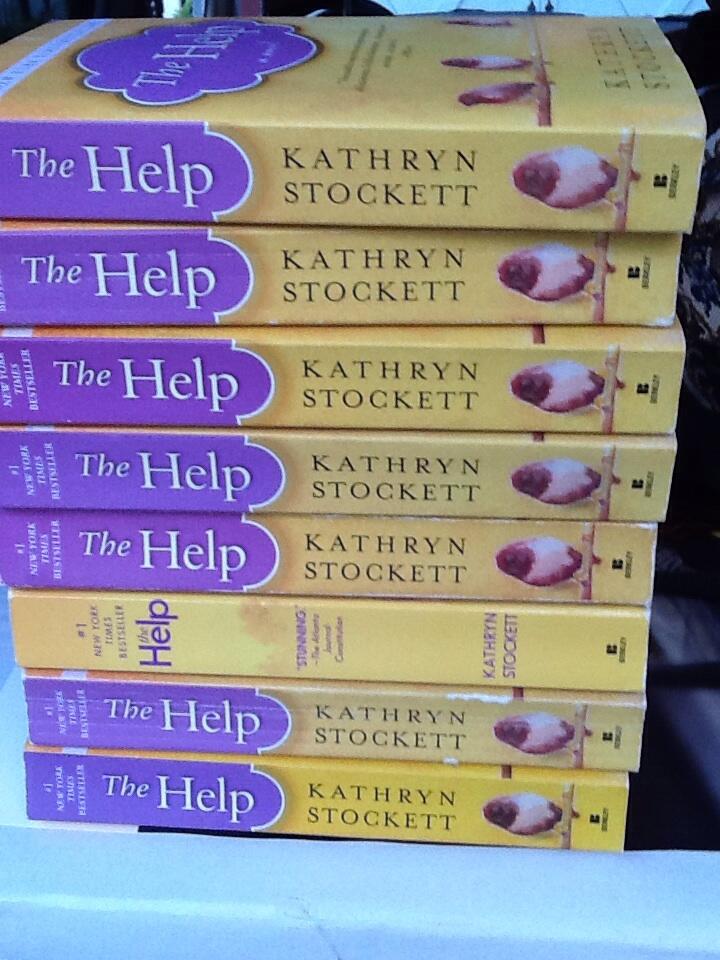
One stack of The Help for English III

I was looking for specific titles and soon was rewarded with a dozen copies of Katheryn Stockett’s The Help. This book retails for $12.92 on Amazon; 12 copies would have cost $155.04. Instead, I spent $73.50 in total for these books plus three and a half bags full of other titles, many also beginning with word “the”: The Things They Carried, The Road, The Giver, The Girl Who Fell from the Sky, and The Book Thief. 

Because the trademark of Westport readers is their ability to take exceptionally good care of their books, these copies are in pristine condition. I suspect there must be some town ordinance about bending pages or preserving book covers on reading material in town.

A further study of the town, based on donated books, would be that Westport residents:

  • Believe in parenting book (five tables full);
  • Do not donate small paperback copies (only three tables full);
  • Do not read the genre “romance” (no tables full);
  • Travel extensively (based on travel guides);

The book sale has dedicated volunteers who will tally books on the side lawns of the main tent if you are purchasing more than an armful; there are boxes available for ambitious shoppers and checkout is a breeze.

The Westport book sale is a bibliophile’s delight with red hot bargains for all ages. Now, if only they could do something about this heat wave!

Poetry Friday: Invictus

July 19, 2013 — 4 Comments

The film Invictus tells the story of how in 1995 Nelson Mandela enlisted the help of South Africa’s National Rugby team in order to unite the country and end prejudices associated with Apartheid. The film stars Morgan Freeman as Mandela and Matt Damon as South African rugby star Francois Pienaar, but this is more than a sports film. One mise-en-scene features a visit to the real Robben’s Island Prison, where Mandela was held as a political prisoner for 27 years.

The film footage shows the cell where Mandela served his sentence before his release in February 1990. As the camera pans around the prison, the voice of Freeman recites William Ernest Henley’s poem Invictus

Out of the night that covers me,
Black as the Pit from pole to pole,
I thank whatever gods may be
For my unconquerable soul.

In the fell clutch of circumstance
I have not winced nor cried aloud.
Under the bludgeonings of chance
My head is bloody, but unbowed.

Beyond this place of wrath and tears
Looms but the Horror of the shade,
And yet the menace of the years
Finds, and shall find, me unafraid.

It matters not how strait the gate,
How charged with punishments the scroll.
I am the master of my fate:
I am the captain of my soul.

I am familiar enough with the poem that I do not need to look it up or “cut and paste” the text.
I can recite this poem cold.
So can the grade 12 seniors at Brookfield High School in CT (my tenure 1999-2008) who traditionally memorized the poem and recited its 16 lines for an English grade.

The “Invictus Day” tradition was begun to honor an English teacher who had passed away; the tradition was sustained by her colleague, Carole Smith, who would prepare “Invictus” sheets for students to carry with them to practice. A rubric was on the back that provided selected teachers a rubric to grade the quality of the recitation: A for a spectacular recitation (with feeling; no errors); B for a good recitation (one error allowed); C for an average recitation (errors allowed). A student had only one shot for an A; a teacher would sign off on the quality, but if there was a single flub, the highest grade that could be achieved was a B. Fortunately, the weight of the “Invictus” grade was nominal, however, the honor of getting an A for recitation was an achievement regardless of weight.

“Invictus Day” was an unannounced event held usually in late October or early November. Members of the faculty wore black, and seniors went scurrying to their lockers for their sheets. In Harry Potter-esque fashion, teachers would point at a senior with a finger and command, “INVICTUS”! The senior would be required to drop everything, hand over the sheet, and begin reciting, “Out of the night that covers me…”

There was a great deal of cowering, creeping, lurking,  prowling, skulking, and stalking on “Invictus Day”…on the part of both students and faculty. Some students took full advantage of the dramatic encounters by shouting the poem at the top of their lungs or climbing on tables or desks to recite for a crowd of delighted underclassmen. Others clung together to recite chorally, while the more timid seniors were given the opportunity to pull a teacher aside to recite and “get this over with!” Every year, a student would sing the poem to a familiar tune; one year, a student had a completely original melody with back-up singers. Once a student was graded, or “invicted”, he or she could show the sheet as a pass. Once invicted, a student could not be forced to recite again.

My favorite story of “Invictus Day” was of a one student who advertised his plans for presenting the poem. He prepared to recite the poem holding a heavy plaster skull, a la Hamlet. Hearing this, I convinced the members of the faculty not to invict him. The idea that he would carry the skull for several days was amusing to the faculty and to the student body. November came and went, and so did December and January. By late March, the student was pleading for someone to “invict me” so that he could rid himself of the skull he had been toting for months. Fortunately, he had been cast as a lead in the school musical. One warm April night, at the end of the final night’s production, he ran forward to take his well-deserved bow. As he stood up, I stepped out from the wings and onto the stage and cried, “Invictus!” There was a split second of shock in his eyes, but he bounded backstage and seconds later reappeared with the skull to recite the poem to a full house. There was a standing ovation; his performance for both the musical and the poem deserved the audience’s applause.

The obvious message of the poem is the control of one’s fate, and that makes the poem perfectly suited for seniors who will be steering their own destinies once they graduate. They may go to colleges, training schools, the military, or they make seek their futures in other pursuits, but who they will be after the thirteen years of mandated education is largely up to them. Holding the poem’s message in their heads, and in their hearts, can serve to guide them through rough waters of adulthood.

Mandela The same could be said for the use of the poem in the film Invictus. Four years after his release from his 27 years in Robben Island’s prison, Nelson Mandela was elected president of South Africa. He had made great sacrifices in bringing the horrors of Apartheid to an end, but his belief in a united South Africa had prevailed.

This past Thursday, July 18, 2013, Mandela turned 95 years old.

Happy Birthday, Mr. Mandela, your life story is affirmation of Henley’s message:

I am the master of my fate:
I am the captain of my soul.