Archives For November 30, 1999

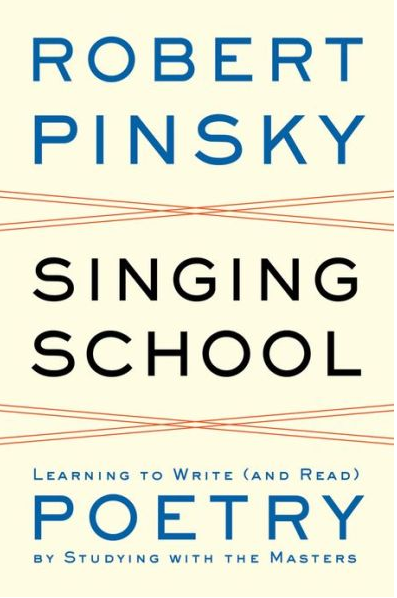
Screen Shot 2013-12-05 at 11.08.36 PMThe sonorous voice delivering the keynote address at the Conference on English Leadership (CEL) on Sunday, November 24, 2013, belonged to the poet Robert Pinsky. He was there to promote his latest book Singing School, which is promoted as, “A bold new approach to writing (and reading) poetry based on great poetry of the past.” This collection of 80 poems includes selections from  Sappho to Allen Ginsberg, Shakespeare to Emily Dickinson. In an interview on NPR,  Pinsky explained that the poems for the book were selected “because of the music of the language, and not from the meaning of the words.” In the interview he explained:

“Even just the cadence of pauses,” he explains. “I stop. I think. I wait. I wait a little longer. Then less. … Something like that generates the poem. And for me, if anything I do is any good, it’s carried by that kind of cadence or melody.”

To prove his point, Pinsky filled his address with reciting lines of poetry, once challenging the crowd of English teachers in attendance to identify the poet; “That was Robert Frost, your New England poet,” he gently chastised when no one responded correctly. (To give you a taste of the experience, you can hear Pinskey read Frost’s poem “Mowing” courtesy of Slate Magazine by clicking here.)

As we listened, I heard someone remark that Pinsky could make a parking ticket sound lyrical.
Screen Shot 2013-11-29 at 2.27.16 PM

Pinsky’s voice was not the only one reciting poems in his keynote. He turned to the presentation screen to show videos from the Favorite Poem Project website. This project  is “dedicated to celebrating, documenting and encouraging poetry’s role in Americans’ lives.”

Pinsky founded the project when he served as the 39th Poet Laureate of the United States, from 1997-2000. The Favorite Poem Project website details how,

“During the one-year open call for submissions, 18,000 Americans wrote to the project volunteering to share their favorite poems — Americans from ages 5 to 97, from every state, of diverse occupations, kinds of education and backgrounds.

Pinsky purposely selected a video to show as a tribute to the City of Boston, host of the CEL. The selected video featured John Ulrich, a student from South Boston, MA, reading Gwendolyn Brooks’s  “We Real Cool”:

We Real Cool
by Gwendolyn Brooks

THE POOL PLAYERS.
SEVEN AT THE GOLDEN SHOVEL.

We real cool. We
Left school. We

Lurk late. We
Strike straight. We

Sing sin. We
Thin gin. We

Jazz June. We
Die soon.

Each video available on the Favorite Poem Project’s website begins with the reader’s reason for choosing the a particular poem. Ulrich provided a touching admission of how Brooks’s short poem reminds him about several childhood friends he lost to suicide. He read her 1950s tribute to the players in a pool hall in the South Side of Chicago with a heavy South Boston accent twice. The defiance on his face during the second reading is visible in the video.

I have taught this poem in my classes, and inevitably one of the more musical students, usually a drummer, will notice, “Hey, this is written in jazz!” The brevity of Brooks’s verse belies the amount of discussion the poem generates for students, particularly with the ending line, “We/ Die soon.”

Pinsky shared other videos: Nick and the Candlestick by Sylvia Plath read by Seph Rodney and Poem by Frank O’Hara read by Richard Samuel. The production quality of these videos garnered admiration from the crowd.

“Are you still taking entries for this project?” one teacher asked.
“We may be,” replied Pinsky.

His final comment sent a ripple that went through the audience as people considered, “What poem could I read for the project?”

Continue Reading…

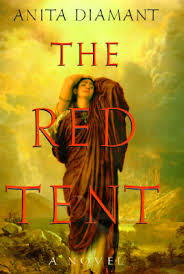
red tentMany of my students do not know Old Testament stories other than “Noah’s Ark” and “Adam and Eve”. There is the occasional biblical teen scholar who may be able to recount the origin a pillar of salt (Lot’s wife) or maybe there will be a student who saw the musical Joseph and the Amazing Technicolor Dreamcoat and make a patriarchal connection. For the most part, students are not up to date on Methuselah or even which of the brothers killed the other (Cain or Abel). They are far more likely to ask, “So, where did all the other people come from if Eve was the only woman?”

Fortunately, The Red Tent, a novel by Anita Diamant (1997) does address other women of the Old Testament. Her fictionalized version of the story of Dinah, daughter of Leah and Jacob, is based on in a brief but particularly violent and gruesome incident in the Book of Genesis. In the King James Version of the Bible, Dinah is known as the daughter who is “defiled” by Shechem, a prince, who then wanted to marry her (Genesis 34: 1-3):

1 And Dinah the daughter of Leah, which she bare unto Jacob, went out to see the daughters of the land.

2 And when Shechem the son of Hamor the Hivite, prince of the country, saw her, he took her, and lay with her, and defiled her.

3 And his soul clave unto Dinah the daughter of Jacob, and he loved the damsel, and spake kindly unto the damsel.

Dinah’s brothers, sought vengeance for the attack on their sister. They tricked Shechem and his family, claiming to come in peace, and exacted their punishment by killing the royal family and all males in the city:

26 And they slew Hamor and Shechem his son with the edge of the sword, and took Dinah out of Shechem’s house, and went out.

27 The sons of Jacob came upon the slain, and spoiled the city, because they had defiled their sister.

This horrific incident is explained very differently in the Diamant’s fictional retelling, as are many other familial incidents, from Dinah’s point of view. The rivalry between Rachel and Leah, the rivalry between Jacob and Esau, and the rivalry between the sons of Joseph, Dinah’s younger brother, are rich with detail and dialogue. The sparse accounts given in the Old Testament are fleshed out in this compelling narrative, with the women center stage, a striking contrast to the male-dominated biblical text.

Several of my female students in Advanced Placement English Literature choose to read The Red Tent as an independent choice, and their response is not unlike other female student responses chronicled in the article “The Wandering Womb at Home in The Red Tent: An Adolescent Bildungsroman in a Different Voice” by Holly Blackford. In this review, Blackford writes about the female students’ enthusiasm for the book:

So emotional about the story of The Red Tent that they can barely speak, and indeed continually interrupt one another, they cite the way in which the contemporary novel revises the patriarchal story of Jacob; represents the concerns of girls in terms of emotion and relationship; and details the entire lifecycle of girl-to-woman through engaging first-person narration:
  Carol: There are certain books I just can’t put down.
      Laticia: Seriously, I’ll read until like three in the morning . . .
      Interviewer: Like what?
      Carol: Like The Red Tent!

Blackford also points out that this revision of an ancient text  comes at a time when girls are, “hungering for an exploration of female-centered myths, deities, worlds, and power-structures.” Her claim in The Alan Review (March, 2005) is that books like The Red Tent:

“… appeal to adolescent women and grow their appreciation for contemporary women’s literature that speaks “in a different voice” (Gilligan) from the more masculine canon they expect in their school curriculum.”

There are about 20 copies of The Red Tent on the class independent book cart, all purchased at book sales for $1.00 each. Picador USA publishers produced an oversized text, about 2″ taller than a standard trade paperback; on the AP English Lit book cart’s top shelf, these copies stick out. The cover art, designed and illustrated by Honi Werner, is also eye-catching. Students always pick up the book with interest.

“What’s this about?” one asks.
“Read the back,” I reply.
“‘...told in Dinah’s voice, this novel reveals the traditions and turmoil of ancient womanhood-the world of the red tent,’ (*pause suspiciously*)…is this a ‘chick book’?”
“Yes,” I chuckle, “this is most definitely a chick book….probably the ultimate chick book, of ALL chick books.”

How else to describe a story that centers on celebrating the onset of womanhood?

After they read any independent book, the AP students are required to write an essay. The essay prompt this quarter for any book they choose is taken from the AP released exam list of questions:

In retrospect, the reader often discovers that the first chapter of a novel or the opening scene of a drama introduces some of the major themes of the work. Write an essay about the opening of the first chapter of a novel in which you explain how it functions in this way. *hint: the lens you use is the lens from the conclusion of the novel*

Students who choose to read Diamant’s The Red Tent will certainly want to return to the beginning to explain how Dinah’s life story begins and ends with the women who loved and supported her.  They will also have had a “crash course” on the Book of Genesis, which is the source of many other literary allusions. While The Red Tent is not great literature, this novel sets many female students looking for equally compelling contemporary novels about women, with or without that “chick book” label.

If nothing else, the Common Core State Standards’ (CCSS) contribution to the academic lexicon will be the renaming of the genre known as non-fiction to a larger genre of informational texts. This renaming expanded the genre to include many forms of reading: textbooks, letters, speeches, maps, brochures, memoirs, biographies, and news articles, to name a few.

So where to find these informational texts? What is appetizing enough to make middle school students want to read a story, and then, answer the questions to check their understanding? What kind of high interest texts appeal to high school students who prefer to “Google” or “Sparknote” answers rather than read a text closely? What multi-media elements could be added to make an informational text palatable enough to be consumed by all levels of readers?

Screen Shot 2013-11-11 at 6.30.17 PM

The 2:12 video for accompanies the story

Well, teachers should look no further than the October 1, 2013, New York Times‘ feature article dedicated to Doritos Tortilla Chip titled That Nacho Dorito Taste. This short feature article combined photography and graphics;  a short video: and even shorter text that combined to provide an explanation on how this particular food is engineered so that “you can’t eat just one.”

The article is timely since the CCSS  requires that the student diet of reading should be 70% informational texts and 30% fiction by the time they graduate from high school.  The Literacy Standards specifically address reading in math, science, social studies, and the technical areas and recommends the increase in reading informational texts be completed in these classes. One of the technical areas content area classes could be a culinary arts class, a marketing class, or a health science class, but consider this particular informational text as scrumptious for any class.

In organizing this story, New York Times reporter Michael Moss, who also narrates the embedded video, interviewed food scientist Steven A. Witherly, author of “Why Humans Like Junk Food,” in order to better understand how all of the chemical elements combine in the Nacho Cheese Doritos chip to make it alluring to our taste buds.  According to Witherly, the mixing of flavors on this particular chip is purposeful:

 “What these are trying to do is excite every stinking taste bud receptor you have in your mouth.”

The graphics for the article by Alicia DeSantis and Jennifer Daniel are cleverly combined with photographs by Fred R. Conrad, also from the The New York Times. A separate page layout with the graphic/photo mix delivers tidbits of information about the Dorito chip. Each detail is organized by topic, as this example shows:

Screen Shot 2013-11-10 at 9.46.47 PM

A teacher does not even have to work at organizing questions for students to answer since the New York Time Learning Network, a free educational blog offered by the paper, organized an entire lesson plan on this article. The lesson is titled 6 Q’s About the News | The Science Behind Your Craving for Doritos, organized by Katherine Schulten. The questions on the blog include:

WHAT is psychobiology?
WHAT is “dynamic contrast”?
HOW do the acids in Doritos work on the brain?

WHAT is “sensory-specific satiety”?

WHERE do half the calories in Doritos come from, and, according to the graphic, HOW does that work on the brain?

WHY is “forgettable flavor” so important to Doritos’ success?

The higher order questions invite students to consider:

Now that you know the formula behind Doritos, are you more likely to eat more or less of them? WHY?
HOW many processed foods do you eat a day?
WHAT might a graphic explaining the effects of this food look like?

So go ahead. Read the Nacho Cheese Doritos article. See how irresistible an informational text can be. Once you read one this good, you will be searching to find another!

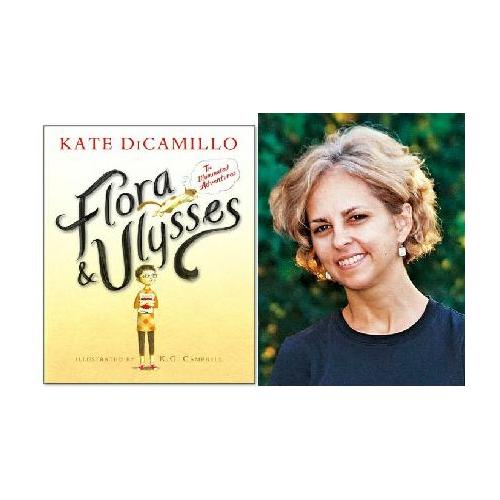
Kate DiCamillo stood in the nave of Riverside Cathedral, her curly hair barely visible over the podium, her voice clear and strong as she delivered the keynote address for the 85th Teacher’s College Reading and Writing Project Reunion (October 19, 2013).

She was exactly as advertised from the information on her website, “I am short. And loud.”

kate-dicamillo-floraandulyssestheilluminatedadvent-68She addressed the packed house of literacy teachers, some 2000 strong, who knew her as the author of Because of Winn-Dixie (a Newbery Honor book), The Tiger Rising (a National Book Award finalist), and The Tale of Despereaux (winner of the 2003 Newbery Medal), but her morning speech was about her latest book, Flora and Ulysses. She set the stage with her opening proclamation:

“This story begins as stories often do with a vacuum cleaner.”

Not just any vacuum cleaner. The vacuum at the center of this story was a 1952 tank Electrolux 2000, a treasured appliance belonging to DiCamillo’s mother. How treasured? DiCamillo joked that when her mother who was ill moved to be with her in Minneapolis, Minnesota, she worried more about the safe delivery of the Electrolux to the new home more than her own personal safety.”I want you to know that you can have the Electrolux when I am gone,” her mother told her. “It’s a really good vacuum cleaner,” she said and added, “The cord is extra long…and its retractable.”

The audience of teachers laughed; DiCamillo’s dry delivery in describing her mother’s attachment to a housecleaning appliance was part retrospective for the older teachers and part kitsch for the newer ones. “Remember the Hoover?” DiCamillo quoted her mother as saying, “that Hoover was useless!” But as she recounted how her mother’s illness progressed, the appreciation for this appliance took on new significance. “I really hope you will take the Electrolux,” her mother told her, “that makes me feel better.” So when her mother passed way, DiCamillo did take the Electrolux, but put it in the garage through that winter.

She spoke how in those dark days after her mother’s death, she found comfort in a poem by Rainer Maria Rilke, from Rilke’s Book of Hours: Love Poems to God and she read the lines from the short poem:

“God speaks to each of us as he makes us,
then walks with us silently out of the night.
These are the words we dimly hear:

You, sent out beyond your recall,
go to the limits of your longing.
Embody me.

Flare up like a flame
and make big shadows I can move in.
Let everything happen to you: beauty and terror.
Just keep going. No feeling is final.
Don’t let yourself lose me.

Nearby is the country they call Life.
You will know it by its seriousness.

Give me your hand.”

She reflected that when her mother was dying, she had held her mother’s hand in comfort, an action profoundly different from all the ways her mother had taken her hand when she was younger. The crowd was visibly moved by this retelling of the loss of her mother, but in typical DiCamillo storytelling fashion, her speech then veered off to include the death of a squirrel.

Shifting from the pathos for her mother, DiCamillo recounted that one day, a dying squirrel had chosen the front steps of her home as the last stop on his final journey. His eyes were open, yet unseeing; his chest dramatically heaving with his last breaths.
“I didn’t want him to suffer and die on my front steps,” she bemoaned.
So, she called a friend.
“‘There’s a squirrel on my front steps…He’s dying’,” she told her friend (Carla), “‘what should I do?'”
The advice she received from her gentle and humane friend appalled her.
“‘Do you have a shovel…and a tee shirt?'” asked Carla.
DiCamillo admitted that she had a shovel, but that she “moved away from the front door so the squirrel would not hear what was being said.”
“‘Put the tee shirt over the squirrel, and I will come over and hit him with the shovel,’ replied Carla.”

Fortunately, before that plan could be executed, the squirrel had crawled away.
“He may have heard us, or he had moved to get away from my presence,” said DiCamillo. The same people who had been tearing up from from the death of her mother and the power of the Rilke poem were now laughing out loud; the cathartic shift in emotions had been seamless.

DiCamillo then told the audience that she considered her reaction to the dying squirrel was not unlike the reaction of E.B.White in an essay he published in The Atlantic, “The Death of a Pig”:

 “He came out of the house to die. When I went down, before going to bed, he lay stretched in the yard a few feet from the door. I knelt, saw that he was dead, and left him there: his face had a mild look, expressive neither of deep peace nor of deep suffering, although I think he had suffered a good deal. I went back up to the house and to bed, and cried internally – deep hemorrhagic intears.”

“White claimed that his novel Charlotte’s Web was not connected to this essay…but could this event,” DiCamillo speculated, “have been more?”
She paused to consider their mutual despair over loss.
“He wanted to keep the pig alive….I wanted to keep the squirrel alive.”

And in that instant, a cathedral full of teachers understood that great ideas do not happen in (pardon the pun) a vacuum. DiCamillo’s speech illustrated how the three seemingly unconnected elements in her keynote address were the elements of story she combined in her latest book Flora and Ulysses.

In this story, there is a vacuum, a squirrel, a shovel, and several lines of the Rilke poem.
To be more specific, there is the near death experience of the squirrel, mistakenly sucked up by the Ulysses 2000; there is a comic-book superhero aficionado who intervenes; and there are several drafts of meta-physical squirrel poetry.  The story has the “beauty and terror” from the Rilke poem as well as the giving of a hand for comfort. There are what DiCamillo terms, “eccentric, endearing characters” presented in a format that combines print with comic book styled illustrations. Like the keynote address, the novel plucks at both the heart and the funny bone; it is a wonderful story.

The biography on DiCamillo’s website reads, “I write for both children and adults, and I like to think of myself as a storyteller.” Listening to her speak, I cannot think of her as anything else.

The rain set early in to-night,
The sullen wind was soon awake,
It tore the elm-tops down for spite,
And did its worst to vex the lake:

In other words, “It was a dark and stormy night.” Thus begins the poet’s Robert Browning’s dark and disturbing dramatic monologue, Porphyria’s Lover, a portrait of a madman that is wonderful to read with students around Halloween. I usually use an audio recording that I can play, and I pause the recording twice as we listen.

The unnamed narrator of the poem sits in a cold cabin, a rendezvous with his lover, Porphyria, who “glides in” as she

…shut the cold out and the storm,
And kneeled and made the cheerless grate
Blaze up, and all the cottage warm;

The narrator’s isolation in the gloomy setting takes on the tone of an illicit romance as Porphyria removes her wet clothing in order to

… let the damp hair fall,
And, last, she sat down by my side
And called me.

But when the recalcitrant narrator does not respond, Porphyria increases her ardent attentions

She put my arm about her waist,
And made her smooth white shoulder bare
And all her yellow hair displaced,
And, stooping, made my cheek lie there,
And spread, o’er all, her yellow hair,
Murmuring how she loved me-

Porphyria’s devotion to the narrator is extreme, expressed in his words “passion”  and “worshipped.” He acknowledges that she could “give herself to me forever” even as she had “come through wind and rain” for this meeting.  This “surprise”

Made my heart swell, and still it grew
While I debated what to do.
That moment she was mine, mine, fair,
Perfectly pure and good:

The narrator revels in this epiphany; Porphyria’s devotion is at its zenith. His reaction seems predictable to my students, and they eagerly anticipate  the romantic tumble they have expected since Porphyria entered the cabin. After all, the word “lover” is in the title.

Yet, the next five lines take a decidedly different turn. The narrator dispassionately admits,

…I found
A thing to do, and all her hair
In one long yellow string I wound
Three times her little throat around,
And strangled her.

Here is where I pause the recording as my students take a moment to comprehend what they have read. Their reactions generally follow this script:

“Wait a minute!”
“What did he do?”
“He ...killed her?”
What is going on here?”

I direct them back to the poem so they can hear the voice of the narrator explain his actions, and his explanation is chilling. “No pain felt she;” the narrator continues, as if to assure my students, “I am quite sure she felt no pain.” As if to prove his judgment, he opens her closed eyes, loosens the hair from her throat, and places a “burning kiss” upon her cheek. Again, the students react in shock:

“This guy is sick!”
“He KISSED her??”
“Ewwww…”
“Why did he do it?”

Why did he do it indeed? The narrator calmly continues to explain his reasons as Porphyria’s head, limp and lifeless, leans upon his shoulder,

The smiling rosy little head,
So glad it has its utmost will,
That all it scorned at once is fled,
And I, its love, am gained instead!

The narrator’s twisted logic in claiming Porphyria’s life in a moment of pure love is so perverse that students are horrified. The final shocker comes as the narrator confidently claims that the murder of Porphyria was something desirable,

Her darling one wish would be heard.
And thus we sit together now,
And all night long we have not stirred,
And yet God has not said a word! –

“He’s a monster.”
“He’s crazy.”
“He is insane.”

Browning’s poem that chronicles a deadly obsession is an excellent addition to the Halloween literary repertoire. The high interest monologue engages students in the “close reading” required by the Common Core.

A close reading can be accomplished by dividing the poem into sections and asking students to identify if the line can be placed into categories:

  • establishing setting
  • poetic technique (metaphor, personification)
  • character development
hair-piece-ponytail-with-draw-string-613-bleach-blonde-longer-length-ponytail-20-inches--401-p

Blonde hair!

Students are encouraged to make adjustments based on their group discussions or to create their own categories.  Once they have categorized the lines, they create large posters that “illustrate” the lines literally or symbolically. They draw or use images that they find online or use photos; then they share the posters which are hung around the room and explain how these details serve the author’s purpose in creating an unforgettable character who is a madman.

Come this Halloween, if you are looking for a poem to send shivers down the spines of your students, try Robert Browning’s “Porphyria’s Lover”.

Try not to think that this frightening portrayal of insanity was created by the husband of Elizabeth Barrett Browning, famous for the poem “How Do I Love Thee? Let Me Count the Ways.”

You can save that sonnet for Valentine’s Day!

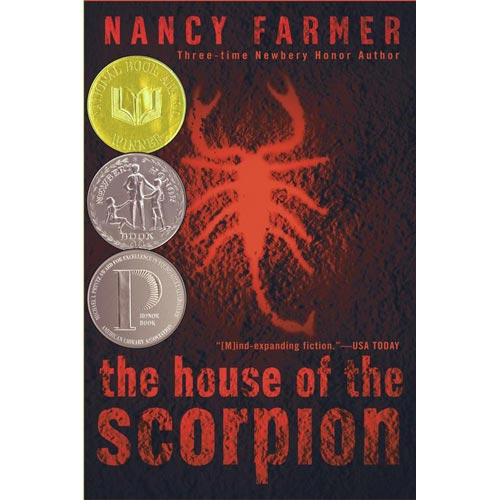
House of the ScorpionThere they were. Four used copies of Nancy Farmer’s The House of the Scorpion, and they were my find of the day at the Friends of the Danbury Public Library Fall Book Sale last weekend in Danbury, Connecticut. The unmistakeable bright red-orange and black spines were scattered in the author-alphabetized “F” section of the fiction offerings. They should have been in the young adult (YA) section, but a volunteer’s shelving error was probably why they were still available when I arrived. In this case, chance favored me.

I first became acquainted with Farmer’s science fiction novel two summers ago when I heard the plot involved cloning. I was looking for YA literature that could be used as a companion pieces to  Frankenstein; novels that incorporated many of the ethical questions raised by recent advances in the science of cloning. Science fiction was the genre that offered the most obvious choices. Farmer herself recognizes how science fiction anticipates the problems created by real science, saying:

“Science fiction allows you to approach a lot of social issues you can’t get to directly. If you wrote a book about how cloning is horrible, it would read like a sermon and no one would pay attention to it. “

The genre of science fiction is amazingly prescient in predicting technological advances.  H. G. Wells’ offered  The First Men in the Moon in 1901, 68 years before Neil Armstrong exited Apollo 11 and took steps on the lunar surface.  Digital books, submarines, droids and robots were features in science fiction novels before they became real nouns in our vocabulary. Credit for dreaming up the Internet is given to a wide spectrum of  fiction writers, from Mark Twain to Arthur C. Clarke, and manipulating human life has its genesis with 18 year old Mary Shelley’s Frankenstein. Therefore, Farmer is following the successful literary tradition of predicting man’s future. Her prediction takes the form of another dystopia, the equivalent of a political science crash course in failed nation-states for young readers.

Her opening mimic another great science fiction read, Aldous Huxley’s Brave New World. His great satire’s opening scene is in a factory that is manufacturing embryos. With streamlined industrialized precision, conveyor belts carry embryos that are then deprived of oxygen in order to create a caste of mindless workers. Farmer borrows some of Huxley’s ideas and begins her story with images that recall that frightening scenario:

A dull, red light shown on the faces of the workers as they watched their own arrays of little glass dishes. Each one contained a drop of life. (1.2)

In addition, Farmer’s predictions of a territory between the United States and Mexico controlled by drug cartels is plausible. That is the setting for her “coming of age” story of a young clone named Matt. The medical breakthroughs that create Matt, a clone of the drug lord El Patrón, are also feasible. Matt is unaware that his life is both protected by his status as the clone for the most powerful man in the land of Opium and endangered by El Patrón’s mortality…and at 146 years old, El Patrón is very mortal.

Farmer combines the issues of organ-harvesting, the economics of drug use, and adds a few Zombies for an exciting read that contains several amazing plot twists. I remember my jaw dropping…I didn’t see one twist coming at all. Farmer’s inventiveness with plot and skills as a storyteller resulted in the book receiving both a National Book Award for Young Adult Literature and a Newbery Honor in 2002. 

Last year, we offered 7th grade independent choices in literature circles centered on their interest in dystopias. The House of the Scorpion was one title offered along with other science fiction novels including Orson Scott Card’s Ender’s Game, M.T. Anderson’s Feed, Neil Shusterman’s Unwind, and several of Scott Westerfield’s selections from his Pretties series. Students fresh from reading Suzanne Collins’s The Hunger Game Trilogy were ready for other predictions for the future, and those who had not completed the series were given the opportunity to read these as well.

The cost for the four gently used copies at the book sale was $8.00; copies normally retail for $8.10, so this was a “buy one get three free” bargain in comparison. Based on other used book sales, we now have a class set (30) of The House of the Scorpion. The novel could be an all class read, however, as some of the topics in the novel require mature readers, we opt to make this and the novel Feed independent choice books.

The ethical questions raised in Frankenstein and The House of the Scorpion makes them good companion pieces, but that is not the only reason to pair them together. Our English Department’s essential question is “What does it mean to be human?” Literature gives students the language and the models for answering that question. The Monster in Frankenstein and the protagonist Matt in The House of the Scorpion are “non-human” characters that make students consider that being human may not be limited by the definitions in science, but by the possibilities in science fiction.

Our English II World Literature course complements the World History course, so when the students are learning about the Industrial Revolution, our English course has students read the opening chapters to Charles Dickens’s Oliver Twist.

Reading Dickens, however, is a challenge for many students, particularly if they lack background knowledge on the story’s setting. In order to help them better understand the context of England during the Industrial Revolution, we incorporated several famous paintings to illustrate the shift from the pastoral setting to the urban setting.

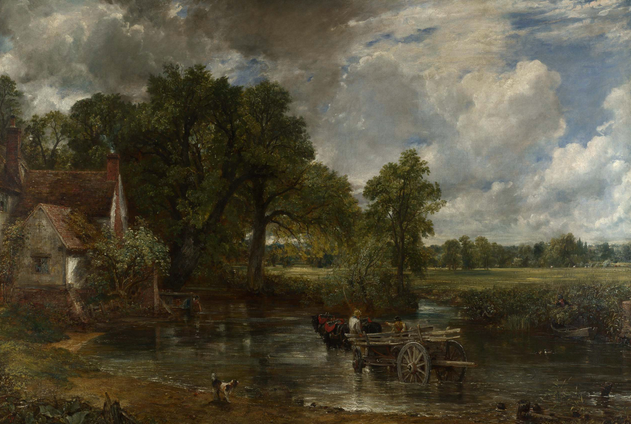
Rather than show a painting in its entirety at first, we made screenshots of different sections of each painting and had the students “read” what they saw. For example, we began with John Constable’s painting The Hay Wain (1821) which hangs in the National Gallery in London, England.

Screen Shot 2013-10-02 at 9.23.04 PM

upper left corner of Constable’s “The Hay Wain”

Students looked at the information communicated in the upper left quadrant  of the painting and discussed the architecture of the roof and the large empty tree branches. They noted the gathering storm clouds in the background; “a tone of danger” noted one student. 

We then had students look at the lower right quadrant of the painting where a farmer’s cart was being driven along a stream bed. They noted the details of the team of horses and speculated as to why the men would be walking upstream. 

Screen Shot 2013-10-02 at 9.23.46 PM

lower right corner of Constables “The Hay Wain”

They speculated that there might be no road because a road might not have been necessary if transportation was easier by water, and one student called attention to a small canoe on the stream’s bank. They called attention to the earth tone colors that contrasted with the red harnesses of the horses.

Then we showed the students the full painting.

Screen Shot 2013-10-02 at 9.49.07 PM

Constable’s painting is based on a site in Suffolk. The hay wain, a type of horse-drawn cart, stands in the water in the foreground. (National Gallery Picture Library
St Vincent House, 30 Orange Street, London)

When the students saw the entire painting, they were already familiar with some of the smaller details. They were able to locate these smaller details and suggest how they contributed to the larger “story” of the painting. They determined Constable’s painting celebrated the pastoral life outside London, a striking contrast from the setting of Oliver Twist where impoverished street children were placed in workhouses or recruited by criminals.

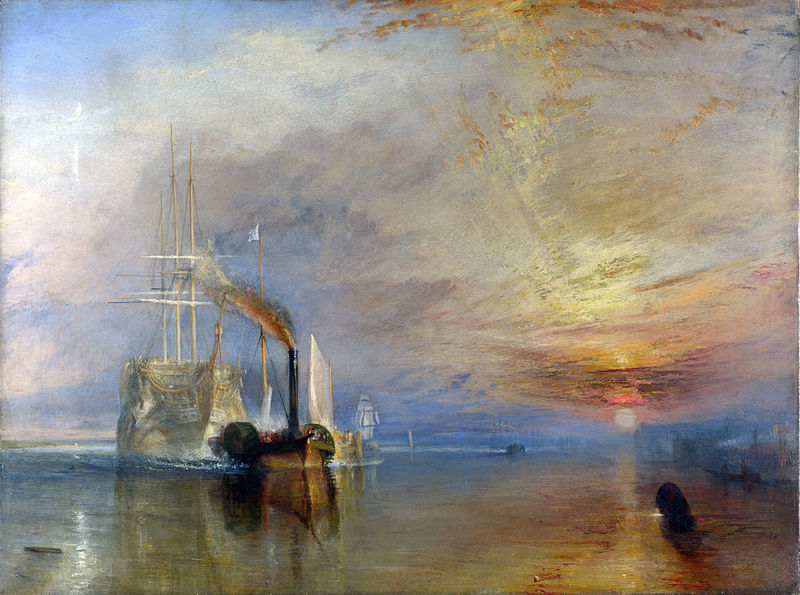
The painting that best illustrates the cultural shift caused by the Industrial Revolution, however,  is J. M. W. Turner’s The Fighting Temeraire. The oil painting depicts the gunship with her sails tightly wrapped to the rigging being tugged  by a steam powered paddle-wheel to the shipyard before being broken up for scrap. Turner painted the tribute to the end of sailing ships in 1838, the same year that Dickens published Oliver Twist. Both works brought attention to the drastic change in the way of life as a result of the Industrial Revolution.

“The Fighting Temeraire”, an oil painting by the English artist J. M. W. Turner (1938) National Gallery, London

Since the students had practiced close reading the Constable pastoral painting, they were ready to close read Turner’s painting. While some called attention to the the dirty smoke stack, others saw the energetic paddling as a sign of progress. One noticed the ghost-like ship hovering in the background; another noted a potential danger of a submerged obstacle in the foreground floating in the right corner of the painting. Most commented on the light created by the sunset which gave the painting “warmth”or “a glow” for some or a “light extinguishing” for others. When they were asked to use these elements as evidence to determine the artist’s message, there were some succinct responses:

  • “It’s out with the old!”
  • “The coal fire is the new light; the sun is the old light”
  • “Coal power, not wind power”
  • “Beauty fades”

Turner’s The Fighting Temeraire was voted England’s favorite painting in a 2005 poll organized by BBC Radio 4’s Today.  The painting was also highlighted in the recent James Bond film Skyfall. In the scene in the National Gallery, Bond meets his new handler, Q, while both sit on a bench opposite the painting:

Q: It always makes me feel a bit melancholy. Grand old war ship. being ignominiously haunted away to scrap… The inevitability of time, don’t you think? What do you see?
Bond:  A bloody big ship. Excuse me.
Q: 007. I’m your new Quartermaster.
Bond: You must be joking.
Q:  Why, because I’m not wearing a lab coat?
Bond: Because you still have spots.
Q: My complexion is hardly relevant.
Bond: Your competence is.
Q: Age is no guarantee of efficiency.
Bond:  And youth is no guarantee of innovation.

Skyfall (http://www.imdb.com/title/tt1074638/quotes)

After watching the film clip, the students were in agreement that they are living in a new digital revolution, and that technology has changed their culture from that of their parents. If they want a sunset, they don’t need a painting by Turner….they have Instagram.

Banned Book Week is held annually during the last week of September in order to bring attention to the controversial practice of banning books, but an exhibit at the New York Public Library is proclaiming the same message through March 24, 2014. The exhibit “The ABCs of It: Why Children’s Books Matter”  celebrates the development of children’s literature in picture books, in chapter books, and in young adult literature.

The exhibit which opened on June 24th, is curated by Leonard S. Marcus who has also curated exhibitions at the Eric Carle Museum of Picture Book Art in Massachusetts, where he is also a founding trustee. This comprehensive exhibit is a must see and does not shy away from controversies in providing…

an examination of why children’s books are important: what and how they teach children, and what they reveal about the societies that produced them. Through a dynamic array of objects and activities, the exhibition celebrates the extraordinary richness, artistry, and diversity of children’s literature across cultures and time.

The differences in opinion on the role of children’s literature are raised at the exhibit’s entrance. Should children’s literature be foremost a means to deliver lessons of morality? (as Cotton Mather urged the Bible on young Puritans) Should children’s literature “delight and entertain”? (as John Locke believed with Aesop’s fables) Or should children’s literature tell the bare truth, not tales that “cover truth with a veil”? (Jean-Jacques Rousseau). From fairy tales to the Suzanne Collins’s The Hunger Games Trilogy, the controversy rages on, and the exhibit presents them all.

Screen Shot 2013-10-01 at 11.01.32 PM

A life-size set of “Goodnight, Moon” at the New York Public Library

There are tributes to William Blake’s poetry, Lewis Carroll’s Through the Looking Glass, and a original copy of Janette Sebring Lowrey’s The Pokey Little Puppy. One large panel features the rhyming words (Sam I am & green eggs and ham) of Theodore Geisel (Dr. Seuss). Along another long wall are the serial contributions of publisher Edward Stratemeyer: Bobbsey Twins, Hardy Boys, Tom Swift, and Nancy Drew. There is a tribute to comic books complete with silhouettes of Marvel and DC heroes, and tribute to books successfully made into films. A glass case holds the original Pooh, Piglet, Kanga, Roo, and Tigger from A.A Milne’s 100 Acre Woods; Eric Carle’s colorful panels (Brown Bear, Brown Bear and others) glow brightly in the cases. Pictures of the exhibit are on the New York Public Library’s Facebook Page and the NYTimes slide show review.

There is a wall that bears the distinctive outline of one of Maurice Sendak’s “Wild Things” around the corner from a life-size set of Margaret Wise Brown’s Good Night, Moon, waiting for the quiet old lady to whisper “hush”. You can listen to E.B. White read the last chapter of Charlotte’s Web, and try not to sob when hearing him say the line, “It is not often that someone comes along who is a true friend and a good writer. Charlotte was both.”

The exhibit also points out the role of children’s literature in politics or in nation building.  On one wall of the exhibit, there is a sculpted relief of the world surrounded by three quotes; each quote makes an important point about the significance of children’s literature. The first quote is by Noah Webster from an essay titled “On the Education of Youth in America,” American Magazine, New York, December 1787:

“The Education of youth is, in all governments, an object of the first consequence. The impressions received in early life usually form the character of individuals, a union of which forms the general character of a nation.”

Political writer, author, and developer of the dictionary, Webster was an early advocate for education as key to America’s growth and development.  The next quote, however, gives the viewer pause…and a few chills:

“Education is a weapon whose effects depend on who holds it in his hands and at whom it is aimed.”
Interview with H. G. Wells -September 1937- said by Joseph Stalin

Similarly, the last quote does demonstrate how in astute political hands, children’s literature can be a powerful propaganda tool:

“Rise up children and learn to be free independent children of China, learn how to wrest this freedom from the yoke of Japanese imperialism, and transform yourself into masters of a new era.”
Mao Zedong from the Journal Children of the Border Areas- 1938

These voices provide a serious reminder that children’s literature is more than board books, rhymes, and fairy tales. There are powerful messages in these stories; some so powerful that they have banned. For example, there is Munro Leaf’s story of the peace loving Ferdinand, the Bull which “caused an international controversy” when it was first published; banned in Spain the book was burned in Nazi Germany. Exposing those horrors of the Holocaust is a copy of Art Spiegelman’s breakthrough graphic novel Maus.

Marcus’s exhibit presents the questions and controversies about children’s literature, but does not provide answers. The exhibit has examples of how this genre of literature can contain both powerful political tools and playful trivial entertainment. There is no answer to the exhibit’s opening questions as to whether children’s literature is a means to educate, a means to enforce a moral code, or a source of joy. On seeing the stories of childhood so beautifully arranged, I opt for joy.

At the end, a large screen posts a continuing stream of Jeopardy-styled quiz questions in an interactive, and serious time-killing, activity.
I stood answering questions (“curiouser and curiouser= Cheshire Cat” or “Lyle, Lyle Crocodile= The House on 88th Street“) for some time before a young boy noted, “Hey, you’re pretty good at this..”

“Thanks,” I said, “I really like these books.”

“So do I,” he responded before leaving.

Thanks for making that moment possible, New York Public Library. Continue Reading…

Back to school soon, eh?
Gotta go back to work?
The long vacation almost over?

August sunday nightI hear these comments from friends and relatives the last days of August. Acquaintances who pass with a quick “How are you?” any other time of year, now take time to gloat and ask, “Back to the grind, right?” Apparently, they are under the impression that I have not thought about school these past weeks of relaxed responsibility. To the contrary, for the past eight weeks, I continued to think about school.

While summer vacation allowed me the opportunity to catch up on reading for pleasure, some of the books I read this summer (The Fault in Our Stars by Jon Green, When She Woke by Hillary Jordan),  are ones I plan to share with my students. Summer allowed me the opportunity be a student and to take classes to improve my understanding of instructional strategies. Cris Tovani’s book, Do I Really Have to Teach Reading? was particularly interesting as a resource to share with content area teachers.  Finally, during the summer I had long stretches of uninterrupted time to think and to write.  Consequently, the activities I pursued in the summer are not unlike the activities I pursue during the school year. The difference is that I do not have to complete reading or writing during July’s halcyon days at the almost breakneck speed I use from September to June. Even in these days of leisure, the classroom is never far from my mind. August’s arrival signals an end to the unhurried pace practiced by those in other professions.

For teachers, there is a great deal of physical preparation to teach: preparing the classroom, preparing the materials, and preparing the kidneys to go hours on end. There is also the emotional preparation for the highs and lows that will follow for the next 38 weeks of school. Teachers know that setting the right tone on Mondays can make  a huge difference on the academic success of a school week. Which brings me to the importance of Sunday night.

Sunday night is for planning.

Those hours before the beginning of any school week are fraught with detailed lists of necessary supplies, schedules for delivering instruction, and aggressive strategies to beat other teachers to the copier on Monday mornings.

Those few hours before the Monday morning announcements are also exciting as planned lessons, packed with potential, sit ready to be deployed. Sunday nights are full of promise.

Therefore, August is the Sunday night of the school year. Teachers mentally planned bulletin boards, unpacked supplies, arranged classroom furniture, and put their last touches on unit plans before they set a foot in their classroom. On that first day of school-that first day of the week- their preparations will pay off.

So, yes, to those who have asked; the long vacation is over. But going “back to school”? I really never left.

“Are you upstairs hiding with a book?” my mother was exasperated as she called up the stairs.
“No-oo..” I would reply, stashing the copy of The Sign of the Twisted Candles, The Password to Larkspur Lane or The Secret in the Old Attic under the covers.
My mother would be looking for me for some chore I had left undone, but the lure of those yellow-spined mystery books was so hard for me to combat. I would succumb and lose track of time, and responsibilities, the minute I picked up one of the mysteries.

I was Nancy Drew addicted.

From the day I found my first copy at age eight under the Christmas tree, I read every Nancy Drew title available, a total 46 titles by the time I completed eighth grade.

“So, how’s that little blue roadster?” my father would ask, passing me while I was lost in a mystery.
“Oh! You are going to ruin your eyes,” my mother would complain finding me reading by hall light.

The contradictory message from my parents to read or not to read while feeding my addiction with new editions of Nancy Drew for birthdays and other holidays only heightened my regard for the series. Nancy Drew was the dessert to my reading diet, the forbidden fruit during Saturday chores, the delicious temptation to finish “just one more chapter” before falling asleep.

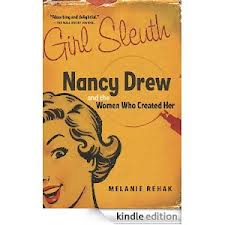
Girl SleuthSo, I was delighted when at a public library book sale I came across a “used” brand new copy of Girl Sleuth, Nancy Drew and the Women Who Created Her by Melanie Rehak.

Here was the story of Nancy’s origins, the brainchild of Edward Stratemeyer (1862-1930) who developed and ran a syndicate of writers of children’s fiction. I have only recently come to understand how much Stratemeyer influenced generations of young readers, myself included, by producing book series specifically geared to their interests.

He created the Tom Swift and The Hardy Boys series. He was responsible for the adventures of Nan, Bert, Flossie and Freddie in The Bobbsey Twins. Early in his writing career, Stratemeyer recognized that writing under different pseudonyms and with different publishers, he could offer more books each year. Unable to keep up with the demand for his stories, he began to outsource his work by hiring writers to complete stories he had outlined. By 1905, his book publishing syndicate mirrored the Henry Ford model of assembly linewriting; Stratemeyer editing the work of other writers who filled in the details from his summary notes.

It was Edward Stratemeyer that conceived of the young girl detective, and he developed five plots that he could offer a writer who could meet his exacting standards. Originally, the character Nancy Drew was named Stella Strong, and one of the plots that Stratemeyer developed was for Stella Strong at Mystery Towers:

How Stella visited the old Tower House and met the rich and eccentric maiden ladies, Patricia and Hildegarde Forshyne, who were much disturbed by unusual happenings about the place. She learns that some relatives are trying to get possession of the Forshyne fortune  Stella was once made a prisoner, but turned the tables and made a startling exposure (112).

Stratemeyer suggested other names for his new sleuth: Nell Cody, Nan Nelson, Diana Dare, Helen Hale, Nan Drew. The decision to expand Nan to Nancy was made by the publishing company Grosset & Dunlap who were enthused by this chance to have books for the growing market for young female readers. Stratemeyer had already decided that the pseudonym Carolyn Keene would be used for the series; each book would sell for fifty cents with two cents royalty going to his syndicate. From a number of applicants, he selected Mildred Wirt Benson, a “convention-flouting journalist” and agreed to pay her $125 for each manuscript (114). She, like all other writers in the Stratemeyer syndicate, signed away all rights to the stories and character.

Rehak’s extensive research clearly shows that Wirt was responsible for developing the character of Nancy Drew from the beginning. When Edward Stratemeyer passed away suddenly after the launch of the first Nancy Drew mystery, his daughter Harriet Stratemeyer Adams, took over the editing and eventually, the supervision of all things Nancy Drew. It was Wirt, however, who fleshed out the Nancy’s character against the backdrop of the Great Depression in 1930. Her Nancy was popular in school with two devoted friends, Bess and George. She was intelligent and attractive, moving stylishly between tweed suits and a “party frock of blue crepe which matched her eyes”. Blue was also the color of her little shiny roadster, a gift from her supportive father, Carson Drew. The mother figure, housekeeper Hannah Gruen, was also Wirt’s idea; the boyfriend Ned Nickerson came later in the series.

In recounting the success of the Nancy Drew series, Rehak notes that Wirt “later confessed  that Nancy Drew was “everything she -or any girl, in fact-wanted to be, and then some” (117). Rehak’s recounting of the success of the series is dampened by the deteriorating relationships in the Stratemeyer family, reduced pay for Wirt, and Harriet’s demands to keep the syndicate’s ghost writers from claiming their authorship.

Rehak also explores the other media ventures that featured Nancy Drew: TV series, movies, graphic novels, and a sordid connection to Playboy magazine.  Harriet’s control of her family’s publishing company’s intellectual property kept many of the writers like Wirt from claiming authorial attribution.

Subsequent revisions of Nancy Drew get less exploration by Rehak, who has little praise for the “loud flashy plots and clothing and crushes” that recent publishers have tried in order to “revamp the sleuth” (311). Nancy Drew’s back story is well organized by Rehak and a must read for all her fans who knew that it was not the plot that made the book exciting, but rather the “pleasure comes from her [Nancy Drew’s] autonomy, her taking events into her own hands”(307).

Rehak concludes with the feminist view that Nancy Drew was a guide for the ages as many of the problems for women (equal pay, inadequate day care, etc) still exist:

Nancy DrewThanks to Mildred and Harriet and the generation of women and girls who glimpsed in Nancy Drew a vision of what they might be someday, it doesn’t look like the sleuth is going away anytime soon, which is a good thing. There are fighting days still ahead of us, and we’re going to need her (314).

Perhaps this is why my memories of Nancy Drew are so salient, and my addiction forgivable. While my chores waited, Mildred Wirt Benson and Harriet Stratemeyer Addams offered me, and thousands of young girls like me, a role model.

So, Mom, I really was not hiding upstairs with a book…I was growing up.