Archives For November 30, 1999

“We are not used to live with such bewildering uncertainty,” wrote Jessica Stern in a New York Times editorial How Terror Hardens Us on Sunday (12/6/15) after the San Bernardino, California, shootings.

Stern, an adult, was writing about adults collectively when she used the pronoun”we.”

That same bewildering uncertainty also confronts our children, our students in schools. That bewildering uncertainty is happening at a vulnerable time, just when they are just learning to be citizens in our democracy. That same state of terror, a state of intense fear, has an impact on their state of mind as each terrorist attack, Stern notes, “evokes a powerful sense of dread.”

 Stern, a professor at Boston University’s Pardee School of Global Studies, co-authored ISIS: The State of Terror. She noted in her editorial:

“It [terrorism] is exactly that kind of psychological warfare that It is a form of psychological warfare whose goal is to bolster the morale of its supporters and demoralize and frighten its target audience — the victims and their communities. Terrorists aim to make us feel afraid, and to overreact in fear.”

Students in our classrooms today attend schools where terrorism or home-grown violence is a possibility; the term “lockdown” is part of their vocabulary. At every grade level, they have every reason to believe that they could be a target audience. while motives for violence have differed, many students are aware that high-profile incidents have happened in schools: Columbine (1999) and Sandy Hook (2012).

As educators in all disciplines at every grade level struggle to help students deal with recent events that are identified as terrorism, perhaps the discipline of social studies is the subject where educators can best counter a terrorist’s goal to have our students “afraid and overreact in fear.”

That academic responsibility to help students cope was claimed 14 years ago by the president of the National Council of Social Studies (NCSS) in 2001, months after the attacks on the Pentagon and the Twin Towers at the World Trade Center.
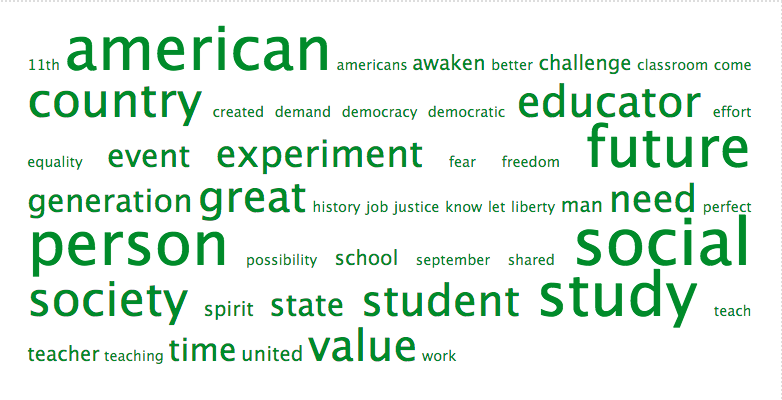
Most frequent words in the speech given by Aiden Davis in 2011 to the National Council of Social Studies after 9/11 (www.wordsift.com)

The most frequent words enlarged from the speech given by Aiden Davis, President of National Council of Social Studies after 9/11/2001 (www.wordsift.com)


When Adrian Davis delivered his 2001 NCSS Presidential Address to the nation’s social studies teachers, he explained their role as educators included efforts to “to work to reconstruct schools to become laboratories for democratic life” by saying:

“Schools do not exist in a vacuum. They are not isolated from their neighborhoods and communities. Schools and teaching reflect society, and they participate in constructing the future society.”

When Davis gave this address, he was making the case that terrorism had made the discipline of social studies more relevant to future societies than ever before. He anticipated that there would be people who could “overreact in fear”; his address hoped to point out that students would need guidance so that democracy would survive the bewildering uncertainty after 9/11:

 As social studies educators, we need to reinforce the ideals of equality, equity, freedom, and justice against a backlash of antidemocratic sentiments and hostile divisions. As social studies educators, we need to teach our students not only how to understand and tolerate but also how to respect others who are different, how to cooperate with one another, and to work together for the common good.

Davis’s concerns about teaching respect and how to cooperate are even more important today when there is heated rhetoric conflating terrorism with religion. His reason to encourage social studies teachers to reinforce the ideals of equality, equity, freedom, and justice provides a solution to the concerns in Stern raised in her How Terror Hardens Us.

Stern’s editorial concludes, “If we are to prevail in the war on terrorism, we need to remember that the freedoms we aspire to come with great responsibilities.”

On behalf of all social studies educators, Davis accepted those responsibilities. As he concluded, he made clear the commitment he was making for teachers, “We have an opportunity to teach the coming generations to preserve and extend the United States as an experiment in building a democratic community….teaching is where we touch the future.”

The future is always uncertain, but educators, especially social studies educators, can provide students the skills of citizenship to deal with uncertainty so that they will not overreact in fear.

Last month, I travelled to Minneapolis, Minnesota, to attend the 2015 National Council of Teachers of English (NCTE) Convention with two fellow teachers to participate in poster sessions under the topic Digital Pedagogies and Approaches to Media. 

One of the poster session was titled  “Every Picture Tells a Story”  and offered by Catherine Flynn, the Literacy Specialist at the K-8 elementary school in Sherman, Connecticut. Her presentation promoted the use of art as a literacy strategy in English/Language Arts classrooms as well as other content area classrooms. She offered examples of lessons on using art to enhance academic background knowledge at multiple grade levels. Background knowledge is critical to improving literacy since students who literally have  “pictures in their heads” of an idea, time period, or event are better able to comprehend the pictures created by words in a text. Flynn illustrated how abstract concepts of point of view, context, and perspective can be made understandable by using art to engage students in conversations across time and place. She also provided viewers with research that supports the use of art  to improve student inferential skills and in analyzing interpretations. Her materials can be accessed on this Google Doc and she can be contacted through her Twitter:@flynn_catherine and her excellent blog https://readingtothecore.wordpress.com/

The other presentation was offered by Caitlin Pinto, a 7th grade English Language Arts teacher at Harry Bailey Middle School in West Haven, Connecticut. I had already posted about Caitlin’s presentation at Here We Go, Pinto. Her lesson had students respond to reading on social media platforms or using social media templates to develop many of the skills that we want our students: analyzing, summarizing, researching, and making text to text connections. The social media platforms she uses are familiar to students who can transfer the strategies of each and apply them to the more traditional roles in literature circles. Her Twitter handle is @cpinto_iteach.

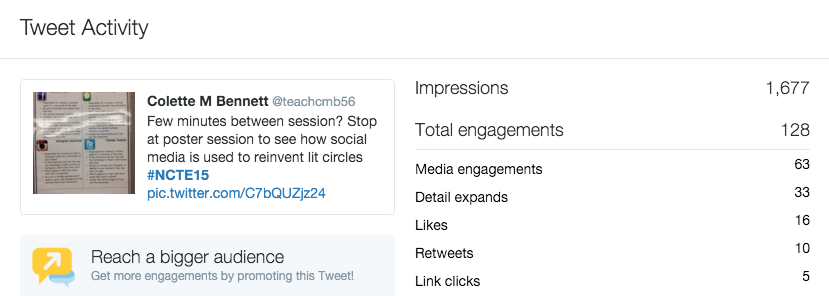
Over 30 educators stopped to speak one-to-one with Catherine or Caitlin, and the conversations about the different lessons they taught were each several minutes long. Both were engaged sharing with peers for the entire 90 minutes.  Moreover, as an example of the effectiveness in using social media, a tweet I posted about Caitlin’s use of showing how she uses the Twitter format for some roles in literature circles has been viewed 1,677 times (see below).

Screenshot 2015-12-02 20.37.13


A poster session is not given in a dedicated room. The number of people who stopped to talk, however, exceeded expectations. At each display, we received more response from attendees than several of the 20-minute presentations held elsewhere during the convention. In this context, poster sessions were great way for these new presenters to become comfortable and network personally with other teachers.

I have written about the word context and this convention in a previous post where I mentioned that the etymology of the word context comes from the 15th C. Latin contextus meaning “a joining together”. The word context was originally the past participle of contexere, which means to “to weave together,” from com- “together” + texere “to weave, to make”.

The poster sessions are an example of how teachers “join together” in opportunities to show how they “make” lessons that help students improve their literacy skills. Catherine’s lessons using art to improve student inferential skills and in analyzing interpretations and Caitlin’s lessons using social media to help students with analyzing, summarizing, researching, and making text to text connections are both evidence of how best practices can be shared peer-to-peer at the NCTE convention.

NCTE poster sessions = contextus=an example of joining [educators] together.

I like “one word” explorations to sum up an experience.

This time the experience was the National Council of Teachers of English Conference (NCTE) held in Minneapolis, Minnesota, November 19-22, 2015. This time my exploration uses the noun “context” which is defined at Dictionary.com as:

1. the parts of a written or spoken statement that precede or follow a specific word or passage, usually influencing its meaning or effect;

2.  the set of circumstances or facts that surround a particular event,situation, etc.

An important concept to know is that in the context of any English teacher conference, authors are rock-star-like celebrities that drive well-manner educators at every grade level to act like paparazzi at gala openings; it’s literary fandom gone wild.

Frankly, it’s embarrassing.

Staid teachers will suddenly go stalker-mode, staging selfies and pressing writers for autographs. When they do catch (trap?) an author, these articulate adults -who are capable of controlling legions of adolescents- will suddenly go tongue-tied, lining up to blurt out Hallmark-like sentiments: “love you” “you’re the best” or “you changed my life”…drowning the poor author in a litany heartfelt sentimentalities. At these conferences, authors should know to be careful not to incite such emotional responses.

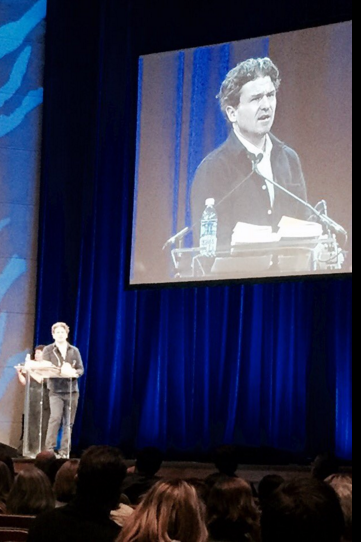
Which makes me wonder how the author Dave Eggers made it out of the Minnesota Conference Center Auditorium in one piece!

Dave Eggers, writer and 2015 NCTE Keynote speaker

Dave Eggers, writer and 2015 NCTE Keynote speaker

Eggers was the Saturday night speaker (11/21)  where he delivered a heartbreaking speech of humor and pathos dedicated to teachers…and to one teacher in particular. He is the author of ten books including Zeitoun, The Circle and A Hologram for the King, a finalist for the 2012 National Book Award. He is also the founder of McSweeney’s, an independent publishing company that also publishes Voice of Witness, a nonprofit book series that uses oral history to illuminate human rights crises around the world.

He began by asking the all-educator-audience to picture a 14 year-old boy “covered in zits” with “foot odor”, a friendless outsider, “angry” and unhappy at home. Many teachers did not have to imagine such a 14-year-old; this brand of boy is often seated in their classrooms.

Eggers proceeded to explain how this boy’s anger led to a subversive approach in responding to English writing assignments: the argumentative paper he wrote promoted a bike trip to the inner mantle of the Earth; the  informational essay he wrote warned of the coming sheep apocalypse. When the anticipated confrontation to change topics did not come from his English teacher, the boy channeled energy into the papers….and he became less angry. Both assignments received an A-.

At the end of the year, there was an encouraging handwritten note penned across a paper:

“I sure hope you become a writer one day.”

Eggers detailed how such encouragement from his teacher brought the boy to the school’s newspaper, then to the school’s literary magazine, and then to the attention of the “elders in the tribe” of the English Department.

Heads nodded in approval.

“And because you are English teachers,” he conceded, “and you understand plot…you have figured out that the 14 year-old in this story is me….”

All heads nodded in agreement; they understood the “he is me” context.

“But, what you don’t know,” Eggers stated, “is that my English teacher is here tonight.”

Gasps….and hundreds of misty-eyed teachers stood in applause as the teacher, Mr. Peter Ferry,  rose from the front row to take a bow.

Eggers rushed down to him and handed over a box festooned with a bright red ribbon.

The applause was deafening.

“And what you don’t know,” Eggers continued, breathless from his leap off and back onto the stage, “is that the gift in the box is my latest manuscript…because Peter Ferry is also the person who reads my first drafts…”

More gasps and more applause.

“And what you also don’t know….” paused Eggers again, “is that I have been the first reader of the manuscripts to his two novels.”

Gasping air depleted, teachers could only clap harder in appreciation for such inspiration, and as cliché it sounds, there were teachers shouting their (intellectual) love for Eggers. But for the height of the stage, he could have been mobbed.

He  held off the crowd by answering questions, and this gracious opportunity provided another familiar educational context…the  Q & A interview. As Eggers is also involved in his own educational enterprise in supporting writing centers, he shared pictures of 826 Valencia  the first of eight tutoring centers for schoolchildren, 6-18.

His efforts began in San Francisco in 2002 with the plan “to close the academic achievement gap for under-served youth in the Bay Area by connecting caring adults to young people in need of individualized support.” In describing the activities at this writing center, he explained that the original space was zoned for retail, and that they needed to open a store. The ship-like surfaces of the former gym gave them the idea to open a pirate store, where the pirate supplies profits helped offset the rent to the writing center.

Eggers has spoken often about  826 National including his TED talk titled Once Upon a Schoola video (in one of its various iterations) is here below:

In sharing the stories of Mr. Ferry, 826 Valencia, and 826 National with English teachers, Dave Eggers served as an illustration of the the word context.

The etymology of the word context comes from the 15th C. Latin contextus meaning “a joining together”. The word context was originally the past participle of contexere, which means to “to weave together,” from com- “together” + texere “to weave, to make”.

Eggers’ speech recounted the initial context that joined together a teacher and a student – Eggers and Ferry- in order to “to weave, to make” good writing. His message to teachers in the context of this NCTE convention was powerful as he thanked the audience saying, “I had incredible uninterrupted string of great English teachers!”

That message helps teachers to encourage the students in their classrooms, the new authors and the next celebrities – and to encourage them “to weave together” stories to share…and to create those contexts where one may write to a student, “I sure hope you become a writer one day.”

Dear Teacher,

As the school year moves forward,  full of…… anyone? anyone? 

And you are no doubt planning the next …..anyone? anyone?

How can you get students to be more engaged?….. anyone? anyone?

How do you get them to respond?….. anyone? anyone?

Just wait.

Instead of droning on and asking question after question, just wait.

Three (3) seconds should do the trick.

That was the minimum amount of time Mary Budd Rowe found in order to move students from passive droolers to active listeners. Her seminal study (1972)  “Wait-Time and Rewards as Instructional Variables: Their Influence on Language, Logic, and Fate Control” set the ground work for the use of wait-time in the classroom.

The “wait-time” of three (3) seconds (or more) is the length of the pause or period of silence that should follow a teacher’s question.  In gathering her data, Budd observed classroom behaviors where the time between the teacher’s question and an answer then given by the teacher “rarely lasted more than 1.5 seconds in typical classrooms.” Some classroom observations also revealed that if a student managed to get a response in, teachers tended to ask another question within an average time span of .09th of a second. Budd noted that many teachers engaged in rapid-fire questioning, especially with low-level questions based on recall.

In contrast, when there was a period of silence after a question that lasted at least three (3) seconds, Budd noted a number of positive outcomes for students. The length and correctness of student responses increased, and the number of their “I don’t know” and no answer responses decreased. The number of volunteered, appropriate answers by larger numbers of students greatly increased as well as the scores of students on academic achievement tests.

Even more impressive was the positive outcome for teachers who deliberately waited three seconds or more. Their questioning strategies tend to be more varied and flexible, the number of questions decreased, and their expectations for student performance appeared to change. They increased the quality and variety of their questions including those that required more complex information processing and higher-level thinking on the part of students.

Rowe found that wait-time on the part of teachers increased the amount of “think-time” on the part of students, shifting them from passive to active learning in the classroom.

Building on Rowe’s research, Robert J. Stahl, a professor in the Division of Curriculum and Instruction, Arizona State University, Tempe, published his own research several years later (1990)  Using “Think-Time” and “Wait-Time” Skillfully in the Classroom. In these findings, he constructed the concept of “think-time”.

Think-time can be defined as a distinct period of uninterrupted silence by the teacher and all students so that they both can complete appropriate information processing tasks, feelings, oral responses, and actions. (Stahl,1990)

Stahl noted other variables, including the quality of questions, in improving student engagement. Vague or confusing questions would confuse or frustrate students, no matter how long a teacher waited for a response.

Stahl offered eight ways to identify pauses in the classroom so that teachers could  recognize when and where “wait-time” silence can be effectively used as “think-time” and to see how these could be employed as instructional strategies. Some of these include the Post-Teacher Question Wait-Time that requires at least 3 seconds of uninterrupted silence after a teacher’s clear, well-structured question, so that students have sufficient uninterrupted time to first consider and then respond. There is also the pause identified as Post-Student’s Response Wait-Time is three (3) or more seconds of uninterrupted silence that occurs after a student has completed a response and while other students are considering volunteering. This could be way that academic discussions are facilitated. There was also the Impact Pause-Time when a teach may use a dramatic pause way to place an emphasis on material. This pause may continue for longer periods, up through several minutes, depending upon the time needed for thinking.

Stahl’s research, along with Rowe’s, demonstrated that silence-even for as little as 3 seconds- can be a powerful instructional tool. Those three seconds can be enough to provide time for students to frame their own questions or to finish their previously started answers.

Just think…and wait.

Three seconds.
How hard can that be? (..one one-thousand; two one-thousand; three one-thousand….) Anyone?  Anyone?

What, How, and Why do you write?

The National Council of Teachers of English, The National Writing Project, The New York Times Learning Network, and the Teaching Channel want to know.

Today, Tuesday, October 20th, 2015, people everywhere are encouraged to respond to the prompt asking What, How, and Why do you write as part of the Seventh Annual National Day on Writing.

Reponses to will be shared in in a “tweet up” during the day using the hashtag #whyIwrite.

I have, of course, my own reasons why I write, but first I would like to share two statements made by the senior media correspondent for CNN, Brian Stelter at a Q & A session at the Inspire Expert Event at the NY offices at About.com (10/17,15). This event brought together the experts that write for the About.com website.

stelterBrian Stetler has been a media reporter for The New York Times and the editor of TVNewser He currently hosts the CNN Sunday morning show Reliable Sources.

In this Q & A session Stelter’s two statements on writing stood out, not because they were surprising, but because they were not surprising, especially for any of the other writers in the audience.

His first statement addresses the Why and How of the National Day of Writing prompt:

“The only way for me to sound smart on TV is [for me] to write all week long.”

This first statement speaks the importance of writing as a process for learning. Because I am an educator, I am expected to promote writing everyday at every grade level and in every subject. Because I write,  however, I can attest to how much more I learn about a topic when I write about that topic. Practicing writing is no different than practicing math facts or practicing for an athletic competition. Writing more improves writing.

Stelter’s second statement addresses the What of the National Day of Writing prompt:

“When I am writing and producing the stories, I discover another great story that has not been written yet, and I can’t wait to get it started.”

This statement by Stelter supports writing as a process of discovery, of finding out what one thinks, of enthusiastically embracing new ideas, of living with the creative disruption of ideas.

When I taught the Advanced Placement English Literature class, the timed in class essays that students drafted would often begin with one idea (thesis) in the opening paragraphs that would mature and change midway through the essay. Somewhere in the middle of this rough drafted essay would be this creative disruption-a new idea- like the discovery that Stelter claimed he found in writing. In these drafts, each student wrote his or her way into the new idea and (usually) developed a more confident position as he or she wrote.

Such an essay would conclude making a point different from the original thesis, a surprise to students who discovered a common experience- “I didn’t know what to write until I wrote it.” While this in class writing exercise from my students produced a series of poor to average drafts that needed revision, there was evidence of great thinking on these papers.

That is what writing is. Writing is thinking on paper.  Brian Stelter explained that thinking. Writers understand that thinking.

So What do I write? I write about education.

How do I write? Daily (mornings are best!)

Why do I write? I write to know what I think.

Happy National Day of Writing!

Twice this summer, I found myself thinking that maybe educators are not taking advantage on how we could show films  in class.

We seldom, if ever, show the film’s credits.

Perhaps the lack of attention to film credits is because there is not enough time already for what many educators might consider a passive activity of sitting and watching. I have worked for administrators who have limited or banned films entirely from curriculum because they perceived that a movie shown in class was merely a babysitting tool. In these situations, I would try to convince them that film is artful storytelling, one that engages the visual and audio learner very effectively.

Films and the Job Market

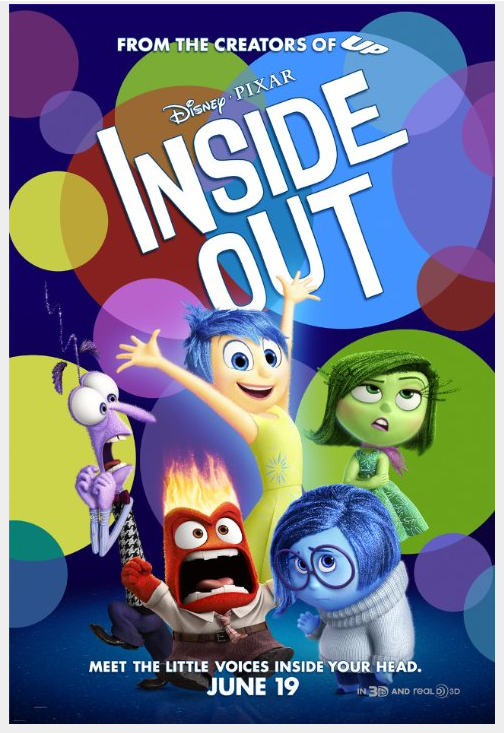
This past summer, after watching Pixar’s Inside Out (2015) and the last broadcast of The Daily Show (8/6/2015), I considered a different argument: films should be included in schools as part of career development.

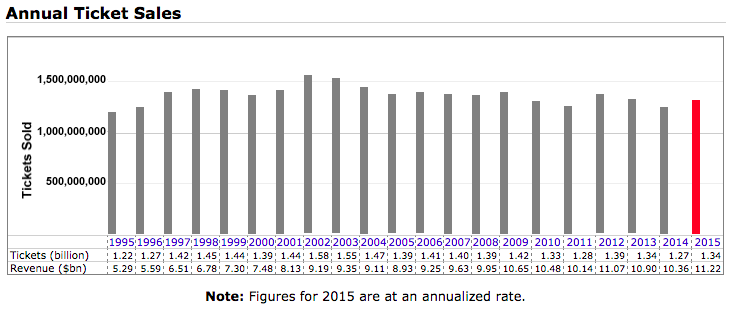
Consider first this annual entertainment (film) ticket sales graphic over the past 20 years from Research and Market Reports:

Screenshot 2015-08-22 13.52.06

The explanation that followed:

The global movie and entertainment industry is expected to reach an estimated US $139 billion in 2017 with a compound annual growth rate of 4.2% over the next five years. This growth is likely to be driven by the acceleration of online and mobile distribution of movies, lower admission prices, and government policy initiatives in developing countries.

Or, read the report from The Motion Picture Industry Association on its website:

In the process of producing video content for today’s audiences, the American motion picture and TV industry contributes approximately $40 billion per year in payments to more than 330,000 local businesses across the country, according to the latest economic impact figures.

Credits for Pixar’s film Inside Out

Screenshot 2015-08-22 13.44.47Pixar’s film Inside Out was a 94 minute animation on the “headquarters” that managed the emotions of a 12 year old girl, Riley, during a particularly difficult time in her life. After the resolution, the first set of film credits (producer(s), director, actor/actress credit) ended with a montage of emotional centers running the lives of supporting characters in the film: Riley’s teacher, a pizza girl, a bus driver, a dog and (hilarious) a cat.

Then, another six full minutes of credits ran after the montage, a listing of all those who had contributed to the film. These credits scrolled listing teams of people involved in creating this animation: visual effects creators , sound designers, animators, editors, artists, etc. (an abbreviated listing is on  Internet Movie Database- IMDB page). Six minutes listing the names of people employed in a film that was very profitable:

  • Budget: $175,000,000 (estimated)
  • Opening Weekend: $90,440,272 (USA) (19 June 2015)
  • Gross: $335,390,545 (USA) (7 August 2015)
Jobs in the Film Industry

Educators are confronted with preparing students for employment in this 21st Century economy that is far more diverse domestically and internationally than any before it. The names of those who had worked on the film Inside Out  had been employed in creating a product for the Walt Disney Company, a major corporation which held assets worth a total of 74.9 billion (US dollars) in 2012.

Perhaps, instead of limiting the showing of a film and asking students about the message or information, we should slow the credits down and ask them to find out answers to some important questions:

What are the kinds of jobs we see in film credits?
How much does one of these positions get paid?
What skill sets do you (students) need to have to get each of these jobs?

There is a great amount of talk about teaching students to be collaborative, and any film can be an example of collaboration.  Unlike a poem, essay, or novel, a film has multiple authors who each bring a particular skill to its creation. The six minutes of credits illustrated how enormous this collaboration had been in Inside Out.

Giving credits-The Daily Show
Audience on the last night of "The Daily Show" as part of the final walk-through

Audience on the last night of “The Daily Show” as part of the final walk-through

I found myself thinking about showing credits again when, on the night of his last broadcast, Jon Stewart offered a backstage look at those who had worked on his show to make it successful. In one section of the show, there was an extended hand-held camera walk-through of the offices and studio taken from Stewart’s point-of-view. As the camera moved through the hallways and onto the set, Stewart rattled off the names of those who had worked in every aspect of The Daily Show‘s production: writers, designers, researchers, editors, make-up and costumers, and even his family.

The sequence took 6:46 minutes in total, culminating with the contributions of the viewers and studio audience. After the clip, Stewart repeatedly praised the members of this collaborative team as a positive experience.

Maybe that particular clip will never be shown in a classroom, but the walk-through raises questions educators should consider. What skills did these people have in order to get a job with The Daily Show? With The Daily Show as part of their resume, where will these people now find employment? How many in the television audience watched this walk-through and envied those who had a hand in creating this show?

Film and entertainment is a major industry in the US and international economy, and educators should make students aware of the possibilities. When showing a film in class, we might let the credits (slowly) and explain that these jobs could be something they would be interested in doing as a career. At the very least, teachers may have students do a little research and find out what the Gaffer does in a film.

The last part of the credits in Inside Out listed the names of the children born to the entire team during the six years of production. Following the names, there was a dedication from the entire collaborative team:

 “this film is dedicated to our kids. please don’t grow up. ever.”

But our role as educators, is different. Educators prepare them [students] to grow up….and maybe develop skills that could be featured in a scrolling film credits.

Several years ago, I was teaching John Keats’s Ode on a Grecian Urn to a group of sophomore students. While they did struggle with the first four stanzas of the poem, they lingered on the the memorable last stanza of the poem:

O Attic shape! fair attitude! with brede
Of marble men and maidens overwrought,
With forest branches and the trodden weed;
Thou, silent form! dost tease us out of thought
As doth eternity: Cold Pastoral!                           45
When old age shall this generation waste,
Thou shalt remain, in midst of other woe
Than ours, a friend to man, to whom thou say’st,
‘Beauty is truth, truth beauty,—that is all
Ye know on earth, and all ye need to know.’        50

Like other students before them in previous years, they wrestled with the conclusion that Keats arrived on with the closing lines:

‘Beauty is truth, truth beauty”

What is beauty?

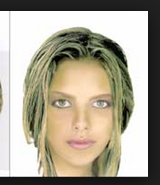
When I asked students, “What is beauty?” they had many different ideas. In one session, we discussed physical beauty. It was not a surprise that each student held a different idea about physical beauty. After they listed the characteristics,  I offered a photo of “beautiful” face. When I shared this photo, they all agreed she was beautiful.

Computerized face: Survival of the Prettiest by Nancy Etcoff

Computerized face: “Survival of the Prettiest” by Nancy Etcoff

After they agreed, I revealed that this particular face had been generated by a computer. The beautiful face was developed as part of the research by Nancy Etcoff, a Harvard psychologist and medical researcher. Her research on attitudes towards beauty resulted in a book titled, Survival of the Prettiest.

The face they all agreed was a beautiful face was, quite literally, an average[d] face. The graphic at right had been generated by a computerized program that averaged the faces of hundreds of women. In other words, this was not a single woman who defined beauty, but a representation of multiple women.

The conclusion my students reached was, although the face of the woman was beautiful, a  “virtual babe”, she was really just “average”.

The Truth in Averages

The students discussing the computerized face understood averages; they were confronted with the term daily. They maintained an attendance average; they received a grade point average. They knew mathematically that an average is a form of reduction; a division into an arithmetic mean. They also understood that calculating an average did provide a kind of truth in their performance, but not the whole truth. There was almost always a test or quiz or project that could be in “dispute” or “unfair.”

They did agree that the face created by the computer program was probably more equitable in making qualitative judgements. Every face was weighed by the software program in exactly the same way. They suggested that there was probably more “truth” (fidelity to an original or to a standard or ideal) in the averaging process in the face’s creation than in their GPAs.

Truth is Beauty?

“So, is this particular beauty ‘truth’?” I asked again, pointing to the computerized face, “…is this a true individual ‘beauty’?”
They did not think so.
“Collectively, then?”
“Mrs. Bennett, all this proves is everyone together is beautiful…and that is the truth!”

What say you, John Keats?

“…but first, I give them a quiz,” the 2nd grade teacher was telling me.
“A quiz?” I was surprised, “Why?”
“Well, how will I know they read their homework?” she responded.
“But…they are only in 2nd grade…so……” I trailed off; she blinked expectantly.

I didn’t finish my sentence.

“So… this is how the madness starts,” is what I wanted to say.

Quid Pro Quo Assignments

Homework has always been a bit of an educational  “quid pro quo (Latin). The “give something, get something” in schools where a quantitative grade marks the successful exchange of educational services, the teacher, to the student in a paper-or digital-transfer.

Quid pro quo homework follows a cycle: the homework worksheet is distributed; the homework worksheet is completed; the homework grade is entered OR the homework is assigned, and the student is quizzed to check compliance.Non-compliance can sometimes bring a punitive action.

This cycle does not facilitate trust between teacher and student.

The quid pro quo cycle of homework has been customary practice in the upper grades, but recent studies are raising concerns about the increasing amounts of homework in the elementary grades.

Increase in Homework for Elementary

The focus on back-to-school issues in the media such as the article Kids Receive 3 Times the Recommended Homework Load in the 8/12/15 issue of TIME magazine  is bringing attention on the tripling of homework at the elementary level. The amount of homework raises concerns in policy and research:

From the National Education Association Research Spotlight on Homework

“In the last 20 years, homework has increased only in the lower grade levels, and this increase is associated with neutral (and sometimes negative) effects on student achievement.”

From Does Homework Improve Academic Achievement? A Synthesis of Research, 1987–2003 (Cooper, Robinson, Pattall REVIEW OF EDUCATIONAL RESEARCH )

“No strong evidence was found for an association between the homework–achievement link and the outcome measure (grades as opposed to standardized tests) or the subject matter (reading as opposed to math).”

From The American Journal of Family Therapy Homework and Family Stress: With Consideration of Parents’ Self Confidence, Educational Level, and Cultural Background

Family stress, measured by self-report, increased as homework load increased and as parent’s perception of their capacity to assist decreased.

One conclusion is that the increase in homework at the elementary level is not only academically ineffective, but also stressful, particularly for families with limited educational resources.

Long Term Consequences of Too Much Homework

A consequence of assigning homework as high stakes, rigorous, or graded practice in the lower grades sets up a disturbing paradigm that becomes ingrained in the upper grades. Homework becomes less about good practice in a discipline and more about student responsibility. In the upper grades, where homework does show academic value, the homework grade is often an average of the two.

Another consequence is how quickly younger students can be trained into a exhausting pattern of expecting a grade for each assignment. Once that pattern is set, students may require a grade for anything they turn in. They may not be able to discriminate between a grade for a long-term assignment or for busy work, and in the course of 13 years of education there will be a great deal of homework that is simply busy work.

Once that habit of quid pro quo homework has been established in the younger grades, it can become an addictive monster at every other grade level. For example, the 2nd grade student who will be met with a quiz for reading homework will be conditioned to associate reading with quizzing.

Constant quizzing could mean the student may never understand how to read for pleasure or grow to love reading. Ironically, reading for pleasure has been proven to be the one academic skill that will make that student successful way beyond that second grade classroom.

from jarofquotes.com

from jarofquotes.com

Of course, homework should receive feedback, an equally critical part of the educational process, but one that serves a different purpose than grading. Feedback on homework could be a positive experience for a student. It can be unexpected, encouraging, comforting, instructional, corrective, supportive-as opposed to a graded assignment….especially for a student in an elementary grade.

If the homework given in a 2nd grade class is to read, a quiz should not be the method to check to see if students did the reading; a  sidebar conference or quick discussion about what was read might be a better assessment.

Not everything needs a grade.
When selecting homework assessments, teachers should consider the question “Is this homework simply busy work?”  as well as other questions:

  • Is a quiz necessary to see that a student has read a homework assignment?
  • Is correcting this homework the best use of time?
  • What does this homework assignment accurately measure ?
  • How many times have I had students do this same homework assignment?

Homework is Practice

Teachers can measure a student’s performance through other forms of assessment. While a teacher, at any grade level, has little control over the conditions and support for homework once a student leaves the building, there are multiple opportunities for the teacher to monitor student progress while students are in the classroom.

Furthermore, homework’s design is to provide students the opportunity to practice, which raises the question: should student practice homework be assessed at all?

This school year, it’s time to halt the increase in elementary homework and the potential madness of its quid pro quo value.

Instead, educators should heed the research that shows students in elementary grades need less homework, and when they do have homework, the emphasis should be on practice.

Students -all students-need the practice more than they need the grade.

seating chartThe seating plan is often thought of as an important element for student success. From the first day of school, the seating plan is a teacher’s strategy for learning student names, and student names can be the most important piece of information a teacher can gather the first day of school.

For that reason most teachers choose to use an initial seating plan that is alphabetical, but once names are committed to memory, should teachers still use the seating plan?

Scramble the Seating Plan

One year, I experimented with my 9th grade students to change things up by using a different approach that was based on a need to have students be more cooperative and collaborative.

Every day, I would greet the students at the door with the following directions:

“Line up at the front of the room.”

Bags and backpacks tossed along the front wall, I would then ask them to organize themselves, without talking, according to different criteria. This criteria was not academic, and sometimes spontaneous, for example:

  • by birthdate;
  • by hair color (dark to light);
  • by middle name;
  • by number of letters in their street address;
  • by size order (tallest to smallest);
  • by color of their shirt (following a spectrum);
  • by the last four letters in their last name.

I would encourage them to silently communicate with each other. Some used a form of sign language; others simply put a letter or number on a piece of paper in order to find their place in line.

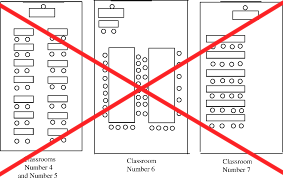
Once they were organized, I would check to make sure they were organized correctly (and not trying to stand next to a “buddy”). I would then place the newly organized line into whatever desk arrangement I had chosen. I would feed them into rows, sometimes horizontally and sometimes vertically, across the room. I would place them in a large square forum style set of desks. I would position them in short slanted sets of rows, angled towards the front. By the end of the first week, they were “trained”, and the process took less than 5 minutes.

Organizing groups

When I wanted to set up groups, I would arrange the desks in pods. Then I would create small groups by having them stand in groups based on other criteria, for example:

  • by fast food preferences (Taco Bell, McDonalds, Arby’s, Burger King);
  • by pet (cat, dog, reptile or bird);
  • by favorite color (blue, green, red, yellow);
  • by favorite car (Ford, Chevy, VW, Subaru, Toyota):
  • by favorite meal (pizza, spaghetti, hamburger, tacos).

Then I would either leave the groups intact or take one member of each group to form new combinations. I could take one  category overflowing with students and disperse those members into each of the other categories. These new groups could work for a day’s activity or a long term project. The students never knew who they might be working with that day or week.

Purpose

My purpose for this scramble every period was social. Since our high school was a regional school, the 9th grade was a 60%/40% combination of students who had been together during grades k-8 with new students from any one of 10 area schools. Over the years, I had noticed the isolation of the newer students while familiar friends wanted to work exclusively with each other.

My goal was to have students get to know each other in order to work collaboratively and cooperatively. For weeks during this exercise, they were collaborative and cooperative.

By the end of the second month, however, some of the students expressed weariness of this daily exercise.

“Can’t we sit where we want?” they asked.

I agreed. Frankly, I was running out of criteria!

When they sat in their preferred seats or tables, I did notice that there were interesting social combinations that would not have happened if they had not spent time together as I mixed them up. My goal appeared to have been met.

Vocabulary and the Seating Plan

I did not give up the opening scramble entirely.  I would use the format for vocabulary lessons by placing a different definition on each desk, and handing a card with the matching word, one to each student, as they entered the room.

“Match the word to the definition on the desk,” I would say, “…that is your seat for today!”

This form of seating plan kept my social goal intact while letting me know how much vocabulary I needed to review.

Summary of Seating

My adventures in seating worked well most of the time. There were days that I was convinced that students represented by one part of the alphabet were definitely more challenging than other parts or that determining hair color was a more arbitrary decision than I realized.

However, I will counter that no seating plan was ever perfect, and I could still manage the “preferential seating” requirements of PPTs by placing myself or an aide next to students who had that listed.  Preferential seating is not always at the front of the room, and I found that most secondary students with that designation would prefer a more confidential location at the back of the room where they can be supported more discreetly.

At the end of the school year, my 9th graders waxed nostalgic about how I had made them scramble every morning.

I obliged them one more time:

“Line up by summer vacation plans… nearest distance from the school to the farthest….and no talking!”

From the stay-cationers to traveling vacationers, they were so cooperative!

This summer, I plan to spend time organizing question stems to spark critical thinking and post them on a number of slides to share with teachers.
OR
I could shorten the process and use just one slide. I could ask one question that is guaranteed to drive critical thinking. I could ask:

So what?”

To be honest, the first time I was asked this question in an academic setting, I was appalled. I felt I was being taunted. I was sure the professor was just being rude.

I was uncomfortable…I could not give an effective response.

“So what?”

I hated the question. I hated that the professor was goading me. I hated Dr. Steven D. Neuwirth. 

I was taking a graduate course (560) Literature of the American South, what I thought would be a “fun” course as I completed my Master’s Degree in English.

I remember distinctly the moment that was not fun…the evening of the second class.

“So what?” Dr. Neuwirth wrote on the chalkboard; he snapped a piece of chalk as he underlined the question for emphasis.

So what? he repeated in class after I offered what I thought was a brilliant observation on the evidence of dignity as a character trait in a discussion on William Falkner’s As I Lay Dying.

I was irritated. I had worked very hard on my responses.

So what? he scrawled in big letters on the paper I handed in three weeks later.

I was angry. I had worked even harder on that response.

My frustrations continued. Nothing in my training had prepared me for his persistence with the So what? question.

I had done what had worked in every other class. I had developed a thesis. I had used evidence. I had proved my thesis.

Regardless, my answers did not satisfy his challenge. So what? He found my reasoning lacking, and because he was not satisfied, neither was I.

I needed to think how to explain better.
I had to think differently.
I had to think critically.

It was then I realized that Dr. Neuwirth’s So what?” question was making me think critically.

Dr. Neuwirth’s irritating challenge brought me to recognize that it was not enough for me to develop and prove a thesis in a paper. I had to prove why my argument mattered.

For example, it was not enough to prove that Faulkner’s characters displayed dignity despite their social status, I had to question so what is the reader to take from his writing?

I had to ask the question So what?” not with attitude but with curiosity. Curiosity led to inquiry:

  • So what was my point? 
  • So what was missing from my response?
  • So what should I want the reader to know or do?
  • So what happens next?
  • So what do I do to cause or prevent something from happening ? 
  • So what makes this work or not work?
  • So what will this information lead me to study next?

Such inquiries led to me to make conclusions. I had always found conclusions difficult to write. I had always followed the predictable formula of restating the thesis, but I found that when I used the critical question So what? I could offer a broader conclusion.

For example, when I developed a thesis on the dignity of Faulkner’s characters and provided evidence from the text, I was really posing the question “Why should anyone read novels by Faulkner?” When I asked myself so what? I could conclude that Faulkner’s characters spark empathy in the reader.

It turned out that I did not hate theSo what? question.

I did not hate Dr. Neuwirth …although, admittedly, liking him took a little longer. While I did understand the importance of being challenged, I still found him a brilliant but abrasive teacher.

Four years after that class, I  became a teacher, and I taught literature. My students wrote predictable and boring conclusions that restated the thesis. They were not thinking critically. I had to do something.

Dr. Steven Neuwirth, Western Connecticut State University-created the University's Honors Program and served as its first director; he passed away February, 2004.

Dr. Steven Neuwirth, Western Connecticut State University-created the University’s Honors Program and served as its first director; he passed away February, 2004.

I asked my students So what?

And I scrawled So what? on their papers.

And I wrote So what? on the Smartboard -without chalk.

My students also hated theSo what? question.

They complained to me, but their conclusions improved.

So here is one question, one irritating question, for critical thinking for sharing on one slide:

So what?