Archives For November 30, 1999

sno_ani07sno_ani07It’s a snow day here in Connecticut. The predictions were so dire (8″-11″; freezing rain) that school was cancelled the night before. I didn’t even have to wait to see my district’s name on the scrolling list of school closings on the bottom of the television screen or check the school’s Twitter account. I could turn off the alarm and sleep as long as I wanted.

I am the first to admit that I look forward to a snow day. Like my students, I check the Weather Channel app on my I-phone or track storms on local weather channels. I deny participating in some of the rituals that are guaranteed to bring about a snow day, however, I have made the following  “suggestions” to students:

  • wear PJs inside out
  • walk up stairs backwards
  • placing a spoon under a pillow
  • yell “Snow Day” into the freezer
  • flush ice cubes down the toilet

In short, I look forward to snow days…but there is a paradox.

Because of snow days, I can catch up on work, BUT because of snow days, I will have to work “extra” days.

The end of one semester (mid-January) is directly in the path of a nature’s pile-up of snow. My desk at the end of one semester (mid-January) is directly in the path of a pile-up of papers. Consequently, snow days are useful for “clearing the deck” of paperwork.

Unfortunately, when the school year comes to a close, all snow days are added to the calendar. These make-up days will also need lesson plans, and there will be work generated during these lessons resulting in a pile up of papers.

An argument can be made that working on a snow day means working twice. By law, school has a finite number of days required, and in Connecticut the required number is 180 days of instruction. Since teachers’ salaries are designed on the numbers of days in the classroom, school calendars are designed with an estimated end date. Snow days are added as make-up days, and working on a snow day does not eliminate make-up days.

In spite of this, each snow day holds a possibility of catching up on schoolwork or of getting ahead.

Technology has only exacerbated this possibility. In the past, student papers could have been left on a desk in the classroom, safely kept away from the red pen by snow or ice-covered  roads. Now, there are a number of ways to assess student work on digital platforms. There are a plethora of ways to plan lessons or webinars to attend. There are Twitter chats to visit, and (this one is obvious) blog posts to write.

This is the paradox of snow days. To work and to work again.

Knowing this may reduce the pleasure of snow days, but only a little. A chance to catch up is a chance enjoyed by teachers everywhere.
Except in San Diego, California.
Oh, how they must suffer.

 “for we are the only love-gods...”( Much Ado about Nothing: 2.1.386)

Every generation has them, the “love gods”, the cultural icons who capture our minds and our hearts.  They are musicians, actors, playwrights, authors, or poets.  They are artists with a stamp so firm on a culture that the mere mention of their names can call forth an image; artists, for example, like Shakespeare or maybe The Beatles. They are artists whose images need no text to explain who they are, like Shakespeare or maybe The Beatles.

These paperAnd because these artists have messages that transcend time there are educators who are committed to teaching their students how best to discover an artist’s message through a study of an artist’s craft. There are even educators so committed that they would spend an entire Saturday, (January 24, 2014) learning new strategies to help their students understand and respond to the messages of cultural icons. These are educators who spent the day at the Yale Repertory Willpower!Workshop centered on the upcoming production of These! Paper! Bullets!.

These! Paper! Bullets! is an adaptation of Shakespeare’s comedy play Much Ado about Nothing, with the setting transported to London in the turbulent 1960s. The play’s adaptation is by Pulitzer Prize and Emmy Award nominated writer Rolin Jones, and the promotional synopsis states:

Meet the Quartos. Ben, Claude, Balth, and Pedro. Their fans worship them. Scotland Yard fears them. And their former drummer will stop at nothing to destroy them. Can these fab four from Liverpool find true love in London and cut an album in seven nights? These Paper Bullets! is a rocking and rolling version of Shakespeare’s Much Ado About Nothing with a serious backbeat.

Many of the teachers attending this Saturday’s workshop will be bringing their classes in early April to the daytime productions of These! Paper! Bullets!, a series of performances offered through the WILLPOWER! program. This program is the brainchild of James Bundy, dean of the School of Drama and  artistic director of the Yale Rep. According to a 2013 Yale News article “‘WILL POWER!’ gives city students a ‘visceral’ introduction to theater,” Bundy’s concerns about having students see live theatre was the motivation for beginning the program 10 years ago since, “studies show that people who attend the theater before the age of 18 are much more likely to attend later in life.”  

The WILLPOWER! Workshop for educators is coordinated by Ruth M. Feldman, the Yale School of Drama’s director of education and accessibility services, and is usually offered several weeks before a production in order to improve classroom instruction and prepare student audiences for the play they will see.

Feldman’s jam-packed line up this particular Saturday included a preview of sets and costumes with the production’s director Jackson Gay. The costumes brought “aahs” from the audience who obviously appreciated the retro-look of white go-go boots on Twiggy-eque models. There were also musical snippets from the production’s musical collaborator, Green Day lead singer and guitarist Billie Joe Armstrong.  Listening to clips of these original songs that echoed the sounds of the 60s, composed in tribute to the Fab Four, had all the heads in the room bopping up and down.
“Is there going to be a CD soundtrack?” one enthused teacher asked.

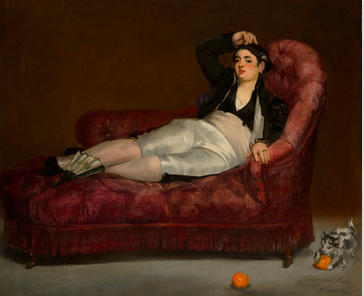
After the question/answer session with the director, Feldman packed off the teachers for a visit to the Yale University Art Gallery, a short brisk walk across the street, to participate in a thematically linked presentation on “adaptations” organized by Museum Educator Elizabeth Manekin and Elizabeth Williams, the John Walsh Fellow at the Yale University Art Gallery.  Teachers were briefed on the Pop Art movement as they studied a series of nine panels of Andy Warhol’s Mao (a screenprint of one similar is available on Amazon). The discussion asked teachers to consider how a cultural icon is adapted for new audiences. Next, teachers gathered around Manet’s Reclining Young Woman in Spanish Costume and continued the discussion on adaptations before heading to the workroom to make collages that were adaptations on Manet’s other reclining female, Olympia.

Andy Warhol Mao 93, 1972 Screenprint sold by RUDOLF BUDJA GALERIE. $200,000.00 + Free Shipping

Andy Warhol
Mao 93, 1972
Screenprint on AMAZON through RUDOLF BUDJA GALERIE.
$200,000.00 + Free Shipping!

Édouard Manet, French, 1832–1883 Reclining Young Woman in Spanish Costume

Édouard Manet, 
Reclining Young Woman in Spanish Costume -Yale University Art Gallery

Returning to Yale Rep, teachers also had the opportunity to try reading and writing strategies aligned with the Common Core using informational texts, short commentaries about social media and cultural icons. Rachel Sexton, an educational specialist at ACES, engaged teachers by having them participate in a reading strategy that asks students to organize an article that had been cut-up. “Don’t look for matching cuts like a puzzle,” she warned, knowing how some students might look for a short-cut. The next strategy involved reading that text and other short commentaries in order to write a personal response incorporating three ideas they found significant. Dutifully, teachers took pencils in hand. The sounds of scribbling were slow at first but became steadier, and Sexton had to interrupt teachers as her session time was drawing to a close,  I overheard teachers:

  • “This is a great way to introduce a topic”
  • “I cannot believe how much I am getting out of this exercise…”
  • “I know how my students have trouble getting started with writing; this [strategy] solves that problem!”

The last session was dedicated to the lyricism in Shakespeare’s play offered by Dr. Matthew Suttor, Director of the Laurie Beechman Center for Theatrical Sound Design and Music at the Yale School of Drama. His session was  titled, “Let Music Sound…”, a presentation designed to have teachers “examine and experience the creative process for drawing both lyrics and music from a play’s text. (full disclosure: Sadly, I could not attend this last session because of impending snow.) 

As she has in the past, Feldman organized seven hours of first-rate (FREE) professional development through the WILLPOWER! program that was both practical for classroom application and powerful enough to encourage educators to explore new possibilities for bringing the messages of adaptation in culture. Exploring the elements of These! Paper! Bullets! before the opening of the show helps educators prepare students for the experience of Shakespeare performed live.

In addition, knowing adaptations can be made from works created by a cultural icon some 400 years ago is an concept that students today, with their ability to create mash-ups and Internet memes coupled with their  fascination with today’s cultural icons, should appreciate or even (hopefully) try themselves.

Continue Reading…

The villanelle is a nineteen-line poem with two repeating rhymes and two refrains. The form originated in France in the late 1800s, and the structure is comprised of five tercets followed by a quatrain. The most famous villanelle is by the Welsh poet Dylan Thomas, “Do Not Go Gentle into That Good Night.”

Do not go gentle into that good night, 

Do not go gentle into that good night,
Old age should burn and rave at close of day;
Rage, rage against the dying of the light.

Though wise men at their end know dark is right,
Because their words had forked no lightning they
Do not go gentle into that good night.

Good men, the last wave by, crying how bright
Their frail deeds might have danced in a green bay,
Rage, rage against the dying of the light.

Wild men who caught and sang the sun in flight,
And learn, too late, they grieved it on its way,
Do not go gentle into that good night.

Grave men, near death, who see with blinding sight
Blind eyes could blaze like meteors and be gay,
Rage, rage against the dying of the light.

And you, my father, there on the sad height,
Curse, bless, me now with your fierce tears, I pray.
Do not go gentle into that good night.
Rage, rage against the dying of the light.

I recently taught this poem to a class of Advanced Placement English Literature seniors who after some discussion were able to determine audience (“And you, my father..”), the form of address (imperative “Do not go“) and the poem’s paradox (“Curse, bless, me now“). They were intrigued by the most striking element of the poem, the repetition of the lines “Do not go gentle into that good night” (1, 6, 12, 18) and “Rage, rage against the dying of the light” (lines 3, 5,15,19). The ferocity of Thomas’s repeated exhortations increase because of the structure of the villanelle.

Structure matters. Structure, that “fundamental, tangible or intangible notion referring to the recognition, observation, nature, and permanence of patterns and relationships of entities” is not limited to poetry. Structure is in all the arts, and in all the sciences.

Structure matters in mathematics. Common Core Mathematic Practice Standard #7 requires students to:

Look for and make use of structure.

This standard details that “proficient students look closely to discern a pattern or structure,” and suggests, “young students, for example, might notice that three and seven more is the same amount as seven and three more.” Promoting this practice standard beyond the math classroom will have students noticing structure in other classes in every grade level. Students will be better equipped to recognize and use the structure of the periodic table or the color spectrum; they will be be prepared to identify and to employ patterns in pronouncing vowels and consonants. Students will be empowered to discover coordinates in longitude and latitude or to categorize the ingredients in food groups.

Recognizing and using structure is the critical academic skill that can help a student unravel both a problem in geometry or the complexity of a poetic structure like the villanelle. Once they understand the structure, they can evaluate the poet’s purposeful choice such as the one made by Dylan Thomas who selected the villanelle for this powerful poem.

The Common Core’s Mathematic Practice Standard #7 is in math and poetry. Note the same letters MP? Pattern? PossiblyCoincidence? Maybe not!

Continue Reading…

January weather forecast? Frigid.
Blogger forecast? Sunshine.
Specifically, “Sunshine Awards.”
Nominating or receiving a Sunshine Award is a way for bloggers to get to know each other. There are unlimited winners to this award because this operates much like the chain letters of old. Get an award from a fellow blogger, and then nominate 11 other bloggers to participate. I suspect that sooner or later, every blogger in the world will be nominated proving the blogging universe has no degrees of separation blogger to blogger.
That said, I was delighted to get a mention….really!!
The Sunshine award does give other bloggers an opportunity to learn about each other, although I am not sure any of the following random facts on me will be useful.
There are five “official” rules (in green):

RULE #1 Acknowledge the nominating blogger:

For me, that was Vicki Vinton of To Make a Prairie “A blog about reading, writing, teaching and the joys of a literate life.” Her blog is an amazing combination of education application and literature tie-ins. Her blog looks so organized and engaging. I know if I am thinking that something might be possible, Vicki proves that what I am thinking is doable. I will reread her posts before I write on a topic (ex: Cautionary Tale Close Reading).You owe it to yourself to visit her blog.

RULE #2 Share 11 random facts about yourself.
Okay…..11 random facts about me:

a. I have 31 nieces and nephews (no twins) from my eight younger brothers and sisters.

b. I made my prom dress in high school; I thought pink calico was adorable!

c. The famous clown Emmett Kelly, Jr. patted me on the head when I was a toddler; I am terrified of clowns.

d. I learned to drive a stick shift on my family’s white 68 VW bus that we called “Moby Dick”; consequently, I also know how to jump start a car with a stick shift.

e. I have one “attached” ear lobe and one “unattached” earlobe which is not the genetic abnormality  you might think.
Kindergarten

Kindergarten narrator

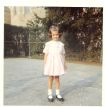
f. I was the “lead”narrator in my kindergarten play which surprised my mother and father. NOTE: I am still comfortable onstage.

g. I can recite Marc Anthony’s speech from Julius Caesar III.i.253-275(“O pardon me, thou bleeding piece of earth…”) because my high school teacher made me memorize a soliloquy.

DSCN0868

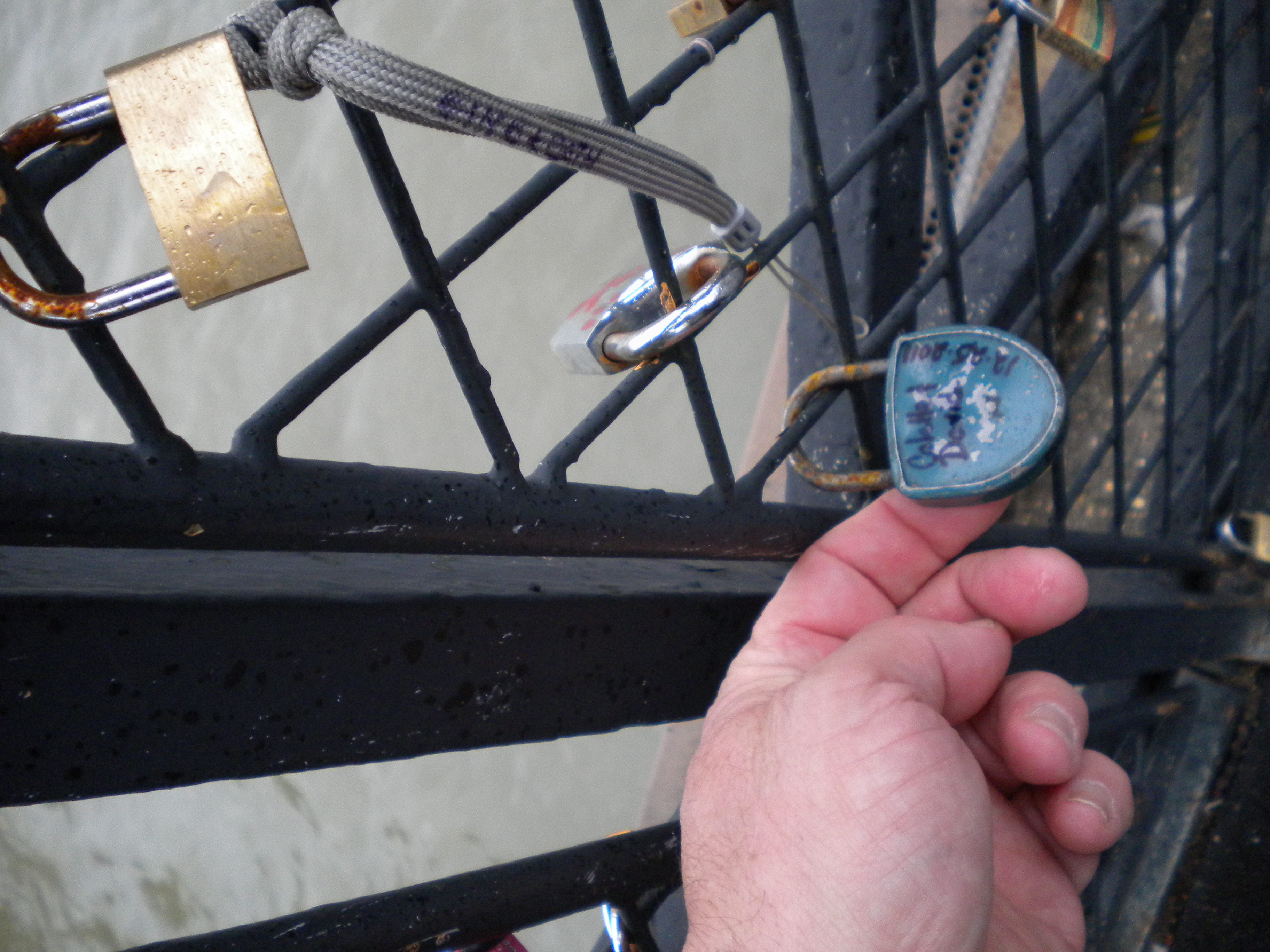
Lock on the Pont L’Archevêché in Paris

h. My husband and I (married 32 years) left a lock on a bridge fence in Paris near Notre Dame in 2011.

i. I tear up at at flash-mob videos. Example? (USAirForce Band at Air & Space Museum)

j. I buy white cars because I want to be seen at night. Paradoxically, these cars always look cleaner than black cars.

Haunted House

My Halloween Haunted House

k. For many years,I had a haunted house for Halloween in my barn while my two sons were young. Now, I shut off all the lights on October 31st and pretend I am not home.

RULE #3. Answer the 11 questions the nominating blogger has created for you.

(Yikes….11 more facts? Aren’t you tired of all this?)

1. What book would you want with you if you were stranded on a deserted island?
How to Build a Ship and Navigate if You Are Ever Stuck on a Desert Island. The more romantic answer, however, would be James Joyce’s Ulysses or Ulysses S. Grant’s letters. Both are on a “to do” list that would require hours of uninterrupted reading time (the connection to Ulysses trying to get back home should not overlooked either…)

2. What did you learn from your mother?
I learned how to cook for a family of eleven; food was plentiful at our dinner table. Cooking is a great skill, but this early training resulted proportion miscalculations and substantial weight gain for my husband. I just cannot get used to cooking for two.

3. Where do you write?
There is a small table in my kitchen where I do much of my writing, but when the weather is nice, I will write on my back patio table. I imagine if I was driving by, I would think, “Oh! I would like to be writing there!”

4. Where do I find joy in my classroom or my work?
When I hear a student correct another student by saying, “a lot is two words.”

5. What do I do to recharge?
I watch movies. I am a movie addict which is not surprising given my addiction to stories.

6. What was my favorite book as a child and why did I love it?
Without question, my favorite book as a child was Little Women. I am the first born, the practical Meg, but in my heart, I am the second born Jo March.

7. If you could have dinner (or coffee or drinks) with anyone living or dead, who would it be and what would you want to ask him or her?
Sister Ella, my first grade school teacher who taught me to read. I want to know if she predicted my interest in reading. She was incredibly -almost frighteningly- tall, and I could never tell if she was smiling or not.

8. Do you have a quote that you keep (in your mind, a notebook, a pocket, your desk, etc.) that captures something that seems important to you? If so, what is it?
The most recent is by Carl Sagan, “What an astonishing thing a book is. It’s a flat object made from a tree with flexible parts on which are imprinted lots of funny dark squiggles. But one glance at it and you’re inside the mind of another person, maybe somebody dead for thousands of years. Across the millennia, an author is speaking clearly and silently inside your head, directly to you.” That’s impressive.

9. How do you feel about the age you are currently in?
Emotionally, I am fine with being 57. I have come to terms with things I will never accomplish (play piano, hike the Appalachian Trail) and still hopeful on other things I want to accomplish (PhD in English, speak French). Physically, I am surprised at how often I need to get up from reading or writing so I don’t get stiff and cramp up. Mentally, I am surprised that 57 sounds old, but 58 sounds wise.

10. What are you afraid of?
I do not like turning off the lights downstairs. To this day, I will race up the stairs as if something is chasing me.

11. If you could go back to one moment in time, when & where would that be & why?
In Our Town Thornton Wilder cautions against revisiting the past; the character Emily finds it too painful. Therefore, I would choose to relieve something I did as a child but not go as myself. I would go back to the 1964-65 World’s Fair in NYC and spend the day with all the exhibits that “predicted” our future.

Now for the fun part:

RULE #4. List 11 bloggers. They should be bloggers you believe deserve some recognition and a little blogging love!

NOTE: Should any of the following bloggers want to accept this award WITHOUT the chain letter-like activities, they have my permission. I have no demands for their participation in what could be a Ponzi-scheme of blogging. These bloggers represent a cross-section of  Bloggers and Tweeters that I read regularly.

 HOWEVER, readers who visit these blogs will benefit. I learn so much from all of these writer/educators…I feel their “love”:

1. First and foremost, my dear friend Catherine Flynn blogged so often in 2013 on Reading to the Core that I could not keep up. I walk with Catherine on the weekends (and I can hardly keep up!), so I am always interested in how our conversations show up in a post. She is a literacy specialist…and a specialist in keeping me focused on the real issues in literacy.

2. I love Bryan Crandall, Connecticut Writing Project (CWP) Director at Fairfield University. He supervised my CWP experience in 2012. His blog this year is Creative Crandall and his entry for January 1st, 2014, reads: “I will spend the next 365 pontificating what creativity means to my world, the people I love, the students I work with, and the teachers that need desperate rejuvenation. The goal is to counter the dreary, maddening, and absolutely criminal doings of governmental leaders and corporate partners who are undoing public schools.” Love that.

3.  Another amazing Connecticut Writing Project Director is Jason Courtmanche at the University of Connecticut. His blog is The Write Space. His posts on Facebook/Twitter alert me to any gem I might overlook in the news that is tied to literature/education. He has worked very hard to outline the transitions of Common Core State Standards to the Early College Experience at UCONN for hundreds of high school teachers.

4.  I met Kate Baker of Baker’s B.Y.O.D.– Bring Your Own Device, Dog, & Deconstruction of Literature in person at the Council of English Leadership (#CEL13) this fall. I had seen many of her posts/tweets. The meeting was kismet…in minutes we had covered The Odyssey, Moby Dick, and other classics. She gave a dynamite presentation of Stop Bleeding Red Ink! at the conference. (FYI: Kate already has posted 11 random facts about herself on her blog!)

5. My mom is in Idaho…and so is Glenda Funk at Evolving English Teacher. I first read her entries on the English Companion Ning; then, I stalked her at the National Conference of English Teachers in 2011.  I LOVED her post about the impact of high school sports on academics: “What We Don’t Talk about When We Talk about Ed Reform in the U.S.A.” In that post she discusses the everyday impact of sports from practice schedules to concussions. Very informative.

6. I read Judy Artz at her blog  Intergrating Learning and Technology-“Here you will find ideas for promoting literacy through the use of technology.” I met her in person also at Council of English Leadership (#CEL13) where I greeted her as an old friend. That is because she tweets (@JudyArtz) at a rapid fire pace, and sometimes mentions me!

7. I also met Daniel Weinstein of The Creativity Core at the National Conference of Teachers of English (@NCTE13) this November. I have used his ideas in my classroom, especially the semantic mapping, with enormous success. The blog is gorgeous with student work as exemplars.

8. Guilty pleasure? The observations of the Anonymous Blogger @ English Teacher Confessions. Entry “This book made me vomit” about Cormac McCarthy’s Child of God is an intriguing homage to McCarthy’s genius as well as a warning. Reading this post will give you an appreciation for this blog writer’s style…who is no slouch herself!

9. Buffy Hamilton, former high school English Teacher and current school librarian, writes at The Unquiet Librarian. She provides interesting and very practical ways to engage students in literacy (Writing Around Texts) through this dual lens. I am more appreciative of advice from educators who have actually been in a classroom.

10. I have participated in the “Slice of Life” challenge series originated by Ruth & Stacey:Two Writing Teachers this year. I admit, I do not always follow the rules (responding to others?!?), but I appreciate their tireless support of teacher writing. I have found that writing my blog (and slices) are the most educational experience I can have. They are to be congratulated for pushing teachers to engage in writing regularly.

11. Not sure where to start? Try The Reading Zone, Sarah Mulhern Gross who writes, “My blog focuses on reading, with a lot of writing and writing workshop thrown in. I also talk about my classroom and classroom projects.” What makes her blog even more legit? She is a regular contributor to The New York Times Learning Network Blog, my “go-to” spot for literacy in content area classrooms. (See how I snuck in two blogs on one entry?)

RULE #5. Post 11 questions for the bloggers you nominate to answer and let all the bloggers know they have been nominated. You cannot nominate the blogger who nominated you.

Here are Vicki’s 11 questions to me, and they are as good as anything I could design. I am plagiarizing them:

  1. What book would you want with you if you were stranded on a deserted island?
  2. What did you learn from your mother?
  3. Where do you write?
  4. Where do you find joy in your classroom or work?
  5. What do you do to recharge?
  6. What was your favorite book as a child and why did you love it?
  7. If you could have dinner (or coffee or drinks) with anyone living or dead, who would it be and what would you want to ask him or her?
  8. Do you have a quote that you keep (in your mind, a notebook, a pocket, your desk, etc.) that captures something that seems important to you? If so, what is it?
  9. What are you afraid of?
  10. How do you feel about being the age you currently are?
  11. If you could go back to one moment in time, when & where would that be & why?

So, dear selected Sunshine Award recipient, here is YOUR choice. You can answer any or all of the 11 questions listed above OR (and I am breaking the rules here) answer this ONE important question….

1. Why write on a blog?

Thanks again, Vicki of To Make a Prairie….this was fun to do on a bitterly cold winter afternoon!


Best two words in winter? “Snow Day”.

Yes. I will look back in mid-June and see the extension of school days to meet mandatory requirements, and I will sigh. I  might question the wisdom of school administrators who would keep students cooped up in classrooms on warm sunny summer afternoons, but even then I will still admit, I love a snow day.

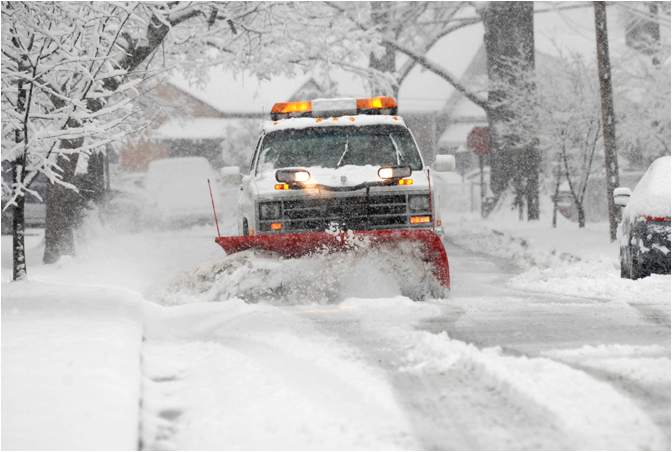
snowremovalThe outside lights were on all night so I could check on the progress of snow mounting on the barn roof. I could hear the town’s plows, chained tires rattling, working throughout the night. My eyeglasses were handy so that I could grab them and read the small print of scrolling school closings on the TV screen, but this morning I did not need them since my school district thoughtfully sent a robo-call.

I am not surprised that one of my favorite poets, Billy Collins, has a poem titled “Snow Day” where he expresses his appreciation of weather-induced holidays. In stanzas 4-6, he mimics the listings of school closings on the radio:

But for now I am a willing prisoner in this house,
a sympathizer with the anarchic cause of snow.
I will make a pot of tea
and listen to the plastic radio on the counter,
as glad as anyone to hear the news
that the Kiddie Corner School is closed,
the Ding-Dong School, closed.
the All Aboard Children’s School, closed,
the Hi-Ho Nursery School, closed,
along with—some will be delighted to hear—
the Toadstool School, the Little School,
Little Sparrows Nursery School,
Little Stars Pre-School, Peas-and-Carrots Day School
the Tom Thumb Child Center, all closed,
and—clap your hands—the Peanuts Play School.
                    …read more from “Snow Day”
Sailing Alone Around the Room: New and Selected Poems (New York: Random House, 2001).

I have written about Collins’s poetry (see links below) several times in this blog for Poetry Friday. His lyrics run parallel to my experiences of growing up, so there is a sense of nostalgia, a familiarity, when I read his poems. His poetry is accessible to all grade levels, but it is his wry humor in his observations on the universal human experience that makes me want to share him with students. So much of literature can be serious, or downright depressing, that I am grateful, even a little giddy, to have several books of Collins’s poetry on my shelf ready for an opportune moment.

“Look,” I will say, “here’s a funny poem about Emily Dickinson!” or “Hey, want me to read a comic take on the elements of a sonnet?

This snow day is one more excuse to share Collins’s poetry with others- whatever the climate. And for just a day, I can pity those in those waking up in sunny Southern California who are going to school. They may have the warm sun on their toes sticking out of their sandals, but they will never know the pleasure of warm toes stretching out under warm blankets just as there is the announcement of a school cancellation….to roll over…and to hit the snooze button.

Sleep in. It’s a snow day.

Continue Reading…

In the spirit of all end of the year reviews, I have condensed the year 2013 by offering month by month posts from this blog that illustrated the best student (and subsequently, teacher) learning:

January 2013: A Freshman’s Modern Odyssey in the Style of Homer

"Dawn spread her rosy fingers..."

“Dawn spread her rosy fingers…”

The Freshmen final project after reading The Odyssey is a narrative that students complete called “The Wamogossey: A Day in the Life of a Freshman at Wamogo High School.” Writing narratives are once again favored in  Common Core State Standards, and this post explained how students made their own attempt at an epic adventure.

February 2013:  Spilling Over the Corners of a Six Word Text

Short Story in 6 words

Short Story in 6 words

This exercise proves that keeping students “within the four corners of the text” is impossible, even when the text, attributed to Ernest Hemingway, is only six words long. This post also serves as evidence that that admonitions on best practices should be limited to those with actual classroom experience, not to the “architects of the Common Core.”

March 2013 If You Want to Watch the Cow Give Birth

Watching the arrival of our latest calf

Watching the arrival of our latest calf

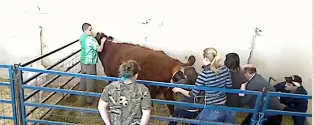
Yes, “If you want to watch the cow give birth, turn on U-stream now!” was an announcement over the PA system. Normally, I am irritated by interruptions to class time, but this announcement cued students about opportunity watch the birth of a calf in the Agricultural Science wing of our high school. The combination of technology in broadcasting and recording the birth of the newest member of the agricultural program with old-fashioned “hands on” physical labor illustrates 21st Century authentic learning.

April 2013 You Never Forget Your First Hamlet

Members of the senior class were fortunate enough to see Paul Giamatti’s “Hamlet” at Yale Repertory Theatre. I’ll let their words speak for the experience:

The performance was a wonderful experience, especially since it was my first time to see Shakespeare.

I wouldn’t mind going to another because it was so enjoyable that I didn’t even realize the 4 hours passing by.

I like the way that a play has a certain kind of vibe. It’s like a live concert, where there’s a certain kind of energy.

It was like seeing a live performance of a film. I would especially like to see another Shakespeare because it is the way that he intended his works to be portrayed.

After seeing Hamlet so well done, it would definitely be worth going to see another one whether it be Shakespeare or a different kind of performance.

May 2013 Kinesthetic Greek and Latin Roots

Spelling "exo"=outside

Spelling “exo”=outside

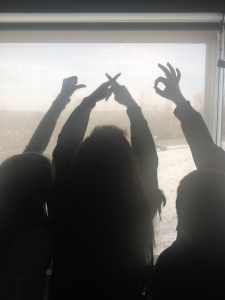
Understanding Greek and Latin roots is critical to decoding vocabulary, so when the freshman had a long list of roots to memorize, we tried a kinesthetic approach. The students used their fingers to spell out Greek roots: ant (against), tech (skill), exo (outside).  They twisted their bodies into letters and spread out against the wall spelling out xen (foreign), phob (fear). They also scored very well on the quizzes as a result!

June 2013 Superteachers!

Superteacher!

Superteacher!

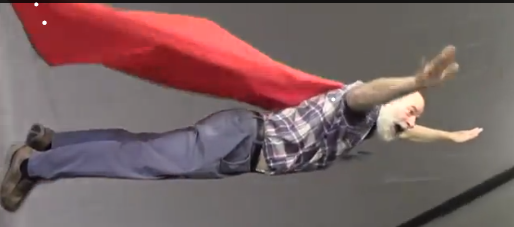
At the end of the 2012-2013 school year, teachers rose to a “friendship and respect” challenge to make a video. With a little help from a green screen, 27 members of the faculty representing a wide variety of disciplines jumped into the nearby closet wearing the big “W” (for Wamogo). Students in the video production class watched and filmed in amazement as, bearing some artifact from a particular subject area, each teacher donned a flowing red cape.

July 2013 Library Book Sales: Three Bags Full!

The original purpose of this blog was to show how I filled classroom libraries with gently used books. The Friends of the C.H. Booth Library Book Sale in Newtown, Connecticut, is one of the premier books sales in the state: well-organized tables filled with excellent quality used books, lots of attentive check-out staff, and great prices. This year, I added three large bags of books to our classroom libraries for $152.00, a discount of 90% off retail!

August 2013 Picture Books Are not for Kindergarten Any More!Cat in Hat book cover

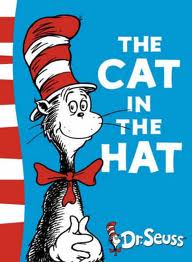
At used book sales, I am always looking for picture books I can use in high school classrooms. For example, I use The Cat in the Hat to explain Freud’s theory of the Id, Ego and Superego . Thing #1 and Thing #2 represent Id, and that righteous fish? The Superego. Yes, Dr. Seuss is great for psychological literary criticism, but he is not the only picture book in my repertoire of children’s literature used in high school. This post features a few of my favorite picture books to use and why.

September 2013 Close Reading with Saki and the Sophomores

Saki’s short stories open our World Literature course in which our students will be reading complex texts required by the English Language Arts Common Core State Standards (CCSS). After a “close reading” the conversations in the room showed the text’s complexity. Saki’s The Interlopers has all the elements suggested by the CCSS:  figurative language, the ironic wish, and multiple meaning in the revenge sought by man versus the revenge exacted by Nature. Our close reading should have been “textbook”. The evidence proved the characters’ demise…or did it? The ensuing discussion forced the class to consider other positions.

October 2013 Close Reading Art

The Fighting Temeraire

The Fighting Temeraire

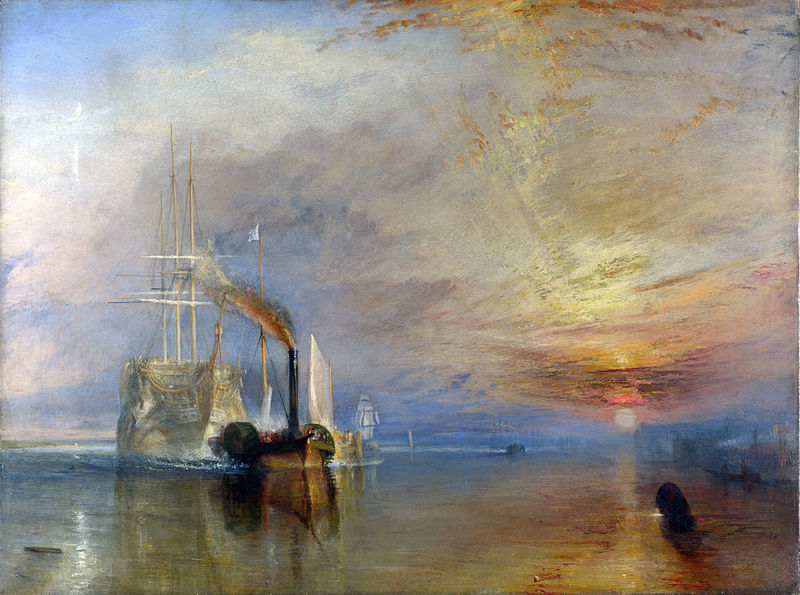
After “close reading” short stories, the sophomores were asked to use the same skills to “close read” several paintings that thematically connected to the Industrial Revolution. They studied a Constable pastoral painting, before J.M.W. Turner’s famous painting, The Fighting Temeraire. While some called attention to the the dirty smoke stack, others saw the energetic paddling as a sign of progress. They noticed the ghost-like ship hovering in the background, the light created by the sunset which gave the painting “warmth”or “light extinguishing”. When they were asked to use these elements as evidence to determine the artist’s message, there were some succinct responses to the painting’s “text.”

November 2013 Thanks for the NCTE Conference

Five members of the English Department attended the conference and selected from over 700 sessions at the National Council of Teachers of English and the Conference on English Leadership.  District support for such great professional development is truly appreciated. We are also grateful that four of our proposals were chosen to share as presentations for other educators. The explanations of our presentations with links to these presentations are included in this post.

December 2013 Drama Class Holiday Miracle

Cast photo!

Cast photo!

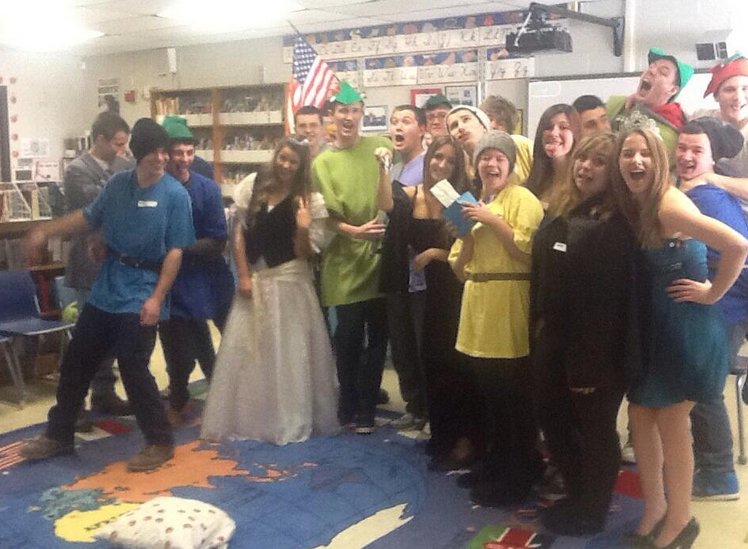
An ice storm two weeks before performance caused a car pile-up, and the drama club teacher was left with a concussion. She could not be in school; the students were on their own, and I was left to supervise their performances of Snow White and the Seven Dwarves at three local elementary schools.

Their “dress rehearsal” was a disaster, but, as the adage says, “The show must go on!” and once they arrived at the elementary schools, the students were anxious to do well. They naturally changed their staging moving from gym floor to library floor, the Evil Queen tossed her hair with anger, and the Prince strode onto the stage with more confidence. The dwarves were a source of comic relief, intentionally or not. I watched the holiday miracle of 2013 repeated three times that day. The students in drama class at each school were applauded, with congratulatory e-mails from the principals that offered praise.

End of the year note:

I am grateful to be an educator and to have the privilege to work with students that I learn from everyday. In this retrospective, I can state unequivocally that 2013 was a memorable year… as you can see from many of the reasons listed above.

Welcome to 2014! May this coming year be even more productive!

Christmas storyThe holidays are here and network television takes full advantage of our want to replay our favorites, to stir memories, or to remind us of our childhood. Perhaps no film is more nostalgic than the 1983 film A Christmas Story based on a novel by Jean Shepard, In God We Trust, All Others Pay Cash. Director Bob Clark and writer Leigh Brown also collaborated on the screenplay for this time piece of the 1940s that highlights one family’s battles with Oldsmobiles, coal-burning furnaces, and spotty electrical wiring. The film is also a timeless story of a young boy’s obsession for toy, a Red Ryder B.B. gun, for Christmas from Santa Claus, the guarantor of all secret wishes.

The casting of actor Darren McGavin (The Old Man), actress Melinda Dillon (Mother), and the young Peter Billingsley, as the bespectacled Ralphie, was perfect, but it is the voice of Shepard himself narrating the story that makes the movie so memorable. The viewer sees the events through Shepard’s eyes and hears his emotional range as he reflects on this one momentous Christmas season. In recalling his youth, he is at turns indignant (“Ovaltine? A crummy commercial?”)  terrified (“Scut Farkus staring out at us with his yellow eyes. He had yellow eyes! So, help me, God! Yellow eyes!”), and determined (“No! No! I want an Official Red Ryder Carbine-Action Two-Hundred-Shot Range Model Air Rifle!”)

The visual laughs abound in the story: Flick’s tongue stuck frozen to the flagpole, Miss Shields’ morphing into a witch, and the camera closing in on Santa’s boot as he shoves Ralphie down the slide into a soft pile of cloth snowballs. But it is the language, Shephard’s script, that gives the film its enduring appeal. Long after December, I have heard people quote lines from the film such as:

  • Fra-gee-lay. That must be Italian.
  • It… It ’twas… soap poisoning!
  • Only I didn’t say “Fudge.” I said THE word, the big one, the queen-mother of dirty words, the “F-dash-dash-dash” word!
  • But those who did it know their blame, and I’m sure that the guilt you feel is far worse than any punishment you might receive.
  • You’ll shoot your eye out, kid.

Not only are the lines marvelous in construction, but the vocabulary in Shepard’s recounting is of the highest caliber, with many words worthy of an SAT rating, for example:

“We plunged into the cornucopia quivering with desire and the ecstasy of unbridled avarice.”

“Over the years I got to be quite a connoisseur of soap. My personal preference was for Lux, but I found Palmolive had a nice, piquant after-dinner flavor – heady, but with just a touch of mellow smoothness.”

“Sometimes, at the height of our revelries, when our joy is at its zenith, when all is most right with the world, the most unthinkable disasters descend upon us.”

“Mothers know nothing about creeping marauders burrowing through the snow toward the kitchen where only you and you alone stand between your tiny, huddled family and insensate evil.”

When a word is not suitable, Shephard turns Shakespeare-like and creates his own:

“Gradually, I drifted off to sleep, pranging ducks on the wing and getting off spectacular hip shots.”

Shephard also preserves the language of a different, perhaps more polite, time when a more conscious effort was made to create substitutes for profanity. The actor McGavin peppers the “Old Man’s” frustration with all things mechanical: nincompoop, dadgummit, keister, and for cripes sake, as well as more colorful expletive sound-a-likes: You wart mundane noodle! You shotten shifter paskabah! You snort tonguer! Lame monger snaffa shell cocker!

The script is also filled with a myriad of examples of figurative language guaranteed to please any English teacher. Here is an opportunity to teach students the power of similes:

“My kid brother looked like a tick about to pop!”
“Randy lay there like a slug! It was his only defense!”
“He looks like a deranged Easter Bunny.”

Shephard’s metaphors are also exceptional. These are constructions of “dictional elegance”, the rare combination of the sacred and profane:

“In the heat of battle my father wove a tapestry of obscenities that as far as we know is still hanging in space over Lake Michigan.”

“Lovely, glorious, beautiful Christmas, upon which the entire kid year revolved.”

“First-nighters, packed earmuff-to-earmuff, jostled in wonderment before a golden, tinkling display of mechanized, electronic joy!”

“Next to me in the blackness lay my oiled blue steel beauty.”

122208lampleg

My personal favorite metaphor of all time centers on the infamous lamp, a prize won by Ralphie’s father who in one hilarious sequence, digs wild-eyed through packing material in a large wood carton. He uncovers a tribute to all things burlesque:  a glass leg adorned with a fishnet stocking and a fringe shade covering the upper thigh. As Ralphie stands, slack-jawed in admiration staring at the lamp, his alarmed mother shoves him back into the kitchen. Ruefully Shephard intones:

Only one thing in the world could’ve dragged me away from the soft glow of electric sex gleaming in the window.

So, during the next 24 hour marathon showing of A Christmas Story, when you tune in for the memories, to watch the exceptional acting and the period piece visuals, pay attention to the language that makes the film so unforgettable. You may even develop an appreciation for Ralphie’s theme essay on “A Red Ryder BB gun with a compass in the stock, and this thing which tells time.

Poetry. Sheer poetry, Ralph! An A+!

Expecting allusions to Herman Melville’s Moby Dick during the National Teachers of English Conference (NCTE) is like (pardon the pun) shooting fish in a barrel. Okay, I know…the whale is a mammal, but once this white whale has been sighted, he keeps surfacing!

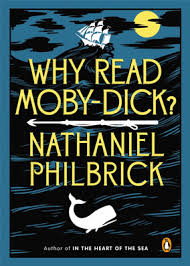
First Sighting: Nathaniel Philbrick’s 2011 slim book Why Read Moby-Dick?

Moby DickThe exhibitors at the NCTE conference were interested in putting books into the hands of teachers who would then put books into the hands of student readers. Once such vendor enthusiastically suggested the book based on its size; “See. you could carry this  book around the convention and hardly know it’s in your bag!”

He was right.  Philbrick’s 127 page argument as to why “this classic tale waits to be discovered anew” fit nicely in my convention bag and was perfect for reading during breaks between sessions.

The book is divided into 28 short chapters each devoted to topics such as setting, characters, or themes. Chapter titles include:

  • Nantucket
  • The View from the Masthead
  • A Mighty Messy Book
  • Queequeg
  • Pulling Dictatorship Out of a Hat

Philbrick is already familiar with the real life incident that was the inspiration for Herman Melville’s literary classic. His non-fiction book In the Heart of the Sea: The Tragedy of the Whaleship Essex in 2000 recounts the loss of the whaling ship Essex in the Pacific Ocean in 1820.  Heart of the Sea won the National Book Award for non-fiction that year, fleshing out the details of the whale attack on the boat, the fateful decision to avoid islands allegedly populated by cannibals, and the ironic turn to cannibalism that claimed the lives of several surviving crew members.

In Why Read Moby Dick?, Philbrick turns to the literary contributions Melville gave American literature, particularly in the creation of Captain Ahab, who in a pre-appearance had been rumored by other sea captains to have “been in colleges as well as ‘mong the cannibals.” In one chapter, “The Anatomy of a Demagogue”, Philbrick analyzes Ahab’s rhetorical craftiness in convincing the crew to hunt and kill the white whale. In discussing first mate Starbuck’s stunned realization that the Pequod is not out on a commercial venture, but rather a mission to settle the score of Ahab’s lost limb, Philbrick engages in a cross-culture reference that is both humorous and insightful:

Starbuck responds by asking what Ahab’s vengence will get ‘in our Nantucket market?’ It’s then, to borrow from the film This is Spinal Tap, that Ahab dials his charisma to eleven. ‘But come closer, Starbuck,’ he says, ‘thou requirest a little lower layer?’ It’s not about the money, he explains; this is personal. Thumping his chest he cries out. ‘My vengeance will fetch a great premium here!’ “(40)

Philbrick also aligns the story as a metaphor for the political turmoil of the United States. In discussing the chapter where Stubbs, the second mate, raises a shiver of sharks by cutting into a whale for a steak, Philbrick writes,

“The job of government, of civilization, is to keep the shark at bay….Here lies the source of the Founding Fathers’ ultimately unforgivable ommission. They refused to contain the great, ravaging shark of slavery, and more than two generations later, their grandchildren and great-grandchildren were about to suffer the consequences.” (78)

Philbrick moves between cultures, between ideologies, between philosophies, and theories in order to encourage more people to actually read Melville’s great American novel. A encouragement that may be necessary, because soon after I received the book, I had whale sighting #2.

Whale sighting #2:  A statement during a key note address at the Conference for English Leadership (CEL):

“We all know the opening line of Moby Dick, but how many of us have actually read the book?” posed speaker Donalyn Miller to the crowd of English teachers. There was a murmur of agreement, and more than a few guilty looks. Miller was discussing her passion and the topic of her two books: how to get students to read for school and independently.

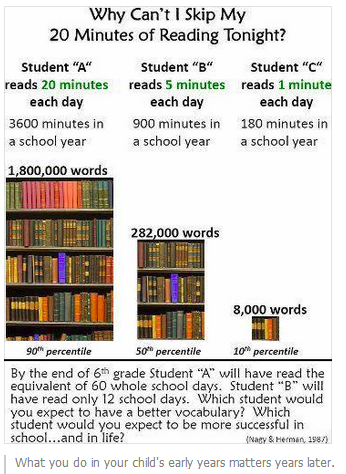
20-minMost notably, Miller is known as the author of The Book Whisperer and the recently released Reading in the Wild. Her keynote address was to encourage students to become the independent readers that could-on their own- pick up a tome like Moby Dick. She discussed the characteristics of “wild readers” and pushed teachers to engage students in examining their reading lives. She advocated for literacy rich environments for students to develop the habits to make them life-long readers. Miller’s assertion that preparing students to read independently is the best guarantor of standardized test success was supported with the graphic she presented. (see left: Nagy & Herman study).

Her point about Moby Dick was that most people know the first line, “Call me Ishmael,” but only those who live literate lives know why the book is so critical to understanding American literature. Students who have not developed the reading endurance necessary for the book may be turned off by both the intimidating size and the 19th Century styled language of the text. Considering that most high schools shy away from teaching Moby Dick to anyone but their best students means that the novel will most likely be an independent choice book for a student who develops into a life-long reader. Miller wants them to be prepared so they can will have the pleasure of sitting back in a comfy chair, perhaps with a cup of coffee, to read.

Whale sighting #3: Coffee at Starbucks.
starbucks

Named for the First Mate of the “Pequod”

Speaking of coffee, I am not sure why I never realized this before, but this coffee company is named for the first mate of the Pequod, Starbuck. I Googled this fact while waiting in the long line of English teachers eager to fuel up before attending the day of sessions at NCTE. According to the company’s website, “The name, inspired by Moby Dick, evoked the romance of the high seas and the seafaring tradition of the early coffee traders.” How did I not put this together?

Whale sightings, continued…….

Once I returned home from NCTE and CEL, the white whale sightings did not stop. A blog post on To Make a Prairie by Edblog award nominee Vicky Vinton summarized a session she had attended at NCTE called “Reading the Visual and Visualizing the Reading” chaired by Tom Newkirk and presented by Louise Wrobleski, Tomasen Carey, and Terry Mohera. Vinton explains the ideas based their mentor text, Moby-Dick in Pictures by the self-taught artist Matt Kish were “too inspiring not to spread around.” Their presentation highlighted the amazing results in student work when students chose one quote from each chapter of the The Scarlet Letter and create an image for it. Vinton notes that, “Mohera was surprised by the depth of the students’ thinking and how, once she’d gotten them started, they took full ownership of the book, the assignments and the whole process.”  The richness of their illustrations shows how literature can inspire new creations, just as Kish’s illustrations were inspired by Melville.

As if on cue, as in the final pages of Melville’s drama, the white whale surfaced dramatically again this morning when I came across another artist who is under Melville’s spell. While perusing the December 16th issue of The New Yorker, there was Mick Stevens’s cartoon of the whale himself (p56), a cross expression behind his spectacles, with his front fins holding a copy of Moby Dick. The caption underneath read, “Oh, C’mon, I wasn’t that terrible!”

Coincidence? I think not. Melville’s white whale is everywhere, but to appreciate him? You have to read the book.

“A bad dress rehearsal foretells a great performance.”

red curtain

This theatrical superstition is a great comfort to those who botch lines, drop lines, break props, or miss entrance cues before performing in front of an audience. Rehearsals are for practice, to fix what could go wrong so that the performance before a critical audience is perfect.

In contrast, there are no “rehearsals” in the classroom, yet the language of teacher evaluation standards repeatedly uses the word “perform” and “performance”.  There are teacher performance standards, and there are student performance measurements.

Perhaps the most authentic way to describe what happens in any classroom is that each lesson is a dress rehearsal. A teacher can plan the elements of a lesson, ( objective, resources/materials, directions, and assessment), and those scripted elements can look good on paper. A teacher can design a lesson for for a particular audience,  but what can happen in the classroom is a guess. Sometimes, a lesson plan fails; a teacher has a bad dress rehearsalEven if that lesson plan is repeated over the course of a day, there was a first audience of students that was engaged in that dress rehearsal of a lesson.

What teachers do is practice teaching, and practice is another word repeated in teacher evaluation. There are, however,  two meanings of the word practice, each depending on its syntactical use. When the word practice is used as a noun, as in the “practice of teaching”, then the word means:

  • the actual application or use of an idea, belief, or method as opposed to theories about such application or use.

When the word practice is used as a verb, it means:

  • to do something again and again in order to become better at it
  • to do (something) regularly or constantly as an ordinary part of your life

The language of teacher evaluation focuses on the word practice as a noun. There is limited use of the word practice as a verb except as an expectation. A teacher is expected to have practiced, or rehearsed, teaching strategies with a group of students. For this reason, teachers try to schedule a “no-fail” lesson plan for a formal observation, perhaps a lesson that has been practiced successfully in previous classes. This small advantage means that an evaluator will see a lesson with all the bells and whistles, a kind of performance.

But what about the “drop-in” evaluation? What kind of teaching practice will an evaluator see in the raw rehearsal environment of the classroom? What happens when a lesson goes horribly wrong, and an evaluator is in the room?

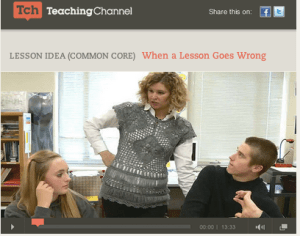
At a session offered by the Council of English Leadership at the National Council of Teachers of English Conference held last month in Boston, Massachusetts, nationally recognized teacher of the year Sarah Brown Wessling openly admitted to lesson failure. Wessling, a English/Language Arts teacher in Johnston, Iowa, was being filmed by The Teaching Channel when the lesson she designed went wrong, a true bad dress rehearsal taking place in real time in front of the cameras.

“I knew they (Teaching Channel) would want this footage,” she admitted laughing to crowded room of teachers, “Oh, I knew they would want this failure!”

The videos that resulted from her failure are some of the most popular on The Teaching Channel website. There are uncut versions plus the final production video (16 mins) that records how she quickly reconfigures the lesson for a different class. The transcript from the video is included on the website. 

Wessling’s voice-over begins:

For a teacher, some days you win, some days you lose.  My third hour tenth-grade English class came completely unhinged, and I had five minutes in which to repurpose it for fourth hour.

She readily admits that even the most veteran teachers experience problems:

No matter how accomplished you are or how effective you are as a teacher, I think these days are going to happen, so when they do, you have to make adjustments.

In her narration, she noted that, “By the time we get to this point, I’ve been in front of the class almost the whole class period, and that was not my intention.”

The video shows her trying to re-engage students in her planned activity. She considers:

Then there was this moment where I realized that I had completely misfired because one of my students did start to read when I asked them to, and she read the first paragraph, and she raised her hand and she said, “I don’t know what any of these words mean.”

Wessling’s final analysis of the lesson’s failure is her admission that:

I opted to try to meet the standards, make sure that the common assessment that I share with the rest of my department meets the criteria of what we had talked about earlier in this year.  In thinking about the adults, I compromised the needs of the kids.

The power of this video is that while this nationally recognized teacher’s bad dress rehearsal informed her practice, it is her training in classrooms that allowed her to redesign the lesson on the fly. Wessling’s second attempt, five minutes after the first class left, is much smoother, as she admits:

We have to be careful with our expectations and realize that we can still teach to these heightened expectations, but it’s going to have to come at a pace that makes sense to the kids who are in front of us.

So how would an evaluator who dropped in on Wessling’s first attempt rate her as a teacher? Would there be a consideration of this first lesson as a “dress rehearsal”?More important, what is the possibility that an evaluator could have stayed to watch the redesign of the lesson to see how her repeated and authentic training in the classroom, her practice, helped her with her teaching practice, her application of teaching methods? Wessling’s first attempt would not meet the criteria in the higher ratings (proficient, exemplary) of many teacher evaluation programs, but her training allowed her to address the needs of the students in subsequent efforts.

The video captures Wessling and her students a rehearsal of learning, which is what happens in every classroom everyday, to nationally ranked teachers, to veterans, and  to novices. Teachers and their students are always rehearsing. Evaluators must consider that the language of teacher evaluation should not be misconstrued. 

There is no performance in the classroom, and even a bad dress rehearsal can still be a great lesson.

Screen Shot 2013-11-29 at 12.50.41 PMThe National Council of Teachers of English (NCTE) and the Council on English Leadership (CEL) met for a convention last week (11/21-26/13) at the Hynes Convention Center in Boston, Massachusetts. Thousands of English teachers and educators (happily) put aside their piles of essays and their red pens in order to attend to participate in a nationwide conversation on teaching English/Language Arts at all grade levels. This annual conference runs the weekend before the Thanksgiving holiday, and this year there were many reasons to be thankful that such a great opportunity exists. Here are our specific thanks to all of those who made this conference amazing.

Thanks to our Regional School District #6 in Connecticut for allowing us to attend:

Our first and most important thanks is to the administration, Board of Education, and staff from Regional School District #6 that allowed five members of the English Department at Wamogo Middle/High School to attend the conference and select from over 700 sessions offered from Thursday night-Sunday afternoon.  District support for such great professional development is truly appreciated!

Thanks to the program chairs who selected our proposals:

Members of Wamogo Middle/High School English/Language Arts department submitted a variety of proposals last year to demonstrate how we use technology in our classrooms. We are grateful that four of our proposals were chosen to share as presentations for other educators. The explanations of our presentations with links to these presentations are included below:

The Blog’s the Thing! (NCTE) roundtable discussion

This presentation demonstrated the use of the blog platform for students to engage in thoughtful discussion on characters and themes from Hamlet by having students “stop the action” of the play to offer advice to characters during different scenes.

Reinventing the Writing Workshop with Digital Literacy to Improve Student Engagement (NCTE)

Technology has reinvented the Writing Workshop in meeting the needs of 21st Century learners with the addition of digital literacies. This presentation features open source software platforms appropriate to the different tasks, purposes and audiences for writing instruction along with examples of student work and grading criteria.

How We Mooo-ved Our District from Cows to Computer (CEL)

This presentation illustrated how professional development in our district was organized on the ED Camp model to allow any teacher who would like to share their expertise or simply discuss a problem with fellow staff or faculty members.These technology initiatives have allowed members of the English Department to help teachers assess, organize, deliver context materials and related readings (fiction and non-fiction) that improve students’ digital literacy as well as foster independence in each student’s growth in reading.

Digital Writing with Collaboration (CEL)

This presentation showed how preparing students to write for the real world  (21st Century skills) must include the collaborative experience, from the initial creation to the final product. The use of digital platforms allows students to be college and career ready through the production and distribution of collaborative writing.

Thanks to the many teachers and educators who presented:

We are also thankful that so many other classroom teachers and educators from all over the USA shared their best classrooms practices. Our collective regret is that we could not attend every session that appealed to us; the jam-packed schedule defied our best attempts at strategic selection. We agreed, however, that quality of the presentations we did get to attend was amazing and relevant to what we do every day. The conference reinforced the importance of teacher-to-teacher professional development.

Thanks to the book publishers who made books available for classroom libraries:

The NCTE Convention offers book publishers opportunity to put advanced reader copies of fiction and non-fiction into the hands of teachers at every grade level. While publishers hope to catch the attention of teachers who will recommend the book to students, teachers look for books to add to their classroom library collection. Many publishers also make books available at a reduced cost  for the same reason. For example, I picked up several copies of books in the “After the Dust Settled” series (apocalyptic young adult literature) by Jonathan Mary-Todd for $2/copy, a purchase made necessary because these books keep disappearing off our classroom library shelves.

Screen Shot 2013-11-29 at 12.51.29 PM

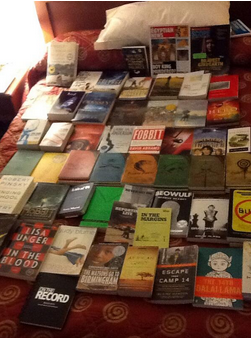
Our “haul” from the NCTE Convention from book publishers and authors…headed for our classroom libraries.


Thanks to the authors who gave away signed copies of their books:

The tote bags distributed free to all registrants bore popular author Nicholas Spark’s imprimatur, a visual testament to the celebrity draw of authors at this convention. Authors are the rock stars at this convention: the children’s book authors rock, the young adult authors rock, and the educator trade book authors rock. Attendees stood in lines snaking around booths on the convention floor waiting to meet authors and have books signed. In the past, my request to an author is to have the book signed with the phrase “READ ME!” on the inside cover. I had the same done this year, so when a student asks what to read, I will point that the author has already made a suggestion to read the book.

There were also a number of authors representing a variety of genres who served as keynote speakers including: Neal ShustermanTeri Lesesne, Laurie Halse AndersonKelly Gallagher, Walter Dean MyersIshmael Beah, and Robert Pinsky. 

We are so thankful to have the opportunity to personally meet and mingle with the rock stars of the convention!

Thanks for the Tweeters:

Finally, the fingers of dedicated Tweeters attending the convention kept us abreast of all the events at the conference. There was a steady stream of information from sessions we could not attend, summaries of keynotes addresses, and updates as to upcoming book signings. The hashtags #NCTE13 and #CEL13 were invaluable sources for notes and quotes during the convention and for well after we left Boston.  For example, some Friday session tweets were archived onto the Storify platform for later use.

Next year, the NCTE Convention is scheduled for Washington, D.C., which gives me one more reason to be thankful…the convention is within driving distance!