Archives For November 30, 1999

 Anne Frank: The Diary of  Young Girl transcends the labels of genre. anne Frank book
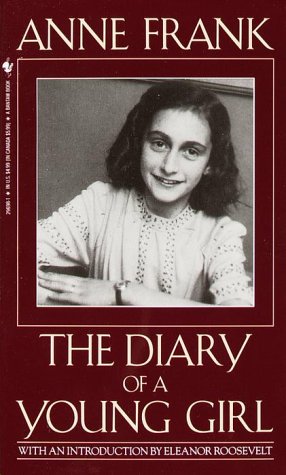
Yes, as the title suggests, it is a diary, but it is also a memoir, a narrative, an argument, an expository journal, an informational text, and much more.

Yet, these genres listed are treated as separate and distinct in the reading and writing standards of the Common Core (CCSS). The standards emphasize the differences between the literary and informational genres. The standards also prescribe what percentages much students should read (by grade 12 30% literary texts/ 70% informational texts), what genres of writing they should practice (narrative, informative/explanatory, argumentative) and the percentages students should expect to communicate  in these genres by grade level.
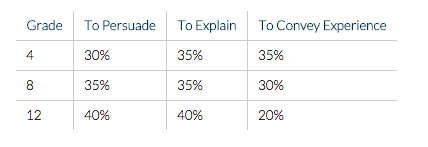
Distribution of Communicative Purposes by Grade supported by the Common Core

Distribution of Communicative Purposes by Grade supported by the Common Core

In the real world, however, the differences between genres is not as clear and distinct as neatly outlined in the standards. The real world of Nazi occupied Holland was the setting that produced the defiant Diary of Anne Frank.

On June 12, 1942,  Anne Frank received a red and white check autograph book as a birthday gift. This small volume was soon filled by Anne as a diary, the first of three separate volumes, as she her family and friends hid in the secret annex.

A diary is a daily record, usually private, especially of the writer’s own experiences, observations, feelings, attitudes.

Anne’s narrative in these diaries provides a sequence of events and experiences during the two years she spent hiding with others behind the bookcase in the attic where her father had been employed.

A narrative is a story or account of events, experiences, or the like, whether true or fictitious.

In June of 1947 Anne’s father Otto Frank published The Diary of Anne Frank, and it has become one of the world’s best-known memoirs of the Holocaust.

A memoir is a written account in which an individual describes  his or her experiences.

In one entry Anne explains she is aware of what was being done with Jews throughout Europe and those who resisted the Nazis. She refers to radio reports from England, official statements, and announcements in the local papers. There are expository style entries throughout the diary that help the reader understand how much she and others knew about the Holocaust:

“Our many Jewish friends and acquaintances are being taken away in droves. The Gestapo is treating them very roughly and transporting them in cattle cars to Westerbork, the big camp in Drenthe to which they’re sending all the Jews….If it’s that bad in Holland, what must it be like in those faraway and uncivilized places where the Germans are sending them? We assume that most of them are being murdered. The English radio says they’re being gassed.” October 9, 1942

“All college students are being asked to sign an official statement to the effect that they ‘sympathize with the Germans and approve of the New Order.” Eighty percent have decided to obey the dictates of their conscience, but the penalty will be severe. Any student refusing to sign will be sent to a German labor camp.”- May 18, 1943

Expository writing’s purpose is to explain, inform, or even describe.

Finally, there are excerpts taken from the diary where Anne makes a persuasive argument for the goodness of people, even in the most awful of circumstances:

“Human greatness does not lie in wealth or power, but in character and goodness. People are just people, and all people have faults and shortcomings, but all of us are born with a basic goodness.  If we were to start by adding to that goodness instead of stifling it, by giving poor people the feeling that they too are human beings, we wouldn’t necessarily have to give money or material things, since not everyone has them to give.” March 26, 1944

A persuasive argument is a writer’s attempt to convince readers of the validity of a particular opinion on a controversial issue.

Anne’s opinion about the goodness of people during the horrors of the Holocaust is a remarkable argument.

The Diary of Anne Frank gave rise to other genres. Anne’s diaries served as the source material for a play produced in 1955 and then as a film in 1959.

The genre of The Diary of Anne Frank, however, should not be the focus, or the reason for its selection into a curriculum or unit of study. Instead, it is the quality of the writing from a young girl that makes the diary a significant contribution to the literature of the 20th Century.Screenshot 2015-06-11 18.50.33
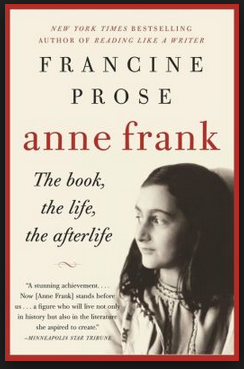
Novelist and former president of the PEN American Center, Francine Prose revisited the diary and was “struck by how beautiful and brilliant it is.” Prose’s research on Anne Frank as a writer culminated with her own retelling, Anne Frank: The Book, the Life, the Afterlife, in which she makes a strong case for the literary quality of Anne’s writing:

“And the more I thought about it, the more I realized how rarely people have really recognized what a conscious, incredible work of literature it is.”

In an interview on the PBS website, Prose was asked, “Do you think there is something about Anne Frank’s voice that continues to resonate with young people today?” Her response,

“I do. Because the diary was written by a kid, it is almost uniquely suited to be read by a kid. Salinger and Mark Twain certainly got certain things right about being a kid; but they weren’t kids when they wrote their books. The diary works on so many different levels.”

When selections from The Diary of Anne Frank were first published in the “Het Parool” on April 3, 1946, the historian Jan Romein also recognized how Anne’s young literary voice rose above the inhumanity that caused in her death at 15 years in the Bergen-Belsen concentration camp. In his review, he writes:

“… this apparently inconsequential diary by a child… stammered out in a child’s voice, embodies all the hideousness of fascism, more so than all the evidence at Nuremberg put together.”

Romein’s review elevates the “apparently inconsequential diary” as testimony in making a legal case against the Nazi regime. It is that power in Anne’s voice that makes her diary a powerful text to offer students, whether it fits the percentages in a CCSS aligned unit of study for an informational text or not.

Her entry on July 15, 1944, written 20 days before she and her family are betrayed to the Nazis reveals yet another genre:

 “I see the world being slowly transformed into a wilderness, I hear the approaching thunder that, one day, will destroy us too, I feel the suffering of millions. And yet, when I look up at the sky, I somehow feel that everything will change for the better, that this cruelty too shall end, that peace and tranquility will return once more.”

For there is poetry in that entry as well.

That letter “O” morphing on your search engine for Mother’s Day?
That spinning Globe for Earth Day?
Those jigging leprechauns for St. Patrick’s Day?
These are all the Google Doodles from 2015 to celebrate holidays.

There are also Google doodle tributes to individuals. Emmy Noether (physicist), Laura Ingalls Wilder (author), and Anna Atkins (botonist), have been featured in doodles this year (2015) as individuals whose work was celebrated as having made an impact in our lives today. Each of the doodles represents the individual artistically using elements that best represent their work.

Some of the Google doodles are interactive. The Google doodle for Martha Graham is a 15 second celebration of dance. The Google doodle for Robert Moog provides a miniature electronic analog Moog Synthesizer (keyboard) that the viewer can play. The tribute to journalist Nellie Bly features a Youtube video scored with an original song (Music: “Nellie” by Karen O).

There are also international tributes not seen here in the United States with Google doodles for surrealist artist Leonora Carrington (Latin America/Australia); the oldest primary grade student at 84 years old, Kimani Maruge (Kenya); and womens’ rights activist, Henrietta Edwards (Canada).

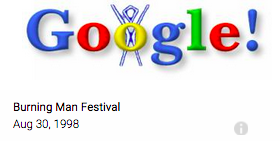
The first Google Doodle celebrating a vacation at the Burning Man Festival

The first Google doodle celebrated a vacation by Google founders Larry and Sergey at the Burning Man Festival

The first Google Doodle (right) was a comical message that the Google founders Larry Page and Sergey Brin were out of the office attending the Burning Man Festival. The Google Doodle Archive houses the entire collection (1998-present). A scroll through the graphics shows how Google’s primary colored logo is changed in a way that is often surprising or magical. Clicking on the Google doodle takes the reader to a page with information about the event or person, and information about the graphic design and artist for the page.

There are hundreds of doodles, and information on the archive states:

Creating doodles is now the responsibility of a team of talented illlustrators (we call them doodlers) and engineers. For them, creating doodles has become a group effort to enliven the Google homepage and bring smiles to the faces of Google users around the world.

Now, consider that a key shift of the Common Core State Standards (CCSS) is to build knowledge through content-rich nonfiction. The explanation on the CCSS website is:

Students must be immersed in information about the world around them if they are to develop the strong general knowledge and vocabulary they need to become successful readers and be prepared for college, career, and life. Informational texts play an important part in building students’ content knowledge. Further, it is vital for students to have extensive opportunities to build knowledge through texts so they can learn independently.

Students at all grade levels can independently develop an interpretation of the Google doodle graphic. After studying the logo created by Google illustrators (doodlers), teachers can determine if the link that takes students information on the holiday, the anniversary, or the biography is appropriate for age or grade level reading. Each link contains general information that aligns to the CCSS shift to “build knowledge through content-rich nonfiction.” There is information on these links that might lead students to investigate the person or topic on the doodle even further.

Should a student have an idea for a Google doodle, “The doodle team is always excited to hear ideas from users – they can email proposals@google.com with ideas for the next Google doodle.” There are hundreds of suggestions daily, but the information of the website assures students that, “…rest assured that we’re reading them :)”

Another opportunity for students to submit ideas for a Google doodle (Doodle 4 Google) will be available in September 2015. The details for the 8th annual US competition will be announced then, and examples of student entry winners in 2014 are available for viewing on the website as well.

A quick click on the Google doodle can be an engaging mini-lesson for students in building background knowledge….especially when the information is offered in a logo that is dancing, leaping, morphing, twisting, falling, jumping, running, exploding, singing, growing….

During a pop-in visit with the 8th grade social studies teachers last week, the discussion turned to the growing number of interruptions to the school calendar because of the snow cancellations and delays we are experiencing here in Connecticut this winter. The teachers were grumbling, frustrated that they were not able to cover the content in the curriculum units.

“There are some advantages to ice and snow this winter,” I suggested.
They looked at me skeptically.
“Our students are feeling the same conditions that the Continental Army felt that winter at Valley Forge,” they paused.
I continued, “I can’t imagine how teachers in San Diego get students to understand what it was like to be a soldier in that winter in 1778.”

Of course, imagine is the key word here. Students taking classes in sunny 75 degree weather would have to imagine the conditions penned by George Washington to then New York Governor George Clinton from his headquarters in a chilly farmhouse at Valley Forge. Our first Commander-in-Chief’s desperation to keep his troops fed and clothed in frigid conditions is clearly evident in this letter, written while the well-stocked British troops camped comfortably nearby in Philadelphia. During that encampment at Valley Forge beginning on December 19, 1777, nearly 2,500 American soldiers, a quarter of the Continental Army, succumbed to disease and exposure by the end of February 1778. A modified version of Washington’s letter for students (Created through the TAH Making History Grant)  appears below:

To Governor George Clinton

Head Quarters, Valley Forge, February 16, 1778

Dear Sir:

It is with great reluctance, I trouble you … For some days…, there has been…a famine in camp. A part of the army has been a week, without any kind of flesh, and the rest for three or four days. Naked and starving as they are, we cannot enough admire the incomparable patience and fidelity of the soldiery, that they have not been [led]…by their sufferings, to a general mutiny…

…I am, on my part, putting every engine to work, that I can possibly think of, to prevent…fatal consequences…. I am calling upon all those, whose stations and influence enable them to contribute their aid upon so important an occasion; … I expect every thing within the compass of your power, and that the abilities and resources of the state over which you preside, will admit….

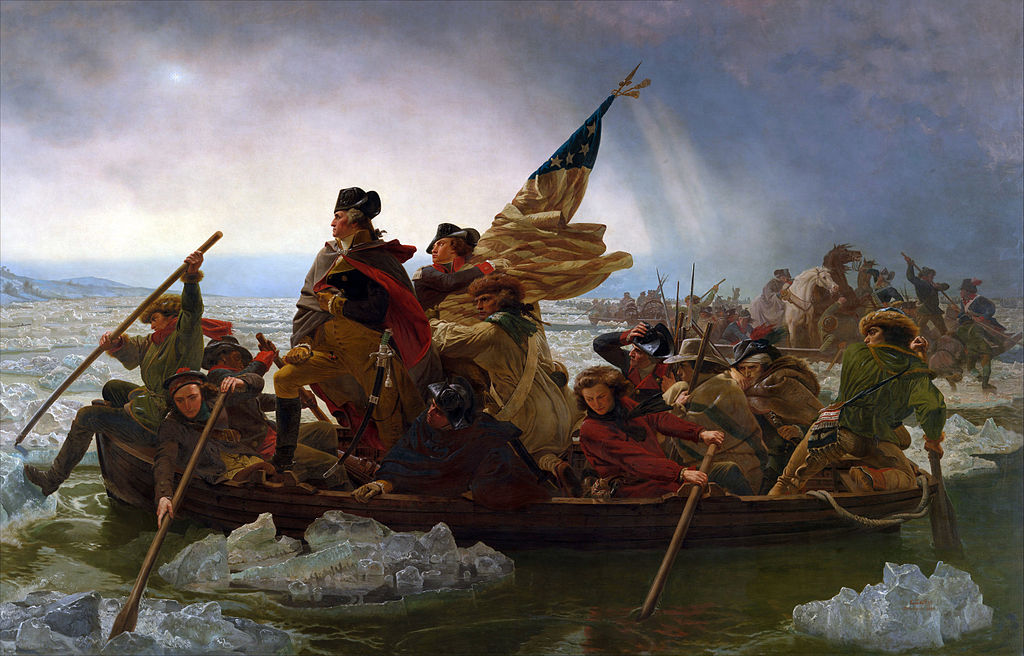
Valley Forge was not Washington’s first test of endurance in harsh winter conditions. Two years previous to this encampment, Washington had successfully crossed the Delaware River in a surprise attack against the Hessian forces in Trenton, New Jersey. Taking advantage of the Hessian’s late night holiday celebration, Washington crossed the icy waters on December 25, and attacked on the following morning.

Washington’s trip across the icy waters was immortalized in the painting Washington Crossing the Delaware by Emanuel Leutze, (Metropolitan Museum of Art-NYC, 1851).

Washington_Crossing_the_Delaware_by_Emanuel_Leutze,_MMA-NYC,_1851

Washington Crossing the Delaware is also the name and subject of a sonnet by David Shulman (1936).  This sonnet is entirely composed of anagrams, or verses of word play, where the letters of a word or phrase are used (once) to produce a new words or in Shulman’s case, verses:

A hard, howling, tossing water scene.
Strong tide was washing hero clean.
“How cold!” Weather stings as in anger.
O Silent night shows war ace danger!

The cold waters swashing on in rage.
Redcoats warn slow his hint engage.
When star general’s action wish’d “Go!”
He saw his ragged continentals row.

Ah, he stands – sailor crew went going.
And so this general watches rowing.
He hastens – winter again grows cold.
A wet crew gain Hessian stronghold.

George can’t lose war with’s hands in;
He’s astern – so go alight, crew, and win!

The nation’s tribute to George Washington, combined his birthday (2/22) with Lincoln’s birthday (2/12) to make President’s Day, a National Holiday celebrated from the frigid shores of the Delaware River, across those same fields of Valley Forge, and all the way to the warm sunny beaches of the San Diego coastline.

The combination of Washington’s letter to George Clinton, the famous painting by Emanuel Leutze, and the sonnet by David Shulman can help students everywhere in the United States to imagine the severe weather conditions of these most famous exploits of Washington, but the students here in the Mid-Atlantic and in New England have the historical advantage to experience that same weather first-hand every year.

Here in Connecticut, in the winter of 2015, our students’ empathy lies with George.

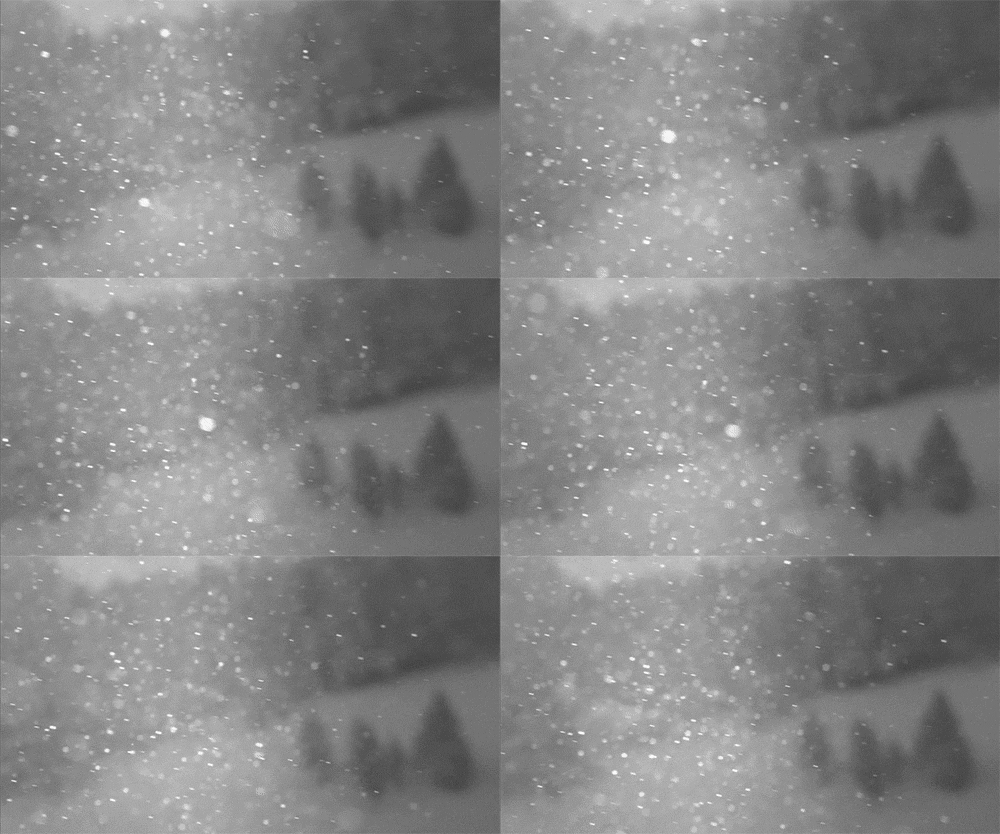
snow giff 2The blizzard raging outside recalls the looping GIF of drifting snow that opens the 2013 Pulitzer Prize winning New York Times feature story, Snowfall: The Avalanche at Tunnel Creek.

As a model text, this example of digital writing is the kind of writing that we should be preparing our students to do.

This story of 16 expert skiers and snowboarders and their fatal decision to ski outside the Stevens Pass ski area in the Washington Cascades was written by journalist John Branch and published digitally on Dec. 20, 2012. His recount of the group’s excursion into the “unmonitored play area of reliably deep snow, a ‘powder stash,’ known as Tunnel Creek” is complemented with embedded video, photos, and other graphics, the result of his extensive research and first person interviews. The print version was published in a 14-page special section on 12/ 23/12, and according to the Times editors, generated more than 1,100 comments online.

Branch’s prose is gripping from the start:

The snow burst through the trees with no warning but a last-second whoosh of sound, a two-story wall of white and Chris Rudolph’s piercing cry: “Avalanche! Elyse!”

The very thing the 16 skiers and snowboarders had sought — fresh, soft snow — instantly became the enemy. Somewhere above, a pristine meadow cracked in the shape of a lightning bolt, slicing a slab nearly 200 feet across and 3 feet deep. Gravity did the rest.

12 journalistically short paragraphs into the feature is the first video clip, an interview with professional skier, Elyse Saugstad, Her interview is juxtaposed next to the text that describes how the avalanche “vomited” her into position:

Saugstad was mummified. She was on her back, her head pointed downhill. Her goggles were off. Her nose ring had been ripped away. She felt the crushing weight of snow on her chest. She could not move her legs. One boot still had a ski attached to it. She could not lift her head because it was locked into the ice.

A graphic map of Cowboy Mountain and the Tunnel Creek area splits the text that follows her interview. Below that graphic are two photos of another avalanche in 1910, that was responsible for the death of 96 people. Each of the six sections of Snowfall is laid out with similar interactive features, the result of a collaboration between Branch and a team of graphic editors and researchers (see end of post)*

The popularity of this kind of digital story is borne out by the Times editor’s testimony:

“Snow Fall” online accounted for more than a million unique visits; a significant percentage of the people who found the story online were first-time visitors to nytimes.com; huge numbers of those readers came to the story through social media; the average time of reader engagement was off the charts.

Snowfall‘s arrival on digital platforms will no doubt give rise to a wave of stories with similar features. As authentic practice, students should have the chance to experiment with their own narratives, fiction or non-fiction, using digital platforms (Google, wikis, blogs, etc.) that allow for embedding video, audio, graphics, and other interactive features. Several of my classes have annotated passages from texts they read in class (ex: The Annotated Prologue: Romeo & Juliet ) with digital links as part of close reading exercises. The text “Snowfall” is the next step, a mentor text that models how to create a story where all forms of media support an author’s purpose.

The blend of genre is seamless in Branch’s narrative; each of the 16 personal stories is fleshed out in detail, along with those other lives who were so effected by the tragedy. There is the expository information devoted to Tunnel Creek’s tragic history interwoven with the informational sections that capture the science of an avalanche. Finally, there is the persuasive argument of how easily “how so many smart, experienced people could make the types of decisions that turned complex, rich, enviable lives into a growing stack of statistics.” Snowfall is proof that good writing is not compartmentalized into separate genres, as the Common Core outline would lead teachers to believe.

Here is evidence that students should move between genres, adding rich expository or informational media to a piece in order to engage readers. Here also, is evidence that good writers should follow their own inquiry, as Branch did as he:

….interviewed every survivor of the avalanche, and the families of its three victims; he researched the world of backcountry skiing, the fastest-growing corner of a handsome, but dangerous sport; he traveled to Alaska to speak with snow scientists and to enlist their help in recreating in words and graphics the physics of the avalanche on Cowboy Mountain; he hiked the terrain, clawed through the avalanche’s path, and established a precise chronology of the disaster; he read formal accident reports, pieced together ski patrol and police photographs, reviewed dozens of 911 calls, and unearthed the formal avalanche warnings that all but predicted trouble the night before the accident.

While our students may not have the opportunity to complete this exhaustive marathon of research that Branch did in order to write Snowfall, they should recognize in this model the link between a writer’s own curiosity, painstaking research, and good prose. They should see that compelling storytelling, engaging literary non-fiction, is generated through participatory experience. They should move away from the desk in order to experiment and to find the answers to their questions.

Branch’s Snowfall contribution to journalism has already been awarded by the Pulitzer Prize Committee who rightfully saw it as an historic achievement; Snowfall’s contribution to student learning as a mentor text is only beginning. Continue Reading…

My seven-year-old nephew hosts his Lego creations on shelves all over his room as though he is curating a museum show. Look, but do not touch.  My three year-old great niece sings the refrain, “Everything is Awesome” from The Lego Movie (NOTE: the tune is a maddening “songworm”)

https://www.youtube.com/watch?v=vx5n21zHPm8

My two sons were adamant that I should not give away their Legos when they went to college.

Those tiny, multi-colored plastic building bits have a dedicated, even obsessive, fan base. Such fanaticism is the  reason why I thought the following story I recently heard on National Public Radio (NPR) would make for a great informational text that blends visual, print, and audio with social media for a wide range of readers.

The story was titled,  Lost At Sea, Legos Reunite On Beaches And Facebook and the audio was broadcast on 7/26/2014.

The text for audio link reads:

Nearly two decades ago, a massive wave struck the Tokio Express, a container ship that had nearly 5 million Legos onboard. The colorful toy building blocks poured into the ocean. Today, they are still washing up on shores in England.

The NPR page contains a link to the Facebook site (https://www.facebook.com/LegoLostAtSea) where beachcombers have been uploading photos of their findings:

This slideshow requires JavaScript.


Each photo on Facebook is accompanied by a few words by the person who posted the photo- a little story to share.

What makes this story of the missing Legos so wonderful is that there are a multitude of stories in other media. Each has a different take on the lost cargo of Legos which were swept off the container ship 17 years ago.

South Florida’s Sun Sentinel ran the article Sea Hunt a year after the loss. The story by Margo Harakas (May 26, 1998) featured interviews with oceanographer Curtis Ebbesmeyer and beachcomber Cathie Katz. Ebbesmeyer provided his estimate that in excess of 1,000 containers a year slip their moorings saying, “That’s not much considering the 40 million or more containers transported across the oceans annually.”  Katz and Ebbesmeyer  both found a delicious irony in the kind of Lego toys that was lost at sea…that particular Lego container contained aquatic-themed toys.

The Atlantic offered specifics on the kinds of aquatic-themed toys in the story Why Are All These Legos Washing Up on the Beach? in an article by Megan Garber that ran 7/26/2014:

 There were toy kits that included plastic aquanauts. And spear guns (13,000 of them). And life preservers (26,600). And scuba tanks (97,500). And octopi (4,200).

For the older students, there is an article by Joseph Gallivan (8/9/2014) in The Independent, Life’s a Beach to Comb, that discusses the technical details of the Lego spill:

A container ship, the Tokio Express, en route from Rotterdam to New York on 13 February 1997, was hit by a rogue wave about 20 miles off Land’s End. She tilted 60 degrees one way, then 40 degrees back, and lost 62 HGV-sized containers overboard.

The article goes on to discuss the contents of other famous cargo spills including one that released chocolate: Hershey’s Kisses, Tootsie Rolls, Reisen dark German chocolates, and Werther’s hard butterscotch candies. Another spill involved 500,000 cans of beer, and yet another spilled out a container of yellow ducks. There is even a mention of a few dead bodies found floating in the ocean’s currents…all lost at sea.

The variety of these informational texts about these lost Legos can serve as a springboard for other research students can do on topics ranging from ocean currents to degrading plastics to the cultural fascination with the Legos themselves.

For those fortunate to live near a beach, there is even an invitation to share their beachcombing findings. The oceanographer Ebbesmeyer has provided his address with directions on how to share:

…findings can be shared with Curtis C Ebbesmeyer, 6306 21st Ave NE, Seattle, Washington 98115, USA. Please include photos of yourself and drifters, written accounts, locations and dates. Factual descriptions, concerning the drift of the water body fronting your shore, are welcome.

So, I guess it is true. When it comes to tracking Legos, “everyone is cool when you’re part of a team.”

Teachers are looking to include informational text in their English Language Arts classrooms, but what about informational space?

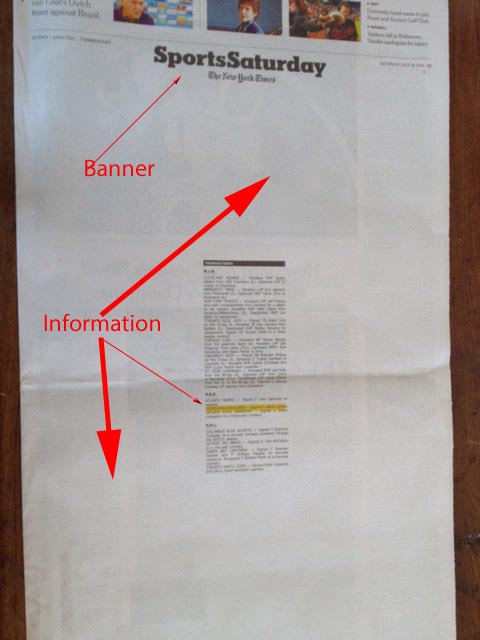
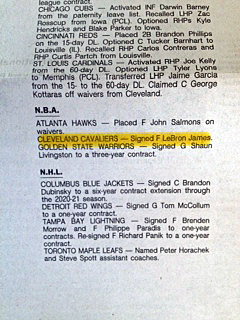
The hard copy of the NYTimes Saturday Sports section on Saturday, July 12, 2014, was an opportunity to teach how space can be information.

full page_edited-2-1

My photo; photo also featured in Deadspin blog

The photo above shows the front page of Sports Saturday. Students can note the banner is in the same location, floating at the top of the page with teaser photos for the content inside. Under the banner and centered on the page is  a feature that is usually on the inside of the sports section, a column of player trades and transactions in the different sports leagues for the day. The column is actual size, straddling the paper’s fold and surrounded by white space. Below the fold, one transaction in the column is highlighted in bright yellow. The rest of the page is blank.LeBraun trade(22)


Why the single highlighted line? What was the reason for all the white space? 

The Cleveland Cavaliers signed LeBron James.
Yes, during the same week when the semi-finals and finals for the 2014 World Cup riveted millions, the only news that mattered to sports fans was a short declarative sentence, “Cleveland Cavaliers signed F James LeBron.”

That was the purpose of the white space….to provide emphasis.

The other transactions listed from Major League Baseball, National Basketball Association, and the National Hockey League, however significant in the future, were not as significant at this moment.

That was the purpose of the yellow highlighted line, “Cleveland Cavaliers signed F James LeBron.”

In determining an author’s purpose, which in this case was the layout editor’s purpose, the Common Core State Standards (CCSS) offers a methodology to have student review the craft and structure of a text. Teachers use these these standards to frame questions about the text:

English Language Arts Craft and Structure Anchor Standards

CCSS.ELA-LITERACY.CCRA.R.4
Interpret words and phrases as they are used in a text, including determining technical, connotative, and figurative meanings, and analyze how specific word choices shape meaning or tone.
CCSS.ELA-LITERACY.CCRA.R.5
Analyze the structure of texts, including how specific sentences, paragraphs, and larger portions of the text (e.g., a section, chapter, scene, or stanza) relate to each other and the whole.
CCSS.ELA-LITERACY.CCRA.R.6
Assess how point of view or purpose shapes the content and style of a text.

The front page of this Sports Saturday provides multiple opportunities to discuss the difference between denotation (what is on the page) and connotation (what is implied). In helping students to consider the craft and structure of this particular layout, a teacher could use questions based on Webb’s Depth of Knowledge (DOK) that might be:

• How would you summarize what you read in the written text? (denotation)
• How would you summarize what you see in the white space in contrast to the written text? (denotation)
• What do you notice about where the highlighted information is placed? (denotation)
• What conclusions can you draw about the layout editor’s choice to highlight only one player transaction? (connotation)
• What is your interpretation of the use of the white space ? (connotation)
• Can you formulate a theory for the layout ? (connotation)
• Can you elaborate on a reason the editor used the small font in the player transaction column for this news? (connotation)

Of course, the story of the LeBron signing was also inside the Saturday Sports section. Michael Powell wrote the feature article  Star Reconnects With a Special Place in His Heart where the news of LeBron’s return was celebrated:

“The man knows his region, and his audience, and his life. Even as the news broke on television, you could hear out your window Cleveland residents loosening more or less random whoops. Car horns beeped. Strangers exchanged bro-hugs and palm slaps” (Powell-NYTimes)

Students could read Powell’s article to extend their thinking about the impact of this one player’s return to a team he left several years ago. Then, there is LeBron’s own essay, co-authored by Lee Jenkins, in Sports Illustrated. In this essay, LeBron explains the reasons for his return:

“But this is not about the roster or the organization. I feel my calling here goes above basketball. I have a responsibility to lead, in more ways than one, and I take that very seriously. My presence can make a difference in Miami, but I think it can mean more where I’m from. I want kids in Northeast Ohio, like the hundreds of Akron third-graders I sponsor through my foundation, to realize that there’s no better place to grow up. Maybe some of them will come home after college and start a family or open a business. That would make me smile. Our community, which has struggled so much, needs all the talent it can get”  (LeBron/Jenkins Sports Illustrated).

In this essay, LeBron anticipates (and connotes) the level of commitment that will be necessary for continued success:

In Northeast Ohio, nothing is given. Everything is earned. You work for what you have” (LeBron/Jenkins Sports Illustrated).

These other two informational texts could also provide opportunities to have students practice denotation and connotation:

  • How would you summarize what you read in these written texts? (denotation)
  • What conclusion can be drawn after reading these three texts? (connotation)
  • What is your interpretation after reading these texts? Support your rationale. (denotation/connotation)

A final exercise? Have students research the cost of a full page spread in the NYTimes ($70,000 non-profit; up to $200,000 for profit). Have students discuss or make arguments on the use of white space in this layout once they know the expense of the layout editor’s choice.

The best part of these exercises is that the reader does not need to know basketball to appreciate how this information is communicated: through layout, through a feature story, and through a personal essay.  I do not follow basketball, and I am only peripherally aware of LeBron’s role in the NBA. I was intrigued, however, about the use of white space to convey information. I also considered the different size of spaces related to the text. The size of a basketball court in the NBA is  94′ by 50′ or 4700 square feet. In another measurement, LeBron has a rumored vertical leap the size of 40 inches or so (the average NBA player can jump 28 inches). Finally, the size of the NYTimes page  is 24″ x 36″ or 864 square inches.

In each case, size matters. In this context, space matters as well.

The end of each year is always marked by a roundup or ranking of the year’s most memorable stories. 2013 was no exception. For example, CNN.com ran a poll on the top 10 news stories of 2013 which were then ranked by CNN.com readers:

  1. NEW POPE
  2. BOSTON MARATHON ATTACKS
  3. MANDELA DIES
  4. EDWARD SNOWDEN LEAKS NSA
  5. FEDERAL GOVERNMENT SHUTDOWN
  6. OBAMACARE ROLLOUT DEBACLE
  7. PHILIPPINES TYPHOON
  8. SYRIA CIVIL WAR
  9. CLEVELAND KIDNAPPINGS
  10. SAME-SEX MARRIAGE

All of these stories showed up on other news websites, perhaps ranked differently, but there was remarkable consistency nationally and internationally on how we will remember the year 2013. Pope Francis, the Boston Marathon, and the conflict in Syria dominated the top of most lists.

Screen Shot 2013-12-29 at 2.46.50 PMMany of these stories will soon be, or are already, the subject of non-fiction books, and some of these stories could be retold with such excellence as to be considered for the Samuel Johnson Prize. This prize is an award given annually for the best writing in current affairs, history, politics, science, sport, travel, biography, autobiography and the arts. This prize, named for the 18th Century English author Samuel Johnson is associated with the BBC (British Broadcasting Company) and awards author(s) of any nationality “whose work is published in the UK in English.” The most striking quality of the Samuel Johnson Prize is its motto that “All the best stories are true.”

There is truth in fiction as well. For example, even 2013’s most outlandish film Sharknado, has a degree of truth. The film detailed a supernatural phenomenon where thousands of sharks, scooped from their watery environment, twisted into another force of nature. The film generated waves of chatter on social media sites, so much so that the website Deepseanews.com speculated about the film’s implausibilities and calculated the physics of tornados holding great white sharks aloft. Researchers concluded in a post titled “Recipe for a Sharknado” that, “Winds in the most intense tornadoes are strong enough to keep a shark airborne.” Unlikely? Yes. Impossible? Physics suggests how.

The year 2013 provided many true stories that also lend themselves to possible re-tellings. The following three true stories of 2013 get my votes as the best potential candidates for future re-tellings, either as fiction or non-fiction:

1. NY TimesDiscovery of Art Looted by the Nazis:
The upcoming film The Monuments Men (February 2014,) where “a World War II platoon is tasked to rescue art masterpieces from Nazi thieves,” is a timely example of the storytelling potential about looted art. This past November, Bavarian authorities arrested an art dealer in his  Munich apartment uncovering a horde of art stolen during WWII. The recovered 1,500 works by Pablo Picasso, Max Liebermann, Ernst Ludwig Kirchner, Marc Chagall, Henri de Toulouse-Lautrec, Gustave Courbet, Auguste Renoir and Canaletto are estimated to be worth $1.4 billion. Since the discovery was made public, there are suspicions as to when authorities first knew about the stockpile. The intrigue abounds in this latest episode of Nazi treachery that continues to today.

2.Amazon.com:  Commercial Delivery using Drones:
While today’s science fiction writers may scoff at so pedestrian an example of technology, delivery drones could be fictionalized as key characters, featured perhaps in dystopian literature. While Hedwig, Harry Potter’s delivery owl, was a fantasy, a writer may consider that the possibility for pet drones has potential. The CEO of Amazon, Jeff Bezos, demonstrated that drones could be used for delivery purposes, in 30 minutes or less, and what better audience in a consumer culture motivated by immediate gratification than an audience of young adults? Storytelling or story-commercials…or both?

3. NYTimes: Richard III Rediscovered
My favorite story this year was the discovery of the bones of Britain’s medieval monarch, Richard III, paved over in a parking lot. He had been killed in 1485, at the Battle of Bosworth Field, the last king of England killed on a battlefield. This archaeological find, also dubbed the “King in a Car Park” in the video from the British Channel 4, put an end to the search for remains of the former king of York. A shorter version of the discovery is available from the University of Leicester:

Richard III had been characterized as a brutal tyrant by Shakespeare in the historical play Richard III, but an organization known as the Richard III Society  has tried to clear his reputation. The remains found so ingloriously buried were identified by his hunchback and the bones that bore the scars of the battle that killed him, including eight wounds on his skull.

Richard IIIThe subject of Richard III has already been fictionalized by the great writer Josephine Tey in her 1951 detective story The Daughter of Time. In this novel, she directly confronted Richard III’s sordid reputation in an attempt to clear him of any misdeeds. This latest archeological find is also ripe with storytelling possibilities.

In the end, though, how we will remember 2013 will be through the stories that we created ourselves. We will remember the births, deaths, accomplishments, failures, celebrations, and losses we experienced over the past 365 days of 2013. We will remember because we have, individually and collectively, made the stories of 2013, and the best stories are true.

Expecting allusions to Herman Melville’s Moby Dick during the National Teachers of English Conference (NCTE) is like (pardon the pun) shooting fish in a barrel. Okay, I know…the whale is a mammal, but once this white whale has been sighted, he keeps surfacing!

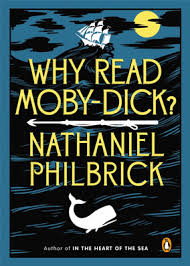
First Sighting: Nathaniel Philbrick’s 2011 slim book Why Read Moby-Dick?

Moby DickThe exhibitors at the NCTE conference were interested in putting books into the hands of teachers who would then put books into the hands of student readers. Once such vendor enthusiastically suggested the book based on its size; “See. you could carry this  book around the convention and hardly know it’s in your bag!”

He was right.  Philbrick’s 127 page argument as to why “this classic tale waits to be discovered anew” fit nicely in my convention bag and was perfect for reading during breaks between sessions.

The book is divided into 28 short chapters each devoted to topics such as setting, characters, or themes. Chapter titles include:

  • Nantucket
  • The View from the Masthead
  • A Mighty Messy Book
  • Queequeg
  • Pulling Dictatorship Out of a Hat

Philbrick is already familiar with the real life incident that was the inspiration for Herman Melville’s literary classic. His non-fiction book In the Heart of the Sea: The Tragedy of the Whaleship Essex in 2000 recounts the loss of the whaling ship Essex in the Pacific Ocean in 1820.  Heart of the Sea won the National Book Award for non-fiction that year, fleshing out the details of the whale attack on the boat, the fateful decision to avoid islands allegedly populated by cannibals, and the ironic turn to cannibalism that claimed the lives of several surviving crew members.

In Why Read Moby Dick?, Philbrick turns to the literary contributions Melville gave American literature, particularly in the creation of Captain Ahab, who in a pre-appearance had been rumored by other sea captains to have “been in colleges as well as ‘mong the cannibals.” In one chapter, “The Anatomy of a Demagogue”, Philbrick analyzes Ahab’s rhetorical craftiness in convincing the crew to hunt and kill the white whale. In discussing first mate Starbuck’s stunned realization that the Pequod is not out on a commercial venture, but rather a mission to settle the score of Ahab’s lost limb, Philbrick engages in a cross-culture reference that is both humorous and insightful:

Starbuck responds by asking what Ahab’s vengence will get ‘in our Nantucket market?’ It’s then, to borrow from the film This is Spinal Tap, that Ahab dials his charisma to eleven. ‘But come closer, Starbuck,’ he says, ‘thou requirest a little lower layer?’ It’s not about the money, he explains; this is personal. Thumping his chest he cries out. ‘My vengeance will fetch a great premium here!’ “(40)

Philbrick also aligns the story as a metaphor for the political turmoil of the United States. In discussing the chapter where Stubbs, the second mate, raises a shiver of sharks by cutting into a whale for a steak, Philbrick writes,

“The job of government, of civilization, is to keep the shark at bay….Here lies the source of the Founding Fathers’ ultimately unforgivable ommission. They refused to contain the great, ravaging shark of slavery, and more than two generations later, their grandchildren and great-grandchildren were about to suffer the consequences.” (78)

Philbrick moves between cultures, between ideologies, between philosophies, and theories in order to encourage more people to actually read Melville’s great American novel. A encouragement that may be necessary, because soon after I received the book, I had whale sighting #2.

Whale sighting #2:  A statement during a key note address at the Conference for English Leadership (CEL):

“We all know the opening line of Moby Dick, but how many of us have actually read the book?” posed speaker Donalyn Miller to the crowd of English teachers. There was a murmur of agreement, and more than a few guilty looks. Miller was discussing her passion and the topic of her two books: how to get students to read for school and independently.

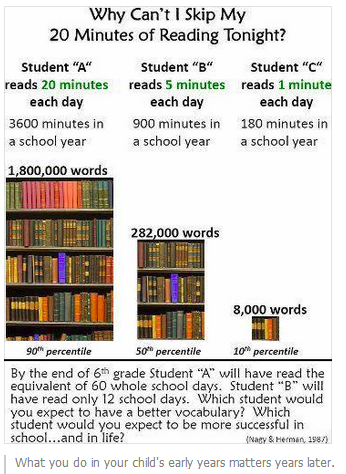
20-minMost notably, Miller is known as the author of The Book Whisperer and the recently released Reading in the Wild. Her keynote address was to encourage students to become the independent readers that could-on their own- pick up a tome like Moby Dick. She discussed the characteristics of “wild readers” and pushed teachers to engage students in examining their reading lives. She advocated for literacy rich environments for students to develop the habits to make them life-long readers. Miller’s assertion that preparing students to read independently is the best guarantor of standardized test success was supported with the graphic she presented. (see left: Nagy & Herman study).

Her point about Moby Dick was that most people know the first line, “Call me Ishmael,” but only those who live literate lives know why the book is so critical to understanding American literature. Students who have not developed the reading endurance necessary for the book may be turned off by both the intimidating size and the 19th Century styled language of the text. Considering that most high schools shy away from teaching Moby Dick to anyone but their best students means that the novel will most likely be an independent choice book for a student who develops into a life-long reader. Miller wants them to be prepared so they can will have the pleasure of sitting back in a comfy chair, perhaps with a cup of coffee, to read.

Whale sighting #3: Coffee at Starbucks.
starbucks

Named for the First Mate of the “Pequod”

Speaking of coffee, I am not sure why I never realized this before, but this coffee company is named for the first mate of the Pequod, Starbuck. I Googled this fact while waiting in the long line of English teachers eager to fuel up before attending the day of sessions at NCTE. According to the company’s website, “The name, inspired by Moby Dick, evoked the romance of the high seas and the seafaring tradition of the early coffee traders.” How did I not put this together?

Whale sightings, continued…….

Once I returned home from NCTE and CEL, the white whale sightings did not stop. A blog post on To Make a Prairie by Edblog award nominee Vicky Vinton summarized a session she had attended at NCTE called “Reading the Visual and Visualizing the Reading” chaired by Tom Newkirk and presented by Louise Wrobleski, Tomasen Carey, and Terry Mohera. Vinton explains the ideas based their mentor text, Moby-Dick in Pictures by the self-taught artist Matt Kish were “too inspiring not to spread around.” Their presentation highlighted the amazing results in student work when students chose one quote from each chapter of the The Scarlet Letter and create an image for it. Vinton notes that, “Mohera was surprised by the depth of the students’ thinking and how, once she’d gotten them started, they took full ownership of the book, the assignments and the whole process.”  The richness of their illustrations shows how literature can inspire new creations, just as Kish’s illustrations were inspired by Melville.

As if on cue, as in the final pages of Melville’s drama, the white whale surfaced dramatically again this morning when I came across another artist who is under Melville’s spell. While perusing the December 16th issue of The New Yorker, there was Mick Stevens’s cartoon of the whale himself (p56), a cross expression behind his spectacles, with his front fins holding a copy of Moby Dick. The caption underneath read, “Oh, C’mon, I wasn’t that terrible!”

Coincidence? I think not. Melville’s white whale is everywhere, but to appreciate him? You have to read the book.

If nothing else, the Common Core State Standards’ (CCSS) contribution to the academic lexicon will be the renaming of the genre known as non-fiction to a larger genre of informational texts. This renaming expanded the genre to include many forms of reading: textbooks, letters, speeches, maps, brochures, memoirs, biographies, and news articles, to name a few.

So where to find these informational texts? What is appetizing enough to make middle school students want to read a story, and then, answer the questions to check their understanding? What kind of high interest texts appeal to high school students who prefer to “Google” or “Sparknote” answers rather than read a text closely? What multi-media elements could be added to make an informational text palatable enough to be consumed by all levels of readers?

Screen Shot 2013-11-11 at 6.30.17 PM

The 2:12 video for accompanies the story

Well, teachers should look no further than the October 1, 2013, New York Times‘ feature article dedicated to Doritos Tortilla Chip titled That Nacho Dorito Taste. This short feature article combined photography and graphics;  a short video: and even shorter text that combined to provide an explanation on how this particular food is engineered so that “you can’t eat just one.”

The article is timely since the CCSS  requires that the student diet of reading should be 70% informational texts and 30% fiction by the time they graduate from high school.  The Literacy Standards specifically address reading in math, science, social studies, and the technical areas and recommends the increase in reading informational texts be completed in these classes. One of the technical areas content area classes could be a culinary arts class, a marketing class, or a health science class, but consider this particular informational text as scrumptious for any class.

In organizing this story, New York Times reporter Michael Moss, who also narrates the embedded video, interviewed food scientist Steven A. Witherly, author of “Why Humans Like Junk Food,” in order to better understand how all of the chemical elements combine in the Nacho Cheese Doritos chip to make it alluring to our taste buds.  According to Witherly, the mixing of flavors on this particular chip is purposeful:

 “What these are trying to do is excite every stinking taste bud receptor you have in your mouth.”

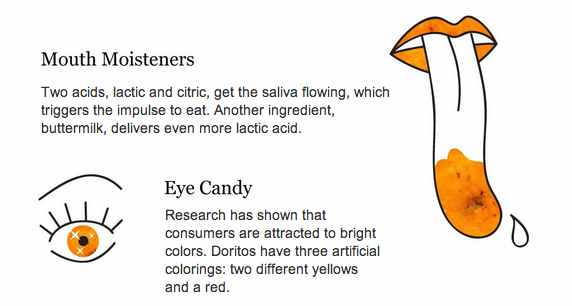
The graphics for the article by Alicia DeSantis and Jennifer Daniel are cleverly combined with photographs by Fred R. Conrad, also from the The New York Times. A separate page layout with the graphic/photo mix delivers tidbits of information about the Dorito chip. Each detail is organized by topic, as this example shows:

Screen Shot 2013-11-10 at 9.46.47 PM

A teacher does not even have to work at organizing questions for students to answer since the New York Time Learning Network, a free educational blog offered by the paper, organized an entire lesson plan on this article. The lesson is titled 6 Q’s About the News | The Science Behind Your Craving for Doritos, organized by Katherine Schulten. The questions on the blog include:

WHAT is psychobiology?
WHAT is “dynamic contrast”?
HOW do the acids in Doritos work on the brain?

WHAT is “sensory-specific satiety”?

WHERE do half the calories in Doritos come from, and, according to the graphic, HOW does that work on the brain?

WHY is “forgettable flavor” so important to Doritos’ success?

The higher order questions invite students to consider:

Now that you know the formula behind Doritos, are you more likely to eat more or less of them? WHY?
HOW many processed foods do you eat a day?
WHAT might a graphic explaining the effects of this food look like?

So go ahead. Read the Nacho Cheese Doritos article. See how irresistible an informational text can be. Once you read one this good, you will be searching to find another!

Here is an educational policy riddle: How much background knowledge does a student need to read a historical text?

According to New York Engage website: None.

The Common Core State Standards (CCSS) are being implemented state by state, and there is an emphasis from teaching students background knowledge to teaching students skills, specifically the skill of close reading.

The pedegogy is explained by The Partnership for Assessment of Readiness for College and Careers (PARCC):

Close, analytic reading stresses engaging with a text of sufficient complexity directly and examining meaning thoroughly and methodically, encouraging students to read and reread deliberately. Directing student attention on the text itself empowers students to understand the central ideas and key supporting details. It also enables students to reflect on the meanings of individual words and sentences; the order in which sentences unfold; and the development of ideas over the course of the text, which ultimately leads students to arrive at an understanding of the text as a whole. (PARCC, 2011)

There are many lessons that strongly advocate the use of close reading in teaching historical texts on the EngageNY.com website, including a set of exemplar lessons for Lincoln’s Gettysburg Address promoted by CCSS contributor and now College Board President, David Coleman. The lesson’s introduction states:

The idea here is to plunge students into an independent encounter with this short text. Refrain from giving background context or substantial instructional guidance at the outset. It may make sense to notify students that the short text is thought to be difficult and they are not expected to understand it fully on a first reading–that they can expect to struggle. Some students may be frustrated, but all students need practice in doing their best to stay with something they do not initially understand. This close reading approach forces students to rely exclusively on the text instead of privileging background knowledge, and levels the playing field for all students as they seek to comprehend Lincoln’s address.

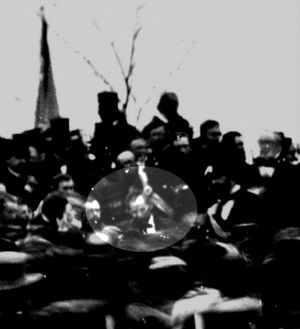
Photo of Lincoln delivering Gettysburg Address- (www.wikipedia.org)

Photo of Lincoln delivering
Gettysburg Address- (www.wikipedia.org)

The lesson plan is organized in three sections. In the first, students are handed a copy of Lincoln’s Gettysburg Address and perform several “cold” readings, to themselves and then with the class.

Lesson Plan SECTION 1 What’s at stake: a nation as a place and as an idea

Students silently read, then the teacher reads aloud the text of the Gettysburg Address while students follow along.

  • Students translate into their own words the first and second paragraph. 
  • Students answer guiding questions regarding the first two paragraphs

Please note, there is no mention of any historical context for the speech. Students will come to this 273-word speech without the background knowledge that the Battle of Gettysburg was fought from July 1 to July 3, 1863, and this battle is considered the most important engagement of the American Civil War. They will not know that the battle resulted in “Union casualties of 23,000, while the Confederates had lost some 28,000 men–more than a third of Lee’s army” (History.com). They will not know how the Army of Northern Virginia achieved an apex into Union territory with “Pickett’s Charge,” a failed attempt by General George Pickett  to break through the Union line in South Central Pennsylvania, and that the charge resulted in the death of thousands of rebel soldiers. They will not know how the newly appointed Major General George Gordon Meade of the Army of the Potomac met the challenges of General Robert E. Lee by ordering responses to skirmishes on Little Round Top, Culp’s Hill, and in the Devil’s Den. They will not know that Meade would then be replaced by General Ulysses S. Grant in part because Meade did not pursue Lee’s troops in their retreat to Virginia.

Instead of referencing any of this historical background, the guding questions in the lesson’s outline imagine the students as blank slates and mention another historical event:

A. When was “four score and seven years ago”? B. What important thing happened in 1776?

The guiding responses for teachers seem to begrudge an acknowledgement that keeping students bound to the four corners of a text is impossible, and that, yes, a little prior knowledge of history is helpful when reading a historical text:

This question, of course, goes beyond the text to explore students’ prior knowledge and associations. Students may or may not know that the Declaration of Independence was issued in 1776, but they will likely know it is a very important date – one that they themselves have heard before. Something very important happened on that date.  It’s OK to mention the Declaration, but the next step is to discover what students can infer about 1776 from Lincoln’s own words now in front of them.

In addition, there are admonishments in Appendix A of the lesson not to ask questions such as, “Why did the North fight the civil war?”

Answering these sorts of questions require students to go outside the text, and indeed in this particular instance asking them these questions actually undermine what Lincoln is trying to say. Lincoln nowhere in the Gettysburg Address distinguishes between the North and South (or northern versus southern soldiers for that matter). Answering such questions take the student away from the actual point Lincoln is making in the text of the speech regarding equality and self-government.

The lesson plan continues:

Lesson Plan SECTION 2  From funeral to new birth

  • Students are re-acquainted with the first two paragraphs of the speech.
  • Students translate the third and final paragraph into their own words.
  • Students answer guiding questions regarding the third paragraph of the Gettysburg Address.

Please note this does not provide the context of the speech that was given that crisp morning of November 19, 1863, at the dedication of the National Cemetery on a damp battlefield that only months before had been dampened red with the blood of tens of thousands of soldiers from either side. The students would be unaware that Lincoln had taken the train from Washington the day before and was feeling slightly feverish on the day of the speech. There is some speculation that he may have been suffering from the early stages of smallpox when he delivered the speech reading from a single piece of paper in a high clear voice. The students would not know that Lincoln’s scheduled time at the podium followed a two hour (memorized) speech by Edward Everett, who later wrote to Lincoln stating, “I should be glad if I could flatter myself that I came as near the central idea of the occasion in two hours as you did in two minutes.” The students would not know that many of the 15,000 crowd members did not hear Lincoln’s two minute speech; the 10 sentences were over before many audience members realized Lincoln had been speaking. The students would not know that this speech marked Lincoln’s first public statement about principles of equality, and they would not know that he considered the speech to be a failure.

Lesson Plan SECTION 3  Dedication as national identity and personal devotion

  • Students trace the accumulated meaning of the word “dedicate” through the text
  • Students write a brief essay on the structure of Lincoln’s argument

The lesson provides links to the five handwritten copies of the text, in the “Additional ELA Task #1: Comparison of the drafts of the speech” so that students can see drafts of the speech and the inclusion of “under God” in the latter three versions. There is also an additional Social Studies task that incorporates the position of respected historian Gary Wills from his book Lincoln at Gettysburg: The Worlds that Remade America. This activity suggests students use excerpts from Wills’s book and an editorial from the Chicago Times (November 23, 1863) to debate “Lincoln’s reading of the Declaration of Independence into the Constitution”. One excerpt from Wills’s book includes the statement,”The stakes of the three days’ butchery are made intellectual, with abstract truths being vindicated.” Finally, here is information about the battle itself; the battle lasted three days and soldiers died.

The enterprise of reading the Gettysburg Address without context defeats PARRC’s stated objective of having the students “arrive at an understanding of the text as a whole”. The irony is that in forwarding their own interpretation of the speech, David Coleman and the lesson plan developers have missed Lincoln’s purpose entirely; Lincoln directs the audience to forget the words of the speech, but never to forget the sacrifices made by the soldiers during that brutal conflict:

The world will little note, nor long remember what we say here, but it can never forget what they did here.

Lincoln wrote and delivered the Gettysburg Address to remind his audience “that these dead shall not have died in vain”. Analyzing the language of the address isolated from the Civil War context that created the tone and message is a hollow academic exercise. Instead, students must be taught the historical context so that they fully understand Lincoln’s purpose in praising those who, “gave the last full measure of devotion.”

“It is altogether fitting and proper that we should do this.”

Continue Reading…