Archives For November 30, 1999

"Dawn spread her rosy fingers..."

“Dawn spread her rosy fingers…”

Our 9th grade classes have been reading Robert Fitzgerald’s excellent translation of The Odyssey. At the beginning of every book, “young Dawn spreads her fingertips of rose to make heaven bright”. My students have heard this phrase so often that they chorus back to me “fingertips of rose” when we read aloud. One morning this past week, I raced up the hill to school to get my iPad so I could capture this picture of the “rosy fingers” and put it on the class wiki.

We dutifully started The Odyssey with the “Invocation to the Muse” and Books 1-4, but the Telemachus “coming of age” story did not really capture their interest. Meeting Odysseus in Book 5 did not improve their respect for the “worthy man of twists and turns.” Once we read Book 9,  the meeting with the Cyclops, Polyphemus, their interest was revived. Apparently, they enjoy a good story of man-eating monster as much as previous generations from 2020 years ago.

I have only been able to locate about a dozen copies of this translation in the secondary market, so we did have to buy a class set. These replaced a worn set of the Richmond Lattimore translation. There will be an audio version of the Fitzgerald translation available in November 2013 I will be ordering so I will finally be able to hear how to pronounce all those Greek names!.

Our final project for the Odyssey is a narrative that students complete called “The Wamogossey: A Day in the Life of a Freshman at Wamogo High School.” Happily,  writing narratives are once again favored in curriculum aligned to the Common Core State Standards:

CCSS.ELA-Literacy.W.9-10.3 Write narratives to develop real or imagined experiences or events using effective technique, well-chosen details, and well-structured event sequences.

The inclusion of the narrative confirms what most writing teachers recognize, that writing a narrative gives a students a better appreciation for reading a narrative.

In writing The Wamogossey, we allow students to organize themselves as individual narrators or in groups of two or three. Our instructions to the students are based on the following premise:

You and your partners are to create a modern equivalent of The Odyssey. The setting is Wamogo High School; the hero a 9th grader – Fresheus or Freshiope.

Your character must make their way through a day at school, facing modern equivalents of the Lotus Eaters, Cyclops, Sirens, and all that Odysseus encountered. The goal is simply to get home alive, where the or she can relax and feel safe.You must mirror Odysseus’ adventures, including how he solves the problems (trickery, patience, skill, self-control, etc).  The essential nature of the obstacles must be the same, in the same order, but set in modern Wamogo.

Each student in a group working on The Wamogossey is required to write three adventures: a single narrator needs three (3) adventures; two people writing the Wamogossey need six (6) adventures; three members of the group need nine (9) adventures. This organization assures that there is an equal sharing of responsibilities regardless as to the size of the group. They compose the narrative on Google Docs; each narrator writing in a different color ink.

In addition, to assure fairness in grading, we allow students to have some feedback on the distribution of points. The project is assigned a base grade (EX: 40 points) Once the project is graded based, that number is multiplied by the number of students in group. For example a project worth 40 points may be awarded only 34 points. If there were three members of the group, then there are 34 X 3 points available, or a total of 102 points. The members of the group then determine a fair distribution of points; slackers are usually “outed” by members of their group. We rarely need to intervene.

The Wamogossey narratives must begin with an invocation to their muse. These are usually very personal and often reflect that we have a vocational agricultural program. For example, from this year’s submissions:

Sing in me, Brandon,
and help me tell the story of tractors, you, skilled in all ways of contending,
the fixing, harried for hours on end,
after the break downs and endless driving in the field.
I saw the end of the last row of corn
and learned that good crops come slowly
and weathered many bitter days
in the early morning cold, while I fought only
to save my life, to get home to the barn.
But not by will nor valor could I save all the gas I use,
Of these adventures, Brandon, tell about me in my school day, lift the great song again.
Begin when the alarm rang, calling me to adventure, when all I hungered for was for home, my  Farm All tractors, and being ready…

In addition to the modernized twists of Homer’s plot, each adventure needs an epithet (“grey-eyed goddess”) and one Homeric simile. My students call these similes “enough already; we get the point” similes.There is also extra credit for using vocabulary from The Odyssey.

So far, several of The Wamogossey entries parallel Odysseus’s adventure very nicely. One student’s encounter with “Eaganphemus” (the Cyclops/our principal) is clever:

Encounter with the Cyclops- Book 9
I was hurrying to class, I was going so fast, I felt like I was in a race car, and the people around me are in a fuzz.  All of a sudden, I saw the huge Eaganphemus standing in my way. I almost slammed into him, my wheels spinning so fast. I tried to get around him, but I couldn’t  But, I happened to have M&M’s in my pocket, so I threw them at him. He seemed overwhelmed! He tried to catch all of them at once!! Once he was trying to gobble them down I raced past, now that he was distracted. I somehow survived getting past him.

As the semester ends next week, the students will have finished their hero’s journey. Odysseus will return to Ithaka and to Penelope, and, yes, another “Dawn will spread her rosy fingers…”.  I may get to run up the hill again to snap another picture.

Screen Shot 2013-01-09 at 4.41.58 PM

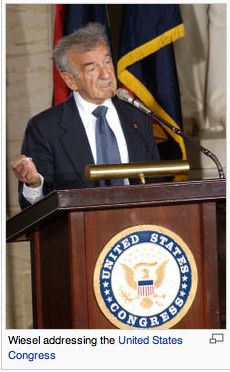
Wikipedia photo -Elie Wiesel

By my calculations, at the mid-point of the school year, many World History classes are studying World War II. Should these classes want to increase their use of an informational text in English or Social Studies curriculum, I suggest Elie Wiesel’s noteworthy speech The Perils of Indifference.

Wiesel delivered this speech to Congress on April 12, 1999. The speech is 1818 words long and connects Wiesel’s experience at the concentration camp at Aushwitcz with the genocides of the late 20th Century using a single powerful word: indifference.

In his speech, Weisel states clearly:

Indifference, then, is not only a sin, it is a punishment. And this is one of the most important lessons of this outgoing century’s wide-ranging experiments in good and evil.

Our English Department has used this speech in the past as a complement to Wiesel’s memoir Night which has been a used as a whole class read.  This year, we are giving Night to the Social Studies classes. They will adopt this memoir in order to increase the assigned informational text reading in their discipline mandated by the Literacy Common Core State Standards in History and Social Studies (CCSS). The English Department will still offer supplemental texts  that students can choose to read independently.

When he gave this speech, Wiesel had come before the US Congress to thank the American soldiers and the American people for liberating the camps at the end of World War II. Wiesel had spent nine months in the Buchewald/Aushwitcz complex. His mother and sisters had been separated from him when they first arrived: “Eight short, simple words… Men to the left, women to the right”; these family members were killed in the ovens. He and his father survived starvation, disease, and the deprivation of spirit. His father eventually succumbed, and Wiesel guiltily admits at the end of the memoir that at his father’s death he felt relieved.

Eventually, Wiesel felt compelled to testify against the Nazi regime, and he wrote the memoir Night to bear witness against the genocide which killed his family and six million Jews. His speech was delivered 54 years after he was liberated by American forces.

His gratitude to these American forces is what opens the speech, but after the opening paragraph, Wiesel seriously admonishes America to do more to halt genocides all over the world. By not intervening on behalf of those victims of genocide, he states clearly, we are indifferent to their suffering:

Indifference, after all, is more dangerous than anger and hatred. Anger can at times be creative. One writes a great poem, a great symphony, one does something special for the sake of humanity because one is angry at the injustice that one witnesses. But indifference is never creative.

My students have always been struck by Wiesel’s juxtaposition of anger and creativity. More than one has agreed pointing to making a “good” creation: an amazing song about an ex-boyfriend or a painting slapped together with passion. They also do not want to be treated indifferently. Yet, Wiesel makes them think beyond themselves:

Indifference is not a beginning, it is an end. And, therefore, indifference is always the friend of the enemy, for it benefits the aggressor — never his victim, whose pain is magnified when he or she feels forgotten. The political prisoner in his cell, the hungry children, the homeless refugees — not to respond to their plight, not to relieve their solitude by offering them a spark of hope is to exile them from human memory. And in denying their humanity we betray our own.

I remember several years ago, one student in my English 10 class, Rick, was particularly bright, fun, and full of daring. He also had an exceptional understanding of math and statistics. That January, I introduced the memoir Night as I had in previous years by providing a little background information.

“Six million Jews were killed during the Holocaust,” I recited off from my list of facts.

“What?” a startled Rick looked up. “Six million?” He was aghast. “That can’t be right.” He looked around at his classmates. “Six million?” They looked at him blankly. “Come on,” he was looking for some support, “That can’t be right.”

“Why?” I asked.

“Do you know how many six million things are?” He was indignant.

“Six million people,” I responded.

“People, yes. People, six million is a lot of people….” Rick was clearly operating with a different level of understanding from his more placid classmates. He understood six million as quantity; he did understand what six million things would look like if stacked up. Other students stirred in their seats.  “No way….six million,” he repeated growing more agitated. “How? How did anyone let this happen?” he asked; he was half-rising out of his seat. “Did we know?”

“Yes,” I remember saying. I do remember explaining that, yes, America did know that Hitler had concentration camps, and that more documentation collected after the war indicated that many of our military and political leaders knew about these camps. That is one of the points from Wiesel’s speech.

I pointed out to the class that the Holocaust was only one example of genocide; that there were others. In fact, that there was recently a genocide in Darfur. Rick sat down; he was overwhelmed. He was capable of understanding numerically the devastation of the Holocaust, and he was clearly upset. “Why do we let this happen?” he asked. I remember his voice was so sad, so full of disbelief.

In The Perils of Indifference, Wiesel asks

Does it mean that we have learned from the past? Does it mean that society has changed? Has the human being become less indifferent and more human? Have we really learned from our experiences? Are we less insensitive to the plight of victims of ethnic cleansing and other forms of injustices in places near and far?

Wiesel’s rhetorical questions echo Rick’s “Did we know?” In trying to respond, Wiesel makes the reader uncomfortable the way Rick was uncomfortable. Creating this kind of emotional impact on a reader is the reason Wiesel’s speech should be taught.

The Common Core State Standards (CCSS) demand that students read informational texts but does not require specific texts. Wiesel’s The Perils of Indifference contains the information and rhetorical devices that meet the text complexity criteria of the CCSS. More specifically, Wiesel’s message is necessary if we want our students to confront the conflicts in this new 21st Century. Our students must be prepared to question why “deportation, the terrorization of children and their parents be allowed anywhere in the world?“

Our humanity should demand nothing less.

The Simpson’s creator Matt Groening is a great satirist. In one episode in an exchange between the cartoon character Lisa Simpson and her Grandmother, he also demonstrates his ability to be a great literary critic:

Grandma Simpson: Don’t be bashful. When I was your age, kids made fun of me because I read at the 9th grade level.
Lisa: Me too!
Grandma Simpson: Although I hardly consider A Separate Peace the ninth-grade level.
Lisa: Yeah, more like preschool.
Grandma Simpson: I hate John Knowles.
Lisa: Me too.

I value Lisa Simpson’s opinion on literature, after all, this is a character who has been seen clutching copies of  The Bell JarEthan FromeMan and SupermanThe Corrections, and the more age appropriate Pippi Longstocking. So when she says she hates John Knowles, I feel validated. I have always disliked John Knowles’s A Separate Peace.
However, there are others who call this same book  “A masterpiece”(National Review) or ” deeply felt and beautifully written” (The Observer) or “Intense, mesmerizing, and compelling” (School Library Journal). The English Language Arts Common Core State Standards gives its recommendation since the novel has been, “Hailed as a literary masterpiece,” and that ” A Separate Peace is a classic novel with numerous teaching resources available.” The CCSS analysis of the text complexity reads:
“When considering the qualitative measures and the reader-task considerations, this novel is well placed at the 9th-10th grade complexity band. The complex themes, use of first person narrative—but with multiple flash backs and flash forward indicate higher level reading skills are needed by the reader. The Common Core Standards Text Exemplars also place the novel in the 9th -10th grade complexity band.”
 In a  2004 study titled A SeparatePeace:Four Decades of Critical ResponseLois Rauch Gibson writes:

“Rejected at first by American publishers, John Knowles’ A SeparatePeace appeared in England in 1959, where critics admiringly compared it to Salinger’s writings. American critics, responding in 1960 to the American edition, generally noted its depth, sensitivity, and ‘disturbing allegories'(Aitken 754). They did not entirely agree about what the allegories might be, nor have the four decades of critics since.”

I would argue there are no allegories in this short story “Phineas” that was expanded (unnecessarily) by Knowles into a full length novel. This is a fairly straightforward story of young white males at an exclusive prep school and their conflicts and competition during a last summer before entering the very grown up world of competition and World War II. I found the story dated when I read it in 1973, but Gibson felt the novel could  speak to today’s readers:

“As we approach the forty-fifth anniversary of the American edition of A Separate Peace,in a world where the all-male, all-white prep school environment has become exceedingly rare, John Knowles’ novel nonetheless continues to speak to adolescents. Once we fought wars against fascism, then against communism, now against terrorism. Before this background, teenagers attend school, bond with peers, lose their innocence, encounter hate and ignorance and what Knowles calls blind impulses; and each one inevitably struggles to develop an identity-sexual and otherwise. As the world continues to change, no doubt the next four decades of critics will have much to say about this resilient and compelling novel.”

I have always considered A Separate Peace to be the poorer literary cousin to J.D. Salinger’s 1951 classic Catcher in the Rye. Unfortunately, I like A Separate Peace’s  Gene less than I like the deluded Holden from Catcher in the Rye, and I like the object of Gene’s angst, Phineas or Finny, even less. This is a critical problem in the novel according to Slate Magazine’s Dec 2009 review The Secret of A Separate Peace by Stephen Metcalf:

“We do not love Phineas as Gene does. His charm for Gene exceeds his charm for us. The less we are seduced by Phineas, the more we experience him not as an Apollonian boy-god lacking the normal ratio of ill-character but as a love object for Gene, and Gene alone.”
I remember reading the climatic moment of the novel, when Gene reflects back on the accident in the tree:
 “He [Phineas/Finny] had never been jealous of me for a second. Now I knew that there never was and never could have been any rivalry between us. I was not of the same quality as he. I couldn’t stand this. . . . Holding firmly to the trunk, I took a step toward him, and then my knees bent and I jounced the limb. Finny, his balance gone, swung his head around to look at me for an instant with extreme interest, and then he tumbled sideways, broke through the little branches below and hit the bank with a sickening, unnatural thud. It was the first clumsy physical action I had ever seen him make. With unthinking sureness I moved out on the limb and jumped into the river, every trace of my fear of this forgotten.”
“What the heck?” I distinctly remember thinking, “He intentionally caused him to fall! What kind of friend is that?” He lost me at “forgotten.” I considered the final “apology” of the novel a fraud:
“I never killed anybody and I never developed an intense level of hatred for the enemy. Because my war ended before I ever put on a uniform; I was on active duty all my time at school; I killed my enemy there. Only Phineas never was afraid, only Phineas never hated anyone.”
It’s a lie. Gene was responsible (indirectly) for the death of Phineas, and in this statement he is contradictory about killing his “enemy.” Apologetically glorifying Phineas at the end is probably meant to be sincere, but to me the conclusion reeks of Freudian dishonesty. Gene could never really know Phineas, so he destroyed him and then made him a god.
 Still, our 9th grade honors classes read A Separate Peace.
When I asked the teacher why she replied casually, “Well, they can read it in a weekend. They like it.”
“Do you do any real lessons with it?” I pressed her.
“No. They generally get it.”
“Get what?”
“Friendship, betrayal. Teenage angst.”
Ah, yes. A Separate Peace is awash in teenage angst. So is high school, which probably is the reason the book remains in the high school canon. That and the accumulated hundreds of copies available in English Department libraries. Of course, this wallowing in the imposed angst of teenagers reminds me of another brilliant Matt Groening observation, this time provided by Lisa’s brother Bart. Heading into an alternative rock and roll concert, Bart is heard commenting, “Lisa, making teenagers depressed is like shooting fish in a barrel.” Which explains why Lisa hates John Knowles.
Me too.

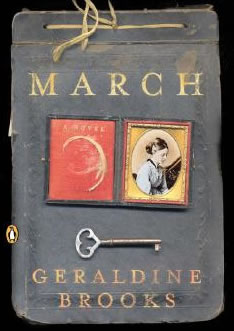
A series of miscommunications left the eight members of the local Burnham Library Book Club wondering which book they should prepare to read for the next meeting. The month before, a decision was made to read a novel that shared the name of the next meeting; we would read a book titled  The March by E.L Doctorow for our March meeting date. How clever! Unfortunately, our plans went awry when the librarian posted the selection as March by Geraldine Brooks. Members arrived with copies of one or the other novel.

No matter. As it turned out, we could discuss both books easily, not only because of the similarity of each fictional story arc but because of the numerous historical references to people and the events in the Civil War.  What struck all members of the book club during the discussion was the amount of research that had gone into creating these works of historical fiction, since both contained a notable fidelity to events, customs, and manners of the Civil War era.

March-Geraldine Brooks

In March, Geraldine Brooks borrows her title character, Peter March, from Louisa May Alcott’s story Little Women. Her narrative is told from the alternating point of views of Marmee and the father of the March girls: Meg, Jo, Beth and Amy. In her explanation for his prolonged absence, the idealistic March enlists as a Union clergyman in 1861, at the beginning of the Civil War.

E. L. Doctorow’s The March is centered on real-life Union General William Tecumseh Sherman in his infamous “march to the sea”, as he burns Atlanta before pivoting north into the Carolinas. Multiple narrators are employed in this novel including a Union regimental surgeon, Colonel Sartorius; Emily Thompson, a daughter of a Southern judge; and Arly and Will, two soldiers who care little about loyalty and more about staying alive.  The scope of  this novel is epic as Sherman’s sixty thousand troops burn, pillage, and choke to death the final throes of the Civil War in 1864.

The similarity of major characters from each novel was uncanny: the mixed-race beautiful protagonist Pearl in The March and the strikingly attractive, educated slave Grace who captivates the title character in March. There were historical figures to people each novel: John Brown, the famous abolitionist; Henry David Thoreau; and Ralph Waldo Emerson make appearances in March. General Sherman, General Joseph E. Johnson, and Abraham Lincoln are present in The March. Both novels also extensively featured field hospitals as settings. March is a a Union chaplain who is wounded and ends up in a Civil War hospital; The March features a Union regimental surgeon, Colonel Sartorius  who curiously employs a number gruesome surgical procedures.

The novels reflected the tumult of a civil war, the hair-raising escapes from danger and the chaos and brutality that ensued from bitter and divided rivalries. Both novels highlighted the technological advancements that made each side more efficient killing machines, and Doctorow in particular noted the historical progress of mechanized warfare:

 “This in America was to be seen with one’s own eye’s. And as bloody and brutal were the contests of the Lancasters and York, they were hand to hand- battle-aves, pikes, maces. These chaps were industrial age killers: they had repeating rifles that could kill at a thousand yards, grape that could decimate an advancing line, cannon, field-pieces, munitions that could bring down entire cities. Their war was so impersonally murderous as to make quaint anything that had gone on before. (214)

Another element of comparison was the reflection in both novels on ancient wars that had preceded the Civil War. Brooks has her narrator, the cerebral Peter March, contemplate the historical continuum, from the Ancient World to the present, noting the how painful is the loss of loved one due to war:

“The waste of it. I sit here, and I look at him, and it is as if a hundred women sit beside me: the revolutionary farm wife, the English peasant woman, the Spartan mother-‘Come back with your shield or on it,’ she cried, because that was what she was expected to cry. And then she leaned across the broken body of her son and the words turned to dust in her throat.” (211)

In contrast, Doctorow uses a visiting English journalist in order to comment on how the echoes of  ancient conflicts are heard in the progression of battles he sees:

“Yet some of the ancient military culture endured. The brutal romance of war was still possible in the taking of spoils. Each town the army overran was a prize. In this village was an amazing store of wine, in that granary brimming to the rafters, a herd of beef here, an armory there, homes to loot, slaves to incorporate. There was something undeniably classic about it, for how else did the armies of Greece and Rome supply themselves? How else had Alexander’s soldiers made an empire? The invading army, when it camped, sat on the land as its owners, with all the elements of domesticity, including women, enlarging the purely martial function of their social order” (215)

The reasons for the Civil War are addressed more clearly in Brook’s tale. She incorporates the arguments offered by the real-life American Transcendentalist Branson Alcott in her creation of the  character of the naive March who is just beginning to doubt his involvement with the conflict he little understands:

“If war can ever be said to be just, then this war is so; it is action for a moral cause, with the most rigorous of intellectual underpinnings. And yet everywhere I turn, I see injustice done in the waging of it…”(65).

In contrast , Doctorow’s characterization of the West Point educated General Sherman suggests his weary recognition that while the physical act of war will run to its exhausted conclusion, the battlefield will move to another plane where the dispute will continue:

“And so the war had come down to words. It was fought now in terminology across a table. It was contested in sentences. Entrenchments and assaults, drum taps and bugle calls, marches, ambushes, burnings and pitched battles were transmogrified into nouns and verbs.  It is all turned very quiet, Sherman said to Johnson, who, not understanding, lifted his head to listen.

No cannonball or canister but has becomes the language here spoke, the words written down, Sherman thought. Language is war by other means” (348).

Ultimately, the members of book group determined that both books provided a fascinating blend of historical fact with fiction. As an educator, I was impressed about how much more effective both novels were in communicating the experiences of living through the Civil War from its beginning (1861) to its inevitable end concluding with Lincoln’s assassination in 1865. A textbook would have covered the information, but not provided the visceral quality a reader gains through a story….both novels succeeded in recreating history using a “his story” model. Both novels complement the study of the Civil War by blending each author’s thematic development and literary technique with historical fact. As a result, both novels will be placed on the 11th grade classroom shelves along with two other wonderful Civil War novels The Killer Angels by Michael Shaara (Gettysburg) and Cold Mountain by Charle Frazier.

All these books appeal to the imagination in recreating the  particulars in the  time and places of the Civil War. As a bonus,  how serendipitous that despite the near duplication of titles, both novels were so similar in subject matter as to allow for a great discussion? How surprising that the story of two “Marches” would ultimately be so similar?

“Chance favors the prepared” in the used book market.

Saturday is my day for running errands which takes me to Brookfield or New Milford, two Northwest Connecticut communities. Each of these towns has a their own Goodwill store located on Route 7, and I make regular stops to their bookshelves of donated books looking to see what has been most recently donated.

This past Saturday morning, I did just that. In fact, I stopped at both stores and purchased a total of 47 books for $41.43. WhenI came home, I noticed that WebEnglish Teacher had posted a link to a website listing the 100 Essential Reads for the Lifelong Learner  organized by Online Schools. These books were organized by discipline: fiction, non-fiction, autobiography/memoir, biography, world literature literary theory, history, political science,science/math/social science. Her question was “How many of these essential books have you read?” I was happy to see some familiar titles on the list, but many were new to me.

I could not help but notice that I had just purchased five of the suggested titles on this list for different classroom libraries that very day! There were other titles on the list available on thrift store shelves that I did not get since our libraries either already had enough copies or the titles are available online in the public domain.  The Online Classroom Essential Reads List is organized so that each title had a designated number, not a rank, and link provided for each book with a short explanation. Some of the links are helpful.

Here is a list of the 5 PURCHASED ESSENTIAL READS and the grade or class that uses them:

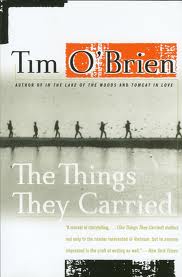
35. The Things They Carried by Tim O’Brien. This fictional account of a platoon in Vietnam is based on Tim O’Brien’s experience in the war himself and explores the fear and courage that are necessary to bring one through to the other side.

-This is a text that is used in our Grade 11-American Literature classes. The book is one of the few texts that students will willingly complete; once they finished the first story, they are hooked which is a tribute to O’Brien’s writing style. The prose is artistic but not difficult for even our lowest readers. Our students are curious about Vietnam, a part of history that is chronologically left for those lazy days of June. We use film clips (Platoon, Apocolypse Now, The Deer Hunter) in our unit with this text. We also eat MREs in class, and organize lists as to what each of use “carries.”

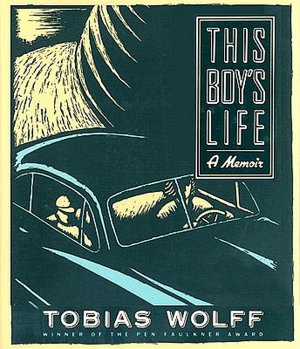
43. This Boy’s Life by Tobias Wolff. Wolff recounts his life as a boy and teen struggling with his identity as he lives with his divorced mother and her second husband in the 1950’s.

-This text will go into the English IV elective Memoir. There is a possibility that a 9th grader will choose this as an independent reading book in the non-fiction unit. The narration captures teen angst very well, and could work as a non-fiction companion piece to Catcher in the Rye in Grade 11. If Common Core wants classrooms to integrate more non-fiction, this is an excellent piece to add.

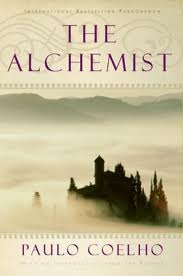
61. The Alchemist by Paulo Coelho. Discover how to find the beauty in life no matter what your experience as you follow the life of a young shepherd who gains so much from his journey of life.

-This book is assigned as summer reading for incoming English II honor students. We require a dialectic journal with 30 quotes from the texts as the summer reading assignment. Despite the burden of writing, students really enjoy this book which allows us to segue from “the journey” archetype taught in Grade 9 to the different types of perspectives in Grade 10 World Literature.

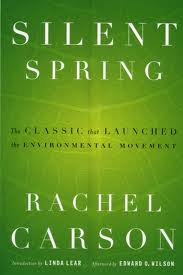
94. Silent Spring by Rachel Carson. Carson’s powerful writing on the topic of environmental justice creates a book that will make the reader think seriously about humanity’s relationship to the Earth.

-I got this book for the environmental studies teacher. So far, I have found five nice copies this past year. She offers this as optional reading to her students, and I think this should be required reading for students interested in pursuing an environmental science…or any science, for that matter.

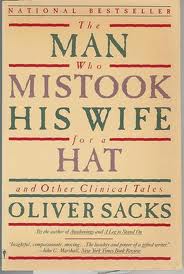
100. The Man Who Mistook His Wife for a Hat by Oliver Sacks. Psychology student or not, this book will appeal to anyone who has an interest in the curious way the mind works–and how it does not work. Several of the most bizarre cases are detailed here.

-I rarely find copies of this book, so finding one in good condition is a score! The psychology/sociology teacher loves to lend this book to her students; they are fascinated by the case studies. I am always excited to find a gently used copy for her to share.

Here is a list of the 10 essential reads I LEFT ON THE SHELVES (and where they are used in our curriculum)

1. The Great Gatsby by F. Scott Fitzgerald.-Grade 11; we have enough copies

12. Heart of Darkness by Joseph Conrad. -AP English Literature; text is in the public domain so students read this online.

14. The Call of the Wild by Jack London.- Grade 9;  text is in the public domain so students read this online.

15. To Kill a Mockingbird by Harper Lee. -Grade 11; we have enough copies

28. The Poisonwood Bible by Barbara Kingsolver.- AP English Literature; we have enough copies

33. Middlesex by Jeffrey Eugenides.- Optional read for Grade 11 Coming of Age unit OR Advanced Placement English

34. Life of Pi by Yann Martel. -Grade 10; We have enough copies

58. One Hundred Years of Solitude by Gabriel Garcia Marquez. AP English Literature; we have enough copies

82. The Elements of Style by William Strunk and E. B. White.- Resource for AP English Language and AP English Literature and Creative Writing

98. The Interpretation of Dreams by Sigmund Freud.-I will need to check with the psychology teacher!

 Both Goodwill stores, Brookfield and New Milford, regularly offer a wide variety of used books, and our classroom libraries are currently well-stocked with titles puchased used for $.50-$2.00.
This past Saturday, the  total cost for the five  “essential” titles I did purchase? $5.18. Getting these essential reads into the hands of our students? Priceless.

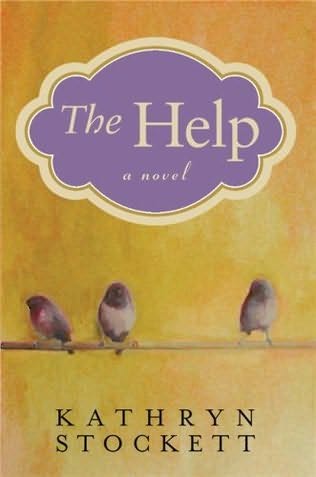
Just had a first sighting of The Help by Kathryn Stockett in a local Goodwill store. This best-selling fictional account of maids and the young reporter who records their stories during the Civil Rights decade (1960s) was first published in 2009 and has remained on the New York Times Best Seller List since then. Granted, this particular copy was a moderately water-damaged paperback selling for $2.00, but this sighting marks the moment when the book is cleared from the reading shelf to the donation shelf in order to make way for other titles.

Paperback copy of The Help sighted at local Goodwill store.

We are hoping to get a class set (30+ copies) of The Help over the next two years to offer with the English III Civil Rights unit (To Kill a Mockingbird; A Lesson Before Dying; The Bluest Eye; Mississippi Trial, 1955; Warriors Don’t Cry; The Color Purple). Thrift stores and public library book sales will probably be the best venues for getting inexpensive copies.

Currently, the book retails for $9.60 at Amazon.  That would be an expense of $288.00. We hope to get these copies for under $50.00 total.

Stay tuned for sighting #2.

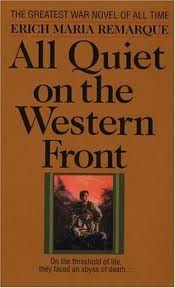
Next week, English II students will begin reading All Quiet on the Western Front by Erich Maria Remarque in tandem with the World War I unit on taught in social studies classes. This collaboration is a great opportunity to have the context of a WWI novel explained from another point of view. The social studies classes cover the causes of WWI, many of the battles, and the results of WWI on Europe and American foreign policy while the English classes follow the lives of a few soldiers engaged in the conflict. Social studies can cover the macrocosm setting, the geography of WWI, while we can cover the microcosms of the novel-the intimate settings   of Paul and Kat feasting on a goose they caught or Paul visiting the bedside of Franz Kemmerich, his mortally wounded companion.

The older edition cover; copies are always found in the YA section of a book sale

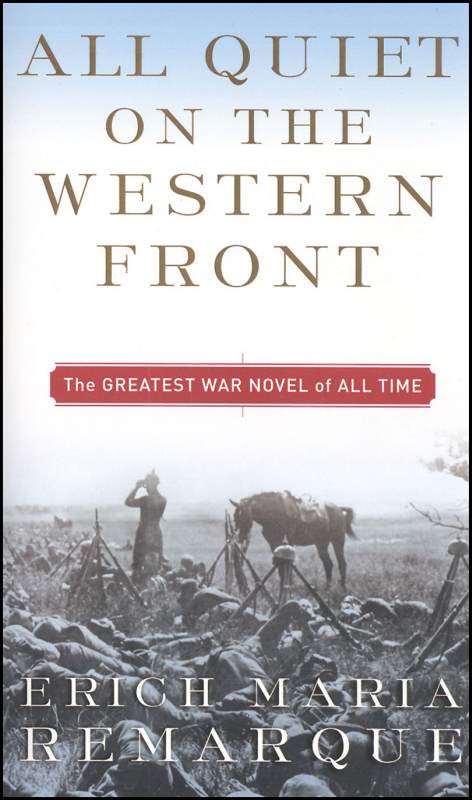
Our copies of the book are fairly old, so I am always looking for additional books to replace those who have become too worn for use in class. The e-book (through Questia) is only available as a free trial. There are always copies of the novel in used book sales including the more recent edition, and the book is almost always located in the young adult section rather than on a table or section dedicated to military history or adult fiction. This placement could be attributed  to the popularity of this novel in curriculum around the country; obviously, the person placing the book on the YA table read the book in high school.  The popularity of the book in schools defies many conventions. First, the novel is a translation from German, which distinguishes it from the multitude of British and American titles that crowd middle school and high school reading lists. Second, the point of view is from an enemy combatant; the French, English and American troops are the enemy. Including this novel acknowledges Remarque’s universal message that the consequence of war is devastation, a message that may be even more important for a nation that has been at war for over 10 years.

The new edition cover

Many technological advances made WWI a brutal war: aerial combat, machine guns, mustard gas. Last year, we were reading one of the passages that described a mustard gas attack,  looking for language that described how lethal this weapon was for the foot soldiers.  Suddenly a startled look came across the face of a  student. His hand shot up as he blurted,  “Ms. P told us that the more technology that’s used in war, the further a soldier gets away from the enemy in combat.”  There was a pause-other students had heard the same in class, and the consequence of increasingly sophisticated weaponry used against Paul and his companions was suddenly very real. His point hung there until another student chimed in, “And now we use drones.”  Suddenly, the WWI novel was not dated. The students understood that military drones currently used in combat would certainly have targeted Paul and his companions if they had been available to Allied forces in 1917.

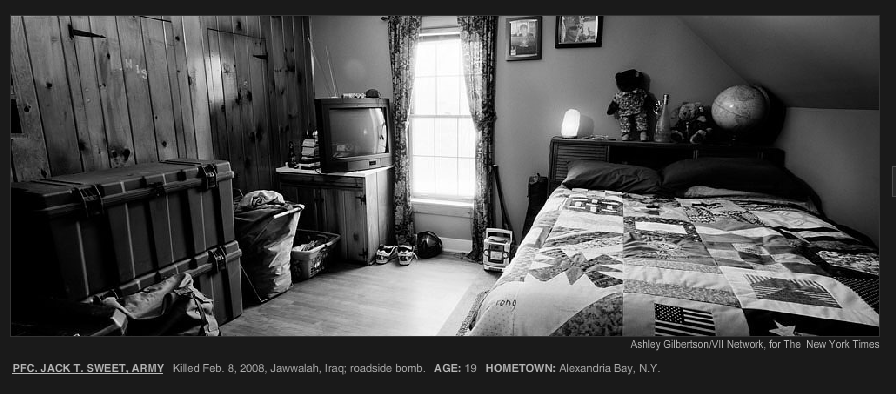
There are several activities that we pair with reading the text, but the most powerful for students is the NY Times Magazine photo essay (Ashley Gilbertson)  of soldier’s bedrooms titled “The Shrine Down the Hall” (there is a video clip as well) In the novel, Paul returns for a visit home. Instead of being a sanctuary, however, the bedroom is a painful reminder of the innocence he has lost after months of combat of the Western Front. Our assignment is to compare the elements of Paul’s bedroom (items, his feelings, his memories) to the elements in the photos of the bedrooms of American soldiers who had been killed in Iraq or Afghanistan. This photo essay brings the impact of war’s devastation to an intense personal level. Many of the students have bedrooms with the same posters, layouts, or furniture, and they note these similarities in their responses.

A photo from Ashley Gilbertson's "The Shrine Down the Hall" photo essay in the NY Times Magazine section

Students are instructed to choose one of the soldier’s bedrooms from the photo essay, and make a connection with text from Chapter 7 (Paul’s visit home) by answering the following questions:

  • How are the text of the novel and the photo alike?
  • How do the text and the photo differ?
  • What is the photographer’s message? What is Remarque’s message? How are they the same? How do they differ?

The students’ responses included:

I chose picture 15, of Matthew J. Emerson’s bedroom. His room is just waiting for him to come home but it never happens. The room also has pictures cut out on the wall, from what appears high school sports, as well as trophies on the shelf. Paul gets to return home one last time, unlike the soldier who was killed in Iraq who returned in a casket with an American Flag on it. Paul feels like a stranger in his own room. War changes people; you can’t go blasting heads off for 2 years and come home and live the normal everyday life again.They come home, changed, forever.

I choose photo 17. The man who died was Sergeant Gilbert who was killed in 2006.  The photographers message is saying that an ordinary young person, even a teenager, can go to war and be killed. The photographer expresses the loneliness, silence, and emptiness that the room has. Remarque’s message is saying that the average soldier has a very hard time coming back because he or she has to make decisions that don’t involve killing, that don’t involve defusing a bomb. These two messages are the same because they both describe the difficulty of coming back home, but they are different because these two messages are set in different times with different technology of warfare.

When I see picture #3 I think of Paul the most. Here are a bunch of pictures everywhere on the walls of all different kinds of things, like “Then below are periodicals, papers, and letters all jammed together with drawings and rough sketches.” When I read this it makes me think of a cluster of a bunch of different things, also when I look at room #3 I see a cutter of a bunch of posters, hats, books, and many other things. I think the picture and Remarque’s  are both saying that life is not the same when you get home and many of the soldiers cannot come home and have everything be the same as when they left.

I chose photo 14 because it is surprisingly similar to the book. The text talks about Paul’s book shelf and his school books all thumbed through. the room has a book shelf and other references to school. What looks like a degree is hanging on his desk. This room however has a poster of the marines in the background which shows that this boy was obviously thinking of joining the military before hand. Paul has no mention to wanting to join the army before Kantorek takes them down to the recruiting office. I think the photographer’s message is to show how innocent the soldier was before.

He was on a sports team and appeared to be quite good, he won a trophy. Remarque’s message is very similar. The soldier is changed after war, he cannot go home and just drink some beers and pretend everything is all right. It’s not.

I chose picture 14. This room was occupied by Nathanial D. Windsor who died on March 11, 2007. He was only 20 years old (about the same age as Paul). T. The photographer said was trying to portray a lonely room that is not occupied anymore. Remarque’s trying to portray that Paul’s room is lonely too. They are both alike because they are lonely.

Christopher Scherer’s room reminded me of when Paul went home. Paul had a nice life before the war he felt at home, when he returned from the war he felt like he was looking through a veil. He tried on his clothes, his civilian clothes, that made him feel like he had nothing. After the two years of war he cannot have that connection to his home, he relates everything back to the war. The war has given him the thought of death and destruction, Paul is no longer himself, he cannot connect to his home, where he is supposed to be.

In the picture a bookshelf was not full which could mean that the soldier was as Paul was did, collecting them gradually.  The solider also has a clear view of the outside that he can sit and watch, just as Paul has in the story. Remarque and the photographer have different views. Remarque tries to display that after the soldiers return home they are never the same people and their rooms do not represent them. While the photographer’s message is that all the pieces of  soldiers’ lives are preserved in their rooms and are now gone forever because they have died.

Remarque’s novel transcends time perhaps because of the intensity the reader feels for one soldier caught up in a conflict beyond his control.  While the social studies classes are required to cover the history of World War I, the English classes are free to cover Paul and “his”-story.

The Wamogo classroom libraries have many new titles, so perhaps an explanation as to how these titles are allowed into the classrooms at Wamogo for independent reading is in order.  Most of the books in the classroom libraries are books already available in the school library’s main collection. Unfortunately, like most schools, there have been, on occasion, challenges to titles taught or made available in classrooms in grades 7-12. Book challenges are made when a parent or guardian objects to content in a book, and there are some titles that receive challenges more frequently than others.

There are two steps that our English Department members employ in order to meet the requirements of a reading curriculum with the requests of parents or guardians. The first step is to offer students a choice in selecting independent reading or to offer an alternate core text. Because of our extensive used book collection, (see our book flood!), our English teachers are often able to offer another title instead.

The second step employed is the focus on lessons that develop skills rather then then lessons that dwell on content. Our curriculum incorporates activities and prompts that address similar themes or topics, so that the difference in titles does not impact a lesson. Prompts such as, “What is the role of the main character in his or her family? Does that role change?” are designed so that students do not always need to be reading the same text in order to participate.  For example, the Contemporary Native American unit in Grade 11 is centered on Barbara Kingsolver’s The Bean Trees as the core text. Titles offered as alternates or for independent reading include Sherman Alexie’s The Absolutely True Diary of a Part-Time Indian or  Reservation Blues, Larry Watson’s Montana 1948, Louise Erdrich’s Love Medicine, Leslie Marmon Silko’s Ceremony, Tony Hillerman’s A Thief of Time, Dee Brown’s Bury My Heat at Wounded Knee, and Codetalkers by Joseph Bruchac. Students can choose a different book in this unit and still answer the prompts and participate in activities individually or in literature circle groups. One topic that connects these titles is how Native Americans view others and how they are viewed by others in society.

Unfortunately, book challenges are often in schools made against many of the books that are in the classical canon of literature.

A YouTube compilation quickly lists the top 100 banned books:

In fact, it would be impossible to teach a survey of American literature without incorporating at least one challenged title; most are on the Advanced Placement Literature recommendation’s list. The American Library Association (ALA) keeps a record of book challenges throughout the United States.  There are lists of books that have been banned; one such  web page  is titled The Top Ten Banned or Challenged Classics.

The reasons for challenging a book are as varied as the books themselves. The entire Harry Potter series has been challenged for a number of reasons dealing with witchcraft; one challenge called the series “evil” attempt to indoctrinate children in the Wicca religion. Harper Lee’s To Kill a Mockingbird has been repeatedly challenged for containing profanity. Mark Twain’s Huck Finn was recently challenged in Connecticut for the repeated use of a derogatory term. These challengesdiffer from the specific objections leveled against Nabokov’s Lolita which has been banned for the obsessive relationship of the middle-aged Humbert Humbert’s with the 12 year old “Lolita”. These examples illustrate the breadth of topics than can result in book challenges or having the book banned entirely.

As a result, most teachers “self-censor”, choosing materials that they consider not objectionable, harmful, or insensitive for students.  However, there are instances where a teacher may not anticipate a challenge; what one group of parents deems inappropriate may not concern another group of parents.

Our solution is to offer a student choice in reading materials which necessitates that more titles representing a wide variety of reading levels are made available to students. Book choices for students are often advertised on websites such as Livebinders  or on a class wiki which is public.  Concerns about the merits of a book should be weighed by all stakeholders- parents, students and teachers- if there should be a question about a student selecting a text. Having a title available may not be enough of a reason to incorporate the book into a lesson plan or unit. Confronting concerns immediately in the teaching of any text is a priority.

In order to draw attention to book challenges in schools and public libraries, the American Library Association publicizes a Banned Books Week. This year, banned book week will run from September 24- October 1, 2011.They organize activities and materials in order “to highlight the benefits of free and open access to information while drawing attention to the harms of censorship by spotlighting actual or attempted bannings.” Educators are often the first to encounter challenges for book removal. Offering choice may be the most successful way to accommodate the parent and still engage the reader.

The New Fairfield Public Library Book Sale  took place on a lovely fall day; a crisp and cool Connecticut beauty of a day. Unfortunately, the sale also took place in the same locale where the local highway department was painting the parking lot lines at the front of the building,  and where the soccer club practice with team coordinators were handing out team jerseys at the back of the building. The actual book sale was held in a meeting room and a small entry hallway. At 10:00 AM, shopping at the sale was challenging between finding a spot to park outside and negotiating cramped quarters inside.

There were, however, some bargains to be had. Browsing was a shared experience with several other buyers; I would remove a box piled with books to one section, while another person would replace that box with another. Crawling along the front hallway floor which held boxes of trade paperbacks, I was able to locate copies of Codetalkers by Joseph Bruchac and A Yellow Raft in Blue Water-Michael Dorris for the Contemporary Native American unit that is being taught this month in Grade 11. I was also able to add to our curriculum collection:

The Giver- Lois Lowery
Night-Elie Wiesel
The Great Gatsby-F. Scott Fitzgerald
Lord of the Flies-William Golding
Brave New World-Aldous Huxley
The Road-Cormac McCarthy
The Handmaid’s Tale- Margaret Atwood

An independent choice book for Grade 11.

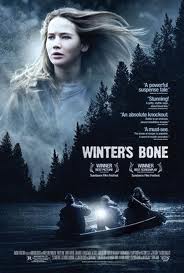
The “score” of the morning was a new copy of Winter’s Bone by Daniel Woodrell.  This is the fourth copy I have found this summer, and the book will be placed in the “Coming of Age” unit in Grade 11 as an independent choice novel. The School Library Journal reviewed this book for high school students saying, “In the poverty-stricken hills of the Ozarks, Rees Dolly, 17, struggles daily to care for her two brothers and an ill mother. When she learns that her absent father, a meth addict, has put up the family home as bond, she embarks on a dangerous search to find him and bring him home for an upcoming court date. Her relatives, many of whom are in the business of cooking crank, thwart her at every turn, but her fight to save the family finally succeeds. Rees is by turns tough and tender. She teaches her brothers how to shoot a shotgun, and even box, the way her father had taught her. Her hope is that these boys would not be dead to wonder by age twelve, dulled to life, empty of kindness, boiling with mean.”  When I read the novel, images of the witches from Macbeth came to mind!

For the independent reading shelves, I also located a copy of Dairy Queen by Catherine Gilbert Murdock, Book Two The Ruins of Gorlan in The Ranger’s Apprentice Series by John Flanagan , After by Francine Prose, and Ape House by Sara Gruen (surprising since this is a recent release).

New Fairfield’s sale offered far more hardcover fiction texts than trade paperbacks, and the children’s picture books were overflowing the small table to which they had been assigned. This could be an indication of a shift in population to more elementary aged choices….the New Fairfield babies are growing up!

Once I brought my two baskets to the counter, the volunteers at the checkout were gracious and accommodating. They were prepared with bags for purchases, and at my request  one quickly designed a receipt for me. (“Last year, I had a pile of receipts, but no one need them, wouldn’t you know?”)

Hardcovers were $2.00, trade paperbacks were $1.00, and small paperbacks were $.50. Sunday was “Bag day”-all books in a bag for $10.00.  I purchased only trade and small paperback on this trip and spent $26.00 for 32 books. These will be added to the school’s “book flood“.

The volunteers picked a perfect weekend for people looking for book bargains. Perhaps next year there will be better coordination of traffic outside the library and inside the sale so the efforts of the Friends of the New Fairfield Public Library are fully supported.

The impending arrival of Hurricane Irene made many of the good people of Fairfield County a little insane. I have watched Connecticut, the “land of steady habits”, develop a paranoid streak since the advent of 24/7 weather coverage. Media hyped hysteria ensues whenever a storm-summer or winter- approaches. So, there was no surprise in witnessing gridlock for the gas stations and deteriorating conditions in grocery aisles this weekend.

Instead of confronting the hysteria, I traveled to the Friends of the Bethel Public Library’s annual summer sale (August 27-29, 2011) where I found calm and order among the patrons quietly shopping for books, videos, records, DVDs and other media.

This sale was held in a large room in the municipal center across the street from the Bethel Public Library. I know the room as the “GP” room (general purpose) since I attended grades 7 & 8 in this building; I even performed on the stage which housed the young adult collection of books for sale!

The books were organized on tables by genres, and there were signs on each table that indicated genre. There were very few “misplaced” books; obviously the organizers know their titles.  The fiction tables were a mix of hardcover and trade copies, and they were not in any particular order. I was an early attendee of the sale, and there were several boxes of fiction trade books under the tables. I imagine the volunteers planned on filling in the tables with these books as the sale went on, and there were many volunteers already busy at work. These volunteers demonstrated a remarkable resistance to apocalyptic predictions of  weathermen; one even was quite confident that the sale would go on as scheduled on Sunday despite the predictions of tropical storm winds and steady rain.

Books for the Wamogo classroom libraries from the Bethel Library Book Sale

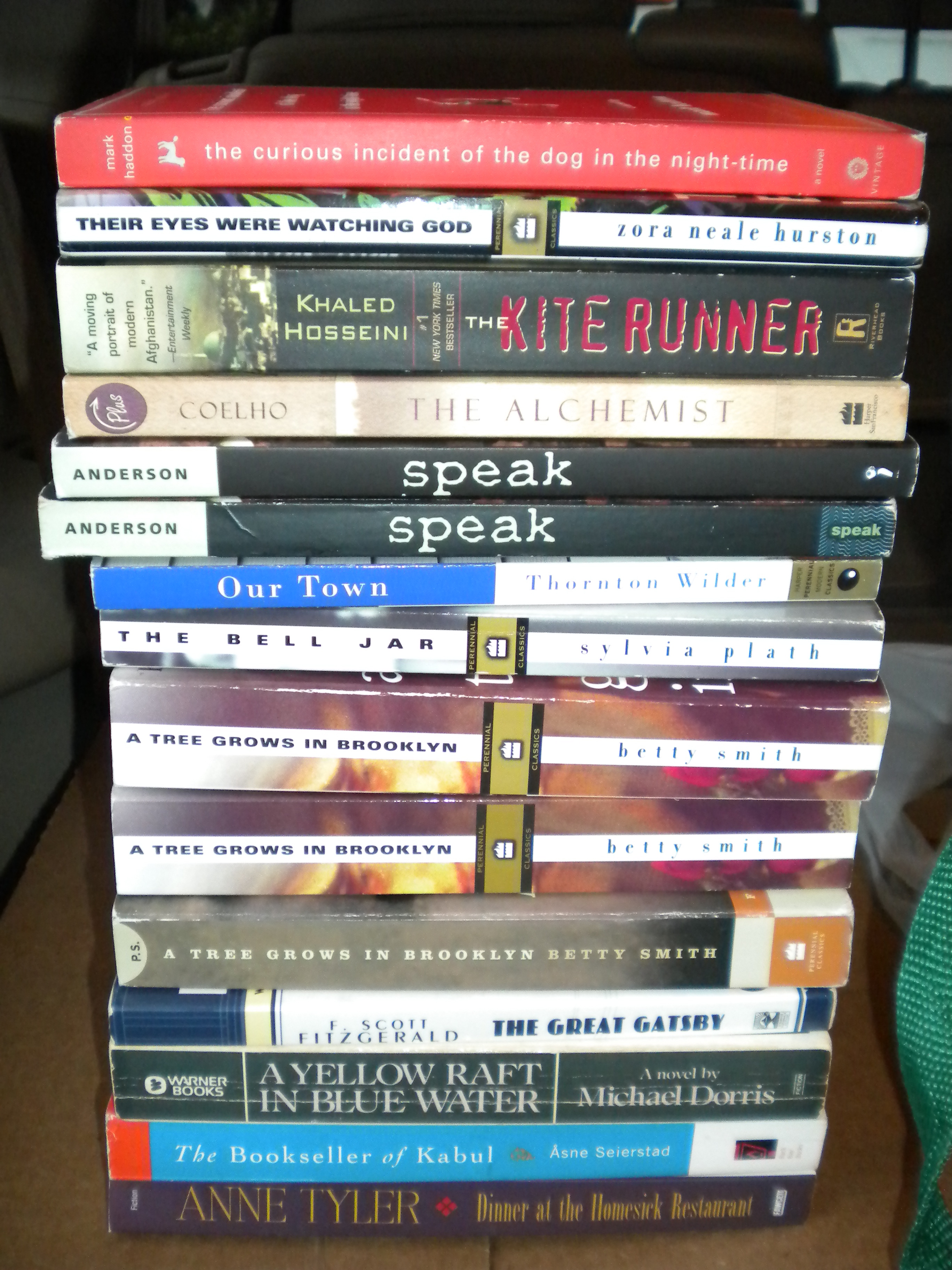
There were many good books at the sale that I can add to the classroom libraries. There were three new copies of A Tree Grows in Brooklyn by Betty Smith, a copy of Yellow Raft in Blue Water by Michael Dorris, and a copy of Anne Tyler’s Dinner at the Homesick Restaurant for independent reading by juniors. There were also copies of books that we teach including:

Speak by Laurie Halse Anderson
The Kite Runner by Khaled Houssani
The Curious Incident of the Dog in the Night-Time by Mark Haddon
The Great Gatsby by F. Scott Fitzgerald
Our Town by Thornton Wilder

There were also five copies of classic story The Light in the Forest by Conrad Richter which we use in our Native American unit in Grade 8. The coming of age story was published in 1953, and combines historical places and incidents centered in Northeastern Ohio in the 1750s. The book has been in continued use in middle school curriculum largely due to Richter’s ability to  portray the consequences of hostilities between the Native Americans and early European settlers of the American Midwest.

In little under 30 minutes, I picked up 72 books for $105.00; prices ranged from .50 -$2.00. The retail price at Amazon for the 15 books in the picture above would have been $158.38. My cost for these 15 books PLUS  57 other books was $105.00.

Community book sales provide an opportunity for a buyer to do a little cultural study on the reading habits of its residents. Obviously, Bethel residents enjoy fiction and the number of cookbooks was greater than the number of military history books. However, the biggest surprise was the number of tables dedicated to the genre of romance novels. I grew up in Bethel (on Grand Street from 1972-1980), and I would never have suspected that the town has developed such “passionate” interests!

I received a postcard to remind me of the upcoming sale, but I had already planned to attend since the sale was also listed on BookSaleFinder.com . Even Hurricane Irene could not stop the calm and dedicated volunteers of the Friends of the Bethel Public Library from succeeding in putting on a great sale with donated books.