Archives For November 30, 1999

Wikipedia-logoA short-lived category sub-set in a Wikipedia entry set off a feminist firestorm at the end of April. In an editorial for the New York Times titled “Wikipedia’s Sexism“,  the writer Amanda Filipacchi noted the removal of women writers from the Wikipedia web page category “American Novelists”; women writers had been regrouped under a new web page, “American Women Novelists”. Filipacchi wrote:

 “I looked up a few female novelists. You can see the categories they’re in at the bottom of their pages. It appears that many female novelists, like Harper Lee, Anne Rice, Amy Tan, Donna Tartt and some 300 others, have been relegated to the ranks of ‘American Women Novelists’ only, and no longer appear in the category ‘American Novelists.’ If you look back in the “history” of these women’s pages, you can see that they used to appear in the category ‘American Novelists,’ but that they were recently bumped down. Male novelists on Wikipedia, however — no matter how small or obscure they are — all get to be in the category ‘American Novelists.’ It seems as though no one noticed.”

The category “American Women Novelists” was created by a 32-year-old history student at Wayne State University, John Pack Lambert.  His editing was violation of Wikipedia’s rules that categories should not be based on gender.

Yet, this regrouping called attention to other “gender-biased” incidents that have happened at “the free encyclopedia that anyone can edit.” Apparently “anyone” is not editing.  In an interview on NPR by Lynn Neary,”What’s In A Category? ‘Women Novelists’ Sparks Wiki-Controversy”, Wikipedia editor Ryan Kaldari admitted:

“Only about 10 percent or less of the editors at Wikipedia are women. And so a lot of times there’s this subconscious, white, male, privileged sexism that exists on Wikipedia that isn’t really acknowledged.”

While that admission is startling in its honesty and frightening implications about editors at Wikipedia, another interesting story seems to have gone unnoticed. At age 12, Wikipedia is “coming of age”. The repercussions from this incident mark another step towards Wikipedia’s gradual movement towards acceptability; Wikipedia is learning how to becoming academically legitimate.

For example, what difference would it have made years or even several months ago if a Wikipedia editor had decided to create gender based subsets within categories if the Wikipedia was used primarily as a source to “settle a bet with a roommate“? In addition, as the web becomes more collaborative in the sharing of information, is the information on Wikipedia less valid because the more than one writer is responsible for the article? Moreover, do the “real time” corrections like those made every day on Wikipedia improve the validity of information available or do these corrections even matter since research from Ohio State University shows that many people cling to misinformation despite corrections? And up until last April, would any scholar or academic have cared how a Wikipedia editor organized one of the 4,325 categories currently available?

In the article “Wikipedia’s Woman Problem”, James Gleick in the New York Review of Books explained that Wikipedia has logged thousands of pages of discussions on categories:

“It’s fair to say that Wikipedia has spent far more time considering the philosophical ramifications of categorization than Aristotle and Kant ever did.”

Aristotle? Kant? Wikipedia is philosophical? That sounds almost scholarly.

Gleich makes the point that categories matter to Wikipedia:

“Categories are a big deal. They are an important way to group articles; some people use them to navigate or browse. Categories provide structure for a web of knowledge—not a tree, because a category can have multiple parents, as well as multiple children.”

The creation of the “American Women Novelist” category briefly separated Toni Morrison, Anne Rice, Nora Roberts, and Annie Dillard from their category counterparts such as Isaac Asimov, Ernest Hemingway, Hunter S. Thompson, Truman Capote,and Zane Gray. The result was that many scholarly people did care, especially female novelists. Joyce Carol Oates (novelist, short story writer, playwright, poet, literary critic, professor, editor) expressed her views on Twitter:

“Wikipedia bias an accurate reflection of universal bias. All (male) writers are writers; a (woman) writer is a woman writer.”

“New idea for Wikipedia sex-bias: list names alphabetically only of those Americans who ARE NOT writers/ poets.”

Similarly, the novelist Amy Tan, mentioned in the NY TImes editorial by Filipacchi, tweeted her response:

#WikipediaFail I have been reduced to a Lady Novelist. American novelists=only men. 1990s ghettoization returns!

These comments among others are an indication of broader academic conversations generated by Lambert’s changes to the “American Novelists” page and the exponential growth of information available online today. Who is in charge of information, the organization of information, and the accuracy of information? Salon’s Andrew Leonard’s considers an argument that the editing process for Wikipedia entries is public and that the process of continuous editing brings about accuracy. In his commentary “Wikipedia’s Shame” Leonard points out:

“…hardcore Wikipedia advocates argue that no matter how dumb or ugly the original bad edit or mistake might have been, the process, carried out in the open for all to see, generally results, in the long run, in something more closely resembling truth than what we might see in more mainstream approaches to knowledge assembly.”

But this is not the only incident involving authors and their dissatisfaction with decisions by Wikipedia, and gender bias is not the only controversy. There was also a recent incident involving the novelist Philip Roth. In August 2012, Roth contacted Wikipedia about a misstatement on an entry dedicated to his novel The Human Stain. Wikipedia would not authorize the change, and Roth wrote about the editors’ decision in an open letter published in The New Yorker:

SEPTEMBER 7, 2012

Dear Wikipedia,

I am Philip Roth. I had reason recently to read for the first time the Wikipedia entry discussing my novel “The Human Stain.” The entry contains a serious misstatement that I would like to ask to have removed. This item entered Wikipedia not from the world of truthfulness but from the babble of literary gossip—there is no truth in it at all.

Yet when, through an official interlocutor, I recently petitioned Wikipedia to delete this misstatement, along with two others, my interlocutor was told by the ‘English Wikipedia Administrator’—in a letter dated August 25th and addressed to my interlocutor—that I, Roth, was not a credible source: ‘I understand your point that the author is the greatest authority on their own work,’ writes the Wikipedia Administrator—’but we require secondary sources.'”

Really? The primary word of the author requires secondary sources? That definitely sounds like Wikipedia’s step towards the scholarly; the kind of instructions a teacher might given to a student doing a research paper.  With Roth’s situation, however, the editor’s decision seems incongruous, and the explanation reads more like text written by George Orwell, author of the prescient novel 1984.

If that Wikipedia’s editor’s response is Orwellian, then consider another comment made by Wikipedia editor Kaladari that the “American Woman Novelist” vs. “American Novelist” controversy has “about 33,000 words of discussion on it which is quite a lot.” Then he added, “It’s actually more than the novel Animal Farm.

Mr. Kaladari’s comparison may not have been intended to be ironic, but Orwell’s allegorical novel Animal Farm about a brutal regime that tries to rewrite history may be closer to this heart of this incident that readers realize. Think back to high school and remember the revolutionary speech by the pig, Old Major:

“There, comrades, is the answer to all our problems. It is summed up in a single word–Man.” 

“Exactly,” respond female writers everywhere.

muckRight about now, the last week of April, my Advanced Placement English Literature students are noticing a frantic tone creeping into my voice.

“No, finish this multiple choice practice FIRST, then complete the essay prompts. Any questions? No? Let’s go, now. Hurry….hurry….HURRY!!”
“Geez, you are so crabby lately,” notes one.

I am crabby; I understand the pressure they will be under during the AP exam in May, and I want them prepared. In contrast, they just want to be fourth quarter seniors.

These weeks are the “boot camp” weeks before the exam, and I am trying to improve their ability to respond quickly and decisively to a prompt. They will be writing three separate essays; each read by an audience of one, a reader who will grade hundreds of essays a day. They need to make a clear argument.

For practice, I offered a choice of four prompts to students. We just finished reading Eugene O’Neil’s A Long Day’s Journey into Night, and each prompt touched on one aspect of the play: the text, the characters, the theme. Rather than have them write a full essay response to a specific prompt, I had them write two separate opening and concluding paragraphs for their two chosen prompts. I gave them forty minutes to do both. The whining began immediately:

“I have a hard time just writing a beginning and an opening.”
“I always start in one place and end in another.”
“I need to write the middle or I can’t write the end!”

“That’s because you write to find out what you think,” I respond, “and that should show up in the introduction or the conclusion.”

Since the AP exam is a timed test, 120 minutes for three prompt analysis and response questions, timed practices are helpful. These truncated practice essays are incomplete and rough, but they do help students practice how to reconcile an introduction with a conclusion in a short time. In these hastily written drafts of beginnings and endings, I can help them distinguish their good ideas from linguistic clutter so an AP reader will better appreciate their argument. I do not want my students to make a thesis so hidden that the AP Reader is hunting for the “manifesto in the muck”.

What “muck” you ask? Essays cluttered with empty words:  a lot, kind of, sort of, actually, stuff, thing, very, really, quite

Essays cluttered with the muck of empty phrases:

  • Because of the fact of
  • The reason…is because

Essays cluttered with the muck of statements of the obvious:

  • The author uses diction and syntax to communicate his meaning.
  • The theme is the message the author is trying to communicate.
  • Words have meaning.

In one block period, the students wrote the truncated essays of introductions and conclusions in response to O’Neill’s semi-autobiographical play,  A Long Day’s Journey into Night.  We reviewed each draft to find the one powerful statement that publicly declared that student’s view, a statement that could get an AP reader’s attention. The prompts are in bold; student’s statements below each prompt:

PROMPT #1: Select a line you find especially memorable; analyze the reasons for its effectiveness.

  • When I read about this family, it reminded me of the advice, “only the strong survive’; the Tyrone family lives like a pack of animals, not a family.
  • If the characters in the play had the ability to leave behind their past, forget the things that made them lesser, they would be better off.

PROMPT #2: Describe how the author manages to give internal awakenings, discoveries, changes in consciousness the sense of excitement, suspense, and climax usually associated with external action.

  • James is struck with the conflict of having someone say his greatest fear is being in a class he does not think he belongs. 
  • The choice presented to each character is which moral or ethical barrier to shatter in order to overcome the cycle of insanity.
  •  Literature is an extension of human understanding and comes from our musings, our curiosities, and our imaginations.

PROMPT #3: Discuss the contribution scenes of social occasions reveal about the values of the characters and the society in which they live.

  • Whether these experiences dealt with alcohol abuse, substance abuse, or general unhappiness in life, all topics were acted out to be ignored or forgotten about, yet these [experiences] remained the most memorable. O’Neill wanted the conflicts to be pushed aside, which then caused the audience to latch on and never forget.
  • We seek out the approval and forgiveness of others when our own soul’s condition is purely of our own pilot.

PROMPT #4: Explain how the tragic figure functions as an instrument of the suffering of others and that the suffering brought upon others by that figure contributes to the tragic vision of the work.

  • In this way, each individual’s poisoned action spreads like a virus and affects all those in its proximity devouring them to the point of self destruction.
  • Edmund’s sickness is not just  source of unwanted strains on the family; it is an object to represent the family relationship.

When I come upon one of the above statements, in the beginning or the end of the draft, I can almost hear the “clink” that went on in the student’s head (and hand) as he or she drafted the essay.  At a point in the writing conferences that followed, a student will agree, “Yeah, that was when I figured out what I was writing about.” My experience is that students write their way into a thesis, and it is important for the student to recognize that statement, so he or she can parse away the clutter, removing the muck so that the AP Reader can find that statement too.

During this last week of AP English Literature practice, students will work at drafting responses to prose and poetry prompts. They will be writing their responses quickly, and I will still be crabby. But because of the practice, there will be less muck that covers a student’s manifesto in an AP literature essay response. After that, they can go back to being 4th quarter seniors.

Stephen King scares me. I have read only a handful of his books: Christine, The Green Mile, Carrie, but those have left a residue in my brain. My fear, created by the gruesome images in his fiction, would probably please him: he likes to tell stories that unsettle the reader.

I have, however, become a fan of his non-fiction book On Writing. While I am not as rabid as Annie Wilkes of Misery, I push this book on as many readers as possible. When I mention King’s name, however, I recognize the same uncomfortable flicker in their eyes. King scares them.

“No, really,” I urge, “this is nothing like the Stephen King books you don’t like. This is the Stephen King book you will like.”

On the surface, On Writing: A Memoir of the Craft is King’s memoir mixed with writing tips. The book is divided into three parts; the second part has two subsets of witty literary criticism.

In section one, the reader learns about King’s childhood, the history of his writing career, and the inspiration for several stories. He discusses his addictions, his stories, and his marriage to Tabitha, an author and his chief literary critic. In the second section, King discusses the craft of writing, first through the use of a “toolbox” of grammar  and then with application of these tips in various works of literature. The third and final section of the book covers his near death experience in June of 1999 when he was hit by a motorist on a side road in Maine.

We assign this book to our juniors who are taking the Advanced Placement English Language class, a course in familiarizing students with rhetoric and argument. The critical commentaries he offers in his “toolbox” section are especially helpful in helping students develop a style of writing.

He lectures the reader in a voice that is informal and wise. He gets the respect that English teachers struggling to impart the importance of subject-verb agreement crave to have from students. Plus, he swears; he swears a lot:

“You’ll also want grammar on the top shelf of your toolbox, and don’t annoy me with your moans of exasperation or your cries that you don’t understand grammar, you never did understand grammar, you flunked that whole semeste rin Sophomore English, writing is fun but grammar sucks the big one. Relax. Chill. We won’t spend much time here because we don’t need to. One either absorbs the grammatical principles of one’s native language in conversation and in reading or not.”

Some of his other observations include:

“Remember that the basic rule of vocabulary is use the first word that comes to your mind, if it is appropriate and colorful. If you hesitate and cogitate, you will come up with another word — of course you will, there’s always another word — but it probably won’t be as good as your first one, or as close to what you really mean.”

“Bad grammar produces bad sentences.”

The adverb is not your friend. … Adverbs, like the passive voice, seem to have been created with the timid writer in mind.”

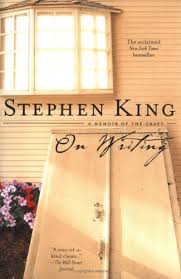
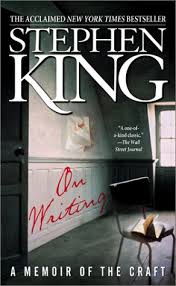
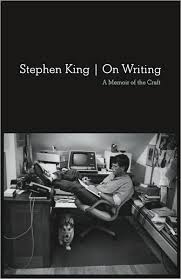
I have had some success in locating used copies of the book in its various editions. There are hardcovers and paperbacks in the secondary markets of thrift stores and library book sales, but I need to look close at the book spines since they are different in size and appearance. Our class set is a mish-mash of all editions.  The most frequent edition’s cover art is a picture of the cellar door, and if there was a book cover design that was dead wrong for the contents, this cover gets my vote. The cellar door may mean entrance to the “foundation” of writing, but the cream colored clapboards, bright window, and potted plant are an odd chice for King. The cover art with the letters of rejection nailed to a wall is macabre, perhaps a better choice for King and the contents. My favorite cover, though, is the most recent and centers on a photo of King working at his desk.

Cover simply did not match content!

Cover disconnect from content.

The macabre cover with rejection letters nailed to the wall

The macabre cover with rejection letters nailed to the wall; blood red title.

The most appropriate cover; one that matches the content

The most appropriate cover; one that matches the content-King writing On Writing

Last week, I offered this book to my own book group, an adult group of educated readers. Our discussion led to the question, “What is good writing?” We failed like so many others to come up with a definitive answer, but we did appreciate KIng’s four pages of suggested titles listed at the end of the memoir to read as examples of good writing. This list brings me to a major point in On Writing, King likes to read. This is repeated many times in the text:

“If you don’t have time to read, you don’t have the time (or the tools) to write. Simple as that.”

“If you want to be a writeryou must do two things above all others: read a lot and write a lot.

King’s dedication to the craft of writing is inspiring; the final paragraph captures his passion:

“Writing isn’t about making money, getting famous, getting dates, getting laid, or making friends. In the end, it’s about enriching the lives of those who will read your work, and enriching your own life, as well. It’s about getting up, getting well, and getting over. Getting happy, okay? Getting happy.”

On Writing has changed how I write. Because of On Writing, I hesitate to add an adverb (see? I consciously did not use “frequently hesitate”). I hear his voice say “I believe the road to hell is paved with adverbs” when I craft sentences,

My favorite part of the “toolbox” deals with his disdain for the passive voice. King tells the writer to “energize your prose with active verbs. … good writing is often about letting go of fear and affectation.”  My students tell me they write in write in passive voice to sound smart, so I need to counter with a clear example of why the use active voice is more powerful. King provides me a hilarious example:

“Everyone’s entitled to his/her opinion, but I don’t believe ‘With a hammerhe killed Frank‘ will ever replace ‘He killed Frank with a hammer.’”

“But how do you know when you are using passive voice?” my students ask. I offer my new “tool” to test, a tool I found on a Facebook post.

“If you can put ‘by Zombies’ after the verb, then you have passive voice,” I respond.

“Frank was killed…by Zombies?”

“Passive voice. To make the sentence active, you would have to write, ‘The Zombies killed Frank’. Much clearer, don’t you think?”

Passive voice and Zombies? I think Stephen King would enjoy that discussion.

This post completes a trilogy of reflections on the Connecticut Academic Performance Test (CAPT) which will be terminated once the new Smarter Balance Assessments tied to the Common Core State Standards (CCSS) are implemented. There will be at least one more year of the same CAPT assessments, specifically the Interdisciplinary Writing Prompt (IW) where 10th grade students write a persusive essay in response to news articles. While the horribly misnamed Response to Literature (RTL) prompt confuses students as to how to truthfully evaluate an story and drives students into “making stories up” in order to respond to a question, the IW shallowly addresses persuasive writing with prompts that have little academic value.

According to the CAPT Handbook (3rd Generation) on the CT State Department of Eduction’s website, the IW uses authentic nonfiction texts that have been:

“… published and are informational and persuasive, 700-1,000 words each in length, and at a 10th-grade reading level.  The texts represent varied content areas (e.g., newspaper, magazine, and online articles, journals, speeches, reports, summaries, interviews, memos, letters, reviews, government documents, workplace and consumer materials, and editorials).  The texts support both the pro and con side of the introduced issue.  Every effort is made to ensure the nonfiction texts are contemporary, multicultural, engaging, appropriate for statewide implementation, and void of any stereotyping or bias.  Each text may include corresponding maps, charts, graphs, and tables.”

Rather than teach this assessment in English, interdisciplinary writing is taught in social studies because the subject of social studies is already interdisciplinary. The big tent of social studies includes elements of economics, biography, law, statistics, theology, philosophy, geography, sociology, psychology, anthropology, political science and, of course, history. Generally, 9th and 10 grade students study the Ancient World through Modern European World (through WWII) in social studies. Some schools may offer civics in grade 10.

Social studies teachers always struggle to capture the breadth of history, usually Western Civilization, in two years. However, for 15 months before the CAPT, social studies teachers must also prepare students to write for the IW test. But does the IW reflect any of the content rich material in social studies class? No, the IW does not. Instead the IW prompt is developed on some “student centered” contemporary issue. For example, past prompts have included:

  • Should students be able to purchase chocolate milk in school?
  • Should utility companies construct wind farms in locations where windmills may impact scenery or wildlife?
  • Should ATVs be allowed in Yellowstone Park?
  • Should the school day start later?
  • Should an athlete who commits a crime be allowed to participate on a sports team?
  • Should there be random drug testing of high school students?

On the English section of the test, there are responses dealing with theme, character and plot. On the science section, the life, physical and earth sciences are woven together in a scientific inquiry. On the math section, numeracy is tested in problem-solving. In contrast to these disciplines, the social studies section, the IW, has little or nothing to do with the subject content. Students only need to write persuasively on ANY topic:

For each test, a student must respond to one task, composed of a contemporary issue with two sources representing pro/con perspectives on the issue.  The task requires a student to take a position on the issue, either pro or con.  A student must support his or her position with information from both sources.  A student, for example, may be asked to draft a letter to his or her congressperson, prepare an editorial for a newspaper, or attempt to persuade a particular audience to adopt a particular position.  The task assesses a student’s ability to respond to five assessed dimensions in relationship to the nonfiction text: (1) take a clear position on the issue, (2) support the position with accurate and relevant information from the source materials, (3) use information from all of the source materials, (4) organize ideas logically and effectively, and (5) express ideas in one’s own words with clarity and fluency.

The “authentic” portions of this test are the news articles, but the released materials illustrate that these news articles are never completely one-sided; if they are written well, they already include a counter-position.  Therefore, students are regurgitating already highly filtered arguments. Secondly, the student responses never find their way into the hands of the legislators or newspaper editors, so the responses are not authentic in their delivery. Finally, because these prompts have little to do with social studies, valuable time that could be used to improve student content knowledge of history is being lost.  Some teachers use historical content to practice writing skills, but there is always instructional time used to practice with released exam materials.

Why are students asked to argue about the length of a school day when, if presented with enough information, they could argue a position that reflects what they are learning in social studies? If they are provided the same kinds of newspaper, magazine, and online articles, journals, speeches, reports, summaries, interviews, memos, letters, reviews, government documents, workplace and consumer materials, and editorials, could students write persuasive essays with social studies content that is measurable? Most certainly. Students could argue whether they would support a government like Athens or a government like Sparta. Students could be provided brief biographies and statements of belief for different philosophers to argue who they would prefer as a teacher, DesCartes or Hegel. Students could write persuasively about which amendment of the United States Constitution they believe needs to be revisited, Amendment 10 (State’s Rights) or Amendment 27 (Limiting Changes to Congressional Pay).

How unfortunate that such forgettable issues as chocolate milk or ATVs are considered worthy of determining a student’s ability to write persuasively. How inauthentic to encourage students to write to a legislator or editor and then do nothing with the students’ opinions. How depressing to know that the time and opportunity to teach and to measure a student’s understanding of the rich content of social studies is lost every year with IW test preparation.

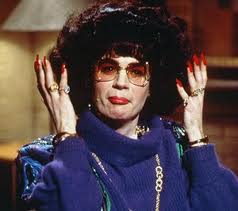
coffeetalkMaybe the writers of the CAPT IW prompt should have taken a lesson from the writers of Saturday Night Live with the Coffee Talk with Michael Myers. In these sketches, Myers played Linda Richmond, host of the call-in talk show “Coffee Talk”. When s(he) would become too emotional (or feclempt or pheklempt ) to talk, s(he) would “give a topic” to talk “amoungst yourselves”.  Holding back tears, waving red nails in front of his face furiously, Myers would gasp out one of the following:

“The Holy Roman Empire was neither holy, Roman, nor an empire….Discuss…”

“Franklin Delano Roosevelt’s New Deal was neither new nor a deal…. Discuss…”

“The radical reconstruction of the South was neither radical nor a reconstruction…. Discuss…”

“The internal combustion engine was neither internal nor a combustion engine…. Discuss…”

If a comedy show can come up with these academic topics for laughs, why can’t students answer them for real? At least they would understand what made the sketches funny, and that understanding would be authentic.

As the Connecticut State Standardized tests fade into the sunset, teachers are learning to say “Good-bye” to all those questions that ask the reader to make a personal connection to a story. The incoming  English Language Arts Common Core Standards (ELA- CCSS) are eradicating the writing of responses that begin with, “This story reminds me of…..” Those text to self, text to text, and text to world connections that students have made at each grade level are being jettisoned. The newly designed state assessment tests will tolerate no more fluff; evidence based responses only, please.

sunsetPerhaps this hard line attitude towards literacy is necessary correction. Many literacy experts had promoted connections to increase a reader’s engagement with a text. For example,

 “Tell about the connections that you made while reading the book. Tell how it reminds you of yourself, of people you know, or of something that happened in your life. It might remind you of other books, especially the characters, the events, or the setting” (Guiding Readers and Writers Grades 3-6, Fountas and Pinnell) 

Unfortunately, the question became over-used, asked for almost every book at each grade level. Of course, many students did not have similar personal experiences to make a connection with each and every text. (Note: Given some of the dark literature-vampies, zombies- that adolescents favor, not having personal experience may be a good sign!) Other students did not have enough reading experience or the sophistication to see how the themes in one text were similar to themes in another text.  Some of the state assessment exemplars revealed how students often made limited or literal connections, for example:”The story has a dog; I have a dog.”

The requirement to make a connection to each and every story eventually led to intellectual dishonesty.  Students who were unable to call to mind an authentic connection faked a relationship or an experience. Some students claimed they were encouraged by their teachers to “pretend” they knew someone just like a character they read about. “Imagine a friend had the same problem,” they were told.   Compounding this problem was the inclusion of this connection question on the state standardized tests, the CAPT (grade 10) and the CMT (grades 3-8). So, some  students traded story for story in their responses, and they became amazingly creative in answering this question. I mentioned this in a previous post when a student told me that the sick relative he had written about in a response didn’t really exist. “Don’t worry,” he said brightly after I offered my condolences, “I made that up!”

Last week, our 9th grade students took a practice standardized test with the “make a connection question” as a prompt. They still need to practice since there is one more year of this prompt before ELA CCSS assessments are in place. The students wrote their responses to a story where the relationship between a mother and daughter is very strained. One of the students wrote about her deteriorating and very difficult relationship with her mother. I was surprised to read how this student had become so depressed and upset about her relationship with her mother. I was even more surprised that afternoon when that same mother called to discuss her daughter’s grade. I hesitated a little, but I decided to share what was written in the essay as a possible explanation. The next day, I received the following e-mail,

“I told M___that I read the practice test where she said I didn’t have time to talk and other things were more important. She just laughed and said that she had nothing in common with the girl in the story so she just made that up because she had to write something. We had a good laugh over that and I felt so relieved that she didn’t feel that way.”

After reading so many student “make a connection” essays, I should have seen that coming!

Good-bye, “Make a Connection” question. Ours was an inauthentic relationship; you were just faking it.

What better way to celebrate International Women’s Day 2013 but to pay tribute to Canadian author Margaret Atwood? Poet, novelist, lecturer, inventor, tweeter, and celebrity ice hockey goalie, Atwood’s achievements in each of these roles is accomplished with wit, grace, and aplomb.

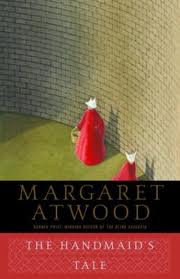
Handmaid's tale

There are other earlier covers, but this one is my personal favorite.

My Advanced Placement English Literature class just finished reading her novel, The Handmaid’s Tale. The novel is set in the dystopia of Gilead, where in response to political and ecological upheaval, a quasi-Christian theocracy is organized in the eastern section of the United States. Astute Sparknote writers, graduates of Harvard, recognized many of the landmarks in the novel’s setting (the brick wall, the gymnasium) as that of their alma mater, an indication of Atwood’s wry sense of irony. In the novel, fertility is an obsession. Rituals and “ceremonies” are enforced; offenders and outliers are publicly executed or sent to labor in toxic waste dumps. The main character Offred, who had a daughter before the establishment of the Republic of Gilead, is valued only for her ability to reproduce.

Because of the mature themes, The Handmaid’s Tale is often taught in senior high school classes. The title is often suggested on the exam for the open-ended Question #3 on the AP Literature exam which means other schools assign the book. There are always plenty of copies available in the secondary market. Our classroom library has over 60 copies from a variety of library book sales and thrift stores. I have spent under $100.00 in adding this title to our curriculum; I’d like to think that Atwood might be pleased with this “ecological” way to have students read the text despite her loss of possible retail revenue. However, if one wanted a new copy, they are available at Amazon for $10.20 paperback or an audio recording by Claire Danes is available  at Audible.com  for $24.95.

When we discuss the clothing that marks the different “castes” of people in Gilead,  I always use the endpaper story Atwood published in the New York Times Magazine published “When Afghanistan Was at Peace”

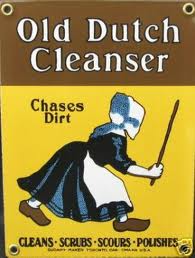
Six years after our trip, I wrote ”The Handmaid’s Tale,” a speculative fiction about an American theocracy. The women in that book wear outfits derived in part from nuns’ costumes, partly from girls’ schools’ hemlines and partly — I must admit — from the faceless woman on the Old Dutch Cleanser box, but also partly from the chador I acquired in Afghanistan and its conflicting associations. As one character says, there is freedom to and freedom from. But how much of the first should you have to give up in order to assure the second? All cultures have had to grapple with that, and our own — as we are now seeing — is no exception. Would I have written the book if I never visited Afghanistan? Possibly. Would it have been the same? Unlikely.”

Dutch Cleanser

The combination of the Dutch Cleanser girl with the chador is the inspiration for Offred’s clothing; the story and the visual always sparks a discussion on the symbolic effect of clothing.

My students always argue about the genre of The Handmaid’s Tale. This year there were a number of votes for political science book, others for a dystopian love story; no one said science fiction. Atwood would be relieved; she has always drawn the distinction between science fiction and her writing which she calls “speculative fiction”. Several of my students also read the other books Oryx and Crake and The Year of The Flood that are speculative fiction.

Here is Atwood with her take on the genre of specultive fiction.

The conclusion of The Handmaid’s Tale ends in an allusion to the story of Orpheus and Eurydice:

“We may call Eurydice forth from the world of the dead, but we cannot make her answer; and when we turn to look at her we glimpse her only for a moment, before she slips from our grasp and flees.”

After we finished the novel, the class read Atwood’s poem Eurydice. I asked them what they thought.

  • “There is a sense of longing in both.”
  • “The language is so similar. There is the white curtain…the gauze.”
  • “‘It is not through him you will get your freedom’ is just like
    from and freedom to…that is Offred’s problem”
  • “We could have just read the poem! They’re almost the same!”

One other area of speculative fiction where Atwood has shared her thoughts is on the topic of modernity…and Zombies. In an interview on George Stroumboulopoulos Tonight, Atwood was quite clear on the limits of Zombie stories:

“No zombie story is ever told from the zombie point of view… they’re not narrative…they don’t have language and that impedes one from telling a story.”

Outside of fiction, Atwood has also written about debt. Her non-fiction book Payback: Debt and the Shadow Side of Wealth came from her 2008 Massey Lectures. Not surprisingly, her interest in debt began in from her study of Victorian Literature. In an interview with Suzanne Ellis, CityLine “Margaret Atwood On Payback And The Concept Of Debt”  Atwood discussed how the Victorian stories that are on the surface about love and romance are really all about financial arrangements:

“In [Jane Austen’s] Sense and Sensibility, Marianne can’t marry the love of her life because he needs to marry a rich person. He doesn’t have any money. She’s devastated by that and gets a bad cold,” Atwood muses. “You start following the money in these novels and it takes you to the most amazing places. Where did Heathcliff get the money that he uses to buy Wuthering Heights, or I should say to gamble the owner of it out of it? How does he do that? We’re not quite sure but it’s something pretty shady.”

The book was made into a documentary and released in the spring of 2012. The New York Times critic A.O. Scott opens his film review with the premise of the documentary:

A glance at the headlines from Europe, the news from Washington or this month’s bills will confirm that we live in an age of debt. Debt, a concept at once straightforward and almost metaphysically complex, is a source of personal, national and global anxiety, and forms a link between the individual and the worldwide economic system.

While the film did not receive critical acclaim, Atwood’s ability to connect herself and link to the world through Twitter is often lauded.  She is an avid twitterer with 383,430 followers and over 15,000 tweets of her own. She links to political issues, comments on travels, and gives recipe advice:

Screen Shot 2013-03-08 at 11.06.17 AM Screen Shot 2013-03-08 at 11.07.07 AM Screen Shot 2013-03-08 at 11.08.58 AM Screen Shot 2013-03-08 at 11.09.56 AM

She also is the inventor of the “long pen”, a device that allows her to attend book signings from distances and sign books “virtually”. When she is tired of traveling to sign books, she can now meet her adoring public in virtual space and provide them with an authentic signature. Fortunately, I saw her before the “long pen” at a Barnes and Noble reading/book signing for her short story collection Moral Disorder. She was amazingly articulate; in the 40 minute talk, she never hesitated or once said “um”.

And just when you thought that Atwood could not be more accomplished, she starred in a video explaining “How to Stop a Hockey Puck” for the comedian reporter Rick Mercer. I put the video below. (Too bad her “Dance Party Video” was removed from YOUTube for copyright violations.)

So, on this International Woman’s Day, let’s hear a cheer for Margaret Atwood!

She writes. She tweets. She scores!

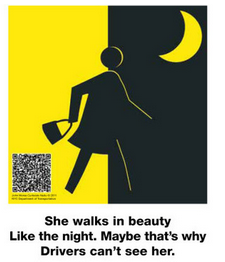
Mash-up are usually the blending of music from two or more sources. However a different mash-up was featured in a story by National Public Radio (NPR) where street signs in New York City were rewritten into Haiku poetry, Haiku Traffic Signs Bring Poetry To NYC Streets. This story illustrated how a mashup could be made of a very basic informational text with a strict poetic form. “Caution: Oncoming Traffic” was expanded into a poem of  of 5 syllables/7 syllable/5 syllables of “8 million swimming/The traffic rolling like waves/Watch for undertow.” In the NPR story,

“Traffic warning street signs written as haiku are appearing on poles around the five boroughs, posted by the New York City Department of Transportation. The poems and accompanying artwork were created by artist John Morse.”

Screen Shot 2013-03-03 at 5.35.21 PM Screen Shot 2013-03-03 at 5.35.31 PM Screen Shot 2013-03-03 at 5.35.39 PM

NYC’s Department of Transportation hoped the signs would catch new eyes in order to communicate important information. The unusual combination of graphics and verse on street signs presented pedestrians with additional information, a different point of view. The reordering of information is just one example of how presenting information in a different genre also provides new writing opportunities for new audiences.

Since the English Language Arts Common Core is rattling its standards calling for an increase in informational texts, the 9th grade curriculum is including a non-fiction unit where students choose a non-fiction text of their own to read. The CCSS  require this increase based on:

“…extensive research establishing the need for college and career ready students to be proficient in reading complex informational text independently in a variety of content areas. Most of the required reading in college and workforce training programs is informational in structure and challenging in content…”

Our students may choose a text to read on topics that range from animal or adventure topics to travel or war. There are titles that have been made available in bulk on the secondary market, such as public library book sales or thrift stores and added to our classroom book carts. The books purchased for $1.00 each (see how) include:

  • Girl Interrupted-Keysen
  • Guts-Paulsen
  • Tuesdays with Morrie-Albom
  • The Tipping Point– Gladwell
  • Left for Dead-Nelson
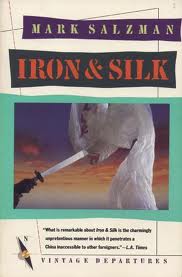
  • Iron and Silk-Salzman
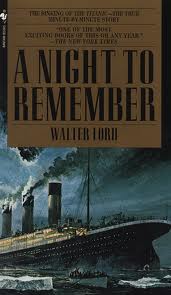
  • A Night to Remember-Lord
  • Hiroshima-Hersey
  • The Teammates-Halberstam

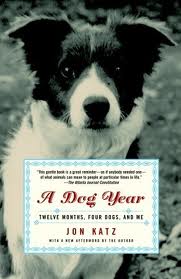
iron and silk Night to remember dog year Tipping

There are also a number of books that deal with animal literature that are stocked on the classroom book cart. Many of these texts will also be available for the senior elective, “Critter Lit”:

  • With Love from Baghdad-Kopelman
  • Tell Me Where It Hurts-Trout
  • Seabiscuit-Hillebrand
  • Winterdance– Paulsen
  • A Dog Year-Katz
  • Wesley the Owl-O’Brien
  • Alex and Me-Royte
  • Modoc-Helfer
  • The Pig Who Sang to the Moon-Masson

Students may chose from these titles or another non-fiction choice though the school library, which also offers the online book shelf Overdrive. The students organize themselves into thematic groups while the unit runs for four weeks (block schedule) with some overlap during the standardized testing weeks. The students spend time reading in class, and they organize themselves into thematic groups. Rather than respond in essays or traditional research papers, the students are given an opportunity to create genre mash-ups.

First, to prepare for writing mash-ups, the students generated a list of the kinds of non-fiction writing they see everyday including:

  • License plate
  • Newspaper article
  • Letter to the editor
  • Ad
  • food labels
  • Menu
  • Directions
  • Q&A Interview
  • Diary
  • Weather report
  • Sports report
  • Billboard
  • Tweet
  • Blog post
  • Directions

Next, the mini-lessons that begin each class are quick( 5-10 minutes) and focus on the characteristics of a particular genre from the list so that students can create rewrite each text in that genre. For example, students review how information is arranged on a food label before creating a “food label” for the books they are reading. Students read billboards and street signs before creating the same.  After each mini-lesson, students write about their text in the assigned genre and use a Google Docs folder to develop a portfolio of authentic writing. The result is a portfolio of mash-ups of informational texts rewritten by students into other genres.

Like the haiku and street sign mash-up, these mashups will still communicate essential information. Students can write about the texts they choose to read in the authentic genres they encounter everyday.

Finally, when April comes around, the students may try writing their essential information in poetry: sonnets, limericks, villanelles and even haikus. After all, April is National Poetry Month!

According to literary legend, Ernest Hemingway wrote a six word short story in response to a bet:

Screen Shot 2013-02-26 at 3.58.31 PM

So when my Advanced Placement English Literature class was suddenly shortened one day last week due to a  delayed opening, I thought that I would do a close reading on this famous short story. After all, how long could a discussion on six words last? I was confident there would certainly be enough time for each of them to craft an essay as well.

The usual procedure for close readings in class is to have a volunteer “read aloud” while students annotate their copies of the text. The text is also displayed on the SMARTboard so that notes can be added and shared with all members of the class.

After they settled down with copies, Sam volunteered to read. We listened and paused. I started to ask, “So how did Ernest Hemingway, the author of this short story, convey his meaning?” when I was cut off.

“Whose baby died?” asked Alexis. She had no notes on her page.

“The baby died?” Connor responded, “I thought this was about a tag sale.”

“Why do you say that?” I asked, “Look at the evidence in the text.”

“Because people who have tag sales put in ads, and the ads are short,” replied Connor.

“But that is why the ad is short,” Alexis retorted, “the parents are so upset, they cannot write a long ad to sell the baby’s shoes.”

“Where are parents in the text?” I demanded.

“I agree with Alexis,” said Sam, “the shoes were ‘never worn’. The baby is dead.”

“OK,” I agreed, ” the words ‘never worn’ are in the text, but…”

“But the baby shoes could have been a gift that was the wrong size,” interrupted Natalie.

We were drifting off in our discussion. I had chosen the story because of its brevity, but I also had considered how well the text responded to the Publisher’s Criteria for the English/Language Arts Common Core Standards:

The Common Core State Standards place a high priority on the close, sustained reading of complex text, beginning with Reading Standard 1. Such reading focuses on what lies within the four corners of the text. It often requires compact, short, self-contained texts that students can read and re-read deliberately and slowly to probe and ponder the meanings of individual words, the order in which sentences unfold, and the development of ideas over the course of the text.

This was a “compact, short, self-contained texts that students can read and re-read deliberately.” The students were beginning to probe the meanings of individual words, but they were drifting.  They were bringing up tag sales, upset parents, and poor present gifting;  we were far off the four corners of this text.

For a moment, a very brief moment, I consider that we were moving away from the goals of the Common Core to work with the text. However, they were so quickly engaged, that I grew far more interested in listening to how close to they were to determining Hemingway’s purpose. Hemingway had selected six specific words to excite the reader’s imagination. My students were not wrong in their suggestions, they were using his text to understand, to create meaning. They were working with Hemingway’s language and responding to his inferences.

Their written drafts also leapt beyond the evidence, much like the discussion:

  • “They have waited nine months in anticipation for this day, and that morning a pair of shoes, no larger than the size of a plum, arrived in the mail, a gift from an aunt. They run to the hospital; they cry, they yell, they cry, but their baby is dead. ‘Get rid of those shoes.’ He writes in the paper, “For sale: baby shoes, never worn.’ Auntie will be sad.”
  • “…whether it’s a parent/ guardian or a thief trying to make money, it is obvious from the syntax that the shoes need to go.”
  • “‘For sale’ is a general coupling of words that comes from a particular type of person….a person low on monetary resources or one who wants to get rid of something…”
  • “…by saying the word ‘never’, that means the parents have never had a baby and will never have a baby…never is finite”
  • “In reality, Hemingway’s story is less of a story and more of a jumping off point. The six words are a choke point, like that of an hourglass stretching of in infinity in either direction.”

These drafts, hastily written in response to the story, ranged from 2-3 handwritten pages; far more than the six words that stimulated their ideas. The students wrote furiously until the bell rang, and then begged for more time to finish.

Certainly, their responses could be judged by the CCSS criteria, “Student knowledge drawn from the text is demonstrated when the student uses evidence from the text to support a claim about the text.” However, their responses in discussion and in essays offer significant proof that the ideas that started in text cannot be limited by clocks or “four corners”.

College Application Essay topics for 2013-2014 have been posted, and SURPRISE! Every prompt requires a narrative!

storyA recent news release by the Common Application, a non-profit widely used for college admissions by high school seniors at nearly 500 colleges and universities, explains the changes in essay prompts for 2013-14. The option to write about a topic of “your choice” has been dropped; the essay topics are:

  • Recount an incident or time when you experienced failure. How did it affect you, and what lessons did you learn?
  • Reflect on a time when you challenged a belief or idea. What prompted you to act? Would you make the same decision again?
  • Describe a place or environment where you are perfectly content. What do you do or experience there, and why is it meaningful to you?
  • Discuss an accomplishment or event, formal or informal, that marked your transition from childhood to adulthood within your culture, community, or family.

The irony of this decision should not be lost on anyone who remembers a blunt statement made by David Coleman, the current President of the College Board. In April of 2011 at a NY State Department of Education presentation on the Common Core, Coleman said, “As you grow up in this world, you realize people really don’t give a sh*t about what you feel or what you think.”

Well, apparently the College Application Board does care. Their prompts specifically ask college bound students what they feel or what they think. In fact, the College Application Board cares so much that they will allow students to expand their storytelling by an additional 150 words, increasing the word count from 500 to 650.

The decision by the College Application Board really is not that surprising.  on the Buffer blog called attention to research on reaction of the  the human brain to stories. He summarized a number of brain studies that indicate that the best learning comes from storytelling. One study by Uri Hasson from Princeton was published in an article titled “Speaker–Listener Neural Coupling Underlies Successful Communication” in the Proceedings of the National Academy of Sciences. The article discussed how subjects under study create empathetic bonds with listeners by using stories:

“When the woman spoke English, the volunteers understood her story, and their brains synchronized.  When she had activity in her insula, an emotional brain region, the listeners did too.  When her frontal cortex lit up, so did theirs. By simply telling a story, the woman could plant ideas, thoughts and emotions into the listeners’ brains.”

College bound seniors should take note of this research when they write; apparently a compelling story can be quite convincing. Luckily, they will have  plenty of practice with the narrative writing genre which is now back in favor with the adoption of the Common Core Literacy Standards. Anchor Writing Standard #3 for grades K-12 reads:

CCSS.ELA-Literacy.CCRA.W.3 Write narratives to develop real or imagined experiences or events using effective technique, well-chosen details and well-structured event sequences.

Curiously enough, one of the architects of the Common Core Literacy Standards was David Coleman before he took his position at the College Board.

Now the revised College Application Board form for 2013-14 states: “Some students have a background or story that is so central to their identity that they believe their application would be incomplete without it. If this sounds like you, then please share your story”

A word of caution, though. Don’t expect College Board President Coleman to care.

Today is Digital Learning Day! To mark the occasion, let me take you through a quick walkthrough of the halls of Wamogo Regional Middle/High School and give you a snapshot on how digital learning looks in the English classrooms grades 7-12. We have 1:1 computers in grades 7 & 8; in grades 9-12, we have a “bring your own digital device” policy. Here are the digital learning activities on Wednesday, February 6, 2013:

Grade 7: Students responded to a short story they read, “The Amigo Brothers”. They accessed the wiki (www.PBworks.com) in order to respond to “close reading” questions on the author’s use of figurative language. (Students are required to use evidence in their responses; digital copies of text helps student correctly add and cite evidence).

Grade 8: Students uploaded their reviews of the books (Mississippi Trial, 1955; Chains; The Greatest) they have been reading in literature circles to www.edmodo.com. These reviews are connected to the Common Core Writing Standard #6:

CCSS.ELA-Literacy.W.8.6 Use technology, including the Internet, to produce and publish writing and present the relationships between information and ideas efficiently as well as to interact and collaborate with others.

Grade 9: Students responded to a “writing on demand” journal prompt in preparation for the novel Of Mice and Men. This prompt is connected to the theme of hopes and dreams, and the students were asked:

What is your hope for life, your goal, or even your dream?  What do you think you want from the future? What would you live without, dream-wise?  What couldn’t you live without?

The students also posted their responses on a www.Edmodo.com discussion thread. Selections from responses included:

  • Something I couldn’t live with out would be my grandparents because they are like another set of parent to me, just better. They mean so much to me, that I really couldn’t see my life without them.
  • I hope to be a plant geneticist in the future, that is my hope but no matter what happens I would like to have a career involving plants and even if I can’t get a career in genetics I know it will always be a hobby of mine.
  • My house will be by the ocean, so close I can see it out of my kitchen window. I will grow old and drink coffee on my porch, while I read the paper and wave to my neighbors who walk by!
  • I could live without being famous around the world but I would like to be known town wise. I cannot live without family and their support in my decisions. They help me to stay confident and get through whatever I want to accomplish in life.
  • I think I could live without wanting a huge house or a huge boat “dream-wise”, but that still doesn’t mean I don’t want those things. I couldn’t live without music or my family.
  • My biggest hope and dream is to have a really big plot of land and have the world’s biggest tractor and a bunch of snowmobiles and ATV’s.
  • I want to be able to adopt kids from Uganda but also have my own, and I want to live in a nice house with a big yard. I want to work with little kids as a job.

10th grade Honors English students are reading Great Expectations. They took a quiz on www.quia.com, a software platform for timed quizzes. The College Prep English classes are reading Animal Farm. Today, they had to access “The International” MP3 and the www.youtube.video of the Beatle’s song “Revolution.

For homework tonight, students will write their own “protest” song.

Grade 11: Students can access the vocabulary list from the film The Great Debaters through the class wiki (www.pbworks.com) while the Advanced Placement English Language students watched a YouTube video of a Langston Hughes poem “I, Too, Sing America” read by Denzel Washington:

They prepared responses to the following questions which were posted on the class wiki:

  1.  To whom is the poet writing?  How do you know?
  2.  Choose one stanza and discuss what you feel is the key word in this stanza and explain why you chose this word?
  3.  What feelings does the poem create?  Which words create this feeling?

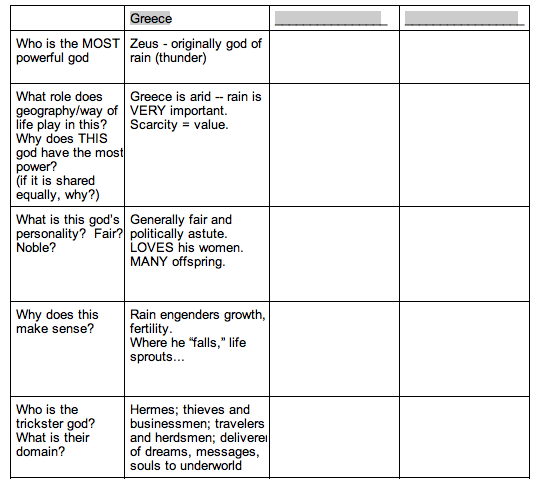
Grade 12: Students in the Grade 12 Mythology class accessed the following Google Doc Template and filled in the chart with their own research about the mythologies of different cultures. This activity meets the CCSS writing:

CCSS.ELA-Literacy.W.11-12.7 Conduct short research projects to answer a question; narrow or broaden the inquiry when appropriate; synthesize multiple sources on the subject

Screen Shot 2013-02-06 at 11.43.41 AM

The Film and Literature class “flips” the content by having students watch films for homework in order to discuss them during class. Tonight’s assignment? Watch the following YouTube clip and be ready for an open note quiz:

Students in the Advanced Placement English Literature class read the short story “Barn Burning” by William Faulkner that was embedded with a quiz on www.quia.com. They then created a list of four themes from the short story on a Google Doc. Each student selected a theme and placed his/her responses in the Google Drive folder to share with other members of the class. Examples included:

  • Actions we take with the grotesque: Shun? Avoid?

This story embodies an ultimate grotesque atmosphere. Even Colonel Satorius Snopes’ sisters are described as, “hulking sisters in their Sunday dresses” (2). These sisters are emulated throughout the story as disgusting, rotund, lethargic, and hog-like beings. This grotesque physical trait emulates the family’s condition in society. Satorius’ clothes are described as, “patched and faded jeans even too small for him.” (1).

  • Family over law or law over family

For the boy to go against his family in the end further proves his actions of courage and strength, and portrays the theme of law over family. “Then he began to struggle. His mother caught him in both arms, he jerking and wrenching at them. He would be stronger in the end, he knew that. But he had no time to wait for it” (10). His whole family is holding him back, but he chooses to go against all of them and do what is right.

This quick walkthrough demonstrating the use of technology in the English classrooms on one day demonstrates that for the teachers and students at Wamogo, everyday is a Digital Learning Day!