Archives For November 30, 1999

Busines_heroThe association of midterm exams with freezing is both literal (I teach in the Northeast) and figurative  (many students “freeze up” during an exam), so at the end of this semester, I took one of the writing standards from the Common Core State Standards  hoping at the very least to stop the “freeze” in the classroom during the exam. Instead of a multiple choice exam with essay questions, I prepared my 12th grade students to write an inquiry paper that would be due the morning of the exam. Yes, even those seniors who had repeatedly assured me that they will never go to college would be tasked with a three to five page paper academic paper that touched on the material that we had read over the course of the semester.

The Common Core State Standard I had in mind was ELA Literacy Standard W.11-12.7:

Conduct short as well as more sustained research projects to answer a question (including a self-generated question) or solve a problem; narrow or broaden the inquiry when appropriate; synthesize multiple sources on the subject, demonstrating understanding of the subject under investigation.

I admit, the draw for me was the “self-generated question”. We had started the “Hero or Monster” English elective brainstorming the following questions:

  • What is the difference between a hero or monster?
  • What criteria do we use to determine who or what is a hero?
  • What criteria do we use to determine who or what is a monster?

We read about monsters in Louis Stevenson’s  Dr. Jekyll and Mr. Hyde and Mary Shelley’s Frankenstein. We read excerpts from Milton’s  Paradise Lost, and we  studied the monsters of mythology (Cyclops, Widiego, Fenris, Leviathan).

We read about heroes in the Iliad and in Roger Rosenblatt’s essay The Man in the Water. We looked at Joseph Campbell’s study of The Hero’s Journey, and we created our own superheroes. Students also read an independent book and determined the hero (or anti-hero) in that text. Finally, we used current events to discuss the monsters and heroes in everyday life.

As the quarter came to a close,  each student had to come up with a “self-generated” question. I was happy to see how these texts had served to inform their line of inquiry. Questions included:

  • Was the hero really a hero before the monsters came along? Does the Hero need a Monster to be a hero?
  • How does our exposure to monsters when we are children inform our views of monsters when we grow up?
  • How does “bad parenting” figure in the development of a monster?
  • How has the criteria of strength in a hero changed since ancient times?

The students had two weeks to frame their questions and find evidence that would support their positions. Our “Bring Your Own Digital Device” (BYOD) policy was an important part of the organization and writing of the paper. Students had access to e-texts, and they had links to sources or discussions that we had placed on the class wiki during the semester. I created a Google doc folder and their papers were available for peer editing or for my comments as they worked. One night, I popped in on a few papers to see their progress. As I was leaving comments on one paper,  I saw the following text appear, “Mrs. Bennett, you are on my paper as I am writing….this is creeping me out.”  Creeping them out or not, I was able to provide guidance as they incorporated citations from the texts we had read in class into their arguments.

I am pleased to write that my gambit for this midterm exam worked. The papers are in, and many exceeded my expectations, proving that the writing standard 7 for grades 11 and 12 that requires a self-generated question is appropriate for this grade level.The self-generated question kept them more engaged because this was their inquiry, and as they wrote,  they came to conclusions that they incorporated into their papers:

Throughout the course of writing this paper, I have come to a surprising realization. It has come to my attention that the heroes that we idolize and fawn over (Hector, Achilles, etc.) are not always as heroic as the everyday, ordinary people who rise to the occasion when chaos ensues.

When Hector went into battle in the Iliad in ancient times, he may have had the same thought as the “Man in the Water” in 1982, the thought that “I might die doing this.” That thought did not stop either of them, and both men are still talked about; they are held high and admired. Time does not change our appreciation of heroes.

Some of these true monsters, (Satan of Paradise Lost and Victor of Frankenstein) have used their cunning ways to confuse or deceive the reader so they cannot be seen as the monsters they are.

The inquiry paper, which does permit the use of the pronoun “I”, has been a much easier way to teach academic research and improve a student’s understanding of an author’s intent. Furthermore, the research students included in their papers reflected a wide range of texts; papers were longer, and the evidence was organized according to information rather than the ubiquitous five-paragraph framework.  More than one student remarked how their fingers seemed to know what to write; more than one told me how the inquiry gave them ideas they found surprising.

While I may not yet know the impact of all the standards from the Common Core, I will state unequivocally that the self-generated question allowed me to successfully measure what students learned about heroes and monsters in both literature and in real-life. Correcting these papers has been less of an “ARRRG!” (insert monster voice) and more of a “Hurray!” (insert heroic cheer!).


"Dawn spread her rosy fingers..."

“Dawn spread her rosy fingers…”

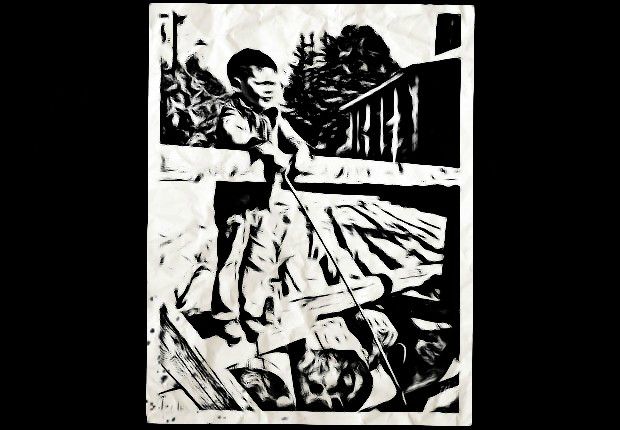
Our 9th grade classes have been reading Robert Fitzgerald’s excellent translation of The Odyssey. At the beginning of every book, “young Dawn spreads her fingertips of rose to make heaven bright”. My students have heard this phrase so often that they chorus back to me “fingertips of rose” when we read aloud. One morning this past week, I raced up the hill to school to get my iPad so I could capture this picture of the “rosy fingers” and put it on the class wiki.

We dutifully started The Odyssey with the “Invocation to the Muse” and Books 1-4, but the Telemachus “coming of age” story did not really capture their interest. Meeting Odysseus in Book 5 did not improve their respect for the “worthy man of twists and turns.” Once we read Book 9,  the meeting with the Cyclops, Polyphemus, their interest was revived. Apparently, they enjoy a good story of man-eating monster as much as previous generations from 2020 years ago.

I have only been able to locate about a dozen copies of this translation in the secondary market, so we did have to buy a class set. These replaced a worn set of the Richmond Lattimore translation. There will be an audio version of the Fitzgerald translation available in November 2013 I will be ordering so I will finally be able to hear how to pronounce all those Greek names!.

Our final project for the Odyssey is a narrative that students complete called “The Wamogossey: A Day in the Life of a Freshman at Wamogo High School.” Happily,  writing narratives are once again favored in curriculum aligned to the Common Core State Standards:

CCSS.ELA-Literacy.W.9-10.3 Write narratives to develop real or imagined experiences or events using effective technique, well-chosen details, and well-structured event sequences.

The inclusion of the narrative confirms what most writing teachers recognize, that writing a narrative gives a students a better appreciation for reading a narrative.

In writing The Wamogossey, we allow students to organize themselves as individual narrators or in groups of two or three. Our instructions to the students are based on the following premise:

You and your partners are to create a modern equivalent of The Odyssey. The setting is Wamogo High School; the hero a 9th grader – Fresheus or Freshiope.

Your character must make their way through a day at school, facing modern equivalents of the Lotus Eaters, Cyclops, Sirens, and all that Odysseus encountered. The goal is simply to get home alive, where the or she can relax and feel safe.You must mirror Odysseus’ adventures, including how he solves the problems (trickery, patience, skill, self-control, etc).  The essential nature of the obstacles must be the same, in the same order, but set in modern Wamogo.

Each student in a group working on The Wamogossey is required to write three adventures: a single narrator needs three (3) adventures; two people writing the Wamogossey need six (6) adventures; three members of the group need nine (9) adventures. This organization assures that there is an equal sharing of responsibilities regardless as to the size of the group. They compose the narrative on Google Docs; each narrator writing in a different color ink.

In addition, to assure fairness in grading, we allow students to have some feedback on the distribution of points. The project is assigned a base grade (EX: 40 points) Once the project is graded based, that number is multiplied by the number of students in group. For example a project worth 40 points may be awarded only 34 points. If there were three members of the group, then there are 34 X 3 points available, or a total of 102 points. The members of the group then determine a fair distribution of points; slackers are usually “outed” by members of their group. We rarely need to intervene.

The Wamogossey narratives must begin with an invocation to their muse. These are usually very personal and often reflect that we have a vocational agricultural program. For example, from this year’s submissions:

Sing in me, Brandon,
and help me tell the story of tractors, you, skilled in all ways of contending,
the fixing, harried for hours on end,
after the break downs and endless driving in the field.
I saw the end of the last row of corn
and learned that good crops come slowly
and weathered many bitter days
in the early morning cold, while I fought only
to save my life, to get home to the barn.
But not by will nor valor could I save all the gas I use,
Of these adventures, Brandon, tell about me in my school day, lift the great song again.
Begin when the alarm rang, calling me to adventure, when all I hungered for was for home, my  Farm All tractors, and being ready…

In addition to the modernized twists of Homer’s plot, each adventure needs an epithet (“grey-eyed goddess”) and one Homeric simile. My students call these similes “enough already; we get the point” similes.There is also extra credit for using vocabulary from The Odyssey.

So far, several of The Wamogossey entries parallel Odysseus’s adventure very nicely. One student’s encounter with “Eaganphemus” (the Cyclops/our principal) is clever:

Encounter with the Cyclops- Book 9
I was hurrying to class, I was going so fast, I felt like I was in a race car, and the people around me are in a fuzz.  All of a sudden, I saw the huge Eaganphemus standing in my way. I almost slammed into him, my wheels spinning so fast. I tried to get around him, but I couldn’t  But, I happened to have M&M’s in my pocket, so I threw them at him. He seemed overwhelmed! He tried to catch all of them at once!! Once he was trying to gobble them down I raced past, now that he was distracted. I somehow survived getting past him.

As the semester ends next week, the students will have finished their hero’s journey. Odysseus will return to Ithaka and to Penelope, and, yes, another “Dawn will spread her rosy fingers…”.  I may get to run up the hill again to snap another picture.

The fiction selected for standardized testing is notorious for its singular ability not to challenge; these stories do not challenge political or religious beliefs, and  I have long suspected they are selected because they do not challenge academically.
My state of Connecticut has had great success locating and incorporating some of the blandest stories ever written for teens to use in the “Response to Literature” section of the Connecticut Academic Performance Test (CAPT).
The CAPT was first administered to students in grade 10 in the spring of 1994, and the quality of the “literature” has less than challenging. For example:
  • Amanda and the Wounded Birds: A radio psychologist is too busy to notice the needs of her teen-age daughter;
  • A Hundred Bucks of Happy: An unclearly defined narrator finds a $100 bill and decides to share the money with his/her family (but not his/her dad);
  • Catch the Moon: A young man walks a fine line between delinquency and a beautiful young woman (to be fair, there was a metaphor in this story)
At least three of the stories have included dogs:
  • Liberty-a dog cannot immigrate to the USA with his family;
  • Viva New Jersey-a lost dog makes a young immigrant feel better;
  • The Dog formally known as Victor Maximilian Bonaparte Lincoln Rothbaum– not exactly an immigrant story, but a dog emigrates from family to family in custody battle.
We are always on the lookout for a CAPT-like story of the requisite forgettable quality for practice when we came upon the story, A View from a Bridge by Cherokee Paul McDonald. The story was short, with average vocabulary, average character development, and average plot complexity. I was reminded about this one particular story last week when Sean, a former student, stopped by the school for a visit during his winter break from college.

The short story "A View from the Bridge" was used as a practice CAPT test prompt

The short story “A View from the Bridge” was used as a practice CAPT test prompt

Sean was a bright student who through his own choice remained seriously under challenged in class. For each assignment. Sean met the minimum requirement: minimum words required, minimum reading level in independent book, minimum time spent on project. I knew that Sean was more capable, but he was not going to give me the satisfaction of finding out, that is until A View from the Bridge.
The story featured a runner out for his jog who stopped on a bridge to take a break near a young boy who was fishing, his tackle nearby. After a brief conversation, the jogger realizes that the young boy was blind. The story concludes with the jogger describing a fish the blind boy had caught but could not see. At the story’s conclusion, the boy is delighted, and the jogger reaffirmed that he should help his fellow man/boy.
“The story A View from the Bridge by McDonald is the most stupid story I have ever read,” wrote Sean in essay #1 in his Initial Response to Literature.
“I mean, who lets a blind boy fish by himself on a bridge? He could fall off into the water!”
I stopped reading. How had I not thought about this?
Sean continued, “Also, fishhooks are dangerous. A blind kid could put a fishhook right into a finger. How would he get that out? A trip to the emergency room, that’s how, and emergency rooms are expensive. I know, because I had to go for stitches and the bill was over $900.00.”
Wow! Sean was “Making a Connection”, and well over his minimum word count. I was very impressed, but I had a standardized rubric to follow. Sean was not addressing the details in the story. His conclusion was strong:
“I think that  kid’s mother should be locked up!”
I was in a quandary. How could I grade his response against the standardized rubric? Furthermore, he was right. The story was ridiculous, but how many other students had seen that? How many had addressed this critical flaw in the plot ? Only Sean was demonstrating critical thinking, the other students were all writing like the trained seals we had created .
One theory of grading suggests that teachers should reward students for what they do well, regardless of a rubric.So Sean received a passing grade on this essay assignment.  There were other students who scored higher because they met the criteria, but I remember thinking how Sean’s response communicated a powerful reaction to a story beyond the demands of the standardized test. In doing so, he reminded me of the adage, “There are none so blind as those who cannot see.”

I had been looking over the compendium of lists touting the top news events of 2012, when a line spoken by the character Death in Terry Prachett’s novel The Hogfather came to mind:,

Humans need fantasy to *be* human.

Prachett often reflects on the role of fiction in his fantasy novels, the Diskworld series, which are set in a world shaped like a disk that floats on the backs of four elephants standing on top of a giant turtle that slowly swims through space. While Prachett’s stories are particularly fantastic, all stories require some willing suspension of disbelief: a talking Cat in the Hat, a journey to the century of the earth, a tea party on the ceiling, a raft down the Mississippi, a beanstalk.

Stories are what prepare us for the complexities of life and death. We tell stories, we create myths, we perpetuate lies. Stories give us a language to express our triumphs and our failures, to respond to our morality and our immorality, to explore our future and remember our past.

Prachett’s 21th Diskworld novel is a Christmas tale of sorts which was developed as a film by the British media Sky One and shown in two installments in 2006. The title character The Hogfather, the diskworld’s equivalent of Santa Claus, has become the target of a assassin and goes missing. In a Gothic turn, the character Death opts to fill the role of the Hogfather by donning a fur-trimmed red suit, practicing his “ho, ho, hos”, and distributing inappropriate toys. Death’s granddaughter, Susan Sto Helit, joins him and upset the forces of the evil Auditors by rescuing the Hogfather just before the world goes dark.

As the rescued Hogfather flys off in his hog-drawn sleigh, Death and Susan are reunited and reconciled. She questions why their efforts to maintain the elaborate fantasies that surround the Hogfather are even necessary:

Death: Humans need fantasy to *be* human. To be the place where the falling angel meets the rising ape.
Susan: With tooth fairies? Hogfathers?
Death: Yes. As practice, you have to start out learning to believe the little lies.
Susan: So we can believe the big ones?
Death: Yes. Justice, mercy, duty. That sort of thing.
Susan: They’re not the same at all.
Death: You think so? Then take the universe and grind it down to the finest powder, and sieve it through the finest sieve, and then show me one atom of justice, one molecule of mercy. And yet, you try to act as if there is some ideal order in the world. As if there is some, some rightness in the universe, by which it may be judged.
Susan: But people have got to believe that, or what’s the point?
Death: You need to believe in things that aren’t true. How else can they become?


Ultimately stories allow us to imagine with an author how those “big lies” of justice, mercy, duty play out in different ways, in different settings, with different characters. For our willing suspension of disbelief, fiction gives us practice in imagining other qualities of truth, faithfulness, and love so that we may be better prepared to recognize and develop these qualities in our real world. Stories prepare us for the times when our real world turns unimaginably cruel or fraught with despair.

At the end of every December, when different media organizations publish the top stories of the year, they rank news stories in order of importance. These are events that over the course of 365 days reflect virtue and triumph along with cruelty and despair. There are always stories of senseless tragedy countered with acts of great compassion, and this year has been no different. There have been cataclysmic disasters, some by nature and some man made, and again, this year has been no different. For each of these very real stories, there are fiction counterparts that can help us to recognize what Prachett suggests are part of “some rightness in the universe.” Moreover, from these real events will come new stories, new fictions, that will be written because writing and telling stories is what makes us human. The news stories of 2012 are a record of what has happened, but the stories we create make us human and help us to believe in the possibility of a New Year where qualities of justice, mercy and duty can “become” real, not fantasy.

The impending Hurricane Sandy did little to stop over 2000 teachers from attending the 83rd Saturday Reunion at Teacher’s College at Columbia University on Saturday, October 27. Taking up the microphone in a set of informal welcoming remarks, Lucy Calkins complimented the crowd that had gathered in the Nave in Riverside Church, “So many of you have come here…instead of clearing out storm drains or without stocking up on toilet paper. You have weathered the trip despite the predictions of this ‘Franken-storm’.” The crowd laughed appreciatively.

“Yes. We are in a storm,” she continued with growing seriousness. “Today, we are in a ‘Perfect Storm’ in education, and we must learn to travel these hurricane winds and sail.”

Calkins was referencing the convergence of the Common Core State Standards with educational reform efforts that emphasize standardized testing. Newly designed teacher evaluations tied to single metric tests combined with cuts in funding for public school education because of a stagnent economy have also contributed to this ‘Perfect Storm’. This audience understood her metaphor.

Lucy Calkins is the Founding Director of the Reading and Writing Project LLC and the Teachers College Reading and Writing Project as well as the Robinson Professor in Children’s Literature at Teachers College where she co-directs the Literacy Specialist Program.

Co-authors Lucy Calkins, Mary Ehrenworth and Christopher Lehman all led sessions at the 83rd Saturday Reunion of the Teachers College Reading and Writing Project on Saturday, October 27, 2012

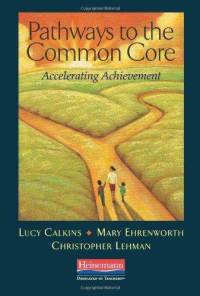
At a session that followed her welcoming remarks titled, “Implementing the Common Core: What’s Working, in Big Exciting Ways, to Engine Dramatic Reforms,” Calkins explained that she would not be delivering a big keynote at this conference on the Common Core, despite her belief that she considers this “most important document in the history of American education.” Instead, she plans to take time off from teaching to tour the country speaking on the Common Core and the book she co-authored, Pathways to the Common Core, in ordercto help school districts with the real work of accelerating students to perform at the level required by the Common Core, noting that “85% of our students are not there.”

Calkins also expressed her concerns that our nation’s history of large-scale educational reform is not good. “We have been sent many times to reform school,” she continued, “we have to be worried that this [Common Core] may be just one more reform.” However, Calkins stated that what works in this particular reform’s effort is the “absolute and total appreciation that what will make the difference is the teacher.” She directly confronted all the teachers in attendance and directed, “You need to be knowledgeable, and read the actual Common Core, not the ‘Publisher’s Guide to the Common Core’.” Her concerns at this conference echo her remarks in March 2012 at the 82nd Saturday reunion where she specifically called out David Coleman, co-founder and CEO of Student Achievement Partners  and who, according to Pathways to the Common Core, “received a  four-year 18 million dollar grant from the GE Foundation to develop materials and do teacher training around the CCSS” (6). Coleman has since moved on to take a position as the President of the College Board. Pathways to the Common Core, co- authored with Mary Ehrenworth and Christopher Lehman, details concerns that this enormous grant and any additional grant money will result supporting those who are “spelling out implications and specifying what they wish the Common Core had said,”(5). Already there has been a growing body of materials that contradict the intentions of the standards:

“There will certainly be additional materials and documents that emerge following this new round of money, with the potential to make similar claims as the Publisher’s Criteria for the Common Core Standards in English Language Arts and Literacy, Grades 3-12 (Coleman and Pimentel 2011)  and the Rubrics for Evaluating Open Education Resources (OER) Objects (Achieve 2011). When documents are presented as if they’ve gone through the process of review and been ratified by the states on subcommittees, it is troubling”(6).

Calkins reminded participants that the crucial difference will be the professional teachers who bring colleagues into their work to build a community of teachers, and that this community should know the Common Core standards.

Turning to the topic of her session, Calkins also explained that some of the most exciting work that was recently taking place on the Common Core  at the Teachers College was with their work with students in argument and debate.

She described the success teachers at the Reading and Writing Project were having with students who participated in read-aloud by gathering evidence for one position or another. For example, students had listened to a reading of The Stray and took notes on different positions. Following the basic rules of debate, students were given the opportunity to caucus with those who held their opinions before debating or refuting their debate partner’s position. In order to model the process with Shel Silverstein’s The Giving Tree, teachers taking one position that the tree was strong stood to caucus with like-minded participants, while those seated conferred with those who agreed with the different opinion that the tree was weak. Calkins directed teachers to stand, sit, debate or caucus, modeling how this might work in a classroom in one 45-50 minute period. She showed several video clips showed students participating in the same process demonstrating the success of using these techniques. “The results were fantastic,” Calkins exclaimed as the videos played, “so exciting to see the students gathering evidence and using the text in their arguments.”

What was evident during her sessions at this conference was that during this ‘Perfect Storm’ in education, Calkins is confidently empowering teachers to sail through what seems to feel like hurricane force changes in the profession. Her efforts in preparing teachers to navigate these new challenges can help insure that while these controversial storms may rage outside, inside the classroom day after day, the teacher is prepared to be the captain of the ship.

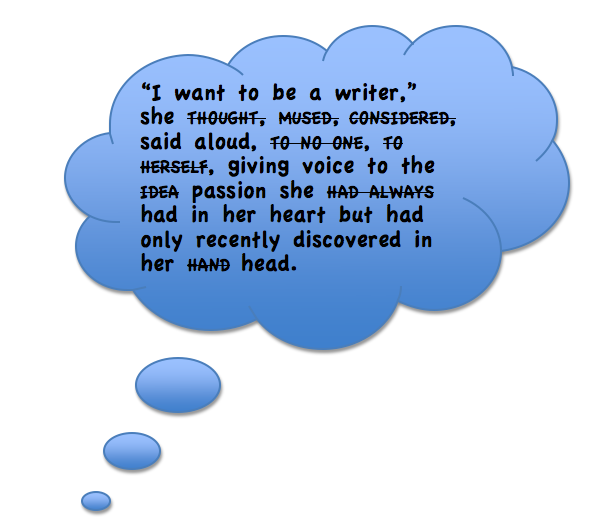
One of my favorite cartoons features a young woman, obviously nervous, seated next to a white-suited, white-haired caricature of Samuel Clemens. Above her head floats a thought bubble,“‘I want to be a writer,’ she thought, mused, considered, said aloud, to no one, to herself, giving voice to the idea passion she had always had in her heart but had only recently discovered in her hand head.”

I also always wanted to be a writer, but the responsibility of writing stopped me. Writing was a task that I took very seriously. I had to write papers for courses I took. I had to write letters-personal and professional- and I had to write memos for work. Writing was a product that needed to be perfect. As a result, my writing duties had stifled my writing passion.

However, sixteen months ago I started this blog to share the ways I had increased the number of books in school classrooms. During the first month of entries, I wondered if I would have enough materials to write about on a blog about used books in class.

I am almost embarrassed to admit that what I have discovered is that writing is less product and more thinking. Sadly, I was an English teacher who required writing and encouraged students to write regularly in class, but who did not cognitively understand that writing is really a recording of thinking. I was always interested developing (and assigning) the prompt and collecting (and correcting) the final product. I did not fully understand the necessity of thinking as the most critical part of the writing until I began to write myself.

Now, as a convert to writing as thinking, I am using this post to encourage others to write in order to think.

October 19-20th, 2012 will be the National Day of Writing. The National Writing Project (NWP) is encouraging people to contribute to “What I Write” on their website:

What do you write or compose? Blog posts? Poems? Videos? Grocery lists, computer code, or song lyrics? Whatever you write, on Friday, October 19, use the hashtag #whatiwrite to share your compositions with the world as part of this year’s National Day on Writing.

National Council of Teachers of English (NCTE) has  links on their blog for people to read what authors say about why they write. The NYTimes Learning Network also has a page on their blog asking, “Post what, you ask? Well, could be…

  • Thoughts about what you write, whether it’s poetry, short stories, school essays, computer code, love notes, song lyrics or Facebook updates.
  • A link to some writing you want to show others.
  • A photo or drawing that illustrates something about writing, or illustrates something you’ve written.
  • Thoughts about things you’d like to write someday.
  • Notes on your writing process.
  • Thoughts on the role of writing in your life in general.
  • Advice about writing.
  • Links to good pieces about writers or writing

So, on Friday, October 19th, I will have my students create lists of topics they want to “think” about, topics* they want to explore in writing over the course of the year. We will collaborate on a master list using a Google doc that we can revisit over the course of the school year. I want my students to learn how to write, but more importantly, I want my students to learn how to write so they can think. I want they to feel free to write without constant assessment. I want them to write and read what they write to understand what they think. Hopefully, in this process they will discover that writing is not an academic responsibility, and that good writing is really good thinking. And I will imagine  thought bubbles over their heads as they write.

Share the hashtag #whatIwrite.

*Topic list created 10/18/2012

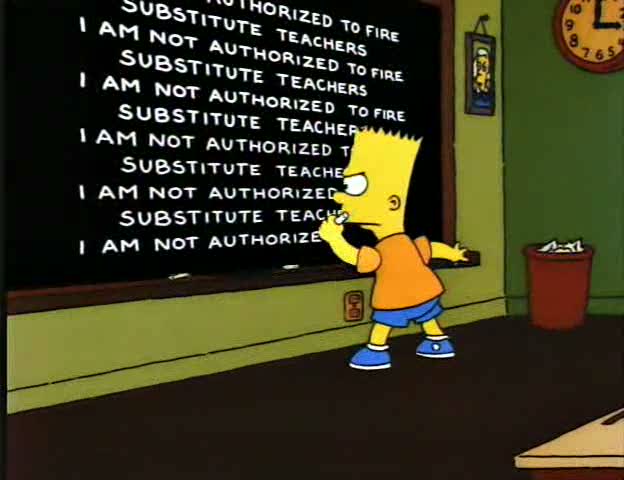
Wamogo High School (Region 6)  in Connecticut finished four days of teacher driven professional development. There were a few “requested sessions” which were organized to address concerns about the upcoming block schedule; we are moving from a sequence of 38-45 minute periods to alternating days of 80 minute blocks. The question came up, “What plans can a teacher leave a substitute teacher for this length of time?”

I suggested that a lesson plan that incorporates film is easy to prepare in advance, so I organized the following links that teachers can use to prepare a substitute lesson that incorporates film.

The substitute teacher may have students who think they have the “day off”, but a film lesson organized with a written reflection can be an effective way to promote new learning.

Film lessons are popular with substitute teachers. They are usually engaging, and they are easy to implement as long as the substitute can access the video online or operate the hardware to run a hard copy of the video.

Video/film lessons also meet many of the Common Core Standards as stated in the Overview for the ELA Standards: “Just as media and technology are integrated in school and life in the twenty-first century, skills related to media use (both critical analysis and production of media) are integrated throughout the standards.”

Our school has a subscription to Discovery Education which is jammed packed with digital content: film clips and prepared lesson plans are available for every grade level. However, other school systems may not have this resource.

The following free websites were reviewed in the presentation for teachers to use in order to find videos, lesson plans to use with videos, and/or worksheets that can be completed by students watching videos.

One major source to start looking for all video materials is the updated Edudemic 100 Video Sites on the Edudemic.com website.This website is organized with sub-headings General; Teacher Training; Science Math & Technology; History, Arts and Social Sciences; Lesson Planning; Video Tools and true to its name there are 100 sites, each rich with links to videos of all lengths in all subjects.

To accompany a selected film or video, I strongly recommend students have a writing assignment. The writing assignment can be in a variety of formats: notes, critical analysis, or reflection. I am not a fan of the worksheet, but substitutes benefit from a well-designed worksheet that students can complete and turn in at the end of class. For that reason, I located a number of websites that can be used to either develop a worksheet or websites that have worksheets already prepared:

Video documentaries are also popular; since these are often shorter than a feature length film, many can be run during one block period. A note of caution: several of these videos will need to be vetted to assure content appropriate materials are used. Many of the video clips on these sites are current and can be associated with news articles to use to supplement the viewing as a comparison or a contrast. 

The Oscars.com website offers a generic documentary worksheet. This prepared sheet is organized around political discourse, but the sheet has questions that can be used with any documentary. 

The Ted Talks website describes the numerous video presentations as “Ideas Worth Spreading.” TED began in 1984 as a “conference bringing together people from three worlds: Technology, Entertainment, Design.” There are very entertaining videos on every subject, but most recently, there has been a new category devoted to education TED-ED. These short film clips at  http://ed.ted.com/ are offered with interactive quizzes and writing prompts.

My Film and Literature class used many of the lessons off the Film English blog devoted to film and English Language Learners (ELL) http://film-english.com/. The lesson plans are very detailed and involve critical thinking skills that can be used outside of the ELL classroom as well.

Our English Department has been phasing out the department’s DVD library; so many DVDs were scratched or went missing during the school year. We now use commercial “instant streaming” websites where we can purchase videos for safekeeping “in the cloud”. Unfortunately, this means that one of the best features used for showing a film, the closed-captioning feature, is not available. If we cannot locate a film through an “instant streaming” service, we check with OpenCulture.com http://www.openculture.com/freemoviesonline which has hundreds of movies available. Some are subtitled in English; most are classic films. Suppose the DVD case is empty? Teachers can check here to see if the film is available for free on this site.

Finally, the “motherlode” of film lesson plans is on the NYTimes Learning Network website. This is a one stop shopping for plans website (no subscription required) with lessons written by “[freelance] educators with deep and broad experience in the classroom and in curriculum development. They work with the editors, Katherine Schulten and Holly Ojalvo, who are also longtime educators, to develop the lessons.” The lessons are thorough, tied to standards, and so easy to follow that a sick teacher need only browse for a few minutes to find a lesson, film or otherwise, that can connect to a discipline.

This year, the 80 minute time block is new for our school and for our substitutes, and this longer class period demands even more attention to preparation. No teacher or administrator wants to lose 80 minutes (X) times the number of students in the classroom; do the math- 20 students in a class X 80 mins = 1600 educable minutes! A film/video lesson should not be offered as babysitting, but rather a lesson that extends learning in another medium. This quick presentation of information was designed to help teachers design lessons that can be easily implemented by a substitute teacher and meaningful for the students.  A well-designed film lesson can be effective even if the classroom teacher is not the one clicking the “play” button.

I am sitting through a professional development session on how to use peer to peer writing conferences. I want to believe there will be a moment in this workshop when the “ah-ha” moment will happen, when I finally unlock the formula for successful in class peer to peer writing conferences at the high school level. The presenter reiterates how important this process is for writers to hear critical feedback to their writing. I hear again that “sticking with it and training students” to peer to peer conference are key ingredients that will improve student writing. Then I think of my students….my 9th, 10th and 11th grade students. This unspoken heresy forms in my mind:

Forgive me, well-intended and passionate presenter, but in my experience, in class peer to peer writing conferences do not work.

There, I admit it. Success in implementing face to face, peer to peer writing conferences, real critical encounters, has eluded me. I have 20 plus years in the English classroom, grades 6-12, and I have always come away from peer to peer writing conference sessions with the uncomfortable opinion that I have been wasting class time.

I now know why.
This summer, I am participating in the Connecticut Writing Project, and I have to write on demand, and then I must share that work. This is a horrible experience for me. I pass my paper wondering, “What will this person think of me?” and “What if there is a grammar error? I’m an English teacher!!” I have to provide feedback on a fellow teacher’s work, and I see the same kind of panic in her eyes.
I quickly reflect. How does my adolescent, pimply, over-stimulated teen-age boy feel as he hands in his rough draft for a critique by the fair skinned, sweet smelling young girl who sits behind him? How does that painfully shy artist who doodles his responses but has yet to complete a paragraph in writing feel about sharing his work with the amazingly popular class jock (boy or girl)?
I mention this to the presenter who says, “Yes, sometimes, there are student combinations that do not work.” That confirms my problem.

Problem #1: My struggle with peer to peer conferencing begins with setting up partnerships. Do I put the uneven writer with the good writer? Does the good writer need another good writer for good editing? Do I put two poor writers together and expect a miracle? Do I let the students choose their partners? How effective is the conference if friendship is in play?

Problem #2: The research shows that students should learn how to peer conference in the elementary and middle school grades to carry that behavior into the high school grades.However, I have found that training in writing conferences in the elementary and middle school grades is  erased in the high school environment. Many high school students claim to hate sharing their work with other members of the class; participation is mixed.

Problem #3: I teach in a regional school where one third of our freshman class comes from out of district schools. Several of these students have not had any training  in peer conferencing. The number of incoming students who are already uncomfortable in moving to a new regional school requires that I need to start at square one and  train everyone how to conference effectively.

Ultimately, I do not want to give up on students providing critical feedback to other student; I just want to take away the awkward immediacy of that face to face encounter. Since I teach in a 1:1 school district with digital literacy embedded in my curriculum, I will continue to use the solutions that have worked in place of those face to face, peer to peer writing conferences. I use digital conferencing.

Solution #1: I use blogs. Each blog is organized for a small group (8-10 students)   to use as a team. Only members of their team see their posts and comments over a period of time, say a semester or a school year. Students post book reviews, and other students comment on that post by asking questions about the book, or by making recommendations to improve the original book review  post. Each student must respond to the posted book reviews. Writing on the blogs allow students the physical distance they need to comfortably respond to each other. Written comments take time to construct, and students are more thoughtful if they know what they write will have a larger audience. Blogs let me  monitor the comments as well and determine which students are the most effective in providing good critical feedback to a student and which students are simply putting down, “great job!” or “I like what you wrote!” I might not have this information if the students were having face to face conferences. During my writing conferences with students I can follow up with the comment stream and target what is necessary to improve a critical response.

Solution #2: I use wikis. Students upload a report or story to a wiki page, and their peers can respond with questions and provide feedback in the comment section at the bottom of the digital page. Here too, the wiki page and the comment section will be seen by a larger audience and students are more thoughtful if they know their work will be read by an entire class. Responses in the comment section of the wiki also allows me to monitor who has provided good critical feedback to the writer.

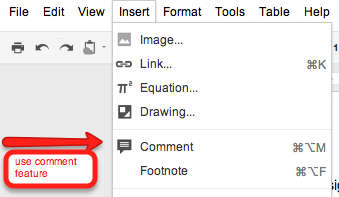
Solution #3: I use Google docs. Students can upload their work to a Google doc and share that link with one or more students. Each peer reviewer can use the comment feature to provide feedback. This feature also identifies the peer conference partner on each comment he or she makes. All  comments by the peer reviewer are recorded on the document’s margin. An student author can even post questions about his or her writing in a comment box. The document can be also shared with multiple students who could work on the same document at the same time if necessary. All  comments are part of the document’s history, and I can monitor changes made by the student writer before and after a peer review. This method is particularly helpful if I have specific students who are hesitant about facing another student in a peer review.

Of course, all this digital peer to peer conferencing is improved if I provide students with  guiding questions (“Did the opening engage you as a reader?”) they would use in written conferences or if they prepare specific questions for the peer reviewer.

Digital platforms: wikis, blogs, and Google docs, allow me the means to provide peer to peer writing conferences by removing those awkward face to face conferences that I have found so unproductive in my high school classrooms. These digital platforms also let me organize students across class periods, and if I found a teacher in a cooperating school who wanted to peer conference, the digital platforms would allow my students to conference outside the classroom. Students still have plenty of opportunities for face to face encounters during class discussions and presentations, but they are comfortable communicating their feedback about a peer’s writing in a digital environment. And, heresy or not, I am finally comfortable with the productive peer to peer (via the Internet) writing conference.

A bit of self-indulgence here. I have been blogging for a year on July 3, which means that the Used Books in Class blog is a one year old “toddler.”

I started this blog for two reasons. The first was a response to Kelly Gallagher’s Readicide, a book I have mentioned numerous times in posts on this blog. I was determined to increase reading in the classroom per his suggestion through “book floods,” and I began purchasing used books for the classroom libraries at Wamogo High School (Region 6 in CT). Fortunately for me, in the Fairfield and Litchfield counties in Connecticut there are numerous sources for excellent quality used books available for $1.00 (or less) through public library book sales held generally in the summer and Goodwill or other thrift stores.  I wanted to share how I had added entire class sets of books ( for example: The Curious Incident of the Dog in the Night-Time, The Kite Runner, The Bluest Eye, A Walk in the Woods) or increased books in classroom libraries for independent choice reading in grades 7-12.

The second reason was that this past year I required students to write using blogs. At each grade level (9-12), the Wamogo English Department teachers used blogs in the classroom in order to increase student reading and writing collaboration. Our Lord of the Flies unit included “survival activities” on team blogs for 10 graders. The freshmen classes used a blog in different ways: to record individual book reports and to respond to questions associated with whole class reads.. The journalism class’s newspaper format is a blog, and we have also had students blog responses to Hamlet or record their progress on Capstone projects. If I was requiring that students blog, I needed to know how to blog as well.

I researched the use of blogs in the classroom. According to Trey Martindale and David A Wiley,  in their paper Using Weblogs in Scholarship and Teaching, “Clearly two keys to effective blogging are knowing who one’s audience is, and knowing that that audience is in fact reading one’s blog. My students were motivated and willing to write regularly and with clarity, knowing that fellow students and the instructor were reading the blogs.”  I recognized that most student writing is read by the teacher, so our students needed to understand how to target an larger audience. I emphasized this question for my students by having them identify the audiences of other blogs, and then consider the question  “Who am I writing this blog for?” and “Who will be able to read this post?”.  Similarly, I had to apply the same consideration for this blog.

I also researched whether blogging was an effective strategy to increasing reading and writing in the classroom. Would student blogging rather that standard writing (papers, essays) improve comprehension skills? In one study by N.B. Ellison and Yuehua Wu, “Analysis revealed no significant differences in comprehension between blog and paper assignments, although students reported spending less time writing in the blogging condition.” However, in another study by R. MacBride and Lynn Luehmann using blogging in science and math classrooms, “Findings indicate that (1) teachers’ intentions focused on creating additional forms of participation as well as increasing student exposure time with content; (2) blogs were used in a wide variety of ways that likely afforded particular benefits; and (3) both teacher and students perceived the greater investment to be worthwhile. ”

I found the same to be true for this blog, Used Books in Class. My first post (7/3/11)  received 8 hits! I was surprised anyone would be interested in this blog about used books, but those first hits motivated me. Now, after a year, the focus of the blog has shifted from “used books” in class to posts discussing “how books are used” in class. I have drifted into other areas of education, namely the English Language Arts Common Core State Standards, but these issues directly or indirectly impact teaching in the classroom.  26,518 hits later, I still am still surprised at the interest this blog has received. Honestly,  it’s not like readers could use yet one more education blog; there is some serious competition for attention!

Yet there is one more reason that I discovered for blogging as I wrote over the course of a year. I found other blogs to be informative on issues in education, and their comment sections were one way to enter into online discussions. I had followed Shelly Blake-Plock who authored Teach Paperless from 2009-May 2012. In his post, Why Teachers Should Blog, he offered one line that stood out:

Because to blog is to teach yourself what you think.

I had no idea how true that statement would be for me this year. Blogging has allowed me to frame an evolving philosophy of education, and I had to think about my own teaching practice every time I sat down to write. Blogging has provided the platform for me to articulate my responses to issues in education, and I had to think about how public my response would be every time I sat down to write. Blogging has let me practice my writing voice, and I had to think about how this voice needed to attract the reader and keep the reader reading every time I sat down to write. In summation, blogging has taught me over the course of this year how to think in order to write about education.

Thank you for reading posts on this blog. I am heading into year two with this “toddler”. When I started, I wondered if I would have enough topics to write about. I do not worry about that any more because this blog has taught me how to write what I think, and I  am thinking all the time. I think, therefore I blog.

One of my favorite final exam questions to assign is a creative narrative assigned to sophomores who are challenged with reading World Literature. The prompt is  based on an imaginary literary awards ceremony that celebrates all of the literature read during the year. I cannot claim this is an original idea; a fellow teacher, Trish,  gave me the prompt several years ago when we both taught sophomores, and the results have never disappointed.

What our imaginary literary awards ceremony might look like!

The prompt asks the student to chose any three characters from the literature read in class as candidates for “The Most Interesting Character of the Year”Award, the coveted MIC. This question is provided to the students at least one day before the exam so that students have time to select the characters and collect evidence.When the students spend a class period preparing for the exam, they are provided a 3X5 index card to write down the quotes and any other evidence they may wish to incorporate in the essay. The card is stapled onto the essay; students who do not use a card lose five points on the essay response.

The student must write a self-nomination speech in the voice of each character in which the character discusses his or her motivations; relationships with other characters; and accomplishments and/or failures.  Each character must also compares/contrasts himself or herself against the other nominees. The name of the work (underlined or in quotes), the author of the work, and at least one quote from the literary work said by or about each nominee is also required. Students are cautioned that they must use MLA style for the integration and and citation of evidence.

While I hate grading a stack of final exam essays, this particular prompt always provides some interesting responses. Rarely is there a combination of characters repeated. Furthermore, although there are plenty of Macbeths, Beowulfs and Paul Bauers, there are an equal number of minor or obscure characters. For example, there have been nominating speeches from the Porter in Macbeth, the airman in Yeat’s An Irish Airman Foresees His Death; one student even wrote from the perspective of Bulleye, Bill Sykes’s dog in Oliver Twist.

There have been students who include details from the ceremony itself (“Live from Hollywood!”), decribing the location or decorations. Several students have had the nominees deliver their nomination speeches from a red carpet area, and many students choose another character, classmate, celebrity act as the evening’s emcee; others use a twist on the American Idol model. Students have included dialogue between characters during the ceremony, while other students have had characters hurl insults at each other.

For example, one student had the witches from Macbeth serving as the evening’s emcees who introduced each nominated character saying, “By the pricking of my thumbs, one more wicked than the other comes.” Another had a “fierce and reckless Grendel” prowling in the audience in order “to snatch thirty audience members from their slumber” when he was suddenly called up to the podium to deliver his own nomination. His monosyllabic charming and tearful self- nomination speech (“You like me!”) was interrupted when the band began to play, and the student wrote that Grendel once again became that “powerful monster, living down/ In the darkness, [who]  growled in pain, impatient/ As day after day the music rang /Loud In that hall,” and charged off the stage with his prey. Another student had Fagin from Oliver Twist give his nomination speech performing magic and juggling tricks while the Artful Dodger led a group of pickpockets through the audience.

My favorite response came two years ago when a student nomintaed Napoleon from Animal Farm and placed him on the dias where he was heckling Heathcliff  from Wuthering Heights and Jack from Lord of the Flies as each gave a self-nominating speech. Suddenly, a flash of lightning blinded the audience for several seconds, and when they had regained a view of the dias, only two nominees remained. Napoleon, like so many of Stalin’s government officials, had mysteriously vanished!

Students never have any trouble filling three full pages of content for this essay response. I grade each of the three essays holistically with special attention given to the incorporation of quotes as evidence and the motivations of each of the nominees. An “A” response would:

  • Demonstrate a clear understanding of the assignment’s purpose (writes in each character’s voice)
  •  Evaluate relevant significant points of view (character, audience)
  • Gather and integrate sufficient, credible, relevant evidence (minimum on quality quote) and cites evidence correctly (MLA)
  • Use standards of English correctly (particular attention to mini-lesson topics) including spelling and capitalization (titles, character names)

Recently, we were aligning our curriculum with the 10th Grade Language Arts Common Core Standards when we came upon standard W.9-10.3: Write narratives to develop real or imagined experiences or events using effective technique, well-chosen details, and well-structured event sequences. The narrative is not a form we generally use in grade 10, so as we were puzzled if we addressed this standard at any point in our curriculum, we remembered the Most Interesting Character Award essay. We determined that this essay allows us to meet standard W.9-10.3 without designing a new lesson/assignment.

I do not require students to pick a winner for this exam question, in fact, I think it is easier for them to write with no winner in mind. No pre-determined winner allows them to write the ultimate cliff-hanger….”and the award goes to_____?”