Bags ready? Set to find great bargains? Go to Newtown, Connecticut, for the Friends of the C.H.Booth Library where over 100,000 books, records, DVDs go on sale annually. Their book sale always marks for me the beginning of the book sale season. This year’s starting date was July 12, 2014.
For the first time, I went on the admission day ($5) and used extra help (husband & son) to follow me with bags. Even then, I was too late to get the 20 or so copies of The Great Gatsby I saw someone packing up at the check out counter. My son noted that I also missed out on copies of of The Hunger Games Trilogy selections.
“The woman was only four feet away from you when I saw her stuffing them in her bag,” he claimed, “but I wasn’t going to tackle her.”
Fortunately, thanks to the diligent efforts of what looked like a small army of volunteer Friends of the Library, the tables were well organized by genre and author. I was able to get multiple copies of the 12th grade summer reading book, A Walk in the Woods.. In addition, I filled bags with the required summer reading for Advanced Placement English Literature including: Little Bee, A Thousand Splendid Suns, and Bel Canto. I also found copies for the grade 10 world literature library including The Places in Between, The Life of Pi, The Curious Incident of the Dog in the Nighttime, and A Long Way Gone.
There were also books to add to classroom libraries for independent reading including Dairy Queen, Elsewhere, and a pile of books from the Rick Riordan’s Percy Jackson series.
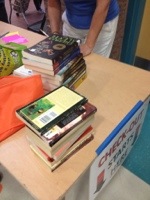
Counting Books at the check-out with the friendly volunteer
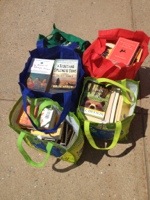
Five bags of books for classroom libraries for $229.00; a bargain!
The book sale at Newtown is a model of efficiency. There is room to move between tables, the books are properly sorted by genre ( for the most part) and the volunteer help is cheerful and efficient.
“You must be using these in a school?” suggested the woman checking us out as she counted out 20 copies of The Help.
“Actually,” my son replied feigning seriousness, “we really like this book….we’re going to read every single copy.”
“Oh,” she started, and then smiled,”you’re terrible…”
What is not terrible is that I spent $229 for over 80 books; some of them core texts and some for independent reading.
The summer book sale season helps me put books in the hands of readers. The Newtown Friends of the Library book sale does that extremely well.
How challenging is it for a teacher to run an independent reading program? Very challenging. That is the only thing thing that Newsweek reporter Alexander Nazaryan got right in his NYTimes op-ed piece The Fallacy of ‘Balanced Literacy’ (7/6/14).
His lack of success in having students choose their own reading for pleasure over the course of one school year, should not grant him the opportunity to decry the practice. His own failure to encourage students to engage in reading for pleasure should not dissuade other teachers from encouraging students to develop life-long reading habits. Had he the proper training and resources in balanced literacy, he would have witnessed how the challenge of implementing independent reading in a classroom can be met at any grade level and is a critical step to making students life-long readers.
If he had the training, he would recognize that teachers who are familiar with books for specific age groups and levels of interest can make reading recommendations to students or help facilitate highly successful peer to peer book recommendations. If he had the resources of high interest, low-level texts in jam packed classroom libraries for his students, he would have increased the level of engagement. If he had utilized the time for reading to individually confer briefly with students about their reading while other students read quietly, he would have established a classroom routine that would allow him to informally measure student growth as they read. Finally, if he had impressed upon students the importance of reading for pleasure, he would have helped their academic success in all other classes.
Research studies (compiled by the American Library Association) have determined that reading outside of the classroom is the best predictor for student success:
The amount of free reading done outside of school has consistently been found to relate to achievement in vocabulary, reading comprehension, verbal fluency, and general information. Students’ reading achievement correlates with success in school and the amount of independent reading they do (Anderson, Wilson, and Fielding 1988; Guthrie and Greaney 1991; Krashen 1993; Cunningham and Stanovich 1991; Stanovich and Cunningham 1993).
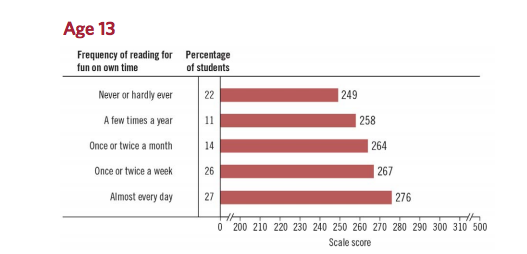
This research from the ALA is borne out by testing through The National Assessment of Educational Progress (NAEP) test, which has monitored the academic performance of 9-, 13-, and 17-year-old students since the 1970s. Long-term trend assessments in reading are measured on a scale of 500 points. In taking the NAEP, students volunteered information on their reading habits. The results from this data in 2012 demonstrated that the average score for the 22% of those students aged 13 who never (or hardly ever) read independently was 25 points lower than students who read every day. By age 17, the difference had increased to 30 points.
NAEP scores for 13 year olds who read for pleasure and the increase in standardized test scores
This data confirms what we have witnessed in our own classrooms. Our students are given SSR (silent sustained reading) time in class for independent reading in grades 7-12. Independent reading for our school means that students get to choose what they would like to read without having to take a quiz or a test on the book. The only “requirements” are that students keep a running record (we are using Shelfari) of their independent reading books. We ask them to share their recommendations with their peers. We talk to them about what they read.
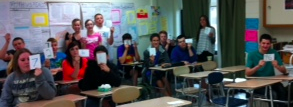
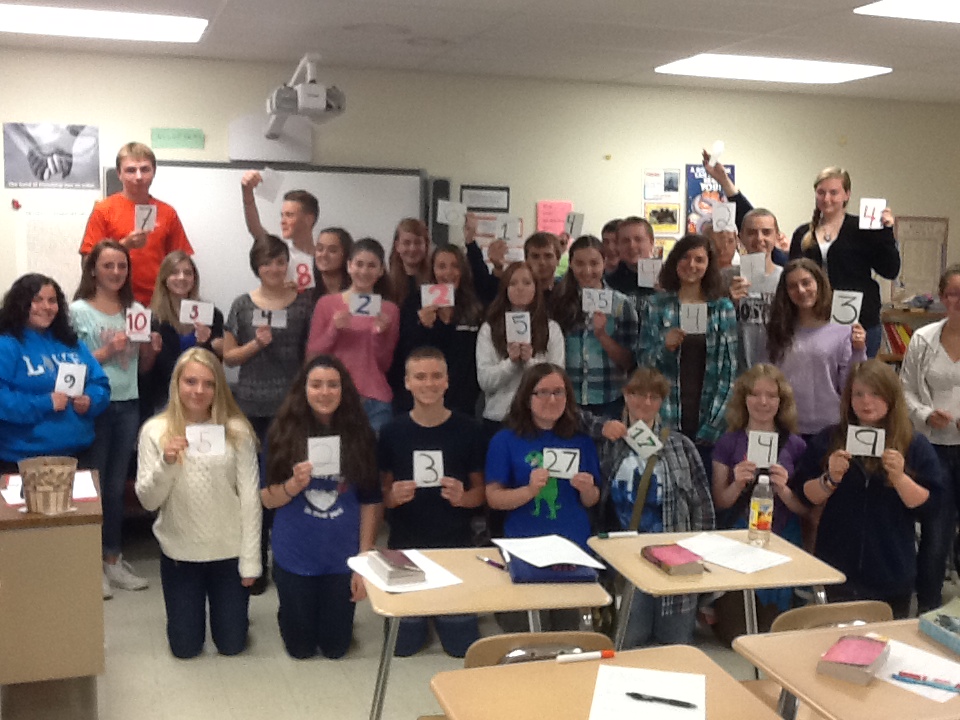
Holding up cards with the numbers of book read independently (included one world lit choice book)
Sometimes students are offered a choice from a length list of thematically connected books, and sometimes the choice must be in a particular genre (non-fiction, memoir, world literature). Other times, the choice is entirely open and students can read whatever books they want. Our block schedule allows us the luxury of offering students 15-20 minutes each period. A quick estimate means that over the course of the school year (40 weeks), meeting twice weekly (roughly 30 minutes minimum a week), students will be offered a minimum of 20 hours of reading time in class. They make very good use of that time.
Holding up the number of books read in grade 9
The main goal of our independent reading program is to encourage students to read beyond the walls of the classroom; our 15 minutes spent in class is intended as a “hook” to connect students with books that they might want to read or as a “refresher” to reconnect a book already being read.
Seniors holding up the number of books read independently in a semester
Encouraging students to read independently means practice, and the time we provide in class contributes to that reading practice. At the end of this year, we are celebrating the number of books read over the course of the year by taking group photos of students proudly holding up the number of books they have read independently over the past school year. So, rather than read a confessed failure in an op-ed piece that incorrectly characterizes independent reading written by someone who has left education, take a look at how the challenge of independent reading is being successfully met in our classrooms. The proof is in the pictures.
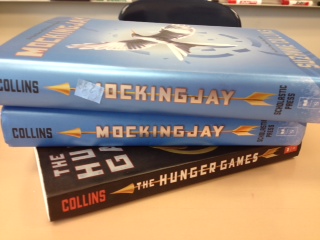
Yesterday, there was one paperback copy of The Hunger Games squeezed in-between other trade fiction. Two hardcover copies of Mockingjay were together on an opposite shelf. These books from The Hunger Games Trilogy by Suzanne Collins had been donated to a local Goodwill store. When I found them tucked away on the store’s shelves, I knew that the series had met a tipping point: still popular but not popular enough to treasure and keep.
The Hunger Games series (2008-2010) has been to today’s graduating seniors what the Harry Potter series (1997-2007) was to today’s 28 year olds…a collective reading experience. The series developed a dedicated young adult following, and the most obvious signs of their dedication was the carting of hardcover editions because each reader could not wait for the book to go to paperback.
Once The Hunger Games series caught fire (literally), book conversations centered on Katniss. There were speculations on her choice of Gale or Peeta. Predictions on the fate District 13 were rampant. The publication of each new book in the series was a major event; students shared copies from period to period. When the first film, The Hunger Games, came out students critiqued every detail that was present and noticed every detail that was missing.
Our Reading/English/Language Arts teachers loved having students read these books as well. The series laid the connections to more traditional texts such as the Greek myths or Romeo and Juliet. There were plenty of connections on current events in the economy and media that could be made as well.
Finding three copies in the used book shelves now, however, signals a sputtering of interest. Students will still pick up the used copies from the book carts in the classroom, but the rabid fans have moved on. Collins has helped this year’s graduating seniors develop their independent reading skills, the kind of skills that will serve them well in the future.
There are benefits to the recycling of books. I spent $7.98 on the three copies that would have been $27.66 if purchased new. The consequences of reaching a tipping point in popularity is a benefit for classroom libraries, which means finding used books from this series will be easier now that …. “the odds be ever in our favor.”
The chocolate milk debate as a test writing prompt is dead in Connecticut to all grade levels.
Yes, that old stalwart, “Should there be chocolate milk in schools?” offered to students as a standardized writing prompt was made null and void with one stroke from Governor Malloy’s pen. According to Hartford Courant, (6/12/14) Malloy Veto Keeps Chocolate Milk On School Lunch Menus,
“to the vast relief of school kids, nutritionists, milk producers and lawmakers, Gov. Dannel P. Malloy used his veto power Thursday to kill a bill that would have banned chocolate milk sales in Connecticut schools.”
Apparently, the same nutritional charts, editorials, and endorsements from dairy groups organized in packets and given to students from grades 3-11 to teach how to incorporate evidence in a fake persuasive argument under testing conditions was convincing enough to have real CT residents make a persuasive argument for legislators. To show his solidarity with the people, Governor Malloy quaffed down a container of chocolate milk before vetoing a bill that would have banned the sale of chocolate milk in schools.
Standardly, the writing prompt is addressed in English/Language Arts (ELA) class in elementary schools, but in middle and high schools, a persuasive essay is often the responsibility of the social studies teacher. The assumption here is that the skill of persuasion requires research and the incorporation of evidence, both taught in social studies classes. In contrast, ELA classes are dedicated to the analysis of literature through essays using a range of skills: identifying author’s craft, identifying author’s purpose, editing, and revising. The responsibilities for the writing portion of an exam are divided between the ELA classes for the literary analysis essay and the social studies classes for the persuasive essay. This design is intended to promote an interdisciplinary effort, but it is an intellectually dishonest division of labor.
ELA teachers have choices to prepare students for standardized tests using ELA content (literature and grammar) to improve skills. Math and science teachers are also tied to their disciplines’ content in order for their students to be prepared. Social studies is the only core discipline with the test-prompt disconnect.
So, what topics might test creators design to replace the infamous chocolate milk debate prompt? Before test creators start manufacturing new and silly debates, there is a window of opportunity where attention could be brought to this disconnect between content and testing in writing. Here is the moment where social studies teachers should point out to test creators the topics from their curriculum that could be developed into writing prompts. Here is a foot in the door for the National Council for the Social Studies to introduce writing prompts that complement their content. For example, there could be prompts about Egyptian culture, prompts on the American Revolution, or prompts about trade routes and river based communities. Too often, social studies teachers must devote class time to topics unrelated to curriculum.
The Smarter Balanced Assessment Field Test given this past spring (2014) to 11th graders was about the use of social media by journalists. When they took the test, I overheard the following exchange:
“Of course they use social media,” grumbled one student, “who is going to stop them?”
“Do they think they are ‘cool’ because they mentioned Twitter?” countered another.
Previous standardized test writing prompts (in Connecticut, the CMT and CAPT) for high school and middle school have been devoted to asking students to write persuasively on the age students should be able to drive; whether wolves should be allowed in Yellowstone National Park or not; whether to permit the random drug testing of high school students; and whether there should be uniforms required in schools.
Please notice that none of these aforementioned prompts are directly related to the content in any social studies curricula. Furthermore, the sources prepared as a database for students to use as evidence in responding to these are packets with newspaper opinion columns or polls, and statistical charts; there is no serious research required.
Here is the moment when social studies teachers and curriculum leaders need to point out how academically dishonest the writing prompt is on a standardized test as a measure of their instruction in their discipline. No longer should the content of social studies be abandoned for inauthentic debate.
The glass in Connecticut is half-full now that students can have chocolate milk in schools. Time for test creators to empty out the silly writing prompts that have maddened social studies teachers for years.
So… who appointed Ruth Graham of Slate Magazine to the book police patrol? In a recent piece Titled Against YA (6/5/14) Graham lays out an argument that adults can,
“Read whatever you want. But you should feel embarrassed when what you’re reading was written for children.”
Why? The best books tell good stories, and good stories are what we share as humans. Good stories are found in picture books; good stories are found in children’s chapter books. Good stories are found in folk tales, fairy tales, and fables. Good stories are not exclusive to one age group or another. Why the need to separate required serious or not serious book choice by a reader’s birthdate?
The problem Graham is fabricating is that readers will become “stunted” on steady diets of YA (young adult) literature. Her snobbish references to Alice Munro (who I love) and John Updike (who I do not love) as those ” authors whose work has only become richer to me as I have grown older” is self-aggrandizing. There are plenty of “serious” award-winning authors who make me “roll my eyes,” but I would not withhold a text from someone who wants to read it. A good story is ageless, a good story is timeless.
So, Ruth Graham, I say readers should be able to read anything. Readers will learn, like you said, what “authors have to say about love, relationships, sex, trauma, happiness, and all the rest—you know, life—from the reading they choose to do,” regardless as to whether the book bears the stigma of YA, or maybe, because that book does.
As the 10th grade English teacher, Linda’s role had been to prepare students for the rigors of the State of Connecticut Academic Performance Test, otherwise known as the CAPT. She had been preparing students with exam-released materials, and her collection of writing prompts stretched back to 1994. Now that she will be retiring, it is time to clean out the classroom. English teachers are not necessarily hoarders, but there was evidence to suggest that Linda was stocked with enough class sets of short stories to ensure students were always more than adequately prepared. Yet, she was delighted to see these particular stories go.
“Let’s de-CAPT-itate,” we laughed and piled up the cartons containing well-worn copies of short stories.
Out went Rough Touch. Out went Machine Runner. Out went Farewell to Violet, and a View from the Bridge.
I chuckled at the contents of the box labelled”depressing stories” before chucking them onto the pile.
Goodbye to Amanda and the Wounded Birds. Farewell toA Hundred Bucks of Happy. Adios toCatch the Moon. We pulled down another carton labeled “dog stories” containing Liberty, Viva New Jersey, The Dog Formally Known as Victor Maximilian Bonaparte Lincoln Rothbaum. They too were discarded without a tear.
The CAPT’s Response to Literature’s chief flaw was the ludicrous diluting of Louise Rosenblatt’s Reader Response Theory where students were asked to “make a connection:”
What does the story say about people in general? In what ways does it remind you of people you have known or experiences you have had? You may also write about stories or other books you have read, or movies, works of art, or television programs you have seen.
That question was difficult for many of the literal readers, who, in responding to the most obvious plot point, might answer, “This story has a dog and I have a dog.” How else to explain all the dog stories? On other occasions, I found out that while taking standardized test in the elementary grades students had been told, “if you have no connection to the story, make one up!” Over the years, the CAPT turned our students into very creative liars rather than literary analysts.
The other flaw in the Response to Literature was the evaluation question. Students were asked,
How successful was the author in creating a good piece of literature? Use examples from the story to explain your thinking.
Many of our students found this a difficult question to negotiate, particularly if they thought the author did not write a good piece of literature, but rather an average or mildly enjoyable story. They did manage to make their opinions known, and one of my favorite student responses began, “While this story is no Macbeth, there are a few nice metaphors…”
Most of the literature on the CAPT did come from reputable writers, but they were not the quality stories found in anthologies like Saki’s The Interlopers or Anton Chekhov’s The Bet. To be honest,I did not think the CAPT essays were an authentic activity, and I particularly did not like the selections on the CAPT’s Response to Literature section.
Now the CAPT will be replaced by the Smarter Balanced Assessments (SBAC), as Connecticut has selected SBAC as their assessment consortium to measure progress with the Common Core State Standards, and the test will move to 11th grade. This year (2014) is the pilot test only; there are no exemplars and no results. The SBAC is digital, and in the future we will practice taking this test on our devices, so there is no need to hang onto class sets of short stories. So why am I concerned that there will be no real difference with the SBAC? Cleaning the classroom may be a transition that is more symbolic of our move from paper to keyboard than in our gaining an authentic assessment.
Nevertheless, Linda’s classroom looked several tons lighter.
“We are finally de-CAPT-itated!” I announced looking at the stack of boxes ready for the dumpster.
“Just in time to be SBAC-kled!” Linda responded cheerfully.
Independent reading in our school grades 7-12 means students read books of their own choosing, make recommendations, and keep records of what they read. Recently, however, one of the English teachers in my department suffered a concussion and while the substitutes delivered the curriculum (John Steinbeck’s Of Mice and Men and Laurie Halse Anderson’s Speak), student independent reading had fallen out of regular practice.
Our latest substitute (Natalie) is an enthusiastic graduate of our high school school who has a BS degree in Creative Writing. She has been serious in tackling her lack of experience in the classroom through her best characteristic…she asks questions. She asks a lot of questions.
One of the latest questions she asked was about independent reading. When I expressed my concerns about having the practice reestablished, she seemed doubtful. I suggested that she have students use books they read independently to make connections with the most recent whole class novels.
“You can ask them if they can make a generic ‘coming of age’ connection between Speak and a book of their choosing,” I suggested.
“But what if they choose a book that doesn’t have that connection? What if they choose a book that is too young for them?” she continued, “or a book that they already read? How do I know what they should be reading?”
I recognized her questions; I had those same questions myself several years ago.
She had the same reaction I did when I first saw that video.
“Wow,” she said, “I get it. They should read what they want.”
Question answered.
My department is just noticing the benefits after a few years of implementing book choice. We are lucky to have an 80 minute block schedule with the luxury of offering 15-30 minutes a class for Silent Sustained Reading (SSR) independent choice books. We have large classroom libraries with high interest titles and a wonderful school library (with Overdrive e-books available) to offer students choice in what they read. When we tell students to pull out their SSR book, they are prepared and settle in to read.
Some classes suggest that a book be in a particular genre. Our English IV-Memoir class reads memoirs or biographies. The English II class is based on World Literature, and students read at least one book during the year by an author who is not American. The critical requirement is that each student chooses a book. There is no leveled reading; students can choose a book below their reading ability or they can attempt a book above their lexile level. They learn what to choose to read because they have control of what they want to read.
Penny Kittle, an English teacher and literacy coach at Kennett High School in North Conway, New Hampshire, wrote a guide to helping students read independently titled Book Love. In this text, Kittle offers strategies to help teachers increase the volume of what students read and to deepen student thinking about what they read.
One of the strategies several of our teachers use is to have students respond to reading through the software Shelfairi (Amazon) where they record what they are reading and make connections to other books. I can organize each class in virtual groups and pose general questions for responses. These short responses prepare me for conferences or allow me to respond directly on the software with links or information or suggestions. For example, the English IV Mythology/Fantasy class reads mythologies or fantasies, and I posed a simple question last week and left quick responses for a conference:
How are you doing with your book? What are the connections to myth/fantasy that can you make?
STUDENT: Eragon: So far I am doing well with this book. My book connects with mythology because it is about Eragon who finds a stone which ends up being a dragon egg, and he bonds with the dragon over time. He and Saphira (the dragon) learn to communicate with one another and have a good connection. Saphira and Eragon create a good relationship with one another.
STUDENT: Ranger’s Apprentice-The Royal Ranger: Good. I have 10 pages left until its over. Its the final book in the series. There is a giant myth that rangers have special and mystical powers. But that is just false. They are just super stealthy which gives them the appearance of just appearing out of no where.
My response: Now what will you read? Another series?
STUDENT: The Alchemist: The Alchemist is a good book. It has to do more with fantasy than mythology, but there is a myth about a treasure in the pyramids.
My response: And the “stones” have a story behind them as well. Did you know this book is on the NY Times Bestseller list for 291 weeks?
While there are multiple software platforms for sharing book choices, I also find that the features on Shelfari are helpful in having students “shop” for books (without purchasing) and/or write responses using evidence. There are tabs for a book’s Description, a Ridiculously Simplified Synopsis, Characters/People, Quotes, and First sentence. There are recommendations and reviews by other readers for each title as well. The student responses can agree or refute other reviews; they can add information to a book’s page as well.
Regardless of platform, sharing what students choose to read is critical to helping them develop a love of reading. The advertisement for Kittle’s Book Love states,
“Books matter. Stories heal. The right book in the hands of a kid can change a life forever. We can’t wait for anyone else to teach our students a love of books—it’s up to us and the time is now. If not you, who?”
I planned a “Poetry Passion Smack-down” for Valentine’s Day 2014, but the Nor’easter that roared across the state of Connecticut kept the school shuttered over an extended President’s Day weekend. So, here is a chance for you, the reader, to be in the class and vote.
The plan was to pit 16th Century poet Christopher Marlowe against 21st Century Pop Star Justin Bieber in a “wooing” contest. The question?: Which poem speaks to you?
Each artist tries to persuade his beloved of his desire using the same two arguments:
I’ll buy you anything;
If you agree, we’ll spend lots of time dancing and singing.
Each artist also sounds a bit desperate. Marlowe’s “Passionate Shepherd” escalates his promises, maybe because of her lack of response to each line. His intentions intensify from one quatrain to the next, offering gifts from “beds of roses” to “silver dishes for thy meat.” One wonders, however, how likely such riches would be if one married a shepherd, passionate or not.
Bieber, on the other hand, works the pity angle, pleading that he will be “going down, down, down, down” because his “…first love won’t be around.” To establish the level of his desperation, he drags in his friend and rap artist Ludacris who makes the metaphorical connection between love and a caffeine rush from Starbucks, and who suggests there’s a headache coming from caffeine withdrawal.
But let us allow the poets to entreat their own cases:
First up, Christopher Marlowe making his petition from “The Passionate Shepherd to His Love”:
The Passionate Shepherd to His Love
Come live with me and be my Love,
And we will all the pleasures prove
That hills and valleys, dale and field,
And all the craggy mountains yield.
There will we sit upon the rocks
And see the shepherds feed their flocks,
By shallow rivers, to whose falls
Melodious birds sing madrigals.
There will I make thee beds of roses
And a thousand fragrant posies,
A cap of flowers, and a kirtle
Embroider’d all with leaves of myrtle.
A gown made of the finest wool
Which from our pretty lambs we pull,
Fair linèd slippers for the cold,
With buckles of the purest gold.
A belt of straw and ivy buds
With coral clasps and amber studs:
And if these pleasures may thee move,
Come live with me and be my Love.
Thy silver dishes for thy meat
As precious as the gods do eat,
Shall on an ivory table be
Prepared each day for thee and me.
The shepherd swains shall dance and sing
For thy delight each May-morning:
If these delights thy mind may move,
Then live with me and be my Love.
Next up, The Bieber’s plea, with his catchy refrains that are easily remembered in a song that was the first ever to go 12-times platinum. They may be simple lyrics, but there is no doubting the economic riches that came with this hit:
Baby, Baby
You know you love me, I know you care
Just shout whenever, and I’ll be there
You are my love, you are my heart
And we will never ever ever be apart
Are we an item? Girl, quit playing
We’re just friends, what are you saying?
Say there’s another and look right in my eyes
My first love broke my heart for the first time
And I was like…
Baby, baby, baby oooh
Like baby, baby, baby nooo
Like baby, baby, baby oooh
I thought you’d always be mine (mine)
Baby, baby, baby oooh
Like baby, baby, baby nooo
Like baby, baby, baby oooh
I thought you’d always be mine (mine)
Oh, for you I would have done whatever
And I just can’t believe we ain’t together
And I wanna play it cool, but I’m losin’ you
I’ll buy you anything, I’ll buy you any ring
And I’m in pieces, baby fix me
And just shake me ’til you wake me from this bad dream
I’m going down, down, down, down
And I just can’t believe my first love won’t be around
And I’m like
Baby, baby, baby oooh
Like baby, baby, baby nooo
Like baby, baby, baby oooh
I thought you’d always be mine (mine)
Baby, baby, baby oooh
Like baby, baby, baby nooo
Like baby, baby, baby oooh
I thought you’d always be mine (mine)
[Ludacris:]
Luda! When I was 13, I had my first love,
There was nobody that compared to my baby
And nobody came between us or could ever come above
She had me going crazy, oh, I was star-struck,
She woke me up daily, don’t need no Starbucks.
She made my heart pound, it skipped a beat when I see her in the street and
At school on the playground but I really wanna see her on the weekend.
She knows she got me dazing cause she was so amazing
And now my heart is breaking but I just keep on saying…
Baby, baby, baby oooh
Like baby, baby, baby nooo
Like baby, baby, baby oooh
I thought you’d always be mine (mine)
Baby, baby, baby oooh
Like baby, baby, baby nooo
Like baby, baby, baby oooh
I thought you’d always be mine (mine)
I’m gone (Yeah Yeah Yeah, Yeah Yeah Yeah)
Now I’m all gone (Yeah Yeah Yeah, Yeah Yeah Yeah)
Now I’m all gone (Yeah Yeah Yeah, Yeah Yeah Yeah)
Now I’m all gone (gone, gone, gone…)
I’m gone
To be sure his public understood the lyrics, Bieber shared the message of the song with MTV News, “I’m chasing her around, trying to get her, and she’s kind of playing hard to get, but I’m persistent. I keep going.”
Over four hundred years earlier, Marlowe said much the same; he did not have the advantage of MTV to explain.
The end of each year is always marked by a roundup or ranking of the year’s most memorable stories. 2013 was no exception. For example, CNN.com ran a poll on the top 10 news stories of 2013 which were then ranked by CNN.com readers:
NEW POPE
BOSTON MARATHON ATTACKS
MANDELA DIES
EDWARD SNOWDEN LEAKS NSA
FEDERAL GOVERNMENT SHUTDOWN
OBAMACARE ROLLOUT DEBACLE
PHILIPPINES TYPHOON
SYRIA CIVIL WAR
CLEVELAND KIDNAPPINGS
SAME-SEX MARRIAGE
All of these stories showed up on other news websites, perhaps ranked differently, but there was remarkable consistency nationally and internationally on how we will remember the year 2013. Pope Francis, the Boston Marathon, and the conflict in Syria dominated the top of most lists.
Many of these stories will soon be, or are already, the subject of non-fiction books, and some of these stories could be retold with such excellence as to be considered for the Samuel Johnson Prize. This prize is an award given annually for the best writing in current affairs, history, politics, science, sport, travel, biography, autobiography and the arts. This prize, named for the 18th Century English author Samuel Johnson is associated with the BBC (British Broadcasting Company) and awards author(s) of any nationality “whose work is published in the UK in English.” The most striking quality of the Samuel Johnson Prize is its motto that “All the best stories are true.”
There is truth in fiction as well. For example, even 2013’s most outlandish film Sharknado, has a degree of truth. The film detailed a supernatural phenomenon where thousands of sharks, scooped from their watery environment, twisted into another force of nature. The film generated waves of chatter on social media sites, so much so that the website Deepseanews.com speculated about the film’s implausibilities and calculated the physics of tornados holding great white sharks aloft. Researchers concluded in a post titled “Recipe for a Sharknado” that, “Winds in the most intense tornadoes are strong enough to keep a shark airborne.” Unlikely? Yes. Impossible? Physics suggests how.
The year 2013 provided many true stories that also lend themselves to possible re-tellings. The following three true stories of 2013 get my votes as the best potential candidates for future re-tellings, either as fiction or non-fiction:
1. NY Times: Discovery of Art Looted by the Nazis:
The upcoming film The Monuments Men (February 2014,) where “a World War II platoon is tasked to rescue art masterpieces from Nazi thieves,” is a timely example of the storytelling potential about looted art. This past November, Bavarian authorities arrested an art dealer in his Munich apartment uncovering a horde of art stolen during WWII. The recovered 1,500 works by Pablo Picasso, Max Liebermann, Ernst Ludwig Kirchner, Marc Chagall, Henri de Toulouse-Lautrec, Gustave Courbet, Auguste Renoir and Canaletto are estimated to be worth $1.4 billion. Since the discovery was made public, there are suspicions as to when authorities first knew about the stockpile. The intrigue abounds in this latest episode of Nazi treachery that continues to today.
2.Amazon.com: Commercial Delivery using Drones: While today’s science fiction writers may scoff at so pedestrian an example of technology, delivery drones could be fictionalized as key characters, featured perhaps in dystopian literature. While Hedwig, Harry Potter’s delivery owl, was a fantasy, a writer may consider that the possibility for pet drones has potential. The CEO of Amazon, Jeff Bezos, demonstrated that drones could be used for delivery purposes, in 30 minutes or less, and what better audience in a consumer culture motivated by immediate gratification than an audience of young adults? Storytelling or story-commercials…or both?
3. NYTimes: Richard III Rediscovered My favorite story this year was the discovery of the bones of Britain’s medieval monarch, Richard III, paved over in a parking lot. He had been killed in 1485, at the Battle of Bosworth Field, the last king of England killed on a battlefield. This archaeological find, also dubbed the “King in a Car Park” in the video from the British Channel 4, put an end to the search for remains of the former king of York. A shorter version of the discovery is available from the University of Leicester:
Richard III had been characterized as a brutal tyrant by Shakespeare in the historical play Richard III, but an organization known as the Richard III Society has tried to clear his reputation. The remains found so ingloriously buried were identified by his hunchback and the bones that bore the scars of the battle that killed him, including eight wounds on his skull.
The subject of Richard III has already been fictionalized by the great writer Josephine Tey in her 1951 detective story The Daughter of Time. In this novel, she directly confronted Richard III’s sordid reputation in an attempt to clear him of any misdeeds. This latest archeological find is also ripe with storytelling possibilities.
In the end, though, how we will remember 2013 will be through the stories that we created ourselves. We will remember the births, deaths, accomplishments, failures, celebrations, and losses we experienced over the past 365 days of 2013. We will remember because we have, individually and collectively, made the stories of 2013, and the best stories are true.
The National Council of Teachers of English (NCTE) and the Council on English Leadership (CEL) met for a convention last week (11/21-26/13) at the Hynes Convention Centerin Boston, Massachusetts. Thousands of English teachers and educators (happily) put aside their piles of essays and their red pens in order to attend to participate in a nationwide conversation on teaching English/Language Arts at all grade levels. This annual conference runs the weekend before the Thanksgiving holiday, and this year there were many reasons to be thankful that such a great opportunity exists. Here are our specific thanks to all of those who made this conference amazing.
Thanks to our Regional School District #6 in Connecticut for allowing us to attend:
Our first and most important thanks is to the administration, Board of Education, and staff from Regional School District #6 that allowed five members of the English Department at Wamogo Middle/High School to attend the conference and select from over 700 sessions offered from Thursday night-Sunday afternoon. District support for such great professional development is truly appreciated!
Thanks to the program chairs who selected our proposals:
Members of Wamogo Middle/High School English/Language Arts department submitted a variety of proposals last year to demonstrate how we use technology in our classrooms. We are grateful that four of our proposals were chosen to share as presentations for other educators. The explanations of our presentations with links to these presentations are included below:
This presentation demonstrated the use of the blog platform for students to engage in thoughtful discussion on characters and themes from Hamlet by having students “stop the action” of the play to offer advice to characters during different scenes.
Technology has reinvented the Writing Workshop in meeting the needs of 21st Century learners with the addition of digital literacies. This presentation features open source software platforms appropriate to the different tasks, purposes and audiences for writing instruction along with examples of student work and grading criteria.
This presentation illustrated how professional development in our district was organized on the ED Camp model to allow any teacher who would like to share their expertise or simply discuss a problem with fellow staff or faculty members.These technology initiatives have allowed members of the English Department to help teachers assess, organize, deliver context materials and related readings (fiction and non-fiction) that improve students’ digital literacy as well as foster independence in each student’s growth in reading.
This presentation showed how preparing students to write for the real world (21st Century skills) must include the collaborative experience, from the initial creation to the final product. The use of digital platforms allows students to be college and career ready through the production and distribution of collaborative writing.
Thanks to the many teachers and educators who presented:
We are also thankful that so many other classroom teachers and educators from all over the USA shared their best classrooms practices. Our collective regret is that we could not attend every session that appealed to us; the jam-packed schedule defied our best attempts at strategic selection. We agreed, however, that quality of the presentations we did get to attend was amazing and relevant to what we do every day. The conference reinforced the importance of teacher-to-teacher professional development.
Thanks to the book publishers who made books available for classroom libraries:
The NCTE Convention offers book publishers opportunity to put advanced reader copies of fiction and non-fiction into the hands of teachers at every grade level. While publishers hope to catch the attention of teachers who will recommend the book to students, teachers look for books to add to their classroom library collection. Many publishers also make books available at a reduced cost for the same reason. For example, I picked up several copies of books in the “After the Dust Settled” series (apocalyptic young adult literature) by Jonathan Mary-Todd for $2/copy, a purchase made necessary because these books keep disappearing off our classroom library shelves.
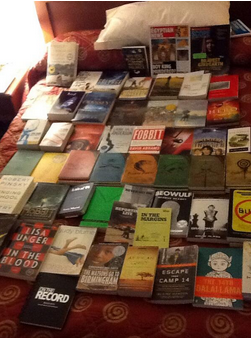
Our “haul” from the NCTE Convention from book publishers and authors…headed for our classroom libraries.
Thanks to the authors who gave away signed copies of their books:
The tote bags distributed free to all registrants bore popular author Nicholas Spark’s imprimatur, a visual testament to the celebrity draw of authors at this convention. Authors are the rock stars at this convention: the children’s book authors rock, the young adult authors rock, and the educator trade book authors rock. Attendees stood in lines snaking around booths on the convention floor waiting to meet authors and have books signed. In the past, my request to an author is to have the book signed with the phrase “READ ME!” on the inside cover. I had the same done this year, so when a student asks what to read, I will point that the author has already made a suggestion to read the book.
We are so thankful to have the opportunity to personally meet and mingle with the rock stars of the convention!
Thanks for the Tweeters:
Finally, the fingers of dedicated Tweeters attending the convention kept us abreast of all the events at the conference. There was a steady stream of information from sessions we could not attend, summaries of keynotes addresses, and updates as to upcoming book signings. The hashtags #NCTE13 and #CEL13 were invaluable sources for notes and quotes during the convention and for well after we left Boston. For example, some Friday session tweets were archived onto the Storify platform for later use.
Next year, the NCTE Convention is scheduled for Washington, D.C., which gives me one more reason to be thankful…the convention is within driving distance!













 Used Books in Class