Archives For November 30, 1999

Watching the Olympics has been an emotional mixture of admiration and frustration. Like many Americans, I was caught by the story of 15-year-old swimmer Katie Ledecky; she is the same age of many of my students. At 11:00 PM Friday (8/3/12), the hype was all about her 800 meter freestyle event; I was hooked. The NCB sports commentator noted, “The race will be about eight minutes long,” before the digital buzz sent the line of swimmers simultaneously into the pool. By the end of the first two minutes, Ledecky was a little ahead of the world record pace and in the lead. She was competing against the hometown favorite Rebecca Adlington of Britain and the 2008 bronze medalist Lotte Friis of Denmark. Ledecky’s arms churned the water, sometimes fully ahead of the animated world record line, sometimes only fingertips stroking its imaginary presence. The NBC commentator chatted away about her strategy; had she pulled in front too soon? Would her more seasoned rivals push her and then pass her? The race was exciting.

Suddenly, NBC cut away from the race to broadcast a series of commercials: a new sitcom, a credit card… who cares what else? The race was continuing in cyberspace while I impatiently waited for its return. Of course, I knew I was watching a rebroadcast. The event had been decided hours ago. I even knew who won, but that did not stop my level of engagement until NBC cut me off.

Six minutes into the race, NBC’s economic responsibilities addressed, Ledecky appeared once more on the screen, solidly in the lead. The commentator who had questioned her strategy was now unabashedly cheering her forward as were the crowds watching the race. She demonstrated that brand of immortal teenage exuberance, simply swimming as fast as she could for as long as she could until she literally hit the wall. This youngest member of the U.S. swim team had finished the race for the gold in 8 minutes, 14.63 second and narrowly missed a world record. Then, I heard the commentator ask, “The future of USA swimming! Have we seen it tonight?”

“No, we did not!” I snarled back to his rhetorical question, a response made more ridiculous by my awareness of our digital divide. No one watching that broadcast saw the race live. Nor did we see the race entire. Instead we saw a truncated version of an Olympic event. We saw the beginning, and the end, but we missed the middle…the plot where the protagonist fights against an antagonist: the water, an opponent, or herself.

I often joke with my fellow teachers that a student’s attention span in class is 24 minutes, the length of a sit-com without commercials. Understanding this programmed behavior has helped to guide my teaching. I get 24 minutes of “real understanding” in a 43 minute period; the rest of the time is administrative (attendance, homework, announcements,lesson prep or product collection, etc). A sitcom , however, is not a continuous 24 minutes, rather, each episode has several breaks at approximately eight minutes intervals throughout a broadcast. The first eight minutes introduces characters and conflict. The second eight minutes features conflict confrontation. The third eight minutes deal with plot resolution. Every eight minutes, a commercial intrusion follows the “cliffhanger moment” or a plot complication to keep viewers intrigued.

This broadcast now has me concerned. The race itself was eight minutes, the length of time that networks have conditioned the public to expect in the story sequence. The race itself could have been shown in its entirety. Instead, NBC pulled away only two minutes into Ledbecky’s race. Why? More than likely, the decision was made to maximize revenues and cram in more commercials to a committed viewing audience. Some executive probably thought that the race would look the same throughout; swimming is not as flashy as gymnastics or basketball. This, however, I see as a dangerous precedent. In chopping up this eight minute race, NBC has catered to the desires of those who only want the outcome.

Many of my students want to read only the beginning of a story and the end “to see how it turns out”, without reading the story itself. These students would rather have the answers rather than experience learning. They think the middle is “boring”. NBC’s coverage of this particular race is similarly condensed. The NBC model suggests that the race, an eight minute sequence of Ledecky’s story, is “boring” and can be interrupted; that the middle of her story is not as important as the concluding last lap.

When we look for reasons as to why students are unable to pay attention for an extended period of time, we might look at the powerful influences of media. How the media tells stories: news, sports, sit-coms, influences the pattern of stories. Audiences will adjust to the shortened version. Ledecky is the same age as many of my students; she is part of the generation that operates on the 24 minute window of learning opportunity. Her race, the plot where she battled in split seconds, at the very minimum deserved the eight minutes of uninterrupted broadcast time. NBC’s methods of broadcasting the “future of swimming” is an indication of a how media will fragment or remove parts of a story in the future; our students’ attention spans will soon reflect the same.


A series of links took me to a lesson plan  on the Edsitement! The Best of the Humanities on the Web site that is associated with the National Council of Teachers of English (NCTE) . The lesson “Vengeful Verbs in Shakespeare’s Hamlet”  is entirely too disturbing. The opening lines of the lesson plan begin, “Shakespeare’s Hamlet  is an excellent source of instruction for students at the middle school level.”

My thoughts? Sorry. Middle school students, grades 6-8, should not read Hamlet. Teachers, leave that play for high school. Middle schools students need to read. They need to read many, many books.  They need young adult literature. They need to read for pleasure to build up their literary skills.

The lesson plan continues:

It [Hamlet] is a tale full of mystery and suspense and peppered with elements of the supernatural. Everyone loves a good ghost story! The popularity of the ghosts in the Harry Potter series and in The Graveyard Book attests to the appeal of the paranormal for this age group. These ghosts manifest as translucent spirits, yet they impact the physical world and certainly add life to the story line. Figments such as Rowling’s histrionic Moaning Myrtle and Gaiman’s mysterious Silas provide guidance for the young adults in their time of need.

My thoughts? Yes, these are the books they SHOULD be reading! Add the ghost stories Hereafter and Anna Dressed In Blood to the list of well written young adult novels. And yes, Harry Potter and The Graveyard Book are stories that will guide young adults in their time of need. But Hamlet?

Back to the lesson plan:

What better way to expose middle school students to a first taste of Shakespeare than from the angle of the ghost story? The first time Hamlet sees his father’s ghost (Hamlet, act 1, scene 5, lines 13–31) is one of the most dramatic moments in theatre and a prime opportunity to teach the often dry and boring subject of verbs.

My thoughts: Whaa…??? This lesson is turning a critical moment of drama into a lesson on verbs? This idea is dry and boring regardless of the content!

Finishing the description of the lesson plan:

Through the ghost of Hamlet’s father, students receive an introduction to the language of Shakespeare in a context they can understand. In this lesson, they will learn to distinguish generic verbs from vivid verbs by working with selected lines in Hamlet’s Ghost scene. Students will then test their knowledge of verbs through a crossword interactive puzzle.

My thoughts: A crossword puzzle. Yup. That will help them appreciate the play. I can hear the rattling from Stratford on Avon; Shakespeare’s bones are disturbed.

The objectives of the lesson are:

  • Students will be able to identify and define the verbs Shakespeare uses to convey the meaning of the scene
  • Students will exchange the verbs from the scene and replace with more vivid and more generic ones to see how that changes intention of the scene
  • Student will be assess their ability to define vivid and generic verbs used by Shakespeare by solving a crossword puzzle

Yes, readers, in this lesson students will replace Shakespeare’s language with bland or generic verbs using a worksheet.

WHY?

There is little consideration as to how all the language in this scene defines each character. No consideration of motive. No moral or ethical discussion about what the Ghost is asking Hamlet do.   The Harvard scholar Steven Greenblatt wrote an entire book, Hamlet in Purgatory,  wrestling with the central question offered in this scene, is the Ghost from Hell or Purgatory? But no, this lesson is on verbs.

Here are the lines: (Act I.V.13-31)

Father’s Ghost. I am thy father’s spirit,
Doom’d for a certain term to walk the night,
And for the day confin’d to fast in fires,
Till the foul crimes done in my days of nature
Are burnt and purg’d away. But that I am forbid
To tell the secrets of my prison house,
I could a tale unfold whose lightest word
Would harrow up thy soul, freeze thy young blood,
Make thy two eyes, like stars, start from their spheres,
Thy knotted and combined locks to part,
And each particular hair to stand on end
Like quills upon the fretful porcupine.
But this eternal blazon must not be
To ears of flesh and blood. List, list, O, list!
If thou didst ever thy dear father love-
Hamlet. O God!
Father’s Ghost. Revenge his foul and most unnatural murther.
Hamlet. Murther?
Father’s Ghost. Murther most foul, as in the best it is;
But this most foul, strange, and unnatural.

In this passage, the Ghost is very cagey about where he is coming from literally and figuratively. The Ghost plays the ultimate guilt card “If thou didst ever thy dear father love-” Hamlet anticipates the request and interjects a prayer “O God”. The Ghost then, you choose: a. asks, b. demands, c. commands the Prince, Hamlet, to revenge.

Another consideration as to the appropriateness of the use of Hamlet is the berating of Hamlet’s mother, Gertrude sixteen lines later:

Father’s Ghost. Ay, that incestuous, that adulterate beast,
With witchcraft of his wit, with traitorous gifts-
O wicked wit and gifts, that have the power
So to seduce!- won to his shameful lust
The will of my most seeming-virtuous queen.
O Hamlet, what a falling-off was there,
From me, whose love was of that dignity
That it went hand in hand even with the vow
I made to her in marriage, and to decline
Upon a wretch whose natural gifts were poor
To those of mine!
But virtue, as it never will be mov’d,
Though lewdness court it in a shape of heaven,
So lust, though to a radiant angel link’d,
Will sate itself in a celestial bed
And prey on garbage.

There are accusations of incest (a thought of Hamlet’s given voice by the Ghost), witchcraft, and adultery for Claudius. Gertrude acts with “lewdness” and “sates” herself in Claudius’s bed of figurative garbage. The Ghost cannot contain his fury at being replaced by Claudius; he has lost kingdom and queen and his fury spills over and exploits Hamlet’s depression. There is much here to discuss.

But for grades 6-8?  To replace the language of Shakespeare and make it “bland” to prove a distinction about verbs in Elizabethan English and today’s English? To measure the student understanding of the language with a crossword puzzle? Is it any wonder that with lessons like this one, many students come to a high school classroom “hating” Shakespeare? I have to work very hard to convince them otherwise.

There is something rotten on the Edsitement! site, and NCTE should be ashamed for endorsing this lesson. This lesson about verbs, not motivation or ethical dilemmas, disregards the dramatic tension of the scene and is wrong at any grade level!

What next? A lesson on the comma during Macbeth’s “Is this a dagger I see before me? /Come, let me clutch thee”?

There are  better lessons on heaven and earth for students in this age group then are dreamt of in this lesson plan!

NCTE must be aware that we have a nation of students who are not reading in part because many teachers kill the pleasure of a book. Hamlet is not the material that will bring middle school students a love of reading, and the literary analysis skills for these students in grades 6-8 are not sophisticated enough to bring them to an understanding of The Ghost’s manipulations. A grammar lesson plucked from a dramatic moment with a brilliant seduction by a spirit from beyond the grave is just so wrong.

This lesson is out of joint. O cursed spite
That ever I was born to set it right!

The Friends of the Westport Public Library book sale never disappoints a reader. In fact, many of the books that I have purchased at this sale in previous summers (2009-2011) now stock our classroom libraries for grades 7-12. Our Grade 10 World Literature class now has entire class sets of The Life of Pi and The Curious Incident of the Dog in the Night-time. The same can be said for the Grade 12 Memoir Class with The Glass Castle. This means that I have had to become more selective and pluck out only the titles that we need to replace or increase. Now, when I see the covers of these texts, I have to stop my hand from its automatic reach; our shelves are already full! So, if there are schools looking to add these titles, I left many great titles on the tables.

This Westport Public Library book sale is massive and almost professionally run; the volunteers could consider running training classes for other library book sales. There are legions of volunteers who straighten tables of books or count purchases. Be aware, however, there are also legions of shoppers; parking is at a premium.

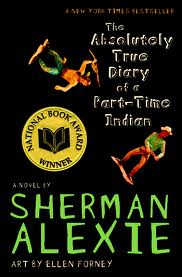
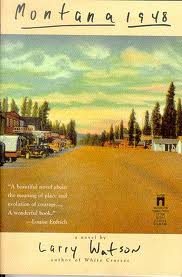
This year, I found copies of books for the Grade 11 Native American Unit: Larry Watson’s Montana 1948, Sherman Alexie’s The Absolutely True Diary of a Part Time Indian.  I suspect these books are also taught in the Westport school system because of the number of copies. Montana 1948 is “about a middle-class Montana family torn apart by scandal during the summer of 1948” and was awarded the Milkweed National Fiction Prize. The Absolutely True Diary of a Part Time Indian was reviewed by School Library Journal as a semi-autobiographical chronicle of Arnold Spirit, aka Junior, a Spokane Indian “whose determination to both improve himself and overcome poverty, despite the handicaps of birth, circumstances, and race, delivers a positive message in a low-key manner.” Both receive high marks from our students.

There were also two copies of A World Lit Only by Fire: The Medieval Mind and the Renaissance: Portrait of an Age by William Manchester which is a new text for our AP European World History course.

The large tents for the Westport book sale provide enough room for patrons and the tables full books. Maps are distributed at the entrance; a mountain of empty boxes is available for shoppers to fill.  Hard to tell if the organizing committee has chosen not to alphabetize because of the number of books titles or because they want to encourage more browsing, I am not sure. I know I visited every table! There were far more book vendors there this year who load up large bags using professional scanners. This sale makes it easy for them to return books they do not want by genre; there are clearly labeled containers; if you cannot find a title, check these containers!

Books are priced at $.50-$3.00 on Saturday, the first day of the sale; there are discount days through Tuesday, June 24.

Saturday & Sunday 9 am to 6 pm
Monday (everything 1/2 price) 9 am to 6 pm
Tuesday (free day: suggested cash donation $5/bag) 9 am to 1 pm

Signs marking each genre were placed on the tables, but the maps were more reliable. I used the map to locate the young adult section which were filled with great choices for independent reading. As a bonus, the children’s section has its own separate tent. Picture books are raised on shelves, smaller chapter books are laid spines up for easier browsing.

I spent $80.50 in total for four bags of carefully selected books.

As I left, the local newspaper photographer was taking candid shots of students in the Children’s section. One young girl, about 11 years old,  had her arms so full of book, the photographer could not see her face.

“Where are you?” she joked with the girl.
“I’m lost in these books,” the girl giggled in response.

I left smiling.

With one broad sweep of a word-processing program, NY Times Columnist David Brooks brushed off the Newbery Award collection of the best children’s novels as containing some “exquisitely sensitive novellas” in his essay Honor Code (July 5, 2012). He should reconsider this judgment on several counts.

The premise of his editorial was to bring attention to recent statistics that suggest young boys are falling behind in the American education system. First, he compared the contemporary American schoolboy to the rambunctious Prince Hal of William Shakespeare’s history plays, Henry IV parts I and II and Henry V. This comparison proved an apt metaphor, although Brookes failed to call attention to the irony of his allusion; Prince Hal and the American schoolboy are both out of place in their respective educational institutions. Unfortunately, he over- stepped his position when he mischaracterized the  prestigious Newbery Award given to excellence in children’s literature by stating: “If schools want to educate a fiercely rambunctious girl, they can’t pretend they will successfully tame her by assigning some of those exquisitely sensitive Newbery award-winning novellas.”

Simply because a book is  written for young audiences (elementary through middle school) and is shorter in length than an adult novel does not mean the book is a novella; the Newbery Award books are novels. However, on several occasions the Newbery has been awarded to books of poetry (1989 Medal Winner: Joyful Noise: Poems for Two Voices by Paul Fleischman) or short stories, songs and poems (2008 Medal Winner: Good Masters! Sweet Ladies! Voices from a Medieval Village by Laura Amy Schlitz).

As to the charge that some of the Newbrry novels are “exquisitely sensitive,” well, yes, some are. I am “exquisitely sensitive” myself when I remember my reading the 1963 Medal Winner: A Wrinkle in Time by Madeleine L’Engle. However, while I can only comfortably include those titles that I have read or recommended to my students, there are fewer “sensitive” novels than one might suspect, in fact, some of the Newbery Award novels are brash, outrageous, or disturbingly violent. More than a few of them have been banned.

Consider that Mr. Brookes began reading Newbery books in 1969; he would be eight or nine years old.  The “exquisitely sensitive” 1967 Medal Winner: Up a Road Slowly by Irene Hunt would be available to him as would 1947 Medal Winner: Miss Hickory by Carolyn Sherwin Bailey However, during a 10 year school reading career, ages 8-18, he could have also encountered:

  • 1969 Medal Winner: The High King by Lloyd Alexander
  • 1970 Medal Winner: Sounder by William H. Armstrong
  • 1972 Medal Winner: Mrs. Frisby and the Rats of NIMH by Robert C. O’Brien
  • 1974 Medal Winner: The Slave Dancer by Paula Fox
  • 1976 Medal Winner: The Grey King by Susan Cooper
  • 1977 Medal Winner: Roll of Thunder, Hear My Cry by Mildred D. Taylor
  • 1979 Medal Winner: The Westing Game by Ellen Raskin

These are seven books that do not qualify as “exquisitely sensitive” books “to tame” rambunctious students. If Brooks had continued to read the canon of Newbery award winning novels as an adult, he would have encountered the following “definitely NOT exquisitely sensitive” books as well:

  • 1987 Medal Winner: The Whipping Boy by Sid Fleischman
  • 1991 Medal Winner: Maniac Magee by Jerry Spinelli
  • 1990 Medal Winner: Number the Stars by Lois Lowry
  • 1994 Medal Winner:  The Giver by Lois Lowry
  • 1999 Medal Winner:  Holes by Louis Sachar
  • 2000 Medal Winner: Bud, Not Buddy by Christopher Paul Curtis
  • 2003 Medal Winner:  Crispin: The Cross of Lead by Avi
  • 2009 Medal Winner: The Graveyard Book by Neil Gaiman

I would also like to give a shout out to the one book that was read by every “rambunctious” boy I ever taught, the  1988 Newbery Honor book Hatchet by Gary Paulsen. For many boys, this is the ONLY book they remember.

Newbery authors do not write in order “to tame” rambunctious youth, boys or girls, and I would suspect that several would take great offense to that statement.  Authors for children and adults alike write to tell an extraordinary story, to share an experience, or to give voice to a character or person from the “margin”, an outsider who has a voice through the written word.

Many authors are not “tame” themselves, in fact, this year’s Newbery Award winning writer was Jack Gantos for Dead End in Norvelt. Gantos has a fascinating back story. He  was convicted as a young man of smuggling drugs and spent time in a federal prison. His behavior, in fact , was very much like the  behavior of Prince Hal of Shakespeare’s plays. However,Gantos was a reader and found great literature to guide him during times of trouble. While in prison, he was without a notebook and wrote in the margins of The Brothers Karamazov, intertwining his words with Dostoevsky . His memoir of his felonious behavior  is called A Hole in My Life, and we teach the text as a required read in our Grade 12 Memoir class.

The Newbery Award winners reflect the rich diversity of literature that is available to students, rambunctious or not. These novels are not assigned “to tame” , but they are assigned, or recommended, to comfort a reader, to entertain a reader, to challenge a reader’s beliefs, or to incite a reader to action. They may be short, but they are not novellas, and no teacher “pretends” they are the solution to educating a fiercely rambunctious student.  Most teachers know that these Newbery Award novels, and their Newbery Award honorees companions, may be the  only solution for educating that fiercely rambunctious student.

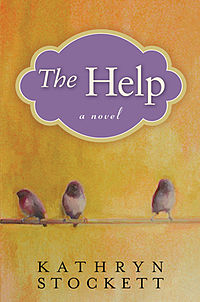
Yes, there were seven (7) copies of Kathryn Stockett’s The Help waiting for me to pluck them from the table at the Friends of the CH Booth Library book sale this morning. I have been hunting down this text for several months for use in conjunction with To Kill A Mockingbird, and -surprise!-there were 18 brand new copies of those as well.

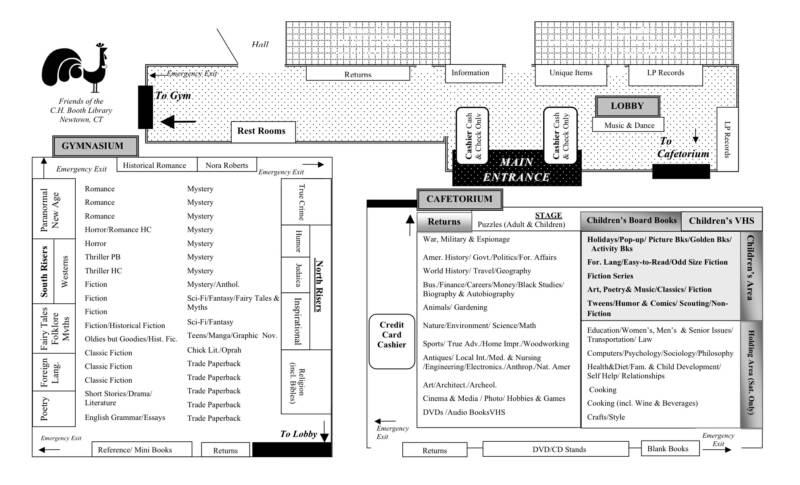
This massive book sale provides easy shopping in the gym and the all purpose rooms of the Reed Elementary School in Newtown, CT, and offers convenient “holding areas”, carts, and plenty of empty boxes for readers to fill. The sale will continue from July 14-17, 2012. Organization is the key to a great library book sale, and this sale is extremely well organized. As I shopped, volunteers kept the books in order, alphabetizing as fast as book were replaced and loading additional copies of texts onto large tables. Their system made finding “sets” of books easy. The tables were laid out with wide aisles to allow for passing other browsers and there was a published floor plan on the website for shoppers to preview as well.

This year, all the trade paperbacks, fiction and non-fiction alike, were loaded onto the tables closest to the entrance., which seemed a logical choice as these books receive the most attention from browsers. At first I was a little disturbed seeing Lucy Grealey’s Autobiography of a Face and Erik Larsson’s The Devil in the White City next to Sue Monk Kidd’s The Secret Life of Bees, but I soon got over the blend of genres, in fact, this choice made my shopping for texts a little easier.

There were plenty of copies of books for me to “add” to our collection: Precious by Sapphire, Dairy Queen by Catherine Gilbert Murdock, All the Pretty Horses by Cormac McCarthy, A Tree Grows in Brooklyn by Betty Smith. In fact, if teachers wanted to add The Kite Runner to their collection, there was a box of 30 or more copies under the table, ready to replace the five copies already up.

But my goal was Kathryn Stockett’s The Help, and it was goal achieved with the seven copies of The Help that I got! The bonus of getting 18 new copies of To Kill a Mockingbird, our core text for the unit for juniors, was icing on the cake (or pie?) The Help was reviewed in 2009 by Publisher’s Weekly:


“What perfect timing for this optimistic, uplifting debut novel set during the nascent civil rights movement in Jackson, Miss., where black women were trusted to raise white children but not to polish the household silver. Eugenia Skeeter Phelan is just home from college in 1962, and, anxious to become a writer, is advised to hone her chops by writing about what disturbs you. The budding social activist begins to collect the stories of the black women on whom the country club sets relies and mistrusts enlisting the help of Aibileen, a maid who’s raised 17 children, and Aibileen’s best friend Minny, who’s found herself unemployed more than a few times after mouthing off to her white employers. The book Skeeter puts together based on their stories is scathing and shocking, bringing pride and hope to the black community, while giving Skeeter the courage to break down her personal boundaries and pursue her dreams.”

As I shopped the animal section, a volunteer asked me, “Do you like the signs on the tables?”
“Yes, I like the signs on the table,” I replied (our conversation mimicking one from Go, Dog, Go which I had in my bag)
“Well, they were much more in order this morning,” she continued as she busily straightened the table.

If the books and signs were in better order in the morning, then this was the UBER-organized sale when the gates opened; I had arrived at 11:15 AM. The place was humming with shoppers, but the books sat neatly in their genres, signs clearly delineating where “Tween HC” (Teenage books-hard cover) sat and where “Non-Fiction PB” (paperback) began.
Needless to say, having a holding area and capable volunteers to tally a purchase is key to customer satisfaction. I had six bags plus one box (over 300 books) for a total of $314.00. My trunk was loaded easily from the front sidewalk of the sale, and no one complained that I ran over one of the pylons blocking the entrance.

So thank you, Friends of the CHBooth Library. Your book sale was a pleasure to attend and The Help that I needed!

The Simpson’s creator Matt Groening is a great satirist. In one episode in an exchange between the cartoon character Lisa Simpson and her Grandmother, he also demonstrates his ability to be a great literary critic:

Grandma Simpson: Don’t be bashful. When I was your age, kids made fun of me because I read at the 9th grade level.
Lisa: Me too!
Grandma Simpson: Although I hardly consider A Separate Peace the ninth-grade level.
Lisa: Yeah, more like preschool.
Grandma Simpson: I hate John Knowles.
Lisa: Me too.

I value Lisa Simpson’s opinion on literature, after all, this is a character who has been seen clutching copies of  The Bell JarEthan FromeMan and SupermanThe Corrections, and the more age appropriate Pippi Longstocking. So when she says she hates John Knowles, I feel validated. I have always disliked John Knowles’s A Separate Peace.
However, there are others who call this same book  “A masterpiece”(National Review) or ” deeply felt and beautifully written” (The Observer) or “Intense, mesmerizing, and compelling” (School Library Journal). The English Language Arts Common Core State Standards gives its recommendation since the novel has been, “Hailed as a literary masterpiece,” and that ” A Separate Peace is a classic novel with numerous teaching resources available.” The CCSS analysis of the text complexity reads:
“When considering the qualitative measures and the reader-task considerations, this novel is well placed at the 9th-10th grade complexity band. The complex themes, use of first person narrative—but with multiple flash backs and flash forward indicate higher level reading skills are needed by the reader. The Common Core Standards Text Exemplars also place the novel in the 9th -10th grade complexity band.”
 In a  2004 study titled A SeparatePeace:Four Decades of Critical ResponseLois Rauch Gibson writes:

“Rejected at first by American publishers, John Knowles’ A SeparatePeace appeared in England in 1959, where critics admiringly compared it to Salinger’s writings. American critics, responding in 1960 to the American edition, generally noted its depth, sensitivity, and ‘disturbing allegories'(Aitken 754). They did not entirely agree about what the allegories might be, nor have the four decades of critics since.”

I would argue there are no allegories in this short story “Phineas” that was expanded (unnecessarily) by Knowles into a full length novel. This is a fairly straightforward story of young white males at an exclusive prep school and their conflicts and competition during a last summer before entering the very grown up world of competition and World War II. I found the story dated when I read it in 1973, but Gibson felt the novel could  speak to today’s readers:

“As we approach the forty-fifth anniversary of the American edition of A Separate Peace,in a world where the all-male, all-white prep school environment has become exceedingly rare, John Knowles’ novel nonetheless continues to speak to adolescents. Once we fought wars against fascism, then against communism, now against terrorism. Before this background, teenagers attend school, bond with peers, lose their innocence, encounter hate and ignorance and what Knowles calls blind impulses; and each one inevitably struggles to develop an identity-sexual and otherwise. As the world continues to change, no doubt the next four decades of critics will have much to say about this resilient and compelling novel.”

I have always considered A Separate Peace to be the poorer literary cousin to J.D. Salinger’s 1951 classic Catcher in the Rye. Unfortunately, I like A Separate Peace’s  Gene less than I like the deluded Holden from Catcher in the Rye, and I like the object of Gene’s angst, Phineas or Finny, even less. This is a critical problem in the novel according to Slate Magazine’s Dec 2009 review The Secret of A Separate Peace by Stephen Metcalf:

“We do not love Phineas as Gene does. His charm for Gene exceeds his charm for us. The less we are seduced by Phineas, the more we experience him not as an Apollonian boy-god lacking the normal ratio of ill-character but as a love object for Gene, and Gene alone.”
I remember reading the climatic moment of the novel, when Gene reflects back on the accident in the tree:
 “He [Phineas/Finny] had never been jealous of me for a second. Now I knew that there never was and never could have been any rivalry between us. I was not of the same quality as he. I couldn’t stand this. . . . Holding firmly to the trunk, I took a step toward him, and then my knees bent and I jounced the limb. Finny, his balance gone, swung his head around to look at me for an instant with extreme interest, and then he tumbled sideways, broke through the little branches below and hit the bank with a sickening, unnatural thud. It was the first clumsy physical action I had ever seen him make. With unthinking sureness I moved out on the limb and jumped into the river, every trace of my fear of this forgotten.”
“What the heck?” I distinctly remember thinking, “He intentionally caused him to fall! What kind of friend is that?” He lost me at “forgotten.” I considered the final “apology” of the novel a fraud:
“I never killed anybody and I never developed an intense level of hatred for the enemy. Because my war ended before I ever put on a uniform; I was on active duty all my time at school; I killed my enemy there. Only Phineas never was afraid, only Phineas never hated anyone.”
It’s a lie. Gene was responsible (indirectly) for the death of Phineas, and in this statement he is contradictory about killing his “enemy.” Apologetically glorifying Phineas at the end is probably meant to be sincere, but to me the conclusion reeks of Freudian dishonesty. Gene could never really know Phineas, so he destroyed him and then made him a god.
 Still, our 9th grade honors classes read A Separate Peace.
When I asked the teacher why she replied casually, “Well, they can read it in a weekend. They like it.”
“Do you do any real lessons with it?” I pressed her.
“No. They generally get it.”
“Get what?”
“Friendship, betrayal. Teenage angst.”
Ah, yes. A Separate Peace is awash in teenage angst. So is high school, which probably is the reason the book remains in the high school canon. That and the accumulated hundreds of copies available in English Department libraries. Of course, this wallowing in the imposed angst of teenagers reminds me of another brilliant Matt Groening observation, this time provided by Lisa’s brother Bart. Heading into an alternative rock and roll concert, Bart is heard commenting, “Lisa, making teenagers depressed is like shooting fish in a barrel.” Which explains why Lisa hates John Knowles.
Me too.

Every generation of readers has one. That book. The book with racy passages. The book with the “reputation”. The naughty book.

The proliferation of  Fifty Shades of Grey-that book- means that is entirely possible that at least one of my high school students will bring in copy as an  independent choice reading text. Of course I will require the student choose something more age- appropriate if this particular book is being read for class credit, but there are many books that teeter on acceptable boundaries.  I have had middle school students bring in copies of Twilight, Eclipse, Breaking Dawn; a series built on heart-pounding sexual teasing for three prolonged book lengths. I have seen a 10th grade student engrossed in reading Girl with the Dragon Tattoo, and although I was aware of the steamy material, I saw no such reaction from the student who was being deeply exposed to Swedish misogyny. Popular culture books, particularly steamy popular culture books, are passing fads in literature.

Naughty book popularity rises and falls with readers. Every year there is some student who could be sneaking  “for mature audience” materials. When I was growing up, the paperback copies of The Godfather opened automatically, like Lucy for Sonny, on page 18. Yes, Mario Puzo’s bestseller was full of quivering and pulsing, when it wasn’t violently establishing the dominance of the Corleone family.  Coffee, Tea or Me? , which detailed the escapades of stewardesses during the sexual revolutionwas the other “naughty” text that I remember the adults keeping out of my reach. No matter. I “borrowed” my aunt’s copy during Thanksgiving dinner and read furiously in an upstairs hallway. Hiding from the relatives celebrating the holiday, I wasn’t missed, probably because I had been seated at the “kid’s table” with at least a dozen cousins.

I also know other adults have had brief flings with inappropriate literature in their youth. I know this also, because Pamela Munoz Ryan, author of the award winning  children’s book  Esperanza Rising, discussed her naughty book adventure at a keynote address at the 82nd Saturday Reunion at Columbia Teacher’s College in March 2012. Opening her remarks, Ryan claimed, “to read because it’s safe and to write because it’s dangerous.” She explained how her love of stories made her choose to write, and then she shared her own “naughty book” story.

When Ryan was young, she discovered racy romance novels in the home library shelves of a Coca-Cola addicted neighbor. Ryan would return those empty soda bottles for candy money, while at the same time, she would “borrow” a copy of a torrid romance novel. She recalled one specific incident, however, involving The Valley of the Dolls, a steamy best-selling fictional account of the rich and famous. She snuck the book out of her neighbor’s house in the back waistband of her pants. At the time, she explained, the only “safe” place for reading was the town public library, and Ryan was soon holed up in a little used aisle of books pouring through the Valley of the Dolls. There, she was approached by the town librarian.

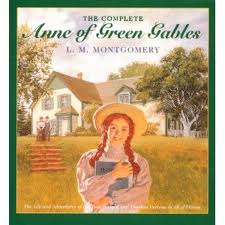
“I could not help notice how engrossed you are in reading,” said the librarian while Ryan desperately tried to hide the title of the book, “and I wondered if  you ever read this book?” In her hand the librarian held a copy of Anne of Green Gables.

Ryan said she had not read the book and feeling obliged, checked it out.

“I rode home on my bike that day,” says Ryan, “with a copy of Valley of the Dolls tucked in my waistband, and a copy of Anne of Green Gables  in my bicycle basket.” She paused for a moment with the recollection, “You know,” she stated to a congregation of teachers, “I have read the Valley of the Dolls only once, but I have read, reread, and revisited Anne of Green Gables many times.”

Teachers too know that a student will at some point in his or her life be exposed to reading materials that may be too mature, or too salacious, for his or her age. We can counter these sensational texts because we know what books will last, what books will transcend the effects of time, and what memorable characters will help our students as they mature and grow into adults. Students should read because, as Ryan stated, “it is safe”, and we need to encourage their reading as much as possible. We should be ready to help them make good choices, such as the classics Little Women or  A Tree Grows in Brooklyn. We should be ready to recommend a contemporary Esperanza Rising, The Book Thief  or Dairy Queen. We must allow students a choice in their reading but look for the opportunity to suggest a more appropriate title, because we know that the Fifty Shades of Grey tucked in the backpack ,or in their waistband, is a passing fad. Great literature endures, and fortunately, Anne of Green Gables will be there for the reader.

Teenagers today read for pleasure just as much their parents-or grandparents- read when they were teens. This means that after all the time and effort dedicated by schools and publishers to increase student reading, the statistics show no increase in the number of teenagers who read for pleasure?

I find this a proposition just a little depressing.

65 years and no improvement in teens reading for pleasure? Why not?

An article in the January 2012 Language Magazine: The Journal of Education and Communication by Stephen Krashen titled “Reading for Pleasure” looks at data about the reading habits of high school students gathered from 1946 to the present in order to explain “why we should stop scolding teenagers and their schools.”  Krashen is a linguist and researcher in second language acquisition who promotes the use of free voluntary reading  which he says “is the most powerful tool we have in language education, first and second.”

Krashen looks at questionnaires given to 17 year olds by  National Assessment of Educational Progress (NAEP)  that asked if they read in their spare time.  Using this data, he determines that despite some improvement between 1946 and 1984, there has been a decline in teenage reading from 1984-2008, resulting in no net gain in reading for the past 65 years. He concludes that, “Contrary to popular opinion, there is no evidence that teenagers are less engaged in literacy activities today than teenagers of the past. Teenagers today do just as much book reading as teenagers did 65 years ago, and it appears that they are more involved in reading and writing in general when we include computer use in the analysis.”

That conclusion is really depressing. There have been considerable efforts to increase student reading on several fronts beginning in earnest with Rudolph Flesch’s Why Johnny Can’t Read: And What You Can Do about It  published in 1955. While this book dealt primarily with the methodology of teaching reading (phonics), the book’s message about the importance of literacy spike a nation’s interest in improving reading skills-an important step in student reading for pleasure. On the education front, the inclusion of   SSR (silent sustained reading) during the school day began over 30 years ago. One of the tenets of SSR is that students have the opportunity to choose materials to read. The practice of SSR has travelled from elementary to many middle and high schools in order to respond to student demands for choice. Finally, on the publishing front, there has been an explosion of  children and young adult literature in the past fifteen years: 3,000 young adult novels were published in 1997;  30,000 titles in 2009. In 2009, total sales exceeded 3 billion.

So, these quick examples suggest there is evidence there is heightened awareness about student reading for over 50 years, there is time provided in school, and there are materials published. Yet, there has been no increase in teenagers reading for pleasure?

Well, Krashen looks at the combined reading and writing habits of teenagers and notes that teenagers in the 2005 and 2010 NAEP reports spent more time on written interaction than on entertainment. Written interaction referred to social networking sites, and these figures are probably on the increase as access to the Internet on mobile devices increases. He writes that, “Communication with their peers is clearly important to them. In terms of total ‘voluntary reading and writing,’ teenagers in the 2005 report and the 2010 report are nearly even.” He concludes that, “’Kids these days’ appear to be reading and writing on their own an average of about an hour and a half a day.”

But student communication with their peers can be limited in vocabulary and scope. A recent student in Britain by Lancaster University’s Professor Tony McEnery who conducted research creating analysis of a database of teenage speech that suggested British teenagers had a vocabulary of just over 12,600 words compared with the nearly 21,400 words that the average person aged 25 to 34 uses. In other words, communication with peers does not increase vocabulary, and this study did not include texting adaptations of vocabulary with acronyms or shortened spelling. Yes, this study was conducted in Britain, but it is unlikely there is much difference in the vocabulary of American teens, other than that lovely accent.

Krashen is very clear to point out that students “are reading peer writing, not Hamlet or the Federalist Papers. And they are writing to each other, not composing essays comparing and contrasting Edgar Allen Poe with Longfellow.” But, I am not comforted that Krashen offers social communication as voluntary reading despite his claim that students experience cognitive development when they write on topics of deep personal concern.

I do agree, however, with Krashen’s claim  that “the true problem in literacy is not related to convincing reluctant teenagers to read: It is providing access to books for those living in poverty.”  I would go further to suggest that all schools, economically privileged or not, need to create reading material rich environments for students.

A classroom book cart in Grade 9 with high interest titles

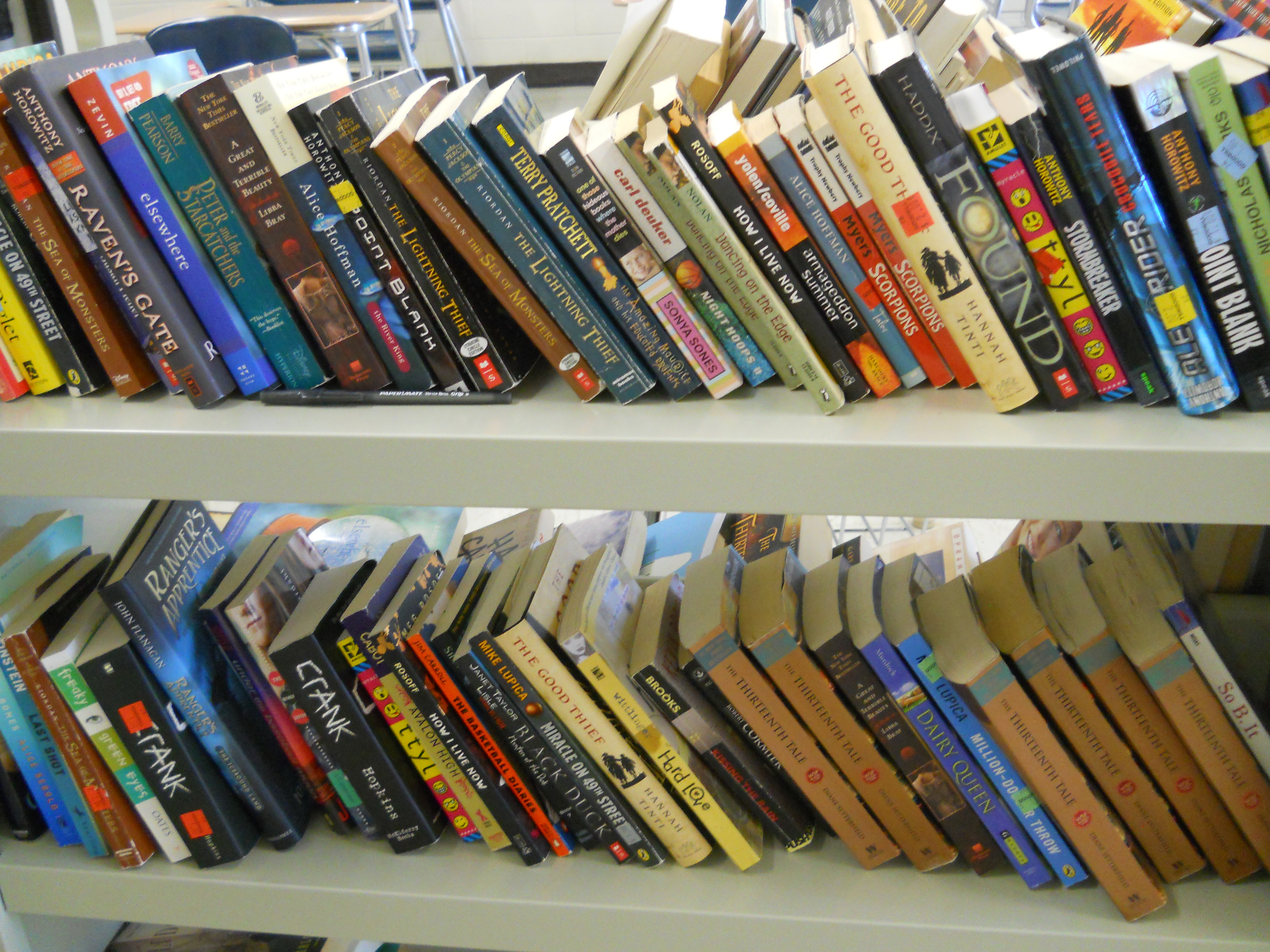
Our 9th grade students are provided SSR time twice weekly (20-25 minutes/day) to read for pleasure. They may choose what they want to read. Often, a student will arrive in class without materials or, having just completed a book, looking for a recommendation. Our classroom libraries (book carts) are filled with high interest used books purchased for exactly this moment, and our school library is now connected to Overdrive which allows students to check out an ebook on a mobile device. This ability to capitalize on this moment of student’s interest with reading materials is critical to a successful reading program. The hope is that this will lead to continued reading for pleasure outside the classroom.

Krashen’s review of the data is depressing; I would have expected that given the amount of attention given to increasing teen reading for pleasure that there should have been a steady increase in reading habits from generation to generation.He cautions that negative attention given to this topic, including “dissing high school students”, is not the way to increase reading for pleasure. Teenagers by nature, regardless of their generation, should come to reading for pleasure through availability AND  choice. Just ask your mom, or grandma, can we do better?

The original purpose of this blog was to explain how used books were purchased in order to increase the classroom libraries at Wamogo Middle and High School, grades 7-12. The name of the blog, “Used Books in Class”, was initially chosen to indicate the condition of the texts. The term “used”, however, can also serve to mean how the text are used in class. In other words, how are the used books being used in the English Language Arts Classrooms at each grade level?

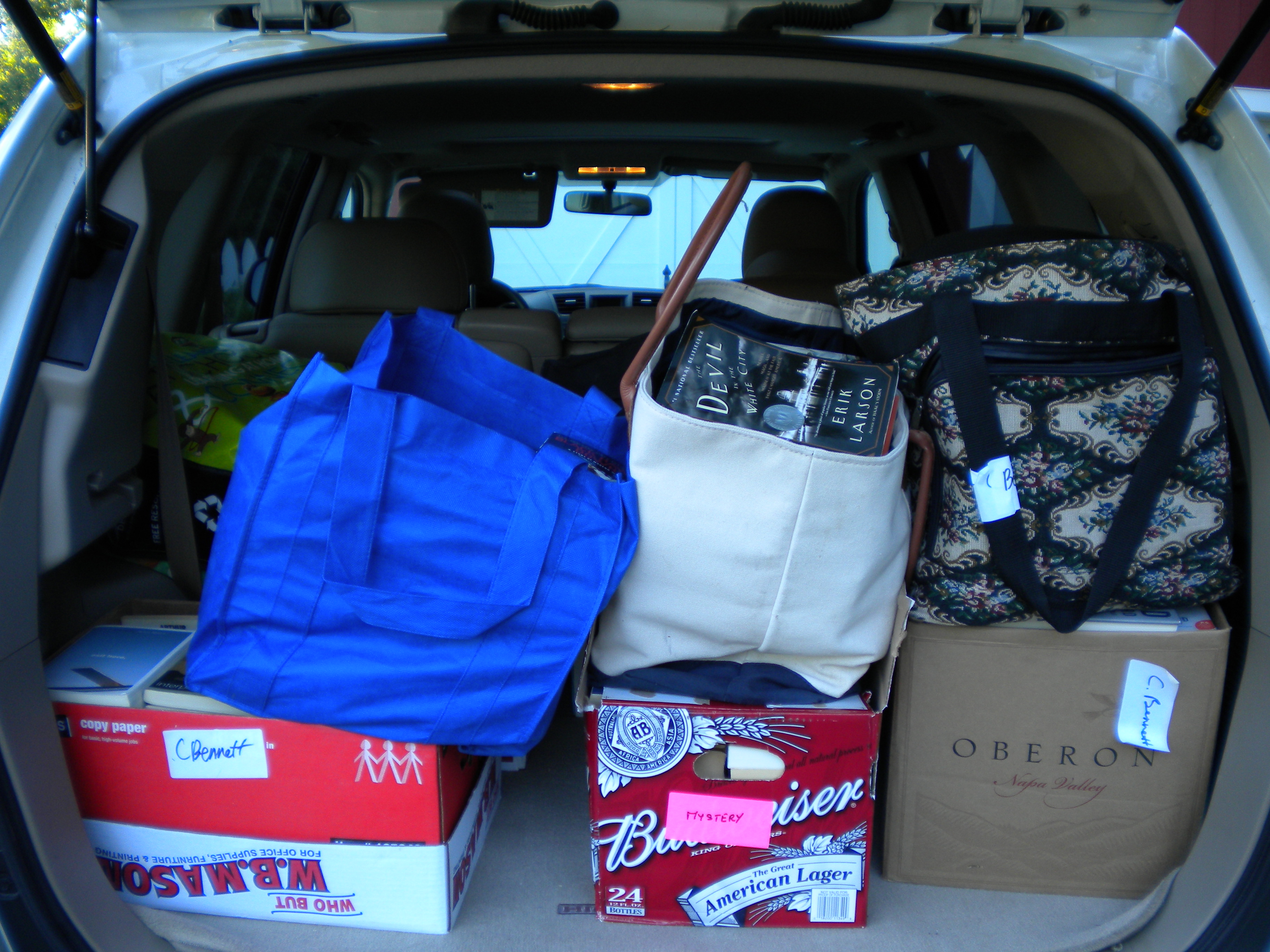
A carload of Used Books after a summer book sale!

In writing this blog, I have found myself increasingly commenting on English/language arts curriculum, lesson plans, and current issues in education. This means the purpose of the blog has grown to include topics that are all related to the use of reading materials in the classroom, and reading is the most important skill that students will need to be successful students at every grade level. Providing a wide variety of books-new and used- is critical to engaging readers.

To date, the used books purchased in the secondary markets have helped in four specific ways:

Used books have replaced copies at each grade level. Used books have been used to replace lost or damaged copies of books assigned to a particular curriculum. For example, there have been replacement copies of The Giver for Grade 7, Of Mice and Men in 9th grade, and Animal Farm in Grade 10. These titles are taught in almost every school system in Connecticut, and are titles that are relatively easy to find locally in the secondary market. These are also titles that are readily available in large quantities online on used book dealer sites such as Better World Books.

-Used books have increased selections for independent reading in classrooms. The English Department has incorporated more time for silent sustained reading (SSR) in class at each grade level, and classroom libraries have been increased to allow students the opportunity to choose books to read. For example, students in grade 9 are provided 40-45 minutes each week to read self-selected books during the school year. Students may choose a book from the school’s library media center, or choose a book from one of the carts in the classroom.  Titles vary in genre, subject and reading level in order to meet student interest. Students are responsible for blogging reviews about the books they read at least twice a quarter.

Other classes that take advantage of independent reading are the Advanced Placement English Language and English Literature classes. Students select independent reading that meets the critical standards of the Advanced Placement program. These selections range from the classics (Dostoevsky’s Crime and Punishment) to more contemporary titles (Roth The Plot Against America) and write responses to these books.

-Used books are added titles as “satellite texts”. English teachers have extended thematic units to include titles that complement a text from the literary canon. For example, the 11th grade thematic unit “Coming of Age” is usually associated with Salinger’s Catcher in the Rye. Purchasing used books have increased selections to include Sittenfield’s Prep, Cormier’s The Chocolate War, Lamb’s She’s Come Undone, Gibbons’s Ellen Foster, and Chbosky’s Perks of Being a Wallflower. Students select a text to explore the thematic idea through the lens of another author.

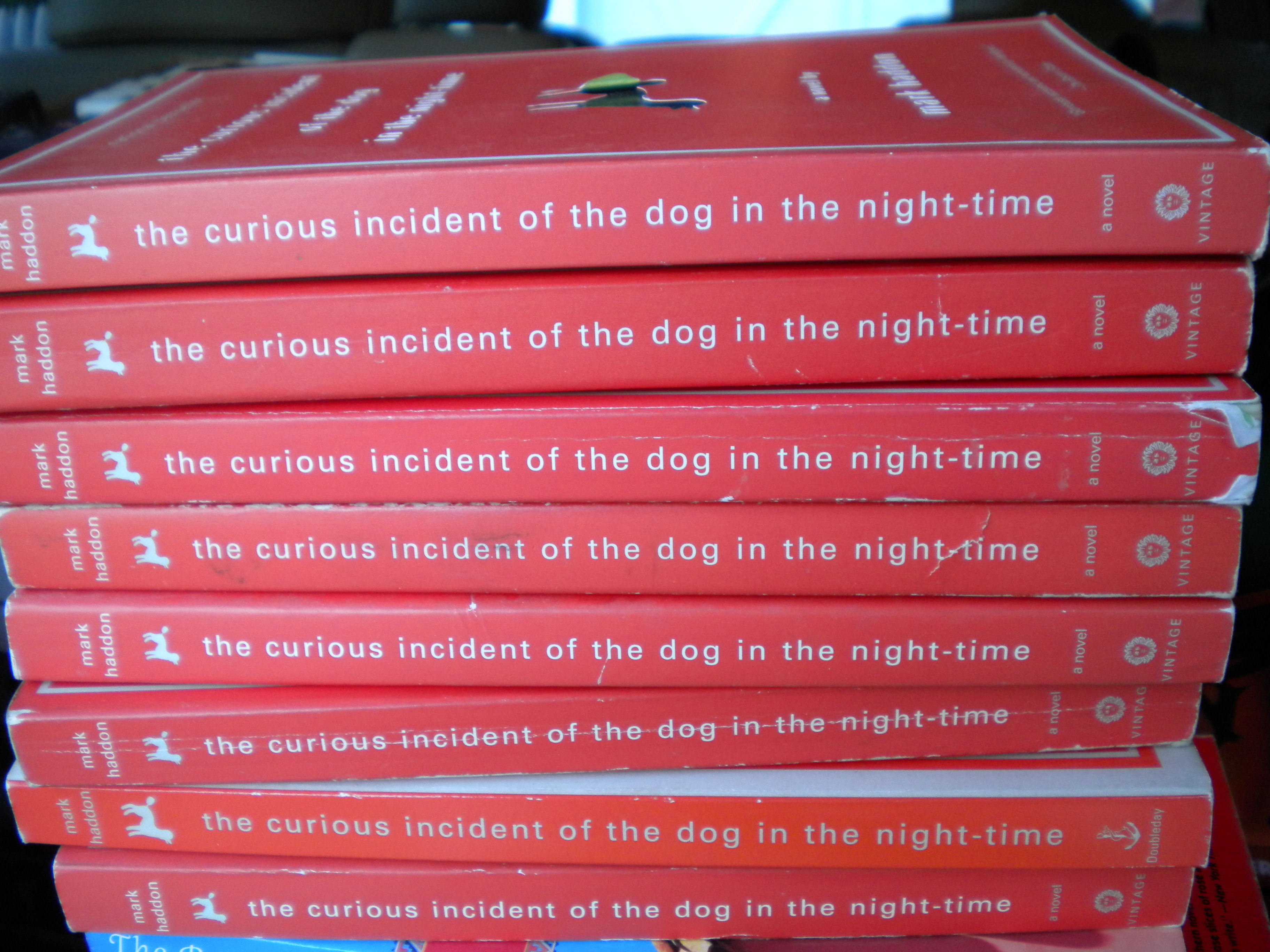
Score! A set of books for Grade 10

-Used books have allowed for the addition of new texts. The purchase of used books has expanded curriculum at several grade levels with high interest titles.  For example, Hosseini’s The Kite Runner, Coelho’s The Alchemist and Haddon’s The Curious Incident of the Dog in the Night-time (see picture) have been added to the World Literature curriculum in grade 10. In addition, Walls’s The Glass Castle has been added to Grade 12 Memoir class while Farmer’s The House of the Scorpion will be added to grade 7.

Ultimately, the re-stated purpose of this blog will be to continue to discuss the inclusion of specific used book titles in English/language arts classrooms as well as discuss how we are working to improve reading in and out of the classroom  at every grade level. Used books in class is also about using books in class to improve reading!

The New Year 2012 is here, and there is nothing more promising then a new calendar of opportunities. Now is the time to take stock of student progress and make plans for the second half of the year. Now is the traditional time to make a resolution. What resolution do I want to keep?

Resolution 2012

RESOLUTION: Assign less student writing that will be seen by the teacher alone.

Currently, the routine standard is student writing to teacher—teacher corrections back to student. So, why should a student’s writing be limited to this repeated stale volley of paper?

Classrooms, particularly language arts classrooms, are designed to be safe areas for students to engage in repeated practice. Unfortunately, that means school are limited in duplicating the demands of authentic world experiences. Yet, schools are charged with the responsibility of preparing students to become “productive citizens in an ever changing and dynamic society” (to paraphrase school mission statements everywhere…)  So, what can I resolve to do with the remainder of this school year  to try to make the student’s experience a real world experience?

I resolve to break the “assign, grade, return” cycle of student writing as much as possible.

The  purpose of writing is to communicate ideas, opinions,and/or information, and that purpose does not change once a student leaves school.The only differences may be that post-school writing will be on varied platforms, perhaps to wider audiences, or  limited in breadth or depth in ways that are not seen in the classroom.
Therefore, I resolve to assign writing that can be viewed by larger and diverse audiences, audiences outside the walls of the classroom.

I specifically resolve to:

-use persuasive  prompts in order to have students develop the skills to articulately express their opinions, and then share those opinions through different media;
-continue student blogging while encouraging students to write to each other on blogs beyond the standard “I liked what you wrote” response;
-place student presentations on school websites instead of limiting them to class time by posting links, QR codes, or embedding powerpoints for public viewing;
-use collaborative essays to improve transitions and organization in group assignments;
-encourage students to submit creative work to forums that actively seek to publish original work.

These five resolutions to make writing real in 2012 should also help me control the paperwork load and allow me the opportunity to give students the feedback they need in a more timely manner.

I also resolve not to grade everything a student writes, because sometimes students need to practice without penalties. That is also a real word experience.