CT Stae flagThe other day, I made a scan of my teaching and administrative certificates and sent them to my school office in order to update my records. If you teach in the State of Connecticut, as I do, you are required to provide the necessary transcripts and payments to secure and maintain a teaching or administrative certificate. The Connecticut Department of Education (CT SDE) has always been one of those great equaling institutions: no paperwork=no certificate.

Until now. Until Paul Vallas, Interim Superintendent of Schools in Bridgeport, Connecticut.

Vallas has served 17 months as Interim Superintendent of Schools for Bridgeport, Connecticut, a 21,000-student school system. Before coming to Connecticut, Vallas had served as the Superintendent of the Recovery School District of Louisiana; and the CEO of Chicago Public Schools and the School District of Philadelphia. Vallas, however, was ousted by a Connecticut Superior Court Judge Judge Barbara Bellis’s weeks ago because he lacked graduate coursework and that the “alternative program” created for Vallas by the State Commissioner of Education, Stefan Pryor, fell far short. Pryor’s letter certifying Vallas’s credentials, according to Jacqueline Rabe Thomas writing (6/28/13) in the Connecticut Mirror, was not accepted by the judge who ruled:

“’There is no doubt that Vallas received preferential treatment,’ the judge wrote in her 27-page decision.The judge also noted that Vallas lacked the required prerequisites to enroll in the regular UConn [University of Connecticut] program in the first place, and that such an independent study hadn’t been approved for anyone else in the last decade. Additionally, the university’s governing board had never approved an independent study program.’Ultimately, the course standards were reduced,’ the judge wrote. ‘The court accepts Vallas’ testimony that the work, although done over the course of 10 weeks while fulfilling his employment as acting superintendent, could have been completed in a week.'”

Ultimately, the judge ruled that Vallas’s BS in Political Science/History and MA Political Science from Western Illinois University were not comparable for a certification in education according to Connecticut’s Department of Education (CT SDE). While his experience as the Executive Director of the Illinois Economic and Fiscal Commission, revenue director and budget director for the City of Chicago provided him the experience to deal with Bridgeport’s financial woes, he lacked training as an educator.

Vallas has a number of supporters on the Bridgeport Board of Education, and his ouster has received the attention from the state and national press. There are articles and editorials, mostly positive about his work in Bridgeport. The editorial headline from the Hartford Courant (7/25/13) was particularly sympathetic: Why Make It So Hard For Paul Vallas To Help Bridgeport Schools? Qualifications shouldn’t obstruct a promising superintendent

It would be a blow to the city of Bridgeport’s school system and its 21,000 students if Paul Vallas is not permitted to stay on as superintendent. Someone of Mr. Vallas’ experience and gravitas is just what the doctor ordered for the city’s ailing school system.

While I know little about Vallas’s efforts to improve the school system in Bridgeport, I was particularly attentive to several comments that followed this editorial discussing the role of the state’s colleges and university programs. These comments made clear that academic institutions should be concerned when their undergraduate and graduate education certificate programs are being discounted at the highest level.

Educators in the Constitution State spend time and money at state colleges and universities to meet the requirements for teacher and administrator certifications. Even the state-run Alternate Route to Certification (ARC) for those entering the profession with degrees other than education has been made more demanding. There are special graduate certificate programs offered at different institutions (Administrator-092, Literacy Specialist-097, Superintendent-093) each with requirements of extensive coursework of 30 credits or more.

In addition, CT SDE requires that educators provide all transcripts and results from subject area texts (PRAXIS II); these cost educators time and money. CT SDE website also states:

All prospective administrators enrolled in Connecticut administrator preparation programs seeking a recommendation for the Initial Educator Certification for Intermediate Administration or Supervision (#092) must pass the CAT (Connecticut Administrators Test) in order to be certified.

All administrators prepared outside of Connecticut with fewer than 3 years within the last 10 years of administration experience who apply for the Initial Educator Certification for Intermediate Administration or Supervision (#092) must pass the CAT. An applicant recommended by an out-of-state institution may be eligible for a one-year deferral of the CAT.

Paul Vallas did not meet these requirements.

The controversy has captured the opinions of state politicians, educators, and reached the federal level with the Secretary of Education, Arne Duncan, siding with Vallas. They argue in the press over what Vallas has done for Bridgeport, or what he has accomplished outside of the state.

A more serious far reaching problem, however, is this example of the State of Connecticut’s unequal application of certification requirements to educators. If a certificate is not necessary for a high-profile educator to work as an administrator in the state, why have the requirement at all? If education course work is unnecessary, why should the state’s colleges and universities offer courses at all? And if there is no need for certificates or coursework, why have I paid money to the state to keep my teaching and administration certificates updated?

In Connecticut, the land of steady habits, inequalities in certification requirements make the state a little less steady.


I love books.

While that is not the most eloquent statement about reading, the three word sentence communicates my desire to spend time with the writings of another.

In contrast to my simple declaration, there are are a number of very eloquent statements about the importance of books.  On my e-mail correspondence, I have a quote from the Victorian Scottish born essayist and historian Thomas Carlyle (1795-1881)

 “All that mankind has done, thought, gained, or been; it is lying as in magic preservation in the pages of books.”

I enjoy sharing that quote and two other facts about Thomas Carlyle:

Carlyle

Thomas Carlyle

1. He invented the word Eleutheromania: A mania or frantic zeal for freedom. If I were to use this word in a sentence, I would write, “At the conclusion of every school year, I suffer a serious case of Eleutheromania.”

2. He and his wife were very unhappy. They were so unhappy that the author Samuel Butler said of their marriage: “It was very good of God to let Carlyle and Mrs Carlyle marry one another, and so make only two people miserable and not four.”

I also have a favorite funny quote about reading books. This quote is by the brilliant comedian Groucho Marx (1890-1977) and is spelled out in big gold letters on one of my book bags:

groucho-marx-on-reading-21664922

Groucho Marx

”Outside a dog, a book is man’s best friend. Inside a dog, it’s too dark to read.”

I get a number of people who look at my bag from a distance, I see their lips move as they read the joke aloud…and then I see them smile when they understand. Groucho’s humor is timeless.

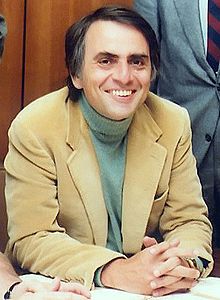
Sagan

Carl Sagan

By far the most eloquent comment I have ever read about reading books, however, comes from Carl Sagan (1934-1996).  Sagan was was an American astronomer, astrophysicist, cosmologist, and author who relentless promoted science. His brilliant TV series in the 1980s Cosmos received critical acclaim and gave over a reported 500 million viewers a new perspective on the size and scope of the universe and the relative size of planet Earth in comparison.  The 11th episode was titled “The Persistence of Memory” and in this episode Sagan stated the following:

“What an astonishing thing a book is. It’s a flat object made from a tree with flexible parts on which are imprinted lots of funny dark squiggles. But one glance at it and you’re inside the mind of another person, maybe somebody dead for thousands of years. Across the millennia, an author is speaking clearly and silently inside your head, directly to you. Writing is perhaps the greatest of human inventions, binding together people who never knew each other, citizens of distant epochs. Books break the shackles of time. A book is proof that humans are capable of working magic.”

A book reaches across the millennia. An author is in your head speaking to you. Books bind people together.

Astonishing indeed, and reason enough to say, “I love books.”

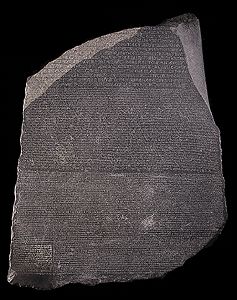
Rosetta

The Rosetta Stone currently located in The British Museum in London, England.

When I stood in front of the Rosetta Stone in the British Museum in London, I had to wiggle my way through the blockade of tourists who were trying to photograph the small black tablet. Since the stone was encased in glass, I knew the reflections from the camera flashes would result in poor quality photos. Once I had my few seconds before the 2200 year old tablet, I headed off to the gift shop to secure a clear photo of the Rosetta Stone and a small plaster recast of the dark black stone; both yielded far more details than I saw when I was squeezed by the crowd.

The face of the Rosetta Stone, one of two tablets, is etched with three different scripts, each spelling out the same decree issued by King Ptolemy V from Memphis (Egypt) in 196 BCE. These inscriptions translate Ptolemy’s decree in three scripts: the upper text is Ancient Egyptian hieroglyphs, the middle portion Demotic script, and the lowest Ancient Greek. Because the Rosetta Stone presented the same text in each script (with a few minor differences among them), the tablet provided the key to our modern understanding of Egyptian hieroglyphs.

Since the Rosetta Stone is often used as a metaphor for using an essential clue to a new field of knowledge, why not use the Rosetta Stone as a metaphor for explaining the role of data, specifically standardized test data, in informing classroom instruction? Imagine that different stakeholders, (school administrators, teachers, students, parents and test creators ) who look at the results of standardized tests are like those who crowd before the Rosetta Stone trying to decipher its meaning.

The first linguists who worked with the Rosetta Stone were able to look closely, touch and take rubbings of the different alphabets and hieroglyphics as they translated each of the texts. They spent time puzzling over the different alphabets, and they constructed primers to help decode each of the languages. They could see the variations in the engraver’s strokes; they could examine nuances in chisel marks that formed the symbols. As to the contents of the missing or damaged sections, the linguists made educated guesses.

Likewise, in education there are those who are knowledgeable in translating the information from standardized tests, those who have spent time examining data looking for patterns of trends comparing collective or individual student progress over time or perhaps comparing student cohorts. The metaphor of the Rosetta Stone, however, fails in directly comparing the different forms of data collected in the multitude of standardized tests. Each test or assessment is constructed as a single metric; the translations of one standardized test to another are not the same. For example, the state mandated Connecticut Mastery Tests (CMT-grades 3-8)  are not correlated to a diagnostic test for reading such as a diagnostic reading assessment (DAR). The Connecticut Academic Performance Test (CAPT Grade 10) cannot be directly compared to the PSAT or ACT or the NAEP, and none of these standardized tests are comparable to each other.

Consider also how the linguists who studied the Rosetta Stone spent time and lingered over the different interpretations in order to translate the symbols in the differing alphabets. They studied a finite number of symbols that related to a finite statement fixed in time.

In contrast, standardized testing associated with education reform is on the upswing, and today’s educators must review continuous waves of incoming data. Often, when the results are finally released, their value to inform classroom instruction has been compromised. These results serve only to inform educators of what student could do months earlier, not what they are doing in real time. Just like the time stamped images each tourist’s camera records of the Rosetta Stone, standardized tests are just time stamped snapshots of past student performance.

How ironic, then, that so much media attention is given over to the results of the standardized tests in informing the public about student progress. How like the crowds snapping blurry photos around the Rosetta Stone are those who do not understand what exactly what each standardized test measures.

What they should appreciate is that prioritizing the streams of data is key to improving instruction, and the day to day collection of information in a classroom is arguably a more accurate snapshot of student ability and progress.

There are the classroom assessments that teachers record on progress reports/report cards: homework, quizzes, tests, projects that measure student achievement in meeting grade level standards and requirements. Then there is the “third leg” of data, the anecdotal data that can be used to inform instruction. The anecdotal data may be in the form of noting a student sleeping in class (“Has she been up late?”), reviewing a lesson plan that did not work (“I should have used a picture to help them understand”), or reporting a fire drill during testing (“Interruptions distracted the students”). Here the multiple forms of data collected to measure student progress are fluid and always changing, and translating these results is like the linguists’ experience of the hands-on translation of the Rosetta Stone noting the variations and nuances and making educated guesses.

The standardized tests results are most useful in determining trends, and if translated correctly, these results can help educators adjust curriculum and/or instructional strategies. But these test results are antiquated in relation to tracking student learning. Students are not the same day to day, week to week, semester to semester. Their lives are not prescribed in flat symbols, rather students live lives of constant change as they evolve, grow, and learn.

As the Rosetta Stone was critical to understanding texts of the Ancient World, our standardized tests are the “ancient texts” of contemporary education. Standardized tests cannot be the only measurement the public gets to interpret on student and school performance since the results are limited as snapshots of the past. Student and school performance is best understood in looking at the timely combination of all streams of data. To do otherwise is to look at snapshots that are narrow, unchangeable, and, like many of those photos snapped in the British Museum, overexposed.

There has been a heat wave in Connecticut this week, temperatures in the high 90s with muggy, sultry, humid weather, so it was no surprise that the bargains were “hot, hot, hot” under the tent at the Westport Public Library Book Sale.  So hot, in fact, that organizers had large fans set up in some of the outdoor tents! The sale is held in Westport, Connecticut:

Tents on Jesup Green and inside the Library
July 20-23, 2013
(Monday—Everything half-price)
Tuesday: 9 am-1 pm (Free day, donations appreciated)

The Westport Public Library Book Sale is a premiere event in the state for several reasons:

  • The tents are huge with tables laden with books;
  • Prices are good (Hardcovers are $3/trades $1/paperbacks and children’s books $.50);
  • Books are of exceptionally high quality.

The main tent offered a spectacular number of books with wide aisles. This is where the non-fiction texts/literature/reference texts are usually laid out.

Informational texts for science classes!

Informational texts for science classes!

For some perplexing reason, however, the teen/YA section was also in the main tent, while the sports/nature books were in the children’s tent. This led to some mistaken shelving; there was a copy of fairy tales and Miss Nelson is Missing in between golf books and some travel guides. The magnitude of the collection of donated books meant some challenges for those  keeping book sorters on message; sometimes the same text appeared on tables for different genres. For example, copies of Tom Brokaw’s The Greatest Generation were in biography, history, politics, and for some inexplicable reason, Judaica.

The children’s book section was extensive enticing shoppers of all ages; shoppers should be wary of smaller patrons underfoot.

My target area for filling the classroom shelves was the tent for fiction, which was overflowing with hardcovers and paperbacks. There were so many hardcover fiction books, that I later discovered an adjunct aisle of hardcover fiction that spilled into the classic literature section in the main tent. I am sure that The Girl Who Played with Fire was enjoying spending time with her more mature cousins Ethan Frome and The Red Badge of Courage.

Unfortunately, the aisles in the smaller fiction tent here were not as wide as in the main tent, and there were boxes loaded with trade paperback fiction below the tables. Stooping to browse through these lower levels slows down buyers and makes for some awkward moments in passing. To make passing smoother, though, there was a volunteer dutifully loading up the tables once people made their selections.

BPp77-1CIAAdviT.jpg-large

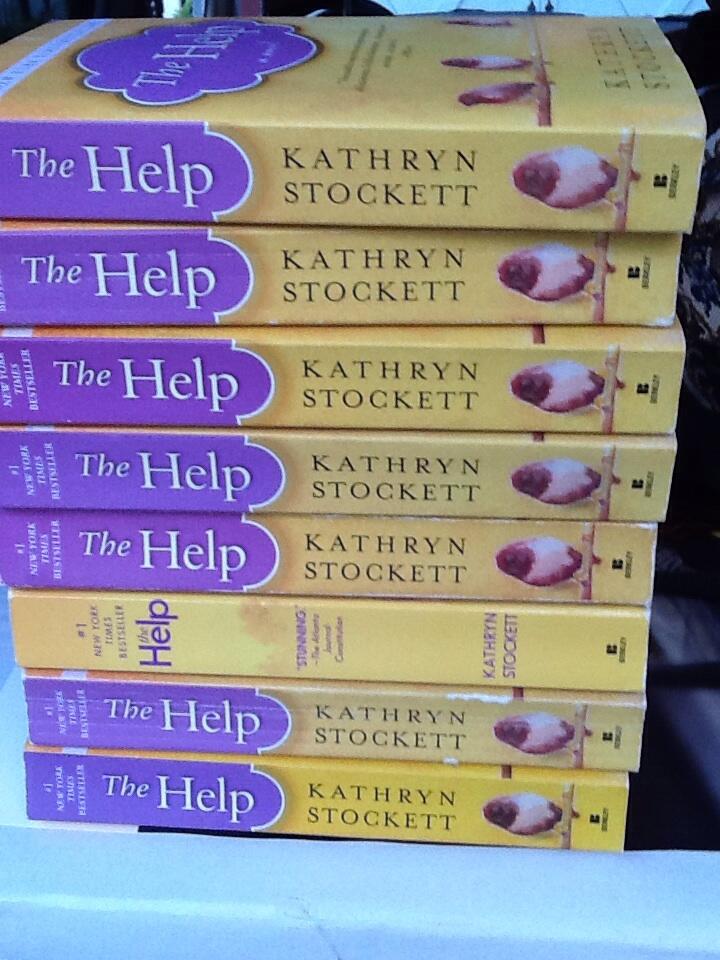
One stack of The Help for English III

I was looking for specific titles and soon was rewarded with a dozen copies of Katheryn Stockett’s The Help. This book retails for $12.92 on Amazon; 12 copies would have cost $155.04. Instead, I spent $73.50 in total for these books plus three and a half bags full of other titles, many also beginning with word “the”: The Things They Carried, The Road, The Giver, The Girl Who Fell from the Sky, and The Book Thief. 

Because the trademark of Westport readers is their ability to take exceptionally good care of their books, these copies are in pristine condition. I suspect there must be some town ordinance about bending pages or preserving book covers on reading material in town.

A further study of the town, based on donated books, would be that Westport residents:

  • Believe in parenting book (five tables full);
  • Do not donate small paperback copies (only three tables full);
  • Do not read the genre “romance” (no tables full);
  • Travel extensively (based on travel guides);

The book sale has dedicated volunteers who will tally books on the side lawns of the main tent if you are purchasing more than an armful; there are boxes available for ambitious shoppers and checkout is a breeze.

The Westport book sale is a bibliophile’s delight with red hot bargains for all ages. Now, if only they could do something about this heat wave!

Poetry Friday: Invictus

July 19, 2013 — 4 Comments

The film Invictus tells the story of how in 1995 Nelson Mandela enlisted the help of South Africa’s National Rugby team in order to unite the country and end prejudices associated with Apartheid. The film stars Morgan Freeman as Mandela and Matt Damon as South African rugby star Francois Pienaar, but this is more than a sports film. One mise-en-scene features a visit to the real Robben’s Island Prison, where Mandela was held as a political prisoner for 27 years.

The film footage shows the cell where Mandela served his sentence before his release in February 1990. As the camera pans around the prison, the voice of Freeman recites William Ernest Henley’s poem Invictus

Out of the night that covers me,
Black as the Pit from pole to pole,
I thank whatever gods may be
For my unconquerable soul.

In the fell clutch of circumstance
I have not winced nor cried aloud.
Under the bludgeonings of chance
My head is bloody, but unbowed.

Beyond this place of wrath and tears
Looms but the Horror of the shade,
And yet the menace of the years
Finds, and shall find, me unafraid.

It matters not how strait the gate,
How charged with punishments the scroll.
I am the master of my fate:
I am the captain of my soul.

I am familiar enough with the poem that I do not need to look it up or “cut and paste” the text.
I can recite this poem cold.
So can the grade 12 seniors at Brookfield High School in CT (my tenure 1999-2008) who traditionally memorized the poem and recited its 16 lines for an English grade.

The “Invictus Day” tradition was begun to honor an English teacher who had passed away; the tradition was sustained by her colleague, Carole Smith, who would prepare “Invictus” sheets for students to carry with them to practice. A rubric was on the back that provided selected teachers a rubric to grade the quality of the recitation: A for a spectacular recitation (with feeling; no errors); B for a good recitation (one error allowed); C for an average recitation (errors allowed). A student had only one shot for an A; a teacher would sign off on the quality, but if there was a single flub, the highest grade that could be achieved was a B. Fortunately, the weight of the “Invictus” grade was nominal, however, the honor of getting an A for recitation was an achievement regardless of weight.

“Invictus Day” was an unannounced event held usually in late October or early November. Members of the faculty wore black, and seniors went scurrying to their lockers for their sheets. In Harry Potter-esque fashion, teachers would point at a senior with a finger and command, “INVICTUS”! The senior would be required to drop everything, hand over the sheet, and begin reciting, “Out of the night that covers me…”

There was a great deal of cowering, creeping, lurking,  prowling, skulking, and stalking on “Invictus Day”…on the part of both students and faculty. Some students took full advantage of the dramatic encounters by shouting the poem at the top of their lungs or climbing on tables or desks to recite for a crowd of delighted underclassmen. Others clung together to recite chorally, while the more timid seniors were given the opportunity to pull a teacher aside to recite and “get this over with!” Every year, a student would sing the poem to a familiar tune; one year, a student had a completely original melody with back-up singers. Once a student was graded, or “invicted”, he or she could show the sheet as a pass. Once invicted, a student could not be forced to recite again.

My favorite story of “Invictus Day” was of a one student who advertised his plans for presenting the poem. He prepared to recite the poem holding a heavy plaster skull, a la Hamlet. Hearing this, I convinced the members of the faculty not to invict him. The idea that he would carry the skull for several days was amusing to the faculty and to the student body. November came and went, and so did December and January. By late March, the student was pleading for someone to “invict me” so that he could rid himself of the skull he had been toting for months. Fortunately, he had been cast as a lead in the school musical. One warm April night, at the end of the final night’s production, he ran forward to take his well-deserved bow. As he stood up, I stepped out from the wings and onto the stage and cried, “Invictus!” There was a split second of shock in his eyes, but he bounded backstage and seconds later reappeared with the skull to recite the poem to a full house. There was a standing ovation; his performance for both the musical and the poem deserved the audience’s applause.

The obvious message of the poem is the control of one’s fate, and that makes the poem perfectly suited for seniors who will be steering their own destinies once they graduate. They may go to colleges, training schools, the military, or they make seek their futures in other pursuits, but who they will be after the thirteen years of mandated education is largely up to them. Holding the poem’s message in their heads, and in their hearts, can serve to guide them through rough waters of adulthood.

Mandela The same could be said for the use of the poem in the film Invictus. Four years after his release from his 27 years in Robben Island’s prison, Nelson Mandela was elected president of South Africa. He had made great sacrifices in bringing the horrors of Apartheid to an end, but his belief in a united South Africa had prevailed.

This past Thursday, July 18, 2013, Mandela turned 95 years old.

Happy Birthday, Mr. Mandela, your life story is affirmation of Henley’s message:

I am the master of my fate:
I am the captain of my soul.

No common coreOne of the underlying problems in educational reform today is that so few reformers have any hands-on classroom experience. Reading about teaching is academic and informative, but the hands-on experience of standing in front of a class of 9, 14, 24, or (heaven forbid!) 31 students at any grade level is irreplaceable. Developing lesson plans is an academic exercise, however monitoring and adjusting that lesson plan for real time problems (fire drill, student absences, material shortage, technology glitch) during instruction is irreplaceable. Reading assessment data is an academic enterprise, but understanding that data in the context of the classroom with all the personalities, abilities, disabilities, and socio-economic influences is irreplaceable. Hands-on experience should be a major factor in education reform, but the education reform efforts in the  Common Core State Standards (CCSS) have little to no classroom credibility.

A recent entry on Twitter from Randi Weingarten, current president of the American Federation of Teachers, was an attempt to address the classroom experience of the creators of the CCSS. Weingarten herself does have hands-on experience in the classroom, but that experience is spotty.  From 1991 until 1997, and with the exception of a six month full time teaching load in the fall of 1994, Weingarten taught on per diem basis (substitute?) at Clara Barton High School in Crown Heights, NY. Total experience? Six years, but this short experience is six more than many of the educational reformers who participated in the creation of the CCSS.

Weingarten tweeted the following on June 29, 2013:

Teachers were part of the development of #CCSS from the beginning http://youtu.be/y1DlNpaKW38

She was posting a link that was supposed to demonstrate that teachers, real classroom teachers with hands-on experience, had been involved in the standards from the beginning. The link led to a YouTube video featuring an ELL classroom teacher Lisa Fretzin who reflects how she “…was part of the review process starting in August looking at the the first draft”:

While Ms. Fretzin certainly has classroom credibility necessary for developing the CCSS, her participation was not exactly at the “beginning” of this process. According to her statement on the video, she was not present at the creation; she was asked to “review” which is different than “from the beginning”. Furthermore, her name is not on the list of participants who did create the CCSS for English Language Arts (or feedback group) which clearly identifies only four of the 50 participants (8%) as “teachers”. The remaining 46 participants (92%) are identified with titles such as: “author”, “consultant”, “specialist”, “professor”,  “supervisor”, “director” or “senior fellow.” In all fairness, perhaps many of these participants had worked in the classroom before moving into higher ranking positions as one would hope, but their hands-on classroom work experience is unclear.

The most glaring examples of classroom incredibility are the lead authors for the CCSS, Susan Pimentel and David Coleman; their collective classroom experience is zero. Pimentel has a law degree and a B.S in Early Childhood Education from Cornell University. Coleman’s, (termed “Architect of the Common Core”) classroom experience is limited to tutoring selected students in a summer program at Yale. He later founded Student Achievement Partners and is currently serving as the President of the College Board.

Weingarten must also know that classroom teachers for PreK-Grade 3 and grade level experts were not included in the creation of the CCSS at all. Many of these educators have express concerns that students are not cognatively ready for many of the standards in math and reading. Valerie Strauss of The Washington Post put up an editorial (1/29/13) “A Tough Critique of Common Core on Early Childhood Education” by Edward Miller, teacher and co-author of Crisis in the Kindergarten: Why Children Need to Play in School, and Nancy Carlsson-Paige is Professor Emerita of Early Childhood Education at Lesley University in Cambridge, Massachusetts and author of Taking Back Childhood. They note that when the standards were first revealed in March 2010, “many early childhood educators and researchers were shocked. “

The promoters of the standards claim they are based in research. They are not. There is no convincing research, for example, showing that certain skills or bits of knowledge (such as counting to 100 or being able to read a certain number of words) if mastered in kindergarten will lead to later success in school. Two recent studies show that direct instruction can actually limit young children’s learning. At best, the standards reflect guesswork, not cognitive or developmental science.

Miller and Carlsson-Paige also include links to the Joint Statement of Early Childhood Health and Education Professionals on the Common Core Standards Initiative and summarize their statement:

 We have grave concerns about the core standards for young children…. The proposed standards conflict with compelling new research in cognitive science, neuroscience, child development, and early childhood education about how young children learn, what they need to learn, and how best to teach them in kindergarten and the early grades….

At all grade levels, therefore, there are concerns about how inclusive the creators of the CCSS were in engaging classroom teachers. The entire initiative, by its own admission, began politically, coming from the nation’s governors and education commissioners, “through their representative organizations the National Governors Association (NGA) and the Council of Chief State School Officers (CCSSO).”

Weingarten’s tweet was more than a little disingenuous when she indicated that “teachers were part of the development” when, to the contrary, there is much more evidence to prove that the ratio of teachers to individuals bearing education titles was disproportionate in favor of reformers and academics without classroom experience.

Real teachers, those with hands-on experience gained in the classroom, have had a limited say in the CCSS that they will be implementing day in and day out in their classrooms at every grade level. Excluding this important faction is why there has been pushback from teachers who recognize the difficulties in implementing many of the standards. Furthermore, there are growing concerns about the level of accountability for teachers in having students meet these same standards.

Ultimately, Weingarten should not tweet out misinformation about teachers developing the CCSS, especially when the evidence demonstrates that teachers were a only a tiny percentage in creating these standards. Weingarten must know that for any educational initiative to succeed, teachers must be engaged from the very beginning.

In these days of education reform, classroom credibility counts.

The “Nation’s Report Card” is released by The National Assessment of Educational Progress (NAEP) every year where students are tested at ages 9, 13, and 17. This past year, the testing results for readers at age 17 were abysmal, demonstrating only a 2% growth in reading scores over the past 41 years.

I was bemoaning this statistic to a friend who responded, “Well, they are just seventeen…”
Almost immediately, I heard the voice of Paul McCartney, the voice of my youth, respond in my brain, “…you know what I mean….”

Well, she was just seventeen,
You know what I mean,
And the way she looked was way beyond compare.
So how could I dance with another, (Ooh)
And I saw her standing there.

Seventeen is that age of great contradictions…you know what I mean? For example:

  • Seventeen is the year before legal adulthood in the USA;
  • Seventeen is the age at which one may watch, rent, or purchase R-rated movies without parental consent;
  • Seventeen is the age at which one can enlist in the armed forces with parental permission;
  • More 17-year-olds commit crimes than any other age group, according to recent studies by psychiatrists.

Nature also provides an example of frenetic activity that can happen in one seventeen year cycle. Consider that cicadas remain buried for seventeen years before coming out and breaking into their mating song. Coincidently there are quite a number of songs, mating or otherwise, that center their message on how it feels to be seventeen.

There is the raw sexuality in Paradise By the Dashboard Light by Meat Loaf:

Though it’s cold and lonely in the deep dark night
I can see paradise by the dashboard light
[Girl:]
Ain’t no doubt about it we were doubly blessed
‘Cause we were barely seventeen
And we were barely dressed

Similarly, the Cars exhort the passions of seventeen in their song Let’s Go:

she’s winding them down
on her clock machine
and she won’t give up
’cause she’s seventeen
she’s a frozen fire
she’s my one desire

Glam rock band Winger also offers a robust cicada-like mating call for their song Seventeen:

I’m only seventeen
But I”ll show you love like you’ve never seen
She’s only seventeen
Daddy says she’s too young

There are songs that address the restlessness of seventeen such as Edge of Seventeen by Stevie Nicks:

He was no more than a baby then
Well, he seemed broken hearted, something within him
But the moment that I first laid eyes on him all alone
On the edge of seventeen

While Rod Stewart adds a cautionary tale of runaway seventeen-year-olds to his song Young Turks:

Billy left his home with a dollar in his pocket and a head full of dreams.
He said somehow, some way, it’s gotta get better than this.
Patti packed her bags, left a note for her momma, she was just seventeen,
There were tears in her eyes when she kissed her little sister goodbye.

Emotional pain is explored in Janis Ian’s heartbreaking  At Seventeen 

I leaned the truth at seventeen
That love was meant for beauty queens
And high school girls with clear-skinned smiles
Who married young and then retired

In contrast, however, adults are nostalgic for the age in Frank Sinatra’s It Was a Very Good Year:

When I was seventeen
It was a very good year
for small town girls
And soft summer nights
We’d hide from the lights
On the village green
When I was seventeen

Seventeen is an age of complications. Don’t even get me started on Rogers and Hammerstein’s I am Sixteen Going on Seventeen from The Sound of Music; poor Lisel has Nazi problems in her secret romance!

Each song, (and yes, I know there are many others) explores the multitude of contradictions in being seventeen. Collectively, the lyrics show how seventeen is a seething ferment of frustration, experimenting, wishing, waiting, and wanting; a potent potion for those tipping into adulthood.

And this is the targeted population for nationwide testing?

Therefore, when the annual sample of seventeen year olds is selected to take the NAEP test in order to diagnosis the reading level of the nation’s seventeen year olds, I wonder, how invested are they in this task? These are the students who have been state standardized tested at every grade level, they have been PSAT, SAT or ACT tested, and maybe Advanced Placement tested. What does this extra test, with no impact on their GPA, mean to them?

I wonder if they simply fill out the letters A-B-B-A on the multiple choice just to have test done? Which reminds me,  ABBA also has a seventeen themed song, Dancing Queen: 

You are the Dancing Queen, young and sweet, only seventeen
Dancing Queen, feel the beat from the tambourine
You can dance, you can jive, having the time of your life
See that girl, watch that scene, digging the Dancing Queen

So what did the Beatles mean when they sang, Well, she was just seventeen, you know what I mean?

On the compilation album Anthology, Paul admits that he and John were also stumped in trying to define the complexity of being seventeen in the lyrics to I Saw Her Standing There:

We were learning our skill. John would like some of my lines and not others. He liked most of what I did, but there would sometimes be a cringe line, such as, ‘She was just seventeen, she’d never been a beauty queen.’ John thought, ‘Beauty queen? Ugh.’ We were thinking of Butlins so we asked ourselves, what should it be? We came up with, ‘You know what I mean.’ Which was good, because you don’t know what I mean.

Maybe we should take this advice from Paul and John and all the other recording artists. Maybe the only thing we are testing for the past 41 years is how seventeen year olds test the same in every generation. Maybe just being seventeen means confronting more immediate problems, and these problems do not include taking a NAEP test.

Maybe there should be some variable or some emotional handicap considered for testing at age seventeen …you know what I mean?I saw her

The Friends of the C.H. Booth Library Book Sale in Newtown, Connecticut, was opened this weekend, and the used book business was good! This is one of the premier books sales in the state: well-organized tables filled with excellent quality used books, lots of attentive check-out staff, and great prices. This year, I attended on Sunday, the day after the big rush, and there were plenty of bargains to be had for classroom teachers since the large crowds on Saturday had left something for the discriminating shoppers the following day.

The 38th Annual Book Sale is held from Saturday, July 13, to Wednesday, July 17, 2013, at the Reed Intermediate School, 3 Trades Lane Newtown, CT 06470

HOURS: 9:00 a.m. to 5:00 p.m. Saturday and Sunday (all items full price)
9:00 a.m. to 7:00 p.m. Monday (half price) and Tuesday ($5 a bag)
9:00 a.m. to 12 noon Wednesday (free).

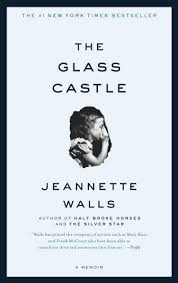
Glass Castle coverThe paperback trade table is always my first stop, and the titles were alphabetized and arranged spines facing in the same direction for easy browsing. I immediately grabbed the remaining 21 copies of Jeanette Walls’s The Glass Castle for the English IV Memoir class. This book retails for $9.85; twenty-one new copies would have cost $206.85 as compared to the $21.00 I spent. Walls’s memoir of her childhood captures any reader’s interest on the first page when, on her way to a fancy dinner party, she spots her mother “rooting through a dumpster.” The following chapters chronicle Walls’s survival through childhood at the hands of her brilliant, but mentally unstable, alcoholic parents. The riveting story is one of the required readings for the Memoir class.

There were also multiple copies of Sandra Cisneros’s The House on Mango Street, two copies of Elie Wiesel’s Night, and three copies of Tim O’Brien’s The Things They Carried. Over in the drama section, there were newish Folger Library copies of Hamlet, Macbeth and Romeo and Juliet.

From the classic fiction table I selected several different editions of Charles Dickens’s Great Expectation, all in excellent condition; our freshmen honors students can handle working from different page numbers in class. Over in young adult (YA) fiction, a friend pointed out two copies of Sharon Draper’s Copper Sun, a book I have been looking to add to Grade 11 American Literature. This is an easy read, but with extremely mature subject matter that is bound to bring about interesting discussions..

A quick trip into the other large all-purpose room where children’s books and non-fiction are available, and I found four copies of Bill Bryson’s A Walk in the Woods, a non-fiction read that we are using in a mandatory English IV unit. Bryson’s journey through some of the Appalachian Trail is a hilarious read, and we intend to relate this trip with the journey student have completed after 13 years of education.

So what sociological study can be applied to this book sale? If the tables loaded with books donated by residents from Newtown could talk, they might say that Newtown residents:

  • Believe in providing their children with books at every age level;
  • Have enough “Chick Lit” books to warrant a separate table;
  • Have enough animal books to divide them into categories: “pets”, “farm animals”, etc;
  • Prefer paperback trades to hardcover fiction;
  • Have a respectable amount of mystery books;
  • Enjoy books about sports.

If there was any criticism, it must come in the form of their (intentional or unintentional) relentless promotion of one title: Seabiscuit. For some inexplicable reason, Laura Hillenbrand’s non-fiction award-winning book about the award-winning race horse was mixed in with almost every genre. As I shopped, I noted several copies in trade fiction, one copy in classic fiction, three copies in memoir, several copies in animals, one in psychology, and one copy in with the Star Trek series. Perhaps, they were try to interest readers of every kind in this great story?

Three bags full

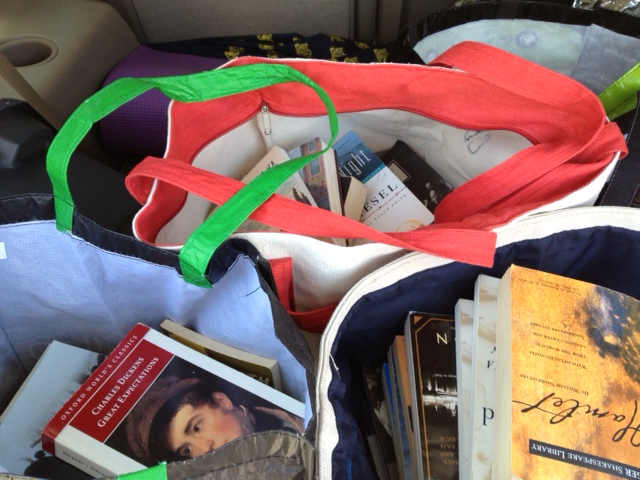
Three bags full of books for $152.00

I ended up spending $152.00 for three FULL bags of books (see photo). This is $54.85 less than I would have spent on the 21 copies of The Glass Castle books had they been new copies. Three bags of books for classroom libraries for independent and assigned reading left nestled comfortably in the back of my car waiting for September.

Thank you, Friends of the C. H. Booth Library in Newtown, CT. Your efforts help keep students reading, extending the reach of your community!

PS: The friend who went to the book sale with me also reported a “find” in the books she purchased. When she got home, she noticed the almost new copy of Eloise was signed by the illustrator Hilary Knight!

There are organized containers of books, spines out for easy browsing, that sit in rows on well-spaced tables. There are signs that mark the genres (fiction, travel, nature, self-help, romance, etc) for targeted shopping. I notice there is a lovely older woman who shadows me anxiously; she is trying to take my heavy load of books to a table for “lay-away” so that I can shop easier. I smile politely and refuse her help; I don’t want to belabor the point that my bags weigh as much as she does. She seemed disappointed. As I looked back I considered that perhaps I had been mistaken; her biceps were very defined! Yes, tidiness and a cadre of very fit efficient elders ready to provide assistance are the hallmarks of the Friends of the New Milford Library Book Sale in New Milford, Connecticut.

The sale is held in the New Milford High School on Route 7, and the hours for 2013 are:

Thursday, July 11th –
Early Bird, $5.00 – 9am-10am
Doors open @ 9am – 7pm close
Friday, July 12th: 10am – 7pm
Saturday, July 13th:10am – 5pm
Sunday, July 14th – HALF PRICE DAY!: 10am – 3pm

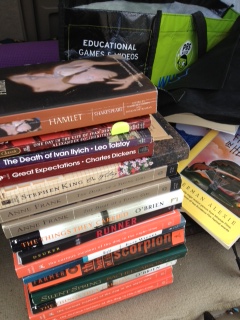
In 20 minutes, I had two bags (totaling $31) filled with books used at different grade levels. Note the three copies of Mark Haddon’s The Curious Incident of the Dog in the Nighttime (photo) which retails at Amazon for $12.41. Three new copies of this book would retail for $37.23. I got these three lightly used copies and all of the other books pictured in the photo for $6.31 LESS than the cost of the three new copies. The Curious Incident of the Dog in the Nighttime is in our Grade 10 World Literature course, and our students enjoy the narration by the autistic boy who uses Sherlock Holmes’s deductive reasoning to solve a mystery.

photo (20)

Stack of books used in our curriculum; additional independent reading books in the other bag

Other big finds that are in the photo included copies of Tim O’Brien’s The Things They Carried, a copy of Stephen King’s On Writing, and Nancy Fisher’s The House of the Scorpion. There are many other “finds” in the bag next to the neat stack of books.

When I shop at these local sales, I think about how each town’s book sale is a small sociological study. If one could speculate about the interests of the people of New Milford, one would conclude:

  1. There are some serious, diehard James Patterson fans;
  2. There is a dedicated interest in nature, animals, and travel (althought this is the first year I did not find a single copy of Bill Bryson’s A Walk in the Woods);
  3. The entire back half of the area illustrates that children have access to books at all levels.

Finally, I feel it is worthy to note, but rather awkward to say, that there were at least 10 cartons of the Books for Dummies series. I am not saying anything about New Milfordites here…. I’m just sayin’.

Check out was a breeze; receipts for teachers were pre-prepared, and I made a beeline for the door so that lovely elderly woman wouldn’t try to help me carry my bags back to my car. Her energy was making me look bad!

“Want to know the shortest poem in the world?” I asked my Advanced Placement students when they were overwhelmed with the epic poem Paradise Lost by John Milton. I wanted to use a related poem to demonstrate a close reading, one of the skills students should have in according to the Common Core Standards for English/Language Arts, but they needed a little fun.

“It’s called Fleas.”

I wrote the poem on the board:

Fleas

Adam
had’em

That’s it. Three words…actually two if you consider the contraction “had’em” as one word.

The poem attribution is generally given to Ogden Nash (1902-1971) although there are some who credit Shel Silverstein (1931-1999). An article by Eric Shackle, however, found the originator of the poem was Strickland Gillilan (1869-1954). The article notes:

“At last, after searching dozens of websites, we discovered the identity of the mystery poet. It was revealed on a US National Park Service website describing Mount Rainer National Park, in west-central Washington state. The Mt Rainier Nature News Notes of July 1, 1927 contained this brief item, tucked away as an end-of-column filler:

‘THE SHORTEST POEM
We like poetry but we cannot stand it in too large doses. The following, which according to its author, Strickland Gillilan, is the shortest poem existing, deals with the antiquity of “bugs”. It runs thus: Adam had em!'”

Authorship clarified, I asked my students, “So, what could you write about this poem?”

They stared at me. Surely I was joking…what kind of discussion or essay could a poem of this length generate?

After several minutes, however, here is what they came up with structurally:

  • iambic (duet?)
  • rhyming couplet
  • rhyme (am/em)
  • perfect internal rhyme (ad)
  • there is contraction
  • no punctuation
  • uneven number of letters; shorter first line

Here is what they came up on the topic of fleas:

    • Scientists have discovered that fleas probably fed on dinosaurs
    • Fleas feed on warm vertebrates’ blood
    • Fleas need Adam; Adam does not need fleas

Here is what they came up with figuratively:

  • the name in the first line establishes context
  • literary allusion: Adam from the Bible, the first man in literature
  • Eve was not mentioned, so the setting may be earlier than Genesis 2:20
  • the tone is casual and comical
  • the mood is humorous
  • Adam has fleas; the fleas don’t have Adam
  • the title is critical to the understanding of the message

Unanswered questions they had on the poem:

  • Could there have ever been just one flea?
  • Does Adam bathe?
  • Is the past tense verb “had” mean that he has cleaned up his act?

adam

Their conclusion?

  • Close reading three words yields a fun discussion;
  • Concise poetry captures the relationship between ancient man and an ancient insect pest.

Fleas– the world’s shortest poem!