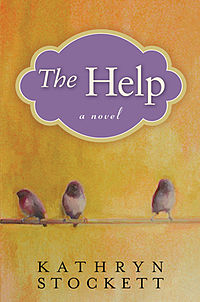
Yes, there were seven (7) copies of Kathryn Stockett’s The Help waiting for me to pluck them from the table at the Friends of the CH Booth Library book sale this morning. I have been hunting down this text for several months for use in conjunction with To Kill A Mockingbird, and -surprise!-there were 18 brand new copies of those as well.

This massive book sale provides easy shopping in the gym and the all purpose rooms of the Reed Elementary School in Newtown, CT, and offers convenient “holding areas”, carts, and plenty of empty boxes for readers to fill. The sale will continue from July 14-17, 2012. Organization is the key to a great library book sale, and this sale is extremely well organized. As I shopped, volunteers kept the books in order, alphabetizing as fast as book were replaced and loading additional copies of texts onto large tables. Their system made finding “sets” of books easy. The tables were laid out with wide aisles to allow for passing other browsers and there was a published floor plan on the website for shoppers to preview as well.
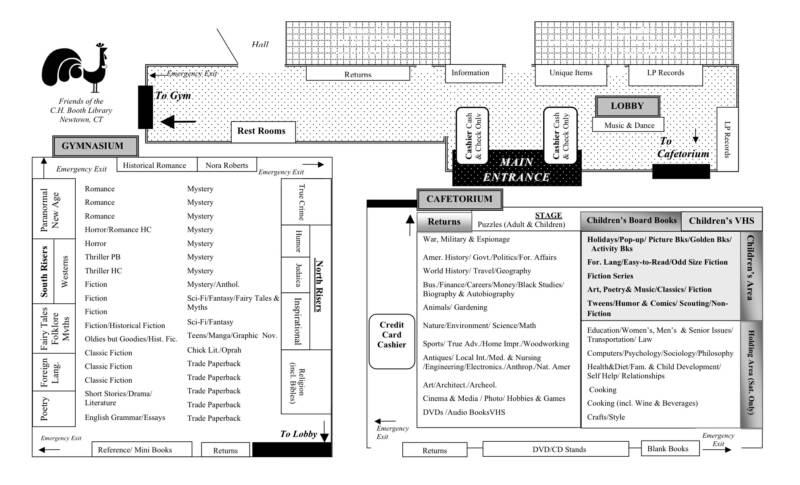
This year, all the trade paperbacks, fiction and non-fiction alike, were loaded onto the tables closest to the entrance., which seemed a logical choice as these books receive the most attention from browsers. At first I was a little disturbed seeing Lucy Grealey’s Autobiography of a Face and Erik Larsson’s The Devil in the White City next to Sue Monk Kidd’s The Secret Life of Bees, but I soon got over the blend of genres, in fact, this choice made my shopping for texts a little easier.

There were plenty of copies of books for me to “add” to our collection: Precious by Sapphire, Dairy Queen by Catherine Gilbert Murdock, All the Pretty Horses by Cormac McCarthy, A Tree Grows in Brooklyn by Betty Smith. In fact, if teachers wanted to add The Kite Runner to their collection, there was a box of 30 or more copies under the table, ready to replace the five copies already up.

But my goal was Kathryn Stockett’s The Help, and it was goal achieved with the seven copies of The Help that I got! The bonus of getting 18 new copies of To Kill a Mockingbird, our core text for the unit for juniors, was icing on the cake (or pie?) The Help was reviewed in 2009 by Publisher’s Weekly:


“What perfect timing for this optimistic, uplifting debut novel set during the nascent civil rights movement in Jackson, Miss., where black women were trusted to raise white children but not to polish the household silver. Eugenia Skeeter Phelan is just home from college in 1962, and, anxious to become a writer, is advised to hone her chops by writing about what disturbs you. The budding social activist begins to collect the stories of the black women on whom the country club sets relies and mistrusts enlisting the help of Aibileen, a maid who’s raised 17 children, and Aibileen’s best friend Minny, who’s found herself unemployed more than a few times after mouthing off to her white employers. The book Skeeter puts together based on their stories is scathing and shocking, bringing pride and hope to the black community, while giving Skeeter the courage to break down her personal boundaries and pursue her dreams.”
As I shopped the animal section, a volunteer asked me, “Do you like the signs on the tables?”
“Yes, I like the signs on the table,” I replied (our conversation mimicking one from Go, Dog, Go which I had in my bag)
“Well, they were much more in order this morning,” she continued as she busily straightened the table.

If the books and signs were in better order in the morning, then this was the UBER-organized sale when the gates opened; I had arrived at 11:15 AM. The place was humming with shoppers, but the books sat neatly in their genres, signs clearly delineating where “Tween HC” (Teenage books-hard cover) sat and where “Non-Fiction PB” (paperback) began.
Needless to say, having a holding area and capable volunteers to tally a purchase is key to customer satisfaction. I had six bags plus one box (over 300 books) for a total of $314.00. My trunk was loaded easily from the front sidewalk of the sale, and no one complained that I ran over one of the pylons blocking the entrance.

So thank you, Friends of the CHBooth Library. Your book sale was a pleasure to attend and The Help that I needed!

This weekend July 13-15, 2012 is the annual Friends of the New Milford Public Library summer book sale (alert to nearby Connecticut/NY residents), and even after I cleaned them out of some great trade paperbacks,there are many bargains to be had. The sale is held in the New Milford High School on Route 7 in a large all-purpose room that has ample room for browsers. The books are very well organized on large spacious tables and very clearly labeled, and, more importantly, the labels are correct-there is no mixing of genres.

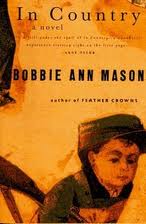
I picked up two copies of Bobbie Ann Mason’s In Country  (1993) to use with Tim O’Brien’s The Things They Carried. This is a very popular text with many of the girls in Grade 11; The School Library Journal reviewed this text:

“Sam Hughes, whose father was killed in Vietnam, lives in rural Kentucky with her uncle Emmett, a veteran whom she suspects is suffering from exposure to Agent Orange. Sam is a typical teenager, trying to choose a college, anticipating a new job at the local Burger Boy, sharing intimacies with her friend Dawn, breaking up with her high school boyfriend, and dealing with her feelings for Tom, one of Emmett’s buddies….Her father’s diary finally provides the insight she seeks insight she cannot accept until she has visited the Vietnam War Memorial in Washington, D.C.”

There were also five brand new copies of Barbara Ehrenreich’s Nickled and Dimed: On (Not) Getting By in America. Obviously, this was a book assigned for a course at a local high school or read by a local book group. These five copies mean that we can continue the tradition and assign the reading for one of our courses! Publisher’s Weekly reviewed this book in 2001:

Determined to find out how anyone could make ends meet on $7 an hour, Ehrenreich left behind her middle class life as a journalist except for $1000 in start-up funds, a car and her laptop computer to try to sustain herself as a low-skilled worker for a month at a time..Delivering a fast read that’s both sobering and sassy, she gives readers pause about those caught in the economy’s undertow, even in good times.

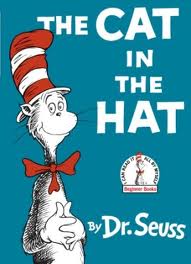
This book sale always has a great selection of  children’s books. Last year, I met a friend with two small children of her own who was hauling out at least 100 titles; she had barely made a dent in the collection. This year my bargain was a set (3) of The Cat in the Hat books. There is a great lesson on the Read, Write, Think website for the National Council of Teachers of English (NCTE) that explains Freudian psychology using this children’s text. The lesson is called Id, Ego and Superego and the Cat in the Hat and my students love looking at the pictures to see how the wild “ids” of Thing 1 and Thing 2 almost cause a disaster.

I spent $42.50 for two bags filled with books (38 total). As I checked out, I mentioned to a volunteer that I blogged about this book sale last year.

“Well,” she challenged me, “did you notice the books are all on the tables?”
I looked around. Sure enough there were no books on the floor.
“Last year, you complained about the books on the floor being hard to reach,” she continued, “So we put them all on tables!”
“Oh, I didn’t mean…” my voice trailed.
“When someone criticizes what needs to be fixed, we fix it,” she stated proudly.

So, go to the Friends of the New Milford Public Library Book Sale if you are in the area. This is a good book sale….made even better with better browsing tables!

David Brooks recently wrote a column in The NYTimesHonor Code (July 5, 2012),  describing a crisis in education for boys. He suggested that Shakespeare’s character Henry V would not have been a success if he had attended an American School. But how different really was Henry V’s education?  Consider that Shakespeare’s Henry V spends his youth in Henry IV Parts I and II as Prince Hal, an irresponsible squanderer of his good fortune.

Brooks lays out his premise that if little Prince Hal had been placed in an American school, and I am assuming he means an American public school, Hal’s boisterous level of pre-school/kindergarten physical play would mean that he would receive recommendations from “sly” teachers for medication for attention deficit hyperactivity disorder. As Prince Hal made his way through our American public school system, Brooks predicts that he would be deprived of the necessary physical outlets such as recess, so he would act out, he would be “rambunctious”. That would result in numerous suspensions for the vigorous heir.

Eventually, Brooks supposes, Prince Hal would “withdraw” and “decide that the official school culture is for wimps and softies and he’d just disengage…by junior high, he’d lose interest in trying and his grades would plummet.” Well, perhaps Brooks should look at Shakespeare’s storyline of Prince Hal who rejected the official British monarchy culture and disengaged for the pubs with his drinking buddies. His “grades” did plummet without the benefit of the American public school.

Prince Hal  had little interest in trying to please his father, he rejected the lessons of his tutors, and he found company with the gregarious Falstaff and other London low-life. In one memorable scene, he “lifts” the crown before his father had passed, a stage metaphor for his immaturity and unreadiness for the responsibilities of Kingship. His education was abysmal; his honor code was lacking.

After the death of the king, however, when Prince Hal becomes Henry V, he engages in a “hands-on” education, one which is gained at the expense of his former friends and at his discovery of the betrayal of allies whom he has executed. He is long past school age when his lack of military strategy catches him outnumbered after the Battle of Harfleur. All these experiences harden him for his ultimate victory at Agincourt, but not before he gets to deliver those wonderful lines from the St. Crispin Day speech, “We few, we happy few, we band of brothers…”. Immediately after the battle, where 10,000 French soliders lay dead as compared to roughly 29 Englishmen, the more battle-hardened Henry V immediately turns around and (twice) orders his men to kill all the French prisoners (Act IV; sc iv).

According to Wikipedia, in March 2010, Supreme Court Justices Samuel Alito and Ruth Bader Ginsburg participated in a mock trial of Henry V for the crimes associated with the legality of the invasion and the slaughter of  the French prisoners. The trial  used evidence from the  historical record and Shakespeare’s play:

“The outcome was originally to be determined by an audience vote, however, due to a draw it came down to a judges’ decision. The court was divided on Henry’s justification for war, but unanimously found him guilty on the killing of the prisoners after applying ‘the evolving standards of the maturing society’.”

Therefore, I am confident that Henry the V is the not the best model to describe an honor code.

All this makes me question Brooks’s intent for using Henry V to attack the public school system. While schools are not entirely responsible for the crisis where boys are falling according to the Organization for Economic Cooperation and Development, his comment that teachers would give “sly little hints dropped” about medicating students casts teachers as covert operators. Why pick on the teachers?

He does have legitimate reasons for concern about how boys are falling behind in education citing:

  • By 12th grade, male reading test scores are far below female test scores.
  • Boys used to have an advantage in math and science, but that gap is nearly gone.
  • An article as far back as 2004 in the magazine Educational Leadership found that boys accounted for nearly three-quarters of the D’s and F’s.

In laying out his argument, Brooks complains that,

“The education system has become culturally cohesive, rewarding and encouraging a certain sort of person: one who is nurturing, collaborative, disciplined, neat, studious, industrious and ambitious. People who don’t fit this cultural ideal respond by disengaging and rebelling.”

Well, yes. Brooks has described the corporate business model that has driven education, the business model that educators have been trained to use to prepare students when they enter the “real world.” What employer does not want an employee with these qualities? Yet, there are many teachers who recognize this model is not ideal for the diversity in attitude and aptitude for their students. Sadly, many of the educational opportunities that engage disaffected boys and girls including art, music, sports, and after-school programs are the first cut in times of economic hardship.

Additionally, teachers are keenly aware that not all students fit a cultural ideal, so they use multiple teaching strategies (differentiation, student success plans, response to intervention, etc) to reengage the withdrawn student. Mr. Brooks might have discovered these had he attended a classroom session and seen teachers working with students like little Prince Hal. Instead, he lays the blame for the failure of boys in the school system solely on teachers when there are other stakeholders, namely parents, who are primarily responsible.

Brooks’s suggestion that teachers celebrate competition might not meet with a school administration’s approval if a school’s mission statement celebrates cooperation. His suggestion that teachers should honor military virtues over environmental virtues might raise some eyebrows of parents, and his disparate suggestion that teachers should ditch friendship circles in favor of boot camps indicates that he has experienced neither.

In Shakespeare’s play, on the night before the battle of Agincourt,  Henry V walks unnoticed through the camp; he is finally and painfully aware of the responsibilities he has to his men and to his country and says, ““What infinite heartsease / Must kings neglect that private men enjoy?” As more pressures: economic, social, cultural and philosophical, are applied to the American public education system, teachers could paraphrase Henry V’s thoughts and say,  ““What infinite heartsease for those who criticize without being on the front lines in the classroom every day?”

Continue Reading…

The Simpson’s creator Matt Groening is a great satirist. In one episode in an exchange between the cartoon character Lisa Simpson and her Grandmother, he also demonstrates his ability to be a great literary critic:

Grandma Simpson: Don’t be bashful. When I was your age, kids made fun of me because I read at the 9th grade level.
Lisa: Me too!
Grandma Simpson: Although I hardly consider A Separate Peace the ninth-grade level.
Lisa: Yeah, more like preschool.
Grandma Simpson: I hate John Knowles.
Lisa: Me too.

I value Lisa Simpson’s opinion on literature, after all, this is a character who has been seen clutching copies of  The Bell JarEthan FromeMan and SupermanThe Corrections, and the more age appropriate Pippi Longstocking. So when she says she hates John Knowles, I feel validated. I have always disliked John Knowles’s A Separate Peace.
However, there are others who call this same book  “A masterpiece”(National Review) or ” deeply felt and beautifully written” (The Observer) or “Intense, mesmerizing, and compelling” (School Library Journal). The English Language Arts Common Core State Standards gives its recommendation since the novel has been, “Hailed as a literary masterpiece,” and that ” A Separate Peace is a classic novel with numerous teaching resources available.” The CCSS analysis of the text complexity reads:
“When considering the qualitative measures and the reader-task considerations, this novel is well placed at the 9th-10th grade complexity band. The complex themes, use of first person narrative—but with multiple flash backs and flash forward indicate higher level reading skills are needed by the reader. The Common Core Standards Text Exemplars also place the novel in the 9th -10th grade complexity band.”
 In a  2004 study titled A SeparatePeace:Four Decades of Critical ResponseLois Rauch Gibson writes:

“Rejected at first by American publishers, John Knowles’ A SeparatePeace appeared in England in 1959, where critics admiringly compared it to Salinger’s writings. American critics, responding in 1960 to the American edition, generally noted its depth, sensitivity, and ‘disturbing allegories'(Aitken 754). They did not entirely agree about what the allegories might be, nor have the four decades of critics since.”

I would argue there are no allegories in this short story “Phineas” that was expanded (unnecessarily) by Knowles into a full length novel. This is a fairly straightforward story of young white males at an exclusive prep school and their conflicts and competition during a last summer before entering the very grown up world of competition and World War II. I found the story dated when I read it in 1973, but Gibson felt the novel could  speak to today’s readers:

“As we approach the forty-fifth anniversary of the American edition of A Separate Peace,in a world where the all-male, all-white prep school environment has become exceedingly rare, John Knowles’ novel nonetheless continues to speak to adolescents. Once we fought wars against fascism, then against communism, now against terrorism. Before this background, teenagers attend school, bond with peers, lose their innocence, encounter hate and ignorance and what Knowles calls blind impulses; and each one inevitably struggles to develop an identity-sexual and otherwise. As the world continues to change, no doubt the next four decades of critics will have much to say about this resilient and compelling novel.”

I have always considered A Separate Peace to be the poorer literary cousin to J.D. Salinger’s 1951 classic Catcher in the Rye. Unfortunately, I like A Separate Peace’s  Gene less than I like the deluded Holden from Catcher in the Rye, and I like the object of Gene’s angst, Phineas or Finny, even less. This is a critical problem in the novel according to Slate Magazine’s Dec 2009 review The Secret of A Separate Peace by Stephen Metcalf:

“We do not love Phineas as Gene does. His charm for Gene exceeds his charm for us. The less we are seduced by Phineas, the more we experience him not as an Apollonian boy-god lacking the normal ratio of ill-character but as a love object for Gene, and Gene alone.”
I remember reading the climatic moment of the novel, when Gene reflects back on the accident in the tree:
 “He [Phineas/Finny] had never been jealous of me for a second. Now I knew that there never was and never could have been any rivalry between us. I was not of the same quality as he. I couldn’t stand this. . . . Holding firmly to the trunk, I took a step toward him, and then my knees bent and I jounced the limb. Finny, his balance gone, swung his head around to look at me for an instant with extreme interest, and then he tumbled sideways, broke through the little branches below and hit the bank with a sickening, unnatural thud. It was the first clumsy physical action I had ever seen him make. With unthinking sureness I moved out on the limb and jumped into the river, every trace of my fear of this forgotten.”
“What the heck?” I distinctly remember thinking, “He intentionally caused him to fall! What kind of friend is that?” He lost me at “forgotten.” I considered the final “apology” of the novel a fraud:
“I never killed anybody and I never developed an intense level of hatred for the enemy. Because my war ended before I ever put on a uniform; I was on active duty all my time at school; I killed my enemy there. Only Phineas never was afraid, only Phineas never hated anyone.”
It’s a lie. Gene was responsible (indirectly) for the death of Phineas, and in this statement he is contradictory about killing his “enemy.” Apologetically glorifying Phineas at the end is probably meant to be sincere, but to me the conclusion reeks of Freudian dishonesty. Gene could never really know Phineas, so he destroyed him and then made him a god.
 Still, our 9th grade honors classes read A Separate Peace.
When I asked the teacher why she replied casually, “Well, they can read it in a weekend. They like it.”
“Do you do any real lessons with it?” I pressed her.
“No. They generally get it.”
“Get what?”
“Friendship, betrayal. Teenage angst.”
Ah, yes. A Separate Peace is awash in teenage angst. So is high school, which probably is the reason the book remains in the high school canon. That and the accumulated hundreds of copies available in English Department libraries. Of course, this wallowing in the imposed angst of teenagers reminds me of another brilliant Matt Groening observation, this time provided by Lisa’s brother Bart. Heading into an alternative rock and roll concert, Bart is heard commenting, “Lisa, making teenagers depressed is like shooting fish in a barrel.” Which explains why Lisa hates John Knowles.
Me too.

A bit of self-indulgence here. I have been blogging for a year on July 3, which means that the Used Books in Class blog is a one year old “toddler.”

I started this blog for two reasons. The first was a response to Kelly Gallagher’s Readicide, a book I have mentioned numerous times in posts on this blog. I was determined to increase reading in the classroom per his suggestion through “book floods,” and I began purchasing used books for the classroom libraries at Wamogo High School (Region 6 in CT). Fortunately for me, in the Fairfield and Litchfield counties in Connecticut there are numerous sources for excellent quality used books available for $1.00 (or less) through public library book sales held generally in the summer and Goodwill or other thrift stores.  I wanted to share how I had added entire class sets of books ( for example: The Curious Incident of the Dog in the Night-Time, The Kite Runner, The Bluest Eye, A Walk in the Woods) or increased books in classroom libraries for independent choice reading in grades 7-12.

The second reason was that this past year I required students to write using blogs. At each grade level (9-12), the Wamogo English Department teachers used blogs in the classroom in order to increase student reading and writing collaboration. Our Lord of the Flies unit included “survival activities” on team blogs for 10 graders. The freshmen classes used a blog in different ways: to record individual book reports and to respond to questions associated with whole class reads.. The journalism class’s newspaper format is a blog, and we have also had students blog responses to Hamlet or record their progress on Capstone projects. If I was requiring that students blog, I needed to know how to blog as well.

I researched the use of blogs in the classroom. According to Trey Martindale and David A Wiley,  in their paper Using Weblogs in Scholarship and Teaching, “Clearly two keys to effective blogging are knowing who one’s audience is, and knowing that that audience is in fact reading one’s blog. My students were motivated and willing to write regularly and with clarity, knowing that fellow students and the instructor were reading the blogs.”  I recognized that most student writing is read by the teacher, so our students needed to understand how to target an larger audience. I emphasized this question for my students by having them identify the audiences of other blogs, and then consider the question  “Who am I writing this blog for?” and “Who will be able to read this post?”.  Similarly, I had to apply the same consideration for this blog.

I also researched whether blogging was an effective strategy to increasing reading and writing in the classroom. Would student blogging rather that standard writing (papers, essays) improve comprehension skills? In one study by N.B. Ellison and Yuehua Wu, “Analysis revealed no significant differences in comprehension between blog and paper assignments, although students reported spending less time writing in the blogging condition.” However, in another study by R. MacBride and Lynn Luehmann using blogging in science and math classrooms, “Findings indicate that (1) teachers’ intentions focused on creating additional forms of participation as well as increasing student exposure time with content; (2) blogs were used in a wide variety of ways that likely afforded particular benefits; and (3) both teacher and students perceived the greater investment to be worthwhile. ”

I found the same to be true for this blog, Used Books in Class. My first post (7/3/11)  received 8 hits! I was surprised anyone would be interested in this blog about used books, but those first hits motivated me. Now, after a year, the focus of the blog has shifted from “used books” in class to posts discussing “how books are used” in class. I have drifted into other areas of education, namely the English Language Arts Common Core State Standards, but these issues directly or indirectly impact teaching in the classroom.  26,518 hits later, I still am still surprised at the interest this blog has received. Honestly,  it’s not like readers could use yet one more education blog; there is some serious competition for attention!

Yet there is one more reason that I discovered for blogging as I wrote over the course of a year. I found other blogs to be informative on issues in education, and their comment sections were one way to enter into online discussions. I had followed Shelly Blake-Plock who authored Teach Paperless from 2009-May 2012. In his post, Why Teachers Should Blog, he offered one line that stood out:

Because to blog is to teach yourself what you think.

I had no idea how true that statement would be for me this year. Blogging has allowed me to frame an evolving philosophy of education, and I had to think about my own teaching practice every time I sat down to write. Blogging has provided the platform for me to articulate my responses to issues in education, and I had to think about how public my response would be every time I sat down to write. Blogging has let me practice my writing voice, and I had to think about how this voice needed to attract the reader and keep the reader reading every time I sat down to write. In summation, blogging has taught me over the course of this year how to think in order to write about education.

Thank you for reading posts on this blog. I am heading into year two with this “toddler”. When I started, I wondered if I would have enough topics to write about. I do not worry about that any more because this blog has taught me how to write what I think, and I  am thinking all the time. I think, therefore I blog.

Certainly, I am not the first to notice the direct correlation between the act of travel and the act of reading. One need only perform a quick web search for quotes about books and travel to find literally hundreds of writers who have written specifically about this connection:

“My grandfather says that’s what books are for,” Ashoke said, using the opportunity to open the volume in his hands. “To travel without moving an inch.”
― Jhumpa Lahiri, The Namesake

“Books are the plane, and the train, and the road. They are the destination, and the journey. They are home.”
― Anna Quindlen, How Reading Changed My Life

In fact, there are some quotations by writers about travel where I could replace the word “travel” with “read” in order and still make an interesting valid sentiment:

“We travel (or we read), some of us forever, to seek other states, other lives, other souls.”
― Anaïs Nin, The Diary of Anaïs Nin, Vol. 7

“Through travel (or reading) I first became aware of the outside world; it was through travel (or reading)  that I found my own introspective way into becoming a part of it.”
― Eudora Welty, One Writer’s Beginnings

While the experience of reading allows readers to imagine places they do not know, the sensory experiences of travel improves their imaginations. For example, a reader who has traveled outdoors in  frigid climates has a more accurate appreciation for Jack London’s To Build a Fire. One could travel on a ferry crossing Lake Michigan or shuttling between the Virgin Islands or cruising up the Bosphorus Strait; the rumble underfoot of a boat engine pulling and out of port, the sensations of crosswinds, and the smell of the diesel combine for a sensory impression, quite literally a “motor memory” ready for recall when one reads about maritime travel.

Perhaps it is the often demanding physical elements of travel that strengthen the link between the tangible experience and a reader’s imagination: the lugging of  personal belongings in suitcases, shopping bags, handbags, backpacks; the laboring over uneven terrains, rural and urban; or the push against a crush of people for transport on a subway, bus, boat, train. The traveler has these physical sensations cognitively recorded as salient memories to be used in imagining how the character(s) march, trudge, slog, plod, trail or trek in, on, or through unfamiliar territory.

The other advantage to travel is the “ah-ha” moment when the reader confronts first-hand the “real setting” of fictional lives. There is a greater understanding of author’s purpose when a reader can place a character within an author’s context, say Dickens’s London, Conrad’s Congo, Tolstoy’s Russia, or any one of Hemingway’s haunts: Paris, Spain, Cuba, South America, Africa. Cathedrals, rose-covered-cottages, pubs, palaces, mosques are better appreciated in their cultural contexts. Similarly, walking the landscape of a historical event that has been recounted in non-fiction allows for a greater comprehension of the significance of a rampart, fort, bastion, jetty or beachhead. One need only add the cacophony of sounds, say the calls from street vendors, the resonance of folk instruments, the chatter of foreign languages combined with the taste of exotic fruits or perfumed sweets in order to complete an immersion in a culture. The reader, standing in the authentic setting of a book, fiction or non-fiction, is connected to the author in a full sensory bond. The well-travelled reader’s imagination can then pluck the strands of travel memory, as if from Dumbledore’s pensive, in creating mental pictures of books already read or books to be read in the future. The traveler cannot help but be a better reader.

There are numerous books written to aid in a traveler who desires this cultural experience.  I have been traveling this past week through Istanbul, Turkey, and by far the most popular book carried by travelers is the Rick Steves’s  Guide to Istanbul, a travel writer who wholeheartedly advocates for a cultural emersion for travelers. On his website, he has a webpage dedicated to “travel as a political act,” which later became the title to his book.

In the introductory paragraph to this webpage, Steves emphasizes the the importance of travel in much the same way that I try to proselytize the importance of reading to my students:

Lessons learned from our travels can better equip us to address and help resolve the challenges facing our world. We travelers are both America’s ambassadors to the world…and the world’s ambassadors to America. Whether you’re a mom, a schoolteacher, a celebrity, a realtor, or a travel writer, it’s wrong to stop paying attention and let others (generally with a vested interest in the situation) make the political decisions for us. Our founding fathers didn’t envision career politicians and professional talking heads doing our political thinking for us. All are welcome in the political discourse that guides this nation. Thoughtful travelers know that we’re all citizens of the world and members of a global family. Spinning from Scotland to Sri Lanka, from Tacoma to Tehran, travelers experience the world like whirling dervishes: We keep one foot planted in our homeland, while acknowledging the diversity of our vast world. We celebrate the abundant and good life we’ve been given and work to help those blessings shower equitably upon all.

Steves’s philosophy of travel is an echo to a great writer from a different century, Samuel Clemens. Clemens was heavily influenced by his trips to Europe and the Middle East (1867-69) before he wrote his greatest contribution to American literature, Huckleberry Finn (1885). One these trips, he wrote a series of travel letters which were later compiled into the popular book The Innocents Abroad. In one letter he wrote:

“Travel is fatal to prejudice, bigotry, and narrow-mindedness, and many of our people need it sorely on these accounts. Broad, wholesome, charitable views of men and things cannot be acquired by vegetating in one little corner of the earth all one’s lifetime.”
-Mark Twain

Readers, get up and pack! Seek out a different world! Improve your imagination and travel, because even the Ancient World’s Augustine of Hippo knew, “The world is a book and those who do not travel read only one page.”

Two weeks ago, I composed a post that questioned whether I should pass or fail E  a student in my English II class who could meet many of the benchmarks of English II but who had failed to complete the  assignments; I could not justify a passing grade. The post was published  a week later in the Teacher edition of Education WeekThe student’s pseudonym  “E” was replaced with “Elena”, and the post received a spectrum of replies (71 to date) which ranged from the hard-line stance of “flunk her” to a more forgiving “grades are meaningless so pass her” position. Responses questioned whether assessments are necessary to measure student learning; others argued that assessments are a means to measure student responsibility. What was the most striking was that these variety of replies to my post revealed the deep divides in teachers and other stakeholders’ opinions on assessing student performance.

There were a few answers that suggested  “how to” better measure student standards. For example, Craig M advocated a standards-based, formative/summative, 4-point grading noting “the 4-point scale changes the difference between passing and a zero from 60% to 20% (a 1 is a D)” and recommended I “look up The Case Against the Zero by Reeves.” Another practical suggestion came from LearnOutside, “The key accommodation that I always made in my classroom was to have a reasonable ‘late work’ policy that accommodated for some of my students’ inability to plan for the future. To me, it made sense to allow them to get partial credit. It tracks with what we know about the teenage brain’s capacity to deal with future risk/reward, and in the end gets them to do the work.”

A response by DrKenGoldberg did detect that E’s current status was not an isolated problem, suggesting that “these issues are often seeded by homework difficulties in the early grades….what most teachers don’t see is ‘the rest of the story’. I admit that for reasons of privacy, I did not detail E’s complicated family history.

There were responses that urged me to think beyond the limits of grades such as the post by Jerry Heverly who offered, “How foolish does all this national testing seem when I think of students like E and when I think of the people who have enriched our society without a high school diploma?” Similarly, Jan Priddy suggested, “It’s another matter of judgment. Education is not the same as building a roof. It’s an appealing analogy, but our students are people, not carpenters, and as teachers we work with minds, not lumber.” Similarly, Dan M noted that, “Most likely, E is not going to be entering corporate America upon graduation from high school or college if she chooses to go. Her actions have demonstrated evidence of this. But that doesn’t mean that she will be a failure in life. One of the mistakes we as educators make is trying to fit (and assess) all of our students within the same paradigm.”

Some were concerned with legal problems that arise from grading, especially Michael Keathley who stated, “We are a culture dominated by legalities. If such students were passed without demonstrating the knowledge by completing written assignments, etc., certainly lawsuits would follow.” His response was echoed by R.x  who suggested, “teachers can only assign the grades their administrations will support.” I would like to think that it was their responses and not my original post that led Thien Ha to conclude that, “this proves that American education system have too much powers on the hands of parents and students than school administrators, and teachers. Many students must pass even though they were not qualified to pass, since teachers have no power to fail or if they fail many students, they would be evaluated by parents by principals as a failure teacher, they might got fired.  “

Certain responses were sympathetic, the “I’ve been there” commiserating type. Duane Swacker considered that I should, “always give the students the benefit of the doubt as there is no teacher grading system that is accurate to even 5-10 percentage points. It’s a fallacy most believe in but grades, standards and standardized testing are all falsehoods with many errors involved in the process.” However, ArtG  scolded my “story of muddled thinking or rather, muddled by emotional overflow”.  In my defense, I would argue that he has never met E or seen her interactions with others; she is difficult not to like.

Ultimately, the see-saw of debate tipped toward taking a hard-line approach. Momwithbrain1 bluntly expressed, “today [students] think they can skate by and when they graduate and take on a job, that simply is NOT the reality. I’d rather they learn life lessons in school. She may have gained some knowledge in the class but she is also learning that she can be irresponsible and lazy and it has no impact on her.” Bntradical agreed stating, “When Elena enters the work world, she will get the job, because she knows the content, but if she fails to meet the real world deadlines, she will get fired. Thus, if you fail to fail her now, you will be failing her later in life, failing yourself, and failing society.” MrLionsDen added, “Failing, at any grade level, is an important life lesson and it’s not terminal.”

Nick Mangieri pointed out the problems that I could experience in the future saying, “What happens in the future when it becomes known that you don’t have to turn in the work in Mr/Mrs X’s class because you’ll pass anyway as long as he/she likes you?” Certainly BK was the most chastising, ” I really, really do not see a dilemma here. You are being paid whatever your contract says – and it’s fair, even though you are also ‘more than a unit to be measured.’ What if instead you were paid whatever your principal ‘feels like’? It seems like this is what you are considering here – and it’s utterly unfair to all the other kids who DID pass and DID earn their A’s and B’s.” Finally, I feel particularly responsible for the students of agardne3 who concluded that, “Your article has pushed me over the edge to grade them as they deserve.”

Numerous replies concluded that I speak to E once more as an intervention, a practice I had performed daily the entire fourth quarter. I was quite serious in when I spoke to E once more the last week of school; I did not hold out much hope after the conversation. I had heard her promises before.

But E strolled in the morning the day grades closed. Clutched in her hand were three missing major assignments…two dialectical journals and one motif paper. She sheepishly handed them to me, “I don’t care if they only get a few points, but would these be enough to pass?”

Yes. The missing work, given even a few points (20/100 each) would push her GPA into passing English for the year.

So I passed her.

She obviously was following the grade change on Powerschool,  and that afternoon she sent me an e-mail:

 I am so excited I passed, Thanks for the second chances!! If it wasn’t for those I would be taking it over. I highly appretiate [sic] it (:

Sharing this story of E has reassured me that I am not alone in wrestling with the obligations of judging student performance in a classroom. This forum has certainly informed me on methods I could employ in order to avoid this problem in the future. Despite the divisions in the commenters’ opinions, each response indicated a desire to help me be a better teacher, or at least help me avoid the an unnecessary dramatic finale for next year.

One of my favorite final exam questions to assign is a creative narrative assigned to sophomores who are challenged with reading World Literature. The prompt is  based on an imaginary literary awards ceremony that celebrates all of the literature read during the year. I cannot claim this is an original idea; a fellow teacher, Trish,  gave me the prompt several years ago when we both taught sophomores, and the results have never disappointed.

What our imaginary literary awards ceremony might look like!

The prompt asks the student to chose any three characters from the literature read in class as candidates for “The Most Interesting Character of the Year”Award, the coveted MIC. This question is provided to the students at least one day before the exam so that students have time to select the characters and collect evidence.When the students spend a class period preparing for the exam, they are provided a 3X5 index card to write down the quotes and any other evidence they may wish to incorporate in the essay. The card is stapled onto the essay; students who do not use a card lose five points on the essay response.

The student must write a self-nomination speech in the voice of each character in which the character discusses his or her motivations; relationships with other characters; and accomplishments and/or failures.  Each character must also compares/contrasts himself or herself against the other nominees. The name of the work (underlined or in quotes), the author of the work, and at least one quote from the literary work said by or about each nominee is also required. Students are cautioned that they must use MLA style for the integration and and citation of evidence.

While I hate grading a stack of final exam essays, this particular prompt always provides some interesting responses. Rarely is there a combination of characters repeated. Furthermore, although there are plenty of Macbeths, Beowulfs and Paul Bauers, there are an equal number of minor or obscure characters. For example, there have been nominating speeches from the Porter in Macbeth, the airman in Yeat’s An Irish Airman Foresees His Death; one student even wrote from the perspective of Bulleye, Bill Sykes’s dog in Oliver Twist.

There have been students who include details from the ceremony itself (“Live from Hollywood!”), decribing the location or decorations. Several students have had the nominees deliver their nomination speeches from a red carpet area, and many students choose another character, classmate, celebrity act as the evening’s emcee; others use a twist on the American Idol model. Students have included dialogue between characters during the ceremony, while other students have had characters hurl insults at each other.

For example, one student had the witches from Macbeth serving as the evening’s emcees who introduced each nominated character saying, “By the pricking of my thumbs, one more wicked than the other comes.” Another had a “fierce and reckless Grendel” prowling in the audience in order “to snatch thirty audience members from their slumber” when he was suddenly called up to the podium to deliver his own nomination. His monosyllabic charming and tearful self- nomination speech (“You like me!”) was interrupted when the band began to play, and the student wrote that Grendel once again became that “powerful monster, living down/ In the darkness, [who]  growled in pain, impatient/ As day after day the music rang /Loud In that hall,” and charged off the stage with his prey. Another student had Fagin from Oliver Twist give his nomination speech performing magic and juggling tricks while the Artful Dodger led a group of pickpockets through the audience.

My favorite response came two years ago when a student nomintaed Napoleon from Animal Farm and placed him on the dias where he was heckling Heathcliff  from Wuthering Heights and Jack from Lord of the Flies as each gave a self-nominating speech. Suddenly, a flash of lightning blinded the audience for several seconds, and when they had regained a view of the dias, only two nominees remained. Napoleon, like so many of Stalin’s government officials, had mysteriously vanished!

Students never have any trouble filling three full pages of content for this essay response. I grade each of the three essays holistically with special attention given to the incorporation of quotes as evidence and the motivations of each of the nominees. An “A” response would:

  • Demonstrate a clear understanding of the assignment’s purpose (writes in each character’s voice)
  •  Evaluate relevant significant points of view (character, audience)
  • Gather and integrate sufficient, credible, relevant evidence (minimum on quality quote) and cites evidence correctly (MLA)
  • Use standards of English correctly (particular attention to mini-lesson topics) including spelling and capitalization (titles, character names)

Recently, we were aligning our curriculum with the 10th Grade Language Arts Common Core Standards when we came upon standard W.9-10.3: Write narratives to develop real or imagined experiences or events using effective technique, well-chosen details, and well-structured event sequences. The narrative is not a form we generally use in grade 10, so as we were puzzled if we addressed this standard at any point in our curriculum, we remembered the Most Interesting Character Award essay. We determined that this essay allows us to meet standard W.9-10.3 without designing a new lesson/assignment.

I do not require students to pick a winner for this exam question, in fact, I think it is easier for them to write with no winner in mind. No pre-determined winner allows them to write the ultimate cliff-hanger….”and the award goes to_____?”

The book room at Wamogo Middle/High School will need to be reorganized to make room for recent arrivals from sales in two very different locations: Greenwich, CT and Poughkeepsie, NY. Books purchased need to be integrated onto the shelves with their companion sets of titles.

The Greenwich library sale is a physical challenge; little aisle space!

The first infusion of texts came last weekend (June 8-10, 2012) with The Friends of the Byram Shubert Library book sale in Greenwich, CT.The layout for the Greenwich sale is very challenging. Like last year, there was little room to pass a fellow shopper at the non-fiction tables downstairs in the church basement, but there is less room at the fiction tables in the “garage” area back up at ground level. Books spill out into the driveway, and there are many packed tightly in boxes under the already overflowing tables. Sunday is the “fill a bag for $3.00” or “fill a box for $5.00” day, a sales pitch that almost guarantees there will be few books remaining at the close of sale on Sunday evening.  The volunteer staff is very helpful and tries to compete for the negative floor space in order to straighten the tables. Titles were originally well organized for genre shopping: history, psychology, biography, sports, and cookbooks, but by the end of the day, a multitude of children’s books was spilling naughtily out of their contained space. One volunteer repeated the mantra that “every book will be sold”, and apparently this is true. At the conclusion of the sale, a recycling company arrives to take the unsold books for so much a pound. While the thought of some of the texts being used for scrap can be a bit disconcerting for a bibliophile, this wholesale purge of any remaining books assures that every year the used books will not be “leftovers” and shoppers can select from a fresh selection annually.

Texts from the Greenwich Library sale June 2012: above books purchased for $5.00/box

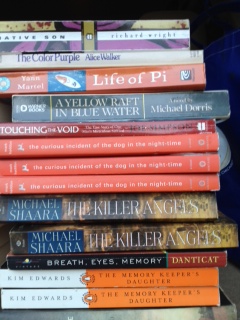
In one short hour, I  left with five boxes filled with texts we use in the high school. There were many  titles  available that we have collected over the past two years, but our shelves are almost filled to overflowing, so I tried to be judicious in my choices. For example, The Life of Pi and The Memory Keeper’s Daughter are both assigned summer reading for the honors/Advanced Placement program, so having extra copies to distribute is helpful. Additionally, we are collecting texts for use in US History as well, and now have a class set of The Killer Angels. We have been able to keep up with the attrition rate for many of our titles, specifically The Curious Incident of the Dog in the Night-time. The creative cover suffers the most damage from my curious sophomores who like to trace the dog cut-out.

On the following Friday (6/15/2012) , school had only been officially over for an hour, when I turned west to the first day of the Friends of Poughkeepsie Public Library District in Duchess County, NY. I had never attended this sale, but the advertisement on Book Sale Finder promoted a “BIG sale of 150,000 books and media.” The sale was held in a large warehouse, and true to the advertisement, there were hundreds of rows upon rows of books on tables. The books were well organized,  and there was ample SPACE to shop for books; shopping cart races could be held in the aisles. There were some drawbacks to this location, however. The lighting system emitted a loud buzz that was particularly maddening in the large echoing warehouse; 45 minutes was all I could take of the sound before heading to the cashier’s table. Unlike the Greenwich Library book sale which purges unwanted texts, the Friends of the Poughkeepsie Library appear to have kept every book ever donated. The boxes clearly labelled “fiction”, “sports”, etc. under each table identified the resting area for texts the other 51 weekends of the year.  This commitment to find a home for every text, no matter the condition or the content, means  a shopper must look peruse through piles of yellowing, damaged books in the hopes of finding a particular title. No matter, I filled three bags of books at the usual price of $1.00 trade, $2.00 hardcover, and $.50 for smaller paperbacks. On Sunday, prices are cut in half;  on Monday, one can fill a grocery bag for $5.00;  and  Tuesday, from 8A.M. to 12 Noon, leftovers are free for the taking. In looking at the selection on the “classics” table, I determined that Poughkeepsie area schools must also assign To Kill a Mockingbird; there were five new copies available. The best title “finds” on the tables were In Country by Bobbie Ann Mason for the grade 11 Vietnam War unit and Perfume by David Susskind for a new English IV course being offered this coming fall titled “Heroes and Monsters”. Apparently, the Duchess County area clearly went through its William Kennedy phase, favoring his upstate NY setting because there were no less than 27 copies of Ironweed available on the fiction tables along with his companion books Legs, and Billy Bathgate. Alas, there were no Joyce Carol Oates texts to support a rabid NY author fan base. After the sale, we stopped at the Daily Planet Diner (Route 55 off the Taconic), with all its kitchy thematic elements, to round out the end of the last day of school and the first day of summer vacation.

Funds spent over the two weekends were $25.00 at Greenwich and $49.50 at Poughkeepsie bringing the grand total  to$74.50. Total number of texts purchased? 117 books.

Over the course of the academic year, English teachers have been integrating the numerous used books purchased through library book sales into classroom libraries; some books have been offered as independent choice books while others have been used as whole class reads. Once the school year ended, we stacked the returned texts back into our hidden book room where access, strangely enough, is gained by going through a bathroom. Based on this latest haul, we may have to order another set of book shelves!

Shhhhh….We’ve been very, very quiet in grade 9 this year with our Silent Sustained Reading (SSR) academic experiment in the college prep 9th grade class. 77 students were asked to read a minimum of eight (8)  independent reading books of their choice as part of the curriculum, and to facilitate reading, students were provided 20 minutes twice a week (40 mins total/week) of SSR.  Responses to the independent books were recorded later on blogs or presented in class.

The inclusion of independent student choice texts with the time made available for SSR meant a reduction in the number of whole class reads; four texts remained in the curriculum: Romeo and Juliet, Of Mice and Men, Speak, and selections from The Odyssey. Classroom libraries were augmented with high interest texts (used books in class) with support from the school library and Overdrive software to allow for a wide selection by students.

So, what were the results? At the beginning of the school year, students took a survey based on questions suggested in Kelly Gallagher’s Readicide. This week, (June 2012) the same students retook the same survey. In order to account for percentage differences in attendance and enrollments, results were also checked using a t-test calculator to determine statistical significance. While there was only little change in students viewing reading as “fun” or “easy,” 57% to 59% or a 2% increase in the affirmative, the other data gathered from the survey indicates a positive shift in the attitude of our students towards themselves as better readers coupled with an increase in time spent reading  outside of class.

According to our September survey, 39% of our students rated themselves as “good” readers, 42% rated themselves as “average” readers, and 21% rated themselves as “poor” readers. The difference in June was very statistically significant (t-test) with 66% of students rating themselves as good readers; 30% of students rating themselves as average readers, and only 8% of students rating themselves as poor readers.

Responding to the prompt “I read independently every day and look forward to my reading time” in September;  9% of students responded “usually”, 35 % of students responded “sometimes”, and 56% of students responded “rarely”. However, by June, the difference in student attitudes her was also very statistically significant (t-test) with 19% of students responding “usually” (up 10%),  53% of students responding “sometimes” (up 21%), and 33% responding “rarely” (down 23%).

Finally, not only did the SSR program did increase the number of books read  by students for class, students indicated (very statistically significant) that they increased the number of additional independent books they read over the course of the year. Students reading no addditional books dropped from 32% to 11% while students reading 1-2 books increased from 52% to 58%, students reading  3-4 books increased from 13% to 22%, and students reading over 4 books increased from 3% to 8%.  These numbers complemented the finding of students who increased their overall “not for school reading/reading for pleasure” for 60 minutes or more (5%), for 30-60 minutes (17%) , and for 30 minutes or less (17%). The number of students who admitted to doing no additional reading dropped from 22% to 15%.

So what are the implications of this data? There are numerous studies that support independent reading for academic achievement. Students who read independently may also have an advantage as adults in the workplace. Author Stephen D. Krashen writes in The Power of Reading:

What the research tells me [about SSR] is that when children or less literate adults start reading for pleasure… good things will happen. Their reading comprehension will improve, and they will find difficult, academic-style texts easier to read. Their writing style will improve, and they will be better able to write prose in a style that is acceptable to schools, business, and the scientific community. Their vocabulary will improve, and their spelling and control of grammar will improve.

Additionally, high school is not too late to start an SSR program. Author  Steven Gardiner defended the practice when he  responded to questions about his book Building Student Literacy Through Sustained Silent Reading and discussed the use of SSR at the high school level:

On more than one occasion, I’ve started class by simply reading aloud. I didn’t explain what I was doing or why, I just started reading. They may be 15 or 17 years old, but they quickly get quiet and listen, trying to understand what is going to happen next, just like youngsters in story hour. They aren’t too old for reading aloud, and they aren’t too old for SSR. Most students are grateful for the time. When I look at changes in modern society, I understand why.

So do I. Our students occupy a digitally distracting universe: tweeting, texting, tethered to some instant communication that generates a almost compulsive nervous response. Carving out time, 10-20 minutes a class, for quiet SSR is necessary for students who need to focus when they read. Sadly, this may be the only time during a day when students read.

The significance of our efforts to increase our students’ independent and voluntary reading is addressed in the 2007 NEA report To Read or Not To Read: A Question of National Consequence:

Voluntary reading involves personal choice, reading widely from a variety of sources, and choosing what one reads. Aliterates, people who have the ability toread but choose not to, miss just as much as those who cannot read at all. Individuals read to live life to its fullest, to earn a living, to understand what is going on in the world, and to benefit from the accumulated knowledge of civilization. Even the benefits of democracy, and the capacity to govern ourselves successfully, depend on reading.

Our practice of  good reading habits,  SSR provided twice weekly with student selected texts, can lead to improved attitudes towards reading, and we now have the data to prove that one academic year of SSR has improved our 9th grade student attitudes towards reading. SSR will be included as an important part of our literacy efforts at other grade levels as well.