I am not a fan of the hardcover book, and for the most part, neither are my students. They are often heavy, and the book jackets bruise easily in lockers or backpacks. However, while I am also not a fan of the mass market paperback, my students often prefer the small sized text. While I have trouble with the font size in these publications, my students –with their younger eyes- want books they can pop into a backpack or purse…they want the mobile edition. Occasionally, I will have a student look for the “smaller-sized” version, “because it’s shorter.” This logic escapes me, but I am happy to comply.

The length of a text is definitely an issue for my students. While they do understand from experience that the quality of the writing (complexity of sentences, vocabulary, point-of-view, etc) are all factors in making a book readable, the damaging effect of a hefty text on a teenage brain cannot be underestimated. I applaud JK Rowling for conquering the size of text criteria in book selection.

Hard cover texts are plentiful in book sales, but they usually do not attract the box-toting buyers with whom I have jostled while perusing the trade paperback tables. I am puzzled that hardcovers are more expensive at most of these sales. If I were loading and unloading these heavier texts, I would advocate they be sold at bargain prices….everything must go! But, hardcover texts, with the exception of Danielle Steele romances and James Patterson mysteries, often sit forlorn, while their cheaper and more popular paperback offspring receive all the attention. Book dealers armed with scanners and mobile apps that identify first or rare editions are the most likely buyers.

I have had to resort to buying some hardcover titles when I am short specific titles for instruction or when I know students are looking for a particular book.  These titles include:
Jarhead
by Anthony Swofford
Black Hawk Down
by Mark Bowden
A Thousand Splendid Suns
by Khaled Hosseini
The Bluest Eye by Toni Morrison  (Oprah Book Club edition)

Summer Reading for AP Lit students...all 562 pages!

Recently, I assigned The Story of Edgar Sawtelle  by David Wroblewski to my Advanced Placement English Literature students; this is a retelling of Hamlet using a modern family of dog breeders. The book was a 2008 Oprah book club pick and is 562 pages in the hardcover. There are far more hardcover copies than paperback copies of this title in the used book markets that I follow. So, I have purchased about a dozen hardcovers for students to borrow as beach books…some heavy lifting required.

In shopping for books, I have noticed the strategies of some publishers to delay going into the paperback market (mass market or trade) with their titles. Dan Brown’s The DaVinci Code is an example of this delay. There are a plethora of hardcover DaVinci Codes, while there are fewer mass market paperbacks and  no trade paperbacks of this title. The popularity of this text kept the publication in hardcover which was more profitable for publishers and for Dan Brown. The same,however, does not hold true for his Angels and Demons; the number hardcovers and mass market paperbacks for this title are about the same in used book sales.

Currently, the book experiencing a publication popularity is The Help by Katheryn Stockett . I would like to add this text to my Civil Rights Unit for Grade 11, but I will have to wait for at least another summer. The Help will be available in record numbers in hardcover as the book has remained on the best seller list for weeks; paperback copies will be available in another two years.

The trade paperback is currently my edition of choice for use in the classroom…but the onset of the Kindle and Nook are shifting book availability of these texts for the future. My strategy will have to change.

Books alphabetized by author wait for buyers

A cultural anthropologist reviewing the trade paperback fiction tables at the C.H. Booth Public Library Book Sale would conclude that there are book clubs in thriving in Newtown, CT…many, many, many book clubs.  This book sale is one of the highlights in my summer book collecting schedule because of the amount of duplicate fiction titles available which indicates that people have read the book at the same time, and then donated it in order to make space for newer titles. This sale is also one of the best organized library book sales in the area.

This is an indoor sale which eliminates chances for inclement weather and book damage. The large tables are well organized in rows using the public space (gyms, multi-purpose rooms) of the Reed Intermediate School (off Route 25) effectively. There are many signs placed strategically around town to make finding the sale easy for drivers.

Fiction is in the large gym; the multi-purpose room holds non-fiction and children’s books, and smaller classrooms are used as holding areas or more expensive/rare texts. There is just enough space to negotiate around tables without becoming physically intimate with other book buyers. Buyers can place selected books in a holding area, and there is no limit to the amount of books one can “hold” before checking out. The lobby holds the checkout area which is spacious enough for several tables. Volunteer cashiers will work on large orders which keeps the traffic for smaller book purchases flowing. Students who need to complete community service will help pack and carry books. Prices are reasonable- from $.50-2.00/book. There was a $5.00 admission fee for the first day, but that was not enough to discourage buyers. Parking was impossible with every spot snapped up after the 1st hour of the sale. I had to park on a side street around the corner from the school.

In total, I spent $809.00. I lost count around book #554, but I would guess that I have at least 700 books from the sale.

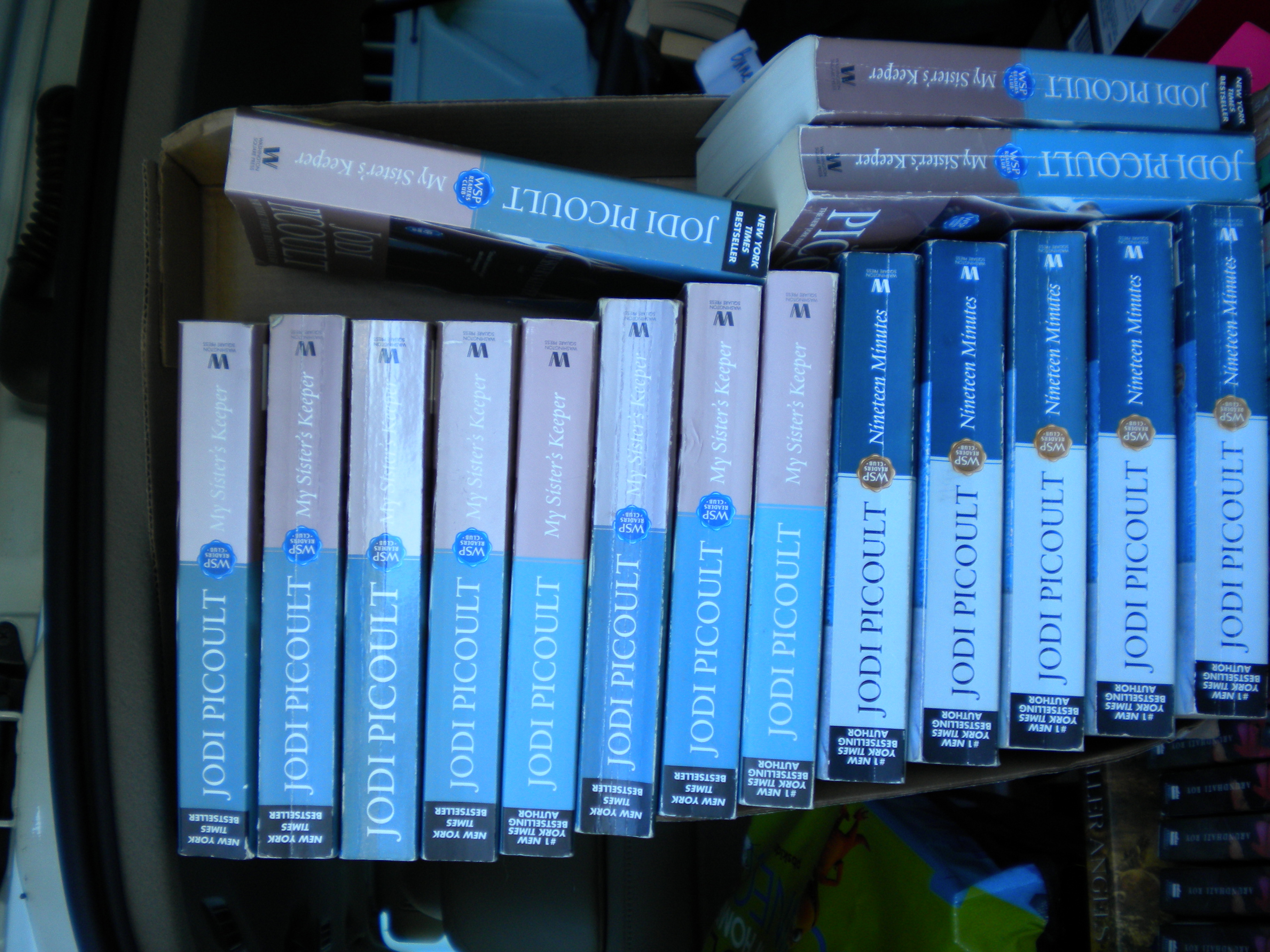
Jody Picoult texts all in a row!

The nicest feature of this sale is the organization of fiction. The trade paperbooks are organized by author’s name which makes finding duplicate texts for the classroom a breeze to find. Since I recognize many of the books by their covers, I have no trouble

locating and scooping up 10 copies of Mark Haddon’s The Curious Incident of the Dog in the Night-Time, or six copies of Barbara Kingsolver’s The Bean Trees. These are both books that are core texts that will be taught.

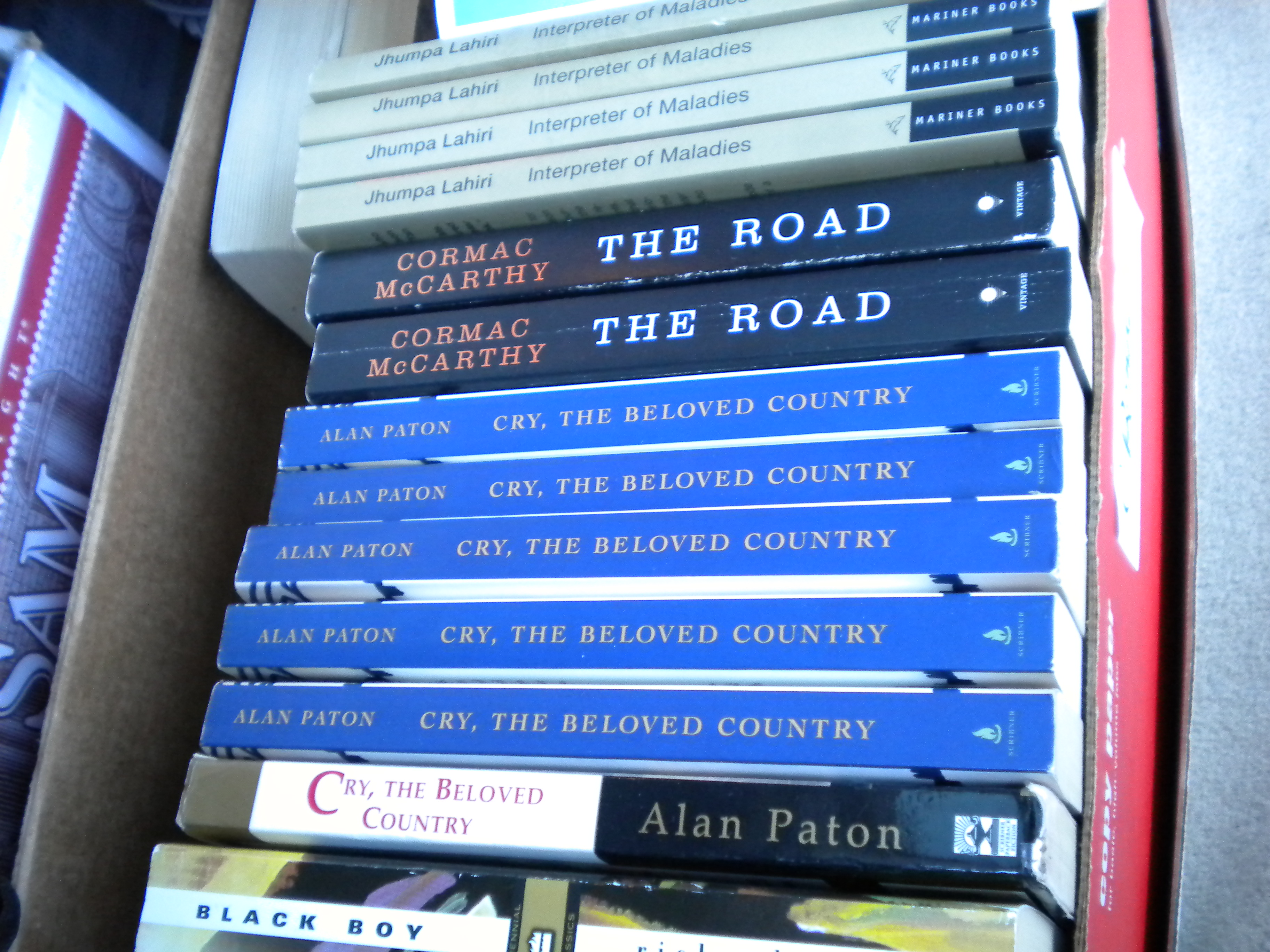
Oprah Book Titles-Core Texts!

There was also an Oprah Book Club section where I could load up on more core texts:  Cormac McCarthy’s The Road, Alan Paton’s Cry, the Beloved Country, and and Toni Morrison’s The Bluest Eye.

I also found sets of Kaye Gibbon’s Ellen Foster, Jodi Picoult’s My Sister’s Keeper and Nineteen Minutes, and Gregory Macguire’s Wicked for the 11th grade Coming of Age unit.

This year’s TEEN section was very profitable. Here I found a boxful of Scott Westerfield titles: Pretties, Uglies and Specials and a few copies of Nancy Farmer’s House of the Scorpion to add to my dystopia unit. I also found copies of Suzanne Fisher Staple’s Shabanu, a number of Anthony Horowitz Stormbreakers, and six copies of SE Hinton’s The Outsiders for 8th and 9th grade.

The non-fiction room is not organized by author, and I have made the conclusion that Newtown does not read much non-fiction. The biography/authbiography table was small; history (American/military/politics) was limited, although I did get several copies of Anthony Swofford’s Jarhead and Robert Kurson’s Shadow Divers. Luckily, some volunteer misplaced (or maybe correctly placed?) copies five of Tim O’Brien’s The Things They Carried on the table labeled “War”. I grabbed those so enthusiastically, I frightened a book dealer who was pouring through a pile of WWII books. All in all, the non-fiction choices, while excellent, were not as numerous as those choices in the fiction room.

In contrast, the tables for children’s literature were overflowing almost to the point of breaking. Boxes under the tables were also filled with texts. Volunteers kept refreshing the tables with books, and some of volunteers were savvy enough to keep book series titles together. The most heartening sight were the many parents and their children making selections together; one girl had a stack so high that she could hardly see around them. Seeing all the children’s books (picture books, learn to read books, series, etc)  available would lead the cultural anthropologist to conclude that reading starts early in Newtown….and continues in the many book clubs that are culturally thriving in this part of the state.

I just returned from the book sale at Stockbridge, Massachusetts, where one can combine a morning of book hunting with an afternoon of theater and dining in the Berkshires….a cultural summer playground!

The Stockbridge Library host its annual three-day book sale, a tradition under the tent, on the front lawn of the Library in July on Main Street in Stockbridge, MA. The parking is tight (although we were lucky to find a spot right on Main Street), and the traffic to and from the library slowed to a crawl with a mix of summer visitors and locals.

The sale is clearly visible with large tents and a dozen or so tables. The books are well organized into clearly labeled boxes; genres are clearly labeled above the tables with signs. The only complaint I have on this particular sale is limited to the stacks of boxes under the tables that should have been unloaded and boxes on the tables continuously refilled. Many patrons were forced to crouch to see what books were hidden, and there were boxes on top of each other which made for some serious gymnastics. I was impressed by the nimble young mother who was able to negotiate the boxes underneath while carrying an infant strapped to her chest! The checkout system, however, was superb. Book prices are penciled in on the first page of each book, and prices range from $0.5 to $3.00.  The volunteers had prepared forms to record the tally of book prices. We spent a total of $143.00 and purchased 82 books.

Before attending the sale, the junior teacher and I agreed that we did not need any additional copies of Cold Mountain or Snow Falling on Cedars…we left several of these on the table. She was looking specifically for Prep by Curtis Sittenfield, a coming of age novel that she used with some success in the Coming of Age unit. She found five copies-one a hardcover-and also copies of:
Core Texts

The Road
by Cormac McCarthy
Catcher in the Rye by JD Salinger
Literature circle books

The Color Purple
by Alice Walker
Middlesex by Jeffrey Eugenides
The Secret Life of Bees by Sue Monk Kidd
The Killer Angels by Michael Shaara
Nickled and Dimed by Barbara Ehrenreich
Summer reading

The Memory Keeper’s Daughter by Kim Edwards

The “find” of the afternoon was a copy of Oliver Sacks The Man Who Mistook His Wife for a Hat. The psychology teacher has been looking for extra copies.

After the sale, we traveled to Shakespeare and Company in Lenox to see Two Gentleman of Verona in the Bernstein Theatre. There is not a bad seat in this small theatre, and the production was clever with modern twists and very lively. Books and paraphrased Shakespeare…..”Then to book sales let us sing, finding books is excelling”….a wonderful summer vacation day for two English Teachers.

The Giver-

July 8, 2011 — Leave a comment

If there is a core text for middle school students, then Lois Lowry’s The Giver is high up on the list; our students read The Giver in Grade 7. This novel follows  Jonas, who receives his life assignment at the age of 12 as the community’s “memory keeper”, a position that requires him to accept serious responsibilities. Jonas is able to experience a wide range of emotions that his community has suppressed in others; he feels joy, despair, terror and can see colors that others cannot. Jonas escapes the community in order to save the life of his baby “brother” Gabriel, and the last pages of the novel find the pair in the snow facing an uncertain future.

Lowry confronts the reader with uncomfortable situations, and many middle school students do not enjoy the book, but they do remember the book. I can use references to Jonas and his community throughout high school, and students will make connections to The Giver in their responses to literature.

The novel was first published in 1993 and is usually categorized as science fiction. A more appropriate category would be dystopia. The popularity of the Hunger Games series by Suzanne Collins has highlighted this growing trend in YA literature; other dystopic visions of the future that I have been looking to include on our classroom shelves include:
Feed (2002) by M. T. Anderson,
Never Let Me Go (2005) by Kazuo Ishiguro,
Uglies (2005) by Scott Westerfeld (and other books Pretties, Specials, Peeps)
The Maze Runner (2009) by James Dashner

There are always used copies of The Giver in the children’s sections at book sales. I have never found the book mistakenly shelved with adult books; apparently, everyone is familiar enough with the book to know where to place a copy. These copies are usually pretty worn- some have highlighted text, others show “backpack” abuse. I will purchase most of these copies so that we have extra copies for students to write in or maybe create “found poetry” with pages from a disassembled text. Occasionally, I will come across a newer copy to add. Since children’s books are generally $.50 or half the cost of an adult trade paperback, I am not overspending when I get these copies.

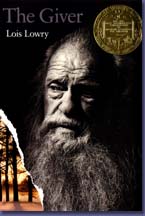
The cover has not changed since the book’s first printing, except to add the Newberry Award medallion to the upper right corner. The old man’s face and torn left corner are evocative of the novel’s themes. Here is a cover students can write about! The novel’s size is a mixed blessing- small enough not to intimidate the reader, but also small enough to be lost in a pile of used books. I often have to dig into piles of children’s books to find a copy.

Currently the book retails for $6.99.

The Giver will remain as a core text for our 7th graders. This is one of the books Wamogo middle school students who have come from three different elementary schools from three different towns will share together. Lowry’s novel marks a similar “coming of age”; as 7th graders, our students also have new responsibilities. Many of our students feel at times that middle school is a dystopia (a police state?), and they share these connections and their ideas of their future when they read this text. Many students may not enjoy the book, but all students keep memories of The Giver.

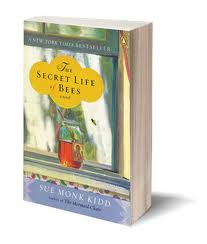
The book I have run across the most frequently in used book locations is Sue Monk Kidd’s The Secret Life of Bees. Actually, this is a book I wanted to collect since I remember reading the novel and thinking, “maybe students would like this one?” At every book sale, there are a plethora of romances and mysteries available (Danielle Steele and James Patterson must be making fortunes!), but I head to the trade paperback table labeled fiction first….and there is almost ALWAYS a copy of The Secret Life of Bees.

The novel was first published in 2002, and the protagonist, 14 year old Lily Owens, is an engaging character. She leaves her abusive father and eventually finds herself living with bee-keeping Boatwright sisters. By the end of the novel, Lily reasons her father would want her to stay; ” you’re better off there in that house of colored women. You never would’ve flowered with me like you will with them.” The book is an easy read and remains on a number of “ongoing favorites” for book club suggestions.

The novel is also a nice companion piece for To Kill a Mockingbird and covers many of the same topics and themes as those covered in Harper Lee’s classic novel. Because of the protagonist’s age,  the book was included in 2010-2011 in the Coming of Age unit in Grade 11, but the novel could also fit into any Civil Rights unit just as easily. I am not sure that this would be a core text, but the book does work well in literature circles or with student self-selection.

The edition I have found the most frequently is the yellow/blue bound trade paperback released in 2003. The design is attractive and the color scheme seems to separate it from other books on a shelf or table. There was a film release copy in 2008 (with Dakota Fanning as Lily on the cover), but that is not seen as frequently in the used book market as much as the original trade paperback. Interestingly, I have never seen a hardcover edition of this book in any used library book sale or thrift store. Is the hardcover of this text like a baby pigeon? One never really sees baby pigeons, but they must exist somewhere!

At this time, there are 67 copies of The Secret Life of Bees in our book room. That means that I have spent less than $70.00 for two class sets (30 + each) of this text. Currently, on Amazon the retail price for the trade paperback is $9.00; to purchase the same amount of book new would be $603.00….a savings of $533.00! I am not sure that I will need to continue to collect this text; my junior teacher says we have enough. If I do get additional copies, they will have to be in pristine condition. That may be difficult, because all these copies have been gently-or less gently- used. That could be a tribute to Sue Monk Kidd….although they have been given away, people have bought AND read her book! Maybe the readers really just wanted to share the story?

The Road by Cormac McCarthy, published in 2006, started my used book journey. The novel charts the journey of a father and son in a post-apocalyptic world as they try to find warmer climates to help their chances of survival. I read the hardcover in one sitting…a very visceral heart-pounding, page-turning sitting. That week, I traveled to Louisville, Kentucky, to grade AP exams. There were hundreds of English teachers there, and the discussion naturally turned to “what are you reading now?” A teacher from San Francisco described how she had patiently waited on a list for The Road at the library. Finally a copy came available, and she picked the novel up on her way home from the market. Leaning in like a conspirator, she said, “The mistake I made was opening the book before I had unloaded the groceries….things melted on the counter for hours.” I knew exactly how she felt.

Finding a book that high school students will read and enjoy is tricky. The canon offers a multitude of books that are of great quality, and many students will grudgingly admit that they thought the book was good …..after being dragged through the text. Teaching literature in high school can make one feel like a mom serving broccoli to finicky toddlers. “Read this,” I will plead, “this book is good for you!”

However, I knew The Road would be different. There was just enough suspense to keep students engaged. The plot was (deceptively) simple. The setting ominous and gloomy and not unlike their view of the future on occasion.

The problem was the cost of the text. The cheapest paperback copies I could find at the time (pre-movie release) were $11.99 each. I  purchased 70 copies (a chunk of the budget at $839.30), but as enrollment fluctuates, I needed eight more copies that November. I found five copies at the Burnham library in Bridgewater that were part of the Oprah book discussion series. The librarians were clearing them off the shelves, and I purchased them for $1.00 each…a find! The last three copies I purchased through Amazon’s used book offerings.

We taught The Road in November of 2009 with amazing success. The students were paired together in teams, like the man and the boy, and completed quizzes and classwork together.  The vocabulary was enriching not demanding; students actually wanted to know what the words “miasma” and “slut lamp” meant.

My fellow teacher and I were crazed in keeping track of each and every book, and at the conclusion of the unit, collected back 76 gently used copies and one water-soaked blob of text. However, the enrollment numbers for the upcoming class of juniors was larger, and I was determined to find cheap copies of this text. I began hunting The Road.

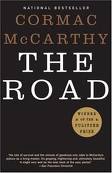
 The Road trade paperback (2007) has a very distinct cover…all black with bold white letters. This design makes the novel easy to locate in a shelf or on a table filled with other texts. During the summer of 2010, I found copies of The Road at library book sales, Goodwill stores, and tag sales. I have added to the 76 copies we collected back, and the department now has a little over 100 copies of this text -which means that honors and college prep classes can be taught at the same time.

Finding The Road in the used book market also means that copies can be provided for students on IEPs who may need to highlight or write in the book. We can also provide extra copies to special education teachers and aides. They also have been engrossed in the book.

For the past two years, The Road has been an excellent addition to our 11th grade curriculum. The students read the book without complaint, and there are now enough copies that will carry us into the future. Which future I do not know…. McCarthy’s vision or another? The journey continues!

According to the American Library Association (ALA) wiki, ““A book discussion group is a forum where readers can come together and talk about books and the reading experience. These groups can be organized in a variety of ways. There are adult groups, student-led groups, mother-daughter groups, father-son groups, and parent-child groups, to name just a few.”

I belong to three book clubs. That is really not that surprising for an English teacher.  My book clubs represent the diversity noted by the ALA as each club is demographically different and each group approaches literature very differently. For about five years, I have facilitated discussions at the local library with senior citizens (myself included!) where the discussions are very casual and very personal. For the past 25 years, I have been a member of a book club filled with professional couples (all Jewish, I am the token Catholic) where each “host” is responsible for framing the discussion. These discussions are often political, theological or psychological in the approaches to the literature. Finally, my third book club is the youngest, only three years, and is made up of high school teachers. Two of these teachers are currently staying home with toddlers who seriously  limit discussion but absolutely contribute joy. For each of these clubs, I have bought books in order to participate, and I have bought A LOT (yes, meaning filling acreage) of books!

Apparently, so have many others. Whether books have been purchased for book clubs like mine or for Oprah, there are always plenty of trade books to be found in the secondary market (which sounds so much better than used book!)

There are certain titles which currently dominate these shelves- Cold Mountain by Charles Frazier, Memoirs of a Geisha by Arthur Golden, Snow Flower and the Little Fan by Lisa See, The Secret Life of Bees by Sue Monk Kidd, The Kite Runner by Khaled Hosseini, and the infamous A Million Little Pieces by James Frey. I can get entire class sets (30-100) copies of each of these texts. The question I consider is how will these texts be useful in the secondary classroom?

There are limitations on many of these texts (subject matter, language, etc) that force them to the upper grades (11th and 12th), and the length of some of these texts, while not too intimidating members of adult book clubs, can turn off students. When I do make copies available to students, I often make them a”choice” book against a less controversial classic such as A Tree Grows in Brooklyn by Betty Smith. Fortunately, I can also find many copies of that text as well.

In a paper titled “Should the American Canon be Discussed in a Public Library?“,David C. Kulpfer notes that,

The book club has a distinguished role in American culture. The clubs were formed in the 19th century, primarily as a way to help immigrants learn the language of their new country. Discussions provided assimilation for a new land; they gave increased literacy, socialization, an upward path of mobility, and a means for the immigrant to speak comfortably in a language that was new (Fabian et al. 46). Today, clubs serve other functions. Barbara Hoffert, Editor ofLibrary Journal, recognizes community health and library publicity as benefits of the reading associations: “It [The club] helps polish the library’s image and build bridges to the entire community” (37). Companionship and literary skills can stimulate. Reference Librarian Sarah Scobey writes, “Book clubs fill a real void in our electronic age. They bring people together in an intellectually stimulating yet non-threatening environment, a sort of College Literature 101 course without the burden of exams and papers” (9). (http://unllib.unl.edu/LPP/kupfer.htm)

I am hoping the book club discussions continue for many reasons. I enjoy the intellectually stimulating discussions noted by Sarah Scobey. I enjoy reading books that have been suggested by others. I enjoy being convinced that the book is not as bad as I previously thought or defending a book’s quality to others. I try to model these behaviors for my students in literature circles. Also, some of my students’ parents participate in book clubs (“…my mom read that book and said I would like it!”) , and I hope to bridge child reading to parent reading by offering texts that are familiar to a household.

There are numerous websites that rate popular book club titles. These include but are not limited to:

Book Movement

Good Reads

Lit Lovers

I look at these lists with anticipation. There are books listed there that will one day find their way into the secondary market. On the top of most lists is The Help by Katheryn Stockett.
I am looking forward to collecting a class set of that text!

The sophomore curriculum at Wamogo High School is centered on world literature (after CAPT practice, of course). I have aligned our texts to meet the Common Core standards (Reading #6: Analyze a particular point of view or cultural experience reflected in a work of literature from outside the United States, drawing on a wide reading of world literature)

This past April, our thematic approach was “Children Living in Conflict”. They had read Night by Elie Wiesel in conjunction with the social studies department’s unit on the Holocaust. We book-ended the unit with films opening with The Power of One and concluding with the film Hotel Rwanda. There were a series of journal responses to films and an SAT prompt (“Will the 21 Century be marked by genocides?”) as assessments. Our goal was to have students read in small lit circles. For reading during the unit, we offered a series of texts to our sophomores and provided six-eight classes of silent sustained reading.

These texts were listed on Livebinders.com (click here).

We already owned:
The Kite Runner*-
Hosseini
Mr. Pip**
-Jones
Nectar in a Sieve**-Markandaya
My Forbidden Face**-Latifa
Persepolis**-Satrapi

PURCHASED USED (5-20 copies of each)
A Long Way Gone
-Beah
A Thousand Splendid Suns– Hosseini
Falling Leaves– Mah
First They Killed My Father-Loung
Kaffir Boy-Mathebane
Say You’re One of Them- Akpan
Snow Flower and the Little Fan-See
Shanghai Girls-See
The Power of One-Courtenay
We Wish to Inform You that Tomorrow We Will Be Killed with our Families-Gourevitch
What is the What-Eggers


Originally, the idea was to offer the books already in the department’s book room as independent reading. I was able to secure 5-20 copies of all other titles during the school year, so that we were able to expand the offerings by interest and by reading level.

In preparing this unit the previous year, I had planned to offer a variety of texts -particularly a variety of reading levels. My Forbidden Face is a low reading level text, but the subject matter is appropriate for 10th grade students. Persepolis allowed some students to try a graphic novel; the text is also excellent for visual learners. Both of these books are rarely available in used book locations.

The most popular texts were A Long Way Gone, A Thousand Splendid Suns, and The Kite Runner. Fortunately, these titles are very plentiful in the used book market. There are now enough Kite Runner texts to give us the option to change this unit to include a core text. I could not find enough A Thousand Splendid Suns, and several students purchased their own copies! That will be one of the targeted texts this summer!

*40 copies already in book room.
**20 copies purchased at full price for this unit July 2010


The Brookfield Goodwill store is also located on Route 7. This is a consistently a “good to excellent” resource for finding texts. I seldom leave without spending $30+ dollars on texts.

All Goodwill stores operate on a “color” coding. Price tags differ in color in order to move inventory, and 50% discounts are offered on items tagged with the color of the day.

I do pay attention to these tags when determining if I really need another copy of The Secret Life of Bees-Kidd  (we have amassed over 60 copies to date). Spending .50 for a book is hard to pass up….but I may opt not to get another copy at $1.00 or $2.00.

The start of this year’s collection on July 1st at Brookfield included (all in new or excellent condition):

Uglies-Westerfield
The Bedford Boys-Alex Kershaw
Confessions of an Ugly Stepsister-Macquire (a 2nd copy that day!)
Touching the Void-Joe Simpson
Night-Wiesel (4 copies!!)
Native Son-Wright
Alex Rider: Stormbreaker– Horowitz
Love in the Time of Cholera-Marquez
A Thousand Splendid Sons-Housseni
Working-Terkel

I also got a few gently used copies of:
The Poisonwood Bible
-Kingsolver (4 copies)
March-Brooks


I also found several new copies of Romeo & Juliet, Hamlet, and a new paperback edition of Lord of the Flies-Golding.

I have been asked to find books by other departments at the school. I located an entire class set of Seabiscuit -Hilldebrand that was used by a teacher for a equine course this past year.
For the Agricultural Science Department, I found 2 copies (one hardcover and one paperback) of The Good, Good Pig-Sy Montgomery. For Psychology, I found Raising Cain-Kindlon.

Brookfield Goodwill Store also gets regular deliveries of used books. I stop in every two weeks, and I have never been disappointed.

The New Milford Goodwill, located on Route 7 in New Milford, CT, is one resources I would rate as “fair to good”. That said, I never seem to leave the store spending less than $20.00. They will have some of the more difficult books to collect such as the books I scored on July 1st:

Son of a Witch AND Confessions of an Ugly Stepsister-Macguire
Cut-McCormick
Shoeless Joe-Kinsella

I also got copies of the more available The Kite Runner-Hosseini, Prep-Sittenfeld, and another Animal Dreams-Kingsolver.

I did also get a Good Times Silver Palate Cookbook for my son!