Dear National Council of Teachers of English (NCTE):

The 2016 NCTE Conference in Atlanta, Georgia, just concluded. This year the theme was “Faces of Advocacy”.

I would like to take this opportunity to do a little advocacy of my own.

The #NCTE Atlanta 2016 conference gave the nation’s English teachers an opportunity to exchange “words”….
have a word with…
get a word in edgewise…
hang on some one’s words…
or have the last word.

Every year, the NCTE conference brings together the nations’s (pre-school, primary, secondary, college) English teachers who traffic in words (vocabulary, root words, parts of speech, synonyms, figurative language, suffixes, etc.),

This conference began eleven days after the 2016 presidential election.

In several state, local and national campaigns, there were many words used by candidates on both sides of the aisle that were hurtful, that were fallacious, that were offensive. These words were highly visible on social media platforms and in the media; these words were highly visible to our students.

The multiple challenges to the use of hurtful, fallacious, or offensive words during the election was often met with derision by candidates, by candidate surrogates, or by media pundits on both sides of the aisle. Challengers were often told that candidates were “only joking” or just being “sarcastic.” There were publicized non-apologies :”I’m sorry if…” or “I’m sorry, but…”.

On occasion, words were retracted. “That meaning is not what I meant.”
Such retractions are linguistically precarious;  a challenge to word’s “meaning” does not negate what was expressed.

The “not what I meant” response conflicts with the definition of what a word means as “a unit of language, consisting of one or more spoken sounds or their written representation, that functions as a principal carrier of meaning.

words

In the 2016 election, many words were separated from their meanings.

Unfortunately, at this conference, NCTE, you did not offer any specific post-election guidance on this separation of word from meaning. At this conference you did not advocate for words and word meaning.

In all fairness, your conference theme (The Many Faces of Advocacy) was set years ago; its was months ago when the presenters were selected for sessions and the rooms assigned. In making these decisions, your organizing committee could not possibly have anticipated the current climate where the real political loser in this election would be words.

How then could NCTE support teachers as they proceed to teach words and their meanings to their students after this election?
How might NCTE prepare teachers in secondary schools to discuss understanding words that are spoken without meaning?
For example, how should NCTE guide teachers to help primary students understand the word meaning of a mean word?

Like the standard in Domain 3 of the Danielson Teacher Evaluation Rubric, NCTE, you could have exercised “Flexibility and Responsiveness” and “made an adjustment to respond to changing conditions.”

There could have been formal or informal opportunities for teachers to discuss their concerns about  hurtful words that were tossed about so publicly.
There could have been formal or informal opportunities for teachers to share strategies to deal with offensive words at multiple grade levels.
Finally, there could have been formal or informal opportunities for teachers to help their students in the future determine when, why, or how words are used to support fallacies.

NCTE, your oversight in not providing these opportunities is particularly ironic given the nation’s push for standards based curricula, where teachers of English are required to place emphasis at every grade level for evidence-based reading, writing, speaking, and listening. Students are expected to produce evidence-based responses that demonstrate precision in word choice (“Use precise language and domain-specific vocabulary to manage the complexity of the topic.”)  Word choice is explicit; students must comprehend and apply word meaning.

Instead, the campaigns of the 2016 election would have failed on any rubric that used evidence requirements for most state standards-based performance assessments.

In November 2017, when the conference moves to the City of St. Louis, NCTE, you could reaffirm your commitment to the mission statement which states:

“The Council promotes the development of literacy, the use of language to construct personal and public worlds and to achieve full participation in society, through the learning and teaching of English and the related arts and sciences of language.“

The phrase “use of language” in this mission statement refers to the use of words in a structured and conventional way. You should be prepared to defend the use of words in structured and conventional ways.

In summary,dear NCTE, when words are divorced from their meaning, they lose their power to communicate.
In 2017, we need to advocate for words.
Without word meaning, there is no reason to teach English.


Why should students be the only ones who have the opportunity to play games in class?

Game application programs are just as powerful an instructional  tool for teachers as they are for their students because game apps can deliver content to educators in an engaging and challenging way. Instead of sitting in professional development sessions, teachers can be like their students ….out of their seats trying to “beat the buzzer” with their response! 

Teams of teachers can challenge other teams of teachers on everything from best practices to trivia hidden in the student handbook, (just how well does everyone know the school dress code?) to organizing performance based assessments ( Choose: debate or poetry smack-down for Shakespeare?)

There are now multiple game applications that can easily deliver different kinds of content to teachers in grades K-12 and make professional development sessions memorable.

kahoot Kahoot! is just one of the game applications that can motivate teachers to participate. Teachers, like their students, can be highly motivated by the immediate competition these game apps create. Like their students, educators at all grade levels  do respond well to the points/rewards that game apps provide. And like their students, they can enjoy the immediate feedback the apps provided. This free, interactive platform records the results to the presenters, which can be used  to design the next level of professional development.

The Kahoot! website explains that their software allows educators the opportunity to:

“Create a fun learning game in minutes (called ‘kahoots’), made from a series of multiple choice questions.”

Once a game is made, it can be individualized with videos and images. Then, “Players answer on their own devices, while games are displayed on a shared screen.”

Another game application that can be used is Quizizz, another quiz, poll, or survey program that uses game graphics with feedback to promote learning. Like Kahoot!, this game app can be individualized for content with videos and images. The promotional material for Quizizz explains that, “Players answer on their own devices, while games are displayed on a shared screen to unite the lesson encouraging players to look up.”quizziz

I have used both the Kahoot! and Quizizz apps with teachers for professional development sessions.

Before using the game apps there were more than a few teachers who, exhausted from a day of teaching, would unenthusiastically go through the scheduled activity. 

But when they learned they could pull out their phones as a part of the presentation, they immediately became more engaged.  The teachers enrolled by using their phone for the quiz and began entering responses on their cell phones or tablets. In less than 20 minutes, I had covered the material that I wanted teachers to know and they remained highly engaged the entire time. They also learned how effective this tool could be if it was used in class on laptops or mobile devices.

When a quiz or survey or poll is created on the game platform, a PIN code is assigned so that everyone can join the activity. Then, the quiz is projected (LCD, Smartboard, Eno board, etc) at the front of the classroom where it can be seen by the whole class so the audience can play together in real-time. The game applications can be used on laptops or personal devices. Depending on which game application is used, devices can display color and symbol choices; the actual answer is viewed on the classroom screen.

A presenter can control the pace of the activity by setting a time limit for each question, which also allows time for information to process or for discussions to take place. As teachers answer questions, they are awarded points for correct answers and the timeliness of their responses. A scoreboard is displayed on the teacher’s screen. Watching that scoreboard with highly engaged teachers proves that nothing is better to incentivize others than a competition with inconsequential rewards!

Game applications can be used for all levels of ability, and the multiple choice option can be set for more than one correct answer. There are options to create discussion questions (“Which of these texts are best used for close reading ?”) or to create surveys (“What percentage of the midterm should contain objective-type questions?”)

I have used the game apps in particular to begin presentations on literacy by taking information from a research study such as Data from Kids Wireless Use Facts:

  • % of teenagers,13 -17, who “occasionally” access the Internet with tablets & mobile devices? (91%)
  • Over ___ % of parents said schools should make more use of mobile devices for education? (50%)

The data available in research studies can better inform teachers about the growing impact of technology on their students and the academic environment.

Digital apps like Kahoot! and Quizizz game platforms are the kind of technology that David Lassner, President of the University of Hawaii and informational technology expert, meant when he said,

“The real power of interactive technologies is that they let us learn in ways that aren’t otherwise possible or practical.”

The “us” in Lassner’s statement should not limited to the students. Teacher professional development with interactive technologies can be a critical part of a successful education program. It can be engaging. It can be challenging. It is practical, and it is certainly possible.

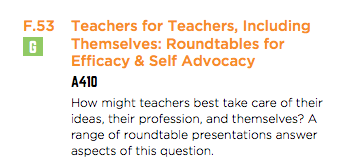
I will be presenting both of these game apps at the National Council of Teachers of English this coming Saturday, November 19th in Atlanta, Georgia. I will be basing the Kahoot! and Quizziz using information on teenagers and literacy. If you are down at NCTE, stop in at Table 7!screen-shot-2016-10-17-at-10-14-22-pm


screen-shot-2016-11-16-at-7-02-54-pm

F Sessions / 8:00–9:15 a.m. TABLE 7: “Get Your Phone App On!”

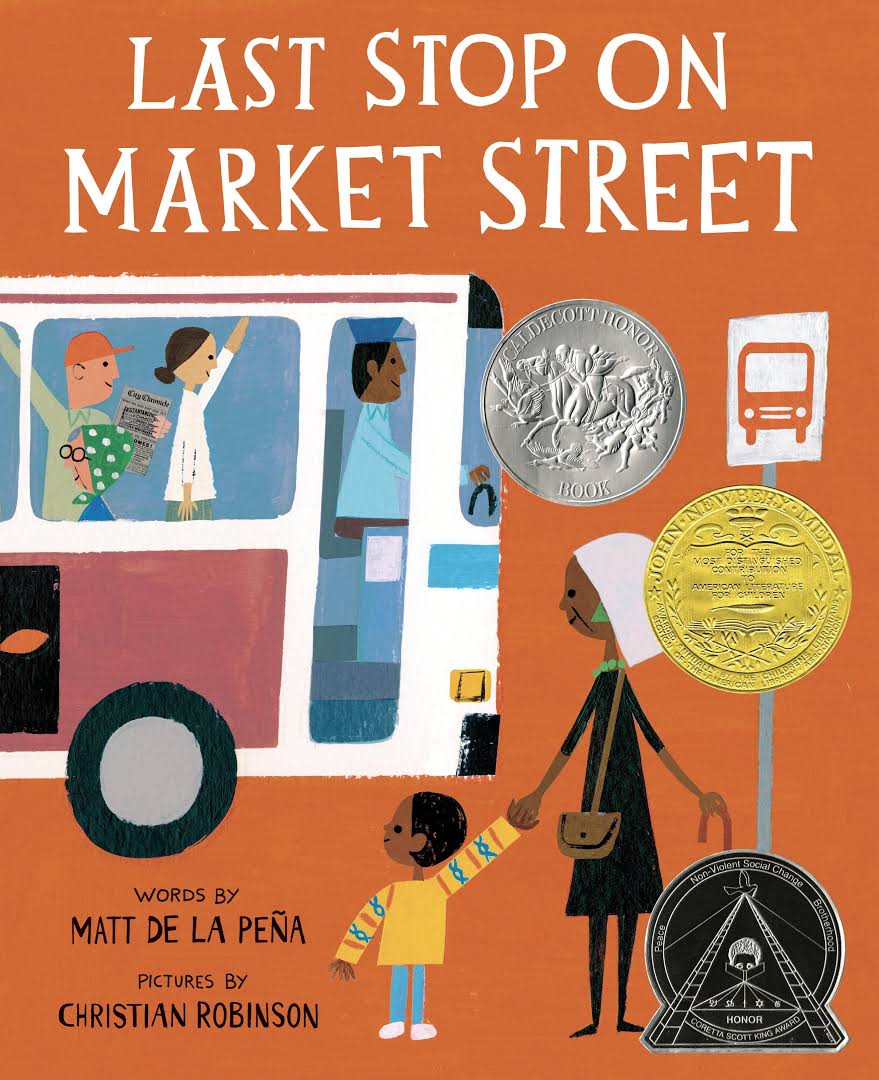
last-stop“…and what is that award for?” the boy asked pointing to the right corner of the book.

I was showing students in a 2nd grade class the cover of the picture book Last Stop on Market Street, written by American author Matt de la Peña and illustrated by Christian Robinson.

The boy was pointing to a black medallion, pasted under the silver foil award marking the  2016 Caldecott Honor and under the gold foil award marking the 2016 Newbery Medal. He was pointing to the shiny black circle that marked the Coretta Scott King Illustrator Honor, that lists the qualities of peace, non-violent social change, and brotherhood on its emblem.

“It has so many awards….and it’s only a few months old,” his classmate noted.

This fall, I have been reading Matt de la Peña’s story to students in different elementary grade levels.

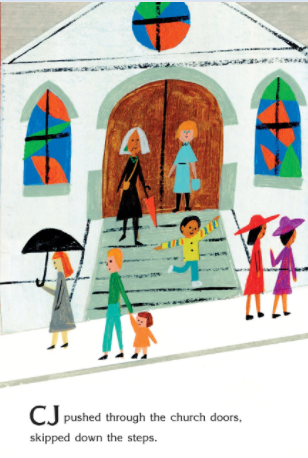
The students are hooked from the beginning when the picture book’s hero CJ bursts through the church doors, and into the rain that “smells like freedom.”

They notice the white trunks of the birch trees, drawn to look like they are “drinking through straw.” They like Nana’s sharp retort as she grows irritated with CJ’s questions.

“Boy, what do we need a car for? We got a bus that breathes fire.”

These repeated readings have made me aware that that CJ’s journey is a sophisticated journey. CJ travels through an urban landscape, a setting that is familiar to these students, but combined with same fantastic elements of an archetypal narrative pattern known as The Hero’s Journey. 

The Hero’s Journey or mono-myth was introduced by Joseph Campbell an American mythologist, who wrote in his most famous work The Hero with a Thousand Faces (1949):

“A hero ventures forth from the world of common day into a region of supernatural wonder: fabulous forces are there encountered and a decisive victory is won: the hero comes back from this mysterious adventure with the power to bestow boons on his fellow man.”

This narrative pattern of myth and legend has been followed by other characters on journeys. In the literary canon there are many examples such as  Odysseus (The Odyssey) and Bilbo Baggins (The Hobbit). The same narrative pattern is seen also in film with Dorothy in the Wizard of Oz and Luke Skywalker in the Star Wars trilogy.

Campbell drew parallels between these journeys of legend in literature and mythology with the journeys that everyday heroes make. He suggested that the everyone in life meets complications and obstacles, but it is the individual who goes through each of the stages and completes them successfully who society regards as a hero of any kind.

The Hero’s Journey follows a pattern of adventures that are generally organized in 12 stages. There is evidence that de la Peña’s little hero CJ experiences each stage, even in the short text (32 pages) of this picture book:

screen-shot-2016-11-03-at-10-24-53-pm1. Beginning in the Ordinary World

This is where the hero CJ begins his journey, oblivious of the adventures to come. We learn his his shortcomings; he complains  (“How come we don’t got a car?”) and he lacks the imagination of his Nana (“…he never saw a straw.”).

2. Call To Adventure

CJ’s adventure is a call to action, but the action is not clear until the end of the story.

3. Refusal Of The Call

Standing at the bus stop, CJ is uncomfortable.“How come we gotta…?” he complains to his Nana.

4. Meeting The Mentor

CJ’s  mentor figure is his Nana. She gives him whatever he needs: wise advice and self-confidence. She dispels his doubts and fears and gives him the strength and courage to continue his journey.

“Nana gave everyone a great big smile and a ‘good afternoon.’ She made sure CJ did the same.”

5. Crossing The Threshold

Climbing into the bus, CJ crosses the threshold between the world he is familiar with and that fantastic world which he is not. He climbs into the “…bus that breathes fire” and immediately the bus driver performs a magic trick with a coin.

6. Tests, Allies, Enemies

As every hero on a journey, CJ  needs to find out who can be trusted and who can not, and these characters on the bus initially seem a little sketchy.

“They sat right up front.
The man across the way was tuning a guitar.
An old woman with curlers was holding butterflies in a jar.”

CJ is out of his comfort zone and is confronted with challenges that help the reader gain a deeper insight into his character. The characters he meets are illustrated: the guitar player, Bobo, and the lady with butterflies, the boys with earphones, the blind man, and the blind man’s dog.

7. Approach To The Inmost Cave

In the mono-myth, the hero must make final preparations before taking that final leap into the great unknown. That comes about when the man with the guitar begins to play, and CJ follows the advice of a blind man:

“To feel the magic of music,” the blind man whispered, “I like to close my eyes.”

screen-shot-2016-11-03-at-10-24-24-pm8. Ordeal

By closing his eyes, CJ experiences the mono-myth’s “metaphorical resurrection” that (literally) grants him the hero’s insight:

“And in the darkness, the rhythm lifted CJ out of the bus, out of the busy city.
He saw sunset colors swirling over crashing waves.”

9. Reward 

During this stage, CJ is transformed into a new state, emerging with the prize or elixir. The background illustration by Robinson is not an urban landscape, but a full page spread of CJ’s imaginings. The prize or elixir is magic of music that activates his imagination.

“CJ’s chest grew full and he was lost in the sound and the sound gave him the feeling of magic.”

10. The Road Back

At this stage in this hero’s journey, CJ returns with his reward.  According to the pattern, he may still need one last push back into the Ordinary World. This is the moment before the Hero finally commits to the last stage of his journey,  moment in which he must choose some higher cause. Here, CJ notices the “Crumbling sidewalks and broken-down doors, graffiti-tagged windows and boarded-up stores,” a stark contrast to the beauty that the elixir of music provided.

11. Resurrection

This is the climax of the picture book, the “a-ha” moment. Responding to his disappointment, CJ’s Nana tells him,

“Sometimes, when you’re surrounded by dirt, you’re a better witness for what’s beautiful.”

Her knowledge has far-reaching consequences to his ordinary world.

He wondered how his Nana always found beautiful where he never thought to look.”

12. Return With The Elixir

This is the final stage of the Hero’s Journey, which is now revealed to have been a journey to a soup kitchen. On this journey, CJ has grown as a person; he has learned many things. He is a fresh hope to others, and, like his Nana, can offer a solution to problems.

“I’m glad we came.”

The final reward that he obtains may be literal or metaphoric. Ultimately the hero CJ will return to where he started, but he has a new point of view, one of empathy.

You can see Matt de la Peña reading selections from the book here:

In proposing The Hero’s Journey, mythologist Joseph Campbell suggested that everyone goes through a series of challenges in life, but it is only the hero who successfully meets each challenge at each stage of the journey.  CJ is the literal and archetypal hero of Last Stop on Market Street, reminding all audiences, young 2nd graders and adults, that the hero can be anyone who makes that challenging journey and who returns to bring hope to his or her community.

CJ’s reward is Nana’s approval to his statement, “I’m glad we came.”
She responds, “Me too, CJ. Now come on.”

CJ’s reward as a hero in completing his journey is captured for all audiences in a picture book by Matt de la Peña and Christian Robinson, in a picture book that is decorated with book awards.

#Why I Write

screen-shot-2016-10-17-at-10-15-43-pm

It’s not because writing is fun…writing is hard.

It’s not because I have the time to write….(so far the first two sentences in this response have taken over two days to construct so they sound the way I would like them to sound).

It’s not because I like the end product…(I still think the aforementioned two sentences need more work). In fact, I usually think of a better ending several hours after publishing.

It’s not because I take unnecessary risks. I am self-conscious; I self-censor. I do not want to be misinterpreted. Writing on a blog that is public is a bit like performing linguistic acrobatics without a net.


So, why do I write?

I write because I cannot provide support in reading and writing for teachers and students if I do not read and write myself. So, I write publicly as a performance task….as an “authentic task”, one that I might assign to students.

I write because I want to remember my own ideas (I am getting forgetful).

I write because the act of completing a sentence, a paragraph, or a blog post in this distracting world demands focus, even if that focus is for a brief amount of time.

I write because writing forces me to research. For example, while I was writing the phrase “linguistic acrobatics” above, I thought of my favorite example of linguistic “acrobatic” writing…an excerpt from a brilliant conversation written by E.B. White for Charlotte’s Web. To get the quote, I had to spend a little time to research the quote from the text (not the film!)

In this exchange, the spider Charlotte plans how to save her friend Wilber, and she listens for suggestions from other farm animals about words she could write in her web:

Goose: “How about TERRIFIC, TERRIFIC, TERRIFIC?”

Charlotte: “Cut that down to one TERRIFIC and it will do nicely. I think TERRIFIC might impress Zuckerman.”

Wilbur: “But Charlotte, I’m not terrific.”

Charlotte: “That doesn’t make a bit of difference. Not a bit. People believe almost anything they see in print. Does anybody know how to spell TERRIFIC?”

Gander: “I think it’s tee double ee double arr double arr double eye double eff double eye double see-see-see-see.”

Charlotte: “What kind of acrobat do you think I am?! I would have to have St. Vitus’s Dance to write a word like that into my web.”

Nevertheless, the spider Charlotte does weave the word terrific into her web. She writes and because she writes, Wilbur is spared.

What better reason to write then the one that E.B. White offers?   Writing saves lives.


You probably have encountered the plot mountain diagram:

Exposition. Rising action. Climax. Falling action. Resolution.

plotmountain1


The plot mountain diagram is taught with short stories in English Language Arts at different grade levels, but I suspect that like most graphic organizers, the plot mountain diagram is over-taught, especially in middle and high school classrooms.

The practice of teaching the plot mountain as a general way to understand that there are patterns to short stories is good in theory, but not so good in practice. Repeated practice of the same plot diagram is worse.

Look at the plot mountain diagram above (courtesy of the Read, Write, Think website).

The falling action of a story is rarely as proportional as the rising action. The climax is not always in the “middle” of the story. This is because, authors do not write their stories according to a plot mountain diagram:
-Authors are unpredictable;
-Plots are unpredictable;
-Most of the short stories taught in middle or high school are selected because they are unpredictable.

Take, for example, Saki’s classic short story The Interlopers. Two men, sworn enemies, are pinned under a tree that crashes in a snowy forest. Trapped together, they come to the conclusion that their longstanding feud is no longer important. Just as they agree to settle their differences, one man sees in the distance how their fate will play out with the single frightening word: “wolves.”

Now, that word (“wolves”) makes up the plot’s “falling action.” There is no real resolution, instead there is imagined horror. Saki designed a story that blew the top off the standard plot mountain diagram.

That same kind of explosion could be said for Guy de Mauppasant’s The Necklace. The character Mathilde spends her youth paying back jewels she was foolish to borrow. The story concludes with the shocking statement:

 “Oh, my poor Mathilde. But mine [jewels]were false. At most they were worth five hundred francs!”

If a student was to create a plot mountain for either of these stories, instead of following the prescribed template above, a student might draw something that looks like this:

screenshot-2016-09-25-14-15-53


Rather than reteaching the same plot mountain model over and over, a teacher should ask students to use their own ideas to diagram a story’s plot. There should not be too much support in the directions.

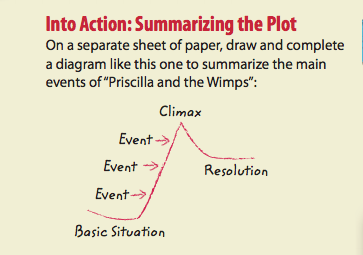
Take, for example, the instructional suggestion (see screenshot below) to use with Richard Peck’s hilarious short story “Priscilla and the Wimps.”

In this story, Peck sets the tone in describing bullying in a public school setting with his opening lines:

“Listen, there was a time when you couldn’t even go to the rest room in this school without a pass. And I’m not talking about those little pink tickets made out by some teacher. I’m talking about a pass that could cost anywhere up to a buck, sold by Monk Klutter.”

One small student-Melvin-is bullied by a group of students led by Klutter. But Melvin has a protector, Priscilla Roseberry, who is described thusly:

“I’m not talking fat. I’m talking big. Even beautiful, in a bionic way.”

screenshot-2016-10-02-11-51-13

In Peck’s story, the brutish Priscilla efficiently dispatches the school bully, Monk Klutter, into a school locker. The story concludes, “Well, this is where fate, an even bigger force than Priscilla, steps in. It snows all that night, a blizzard. The whole town ices up. And school closes for a week.”

What I most remember about teaching this story with 8th graders is how Peck’s resolution was somewhat unsettling to some readers. More than one student had commented on what could have happened to Klutter if he was stuffed in a school locker during a blizzard.

“Without food and water for a week,” one student pointed out to me, “he’d be dead. Priscilla could be a murderer!”

The directions above do not support such thinking, even if it is slightly misguided. In the directions, although there is some movement away from a “fill-in-the-blank” worksheet by asking students to draw a diagram “like this one” to summarize events, a model is still there for them to follow. The climax (again) is followed by a disproportionately sized resolution.

While directions suggest creating something similar (“like”), many students will simply recreate this diagram, plug in three events, and place Monk’s undoing at the climax.

So what is the purpose for students to use a pre-printed plot mountain diagram?

All they need are the story elements that help them explain a story’s pattern. Teachers could give the terms (perhaps on labels: exposition, rising action, climax, falling action, and resolution) in order to for students to create the unique diagrams that are proportional to the stories they are reading.

When students are free to demonstrate their understanding of these terms, they can move beyond a prescribed application or a fill-in-the-blank drawing on a worksheet. They can do more of the higher taxonomy activities, such as comparing and contrasting the patterns of different stories. What did Saki do differently than Peck? How does de Mauppasant’s ending compare with either?These more sophisticated educational exercises would not be effective if the same plot mountain template is used over and over (and over!)

Students should be able to identify the elements that make up the unique pattern of each story as well as appreciate an author’s craft in configuring those same elements differently in a story.

In this sense, the plot mountains of stories are a lot like geography…no two mountains are alike.

As it often happens, I was looking for one thing (Google’s expansion into creating maps and navigation tools) when I came upon another. I had clicked my way to a story map of the folk tale hero Paul Bunyan. I had followed a link to the Osher Library Map Cartographic Southern Maine University website and soon was down an Internet rabbit hole, digging around in their map collection.

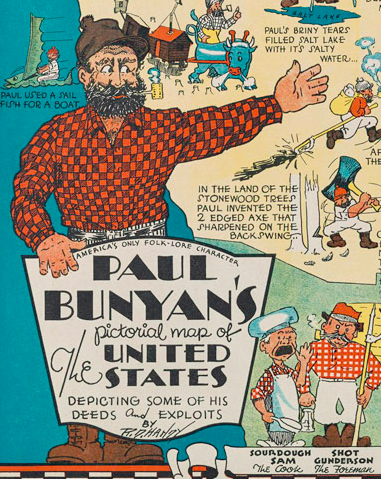
There I found Paul Bunyan’s Pictorial Map of the United States Depicting Some of His Deeds and Exploits created by Handy, R.D. 

screenshot-2016-09-11-12-13-58A screenshot of lower left corner of Paul Bunyan’s Pictorial Map of the United States Depicting Some of His Deeds and Exploits by Handy, R.D. (1935); 22 cm X 32 cm; Image No: 4000166.0001

As the literature in Grades Two and Three centers on folk tales, I was thrilled to find this map. I thought this combination of pictures and text would be something to share with teachers.

I spent several happy minutes zooming in on the map. There in the lower right corner was the boast of authenticity: “This is to certify that all the facts on this map are without any change or exaggeration,” with several witness listed below. It was just the sort of hyperbole that goes with the stories of Paul Bunyan.

Some of the stories on the map explained:

  • In school Paul used a slab of lime stone for a slate and a big white pine tree for a pencil.
  • The 10,000 lakes in the State of Minnesota fill the footprints of Paul’s gigantic Blue Ox, Babe who measured forty-two ax handles wide between the eyes.
  • The Mississippi River was the result of water leaking from one of Paul’s water storage barrels.
  • Paul’s briny tears filled the Great Salt Lake of Utah.
  • When Paul sat down for a smoke to think about his problems, he set off the Great Smokey Mountains.
  • When Babe when digging after a field mouse, he created famous Mammoth Caves.

My delight, however,  came to an abrupt halt when I got to the upper left hand corner of the story map. There were two small characters in the upper left corner (not pictured) of the map that changed everything.

In this upper left corner was a small illustration of what the text described as “two small colored boys.” They were drawn to show how Paul Bunyan’s cook, Sourdough Sam, made “pancakes  on a griddle so large that you couldn’t see across it.” The drawing of these two boys who “greased the griddle with bacon slabs tied to their feet” highlighted their simian-like features. The illustration on the map looked like an artifact from a Jim Crow exhibit.

Suddenly, my lesson in sharing an American folk tales with elementary school children had turned into a lesson on the history of racism in America.

Up until that moment, my familiarity with Paul Bunyan was with his exaggerated prowess as a lumberjack in Northern Minnesota. Some might argue he was a creation more of “fakelore,” a literary invention passed off as an older folk tale. I had never considered that Paul Bunyan was racially motivated.

Environmentally unfriendly? Yes. But a bigot? No.

Furthermore, research on other sources of the same story of those cooks who greased Paul Bunyan’s griddle yielded accounts that did not mention the race of the cooks.

On this R. D. Handy story map, Paul Bunyan was not funny. I was not going to share this story map with 7-9 year olds.

The use of this R. D. Handy story map would be limited at best a to high school U.S. History class where students could have the opportunity to discuss America’s cultural past and how that past impacts both the present and informs the future.

To be fair, R.D. Handy, author of the map, was no doubt responding to cultural norms of his times. During his tenure as a cartoonist for the News Tribune in Duluth, Minnesota, the Great Depression had hit all Americans very hard. The economy nationwide struggled to improve. The competition between all races for the few jobs available brought added hostility.

According to an entry in Encyclopedia.com titled “Black Americans, 1929-1941, “there was migration of southern rural blacks seeking employment in the industrial centers of the North.” In traveling north, Black Americans could escape the racial violence of the South, and some “400,000 made the journey during the 1930s.” This was the historical context when the map was released to the public.

The R.D. Handy story map illustrates an American paradox. The story map contains the promise of American exceptionalism in a folk tale, combined with the exploitation of a race in building up that hero. The story map captures the charisma of American bravado stained by American bias.

Perhaps the lesson now will be to challenge the second and third grades to give Paul Bunyan’s folk tales another chance.

Paul Bunyan needs a new map.

15 years ago the World Trade Center Twin Towers in NYC were struck by terrorists. When they collapsed, many students at Brookfield High School in Connecticut watched them fall -75 miles away-on television screens set up along the walls of the school’s library media center.

Those students did not attend classes. Instead, they had the opportunity to be witnesses to history. They were given this opportunity to stand as witness to the tragic events that happened because of a decision made by the school’s library media specialist (LMS), Sydnye Cohen.

The role of the school librarian had radically changed beginning in the 1980s and Sydnye was a library media specialist who had trained to be at the forefront of that change. I was an English Language Arts teacher at Brookfield in September of 2001, and I had developed a great respect for her. She had encouraged me and other members of my department the previous year to incorporate technology in our lessons. She had guided us to embrace a broad range of digital tools and instructional materials.

Sydnye was confident. She was knowledgable. She was fierce in her convictions.

I remember that on that morning of September 11th, the students who had heard about the attack gathered in the school library where Sydnye had decided, with support from the school administration, no doubt, to set up the school televisions.

She had set up several different televisions along the outside walls broadcasting news; the center of the library was open space. The students sat quietly on the floor in the center of the library surrounded by the images of smoke and flames. They watched small screens that sat up high on metal stands.

That morning, Sydnye did not waver in her role to provide critical information to the high school students. I remember that she did not appear to be concerned about the impact her decision to stream the live footage into the school might have. I believe I may have said something about what parents might think; I believe she shrugged off my remark.

The students watched minute by minute, even as the Twin Towers burned and then crumbled into rubble on the NYC streets.

Her conviction to have students witness this event was based on her desire not to shield students from this man-made disaster, but to give them first-hand information.

Fifteen years later, I have noted a number of posts and news articles that ask the question:

SHOULD STUDENTS SEE THE GRAPHIC IMAGERY OF 9/11?

Several of these articles mention concerns raised by secondary school teachers today. Many high school students in 2016 could be seeing the raw footage from 9/11 for the first time. Our current 24-hour news cycle was just beginning, and Fox News and MSNBC were only five years old. Their coverage of the event streamed into the school live….unedited. Years later, the recordings are difficult to watch.

When today’s teachers tackle the topic of 9/11 in the classroom, they may feel a personal responsibility to educate students about the event, but they may also feel concerns about the impact of these videos.

cnnThe students at Brookfield High School had their LMS take on that responsibility that morning. Sydnye Cohen had every confidence that giving students the opportunity to see the events of 9/11 was historically important.  She was fierce in her conviction that witnessing this event would be important for them to become critical thinkers.

The students who sat in the library media center in Brookfield High School will clearly remember 9/11, because their library media specialist gave them that opportunity.

I recently underwent a hip replacement surgery for my left hip. This has meant that during the past several weeks of recuperation, I have had to relearn how to use my left leg and unlearn any movements that required me to bend more than 90 degrees in order to reach down and pick up something on the ground.

This period of recuperation has made me think about relearning and unlearning. Both should be used by teachers, especially middle and high school teachers, to teach writing in ELA, or any other content area, during the school year.

Relearning: What do the students already know

Students who had been out of the classroom for several weeks due to summer break will begin the year doing a lot of relearning.

The German psychologist Hermann Ebbinghaus was a pioneer in the study of memory and learning which led to his discovery of the forgetting curve and the spacing effect. In 1883, he determined that

“Relearning is supposedly the most efficient way of remembering information.”

I can attest. While I had to relearn to use my left leg to step up the stairs or to put on a pair of pants, my relearning was not very difficult. I was already proficient at these tasks before the hip surgery. According to Ebbinghaus, relearning is faster when the information is already stored, and the brain needs only to revive these memories and refresh them for use.

The level of relearning for each student will differ depending on the level of proficiency a student was originally able to attain on a task. That means the amount of time/attempts that a student took to meet a specified level of proficiency can be compared proportionally to the time/attempts he or she later needs to attain the same level.

Once school begins, teachers should take advantage of relearning by finding out first what students already know. While this may seem a statement of the obvious, a student does not come to class as a “blank slate.” They may already be familiar with information; what they may need is an opportunity to relearn.

There is ongoing relearning in English Language Arts classes at most grades because the literacy anchor standards for writing are almost the same for all grades. The difference in the relearning is directly related to the increase in sophistication required for reading (ex: character, plot, setting) and for writing (ex: noun, question mark, phrase).

Students have already been introduced to the rules for writing, those standard rules of English, at the earliest grade levels. They may need only “to revive these memories and refresh them for use.” That ability for a teacher to differentiate between students who need to relearn versus those who need to be retaught from the beginning can guide the framework for effective instruction for the school year.

Unlearning: Letting go 

Unlearning is harder. During this recuperation from hip surgery, I would repeatedly have to stop myself from reaching down to the ground to pickup whatever I dropped (and I dropped many items!) I had to “unlearn” the reflex action of bending.

“Unlearning is about moving away from something—letting go—rather than acquiring.”

In the same way, students may need to unlearn or “let go” before they can learn new information or try their own strategies in order to develop new skills.

Unlearning or letting go plays an important process  in learning how to write for grades 6-12. By the time students have reached the middle and high school levels, they will have been taught a number of writing formulas, mnemonic training wheels, designed to help them learn how to respond to a writing prompt. Some examples include:

RACE: Restate the question. Answer the question. Cite evidence. Expand/Explain.
TREE: Topic sentence. Note Reasons. Examine reasons. Note Ending
DIDLS: Diction. Images. Details. Language. Sentence Structure.

While many of these mnemonic devices are generally helpful to students, they are designed to be training steps or preliminary checklists. These formulas are meant to stir, not replace, the kind of good thinking that leads to good writing. As noted writer an editor William Zissner said in On Writing Well: The Classic Guide to Writing Nonfiction,

“Writing is thinking on paper.”  Screenshot 2016-08-14 12.47.32

That is the goal teachers want their students to meet…to put their thinking on paper.

To turn their thinking into writing, students should be encouraged to “unlearn” and move away from the checklists and formulas.

Good writing does not follow a prescribed outline where student fill in the blanks, often without generating the important thinking they need to do for comprehension. Even more dangerous is the impression the outlines give to students that writing is neat and easily organized. Good writing is neither neat or easily organized, instead:

Writing is messy.
Writing takes time.

Unlearning the fill-in-the-blank outline can give students new opportunities to develop their own strategies in order to deepen their own understanding. And while students are unlearning the writing formulas they were taught in elementary school, they could also unlearn some of the myths or general misinformation that still circulate in high schools about the writing process:

  • myth: essays have 5 paragraphs;
  • myth: a paragraph has at least three sentences;
  • myth: “I” should never be used in a response.

The end result of misinformation and formula writing has generated years of sameness in student responses. While these same kinds of responses may be easier for teachers to compare and to grade,  the sameness in responses will never truly reflect an individual student’s writing ability.

Encouraging writers: Relearning & Unlearning

For students to become better writers, they may need to relearn some of the general rules for writing and unlearn many of the prescribed ways that writing has been taught to them in the earlier grades. Students will need to be encouraged to drop those outlines that were put in place to guide them -like training wheels- towards the goal of being good writers.

Two areas of focus for the ELA classroom this new school year can be relearning the standard rules for writing, and unlearning the formulas, the checklists, or misinformation that stop student thinking.

Students will need those teachers who are willing to support them as they experiment in the more sophisticated, but very messy, art of writing.

Relearning to remember and unlearning to let go; important goals for the school year in the grades 6-12 classrooms… and for post-hip surgery recuperation!

I had four large bags full of young adult fiction, and I stood waiting for the volunteers to tally the total.

“$60.00,” one told me.

I looked at the pile. I paused, “OK, Wait here….I’ll get more!”

rooster-booksUsually I attend the Newtown CT Book Sale on one of the opening days when the books are full price. I have waited in the early morning hours on a long line for first crack at the trade paperbacks. But, this was 1/2 price Monday, and I was getting TWICE the amount of books for classroom libraries. To be honest, I had never shopped on the 1/2 price day, assuming that there would not be any books left.

I was wrong.

After the weekend crowds had had there full, there were still hundreds of young adult (YA), “tween,” and upper elementary chapter books laid out on the tables. I could keep shopping!

I had also assumed that any remaining books would piled chaotically from the book shoppers over the weekend.

I was very wrong.

Once again, the volunteers for the Cyrus H. Booth Library in Newtown, Connecticut, had kept up with the steady stream of shoppers. They had alphabetized the books by author. They had kept the genres separated on tables for easy navigation. They kept signs visible: “Chick Lit” or “Classic Fiction.”

But I was right about the amount of help I would get from volunteers. One of the volunteers noticed the titles I had selected, and the logos on the bags I filled: Scholastic, Penguin Young Readers, Lakeshore Learning, Heinemann.  I was returning home from the International Literacy Association Conference (#ILA2016) in Boston, MA, and I was already using the “swag” that had been handed out by the different education book publishers in the conference exhibition hall. I was, quite literally filling these literacy tote bags with literacy books.

“You must be a teacher,” she noted, “I used to be a teacher.” So was her fellow volunteer.

Of course, it is not surprising that several of the library book sale volunteers were former educators; they know the power of getting books-these piles of gently used books-into the hands of young readers.

They tallied my piles, and we chatted about what students read, what book covers attract readers (dark and spooky, we agreed). Then, they loaded my purchases on a cart, and one former teacher helped load my car with the four bags plus two additional boxes of books.

In total, I spent $103 dollars. Shopping on 1/2 price day yielded 184 book titles, some of which included student favorite titles by Sarah Dessen, Rick Riordan, Sarah Weeks, Gary Paulsen, and Andrew Clement. These books will be going into classrooms, grades 5-9, for independent reading.

The School Library Journal published (2000) study Independent Reading and School Achievement by Bernice E. Cullinan, New York University. The study explained that “Independent reading is the kind students choose to do on their own; it is not assigned or assessed, but it has a positive effect on learning and school achievement.”

Thank you, again, CH Booth Library volunteers. Your book sale will help to have a positive effect on student learning and school achievement!

On occasion, I hear a statement that captures how much the classroom differs from the real world.

Such was the case at the International Reading Association Conference in Boston (July 9-11, 2016) when literacy consultant Mark Overmeyer noted that in the real world:

“Our most skilled writers have editors…the more skilled the writer, the more editors”

Then he pointed out the obvious,

“So why do we expect our 10-year-olds to write perfectly?”

Editors in the Real World

Overmeyer was speaking at the session to a roomful of educators, attending the session on “Grammar Matters: Promoting Engagement, Strategic Instruction, and Reflection Using Mentor Texts.” His statements highlighted the contrast between the support the best professional writers receive and the support an average student-at any grade level-receives is worth looking into for a moment.

First, in the real world there are different roles editors who specialize in stage of writing. Here is a description of editors, and how these roles are represented (or not) in the writing process in schools today.

  1. Acquisition Editor: This editor selects books for a publisher, and stays with an author in prepping a book for publication.
    Counterpart in education: The teacher may submit a piece for “publication” in a literary magazine, a writing writing contest, or hang student work on a bulletin board.
  2. Developmental Editor: This is the writing coach, or in some cases, the ghost writer, who supports the writer in moving the writing forward.
    Counterpart in education: Could be a teacher 
  3. Content Editor: In large publishing houses, there are Content Editors who review all writing.
    Counterpart in education: A teacher
  4. Copy Editor: This editor reviews grammar, punctuation, fact-checking, spelling, and formatting. There are Copy Editors for the different forms of publications: newspaper, brochures, books, etc. Some publishers use a line editor as well.
    Counterpart in education: teacher, student or student peer
  5. Proofreader: A proofreader reviews writing after an editor.image
    Counterpart in education: teacher grading the final product.


In the real world, there is an editor for every stage of the writing process. A book will go through an editorial review by a different specialist at LEAST four times before publication. In contrast, a student will receive editorial feedback from one single source….the teacher.

In making his observation, Overmeyer pointed out the fallacy of autonomy that is often seen in schools:

“We [teachers] purposely do not help,” he noted, “They [students] are on their own!”

He argued that there is an assumption by educators that the students should be able to produce “perfection”.

Writing Towards Improvement

Overmeyer’s point was that student writing should not be used to measure perfection, but used instead to measure a student’s improvement.

Contributing to the drive for perfection Is graded writing. Grading is a diagnosis, an informal or formal assessment of a particular skill set. Because graded writing is diagnostic, students are expected to perform without assistance in order to produce quality writing. More often than not, teachers do not step in to help with writing because they want to know how well a student can perform on his or her own.

Overmeyer’s comment, however, points out this fallacy of autonomy, the false assumption that because a student has been taught particular skills in writing, they should be able to produce correct writing independent of support.

Overmeyer’s reference to the enormous amount of support an adult writer receives in the real world stands in sharp contrast to what students are expected to do. For those adults wishing to enter the field of writing, there are a number of professionals willing -often for a price- to help anyone to become a published writer.

For example, consider the positive support offered by the site, NY Book Editors:

“[Our] editor’s goal is to make your story more engaging. Editors may correct spelling and grammar here and there, but that’s not their role. It’s the job of a copyeditor to fix your grammar, and he steps in at the final stages of the editing process.”

For multiple reasons (time, budget, teacher buy-in, etc.) however, this specialized editorial support is missing in the classroom. Instead of the supportive instruction available to adults, the teacher’s role may shift from developmental editor to copy editor or “corrector-in-chief.”

“Be Human”

The best way to improve student writing is through conferencing, and Overmeyer has detailed how to integrate the different kinds of conferring that can happen in the classroom in his recent book, Let’s Talk.

During the presentation, Overmeyer promoted the role of the teacher as a writing coach, reminding teachers to “be human” when they do provide their feedback to students. He provided an example of a student who chose to wrote about the recent death of a relative.

“That’s not when you correct his paper,” Overmeyer noted. “You need to be human…read the content.”

#ILA16

The International Literacy Association (ILA) Conference in 2016  brought together numbers of like-minded literacy educators and gave them the opportunity to share in order to move the education profession forward. This conference gave also teachers a opportunity to hear one voice -in this case the voice of Mark Overmeyer-pose the challenging question:

“Why do we expect our 10-year-olds to write perfectly?”

We can’t….and we shouldn’t.