Archives For November 30, 1999

Books read in Grade 10- World Literature

The advertisement on Book Sale Finder for the Wilton Public Library Book Sale  in Wilton, CT, read,All books on sale for this sale… not just Children and Teens.”

The reason for the clarification? This annual end of summer book sale usually offers the best selections of donated books for children and teens in the area.

This past weekend’s sale  (9/19-21) did not disappoint.

In the space of an hour, I collected over 200 books suited for students in grades 5-10. High interest titles such as Angus, Thongs and Perfect Snogging for the older students, selections from the Lunch Lady graphic novel series (“serving justice, and serving…..lunch!”) for the younger students. My shopping spree was fueled by the knowledge that Sunday was the 1/2 price day. Hardcovers were $1.50; paperbacks were as little as $.25. At these prices, who could resist picking up multiple copies of Chicken Soup for the Teenaged Soul or duplicate selections from Margaret Peterson’s Haddix series?

All books are headed to the independent reading classroom libraries in the intermediate, middle, and high schools in West Haven. In particular, the SSR (silent sustained reading) in grades 7 & 8 is a reading initiative that is now possible because of the new 90 minute block schedule. Teachers explained the SSR program to parents during the Open House last week and encouraged attending parents to discuss reading for fun with their children.

My industrious selecting caught the attention of several of the volunteers who provided the extra bags and boxes I needed. These Friends of the Wilton Library were genuinely delighted that I was removing a large portion of their inventory.
“These books will be enjoyed again,” from one.
“You are exactly who we want to come to these sales,” from another, “these will be books for classrooms!”
“You got so many of the better titles,” from a third who seemed to know YA literature as she perused my selections.

Like good professional salespeople, they continued to affirm the choices I made as they counted….and counted, and counted. The sum total? $150.00!

This event was advertised as an “Awesome Autumn Book Sale” and yes, it was awesome! This is the first day of autumn, and this autumn I can confidently predict there will be a multiple floods…multiple classroom book floods!

Thank you, Friends of the Wilton Public Library!

“I find people confusing.” 

That particular quote is spoken by Christopher John Francis Boone, the 15-year-old narrator of The Curious Incident of the Dog in the Night-Time, who describes himself as “a mathematician with some behavioral difficulties.” Christopher lives in Swindon, England, and his behavioral difficulties are more along the lines of Asberger’s or high functioning autism or savant syndrome. This diagnosis explains his attitude towards his peers, 

“All the other children at my school are stupid. Except I’m not meant to call them stupid, even though this is what they are.” 

Or his obsession with truth:

“Metaphors are lies.” 

Or his appreciation for math:

“Prime numbers are what is left when you have taken all the patterns away. I think prime numbers are like life. They are very logical but you could never work out the rules, even if you spent all your time thinking about them.”

Christopher’s observations are also what make him interesting to our students who read the novel in literature circles in grade 10. Students at this age connect with the author, Mark Haddon, and his belief that the novel is not about a character with Asperger’s Syndrome, but rather,

“…a novel about difference, about being an outsider, about seeing the world in a surprising and revealing way. It’s as much a novel about us as it is about Christopher.”

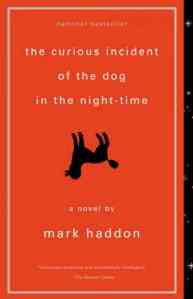
CIDNT coverWe have well over 100 copies of The Curious Incident of the Dog in the NightTime in our book room. They are a collection of books purchased at book sales ($1-$3 a copy) throughout the state of Connecticut for the past five years. These copies are most likely the discards from book club members who, 10 years after its original publication date (2003), donated their used copies. The only problem in locating  copies of the text at a book sale is determining on which genre table the copies will be shelved. The novel is classified as a mystery, but it is also considered a young adult novel or trade fiction, and was published in England simultaneously in separate editions for adults and children.

Fortunately, I can see that iconic bright red cover from a distance, the same one with the dog cut-out onto the shiny black cover underneath. When I distribute the texts, no matter how I threaten to make sure the book comes back in pristine condition, there are students who will trace and retrace that cutout until the die-cut shape of the dog becomes the shape of a blob.

The students read the novel independently first, usually during a unit on Shakespeare’s Macbeth, before coming together in literature circles. I would like to think that the character of Christopher would enjoy being paired with Shakespeare’s murder and intrigue since he is uncovering a sinister killing of a neighborhood dog. Students are given time in class to read the novel as SSR, and the literature circles begin once the play is concluded. The students are organized into smaller groups, where they work together to choose a “big idea” that can be found in the novel. The “big idea” can center on large concept words such as bravery, fear, change, determination, trust, or belief. Once a big idea is selected for the day, each group has several tasks to complete, with each member of the group completing one task. The students receive one grade for the completion of these assignments, and disputes are resolved through peer review feedback sheets. The roles for the literature circles are fairly traditional:

  • Group leader/discussion director/writer: leads the discussion and writes the response that answers the question with contributions from the other members.
  • Notes taker/quote maker: keeps notes during the discussion, finds, and writes the passages that support the group’s conclusions about the big idea.
  • Artist: draws a series of cartoons or a particularly important scene that represents the big idea.
  • Poet: creates a found poem of at least 20 lines that supports the group’s conclusions.
  • OrganizerGets the paper, plans the poster, keeping everyone on task and contributing to the overall success of the assignment!

Because we are a BYOD school, we have on occasion also included some “digital” tasks where group members can use a software platform to create an Animoto or a Voice Thread as a way to illustrate the big idea.

The literature circles usually meet four or five times covering different sections of the book depending on the big idea selected. At the end of each meeting, students their findings to the class with each member explaining the contributions from his or her role.  The rubric is centered on Common Core State Standards that require the inclusion of evidence to support a position. For an exemplary rating, a group will produce the following:

POSITION: clearly addressed task, purpose, and audience

  • One page that answers question about the big idea
  • Found quotes in novel to support a group’s position; wrote them on the chart paper
  •  a cartoon or illustrated scene that supports big idea
  • Creation of a “found” poem of at least 20 lines, using words from the novel.

COMPOSITION:

  • Response answers the question; it has a thesis, and at least two quotations for support.
  • Poster displays the quotations you have found; they are written carefully & cited.
  • Art work is neat and colorful and expresses the big idea
  • The poem is of required length and is expressive and creative.

STANDARDS of the DISCIPLINE

  • Response has no more than two errors in mechanics, spelling, capitalization.
  • Quotations are blended.
  • Quotes have no misspellings, etc.

As they read, many students become curious about Aspergers and autism, so we have incorporated video supplemental materials including a speech on the inspiration for the novel by Mark Haddon; a film on autism activist Temple Gradin; and a quick 6 minute video on another savant Stephen Wiltshire: The Human Camera.

Sometimes, if time allows, we have included mysteries from Christopher’s idol, Sir Arthur Conan Doyle. For the honors students, we have added the text of the Sherlock Holmes mystery “The Hound of the Baskervilles” for independent reading (audio text) . On other occasions we have used adaptations of Sherlock Holmes mysteries in short audio texts (Story Nory site).

While the addition of The Curious Incident of the Dog in the Night-Time has richly enhanced our curriculum of World Literature, the price was not expensive, roughly $250 for the entire set of books. This contemporary novel by a British writer allows us to connect the reading to other fiction (mysteries) and informational texts including speeches and documentaries. In the beginning of the novel, Christopher explains,

“In a murder mystery novel someone has to work out who the murderer is and then catch them. It is a puzzle. If it is a good puzzle you can sometimes work out the answer before the end of the book.”

By the end of the novel Christopher comments on the mystery as a “good puzzle” saying, “I solved the mystery…and I was brave and I wrote a book and that means I can do anything.” That assessment is a powerful reason to share Haddon’s novel with students…if they can draw from a character like Christopher the inspiration that they too can do anything.

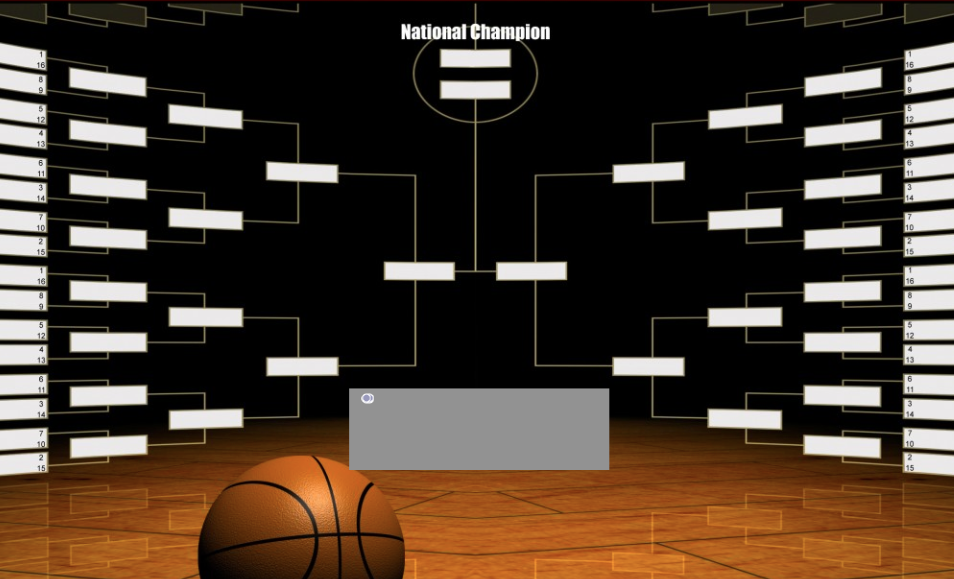
March Madness is not exclusive to basketball.Screen Shot 2014-03-15 at 1.38.50 PM

March Madness signals the season for standardized testing season here in Connecticut.
March Madness signals the tip-off for testing in 23 other states as well.

All CT school districts were offered the opportunity to choose the soon-to-be-phased-out pen and paper grades 3-8 Connecticut Mastery Tests (CMT)/ grade 10 Connecticut Academic Performance Test (CAPT) OR to choose the new set of computer adaptive Smarter Balanced Tests developed by the federally funded Smarter Balanced Assessment Consortium (SBAC). Regardless of choice, testing would begin in March 2014,

As an incentive, the SBAC offered the 2014 field test as a “practice only”, a means to develop/calibrate future tests to be given in 2015, when the results will be recorded and shared with students and educators. Districts weighed their choices based on technology requirements, and many chose the SBAC field test. But for high school juniors who had completed the pen and paper CAPT in 2013, this is practice; they will receive no feedback. This 2014 SBAC field test will not count.

Unfortunately, the same can not be said for counting the 8.5 hours of testing in English/language arts and mathematics that had to be taken from 2014 academic classes. The elimination of 510 minutes of instructional time is complicated by scheduling students into computer labs with hardware that meets testing  specifications. For example, rotating students alphabetically through these labs means that academic classes scheduled during the testing windows may see students A-L one day, students M-Z on another. Additional complications arise for mixed grade classrooms or schools with block schedules. Teachers must be prepared with partial lessons or repeating lessons during the two week testing period; some teachers may miss seeing students for extended periods of time. Scheduling madness.

For years, the state standardized test was given to grade 10, sophomore students. In Connecticut, the results were never timely enough to deliver instruction to address areas of weakness during 10th grade, but they did help inform general areas of weakness in curriculum in mathematics, English/language arts, and science. Students who had not passed the CAPT had two more years to pass this graduation requirement; two more years of education were available to address specific student weaknesses.

In contrast, the SBAC is designed to given to 11th graders, the junior class. Never mind that these junior year students are preparing to sit for the SAT or ACT, national standardized tests. Never mind that many of these same juniors have opted to take Advanced Placement courses with testing dates scheduled for the first two full weeks of May. On Twitter feeds, AP teachers from New England to the mid-Atlantic are already complaining about the number of delays and school days already lost to winter weather (for us 5) and the scheduled week of spring break (for us, the third week of April) that comes right before testing for these AP college credit exams. There is content to be covered, and teachers are voicing concerns about losing classroom seat time. Madness.

Preparing students to be college and career ready through the elimination of instructional time teachers use to prepare students for college required standardized testing (SAT, ACT) is puzzling, but the taking of instructional time so students can take state mandated standardized tests that claim to measure preparedness for college and career is an exercise in circular logic. Junior students are experiencing an educational Catch 22, they are practicing for a test they will never take, a field test that does not count. More madness.

In addition, juniors who failed the CT CAPT in grade 10 will still practice with the field test in 2014. Their CAPT graduation requirement, however, cannot be met with this test, and they must still take an alternative assessment to meet district standards. Furthermore, from 2015 on, students who do not pass SBAC will not have two years to meet a state graduation requirement; their window to meet the graduation standard is limited to their senior year. Even more madness.

Now, on the eve of the inaugural testing season, a tweet from SBAC itself (3/14):

Screen Shot 2014-03-15 at 1.28.22 PM

This tweet was followed by word from CT Department of Education Commissioner Stefan Pryor’s office sent out on to superintendents from Dianna Roberge-Wentzell, DRW, that the state test will be delayed a week:

Schools that anticipated administering the Field Test during the first week of testing window 1 (March 18 – March 24) will need to adjust their schedule. It is possible that these schools might be able to reschedule the testing days to fall within the remainder of the first testing window or extend testing into the first week of window 2 (April 7 – April 11).

Education Week blogger Stephen Sawchuk provides more details in his post  Smarter Balanced Group Delays in the explanation for the delay:

The delay isn’t about the test’s content, officials said: It’s about ensuring that all the important elements, including the software and accessibility features (such as read-aloud assistance for certain students with disabilities) are working together seamlessly.

“There’s a huge amount of quality checking you want to do to make sure that things go well, and that when students sit down, the test is ready for them, and if they have any special supports, that they’re loaded in and ready to go,” Jacqueline King, a spokeswoman for Smarter Balanced, said in a March 14 interview. “We’re well on our way through that, but we decided yesterday that we needed a few more days to make sure we had absolutely done all that we could before students start to take the field tests.”

A few more days is what teachers who carefully planned alternative lesson plans during the first week of the field test probably want in order to revise their lessons. The notice that districts “might be able to reschedule” in the CT memo is not helpful for a smooth delivery of curriculum, especially since school schedules are not developed empty time slots available to accommodate “willy-nilly testing” windows. There are field trips, author visits, assemblies that are scattered throughout the year, sometimes organized years in advance. Cancellation of activities can be at best disappointing, at worst costly. Increasing madness.

Added to all this madness, is a growing “opt-out” movement for the field test. District administrators are trying to address this concern from the parents on one front and the growing concerns of educators who are wrestling with an increasingly fluid schedule. According to Sarah Darer Littman on her blog Connecticut News Junkie, the Bethel school district offered the following in a letter parents of Bethel High School students received in February:

“Unless we are able to field test students, we will not know what assessment items and performance tasks work well and what must be changed in the future development of the test . . . Therefore, every child’s participation is critical.

For actively participating in both portions of the field test (mathematics/English language arts), students will receive 10 hours of community service and they will be eligible for exemption from their final exam in English and/or Math if they receive a B average (83) or higher in that class during Semester Two.”

Field testing as community service? Madness. Littman goes on to point out that research shows that a student’s GPA is a better indicator of college success than an SAT score and suggests an exemption raises questions about a district’s value on standardized testing over student GPA, their own internal measurement. That statement may cause even more madness, of an entirely different sort.

Connecticut is not the only state to be impacted by the delay. SBAC states include: California, Delaware,  Hawaii, Idaho, Iowa, Maine, Michigan, Missouri, Montana, Nevada, New Hampshire, North Carolina, North Dakota, Oregon, Pennsylvania, South Carolina, South Dakota, U.S. Virgin Islands, Vermont, Washington, West Virginia, Wisconsin, Wyoming.

In the past, Connecticut has been called “The Land of Steady Habits,” “The Constitution State,” “The Nutmeg State.” With SBAC, we could claim that we are now a “A State of Madness,” except for the 23 other states that might want the same moniker. Maybe we should compete for the title? A kind of Education Bracketology just in time for March Madness.

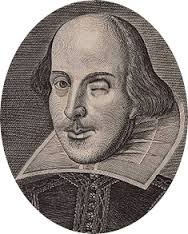
Shakepeare winkingPlanning on teaching literature in high school? I suggest a brush up on literary pitfalls….and work on developing a sense of humor because sooner or later, a student, (usually a boy) will come upon one of the following words in some great work of literature:

Screw.
Bang
Bosom.
Laid.
Nuts.

In context, these words have been carefully chosen by an author to express some lofty ideal.  Yet, to that student who is looking for any way to make the class more entertaining, these words can mean something else entirely.

No author has been more successful in creating linguistic traps than Shakespeare. There are the overt references, such as Lady Macbeth’s startling announcement to “Unsex me here..!” (I.5) in preparation to assassinate the visiting King Duncan.  There are the more subtle problems with the “hoary-headed frosts” in Midsummer Night’s Dream, but Romeo and Juliet offers the most opportunity for student sniggering.

From the opening scuffle where, “My naked weapon is out”, a teacher must negotiate students through Lord Capulet’s Give me my long sword, ho“,  Mercutio’s  teasing  “Prick love for pricking,” or the Nurse’s explanation that Juliet “shall bear the burden soon at night.

“Is Shakespeare always this dirty?” I see the quizzical looks on their faces.
“Your parents are okay with this,” I reassure them, “Besides, this is required reading.”

The Bard does not have a monopoly on creating awkward moments with language in class. Students are capable of creating discomfort, intentionally or not.

Years ago, I taught an Animal Farm unit and delivered a lesson on George Orwell’s characters and their historical counterparts. I explained that Napoleon was Stalin, the dogs were his secret police, and Snowball was Trotsky. I mentioned in passing that Trotsky was considered an insurrectionist, and I paused to let the information sink in. Instead I heard the distinct sound of giggling from several of the boys in the back of the room.

“What is so funny?”I demanded.
“Nothing,” they stammered.
I should have stopped there, but I moved in to clarify.
“What do you think I said? Do you know what an insurrectionist is?”

There was a pause…
“When… it… goes down?” blurted out one of the offenders.

“No,” I was indignant…not to be stopped. “No, I said’ insurrection’…what did you think I …..”
Then it hit me.
Erection.
I doubled back.
“It’s someone who is trying to start an uprising…..”
That explanation was drowned out with guffaws.
Did I mention that a very good sense of humor is needed in with sophomores?

This past fall, I had posted charts around the rooms with questions associated with Oliver Twist.
As the students moved around the room I noticed students giggling when they got to one of the charts.
“Why would someone lie?” was the heading on the chart.
“To get laid,” was scribbled in small print.
I recognized that print.
That print belonged to Mitch. Mitch who stood all of 4’2″ and was 90 lbs, soaking wet.

Everyone had seen it, so I needed to address the problem quickly.
“Mitch,” I demanded, “is that an appropriate thing to write?”

“Sure, Ms. B,” he replied casually,”I could lie and say I’m dying…Like in the movie 50/50.
I had to admit he was using logic…to say nothing of his confidence.
He still erased the comment.

Next week, I plan to use an Advanced Placement Literature multiple choice prompt from Jane Austen’s Northanger Abbey as practice for the upcoming AP exam.  I was rereading the passage to check its length and the matching questions when I came upon the line, “She began to curl her hair and long for balls.”

Oh, Jane. That’s going to definitely cause a stir!

Book Choice Questions

March 1, 2014 — 1 Comment

book loveIndependent reading in our school grades 7-12 means students read books of their own choosing, make recommendations, and keep records of what they read. Recently, however, one of the English teachers in my department suffered a concussion and while the substitutes delivered the curriculum (John Steinbeck’s Of Mice and Men and Laurie Halse Anderson’s Speak), student independent reading had fallen out of regular practice.

Our latest substitute (Natalie) is an enthusiastic graduate of our high school school who has a BS degree in Creative Writing. She has been serious in tackling her lack of experience in the classroom through her best characteristic…she asks questions. She asks a lot of questions.

One of the latest questions she asked was about independent reading. When I expressed my concerns about having the practice reestablished, she seemed doubtful. I suggested that she have students use books they read independently to make connections with the most recent whole class novels.

“You can ask them if they can make a generic ‘coming of age’ connection between Speak and a book of their choosing,” I suggested.

“But what if they choose a book that doesn’t have that connection? What if they choose a book that is too young for them?” she continued, “or a book that they already read? How do I know what they should be reading?”

I recognized her questions; I had those same questions myself several years ago.

So, I sat her down and showed her the following Penny Kittle video that is available through Heinemann Publishers on YouTube under the title “Why Students Don’t Read What is Assigned in Class”:

She had the same reaction I did when I first saw that video.

“Wow,” she said, “I get it. They should read what they want.”

Question answered.

My department is just noticing the benefits after a few years of implementing book choice. We are lucky to have an 80 minute block schedule with the luxury of offering 15-30 minutes a class for Silent Sustained Reading (SSR) independent choice books. We have large classroom libraries with high interest titles and a wonderful school library (with Overdrive e-books available)  to offer students choice in what they read. When we tell students to pull out their SSR book, they are prepared and settle in to read.

Some classes suggest that a book be in a particular genre. Our English IV-Memoir class reads memoirs or biographies. The English II class is based on World Literature, and students read at least one book during the year by an author who is not American. The critical requirement is that each student chooses a book. There is no leveled reading; students can choose a book below their reading ability or they can attempt a book above their lexile level. They learn what to choose to read because they have control of what they want to read.

Penny Kittle, an English teacher and literacy coach at Kennett High School in North Conway, New Hampshire, wrote a guide to helping students read independently titled Book Love. In this text, Kittle offers strategies to help teachers increase the volume of what students read and to deepen student thinking about what they read.

One of the strategies several of our teachers use is to have students respond to reading through the software Shelfairi (Amazon) where they record what they are reading and make connections to other books. I can organize each class in virtual groups and pose general questions for responses. These short responses prepare me for conferences or allow me to respond directly on the software with links or information or suggestions. For example, the English IV Mythology/Fantasy class reads mythologies or fantasies, and I posed a simple question last week and left quick responses for a conference:

How are you doing with your book? What are the connections to myth/fantasy that can you make?

STUDENT: Eragon: So far I am doing well with this book. My book connects with mythology because it is about Eragon who finds a stone which ends up being a dragon egg, and he bonds with the dragon over time. He and Saphira (the dragon) learn to communicate with one another and have a good connection. Saphira and Eragon create a good relationship with one another.

My response: This is a great fantasy…and a series. This novel has elements of the hero’s journey: http://www.thewritersjourney.com/hero’s_journey.htm

STUDENT: Ranger’s Apprentice-The Royal Ranger: Good. I have 10 pages left until its over. Its the final book in the series. There is a giant myth that rangers have special and mystical powers. But that is just false. They are just super stealthy which gives them the appearance of just appearing out of no where.

My response: Now what will you read? Another series?

STUDENT: The Alchemist: The Alchemist is a good book. It has to do more with fantasy than mythology, but there is a myth about a treasure in the pyramids.

My response: And the “stones” have a story behind them as well. Did you know this book is on the NY Times Bestseller list for 291 weeks?

While there are multiple software platforms for sharing book choices, I also find that the features on Shelfari are helpful in having students “shop” for books (without purchasing) and/or write responses using evidence. There are tabs for a book’s Description, a Ridiculously Simplified Synopsis, Characters/People, Quotes, and First sentence. There are recommendations and reviews by other readers for each title as well. The student responses can agree or refute other reviews; they can add information to a book’s page as well.

Regardless of platform, sharing what students choose to read is critical to helping them develop a love of reading. The advertisement for Kittle’s Book Love states,

“Books matter.  Stories heal.  The right book in the hands of a kid can change a life forever.  We can’t wait for anyone else to teach our students a love of books—it’s up to us and the time is now.  If not you, who?”

And that is a very good question.

There are waves from England that reach America’s shores.

There are literary waves.
George Orwell’s Animal Farm was published in America in 1946.

There are musical waves.
The Beatles came to America in 1964.

George Orwell used satire as a commentary on Communism in the USSR and the rise of Stalin in his allegory Animal Farm.

John Lennon used the lyrics in the song Revolution as a response to the increase of protests against the Vietnam War, specifically student riots in Paris in May of 1968.

Satire, politics, protests….so many connections. Why not share them in class?
Why not share the Beatles’ song Revolution while students read Orwell’s Animal Farm?

“Revolution”

You say you want a revolution
Well you know
We all want to change the world
You tell me that it’s evolution
Well you know
We all want to change the world
But when you talk about destruction
Don’t you know you can count me out

Don’t you know it’s gonna be alright
Alright, alright

You say you got a real solution
Well you know
We don’t love to see the plan
You ask me for a contribution
Well you know
We’re doing what we can
But if you want money for people with minds that hate
All I can tell you is brother you have to wait (Revolution lyrics continued…)

After we read first chapter of Animal Farm aloud in class, I played the video of the Beatles performing the song Revolution. For some, this was the first time they had ever heard the song; for some, this was the first time they had seen the Beatles perform.

After watching the video, I posted an assignment to use the power of music – “to write a song for your cause.” The directions given to the students were:

You say you want a Revolution….?
Well, you have to write your song!! (for extra credit)

Step 1: Identify your cause. What makes you angry? What do you see as a problem in society? What is your Pet Peeve? What would you like to change about your world? This can be something big or little.

Step 2: The power of music! To persuade people to join your revolution, (like Major’s Beasts of England) you have to write a song.

Step 3: Share your lyrics, and we will join you in song (karaoke tunes preferred)

Their protest songs came in. In their songs the students protested: homework, English class (*sigh*), the school parking lot ban on underclassmen, bad weather, cafeteria food, Twilight movies, dirt clods in the hallways from steel-toed boots, the ban on cupcakes in class, and (and there were several of these), Justin Bieber.

While their songs were unlikely to inspire a revolution, they did appreciate the power of music in communicating a message. Their reactions to their own songs of protest were positive, but they admitted that their songs did not have the same power as the Beatle’s Revolution. They recognized Orwell’s statement on the power of song in Animal Farm “The Beasts of England” sung at the end of Chapter One. That song (sung to the tune of My Darling Clementine) was a take-off on the famous socialist anthem, The Internationale:

Beasts of England, Beasts of Ireland,
Beasts of every land and clime,
Hearken to my joyful tidings
Of the Golden future time.

Soon or late the day is coming,
Tyrant Man shall be o’erthrown,
And the fruitful fields of England
Shall be trod by beasts alone…….(continued )

 “…The singing of this song threw the animals into the wildest excitement…. And then, after a few preliminary tries, the whole farm burst out into Beasts of England in tremendous unison….” (Ch1:Orwell)

Orwell was demonstrating how the lyrics in a song could motivate. The student protest songs, however, were more entertaining than motivating. The Beatle’s song Revolution is both entertaining and motivating, a song written four years after their momentous arrival in America.

From the moment the Beatles disembarked from Pan-Am flight 101 on February 7, 1964, they were a force in American music. Yet, according to TIME magazine’s story, Beatlemania Begins: The Beatles First U.S. Visit to Play Ed Sullivan, the Beatles were surprised by how their music had made thousands of frenetic fans:

Just before 1:30 p.m., Flight 101 taxied to a stop outside the terminal and the aircraft door popped open. An explosion of cheers and screams rang out as the crowd stormed forward….

“We heard that our records were selling well in America,” George [Harrison] noted, “but it wasn’t until we stepped off the plane … that we understood what was going on. Seeing thousands of kids there to meet us made us realize just how popular we were there.”

Their first appearance on The Ed Sullivan Show (February 9) featured a set list that set fans shrieking:

  • All My Loving 
  • Till There Was You (Sue Raney cover)
  • She Loves You 
  • I Saw Her Standing There 
  • I Want to Hold Your Hand

Those five songs began the domination of pop music charts, coined the term “Beatlemania”, and changed the culture of a generation. The Beatles proved the power of music, so our protest song assignment capitalized on student awareness of this power. The students shared what they would protest if given the opportunity. They had a chance to make connections between two genres, between a set of music lyrics and a set of lyrics from a novel-both of which were penned by Englishmen.

This was also an opportunity for me to highlight the Beatles. Students watched and listened to a recording of the “Fab Four” who created a revolution in music here in America; they saw those “lads from Liverpool” who invaded America from England many Yesterday’s ago.

While there are whirlwind changes in education such as new evaluation programs, digital devices in school, or flipped classrooms, one element remains constant: vocabulary. In order for students to succeed, they must understand the content area vocabulary in each subject area.

“Vocabulary knowledge is fundamental to reading comprehension;
one cannot understand text without knowing what most of the words mean.”
(Nagy, 1988)

The Common Core Literacy Standards have dedicated an anchor standard to the acquisition to vocabulary: 

CCSS.ELA-Literacy.CCRA.L.6 Acquire and use accurately a range of general academic and domain-specific words and phrases sufficient for reading, writing, speaking, and listening at the college and career readiness level; demonstrate independence in gathering vocabulary knowledge when encountering an unknown term important to comprehension or expression.

So what strategies work best? While there are familiar ways to teach vocabulary such as flashcards and word lists, every now and then there are the vocabulary lessons that are so effective, that they must be shared…like this political campaign using biology terms.

All month the 10th grade biology teacher centered a political campaign on vocabulary. The campaign immersed the entire school in domain specific words on the parts of a cell.  Teams of students were assigned to promote each part of the cell (EX: nucleus, endomembrane  system, chloroplasts, mitochondria)  for a political election designed to let students determine the most important member of the cell. Students made posters that hung in the hallways, and each poster featured characteristics and functions of the cell’s “candidate.” The posters were filled with content area vocabulary; there were explanations with diagrams or pictures.

For the first week, the campaign posters for different parts of the cell were explanatory in nature:

  • Do you enjoy moving, growing, breathing? Vote for the Mitochondria!
  • Chloroplast: Makes your green last! Carry out Photosynthesis!
  • Let’s assemble or die! Vote for Ribosomes or go home!

This slideshow requires JavaScript.

The final week was dedicated to a “smear” campaign. Additional information was added to posters; opposing candidates countered the claims on posters with even more content area vocabulary:

  • Algae blooms? They are caused by pollution! Look in the mirror! It’s not the chloroplast’s fault
  • Don’t vote for the mitochondria: They cause heart disease, diabetes, and cancer? Why vote for something that is bad?
  • Ribosome: Subject to mutation and damage that can cause illness
  • The Nucleus: if coded improperly can cause all sorts of defects
  • The mitochondria causes stupidity and mental disorders. The nucleus knows you’re smart and will support you through everything.

This slideshow requires JavaScript.

Wall space became a premium.  Attack ads increased the amount of information and featured even more content-area vocabulary. The stairwell going down to the middle school wing was a cluttered word wall.

Finally, election day arrived. To ensure there would be no favoritism, the students in 7th grade were selected to vote on their choice of the most important part of the cell. They had read the posters and become familiar with each of the candidates. They knew the strengths of each part of the cell. They knew the weaknesses of each part of the cell. They knew how each candidate functioned in the cell. They could separate the facts and the hype. The 10th grade waited to hear the results of their campaign.

Who did they vote for?
The Chloroplast.
Why?
Because of its contributions to plant life?
Because of photosynthesis?
Because it synthesizes fatty acids?


Buggin-out-green-sparkle

No….Because, “The poster had green glitter that was pretty.”
Apparently, campaigns for the most important member of the cell do not differ that much from real political campaigns.

Even with all that domain specific language…bling wins.

In the spirit of all end of the year reviews, I have condensed the year 2013 by offering month by month posts from this blog that illustrated the best student (and subsequently, teacher) learning:

January 2013: A Freshman’s Modern Odyssey in the Style of Homer

"Dawn spread her rosy fingers..."

“Dawn spread her rosy fingers…”

The Freshmen final project after reading The Odyssey is a narrative that students complete called “The Wamogossey: A Day in the Life of a Freshman at Wamogo High School.” Writing narratives are once again favored in  Common Core State Standards, and this post explained how students made their own attempt at an epic adventure.

February 2013:  Spilling Over the Corners of a Six Word Text

Short Story in 6 words

Short Story in 6 words

This exercise proves that keeping students “within the four corners of the text” is impossible, even when the text, attributed to Ernest Hemingway, is only six words long. This post also serves as evidence that that admonitions on best practices should be limited to those with actual classroom experience, not to the “architects of the Common Core.”

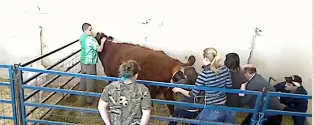
March 2013 If You Want to Watch the Cow Give Birth

Watching the arrival of our latest calf

Watching the arrival of our latest calf

Yes, “If you want to watch the cow give birth, turn on U-stream now!” was an announcement over the PA system. Normally, I am irritated by interruptions to class time, but this announcement cued students about opportunity watch the birth of a calf in the Agricultural Science wing of our high school. The combination of technology in broadcasting and recording the birth of the newest member of the agricultural program with old-fashioned “hands on” physical labor illustrates 21st Century authentic learning.

April 2013 You Never Forget Your First Hamlet

Members of the senior class were fortunate enough to see Paul Giamatti’s “Hamlet” at Yale Repertory Theatre. I’ll let their words speak for the experience:

The performance was a wonderful experience, especially since it was my first time to see Shakespeare.

I wouldn’t mind going to another because it was so enjoyable that I didn’t even realize the 4 hours passing by.

I like the way that a play has a certain kind of vibe. It’s like a live concert, where there’s a certain kind of energy.

It was like seeing a live performance of a film. I would especially like to see another Shakespeare because it is the way that he intended his works to be portrayed.

After seeing Hamlet so well done, it would definitely be worth going to see another one whether it be Shakespeare or a different kind of performance.

May 2013 Kinesthetic Greek and Latin Roots

Spelling "exo"=outside

Spelling “exo”=outside

Understanding Greek and Latin roots is critical to decoding vocabulary, so when the freshman had a long list of roots to memorize, we tried a kinesthetic approach. The students used their fingers to spell out Greek roots: ant (against), tech (skill), exo (outside).  They twisted their bodies into letters and spread out against the wall spelling out xen (foreign), phob (fear). They also scored very well on the quizzes as a result!

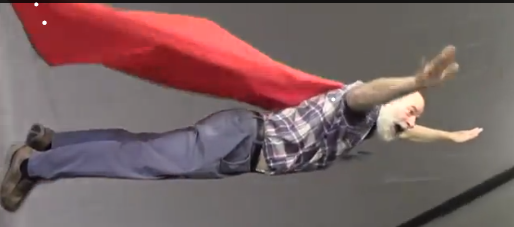
June 2013 Superteachers!

Superteacher!

Superteacher!

At the end of the 2012-2013 school year, teachers rose to a “friendship and respect” challenge to make a video. With a little help from a green screen, 27 members of the faculty representing a wide variety of disciplines jumped into the nearby closet wearing the big “W” (for Wamogo). Students in the video production class watched and filmed in amazement as, bearing some artifact from a particular subject area, each teacher donned a flowing red cape.

July 2013 Library Book Sales: Three Bags Full!

The original purpose of this blog was to show how I filled classroom libraries with gently used books. The Friends of the C.H. Booth Library Book Sale in Newtown, Connecticut, is one of the premier books sales in the state: well-organized tables filled with excellent quality used books, lots of attentive check-out staff, and great prices. This year, I added three large bags of books to our classroom libraries for $152.00, a discount of 90% off retail!

August 2013 Picture Books Are not for Kindergarten Any More!Cat in Hat book cover

At used book sales, I am always looking for picture books I can use in high school classrooms. For example, I use The Cat in the Hat to explain Freud’s theory of the Id, Ego and Superego . Thing #1 and Thing #2 represent Id, and that righteous fish? The Superego. Yes, Dr. Seuss is great for psychological literary criticism, but he is not the only picture book in my repertoire of children’s literature used in high school. This post features a few of my favorite picture books to use and why.

September 2013 Close Reading with Saki and the Sophomores

Saki’s short stories open our World Literature course in which our students will be reading complex texts required by the English Language Arts Common Core State Standards (CCSS). After a “close reading” the conversations in the room showed the text’s complexity. Saki’s The Interlopers has all the elements suggested by the CCSS:  figurative language, the ironic wish, and multiple meaning in the revenge sought by man versus the revenge exacted by Nature. Our close reading should have been “textbook”. The evidence proved the characters’ demise…or did it? The ensuing discussion forced the class to consider other positions.

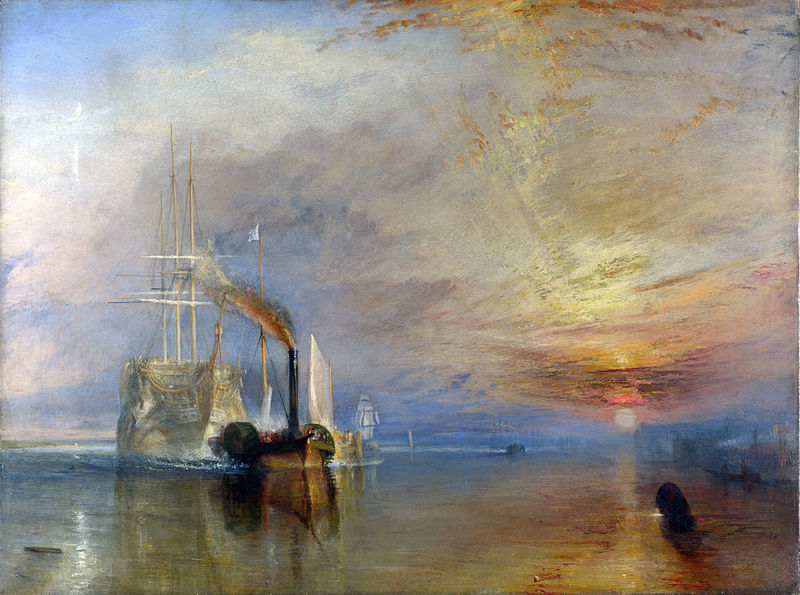
October 2013 Close Reading Art

The Fighting Temeraire

The Fighting Temeraire

After “close reading” short stories, the sophomores were asked to use the same skills to “close read” several paintings that thematically connected to the Industrial Revolution. They studied a Constable pastoral painting, before J.M.W. Turner’s famous painting, The Fighting Temeraire. While some called attention to the the dirty smoke stack, others saw the energetic paddling as a sign of progress. They noticed the ghost-like ship hovering in the background, the light created by the sunset which gave the painting “warmth”or “light extinguishing”. When they were asked to use these elements as evidence to determine the artist’s message, there were some succinct responses to the painting’s “text.”

November 2013 Thanks for the NCTE Conference

Five members of the English Department attended the conference and selected from over 700 sessions at the National Council of Teachers of English and the Conference on English Leadership.  District support for such great professional development is truly appreciated. We are also grateful that four of our proposals were chosen to share as presentations for other educators. The explanations of our presentations with links to these presentations are included in this post.

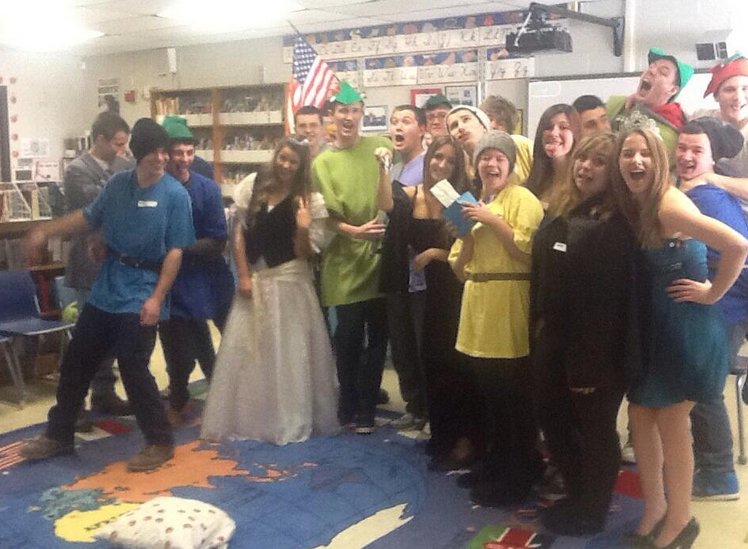
December 2013 Drama Class Holiday Miracle

Cast photo!

Cast photo!

An ice storm two weeks before performance caused a car pile-up, and the drama club teacher was left with a concussion. She could not be in school; the students were on their own, and I was left to supervise their performances of Snow White and the Seven Dwarves at three local elementary schools.

Their “dress rehearsal” was a disaster, but, as the adage says, “The show must go on!” and once they arrived at the elementary schools, the students were anxious to do well. They naturally changed their staging moving from gym floor to library floor, the Evil Queen tossed her hair with anger, and the Prince strode onto the stage with more confidence. The dwarves were a source of comic relief, intentionally or not. I watched the holiday miracle of 2013 repeated three times that day. The students in drama class at each school were applauded, with congratulatory e-mails from the principals that offered praise.

End of the year note:

I am grateful to be an educator and to have the privilege to work with students that I learn from everyday. In this retrospective, I can state unequivocally that 2013 was a memorable year… as you can see from many of the reasons listed above.

Welcome to 2014! May this coming year be even more productive!

The rain set early in to-night,
The sullen wind was soon awake,
It tore the elm-tops down for spite,
And did its worst to vex the lake:

In other words, “It was a dark and stormy night.” Thus begins the poet’s Robert Browning’s dark and disturbing dramatic monologue, Porphyria’s Lover, a portrait of a madman that is wonderful to read with students around Halloween. I usually use an audio recording that I can play, and I pause the recording twice as we listen.

The unnamed narrator of the poem sits in a cold cabin, a rendezvous with his lover, Porphyria, who “glides in” as she

…shut the cold out and the storm,
And kneeled and made the cheerless grate
Blaze up, and all the cottage warm;

The narrator’s isolation in the gloomy setting takes on the tone of an illicit romance as Porphyria removes her wet clothing in order to

… let the damp hair fall,
And, last, she sat down by my side
And called me.

But when the recalcitrant narrator does not respond, Porphyria increases her ardent attentions

She put my arm about her waist,
And made her smooth white shoulder bare
And all her yellow hair displaced,
And, stooping, made my cheek lie there,
And spread, o’er all, her yellow hair,
Murmuring how she loved me-

Porphyria’s devotion to the narrator is extreme, expressed in his words “passion”  and “worshipped.” He acknowledges that she could “give herself to me forever” even as she had “come through wind and rain” for this meeting.  This “surprise”

Made my heart swell, and still it grew
While I debated what to do.
That moment she was mine, mine, fair,
Perfectly pure and good:

The narrator revels in this epiphany; Porphyria’s devotion is at its zenith. His reaction seems predictable to my students, and they eagerly anticipate  the romantic tumble they have expected since Porphyria entered the cabin. After all, the word “lover” is in the title.

Yet, the next five lines take a decidedly different turn. The narrator dispassionately admits,

…I found
A thing to do, and all her hair
In one long yellow string I wound
Three times her little throat around,
And strangled her.

Here is where I pause the recording as my students take a moment to comprehend what they have read. Their reactions generally follow this script:

“Wait a minute!”
“What did he do?”
“He ...killed her?”
What is going on here?”

I direct them back to the poem so they can hear the voice of the narrator explain his actions, and his explanation is chilling. “No pain felt she;” the narrator continues, as if to assure my students, “I am quite sure she felt no pain.” As if to prove his judgment, he opens her closed eyes, loosens the hair from her throat, and places a “burning kiss” upon her cheek. Again, the students react in shock:

“This guy is sick!”
“He KISSED her??”
“Ewwww…”
“Why did he do it?”

Why did he do it indeed? The narrator calmly continues to explain his reasons as Porphyria’s head, limp and lifeless, leans upon his shoulder,

The smiling rosy little head,
So glad it has its utmost will,
That all it scorned at once is fled,
And I, its love, am gained instead!

The narrator’s twisted logic in claiming Porphyria’s life in a moment of pure love is so perverse that students are horrified. The final shocker comes as the narrator confidently claims that the murder of Porphyria was something desirable,

Her darling one wish would be heard.
And thus we sit together now,
And all night long we have not stirred,
And yet God has not said a word! –

“He’s a monster.”
“He’s crazy.”
“He is insane.”

Browning’s poem that chronicles a deadly obsession is an excellent addition to the Halloween literary repertoire. The high interest monologue engages students in the “close reading” required by the Common Core.

A close reading can be accomplished by dividing the poem into sections and asking students to identify if the line can be placed into categories:

  • establishing setting
  • poetic technique (metaphor, personification)
  • character development
hair-piece-ponytail-with-draw-string-613-bleach-blonde-longer-length-ponytail-20-inches--401-p

Blonde hair!

Students are encouraged to make adjustments based on their group discussions or to create their own categories.  Once they have categorized the lines, they create large posters that “illustrate” the lines literally or symbolically. They draw or use images that they find online or use photos; then they share the posters which are hung around the room and explain how these details serve the author’s purpose in creating an unforgettable character who is a madman.

Come this Halloween, if you are looking for a poem to send shivers down the spines of your students, try Robert Browning’s “Porphyria’s Lover”.

Try not to think that this frightening portrayal of insanity was created by the husband of Elizabeth Barrett Browning, famous for the poem “How Do I Love Thee? Let Me Count the Ways.”

You can save that sonnet for Valentine’s Day!

Our English II World Literature course complements the World History course, so when the students are learning about the Industrial Revolution, our English course has students read the opening chapters to Charles Dickens’s Oliver Twist.

Reading Dickens, however, is a challenge for many students, particularly if they lack background knowledge on the story’s setting. In order to help them better understand the context of England during the Industrial Revolution, we incorporated several famous paintings to illustrate the shift from the pastoral setting to the urban setting.

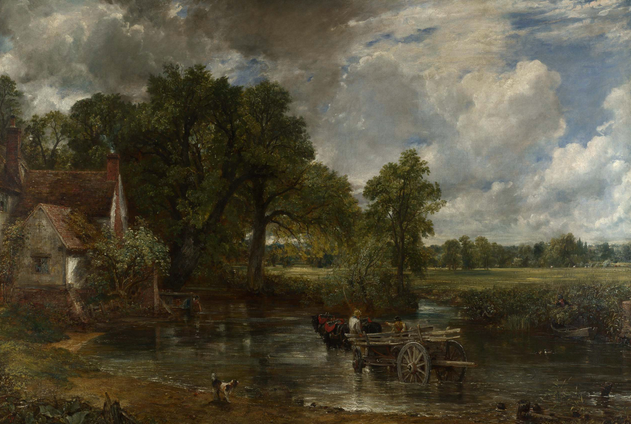
Rather than show a painting in its entirety at first, we made screenshots of different sections of each painting and had the students “read” what they saw. For example, we began with John Constable’s painting The Hay Wain (1821) which hangs in the National Gallery in London, England.

Screen Shot 2013-10-02 at 9.23.04 PM

upper left corner of Constable’s “The Hay Wain”

Students looked at the information communicated in the upper left quadrant  of the painting and discussed the architecture of the roof and the large empty tree branches. They noted the gathering storm clouds in the background; “a tone of danger” noted one student. 

We then had students look at the lower right quadrant of the painting where a farmer’s cart was being driven along a stream bed. They noted the details of the team of horses and speculated as to why the men would be walking upstream. 

Screen Shot 2013-10-02 at 9.23.46 PM

lower right corner of Constables “The Hay Wain”

They speculated that there might be no road because a road might not have been necessary if transportation was easier by water, and one student called attention to a small canoe on the stream’s bank. They called attention to the earth tone colors that contrasted with the red harnesses of the horses.

Then we showed the students the full painting.

Screen Shot 2013-10-02 at 9.49.07 PM

Constable’s painting is based on a site in Suffolk. The hay wain, a type of horse-drawn cart, stands in the water in the foreground. (National Gallery Picture Library
St Vincent House, 30 Orange Street, London)

When the students saw the entire painting, they were already familiar with some of the smaller details. They were able to locate these smaller details and suggest how they contributed to the larger “story” of the painting. They determined Constable’s painting celebrated the pastoral life outside London, a striking contrast from the setting of Oliver Twist where impoverished street children were placed in workhouses or recruited by criminals.

The painting that best illustrates the cultural shift caused by the Industrial Revolution, however,  is J. M. W. Turner’s The Fighting Temeraire. The oil painting depicts the gunship with her sails tightly wrapped to the rigging being tugged  by a steam powered paddle-wheel to the shipyard before being broken up for scrap. Turner painted the tribute to the end of sailing ships in 1838, the same year that Dickens published Oliver Twist. Both works brought attention to the drastic change in the way of life as a result of the Industrial Revolution.

“The Fighting Temeraire”, an oil painting by the English artist J. M. W. Turner (1938) National Gallery, London

Since the students had practiced close reading the Constable pastoral painting, they were ready to close read Turner’s painting. While some called attention to the the dirty smoke stack, others saw the energetic paddling as a sign of progress. One noticed the ghost-like ship hovering in the background; another noted a potential danger of a submerged obstacle in the foreground floating in the right corner of the painting. Most commented on the light created by the sunset which gave the painting “warmth”or “a glow” for some or a “light extinguishing” for others. When they were asked to use these elements as evidence to determine the artist’s message, there were some succinct responses:

  • “It’s out with the old!”
  • “The coal fire is the new light; the sun is the old light”
  • “Coal power, not wind power”
  • “Beauty fades”

Turner’s The Fighting Temeraire was voted England’s favorite painting in a 2005 poll organized by BBC Radio 4’s Today.  The painting was also highlighted in the recent James Bond film Skyfall. In the scene in the National Gallery, Bond meets his new handler, Q, while both sit on a bench opposite the painting:

Q: It always makes me feel a bit melancholy. Grand old war ship. being ignominiously haunted away to scrap… The inevitability of time, don’t you think? What do you see?
Bond:  A bloody big ship. Excuse me.
Q: 007. I’m your new Quartermaster.
Bond: You must be joking.
Q:  Why, because I’m not wearing a lab coat?
Bond: Because you still have spots.
Q: My complexion is hardly relevant.
Bond: Your competence is.
Q: Age is no guarantee of efficiency.
Bond:  And youth is no guarantee of innovation.

Skyfall (http://www.imdb.com/title/tt1074638/quotes)

After watching the film clip, the students were in agreement that they are living in a new digital revolution, and that technology has changed their culture from that of their parents. If they want a sunset, they don’t need a painting by Turner….they have Instagram.