Archives For November 30, 1999

Books read in Grade 10- World Literature

Saki

Author H.H. Munro also known as Saki

H.H. Munro was the NYTimes crossword across clue last week, and as it so often happens, I just happened to be talking about H.H. Munro to the sophomore English class these first days of school. Just name dropping Saki, his pseudonym, caught their attention.
“What kind of a name is that?” they asked.
When I told them he might have been referring to the Saki monkey, a small South American primate, they concurred that he had chosen a cool pen name. 

Saki’s short stories open our World Literature course which complements the Modern World History course offered the same year. Our students will be reading complex texts required by the English Language Arts Common Core State Standards (CCSS), and  complex texts are those that meet four criteria:

1) Meaning: Multiple levels of meaning (such as satires, in which the author’s literal message is intentionally at odds with his or her underlying message).
(2)  Structure: Complex, implicit, and (particularly in literary texts) unconventional structures.
(3) Language: Figurative, ironic, ambiguous, purposefully misleading, archaic or otherwise unfamiliar language
(4) Knowledge Demands: Everyday knowledge and familiarity with genre conventions required; cultural and literary knowledge useful.

Saki’s work meets the CCSS criteria above, but I have learned that the practice of close reading never follows the lengthy tortuous path suggested by Common Core developers who have no classroom experience. My students stray.

The text selected was “The Interlopers”. (SPOILER ALERT For those of you who are unfamiliar with the story and want to read it before I reveal the plot twist, link to the text. There is also an audio-text.)

To prepare students, but careful not to “overteach” before reading, I gave students slips of paper with 25 words from the story. The slips including some of the more difficult vocabulary (languor, succor, marauder) and some plot details (woodland, feud, detest). Some of the students sorted the words alphabetically, but others grouped words that shared some commonality. After a few minutes of discussion, we joined together to predict what the story would be about using the grouped words; there would be a dispute in the forest that was linked to some feud, just like the feud in Romeo and Juliet.
Then we read the story.

Thirteen minutes later, some heads shot up. They had reached Saki’s iconic last word…”wolves!”

“Wolves!” one student questioned, “does that mean they die?”
There was much stirring. Some seemed surprised; others seemed confused.
In contrast, I thought the ending was obvious. Two men, trapped under a tree, end a bitter feud over forest land only to eaten by wolves.

Several, but not all, of my students thought differently.

“They weren’t rescued?” asked Kailey, “but one of them said he had men that would be there to rescue them in the forest.”
“He was bluffing,” responded Logan. “He was trying to scare the other guy when they first met.”
“But there was a gun,” pointed out Stephan, “one could have used the gun.”
“They had their arms ‘pinioned’,” I responded, trying to slip in another vocabulary word, “pinioned means to tie up the arms of…”
“They could have wriggled out when they saw the wolves,” insisted Stephan, “the rush of adrenaline would make them so strong, they could un-pinion their arms.”
“But there is no evidence to show that,” I responded. “The last word is their last word because the wolves come upon them.”

I had thought the story was straightforward. There were no flashbacks, and no change in setting. This was, according to Aristotle, a story that demonstrated unity of time, unity of place, and unity of action.

Yet the conversations in the room showed the text’s complexity. Saki’s The Interlopers has all the elements suggested by the CCSS. There is the figurative language in the character Ulrich’s statement, “We have quarrelled like devils all our lives over this stupid strip of forest, where the trees can’t even stand upright in a breath of wind.” There is the ironic wish, “If only on this wild night, in this dark, lone spot, he might come across Georg Znaeym, man to man, with none to witness – that was the wish that was uppermost in his thoughts.” There is also the multiple meaning in the revenge sought by man and the revenge exacted by Nature. Our close reading should have been “textbook”. The evidence proved the characters’ demise…or did it? I began to consider the renegade students’ position.

“See,” insisted Kailey, “look at the text, Georg says he has seven men out with him before the tree fell. These seven men would hear their screaming.”
“Yes, there would be screaming. Their last words were, ‘AHHH!!! OUCH!!! THAT HURTS!!'”Jay yelled.
“But that does not mean they were definitely eaten,” corrected Kai, “this guy Saki wants you to make up your mind.”

Which is true. Saki does not end the story with screams of pain or with tales of rescue. He trusts the reader to use evidence to make up his or her own mind. Several of my students did not want to see Ulrich and Georg meet their demise, especially when they had settled their long standing feud.

The class discussion continued with each piece of evidence for the “eaten by wolves” side being countered by evidence from the “escaped with their lives” side. The students were definitely close reading, but they were exploiting Saki’s ambiguity to defend their differing positions. A case could be made for both.

Yes, they understood the importance of irony in the story, and yes, they were familiar with plot twists, but they still held out hope. Saki had made them care for these characters in the 2100 words of this short story. He had given just the right amount of contradictory information to leave room for just a sliver of hope. A 99 and 44/100’s sort of hope.

Did they hold out hope because of their youth? Aristotle suggests that, “Youth is easily deceived because it is quick to hope.” Yet, Aristotle is also credited with saying, “Hope is the dream of a waking man.” 

In retrospect, Saki himself would probably have enjoyed their commentary. I discovered too late for the discussion that Saki has been quoted as saying, “A little inaccuracy sometimes saves a ton of explanation.”

Continue Reading…

Here is an educational policy riddle: How much background knowledge does a student need to read a historical text?

According to New York Engage website: None.

The Common Core State Standards (CCSS) are being implemented state by state, and there is an emphasis from teaching students background knowledge to teaching students skills, specifically the skill of close reading.

The pedegogy is explained by The Partnership for Assessment of Readiness for College and Careers (PARCC):

Close, analytic reading stresses engaging with a text of sufficient complexity directly and examining meaning thoroughly and methodically, encouraging students to read and reread deliberately. Directing student attention on the text itself empowers students to understand the central ideas and key supporting details. It also enables students to reflect on the meanings of individual words and sentences; the order in which sentences unfold; and the development of ideas over the course of the text, which ultimately leads students to arrive at an understanding of the text as a whole. (PARCC, 2011)

There are many lessons that strongly advocate the use of close reading in teaching historical texts on the EngageNY.com website, including a set of exemplar lessons for Lincoln’s Gettysburg Address promoted by CCSS contributor and now College Board President, David Coleman. The lesson’s introduction states:

The idea here is to plunge students into an independent encounter with this short text. Refrain from giving background context or substantial instructional guidance at the outset. It may make sense to notify students that the short text is thought to be difficult and they are not expected to understand it fully on a first reading–that they can expect to struggle. Some students may be frustrated, but all students need practice in doing their best to stay with something they do not initially understand. This close reading approach forces students to rely exclusively on the text instead of privileging background knowledge, and levels the playing field for all students as they seek to comprehend Lincoln’s address.

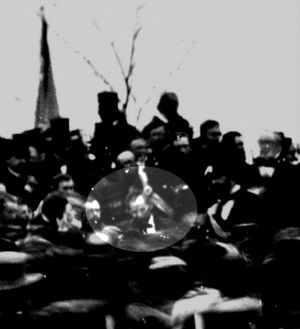
Photo of Lincoln delivering Gettysburg Address- (www.wikipedia.org)

Photo of Lincoln delivering
Gettysburg Address- (www.wikipedia.org)

The lesson plan is organized in three sections. In the first, students are handed a copy of Lincoln’s Gettysburg Address and perform several “cold” readings, to themselves and then with the class.

Lesson Plan SECTION 1 What’s at stake: a nation as a place and as an idea

Students silently read, then the teacher reads aloud the text of the Gettysburg Address while students follow along.

  • Students translate into their own words the first and second paragraph. 
  • Students answer guiding questions regarding the first two paragraphs

Please note, there is no mention of any historical context for the speech. Students will come to this 273-word speech without the background knowledge that the Battle of Gettysburg was fought from July 1 to July 3, 1863, and this battle is considered the most important engagement of the American Civil War. They will not know that the battle resulted in “Union casualties of 23,000, while the Confederates had lost some 28,000 men–more than a third of Lee’s army” (History.com). They will not know how the Army of Northern Virginia achieved an apex into Union territory with “Pickett’s Charge,” a failed attempt by General George Pickett  to break through the Union line in South Central Pennsylvania, and that the charge resulted in the death of thousands of rebel soldiers. They will not know how the newly appointed Major General George Gordon Meade of the Army of the Potomac met the challenges of General Robert E. Lee by ordering responses to skirmishes on Little Round Top, Culp’s Hill, and in the Devil’s Den. They will not know that Meade would then be replaced by General Ulysses S. Grant in part because Meade did not pursue Lee’s troops in their retreat to Virginia.

Instead of referencing any of this historical background, the guding questions in the lesson’s outline imagine the students as blank slates and mention another historical event:

A. When was “four score and seven years ago”? B. What important thing happened in 1776?

The guiding responses for teachers seem to begrudge an acknowledgement that keeping students bound to the four corners of a text is impossible, and that, yes, a little prior knowledge of history is helpful when reading a historical text:

This question, of course, goes beyond the text to explore students’ prior knowledge and associations. Students may or may not know that the Declaration of Independence was issued in 1776, but they will likely know it is a very important date – one that they themselves have heard before. Something very important happened on that date.  It’s OK to mention the Declaration, but the next step is to discover what students can infer about 1776 from Lincoln’s own words now in front of them.

In addition, there are admonishments in Appendix A of the lesson not to ask questions such as, “Why did the North fight the civil war?”

Answering these sorts of questions require students to go outside the text, and indeed in this particular instance asking them these questions actually undermine what Lincoln is trying to say. Lincoln nowhere in the Gettysburg Address distinguishes between the North and South (or northern versus southern soldiers for that matter). Answering such questions take the student away from the actual point Lincoln is making in the text of the speech regarding equality and self-government.

The lesson plan continues:

Lesson Plan SECTION 2  From funeral to new birth

  • Students are re-acquainted with the first two paragraphs of the speech.
  • Students translate the third and final paragraph into their own words.
  • Students answer guiding questions regarding the third paragraph of the Gettysburg Address.

Please note this does not provide the context of the speech that was given that crisp morning of November 19, 1863, at the dedication of the National Cemetery on a damp battlefield that only months before had been dampened red with the blood of tens of thousands of soldiers from either side. The students would be unaware that Lincoln had taken the train from Washington the day before and was feeling slightly feverish on the day of the speech. There is some speculation that he may have been suffering from the early stages of smallpox when he delivered the speech reading from a single piece of paper in a high clear voice. The students would not know that Lincoln’s scheduled time at the podium followed a two hour (memorized) speech by Edward Everett, who later wrote to Lincoln stating, “I should be glad if I could flatter myself that I came as near the central idea of the occasion in two hours as you did in two minutes.” The students would not know that many of the 15,000 crowd members did not hear Lincoln’s two minute speech; the 10 sentences were over before many audience members realized Lincoln had been speaking. The students would not know that this speech marked Lincoln’s first public statement about principles of equality, and they would not know that he considered the speech to be a failure.

Lesson Plan SECTION 3  Dedication as national identity and personal devotion

  • Students trace the accumulated meaning of the word “dedicate” through the text
  • Students write a brief essay on the structure of Lincoln’s argument

The lesson provides links to the five handwritten copies of the text, in the “Additional ELA Task #1: Comparison of the drafts of the speech” so that students can see drafts of the speech and the inclusion of “under God” in the latter three versions. There is also an additional Social Studies task that incorporates the position of respected historian Gary Wills from his book Lincoln at Gettysburg: The Worlds that Remade America. This activity suggests students use excerpts from Wills’s book and an editorial from the Chicago Times (November 23, 1863) to debate “Lincoln’s reading of the Declaration of Independence into the Constitution”. One excerpt from Wills’s book includes the statement,”The stakes of the three days’ butchery are made intellectual, with abstract truths being vindicated.” Finally, here is information about the battle itself; the battle lasted three days and soldiers died.

The enterprise of reading the Gettysburg Address without context defeats PARRC’s stated objective of having the students “arrive at an understanding of the text as a whole”. The irony is that in forwarding their own interpretation of the speech, David Coleman and the lesson plan developers have missed Lincoln’s purpose entirely; Lincoln directs the audience to forget the words of the speech, but never to forget the sacrifices made by the soldiers during that brutal conflict:

The world will little note, nor long remember what we say here, but it can never forget what they did here.

Lincoln wrote and delivered the Gettysburg Address to remind his audience “that these dead shall not have died in vain”. Analyzing the language of the address isolated from the Civil War context that created the tone and message is a hollow academic exercise. Instead, students must be taught the historical context so that they fully understand Lincoln’s purpose in praising those who, “gave the last full measure of devotion.”

“It is altogether fitting and proper that we should do this.”

Continue Reading…

This post completes a trilogy of reflections on the Connecticut Academic Performance Test (CAPT) which will be terminated once the new Smarter Balance Assessments tied to the Common Core State Standards (CCSS) are implemented. There will be at least one more year of the same CAPT assessments, specifically the Interdisciplinary Writing Prompt (IW) where 10th grade students write a persusive essay in response to news articles. While the horribly misnamed Response to Literature (RTL) prompt confuses students as to how to truthfully evaluate an story and drives students into “making stories up” in order to respond to a question, the IW shallowly addresses persuasive writing with prompts that have little academic value.

According to the CAPT Handbook (3rd Generation) on the CT State Department of Eduction’s website, the IW uses authentic nonfiction texts that have been:

“… published and are informational and persuasive, 700-1,000 words each in length, and at a 10th-grade reading level.  The texts represent varied content areas (e.g., newspaper, magazine, and online articles, journals, speeches, reports, summaries, interviews, memos, letters, reviews, government documents, workplace and consumer materials, and editorials).  The texts support both the pro and con side of the introduced issue.  Every effort is made to ensure the nonfiction texts are contemporary, multicultural, engaging, appropriate for statewide implementation, and void of any stereotyping or bias.  Each text may include corresponding maps, charts, graphs, and tables.”

Rather than teach this assessment in English, interdisciplinary writing is taught in social studies because the subject of social studies is already interdisciplinary. The big tent of social studies includes elements of economics, biography, law, statistics, theology, philosophy, geography, sociology, psychology, anthropology, political science and, of course, history. Generally, 9th and 10 grade students study the Ancient World through Modern European World (through WWII) in social studies. Some schools may offer civics in grade 10.

Social studies teachers always struggle to capture the breadth of history, usually Western Civilization, in two years. However, for 15 months before the CAPT, social studies teachers must also prepare students to write for the IW test. But does the IW reflect any of the content rich material in social studies class? No, the IW does not. Instead the IW prompt is developed on some “student centered” contemporary issue. For example, past prompts have included:

  • Should students be able to purchase chocolate milk in school?
  • Should utility companies construct wind farms in locations where windmills may impact scenery or wildlife?
  • Should ATVs be allowed in Yellowstone Park?
  • Should the school day start later?
  • Should an athlete who commits a crime be allowed to participate on a sports team?
  • Should there be random drug testing of high school students?

On the English section of the test, there are responses dealing with theme, character and plot. On the science section, the life, physical and earth sciences are woven together in a scientific inquiry. On the math section, numeracy is tested in problem-solving. In contrast to these disciplines, the social studies section, the IW, has little or nothing to do with the subject content. Students only need to write persuasively on ANY topic:

For each test, a student must respond to one task, composed of a contemporary issue with two sources representing pro/con perspectives on the issue.  The task requires a student to take a position on the issue, either pro or con.  A student must support his or her position with information from both sources.  A student, for example, may be asked to draft a letter to his or her congressperson, prepare an editorial for a newspaper, or attempt to persuade a particular audience to adopt a particular position.  The task assesses a student’s ability to respond to five assessed dimensions in relationship to the nonfiction text: (1) take a clear position on the issue, (2) support the position with accurate and relevant information from the source materials, (3) use information from all of the source materials, (4) organize ideas logically and effectively, and (5) express ideas in one’s own words with clarity and fluency.

The “authentic” portions of this test are the news articles, but the released materials illustrate that these news articles are never completely one-sided; if they are written well, they already include a counter-position.  Therefore, students are regurgitating already highly filtered arguments. Secondly, the student responses never find their way into the hands of the legislators or newspaper editors, so the responses are not authentic in their delivery. Finally, because these prompts have little to do with social studies, valuable time that could be used to improve student content knowledge of history is being lost.  Some teachers use historical content to practice writing skills, but there is always instructional time used to practice with released exam materials.

Why are students asked to argue about the length of a school day when, if presented with enough information, they could argue a position that reflects what they are learning in social studies? If they are provided the same kinds of newspaper, magazine, and online articles, journals, speeches, reports, summaries, interviews, memos, letters, reviews, government documents, workplace and consumer materials, and editorials, could students write persuasive essays with social studies content that is measurable? Most certainly. Students could argue whether they would support a government like Athens or a government like Sparta. Students could be provided brief biographies and statements of belief for different philosophers to argue who they would prefer as a teacher, DesCartes or Hegel. Students could write persuasively about which amendment of the United States Constitution they believe needs to be revisited, Amendment 10 (State’s Rights) or Amendment 27 (Limiting Changes to Congressional Pay).

How unfortunate that such forgettable issues as chocolate milk or ATVs are considered worthy of determining a student’s ability to write persuasively. How inauthentic to encourage students to write to a legislator or editor and then do nothing with the students’ opinions. How depressing to know that the time and opportunity to teach and to measure a student’s understanding of the rich content of social studies is lost every year with IW test preparation.

coffeetalkMaybe the writers of the CAPT IW prompt should have taken a lesson from the writers of Saturday Night Live with the Coffee Talk with Michael Myers. In these sketches, Myers played Linda Richmond, host of the call-in talk show “Coffee Talk”. When s(he) would become too emotional (or feclempt or pheklempt ) to talk, s(he) would “give a topic” to talk “amoungst yourselves”.  Holding back tears, waving red nails in front of his face furiously, Myers would gasp out one of the following:

“The Holy Roman Empire was neither holy, Roman, nor an empire….Discuss…”

“Franklin Delano Roosevelt’s New Deal was neither new nor a deal…. Discuss…”

“The radical reconstruction of the South was neither radical nor a reconstruction…. Discuss…”

“The internal combustion engine was neither internal nor a combustion engine…. Discuss…”

If a comedy show can come up with these academic topics for laughs, why can’t students answer them for real? At least they would understand what made the sketches funny, and that understanding would be authentic.

Screen Shot 2013-03-10 at 11.08.07 AMMarch in Connecticut brings two unpleasant realities: high winds and the state standardized tests. Specifically, the Connecticut Academic Performance Tests (CAPT) given to Grade 10th are in the subjects of math, social studies, sciences and English.

There are two tests in the English section of the CAPT to demonstrate student proficiency in reading. In one, students are given a published story of 2,000-3,000 words in length at a 10th-grade reading level. They have 70 minutes to read the story and draft four essay responses.

What is being tested is the student’s ability to comprehend, analyze, synthesize, and evaluate. While these goals are properly aligned to Bloom’s taxonomy, the entire enterprise smacks of intellectual dishonesty when “Response to Literature” is the title of this section of the test.

Literature is defined online as:

“imaginative or creative writing, especially of recognized artistic value: or writings in prose or verse; especially writings having excellence of form or expression and expressing ideas of permanent or universal interest.”

What the students read on the test is not literature. What they read is a story.

A story is defined as:

“an account of imaginary or real people and events told for entertainment.”

While the distinction may seem small at first, the students have a very difficult time responding to the last of the four questions asked in the test:

How successful was the author in creating a good piece of literature? Use examples from the story to explain your thinking.

The problem is that the students want to be honest.

When we practice writing responses to this question, we use the released test materials from previous years: “Amanda and the Wounded Birds”, “A Hundred Bucks of Happy”, “Machine Runner” or “Playing for Berlinsky”.  When the students write their responses, they are able to write they understood the story and that they can make a connection. However, many students complain the story they just read is not “good” literature.

I should be proud that the students recognize the difference. In Grades 9 & 10, they are fed a steady diet of great literature: The Odyssey, Of Mice and Men, Romeo and Juliet, All Quiet on the Western Front, Animal Farm, Oliver Twist. The students develop an understanding of characterization. They are able to tease out complex themes and identify “author’s craft”. We read the short stories “The Interlopers” by Saki, “The Sniper” by Liam O´Flaherty, or “All of Summer in a Day” by Ray Bradbury. We practice the CAPT good literature question with these works of literature. The students generally score well.

But when the students are asked to do the same for a CAPT story like the 2011 story “The Dog Formerly Known as Victor Maximilian Bonaparte Lincoln Rothbaum”, they are uncomfortable trying to find the same rich elements that make literature good. A few students will be brave enough to take on the question with statements such as:

  • “Because these characters are nothing like Lenny and George in Of Mice and Men…”
  • “I am unable to find one iota of author’s craft, but I did find a metaphor.”
  • “I am intelligent enough to know that this is not ‘literature’…”

I generally caution my students not to write against the prompt. All the CAPT released exemplars are ripe with praise for each story offered year after year. But I also recognize that calling the stories offered on the CAPT “literature” promotes intellectual dishonesty.

Perhaps the distinction between literature and story is not the biggest problem that students encounter when they take a CAPT Response to Literature. For at least one more year students will handwrite all responses under timed conditions: read a short story (30 minutes) and answer four questions (40 minutes). Digital platforms will be introduced in 2014, and that may help students who are becoming more proficient with keyboards than pencils.
But even digital platforms will not halt the other significant issue with one other question, the “Connection question (#3)” on the CAPT Response to Literature:

 What does this story say about people in general? In what ways does it remind you of people you have known or experiences you have had?  You may also write about stories or books you have read or movies, works of art, or television programs you have seen.  Use examples from the story to explain your thinking.

Inevitably, a large percentage of students write about personal experiences when they make a connection to the text. They write about “friends who have had the same problem” or “a relative who is just like” or “neighbors who also had trouble”.  When I read these in practice session, I sometimes comment to the student, “I am sorry to hear about____”.

However, the most frequent reply I get is often startling.

“No, that’s okay. I just made that up for the test.”

At least they know that their story, “an account of imaginary or real people and events told for entertainment,” is not literature, either.

Today is Digital Learning Day! To mark the occasion, let me take you through a quick walkthrough of the halls of Wamogo Regional Middle/High School and give you a snapshot on how digital learning looks in the English classrooms grades 7-12. We have 1:1 computers in grades 7 & 8; in grades 9-12, we have a “bring your own digital device” policy. Here are the digital learning activities on Wednesday, February 6, 2013:

Grade 7: Students responded to a short story they read, “The Amigo Brothers”. They accessed the wiki (www.PBworks.com) in order to respond to “close reading” questions on the author’s use of figurative language. (Students are required to use evidence in their responses; digital copies of text helps student correctly add and cite evidence).

Grade 8: Students uploaded their reviews of the books (Mississippi Trial, 1955; Chains; The Greatest) they have been reading in literature circles to www.edmodo.com. These reviews are connected to the Common Core Writing Standard #6:

CCSS.ELA-Literacy.W.8.6 Use technology, including the Internet, to produce and publish writing and present the relationships between information and ideas efficiently as well as to interact and collaborate with others.

Grade 9: Students responded to a “writing on demand” journal prompt in preparation for the novel Of Mice and Men. This prompt is connected to the theme of hopes and dreams, and the students were asked:

What is your hope for life, your goal, or even your dream?  What do you think you want from the future? What would you live without, dream-wise?  What couldn’t you live without?

The students also posted their responses on a www.Edmodo.com discussion thread. Selections from responses included:

  • Something I couldn’t live with out would be my grandparents because they are like another set of parent to me, just better. They mean so much to me, that I really couldn’t see my life without them.
  • I hope to be a plant geneticist in the future, that is my hope but no matter what happens I would like to have a career involving plants and even if I can’t get a career in genetics I know it will always be a hobby of mine.
  • My house will be by the ocean, so close I can see it out of my kitchen window. I will grow old and drink coffee on my porch, while I read the paper and wave to my neighbors who walk by!
  • I could live without being famous around the world but I would like to be known town wise. I cannot live without family and their support in my decisions. They help me to stay confident and get through whatever I want to accomplish in life.
  • I think I could live without wanting a huge house or a huge boat “dream-wise”, but that still doesn’t mean I don’t want those things. I couldn’t live without music or my family.
  • My biggest hope and dream is to have a really big plot of land and have the world’s biggest tractor and a bunch of snowmobiles and ATV’s.
  • I want to be able to adopt kids from Uganda but also have my own, and I want to live in a nice house with a big yard. I want to work with little kids as a job.

10th grade Honors English students are reading Great Expectations. They took a quiz on www.quia.com, a software platform for timed quizzes. The College Prep English classes are reading Animal Farm. Today, they had to access “The International” MP3 and the www.youtube.video of the Beatle’s song “Revolution.

For homework tonight, students will write their own “protest” song.

Grade 11: Students can access the vocabulary list from the film The Great Debaters through the class wiki (www.pbworks.com) while the Advanced Placement English Language students watched a YouTube video of a Langston Hughes poem “I, Too, Sing America” read by Denzel Washington:

They prepared responses to the following questions which were posted on the class wiki:

  1.  To whom is the poet writing?  How do you know?
  2.  Choose one stanza and discuss what you feel is the key word in this stanza and explain why you chose this word?
  3.  What feelings does the poem create?  Which words create this feeling?

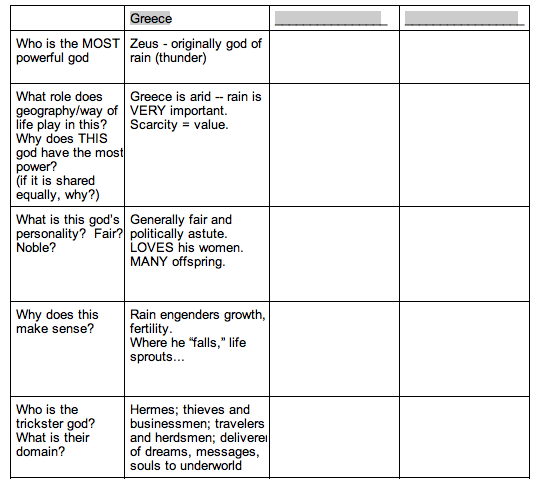
Grade 12: Students in the Grade 12 Mythology class accessed the following Google Doc Template and filled in the chart with their own research about the mythologies of different cultures. This activity meets the CCSS writing:

CCSS.ELA-Literacy.W.11-12.7 Conduct short research projects to answer a question; narrow or broaden the inquiry when appropriate; synthesize multiple sources on the subject

Screen Shot 2013-02-06 at 11.43.41 AM

The Film and Literature class “flips” the content by having students watch films for homework in order to discuss them during class. Tonight’s assignment? Watch the following YouTube clip and be ready for an open note quiz:

Students in the Advanced Placement English Literature class read the short story “Barn Burning” by William Faulkner that was embedded with a quiz on www.quia.com. They then created a list of four themes from the short story on a Google Doc. Each student selected a theme and placed his/her responses in the Google Drive folder to share with other members of the class. Examples included:

  • Actions we take with the grotesque: Shun? Avoid?

This story embodies an ultimate grotesque atmosphere. Even Colonel Satorius Snopes’ sisters are described as, “hulking sisters in their Sunday dresses” (2). These sisters are emulated throughout the story as disgusting, rotund, lethargic, and hog-like beings. This grotesque physical trait emulates the family’s condition in society. Satorius’ clothes are described as, “patched and faded jeans even too small for him.” (1).

  • Family over law or law over family

For the boy to go against his family in the end further proves his actions of courage and strength, and portrays the theme of law over family. “Then he began to struggle. His mother caught him in both arms, he jerking and wrenching at them. He would be stronger in the end, he knew that. But he had no time to wait for it” (10). His whole family is holding him back, but he chooses to go against all of them and do what is right.

This quick walkthrough demonstrating the use of technology in the English classrooms on one day demonstrates that for the teachers and students at Wamogo, everyday is a Digital Learning Day!

Screen Shot 2013-01-09 at 4.41.58 PM

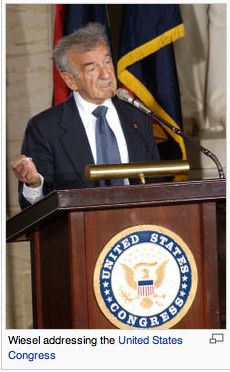
Wikipedia photo -Elie Wiesel

By my calculations, at the mid-point of the school year, many World History classes are studying World War II. Should these classes want to increase their use of an informational text in English or Social Studies curriculum, I suggest Elie Wiesel’s noteworthy speech The Perils of Indifference.

Wiesel delivered this speech to Congress on April 12, 1999. The speech is 1818 words long and connects Wiesel’s experience at the concentration camp at Aushwitcz with the genocides of the late 20th Century using a single powerful word: indifference.

In his speech, Weisel states clearly:

Indifference, then, is not only a sin, it is a punishment. And this is one of the most important lessons of this outgoing century’s wide-ranging experiments in good and evil.

Our English Department has used this speech in the past as a complement to Wiesel’s memoir Night which has been a used as a whole class read.  This year, we are giving Night to the Social Studies classes. They will adopt this memoir in order to increase the assigned informational text reading in their discipline mandated by the Literacy Common Core State Standards in History and Social Studies (CCSS). The English Department will still offer supplemental texts  that students can choose to read independently.

When he gave this speech, Wiesel had come before the US Congress to thank the American soldiers and the American people for liberating the camps at the end of World War II. Wiesel had spent nine months in the Buchewald/Aushwitcz complex. His mother and sisters had been separated from him when they first arrived: “Eight short, simple words… Men to the left, women to the right”; these family members were killed in the ovens. He and his father survived starvation, disease, and the deprivation of spirit. His father eventually succumbed, and Wiesel guiltily admits at the end of the memoir that at his father’s death he felt relieved.

Eventually, Wiesel felt compelled to testify against the Nazi regime, and he wrote the memoir Night to bear witness against the genocide which killed his family and six million Jews. His speech was delivered 54 years after he was liberated by American forces.

His gratitude to these American forces is what opens the speech, but after the opening paragraph, Wiesel seriously admonishes America to do more to halt genocides all over the world. By not intervening on behalf of those victims of genocide, he states clearly, we are indifferent to their suffering:

Indifference, after all, is more dangerous than anger and hatred. Anger can at times be creative. One writes a great poem, a great symphony, one does something special for the sake of humanity because one is angry at the injustice that one witnesses. But indifference is never creative.

My students have always been struck by Wiesel’s juxtaposition of anger and creativity. More than one has agreed pointing to making a “good” creation: an amazing song about an ex-boyfriend or a painting slapped together with passion. They also do not want to be treated indifferently. Yet, Wiesel makes them think beyond themselves:

Indifference is not a beginning, it is an end. And, therefore, indifference is always the friend of the enemy, for it benefits the aggressor — never his victim, whose pain is magnified when he or she feels forgotten. The political prisoner in his cell, the hungry children, the homeless refugees — not to respond to their plight, not to relieve their solitude by offering them a spark of hope is to exile them from human memory. And in denying their humanity we betray our own.

I remember several years ago, one student in my English 10 class, Rick, was particularly bright, fun, and full of daring. He also had an exceptional understanding of math and statistics. That January, I introduced the memoir Night as I had in previous years by providing a little background information.

“Six million Jews were killed during the Holocaust,” I recited off from my list of facts.

“What?” a startled Rick looked up. “Six million?” He was aghast. “That can’t be right.” He looked around at his classmates. “Six million?” They looked at him blankly. “Come on,” he was looking for some support, “That can’t be right.”

“Why?” I asked.

“Do you know how many six million things are?” He was indignant.

“Six million people,” I responded.

“People, yes. People, six million is a lot of people….” Rick was clearly operating with a different level of understanding from his more placid classmates. He understood six million as quantity; he did understand what six million things would look like if stacked up. Other students stirred in their seats.  “No way….six million,” he repeated growing more agitated. “How? How did anyone let this happen?” he asked; he was half-rising out of his seat. “Did we know?”

“Yes,” I remember saying. I do remember explaining that, yes, America did know that Hitler had concentration camps, and that more documentation collected after the war indicated that many of our military and political leaders knew about these camps. That is one of the points from Wiesel’s speech.

I pointed out to the class that the Holocaust was only one example of genocide; that there were others. In fact, that there was recently a genocide in Darfur. Rick sat down; he was overwhelmed. He was capable of understanding numerically the devastation of the Holocaust, and he was clearly upset. “Why do we let this happen?” he asked. I remember his voice was so sad, so full of disbelief.

In The Perils of Indifference, Wiesel asks

Does it mean that we have learned from the past? Does it mean that society has changed? Has the human being become less indifferent and more human? Have we really learned from our experiences? Are we less insensitive to the plight of victims of ethnic cleansing and other forms of injustices in places near and far?

Wiesel’s rhetorical questions echo Rick’s “Did we know?” In trying to respond, Wiesel makes the reader uncomfortable the way Rick was uncomfortable. Creating this kind of emotional impact on a reader is the reason Wiesel’s speech should be taught.

The Common Core State Standards (CCSS) demand that students read informational texts but does not require specific texts. Wiesel’s The Perils of Indifference contains the information and rhetorical devices that meet the text complexity criteria of the CCSS. More specifically, Wiesel’s message is necessary if we want our students to confront the conflicts in this new 21st Century. Our students must be prepared to question why “deportation, the terrorization of children and their parents be allowed anywhere in the world?“

Our humanity should demand nothing less.

brainwith contentThis winter, I am discontented. I see less of the “click” of recognition in a student’s eyes when he or she “knows something”. At the risk of sounding like a fuddy-duddy (“old-fashioned person,” 1871, American English, of uncertain origin), my students used to come to class pre-loaded with information; they had a predictable set of stories in their brains. These were often fairy tales such as Cinderella or Jack and the Beanstalk or folktales such as Rip Van Winkle or Johnny Appleseed. And speaking of apple seed, students used to know many of the Biblical stories as well. They may have been misinformed that the fruit of the Tree of Knowledge in the Garden of Eden was an apple and did not know that they could thank John Milton’s Paradise Lost for that substitution, but at the very least students used to be familiar with the Garden of Eden stories, the genesis of multiple allusions.

Today’s students’ lack of content, specifically story content, means that a good deal of class time is spent on a “back story” so they can better understand all the allusions or references in a particular text. Allusions are critical to understanding almost anything taught in English: Chaucer, Shakespeare, Bronte, Hawthorne, Faulkner, Steinbeck, etc. For example, our 10th grade is beginning Beowulf this week, and we read the Burton Raffel’s translation. He opens with the monster Grendel down in his cave howling at the sound of men singing the song of creation. Grendel swears vengeance against the “Almighty” for the exile of his ancestor Cain:

He was spawned in that slime,
Conceived by a pair of those monsters born
Of Cain, murderous creatures banished
By God, punished forever for the crime
Of Abel’s death.

“Can anyone tell me who Cain or Abel is?” we ask.
This year, only two out of 27 students had any idea about the story of Cain and Abel. Cain’s relationship to Grendel is part of the monster’s motivation, and so we were forced to do a little “Bible as literature” storytelling. Unfortunately, the number of students who have no information about the most basic Old Testament stories, which happen to be the same stories in Torah and the Koran, grows every year.

Fortunately, we are a 1:1 district and our students are equipped to quickly use their devices to learn who Cain and Abel are, so we can stop and have them quickly research any allusion, but this immediate research on a digital device disrupts the flow of the story of Beowulf. Moreover, the need to constantly look up information ultimately turns every text into a hyper-text.

This constant researching could be reflected in measuring the lack of information our students have when they approach a task. Last December (2012), the results of the Trends in International Mathematics and Science Study were released and, despite significant improvements,  students in the United States did not rank as high as did students from other countries. The results were discussed at a forum at the Washington Post where  David Conley, CEO of the Education Policy Improvement Center noted,

“One of the great ironies is that we are headed into an age where students can get almost any piece of information off their phones, yet, what we are doing is getting more and more information into their heads. The goal is to go beyond that and make them understand that they have to own their own learning.” (Conley, Ed Policy Improvement Center)

I agree; students need to own content for successful recall and application. I have no objection to students improving their research skills; even Wikipedia is acceptable for quick textual reference research, but students must understand the content in their brains in order to apply that information when they encounter a text. Employing content and applying information is different from employing the skill of accessing information. Owning content is critical to understanding an author’s use of allusions or references. Owning content contributes to fluid reading and better understanding. However, not all owned content is equal.

My admiration for the plethora of animated cartoon sources that do provide story content with a modernized twist is a bit mixed. For example, the popular Shrek series is riddled with storybook allusions. Unfortunately, students often do not understand allusions in these modern re-tellings as parodies. Students need to be disavowed from a belief that Puss ‘n Boots is fat and wears a pink bow or that Snow White is very proud and vain. One could argue the same modernized treatment was done for the original Grimm’s Fairy Tales which have been made more palatable and child-friendly. However, these gruesome original stories were the allusions for writers in earlier centuries. When the Common Core State Standards suggested reading list is filled with the literature and informational texts from centuries past, the recently released cartoon parodies of the originals may not be particularly helpful in understanding these allusions.

While the students today are exposed to information from a myriad of sources, they need to own information to be educated. Students need content, stories and information that they understand, to apply to a text or problem without relying on a digital device. So, this winter, the heightened level of my discontent is measured by the increase of fingering for information on devices. I miss the light that would go off in the students’ eyes when they “knew something,” particularly if that “something” was a story.

I miss content.

The fiction selected for standardized testing is notorious for its singular ability not to challenge; these stories do not challenge political or religious beliefs, and  I have long suspected they are selected because they do not challenge academically.
My state of Connecticut has had great success locating and incorporating some of the blandest stories ever written for teens to use in the “Response to Literature” section of the Connecticut Academic Performance Test (CAPT).
The CAPT was first administered to students in grade 10 in the spring of 1994, and the quality of the “literature” has less than challenging. For example:
  • Amanda and the Wounded Birds: A radio psychologist is too busy to notice the needs of her teen-age daughter;
  • A Hundred Bucks of Happy: An unclearly defined narrator finds a $100 bill and decides to share the money with his/her family (but not his/her dad);
  • Catch the Moon: A young man walks a fine line between delinquency and a beautiful young woman (to be fair, there was a metaphor in this story)
At least three of the stories have included dogs:
  • Liberty-a dog cannot immigrate to the USA with his family;
  • Viva New Jersey-a lost dog makes a young immigrant feel better;
  • The Dog formally known as Victor Maximilian Bonaparte Lincoln Rothbaum– not exactly an immigrant story, but a dog emigrates from family to family in custody battle.
We are always on the lookout for a CAPT-like story of the requisite forgettable quality for practice when we came upon the story, A View from a Bridge by Cherokee Paul McDonald. The story was short, with average vocabulary, average character development, and average plot complexity. I was reminded about this one particular story last week when Sean, a former student, stopped by the school for a visit during his winter break from college.

The short story "A View from the Bridge" was used as a practice CAPT test prompt

The short story “A View from the Bridge” was used as a practice CAPT test prompt

Sean was a bright student who through his own choice remained seriously under challenged in class. For each assignment. Sean met the minimum requirement: minimum words required, minimum reading level in independent book, minimum time spent on project. I knew that Sean was more capable, but he was not going to give me the satisfaction of finding out, that is until A View from the Bridge.
The story featured a runner out for his jog who stopped on a bridge to take a break near a young boy who was fishing, his tackle nearby. After a brief conversation, the jogger realizes that the young boy was blind. The story concludes with the jogger describing a fish the blind boy had caught but could not see. At the story’s conclusion, the boy is delighted, and the jogger reaffirmed that he should help his fellow man/boy.
“The story A View from the Bridge by McDonald is the most stupid story I have ever read,” wrote Sean in essay #1 in his Initial Response to Literature.
“I mean, who lets a blind boy fish by himself on a bridge? He could fall off into the water!”
I stopped reading. How had I not thought about this?
Sean continued, “Also, fishhooks are dangerous. A blind kid could put a fishhook right into a finger. How would he get that out? A trip to the emergency room, that’s how, and emergency rooms are expensive. I know, because I had to go for stitches and the bill was over $900.00.”
Wow! Sean was “Making a Connection”, and well over his minimum word count. I was very impressed, but I had a standardized rubric to follow. Sean was not addressing the details in the story. His conclusion was strong:
“I think that  kid’s mother should be locked up!”
I was in a quandary. How could I grade his response against the standardized rubric? Furthermore, he was right. The story was ridiculous, but how many other students had seen that? How many had addressed this critical flaw in the plot ? Only Sean was demonstrating critical thinking, the other students were all writing like the trained seals we had created .
One theory of grading suggests that teachers should reward students for what they do well, regardless of a rubric.So Sean received a passing grade on this essay assignment.  There were other students who scored higher because they met the criteria, but I remember thinking how Sean’s response communicated a powerful reaction to a story beyond the demands of the standardized test. In doing so, he reminded me of the adage, “There are none so blind as those who cannot see.”

tragedy“On Friday noon, July the twentieth, 1714, the finest bridge in all Peru broke and precipitated five travelers into the gulf below.”

That is the opening sentence from Thornton Wilder’s novel The Bridge of San Luis Rey. A monk who witnesses the fall of those travelers searches for answers as to whether the accident was simply chance or an act of the Divine. In writing The Bridge of San Luis Rey, Wilder was addressing the genre of tragedy which was defined by Aristotle in his Poetics as “an imitation of a serious act” in literature. The purpose of tragedy is to provide the reader, or viewer in the case of drama, an experience of loss without having to suffer what a fictional character suffers. Through his literature, Wilder, like the authors and playwrights before him, provided the experience and language to us to respond when there is a tragedy. Great literature does this well which may be why the literature taught in high school classrooms is, more often than not, tragedy.

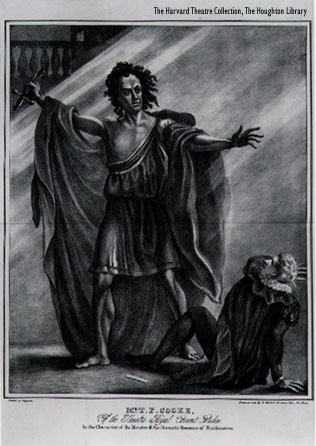
Of course, tragedy is not always a popular curriculum choice. I am always being confronted by students,  “Why do we have to read such depressing books?” or “Why does every book we read in English have to be so sad?” Predictably, when I hand out a book for a whole class read, student will examine the cover, the length of the text, and ask, “So, who dies?” Through literature, students learn a number of different approaches or definitions of  tragedy. In grades 9-12, students are taught about Greek tragedy (Oedipus, Antigone, Medea) where fate or Nemesis cannot be avoided. They learn about catharsis, the purging of pity and fear, and pathos, the empathy one has for the tragic hero. Students are taught about how the Shakespearean tragedy (King Lear, Macbeth, Richard III) centers on the willful downfall of a character who brings about the destruction of others. We have also included a modern interpretation of tragedy by Otto Reinherdt as students read contemporary works of literature (Death of a Salesman, The Road):

“Tragic Man demands that an imperfect world conform to his notions of right and good, and he is defeated because discord, injustice, pain, and moral evil are the world’s warp and woof. The final paradox is man in his tragic vision saying, ‘I do not believe in the invincibility of evil but in the inevitability of defeat’.. . . But in the absoluteness of his commitment, the tragic hero triumphs in the very inevitability of his defeat.”

The indoctrination to tragedy as a “serious action imitated” begins early in the student’s educational career. In grade 5, whole class reads can be The Giver, a dystopian novel that features the euthanasia of a small child. In grade 6, students may read The Devil’s Arithmetic, a book that brings students closer to an authentic understanding of the Holocaust and the deaths of six million Jews. In young adult (YA) literature, there are so many stories about the deaths of pet dogs  (Old Yeller, Where the Red Fern Grows, Love that Dog) that author Gordon Korman fought back against that literary trope with his  YA novel, No More Dead Dogs. Our 7th grade reads that book as an opening bonding experience in September, but they also read Pearl Buck’s short story “The Big Wave” about a tsunami that wipes out a small coastal village in Japan. The recent tsunami in Japan gave our young readers a new appreciation for the tragedy caused by nature.

In high school curriculums everywhere, students decry the death of a character, “Why does the author make us like him and then kill him?” They rail against the death of Johnny in The Outsiders (grade 8); the death of Lenny in Of Mice and Men (grade 9); the death of Kat in All Quiet on the Western Front (Grade 10); the death of John Proctor in The Crucible  (Grade 11); and the death of Hamlet (Grade 12). They claim to want a happy ending.

But do English teachers force an unwanted genre on students? Do students hate tragedy? Not really. Look at the two most popular series of books students chose to read independently. The Harry Potter series began with two deaths, the sacrifice of Lily and James Potter for their infant son, Harry. Seven books later,  JR Rowling had bumped off over 50 characters, and one beloved owl Hedwig (although, admittedly the death of Bellatrix Lestrange was satisfying). Student loved these novels. In Suzanne Collin’s The Hunger Games trilogy, killing and death is a form of entertainment, an entertainment made even more horrific when teenagers are the assassins. In the first book, eleven “tributes” are killed on the first day of the games. The protagonist Katniss kills four tributes herself before she “wins” this round of games with Peeta; the deaths pile up as the series continues with Collins disposing of major characters at a furious clip. I cannot keep these books on my classroom shelf.

Ultimately, tragedy in literature prepares a reader for the experience of tragedy in life. My own first experience with death was from Louisa May Alcott in Little Women when the sickly Beth March finally succumbed to illness:

“As Beth had hoped, the `tide went out easily’, and in the dark hour before dawn, on the bosom where she had drawn her first breath, she quietly drew her last, with no farewell but one loving look, one little sigh.”

I remember reading and re-reading that passage over and over and thinking: “Had I read correctly? Were there only three March sisters left? How could Alcott do this to me?” Well, she did this to me and millions of other readers because in real life people die. Nice people. Good people. Young people. Beth’s death was not a tragedy in the literary sense, but the hole left by her death for the fictional family was “a serious act imitated in literature” like the many real deaths that leave holes in the lives of real families.

Our society confronts news that is tragic everyday.  The recent death of 20 schoolchildren and six teachers in a school shooting not far from where I teach just before the Christmas holiday season is a tragedy so horrific that many have been left speechless; I hear, “There are no words.” But there are words, words in great literature written to prepare us, from a young age through high school and beyond, for exactly this experience. Thornton Wilder’s fictional story of The Bridge of San Luis Rey concludes with a paragraph that offers his response to a tragedy. Through literature, Wilder provides a language for readers to respond to a tragedy such as the one in Newtown, Connecticut, and other heartbreaking events:

“We ourselves shall be loved for awhile and forgotten. But the love will have been enough; all those impulses of love return to the love that made them. Even memory is not necessary for love. There is a land of the living and a land of the dead and the bridge is love, the only survival, the only meaning.”

It’s Halloween…what is the most frightening story you have ever read?

“I busied myself to think of a story, — a story to rival those which had excited us to this task. One which would speak to the mysterious fears of our nature, and awaken thrilling horror — one to make the reader dread to look round, to curdle the blood, and quicken the beatings of the heart. ……. I thought and pondered — vainly. I felt that blank incapability of invention which is the greatest misery of authorship, when dull Nothing replies to our anxious invocations. Have you thought of a story?” (Shelley, Preface)

Yes. Frankenstein. Mary Shelley’s masterpiece drafted when she was18 years old.  Teaching Mary Shelley’s “ghost story” always elicits the most interesting responses from my students. I have taught the novel every year for the past 12 years to students in grades 10-12, in AP or unleveled curriculums, and the results are always satisfying.

Note: I did not say easy.

Since I am now familiar enough with the text and the pitfalls that catch most students, I know that I will need to summon an enormous amount of energy to begin teaching Frankenstein. First, there is the baggage of the pop culture monster with its green skin, bolted neck and squared boots. That baggage must be “unpacked” first. Then, there is Robert Walton’s epistolary start of the novel, coupled with Victor Frankenstein’s lengthy autobiography.  References to Cornelius Agrippa, Lake Geneva, and Galvanism are more stumbling blocks.

  • “So, where is the Monster?”
  • “When does this book get good?”
  • “I’m sorry, but this is just boring!”

Okay, Chapter Five.  On a dark and stormy night,

“With an anxiety that almost amounted to agony, I collected the instruments of life around me, that I might infuse a spark of being into the lifeless thing that lay at my feet. It was already one in the morning; the rain pattered dismally against the panes, and my candle was nearly burnt out, when, by the glimmer of the half-extinguished light, I saw the dull yellow eye of the creature open; it breathed hard, and a convulsive motion agitated its limbs”(Shelley, 5).

The Monster lives! Like the Creator in Genesis who “formed the man of dust from the ground and breathed into his nostrils the breath of life, and the man became a living creature” (Genesis 2:8), Shelley breathes life into her creation without regard to hard science.  In both stories, the empirical data or formulas, which led to these creations, express leaps of faith understood by the reader. The spark of life is imbued; the creation lives and breathes. The Creator of Genesis differs immediately from Victor when he, “planted a garden in Eden, in the east, and there he put the man whom he had formed”(Genesis 2:8), In contrast, the reader can hear Victor’s sudden gasp, “Beautiful!–Great God!” so repulsed is he once the creature comes to life. Victor weakly admits that all this work has been a failure, and comments almost apologetically, “The different accidents of life are not so changeable as the feelings of human nature” (Shelley, 5). Unfortunately, the creation has been loosed upon the earth; he will not easily be unmade simply because his creator has changed his mind.

Exhausted, Victor sleeps only to be wakened by

“when, by the dim and yellow light of the moon, as it forced its way through the window shutters, I beheld the wretch — the miserable monster whom I had created… His jaws opened, and he muttered some inarticulate sounds, while a grin wrinkled his cheeks. He might have spoken, but I did not hear; one hand was stretched out, seemingly to detain me, but I escaped, and rushed down stairs” (Shelley, 5).

Rejection! Abandonment! Isolation.

The Creator in Genesis does not abandon his creations, despite their disastrous decision to disobey. Rather, the reader finds this Creator “made for Adam and for his wife garments of skins and clothed them (Genesis 3:21) before banishing them from the Garden.Victor, in contrast, flees from the sound and the touch of the Monster who was trying to say….what? Creator?….Father?

  • Daddy.”
  • “Victor is a jerk.”
  • “He ran away because he didn’t want the responsibility.”

Exactly. And that is why Frankenstein gets to the heart of so many of the issues that our students, our culture, our world must deal with today. There are questions of responsibility. The responsibilities of a creator for the created can be extended to include the responsibilities of parents to children, of scientists to inventions, of writers to literature, of politicians to policies, and of pundits to sound bytes. What happens when the “creation” goes bad?

  • “If Victor kills the Monster, is it murder?”
  • “It’s Victor’s fault that the Monster is a murderer.”

Is the Monster a human? Shelley allows that the Monster eats, reads, and pines for a companion; he is alone, and miserable. A critical scene has the Monster pleading with Victor for a friend, a companion, a mate. Shelley has her Monster claim to have a soul; is the Monster a human? What makes a human a human?

  • Having a mate will mean monster babies!”
  • “Why didn’t Victor think about what the Monster would do?”
  • “This is just like Jurassic Park !”

Shelley’s novel also considers related ethical questions. These include what is the result of unleashing a new technology on earth? Because the technology exists to create, should the technology be used? How far should technology go in helping humanity?

In our brave new world, the “lyger” has been created because geographically separated tigers and lions can be crossbred in labs. Genetically altered crops are in the mainstream food source. These technological advancements have moved into our world with a ripple. But what of the advancements that will follow? Will human cloning become a reality, and will society deal ethically with clones? How far are we from artificial intelligence and should-or can- this intelligence be controlled? What does Frankenstein teach the reader about making ethical decisions today or in the near future? Why is literature such a great predictor for what will happen in the future?

We feel pathos. The Monster’s story is one of tragedy.

  • “Victor is the real monster.”
  • “I feel bad for the Monster…he didn’t want to be a Monster.”

By the end of the novel, my students have dealt with some very profound ideas. They have asked some very important questions about responsibility, humanity, and ethical behavior. They feel a sense of accomplishment in reading a difficult 19th Century text. They have confronted contemporary issues through literature, and isn’t that what is supposed to happen in the classroom?

Mary Shelley was only 18 years old when she attempted to answer some of the questions about the limits of man.  She was young and ambitious, like many of our students. Her “hideous progeny” is extraordinarily prescient; then novel is in every way a Modern Prometheus-a modern myth. Mary Shelley’s Frankenstein is a must read, and a cautiously frightening tale, for Halloween or for any other day.