Archives For November 30, 1999

Screenshot 2014-05-31 14.25.03As the school year comes to a close, the buzzphrase is “student growth.” All stakeholders in education want to be able to demonstrate student growth, especially if student growth could be on an upwards trajectory like the graph at left.

Last week I had an opportunity to consider student growth with a different lens, and that lens was provided by a graduating senior who was preparing a presentation to a group of 7th & 8th graders.
I had assigned Steven and his classmates the task of developing  TED-like-Talks that they would give to the middle schoolers. The theme of these talks was “The Most Important Lesson I Learned in 13 Years of Education.” The talk was required  to be short (3-5 minutes), to incorporate graphics, and to make a connection between what was learned and the outside world. I asked students to come up some “profound” idea that made the lesson the most important lesson in their academic career. I gave them several periods to pitch ideas and practice.

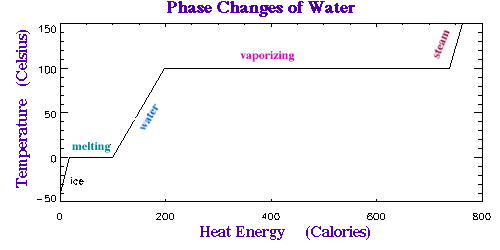
Steven’s practice presentation was four slides long on the lesson “Phase Changes of Water.” There was a graphic on each slide that illustrated the changes of water from solid ice to liquid to vapor. The last slide illustrated the temperatures at which water underwent a change and the amount of heat energy or calories expended to make that phase change (below):
phaseplot

“What you see in this graph,” Steven explained, “is that there is a stage, a critical point, where the amount of energy needs to increase to have water change from solid to liquid. The graph shows that stage of changing from solid to liquid is shorter than the stage where the amount of energy needs to increase to change water into steam.”
He pointed to the lines on the graph, first the shorter line labeled melting and then longer line labeled vaporizing.
“So how is this a profound idea?” he asked. “Well, this chart is just like anything you might want to improve on. Sometimes you are working to go to the next level, but you hit a plateau, a critical point. You need to expend more energy for a longer period of time to get to that next level. Thank you.”

We clapped. Everyone sitting in class agreed that Steven had met the assignment. He met the time limit. He had graphics. He made a connection.
I saw something even more profound.

In less than three minutes, Steven had used what he had learned in physics to teach me a new way to consider the learning process. I could see phase changes or phase transitions to illustrate the relationship between energy expended over time and academic performance. I could relabel the side marked heat energy to a label of “energy expended over time.”  Some phase changes would be short, as in the change from ice to a liquid state. Other phase changes would be longer, as in the change from liquid to gas. Each line of phase change would be different.

For example, if I applied this idea to teaching  English grammar, some student phase changes would be short, as in a student’s use of pronouns to represent a noun. Other phase changes could be much longer, such as that same student employing noun-pronoun agreement. Time and energy would need to be expended to improve individual student performance on this task.

But whose energy is measured in this re-imagined transition? Perhaps the idea of phase changes could be used to explain how a teacher’s energy expended in instruction over time, or during a critical point, could improve academic performance. The same idea could be used to demonstrate how a student must expend additional energy at a critical point to improve understanding in order to advance to the next level.

At the end of the school year, teachers need to provide evidence of individual student growth, but perhaps a student is in a transitioning phase and growth is not yet evident?  The major variable in measuring student achievement is the length of the critical point of transition from one level to another, and that length of that critical point could extend for the length of a school year or maybe even longer. Growth may not be measured in the time provided and more energy may need to be expended.

What was so interesting to me was how Steven’s use of phase changes had given me another lens to view the students I assess and the teachers I evaluate. Because measuring academic progress is not fixed by the same physical laws where 540 calories are needed to turn 1 gram (at 100 degrees Celsius) of water to steam, each student’s graph of academic achievement (phase changes) varies. Critical points will be at different levels of achievement measured by different lengths of energy expended. Despite the wishes of teachers, administrators, and students themselves, “growth” is rarely on that 45º trajectory. Instead, growth is represented by moving up a series of stages or critical points that illustrate the amount of energy, by student and/or teacher, spent over time.

Energy matters, in physics and in student achievement. Steven’s TEDTalk gave me a new way to think about that. He was profound. I think he gets an A.

The 4th period senior Advanced Placement Literature class watched Hamlet die four times on Friday. Four times was all the time we had.

These students have been reading and annotating the great soliloquies in Hamlet, but since this is a drama, they have benefitted much more from watching scenes from several film versions of the play. The closed caption feature is on so the students “read” the play while the actors in each cast attempt to, “Fit the action to the word and the word to the action,” per Shakespeare’s directions.

Watching the different film productions complements the study of literary critical theory. These students have been analyzing works of literature through a psychoanalytic, historic, or Marxist lenses, and they are familiar with New Criticism which is so similar to the Common Core State Standards. They know there is more than one way to read a text. Watching the different versions of Hamlet illustrates there are different ways directors and actors interpret and act the text as well.

Moreover, watching the different versions meets the Common Core State Standard:

CCSS.ELA-LITERACY.RL.11-12.7
Analyze multiple interpretations of a story, drama, or poem (e.g., recorded or live production of a play or recorded novel or poetry), evaluating how each version interprets the source text. (Include at least one play by Shakespeare)

This year, I used the 1996 Franco Zefferelli version, which stars Mel Gibson as Hamlet, as the “spine” of analysis for the class. His version is also the shortest, but that is what happens when Zefferelli’s interpretation means he rearranges the order of scenes and drops Fortinbras from the plot entirely.

For “speaking the speech trippingly on the tongue,” I showed  selections from the Kenneth Branagh version (1996) in which he plays the title role. I also used scenes from the much praised 1948 classic starring and directed by Laurence Olivier, as well as the most recent BBC production directed by Greg Doran with David Tennant as Hamlet. To provide contrasts to these versions, the students also watched short scenes from the Hallmark production directed and acted by Campbell Scott and Michael Almereyda’s 2000 modernization with Ethan Hawke as Hamlet.

The scenario of film clips went in this order:

Act I; scene i: The “Who’s there?” opening:

  • Branagh (Note: Jack Lemmon as Marcello is woefully miscast)
  • BBC (Patrick Stewart plays both Ghost and Claudius)
  • Olivier (students thought the graphics and set were amazing for 1948)

Act I; scene v: In order to have students appreciate the complexity of the Ghost’s request, I showed different versions of the Ghost scene with Hamlet. I started with Zefferelli, and then moved to the Branagh version.  I added two more versions to the line-up: short clips from the 1964 Grigori Kozintsev‘s version and a nightmarish version (2007) by Alexander Fodor. To have a sense, here are some clips to compare of the Ghost meeting Hamlet:

Kenneth Branagh
Grigori Kozintsev

Alexander Fodor

I had asked the students to consider the origin of the Ghost-from Heaven (“spirit of health”), from Purgatory (“till my sins were purged”), or Hell (“goblin damned”). Where did they believe the Ghost originated? After watching the clips, they decided:

  • Zefferelli: Heaven or Purgatory (“The ghost looks so sad..”)
  • Branagh: Hell (“there’s fire coming out of the ground! it’s Hell unlashed,” said one.)
  • Hallmark: Hell (“there is a hand that comes from the ground!” “He’s wounded by the Ghost!”)
  • Fodor: Hell (“That’s an abusive dad!”)
  • Grigori Kozintsev: Hell or Purgatory (“Darth Vadar!”)

Act III; scene iv: The students also watched the stabbing of Polonius in Gertrude’s bedchamber where Zefferelli’s version veers into a disturbing Oedipal psychoanalysis akin to Olivier’s version. Students compared that version with the more toned down version from Branagh before moving onto Act IV.

Finally, when we arrived at Act V; scene ii, I lined up the five different versions moving between the Smartboard and a small projector. This year, I followed this order and have summarized the student responses:

  1. Starting with Zefferelli’s authentic combat, Hamlet is both clown and avenger. The three bouts are elaborate and full of suspense; my students were amazed at the hand-to-hand combat that would have been for “entertainment.” Glenn Close’s Gertrude dies in pain with wonderful contortions, and one student noted hearing “a satisfying “crunch” when Claudius is finally stabbed. As the camera pulls away, four bodies litter the stage, and the “rest is silence.”
  2. Branagh wisely kept Fortinbras in the play (all four hours of it!) using the setting of Blenheim Palace in England, which could serve as a substitute for the Russian Winter Palace of the Tsars in his Marxist take on the play. The students did not care for the elaborate staging in the death of Claudius who is “fed” poison after he has been lanced by a foil and crushed by a falling chandelier. They did, however, give “thumbs up” to the editing which juxtaposes the combat between Laertes and Hamlet with the invasion of the palace by Fortinbras. One of the open-ended questions I had asked was to choose “Fortinbras or Hamlet: The soldier or the scholar?” This film put most student squarely in Fortinbras’s corner as the man of action.
  3. The BBC version switches between security camera feed and with a single-camera setup giving the impression that the action recorded will be later viewed in some criminal investigation. Patrick Stewart returned to the BBC as Claudius where played the same role in 1980 with Derek Jacobi as Hamlet. In the final scene, confronted by Hamlet, Stewart’s Claudius takes the cup and with a resigned shrug, drinks the remaining poison and falls dead a few inches from his beloved queen. My students thought this version was hilarious, a dark and cynical twist on justice.
  4. The Almereyda version suggests that Gertrude, played by Diane Venora, willingly drinks from the cup in order to protect Hamlet and that Laertes played by Liev Schreiber is not Claudius’s dupe. As Hamlet remarks to Laertes, “You do but dally. I pray you, pass with your best violence,” Schreiber’s brutish and vengeful son of Polonius stands up with a concealed weapon and, in the scuffle that follows, shoots Hamlet in the abdomen before being wounded in the same way himself. My students reacted in shock:”didn’t see that coming!”  Once avenged, Schreiber’s next act is one of brotherhood towards Hamlet as he hands the weapon off for Hamlet to kill Claudius. Viewers should note that Horatio has something useful to do in this version, as he holds the dying Hamlet upright to hunt Claudius.  

Watching these four Hamlets die took all the time we had in our block schedule (80 minutes). A few more minutes, and I could have offered a fifth? Which one? I never did get to Kevin Kline’s Hamlet (1990), or Richard Burton’s (1964) filmed rehearsal.  There are so many excellent choices from directors, and each has a different way “to draw thy breath in pain. To tell my story.”

Die again, Hamlet, please, die again.

theatre-stage-81d434 copyShakespeare’s sonnets are little one-act plays.
I learned this one year when I was teaching drama to grades 9-12 and I discovered Will and WhimsySixteen Dramatically Illustrated Sonnets of Shakespeare by Alan Haehnel. The short comic/poignant skits in the collection are an excellent way for middle school and high school students to be exposed to the Bard’s 154 poems.
Consequently, when I began the study of sonnets with my Advanced Placement English Literature students, I thought they might benefit from a similar technique. In addition, I considered that this could be an opportunity for them to write a narrative as required by the Common Core State Standards:

CCSS.ELA-LITERACY.W.11-12.3
Write narratives to develop real or imagined experiences or events using effective technique, well-chosen details, and well-structured event sequences.

“Imagine a character in each sonnet is talking to you,” I explained, “you need to synthesize the ideas from the poem, and write that character’s story.”

Then, I handed out copies of Shakespeare’s Sonnet 29:

sonnet 29

When, in disgrace with fortune and men’s eyes,
I all alone beweep my outcast state,
And trouble deaf heaven with my bootless cries,
And look upon myself, and curse my fate,
Wishing me like to one more rich in hope,
Featur’d like him, like him with friends possess’d,
Desiring this man’s art and that man’s scope,
With what I most enjoy contented least;
Yet in these thoughts myself almost despising,
Haply I think on thee, and then my state,
Like to the lark at break of day arising
From sullen earth, sings hymns at heaven’s gate;
For thy sweet love remember’d such wealth brings
That then I scorn to change my state with kings.

On the bottom of the page I restated one simple direction, “Write the narrative.”

The results were unexpected. While my students are good at analyzing poems, I was unaware that a number of them are born storytellers. In their retellings, they captured the spirit, and sometimes the exact language, of the poem. They found ways to expand on the isolation and alienation of the speaker and incorporate the shift in the speaker’s attitude from despair to one of acceptance.

For example, Melissa used a pivotal moment in the lives of high school students…asking someone to go to the prom:

After weeks of preparation and endless nerves the day has come to ask her to come to prom with me!
I wrote her a poem listing all the things I liked about her and read it to her under the starlight sky just at sunset.
I ended the poem with “thy sweet love remember’d such wealth brings.”
My nerves ran through my body and I felt like I was going to pass out.
YES! SHE SAID YES!
I take her off to dinner and we planned for the night of prom. My dreams have come true! I am going to my senior prom with the girl of my dreams!

In contrast, Makayla began her narrative from the point of view of a frighteningly depressed teenager who observes others in a community park. The young girl’s attention is eventually drawn to one elderly couple, and their tenderness towards each other brings about an “epiphany,” a realization:

I inhale a summer thriving breathe and release the darkness out of my body. I turn to walk down the once sullen Earth path now as a gateway to sweet heaven’s gate. I take my phone out of the bag and dial my boyfriend’s number to make things right and explain myself to him. I pass the two elderly couple and smile.
In return I get a friendly, “Beautiful day, isn’t it?” and I respond, “Yes, yes ,it truly is, and I won’t beweep it again.”
As I near the running children, I pulled my bag off my shoulder and slipped it into a nearby trashcan. It’s time to change my state with kings.

Emma’s chose to use the point-of-view of an elderly woman suffering from Alzheimer’s in this poignant tale:

He doesn’t know that me is right underneath all of this forgotten memory. I’m right here, but I don’t know who I am. I bury my face in my wrinkled hands and trouble deaf heaven with my bootless cries. I can’t change. Curse my fate.
When I look up he’s standing over me. “Your appointment is at four.”
I swear I didn’t know. When I searched his face for recognition, I knew that he did not see me. He doesn’t know who I am and neither do I. He doesn’t understand that I can’t control my fate. But I am not my forgotten memory, I am his wife. That much, I know.

Finally, Jen’s story was humorous, told from the perspective of a jilted bride:

I’m sitting alone on altar steps in my once-worn Vera Wang wedding dress that’s as deflated now as I feel. My supposed-to-be husband left me for some California-toned, bottle-blond chick bustier than Dolly Parton. (Curses her and her awesome figure. I swear she was created by Russian scientists.) I all alone beweep my outcast state….

….That son-of-a-bitch should not be in my thoughts right now. Well, maybe he should considering he was a 10 thousand dollar mistake. Dammit I looked good in that dress.
Sullen Earth, why me?

What started out as an educated guess for an assignment on my part has yielded great results. Moreover, my students have written narratives based on  “this man’s art.”

“We loved writing these,” was their collective response.
Of course they did….hard to go wrong with Shakespeare as their mentor.

Continue Reading…

The poems of Seamus Heaney get a great deal of attention in mid-March probably because everything Irish gets attention around St. Patrick’s Day (March 17). Heaney is well represented in our curriculum; we read his Beowulf translation in grade 10. This Nobel prize-winning interpreter,, playwright and poet passed away in September 2013, leaving a legacy he described as one of “…words as bearers of history and mystery.”

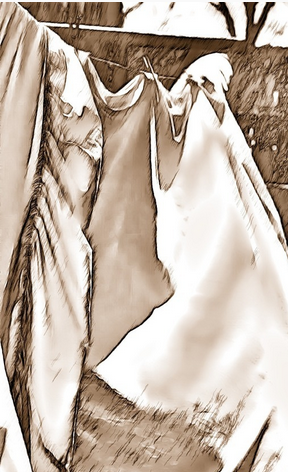
Screenshot 2014-03-14 07.32.13I taught his Sonnet, In Memoriam M.K.H., 1911-1984 to my Advanced Placement English Literature class this week. They listened first to hear him read the poem: (NOTE: be sure and listen to the little comment about “x’s and o’s” he makes at the end)

The cool that came off the sheets just off the line

Made me think the damp must still be in them

But when I took my corners of the linen

And pulled against her, first straight down the hem

And then diagonally, then flapped and shook

The fabric like a sail in a cross-wind,

They made a dried-out undulating thwack.       (sonnet continues…..)

“Is this about death?” asked my 4th period class. They were curious.
“This is about sex,” stated my 1st period class. They were emphatic.
Ultimately, they came to agree that the “thwack” could be either.

This past week has been “Sonnet Hell Week” where I teach my students to read, analyze, and then respond in draft form about a selected sonnet in preparation for the exam this coming May. This kind of exercise has the potential to poison anyone’s love for poetry, and they had written several essays before getting to this poem.
Despite the danger, I was confident that 
Heaney’s poem could withstand even the most jaded 2nd semester senior’s interpretation.

“I like it,” was the collective sentiment. These lines from a few of their quick draft essays reflect their appreciation:

Heaney uses comparisons to tell the reader that folding sheets makes him feel like his wife is still around, as the two end up “hand to hand” just from folding alone.

He describes their romance in moves when he was “x and she was o”…XOXO commonly represents hugs and kisses, creating the heartfelt connection.

This touching and pulling away symbolizes her physical existence on earth and her abrupt departure through the onomotopoeic “thwack.”

Just like the finality of the chore of folding sheets that they used to do together will never stop being a chore, she is forever present. She is in every fiber sewn in the sheets, every old flour sack used.

He must face the perils of household chores without help, endure his worst fears without his best friend. He must make his bed and sleep in it too.

The New York Times ran a wonderful opinion-documentary (Op-doc) on Heaney in December 2013. Watch and listen (yes, listen!) to the lovely tribute to Ireland’s great literary talent:

Continue Reading…

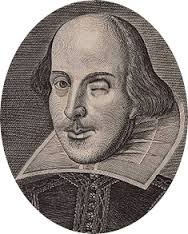
Shakepeare winkingPlanning on teaching literature in high school? I suggest a brush up on literary pitfalls….and work on developing a sense of humor because sooner or later, a student, (usually a boy) will come upon one of the following words in some great work of literature:

Screw.
Bang
Bosom.
Laid.
Nuts.

In context, these words have been carefully chosen by an author to express some lofty ideal.  Yet, to that student who is looking for any way to make the class more entertaining, these words can mean something else entirely.

No author has been more successful in creating linguistic traps than Shakespeare. There are the overt references, such as Lady Macbeth’s startling announcement to “Unsex me here..!” (I.5) in preparation to assassinate the visiting King Duncan.  There are the more subtle problems with the “hoary-headed frosts” in Midsummer Night’s Dream, but Romeo and Juliet offers the most opportunity for student sniggering.

From the opening scuffle where, “My naked weapon is out”, a teacher must negotiate students through Lord Capulet’s Give me my long sword, ho“,  Mercutio’s  teasing  “Prick love for pricking,” or the Nurse’s explanation that Juliet “shall bear the burden soon at night.

“Is Shakespeare always this dirty?” I see the quizzical looks on their faces.
“Your parents are okay with this,” I reassure them, “Besides, this is required reading.”

The Bard does not have a monopoly on creating awkward moments with language in class. Students are capable of creating discomfort, intentionally or not.

Years ago, I taught an Animal Farm unit and delivered a lesson on George Orwell’s characters and their historical counterparts. I explained that Napoleon was Stalin, the dogs were his secret police, and Snowball was Trotsky. I mentioned in passing that Trotsky was considered an insurrectionist, and I paused to let the information sink in. Instead I heard the distinct sound of giggling from several of the boys in the back of the room.

“What is so funny?”I demanded.
“Nothing,” they stammered.
I should have stopped there, but I moved in to clarify.
“What do you think I said? Do you know what an insurrectionist is?”

There was a pause…
“When… it… goes down?” blurted out one of the offenders.

“No,” I was indignant…not to be stopped. “No, I said’ insurrection’…what did you think I …..”
Then it hit me.
Erection.
I doubled back.
“It’s someone who is trying to start an uprising…..”
That explanation was drowned out with guffaws.
Did I mention that a very good sense of humor is needed in with sophomores?

This past fall, I had posted charts around the rooms with questions associated with Oliver Twist.
As the students moved around the room I noticed students giggling when they got to one of the charts.
“Why would someone lie?” was the heading on the chart.
“To get laid,” was scribbled in small print.
I recognized that print.
That print belonged to Mitch. Mitch who stood all of 4’2″ and was 90 lbs, soaking wet.

Everyone had seen it, so I needed to address the problem quickly.
“Mitch,” I demanded, “is that an appropriate thing to write?”

“Sure, Ms. B,” he replied casually,”I could lie and say I’m dying…Like in the movie 50/50.
I had to admit he was using logic…to say nothing of his confidence.
He still erased the comment.

Next week, I plan to use an Advanced Placement Literature multiple choice prompt from Jane Austen’s Northanger Abbey as practice for the upcoming AP exam.  I was rereading the passage to check its length and the matching questions when I came upon the line, “She began to curl her hair and long for balls.”

Oh, Jane. That’s going to definitely cause a stir!

Book Choice Questions

March 1, 2014 — 1 Comment

book loveIndependent reading in our school grades 7-12 means students read books of their own choosing, make recommendations, and keep records of what they read. Recently, however, one of the English teachers in my department suffered a concussion and while the substitutes delivered the curriculum (John Steinbeck’s Of Mice and Men and Laurie Halse Anderson’s Speak), student independent reading had fallen out of regular practice.

Our latest substitute (Natalie) is an enthusiastic graduate of our high school school who has a BS degree in Creative Writing. She has been serious in tackling her lack of experience in the classroom through her best characteristic…she asks questions. She asks a lot of questions.

One of the latest questions she asked was about independent reading. When I expressed my concerns about having the practice reestablished, she seemed doubtful. I suggested that she have students use books they read independently to make connections with the most recent whole class novels.

“You can ask them if they can make a generic ‘coming of age’ connection between Speak and a book of their choosing,” I suggested.

“But what if they choose a book that doesn’t have that connection? What if they choose a book that is too young for them?” she continued, “or a book that they already read? How do I know what they should be reading?”

I recognized her questions; I had those same questions myself several years ago.

So, I sat her down and showed her the following Penny Kittle video that is available through Heinemann Publishers on YouTube under the title “Why Students Don’t Read What is Assigned in Class”:

She had the same reaction I did when I first saw that video.

“Wow,” she said, “I get it. They should read what they want.”

Question answered.

My department is just noticing the benefits after a few years of implementing book choice. We are lucky to have an 80 minute block schedule with the luxury of offering 15-30 minutes a class for Silent Sustained Reading (SSR) independent choice books. We have large classroom libraries with high interest titles and a wonderful school library (with Overdrive e-books available)  to offer students choice in what they read. When we tell students to pull out their SSR book, they are prepared and settle in to read.

Some classes suggest that a book be in a particular genre. Our English IV-Memoir class reads memoirs or biographies. The English II class is based on World Literature, and students read at least one book during the year by an author who is not American. The critical requirement is that each student chooses a book. There is no leveled reading; students can choose a book below their reading ability or they can attempt a book above their lexile level. They learn what to choose to read because they have control of what they want to read.

Penny Kittle, an English teacher and literacy coach at Kennett High School in North Conway, New Hampshire, wrote a guide to helping students read independently titled Book Love. In this text, Kittle offers strategies to help teachers increase the volume of what students read and to deepen student thinking about what they read.

One of the strategies several of our teachers use is to have students respond to reading through the software Shelfairi (Amazon) where they record what they are reading and make connections to other books. I can organize each class in virtual groups and pose general questions for responses. These short responses prepare me for conferences or allow me to respond directly on the software with links or information or suggestions. For example, the English IV Mythology/Fantasy class reads mythologies or fantasies, and I posed a simple question last week and left quick responses for a conference:

How are you doing with your book? What are the connections to myth/fantasy that can you make?

STUDENT: Eragon: So far I am doing well with this book. My book connects with mythology because it is about Eragon who finds a stone which ends up being a dragon egg, and he bonds with the dragon over time. He and Saphira (the dragon) learn to communicate with one another and have a good connection. Saphira and Eragon create a good relationship with one another.

My response: This is a great fantasy…and a series. This novel has elements of the hero’s journey: http://www.thewritersjourney.com/hero’s_journey.htm

STUDENT: Ranger’s Apprentice-The Royal Ranger: Good. I have 10 pages left until its over. Its the final book in the series. There is a giant myth that rangers have special and mystical powers. But that is just false. They are just super stealthy which gives them the appearance of just appearing out of no where.

My response: Now what will you read? Another series?

STUDENT: The Alchemist: The Alchemist is a good book. It has to do more with fantasy than mythology, but there is a myth about a treasure in the pyramids.

My response: And the “stones” have a story behind them as well. Did you know this book is on the NY Times Bestseller list for 291 weeks?

While there are multiple software platforms for sharing book choices, I also find that the features on Shelfari are helpful in having students “shop” for books (without purchasing) and/or write responses using evidence. There are tabs for a book’s Description, a Ridiculously Simplified Synopsis, Characters/People, Quotes, and First sentence. There are recommendations and reviews by other readers for each title as well. The student responses can agree or refute other reviews; they can add information to a book’s page as well.

Regardless of platform, sharing what students choose to read is critical to helping them develop a love of reading. The advertisement for Kittle’s Book Love states,

“Books matter.  Stories heal.  The right book in the hands of a kid can change a life forever.  We can’t wait for anyone else to teach our students a love of books—it’s up to us and the time is now.  If not you, who?”

And that is a very good question.

In the spirit of all end of the year reviews, I have condensed the year 2013 by offering month by month posts from this blog that illustrated the best student (and subsequently, teacher) learning:

January 2013: A Freshman’s Modern Odyssey in the Style of Homer

"Dawn spread her rosy fingers..."

“Dawn spread her rosy fingers…”

The Freshmen final project after reading The Odyssey is a narrative that students complete called “The Wamogossey: A Day in the Life of a Freshman at Wamogo High School.” Writing narratives are once again favored in  Common Core State Standards, and this post explained how students made their own attempt at an epic adventure.

February 2013:  Spilling Over the Corners of a Six Word Text

Short Story in 6 words

Short Story in 6 words

This exercise proves that keeping students “within the four corners of the text” is impossible, even when the text, attributed to Ernest Hemingway, is only six words long. This post also serves as evidence that that admonitions on best practices should be limited to those with actual classroom experience, not to the “architects of the Common Core.”

March 2013 If You Want to Watch the Cow Give Birth

Watching the arrival of our latest calf

Watching the arrival of our latest calf

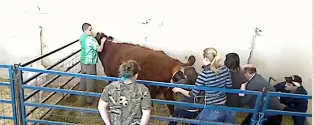
Yes, “If you want to watch the cow give birth, turn on U-stream now!” was an announcement over the PA system. Normally, I am irritated by interruptions to class time, but this announcement cued students about opportunity watch the birth of a calf in the Agricultural Science wing of our high school. The combination of technology in broadcasting and recording the birth of the newest member of the agricultural program with old-fashioned “hands on” physical labor illustrates 21st Century authentic learning.

April 2013 You Never Forget Your First Hamlet

Members of the senior class were fortunate enough to see Paul Giamatti’s “Hamlet” at Yale Repertory Theatre. I’ll let their words speak for the experience:

The performance was a wonderful experience, especially since it was my first time to see Shakespeare.

I wouldn’t mind going to another because it was so enjoyable that I didn’t even realize the 4 hours passing by.

I like the way that a play has a certain kind of vibe. It’s like a live concert, where there’s a certain kind of energy.

It was like seeing a live performance of a film. I would especially like to see another Shakespeare because it is the way that he intended his works to be portrayed.

After seeing Hamlet so well done, it would definitely be worth going to see another one whether it be Shakespeare or a different kind of performance.

May 2013 Kinesthetic Greek and Latin Roots

Spelling "exo"=outside

Spelling “exo”=outside

Understanding Greek and Latin roots is critical to decoding vocabulary, so when the freshman had a long list of roots to memorize, we tried a kinesthetic approach. The students used their fingers to spell out Greek roots: ant (against), tech (skill), exo (outside).  They twisted their bodies into letters and spread out against the wall spelling out xen (foreign), phob (fear). They also scored very well on the quizzes as a result!

June 2013 Superteachers!

Superteacher!

Superteacher!

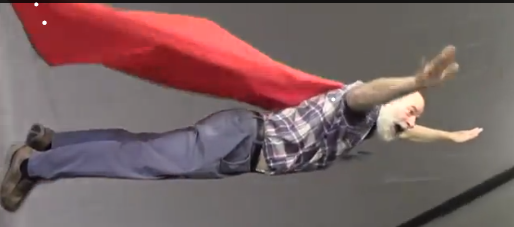
At the end of the 2012-2013 school year, teachers rose to a “friendship and respect” challenge to make a video. With a little help from a green screen, 27 members of the faculty representing a wide variety of disciplines jumped into the nearby closet wearing the big “W” (for Wamogo). Students in the video production class watched and filmed in amazement as, bearing some artifact from a particular subject area, each teacher donned a flowing red cape.

July 2013 Library Book Sales: Three Bags Full!

The original purpose of this blog was to show how I filled classroom libraries with gently used books. The Friends of the C.H. Booth Library Book Sale in Newtown, Connecticut, is one of the premier books sales in the state: well-organized tables filled with excellent quality used books, lots of attentive check-out staff, and great prices. This year, I added three large bags of books to our classroom libraries for $152.00, a discount of 90% off retail!

August 2013 Picture Books Are not for Kindergarten Any More!Cat in Hat book cover

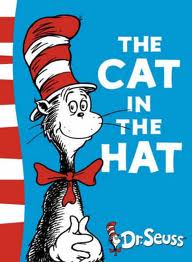
At used book sales, I am always looking for picture books I can use in high school classrooms. For example, I use The Cat in the Hat to explain Freud’s theory of the Id, Ego and Superego . Thing #1 and Thing #2 represent Id, and that righteous fish? The Superego. Yes, Dr. Seuss is great for psychological literary criticism, but he is not the only picture book in my repertoire of children’s literature used in high school. This post features a few of my favorite picture books to use and why.

September 2013 Close Reading with Saki and the Sophomores

Saki’s short stories open our World Literature course in which our students will be reading complex texts required by the English Language Arts Common Core State Standards (CCSS). After a “close reading” the conversations in the room showed the text’s complexity. Saki’s The Interlopers has all the elements suggested by the CCSS:  figurative language, the ironic wish, and multiple meaning in the revenge sought by man versus the revenge exacted by Nature. Our close reading should have been “textbook”. The evidence proved the characters’ demise…or did it? The ensuing discussion forced the class to consider other positions.

October 2013 Close Reading Art

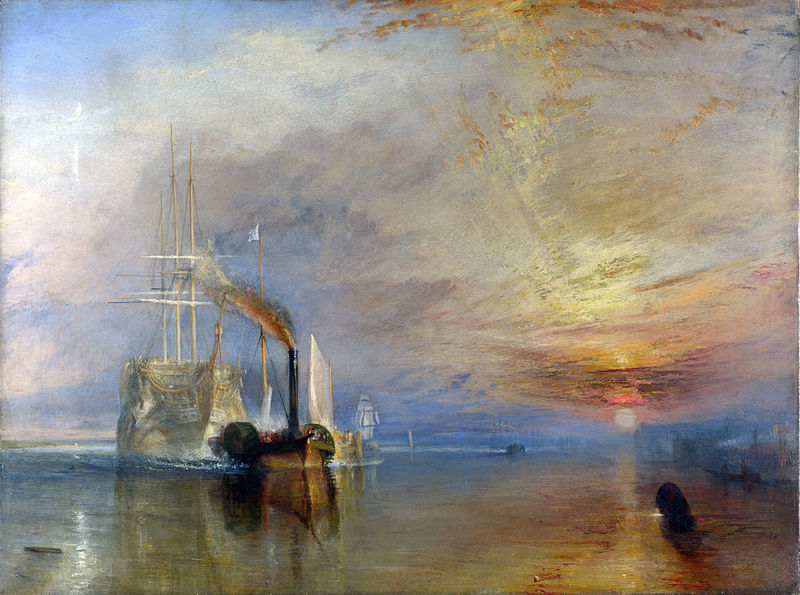
The Fighting Temeraire

The Fighting Temeraire

After “close reading” short stories, the sophomores were asked to use the same skills to “close read” several paintings that thematically connected to the Industrial Revolution. They studied a Constable pastoral painting, before J.M.W. Turner’s famous painting, The Fighting Temeraire. While some called attention to the the dirty smoke stack, others saw the energetic paddling as a sign of progress. They noticed the ghost-like ship hovering in the background, the light created by the sunset which gave the painting “warmth”or “light extinguishing”. When they were asked to use these elements as evidence to determine the artist’s message, there were some succinct responses to the painting’s “text.”

November 2013 Thanks for the NCTE Conference

Five members of the English Department attended the conference and selected from over 700 sessions at the National Council of Teachers of English and the Conference on English Leadership.  District support for such great professional development is truly appreciated. We are also grateful that four of our proposals were chosen to share as presentations for other educators. The explanations of our presentations with links to these presentations are included in this post.

December 2013 Drama Class Holiday Miracle

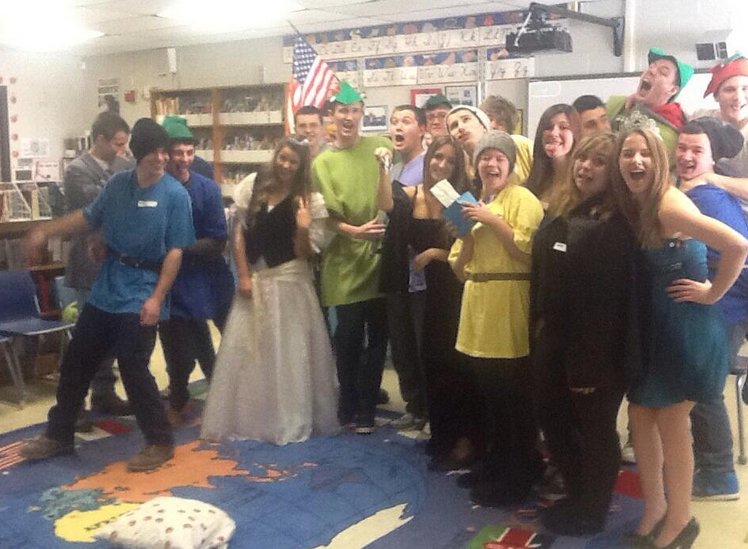
Cast photo!

Cast photo!

An ice storm two weeks before performance caused a car pile-up, and the drama club teacher was left with a concussion. She could not be in school; the students were on their own, and I was left to supervise their performances of Snow White and the Seven Dwarves at three local elementary schools.

Their “dress rehearsal” was a disaster, but, as the adage says, “The show must go on!” and once they arrived at the elementary schools, the students were anxious to do well. They naturally changed their staging moving from gym floor to library floor, the Evil Queen tossed her hair with anger, and the Prince strode onto the stage with more confidence. The dwarves were a source of comic relief, intentionally or not. I watched the holiday miracle of 2013 repeated three times that day. The students in drama class at each school were applauded, with congratulatory e-mails from the principals that offered praise.

End of the year note:

I am grateful to be an educator and to have the privilege to work with students that I learn from everyday. In this retrospective, I can state unequivocally that 2013 was a memorable year… as you can see from many of the reasons listed above.

Welcome to 2014! May this coming year be even more productive!

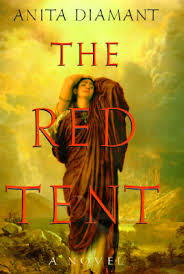
red tentMany of my students do not know Old Testament stories other than “Noah’s Ark” and “Adam and Eve”. There is the occasional biblical teen scholar who may be able to recount the origin a pillar of salt (Lot’s wife) or maybe there will be a student who saw the musical Joseph and the Amazing Technicolor Dreamcoat and make a patriarchal connection. For the most part, students are not up to date on Methuselah or even which of the brothers killed the other (Cain or Abel). They are far more likely to ask, “So, where did all the other people come from if Eve was the only woman?”

Fortunately, The Red Tent, a novel by Anita Diamant (1997) does address other women of the Old Testament. Her fictionalized version of the story of Dinah, daughter of Leah and Jacob, is based on in a brief but particularly violent and gruesome incident in the Book of Genesis. In the King James Version of the Bible, Dinah is known as the daughter who is “defiled” by Shechem, a prince, who then wanted to marry her (Genesis 34: 1-3):

1 And Dinah the daughter of Leah, which she bare unto Jacob, went out to see the daughters of the land.

2 And when Shechem the son of Hamor the Hivite, prince of the country, saw her, he took her, and lay with her, and defiled her.

3 And his soul clave unto Dinah the daughter of Jacob, and he loved the damsel, and spake kindly unto the damsel.

Dinah’s brothers, sought vengeance for the attack on their sister. They tricked Shechem and his family, claiming to come in peace, and exacted their punishment by killing the royal family and all males in the city:

26 And they slew Hamor and Shechem his son with the edge of the sword, and took Dinah out of Shechem’s house, and went out.

27 The sons of Jacob came upon the slain, and spoiled the city, because they had defiled their sister.

This horrific incident is explained very differently in the Diamant’s fictional retelling, as are many other familial incidents, from Dinah’s point of view. The rivalry between Rachel and Leah, the rivalry between Jacob and Esau, and the rivalry between the sons of Joseph, Dinah’s younger brother, are rich with detail and dialogue. The sparse accounts given in the Old Testament are fleshed out in this compelling narrative, with the women center stage, a striking contrast to the male-dominated biblical text.

Several of my female students in Advanced Placement English Literature choose to read The Red Tent as an independent choice, and their response is not unlike other female student responses chronicled in the article “The Wandering Womb at Home in The Red Tent: An Adolescent Bildungsroman in a Different Voice” by Holly Blackford. In this review, Blackford writes about the female students’ enthusiasm for the book:

So emotional about the story of The Red Tent that they can barely speak, and indeed continually interrupt one another, they cite the way in which the contemporary novel revises the patriarchal story of Jacob; represents the concerns of girls in terms of emotion and relationship; and details the entire lifecycle of girl-to-woman through engaging first-person narration:
  Carol: There are certain books I just can’t put down.
      Laticia: Seriously, I’ll read until like three in the morning . . .
      Interviewer: Like what?
      Carol: Like The Red Tent!

Blackford also points out that this revision of an ancient text  comes at a time when girls are, “hungering for an exploration of female-centered myths, deities, worlds, and power-structures.” Her claim in The Alan Review (March, 2005) is that books like The Red Tent:

“… appeal to adolescent women and grow their appreciation for contemporary women’s literature that speaks “in a different voice” (Gilligan) from the more masculine canon they expect in their school curriculum.”

There are about 20 copies of The Red Tent on the class independent book cart, all purchased at book sales for $1.00 each. Picador USA publishers produced an oversized text, about 2″ taller than a standard trade paperback; on the AP English Lit book cart’s top shelf, these copies stick out. The cover art, designed and illustrated by Honi Werner, is also eye-catching. Students always pick up the book with interest.

“What’s this about?” one asks.
“Read the back,” I reply.
“‘...told in Dinah’s voice, this novel reveals the traditions and turmoil of ancient womanhood-the world of the red tent,’ (*pause suspiciously*)…is this a ‘chick book’?”
“Yes,” I chuckle, “this is most definitely a chick book….probably the ultimate chick book, of ALL chick books.”

How else to describe a story that centers on celebrating the onset of womanhood?

After they read any independent book, the AP students are required to write an essay. The essay prompt this quarter for any book they choose is taken from the AP released exam list of questions:

In retrospect, the reader often discovers that the first chapter of a novel or the opening scene of a drama introduces some of the major themes of the work. Write an essay about the opening of the first chapter of a novel in which you explain how it functions in this way. *hint: the lens you use is the lens from the conclusion of the novel*

Students who choose to read Diamant’s The Red Tent will certainly want to return to the beginning to explain how Dinah’s life story begins and ends with the women who loved and supported her.  They will also have had a “crash course” on the Book of Genesis, which is the source of many other literary allusions. While The Red Tent is not great literature, this novel sets many female students looking for equally compelling contemporary novels about women, with or without that “chick book” label.

The recent invitation to respond to the statement “Don’t Teach the Test” was under discussion in the New York Times: Invitation to a Dialogue series. The question was posed by Peter Schmidt,  the director of studies at Gill St. Bernard’s School, and he singled out two tests in particular: the SAT and the Advanced Placement Tests.

Schmidt suggested that the SAT should be eliminated as a requirement for college on the basis of economic inequality.  Students who have the finances to take prep courses or hire tutors have an advantage, and Schmidt suggests that, “our colleges are further promoting the inequities of our society.”

Schmidt also called for the end to  Advanced Placement  (A.P.) courses in high school, saying that they

“too often fail to prepare students adequately for college-level course work. They also put pressure on students to perform well on the A.P. exams in the spring, leaving them exhausted and lacking a spirit of intellectual curiosity.”

Full disclosure: I teach Advanced Placement English Literature, and I have served as an A.P. Reader.

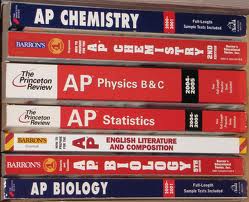
AP TestsThat said, I believe Schmidt is right about the pressure the testing for these courses places on students. I agree that these students are exhausted the first two weeks of May since students who take A.P. courses often take more than one A.P. class. Many students are scheduled for two separate tests on the same day. But as to his assessment that the A.P. courses do not prepare students for college level work, I must respectfully disagree.

Students who take A.P. courses recognize that they may or may not receive college credit for the course. College credit is given based on a student’s test score (minimum a level “3” on the A.P. English Language or Literature) and the willingness of the college to accept that score in lieu of an undergraduate course.  As a result, there are no guarantees of college credit in an A.P. class; however, colleges do look to see if students are taking A.P. classes as an indication of their academic ambitions.

The A.P. exams in all subject areas are a mix of multiple choice questions and essay responses questions.  In the A.P. English Literature exam, there are 55 challenging questions on five or six literature selections. Students need a command of vocabulary and the ability to “close read”, a skill that was the hallmark of A.P. courses long before the Common Core State Standards. But the most demanding part of the AP English Literature exam is the essay section where students write three essays in response to three prompts in two hours. 

My students practice writing to these prompts throughout the school year.  They learn to read, annotate, and draft quickly, but Schmidt raises a good question.

Does the A.P. test prepare students for college?

In responding to Schmidt’s concern, I have thought about how my student’s responses to the essay test questions are not the only measure for determining student understanding. A good A.P. course incorporates the practice of revising drafts written for a practice test. There is always a gem of an idea in these hasty constructions. There is always some hypothesis that student will discover as he or she “writes into” the prompt, something I have previously referred to as a “manifesto in the muck.” A good A.P. course provides a student with the chance to take that essay draft, and expand and revise. A good A.P. course gives students the chance to start again with the end of the draft in order to begin a better essay.

Schmidt complains about “the  lack of  imagination and creativity” that “are the cornerstones of genuine learning,”but these generalizations are not true.  I know first-hand that there is nothing to stop a student’s imagination or creativity in responding to a work of literature in an A.P. course. Some of the most amazing statements or ideas I have read have come from students undergoing the intellectual crucible of writing an organized essay in under 40 minutes. In reading these practice drafts, some ripe with grammatical errors and misspellings,  I will pause with my red pen suspended, repeating to myself, “First do no harm”, as I leave a draft untouched. A.P. advises instructors to “reward the student for what they do well”, even on a practice test.

There are too many reasons to not like the standardized tests that are choking education today; the limited data that standardized testing yields is often not worth the time and expense. Frankly, I am no fan of the College Board. The limitations of the A.P. test, however, does not mean that an A.P. course is not valuable.

The A.P. test, like all standardized tests, is a single metric measure, but an A.P. course is a much broader experience.  So, yes, I teach to the test, but I also teach the A.P. course as a preparation for the rigors of college level work, and in particular, I teach the course so that my students will have the option to waive a 100 level composition class giving them the option to take a course in their major field of study.

Schmidt concluded his invitation with an impassioned plea,

As E. M. Forster wrote more than a century ago in Howards End, in addressing the shortcomings of British universities: “Oh yes, you have learned men who collect … facts, and facts, and empires of facts. But which of them will rekindle the light within?”

I would argue that my A.P. class is the only place in my curriculum where I can offer the writings of E.M Forster, if for no other reason than to see how students would respond to that literary prompt.  I know that in their responses, there could be one from a student who, writing under intense pressure, could draft a sentence or two that would reveal a “kindle of light within.”  Whether that student response would be in a test booklet written during the A.P. test or not does not matter.

Poetry Friday: Invictus

July 19, 2013 — 4 Comments

The film Invictus tells the story of how in 1995 Nelson Mandela enlisted the help of South Africa’s National Rugby team in order to unite the country and end prejudices associated with Apartheid. The film stars Morgan Freeman as Mandela and Matt Damon as South African rugby star Francois Pienaar, but this is more than a sports film. One mise-en-scene features a visit to the real Robben’s Island Prison, where Mandela was held as a political prisoner for 27 years.

The film footage shows the cell where Mandela served his sentence before his release in February 1990. As the camera pans around the prison, the voice of Freeman recites William Ernest Henley’s poem Invictus

Out of the night that covers me,
Black as the Pit from pole to pole,
I thank whatever gods may be
For my unconquerable soul.

In the fell clutch of circumstance
I have not winced nor cried aloud.
Under the bludgeonings of chance
My head is bloody, but unbowed.

Beyond this place of wrath and tears
Looms but the Horror of the shade,
And yet the menace of the years
Finds, and shall find, me unafraid.

It matters not how strait the gate,
How charged with punishments the scroll.
I am the master of my fate:
I am the captain of my soul.

I am familiar enough with the poem that I do not need to look it up or “cut and paste” the text.
I can recite this poem cold.
So can the grade 12 seniors at Brookfield High School in CT (my tenure 1999-2008) who traditionally memorized the poem and recited its 16 lines for an English grade.

The “Invictus Day” tradition was begun to honor an English teacher who had passed away; the tradition was sustained by her colleague, Carole Smith, who would prepare “Invictus” sheets for students to carry with them to practice. A rubric was on the back that provided selected teachers a rubric to grade the quality of the recitation: A for a spectacular recitation (with feeling; no errors); B for a good recitation (one error allowed); C for an average recitation (errors allowed). A student had only one shot for an A; a teacher would sign off on the quality, but if there was a single flub, the highest grade that could be achieved was a B. Fortunately, the weight of the “Invictus” grade was nominal, however, the honor of getting an A for recitation was an achievement regardless of weight.

“Invictus Day” was an unannounced event held usually in late October or early November. Members of the faculty wore black, and seniors went scurrying to their lockers for their sheets. In Harry Potter-esque fashion, teachers would point at a senior with a finger and command, “INVICTUS”! The senior would be required to drop everything, hand over the sheet, and begin reciting, “Out of the night that covers me…”

There was a great deal of cowering, creeping, lurking,  prowling, skulking, and stalking on “Invictus Day”…on the part of both students and faculty. Some students took full advantage of the dramatic encounters by shouting the poem at the top of their lungs or climbing on tables or desks to recite for a crowd of delighted underclassmen. Others clung together to recite chorally, while the more timid seniors were given the opportunity to pull a teacher aside to recite and “get this over with!” Every year, a student would sing the poem to a familiar tune; one year, a student had a completely original melody with back-up singers. Once a student was graded, or “invicted”, he or she could show the sheet as a pass. Once invicted, a student could not be forced to recite again.

My favorite story of “Invictus Day” was of a one student who advertised his plans for presenting the poem. He prepared to recite the poem holding a heavy plaster skull, a la Hamlet. Hearing this, I convinced the members of the faculty not to invict him. The idea that he would carry the skull for several days was amusing to the faculty and to the student body. November came and went, and so did December and January. By late March, the student was pleading for someone to “invict me” so that he could rid himself of the skull he had been toting for months. Fortunately, he had been cast as a lead in the school musical. One warm April night, at the end of the final night’s production, he ran forward to take his well-deserved bow. As he stood up, I stepped out from the wings and onto the stage and cried, “Invictus!” There was a split second of shock in his eyes, but he bounded backstage and seconds later reappeared with the skull to recite the poem to a full house. There was a standing ovation; his performance for both the musical and the poem deserved the audience’s applause.

The obvious message of the poem is the control of one’s fate, and that makes the poem perfectly suited for seniors who will be steering their own destinies once they graduate. They may go to colleges, training schools, the military, or they make seek their futures in other pursuits, but who they will be after the thirteen years of mandated education is largely up to them. Holding the poem’s message in their heads, and in their hearts, can serve to guide them through rough waters of adulthood.

Mandela The same could be said for the use of the poem in the film Invictus. Four years after his release from his 27 years in Robben Island’s prison, Nelson Mandela was elected president of South Africa. He had made great sacrifices in bringing the horrors of Apartheid to an end, but his belief in a united South Africa had prevailed.

This past Thursday, July 18, 2013, Mandela turned 95 years old.

Happy Birthday, Mr. Mandela, your life story is affirmation of Henley’s message:

I am the master of my fate:
I am the captain of my soul.