Archives For November 30, 1999

I had been looking over the compendium of lists touting the top news events of 2012, when a line spoken by the character Death in Terry Prachett’s novel The Hogfather came to mind:,

Humans need fantasy to *be* human.

Prachett often reflects on the role of fiction in his fantasy novels, the Diskworld series, which are set in a world shaped like a disk that floats on the backs of four elephants standing on top of a giant turtle that slowly swims through space. While Prachett’s stories are particularly fantastic, all stories require some willing suspension of disbelief: a talking Cat in the Hat, a journey to the century of the earth, a tea party on the ceiling, a raft down the Mississippi, a beanstalk.

Stories are what prepare us for the complexities of life and death. We tell stories, we create myths, we perpetuate lies. Stories give us a language to express our triumphs and our failures, to respond to our morality and our immorality, to explore our future and remember our past.

Prachett’s 21th Diskworld novel is a Christmas tale of sorts which was developed as a film by the British media Sky One and shown in two installments in 2006. The title character The Hogfather, the diskworld’s equivalent of Santa Claus, has become the target of a assassin and goes missing. In a Gothic turn, the character Death opts to fill the role of the Hogfather by donning a fur-trimmed red suit, practicing his “ho, ho, hos”, and distributing inappropriate toys. Death’s granddaughter, Susan Sto Helit, joins him and upset the forces of the evil Auditors by rescuing the Hogfather just before the world goes dark.

As the rescued Hogfather flys off in his hog-drawn sleigh, Death and Susan are reunited and reconciled. She questions why their efforts to maintain the elaborate fantasies that surround the Hogfather are even necessary:

Death: Humans need fantasy to *be* human. To be the place where the falling angel meets the rising ape.
Susan: With tooth fairies? Hogfathers?
Death: Yes. As practice, you have to start out learning to believe the little lies.
Susan: So we can believe the big ones?
Death: Yes. Justice, mercy, duty. That sort of thing.
Susan: They’re not the same at all.
Death: You think so? Then take the universe and grind it down to the finest powder, and sieve it through the finest sieve, and then show me one atom of justice, one molecule of mercy. And yet, you try to act as if there is some ideal order in the world. As if there is some, some rightness in the universe, by which it may be judged.
Susan: But people have got to believe that, or what’s the point?
Death: You need to believe in things that aren’t true. How else can they become?


Ultimately stories allow us to imagine with an author how those “big lies” of justice, mercy, duty play out in different ways, in different settings, with different characters. For our willing suspension of disbelief, fiction gives us practice in imagining other qualities of truth, faithfulness, and love so that we may be better prepared to recognize and develop these qualities in our real world. Stories prepare us for the times when our real world turns unimaginably cruel or fraught with despair.

At the end of every December, when different media organizations publish the top stories of the year, they rank news stories in order of importance. These are events that over the course of 365 days reflect virtue and triumph along with cruelty and despair. There are always stories of senseless tragedy countered with acts of great compassion, and this year has been no different. There have been cataclysmic disasters, some by nature and some man made, and again, this year has been no different. For each of these very real stories, there are fiction counterparts that can help us to recognize what Prachett suggests are part of “some rightness in the universe.” Moreover, from these real events will come new stories, new fictions, that will be written because writing and telling stories is what makes us human. The news stories of 2012 are a record of what has happened, but the stories we create make us human and help us to believe in the possibility of a New Year where qualities of justice, mercy and duty can “become” real, not fantasy.

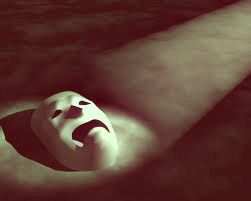
tragedy“On Friday noon, July the twentieth, 1714, the finest bridge in all Peru broke and precipitated five travelers into the gulf below.”

That is the opening sentence from Thornton Wilder’s novel The Bridge of San Luis Rey. A monk who witnesses the fall of those travelers searches for answers as to whether the accident was simply chance or an act of the Divine. In writing The Bridge of San Luis Rey, Wilder was addressing the genre of tragedy which was defined by Aristotle in his Poetics as “an imitation of a serious act” in literature. The purpose of tragedy is to provide the reader, or viewer in the case of drama, an experience of loss without having to suffer what a fictional character suffers. Through his literature, Wilder, like the authors and playwrights before him, provided the experience and language to us to respond when there is a tragedy. Great literature does this well which may be why the literature taught in high school classrooms is, more often than not, tragedy.

Of course, tragedy is not always a popular curriculum choice. I am always being confronted by students,  “Why do we have to read such depressing books?” or “Why does every book we read in English have to be so sad?” Predictably, when I hand out a book for a whole class read, student will examine the cover, the length of the text, and ask, “So, who dies?” Through literature, students learn a number of different approaches or definitions of  tragedy. In grades 9-12, students are taught about Greek tragedy (Oedipus, Antigone, Medea) where fate or Nemesis cannot be avoided. They learn about catharsis, the purging of pity and fear, and pathos, the empathy one has for the tragic hero. Students are taught about how the Shakespearean tragedy (King Lear, Macbeth, Richard III) centers on the willful downfall of a character who brings about the destruction of others. We have also included a modern interpretation of tragedy by Otto Reinherdt as students read contemporary works of literature (Death of a Salesman, The Road):

“Tragic Man demands that an imperfect world conform to his notions of right and good, and he is defeated because discord, injustice, pain, and moral evil are the world’s warp and woof. The final paradox is man in his tragic vision saying, ‘I do not believe in the invincibility of evil but in the inevitability of defeat’.. . . But in the absoluteness of his commitment, the tragic hero triumphs in the very inevitability of his defeat.”

The indoctrination to tragedy as a “serious action imitated” begins early in the student’s educational career. In grade 5, whole class reads can be The Giver, a dystopian novel that features the euthanasia of a small child. In grade 6, students may read The Devil’s Arithmetic, a book that brings students closer to an authentic understanding of the Holocaust and the deaths of six million Jews. In young adult (YA) literature, there are so many stories about the deaths of pet dogs  (Old Yeller, Where the Red Fern Grows, Love that Dog) that author Gordon Korman fought back against that literary trope with his  YA novel, No More Dead Dogs. Our 7th grade reads that book as an opening bonding experience in September, but they also read Pearl Buck’s short story “The Big Wave” about a tsunami that wipes out a small coastal village in Japan. The recent tsunami in Japan gave our young readers a new appreciation for the tragedy caused by nature.

In high school curriculums everywhere, students decry the death of a character, “Why does the author make us like him and then kill him?” They rail against the death of Johnny in The Outsiders (grade 8); the death of Lenny in Of Mice and Men (grade 9); the death of Kat in All Quiet on the Western Front (Grade 10); the death of John Proctor in The Crucible  (Grade 11); and the death of Hamlet (Grade 12). They claim to want a happy ending.

But do English teachers force an unwanted genre on students? Do students hate tragedy? Not really. Look at the two most popular series of books students chose to read independently. The Harry Potter series began with two deaths, the sacrifice of Lily and James Potter for their infant son, Harry. Seven books later,  JR Rowling had bumped off over 50 characters, and one beloved owl Hedwig (although, admittedly the death of Bellatrix Lestrange was satisfying). Student loved these novels. In Suzanne Collin’s The Hunger Games trilogy, killing and death is a form of entertainment, an entertainment made even more horrific when teenagers are the assassins. In the first book, eleven “tributes” are killed on the first day of the games. The protagonist Katniss kills four tributes herself before she “wins” this round of games with Peeta; the deaths pile up as the series continues with Collins disposing of major characters at a furious clip. I cannot keep these books on my classroom shelf.

Ultimately, tragedy in literature prepares a reader for the experience of tragedy in life. My own first experience with death was from Louisa May Alcott in Little Women when the sickly Beth March finally succumbed to illness:

“As Beth had hoped, the `tide went out easily’, and in the dark hour before dawn, on the bosom where she had drawn her first breath, she quietly drew her last, with no farewell but one loving look, one little sigh.”

I remember reading and re-reading that passage over and over and thinking: “Had I read correctly? Were there only three March sisters left? How could Alcott do this to me?” Well, she did this to me and millions of other readers because in real life people die. Nice people. Good people. Young people. Beth’s death was not a tragedy in the literary sense, but the hole left by her death for the fictional family was “a serious act imitated in literature” like the many real deaths that leave holes in the lives of real families.

Our society confronts news that is tragic everyday.  The recent death of 20 schoolchildren and six teachers in a school shooting not far from where I teach just before the Christmas holiday season is a tragedy so horrific that many have been left speechless; I hear, “There are no words.” But there are words, words in great literature written to prepare us, from a young age through high school and beyond, for exactly this experience. Thornton Wilder’s fictional story of The Bridge of San Luis Rey concludes with a paragraph that offers his response to a tragedy. Through literature, Wilder provides a language for readers to respond to a tragedy such as the one in Newtown, Connecticut, and other heartbreaking events:

“We ourselves shall be loved for awhile and forgotten. But the love will have been enough; all those impulses of love return to the love that made them. Even memory is not necessary for love. There is a land of the living and a land of the dead and the bridge is love, the only survival, the only meaning.”

As the first semester begins to draw to a close, I need to check in and see what progress the 9th grade students are making with Silent Sustained Reading (SSR). Our school’s move to a block schedule (A/B) days of 83 minute classes has given us the opportunity to provide students with 10-20 minutes of SSR every English class period. I try very hard not to put any restriction on what students read, although I still urge them to try and “read up” to more complicated texts. I wrote about the rationale for this program in a previous post, “Be Vewy, Vewy Quiet…We’re Reading”.

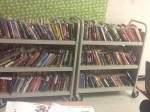
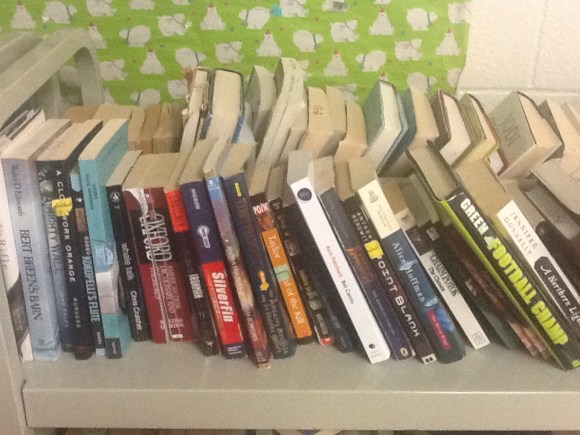
To facilitate the SSR program, there are two carts in the room with books I have purchased through the secondary market, mostly thrift stores and public library book sales (hence the title of the blog “Used Books in Class”). Each cart holds about 150 books; at $1-$2 a book, I have spent about $500 on the 300 books available for SSR.

A wide selection

A wide selection

The most popular titles in circulation these past few months have been:

Lauren Myracle’s TTFN and TTYL
John Flanagan’s Ranger’s Apprentice (any one in the series)
Catherine Gilbert Murdock ‘s Dairy Queen
Gabrielle Zevin’s Elsewhere
Alice Sebold’s The Lovely Bones
Patricia McCormack’s Cut
Carl Deuker’s Gym Candy
S. A. Bodeen’s The Compound
Sarah Dressen’s  Dreamland
Nicholas Sparks’s Dear John
Suzanne Collins’s The Hunger Games Trilogy (pick any one of these; they are on EVERYONE’S shelf)

The students are keeping their responses to the books they read on the Shelfari website this year. This is a commercial site tied to the retail giant Amazon, but there are ways to lock down the private groups we have established for each class. Last year, we used Blogger, but there were some glitches with Internet Explorer and Blogger; unless we used a browser like Firefox, the pages kept jumping and commenting was impossible. When students are on the Shelfari site, they can see what other students in the class are reading, and posting titles they have read or plan on reading is really easy. In addition, there are already reviews of the books, so students are forced to add something original to a review of the book. They can read recommendations (for and against the text) and they can participate in a discussion.

This morning I posted the following discussion prompt on Shelfari:

Hello,
You have had 16 weeks of SSR in class-most of the time with your choice of reading materials.
Tell me how you are progressing as a reader. Are you finding enough materials to read? Have you read at least ONE good book? Are you a better reader now that you were in September? Why or why not?

Some of the responses made my teacher’s heart pound proudly:

Over the past 16 weeks of SSR, I’ve probably read 5 or 6 books. Some of them were short, but some were a reasonable length. I’ve really been enjoying the SSR time we’ve been getting because the quiet period of time we get is really beneficial to my reading skills.

I am progressing in my reading. So far I have read three books this year. I am finding plenty to read. I have found many good books, including “Prom & Prejudice” and “Awkward”. I feel I am a better reader than I was in September because I am reading more difficult books than I was before and in September.

Yes I am better reader because last year I read even slower than I do now and I understand more because of the vocabulary words. I am finding enough materials to read. A good book I read this year was Miracle on 49th Street, this was good because it was a very suspenseful book.

But then, there are the honest appraisals that make me concerned about how students select books and a student’s ability to stay focused in a class for 10-20 minutes:

I’m an average speed reader, but I tend to get distracted. I’ve read a lot of good books, but they were in a lot of different genres. It’s hard for me to find books that interest me lately. I feel that my reading skills have changed a little, I’ve been able to understand things a little more.

During the past 16 weeks of SSR I haven’t really improved very much with my reading. I have only finished one book and I am working on another the first was a pretty good length and didn’t take long to read and the other is pretty long. I am a slow reader and I also just never find the time to sit down and read my book. Also, I get distracted while reading my book sometimes, so I haven’t progressed very much in the weeks of SSR.

And then, there are the even more painfully honest appraisals:

I’m a really really slow reader, and tend to get very distracted while reading, so I have a hard time making lots of progress in books. Books that are available to me don’t interest me. There was only one book that I’ve read and liked in my whole life; but there are no sequels. No I’m not a better reader, my reading skills never change, I’m always a slow and easily distracted reader.

The quiet time in SSR may not be “quiet” enough for some students, so I need to think about the physical space being more reader friendly. Apparently, I also need to have some students develop an understanding of what they like to read, and see how I can get those books onto my book carts.

Success with SSR is monitored through student self-appraisal, so I will be checking back in a few months to see if students note any changes in how they are reading. If nothing else, I know that there is power in the shared quiet reading experience we have twice or three times a week. When their heads are bent down in a book, I can feel them read.

Two visibly dissimilar groups arrived at the Downtown Convention Center in Providence, Rhode Island, on Sunday, November 4, 2012.

The Literacy for All Convention organized by Lesley University attracted thousands of business casual educators-teachers, literacy specialists, reading consultants, etc. These attendees were easily identified by their large red book totes and sensible shoes.

In contrast there were thousands of attendees to the Rhode Island Comic Con dressed as Speed Racers, Waldos, Power Rangers, Luke Skywalkers, Hulks, Green Honets, Spidermans, Ghostbusters and others. These attendees were easily identified by masks and spandex.  

This slideshow requires JavaScript.

As I approached one of the ballrooms, a pair of ninja-attired ushers looked me up and down, and without a word pointed me to the left lane, down the “boring” hallway.

Was my dress that obvious? I looked around. My brand? Coldwater Creek. Their brand? Marvel.

I walked past the long lines of patient Comic Con attendees; spandex, glitter, togas, masks, and capes abounded. I heard an announcement, “Jedi training in this room!” Jedi training? I looked at my program to the upcoming session I would be attending: Writing the Persuasive Essay. Jedi training looked far more interesting.

And then it hit me. There is a deep bond between the educators who busily rushed from session to session with oversized bags and the strutting costume clad participants who preened through the lobbies. There is a literacy foundation for both conventions. Everyone in the convention center was there because of the power of story.

Comic Con celebrates of the characters of stories; stories are the ways educators build literacy.

Yes, the love of story is what drew two unlikely groups together. The love of story transcended age and wardrobe…I looked around with new perspective. These were my people!

Throughout the day, we shared the same lobby areas and escalators…Pincachu in front of me, Katniss behind me.

“Look,” I remarked as we got off at the top floor, “It’s the Red Power Ranger!”

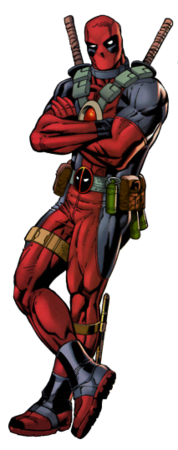
“That’s Deadpool,”  the young man behind me sneered. I tried to laugh off my error, but I had obviously touched a nerve.

“I stand corrected,” I apologized.

This is Deadpool…NOT the Red Power Ranger.

I quickly looked up up Deadpool. According to the Marvel Universe website, Deadpool (aka Wade Winston Wilson) is an anti-hero, a disfigured and mentally unstable mercenary whose power is an accelerated healing factor,which provides him with regenerative healing powers for all known diseases including cancer. He first appeared as a villain in The New Mutants #98 (Feb. 1991). Deadpool’s complicated back story alternates from a possible genesis as character with a stolen identity or as the crazed son of a war hero. Reading his lengthy biography is as challenging as some classic literary texts. Deadpool‘s history is as complicated as Shakespeare’s Richard III, Mary Shelley’s Monster, or Emily Bronte’s Heathcliff…all classical anti-heroes.

While I am familiar with each of these literary characters, I simply did not recognize many of the costumes that passed me; my literacy level for Comic Con was seriously limited. I reflected how regularly, and with the same disdain as the young man so boldly corrected me, I had regularly corrected anyone who was mistaken about the relationship of Oedipus to Antigone (“He’s her father AND her grandfather”) about Romeo to Juliet (“She’s a Capulet not a Montague!”) or for George to Lenny (“Remember? Lenny needs George as a protector!”). Now I was the one at a loss for identifying characters or relationships.

Sadly, I was Comic Con illiterate. Apparently, so are many of my fellow educators, but that is changing as research is demonstrating the growth of the literacies associated with graphic novels, comic books, and video games. Several studies are collected in The Handbook of Research on New Literacies edited by Julie Coiro (‪Taylor & Francis, 2008)  Chapter 23 is titled A Literacy of Expertise by Kurt D. Squire and features a study at University of Wisconsin-Madison.

As critics lament the “decline of the book” (with Harry Potter presumably not counting as literature), those few scholars who have touched video-game controllers are noting that games are surprisingly long, difficult, and complex,requiring and developing new digital literacies” (246).

Squires defends these new literacies as complementing more traditional reading materials:

Perhaps the alarm bells sounding the decline of “reading” do not signal a “loss” of literacy, but the emergence of a new constellation of literacy practices that could someday transform our social institutions. If the history of media holds true, video games, like film or television, are not going to replace books but live along side them.  (666).

In the article, When Gaming is Good for You (3/5/12) on the Wall Street Journal online edition explained how  researchers at Michigan State University’s Children and Technology Project reported on a three year study of video games:

491 middle school students found that the more children played computer games the higher their scores on a standardized test of creativity—regardless of race, gender, or the kind of game played. The researchers ranked students on a widely used measure called the Torrance Test of Creativity, which involves such tasks as drawing an “interesting and exciting” picture from a curved shape on a sheet of paper, giving the picture a title, and then writing a story about it.

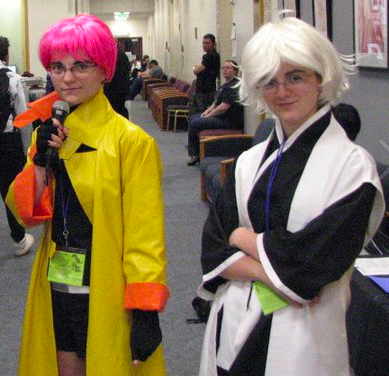
Lucy and Sarah, my nieces, at a Comic Con in Idaho. Their literacy levels are off the charts!

I should be more aware of the significant contributions that these new literacies are having on my students. I also should have been more prepared for the epiphany I experienced at this aptly named Literacy for All conference. My own nieces, Lucy and Sarah, participate regularly at Comic Cons organized in Idaho. Both young women are articulate advocates for anime characters and transform themselves in appearance and attitude. The reading level of some of their texts? 11.8 lexiles. The enjoyment they receive from sharing their knowledge with other like-minded people? Priceless.

The floor lobby areas of the convention center were probably more accurate in reflecting the literacy of today: traditional literacy standard bearers milling about with highly engaged new literacy consumers. These newer literacies may not be for all of my students, but the literacy demands on students who are involved in video games, graphic novels, comic books should be recognized. While teachers may not adopt the spandex, we all understand the importance role of story in our lives.

Who knows if there would be another convergence of the twain at the Literacy For All in future years, but I would like the opportunity to see what that Jedi training is all about.

Continue Reading…

In the classroom, the authors of children’s books are celebrities; the authors of young adult literature are rock stars. So when the National Conference of English Teachers (NCTE) and associated independent organizations the Council of English Leadership (CEL) and the The Assembly on Literature for Adolescents (ALAN) converged on Las Vegas last week, publishers made sure their authors were front and center, delivering keynote addresses and personally meeting and signing books for some of their greatest fans-teachers.

Highlights of the convention included Sherman Alexie (The Absolutely True Diary of a Part-Time Indian) delivering a keynote address to an enthusiastic audience of readers who know how he can reach their reluctant readers. Scott Westerfield (Uglies, Pretties) was there representing the oh-so-popular dystopian fiction. Nicholas Sparks (The Notebook) was there for the older readers, including the teachers themselves, with new educational materials for high school classrooms. Newbery Award winning Lois Lowery (The Giver, Number the Stars) spoke to an enthralled crowd of middle school teachers at ALAN.

The convention had invited many authors; book publishers arranged to bring even more to the exhibition hall. There were over 200 “signing” stations in exhibitor booths advertised in the conference program to alert teachers where to purchase and get books autographed.

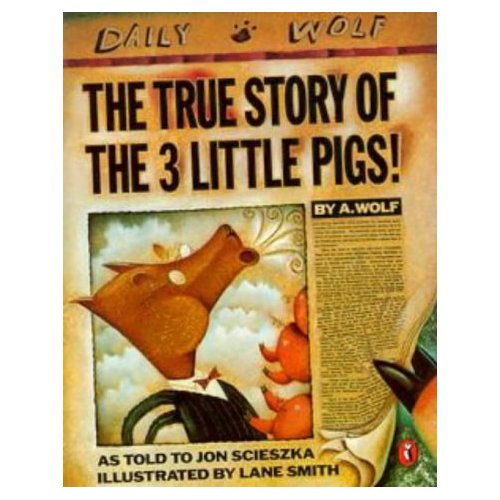
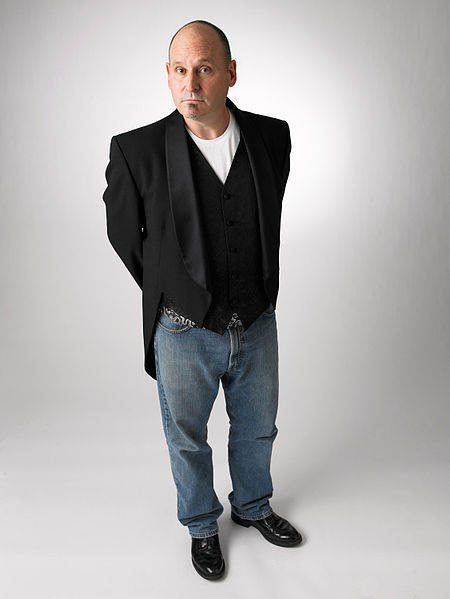
Most booths were mobbed, but on Sunday morning, I came upon a table where a solitary Jon Scieszka sat with a exhibitor. I could not believe my luck. For those who do not know, Scieszka is the author of  Math Curse,  The Stinky Cheese Man and Other Fairly Stupid Tales,and the series The Time Warp Trio, which was made into a TV series. His retelling of the The Three Little Pigs is told from the point of view of A.Wolf. The True Story of the Three Little Pigs was my first Scieszka book experience.In the book, A. Wolf explains how his requests for a cup of sugar from each of the pigs eventually led to his “sneezing” not “huffing and puffing” which sets off the unfortunate demise of the pigs. Illustrated by Lane Smith, this book was one of the “Top 100 Picture Books” of all time in a 2012 poll by School Library Journal. I concur, and I use the book to explain literary point of view to all grade levels. In 2008, Scieszka was named the National Ambassador for Young People’s Literature by the Librarian of Congress.

There Jon Scieszka sat, and there was no teacher in sight!

“Jon Scieszka!” I exclaimed, ” I can’t believe you are alone!”
“Neither can I,” he grinned.
“Me either,” said the exhibitor with him, much more uncomfortably..
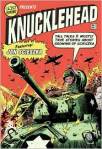
“Well, now that I have you all to myself,” I was ready with a question I had asked so many times in my head, “Can I ask how you know so much about my brothers?” I was referring to his hilarious YA memoir Knuckleheads in which Scieszka relates his

experiences growing up. The publisher’s review:

“Growing up as one of six brothers was a good start, but that was just the beginning. Throw in Catholic school, lots of comic books, lazy summers at the lake with time to kill, babysitting misadventures, TV shows, jokes told at family dinner, and the result is Knucklehead. Part memoir, part scrapbook, this hilarious trip down memory lane provides a unique glimpse into the formation of a creative mind and a free spirit.”

The book is almost a mirror reflection of watching my younger siblings compete with each other, set fire to things, and survive Catholic school (with fewer nuns). “I swear you must have been watching my three brothers grow up!” I babbled on.
“You’d be surprised how many people say that,” he chuckled.
“And your short stories in Guy’s Read?” By this time, I was positively gushing, “they are exactly what I need for my 9th grade boys who only want a short read.”
“That’s why we wrote them,” he nodded appreciatively, “for short reads. Now, what name do you want in this book?”
Yes, I got a signed book Spaceheadz by Jon Scieszka! For free. A conversation and a book.

20 minutes later, I passed by the table again, but I caught only a glimpse of him. He was surrounded by a throng of teachers,the serpentine line of fans waiting to talk to him went down the long aisle. My brief and personal moment was obviously a fluke. That’s because he’s Jon Scieszka, children’s book author. Jon Scieszka, Rock Star.

Jack Gantos stood on the steps of the altar at NYC Riverside Chapel blinking through large black glasses as he addressed the large crowd of educators who sat eager to hear him speak, “I feel compelled to throw a little fairy dust teaching into this…to educate and illuminate simultaneously.” Then, looking back at the large screen that projected the cover of his Newbery Award winning book, Dead End in Norvelt, he grinned broadly, “Yes, I wrote this book!”

Jack Gantos was the final keynote speaker at the Teachers College 83rd Saturday Reunion on Saturday, October 27th, and he was clearly enjoying this opportunity to talk about his evolution as a reader and as a writer.  The large screen projected other images, handwritten notes and neatly drawn “spy” maps. “Here are some pages from a journal I kept,” explained Gantos, “ and you should know, that the boy that wrote this journal in fifth grade is the same man who writes today.” And write he does. Gantos is the author of the Rotten Ralph series and several books dedicated to the character Joey Pigza. In addition to this most recent Newbery Award, Gantos has also won Michael L. Printz and Robert F. Sibert honors, and he has been a National Book Award Finalist.

“The very first award you give yourself to set the bar high,” he intoned earnestly. “What everybody needs to do is to honestly come to some sense of literary standards, and those standards are defined by your reading.”

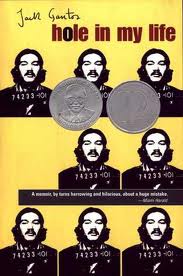
As a teacher, I am most familiar with Gantos’s memoir A Hole in My Life, which is a core text for our 12th grade Memoir elective. At 208 pages, the small paperback is much less intimidating than other memoirs, but its small size packs an amazing punch. With brutal honesty, Gantos details the year when just out of high school he became involved in smuggling drugs, and how he survived his prison sentence. A pattern of his prison mug shots covers the front of the text, and Gantos remarks about that picture early in the memoir:

“The prisoner in the photograph is me. The ID number is mine. Th ephoto was taken in 1972 at the medium-security Federal Correctional Institution in Ashland, Kentucky. I was twenty-one years old and had been locked up for a year already -the bleakest year of my life-and I had more time ahead of me” (3).

The memoir also chronicles Gantos’s development as a writer, and how, “dedicating himself more fully to the thing he most wanted to do helped him endure and ultimately overcome the worst experience of his life.” (Amazon)

I have one class set (30) of these memoirs, and I occasionally find additional copies at used book sales which indicates that the book is often assigned for summer reading.

When they read A Hole in My Life, many students have strong reactions to the prison scenes, which take place in the last third of the memoir. “This is NOT a kid’s book,” more than one of them has told me, “this guy cannot be a children’s author!”  They are notorious for trying to “protect” younger readers from any sordid incidents recounted in a book, and Gantos spares no details in describing some of the violent injuries he witnessed while working in the prison’s hospital ward. A Hole in My Life carries differences in age recommendations. Publisher’s Weekly suggests ages 12 and up, the book is a 2003 Bank Street – Best Children’s Book of the Year, and the Amazon recommendation is for ages 14 and up.

During his address, Gantos talked about the importance talking to teachers and students had in his creative process. Pointing to a picture of the cover, he said proudly, “This is the book that gets me into the front door of some high school where I can I get to talk about books and writing. This book is just like a key where I get to meet those high school kids.”

Usually, I usually assign the memoir to be read and discussed in literature circles and frequently students take these instructions to simply restate plot, “what happened? What happened next?” However, since Gantos was eager to share his structure with his audience, I may employ this strategy with this text. “When you think about a story,” he paused to show a graph projected on the big screen, ”you don’t think about the 50% invisible side called the structure. When I write, I draw 16 boxes and I fill them” he gestured to his sketches, “Beginning, middle,…action, story, character,” proving to this audience that their time pushing graphic organizers onto their students is still a worthwhile endeavor. As for the ending? “A book always has a double ending; the first is the physical ending, but the second is the emotional ending.” This is true in A Hole in My Life. Gantos relates the heartbreaking loss of his prison diary, written in between the lines of The Brother’s Karamazov, Gantos sharing the page space with the words of Dostoevsky. This diary was the more expensive the price to pay for his felonious actions, not the physical time he had spent behind bars.

He explained to his audience, “the reader wants to know how has the character been changed by an experience…the reader wants to have been inspired.” Gantos continued with more passion as he continued, “You read a book, and the next day, the book will be the same, but that you won’t. The that book will infects you and add to that little Library of Congress you have in your head.”

Gantos’s use of the Library of Congress, with the marble and beautiful domed ceiling as a metaphor for the reader’s brain is particularly vivid. The Library of Congress is the largest library in the world, with millions of books, recordings, photographs, maps and manuscripts in its collections. That powerful image is one every teacher in the room hopes for their students.  After all, what could be better than producing a nation of graduates who have the resources of Library of Congress readily available in their brains?

It’s Halloween…what is the most frightening story you have ever read?

“I busied myself to think of a story, — a story to rival those which had excited us to this task. One which would speak to the mysterious fears of our nature, and awaken thrilling horror — one to make the reader dread to look round, to curdle the blood, and quicken the beatings of the heart. ……. I thought and pondered — vainly. I felt that blank incapability of invention which is the greatest misery of authorship, when dull Nothing replies to our anxious invocations. Have you thought of a story?” (Shelley, Preface)

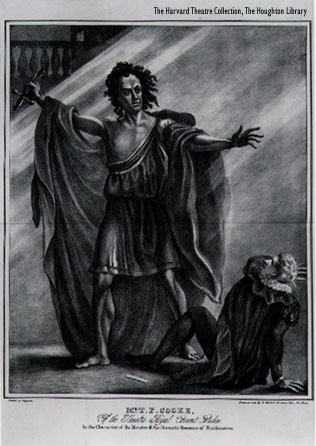
Yes. Frankenstein. Mary Shelley’s masterpiece drafted when she was18 years old.  Teaching Mary Shelley’s “ghost story” always elicits the most interesting responses from my students. I have taught the novel every year for the past 12 years to students in grades 10-12, in AP or unleveled curriculums, and the results are always satisfying.

Note: I did not say easy.

Since I am now familiar enough with the text and the pitfalls that catch most students, I know that I will need to summon an enormous amount of energy to begin teaching Frankenstein. First, there is the baggage of the pop culture monster with its green skin, bolted neck and squared boots. That baggage must be “unpacked” first. Then, there is Robert Walton’s epistolary start of the novel, coupled with Victor Frankenstein’s lengthy autobiography.  References to Cornelius Agrippa, Lake Geneva, and Galvanism are more stumbling blocks.

  • “So, where is the Monster?”
  • “When does this book get good?”
  • “I’m sorry, but this is just boring!”

Okay, Chapter Five.  On a dark and stormy night,

“With an anxiety that almost amounted to agony, I collected the instruments of life around me, that I might infuse a spark of being into the lifeless thing that lay at my feet. It was already one in the morning; the rain pattered dismally against the panes, and my candle was nearly burnt out, when, by the glimmer of the half-extinguished light, I saw the dull yellow eye of the creature open; it breathed hard, and a convulsive motion agitated its limbs”(Shelley, 5).

The Monster lives! Like the Creator in Genesis who “formed the man of dust from the ground and breathed into his nostrils the breath of life, and the man became a living creature” (Genesis 2:8), Shelley breathes life into her creation without regard to hard science.  In both stories, the empirical data or formulas, which led to these creations, express leaps of faith understood by the reader. The spark of life is imbued; the creation lives and breathes. The Creator of Genesis differs immediately from Victor when he, “planted a garden in Eden, in the east, and there he put the man whom he had formed”(Genesis 2:8), In contrast, the reader can hear Victor’s sudden gasp, “Beautiful!–Great God!” so repulsed is he once the creature comes to life. Victor weakly admits that all this work has been a failure, and comments almost apologetically, “The different accidents of life are not so changeable as the feelings of human nature” (Shelley, 5). Unfortunately, the creation has been loosed upon the earth; he will not easily be unmade simply because his creator has changed his mind.

Exhausted, Victor sleeps only to be wakened by

“when, by the dim and yellow light of the moon, as it forced its way through the window shutters, I beheld the wretch — the miserable monster whom I had created… His jaws opened, and he muttered some inarticulate sounds, while a grin wrinkled his cheeks. He might have spoken, but I did not hear; one hand was stretched out, seemingly to detain me, but I escaped, and rushed down stairs” (Shelley, 5).

Rejection! Abandonment! Isolation.

The Creator in Genesis does not abandon his creations, despite their disastrous decision to disobey. Rather, the reader finds this Creator “made for Adam and for his wife garments of skins and clothed them (Genesis 3:21) before banishing them from the Garden.Victor, in contrast, flees from the sound and the touch of the Monster who was trying to say….what? Creator?….Father?

  • Daddy.”
  • “Victor is a jerk.”
  • “He ran away because he didn’t want the responsibility.”

Exactly. And that is why Frankenstein gets to the heart of so many of the issues that our students, our culture, our world must deal with today. There are questions of responsibility. The responsibilities of a creator for the created can be extended to include the responsibilities of parents to children, of scientists to inventions, of writers to literature, of politicians to policies, and of pundits to sound bytes. What happens when the “creation” goes bad?

  • “If Victor kills the Monster, is it murder?”
  • “It’s Victor’s fault that the Monster is a murderer.”

Is the Monster a human? Shelley allows that the Monster eats, reads, and pines for a companion; he is alone, and miserable. A critical scene has the Monster pleading with Victor for a friend, a companion, a mate. Shelley has her Monster claim to have a soul; is the Monster a human? What makes a human a human?

  • Having a mate will mean monster babies!”
  • “Why didn’t Victor think about what the Monster would do?”
  • “This is just like Jurassic Park !”

Shelley’s novel also considers related ethical questions. These include what is the result of unleashing a new technology on earth? Because the technology exists to create, should the technology be used? How far should technology go in helping humanity?

In our brave new world, the “lyger” has been created because geographically separated tigers and lions can be crossbred in labs. Genetically altered crops are in the mainstream food source. These technological advancements have moved into our world with a ripple. But what of the advancements that will follow? Will human cloning become a reality, and will society deal ethically with clones? How far are we from artificial intelligence and should-or can- this intelligence be controlled? What does Frankenstein teach the reader about making ethical decisions today or in the near future? Why is literature such a great predictor for what will happen in the future?

We feel pathos. The Monster’s story is one of tragedy.

  • “Victor is the real monster.”
  • “I feel bad for the Monster…he didn’t want to be a Monster.”

By the end of the novel, my students have dealt with some very profound ideas. They have asked some very important questions about responsibility, humanity, and ethical behavior. They feel a sense of accomplishment in reading a difficult 19th Century text. They have confronted contemporary issues through literature, and isn’t that what is supposed to happen in the classroom?

Mary Shelley was only 18 years old when she attempted to answer some of the questions about the limits of man.  She was young and ambitious, like many of our students. Her “hideous progeny” is extraordinarily prescient; then novel is in every way a Modern Prometheus-a modern myth. Mary Shelley’s Frankenstein is a must read, and a cautiously frightening tale, for Halloween or for any other day.

The cover is not at all frightening, but the contents are. I had found two copies of Max Brooks’s World War Z: An Oral History of the Zombie Wars at summer book sales ($1.00 each) and placed them on the 9th grade independent reading book carts.  There was not much interest; the paperback measures a hefty 342 pages. But lately, the book is gaining some tractions with some of the freshmen boys.

“It’s about these interviews with survivors of the Zombie apocalypse ” explained Paul to the class yesterday when he volunteered to share what he was reading, “and it is really realistic. You hear how the zombie plague started and how the governments are corrupt.”

When a classmate endorses a book, the other students listen; first person testimonials are very powerful in our independent reading program. I had touted the book early in September to students when they were first perusing the book carts  The storyline was compelling enough for me, a squeamish reader, to appreciate how Brooks made a zombie war a study in political science. How would governments react to an epidemiological disaster? What would our military do to contain a potent virus? What rules would govern the survivors? I found the book to be a heart pounding read, and I read a few paragraphs to the class who listened with interest.

World War Z is told through a series of eye-witness accounts that occasionally connect characters and events. For example, there is the testimony of the fictional Dr. Kwang Jingshu, Greater Chongqing, United Federation of China:

“I found ‘Patient Zero’ behind the locked door of an abandoned apartment across town. . . . His wrists and feet were bound with plastic packing twine. Although he’d rubbed off the skin around his bonds, there was no blood. There was also no blood on his other wounds. . . . He was writhing like an animal; a gag muffled his growls. At first the villagers tried to hold me back. They warned me not to touch him, that he was ‘cursed.’ I shrugged them off and reached for my mask and gloves. The boy’s skin was . . . cold and gray . . . I could find neither his heartbeat nor his pulse.”

There is also very realistic testimony from the fictional General Travis D’Ambrosia, Supreme Allied Commander, Europe:

“Two hundred million zombies. Who can even visualize that type of number, let alone combat it? . . . For the first time in history, we faced an enemy that was actively waging total war. They had no limits of endurance. They would never negotiate, never surrender. They would fight until the very end because, unlike us, every single one of them, every second of every day, was devoted to consuming all life on Earth.”

What was most frightening as I read was my increasing doubt that the hundreds of characters interviewed in this story were fictional at all. Brooks has written post-zombie war interviews of doctors, generals, mayors, and newspaper reporters with remarkable authenticity.

But World War Z is not the only post-apocolyptic zombie book making the rounds in class. Another popular book making the rounds is Jonathan Mayberry’s Rot and Ruin (Benny Imura) the first novel in a series. I often see the rather grotesque cover art sitting on a desk, one eyeball staring up at the ceiling.

A review of Rot and Ruin on Amazon states:
In the zombie-infested, post-apocalyptic America where Benny Imura lives, every teenager must find a job by the time they turn fifteen or get their rations cut in half. Benny doesn’t want to apprentice as a zombie hunter with his boring older brother Tom, but he has no choice. He expects a tedious job whacking zoms for cash, but what he gets is a vocation that will teach him what it means to be human.
Zombie literature seems to cross our class’s gender lines, although Rot and Ruin seems to be more popular with the girls in the class. At present, there are only a few copies available through our school library, so I will be looking out for it at book sales. In addition to these titles, we also have several copies of James Dashner’s The Maze Runner, a series also loosely connected to the zombie phenomenon.
I am not entirely sure what my students’ fascination with zombies means. There are always trends or fads in literature; several years ago handsome vampires were all the rage, and several year before that, wizards ruled the reading lists. So I am aware that this infatuation with all things zombie will eventually fade, but maybe I can convince them to use their own brains as “food” for thought.

English teachers, defend literature in the classroom!

I teach English, and I am feeling a little defensive lately. In the past week, I have had two separate “literature-threatening” incidents.

The first came from a reader to an opinion piece I wrote that was featured in Education Weekly, 21st Century Students Need Books, Not Textbooks. The responder was repeating the myth that English classrooms need to abandon teaching literature in favor of teaching math and science texts:

“You need to look at the Common Core ELA [English Language Arts] standards and realize you now have a responsibility to teach reading and writing for STEM subjects. That is why this discussion is so wrong. Start reading math and science textbooks and start teaching what your students need, not what you love. I learned early on: the most boring subject is the world is another person’s hobby. Your hobby is reading “literature.” Your students need to learn to read and write STEM [science, technology, engineering, and math] topics, and those are found in textbooks. PERIOD!!”-Ebasco

This kind of response comes from the mistaken interpretation that the 70% of informational texts suggested by the Common Core State Standards (CCSS) need to be taught in English class; even the CCSS devotes a clarification to this on page 5 of their document in a footnote. Instead, reading is to be a critical part of all disciplines, generally 70% informational texts in all subjects and 30% fiction in English classrooms. However, English teachers can assign informational texts just as history/social studies can assign historical fiction; the genre assignment is fluid. An entire section of the ELA CCSS titled “Reading in History/Social Studies, Science, Math and the Technical Areas” is a guide devoted to improving the reading and writing standards in all disciplines. The push for reading informational texts is certainly a result of STEM, but literature is not being jettisoned out of the curriculum because it is a “hobby”.

Indeed, the benefits of reading literature is rooted in the second of the “literature threatening” incidents, in a WNYC Schoolbook blog post a piece titled Never Mind Algebra, Is Literature Necessary?  In this post, Tim Clifford made a compelling case regarding the stripping of literature from English classrooms in favor of Common Core, and again, the roots of this anti-literature movement are found in mistaken interpretations of the CCSS.

Clifford began his post with a multiple choice quiz based on the following quote:

“Now, what I want is facts. Teach these boys and girls nothing but facts. Facts alone are wanted in life. Plant nothing else, and root everything else out.”

Clifford posed the question “Who said the above?” and then offered three responses:

a. Bill Gates, Microsoft founder and educational gadfly
b. Michelle Rhee, staunch proponent of standardized testing
c. David Coleman, author of the Common Core standards

Then he offered the real answer,
d. Thomas Gradgrind, a fictional character created by Charles Dickens in the 1854 novel Hard Times.

The quote expressed the publicized sentiment of standardized testing advocates David Coleman, Bill Gates and Michelle Rhee. (I had chosen David Coleman as my answer). In discussing the correct answer, Gradgrind, Clifford explained that Dickens’s character was an attempt to skewer those utilitarian values in the mid 19th Century. Like today, there was a push for informational facts and statistics at the expense of creativity and imagination in public education.

Dickens’s novel Hard Times expressed his belief that an over-emphasis on facts over creativity promoted contempt between mill owners and workers.  Gradgrind’s name, like other Dickens creations, immediately expresses to the reader that he is an altogether unpleasant man, espousing that all one needs is “facts and statistics.” His daughter Louisa’s breakdown towards the conclusion of the novel brings him to the realization that fiction, poetry and other pursuits are not “destructive nonsense.”   Oh, if only Gates, Rhee, and Coleman were characters that could be similarly convinced.

In his post, Clifford described how his 6th grade curriculum has been altered to fit the ELA CCSS. He bemoaned the earlier loss of vocabulary and grammar in context and the most recent loss of creative writing which, “has been chopped clean away, to be replaced with unending persuasive essays that are the darlings of the Common Core standards.” He continues:

“Even reading has not been left unscathed. Many schools teach reading as a set of skills to be mastered rather than as a journey to be embarked upon. Children are taught how to predict, to connect, to draw inferences, and so forth, but they are rarely allowed the leisure to savor what they read or to reflect on the art of good writing.”

Clifford wrote about a successful novel writing project that, “engaged students on many levels and taught them story structure, characterization, use of dialogue, and exposition.” Unfortunately the project, “was jettisoned last year because of the national shift to the Common Core. It was replaced with an eight-page (for sixth graders!) research project.” He sadly noted, “The results were predictably dull and uninspired, but Gradgrind certainly would have approved. The papers were filled with facts but devoid of imagination.” In Clifford’s scenario, a successful unit of reading and writing was eliminated to favor lesson plans that do not have the evidence to prove success.

Where is the evidence that eliminating writing literature in favor of writing research papers will serve a mission statement of educating  “productive problem solvers and decision makers” who are “personally fulfilled, interdependent, socially responsible adults” ? Why are so many interpretations of the ELA CCSS rigidly eliminating what does work in favor of what might work? More to the point, why is there even a 70% vs. 30% split in reading genres, and why do stakeholders keep missing the point that the increase in informational texts must come by increasing reading in other content areas?

The positive impact of reading literature was discussed in the NYTimes article by Annie Paul Murray, “The Neuroscience of Your Brain on Fiction”. Reading fiction, “is an exercise that hones our real-life social skills, another body of research suggests. Dr. Oatley and Dr. Mar, in collaboration with several other scientists, reported in two studies, published in 2006 and 2009, that individuals who frequently read fiction seem to be better able to understand other people, empathize with them and see the world from their perspective.” To summarize, the data using neuroscience proves that reading fiction is good for you.

I teach literature, and my students make connections to the real word (Macbeth to Afghan Warlords; Frankenstein to the science of cloning) in my class everyday. Literature helps my students make sense of the world; they do not need to suffer under a despot, but they can experience a corrupt political system in Orwell’s  Animal Farm. They do not need to crash on a deserted island to understand how quickly very civilized young people can tun into savages when they read William Golding’s  Lord of the Flies. They can contemplate how precious is the relationship between a father and son who cling to decency and humanity without having to survive an apocalyptic nightmare  from Cormac McCarthy’s The Road.  They  can better understand the historical context of Jim Crow laws from Harper Lee’s To Kill a Mockingbird and in Kathryn Stockett’s more recent novel The Help.

And they can also learn about the utilitarian movement in England during the Industrial Revolution, the rise of the middle class, the frightening system of government-run workhouses, and the dangers of child labor in another Dicken’s novel,  Oliver Twist. Dickens’s literature demonstrates the power of fiction as a means of providing background information. Read a textbook of facts and statistics explaining the Industrial Revolution, and then read Oliver Twist. Which version will you vividly remember?

On Textbooks: Opinion Piece published by Education Week 8/8/12