Archives For November 30, 1999

Screen Shot 2013-01-09 at 4.41.58 PM

Wikipedia photo -Elie Wiesel

By my calculations, at the mid-point of the school year, many World History classes are studying World War II. Should these classes want to increase their use of an informational text in English or Social Studies curriculum, I suggest Elie Wiesel’s noteworthy speech The Perils of Indifference.

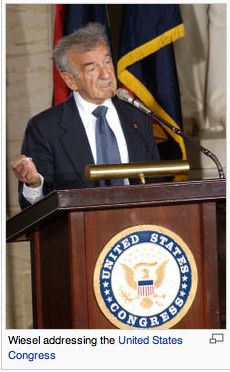
Wiesel delivered this speech to Congress on April 12, 1999. The speech is 1818 words long and connects Wiesel’s experience at the concentration camp at Aushwitcz with the genocides of the late 20th Century using a single powerful word: indifference.

In his speech, Weisel states clearly:

Indifference, then, is not only a sin, it is a punishment. And this is one of the most important lessons of this outgoing century’s wide-ranging experiments in good and evil.

Our English Department has used this speech in the past as a complement to Wiesel’s memoir Night which has been a used as a whole class read.  This year, we are giving Night to the Social Studies classes. They will adopt this memoir in order to increase the assigned informational text reading in their discipline mandated by the Literacy Common Core State Standards in History and Social Studies (CCSS). The English Department will still offer supplemental texts  that students can choose to read independently.

When he gave this speech, Wiesel had come before the US Congress to thank the American soldiers and the American people for liberating the camps at the end of World War II. Wiesel had spent nine months in the Buchewald/Aushwitcz complex. His mother and sisters had been separated from him when they first arrived: “Eight short, simple words… Men to the left, women to the right”; these family members were killed in the ovens. He and his father survived starvation, disease, and the deprivation of spirit. His father eventually succumbed, and Wiesel guiltily admits at the end of the memoir that at his father’s death he felt relieved.

Eventually, Wiesel felt compelled to testify against the Nazi regime, and he wrote the memoir Night to bear witness against the genocide which killed his family and six million Jews. His speech was delivered 54 years after he was liberated by American forces.

His gratitude to these American forces is what opens the speech, but after the opening paragraph, Wiesel seriously admonishes America to do more to halt genocides all over the world. By not intervening on behalf of those victims of genocide, he states clearly, we are indifferent to their suffering:

Indifference, after all, is more dangerous than anger and hatred. Anger can at times be creative. One writes a great poem, a great symphony, one does something special for the sake of humanity because one is angry at the injustice that one witnesses. But indifference is never creative.

My students have always been struck by Wiesel’s juxtaposition of anger and creativity. More than one has agreed pointing to making a “good” creation: an amazing song about an ex-boyfriend or a painting slapped together with passion. They also do not want to be treated indifferently. Yet, Wiesel makes them think beyond themselves:

Indifference is not a beginning, it is an end. And, therefore, indifference is always the friend of the enemy, for it benefits the aggressor — never his victim, whose pain is magnified when he or she feels forgotten. The political prisoner in his cell, the hungry children, the homeless refugees — not to respond to their plight, not to relieve their solitude by offering them a spark of hope is to exile them from human memory. And in denying their humanity we betray our own.

I remember several years ago, one student in my English 10 class, Rick, was particularly bright, fun, and full of daring. He also had an exceptional understanding of math and statistics. That January, I introduced the memoir Night as I had in previous years by providing a little background information.

“Six million Jews were killed during the Holocaust,” I recited off from my list of facts.

“What?” a startled Rick looked up. “Six million?” He was aghast. “That can’t be right.” He looked around at his classmates. “Six million?” They looked at him blankly. “Come on,” he was looking for some support, “That can’t be right.”

“Why?” I asked.

“Do you know how many six million things are?” He was indignant.

“Six million people,” I responded.

“People, yes. People, six million is a lot of people….” Rick was clearly operating with a different level of understanding from his more placid classmates. He understood six million as quantity; he did understand what six million things would look like if stacked up. Other students stirred in their seats.  “No way….six million,” he repeated growing more agitated. “How? How did anyone let this happen?” he asked; he was half-rising out of his seat. “Did we know?”

“Yes,” I remember saying. I do remember explaining that, yes, America did know that Hitler had concentration camps, and that more documentation collected after the war indicated that many of our military and political leaders knew about these camps. That is one of the points from Wiesel’s speech.

I pointed out to the class that the Holocaust was only one example of genocide; that there were others. In fact, that there was recently a genocide in Darfur. Rick sat down; he was overwhelmed. He was capable of understanding numerically the devastation of the Holocaust, and he was clearly upset. “Why do we let this happen?” he asked. I remember his voice was so sad, so full of disbelief.

In The Perils of Indifference, Wiesel asks

Does it mean that we have learned from the past? Does it mean that society has changed? Has the human being become less indifferent and more human? Have we really learned from our experiences? Are we less insensitive to the plight of victims of ethnic cleansing and other forms of injustices in places near and far?

Wiesel’s rhetorical questions echo Rick’s “Did we know?” In trying to respond, Wiesel makes the reader uncomfortable the way Rick was uncomfortable. Creating this kind of emotional impact on a reader is the reason Wiesel’s speech should be taught.

The Common Core State Standards (CCSS) demand that students read informational texts but does not require specific texts. Wiesel’s The Perils of Indifference contains the information and rhetorical devices that meet the text complexity criteria of the CCSS. More specifically, Wiesel’s message is necessary if we want our students to confront the conflicts in this new 21st Century. Our students must be prepared to question why “deportation, the terrorization of children and their parents be allowed anywhere in the world?“

Our humanity should demand nothing less.

brainwith contentThis winter, I am discontented. I see less of the “click” of recognition in a student’s eyes when he or she “knows something”. At the risk of sounding like a fuddy-duddy (“old-fashioned person,” 1871, American English, of uncertain origin), my students used to come to class pre-loaded with information; they had a predictable set of stories in their brains. These were often fairy tales such as Cinderella or Jack and the Beanstalk or folktales such as Rip Van Winkle or Johnny Appleseed. And speaking of apple seed, students used to know many of the Biblical stories as well. They may have been misinformed that the fruit of the Tree of Knowledge in the Garden of Eden was an apple and did not know that they could thank John Milton’s Paradise Lost for that substitution, but at the very least students used to be familiar with the Garden of Eden stories, the genesis of multiple allusions.

Today’s students’ lack of content, specifically story content, means that a good deal of class time is spent on a “back story” so they can better understand all the allusions or references in a particular text. Allusions are critical to understanding almost anything taught in English: Chaucer, Shakespeare, Bronte, Hawthorne, Faulkner, Steinbeck, etc. For example, our 10th grade is beginning Beowulf this week, and we read the Burton Raffel’s translation. He opens with the monster Grendel down in his cave howling at the sound of men singing the song of creation. Grendel swears vengeance against the “Almighty” for the exile of his ancestor Cain:

He was spawned in that slime,
Conceived by a pair of those monsters born
Of Cain, murderous creatures banished
By God, punished forever for the crime
Of Abel’s death.

“Can anyone tell me who Cain or Abel is?” we ask.
This year, only two out of 27 students had any idea about the story of Cain and Abel. Cain’s relationship to Grendel is part of the monster’s motivation, and so we were forced to do a little “Bible as literature” storytelling. Unfortunately, the number of students who have no information about the most basic Old Testament stories, which happen to be the same stories in Torah and the Koran, grows every year.

Fortunately, we are a 1:1 district and our students are equipped to quickly use their devices to learn who Cain and Abel are, so we can stop and have them quickly research any allusion, but this immediate research on a digital device disrupts the flow of the story of Beowulf. Moreover, the need to constantly look up information ultimately turns every text into a hyper-text.

This constant researching could be reflected in measuring the lack of information our students have when they approach a task. Last December (2012), the results of the Trends in International Mathematics and Science Study were released and, despite significant improvements,  students in the United States did not rank as high as did students from other countries. The results were discussed at a forum at the Washington Post where  David Conley, CEO of the Education Policy Improvement Center noted,

“One of the great ironies is that we are headed into an age where students can get almost any piece of information off their phones, yet, what we are doing is getting more and more information into their heads. The goal is to go beyond that and make them understand that they have to own their own learning.” (Conley, Ed Policy Improvement Center)

I agree; students need to own content for successful recall and application. I have no objection to students improving their research skills; even Wikipedia is acceptable for quick textual reference research, but students must understand the content in their brains in order to apply that information when they encounter a text. Employing content and applying information is different from employing the skill of accessing information. Owning content is critical to understanding an author’s use of allusions or references. Owning content contributes to fluid reading and better understanding. However, not all owned content is equal.

My admiration for the plethora of animated cartoon sources that do provide story content with a modernized twist is a bit mixed. For example, the popular Shrek series is riddled with storybook allusions. Unfortunately, students often do not understand allusions in these modern re-tellings as parodies. Students need to be disavowed from a belief that Puss ‘n Boots is fat and wears a pink bow or that Snow White is very proud and vain. One could argue the same modernized treatment was done for the original Grimm’s Fairy Tales which have been made more palatable and child-friendly. However, these gruesome original stories were the allusions for writers in earlier centuries. When the Common Core State Standards suggested reading list is filled with the literature and informational texts from centuries past, the recently released cartoon parodies of the originals may not be particularly helpful in understanding these allusions.

While the students today are exposed to information from a myriad of sources, they need to own information to be educated. Students need content, stories and information that they understand, to apply to a text or problem without relying on a digital device. So, this winter, the heightened level of my discontent is measured by the increase of fingering for information on devices. I miss the light that would go off in the students’ eyes when they “knew something,” particularly if that “something” was a story.

I miss content.

Here is how to add an informational text to appease the Common Core State Standards without throwing out literature. Find an exceptionally well-written piece of non fiction and use that informational text as a centerpiece for a thematic unit.

Here is my example: On January 13, 1982, Air Florida Flight 90 crashed into Washington DC’s 14th Street Bridge and plunged into the Potomac River. There had been a heavy snowstorm which had closed National Airport earlier that day. Improper de-icing procedures were credited as a major reason for the crash; 78 people were killed, four of these fatalities were motorists from the bridge who had been caught in the traffic jam caused by the storm. Only five people were rescued from the icy waters, and their rescue was broadcast live during the evening news. A news media crew, stuck in traffic only a few hundred yards away from the plane crash, filmed one rescuer’s memorable plunge to pull a flight attendant  from the icy water. I remember; I watched that happen live on the evening news.

Twelve days later Roger Rosenblatt’s piece The Man in the Water appeared in TIME magazine (January 25, 1982). His opening paragraph starts with an ordinary sentence, “As disasters go, this one was terrible but not unique, certainly not among the worst on the roster of U.S. air crashes” He continues to comment on the setting, “There was the unusual element of the bridge, of course, and the fact that the plane clipped it at a moment of high traffic, one routine thus intersecting another and disrupting both.” But then, there is a shift; Rosenblatt suddenly shifts into the kind of figurative imagery usually reserved for poetry:

“Washington, the city of form and regulations, turned chaotic, deregulated, by a blast of real winter and a single slap of metal on metal. The jets from Washington National Airport that normally swoop around the presidential monuments like famished gulls were, for the moment, emblemized by the one that fell; so there was that detail. And there was the aesthetic clash as well—blue-and-green Air Florida, the name a flying garden, sunk down among gray chunks in a black river.”

Rosenblatt’s purpose was not to comment of the disaster itself, but rather to focus on the actions of one individual who rescued other crash survivors floundering amid the frozen chunks of ice and crash debris floating in the Potomac. This individual Rosenblatt christened “The Man in the Water.”

“Balding, probably in his 50s, an extravagant moustache.) He was seen clinging with five other survivors to the tail section of the airplane. This man was described by Usher and Windsor as appearing alert and in control. Every time they lowered a lifeline and flotation ring to him, he passed it on to another of the passengers.”

Rosenblatt called attention to the other resuers in this disaster including, Donald Usher and Eugene Windsor, a park-police helicopter team and Lenny Skutnik who jumped from shore to drag flight attendant Priscilla Tirado to shore. But it is the “Man in the Water” that Rosenblatt immortalizes in the essay:

“When the helicopter came back for him, the man had gone under. His selflessness was one reason the story held national attention; his anonymity another. The fact that he went unidentified invested him with a universal character. For a while he was Everyman, and thus proof (as if one needed it) that no man is ordinary.”

I use this essay, which is anthologized in an English literature textbook, as the thematic centerpiece for the senior elective Hero or Monster. The essay sets up the essential question: What makes a hero?

There are other resources to use with this text. A National Geographic Video Plane Crash in the Potomac (credit – Discovery/ National Geographic channel Seconds From Disaster)

After reading this essay and watching the video, student are charged to consider what makes a hero in literature. The required reading for the thematic unit will including selections from the Iliad, James Thurber’s short story The Greatest Man in the World, Ken Kesey’s One Flew Over the Cuckoo’s Nest, and an independent reading book. Students will also read about the monomyth or hero’s journey and trace the journey of a hero in a book of their choice.

While Rosenblatt’s essay never identifies the man in the water, forensic experts determined that his name was Arland Dean Williams Jr. Of course, by not naming the man in the water, Rosenblatt suggests anyone can be a hero,and concludes in a memorable last line, “He was the best we can do.” Similarly, if informational texts are required in the Common Core State Standards, than including an essay of this caliber for our students is also the best we can do.

Screen Shot 2012-12-02 at 10.44.58 AM

What SHOULD be a tenet of the Common Core State Standards.

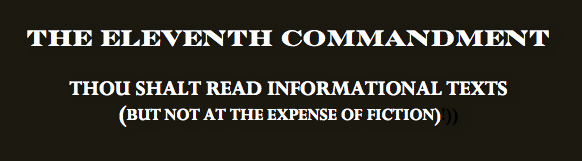
The 11th Commandment from Common Core State Standards (CCSS)? Thou Shalt Read Informational Texts.

This edict from on high, from current College Board President and co-architect/promoter of the CCSS David Coleman, has had a seismic shift in curriculum at all grade levels. English/Language Arts Curriculum directors and teachers are jettisoning fiction from their lesson plans in the mistaken belief that they alone are responsible for addressing this new found commandment. For the uninitiated, informational texts in the CCSS replaces the genre previously known as non-fiction and includes many other genres including essays, speeches, and reports.

Columnist Joel Stein exposes the foolishness of this effort in his commentary “How I Replaced Shakespeare” in the 12/10/12 issue of Time Magazine when he discovered that his writing was being analyzed by students. (Note: Diane Ravitch, education activist has the full post on her blog) His response to students who were assigned his articles and who were parsing them for literary devices or thesis?

“Transfer high schools immediately! To one that teaches Shakespeare and Homer instead of the insightful commentary of a first-rate, unconventionally handsome modern wit! Also, don’t do drugs!”

Stein readily admits that students should have some exposure to different genres and explains that he learns how to write in different genres by looking at examples. Similarly English/Language Arts curriculum require students to write in various genres as well through models as well; for example, students are taught with models as to how to write in the genres of essay, business or friendly letter, book review, and poetry.

However, Stein refutes one of Coleman’s most quoted talking points. Coleman said, “It is rare in a working environment that someone says, ‘Johnson, I need a market analysis by Friday, but before that I need a compelling account of your childhood.’” Stein’s response? “I agree with this, but only because no one has ever asked me for a market analysis.”

Stein points out that fiction provides the models that makes writers better. “No nonfiction writer can teach you how to use language like William Faulkner or James Joyce can,” he continues. Stein also mentions how the themes in fiction, and he mentions Shakespeare specifically, prepare students for real life choices. Othello, he notes, can help students make better choices about choices in working partnerships.

Instead, the shared blame for students not knowing how to write well or be able to read non-fiction lies with other disciplines such as history and science, a charge echoed by Gene Wilhoit, executive director of the Council of Chief State School Officers who, along the National Governors Association, created the Common Core. Stein quotes Wilhoit saying, “History class assignments tend to be short textbook summaries, not primary sources.” Indeed the CCSS anticipated that reading across the disciplines is the most effective way to increase student understanding, so the CCSS made clear that a student’s diet of reading should be 70% informational texts and 30% fiction. Unfortunately, the explanation as to how this percentage would play out in the average student’s school day was relegated to two footnotes. On page 5 of the CCSS English Language Arts (down load) is the footnote that illuminates the 11th commandment of how Thou Shalt Read Informational Texts:

1
The percentages on the table reflect the sum of student reading, not just reading in ELA settings. Teachers of senior English classes, for example, are not required to devote 70
percent of reading to informational texts. Rather, 70 percent of student reading across the grade should be informational.
2
As with reading, the percentages in the table reflect the sum of student writing, not just writing in ELA settings.

When the CCSS were announced, the misreadings of this the English/Language Arts standards began immediately. The footnote was largely ignored. Instead, the movement to jam informational texts into English classes began. Literature was dumped in order to meet the set ratio in English classes alone rather than a move to increase the reading of informational texts in all other disciplines.Stein recounts how Wilhoit highlights the reaction of the small, vocal group who objected. “It (CCSS) upset people who love literature. That happens to be a lot of high school teachers,” Wilhoit said.

In How I Replaced Shakespeare, Stein adds his voice to the small vocal group who love literature.  He is a former writer for the Los Angeles Times and now is a regular contributor to Time. He is a good writer who recognizes that all students would be far better served to read great literature (Shakespeare,Faulkner, Joyce)  rather than his column of “informational texts.” The loss of literature at every grade level in an attempt to serve ratios-50% fiction/50% informational text in elementary and 30% fiction/70% in high school- is too great a price to be paid to meet the goals of the yet unproven Common Core.

The impending Hurricane Sandy did little to stop over 2000 teachers from attending the 83rd Saturday Reunion at Teacher’s College at Columbia University on Saturday, October 27. Taking up the microphone in a set of informal welcoming remarks, Lucy Calkins complimented the crowd that had gathered in the Nave in Riverside Church, “So many of you have come here…instead of clearing out storm drains or without stocking up on toilet paper. You have weathered the trip despite the predictions of this ‘Franken-storm’.” The crowd laughed appreciatively.

“Yes. We are in a storm,” she continued with growing seriousness. “Today, we are in a ‘Perfect Storm’ in education, and we must learn to travel these hurricane winds and sail.”

Calkins was referencing the convergence of the Common Core State Standards with educational reform efforts that emphasize standardized testing. Newly designed teacher evaluations tied to single metric tests combined with cuts in funding for public school education because of a stagnent economy have also contributed to this ‘Perfect Storm’. This audience understood her metaphor.

Lucy Calkins is the Founding Director of the Reading and Writing Project LLC and the Teachers College Reading and Writing Project as well as the Robinson Professor in Children’s Literature at Teachers College where she co-directs the Literacy Specialist Program.

Co-authors Lucy Calkins, Mary Ehrenworth and Christopher Lehman all led sessions at the 83rd Saturday Reunion of the Teachers College Reading and Writing Project on Saturday, October 27, 2012

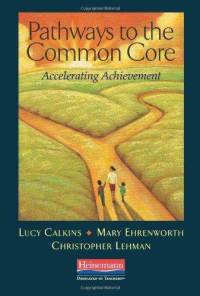
At a session that followed her welcoming remarks titled, “Implementing the Common Core: What’s Working, in Big Exciting Ways, to Engine Dramatic Reforms,” Calkins explained that she would not be delivering a big keynote at this conference on the Common Core, despite her belief that she considers this “most important document in the history of American education.” Instead, she plans to take time off from teaching to tour the country speaking on the Common Core and the book she co-authored, Pathways to the Common Core, in ordercto help school districts with the real work of accelerating students to perform at the level required by the Common Core, noting that “85% of our students are not there.”

Calkins also expressed her concerns that our nation’s history of large-scale educational reform is not good. “We have been sent many times to reform school,” she continued, “we have to be worried that this [Common Core] may be just one more reform.” However, Calkins stated that what works in this particular reform’s effort is the “absolute and total appreciation that what will make the difference is the teacher.” She directly confronted all the teachers in attendance and directed, “You need to be knowledgeable, and read the actual Common Core, not the ‘Publisher’s Guide to the Common Core’.” Her concerns at this conference echo her remarks in March 2012 at the 82nd Saturday reunion where she specifically called out David Coleman, co-founder and CEO of Student Achievement Partners  and who, according to Pathways to the Common Core, “received a  four-year 18 million dollar grant from the GE Foundation to develop materials and do teacher training around the CCSS” (6). Coleman has since moved on to take a position as the President of the College Board. Pathways to the Common Core, co- authored with Mary Ehrenworth and Christopher Lehman, details concerns that this enormous grant and any additional grant money will result supporting those who are “spelling out implications and specifying what they wish the Common Core had said,”(5). Already there has been a growing body of materials that contradict the intentions of the standards:

“There will certainly be additional materials and documents that emerge following this new round of money, with the potential to make similar claims as the Publisher’s Criteria for the Common Core Standards in English Language Arts and Literacy, Grades 3-12 (Coleman and Pimentel 2011)  and the Rubrics for Evaluating Open Education Resources (OER) Objects (Achieve 2011). When documents are presented as if they’ve gone through the process of review and been ratified by the states on subcommittees, it is troubling”(6).

Calkins reminded participants that the crucial difference will be the professional teachers who bring colleagues into their work to build a community of teachers, and that this community should know the Common Core standards.

Turning to the topic of her session, Calkins also explained that some of the most exciting work that was recently taking place on the Common Core  at the Teachers College was with their work with students in argument and debate.

She described the success teachers at the Reading and Writing Project were having with students who participated in read-aloud by gathering evidence for one position or another. For example, students had listened to a reading of The Stray and took notes on different positions. Following the basic rules of debate, students were given the opportunity to caucus with those who held their opinions before debating or refuting their debate partner’s position. In order to model the process with Shel Silverstein’s The Giving Tree, teachers taking one position that the tree was strong stood to caucus with like-minded participants, while those seated conferred with those who agreed with the different opinion that the tree was weak. Calkins directed teachers to stand, sit, debate or caucus, modeling how this might work in a classroom in one 45-50 minute period. She showed several video clips showed students participating in the same process demonstrating the success of using these techniques. “The results were fantastic,” Calkins exclaimed as the videos played, “so exciting to see the students gathering evidence and using the text in their arguments.”

What was evident during her sessions at this conference was that during this ‘Perfect Storm’ in education, Calkins is confidently empowering teachers to sail through what seems to feel like hurricane force changes in the profession. Her efforts in preparing teachers to navigate these new challenges can help insure that while these controversial storms may rage outside, inside the classroom day after day, the teacher is prepared to be the captain of the ship.

 David Coleman, incoming president of the College Board is staring out from the front cover of the October 2012 issue of The Atlantic . Actually, he is not staring. I think he is smirking…a Cheshire Cat smirk.

He has every reason to smirk. Coleman one of the architects of the Common Core State Standards has emerged as one of the more influential education policymakers to change what will be taught in classrooms and how this content will be taught without ever having spent time in the classroom himself.

Yes, Coleman has never taught in a public school classroom, although he was very successful as a student. He was educated in the Manhattan public school system, the son of highly educated parents, his father, a psychiatrist, and his mother, president of Bennington College. His privileged liberal arts credentials are immersive and include Yale, a Rhodes Scholarship, Oxford, and Cambridge.

His perspective on education has been informed by the business side of education which included pro-bono work at the management consulting firm McKinsey & Company. He developed and sold the assessment company Grow Network; co-founded and sold Student Achievement Partner; and most recently, accepted a position as president of The College Board.

Coleman has materialized, like Lewis Carroll’s enigmatic Cheshire Cat, as the cool outsider who surveys education as a Wonderland ruled by nonsense. He has promoted an agenda of close reading and an increase in non-fiction, to a ratio of 70% of all required reading by grade 12, from his perch high above the daily dust-ups of the average classroom.

Now, after developing the CCSS, replete with new batteries of state tests, he has moved on to the pinnacle of high stakes testing, the SAT. His arrival comes amid renewed concerns from studies about the SAT that demonstrate the unfairness of the test for minorities, females, and students living in poverty.

While I can embrace many of the standards in the English Language Arts Common Core State Standards (CCSS),  I remain unconvinced by Coleman’s sweeping claims that “close reading” lessons  of several days focused on a complex and difficult text is critical to improving understanding. I have practiced close reading, but not with the singular and tortuous focus Coleman advocates. There is little research as to how this approach will improve reading skills for all students. For 21 years, I have been a “boots on the ground” promoter of reading to a population of students who are reading less and less of the assigned materials, so I speak from experience when I state that Coleman’s emphasis on close reading can have an adverse effect on an already poor reader.

Furthermore, Coleman negates the effectiveness of the past 35 years of having students engage with a text using Louise Rosenblatt’s Reader Response Theory. His blunt charge “as you grow up in this world you realize people really don’t give a sh*t about what you feel or what you think” is simply not true. I cannot imagine any author who would not want to know what a reader thought. Writing is supposed to inspire; writing is an invitation to a dialogue. Furthermore, how will not listening to what students thought engage them in writing at all?

The question is how did Coleman get to place his large footprint on education, and why did teachers let him move into this position? Were teachers so preoccupied with teaching that they failed to see how the dynamics of education were moving from engaging leaders from public school institutions to accepting leadership from more commercial enterprises?

Dennis Van Roekel alluded to the rise of Coleman and others like him when he delivered an address to the National Education Association 91st Representative Assembly this past July:

Are we willing to assert our leadership, and take RESPONSIBILITY for our professions?
The demands of our work are changing as our students change, and the world around us is changing too – ever so fast.I say it is time for us to lead the next generation of professionals – in educating the next generation of students!

I’m so tired of OTHERS defining the solutions… without even asking those who do the work every day of their professional life.
I want to take advantage of this opportunity for US to lead – and I’m not waiting to be asked, nor am I asking anyone’s permission.

Because if we are not ready to lead, I know there are many others ready, willing, and waiting to do it for us. Or maybe I should say, do it “to” us.

Van Roekel’s quote echoes the question rhetorically posed by noted educator Lucy Caulkins at her presentation of the 82nd reunion at Columbia Teacher’s College, “Where is the proof, David Coleman, that your strategy works?”

Coleman’s ascent to the top of American education policy has been steady. He made contributions to the CCSS which will result in nationwide metrics for grades K-12. Add this testing to his new control of the SAT, and his influence on American education and the tests that measure learning will continue through the college level, all without his having the informative experience of teaching in a classroom. That any one individual without any teaching experience could have had this impact on the daily workings of the classroom is a commentary on the current state of madness that public education now finds itself.

At one point in in her Adventures in Wonderland, Alice comes across the Cheshire Cat in the hope of finding her way out:

‘But I don’t want to go among mad people,’ Alice remarked.
‘Oh, you can’t help that,’ said the Cat: ‘we’re all mad here. I’m mad. You’re mad.’
‘How do you know I’m mad?’ said Alice.
‘You must be,’ said the Cat, ‘or you wouldn’t have come here.’

Carroll’s Cheshire Cat character is a tease, an enigmatic riddler who offers judgments and cryptic clues but no  solution to the frustrated Alice. Coleman is education’s Cheshire Cat, offering positions in education but with no evidence to prove his solutions will work.

Curiouser and curiouser. David Coleman has become one of the most influential educational policymakers in our public school systems, but at this time, we have little else but his smirk.

Is this the Age of Enlightenment? No.
Is this the Age of Reason? No.
Is this the Age of Discovery? No.

This is the Age of Measurement.

Specifically, this is the age of measurement in education where an unprecedented amount of a teacher’s time is being given over to the collection and review of data. Student achievement is being measured with multiple tools in the pursuit of improving student outcomes.

I am becoming particularly attuned to the many ways student achievement is measured as our high school is scheduled for an accreditation visit by New England Association of Schools and Colleges(NEASC) in the Spring of 2014. I am serving as a co-chair with the very capable library media specialist, and we are preparing the use of school-wide rubrics.

Several of our school-wide rubrics currently in use have been designed to complement scoring systems associated with our state tests,  the Connecticut Mastery Tests (CMT) or Connecticut Academic Performance Tests (CAPT). While we have modified the criteria and revised the language in the descriptors to meet our needs, we have kept the same number of qualitative criteria in our rubrics. For example, our reading comprehension rubric has the same two scoring criteria as does the CAPT. Where our rubric asks students to “explain”, the CAPT asks students to “interpret”. The three rating levels of our rubric are “limited”, “acceptable”, and  “excellent” while the CAPT Reading for Information ratings are “below basic”, “proficient”, and “goal”.

We have other standardized rubrics, for example, we have rubrics that mimic the six scale PSAT/SAT scoring for our junior essays, and we also have rubrics that address the nine scale Advanced Placement scoring rubric.

Our creation of rubrics to meet the scoring scales for standardized tests is not an accident. Our customized rubrics help our teachers to determine a student’s performance growth on common assessments that serve as indicators for standardized tests. Many of our current rubrics correspond to standardized test scoring scales of 3, 6, or 9 points, however, these rating levels will be soon changed.

Our reading and writing rubrics will need to be recalibrated in order to present NEASC with school-wide rubrics that measure 21st Century Learning skills; other rubrics will need to be designed to meet our topics. Our NEASC committee at school has determined that (4) four-scale scoring rubrics would be more appropriate in creating rubrics for six topics:

  • Collaboration
  • Information literacy*
  • Communication*
  • Creativity and innovation
  • Problem solving*
  • Responsible citizenship

These six scoring criteria for NEASC highlight a gap of measurement that can be created by relying on standardized tests, which directly address only three (*) of these 21st Century skills. Measuring the other 21st Century skills requires schools like ours to develop their own data stream.

Measuring student performance should require multiple metrics. Measuring student performance in Connecticut, however, is complicated by the lack of common scoring rubrics between the state standardized tests and the accrediting agency NEASC. The scoring of the state tests themselves can also be confusing as three (3) or six (6) point score results are organized into bands labelled 1-5. Scoring inequities could be exacerbated when the CMT and CAPT and similar standardized tests are used in 2013 and 2014 as 40 % of a teacher’s evaluation, with an additional 5% on whole school performance. The measurement of student performance in 21st Century skills will be addressed in teacher evaluation through the Common Core State Standards (CCSS), but these tests are currently being designed.  By 2015, new tests that measure student achievement according to the CCSS with their criteria, levels, and descriptors in new rubrics will be implemented.This emphasis on standardized tests measuring student performance with multiple rubrics has become the significant measure of student and teacher performance, a result of the newly adopted Connecticut Teacher Evaluation (SEED) program.

The consequence is that today’s classroom teachers spend a great deal of time reviewing of data that has limited correlation between standards of measurement found in state-wide tests (CMT,CAPT, CCSS) with those measurements in nation-wide tests (AP, PSAT, SAT, ACT) and what is expected in accrediting agencies (NEASC). Ultimately valuable teacher time is being expended in determining student progress across a multitude of rubrics with little correlation; yes, in simplest terms, teachers are spending a great deal of time comparing apples to oranges.

I do not believe that the one metric measurement such as Connecticut’s CMT or CAPT or any standardized test accurately reflects a year of student learning; I believe that these tests are snapshots of student performance on a given day. The goals of NEASC in accrediting schools to measure student performance with school-wide rubrics that demonstrate students performing 21st Century skills are more laudable. However, as the singular test metric has been adopted as a critical part of Connecticut’s newly adopted teacher evaluation system, teachers here must serve two masters, testing and accreditation, each with their own separate systems of measurement.

With the aggregation of all these differing data streams, there is one data stream missing. There is no data being collected on the cost in teacher hours for the collection, review, and recalibration of data. That specific stream of data would show that in this Age of Measurement, teachers have less time for /or to work with students; the kind of time that could allow teachers to engage students in the qualities from ages past: reason, discovery, and enlightenment.

Smartblogs recently ran a post by Bill Ferriter titled “Reading Nonfiction is not Optional ” where he argued that there is too much fiction in a student’s reading diet. “The sad truth,” he wrote, “is that fiction still dominates the literacy lives of young readers. Whether they are wrapped up in fantastic exploits written by guys like Rick Riordan or churning through the latest release in the hottest new vampire series, today’s kids rarely make room for nonfiction in their book bags.”

Sad truth? Why is this a “sad truth”? What is wrong with reading fiction? Fiction, like its counterpart non-fiction, offers our student readers valuable life lessons. For example, in an online article in guardian.co.uk September 7, 2011 Reading Fiction ‘Improves Empathy’, Study Finds, Professor Keith Oatly at the University of Toronto who studies the psychology of fiction reports that:

“I think the reason fiction but not non-fiction has the effect of improving empathy is because fiction is primarily about selves interacting with other selves in the social world. The subject matter of fiction is constantly about why she did this, or if that’s the case what should he do now, and so on. With fiction we enter into a world in which this way of thinking predominates. …. In fiction, also, we are able to understand characters’ actions from their interior point of view, by entering into their situations and minds, rather than the more exterior view of them that we usually have.”

Annie Murphy Paul noted the same study in her article in The New York TimesYour Brain on Fiction (3/17/12) writing that, “Brain scans are revealing what happens in our heads when we read a detailed description, an evocative metaphor or an emotional exchange between characters. Stories, this research is showing, stimulate the brain and even change how we act in life.” Apparently, our brains cannot differentiate between the fictional experience and the real life experience, “in each case, the same neurological regions are stimulated.” Furthermore, the simulation of social experience in fiction through a character’s point of view  helps prepare our brains for real-life social interactions.

In other words, while the genre of non-fiction may be the recording of real life, the genre of fiction is critical in preparing readers for real life.

In his post, Ferriter also quoted young adult (YA) writer Walter Dean Myers:

“We all know we should eat right and we should exercise, but reading is treated as if it’s this wonderful adjunct…We’re still thinking in terms of enticing kids to read with a sports book or a book about war. We’re suggesting that they’re missing something if they don’t read but, actually, we’re condemning kids to a lesser life. If you had a sick patient, you would not try to entice them to take their medicine. You would tell them, ‘Take this or you’re going to die.’ We need to tell kids flat out: reading is not optional.”

Ferriter’s paraphrase of Myers’s statement, the title of his post, “Reading Nonfiction is not Optional,” strikes the wrong tone. Myers, a writer of both YA fiction and non-fiction, did not specify as to the genre he endorsed for student reading. Myers was advocating reading, period. Both fiction and non-fiction are critical to our students’ growth and development, not one genre at the expense of another.

Independent reading means a student can choose to read non-fiction OR fiction

Yes, the English Language Arts Common Core State Standards (ELA CCSS) call for an increase in non-fiction. The authors of the ELA CCSS created a little chart on page 5 of the ELA CCSS that notes that students should be reading 70% non-fiction and 30% fiction by grade 12. But this is not the ratio for reading in an English Language Arts classroom. That is the ratio for a whole school curriculum.

I am particularly sensitive to the increasing number of attacks on fiction and the need to reducing fiction from the English classroom. Ferriter’s post makes a similar argument and could be associated with the myth that “English teachers will be asked to teach non-fiction”. This myth is directly repudiated in the ELA CCSS document:

“Fact: With the Common Core ELA Standards, English teachers will still teach their students literature as well as literary non‐fiction. However, because college and career readiness overwhelmingly focuses on complex texts outside of literature, these standards also ensure students are being prepared to read, write, and research across the curriculum, including in history and science. These goals can be achieved by ensuring that teachers in other disciplines are also focusing on reading and writing to build knowledge within their subject areas.”

In other words, reading must be offered in every discipline, students must read across the curriculum.While Ferriter’s Reading Nonfiction is Not Optional makes the important point that all teachers are responsible for modeling reading, he oversteps when he says, “If you want students to love nonfiction — and you should considering the important role that nonfiction plays in learning — you really do need to stop spending all of your sustained silent reading time figuring out what’s going to happen next to Origami Yoda.” Good SSR programs allow for independent choice in any genre by students. What Ferriter could have suggested that the expansion of SSR to other disciplines would increase reading of non-fiction while having the additional benefit of satisfying the ELA CCSS.

Of course, I often hear arguments from teachers in other disciplines moaning, “What do I drop out of my course to include reading?” which could be interpreted as the reason why the authors of the ELA CCSS felt the need to develop reading and writing standards for History, Social Studies, Science and the Technical Areas. These disciplines need to step up the reading in their classrooms.

But who said reading non-fiction was an option? I can assure Ferriter that English/Language Arts teachers are dedicated to improving student reading. They are not hung up on genre, but when they teach fiction, English/Language Arts teachers are teaching their subject matter. The adoption of the ELA CCSS means that all disciplines must offer for opportunities to share their subject matter. To re-frame Ferriter’s argument to align with the new standards, reading non-fiction in every classroom is not an option, and reading non-fiction in an English/Language Arts classroom can be a choice. After all, that growing body of research shows that fiction is just as important as non-fiction for our students, including what happens in Origami Yoda.

Going back to school means that teachers and students will confront two philosophical statements. One statement is the school’s mission statement that quite literally confronts them as they enter a school building. The second statement is the statement of purpose for the Common Core State Standards (CCSS) that currently guides the curriculum for K-12 teachers in states that adopted the CCSS.

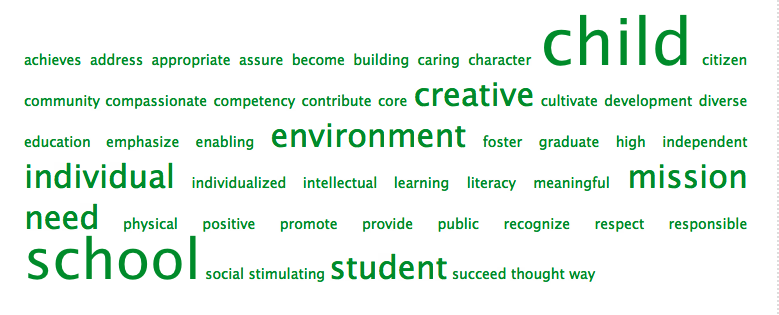
Here is an interesting exercise. Below, there are three randomly selected school mission statements plus the mission statement from my own school, Wamogo Middle/High School. These statements are generic enough to be for any grade level; they could be for any school.  You could test your school’s mission statement as well. I pasted the combination of these four statements into a Wordsift.com word cloud generator that highlights the more frequently used terms. (illustration below)

_______School recognizes that each child is an individual; that all children are creative; that all children need to succeed. Therefore, _______ School respects the individual needs of children; fosters a caring and creative environment; and emphasizes the social, emotional, physical, intellectual development of each child.

Our mission at ____ High School is to provide individualized education that addresses students’ unique learning styles, cultivates independent thought, and promotes the building of character, enabling them to contribute to their communities in meaningful and positive ways.

The mission of _______Public Schools is to assure that, within a nurturing and stimulating environment, each of our diverse students and graduates achieves literacy and appropriate core competencies, and becomes a responsible and compassionate citizen.

The mission of Wamogo is to educate all students in a challenging, disciplined, and supportive environment. In cooperation with students, parents, and community members, we seek to empower students to be lifelong, independent learners and contributors in a diverse and ever changing society. (Wamogo Middle/High School)

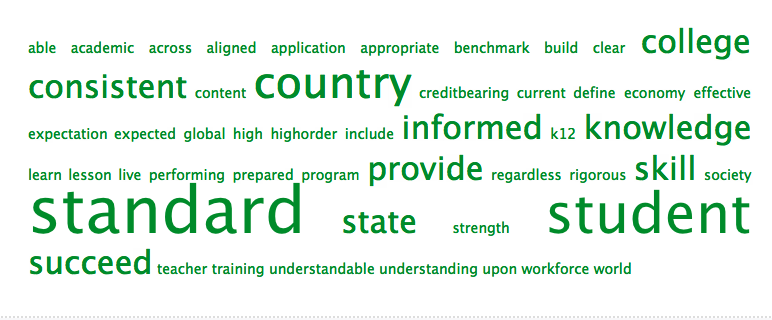
Next, I selected an an excerpt from introduction that explains the purpose and goals of the Common Core State Standards; the text selected was about the same length as the mission statements. I pasted the excerpt  into another Wordsift.com word cloud generator that highlights the more frequently used terms. (illustration below)

The standards are informed by the highest, most effective models from states across the country and countries around the world, and provide teachers and parents with a common understanding of what students are expected to learn. Consistent standards will provide appropriate benchmarks for all students, regardless of where they live.

These standards define the knowledge and skills students should have within their K-12 education careers so that they will graduate high school able to succeed in entry-level, credit-bearing academic college courses and in workforce training programs. The standards:

  • Are aligned with college and work expectations;
  • Are clear, understandable and consistent;
  • Include rigorous content and application of knowledge through high-order skills;
  • Build upon strengths and lessons of current state standards;
  • Are informed by other top performing countries, so that all students are prepared to succeed in our global economy and society; and
  • Are evidence-based.

What is immediately  apparent is that the language in the school mission statement Wordsift wordcloud is very different than the language in the CCSS Wordsift wordcloud. For example, the words education and school do not appear in the CCSS wordcloud; the words skill and knowledge do not appear in the school mission statements wordcloud. The word standard is emphasized in the CCSS wordcloud; the  word child is emphasized in the school mission statement wordcloud. The word career is in the CCSS workcloud; its counterpart is citizen in the mission statement wordcloud. The words college, consistent, informed, provide dominate the CCSS wordcloud. The words creative, environment, individual, need dominate the school mission statement wordcloud. The word student is one of the few emphasized overlapping vocabulary choices. Neither mentions 21st century skills.

I am not a fan of school mission statements. They are usually written by committee, and each successive rewrite makes the language in the statement generalized or vague or bland; I believe that “please all, please none” is the problem with a mission statement. However, one would hope that the differences in diction between a generic mission statement and the Common Core would not be so striking. Ultimately, these two ideas contribute to a common outcome; there should be some commonality other than an emphasis on the word student.

Additionally, the difference is not only one of word choice, but also one of tone. The verbs assure, become, contribute, cultivate, foster, promote, and recognize in the school mission statement wordcloud differ in tone from the few verbs  build, define, learn, live, and graduate in the CCSS wordcloud. The adjectives caring, compassionate, diverse, individualized, stimulating in the school mission statement wordcloud differ in tone from aligned, appropriate, effective, expected, higher order, global and rigorous as adjectives in the CCSS wordcloud. The words social, public and character are not in the CCSS wordcloud; the words economy, benchmark and workforce are not in the mission statement wordcloud. Perhaps it is not a surprise that the language of the mission statements is more sensitive or empathetic in tone than the businesslike language of the CCSS.

My random selection of the three school mission statement plus the statement of my own school cannot possibly speak for all school mission statements. There may be mission statements that have vastly different vocabulary.  Regardless, this imperfect comparison highlights a gap in the language of these mission statements and the language of the CCSS. The goals and purpose of the Common Core should have something in common with goals and purpose of a school.

To some educators, the Common Core State Standards (CCSS) could be consider the work of control freaks. To other educators, the CCSS could be interpreted like the line spoken by Captain Barbossa in Pirates of the Carribean, “the code is more what you’d call ‘guidelines’ than actual rules.”

At my core I am a control freak with strong tendencies towards being a perfectionist. However, 21 years of teaching in real classrooms with real students has informed me to deal with these tendencies in order to achieve realistic educational outcomes. I must teach the student in front of me, not the student I want to teach. I must deal with each student’s  particular mix of strengths and weaknesses. As I deal with that reality, I have learned to hand over more control to my students in their choice of reading and their choice to demonstrate understanding at each grade level.

When I give up control, the results are often unexpected, occasionally raw, and generally more than I planned every year. However, this  process is messy and individualized which is probably why policymakers cannot wrap their neat little statements around what really happens in a classroom. I have learned teaching  in the classroom is more like following the guidelines rather than following a strict set of rules.

But there are those policymakers who claim that following the rules is more important. One argument for this ideology recently was posted by Kathleen Porter-Magee who argues for text complexity in a blog post on the Thomas B. Fordham Institute website, “Common Core Opens a Second Front in the Reading Wars” (8/15/12):

But the Common Core ELA standards are revolutionary for another, less talked about, reason: They define rigor in reading and literature classrooms more clearly and explicitly than nearly any of the state ELA standards that they are replacing. Now, as the full impact of these expectations  starts to take hold, the decision to define rigor—and the way it is defined—is fanning the flames of a debate that threatens to open up a whole new front in America’s long-running “Reading Wars.”

Her missive across the bow of education uses the motif of war, the subject of a 2007 post “Reading Wars Redux”  which scratches at the scab of the phonics vs. whole language debate associating a student’s “natural” selection of a text with whole language; a student’s reading choice does not fit with scientifically-based reading research reading programs. Porter-Magee references that argument as part of a strict adherence to text complexity as outlined in English Language Arts Standard 10 and the complexity determining software.

The ELA Standard 10’s arc begins in kindergarten where students will, “Actively engage in group reading activities with purpose and understanding.” By grades 11-12, students should, “Read and comprehend literature, including stories, dramas, and poems, in the grades 11–CCR text complexity band proficiently, with scaffolding as needed at the high end of the range.” Determination of a text’s rigor is suggested through six different computer programs that factored in the research study: ATOS by Renaissance Learning; Degrees of Reading Power® (DRP®) by Questar Assessment, Inc.; Flesch-Kincaid; The Lexile® Framework For Reading by MetaMetrics; Reading Maturity by Pearson Education; SourceRater by Educational Testing Service; and the Easability Indicator by Coh-Metrix. These educational commercial enterprises (only the Flesh-Kincaid is in the public domain) are the means to determine what Porter-Magee argues is critical to developing rigor in our classrooms.

I would argue differently. A curriculum is not rigorous because of a text; a curriculum is rigorous because of what a student does with a text. Assigning students a rigorous text, say Narrative of the Life of Frederick Douglass, an American Slave in grades 6-8 does not mean the curriculum is rigorous. However, a curriculum with a lesson that has students read the narrative, compare this autobiography with  narratives from former slaves that were recorded in the 1930’s as part of the Federal Writers’ Project, and then have students conduct research on slavery and tell a story based on their findings could be considered rigorous. This lesson would be an example of a whole class read.

This lesson, however, does not promote a critical learning experience. The lesson does not address a student’s love of reading. Students may enjoy the Autobiography of Frederick Douglass, but I would venture that few 6-8th graders would choose to read the text independently. That is why there needs to be a place in every curriculum for independent choice where students may read above, on, or maybe even below grade level. Teachers are educating students so that we will be a nation of readers. My experience in the classroom informs me that handing a low level reader a complex text for close reading does not lead to a love of reading. Moreover, forcing rigor is not authentic; many adults do not choose complex texts, in fact, many admit to avoiding text complexity as a result of being force fed the literary canon in a misguided attempt to enforce rigor.

The ELA CCSS itself does not require the forced rigor that Porter-Magee implies. Appendix A of the ELA CCSS “Key Considerations in Implementing Text Complexity” notes the flexibility that educators have:

The tools for measuring text complexity are at once useful and imperfect. Each of the tools described above—quantitative and qualitative—has its limitations, and none is completely accurate. The question remains as to how to best integrate quantitative measures with qualitative measures when locating texts at a grade level. The fact that the quantitative measures operate in bands rather than specific grades gives room for both qualitative and quantitative factors to work in concert when situating texts. The following recommendations that play to the strengths of each type of tool—quantitative and qualitative—are offered as guidance in selecting and placing texts.

Quantitatively, a book may be at the level for a grade 10 student; qualitatively, the book may be too mature in theme, or the student may need additional support. The ELA CCSS recognizes this difference. That is why Appendix A offers guidelines rather than rules; suggested texts rather than required reading.

This is not a war. This should not be a skirmish. The ELA CCSS can be met with a blend of independent reading and complex texts. (see my earlier post  on blending independent student selected reading with whole class novels) Porter-Magee’s hyperbolic statement about a second front in a reading war is  one of ideology not reality. Teachers, even the most controlling, have an understanding of how text complexity can be balanced in the classroom today with the real students in front of them. Policymakers who see rigor through the addition of texts are distanced from the classroom. Magee-Porter’s post should be met with the same level of criticism as given to the pirates of the Caribbean, “You’re teachers. Hang the code, and hang the rules. They’re more like guidelines anyway.”