Archives For November 30, 1999

test

Standardized testing in Connecticut begins next month. The 10th grade students who are taking a reading comprehension practice test all look like they are engaged. Their heads are bent down; they are marking the papers.  I am trying to duplicate test taking conditions to prepare them for these exams. I also want to compare the scores from this assessment to one taken earlier in the year to note their progress.

Next month, these these students will sit in the same seats, for the same amount of time, perhaps using the same pen or pencil, but they are not the “same”. That is because they are adolescents. They are going through physical changes. They are going through emotional changes. They are are going through a period of social adjustment. Outwardly, they may look calm, but the turbulence inside is palpable.

I imagine if I could tune into their inner monologues, the cacophony would be deafening:

  • “…missed the bus!!!! No time for breakfast this morning…”
  • “…this is the biggest zit I have ever had!…”
  • “…not ready for the math test tomorrow…”
  • “….did I make the team?…”
  • “…why didn’t I get that part in the play?…”
  • “…I forgot the science homework!..”
  • “…When this test was over, I’ve got to find out who he is taking to the dance!..”
  • “…what am I going to do when I grow up?..”
  • “…should I get ride home or should I take the late bus?…”
  • “…Is she wearing the same shirt as me?…”

These students take the practice assessment like other classes of students before them. Unlike generations of students before them, however, social media makes a significant contribution to their behavior. Their access to social media updates with Facebook posts, tweets, or text messages exacerbates the turmoil and creates a social, emotional, hormonal slurry that changes hourly. 

And very soon, in one of those hours, these students will take a real state standardized test.

These factors may explain why the highs and lows of my data collection for several students bear a closer resemblance to an EKG rather than a successful corporate stock report. I may not want to count the results of an assessment for a student because I know what may have gone wrong on that day. However, the anecdotal information I have for a given student on a given day student is not recorded in the collection of numbers; measuring student performance is exclusively the number of items right vs. the number of items wrong.

Yet, there is still truth in the data. When the individual student results are combined as a class, student A’s bad day is mitigated by Student B’s good day. The reverse may be true the following week. Averaging Student A’s results with all the other members of the class, neutralizes many of the individual emotional or hormonal influences. Collectively, the effects of adolescence are qualified, and I can analyze a group score that measures understanding. Ultimately, the data averaged class by class, or averaging a student’s ups and downs, is more reliable in providing general information about growth over time.

Although I try to provide the ideal circumstances in order to optimize test scores, I can never exclude that social, emotional, hormonal slurry swirling in each of their heads. I know that the data collected on any given day might be unreliable in determining an individual student’s progress. I cannot predict the day or hour when a student should take a test to measure understanding.

How unfortunate that this is exacty what happens when students take a state standardized test on a predetermined date during an assigned hour, regardless of what turmoil might be going on in their lives. How unfortunate when that the advocates of standardized testing are never in the classroom to hear the voices in the adolescent students’ internal monologues:“….I am so tired!…..When will this be over?…Does this test really show what I know?”


Ode on Grading (Earned)

January 28, 2013 — 2 Comments

The semester just ended, and there are papers to grade. In addition, the midterms are done, and there are essays and papers to grade. I am surrounded by paper. A recent article titled “Why Teachers Secretly Hate to Grade Papers” by John T. Tierney in The Atlantic received quite a bit of buzz, with most teachers flat out saying, “Secretly? There is nothing secret about our hating to grade!”

The article discussed the inability to be fair when grading, but I particularly enjoyed the following paragraph:

The sheer drudgery and tedium. When you’re two-thirds of the way through 35 essays on why the Supreme Court’s decision in the case of McCulloch v. Maryland is important for an understanding of the development of American federalism, it takes a strong spirit not to want to poke your eyes out with a steak knife rather than read one more. I have lots of friends who are teachers and professors. Their tweets and Facebook status updates when they’re in the midst of grading provide glimpses into minds on the edge of the abyss — and, in some cases, already deranged.

Since several of my classes are deep in the Odyssey, the “poke your eyes out” reference kicked all my Greek allusions into high gear. Consequently, instead of full-fledged blog post that will drain me of the minutes I have before grades are due, I leave you with a quick poetic attempt to capture my grading frustration:

Tantalus Has It Easy

My desk is piled high
with papers and essays that had been assigned
during the Christmas break,
when Dawn spread her rosy fingers on the
new year calendar empty of responsibilities.

Sing in me, Muse, and tell me
What was I thinking? an invocation I repeat
with each carefully completed grading rubric
stapled to a hastily penned paper.

More than one paper bears the correcting
suggestions I had made days ago without
the corrections I suggested. I am Cassandra,
unhappy prophetess whose warnings
go unheeded.

I hear a teacher’s scantron sheets
click noisely in the teacher’s room next door.
“Grading’s done,” he chortles, while I am
caught between the Scylla of unintelligible answers
and the Charybdis of illegible handwriting.

I see the PE teacher leaving early to workout
the stress of the week at the local fitness club.
Apparently, fate favors
the Olympically-sculpted

While I, like Sisyphus,upload_6i2s45k8nordin9cemradc8sv7249883.jpeg-final
reach for another paper to roll up
the grading curve.

Busines_heroThe association of midterm exams with freezing is both literal (I teach in the Northeast) and figurative  (many students “freeze up” during an exam), so at the end of this semester, I took one of the writing standards from the Common Core State Standards  hoping at the very least to stop the “freeze” in the classroom during the exam. Instead of a multiple choice exam with essay questions, I prepared my 12th grade students to write an inquiry paper that would be due the morning of the exam. Yes, even those seniors who had repeatedly assured me that they will never go to college would be tasked with a three to five page paper academic paper that touched on the material that we had read over the course of the semester.

The Common Core State Standard I had in mind was ELA Literacy Standard W.11-12.7:

Conduct short as well as more sustained research projects to answer a question (including a self-generated question) or solve a problem; narrow or broaden the inquiry when appropriate; synthesize multiple sources on the subject, demonstrating understanding of the subject under investigation.

I admit, the draw for me was the “self-generated question”. We had started the “Hero or Monster” English elective brainstorming the following questions:

  • What is the difference between a hero or monster?
  • What criteria do we use to determine who or what is a hero?
  • What criteria do we use to determine who or what is a monster?

We read about monsters in Louis Stevenson’s  Dr. Jekyll and Mr. Hyde and Mary Shelley’s Frankenstein. We read excerpts from Milton’s  Paradise Lost, and we  studied the monsters of mythology (Cyclops, Widiego, Fenris, Leviathan).

We read about heroes in the Iliad and in Roger Rosenblatt’s essay The Man in the Water. We looked at Joseph Campbell’s study of The Hero’s Journey, and we created our own superheroes. Students also read an independent book and determined the hero (or anti-hero) in that text. Finally, we used current events to discuss the monsters and heroes in everyday life.

As the quarter came to a close,  each student had to come up with a “self-generated” question. I was happy to see how these texts had served to inform their line of inquiry. Questions included:

  • Was the hero really a hero before the monsters came along? Does the Hero need a Monster to be a hero?
  • How does our exposure to monsters when we are children inform our views of monsters when we grow up?
  • How does “bad parenting” figure in the development of a monster?
  • How has the criteria of strength in a hero changed since ancient times?

The students had two weeks to frame their questions and find evidence that would support their positions. Our “Bring Your Own Digital Device” (BYOD) policy was an important part of the organization and writing of the paper. Students had access to e-texts, and they had links to sources or discussions that we had placed on the class wiki during the semester. I created a Google doc folder and their papers were available for peer editing or for my comments as they worked. One night, I popped in on a few papers to see their progress. As I was leaving comments on one paper,  I saw the following text appear, “Mrs. Bennett, you are on my paper as I am writing….this is creeping me out.”  Creeping them out or not, I was able to provide guidance as they incorporated citations from the texts we had read in class into their arguments.

I am pleased to write that my gambit for this midterm exam worked. The papers are in, and many exceeded my expectations, proving that the writing standard 7 for grades 11 and 12 that requires a self-generated question is appropriate for this grade level.The self-generated question kept them more engaged because this was their inquiry, and as they wrote,  they came to conclusions that they incorporated into their papers:

Throughout the course of writing this paper, I have come to a surprising realization. It has come to my attention that the heroes that we idolize and fawn over (Hector, Achilles, etc.) are not always as heroic as the everyday, ordinary people who rise to the occasion when chaos ensues.

When Hector went into battle in the Iliad in ancient times, he may have had the same thought as the “Man in the Water” in 1982, the thought that “I might die doing this.” That thought did not stop either of them, and both men are still talked about; they are held high and admired. Time does not change our appreciation of heroes.

Some of these true monsters, (Satan of Paradise Lost and Victor of Frankenstein) have used their cunning ways to confuse or deceive the reader so they cannot be seen as the monsters they are.

The inquiry paper, which does permit the use of the pronoun “I”, has been a much easier way to teach academic research and improve a student’s understanding of an author’s intent. Furthermore, the research students included in their papers reflected a wide range of texts; papers were longer, and the evidence was organized according to information rather than the ubiquitous five-paragraph framework.  More than one student remarked how their fingers seemed to know what to write; more than one told me how the inquiry gave them ideas they found surprising.

While I may not yet know the impact of all the standards from the Common Core, I will state unequivocally that the self-generated question allowed me to successfully measure what students learned about heroes and monsters in both literature and in real-life. Correcting these papers has been less of an “ARRRG!” (insert monster voice) and more of a “Hurray!” (insert heroic cheer!).

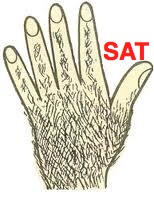
hairy handSince many college applications are due between January 1 and February 1, I know that many of my students are fretting about their SAT scores. I wish I could tell them to relax, that the score is just a score, and that they will never have to hear the words SAT again, but that would not be telling them the truth. The hairy hand of the SAT can reach far forward into their future. An SAT score is a brand, locking academic potential in a data point where we are forever 17 years old.

When I took the test, it was known as the Scholastic Aptitude Test, and that was before it became known as the Scholastic Assessment Test. At that time, the top score was a 1600, and there was no writing section. There were no pre-tutoring sessions from pricey tutors available after school or on Saturdays to practice for the SAT. I think I glanced through a practice book.

That Saturday morning, I was dropped off by my father in our 68 VW van along with hundreds of equally bleary-eyed seniors. I think I paid that day because I waited for him to write out a check. About two hours later in the middle of the math section, I remember thinking “Whoa…maybe I should have studied for this.” I had approached this milestone in my life with a little too much confidence and too little breakfast. I came out of that ordeal exhausted and starved.

Some 38 years later, I am still reminded about the results from that day. For example, on applications to graduate school, there is always a question on my score on the SATs taken back in 1974.

“Really?” I think to myself, “I am so much better a student today. I have two graduate degrees, and I am gainfully employed in the field of education. I am a very differently educated person from my 17 year old self. Then I was financially strapped, working part-time in a pizza restaurant, and I had yet to attend my first rock concert. Yet, you still want to know what my high school SAT score was?”

While I am not ashamed of my score, I am not posting it, either. Fortunately, because of my SAT score, I have been able to waive out of other standardized tests, for example, the Praxis I in Connecticut which requires a combined minimum score of 1000. You can be content to know I met this minimum standard with several hundred points to spare. I did very well on the verbal, but in retrospect, I probably could have done better had I prepared for the math section a little more.

So when I come to that question on an application, I think how that score taken when I was 17 one cold spring morning cannot accurately reflect who I am today. Nor do I think that an SAT score accurately reflects who my students are either. At this time of year, I hear them discuss numbers as they explain why they may or may not, or did or did not, get into a college of their choice. Sometimes I am surprised to hear particularly high or low scores, however, this information never changes my opinion of the student I have seated in my class. A student with a particularly high SAT score may never turn a paper in on time and have a failing grade while a student with a low SAT score may have an “A” in my class because every assignment is done on time or revised when recommended. The SATs may be an “indicator”, but these are students, not numbers. The score on an SAT can still fall subject to human error.

I do not think at age 17 that I fully understood how far forward into my future the hairy hand of the SAT would travel. I doubt my students understand, but I hope they know that their future will not depend on their 17 year old academic selves.

I suppose I should be grateful that when I am asked for my SAT score, that there is not also a request for   additional identification, say, a picture of me in that decade. That thought is chilling. The hiphuggers, bell bottoms, velvet jackets, and ubiquitous leotards of my high school decade are positively comical.My yellow chiffon prom dress is particularly hilarious. On the whole, I’d rather they see my SAT score.

Screen Shot 2013-01-09 at 4.41.58 PM

Wikipedia photo -Elie Wiesel

By my calculations, at the mid-point of the school year, many World History classes are studying World War II. Should these classes want to increase their use of an informational text in English or Social Studies curriculum, I suggest Elie Wiesel’s noteworthy speech The Perils of Indifference.

Wiesel delivered this speech to Congress on April 12, 1999. The speech is 1818 words long and connects Wiesel’s experience at the concentration camp at Aushwitcz with the genocides of the late 20th Century using a single powerful word: indifference.

In his speech, Weisel states clearly:

Indifference, then, is not only a sin, it is a punishment. And this is one of the most important lessons of this outgoing century’s wide-ranging experiments in good and evil.

Our English Department has used this speech in the past as a complement to Wiesel’s memoir Night which has been a used as a whole class read.  This year, we are giving Night to the Social Studies classes. They will adopt this memoir in order to increase the assigned informational text reading in their discipline mandated by the Literacy Common Core State Standards in History and Social Studies (CCSS). The English Department will still offer supplemental texts  that students can choose to read independently.

When he gave this speech, Wiesel had come before the US Congress to thank the American soldiers and the American people for liberating the camps at the end of World War II. Wiesel had spent nine months in the Buchewald/Aushwitcz complex. His mother and sisters had been separated from him when they first arrived: “Eight short, simple words… Men to the left, women to the right”; these family members were killed in the ovens. He and his father survived starvation, disease, and the deprivation of spirit. His father eventually succumbed, and Wiesel guiltily admits at the end of the memoir that at his father’s death he felt relieved.

Eventually, Wiesel felt compelled to testify against the Nazi regime, and he wrote the memoir Night to bear witness against the genocide which killed his family and six million Jews. His speech was delivered 54 years after he was liberated by American forces.

His gratitude to these American forces is what opens the speech, but after the opening paragraph, Wiesel seriously admonishes America to do more to halt genocides all over the world. By not intervening on behalf of those victims of genocide, he states clearly, we are indifferent to their suffering:

Indifference, after all, is more dangerous than anger and hatred. Anger can at times be creative. One writes a great poem, a great symphony, one does something special for the sake of humanity because one is angry at the injustice that one witnesses. But indifference is never creative.

My students have always been struck by Wiesel’s juxtaposition of anger and creativity. More than one has agreed pointing to making a “good” creation: an amazing song about an ex-boyfriend or a painting slapped together with passion. They also do not want to be treated indifferently. Yet, Wiesel makes them think beyond themselves:

Indifference is not a beginning, it is an end. And, therefore, indifference is always the friend of the enemy, for it benefits the aggressor — never his victim, whose pain is magnified when he or she feels forgotten. The political prisoner in his cell, the hungry children, the homeless refugees — not to respond to their plight, not to relieve their solitude by offering them a spark of hope is to exile them from human memory. And in denying their humanity we betray our own.

I remember several years ago, one student in my English 10 class, Rick, was particularly bright, fun, and full of daring. He also had an exceptional understanding of math and statistics. That January, I introduced the memoir Night as I had in previous years by providing a little background information.

“Six million Jews were killed during the Holocaust,” I recited off from my list of facts.

“What?” a startled Rick looked up. “Six million?” He was aghast. “That can’t be right.” He looked around at his classmates. “Six million?” They looked at him blankly. “Come on,” he was looking for some support, “That can’t be right.”

“Why?” I asked.

“Do you know how many six million things are?” He was indignant.

“Six million people,” I responded.

“People, yes. People, six million is a lot of people….” Rick was clearly operating with a different level of understanding from his more placid classmates. He understood six million as quantity; he did understand what six million things would look like if stacked up. Other students stirred in their seats.  “No way….six million,” he repeated growing more agitated. “How? How did anyone let this happen?” he asked; he was half-rising out of his seat. “Did we know?”

“Yes,” I remember saying. I do remember explaining that, yes, America did know that Hitler had concentration camps, and that more documentation collected after the war indicated that many of our military and political leaders knew about these camps. That is one of the points from Wiesel’s speech.

I pointed out to the class that the Holocaust was only one example of genocide; that there were others. In fact, that there was recently a genocide in Darfur. Rick sat down; he was overwhelmed. He was capable of understanding numerically the devastation of the Holocaust, and he was clearly upset. “Why do we let this happen?” he asked. I remember his voice was so sad, so full of disbelief.

In The Perils of Indifference, Wiesel asks

Does it mean that we have learned from the past? Does it mean that society has changed? Has the human being become less indifferent and more human? Have we really learned from our experiences? Are we less insensitive to the plight of victims of ethnic cleansing and other forms of injustices in places near and far?

Wiesel’s rhetorical questions echo Rick’s “Did we know?” In trying to respond, Wiesel makes the reader uncomfortable the way Rick was uncomfortable. Creating this kind of emotional impact on a reader is the reason Wiesel’s speech should be taught.

The Common Core State Standards (CCSS) demand that students read informational texts but does not require specific texts. Wiesel’s The Perils of Indifference contains the information and rhetorical devices that meet the text complexity criteria of the CCSS. More specifically, Wiesel’s message is necessary if we want our students to confront the conflicts in this new 21st Century. Our students must be prepared to question why “deportation, the terrorization of children and their parents be allowed anywhere in the world?“

Our humanity should demand nothing less.

Bond.

James Bond.

007.

On Her Majesty’s Secret Service, and (surprise!) a metaphor for why relying on the standardized test is flawed.

Honestly, I was not expecting Skyfall, the latest James Bond blockbuster, to resonate with issues being discussed in educational reform today, but sitting in the darkened theatre, I suddenly heard the same concerns about the validity of tests used in assessing secret agents that I hear in assessing students.

Apparently, M-I 6 wrestles with the question: Do tests really measure ability?

Spoiler Alert! If you are someone who intends to see the film, I may be giving away a few facts; not major plot points, but a few incidental pieces of information. Bond Purists-stop reading now, please.

Before Bond (Daniel Craig) returns to work for M (Dame Judi Dench), he needs to pass a set of standardized performance tests. He is first put through a series of grueling fitness tests. He is tested on his ability to shoot a pistol at various distances in a firing range. Finally, he faces a series of psychological tests. The results of how well he succeeded in this battery of objective tests is initially kept from the audience, but the viewers are not surprised when he eventually returns to service.

Painting at the National Gallery in London

The film’s screenwriters saw fit to combine the concerns about the results of these tests with M-I 6’s concerns about Bond’s age. No scene is more direct in confronting Bond’s age than in his first meeting with the young gadget supplier “Q”. The filmmakers placed Bond at a British National Gallery sitting on a bench looking at J.M.W. Turner’s painting Fighting Temeraire Tugged to Her Last Berth To Be Broken Up, 1838 .

Turner’s symbolic message of the painting depicts the shift from sail power to coal engine, the billowing white clouds swirling like sails a stark contrast to the blackened smokestack of the tug in the forefront of the painting.  Q enters, sits next to Bond, and strikes up a conversation:

Q: It always makes me feel a bit melancholy. Grand old war ship. being ignominiously haunted away to scrap… The inevitability of time, don’t you think? What do you see?
Bond:  A bloody big ship. Excuse me.
Q: 007. I’m your new Quartermaster.
Bond: You must be joking.
Q:  Why, because I’m not wearing a lab coat?
Bond: Because you still have spots.
Q: My complexion is hardly relevant.
Bond: Your competence is.
Q: Age is no guarantee of efficiency.
Bond:  And youth is no guarantee of innovation.

Skyfall (http://www.imdb.com/title/tt1074638/quotes)

Of course, the M-I 6 tests are designed to determine if Bond is too old, if his brand of “boots on the ground” spying should be replaced by agents in command of newer technologies. And of course, M is obligated to submit Bond to the required standardized tests, tests given on one particular day. However, she is not obligated to act on the results of the tests.

M’s response, therefore, is to weigh what audiences know are the 50 years of evidence on Bond’s unconventional performance as a creative problem solver. She recognizes that Bond possesses those intangible qualities of initiative and drive, and while a standardized test does measure a level of ability, what makes Bond a valuable British agent is his ability to confound a standard.

Watching James Bond puzzle the test-driven establishment is a large part of the enjoyment for the audience. Agent 007 cannot be limited by a test score if he is going to save the free world.

Which brings me back to the shared message about testing from Skyfall and its application to education reform. The audience understands that the testing in Skyfall is flawed because of the limited results; standardized testing in education is similarly limited. Like M, educators should not let their students be defined by test scores from standardized tests, those single metric assessments given on one day. Like M, educators should pay more attention to having students develop problem-solving skills and to consider other assessments that measure students’ critical thinking skills.  Students should have the opportunity to be evaluated on the intangible qualities of initiative and drive through project-based learning. Like Agent 007, students should be allowed the opportunity to confound those standards measured by objective testing.

Oh, and maybe they could also ask for their chocolate milk shaken, not stirred.

An interviewer can ask a question to get the answer he or she wants to hear. That may have been the case on September 2, 2012 when   CBS’s 60 Minutes  framed a question on educators and education. The interview featured Google chairman Eric Schmidt who was responding to questions about Sal Khan, founder of the Khan Academy. The educational enterprise Khan Academy began as a series of math video tutorials given by Khan for his nephew in 2004. Khan Academy expanded into its own YouTube channel to feature other disciplines including history, healthcare and medicine, finance, physics, chemistry, biology, astronomy, economics, cosmology, organic chemistry, American civics, art history, macroeconomics, microeconomics, and computer science. Schmidt was heaping praise on Sal Khan when he was asked, “He [Khan] was the guy to sort of make this happen? Why do you think it was him and not some person who was an educator, who had a background in this area?”

Schmidt’s response was incredibly disappointing:

“Innovation never comes from the established institutions. It’s always a graduate students or a crazy person or somebody with a great vision.”

With one sweeping over-generalization, Schmidt and the producers of 60 Minutes dismissed the efforts of our nation’s teachers as innovators inferring that outsiders, specifically outsiders from the business world, are better equipped to reform our education system.

Both Schmidt and the producers of 60 Minutes are wrong. Teachers are innovative.
Just look at the definition of “to innovate”:

1: to introduce as or as if new (as transitive verb)
2 (archaic) : to effect a change in
3: to make changes : do something in a new way

“To innovate” is conceptually connected to the verb “to teach”; teachers introduce content as new, effect a change in understanding, and encourage students to make changes in order to prepare for the future. Our nation’s public school system is an innovative effort; no other nation has so purposefully engaged in the enterprise of educating ALL children, regardless of ability or disability.

Apparently, Mr. Schmidt blanked on the relationship between his company and teachers who are familarizing students with Google’s mutiple applications. The Google Educator Academy is offered to teachers so they can better learn how to integrate Google products into classrooms. Of course, the Google Educator Academy also allows Google designers the opportunity to pick the brains of innovative educators as to what is needed in the classroom. For example, many teachers innovate with Google products in ways engineers did not anticipate. I doubt that when Google Maps programmers designed the software to provide directions on virtual maps that they anticipated teachers would use their program to create as virtual field trips to locations in literature. There are hundreds of these trips online including Jon Krakauer’s Into the Wild, Christopher Curtis’s The Watsons Go To Birmingham, or David Wiesner’s Flotsam. My own Grade 12 students have created their “journeys of life” dropping their pins and explanations on their own Google Maps. Everyday, teachers use the available technologies in ways the creators never imagined.

Teachers are not in the business of developing technologies. Developing technologies are in the purview of engineers, graduate students, or a Schmidt put it, some “crazy person”. Instead teachers innovate with creativity and flexibility everyday in the classroom to promote understanding for diverse learning styles. At any moment, a change in schedule (fire drill, student emergency) could require an immediate shift in plans, a demand for innovation. An elementary teacher needs to be prepared to walk into a classroom at any grade level armed with little else than a picture book and innovate a writing lesson for pen and paper or for an open software program. Subject area teachers need to be innovative in content areas: to deliver a memorable lesson on percentages with pizza (virtual or otherwise), or to implement a lesson on measuring area using nothing but paper clips (virtual or otherwise), or to create a lesson on character development using paper bag puppets or animation software. Before accepting the premise that teachers are not innovative, consider how you might engage 24 fifth graders right after a recess period. If you are not innovative, I can assure you that 45 minute period will be memorably exhausting and/or uncomfortable..

While I certainly appreciate Sal Khan’s innovative contributions of providing video tutorials, I would also like to point out that his method of delivering content takes place some distance away from the classroom. His Khan Academy is a great supplement or complement to education, but the Khan Academy cannot replace the role of the teacher in the classroom. Khan’s methodology of taping lectures is also not entirely innovative. Eric Mazur at Harvard developed Peer Instruction in the 1990s, and the birth of YouTube in 2007 saw a plethora of teachers providing lessons for students. The Flipped Classroom Movement, started by teachers, is currently adopting the practices and offering variations to Khan Academy. What does bear remembering is that Khan’s position as a hedge fund manager provided him the time, financing, and connections to develop and market his Academy’s method to deliver content. Teachers do not have those resources so readily available.

Finally, I would suggest to Mr. Schmidt that innovation most certainly does come from established institution of education, and that he need only look around the offices and boardrooms of Google to see how traditional education has directly benefitted his company. Every single person in these rooms has had an education from an established institution, yet they are considered innovators. The people at Google, however, are not under the same kind of pressure to innovate at least five (5) hours a day for a minimum of 180 days a year.  That grueling pace is what innovative teachers keep.

 David Coleman, incoming president of the College Board is staring out from the front cover of the October 2012 issue of The Atlantic . Actually, he is not staring. I think he is smirking…a Cheshire Cat smirk.

He has every reason to smirk. Coleman one of the architects of the Common Core State Standards has emerged as one of the more influential education policymakers to change what will be taught in classrooms and how this content will be taught without ever having spent time in the classroom himself.

Yes, Coleman has never taught in a public school classroom, although he was very successful as a student. He was educated in the Manhattan public school system, the son of highly educated parents, his father, a psychiatrist, and his mother, president of Bennington College. His privileged liberal arts credentials are immersive and include Yale, a Rhodes Scholarship, Oxford, and Cambridge.

His perspective on education has been informed by the business side of education which included pro-bono work at the management consulting firm McKinsey & Company. He developed and sold the assessment company Grow Network; co-founded and sold Student Achievement Partner; and most recently, accepted a position as president of The College Board.

Coleman has materialized, like Lewis Carroll’s enigmatic Cheshire Cat, as the cool outsider who surveys education as a Wonderland ruled by nonsense. He has promoted an agenda of close reading and an increase in non-fiction, to a ratio of 70% of all required reading by grade 12, from his perch high above the daily dust-ups of the average classroom.

Now, after developing the CCSS, replete with new batteries of state tests, he has moved on to the pinnacle of high stakes testing, the SAT. His arrival comes amid renewed concerns from studies about the SAT that demonstrate the unfairness of the test for minorities, females, and students living in poverty.

While I can embrace many of the standards in the English Language Arts Common Core State Standards (CCSS),  I remain unconvinced by Coleman’s sweeping claims that “close reading” lessons  of several days focused on a complex and difficult text is critical to improving understanding. I have practiced close reading, but not with the singular and tortuous focus Coleman advocates. There is little research as to how this approach will improve reading skills for all students. For 21 years, I have been a “boots on the ground” promoter of reading to a population of students who are reading less and less of the assigned materials, so I speak from experience when I state that Coleman’s emphasis on close reading can have an adverse effect on an already poor reader.

Furthermore, Coleman negates the effectiveness of the past 35 years of having students engage with a text using Louise Rosenblatt’s Reader Response Theory. His blunt charge “as you grow up in this world you realize people really don’t give a sh*t about what you feel or what you think” is simply not true. I cannot imagine any author who would not want to know what a reader thought. Writing is supposed to inspire; writing is an invitation to a dialogue. Furthermore, how will not listening to what students thought engage them in writing at all?

The question is how did Coleman get to place his large footprint on education, and why did teachers let him move into this position? Were teachers so preoccupied with teaching that they failed to see how the dynamics of education were moving from engaging leaders from public school institutions to accepting leadership from more commercial enterprises?

Dennis Van Roekel alluded to the rise of Coleman and others like him when he delivered an address to the National Education Association 91st Representative Assembly this past July:

Are we willing to assert our leadership, and take RESPONSIBILITY for our professions?
The demands of our work are changing as our students change, and the world around us is changing too – ever so fast.I say it is time for us to lead the next generation of professionals – in educating the next generation of students!

I’m so tired of OTHERS defining the solutions… without even asking those who do the work every day of their professional life.
I want to take advantage of this opportunity for US to lead – and I’m not waiting to be asked, nor am I asking anyone’s permission.

Because if we are not ready to lead, I know there are many others ready, willing, and waiting to do it for us. Or maybe I should say, do it “to” us.

Van Roekel’s quote echoes the question rhetorically posed by noted educator Lucy Caulkins at her presentation of the 82nd reunion at Columbia Teacher’s College, “Where is the proof, David Coleman, that your strategy works?”

Coleman’s ascent to the top of American education policy has been steady. He made contributions to the CCSS which will result in nationwide metrics for grades K-12. Add this testing to his new control of the SAT, and his influence on American education and the tests that measure learning will continue through the college level, all without his having the informative experience of teaching in a classroom. That any one individual without any teaching experience could have had this impact on the daily workings of the classroom is a commentary on the current state of madness that public education now finds itself.

At one point in in her Adventures in Wonderland, Alice comes across the Cheshire Cat in the hope of finding her way out:

‘But I don’t want to go among mad people,’ Alice remarked.
‘Oh, you can’t help that,’ said the Cat: ‘we’re all mad here. I’m mad. You’re mad.’
‘How do you know I’m mad?’ said Alice.
‘You must be,’ said the Cat, ‘or you wouldn’t have come here.’

Carroll’s Cheshire Cat character is a tease, an enigmatic riddler who offers judgments and cryptic clues but no  solution to the frustrated Alice. Coleman is education’s Cheshire Cat, offering positions in education but with no evidence to prove his solutions will work.

Curiouser and curiouser. David Coleman has become one of the most influential educational policymakers in our public school systems, but at this time, we have little else but his smirk.

Is this the Age of Enlightenment? No.
Is this the Age of Reason? No.
Is this the Age of Discovery? No.

This is the Age of Measurement.

Specifically, this is the age of measurement in education where an unprecedented amount of a teacher’s time is being given over to the collection and review of data. Student achievement is being measured with multiple tools in the pursuit of improving student outcomes.

I am becoming particularly attuned to the many ways student achievement is measured as our high school is scheduled for an accreditation visit by New England Association of Schools and Colleges(NEASC) in the Spring of 2014. I am serving as a co-chair with the very capable library media specialist, and we are preparing the use of school-wide rubrics.

Several of our school-wide rubrics currently in use have been designed to complement scoring systems associated with our state tests,  the Connecticut Mastery Tests (CMT) or Connecticut Academic Performance Tests (CAPT). While we have modified the criteria and revised the language in the descriptors to meet our needs, we have kept the same number of qualitative criteria in our rubrics. For example, our reading comprehension rubric has the same two scoring criteria as does the CAPT. Where our rubric asks students to “explain”, the CAPT asks students to “interpret”. The three rating levels of our rubric are “limited”, “acceptable”, and  “excellent” while the CAPT Reading for Information ratings are “below basic”, “proficient”, and “goal”.

We have other standardized rubrics, for example, we have rubrics that mimic the six scale PSAT/SAT scoring for our junior essays, and we also have rubrics that address the nine scale Advanced Placement scoring rubric.

Our creation of rubrics to meet the scoring scales for standardized tests is not an accident. Our customized rubrics help our teachers to determine a student’s performance growth on common assessments that serve as indicators for standardized tests. Many of our current rubrics correspond to standardized test scoring scales of 3, 6, or 9 points, however, these rating levels will be soon changed.

Our reading and writing rubrics will need to be recalibrated in order to present NEASC with school-wide rubrics that measure 21st Century Learning skills; other rubrics will need to be designed to meet our topics. Our NEASC committee at school has determined that (4) four-scale scoring rubrics would be more appropriate in creating rubrics for six topics:

  • Collaboration
  • Information literacy*
  • Communication*
  • Creativity and innovation
  • Problem solving*
  • Responsible citizenship

These six scoring criteria for NEASC highlight a gap of measurement that can be created by relying on standardized tests, which directly address only three (*) of these 21st Century skills. Measuring the other 21st Century skills requires schools like ours to develop their own data stream.

Measuring student performance should require multiple metrics. Measuring student performance in Connecticut, however, is complicated by the lack of common scoring rubrics between the state standardized tests and the accrediting agency NEASC. The scoring of the state tests themselves can also be confusing as three (3) or six (6) point score results are organized into bands labelled 1-5. Scoring inequities could be exacerbated when the CMT and CAPT and similar standardized tests are used in 2013 and 2014 as 40 % of a teacher’s evaluation, with an additional 5% on whole school performance. The measurement of student performance in 21st Century skills will be addressed in teacher evaluation through the Common Core State Standards (CCSS), but these tests are currently being designed.  By 2015, new tests that measure student achievement according to the CCSS with their criteria, levels, and descriptors in new rubrics will be implemented.This emphasis on standardized tests measuring student performance with multiple rubrics has become the significant measure of student and teacher performance, a result of the newly adopted Connecticut Teacher Evaluation (SEED) program.

The consequence is that today’s classroom teachers spend a great deal of time reviewing of data that has limited correlation between standards of measurement found in state-wide tests (CMT,CAPT, CCSS) with those measurements in nation-wide tests (AP, PSAT, SAT, ACT) and what is expected in accrediting agencies (NEASC). Ultimately valuable teacher time is being expended in determining student progress across a multitude of rubrics with little correlation; yes, in simplest terms, teachers are spending a great deal of time comparing apples to oranges.

I do not believe that the one metric measurement such as Connecticut’s CMT or CAPT or any standardized test accurately reflects a year of student learning; I believe that these tests are snapshots of student performance on a given day. The goals of NEASC in accrediting schools to measure student performance with school-wide rubrics that demonstrate students performing 21st Century skills are more laudable. However, as the singular test metric has been adopted as a critical part of Connecticut’s newly adopted teacher evaluation system, teachers here must serve two masters, testing and accreditation, each with their own separate systems of measurement.

With the aggregation of all these differing data streams, there is one data stream missing. There is no data being collected on the cost in teacher hours for the collection, review, and recalibration of data. That specific stream of data would show that in this Age of Measurement, teachers have less time for /or to work with students; the kind of time that could allow teachers to engage students in the qualities from ages past: reason, discovery, and enlightenment.

Going back to school means that teachers and students will confront two philosophical statements. One statement is the school’s mission statement that quite literally confronts them as they enter a school building. The second statement is the statement of purpose for the Common Core State Standards (CCSS) that currently guides the curriculum for K-12 teachers in states that adopted the CCSS.

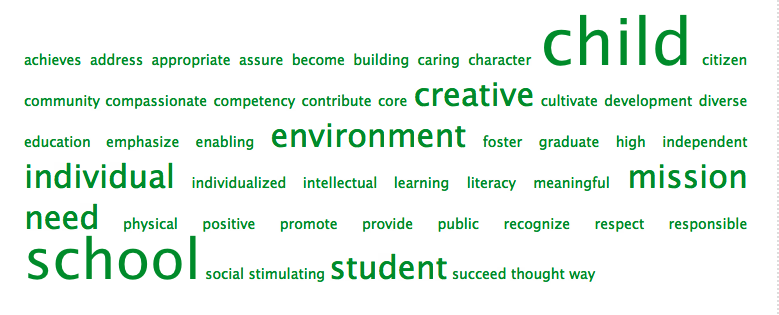
Here is an interesting exercise. Below, there are three randomly selected school mission statements plus the mission statement from my own school, Wamogo Middle/High School. These statements are generic enough to be for any grade level; they could be for any school.  You could test your school’s mission statement as well. I pasted the combination of these four statements into a Wordsift.com word cloud generator that highlights the more frequently used terms. (illustration below)

_______School recognizes that each child is an individual; that all children are creative; that all children need to succeed. Therefore, _______ School respects the individual needs of children; fosters a caring and creative environment; and emphasizes the social, emotional, physical, intellectual development of each child.

Our mission at ____ High School is to provide individualized education that addresses students’ unique learning styles, cultivates independent thought, and promotes the building of character, enabling them to contribute to their communities in meaningful and positive ways.

The mission of _______Public Schools is to assure that, within a nurturing and stimulating environment, each of our diverse students and graduates achieves literacy and appropriate core competencies, and becomes a responsible and compassionate citizen.

The mission of Wamogo is to educate all students in a challenging, disciplined, and supportive environment. In cooperation with students, parents, and community members, we seek to empower students to be lifelong, independent learners and contributors in a diverse and ever changing society. (Wamogo Middle/High School)

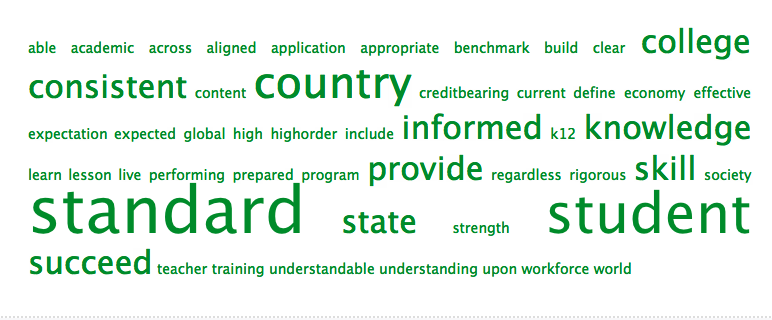
Next, I selected an an excerpt from introduction that explains the purpose and goals of the Common Core State Standards; the text selected was about the same length as the mission statements. I pasted the excerpt  into another Wordsift.com word cloud generator that highlights the more frequently used terms. (illustration below)

The standards are informed by the highest, most effective models from states across the country and countries around the world, and provide teachers and parents with a common understanding of what students are expected to learn. Consistent standards will provide appropriate benchmarks for all students, regardless of where they live.

These standards define the knowledge and skills students should have within their K-12 education careers so that they will graduate high school able to succeed in entry-level, credit-bearing academic college courses and in workforce training programs. The standards:

  • Are aligned with college and work expectations;
  • Are clear, understandable and consistent;
  • Include rigorous content and application of knowledge through high-order skills;
  • Build upon strengths and lessons of current state standards;
  • Are informed by other top performing countries, so that all students are prepared to succeed in our global economy and society; and
  • Are evidence-based.

What is immediately  apparent is that the language in the school mission statement Wordsift wordcloud is very different than the language in the CCSS Wordsift wordcloud. For example, the words education and school do not appear in the CCSS wordcloud; the words skill and knowledge do not appear in the school mission statements wordcloud. The word standard is emphasized in the CCSS wordcloud; the  word child is emphasized in the school mission statement wordcloud. The word career is in the CCSS workcloud; its counterpart is citizen in the mission statement wordcloud. The words college, consistent, informed, provide dominate the CCSS wordcloud. The words creative, environment, individual, need dominate the school mission statement wordcloud. The word student is one of the few emphasized overlapping vocabulary choices. Neither mentions 21st century skills.

I am not a fan of school mission statements. They are usually written by committee, and each successive rewrite makes the language in the statement generalized or vague or bland; I believe that “please all, please none” is the problem with a mission statement. However, one would hope that the differences in diction between a generic mission statement and the Common Core would not be so striking. Ultimately, these two ideas contribute to a common outcome; there should be some commonality other than an emphasis on the word student.

Additionally, the difference is not only one of word choice, but also one of tone. The verbs assure, become, contribute, cultivate, foster, promote, and recognize in the school mission statement wordcloud differ in tone from the few verbs  build, define, learn, live, and graduate in the CCSS wordcloud. The adjectives caring, compassionate, diverse, individualized, stimulating in the school mission statement wordcloud differ in tone from aligned, appropriate, effective, expected, higher order, global and rigorous as adjectives in the CCSS wordcloud. The words social, public and character are not in the CCSS wordcloud; the words economy, benchmark and workforce are not in the mission statement wordcloud. Perhaps it is not a surprise that the language of the mission statements is more sensitive or empathetic in tone than the businesslike language of the CCSS.

My random selection of the three school mission statement plus the statement of my own school cannot possibly speak for all school mission statements. There may be mission statements that have vastly different vocabulary.  Regardless, this imperfect comparison highlights a gap in the language of these mission statements and the language of the CCSS. The goals and purpose of the Common Core should have something in common with goals and purpose of a school.