Archives For November 30, 1999

Rosetta

The Rosetta Stone currently located in The British Museum in London, England.

When I stood in front of the Rosetta Stone in the British Museum in London, I had to wiggle my way through the blockade of tourists who were trying to photograph the small black tablet. Since the stone was encased in glass, I knew the reflections from the camera flashes would result in poor quality photos. Once I had my few seconds before the 2200 year old tablet, I headed off to the gift shop to secure a clear photo of the Rosetta Stone and a small plaster recast of the dark black stone; both yielded far more details than I saw when I was squeezed by the crowd.

The face of the Rosetta Stone, one of two tablets, is etched with three different scripts, each spelling out the same decree issued by King Ptolemy V from Memphis (Egypt) in 196 BCE. These inscriptions translate Ptolemy’s decree in three scripts: the upper text is Ancient Egyptian hieroglyphs, the middle portion Demotic script, and the lowest Ancient Greek. Because the Rosetta Stone presented the same text in each script (with a few minor differences among them), the tablet provided the key to our modern understanding of Egyptian hieroglyphs.

Since the Rosetta Stone is often used as a metaphor for using an essential clue to a new field of knowledge, why not use the Rosetta Stone as a metaphor for explaining the role of data, specifically standardized test data, in informing classroom instruction? Imagine that different stakeholders, (school administrators, teachers, students, parents and test creators ) who look at the results of standardized tests are like those who crowd before the Rosetta Stone trying to decipher its meaning.

The first linguists who worked with the Rosetta Stone were able to look closely, touch and take rubbings of the different alphabets and hieroglyphics as they translated each of the texts. They spent time puzzling over the different alphabets, and they constructed primers to help decode each of the languages. They could see the variations in the engraver’s strokes; they could examine nuances in chisel marks that formed the symbols. As to the contents of the missing or damaged sections, the linguists made educated guesses.

Likewise, in education there are those who are knowledgeable in translating the information from standardized tests, those who have spent time examining data looking for patterns of trends comparing collective or individual student progress over time or perhaps comparing student cohorts. The metaphor of the Rosetta Stone, however, fails in directly comparing the different forms of data collected in the multitude of standardized tests. Each test or assessment is constructed as a single metric; the translations of one standardized test to another are not the same. For example, the state mandated Connecticut Mastery Tests (CMT-grades 3-8)  are not correlated to a diagnostic test for reading such as a diagnostic reading assessment (DAR). The Connecticut Academic Performance Test (CAPT Grade 10) cannot be directly compared to the PSAT or ACT or the NAEP, and none of these standardized tests are comparable to each other.

Consider also how the linguists who studied the Rosetta Stone spent time and lingered over the different interpretations in order to translate the symbols in the differing alphabets. They studied a finite number of symbols that related to a finite statement fixed in time.

In contrast, standardized testing associated with education reform is on the upswing, and today’s educators must review continuous waves of incoming data. Often, when the results are finally released, their value to inform classroom instruction has been compromised. These results serve only to inform educators of what student could do months earlier, not what they are doing in real time. Just like the time stamped images each tourist’s camera records of the Rosetta Stone, standardized tests are just time stamped snapshots of past student performance.

How ironic, then, that so much media attention is given over to the results of the standardized tests in informing the public about student progress. How like the crowds snapping blurry photos around the Rosetta Stone are those who do not understand what exactly what each standardized test measures.

What they should appreciate is that prioritizing the streams of data is key to improving instruction, and the day to day collection of information in a classroom is arguably a more accurate snapshot of student ability and progress.

There are the classroom assessments that teachers record on progress reports/report cards: homework, quizzes, tests, projects that measure student achievement in meeting grade level standards and requirements. Then there is the “third leg” of data, the anecdotal data that can be used to inform instruction. The anecdotal data may be in the form of noting a student sleeping in class (“Has she been up late?”), reviewing a lesson plan that did not work (“I should have used a picture to help them understand”), or reporting a fire drill during testing (“Interruptions distracted the students”). Here the multiple forms of data collected to measure student progress are fluid and always changing, and translating these results is like the linguists’ experience of the hands-on translation of the Rosetta Stone noting the variations and nuances and making educated guesses.

The standardized tests results are most useful in determining trends, and if translated correctly, these results can help educators adjust curriculum and/or instructional strategies. But these test results are antiquated in relation to tracking student learning. Students are not the same day to day, week to week, semester to semester. Their lives are not prescribed in flat symbols, rather students live lives of constant change as they evolve, grow, and learn.

As the Rosetta Stone was critical to understanding texts of the Ancient World, our standardized tests are the “ancient texts” of contemporary education. Standardized tests cannot be the only measurement the public gets to interpret on student and school performance since the results are limited as snapshots of the past. Student and school performance is best understood in looking at the timely combination of all streams of data. To do otherwise is to look at snapshots that are narrow, unchangeable, and, like many of those photos snapped in the British Museum, overexposed.

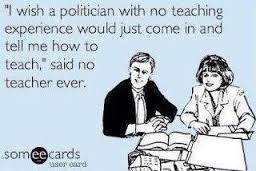
No common coreOne of the underlying problems in educational reform today is that so few reformers have any hands-on classroom experience. Reading about teaching is academic and informative, but the hands-on experience of standing in front of a class of 9, 14, 24, or (heaven forbid!) 31 students at any grade level is irreplaceable. Developing lesson plans is an academic exercise, however monitoring and adjusting that lesson plan for real time problems (fire drill, student absences, material shortage, technology glitch) during instruction is irreplaceable. Reading assessment data is an academic enterprise, but understanding that data in the context of the classroom with all the personalities, abilities, disabilities, and socio-economic influences is irreplaceable. Hands-on experience should be a major factor in education reform, but the education reform efforts in the  Common Core State Standards (CCSS) have little to no classroom credibility.

A recent entry on Twitter from Randi Weingarten, current president of the American Federation of Teachers, was an attempt to address the classroom experience of the creators of the CCSS. Weingarten herself does have hands-on experience in the classroom, but that experience is spotty.  From 1991 until 1997, and with the exception of a six month full time teaching load in the fall of 1994, Weingarten taught on per diem basis (substitute?) at Clara Barton High School in Crown Heights, NY. Total experience? Six years, but this short experience is six more than many of the educational reformers who participated in the creation of the CCSS.

Weingarten tweeted the following on June 29, 2013:

Teachers were part of the development of #CCSS from the beginning http://youtu.be/y1DlNpaKW38

She was posting a link that was supposed to demonstrate that teachers, real classroom teachers with hands-on experience, had been involved in the standards from the beginning. The link led to a YouTube video featuring an ELL classroom teacher Lisa Fretzin who reflects how she “…was part of the review process starting in August looking at the the first draft”:

While Ms. Fretzin certainly has classroom credibility necessary for developing the CCSS, her participation was not exactly at the “beginning” of this process. According to her statement on the video, she was not present at the creation; she was asked to “review” which is different than “from the beginning”. Furthermore, her name is not on the list of participants who did create the CCSS for English Language Arts (or feedback group) which clearly identifies only four of the 50 participants (8%) as “teachers”. The remaining 46 participants (92%) are identified with titles such as: “author”, “consultant”, “specialist”, “professor”,  “supervisor”, “director” or “senior fellow.” In all fairness, perhaps many of these participants had worked in the classroom before moving into higher ranking positions as one would hope, but their hands-on classroom work experience is unclear.

The most glaring examples of classroom incredibility are the lead authors for the CCSS, Susan Pimentel and David Coleman; their collective classroom experience is zero. Pimentel has a law degree and a B.S in Early Childhood Education from Cornell University. Coleman’s, (termed “Architect of the Common Core”) classroom experience is limited to tutoring selected students in a summer program at Yale. He later founded Student Achievement Partners and is currently serving as the President of the College Board.

Weingarten must also know that classroom teachers for PreK-Grade 3 and grade level experts were not included in the creation of the CCSS at all. Many of these educators have express concerns that students are not cognatively ready for many of the standards in math and reading. Valerie Strauss of The Washington Post put up an editorial (1/29/13) “A Tough Critique of Common Core on Early Childhood Education” by Edward Miller, teacher and co-author of Crisis in the Kindergarten: Why Children Need to Play in School, and Nancy Carlsson-Paige is Professor Emerita of Early Childhood Education at Lesley University in Cambridge, Massachusetts and author of Taking Back Childhood. They note that when the standards were first revealed in March 2010, “many early childhood educators and researchers were shocked. “

The promoters of the standards claim they are based in research. They are not. There is no convincing research, for example, showing that certain skills or bits of knowledge (such as counting to 100 or being able to read a certain number of words) if mastered in kindergarten will lead to later success in school. Two recent studies show that direct instruction can actually limit young children’s learning. At best, the standards reflect guesswork, not cognitive or developmental science.

Miller and Carlsson-Paige also include links to the Joint Statement of Early Childhood Health and Education Professionals on the Common Core Standards Initiative and summarize their statement:

 We have grave concerns about the core standards for young children…. The proposed standards conflict with compelling new research in cognitive science, neuroscience, child development, and early childhood education about how young children learn, what they need to learn, and how best to teach them in kindergarten and the early grades….

At all grade levels, therefore, there are concerns about how inclusive the creators of the CCSS were in engaging classroom teachers. The entire initiative, by its own admission, began politically, coming from the nation’s governors and education commissioners, “through their representative organizations the National Governors Association (NGA) and the Council of Chief State School Officers (CCSSO).”

Weingarten’s tweet was more than a little disingenuous when she indicated that “teachers were part of the development” when, to the contrary, there is much more evidence to prove that the ratio of teachers to individuals bearing education titles was disproportionate in favor of reformers and academics without classroom experience.

Real teachers, those with hands-on experience gained in the classroom, have had a limited say in the CCSS that they will be implementing day in and day out in their classrooms at every grade level. Excluding this important faction is why there has been pushback from teachers who recognize the difficulties in implementing many of the standards. Furthermore, there are growing concerns about the level of accountability for teachers in having students meet these same standards.

Ultimately, Weingarten should not tweet out misinformation about teachers developing the CCSS, especially when the evidence demonstrates that teachers were a only a tiny percentage in creating these standards. Weingarten must know that for any educational initiative to succeed, teachers must be engaged from the very beginning.

In these days of education reform, classroom credibility counts.

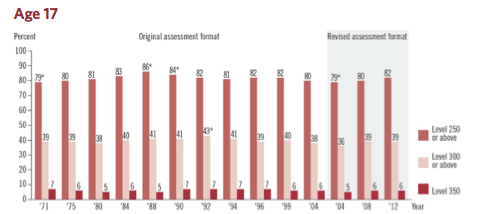
The release of the National Assessment of Educational Progress (NAEP) Progress Report for 2012  (“Nation’s Report Card”) provides an overview on the progress made by specific age groups in public and private schools in reading and in mathematics since the early 1970s. The gain in reading scores after spending billions of dollars, countless hours and effort was a measly 2% rise in scores for 17-year-olds. After 41 years of testing, the data on the graphs show a minimal 2% growth. After 41 years, Einstein’s statement, “Insanity is doing the same thing repeatedly and expecting different results,” is a confirmation that efforts in developing effective reading programs have left the education system insane.

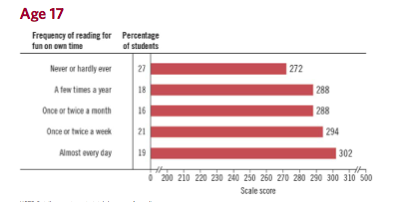
The rather depressing news from NAEP in reading scores (detailed in a previous blog) could be offset, however, by information included in additional statistics in the report. These statistics measure the impact of “reading for fun” on student test scores. Not surprisingly, the students who read more independently, scored higher. NAEP states:

Results from previous NAEP reading assessments show students who read for fun more frequently had higher average scores. Results from the 2012 long-term trend assessment also reflect this pattern. At all three ages, students who reported reading for fun almost daily or once or twice a week scored higher than did students who reported reading for fun a few times a year or less

The irony is that reading for fun is not measured in levels or for specific standards as they are in the standardized tests. For example, the responses in standardized tests are measured accordingly:

High Level readers:

  • Extend the information in a short historical passage to provide comparisons (CR – ages 9 and 13)
  • Provide a text-based description of the key steps in a process (CR)
  • Make an inference to recognize a non-explicit cause in an expository passage (MC – age 13)
  • Provide a description that includes the key aspects of a passage topic (CR – ages 9 and 13)

Mid Range Readers:

  • Read a highly detailed schedule to locate specific information (MC – age 13)
  • Provide a description that reflects the main idea of a science passage (CR – ages 9 and 13)
  • Infer the meaning of a supporting idea in a biographical sketch (MC – ages 9 and 13)
  • Use understanding of a poem to recognize the best description of the poem’s speaker (MC)

Low Level Readers:

  • Summarize the main ideas in an expository passage to provide a description (CR – ages 9 and 13)
  • Support an opinion about a story using details (CR – ages 9 and 13)
  • Recognize an explicitly stated reason in a highly detailed description (MC)
  • Recognize a character’s feeling in a short narrative passage (MC – age 13)

(CR Constructed-response question /MC Multiple-choice question)

Independent reading, in contrast, is deliberately void of any assessment. Students may choose to participate in a discussion or keep a log on their own, but that is their choice.  The only measurement is a student’s willingness to volunteer the frequency of their reading, a form of anecdotal data.

According to the graph below (age 17 only), students who volunteered that they read less frequently were in the low to mid-level ranges in reading. Students who volunteered that they read everyday met the standards at the top of the reading scale.

Graph showing that 17-year-olds who read for fun score higher on standardized tests

#1 Graph showing that 17-year-olds who read for fun score higher on standardized tests

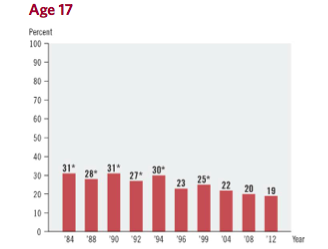
Sadly, this NAEP data recorded a decline in reading for fun over the last 17 years-exactly the age of those students who have demonstrated only a 2% increase in reading ability. The high number of independent readers (“reading for fun”) was in 1994 at 30%.

Steady decline  in the number of 17- year-old students who say that they  "read for fun."

#2 Steady decline in the number of 17- year-old students who say that they “read for fun.”

So what happened the following years, in 1995 and 1996, to cause the drop in students who read voluntarily? What has happened to facilitate the steady decline?

In 1995 there were many voices advocating independent reading: Richard Allington, Stephen Krashen, and Robert Marzano. The value of independent reading had been researched and was being recommended to all districts.

Profit for testing companies or publishing companies, however, is not the motive in independent reading programs.There are no “scripted” or packaged or leveled programs to offer when students choose to “read for fun”, and there is no test that can be developed in order to report a score on an independent read. The numerical correlation of reading independently and higher test scores (ex: read 150 pages=3 points) is not individually measurable; and districts, parents, and even students are conditioned to receiving a score. Could the increase of reading programs from educational publishers with leveled reading box sets or reading software, all implemented in the early 1990s, be a factor?

Or perhaps the controversy on whole language vs. phonics, a controversy that raged during the 1990s, was a factor? Whole language was increasingly controversial, and reading instructional strategies were being revised to either remove whole language entirely or blend instruction with the more traditional phonics approach.

The sad truth is that there was plenty of research by 1995 to support a focus on independent “reading for fun” in a balanced literacy program, for example:

Yet seventeen years later, as detailed in the NAEP report of 2012, the scores for 17-year-old students who read independently for fun dropped to the lowest level of 19%. (chart #2)

While the scores from standardized testing over 41 years according to the NAEP report show only 2% growth in reading, the no cost independent “reading for fun” factor has proven to have a benefit on improving reading scores. Chart #1 shows a difference of 30 points out of a standardized test score of 500 or a 6% difference in scores between students who do not read to those who read daily. Based on the data in NAEP’s report, reading programs have been costly and yielded abysmal results, but letting students choose to “read for fun” has been far less costly and reflects a gain in reading scores.

The solution to breaking this cycle is given by the authors of The Nation’s Report Card. Ironically, these authors are assessment experts, data collectors, who have INCLUDED a strategy that is largely anecdotal, a strategy that can only be measured by students volunteering information about how often they read.

The choice to include the solution of “reading for fun” is up to all stakeholders-districts, educators, parents, students. If “reading for fun” has yielded the positive outcomes, then this solution should take priority in all reading programs. If not, then we are as insane as Einstein said; in trying to raise reading scores through the continued use of reading programs that have proven to be unsuccessful, we are “doing the same thing repeatedly and expecting different results.”

I recently had to write a position statement on assessment and evaluation.  The timing of this assignment, June 2013, coincided with the release of the National Assessment of Educational Progress (NAEP) Progress Report for 2012. This “Nation’s Report Card” provides an overview on the progress made by specific age groups in public and private schools in reading and in mathematics since the early 1970s.

Since NAEP uses the results of standardized tests, and those standardized tests use multiple choice questions, here is my multiple choice question for consideration:

Based on the 2012 NAEP Report results, what difference(s) in reading scores separates a 17-year-old high school student in 1971 from a 17-year-old high school student in 2012?

a. 41 years
b. billions in dollars spent in training, teaching, and testing
c. a 2 % overall difference in growth in reading
d. all of the above

You could act on your most skeptical instincts about the costs and ineffectiveness of standardized testing and make a calculated guess from the title of this blog post or you could skim the 57 page report (replete with charts, graphs, graphics, etc) that does not take long to read, so you could get the information quickly to answer correctly: choice “D”.

Yes, 41 years later, a 17-year old scores only 2% higher than a previous generation that probably contained his or her parents.

There have been billions of dollars invested in developing reading skills for our nation’s children. In just the last twelve years, there has been the federal effort in the form of Reading First, the literacy component of President Bush’s 2001 “No Child Left Behind” Act. Reading First initially offered over $6 billion to fund scientifically based reading-improvement efforts in five key early reading skills: phonemic awareness, phonics, fluency, vocabulary, and comprehension. The funding of grants for students enrolled in kindergarten through grade three in Title I Schools began in 2002-2003.

There have been individual state initiatives that complement Reading First, funded by state legislatures, such as:

There have been efforts to improve literacy made by non-profit educational corporations/foundations such as The Children’s Literacy Initiative, the National Reading Panel, and a Born to Read initiative from the American Library Association. In addition, there have been a host of policy statements from The National Council of Teachers of English and programs offered by the National Writing Project that have helped to drive attention towards the importance of reading.

All of these initiatives drove publishers of educational materials to create programs, materials and resources for educators to use. Unfortunately, the question of which reading program would prove most effective (Direct Instruction, Reading Recovery, Success for All and others) became a tangled controversy as charges of conflicts of interest between the consultants who had been hired by the Department of Education (DOE) and who trained teachers and state department of education personnel had also authored reading programs for curriculum. Fuel to this controversy was added when a review in 2006 by the DOE’s Inspector General suggested that the personnel in the DOE had frequently tried to dictate which curriculum schools must use with Reading First grant money.

Trying to improve our our students’ reading scores has been the focus so much so that our education systems have been awash in funding, materials, initiatives and controversies since 2001 in our collective to improve reading for students…and the result?

The result is a measly 2% of growth in reading for those leaving our school systems.

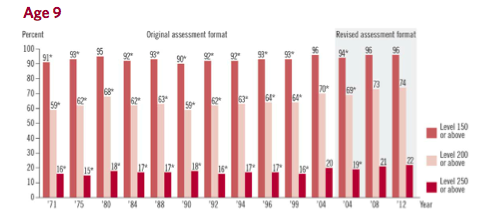
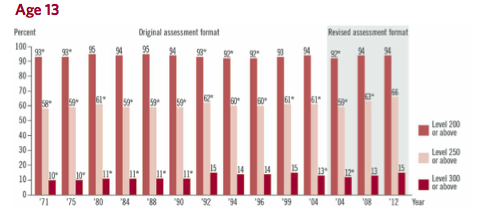
The evidence for this statement has been tracked by NAEP, an organization that has been assessing the progress of  9-, 13-, and 17-year-olds in reading. The graphs below taken from the NAEP report measure annual growth at each age level at the high level 250, mid level 200, and low level 150 of reading.  There are other levels measured for highest or lowest achieving students, but the levels measured on the graphs levels are correlated to the following descriptions:

LEVEL 250: Interrelate Ideas and Make Generalizations
Readers at this level use intermediate skills and strategies to search for, locate, and organize the information they find in relatively lengthy passages and can recognize paraphrases of what they have read. They can also make inferences and reach generalizations about main ideas and the author’s purpose from passages dealing with literature, science, and social studies. Performance at this level suggests the ability to search for specific information, interrelate ideas, and make generalizations.

LEVEL 200: Demonstrate Partially Developed Skills and Understanding
Readers at this level can locate and identify facts from simple informational paragraphs, stories, and news articles. In addition, they can combine ideas and make inferences based on short, uncomplicated passages. Performance at this level suggests the ability to understand specific or sequentially related information.

LEVEL 150: Carry Out Simple, Discrete Reading Tasks
Readers at this level can follow brief written directions. They can also select words, phrases, 9 or sentences to describe a simple picture and can interpret simple written clues to identify a common object. Performance at this level suggests the ability to carry out simple, discrete reading tasks.

Screen Shot 2013-06-29 at 7.52.04 PM

The NAEP report does offer some positive developments. For example, from 1971-2012, reading scores for 9-year-olds have seen an increase of 5% in students reading at the lower (150) level, an increase of 15% for students reading at mid-range (200), and an increase of 6% for students reading at the higher (250) level.

Screen Shot 2013-06-29 at 7.52.16 PMSimilarly, reading scores for 13-year olds have increased 8% for students reading at mid-level, and 5% for students at the higher level. Scores for student reading at the lower level, however, saw a negligible increase of only 1%.

At this point, I should note that the NAEP report does contain some positive finding. For example, the measurements indicate that the gaps for racial/ethnic groups did narrow in reading over the past 41 years. According to the report:

Even though White students continued to score 21 or more points higher on average than Black and Hispanic students in 2012, the White – Black and White – Hispanic gaps narrowed in comparison to the gaps in the 1970s at all three ages. The White – Black score gaps for 9- and 17-year-olds in 2012 were nearly half the size of the gaps in 1971.

Unfortunately, even that positive information should be considered with the understanding that most of these gains for racial and ethnic groups were accomplished before 2004.

Finally, for students leaving public and private school systems, the overall news is depressing. Any gains in reading in ages 9 and 13, were flattened by age 17. The growth for students reading at higher level dropped from 7% to 6%, while the  percentage of mid-range readers remained the same at 39%. The gains of 3% were in the scores of lower range readers, from 79% to 82%. Considering the loss of 1% at the higher end, the overall growth in measurement is that measly 2%.

Screen Shot 2013-06-29 at 7.55.37 PM

That’s it. A financial comparison would be a  yield $.02 for every dollar we have invested. Another comparison is that for every 100 students, only two have demonstrated improvement after 13 years of education.

Assessing the last 12 of the 41 years of measuring reading initiatives illustrates that there has been no real progress in reading as measured by standardized tests in our public and private education institutions grades K-12. NAEP’s recounting of the results after considerable funding, legislation, and effort, is as Shakespeare said, “a tale…full of sound and fury, signifying nothing.”

Continue Reading…

boringMany educators use Twitter to communicate as part of personal learning networks (PLN). I appreciate the means to share messages with other educators, but I am sometimes alarmed by some of the tweets I read. The brevity of 140 characters does not allow for nuances. The tweet is, by design, blunt.
Example #1: Most teachers do not share a professional language. And they don’t share prof lang with students. 
I wonder, “Really? Is there evidence to support this claim?”
Example #2: Freedom—for educators and parents—is necessary, but not sufficient, for excellent schools
I think, “Define Freedom. Define sufficient. Define excellent.”
These tweets are made of some sentiment that begins an argument, but they are so brief and banal that they cut off debate.
Such was the case this week when prominent author and educator Dr. Tony Wagner paraphrased a statement made by Education Secretary Arne Duncan (week May 21, 2013) in a response on his twitter feed.  Wagner is the first Innovation Education Fellow at the Technology & Entrepreneurship Center at Harvard; he is a former high school teacher, K-8 principal, and a university professor in teacher education. Wagner’s tweet read:

“‘Too many high school students are dropping out, not because school is too hard, but because it’s too easy @arneduncan’ Wrong! It’s boring!” @DrTonyWagner.

While I disagree with Duncan’s generalization that schools are too easy, I was even more disturbed by Wagner’s response, about school, “It’s boring!”
I hear this complaint enough from students before they read the class novel or before we start the unit. I did not expect to hear it from Wagner.
Students say “this is boring” so much that I will not let them use the word “boring” any more.
But, is school boring?
Is it?
I take issue with Wagner’s claim. I would like to debate this.
As someone who attended Mr. Orontias’s History and Geography class in 1970, I can confidently say I have experienced boring. His 45 minute lecture delivered in a monotone right after lunch was not in a time space continuum; the clock hands did not move.
I know boring.
In contrast, my students’ high school today is not boring. As examples, I offer the following:
  • We have a Bring Your Own Technology (BYOT) initiative;
  • We employ student driven learning with choice on reading, topics, and presentation;
  • We include project based assessments and encourage reflection on tests.
We do, however, require that students do schoolwork. They practice math problems. They do research. They must complete reading assignments. They have deadlines. Some of this work is repetitious; some of this work is tedious. Some rote learning may be necessary to develop background knowledge before students can engage in active participation or collaboration.
So, when I hear from students that they are “bored” with school, often what they are saying is “schoolwork is not fun.”
This is not unexpected. A great deal of time is spent everyday in “not fun” activities inside school, just as a number of “not fun” activities are required in the real world.
I sympathize, but the reality is that not every lesson in school is fun. Education objectives require students to work rather than have the teachers be the engine of the classroom.
Wagner is one of the innovative educators who promotes education to incorporate more real world problems, reforming education to prepare students with 21st Century skills in order to engage students in meaningful enterprises. Whatever innovations are developed by education reformers like Wagner, students will experience frustrations, and experience failures. There will be efforts expended by teachers and students successfully and unsuccessfully. Work will be necessary, and some of that work will not be fun. If the goal of schools is to prepare students to learn the value of work, to prepare students for the workforce, work should be applauded, even if the work is not fun, or if the work is “boring.”
Arne Duncan’s statement that high school students are dropping out because schools are too easy is a gross overstatement. How easy will the real world be for those high school dropouts?
Similarly, Wagner’s accusation that high school is boring is infuriatingly terse, using only 20 out of Twitter’s 140 characters. How bored will students be if they drop out and cannot find fulfilling employment?
There are isolated cases of students who may write code for some fabulous new social media or video game that goes viral, but those are isolated. A high school diploma is necessary for even the most menial employment.
Today’s schools are not boring. Today’s schools are preparing students for work environments just like schools have done in decades past. Historically, teachers do not predict the job market, instead they prepare students with the fundamentals so that their students may create the job market. Some of that preparation is not fun; it is work, and in student lingo, it is boring.
Stating this needs more than a pithy remark that negates the efforts of teachers who are engaging students with 21st Century skills, with active rather than passive instruction.
Education has come a long way since my experience in the 1970s because of the efforts of education reformers like Dr. Wagner. Forty years ago, education came in primarily in the form of direct instruction. We sat in rows and listened to lectures, and yes, that was boring.
Except for the day that Mr. Orontias stepped into the wastebasket.
That was not boring at all.

Tributes for teachers during Teacher Appreciation Week are welcome coming just as the school year comes to a close when very tired teachers are looking back to see student progress over the past eight months. Many of the tributes are touching, and some are comical. Comedy was the intent of the The Late Show with David Letterman, when the producers invited ten (10)  Teach For America teachers to deliver Letterman’s Top Ten List. In introducing the selected ten teachers, Letterman prefaced the performance with his own tribute,

“My God! If there is a future, it is in the hands of our teachers doing thankless work day after day (APPLAUSE) …..and by the way thankless is the wrong word… we should be grateful, eternally grateful, for the work these people do…”

After his heart-felt introduction, each of the ten Teach for American teachers stepped forward to deliver one entry on the list:

The Top 10 Reasons I Decided to Become a Teacher

  • 10. I hope to live up to the teachers who inspired me. . .like Ms. What’s Her Name
  • 9. It’s no fun saying the Pledge of Allegiance every day by myself.
  • 8. Honestly, I didn’t pay much attention the first time through school.
  • 7. Kids need to know the moon landing was faked. 
  • 6. If I could make a difference in just one student’s life–well, that wouldn’t be a very good average. 
  • 5. The glamour. 
  • 4. You work long hours, but at least the pay is bad.
  • 3. Hoping to teach in an all song-and-dance high school, like on “Glee.” 
  • 2. In the summer, I can watch all you losers go to the office. 
  • 1. I want to help kids talk good. 

This very funny video was posted on the Teach for America website, listing participating teachers as members of the Class of ’13. Teach for America is a not for profit organization established in 1990 under a proposal by Wendy Kopp. The original objective is explained on their website:

We recruit a diverse group of leaders with a record of achievement who work to expand educational opportunity, starting by teaching for two years in a low-income community.                 

Teach for America sent 500 teachers to low-income schools in its first year. To date, over 33,000 have completed the program, however, Teach for America has come under some criticism for the “temporary” nature of the assignments. Two years of teaching is not enough, argued David Greene in an editorial featured in the New York Times (4/30/13),Invitation to a Dialogue: The Art of Teaching”:

Corps members should intern for a year under the supervision of a talented mentor teacher, then teach for at least four years, not two. That may discourage some. Good. We want career teachers. A “temp” work force does not improve education or erase the achievement gap. Rather it helps to create havoc in schools desperately trying to gain stability, a key factor in any school’s success.

Greene explained that he has served in the past as a mentor to Teach for America corps members, and that he has seen their “tears, anxieties, heartaches, successes and achievements.” He claims, however, that the preparation for these teachers now includes “simple, formulaic scripts” instead of letting these teachers be “creative, independent, spontaneous, practical and rule-bending.” He noted:

Scripts and rules and models strictly followed cannot replace what the best teachers have: practical wisdom. In our anti-teacher world and scripted teaching climate perpetuated by corporate reformers, what room is there for the teachers we want for our kids?

Greene cautioned that the today’s Teach for America has “morphed into more of a leadership institute”, with too little classroom experience to inform the members as they move quickly from the classroom into higher levels in education administration and in educational reform.

Letterman’s producers must be applauded for focusing attention on teachers during Teacher Appreciation Week, but in the future, they might consider a different group to represent teachers. Perhaps they could recruit seasoned veteran teachers who made this career choice, or if new teachers are what they want, they might look to spotlight new teachers who do not have the benefits of training and continuing support from Teach for America. Or, they might look to recruit the teacher described below in a letter published in the NYTimes written by Derl Clausen, a high school student, in a response to Greene’s editorial:

He walks in five minutes late to first period, half-shaven, cup of coffee in hand. He walks over to the white board, his stage, puts his coffee down, and looks into the eyes of every student. He’s not given the best students, and so his standardized test scores are average. Instead, they leave with something more; they leave inspired.

He tells them about life: the challenges, the problems, the reason he’s half-shaven. He turns “Romeo and Juliet” into a lesson on love, algebra into a philosophy discussion, and science into an art appreciation class. Vocabulary, equations and historical dates will enter and leave children’s memories, but the inspiration, motivation and wisdom that he gives them will remain throughout their lives.

It’s that teacher who is worth the five-minute wait, the smell of coffee — and if anyone questions his half-shaven beard, he’ll learn a whole lot more about life.

Clausen’s describes a teacher who goes “off script”, a teacher that fits Greene’s observation that, “Often it is the least orthodox teacher who most engages and excites students.” Clausen’s portrait could be a choice worth of a Top Ten List, or maybe even a guest appearance. Clausen and the half-shaved teacher as guests on The Late Show with David Letterman for Teacher Appreciation Week 2014? Not a satirical list, but one real teacher-student relationship as part of a Teacher Appreciation Week “Top Ten”.

ScantronThe New York State Department of Education’s new standardized tests were administered last week. The tests for grades 3-8 were developed by the educational testing company Pearson and contained new “authentic” passages aligned to the new Common Core State Standards. State tests might have been routine news had not several teachers also noticed that the English Language Arts “authentic” passages mentioned products and trademark names including Mug ©Root Beer and Lego ©.

Product placement on standardized tests in elementary schools is bigger news. The public has grown accustomed to advertisements on webpages, before videos, on scoreboards, and with the well-placed beverage during a movie. Subtle and direct advertising to the youth market to develop brand loyalty at an early age is the goal of almost every corporation.

Consider a survey by Piper Jaffray, a leading investment bank and asset management firm, the  “Taking Stock With Teens” survey (taken March 1–April 3, 2013), that gathered input from approximately 5,200 teens (average age of 16.3 years). The survey is used to determine trends, and the most recent results note:

“Spending has moderated across discretionary categories for both upper-income and average-income teens when compared to the prior year and prior season. Yet nearly two-thirds of respondents view the economy as consistent to improving, and just over half signaled an intent to spend ‘more’ on key categories of interest, particularly fashion and status brand merchandise.”

Much attention, therefore, is placed on the youth market, and product placement on standardized testing could be a new marketing strategy. For example, corporations in the fashion industry could read this report and be inclined to offer some news stories or commission a short story that mentioned clothing brand names in the future to Pearson or another testing company in order to provide “authentic” passages. What better opportunity for corporations to build brand loyalty then to an audience, captive in a classroom during a state-mandated test?

The education reporter for the Washington Post, Valerie Strauss, reported on the “authentic” passages that mentioned products as “author’s choices”; Pearson’s response to her query:

As part of our partnership with NYSED, Pearson searches for previously published passages that will support grade-level appropriate items for use in the 3-8 ELA assessments. The passages must meet certain criteria agreed upon by both NYSED and Pearson in order to best align to Common Core State Standards and be robust enough to support the development of items. Once passages are approved, Pearson follows legal protocols to procure the rights to use the published passages on the assessment on behalf of NYSED. If a fee is required to obtain permission, Pearson pays this fee. NYSED has ultimate approval of passages used on the assessment.

Strauss’s report, “New Standardized Tests Feature Plugs for Commercial Products” also indicated that this practice is not exclusive to NY, and that “several different assessment programs have instances of brand names included due to use of authentic texts.” There were no specifics mentioned.

Following up with the NY Department of Education, Beth Fertig from the blog Schoolbook (WNYC),  Stories from the Front Line of Testing asked about the recent product placement:

“This is the first time we have had 100 percent authentic texts on the assessments,” said spokesman Tom Dunn. “They were selected as appropriate to measure the ELA standards. Any brand names that occurred in them were incidental and were cited according to publishing conventions. No one was paid for product placements.”

Perhaps no one was paid this year, but an unwritten taboo was broken with these standardized test. The New York Post reported one teacher response in the article  “Learn ABC’s – & IBM’s: Products in Kid Exams” by Yoav Gonen and Georgett Roberts

“I’ve been giving this test for eight years and have never seen the test drop trademarked names in passages — let alone note the trademark at the bottom of the page,” said one teacher who administered the exam.

They also reported that other commercial enterprises including the TV show “Teen Titans” and the international soccer brand FIFA  were also included on the tests.

While gaining the loyalty of the youth market is a necessary step for major corporations, the appearance of these brands on standardized tests brings our students one step closer to the future as envisioned by Stephen Spielberg in the film Minority Report. In one scene, the fugitive John Anderton (Tom Cruise) walks along a corridor while animated billboards market directly to him by calling his name:

The possibility of this kind of marketing exists and perhaps personalized advertising will call to us everyday; a cacophony of advertisements designed to keep brand names in our consciousness. Similarly, even the youngest students are the target of marketing campaigns as part of any corporation’s long term economic strategy; advertisements on multiple platforms are the “white noise” of their lives. So frequent are advertisements in students’ lives that any product placement, paid or unpaid, on these standardized tests may contribute to the definition of what is “authentic”. Students are exposed to ads so frequently and in so many genres that a text is not real without some brand name mentioned.

And if that product placement is a small part of what makes a passage “authentic” on a standardized test, can talking “authentic” billboards in the school hallways be far behind?

Here is an educational policy riddle: How much background knowledge does a student need to read a historical text?

According to New York Engage website: None.

The Common Core State Standards (CCSS) are being implemented state by state, and there is an emphasis from teaching students background knowledge to teaching students skills, specifically the skill of close reading.

The pedegogy is explained by The Partnership for Assessment of Readiness for College and Careers (PARCC):

Close, analytic reading stresses engaging with a text of sufficient complexity directly and examining meaning thoroughly and methodically, encouraging students to read and reread deliberately. Directing student attention on the text itself empowers students to understand the central ideas and key supporting details. It also enables students to reflect on the meanings of individual words and sentences; the order in which sentences unfold; and the development of ideas over the course of the text, which ultimately leads students to arrive at an understanding of the text as a whole. (PARCC, 2011)

There are many lessons that strongly advocate the use of close reading in teaching historical texts on the EngageNY.com website, including a set of exemplar lessons for Lincoln’s Gettysburg Address promoted by CCSS contributor and now College Board President, David Coleman. The lesson’s introduction states:

The idea here is to plunge students into an independent encounter with this short text. Refrain from giving background context or substantial instructional guidance at the outset. It may make sense to notify students that the short text is thought to be difficult and they are not expected to understand it fully on a first reading–that they can expect to struggle. Some students may be frustrated, but all students need practice in doing their best to stay with something they do not initially understand. This close reading approach forces students to rely exclusively on the text instead of privileging background knowledge, and levels the playing field for all students as they seek to comprehend Lincoln’s address.

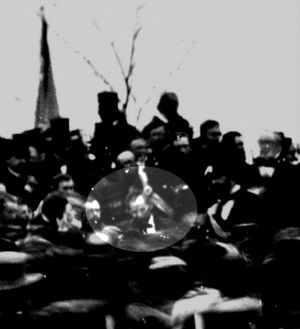
Photo of Lincoln delivering Gettysburg Address- (www.wikipedia.org)

Photo of Lincoln delivering
Gettysburg Address- (www.wikipedia.org)

The lesson plan is organized in three sections. In the first, students are handed a copy of Lincoln’s Gettysburg Address and perform several “cold” readings, to themselves and then with the class.

Lesson Plan SECTION 1 What’s at stake: a nation as a place and as an idea

Students silently read, then the teacher reads aloud the text of the Gettysburg Address while students follow along.

  • Students translate into their own words the first and second paragraph. 
  • Students answer guiding questions regarding the first two paragraphs

Please note, there is no mention of any historical context for the speech. Students will come to this 273-word speech without the background knowledge that the Battle of Gettysburg was fought from July 1 to July 3, 1863, and this battle is considered the most important engagement of the American Civil War. They will not know that the battle resulted in “Union casualties of 23,000, while the Confederates had lost some 28,000 men–more than a third of Lee’s army” (History.com). They will not know how the Army of Northern Virginia achieved an apex into Union territory with “Pickett’s Charge,” a failed attempt by General George Pickett  to break through the Union line in South Central Pennsylvania, and that the charge resulted in the death of thousands of rebel soldiers. They will not know how the newly appointed Major General George Gordon Meade of the Army of the Potomac met the challenges of General Robert E. Lee by ordering responses to skirmishes on Little Round Top, Culp’s Hill, and in the Devil’s Den. They will not know that Meade would then be replaced by General Ulysses S. Grant in part because Meade did not pursue Lee’s troops in their retreat to Virginia.

Instead of referencing any of this historical background, the guding questions in the lesson’s outline imagine the students as blank slates and mention another historical event:

A. When was “four score and seven years ago”? B. What important thing happened in 1776?

The guiding responses for teachers seem to begrudge an acknowledgement that keeping students bound to the four corners of a text is impossible, and that, yes, a little prior knowledge of history is helpful when reading a historical text:

This question, of course, goes beyond the text to explore students’ prior knowledge and associations. Students may or may not know that the Declaration of Independence was issued in 1776, but they will likely know it is a very important date – one that they themselves have heard before. Something very important happened on that date.  It’s OK to mention the Declaration, but the next step is to discover what students can infer about 1776 from Lincoln’s own words now in front of them.

In addition, there are admonishments in Appendix A of the lesson not to ask questions such as, “Why did the North fight the civil war?”

Answering these sorts of questions require students to go outside the text, and indeed in this particular instance asking them these questions actually undermine what Lincoln is trying to say. Lincoln nowhere in the Gettysburg Address distinguishes between the North and South (or northern versus southern soldiers for that matter). Answering such questions take the student away from the actual point Lincoln is making in the text of the speech regarding equality and self-government.

The lesson plan continues:

Lesson Plan SECTION 2  From funeral to new birth

  • Students are re-acquainted with the first two paragraphs of the speech.
  • Students translate the third and final paragraph into their own words.
  • Students answer guiding questions regarding the third paragraph of the Gettysburg Address.

Please note this does not provide the context of the speech that was given that crisp morning of November 19, 1863, at the dedication of the National Cemetery on a damp battlefield that only months before had been dampened red with the blood of tens of thousands of soldiers from either side. The students would be unaware that Lincoln had taken the train from Washington the day before and was feeling slightly feverish on the day of the speech. There is some speculation that he may have been suffering from the early stages of smallpox when he delivered the speech reading from a single piece of paper in a high clear voice. The students would not know that Lincoln’s scheduled time at the podium followed a two hour (memorized) speech by Edward Everett, who later wrote to Lincoln stating, “I should be glad if I could flatter myself that I came as near the central idea of the occasion in two hours as you did in two minutes.” The students would not know that many of the 15,000 crowd members did not hear Lincoln’s two minute speech; the 10 sentences were over before many audience members realized Lincoln had been speaking. The students would not know that this speech marked Lincoln’s first public statement about principles of equality, and they would not know that he considered the speech to be a failure.

Lesson Plan SECTION 3  Dedication as national identity and personal devotion

  • Students trace the accumulated meaning of the word “dedicate” through the text
  • Students write a brief essay on the structure of Lincoln’s argument

The lesson provides links to the five handwritten copies of the text, in the “Additional ELA Task #1: Comparison of the drafts of the speech” so that students can see drafts of the speech and the inclusion of “under God” in the latter three versions. There is also an additional Social Studies task that incorporates the position of respected historian Gary Wills from his book Lincoln at Gettysburg: The Worlds that Remade America. This activity suggests students use excerpts from Wills’s book and an editorial from the Chicago Times (November 23, 1863) to debate “Lincoln’s reading of the Declaration of Independence into the Constitution”. One excerpt from Wills’s book includes the statement,”The stakes of the three days’ butchery are made intellectual, with abstract truths being vindicated.” Finally, here is information about the battle itself; the battle lasted three days and soldiers died.

The enterprise of reading the Gettysburg Address without context defeats PARRC’s stated objective of having the students “arrive at an understanding of the text as a whole”. The irony is that in forwarding their own interpretation of the speech, David Coleman and the lesson plan developers have missed Lincoln’s purpose entirely; Lincoln directs the audience to forget the words of the speech, but never to forget the sacrifices made by the soldiers during that brutal conflict:

The world will little note, nor long remember what we say here, but it can never forget what they did here.

Lincoln wrote and delivered the Gettysburg Address to remind his audience “that these dead shall not have died in vain”. Analyzing the language of the address isolated from the Civil War context that created the tone and message is a hollow academic exercise. Instead, students must be taught the historical context so that they fully understand Lincoln’s purpose in praising those who, “gave the last full measure of devotion.”

“It is altogether fitting and proper that we should do this.”

Continue Reading…

Six years ago, the video “Shift Happens” (2007) was featured at our school’s professional development day. I clearly remember one take-away:

We are currently preparing students for jobs that don’t exist using technologies that do not exist in order to solve problems we don’t even know are problems yet.

The video was created by Karl Fisch, and modified by Scott McLeod. The slides provided statistics on the rapid exponential growth in population and in information, highlighting the differences between the present and what was successful in the past, specifically England’s position on the world stage in 1900. Several slides are alarming in calling attention to the building tsunami of information available to students with examples such as ” there is more information in a week’s worth of the The New York Times than what an average person knew in the 1700s”. Since 2007, there have been several updated versions of “Shift Happens” uploaded to YouTube; there have also been many imitations.

I thought of this video this week when I drove past a sign on a large office building: Strategic Information Technologies.

“What does that mean?” I asked my friend Catherine, “Is the technology stategic because of geography? Strategic because of a choice of software or hardware?” I continued, “I don’t know what a ‘strategic information technologist’ does…Is this one of the unknown new jobs were are ‘preparing’ our 21st Century students to take?” I referenced the video.

“That’s ridiculous!” Catherine responded, “The people who ‘prepared’ us for the 21st Century were not worried about what new jobs would be available in our future. In fact,” she continued, “they taught us what they knew…what they thought we should know, and we are doing just fine.”

I was startled. Could a “Shift Happens” video place a misguided emphasis on adjusting skills and content in order to prepare students for the unidentified problems they don’t even know are problems yet?

“After all,” she continued, “We are the generation that created these new technologies that we didn’t know would exist today.”

When I reflect on her statement I think about how my favorite teachers in grades K-12  (Sister Ella, Mrs. Rowland, Miss Montessi) were not obsessed with preparing me for some unidentified job in the future. Instead, their collective obsession was to prepare me with basic skills and content so that I could be a productive member of society  I was taught to think, to read well, write well, speak well, know math, appreciate history, recognize science, and, since I attended Catholic school, recite my Catechism.

Perhaps, educators cannot predict the future for their students, but educators can address trends. For example, in 1957, the American public began to reconsider how the role of public education may contribute to winning the Space Race with the Soviets once Sputnik had been released. The investments in education made as a consequence resulted in increased scientific advancements and many spin-off technologies. In contrast, however, predictions such as those at the 1964 NY World’s Fair of a future with flying cars, jet packs, vacation trips to Mars and beyond, underwater cities, and robot laborers have never came to fruition.

Similarly, Karl Fisch’s video alerted educators to the rapid changes in education and the global implications in preparing students for the real world. He wrote:

“…it’s a different world out there. A world whereanyone’s ideas can quickly spread if they happen to strike a chord.”
This was certainly true of the “Shift Happens” video which had great success without “a large company or a huge public relations effort to make an impact.” Fisch continued:
This is just one of the reasons that I believe our schools need to change. They need to change to reflect this new world, this flatter world, this information-abundant, globally connected, rapidly changing, technology super-charged world that they are going to spend the rest of their lives in.

Fisch made no silly “predictions” like those at the NY World’s Fair. Instead, his video served to bring attention to trends that require an increase in the skills of  communication and sharing information.

In order to communicate and to share, students from grades K-12 must think, read well, write well, and speak well regardless as to what predictions are being made about new industries or technologies. In trying to anticipate the future, educators must not discount how the generations of students who learned these important skills became the graduates who are now responsible for evolving changes of the present.

Shift is not an entirely new enterprise on the world stage, for example,  the Renaissance, the Enlightenment, the Reformation, the Industrial Revolution are all examples of global “shifts”. In the six short years since the “Shift Happens” video, Facebook has replaced MySpace as the world’s most formidable social network; Twitter has evolved into a powerful communication tool. The role of educators is not  to predict the next Steve Jobs or Bill Gates or company that will spawn new jobs or dominate an industry or the next “shift”. Instead, the role of educators must be to continue to teach those skills of thinking, reading, writing, and speaking well that contributed to the “shift” that is happening for our students.

There is no surprise that “Shift Happens”, and the students who are prepared to think, to read well, to write well, and to speak well will not be surprised either.

If I had a choice of vanity license plates, I might consider one that marked my recent experience as a volunteer on an educational accreditation team.

NEASC PlateEducational accreditation is the “quality assurance process during which services and operations of schools are evaluated by an external body to determine if applicable standards are met.”


I served as a volunteer on a panel for the New England Association of Schools and Colleges (NEASC), an agency that provides accreditation services  – Pre-K through university for more than 2000 public and private institutions in the six state region.  NEASC  Panels are composed of experienced chairpersons and volunteer teachers, administrators, and support staff who visit schools according to a set schedule. According to its website:

In preparation for a NEASC evaluation, all member schools must undertake an exhaustive self-study involving the participation of faculty, administrators, staff, students, community members, and board members.

The key word here? Exhaustive.

Exhaustive in preparation for a NEASC visit. Exhaustive in being hosting a NEASC visit. Exhaustive in being a member of the NEASC team that visits.

But first, a little background. In order to serve as a volunteer, I had to leave several lessons on Hamlet, my favorite unit, with my substitute. So, when I understood the level of professional discretion required for a NEASC visit, I felt a curious connection to the Ghost, Hamlet’s father, who likewise abides by an oath.  On the ramparts of Elsinore, he tells Hamlet:

But that I am forbid
To tell the secrets of my prison-house
I could a tale unfold whose lightest word
Would harrow up thy soul, freeze thy young blood,(1.5.749-752)

I may not say what school I visited nor may I discuss any part of the actual accreditation discussion by members of my team. So this post will speak only as a self reflection of the process and a few moments of recognition on how accreditation works.

List, list, O, list! (1.5.758)

Sunday morning at 9:30 AM, the team members were already hard at work organizing piles of documents prepared for our visit. We were organized into pairs, two members to work on each of the seven standards, 14 members of the team and two chairpeople.

There was a working lunch before the entire team went to the school for a prepared presentation. This presentation was the high school’s opportunity to quickly familiarize us with their school’s culture and present their strengths and needs that they had determined in the (exhaustive) self study.

Madam, how like you this play?(3.2.222)

Returning to our hotel, the lodgings provided by our hosting school, the work began in earnest. We looked through bins of student work to see if they met the standards set by NEASC.  We looked at all forms of assessments, lesson plans, and student responses. We recorded our findings well into the night, and finally left the work room at 10 PM.

…to sleep;/To sleep: perchance to dream (3.1.65-66)

On both Monday and Tuesday, the team was up early to return to the school (7:00 AM), and the team split up individually or in groups to spend a school day conducting interviews with faculty, staff, and students. Facility tours, lunches shared with students in the cafeteria, and opportunities to “pop-into” classes were available. There simply was no “unobligated time” as we worked steadily in the work room at the school. Here we would record our findings before returning to the school hallways.

Were you not sent for? Is it
your own inclining? Is it a free visitation? Come,
deal justly (2.2.275-276)

Both Monday and Tuesday evening sessions were long as team members furiously documented their findings into a report that will still need editing and revision.  We had worked from 6AM-10:30PM with time allotted for meals and one hour respite in order to call home or check on my own school’s e-mail.  Closing my eyes, I thought how much,

My spirits grow dull, and fain I would beguile
The tedious day with sleep. (3.2.226-227)

An early Wednesday morning work session let us polish the report and present our final conclusions to other members of the team. Finally, the votes as to whether the team would recommend accreditation or not to the school were tallied, and we marched into the school library to meet the faculty and staff a final time. We were leaving a report for them to:

suit the action to the word, the word
to the action; (3.2.17-18)

The chair gave a short speech indicating the tone but not the contents of our report, and then, according to protocol, we left as team, not speaking to anyone from the school, nor to each other. Staying silent, I thought

Farewell, and let your haste commend your duty. (1.2.39)

The experience provided me with insights into the strengths and weaknesses in the educational program of my own school, and I am eager to share ways that can improve instruction with my fellow faculty members. Our school is scheduled for a visit in the spring of 2014 by a NEASC accreditation team.

As professional development, the experience was positive but physically demanding and intellectually challenging. The chairs’ use of technology (Google docs, Livebinders, Linot) allowed for efficient sharing of information on seven standards: Core Values and Beliefs, Curriculum, Instruction, Assessment, School Culture and Leadership, School Resources, and Community Resources. Awash in papers and digital materials for 16 hours a day, I wondered how any previous teams using only hard copies had collaborated successfully.

Additionally, as I looked at the various standards of instruction, I also found myself wondering about the consequences of implementing Common Core Standards (CCSS) and the growing reliance on standardized testing in evaluating teachers and assessing student understanding. Will the current form of regional accreditation adjust to measurements that will be implemented nationally? The United States is broken into five regional accreditation districts, however, if students meet the national standards, how will these regional accreditation panels be used?

Finally, our four day “snap shot” coupled with a the school’s own exhaustive self-study could not address all of the arbitrary elements out of a school’s control, but the process is far more informative and meaningful than any standardized test results that could be offered by the CCSS. Consider also that the financing of a school seriously impacts, for good or for ill, all standards of measuring a school’s success. The intangible “culture” surrounding a school and the fluid landscape of 21st Century’s technology are other arbitrary factors that impact all standards. We even encountered a “snow-delayed” opening as if to remind us that a capricious Mother Nature refuses to allow for standardized measurement!

I only hope that my experience in informing another school in order to improve their educational program will prove beneficial. I know that when the team comes in the spring of 2014, that that they will do as I have tried to do:

 report me and my cause aright…(5.2.339)

The rest I now need requires silence.