Archives For November 30, 1999

Our English II World Literature course complements the World History course, so when the students are learning about the Industrial Revolution, our English course has students read the opening chapters to Charles Dickens’s Oliver Twist.

Reading Dickens, however, is a challenge for many students, particularly if they lack background knowledge on the story’s setting. In order to help them better understand the context of England during the Industrial Revolution, we incorporated several famous paintings to illustrate the shift from the pastoral setting to the urban setting.

Rather than show a painting in its entirety at first, we made screenshots of different sections of each painting and had the students “read” what they saw. For example, we began with John Constable’s painting The Hay Wain (1821) which hangs in the National Gallery in London, England.

Screen Shot 2013-10-02 at 9.23.04 PM

upper left corner of Constable’s “The Hay Wain”

Students looked at the information communicated in the upper left quadrant  of the painting and discussed the architecture of the roof and the large empty tree branches. They noted the gathering storm clouds in the background; “a tone of danger” noted one student. 

We then had students look at the lower right quadrant of the painting where a farmer’s cart was being driven along a stream bed. They noted the details of the team of horses and speculated as to why the men would be walking upstream. 

Screen Shot 2013-10-02 at 9.23.46 PM

lower right corner of Constables “The Hay Wain”

They speculated that there might be no road because a road might not have been necessary if transportation was easier by water, and one student called attention to a small canoe on the stream’s bank. They called attention to the earth tone colors that contrasted with the red harnesses of the horses.

Then we showed the students the full painting.
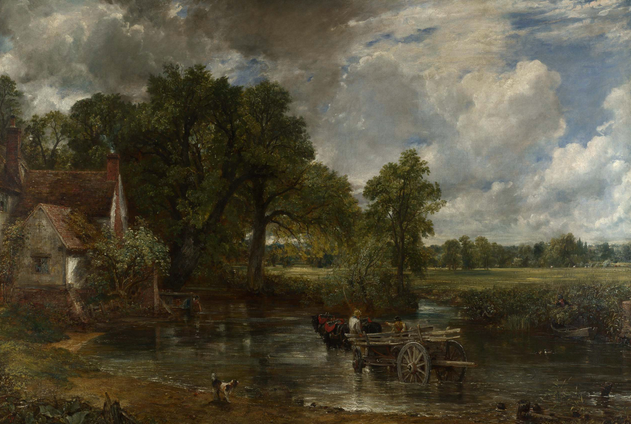
Screen Shot 2013-10-02 at 9.49.07 PM

Constable’s painting is based on a site in Suffolk. The hay wain, a type of horse-drawn cart, stands in the water in the foreground. (National Gallery Picture Library
St Vincent House, 30 Orange Street, London)

When the students saw the entire painting, they were already familiar with some of the smaller details. They were able to locate these smaller details and suggest how they contributed to the larger “story” of the painting. They determined Constable’s painting celebrated the pastoral life outside London, a striking contrast from the setting of Oliver Twist where impoverished street children were placed in workhouses or recruited by criminals.

The painting that best illustrates the cultural shift caused by the Industrial Revolution, however,  is J. M. W. Turner’s The Fighting Temeraire. The oil painting depicts the gunship with her sails tightly wrapped to the rigging being tugged  by a steam powered paddle-wheel to the shipyard before being broken up for scrap. Turner painted the tribute to the end of sailing ships in 1838, the same year that Dickens published Oliver Twist. Both works brought attention to the drastic change in the way of life as a result of the Industrial Revolution.
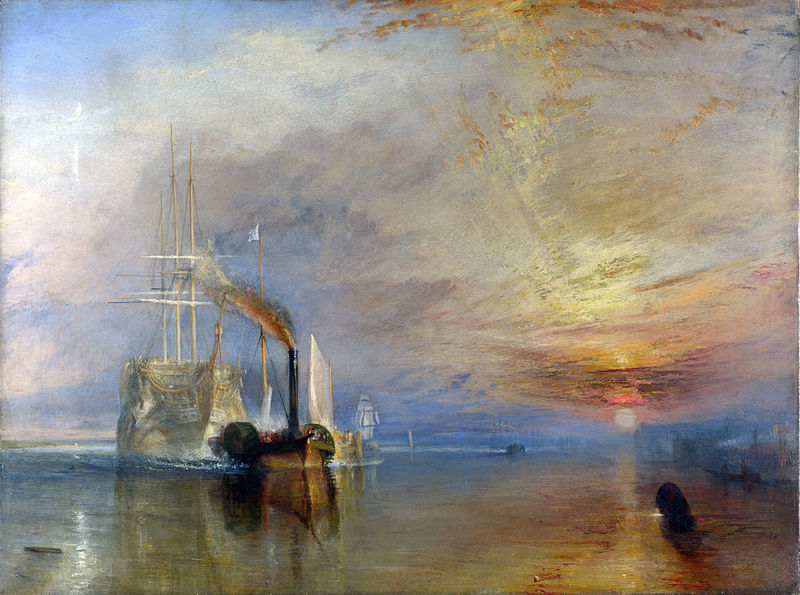
“The Fighting Temeraire”, an oil painting by the English artist J. M. W. Turner (1938) National Gallery, London

Since the students had practiced close reading the Constable pastoral painting, they were ready to close read Turner’s painting. While some called attention to the the dirty smoke stack, others saw the energetic paddling as a sign of progress. One noticed the ghost-like ship hovering in the background; another noted a potential danger of a submerged obstacle in the foreground floating in the right corner of the painting. Most commented on the light created by the sunset which gave the painting “warmth”or “a glow” for some or a “light extinguishing” for others. When they were asked to use these elements as evidence to determine the artist’s message, there were some succinct responses:

  • “It’s out with the old!”
  • “The coal fire is the new light; the sun is the old light”
  • “Coal power, not wind power”
  • “Beauty fades”

Turner’s The Fighting Temeraire was voted England’s favorite painting in a 2005 poll organized by BBC Radio 4’s Today.  The painting was also highlighted in the recent James Bond film Skyfall. In the scene in the National Gallery, Bond meets his new handler, Q, while both sit on a bench opposite the painting:

Q: It always makes me feel a bit melancholy. Grand old war ship. being ignominiously haunted away to scrap… The inevitability of time, don’t you think? What do you see?
Bond:  A bloody big ship. Excuse me.
Q: 007. I’m your new Quartermaster.
Bond: You must be joking.
Q:  Why, because I’m not wearing a lab coat?
Bond: Because you still have spots.
Q: My complexion is hardly relevant.
Bond: Your competence is.
Q: Age is no guarantee of efficiency.
Bond:  And youth is no guarantee of innovation.

Skyfall (http://www.imdb.com/title/tt1074638/quotes)

After watching the film clip, the students were in agreement that they are living in a new digital revolution, and that technology has changed their culture from that of their parents. If they want a sunset, they don’t need a painting by Turner….they have Instagram.

messy-desk_2637008b

Research shows that chaos can lead to creativity

Own a messy desk?

Envy the organized?

Fear criticism from the orderly?

Well, be ashamed no longer. A messy desk can be a sign of creativity. A recent article in the NYTimes What a Messy Desk Says about You  (September 22, 2013) centered on a study at the University of Minnesota that compared the neat office environments of individuals with the messy office environments of others. The research shows that imagination favors the cluttered.

This may be particularly encouraging to those who, despite having invested in fancy organization systems, are unable to maintain the uncluttered look of an office in a magazine or catalogue spread.

I am particularly happy to read the results of this study since the mound of papers on my desk from September to June is never completely dissipated. A good week of planning lessons and grading papers creates a small foothill; a bad week mimics a towering mudslide. Reading that apologies for the mess are not necessary for my desk’s appearance is vindication.

As evidence, researchers under the supervision of behavioral scientist Kathleen D. Vohs organized an experiment using college students.  The students were placed in in adjacent office spaces and given a series of tasks to complete. One of the offices was “exquisitely neat”; in contrast, the other office was “wildly cluttered”.  The students filled out questionnaires that had nothing to do with the study and after several minutes, were dismissed. As the students left the two different surroundings, they were offered the choice of an apple or a chocolate bar. As expected, those emerging from the tidy location chose the healthy apple; those who spent even a short time in chaos grabbed the chocolate bar.

The experiment, however, produced unexpected results when those college students were placed again in those messy or neat offices and asked to dream up new uses for Ping-Pong balls:

Those in messy spaces generated ideas that were significantly more creative, according to two independent judges, than those plugging away in offices where stacks of papers and other objects were neatly aligned.

According to the results that were  published online last month in Psychological Science, the theory that a chaotic environment can only produce more chaos has been brought into question. Dr. Vohs and her co-authors conclude in the study, “Disorderly environments seem to inspire breaking free of tradition, which can produce fresh insights.” Apparently, an office with all the things out of the box can lead to thinking that is out of the box.

The school year is new, and there will be challenges ahead. I look at my own messy desk and consider that the pile of papers on my desk may be the secret to producing new and creative solutions. Where glossy magazine spreads are a minimalist tease, the desk in my office reflects the clutter of my challenging day. Where Ikea has failed, this small study has given me hope.

Take that, Martha Stewart, and hand me that bar of chocolate!

The viral video that came through my e-mail last week had nothing to do with cats. Instead, this video showed the singer and actress Kristen Chenoweth sharing a duet with an audience member. Apparently, this opportunity is extended to concert goers on a regular basis by Chenoweth who invites a member of the audience to sing the Elphaba role in the duet, “For Good” from the musical Wicked (Music and Lyrics by Stephen Schwartz; based on the book Wicked by Gregory Maguire).

On this particular night, the selected audience member was Sarah Horn, a voice teacher, who as fate would have it was wearing a green shirt and a floor length green skirt with straight hair and black rimmed glasses. Horn noted in her recollection of being chosen, “How much more Elphaba-looking can a regular gal get?”

Horn strode across the stage of the Hollywood Bowl; she towered over the petite Chenoweth and, with the glee of a child opening the best present ever,  proclaimed to delight of the crowd, “I’m on stage with Kristen Chenoweth!”

The music began with Chenoweth firmly in control. “I’m Glinda,” she said, and began singing her duet’s part:

I’ve heard it said
That people come into our lives for a reason
Bringing something we must learn
And we are led
To those who help us most to grow
If we let them
And we help them in return
Well, I don’t know if I believe that’s true
But I know I’m who I am today
Because I knew you…

There was a pause in the music, and Chenoweth put up her hand to indicate she had one more verse to sing. “Still me,” she said. The crowd giggled, and she completed her verse:

Like a comet pulled from orbit
As it passes a sun
Like a stream that meets a boulder
Halfway through the wood
Who can say if I’ve been changed for the better?
But because I knew you
I have been changed for good

Then Chenoweth stepped back. Sarah Horn stepped in, and the song took off when Horn’s clear voice began:

It well may be
That we will never meet again
In this lifetime
So let me say before we part
So much of me
Is made from what I learned from you
You’ll be with me
Like a handprint on my heart
And now whatever way our stories end
I know you have re-written mine
By being my friend…

There was an immediate response from the crowd; Horn was amazing! The conductor of the Los Angeles Philharmonic Orchestra stopped to turn around (twice) to see who was singing. One imagines him thinking, Is this a plant?
But the best reaction comes from Chenoweth, whose delight at having so capable a voice to sing this duet with is clearly visible to the viewer.

That moment is captured on a handheld camera, but what makes the recording is so powerful is that it captures the moment of risk. The ever-gracious Chenoweth is practiced in taking this risk. There are many videos on YouTube that place her onstage in other concert venues with an audience member singing “For Good.” These recordings capture her saying “Still me…” at the musical pause at the end of the first verse; she knows how to coach the selected partner when to begin. The moment a new Elphaba opens her mouth, Chenoweth wants to make sure she enters on the right musical cue.

Sarah Horn hit that musical cue entrance, and every other musical note after that, to the delight of the crowd and to Chenoweth. She accepted the challenge that Chenoweth offered and took a risk. Chenoweth’s enthusiasm was matched in the power of their duet and the praise she heaped on Horn at the end.

The word risk has a dark side; according to the Merriam Webster Online Dictionary, risk means: “the possibility that something bad or unpleasant (such as an injury or a loss) will happen.” There was certainly the great possibility that Sarah Horn might have failed; her reputation as a voice coach was out for judgment. That great risk, however, was matched with great reward. To date the video has just about 3 million hits, and Horn had her experience published on the Broadway World blog.

The same can be said for those teachers and coaches that offer their students the opportunity to take a risk. The lyrics of “For Good” reflect the ideals of education where “we must learn”; where “we are led” in order “to grow.” In schools, teachers and coaches empower students to risk being noticed on a variety of stages: the classroom, the auditorium, the athletic fields, etc. They practice to prepare the student to take a risk. They encourage their students to risk what may be the criticism of others. They signal the student to “the cue” that starts the risk, and they may have the opportunity to delight in watching the student succeed.

Teachers and coaches who support students know that a school environment is protected space, and that failure in the protective space of a school provides an ideal space to practice risk. Yet there are moments when the teacher or the coach, like Chenoweth on the video, must step back for the student step to forward into “the the possibility of danger”.  

Risk empowers students. Risk changes students. Risk prepares students for real life. Teachers and coaches who allow students the opportunity for risk are like those “Glindas” to their student “Elphabas” in a different kind of duet, but a duet with the same message as the lyrics of the song:

(Glinda):
And because I knew you…
(Elphaba):
Because I knew you…
(Both):
Because I knew you…
I have been changed for good…

Open House: OMG!

September 15, 2013 — 1 Comment

September is Open House Month, and the welcoming speech from a teacher could sound like this:

“Welcome, Parents! Let me show you how to access my website on the SMARTboard where you can see how the CCSS are aligned with our curriculum. You can monitor your child’s AYP by accessing our SIS system, Powerschool. In addition, all of our assignments are on the class wiki that you can access 24/7.  As we are a BYOD school, your child will need a digital device with a 7″ screen to use in class.”

OMG!

How parents may feel during Open House listening to education acronyms

The result of such a speech is that parents may feel like students all over again. The same people who sat in desks, perhaps only a few years ago, now are on another side of the classroom experience, and the rapid changes caused by the use of technology in education necessitate a need for education primer, a list of important terms to know. While attending the Open House, parents can observe that there are still bulletin boards showcasing student work. They can note how small the desks appear now, if there are desks. Perhaps the lunch lady is the same individual who doled out applesauce and tater tots onto their school lunch trays.  Yet, listening to how instruction is delivered, monitored, and accessed may make parents feel that they are in some alien experience with instructors and administrators spouting a foreign language. Just what is a wiki? they may wonder, and what does BYOD stand for?

So, let’s begin with some of the acronyms.  At Open House, educators may casually throw around some of the following terms to explain what they teach or how they measure what they teach:

  • PBL (Project Based Learning) a hands-on lesson;
  • SIS (Student Information System);
  • Bloom’s Taxonomy: a sequence of learning based on complication of task and level of critical thinking which is being replaced by the DOK;
  • DOK (Depths of Knowledge) complication of task and level of critical thinking required
  • ESL (English as a Second Language);
  • AYP (Adequate Yearly Progress);
  • WIKI: a web application which allows people to add, modify, or delete content in a collaboration with others; and
  • SMARTboard: interactive white board

Subject area names may also seem unfamiliar since they now reflect a different focus on areas in education. English is now ELA (English/Language Arts) while science and math have merged like the Transformers into the mighty STEM (Science, Technology, Engineering, and Math). The old PE class may now bear the moniker Physical Activity and Health (PAH), but  History has already dealt with the shift to the more inclusive term Social Studies coined in the 1970s.

Assessment (testing) brings about another page in the list of education acronyms that parents may hear on Open House, including these few examples:

DRP (Degrees of Reading Power) reading engagement, oral reading fluency, and comprehension younger elementary students;
DRA (Developmental Reading Assessment) reading engagement, oral reading fluency, and comprehension in elementary and middle grade students;
STAR: new skills-based test items, and new in-depth reports for screening, instructional planning, progress monitoring;
PSAT/SAT/ACT:designed to assess student academic readiness for college 

Parents, however, should be aware that they are not alone in their confusion. Educators often deal with acronym duplication, and  state by state the abbreviations may change. In Connecticut, some students have IEPs (Individual Education Plans), but all students have SSP (Student Success Profiles) which shares the same acronym with the SSP (Strategic School Profile). Connecticut introduced the teacher evaluation program SEED known as the System for Educator Evaluation and Development, which is an acronym not to be confused with SEED, a partnership with urban communities to provide educational opportunities that prepare underserved students for success in college and career.

Federal programs only add to the list of abbreviations. Since 1975, students have been taught while IDEA (Individuals with Disabilities Education Act) has been implemented. NCLB (No Child Left Behind) has been the dominating force in education for the length of the Class of 14’s time in school, along with its partner SSA (Student Success Act) which is similar to, but not exactly like, the SSP mentioned earlier. The latest initiative to enter the list of reform movements that parents should know  is known as the CCSS the Common Core State Standards.

The CCSS are academic standards developed in 2009 and adopted by 45 states in order to provide “a consistent, clear understanding of what students are expected to learn, so teachers and parents know what they need to do to help them.” Many of the concepts in the CCSS will be familiar to parents, however, the grade level at which they are introduced may be a surprise. Just as their parents may have been surprised to find the periodic tables in their 5th grade science textbooks, there are many concepts in math (algebra) and English (schema) that are being introduced as early as Kindergarten.

So when a student leaves in the morning with a digital device for school, BYOD or BYOT (Bring Your Own Technology) and sends a “text” that they will be staying late for extra help or extra-curricular activities, parents should embrace the enhanced communication that this Brave New World of technology in education is using. If at Open House a parent needs a quick explanation of the terms being used by a teacher, he should raise his hand;  in spite of all these newfangled terms and devices, that action still signals a question.

Above all, parents should get to know the most important people in the building: the school secretary (sorry, the Office Coordinator) and the school custodian (sorry, FMP: Facility Maintenance Personnel). They know where your child left her backpack.

Saki

Author H.H. Munro also known as Saki

H.H. Munro was the NYTimes crossword across clue last week, and as it so often happens, I just happened to be talking about H.H. Munro to the sophomore English class these first days of school. Just name dropping Saki, his pseudonym, caught their attention.
“What kind of a name is that?” they asked.
When I told them he might have been referring to the Saki monkey, a small South American primate, they concurred that he had chosen a cool pen name. 

Saki’s short stories open our World Literature course which complements the Modern World History course offered the same year. Our students will be reading complex texts required by the English Language Arts Common Core State Standards (CCSS), and  complex texts are those that meet four criteria:

1) Meaning: Multiple levels of meaning (such as satires, in which the author’s literal message is intentionally at odds with his or her underlying message).
(2)  Structure: Complex, implicit, and (particularly in literary texts) unconventional structures.
(3) Language: Figurative, ironic, ambiguous, purposefully misleading, archaic or otherwise unfamiliar language
(4) Knowledge Demands: Everyday knowledge and familiarity with genre conventions required; cultural and literary knowledge useful.

Saki’s work meets the CCSS criteria above, but I have learned that the practice of close reading never follows the lengthy tortuous path suggested by Common Core developers who have no classroom experience. My students stray.

The text selected was “The Interlopers”. (SPOILER ALERT For those of you who are unfamiliar with the story and want to read it before I reveal the plot twist, link to the text. There is also an audio-text.)

To prepare students, but careful not to “overteach” before reading, I gave students slips of paper with 25 words from the story. The slips including some of the more difficult vocabulary (languor, succor, marauder) and some plot details (woodland, feud, detest). Some of the students sorted the words alphabetically, but others grouped words that shared some commonality. After a few minutes of discussion, we joined together to predict what the story would be about using the grouped words; there would be a dispute in the forest that was linked to some feud, just like the feud in Romeo and Juliet.
Then we read the story.

Thirteen minutes later, some heads shot up. They had reached Saki’s iconic last word…”wolves!”

“Wolves!” one student questioned, “does that mean they die?”
There was much stirring. Some seemed surprised; others seemed confused.
In contrast, I thought the ending was obvious. Two men, trapped under a tree, end a bitter feud over forest land only to eaten by wolves.

Several, but not all, of my students thought differently.

“They weren’t rescued?” asked Kailey, “but one of them said he had men that would be there to rescue them in the forest.”
“He was bluffing,” responded Logan. “He was trying to scare the other guy when they first met.”
“But there was a gun,” pointed out Stephan, “one could have used the gun.”
“They had their arms ‘pinioned’,” I responded, trying to slip in another vocabulary word, “pinioned means to tie up the arms of…”
“They could have wriggled out when they saw the wolves,” insisted Stephan, “the rush of adrenaline would make them so strong, they could un-pinion their arms.”
“But there is no evidence to show that,” I responded. “The last word is their last word because the wolves come upon them.”

I had thought the story was straightforward. There were no flashbacks, and no change in setting. This was, according to Aristotle, a story that demonstrated unity of time, unity of place, and unity of action.

Yet the conversations in the room showed the text’s complexity. Saki’s The Interlopers has all the elements suggested by the CCSS. There is the figurative language in the character Ulrich’s statement, “We have quarrelled like devils all our lives over this stupid strip of forest, where the trees can’t even stand upright in a breath of wind.” There is the ironic wish, “If only on this wild night, in this dark, lone spot, he might come across Georg Znaeym, man to man, with none to witness – that was the wish that was uppermost in his thoughts.” There is also the multiple meaning in the revenge sought by man and the revenge exacted by Nature. Our close reading should have been “textbook”. The evidence proved the characters’ demise…or did it? I began to consider the renegade students’ position.

“See,” insisted Kailey, “look at the text, Georg says he has seven men out with him before the tree fell. These seven men would hear their screaming.”
“Yes, there would be screaming. Their last words were, ‘AHHH!!! OUCH!!! THAT HURTS!!'”Jay yelled.
“But that does not mean they were definitely eaten,” corrected Kai, “this guy Saki wants you to make up your mind.”

Which is true. Saki does not end the story with screams of pain or with tales of rescue. He trusts the reader to use evidence to make up his or her own mind. Several of my students did not want to see Ulrich and Georg meet their demise, especially when they had settled their long standing feud.

The class discussion continued with each piece of evidence for the “eaten by wolves” side being countered by evidence from the “escaped with their lives” side. The students were definitely close reading, but they were exploiting Saki’s ambiguity to defend their differing positions. A case could be made for both.

Yes, they understood the importance of irony in the story, and yes, they were familiar with plot twists, but they still held out hope. Saki had made them care for these characters in the 2100 words of this short story. He had given just the right amount of contradictory information to leave room for just a sliver of hope. A 99 and 44/100’s sort of hope.

Did they hold out hope because of their youth? Aristotle suggests that, “Youth is easily deceived because it is quick to hope.” Yet, Aristotle is also credited with saying, “Hope is the dream of a waking man.” 

In retrospect, Saki himself would probably have enjoyed their commentary. I discovered too late for the discussion that Saki has been quoted as saying, “A little inaccuracy sometimes saves a ton of explanation.”

Continue Reading…

Twelve years ago, I was teaching my Advanced Placement English class when word came that a plane had crashed into one of the Twin Towers in New York City. Several hours later, all classes were abandoned in the high school. A line of students formed in the office in order to call and know if family members who worked in NYC were okay.  Our school media specialist hooked up televisions around the walls of the library, and students sat on the floor in the middle; everyone was silent and somber. Teachers and students mingled together, some with arms around each other, watching the catastrophic events on that beautiful September morning when the blue skies belied the carnage happening less than 100 miles away.

In December that year, I took those same AP students to see Othello performed at The Public Theatre in downtown NYC. We arrived early enough, so I suggested to the other chaperones that we have the bus take us down to Ground Zero. We reasoned that students should have a chance to witness history.

We travelled downtown, past the business-as-usual activity of stores and heavy traffic. We turned down a side street when the “shroud” suddenly came into view. The mangled frame was eerily illuminated, bending over the dust created by the workers who were working late into the night dismantling the remaining structures of the two buildings. We got off the bus and walked along the chain link fences that were covered with sheets and banners bearing the names of those killed and the sentiments of others who had come down to witness the aftermath.

A policeman approached us. I stepped out to explain our presence, but he turned to the students and asked, “Are you here to sing for us?”
The students stood dumbfounded. Finally, one choked out a sincere response, “No, but we will if you want us to.”
He hugged her with his big arms. “It’s ok, honey,” he smiled sadly, “just coming here is enough.”
There was no question that Shakespeare’s tragedy took a backseat that night.

This year’s graduating class of high school seniors is the last class that experienced 9/11 while in school. They are members of the last class that shared their emotions with teachers who struggled that day to explain the unexplainable. They were in kindergarten that fall. Chances are they had no idea what was happening except that their teachers may have been agitated, emotional, or distracted that day. Throughout the school year, they may have asked their teachers questions about what happened. In all likelihood, their teachers struggled with prepared responses.

The events of 9/11 have been etched indelibly in the hearts and minds of teachers and students who shared that experience. Now, that last group is graduating school. In the future, students will learn about the events of that day in schools in various classes and through a variety of mediums, but they will not be able to say, “I remember, I was in school when…”.

One way they will learn about the impact of 9/11 is through poetry, and there are many poems written from different perspectives. Billy Collins’s poem “The Names” captures the loss of 2,763 individuals in the Twin Towers by using the names of 26, one for each letter of the alphabet, with the exception of the letter X -“(let X stand, if it can, for the ones unfound)”.

Television’s PBS invited Collins to read “The Names” on a broadcast September 12, 2012. The video and full text of the poem are on the PBS website.

BILLY COLLINS, poet (speaking): “The Names,” for the victims of September 11th and their survivors.

Yesterday, I lay awake in the palm of the night.

A soft rain stole in, unhelped by any breeze,

And when I saw the silver glaze on the windows,

I started with A, with Ackerman, as it happened,

Then Baxter and Calabro,

Davis and Eberling, names falling into place

As droplets fell through the dark. (continued on Billy Collins’s website)

This graduating Class of 2014 is the last where teachers and students were together when the world changed. The images and the aftermath were part of their school experience in 2001. Together, they learned the fate of so many, as Collins says,

Names wheeled into the dim warehouse of memory.

So many names, there is barely room on the walls of the heart.

Continue Reading…

“Inconceivable!” Rigor

September 3, 2013 — 4 Comments

Some of best lines in the film The Princess Bride are given to the assassin-for-hire Vizzini. For those unfamiliar with this classic film, Vizzini’s repeated use of the word “inconceivable” is finally challenged by the vengeance-seeking swordsman Inigo Montoya while they stand overlooking a cliff watching the Dread Pirate Roberts climb in pursuit:

[Vizzini has just cut the rope The Dread Pirate Roberts is climbing up]
Vizzini: (enraged)  HE DIDN’T FALL? INCONCEIVABLE!
Inigo Montoya: You keep using that word. I do not think it means what you think it means.

I believe the same misunderstanding is happening when education reformers overuse the word “rigor”. This word is tossed about by education reformers who do not demonstrate an understanding of what rigor means. To clear up any confusion, here are three definitions of rigor according to Vocabulary.com:

1 n excessive sternness
“the rigors of boot camp”
Synonyms:
hardness, harshness, inclemency, rigorousness, rigour, rigourousness, severeness, severity, stiffness
Type of:
sternness, strictness
uncompromising resolution

“Excessive sternness” sounds like a  workhouse/boarding school from a Charles Dickens novel, while “boot camp” is an altogether different kind of training. Both interpretations are not tied to 21st Century skills. How do education reformers who  create the rigor of “uncompromising resolution” help to make students career and college ready when cooperation and collaboration are part of 21st Century skills?

The second meaning:

2. n something hard to endure
Synonyms:
asperity, grimness, hardship, rigorousness, rigour, rigourousness, severeness, severity
Types:
sternness
the quality (as of scenery) being grim and gloomy and forbidding
Type of:
difficultness, difficulty
the quality of being difficult

“Something hard to endure” is how many high school students do feel, enduring school as a requirement.  Many employ a degree of “difficult-ness” in order to stop class. “Grimness” and “hardship” are not qualities that encourage students to do well or succeed. Education reformers who seek to make schools “forbidding” with rigor sound as though they want to eliminate schools.

The third meaning:

3. n the quality of being valid and rigorous
Synonyms:
cogency, rigour, validity
Type of:
believability, credibility, credibleness
the quality of being believable or trustworthy

Here at last is a definition that addresses one quality needed for education- “validity”. Yes, there should be validity to information in school and a way to measure student understanding of information in order to be credible. A synonym to validity is “the property of being strong and healthy in constitution”. Education reformers should substitute rigor with validity in order to promote better attitudes towards improving education.

So how did rigor become so misused? In 2008, education advocate Tony Wagner called for a new definition of “rigor” according to 21st Century criteria. In an article published in ASCD Magazine titled “Rigor Redefined” he indicated that:

 “It’s time to hold ourselves and all of our students to a new and higher standard of rigor, defined according to 21st-century criteria. It’s time for our profession to advocate for accountability systems that will enable us to teach and test the skills that matter most. Our students’ futures are at stake.”

Wagner suggested the following criteria:

  1. Critical Thinking and Problem Solving
  2.  Collaboration and Leadership
  3. Agility and Adaptability
  4.  Initiative and Entrepreneurialism
  5. Effective Oral and Written Communication
  6.  Accessing and Analyzing Information
  7.  Curiosity and Imagination

Note that there is nothing about severity or harshness in Wagner’s recommendations for rigor in education. Unfortunately, the Draconian definition from Vocabulary.com is the one that most often captures the attitude of education reformers and politicians who call for tougher standards, increased testing, and more (home) work in order to create an impression of rigor in making school more demanding. Their misuse of what Wagner sought by using the word rigor fails to include higher order thinking skills, problem solving or the significance of imagination.

Therefore, when education reformers misuse the word rigor to mean more demanding lessons or tests so difficult that students cannot possibly succeed, I propose teachers respond with by saying the word “Inconceivable!”

When education reformers misuse the word rigor as a means to evaluate student or teacher performance with tools that only measure basic comprehension skills without addressing any creative problem solving, I propose teachers respond again with the word “Inconceivable!”

And if education reformers continue to misuse the word rigor to describe what is lacking in curriculum at every grade level, I propose teachers stop and correct the reformers, with or without Inigo Montoya’s accent, and say, “You keep using that word …I do not think you know the meaning of that word!”

My school district completed four days of first class professional development that began with a visit from Dave Burgess, the author of Teach Like a Pirate and ended with faculty-led collaborative committees organizing for an accreditation visit from the New England Association of Schools and Colleges (NEASC).  In four short days, the veteran teachers adjusted, organized classrooms, and prepared the first week of lessons. The administrators indicated that schools were off to a “great start”  while the facility management personnel finished polishing the floors and touching up wall paint. One group however, looked different.

teacher appleThe new teachers’ eyes glazed over. Although some have taught for years in other districts, each one has been lost in the labyrinth of our hallways at least once this past week. There are at least fifty names they still need in order to match staff to academic disciplines and a number of faces before they begin to match their attendance rolls with students. The location of materials for various units of study has yet to be established; boxes are unopened in their classrooms.

In short, they are whelmed. Merriam-Webster online defines whelmed as

1. to turn (as a dish or vessel) upside down usually to cover something : cover or engulf completely with usually disastrous effect
2. to overcome in thought or feeling : overwhelm

According to the dictionary, there is no “over” in being “overwhelmed”. Watching the newest members of the faculty trying to mentally sort through the information they had taken in the past four days reminded me of how I felt my first few years of teaching. Putting “over” with whelmed seemed redundant; I was “engulfed completely” my first years of school as well.

Twenty-three years later, I am less whelmed by the start of school, but I still have to adapt. There are always new materials, new changes to schedules, new students to get to know. In 2013-2014 there is also a new state mandated teacher evaluation system and a set of new tests will be rolled out this year to measure the new Common Core State Standards. For these new-to-district teachers, the flood of information in the early days of the school year must seem insurmountable. There is research, however, that indicates with three years of practice, teachers develop strategies for being effective in improving student achievement in the classroom.

In particular, there is research that demonstrates that “teachers in their first and, to a somewhat lesser extent, their second year tend to perform significantly worse in the classroom” (Rivkin, Hanushek, and Kain -2005). In a follow-up interview to this study, Kati Haycock was quoted in Education Next as saying,

“And experience does matter for inexperienced teachers. As a group, first-year teachers tend to be less effective than those with even a little more experience, and effectiveness tends to climb steeply for any given cohort of teachers until it begins to plateau after a few years. According to research by Eric Hanushek and others, disproportionate exposure to inexperienced teachers contributes to the achievement gap.”

How a teacher develops on a learning curve is significant for both the teacher and the students, which is why the story from Mokoto Rich of the New York Times At Charter Schools, Short Careers by Choice (8/26/2013) flies in the face of both anecdotal data and research studies. The article addressed the high turnover rate of teachers in charter schools by first highlighting the story of 24 year-old teacher, Tyler Dowdy. With two completed years of teaching behind him, Dowdy is “exploring his next step, including applying for a supervisory position at the school.” The article described him as someone, “who is already thinking beyond the classroom, wants something more.” His interest in education appeared cursory, “I feel like our generation is always moving onto the next thing,” he said, “and always moving onto something bigger and better.”

Supporting Dowdy’s lack of commitment to the profession, was the statement by Wendy Kopp, founder of  Teach for America (TFA)  who said,

“Strong schools can withstand the turnover of their teachers…The strongest schools develop their teachers tremendously so they become great in the classroom even in their first and second years.”

Kopp’s claims, however, have little credibility considering her own lack of classroom experience. While she has taken TFA from a $22 million dollar enterprise in 2003 to a $244 million dollar business in ten years before her departure this year as CEO, there is no record of her creating or delivering lessons to students herself. She has not had the experience of developing or implementing classroom management skills, a major cause of much teacher turnover.  Teachers, new and old, experience first-hand the fallacies in her argument. Yes, during the first years, teaching can be greatly improved, but that does not mean a new teacher has become “great”. Like so many educational reformers without classroom experience, Kopp dismisses critical teacher training as something that can be condensed, like TFA’s five week summer teacher preparation program.

A five week training for TFA is luxurious compared to the two and a half weeks of training over the summer for other teacher training programs, such as the YES Prep program like Dowdy’s, where new teachers “learn common disciplinary methods and work with curriculum coordinators to plan lessons.” Yet, these teachers from these accelerated programs will look the way new recruits in my district look, glazed and anxious. These teachers will soon learn the importance of experience. They will understand that the only way to learn how to teach is to practice teaching over and over and over….in spite of being whelmed.

Back to school soon, eh?
Gotta go back to work?
The long vacation almost over?

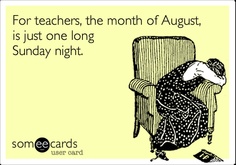
August sunday nightI hear these comments from friends and relatives the last days of August. Acquaintances who pass with a quick “How are you?” any other time of year, now take time to gloat and ask, “Back to the grind, right?” Apparently, they are under the impression that I have not thought about school these past weeks of relaxed responsibility. To the contrary, for the past eight weeks, I continued to think about school.

While summer vacation allowed me the opportunity to catch up on reading for pleasure, some of the books I read this summer (The Fault in Our Stars by Jon Green, When She Woke by Hillary Jordan),  are ones I plan to share with my students. Summer allowed me the opportunity be a student and to take classes to improve my understanding of instructional strategies. Cris Tovani’s book, Do I Really Have to Teach Reading? was particularly interesting as a resource to share with content area teachers.  Finally, during the summer I had long stretches of uninterrupted time to think and to write.  Consequently, the activities I pursued in the summer are not unlike the activities I pursue during the school year. The difference is that I do not have to complete reading or writing during July’s halcyon days at the almost breakneck speed I use from September to June. Even in these days of leisure, the classroom is never far from my mind. August’s arrival signals an end to the unhurried pace practiced by those in other professions.

For teachers, there is a great deal of physical preparation to teach: preparing the classroom, preparing the materials, and preparing the kidneys to go hours on end. There is also the emotional preparation for the highs and lows that will follow for the next 38 weeks of school. Teachers know that setting the right tone on Mondays can make  a huge difference on the academic success of a school week. Which brings me to the importance of Sunday night.

Sunday night is for planning.

Those hours before the beginning of any school week are fraught with detailed lists of necessary supplies, schedules for delivering instruction, and aggressive strategies to beat other teachers to the copier on Monday mornings.

Those few hours before the Monday morning announcements are also exciting as planned lessons, packed with potential, sit ready to be deployed. Sunday nights are full of promise.

Therefore, August is the Sunday night of the school year. Teachers mentally planned bulletin boards, unpacked supplies, arranged classroom furniture, and put their last touches on unit plans before they set a foot in their classroom. On that first day of school-that first day of the week- their preparations will pay off.

So, yes, to those who have asked; the long vacation is over. But going “back to school”? I really never left.

Literally….David Coleman

August 24, 2013 — 2 Comments

Literally added a new meaning this past month….literally.

A quick look at the Cambridge Dictionaries Online indicates that while the meaning of literally as ” having the real or original meaning of a word or phrase” will now include use of the word “to emphasize what you are saying”. A similar entry from an authority across the pond, Oxford Dictionaries notes:

In recent years an extended use of literally (and also literal) has become very common, where literally (or literal) is used deliberately in non-literal contexts, for added effect, as in they bought the car and literally ran it into the ground. This use can lead to unintentional humorous effects (we were literally killing ourselves laughing) and is not acceptable in formal contexts, though it is widespread.

This chatter about literally and literalness came to mind when I read the Frizzleblog on the Scholastic website ten “takeaways” from a presentation given by David Coleman, an architect of the Common Core State Standards (CCSS) and the current College Board president, to a group of New York City teachers. The blog entry was titled 10 Things Worth Doing in Your Classroom by  Suzanne McCabe, Editor in Chief at Scholastic, and she listed ten summaries from Coleman’s presentation on how to enrich classroom instruction.

Her summary statement #4 stopped me cold…literally.
4. Only draw conclusions that can be substantiated by the words on the page. Scrape away terms like “metaphorical,” and talk as simply as possible. Once you bring up metaphor and meaning, kids are out of the game.
McCabe may be misrepresenting Coleman in this statement, however, the Common Core State Standards promoted by Coleman centers on textual evidence, so the “conclusions substantiated by the words on the page” summarizes his preferred reading strategy.  In addition, his lack of classroom experience at any grade level explains why he may have said something akin to “kids are out of the game” when metaphors are discussed.
To the contrary, children of all ages understand metaphor according to Maria Popova in her post The Magic of Metaphor: What Children’s Minds Teach Us about the Evolution of the Imagination on her Brain Picking’s blog:

During pretend play, children effortlessly describe objects as other objects and then use them as such. A comb becomes a centipede; cornflakes become freckles; a crust of bread becomes a curb.

The combination of life experience and practice with similes (“pancakes are like nickels,”  “A roof is like a hat,”“Plant stems are like drinking straws,”) builds a student’s understanding of metaphors that are more complex (“”I am the good shepherd; I know my sheep and my sheep know me” John 10:14). 

So why would a teacher want to “scrape” away metaphorical terms at this important stage in developing a student’s understanding of more sophisticated metaphors?
Furthermore, how could Coleman reconcile an author’s choice in using a metaphor if that metaphor is scraped away in order to talk as “simply as possible”? McCabe’s summary of Coleman’s position reduces students to reading “literally”, rendering them unable to appreciate an author’s craft .
For example, if students had to scrape away the  metaphorical ideas in some of Shakespeare’s most recognized literary comparisons, what would they say?

“All the world’s a stage, and all the men and women merely players. They have their exits and their entrances.” As You Like It

Students may determine through textual evidence that Shakespeare was literally referring to the stage.

Night’s candles are burnt out, and jocund day
Stands tiptoe on the misty mountain tops.” Romeo and Juliet

Students may determine through textual evidence that Shakespeare was literally writing about candles.

Smiling sunStudents are more creative than Coleman recognizes in his untested design of the CCSS. From the beginning of their academic careers, they draw their metaphors: smiling suns, hearts in hands, trees with large red dots. They start simply “Freddie is a pig when he eats,” before moving to more sophisticated constructs on their own such as “Love is a chocolate fountain that never runs out.” They are capable of sustaining elaborate metaphors to explain the writing process:

I choose my audience very carefully when playing for an audience for the first time. I want constructive criticism, and therefore I prefer to have my peer musicians as well as my conductor or private instructor hear me play aloud for the first time. . . .When I have read and reread [the paper] so many times that I am unable to find any mistakes, I then like to read my paper aloud to my family or a group of my close friends in order to get their reactions. Maria, National Writing Project website

These students knew they were not writing about a pig, chocolate fountains, or conducting music. If Coleman had classroom experience, he would have first hand evidence about student creativity.

Finally, many of the most beloved children stories are saturated with metaphor.  Lewis Carroll’s Alice in Wonderland is filled with metaphors that address life’s absurdities, and one specific metaphor brings me back to an entry I wrote titled  David Coleman, the Cheshire Cat of Education.

While I did not mean that Coleman is a cat literally, I do mean that his philosophy of education is as contradictory as the character in Carroll’s imaginative classic. “Curiouser and curiouser,” wonders Alice, when the enigmatic Cheshire Cat appears and reappears at critical moments in the story. Likewise, Coleman’s curious contradictions may be the reason for any inaccuracies in McCabe’s summary of his presentation. On the other hand McCabe may have accurately recorded these contradictions and illustrated how Coleman’s inexperience makes his statements about how to teach in a classroom ridiculous…literally.