Archives For November 30, 1999

Late August and early September means back to school for all students. Many primary school teachers are pulling out the traditional “apple” unit to welcome their students. Many of these teachers will be ready with “pumpkin”, also a fruit, for the following month of October. During the school year, teachers of all grade levels might find out that a lesson turned out to be a “lemon”, or one that is “not worth a fig.” Educational stakeholders can “cherry-pick” data to see if the efforts of a teacher “bears fruit”, while the focus on data-driven instruction can drive some teachers “bananas”.

Fruit metaphors are plentiful when discussing education, and a recent post by a friend and literacy specialist, Catherine Flynn, explains a possible reason. Consider that fruits, although uniform at first glance are, upon closer inspection, very different. Fruits flourish in different environments, and fruits require different nutrients. Fruits require different means of harvesting, and fruits ripen at different times.

blackberriesThis ripening was the point of Catherine’s blog post in her response to the Slice of Life blog challenge, a weekly prompt organized by Two Writing Teachers. Catherine’s response to their prompt on her Reading to the Core Blog was titled Ripe Blackberries.  Since she lives in a rural area, she had the opportunity to consider the ripening blackberries on a bush near her home:

 Each morning as I walk my dog, I notice that some of the fruit is deep black, as ripe as it’s going to get, while others still have just a hint of red. Why such variation on one bush? Each blackberry has gotten the same amount of rain and sun. Each one has the same genetic make up. So why are some ripening faster than others?

There are many forces in nature that cause the variations that Catherine noted as she admired the blackberry bush. These forces dictate the time for harvesting those blackberries, but this fruit is never uniformly ready for harvest at the same moment. For example, the advice for picking berries on several websites suggests that to “ensure that none of the fruit gets too ripe, berries should be picked every two or three days.” Berries are not the only fruit that may require a second or third harvest, and pinpointing the exact moment of any fruit’s maturity is a combination of science and practiced guessing.

In contrast to how nature influences fruit to ripen and mature, our educational system requires students to be “ripe” collectively at the same time, regardless of the variations in age, race, or gender of the students. The educational system measures how well a student meets a pre-determined standard through tests given on a prescribed date, picked perhaps years in advance. There is no accounting for arbitrary changes that may have happened in a school system, perhaps changes in staff, facility, or materials. There is no accounting for the arbitrary changes in a student’s personal life. Rather, there is a standardization for elements in our educational system that defies the individual nature of each student.

In her post Catherine notes:

Within every classroom, there will be a variety of strengths, abilities, and weakness. Students will arrive at school with a vastly different amounts of background knowledge and interests. Despite these differences, in the hands of a caring, knowledgable teacher in a supportive, nurturing environment, almost all children will learn and grow. Not at the same pace, and not to the same degree, but they will learn, just as most of the berries on those bushes will eventually ripen.

Screen Shot 2013-08-14 at 8.54.31 PM

Teachers see the differences in the nature of each student: the emotions, the ability, and the interests. Teachers see each student as more than a data point in achieving instruction, and teachers know that each student is more than what a test score represents. As Catherine suggests, in the hands of a caring and knowledgeable teacher, each student will learn and grow.

Yet, countering the forces in the nature of each student are the forces of educational reform that are increasing testing at every grade level. Tests focus on a limited range of skill sets with little consideration for other student aptitudes. To determine each student’s preparedness, students are bunched together by a “date of production” or birthdate, not when a student is “ripe” or cognitively mature.

Therefore, trying to compare student cognition through collective testing on any given day is the final metaphor of this post. It is like comparing apples to oranges. Yes, they are both fruit, but they are very different. So are our students.


A favorite New Yorker cartoon of mine is by Sidney Harris.

Screen Shot 2013-08-07 at 6.06.50 AMTwo men stand in front of a chalkboard. Their demeanor indicates they are mathematicians. Scrawled on the chalkboard to the left of them is step one, a complicated mathematical formula. To the right of them, step three, is the solution to that complicated formula. In the center of these numbers and symbols,one of the men is pointing to the phrase, “THEN A MIRACLE OCCURS…”.

Under the cartoon is the caption spoken by one of the mathematicians: “I think you need to be a little more explicit here in step two.”

There are so many scenarios that could be explained by this cartoon, but lately I have been thinking about how this cartoon represents the process of education. The missing “step two” is the miracle of how a teacher helps a student to learn, since by definition, a miracle is an extremely outstanding accomplishment. Good teaching is that miracle that blends both science and art. The science formula here is the diagnosis of student needs and the application of strategies that address these needs. The art is the manner in which a good teacher does both.

This blend of science and art is necessary since each student learns differently. Students’ brains are different. Students’ personalities are different. There are differences in how students mature physically and emotionally, and students’ learning styles are different. A great deal of time and energy has been expended in researching the science of teaching to address these differences.

For example, at the beginning of the 20th Century, researchers noted that those students who performed well on one type of test, say mathematics or verbal fluency, were also successful on other academic tests, while those who did poorly on one test tended to do poorly on other tests as well. British psychologist Charles Spearman, put forth a theory that a student’s mental performance across different could be consolidated in a single general ability rating, the g factor. In 1983, American developmental psychologist Howard Gardner countered with his Theory of Multiple Intelligences. He suggested that a measuring student’s intelligence should also include the following considerations:

Visual/Spatial – Involves visual perception of the environment, the ability to create and manipulate mental images, and the orientation of the body in space.
Verbal/Linguistic – Involves reading, writing, speaking, and conversing in one’s own or foreign languages.
Logical/Mathematical – Involves number and computing skills, recognizing patterns and relationships, timeliness and order, and the ability to solve different kinds of problems through logic.
Bodily/Kinesthetic – Involves physical coordination and dexterity, using fine and gross motor skills, and expressing oneself or learning through physical activities.
Musical – Involves understanding and expressing oneself through music and rhythmic movements or dance, or composing, playing, or conducting music.
Interpersonal – Involves understanding how to communicate with and understand other people and how to work collaboratively.
Intrapersonal – Involves understanding one’s inner world of emotions and thoughts, and growing in the ability to control them and work with them consciously.
Naturalist – Involves understanding the natural world of plants and animals, noticing their characteristics, and categorizing them; it generally involves keen observation and the ability to classify other things as well.

Gardner’s theory has been adopted by educators, including Sir Ken Robinson, an English author, speaker, and international advisor, who has stated that,

Many highly talented, brilliant, creative people think they’re not — because the thing they were good at at school wasn’t valued, or was actually stigmatized.

He has noted that organizing students by birthdate is not the best determiner of learning saying,

Students are educated in batches, according to age, as if the most important thing they have in common is their date of manufacture. 

Robinson advocates accounting for student differences in an educational system that has been standardized for ease of delivery, an educational system of definitions and measurement. Balancing these forces of measurement and definition in the science of good teaching demands another great force, the art of good teaching.

Good teachers practice the art of teaching in accounting for student differences in maturity, in personality, and in interest. Good teachers practice the art of teaching by choosing how to challenge or aid a student with new content. Good teachers practice the art of teaching when they distinguish between the look of confusion from a look of comprehension and respond appropriately. The art of teaching is knowing how to address the needs of the individual learner.

While there is a degree of science used in the “miracle” step two of the cartoon, the degree of art is trickier. Science is valuable to education as measuring the student; art is valuable to education because the art of teaching has an effect on the student that cannot be measured. The miracle of good teaching is a blend of the two, a blend of science and art for each individual student.

As to those mathematicians in the cartoon who need to be more explicit in step two? They should ask a teacher about performing miracles.

I hold up the book I will be reading aloud, Dr. Seuss’s The Cat in the Hat. The students start commenting:

This is one of my favorite books…
I love Thing #1 and Thing #2!
I (loved) or I (hated) the movie!
Can we read Green Eggs and Ham, too?

Cat in Hat book coverI settle the students down and begin,

“The sun did not shine.
It was too wet to play.
Just sit in the house all that cold, cold wet day.”

32 eyes blink brightly up at the pages as I turn them.
Several mouths move without sound to recite along with me.
The students are mesmerized.

Oh, did I mention that these are seniors in high school?

I am using a picture book to explain Freud’s theory of the Id, Ego and Superego (see post). Thing #1 and Thing #2 represent Id, and that righteous fish? The Superego. Yes, Dr. Seuss is great for psychological literary criticism, but he is not the only picture book in my repertoire of children’s literature used in high school. Here are a few of my favorites to use and why:

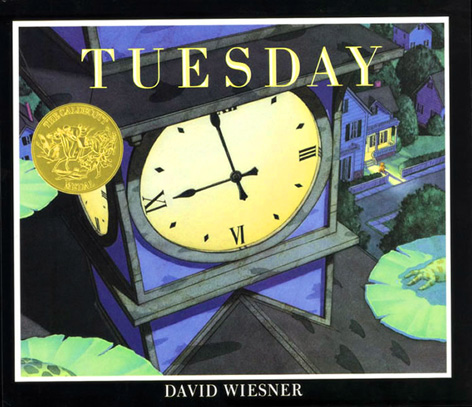
Tuesday by David Wiesner_CoverTuesday by David Weisner. We use this text for our 9th grade mythology unit because a myth explains the unexplainable. Our students have to create a myth for why frogs might lift off from a local pond and terrorize some inhabitants of a small town (see post).

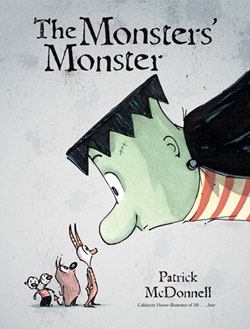
The Monsters’ Monster by Patrick McDonnell. This mash-up of the 1931 film Frankenstein and Mary Shelley’s 1818 novel is ideal to stimulate discussion on the relationship between a creator and the created. In McDonnell’s version, however, the Monster is sensitive, compassionate, with more of an interest in warm, powdered jelly doughnuts than in seeking vengeance…a nice break from the rigors of Advanced Placement English Literature.coverbook_monsters-monster

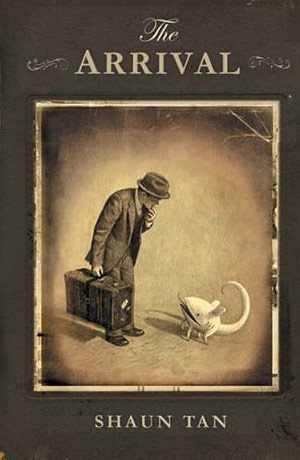
the-arrival-by-shaun-tanThe Arrival by Shaun Tan. Surreal images capture the point of view of an immigrant experience which makes this wordless text ideal for students who are studying Ellis Island or Angel Island. Many of the illustrations are available on the website so students can look at the haunting pictures on their own devices as well.

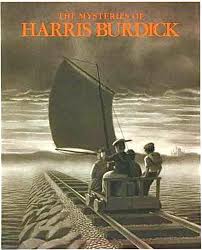
Harris BurdickThe Mysteries of Harris Burdick by Chris Van Allsburg. A book full of provocative images that has inspired thousands of stories explaining the mysteries in each sepia toned drawing. This book is wonderful for writing classroom, and there have been contests for the best stories written by children. Celebrated children’s authors have also taken an opportunity to try their imaginations using the pictures as story prompts in The Chronicles of Harris Burdick.

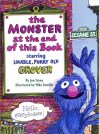
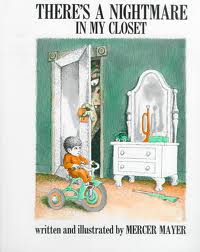
The Monster at the End of this Book by Jon Stone; illustrated by Mark Smollin and There’s a Nightmare in My Closet by Mercer Mayer. Both of these books have been incorporated into our Heroes and Monsters English IV (grade 12) elective. I use them as a starting point for an inquiry project about images of monsters given to children contrasted with the images of monsters we know as adults. Most students discuss the “fuzzy factor” with cute, loveable old Grover as something they remember fondly. They also remember very clearly the monster that lived in their closets. The anxiety of Mayer’s “Nightmare”, sobbing at the foot of the bed, usually brings about a discussion of facing fears.

grover

There are YouTube Videos for students to watch in advance of class (flipped classroom):  The Monster at the End of this Book and There’s a Nightmare in My Closet

Nightmare

Fredrick

Fredrick by Leo Lionni. What does the poet do for society? This little fable answers that question and works well in any poetry unit. Frederick’s use of language paints pictures in the minds of the other mice who are struggling through a particularly bleak winter season. There is a delightful video recording of this to share in class or to have students watch on their own (flipped classroom).

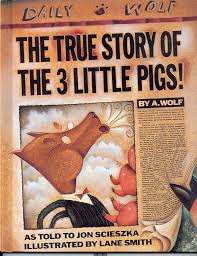
The True Story of the Three Little Pigs by Jon Scieszka; illustrated by Lane Smith. Want a lesson on point of view? This retake of the three little pigs is one of the best ways to present the advantages of this literary device to students of all ages. In his explanation of the story, A. Wolf comes across the first little pig after the house of straw caved in. With culinary justification, he says,

True story“It seemed like a shame to leave a perfectly good ham dinner lying there in the straw. So I ate it up. Think of it as a cheeseburger just lying there.”

The story presents opportunities to use other fairy tales for students to practice retelling stories from another point of view once they buy into Scieszka’s formula.

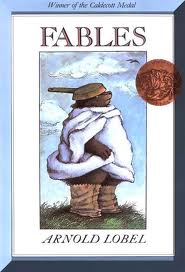
Fables by Arnold Lobel. Here are modern little fables that are one page long with morals such as “It is the high and mighty that have the farthest to fall.” One year, I used these fables with my drama class as short sketches. My favorite sketch to watch was the story of the Lobster and the Crab where the insanely spirited Lobster took timid Crab out for a ride in a boat during a tremendous storm. When the boat capsized, the student playing Crab cried out in despair, “Horrors!” while the student playing Lobster jumped and shouted with glee.”Down we go!” she yelled at the top of her lungs.
FablesLobel writes:

The Crab was shaken and upset.
The Lobster took him for a relaxing walk along the ocean floor.
“How brave we are,” said the Lobster. “What a wonderful adventure we have had!”

The moral? “Even the taking of small risks will add to the excitement of life.”

The same can be said for using children’s literature in high school.
The use of a well-chosen picture book will add to the excitement of a lesson! Continue Reading…

Read picture books.

Yes, I am talking to you.

(No, not you kids….)

I am talking to you….you, Advanced Placement English Literature teacher, pretentiously waving me off with your worn cover of Thomas Hardy’s Tess of the D’Urbevilles. Yes, you too..the one taking notes on Nathaniel Hawthorne’s The Scarlet Letter, the book you assigned for summer reading?

Time to do some other kind of reading.

Time to read for pleasure.

It’s time to wallow in Sendack (Maurice), Carle (Eric), and Seuss (Dr.).

Max Horton Ladybug

It’s time to discover Mo Williams’s Pigeon, Jon Scieszka’s Big Bad Wolf, and Jon Klassen’s hatless bear.

BearPigspigon

Why?

Primarily because teachers, all teachers, who are familiar with children’s literature can be positive role models for their students. They can engage students by making references to these books or they can make suggestions to young readers. They may even use them in lessons. But a new compelling reason has come out of a study by Jo Bowers and Dr Susan Davis, senior lecturers in primary education at Cardiff Metropolitan University. A review of responses by teacher trainees for primary grades indicates that reading children’s literature is good for your well-being.

An article in the British paper The Guardian Why Teachers Should Read More Children’s Books explains the study and promotes a paper Reflecting on Teacher Wellbeing that Bowers and Davis will give at Issues and Changing Perceptions conference in December 2013.

They had set up a year-long blog where teacher trainees could post reviews for three books they used with children over the course of the year. They then asked a focus group of these blog contributors a series of questions about their own reading experiences, such as, “What made you become a reader?”

The joys of reading became apparent, namely, how they had enjoyed “getting totally lost in a book” or “absorbed” by the narrative. It also became evident that they had close personal associations with certain texts from their own childhoods, and the fact that they could turn the page of a book and by knowing what was on that page gave them comfort and confidence to share that book with their class.

Trainee teachers reported they were using children’s books of all genres as a form of escapism from the stresses and strains of teaching in the primary classrooms. Researchers concluded that trainee teachers were using the book as a form of bibliotherapy, a therapy “increasingly moving away from its original medical model– whereby practitioners ‘prescribed’ self-help books to patients suffering from depression or eating disorders.” While the teacher trainees had to read the children’s literature selections as part of their professional development, they also found the experience pleasurable:

We have also found that trainee teachers often don’t read purely for pleasure, citing time constraints as the reason. Our blog project forced them to read as part of their professional development, and because they wanted to improve their subject knowledge. Wellbeing was secondary, but nonetheless became part of the project, almost by default. One of our students summed it up nicely: “Books are like best friends during stressful times.”

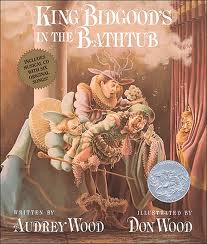
So, go ahead and pick up that copy of King Bidgood’s in the Bathtub and chant loudy the refrain “…and he won’t get out!”
Listen to the poetic wisdom of a small mouse who notes that everyone has a gift to bring in Leo Lionni’s Fredrick.
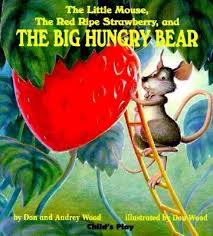
Or, share a red, ripe strawberry in The Little Mouse, The Big Hungry Bear and The Red Ripe Stawberry.

king Fredrick mouse

You will be reading for pleasure. You will be reading quickly, and you will probably feel better, things Thomas Hardy and Nathaniel Hawthorne may not do for you.

References according to The Guardian:

Jo Bowers and Dr Susan Davis are senior lecturers in primary education at Cardiff Metropolitan University. Follow them on Twitter: @Jo_Bowersand @drsuzyw. Reflecting on Teacher Wellbeing – Issues and Changing Perceptions conference will be held at Cardiff Metropolitan University on Wednesday 4 December 2013. For further information please contact:cseenterprise@cardiffmet.ac.uk.


JaneEyre-300x253

Jane Eyre audio offered by SYNC YA

This summer I have been visiting the family estate at Gateshead, the harsh boarding school Lowood, and the Gothic mansion called Thornfield Hall through the audio download of Charlotte Bronte’s Jane Eyre courtesy of SYNC YA. This free audiobook uses Overdrive software which is on both my computer and my mobile phone. As the recording of Jane Eyre is about eight hours long, the ability to move from device to device has proved most helpful in finishing the book.

This is not my first experience with this novel. I read the book when I was a teenager, and, like Jane, I fell in love with Mr. Rochester. Years later, I taught the book later to Advanced Placement students and marveled at Jane’s independence, her morality, and her ability to emphatically say “No” to the persistently persuasive Rochester.  Now, I am struck by Jane’s role as a governess and how Bronte characterizes attitudes towards that profession in Victorian England.

At one of Rochester’s soirees, Bronte has the spoiled but beautiful Blanche Ingram recount how she and her brother and sister, tormented their governesses and tutors as as they grew up. The incident begins when Blanche’s mother, Mrs. Ingram, calls the guests’ attention to Jane, isolated in a corner of the room. “I have just one word to say of the whole tribe,” whispers Blanche’s mother loud enough for Jane to hear, “they are a nuisance.”

Blanche cheerfully counters:

Not that I ever suffered much from them; I took care to turn the tables. What tricks Theodore and I used to play on our Miss Wilsons, and Mrs. Greys, and Madame Jouberts! Mary was always too sleepy to join in a plot with spirit. The best fun was with Madame Joubert: Miss Wilson was a poor sickly thing, lachrymose and low-spirited, not worth the trouble of vanquishing, in short; and Mrs. Grey was coarse and insensible; no blow took effect on her.

Not satisfied with those affronts to those poor teachers, Bronte has Blanche continue the list the indignities inflicted on one particular governess who was subjected to especially bad behavior from the Ingram children:

But poor Madame Joubert! I see her yet in her raging passions, when we had driven her to extremities–spilt our tea, crumbled our bread and butter, tossed our books up to the ceiling, and played a charivari with the ruler and desk, the fender and fire-irons. Theodore, do you remember those merry days?”

Blanche’s condemnation of those who tried to educate her backfires; Bronte’s desire to have the reader dislike this rival for Rochester’s affection is deliberate. Jane’s quiet moral intelligence wins out in the end.

Listening to the story, I considered that Bronte was making a case for the importance of education as a means to rise out of poverty. Jane’s education at the Lowood Institute, a boarding school, was hazardous and purchased at a terrible price. Her classmate, Helen, dies because of the stark conditions at Lowood, mirroring the real-life death of Bronte’s sister, Maria, who died from tuberculosis contracted because of hunger, cold, and privation at Cowan Bridge School. Despite the treacherous conditions, however, Bronte revisits the theme of education’s importance as it provided the character Jane with an independent profession. She is hired to teach Rochester’s ward Adele, and she proves to be a successful governess.

The conflict between Bronte’s belief that education was one way for a young woman to earn a small income, to have a marketable profession, clashes with the upper classes’s view of the teaching profession in 1847. Therefore, how disappointing to read polls (2009-2012) about contemporary economics of the teaching profession that demonstrate that a century and a half later, not much has changed. According to The Economix blog on the NYTimes, “Does it Pay to Become a Teacher?”, salary  may reduce attracting high quality graduates to the teaching profession:

The average primary-school teacher in the United States earns about 67 percent of the salary of a average college-educated worker in the United States. The comparable figure is 82 percent across the overall Organization for Economic Cooperation and Development (O.E.C.D.). For teachers in lower secondary school (roughly the years Americans would call middle school), the ratio in the United States is 69 percent, compared to 85 percent across the O.E.C.D. The average upper secondary teacher earns 72 percent of the salary for the average college-educated worker in the United States, compared to 90 percent for the overall O.E.C.D.

The findings also point out that teachers in the USA teach over 1000 hours annually, an amount well over the hours of their international peers. That number does not include time for preparation, training, or assessing. The article concludes:

Given the opportunity costs of becoming a teacher instead of using your college degree to enter another, more remunerative field, are the psychic rewards of teaching great enough to convince America’s best and brightest to become educators?

Bronte was one of England’s best and brightest who advocated education, but Bronte knew that teaching was not an economically successful profession. Jane Eyre only becomes financially independent when a relative leaves her a fortune; she only becomes wealthy when she confesses, “Reader, I married him.”

Over 150 years after Charlotte Bronte’s novel, the teaching profession still has its critics; there are real life Mrs. Ingrams and Blanches who hold the profession in contempt. There are also economic drawbacks to choosing the profession, as demonstrated in the O.E.C.D poll.

In the 21st Century, the teaching profession should be desirable to those who aspire to teach, but who, like Jane, want to be financially independent. Teachers should not have to wait for a Mr. Rochester in order to prosper.

CT Stae flagThe other day, I made a scan of my teaching and administrative certificates and sent them to my school office in order to update my records. If you teach in the State of Connecticut, as I do, you are required to provide the necessary transcripts and payments to secure and maintain a teaching or administrative certificate. The Connecticut Department of Education (CT SDE) has always been one of those great equaling institutions: no paperwork=no certificate.

Until now. Until Paul Vallas, Interim Superintendent of Schools in Bridgeport, Connecticut.

Vallas has served 17 months as Interim Superintendent of Schools for Bridgeport, Connecticut, a 21,000-student school system. Before coming to Connecticut, Vallas had served as the Superintendent of the Recovery School District of Louisiana; and the CEO of Chicago Public Schools and the School District of Philadelphia. Vallas, however, was ousted by a Connecticut Superior Court Judge Judge Barbara Bellis’s weeks ago because he lacked graduate coursework and that the “alternative program” created for Vallas by the State Commissioner of Education, Stefan Pryor, fell far short. Pryor’s letter certifying Vallas’s credentials, according to Jacqueline Rabe Thomas writing (6/28/13) in the Connecticut Mirror, was not accepted by the judge who ruled:

“’There is no doubt that Vallas received preferential treatment,’ the judge wrote in her 27-page decision.The judge also noted that Vallas lacked the required prerequisites to enroll in the regular UConn [University of Connecticut] program in the first place, and that such an independent study hadn’t been approved for anyone else in the last decade. Additionally, the university’s governing board had never approved an independent study program.’Ultimately, the course standards were reduced,’ the judge wrote. ‘The court accepts Vallas’ testimony that the work, although done over the course of 10 weeks while fulfilling his employment as acting superintendent, could have been completed in a week.'”

Ultimately, the judge ruled that Vallas’s BS in Political Science/History and MA Political Science from Western Illinois University were not comparable for a certification in education according to Connecticut’s Department of Education (CT SDE). While his experience as the Executive Director of the Illinois Economic and Fiscal Commission, revenue director and budget director for the City of Chicago provided him the experience to deal with Bridgeport’s financial woes, he lacked training as an educator.

Vallas has a number of supporters on the Bridgeport Board of Education, and his ouster has received the attention from the state and national press. There are articles and editorials, mostly positive about his work in Bridgeport. The editorial headline from the Hartford Courant (7/25/13) was particularly sympathetic: Why Make It So Hard For Paul Vallas To Help Bridgeport Schools? Qualifications shouldn’t obstruct a promising superintendent

It would be a blow to the city of Bridgeport’s school system and its 21,000 students if Paul Vallas is not permitted to stay on as superintendent. Someone of Mr. Vallas’ experience and gravitas is just what the doctor ordered for the city’s ailing school system.

While I know little about Vallas’s efforts to improve the school system in Bridgeport, I was particularly attentive to several comments that followed this editorial discussing the role of the state’s colleges and university programs. These comments made clear that academic institutions should be concerned when their undergraduate and graduate education certificate programs are being discounted at the highest level.

Educators in the Constitution State spend time and money at state colleges and universities to meet the requirements for teacher and administrator certifications. Even the state-run Alternate Route to Certification (ARC) for those entering the profession with degrees other than education has been made more demanding. There are special graduate certificate programs offered at different institutions (Administrator-092, Literacy Specialist-097, Superintendent-093) each with requirements of extensive coursework of 30 credits or more.

In addition, CT SDE requires that educators provide all transcripts and results from subject area texts (PRAXIS II); these cost educators time and money. CT SDE website also states:

All prospective administrators enrolled in Connecticut administrator preparation programs seeking a recommendation for the Initial Educator Certification for Intermediate Administration or Supervision (#092) must pass the CAT (Connecticut Administrators Test) in order to be certified.

All administrators prepared outside of Connecticut with fewer than 3 years within the last 10 years of administration experience who apply for the Initial Educator Certification for Intermediate Administration or Supervision (#092) must pass the CAT. An applicant recommended by an out-of-state institution may be eligible for a one-year deferral of the CAT.

Paul Vallas did not meet these requirements.

The controversy has captured the opinions of state politicians, educators, and reached the federal level with the Secretary of Education, Arne Duncan, siding with Vallas. They argue in the press over what Vallas has done for Bridgeport, or what he has accomplished outside of the state.

A more serious far reaching problem, however, is this example of the State of Connecticut’s unequal application of certification requirements to educators. If a certificate is not necessary for a high-profile educator to work as an administrator in the state, why have the requirement at all? If education course work is unnecessary, why should the state’s colleges and universities offer courses at all? And if there is no need for certificates or coursework, why have I paid money to the state to keep my teaching and administration certificates updated?

In Connecticut, the land of steady habits, inequalities in certification requirements make the state a little less steady.

Rosetta

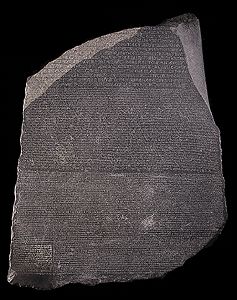
The Rosetta Stone currently located in The British Museum in London, England.

When I stood in front of the Rosetta Stone in the British Museum in London, I had to wiggle my way through the blockade of tourists who were trying to photograph the small black tablet. Since the stone was encased in glass, I knew the reflections from the camera flashes would result in poor quality photos. Once I had my few seconds before the 2200 year old tablet, I headed off to the gift shop to secure a clear photo of the Rosetta Stone and a small plaster recast of the dark black stone; both yielded far more details than I saw when I was squeezed by the crowd.

The face of the Rosetta Stone, one of two tablets, is etched with three different scripts, each spelling out the same decree issued by King Ptolemy V from Memphis (Egypt) in 196 BCE. These inscriptions translate Ptolemy’s decree in three scripts: the upper text is Ancient Egyptian hieroglyphs, the middle portion Demotic script, and the lowest Ancient Greek. Because the Rosetta Stone presented the same text in each script (with a few minor differences among them), the tablet provided the key to our modern understanding of Egyptian hieroglyphs.

Since the Rosetta Stone is often used as a metaphor for using an essential clue to a new field of knowledge, why not use the Rosetta Stone as a metaphor for explaining the role of data, specifically standardized test data, in informing classroom instruction? Imagine that different stakeholders, (school administrators, teachers, students, parents and test creators ) who look at the results of standardized tests are like those who crowd before the Rosetta Stone trying to decipher its meaning.

The first linguists who worked with the Rosetta Stone were able to look closely, touch and take rubbings of the different alphabets and hieroglyphics as they translated each of the texts. They spent time puzzling over the different alphabets, and they constructed primers to help decode each of the languages. They could see the variations in the engraver’s strokes; they could examine nuances in chisel marks that formed the symbols. As to the contents of the missing or damaged sections, the linguists made educated guesses.

Likewise, in education there are those who are knowledgeable in translating the information from standardized tests, those who have spent time examining data looking for patterns of trends comparing collective or individual student progress over time or perhaps comparing student cohorts. The metaphor of the Rosetta Stone, however, fails in directly comparing the different forms of data collected in the multitude of standardized tests. Each test or assessment is constructed as a single metric; the translations of one standardized test to another are not the same. For example, the state mandated Connecticut Mastery Tests (CMT-grades 3-8)  are not correlated to a diagnostic test for reading such as a diagnostic reading assessment (DAR). The Connecticut Academic Performance Test (CAPT Grade 10) cannot be directly compared to the PSAT or ACT or the NAEP, and none of these standardized tests are comparable to each other.

Consider also how the linguists who studied the Rosetta Stone spent time and lingered over the different interpretations in order to translate the symbols in the differing alphabets. They studied a finite number of symbols that related to a finite statement fixed in time.

In contrast, standardized testing associated with education reform is on the upswing, and today’s educators must review continuous waves of incoming data. Often, when the results are finally released, their value to inform classroom instruction has been compromised. These results serve only to inform educators of what student could do months earlier, not what they are doing in real time. Just like the time stamped images each tourist’s camera records of the Rosetta Stone, standardized tests are just time stamped snapshots of past student performance.

How ironic, then, that so much media attention is given over to the results of the standardized tests in informing the public about student progress. How like the crowds snapping blurry photos around the Rosetta Stone are those who do not understand what exactly what each standardized test measures.

What they should appreciate is that prioritizing the streams of data is key to improving instruction, and the day to day collection of information in a classroom is arguably a more accurate snapshot of student ability and progress.

There are the classroom assessments that teachers record on progress reports/report cards: homework, quizzes, tests, projects that measure student achievement in meeting grade level standards and requirements. Then there is the “third leg” of data, the anecdotal data that can be used to inform instruction. The anecdotal data may be in the form of noting a student sleeping in class (“Has she been up late?”), reviewing a lesson plan that did not work (“I should have used a picture to help them understand”), or reporting a fire drill during testing (“Interruptions distracted the students”). Here the multiple forms of data collected to measure student progress are fluid and always changing, and translating these results is like the linguists’ experience of the hands-on translation of the Rosetta Stone noting the variations and nuances and making educated guesses.

The standardized tests results are most useful in determining trends, and if translated correctly, these results can help educators adjust curriculum and/or instructional strategies. But these test results are antiquated in relation to tracking student learning. Students are not the same day to day, week to week, semester to semester. Their lives are not prescribed in flat symbols, rather students live lives of constant change as they evolve, grow, and learn.

As the Rosetta Stone was critical to understanding texts of the Ancient World, our standardized tests are the “ancient texts” of contemporary education. Standardized tests cannot be the only measurement the public gets to interpret on student and school performance since the results are limited as snapshots of the past. Student and school performance is best understood in looking at the timely combination of all streams of data. To do otherwise is to look at snapshots that are narrow, unchangeable, and, like many of those photos snapped in the British Museum, overexposed.

Poetry Friday: Invictus

July 19, 2013 — 4 Comments

The film Invictus tells the story of how in 1995 Nelson Mandela enlisted the help of South Africa’s National Rugby team in order to unite the country and end prejudices associated with Apartheid. The film stars Morgan Freeman as Mandela and Matt Damon as South African rugby star Francois Pienaar, but this is more than a sports film. One mise-en-scene features a visit to the real Robben’s Island Prison, where Mandela was held as a political prisoner for 27 years.

The film footage shows the cell where Mandela served his sentence before his release in February 1990. As the camera pans around the prison, the voice of Freeman recites William Ernest Henley’s poem Invictus

Out of the night that covers me,
Black as the Pit from pole to pole,
I thank whatever gods may be
For my unconquerable soul.

In the fell clutch of circumstance
I have not winced nor cried aloud.
Under the bludgeonings of chance
My head is bloody, but unbowed.

Beyond this place of wrath and tears
Looms but the Horror of the shade,
And yet the menace of the years
Finds, and shall find, me unafraid.

It matters not how strait the gate,
How charged with punishments the scroll.
I am the master of my fate:
I am the captain of my soul.

I am familiar enough with the poem that I do not need to look it up or “cut and paste” the text.
I can recite this poem cold.
So can the grade 12 seniors at Brookfield High School in CT (my tenure 1999-2008) who traditionally memorized the poem and recited its 16 lines for an English grade.

The “Invictus Day” tradition was begun to honor an English teacher who had passed away; the tradition was sustained by her colleague, Carole Smith, who would prepare “Invictus” sheets for students to carry with them to practice. A rubric was on the back that provided selected teachers a rubric to grade the quality of the recitation: A for a spectacular recitation (with feeling; no errors); B for a good recitation (one error allowed); C for an average recitation (errors allowed). A student had only one shot for an A; a teacher would sign off on the quality, but if there was a single flub, the highest grade that could be achieved was a B. Fortunately, the weight of the “Invictus” grade was nominal, however, the honor of getting an A for recitation was an achievement regardless of weight.

“Invictus Day” was an unannounced event held usually in late October or early November. Members of the faculty wore black, and seniors went scurrying to their lockers for their sheets. In Harry Potter-esque fashion, teachers would point at a senior with a finger and command, “INVICTUS”! The senior would be required to drop everything, hand over the sheet, and begin reciting, “Out of the night that covers me…”

There was a great deal of cowering, creeping, lurking,  prowling, skulking, and stalking on “Invictus Day”…on the part of both students and faculty. Some students took full advantage of the dramatic encounters by shouting the poem at the top of their lungs or climbing on tables or desks to recite for a crowd of delighted underclassmen. Others clung together to recite chorally, while the more timid seniors were given the opportunity to pull a teacher aside to recite and “get this over with!” Every year, a student would sing the poem to a familiar tune; one year, a student had a completely original melody with back-up singers. Once a student was graded, or “invicted”, he or she could show the sheet as a pass. Once invicted, a student could not be forced to recite again.

My favorite story of “Invictus Day” was of a one student who advertised his plans for presenting the poem. He prepared to recite the poem holding a heavy plaster skull, a la Hamlet. Hearing this, I convinced the members of the faculty not to invict him. The idea that he would carry the skull for several days was amusing to the faculty and to the student body. November came and went, and so did December and January. By late March, the student was pleading for someone to “invict me” so that he could rid himself of the skull he had been toting for months. Fortunately, he had been cast as a lead in the school musical. One warm April night, at the end of the final night’s production, he ran forward to take his well-deserved bow. As he stood up, I stepped out from the wings and onto the stage and cried, “Invictus!” There was a split second of shock in his eyes, but he bounded backstage and seconds later reappeared with the skull to recite the poem to a full house. There was a standing ovation; his performance for both the musical and the poem deserved the audience’s applause.

The obvious message of the poem is the control of one’s fate, and that makes the poem perfectly suited for seniors who will be steering their own destinies once they graduate. They may go to colleges, training schools, the military, or they make seek their futures in other pursuits, but who they will be after the thirteen years of mandated education is largely up to them. Holding the poem’s message in their heads, and in their hearts, can serve to guide them through rough waters of adulthood.

Mandela The same could be said for the use of the poem in the film Invictus. Four years after his release from his 27 years in Robben Island’s prison, Nelson Mandela was elected president of South Africa. He had made great sacrifices in bringing the horrors of Apartheid to an end, but his belief in a united South Africa had prevailed.

This past Thursday, July 18, 2013, Mandela turned 95 years old.

Happy Birthday, Mr. Mandela, your life story is affirmation of Henley’s message:

I am the master of my fate:
I am the captain of my soul.

No common coreOne of the underlying problems in educational reform today is that so few reformers have any hands-on classroom experience. Reading about teaching is academic and informative, but the hands-on experience of standing in front of a class of 9, 14, 24, or (heaven forbid!) 31 students at any grade level is irreplaceable. Developing lesson plans is an academic exercise, however monitoring and adjusting that lesson plan for real time problems (fire drill, student absences, material shortage, technology glitch) during instruction is irreplaceable. Reading assessment data is an academic enterprise, but understanding that data in the context of the classroom with all the personalities, abilities, disabilities, and socio-economic influences is irreplaceable. Hands-on experience should be a major factor in education reform, but the education reform efforts in the  Common Core State Standards (CCSS) have little to no classroom credibility.

A recent entry on Twitter from Randi Weingarten, current president of the American Federation of Teachers, was an attempt to address the classroom experience of the creators of the CCSS. Weingarten herself does have hands-on experience in the classroom, but that experience is spotty.  From 1991 until 1997, and with the exception of a six month full time teaching load in the fall of 1994, Weingarten taught on per diem basis (substitute?) at Clara Barton High School in Crown Heights, NY. Total experience? Six years, but this short experience is six more than many of the educational reformers who participated in the creation of the CCSS.

Weingarten tweeted the following on June 29, 2013:

Teachers were part of the development of #CCSS from the beginning http://youtu.be/y1DlNpaKW38

She was posting a link that was supposed to demonstrate that teachers, real classroom teachers with hands-on experience, had been involved in the standards from the beginning. The link led to a YouTube video featuring an ELL classroom teacher Lisa Fretzin who reflects how she “…was part of the review process starting in August looking at the the first draft”:

While Ms. Fretzin certainly has classroom credibility necessary for developing the CCSS, her participation was not exactly at the “beginning” of this process. According to her statement on the video, she was not present at the creation; she was asked to “review” which is different than “from the beginning”. Furthermore, her name is not on the list of participants who did create the CCSS for English Language Arts (or feedback group) which clearly identifies only four of the 50 participants (8%) as “teachers”. The remaining 46 participants (92%) are identified with titles such as: “author”, “consultant”, “specialist”, “professor”,  “supervisor”, “director” or “senior fellow.” In all fairness, perhaps many of these participants had worked in the classroom before moving into higher ranking positions as one would hope, but their hands-on classroom work experience is unclear.

The most glaring examples of classroom incredibility are the lead authors for the CCSS, Susan Pimentel and David Coleman; their collective classroom experience is zero. Pimentel has a law degree and a B.S in Early Childhood Education from Cornell University. Coleman’s, (termed “Architect of the Common Core”) classroom experience is limited to tutoring selected students in a summer program at Yale. He later founded Student Achievement Partners and is currently serving as the President of the College Board.

Weingarten must also know that classroom teachers for PreK-Grade 3 and grade level experts were not included in the creation of the CCSS at all. Many of these educators have express concerns that students are not cognatively ready for many of the standards in math and reading. Valerie Strauss of The Washington Post put up an editorial (1/29/13) “A Tough Critique of Common Core on Early Childhood Education” by Edward Miller, teacher and co-author of Crisis in the Kindergarten: Why Children Need to Play in School, and Nancy Carlsson-Paige is Professor Emerita of Early Childhood Education at Lesley University in Cambridge, Massachusetts and author of Taking Back Childhood. They note that when the standards were first revealed in March 2010, “many early childhood educators and researchers were shocked. “

The promoters of the standards claim they are based in research. They are not. There is no convincing research, for example, showing that certain skills or bits of knowledge (such as counting to 100 or being able to read a certain number of words) if mastered in kindergarten will lead to later success in school. Two recent studies show that direct instruction can actually limit young children’s learning. At best, the standards reflect guesswork, not cognitive or developmental science.

Miller and Carlsson-Paige also include links to the Joint Statement of Early Childhood Health and Education Professionals on the Common Core Standards Initiative and summarize their statement:

 We have grave concerns about the core standards for young children…. The proposed standards conflict with compelling new research in cognitive science, neuroscience, child development, and early childhood education about how young children learn, what they need to learn, and how best to teach them in kindergarten and the early grades….

At all grade levels, therefore, there are concerns about how inclusive the creators of the CCSS were in engaging classroom teachers. The entire initiative, by its own admission, began politically, coming from the nation’s governors and education commissioners, “through their representative organizations the National Governors Association (NGA) and the Council of Chief State School Officers (CCSSO).”

Weingarten’s tweet was more than a little disingenuous when she indicated that “teachers were part of the development” when, to the contrary, there is much more evidence to prove that the ratio of teachers to individuals bearing education titles was disproportionate in favor of reformers and academics without classroom experience.

Real teachers, those with hands-on experience gained in the classroom, have had a limited say in the CCSS that they will be implementing day in and day out in their classrooms at every grade level. Excluding this important faction is why there has been pushback from teachers who recognize the difficulties in implementing many of the standards. Furthermore, there are growing concerns about the level of accountability for teachers in having students meet these same standards.

Ultimately, Weingarten should not tweet out misinformation about teachers developing the CCSS, especially when the evidence demonstrates that teachers were a only a tiny percentage in creating these standards. Weingarten must know that for any educational initiative to succeed, teachers must be engaged from the very beginning.

In these days of education reform, classroom credibility counts.

The “Nation’s Report Card” is released by The National Assessment of Educational Progress (NAEP) every year where students are tested at ages 9, 13, and 17. This past year, the testing results for readers at age 17 were abysmal, demonstrating only a 2% growth in reading scores over the past 41 years.

I was bemoaning this statistic to a friend who responded, “Well, they are just seventeen…”
Almost immediately, I heard the voice of Paul McCartney, the voice of my youth, respond in my brain, “…you know what I mean….”

Well, she was just seventeen,
You know what I mean,
And the way she looked was way beyond compare.
So how could I dance with another, (Ooh)
And I saw her standing there.

Seventeen is that age of great contradictions…you know what I mean? For example:

  • Seventeen is the year before legal adulthood in the USA;
  • Seventeen is the age at which one may watch, rent, or purchase R-rated movies without parental consent;
  • Seventeen is the age at which one can enlist in the armed forces with parental permission;
  • More 17-year-olds commit crimes than any other age group, according to recent studies by psychiatrists.

Nature also provides an example of frenetic activity that can happen in one seventeen year cycle. Consider that cicadas remain buried for seventeen years before coming out and breaking into their mating song. Coincidently there are quite a number of songs, mating or otherwise, that center their message on how it feels to be seventeen.

There is the raw sexuality in Paradise By the Dashboard Light by Meat Loaf:

Though it’s cold and lonely in the deep dark night
I can see paradise by the dashboard light
[Girl:]
Ain’t no doubt about it we were doubly blessed
‘Cause we were barely seventeen
And we were barely dressed

Similarly, the Cars exhort the passions of seventeen in their song Let’s Go:

she’s winding them down
on her clock machine
and she won’t give up
’cause she’s seventeen
she’s a frozen fire
she’s my one desire

Glam rock band Winger also offers a robust cicada-like mating call for their song Seventeen:

I’m only seventeen
But I”ll show you love like you’ve never seen
She’s only seventeen
Daddy says she’s too young

There are songs that address the restlessness of seventeen such as Edge of Seventeen by Stevie Nicks:

He was no more than a baby then
Well, he seemed broken hearted, something within him
But the moment that I first laid eyes on him all alone
On the edge of seventeen

While Rod Stewart adds a cautionary tale of runaway seventeen-year-olds to his song Young Turks:

Billy left his home with a dollar in his pocket and a head full of dreams.
He said somehow, some way, it’s gotta get better than this.
Patti packed her bags, left a note for her momma, she was just seventeen,
There were tears in her eyes when she kissed her little sister goodbye.

Emotional pain is explored in Janis Ian’s heartbreaking  At Seventeen 

I leaned the truth at seventeen
That love was meant for beauty queens
And high school girls with clear-skinned smiles
Who married young and then retired

In contrast, however, adults are nostalgic for the age in Frank Sinatra’s It Was a Very Good Year:

When I was seventeen
It was a very good year
for small town girls
And soft summer nights
We’d hide from the lights
On the village green
When I was seventeen

Seventeen is an age of complications. Don’t even get me started on Rogers and Hammerstein’s I am Sixteen Going on Seventeen from The Sound of Music; poor Lisel has Nazi problems in her secret romance!

Each song, (and yes, I know there are many others) explores the multitude of contradictions in being seventeen. Collectively, the lyrics show how seventeen is a seething ferment of frustration, experimenting, wishing, waiting, and wanting; a potent potion for those tipping into adulthood.

And this is the targeted population for nationwide testing?

Therefore, when the annual sample of seventeen year olds is selected to take the NAEP test in order to diagnosis the reading level of the nation’s seventeen year olds, I wonder, how invested are they in this task? These are the students who have been state standardized tested at every grade level, they have been PSAT, SAT or ACT tested, and maybe Advanced Placement tested. What does this extra test, with no impact on their GPA, mean to them?

I wonder if they simply fill out the letters A-B-B-A on the multiple choice just to have test done? Which reminds me,  ABBA also has a seventeen themed song, Dancing Queen: 

You are the Dancing Queen, young and sweet, only seventeen
Dancing Queen, feel the beat from the tambourine
You can dance, you can jive, having the time of your life
See that girl, watch that scene, digging the Dancing Queen

So what did the Beatles mean when they sang, Well, she was just seventeen, you know what I mean?

On the compilation album Anthology, Paul admits that he and John were also stumped in trying to define the complexity of being seventeen in the lyrics to I Saw Her Standing There:

We were learning our skill. John would like some of my lines and not others. He liked most of what I did, but there would sometimes be a cringe line, such as, ‘She was just seventeen, she’d never been a beauty queen.’ John thought, ‘Beauty queen? Ugh.’ We were thinking of Butlins so we asked ourselves, what should it be? We came up with, ‘You know what I mean.’ Which was good, because you don’t know what I mean.

Maybe we should take this advice from Paul and John and all the other recording artists. Maybe the only thing we are testing for the past 41 years is how seventeen year olds test the same in every generation. Maybe just being seventeen means confronting more immediate problems, and these problems do not include taking a NAEP test.

Maybe there should be some variable or some emotional handicap considered for testing at age seventeen …you know what I mean?I saw her