Archives For November 30, 1999

Busines_heroThe association of midterm exams with freezing is both literal (I teach in the Northeast) and figurative  (many students “freeze up” during an exam), so at the end of this semester, I took one of the writing standards from the Common Core State Standards  hoping at the very least to stop the “freeze” in the classroom during the exam. Instead of a multiple choice exam with essay questions, I prepared my 12th grade students to write an inquiry paper that would be due the morning of the exam. Yes, even those seniors who had repeatedly assured me that they will never go to college would be tasked with a three to five page paper academic paper that touched on the material that we had read over the course of the semester.

The Common Core State Standard I had in mind was ELA Literacy Standard W.11-12.7:

Conduct short as well as more sustained research projects to answer a question (including a self-generated question) or solve a problem; narrow or broaden the inquiry when appropriate; synthesize multiple sources on the subject, demonstrating understanding of the subject under investigation.

I admit, the draw for me was the “self-generated question”. We had started the “Hero or Monster” English elective brainstorming the following questions:

  • What is the difference between a hero or monster?
  • What criteria do we use to determine who or what is a hero?
  • What criteria do we use to determine who or what is a monster?

We read about monsters in Louis Stevenson’s  Dr. Jekyll and Mr. Hyde and Mary Shelley’s Frankenstein. We read excerpts from Milton’s  Paradise Lost, and we  studied the monsters of mythology (Cyclops, Widiego, Fenris, Leviathan).

We read about heroes in the Iliad and in Roger Rosenblatt’s essay The Man in the Water. We looked at Joseph Campbell’s study of The Hero’s Journey, and we created our own superheroes. Students also read an independent book and determined the hero (or anti-hero) in that text. Finally, we used current events to discuss the monsters and heroes in everyday life.

As the quarter came to a close,  each student had to come up with a “self-generated” question. I was happy to see how these texts had served to inform their line of inquiry. Questions included:

  • Was the hero really a hero before the monsters came along? Does the Hero need a Monster to be a hero?
  • How does our exposure to monsters when we are children inform our views of monsters when we grow up?
  • How does “bad parenting” figure in the development of a monster?
  • How has the criteria of strength in a hero changed since ancient times?

The students had two weeks to frame their questions and find evidence that would support their positions. Our “Bring Your Own Digital Device” (BYOD) policy was an important part of the organization and writing of the paper. Students had access to e-texts, and they had links to sources or discussions that we had placed on the class wiki during the semester. I created a Google doc folder and their papers were available for peer editing or for my comments as they worked. One night, I popped in on a few papers to see their progress. As I was leaving comments on one paper,  I saw the following text appear, “Mrs. Bennett, you are on my paper as I am writing….this is creeping me out.”  Creeping them out or not, I was able to provide guidance as they incorporated citations from the texts we had read in class into their arguments.

I am pleased to write that my gambit for this midterm exam worked. The papers are in, and many exceeded my expectations, proving that the writing standard 7 for grades 11 and 12 that requires a self-generated question is appropriate for this grade level.The self-generated question kept them more engaged because this was their inquiry, and as they wrote,  they came to conclusions that they incorporated into their papers:

Throughout the course of writing this paper, I have come to a surprising realization. It has come to my attention that the heroes that we idolize and fawn over (Hector, Achilles, etc.) are not always as heroic as the everyday, ordinary people who rise to the occasion when chaos ensues.

When Hector went into battle in the Iliad in ancient times, he may have had the same thought as the “Man in the Water” in 1982, the thought that “I might die doing this.” That thought did not stop either of them, and both men are still talked about; they are held high and admired. Time does not change our appreciation of heroes.

Some of these true monsters, (Satan of Paradise Lost and Victor of Frankenstein) have used their cunning ways to confuse or deceive the reader so they cannot be seen as the monsters they are.

The inquiry paper, which does permit the use of the pronoun “I”, has been a much easier way to teach academic research and improve a student’s understanding of an author’s intent. Furthermore, the research students included in their papers reflected a wide range of texts; papers were longer, and the evidence was organized according to information rather than the ubiquitous five-paragraph framework.  More than one student remarked how their fingers seemed to know what to write; more than one told me how the inquiry gave them ideas they found surprising.

While I may not yet know the impact of all the standards from the Common Core, I will state unequivocally that the self-generated question allowed me to successfully measure what students learned about heroes and monsters in both literature and in real-life. Correcting these papers has been less of an “ARRRG!” (insert monster voice) and more of a “Hurray!” (insert heroic cheer!).


"Dawn spread her rosy fingers..."

“Dawn spread her rosy fingers…”

Our 9th grade classes have been reading Robert Fitzgerald’s excellent translation of The Odyssey. At the beginning of every book, “young Dawn spreads her fingertips of rose to make heaven bright”. My students have heard this phrase so often that they chorus back to me “fingertips of rose” when we read aloud. One morning this past week, I raced up the hill to school to get my iPad so I could capture this picture of the “rosy fingers” and put it on the class wiki.

We dutifully started The Odyssey with the “Invocation to the Muse” and Books 1-4, but the Telemachus “coming of age” story did not really capture their interest. Meeting Odysseus in Book 5 did not improve their respect for the “worthy man of twists and turns.” Once we read Book 9,  the meeting with the Cyclops, Polyphemus, their interest was revived. Apparently, they enjoy a good story of man-eating monster as much as previous generations from 2020 years ago.

I have only been able to locate about a dozen copies of this translation in the secondary market, so we did have to buy a class set. These replaced a worn set of the Richmond Lattimore translation. There will be an audio version of the Fitzgerald translation available in November 2013 I will be ordering so I will finally be able to hear how to pronounce all those Greek names!.

Our final project for the Odyssey is a narrative that students complete called “The Wamogossey: A Day in the Life of a Freshman at Wamogo High School.” Happily,  writing narratives are once again favored in curriculum aligned to the Common Core State Standards:

CCSS.ELA-Literacy.W.9-10.3 Write narratives to develop real or imagined experiences or events using effective technique, well-chosen details, and well-structured event sequences.

The inclusion of the narrative confirms what most writing teachers recognize, that writing a narrative gives a students a better appreciation for reading a narrative.

In writing The Wamogossey, we allow students to organize themselves as individual narrators or in groups of two or three. Our instructions to the students are based on the following premise:

You and your partners are to create a modern equivalent of The Odyssey. The setting is Wamogo High School; the hero a 9th grader – Fresheus or Freshiope.

Your character must make their way through a day at school, facing modern equivalents of the Lotus Eaters, Cyclops, Sirens, and all that Odysseus encountered. The goal is simply to get home alive, where the or she can relax and feel safe.You must mirror Odysseus’ adventures, including how he solves the problems (trickery, patience, skill, self-control, etc).  The essential nature of the obstacles must be the same, in the same order, but set in modern Wamogo.

Each student in a group working on The Wamogossey is required to write three adventures: a single narrator needs three (3) adventures; two people writing the Wamogossey need six (6) adventures; three members of the group need nine (9) adventures. This organization assures that there is an equal sharing of responsibilities regardless as to the size of the group. They compose the narrative on Google Docs; each narrator writing in a different color ink.

In addition, to assure fairness in grading, we allow students to have some feedback on the distribution of points. The project is assigned a base grade (EX: 40 points) Once the project is graded based, that number is multiplied by the number of students in group. For example a project worth 40 points may be awarded only 34 points. If there were three members of the group, then there are 34 X 3 points available, or a total of 102 points. The members of the group then determine a fair distribution of points; slackers are usually “outed” by members of their group. We rarely need to intervene.

The Wamogossey narratives must begin with an invocation to their muse. These are usually very personal and often reflect that we have a vocational agricultural program. For example, from this year’s submissions:

Sing in me, Brandon,
and help me tell the story of tractors, you, skilled in all ways of contending,
the fixing, harried for hours on end,
after the break downs and endless driving in the field.
I saw the end of the last row of corn
and learned that good crops come slowly
and weathered many bitter days
in the early morning cold, while I fought only
to save my life, to get home to the barn.
But not by will nor valor could I save all the gas I use,
Of these adventures, Brandon, tell about me in my school day, lift the great song again.
Begin when the alarm rang, calling me to adventure, when all I hungered for was for home, my  Farm All tractors, and being ready…

In addition to the modernized twists of Homer’s plot, each adventure needs an epithet (“grey-eyed goddess”) and one Homeric simile. My students call these similes “enough already; we get the point” similes.There is also extra credit for using vocabulary from The Odyssey.

So far, several of The Wamogossey entries parallel Odysseus’s adventure very nicely. One student’s encounter with “Eaganphemus” (the Cyclops/our principal) is clever:

Encounter with the Cyclops- Book 9
I was hurrying to class, I was going so fast, I felt like I was in a race car, and the people around me are in a fuzz.  All of a sudden, I saw the huge Eaganphemus standing in my way. I almost slammed into him, my wheels spinning so fast. I tried to get around him, but I couldn’t  But, I happened to have M&M’s in my pocket, so I threw them at him. He seemed overwhelmed! He tried to catch all of them at once!! Once he was trying to gobble them down I raced past, now that he was distracted. I somehow survived getting past him.

As the semester ends next week, the students will have finished their hero’s journey. Odysseus will return to Ithaka and to Penelope, and, yes, another “Dawn will spread her rosy fingers…”.  I may get to run up the hill again to snap another picture.

brainwith contentThis winter, I am discontented. I see less of the “click” of recognition in a student’s eyes when he or she “knows something”. At the risk of sounding like a fuddy-duddy (“old-fashioned person,” 1871, American English, of uncertain origin), my students used to come to class pre-loaded with information; they had a predictable set of stories in their brains. These were often fairy tales such as Cinderella or Jack and the Beanstalk or folktales such as Rip Van Winkle or Johnny Appleseed. And speaking of apple seed, students used to know many of the Biblical stories as well. They may have been misinformed that the fruit of the Tree of Knowledge in the Garden of Eden was an apple and did not know that they could thank John Milton’s Paradise Lost for that substitution, but at the very least students used to be familiar with the Garden of Eden stories, the genesis of multiple allusions.

Today’s students’ lack of content, specifically story content, means that a good deal of class time is spent on a “back story” so they can better understand all the allusions or references in a particular text. Allusions are critical to understanding almost anything taught in English: Chaucer, Shakespeare, Bronte, Hawthorne, Faulkner, Steinbeck, etc. For example, our 10th grade is beginning Beowulf this week, and we read the Burton Raffel’s translation. He opens with the monster Grendel down in his cave howling at the sound of men singing the song of creation. Grendel swears vengeance against the “Almighty” for the exile of his ancestor Cain:

He was spawned in that slime,
Conceived by a pair of those monsters born
Of Cain, murderous creatures banished
By God, punished forever for the crime
Of Abel’s death.

“Can anyone tell me who Cain or Abel is?” we ask.
This year, only two out of 27 students had any idea about the story of Cain and Abel. Cain’s relationship to Grendel is part of the monster’s motivation, and so we were forced to do a little “Bible as literature” storytelling. Unfortunately, the number of students who have no information about the most basic Old Testament stories, which happen to be the same stories in Torah and the Koran, grows every year.

Fortunately, we are a 1:1 district and our students are equipped to quickly use their devices to learn who Cain and Abel are, so we can stop and have them quickly research any allusion, but this immediate research on a digital device disrupts the flow of the story of Beowulf. Moreover, the need to constantly look up information ultimately turns every text into a hyper-text.

This constant researching could be reflected in measuring the lack of information our students have when they approach a task. Last December (2012), the results of the Trends in International Mathematics and Science Study were released and, despite significant improvements,  students in the United States did not rank as high as did students from other countries. The results were discussed at a forum at the Washington Post where  David Conley, CEO of the Education Policy Improvement Center noted,

“One of the great ironies is that we are headed into an age where students can get almost any piece of information off their phones, yet, what we are doing is getting more and more information into their heads. The goal is to go beyond that and make them understand that they have to own their own learning.” (Conley, Ed Policy Improvement Center)

I agree; students need to own content for successful recall and application. I have no objection to students improving their research skills; even Wikipedia is acceptable for quick textual reference research, but students must understand the content in their brains in order to apply that information when they encounter a text. Employing content and applying information is different from employing the skill of accessing information. Owning content is critical to understanding an author’s use of allusions or references. Owning content contributes to fluid reading and better understanding. However, not all owned content is equal.

My admiration for the plethora of animated cartoon sources that do provide story content with a modernized twist is a bit mixed. For example, the popular Shrek series is riddled with storybook allusions. Unfortunately, students often do not understand allusions in these modern re-tellings as parodies. Students need to be disavowed from a belief that Puss ‘n Boots is fat and wears a pink bow or that Snow White is very proud and vain. One could argue the same modernized treatment was done for the original Grimm’s Fairy Tales which have been made more palatable and child-friendly. However, these gruesome original stories were the allusions for writers in earlier centuries. When the Common Core State Standards suggested reading list is filled with the literature and informational texts from centuries past, the recently released cartoon parodies of the originals may not be particularly helpful in understanding these allusions.

While the students today are exposed to information from a myriad of sources, they need to own information to be educated. Students need content, stories and information that they understand, to apply to a text or problem without relying on a digital device. So, this winter, the heightened level of my discontent is measured by the increase of fingering for information on devices. I miss the light that would go off in the students’ eyes when they “knew something,” particularly if that “something” was a story.

I miss content.

The fiction selected for standardized testing is notorious for its singular ability not to challenge; these stories do not challenge political or religious beliefs, and  I have long suspected they are selected because they do not challenge academically.
My state of Connecticut has had great success locating and incorporating some of the blandest stories ever written for teens to use in the “Response to Literature” section of the Connecticut Academic Performance Test (CAPT).
The CAPT was first administered to students in grade 10 in the spring of 1994, and the quality of the “literature” has less than challenging. For example:
  • Amanda and the Wounded Birds: A radio psychologist is too busy to notice the needs of her teen-age daughter;
  • A Hundred Bucks of Happy: An unclearly defined narrator finds a $100 bill and decides to share the money with his/her family (but not his/her dad);
  • Catch the Moon: A young man walks a fine line between delinquency and a beautiful young woman (to be fair, there was a metaphor in this story)
At least three of the stories have included dogs:
  • Liberty-a dog cannot immigrate to the USA with his family;
  • Viva New Jersey-a lost dog makes a young immigrant feel better;
  • The Dog formally known as Victor Maximilian Bonaparte Lincoln Rothbaum– not exactly an immigrant story, but a dog emigrates from family to family in custody battle.
We are always on the lookout for a CAPT-like story of the requisite forgettable quality for practice when we came upon the story, A View from a Bridge by Cherokee Paul McDonald. The story was short, with average vocabulary, average character development, and average plot complexity. I was reminded about this one particular story last week when Sean, a former student, stopped by the school for a visit during his winter break from college.

The short story "A View from the Bridge" was used as a practice CAPT test prompt

The short story “A View from the Bridge” was used as a practice CAPT test prompt

Sean was a bright student who through his own choice remained seriously under challenged in class. For each assignment. Sean met the minimum requirement: minimum words required, minimum reading level in independent book, minimum time spent on project. I knew that Sean was more capable, but he was not going to give me the satisfaction of finding out, that is until A View from the Bridge.
The story featured a runner out for his jog who stopped on a bridge to take a break near a young boy who was fishing, his tackle nearby. After a brief conversation, the jogger realizes that the young boy was blind. The story concludes with the jogger describing a fish the blind boy had caught but could not see. At the story’s conclusion, the boy is delighted, and the jogger reaffirmed that he should help his fellow man/boy.
“The story A View from the Bridge by McDonald is the most stupid story I have ever read,” wrote Sean in essay #1 in his Initial Response to Literature.
“I mean, who lets a blind boy fish by himself on a bridge? He could fall off into the water!”
I stopped reading. How had I not thought about this?
Sean continued, “Also, fishhooks are dangerous. A blind kid could put a fishhook right into a finger. How would he get that out? A trip to the emergency room, that’s how, and emergency rooms are expensive. I know, because I had to go for stitches and the bill was over $900.00.”
Wow! Sean was “Making a Connection”, and well over his minimum word count. I was very impressed, but I had a standardized rubric to follow. Sean was not addressing the details in the story. His conclusion was strong:
“I think that  kid’s mother should be locked up!”
I was in a quandary. How could I grade his response against the standardized rubric? Furthermore, he was right. The story was ridiculous, but how many other students had seen that? How many had addressed this critical flaw in the plot ? Only Sean was demonstrating critical thinking, the other students were all writing like the trained seals we had created .
One theory of grading suggests that teachers should reward students for what they do well, regardless of a rubric.So Sean received a passing grade on this essay assignment.  There were other students who scored higher because they met the criteria, but I remember thinking how Sean’s response communicated a powerful reaction to a story beyond the demands of the standardized test. In doing so, he reminded me of the adage, “There are none so blind as those who cannot see.”

Go Away. I’m Reading.

December 30, 2012 — 2 Comments

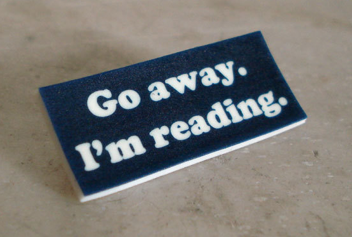
Perhaps you received a book this past holiday, or perhaps you had some time to catch up on book you have been waiting to read. You might need one of these signs:

Why might you need a “Go Away. I’m Reading” sign? Because reading is often interrupted by people. The sign could stop those interruptions by others that inevitably occur at a critical moment in a book or article. You would use the sign to ward off those who are blind to the obvious and ask, “What are you doing?” You might even use the sign to stymie those who intrude to ask, “What are you reading?” But you would most certainly wave the sign to stop those who interrupt to ask, “Is what you’re doing so important?”

Reading is a very quiet, sedentary activity, an activity that requires concentration. You cannot multi-task reading. An interruption in that concentration disrupts comprehension, and there are studies that look to measure the effects of interruptions on comprehension. There was the 2002 study from the University of North Carolina at Chapel Hill titled, “The Effect of Interruption on Working Memory During Discourse Processing ” by Kerry Ledoux and Peter C. Gordon.

Ledoux and Gordon conducted separate experiments using the same narrative and expository passages, but they varied who read the narrative and who read the narrative and expository passages. They gathered evidence to prove that comprehension of similar (narrative) passages was more disrupted by interruption in the first experiment, and than with dissimilar (narrative/expository) passages  in the second experiment:

This supports the notion that the maintenance of text information in working memory is affected by interruption. Second, we found that the initial reading of the second passage in a pair is disrupted more if the first passage in the pair is of a similar type than if it is of a dissimilar type.

Their two experiments looked directly at the systems of language processing necessary for comprehension:

 Our results support the view of the role of working memory in language processing as a system whose function comprises the creation and maintenance of an elaborate, semantic representation of a text and the efficient retrieval of this representation from long-term memory.

They determined that interruptions had an adverse impact on the role of working memory, but could not determine the magnitude of these interruptions because of differences in texts.

Another more recent study concluded that visual clues are helpful to resume reading after an interruption. An abstract from the 2012 study by JE Cane, F Couchard, and UW Weger from the University of Kent, UK titled, “The Time-Course of Recovery from Interruption During Reading: Eye Movement Evidence for the Role of Interruption Lag and Spatial Memory” centered on the impotence of visual cues. Locating where one stopped reading is important to recovering comprehension:

Two experiments examined how interruptions impact reading and how interruption lags and the reader’s spatial memory affect the recovery from such interruptions. Participants read paragraphs of text and were interrupted unpredictably by a spoken news story while their eye movements were monitored. Time made available for consolidation prior to responding to the interruption did not aid reading resumption. However, providing readers with a visual cue that indicated the interruption location did aid task resumption substantially.

Predictably, cuing the place where the interruption took place is helpful to comprehension, but there is also considerably conversation about the amount of time it takes a reader to return to a full involvement with a text. Consider that research in the business communities has determined that many interruptions are costly and hurt business productivity. A 2005 NYTimes Magazine article by Clive Thompson titled Meet the Life Hackers  described a study by Gloria Mark, a professor at the University of California at Irvine. Mark looked at interruptions in the average 21st Century office worker. She developed a series of timed tasks that mimic work in the business day. Her research was organized so that,

 Each employee spent only 11 minutes on any given project before being interrupted and whisked off to do something else. What’s more, each 11-minute project was itself fragmented into even shorter three-minute tasks, like answering e-mail messages, reading a Web page or working on a spreadsheet. And each time a worker was distracted from a task, it would take, on average, 25 minutes to return to that task.

Although 25 minutes may not be the same amount of time required for the average reader to return to a text, Mark’s research does demonstrate the serious loss of time interruptions cause to work productivity. If one of these activities involved reading, then reading productivity was adversely effected.

One other interesting view on uninterrupted reading has been offered by the Telecommunications Information Networking Architecture Consortium (TINAC). In 1988, they published a “manifesto” on writing hypertext, those texts that feature embedded links for the reader. What is surprising is how they began the “manifesto” by focusing not on the writing of such texts starting from the reading of such texts.  Their first statement:

I) No interruptions.

Reading should be a seamless and uninterrupted experience. Its choices proceed from the expression of possibilities as a narrative medium and depend upon the complicity of the reader in the creation of a narrative. Reading is design enacted.

Reading is “design enacted”, meaning that even the distractions in hypertexts are meant to be done in a sitting without distractions, without interruption.

Ultimately, conveying the importance of uninterrupted reading may be necessary. But if the little sign, “Go Away. I’m Reading.” doesn’t work, you might want to try other strategies. A quick survey on the Internet reveals available like-minded products.

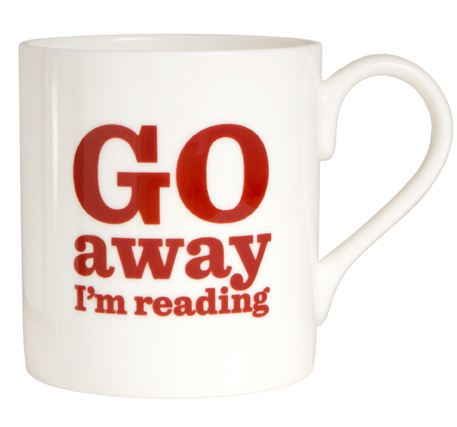
There are plans for free “Go Away. I’m Reading” Book Covers in several different styles. There are also “Go Away. I’m Reading” coffee mugs handy for uninterrupted newspaper reading in the morning.

However, the ultimate solution may still be the most simple: find a quiet spot in the house, and lock the door.

I had been looking over the compendium of lists touting the top news events of 2012, when a line spoken by the character Death in Terry Prachett’s novel The Hogfather came to mind:,

Humans need fantasy to *be* human.

Prachett often reflects on the role of fiction in his fantasy novels, the Diskworld series, which are set in a world shaped like a disk that floats on the backs of four elephants standing on top of a giant turtle that slowly swims through space. While Prachett’s stories are particularly fantastic, all stories require some willing suspension of disbelief: a talking Cat in the Hat, a journey to the century of the earth, a tea party on the ceiling, a raft down the Mississippi, a beanstalk.

Stories are what prepare us for the complexities of life and death. We tell stories, we create myths, we perpetuate lies. Stories give us a language to express our triumphs and our failures, to respond to our morality and our immorality, to explore our future and remember our past.

Prachett’s 21th Diskworld novel is a Christmas tale of sorts which was developed as a film by the British media Sky One and shown in two installments in 2006. The title character The Hogfather, the diskworld’s equivalent of Santa Claus, has become the target of a assassin and goes missing. In a Gothic turn, the character Death opts to fill the role of the Hogfather by donning a fur-trimmed red suit, practicing his “ho, ho, hos”, and distributing inappropriate toys. Death’s granddaughter, Susan Sto Helit, joins him and upset the forces of the evil Auditors by rescuing the Hogfather just before the world goes dark.

As the rescued Hogfather flys off in his hog-drawn sleigh, Death and Susan are reunited and reconciled. She questions why their efforts to maintain the elaborate fantasies that surround the Hogfather are even necessary:

Death: Humans need fantasy to *be* human. To be the place where the falling angel meets the rising ape.
Susan: With tooth fairies? Hogfathers?
Death: Yes. As practice, you have to start out learning to believe the little lies.
Susan: So we can believe the big ones?
Death: Yes. Justice, mercy, duty. That sort of thing.
Susan: They’re not the same at all.
Death: You think so? Then take the universe and grind it down to the finest powder, and sieve it through the finest sieve, and then show me one atom of justice, one molecule of mercy. And yet, you try to act as if there is some ideal order in the world. As if there is some, some rightness in the universe, by which it may be judged.
Susan: But people have got to believe that, or what’s the point?
Death: You need to believe in things that aren’t true. How else can they become?


Ultimately stories allow us to imagine with an author how those “big lies” of justice, mercy, duty play out in different ways, in different settings, with different characters. For our willing suspension of disbelief, fiction gives us practice in imagining other qualities of truth, faithfulness, and love so that we may be better prepared to recognize and develop these qualities in our real world. Stories prepare us for the times when our real world turns unimaginably cruel or fraught with despair.

At the end of every December, when different media organizations publish the top stories of the year, they rank news stories in order of importance. These are events that over the course of 365 days reflect virtue and triumph along with cruelty and despair. There are always stories of senseless tragedy countered with acts of great compassion, and this year has been no different. There have been cataclysmic disasters, some by nature and some man made, and again, this year has been no different. For each of these very real stories, there are fiction counterparts that can help us to recognize what Prachett suggests are part of “some rightness in the universe.” Moreover, from these real events will come new stories, new fictions, that will be written because writing and telling stories is what makes us human. The news stories of 2012 are a record of what has happened, but the stories we create make us human and help us to believe in the possibility of a New Year where qualities of justice, mercy and duty can “become” real, not fantasy.

How to create indelible memories? Read aloud to children. Too much attention is focused on what to give to make a holiday meaningful, when this inexpensive and simple choice is available to anyone who can read: poem, picture book, story. I clearly remember my father reading “King John’s Christmas”  during the holidays on several occasions. So powerful is this memory, that I can hear his voice as I re-read the poem myself:

King John was not a good man —
He had his little ways.
And sometimes no one spoke to him
For days and days and days.

My father would always begin reading the poem by reciting the first four lines from memory. While his read alouds were not frequent, they were memorably dramatic. He had a gift for animating  words. Most of the stories he chose were something from his childhood. “King John’s Christmas” came from the collection Now We Are Six by the noted children’s author A.A.Milne, creator of Winnie the Pooh. King John was less than popular with his subjects, but he was hardly a villain:

And men who came across him,
When walking in the town,
Gave him a supercilious stare,
Or passed with noses in the air —
And bad King John stood dumbly there,
Blushing beneath his crown.

Screen Shot 2012-12-22 at 7.53.15 AM

Ernest Shepard’s illustration of King John, “blushing beneath his crown”

I remember how my father would stress the five syllables of “supercilious”; while we had never heard that word, his intonation told us that no one liked King John. He was a king so disliked that he was forced to send himself Christmas cards:

King John was not a good man,
And no good friends had he.
He stayed in every afternoon …
But no one came to tea.
And, round about December,
The cards upon his shelf
Which wished him lots of Christmas cheer,
And fortune in the coming year,
Were never from his near and dear,
But only from himself.

A.A. Milne was already an experienced writer before he created the children’s classic Winnie-the-Pooh. He had been an editor for Punch Magazine  and a playwright. He also had served in World War I from 1914-1919 as a signaling officer who saw his fair share of the frontlines. He was dismissed from the army after a fever, and during his recuperation he returned to playwriting. In 1920, his son Christopher Robin Milne was born, and Milne turned to writing for children. After some success with  poetry published in children’s poetry magazines, Milne sought out an illustrator from his days at Punch, Ernest Shepard. The collaboration produced When We Were Very Young and within the first eight weeks of publication, over 50,000 copies were sold here and in the UK.

Milne’s next effort featured short stories involving the childhood toys of Christopher Robin. The book was titled Winnie-the-Pooh, and recognizing how important Shepard’s illustrations were to the book, Milne offered him an unprecedented share in the royalties. The second book of poetry, Now We Are Six, was published in 1927, and “King John’s Christmas” is one of the 31 poems in that book. The illustrations again were Shepard’s.

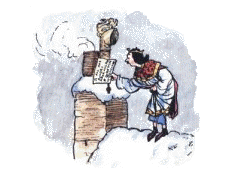
In stanza five of the poem, King John writes a lengthy Christmas wish list to Old Father Christmas, just before “He stole away upstairs and hung, A hopeful stocking out.”

Screen Shot 2012-12-22 at 7.52.46 AM

Shepard’s rendering of King John leaving his list, “..up the roof…
propped against the chimney stack”

King John’s list was full of things none of us would have requested, but my father would enthusiastically recite the list making each item seem so desirable:

“I want some crackers,
And I want some candy;
I think a box of chocolates
Would come in handy;
I don’t mind oranges,
I do like nuts!
And I SHOULD like a pocket-knife
That really cuts.
And, oh! Father Christmas, if you love me at all,
Bring me a big, red India-rubber ball!”

The desire for the “big, red India-rubber ball” was the clincher. Why a toy? Had King John never had this simple toy? Had all his Christmas lists been unanswered? Had Father Christmas never visited the king? Milne’s King John was characterized as “not a good man”, but would Father Christmas be so cruel as to withhold a gift at Christmas?

Sadly, yes. King John goes to his stocking on Christmas morning only to find an empty stocking. We imagined the already pathetic king holding a flat limp stocking as my father intoned:

King John said grimly: “As I feared,
Nothing again for me!”

My father would pause to let this discovery sink in. The poem was unimaginably sad to us, especially during the holiday, finding an empty stocking. Then he would read on as King John dismissed all the things on his list. He confesses he had not really wanted anything, all he wanted was the “big red, India-rubber ball”. Milne’s reference to the pocket knife was not the only “cut” delivered when King John comes to the conclusion he cannot be loved, even by the beneficent Father Christmas.

I haven’t got a pocket-knife —
Not one that cuts.
And, oh! if Father Christmas had loved me at all,
He would have brought a big, red India-rubber ball!”

Does Milne leave the reader with the memory of the pathetic king, abandoned by all at a magical time of the year? Of course not! King John “frowns” as he looks out his window at all the “happy bands of boys and girls all playing in the snow.” He stands alone, abandoned, and jealous of their joy, when suddenly, a small miracle occurs:

When through the window big and red
There hurtled by his royal head,
And bounced and fell upon the bed,
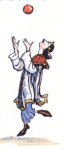
An India-rubber ball!

Screen Shot 2012-12-22 at 7.52.23 AM

“A big red, India-rubber ball!”

The final stanza is written in capital letters, as if shouted from the rooftops. My father would raise his voice as well in reading the poem’s conclusion:

AND OH, FATHER CHRISTMAS,
MY BLESSINGS ON YOU FALL
FOR BRINGING HIM
A BIG, RED
INDIA-RUBBER
BALL!

So, my thanks to the genius of A.A.Milne for writing the wonderful poem “King John’s Christmas” and to my father who read the poem and made such a powerful memories with all his read-alouds. MY BLESSINGS ON YOU FALL!

tragedy“On Friday noon, July the twentieth, 1714, the finest bridge in all Peru broke and precipitated five travelers into the gulf below.”

That is the opening sentence from Thornton Wilder’s novel The Bridge of San Luis Rey. A monk who witnesses the fall of those travelers searches for answers as to whether the accident was simply chance or an act of the Divine. In writing The Bridge of San Luis Rey, Wilder was addressing the genre of tragedy which was defined by Aristotle in his Poetics as “an imitation of a serious act” in literature. The purpose of tragedy is to provide the reader, or viewer in the case of drama, an experience of loss without having to suffer what a fictional character suffers. Through his literature, Wilder, like the authors and playwrights before him, provided the experience and language to us to respond when there is a tragedy. Great literature does this well which may be why the literature taught in high school classrooms is, more often than not, tragedy.

Of course, tragedy is not always a popular curriculum choice. I am always being confronted by students,  “Why do we have to read such depressing books?” or “Why does every book we read in English have to be so sad?” Predictably, when I hand out a book for a whole class read, student will examine the cover, the length of the text, and ask, “So, who dies?” Through literature, students learn a number of different approaches or definitions of  tragedy. In grades 9-12, students are taught about Greek tragedy (Oedipus, Antigone, Medea) where fate or Nemesis cannot be avoided. They learn about catharsis, the purging of pity and fear, and pathos, the empathy one has for the tragic hero. Students are taught about how the Shakespearean tragedy (King Lear, Macbeth, Richard III) centers on the willful downfall of a character who brings about the destruction of others. We have also included a modern interpretation of tragedy by Otto Reinherdt as students read contemporary works of literature (Death of a Salesman, The Road):

“Tragic Man demands that an imperfect world conform to his notions of right and good, and he is defeated because discord, injustice, pain, and moral evil are the world’s warp and woof. The final paradox is man in his tragic vision saying, ‘I do not believe in the invincibility of evil but in the inevitability of defeat’.. . . But in the absoluteness of his commitment, the tragic hero triumphs in the very inevitability of his defeat.”

The indoctrination to tragedy as a “serious action imitated” begins early in the student’s educational career. In grade 5, whole class reads can be The Giver, a dystopian novel that features the euthanasia of a small child. In grade 6, students may read The Devil’s Arithmetic, a book that brings students closer to an authentic understanding of the Holocaust and the deaths of six million Jews. In young adult (YA) literature, there are so many stories about the deaths of pet dogs  (Old Yeller, Where the Red Fern Grows, Love that Dog) that author Gordon Korman fought back against that literary trope with his  YA novel, No More Dead Dogs. Our 7th grade reads that book as an opening bonding experience in September, but they also read Pearl Buck’s short story “The Big Wave” about a tsunami that wipes out a small coastal village in Japan. The recent tsunami in Japan gave our young readers a new appreciation for the tragedy caused by nature.

In high school curriculums everywhere, students decry the death of a character, “Why does the author make us like him and then kill him?” They rail against the death of Johnny in The Outsiders (grade 8); the death of Lenny in Of Mice and Men (grade 9); the death of Kat in All Quiet on the Western Front (Grade 10); the death of John Proctor in The Crucible  (Grade 11); and the death of Hamlet (Grade 12). They claim to want a happy ending.

But do English teachers force an unwanted genre on students? Do students hate tragedy? Not really. Look at the two most popular series of books students chose to read independently. The Harry Potter series began with two deaths, the sacrifice of Lily and James Potter for their infant son, Harry. Seven books later,  JR Rowling had bumped off over 50 characters, and one beloved owl Hedwig (although, admittedly the death of Bellatrix Lestrange was satisfying). Student loved these novels. In Suzanne Collin’s The Hunger Games trilogy, killing and death is a form of entertainment, an entertainment made even more horrific when teenagers are the assassins. In the first book, eleven “tributes” are killed on the first day of the games. The protagonist Katniss kills four tributes herself before she “wins” this round of games with Peeta; the deaths pile up as the series continues with Collins disposing of major characters at a furious clip. I cannot keep these books on my classroom shelf.

Ultimately, tragedy in literature prepares a reader for the experience of tragedy in life. My own first experience with death was from Louisa May Alcott in Little Women when the sickly Beth March finally succumbed to illness:

“As Beth had hoped, the `tide went out easily’, and in the dark hour before dawn, on the bosom where she had drawn her first breath, she quietly drew her last, with no farewell but one loving look, one little sigh.”

I remember reading and re-reading that passage over and over and thinking: “Had I read correctly? Were there only three March sisters left? How could Alcott do this to me?” Well, she did this to me and millions of other readers because in real life people die. Nice people. Good people. Young people. Beth’s death was not a tragedy in the literary sense, but the hole left by her death for the fictional family was “a serious act imitated in literature” like the many real deaths that leave holes in the lives of real families.

Our society confronts news that is tragic everyday.  The recent death of 20 schoolchildren and six teachers in a school shooting not far from where I teach just before the Christmas holiday season is a tragedy so horrific that many have been left speechless; I hear, “There are no words.” But there are words, words in great literature written to prepare us, from a young age through high school and beyond, for exactly this experience. Thornton Wilder’s fictional story of The Bridge of San Luis Rey concludes with a paragraph that offers his response to a tragedy. Through literature, Wilder provides a language for readers to respond to a tragedy such as the one in Newtown, Connecticut, and other heartbreaking events:

“We ourselves shall be loved for awhile and forgotten. But the love will have been enough; all those impulses of love return to the love that made them. Even memory is not necessary for love. There is a land of the living and a land of the dead and the bridge is love, the only survival, the only meaning.”

My two boys were raised on a steady diet of musicals and plays. I selected what we would attend with great care:

Annie, Get Your Gun
Les Miserables ( remember the Battle at the Barricades?)
The Pirates of Penzance
Oklahoma (the song-“Oh the Cowboy and the Rancher Should Be Friends”)

Do you see a pattern? When we first started to expose our sons to live theatre, my choices all had weapons or professions that could be deemed interesting to six and eight year olds. We graduated to other pieces, including A Midsummer Night’s Dream (“What was funny in this comedy?”) and A Servant of Two Masters (“Now, that is comedy!”) They became effective young theatre critics: Showboat was good, Cats was awful (“P-U”).

Their first big theatre experience was Miss Saigon on Broadway.  We sat up in the nose-bleed section, which turned out to be a blessing as the opening number takes place in a brothel with scatily clad singers and dancers. We did not rent the binoculars; we were really there for the helicopter scene. The overblown sound system did not disappoint; we could feel the whirr of the chopper blades in our bones.

I thought of these choices when I read Dwight Garner’s commentary in his NYTimes piece, “Going Beyond Cultural Kid Stuff With a Wary Sense of Adventure”. He had taken his 15 and 13 year old children to see Who’s Afraid of Virginia Woolfe? and reviewed their reaction to the play. They liked the set, the action and the performances; he was happy they had gotten so much from the “witty but sinister play, stocked like a nightmare bodega with adult themes.”

He also posed a good question, “When is it O.K. to introduce challenging cultural material — whether it is sexy or profane, creepy or violent, or simply adult and intense — to your children?” My response to him would be what I told to my own children when they asked to see adult or intense and violent films: “If you want to see it, read about it first.”

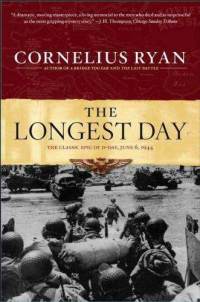
Saving Private RyanThe Longest Day CoverMichael was 13 when the film Saving Private Ryan came out in theaters in 1998. He begged to go. I was very hesitant, I had heard that the first 27 minutes of the film depicted the landing on the beaches of Normandy (Omaha Beach) very realistically; that director Stephen Spielberg was not interested in sugarcoating the gruesome damage machine gun and explosions can exact on a soldier’s body. But Michael had a keen interest in history.
“Come on, Mom, this is supposed to be just like the landing,” he argued.
That was what worried me.
“The only way you can see this film is if you read about the landing first,” I agreed.
“Ok, no problem,” he replied confidently, “done.” So he read The Longest Day by Cornelius Ryan; 362 pages of historical prose.

There are many opportunities for a student to read a book in advance of watching a film. Reading the book or background materials prepares students for many of the adult themes in a film or play. For example, students who read books from the Harry Potter series were prepared for the dark themes or the twisted violence that was wrought upon many of the characters. I cannot imagine how confusing the series must have been for those students who had not prepared themselves by reading about characters, spells, or the magic elements at Hogwarts. Likewise, the students who read books from The Hunger Games trilogy were certainly more prepared for scale of the brutality of the society that “sacrifices” children for entertainment. In fact, I felt the book was far less gruesome than many of the moments from the film. When books are in circulation before the film is announced (Twilight, The Life of Pi), parents should take the opportunity to hold out for a little reading before letting a child see a film with a mature rating.

Granted, there are sometimes when a parent may have no control over what other parents deem acceptable. Michael already read Edith Hamilton’s brutal explanation of Roman life in her classic The Roman Way when Gladiator (2000) was released on DVD. That Thanksgiving, we were invited to our friend’s home for dinner. After dinner, I was forced into an awkward agreement when I found that our hosts had a copy of the film in the downstairs “playroom” for the boys to watch with their son while we socialized. I cringed that my younger son, Kevin, then age 12, would also be watching, too late for me to assign the required background reading. Of course, the boys were both thrilled to have me in such an uncomfortable position, and both we delighted we reluctantly agreed they could watch the film.

“Now, you have to read The Roman Way,” Michael told Kevin as we drove home that night, “or read Marcus Aurelius’s letters.”

I was duly impressed; perhaps I had not failed parenting.

In the classroom, the authors of children’s books are celebrities; the authors of young adult literature are rock stars. So when the National Conference of English Teachers (NCTE) and associated independent organizations the Council of English Leadership (CEL) and the The Assembly on Literature for Adolescents (ALAN) converged on Las Vegas last week, publishers made sure their authors were front and center, delivering keynote addresses and personally meeting and signing books for some of their greatest fans-teachers.

Highlights of the convention included Sherman Alexie (The Absolutely True Diary of a Part-Time Indian) delivering a keynote address to an enthusiastic audience of readers who know how he can reach their reluctant readers. Scott Westerfield (Uglies, Pretties) was there representing the oh-so-popular dystopian fiction. Nicholas Sparks (The Notebook) was there for the older readers, including the teachers themselves, with new educational materials for high school classrooms. Newbery Award winning Lois Lowery (The Giver, Number the Stars) spoke to an enthralled crowd of middle school teachers at ALAN.

The convention had invited many authors; book publishers arranged to bring even more to the exhibition hall. There were over 200 “signing” stations in exhibitor booths advertised in the conference program to alert teachers where to purchase and get books autographed.

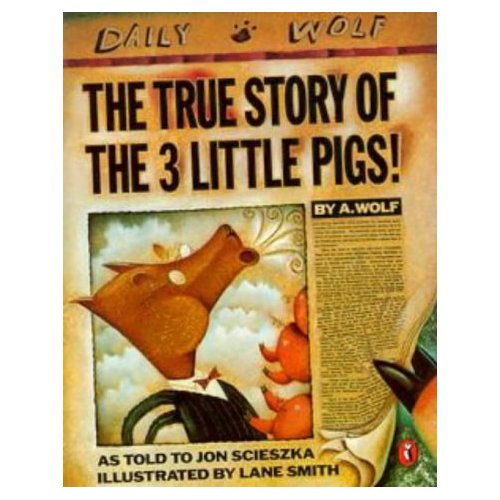
Most booths were mobbed, but on Sunday morning, I came upon a table where a solitary Jon Scieszka sat with a exhibitor. I could not believe my luck. For those who do not know, Scieszka is the author of  Math Curse,  The Stinky Cheese Man and Other Fairly Stupid Tales,and the series The Time Warp Trio, which was made into a TV series. His retelling of the The Three Little Pigs is told from the point of view of A.Wolf. The True Story of the Three Little Pigs was my first Scieszka book experience.In the book, A. Wolf explains how his requests for a cup of sugar from each of the pigs eventually led to his “sneezing” not “huffing and puffing” which sets off the unfortunate demise of the pigs. Illustrated by Lane Smith, this book was one of the “Top 100 Picture Books” of all time in a 2012 poll by School Library Journal. I concur, and I use the book to explain literary point of view to all grade levels. In 2008, Scieszka was named the National Ambassador for Young People’s Literature by the Librarian of Congress.

There Jon Scieszka sat, and there was no teacher in sight!

“Jon Scieszka!” I exclaimed, ” I can’t believe you are alone!”
“Neither can I,” he grinned.
“Me either,” said the exhibitor with him, much more uncomfortably..
“Well, now that I have you all to myself,” I was ready with a question I had asked so many times in my head, “Can I ask how you know so much about my brothers?” I was referring to his hilarious YA memoir Knuckleheads in which Scieszka relates his

experiences growing up. The publisher’s review:

“Growing up as one of six brothers was a good start, but that was just the beginning. Throw in Catholic school, lots of comic books, lazy summers at the lake with time to kill, babysitting misadventures, TV shows, jokes told at family dinner, and the result is Knucklehead. Part memoir, part scrapbook, this hilarious trip down memory lane provides a unique glimpse into the formation of a creative mind and a free spirit.”

The book is almost a mirror reflection of watching my younger siblings compete with each other, set fire to things, and survive Catholic school (with fewer nuns). “I swear you must have been watching my three brothers grow up!” I babbled on.
“You’d be surprised how many people say that,” he chuckled.
“And your short stories in Guy’s Read?” By this time, I was positively gushing, “they are exactly what I need for my 9th grade boys who only want a short read.”
“That’s why we wrote them,” he nodded appreciatively, “for short reads. Now, what name do you want in this book?”
Yes, I got a signed book Spaceheadz by Jon Scieszka! For free. A conversation and a book.

20 minutes later, I passed by the table again, but I caught only a glimpse of him. He was surrounded by a throng of teachers,the serpentine line of fans waiting to talk to him went down the long aisle. My brief and personal moment was obviously a fluke. That’s because he’s Jon Scieszka, children’s book author. Jon Scieszka, Rock Star.