Across the pond, British students studying for the General Certificate of Secondary Education (GCSE) will no longer experience a narrative on growing up in the Jim Crowe South or reenact the witch hunts of Salem, Massachusetts, or be immersed in stories of The Great Depression’s impact on itinerant laborers. A recent decision by the United Kingdom’s Department for Education means that British students will no longer be reading Harper Lee’s To Kill a Mockingbird, Arthur Miller’s The Crucible, or John Steinbeck’s Of Mice and Men. The Education Secretary of the United Kingdom, Michael Gove, has recommended a syllabus that favors British texts exclusively for students to “swot up” for their exam boards. In order to make more room for the strictly British diet of Eliot, Dickens, at least one of the Bronte Sisters, these 20th Century American classics are being dropped in favor of British texts. According to The Guardian, when Gove took office he told his party’s conference:,
“The great tradition of our literature – Dryden, Pope, Swift, Byron, Keats, Shelley, Austen, Dickens and Hardy – should be at the heart of school life.”
A number of responders have noted Gove’s concern that the American texts come with “ideological baggage” that is not relevant to British students. The controversy was sparked when the new syllabus for OCR, one of the biggest UK exam boards, was released. A statement by UK’s Department for Education noted that in the revised syllabus, specific (American) books are not banned, but rather:
In the past, English literature GCSEs were not rigorous enough and their content was often far too narrow. We published the new subject content for English literature in December. It doesn’t ban any authors, books or genres. It does ensure pupils will learn about a wide range of literature, including at least one Shakespeare play, a 19th-century novel written anywhere and post-1914 fiction or drama written in the British Isles. (“To Kill a Mockingbird and Of Mice and Men axed as Gove orders more Brit lit” Guardian)
Michael Gove, Britain’s Education Secretary, recommends removing 20th C American texts by Steinbeck, Miller, and Lee.
The news is not all bad, however. Instead of considering the removal as a literary slight to the multitude of authors who write in English -but who do not serve the Crown- perhaps Americans should be grateful that those discomforting moments of U.S. History are being hidden or systematically expunged from the prying eyes of young British readers. Students do not need to be exposed to the effects of prejudice, intolerance, and poverty through the lens of an American culture when British culture already has a plethora of masterworks that focus on their own brand of bigotry, bias, and destitution. Why would British students need a global perspective as they enter the 21st Century workforce?
Consider how wonderful for Americans that Gove has eliminated the need to explain the real inditement of our judicial system through the fictional violation of Tom Robinson’s civil rights despite the dramatic evidence provided by his defense attorney, Atticus Finch. How brilliant that British students will never have the opportunity to connect the fictional fraud in the trial of John Proctor to the real terror of the McCarthy Hearings and Communist witch hunts of the 1950s. How fabulous that readers in the United Kingdom will not be forced to read how the myth of the American Dream is often unattainable, especially when a scientifically confirmed climate change associated with the Dust Bowl contributed to harsh economic realities.
So, thank you, Secretary Gove, for keeping America’s literary exposés on dirty secrets hidden. Now, a schoolchild’s positive image of an American 20th Century will not be tarnished by the likes of those upstarts Lee, Miller, and Steinbeck.
Yes, Mr. Secretary, for British students everywhere, ignorance will be bliss!
That particular quote is spoken by Christopher John Francis Boone, the 15-year-old narrator of The Curious Incident of the Dog in the Night-Time, who describes himself as “a mathematician with some behavioral difficulties.” Christopher lives in Swindon, England, and his behavioral difficulties are more along the lines of Asberger’s or high functioning autism or savant syndrome. This diagnosis explains his attitude towards his peers,
“All the other children at my school are stupid. Except I’m not meant to call them stupid, even though this is what they are.”
Or his obsession with truth:
“Metaphors are lies.”
Or his appreciation for math:
“Prime numbers are what is left when you have taken all the patterns away. I think prime numbers are like life. They are very logical but you could never work out the rules, even if you spent all your time thinking about them.”
Christopher’s observations are also what make him interesting to our students who read the novel in literature circles in grade 10. Students at this age connect with the author, Mark Haddon, and his belief that the novel is not about a character with Asperger’s Syndrome, but rather,
“…a novel about difference, about being an outsider, about seeing the world in a surprising and revealing way. It’s as much a novel about us as it is about Christopher.”
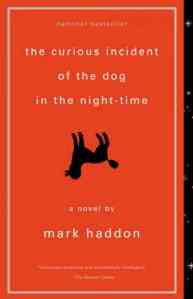
We have well over 100 copies of The Curious Incident of the Dog in the NightTime in our book room. They are a collection of books purchased at book sales ($1-$3 a copy) throughout the state of Connecticut for the past five years. These copies are most likely the discards from book club members who, 10 years after its original publication date (2003), donated their used copies. The only problem in locating copies of the text at a book sale is determining on which genre table the copies will be shelved. The novel is classified as a mystery, but it is also considered a young adult novel or trade fiction, and was published in England simultaneously in separate editions for adults and children.
Fortunately, I can see that iconic bright red cover from a distance, the same one with the dog cut-out onto the shiny black cover underneath. When I distribute the texts, no matter how I threaten to make sure the book comes back in pristine condition, there are students who will trace and retrace that cutout until the die-cut shape of the dog becomes the shape of a blob.
The students read the novel independently first, usually during a unit on Shakespeare’s Macbeth, before coming together in literature circles. I would like to think that the character of Christopher would enjoy being paired with Shakespeare’s murder and intrigue since he is uncovering a sinister killing of a neighborhood dog. Students are given time in class to read the novel as SSR, and the literature circles begin once the play is concluded. The students are organized into smaller groups, where they work together to choose a “big idea” that can be found in the novel. The “big idea” can center on large concept words such as bravery, fear, change, determination, trust, or belief. Once a big idea is selected for the day, each group has several tasks to complete, with each member of the group completing one task. The students receive one grade for the completion of these assignments, and disputes are resolved through peer review feedback sheets. The roles for the literature circles are fairly traditional:
Group leader/discussion director/writer: leads the discussion and writes the response that answers the question with contributions from the other members.
Notes taker/quote maker: keeps notes during the discussion, finds, and writes the passages that support the group’s conclusions about the big idea.
Artist: draws a series of cartoons or a particularly important scene that represents the big idea.
Poet: creates a found poem of at least 20 lines that supports the group’s conclusions.
Organizer: Gets the paper, plans the poster, keeping everyone on task and contributing to the overall success of the assignment!
Because we are a BYOD school, we have on occasion also included some “digital” tasks where group members can use a software platform to create an Animoto or a Voice Thread as a way to illustrate the big idea.
The literature circles usually meet four or five times covering different sections of the book depending on the big idea selected. At the end of each meeting, students their findings to the class with each member explaining the contributions from his or her role. The rubric is centered on Common Core State Standards that require the inclusion of evidence to support a position. For an exemplary rating, a group will produce the following:
POSITION: clearly addressed task, purpose, and audience
One page that answers question about the big idea
Found quotes in novel to support a group’s position; wrote them on the chart paper
a cartoon or illustrated scene that supports big idea
Creation of a “found” poem of at least 20 lines, using words from the novel.
COMPOSITION:
Response answers the question; it has a thesis, and at least two quotations for support.
Poster displays the quotations you have found; they are written carefully & cited.
Art work is neat and colorful and expresses the big idea
The poem is of required length and is expressive and creative.
STANDARDS of the DISCIPLINE
Response has no more than two errors in mechanics, spelling, capitalization.
Sometimes, if time allows, we have included mysteries from Christopher’s idol, Sir Arthur Conan Doyle. For the honors students, we have added the text of the Sherlock Holmes mystery “The Hound of the Baskervilles” for independent reading (audio text) . On other occasions we have used adaptations of Sherlock Holmes mysteries in short audio texts (Story Nory site).
While the addition of The Curious Incident of the Dog in the Night-Time has richly enhanced our curriculum of World Literature, the price was not expensive, roughly $250 for the entire set of books. This contemporary novel by a British writer allows us to connect the reading to other fiction (mysteries) and informational texts including speeches and documentaries. In the beginning of the novel, Christopher explains,
“In a murder mystery novel someone has to work out who the murderer is and then catch them. It is a puzzle. If it is a good puzzle you can sometimes work out the answer before the end of the book.”
By the end of the novel Christopher comments on the mystery as a “good puzzle” saying, “I solved the mystery…and I was brave and I wrote a book and that means I can do anything.” That assessment is a powerful reason to share Haddon’s novel with students…if they can draw from a character like Christopher the inspiration that they too can do anything.
Yesterday, Scott, the social studies teacher, brought an eighth grader into my office to recite a poem. He had arrived unannounced, and the young girl looked uncomfortable standing in front of teachers and 12th grade students. But, she had Scott by her side, and he encouraged her with small nudge. She took a breath, and holding a copy of the poem before her, she began to recite:
In Flanders Fields the poppies blow
Between the crosses row on row,
That mark our place; and in the sky
The larks, still bravely singing, fly
Scarce heard amid the guns below.
We are the Dead. Short days ago
We lived, felt dawn, saw sunset glow,
Loved and were loved, and now we lie
In Flanders fields.
Take up our quarrel with the foe:
To you from failing hands we throw
The torch; be yours to hold it high.
If ye break faith with us who die
We shall not sleep, though poppies grow
In Flanders fields.
No one said anything after she muffled the last line, and there was an awkward pause. So, I asked her to read the last line again, and Scott pointed to the last sentence in the poem.
“Start here,” he told her, and she reread: If ye break faith with us who die /We shall not sleep, though poppies grow/In Flanders fields.
Only then did we all clap. Her relief was evident, and I noted just as they left, “That last line is the most important in the poem.”
Equally important is what Scott did when he supported this student in having her practice reciting a poem aloud to a group of people. Moreover, this Memorial Day weekend is the appropriate time to hear this particular poem read aloud.
autographed copy from Arlington National Cemetery website
In Flanders Fieldwas composed by John McCrae, a poet and a physician who served in the Canadian army in World War I.
The most common account of the poem’s origin is that McCrae was sitting in the back of an ambulance after the Battle of Ypes in Belgium, when he scripted the poem on May 3, 1915, as a eulogy for his close friend Alexis Helmer, who was killed during the battle the day before.
There are other accounts that McCrae was unhappy with the poem and crumpled the paper before it was retrieved by another soldier who was so impressed that he committed it to memory. Another story is that McCrae had worked on the poem for months after the Battle of Ypes. Most stories about the poem agree, however, that McCrae was struck by how quickly poppies quickly grew around the graves of those who died, and he used this striking image that dominates the poem.
So powerful was this image of a brilliant red poppy that American professor Moina Michael promoted the wearing of red poppies year-round to honor the soldiers who died in the war.
By 1922, the Veterans of Foreign Wars (VFW) adopted the poppy as its official memorial, and when fresh poppies could not be found to sell as tributes, artificial poppies were made by veterans groups. These poppies are called “buddy poppies” and, according to the information on the VFW website, the proceeds from their sale,
“provides compensation to the veterans who assemble the poppies, provides financial assistance in maintaining state and national veterans’ rehabilitation and service programs and partially supports the VFW National Home for orphans and widows of our nation’s veterans.”
I appreciate Scott encouraging his student to share the poem. Hearing her read, “If ye break faith with us who die/We shall not sleep” reminded us listening to remember those who made the ultimate sacrifice for their country. The image of those red poppies, those blooming on Flanders Field or those buddy poppies taken from the hand of a veteran this coming Memorial Day, remind us as well.
As the 10th grade English teacher, Linda’s role had been to prepare students for the rigors of the State of Connecticut Academic Performance Test, otherwise known as the CAPT. She had been preparing students with exam-released materials, and her collection of writing prompts stretched back to 1994. Now that she will be retiring, it is time to clean out the classroom. English teachers are not necessarily hoarders, but there was evidence to suggest that Linda was stocked with enough class sets of short stories to ensure students were always more than adequately prepared. Yet, she was delighted to see these particular stories go.
“Let’s de-CAPT-itate,” we laughed and piled up the cartons containing well-worn copies of short stories.
Out went Rough Touch. Out went Machine Runner. Out went Farewell to Violet, and a View from the Bridge.
I chuckled at the contents of the box labelled”depressing stories” before chucking them onto the pile.
Goodbye to Amanda and the Wounded Birds. Farewell toA Hundred Bucks of Happy. Adios toCatch the Moon. We pulled down another carton labeled “dog stories” containing Liberty, Viva New Jersey, The Dog Formally Known as Victor Maximilian Bonaparte Lincoln Rothbaum. They too were discarded without a tear.
The CAPT’s Response to Literature’s chief flaw was the ludicrous diluting of Louise Rosenblatt’s Reader Response Theory where students were asked to “make a connection:”
What does the story say about people in general? In what ways does it remind you of people you have known or experiences you have had? You may also write about stories or other books you have read, or movies, works of art, or television programs you have seen.
That question was difficult for many of the literal readers, who, in responding to the most obvious plot point, might answer, “This story has a dog and I have a dog.” How else to explain all the dog stories? On other occasions, I found out that while taking standardized test in the elementary grades students had been told, “if you have no connection to the story, make one up!” Over the years, the CAPT turned our students into very creative liars rather than literary analysts.
The other flaw in the Response to Literature was the evaluation question. Students were asked,
How successful was the author in creating a good piece of literature? Use examples from the story to explain your thinking.
Many of our students found this a difficult question to negotiate, particularly if they thought the author did not write a good piece of literature, but rather an average or mildly enjoyable story. They did manage to make their opinions known, and one of my favorite student responses began, “While this story is no Macbeth, there are a few nice metaphors…”
Most of the literature on the CAPT did come from reputable writers, but they were not the quality stories found in anthologies like Saki’s The Interlopers or Anton Chekhov’s The Bet. To be honest,I did not think the CAPT essays were an authentic activity, and I particularly did not like the selections on the CAPT’s Response to Literature section.
Now the CAPT will be replaced by the Smarter Balanced Assessments (SBAC), as Connecticut has selected SBAC as their assessment consortium to measure progress with the Common Core State Standards, and the test will move to 11th grade. This year (2014) is the pilot test only; there are no exemplars and no results. The SBAC is digital, and in the future we will practice taking this test on our devices, so there is no need to hang onto class sets of short stories. So why am I concerned that there will be no real difference with the SBAC? Cleaning the classroom may be a transition that is more symbolic of our move from paper to keyboard than in our gaining an authentic assessment.
Nevertheless, Linda’s classroom looked several tons lighter.
“We are finally de-CAPT-itated!” I announced looking at the stack of boxes ready for the dumpster.
“Just in time to be SBAC-kled!” Linda responded cheerfully.
On the Studio 360 website, the following photo of a poem written by a 1st grader is posted as the best poem to celebrate National Poetry Month 2014. I would agree that there is something universally appealing about this child’s observations that were created with considerable attention to the way words sound…
We did the soft wind. We danst slowly. We swrld Aroned. We danst soft. We lisin to the mozik. We danst to the mozik. We made personal space.
The poem by this 1st grader is strikingly similar to Gwendolyn Brook’s short poem. She also pays considerable attention to the way words sound:
THE POOL PLAYERS. SEVEN AT THE GOLDEN SHOVEL.
We real cool. We
Left school. We
Lurk late. We
Strike straight. We
Sing sin. We
Thin gin. We
Jazz June. We
Die soon.
My students have always commented on the inferences that Brooks creates in her eight lines of verse in characterizing the seven pool players. They write about the pool players’ attitudes and their fatalistic approach to life. My students also comment on what is missing in drawing their conclusions. They are satisfied with providing interpretations in the “spaces” of the poem, filling in their own ideas what is not explicit. They agree with T.S. Eliot’s statement: “poetry communicates before it is understood.”
The unnamed 1st grade poet of the poem above communicates the slow, swirling, soft relationship between music and dance in seven short statements on six lines of verse. What does it matter if the reader may never understand if the personal space for the poet is made because of the room needed for the dance or the space made personal by the dance ? In filling in the “space” of the 1st grader’s poem, I like to think that line was probably added because of a teacher’s repeated plea to a room of dancing 6 year- olds:
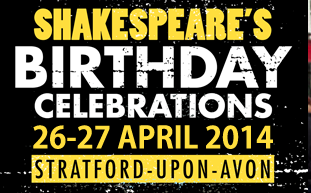
Shakespeare would be 450 years old this year, April 2014. To celebrate this milestone the Shakespeare’s Birthplace Trust has a number of activities scheduled including performances and parades in Shakespeare’s hometown of Stratford-Upon-Avon the weekend of April 26/27:
The birthday weekend brings together performers, artists, the local community and ambassadors from around the world in a vibrant celebration of the life and works of William Shakespeare. During the two day event, the town’s streets overflow with music, pageantry and drama and you are invited to enjoy a packed programme of special activities and great days out at the five Shakespeare houses.
Whatever activities they plan, I am sure Shakespeare would be honored to be the cause of merry-making and revelry. He would love to the be the cause of festivity; he would enjoy a celebratory bash. But the committee planning the events has been careful not to use the word “party.” That word would confuse Shakespeare because for all of his prowess as a dramatist and poet, Shakespeare does not know the word “party.”
In penning 37 plays and 154 sonnets Shakespeare is credited with contributing an estimated 1,700 words to the English language. In his verse, he used six different meanings to the word party. Using the Shakespeare Navigator, owned by Philip Weller, I researched how the word “party” was used in Shakespeare’s works:
party (n.) 1 side, faction, camp
party (n.) 2 litigant, disputant, side
party (n.) 3 side, part, function
party (n.) 4 participant, accessory, supporter
party (n.) 5 person, fellow
party (n.) 6 side, position, viewpoint
Note: none of these means “celebration.”
Perhaps this is not so much of a surprise since the word “party” as a noun was not used as an occasion for celebration until 1716, a century after Shakespeare’s death. The Online Etymology Dictionary records the first use of “party” as:
Sense of “gathering for social pleasure” is first found 1716, from general sense of persons gathered together (originally for some specific purpose, such as dinner party, hunting party).
“To Party,” the verb derived from the noun was not added until the Roaring 20’s”
Shakespeare was acquainted with the word “birthday” since it had been in use for at least two hundred years before he was writing:
birthday (n.) late 14c., from Old English byrddæg, “anniversary celebration of someone’s birth” (at first usually a king or saint); see birth (n.) + day. Meaning “day on which one is born” is from 1570s.
He does note “birthdays” in plays:
Antony and Cleopatra: AC III.xiii.184.2 It is my birthday. Julius Caesar: JC V.i.71 This is my birthday; Pericles: Per II.i.109 is It is her birthday, and there are princes and knights come The Two Noble Kinsmen: TNK II.iv.36 You have honoured her fair birthday with your virtues,
Still Shakespeare chose other ways of expressing birth, as evidence by a particularly sad admission from Beatrice in Much Ado abut Nothing about the death of her mother in childbirth:
BEATRICE
334 No, sure, my lord, my mother cried; but then there
335 was a star danced, and under that was I born. (2.1)
So, members of the Shakespeare’s Birthplace Trust, have a wonderful gala. Have a fabulous social gathering. Celebrate Shakespeare’s 450th birthday, but please, do not party.
I was researching websites for the Film and Literature class when I first heard about the “17 Minute Rule;” a rule that suggests the real plot is revealed to the audience 17 minutes into any film. Todd Pack’s Messy Desk Blog uses a number of examples to illustrate The 17 Minute Rule:
George Bailey tells his father he couldn’t face being cooped up the rest of his life in a shabby little office at his father’s building and loan 17 minutes into It’s a Wonderful Life.
The rest of the movie is about everything that happens that stops him from leaving Bedford Falls and drives him to consider jumping off that bridge on Christmas Eve.
Luke’s uncle buys the droids 17 minutes into Star Wars. The droids are what leads Luke to Obi-Wan Kenobi and Princess Leia and, ultimiately, the Death Star.
Buddy leaves the North Pole to find his real dad 17 minutes into Elf.
The shark eats the little boy on the raft 17 minutes intoJaws. It’s the second attack that forces the town to close the beach and go after the shark.
The Iowa farmer is thinking about plowing under the baseball field he built in his cornfield until Shoeless Joe appears 17 minutes after the credits in Field of Dreams.
This 17 minute phenomenon was corroborated on other blogs as well. Writer and Director Nathan Marshall posted Screenplay Structure: Three Acts & Five PointsScript Frenzy! blog where he also called attention to minute 17:
3) Page 17. Next time you watch a DVD, pause it 17 minutes into the film. Trust me—any film. What’s happening at that point in the story? Most likely, the essential character conflict has just been laid out. A teenage Indiana Jones runs to his father for help, but is shushed instead. Shaun convinces his girlfriend to trust him in Shaun of the Dead. Captain Renault asks Rick why he came to Casablanca. On page 17, your audience should realize what the film is really about. It’s not about finding the Holy Grail, Indy—it’s about learning to forgive dad!
The same was outlined on the All About Screenwriting blog. In addition to explaining the rule, this post made the claim that the ratio of screenplay to minute of film is 1:1; and page 17 will be the 17th minute of a film. The site provides a basic outline for a screenplay of the average movie made today:
FADE IN:
Between pages 1-5: The HOOK, something that grabs our attention and pulls us in.
Page 10: At this point in your script you should have the “MINI CRISIS”. The “MINI CRISIS” should lead us into…
Page 17: …The DILEMMA. Creation of the team and what the movie is about.
Page 30: The REACTION to the dilemma or situation.
Page 45: First “REVERSAL” of the 17 minute point. This point furthers the characters and pushes them deeper into the situation or the dilemma.
Page 60: The “TENT POLE” of the movie. Where the passive characters become active or vice versa.
Page 75: Second “REVERSAL” to the 17 minute point. To reaffirm what the story is about.
Page 90: The LOW POINT of action. The place from which our main character has to rise up from.
FADE OUT.
So when I noticed students picking up books for independent reading and discarding them after the first few pages, I wondered if they were giving the book a real chance. Could a 17 page rule apply to books student might choose to read? And, if the rule applied, would a student become more engaged once he or she reached page 17?
In a short experiment, I grabbed three books off the top of the book cart, and noted the following:
The Hobbit (The Dwarves and Gandalf invade Bilbo’s home)
“The poor little hobbit sat down in the hall and put his head in his hands, and wondered what had happened, and what was going to happen, and whether they would all stay to supper. Then the bell rang again louder than ever, and he had to run to the door.”
Little Women -Marmee gives Meg, Jo, Beth, and Amy their Christmas gifts with her words of encouragement to survive the difficulties of life.
‘We never are too old for this, my dear, because it is a play we are playing all the time in one way or another.Out burdens are here, our road is before us, and the longing for goodness and happiness is the guide that leads us through many troubles and mistakes to the peace which is a true Celestial City. Now, my little pilgrims, suppose you begin again, not in play, but in earnest, and see how far on you can get before Father comes home.’”
Lord of the Flies-The boys Ralph and Piggy discover they are on their own in a hostile environment:
“They’re all dead,” said Piggy, “an’ this is an island. Nobody don’t know we’re here. Your dad don’t know, nobody don’t know—”
His lips quivered and the spectacles were dimmed with mist.
“We may stay here till we die.”
With that word the heat seemed to increase till it became a threatening weight and the lagoon attacked them with a blinding effulgence.”
Yes, the rule was working for books from the canon. Later that same afternoon, I was working with a “reluctant reader” who had selected James and the Giant Peach as a guided reading text. I glanced at page 17 and noticed the wonderful passage where James finds the entrance to the giant peach.
James and the Giant Peach
“Almost without knowing what he was doing, as though drawn by some powerful magnet, James Henry Trotter started walking slowly toward the giant peach. He climbed over the fence that surrounded it, and stood directly beneath it, staring up at its great bulging sides. He put out a hand and touched it gently with the tip of one finger. It felt soft and warm and slightly furry, like the skin of a baby mouse. He moved a step closer and rubbed his cheek lightly against the soft skin. And then suddenly, while he was doing this, he happened to notice that right beside him and below him, close to the ground, there was a hole in the side of the peach.”
Not every text has a page 17 moment…sometimes the dilemma is posed on page 16 or page 18 or 19. I suspect the rule holds up because the 17 minute rule/page 17 is part of a pattern in storytelling, and stories always follow a pattern. Sharing this rule with students gives me another “tool” in my teaching toolbox, so when I see a student toss a book aside after reading only a few pages, I casually remark, “Did you get to page 17 yet? There’s a rule about page 17…. on page 17, something important always happens.”
I may get a quizzical look, but several minutes later, I have seen that same student engrossed in the text.
“The book got better,” says the student.
“Well, you got past page 17,” I respond.
I believe the author Stephen King would hate the language of the Common Core State Standards for one reason: unnecessary adverbs. His book On Writing has a section devoted to explaining why The adverb is not your friend.
Adverbs … are words that modify verbs, adjectives, or other adverbs. They’re the ones that usually end in -ly. Adverbs, like the passive voice, seem to have been created with the timid writer in mind. … With adverbs, the writer usually tells us he or she is afraid he/she isn’t expressing himself/herself clearly, that he or she is not getting the point or the picture across.
I have written about King and adverbs before. As I am implementing the standards in my high school English curriculums, I find myself agreeing with him. Take, for example, the Common Core Anchor Reading Standard 1. The standard states:
Read closely to determine what the text says explicitly and to make logical inferences from it; cite specific textual evidence when writing or speaking to support conclusions drawn from the text. CCSS.ELA-LITERACY.CCRA.R.1
The use of adverbs in this standard has led to more confusion, not less. The expression “read closely” was recoined as “close reading,” and that has resulted in parodies of teachers holding books up to their faces, mocking the standard. Why the writers of the Common Core felt the need to modify the action verb “read” at all is perplexing. Students must read to determine what a text says. That is all. The admonishment to “read closely” to determine what the “text says explicitly” infers the author is either trying to slip an idea past a reader or the author has been ineffective in communicating the idea. I am not convinced any author would appreciate this standard.
Moreover, the Common Core Anchor Writing Standards have the same problem, for example,
Write informative/explanatory texts to examine and convey complex ideas and information clearly and accurately through the effective selection, organization, and analysis of content. CCSS.ELA-LITERACY.CCRA.W.2
I believe that every teacher requires students to convey “complex ideas and information clearly and accurately,” yet the language of this standard infers that students would be allowed to write distorted or inaccurate responses. The standard should read, “Write informative/explanatory texts to examine and convey complex ideas and information through the effective selection, organization, and analysis of content.” The adverbs are redundant, as King demonstrates in On Writing: (bolded words his choice)
Consider the sentence He closed the door firmly. It’s by no means a terrible sentence (at least it’s got an active verb going for it), but ask yourself if firmly really has to be there. You can argue that it expresses a degree of difference between He closed the door and He slammed the door, and you’ll get no argument from me … but what about context? What about all the enlightening (not to say emotionally moving) prose which came beforeHe closed the door firmly? Shouldn’t this tell us how he closed the door? And if the foregoing prose doestell us, isn’t firmly an extra word? Isn’t it redundant?
The same editing should be applied to the Speaking and Listening Anchor Standards:
Prepare for and participate effectively in a range of conversations and collaborations with diverse partners, building on others’ ideas and expressing their own clearly and persuasively.CCSS.ELA-LITERACY.CCRA.SL.1
In this standard, the subjective nature of the adverb “effectively” creates the same confusion as reading “closely.” This standard could be made measurable if the emphasis was on the infinitive “to persuade” rather than on the timid adverbs “effectively” and “persuasively.” How does one measure these terms, unless by degrees? An argument is either effective or not. Readers are persuaded or not. A standard is unequivocal. The present wording could lead to much equivocating if a reader has to determine the degree of “effectively” or “persuasively.” Try this rewrite: Prepare for and participate in a range of conversations and collaborations with diverse partners, building on others’ ideas in order to persuade.”
In addition, the Language (or grammar standards) themselves contain a distracting adverbial phrase:
Apply knowledge of language to understand how language functions in different contexts, to make effective choices for meaning or style, and to comprehend more fully when reading or listening.CCSS.ELA-LITERACY.CCRA.L.3
The phrase comprehend”more fully” sounds like a phrase from one of my student’s essays. I would equate the construct of “more fully” with “as a whole” or “the fact that” or the ubiquitous word “flows” found in my weaker writers’ responses. These are all phrases that receive a large NO!in red ink from me as I grade or confer. A reader comprehends or a reader does not.
King argues that writers must be deliberate in stemming adverbs in this selection from On Writing:
Someone out there is now accusing me of being tiresome and anal-retentive. I deny it. I believe the road to hell is paved with adverbs, and I will shout it from the rooftops. To put it another way, they’re like dandelions. If you have one on your lawn, it looks pretty and unique. If you fail to root it out, however, you find five the next day . . . fifty the day after that . . . and then, my brothers and sisters, your lawn is totally, completely, and profligately covered with dandelions. By then you see them for the weeds they really are, but by then it’s — GASP!! — too late.
King is proved correct about the propagation of adverbs in the language of the Common Core. Adverbs pop up in the NOTES ON sections that follow the anchor standards. For example:
Students can only gain this foundation when the curriculum is intentionally and coherently structured to develop rich content knowledge within and across grades. Students also acquire the habits of reading independently and closely, which are essential to their future success.
Digital texts confront students with the potential for continually updated content and dynamically changing combinations of words, graphics, images, hyperlinks, and embedded video and audio.
When a reader removes the bolded words, the pedantic tone disappears. The implications that curriculum is “unintentional” or “unstructured” is removed. The confusion as to what reading “closely” means is removed. Don’t even get me started as to why “dynamically” is there, although I suspect the use is to suggest there may be some form of cool media out there that does not yet exist so the CCSS writers modified the adjective “changing” on combination with “dynamically” to cover future media constructs. The only adverb in this section that needs to be included is “independently,” and that should be an adjective. We all want independent readers, so be clear and say “independent readers.”
Stephen King has had an impact on my writing, and when I come to including an adverb I pause to think if that adverb is necessary. Would that the writers of the Common Core felt the same. The standards are riddled with adverbs. How did I find most of them? I used the “Find” option (command-F on my Mac) and put “LY” in the search box. How did I know that most adverbs end with ly? Here, for your enjoyment, is my favorite adverb resource, a video from Schoolhouse Rock with the charming song about adverbs that remains emblazoned on my brain:
Consider how the advice from King and the lesson from this video can be used by teachers in stopping the flood of adverbs and in applying the Speaking and Listening standard in a classroom where “Digital texts confront students with the potential for updated content and changing combinations of words”….. NOTE: continually and dynamically not included.
There is no surprise in reading the word “precision” in the language of the Common Core’s Mathematical Practice Standards. Mathematics requires precision:
Mathematically proficient students try to communicate precisely to others. They try to use clear definitions in discussion with others and in their own reasoning.
Writing requires precision as well. Proficient writers in every genre communicate precisely to others. Yet, one of the most difficult concepts to teach to students in recognizing the precision in an author’s craft. Word choice and punctuation are committed with intent by an author, yet, there are students who doubt these steps of precision made by an author. They believe that any text has stepped, as if full-formed or Athena-like, from the mind of an author. They think that novels pop into existence…unless, they are reading Toni Morrison.
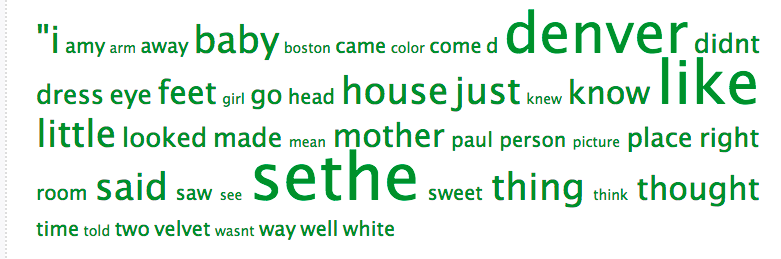
A “Wordsift” of precise language in Chapter 3 of “Beloved”; Denver and Sethe dominate as does the simile generator “like”.
My Advanced Placement English Literature students are currently reading Morrison’s 1988 Pulitzer Prize winning novel, Beloved. This story confronts the horrors of slavery by fictionalizing the true story of Margaret Garner who, in a failed bid for freedom, killed her baby daughter rather than have her returned to slavery.
A look at the opening two lines to Toni Morrison novel Beloved demonstrate her power as a storyteller and highlight her precision with language:
“124 was spiteful. Full of baby venom.”
An quick analysis of the specificity of language in these two short statements reveals:
124 is the address (setting) where Paul D arrives looking for the run-away slave, Sethe.
124 is also a combination of 1and 2 and 4…the first-born, the second-born, and the fourth-born children of Sethe. The third-born child (3), the child named Beloved, is missing numerically. That child chooses to make her presence known in more ghostly ways.
Morrison is exacting in her selection of word choice from her opening personification of the house as spiteful (“having or showing a desire to harm, anger, or defeat someone; malicious”) to the incongruous pairing of the words “baby” and “venom”.
So, when I asked students to write about the precision in word choice Morrison uses to craft imagery in the novel in the first 100 pages, they had much to choose from:
“In describing the choke cherry tree of scars on Sethe’s back, Morrison writes, ‘See, here’s the trunk it’s red and split wide open, full of sap and here’s the parting for the branches'(79). A history textbooks do not give details of slave wounds like that.”
“Sethe and Denver even accept ‘the lively spite the house felt for them'(3) …. Morrison utilizes this personification to show how objects took on the role of companionship when Sethe and Denver were ignored by their community.
“Sethe describes seeing the sunrise as menacing with ‘red baby blood’ with ‘pink gravestone chips'(34) instead of seeing the colors as warm and inviting.”
In making these and other observations, students called attention to Morrison’s specific use of dialect, alliteration, hyperbole, synecdoche, repetition, smilies, symbols as well as the differences in syntax to serve her purpose in making the reader confront the irreparable harm of slavery. The closer the students read, and they were “close reading”, the more appreciative they became of Morrison’s style. They became more appreciative of her power to select specific words in creating a particular image. They had no idea they could have just as easily be applying a mathematical practice standard (“attend to precision”) in their literary analysis.
Morrison was awarded the Nobel Prize in 1993 in for her body of work that included the novel Beloved. In her acceptance speech, she addressed how precise language is used to describe; to depict [as if] by painting or drawing:
The vitality of language lies in its ability to limn the actual, imagined and possible lives of its speakers, readers, writers. … When a President of the United States thought about the graveyard his country had become, and said, “The world will little note nor long remember what we say here. But it will never forget what they did here,” his simple words are exhilarating in their life-sustaining properties because they refused to encapsulate the reality of 600, 000 dead men in a cataclysmic race war. Refusing to monumentalize, disdaining the “final word”, the precise “summing up”, acknowledging their “poor power to add or detract”, his words signal deference to the uncapturability of the life it mourns.
Morrison’s admiration for Lincoln’s precise language in the Gettysburg Address is a shared admiration. The speech is a suggested 9th/10th grade text for the Common Core Common Core State Standards for Literacy in History/Social Studies. Moreover, educators should note the literary connection between the president who led the nation to abolish slavery with authors like Morrison who use their craft in pressing the reader to face the horrors of slavery.
Finally, the Mathematical Practice Standard #6 states that by high school, students will “have learned to examine claims and make explicit use of definitions.” There could be no better claim on the damage inflicted on humans in bondage than Morrison’s story of Sethe and her Beloved. The last lines of the novel, “This is not a story to pass on” communicates “You [reader] may not pass [or avoid] this story.” She explicitly defines the experiences of those “60 million or more” and captures their love and their longing for familial bonds by writing precisely what they could not.
March 2nd is Theodor Geisel’s (aka Dr. Seuss’s) birthday.
March 2nd is Read Across America Day as well, and Read Across America is an annual nationwide reading celebration sponsored by the National Education Association (NEA).
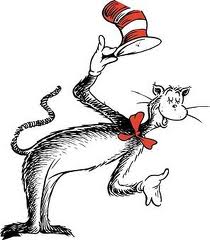
The impact of Dr. Seuss’s texts on young readers is enormous, but the impact does not stop there. Even at the high school level, I have made extensive use of Dr. Seuss’s classic The Cat in the Hat. I have posted about using this text to introduce Freudian psychology in I Wish I Had Thought of Id, Ego, and the Superego in Dr. Seuss’s “The Cat in the Hat”.
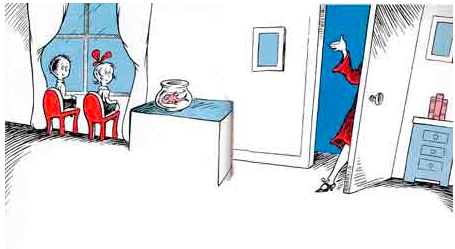
At the end of that lesson, my students have a clear understanding about the differences between the Id, represented by the wild Thing 1 and Thing 2, and the Superego, represented by the dutiful Fish. The also have one lingering question:
“Does the Cat want the kids to lie to their Mom?”
Their question encouraged me to look more closely at the text as a possible means to introduce other literary concepts. But I am not the only one who thought there were other lessons to be gained from this text. I recently found a series of philosophical topics and questions for The Cat in the Hat on The Teaching Children Philosophy Wiki.
The home page states:
This website is dedicated to helping adults conduct philosophical discussion with and among elementary school children.Contrary to what many people think, young children are both interested in and good at discussing philosophical questions. Picture books are a great way to initiate a philosophical discussion with young children and this site will help you get started.
Along with a long list of picture books, there are a number of Dr. Seuss texts represented on this wiki including Green Eggs and Ham for educators to teach a lesson on arguing reason vs. experience by Taiba Akhtar or The Sneetches for lessons on defining differences and noting prejudice by Lena Harwood.
The lesson for The Cat in the Hat was posted by Joey Shaughnessy and includes five topics and related follow-up questions, some of which include:
Trust
The Cat reassures the children that what he is doing is okay and that their mother won’t mind…
Would have you trusted the cat?
When can you trust strangers? What if they’re a teacher, or a policeman?
How do you know that you can trust your friends?
What is trust?
Responsibility
The Cat, with all of his games, made quite a mess in Sally and Sam’s house…
Is it okay that the Cat made a mess?
Since the Cat cleaned up his mess, was it more okay that he made it?
When is it okay to make a mess?
Wrongness
In the story, Sally and Sam had a very different view on what is right and wrong than the Cat did…
Is it okay if the children were entertained by the Cat, even though what he was doing was dangerous?
Is it okay to do things that are wrong to try and impress people?
Is it more okay to do something wrong if it’s fun? Why or why not?
Social Expectations
In the story, the Cat invited himself in, and started taking action…
Was what the Cat did an okay way to act?
What are inappropriate things to do in a friend’s home?
What makes them inappropriate?
Lying
At the end of the story, the reader is left to wonder if they would tell their mom what had happened…
Would have you told your mother what happened? Why?
Is it okay to lie to hide something that you’ve done wrong?
If we lie and get away with it, can people still be hurt by what we’ve done?
Should we tell the truth, even if no one would believe us?
If you tell someone only part of what happened, is this lying?
The last question (If you tell someone only part of what happened, is this lying?) was easy to discuss. My students agreed telling someone only part of what happened was lying.
They also mentioned something about speaking from experience.



 We have well over 100 copies of The Curious Incident of the Dog in the NightTime in our book room. They are a collection of books purchased at book sales ($1-$3 a copy) throughout the state of Connecticut for the past five years. These copies are most likely the discards from book club members who, 10 years after its original publication date (2003), donated their used copies. The only problem in locating copies of the text at a book sale is determining on which genre table the copies will be shelved. The novel is classified as a mystery, but it is also considered a young adult novel or trade fiction, and was






 Used Books in Class