Archives For November 30, 1999

March 2 was Dr. Seuss’s birthday, celebrated as Read Across America Day. In West Haven, Connecticut, planning for the event began in January when the Reading Department discussed how teachers were the model readers in every building. In a previous post, I added a sideshow of photos of classroom doors that teachers and staff designed to help students recognize the importance of reading and pay tribute to Dr. Seuss.

Many of the designs were remarkable. There were doors decorated as “Readboxes,” a playful twist on the movie-dispensing Redboxes. There were doors decorated with book choices displayed in Twitter tweets, or pie charts, or hot air balloons taking students “to the places they will go.” There was even a Type 40 TARDIS door where Dr. Who can meet Dr. Seuss!

Even more remarkable was the amount of time and effort that these West Haven educators put into the communal sharing of texts. Back in January, the hope of the Reading Department was that conversations about books would happen between students; between teachers and staff; and between teachers and students and staff.  Too often in education, there is an expectation that reading a book will end in an assessment or grade. Too often, reading a book means analyzing theme, discussing character change, or identifying setting.  Too often, there is no celebration in reading.

The hope of asking teachers to share their favorite titles on classroom doors was that these displays would spark new conversations about books that were far more informal, something akin to a student saying,  “Hey, I like that book, too!”

Two other West Haven elementary schools participated in the Read Across America, and their classroom doors and bulletin boards will hopefully continue their school community’s conversations about books. At minimum, their door decorations have definitely sparked conversations about  the impact of Pinterest on education!

Some of Mackrille Elementary  School’s offerings are seen here:

This slideshow requires JavaScript.

The numerous weather delays and cancellations resulted in a delay of festivities for Forest Elementary School, but their enthusiasm for engaging in conversations about favorite books and reading is clearly evident:

This slideshow requires JavaScript.

These posts wrap up the 2015 West Haven edition of Read Across America where educators contributed time and effort to celebrate reading. Now, we can listen for students to say, “Hey, that’s my favorite book, too!”

A Seussian-thanks to all those who participated:

The doors, the books, a wonderful sight
Seeing everyone share was such a delight!

In a well organized essay, explain how the author conveys his meaning. Be sure to consider structure, diction, setting, and point of view.

Popular MechanicsAbove is the prompt I used when I taught Advanced Placement English Literature (APLit) for all kinds of literature. This was before the Common Core’s “close reading” dictums; APLit students read and looked for author style and purpose because that was the focus of the course.

Tonight (2/22) there is a Twitter Chat #aplitchat on Raymond Carver’s short story “Popular Mechanics”; across the nation, APLit teachers will contribute their ideas on how to guide students through this particular dark story. I am trapped here in CT under another 7″ of snow, and while I wait to be dug out, here is an explanation of how my students wrote about this story.

When I passed out the copies,my students were, at first, delighted to see its brevity; the entire story is under 500 words. I would watch my students as they silently read. As they would finish in unison, their heads would snap up in shock.

Some of my students saw the story as deeply disturbing; others saw the story as dark humor. They wanted to talk plot, so I would allow several minutes of “What just happened?” and “They killed the baby??” and “Those people are sick!”
No surprise that Carver’s story generated strong responses by all of my students.

My next step in pre-writing would be to share some supporting information.  One year I gave the students the Biblical story of King Solomon to contrast the behavior of the mothers in each. Every year, I provided the definition of the word issue, the key linking the concluding sentence and the title. Here are some of the possible means of issue with connections to the story.

  •  something that is printed or published and distributed, esp. a given number of a periodical: 
  • a point in question or a matter that is in dispute, as between contending parties in an action at law; 
  • offspring; progeny:
  • a discharge of blood, pus, or the like;
  •  to go, pass, or flow out; come forth; emerge.

My students would reread the story, take notes, and spend several minutes of peer-to-peer discussions in groups. They would share how Carver’s structure, diction, setting, and point of view contributed to their understanding. After the discussions, I would ask them to draft a response using the standard prompt above.

My contribution to the #APLitchat tonight is a folder with three student exemplars that were created one year as a result. These drafts represent some interesting ideas as seen in some of these excerpts:

Student #1

Finally Carver uses these simple but revealing details about his characters to keep his story interesting and detailed but also very concise. The story starts in a bedroom, a place they probably consecrated their marriage but he is now tearing apart by leaving. We then switch to the doorway of the kitchen, paralleling her change in emotion. The kitchen is typically a place of family and love.

Student #2

Carver uses words and phrases such as “Bring that back” and “I want the baby” (Carver). The use of very simple, short words provides a more aggressive, hard-hitting tone. Carver’s sentence construction is very mechanical and rhythmic, which furthers Carver’s theory that the inner workings of a marriage and a family can be broken down into a mechanized object where basic laws of physics can be applied.

Student #3 

Carver brings in this contrast of light and dark in his first paragraph that states “it was getting dark. But it was getting dark on the inside too.” There is still light in their life before the argument, but as he packs, it begins to fade. By the time the couple is in a shady corner and the baby is torn apart, the house is darkened. It creates good imagery for the reader to illustrate the family “issues.”

As these excerpts from essay illustrate, Carver’s terse dialogue and minimal details helped my students appreciate the link between an author’s style and his or her purpose. Students enjoyed “Popular Mechanics” and at the end of the school year, they would always mark it a story that made them think about an author’s choices in writing a story.

I was fortunate to have 90 minute block periods to do this lesson in one sitting, but the lesson can be spread over two sessions or truncated to fit into a 45 minute block organized as 15 minutes of reading and discussion and 30 minutes of writing.

Good luck, #APLitchat on your discussion, and may all issues on responses to this story be resolved!

The Hollywood Academy released the 2015 nominations this past week, and their choices for best picture, best actor, and best director lit a firestorm on social media about the lack of diversity in their choices.Oscar

Some of the heated discussions called into question the make-up of the Academy, which according to a  2014 Los Angeles Times article is:

  • 93 percent white
  • 76 percent male
  • Average age of 63

The percentages that make up the homogenized Academy bear a striking resemblance to the make-up in the canon of literature traditionally taught in high school English classrooms, a list of works dominated by white male writers. There are numerous reasons as to why the literature is singular in gender and race: politics, economics, culture, and textbooks play a part. The most probable explanation on why the traditional canon endures, however, may be as simple as teachers teaching the books they were taught.

Even the average age of the dead white male writers in the canon is the same as those in the Academy. A sampling of traditionally assigned authors at the time of their deaths (offered in no particular order) is the average age as the members in the Academy=63 years: John Milton (72), Percy Bysshe Shelley (30), F. Scott Fitzgerald (44), Dylan Thomas (39), Arthur Miller (90), William Shakespeare (52), John Keats (27) Ernest Hemingway (62), William Faulkner (65), John Steinbeck (66) William Blake (70), George Orwell (47), and TS Eliot (77).

My observation that older white male literature dominates the curriculum is nothing new, and while there are there are glimmers of diversity, authorship bears little resemblance to readership. Occasionally, Richard Wright, Langston Hughes, and August Wilson pop up to address racial diversity, while the inclusion of Mary Shelley, Harper Lee, Jane Austen and the Bronte sisters are worthwhile contributions to gender equity.

At the same time, there is a growing body of popular young adult literature from authors representing diversity such as Jacquelyn Woodson, Sharon Draper, Pam Muñoz Ryan, Gary Soto, and Sherman Alexie.  In a manner akin to film audiences, students have been voting for these book choices with their pocketbooks or checking out library books. They are selecting materials (novels, graphic novels, animé, pop culture, biography) that they want to read.

As readers, students look for characters like themselves, who have problems like themselves, even if the settings of the stories are in the ancient past or distant future. If a student never builds empathy with a character because all the assigned reading comes from the canon, then the canon is disconnected from personal experience and useless for that student. If creating life long readers is the goal, curriculum developers must pay attention to student interests and the trends in the popular reading lists. Continuing the disconnect between the traditional canon in school and what students choose does little to build credibility.

That same kind of disconnect is seen in the nominations submitted by the Academy. Their choices show a wide gulf of opinion between critics and audiences, between the selected films and popular films at the box office. National Public Radio (NPR) film critic Bob Mondello noted the low audience numbers for many of the 2015 nominated films:

MONDELLO:  If you total up all of the grosses for all of the best picture nominees this year, you come up to about 200 million, which is roughly what a picture like “Teenage Mutant Ninja Turtles” makes all by itself so that you’re talking about very few eyeballs were on those pictures.

Mondello’s noting the difference in box office is striking in comparison to the the top three box office films to three of the nominated films for best picture:

TOP GROSSING:
1 Guardians of the Galaxy – $333,145,154
2 The Hunger Games: Mockingjay – Part 1 $330,643,639
3 Captain America: The Winter Soldier – $259,766,572

NOMINATED FOR BEST PICTURE:
94 Birdman  $26,725,993
95 The Theory of Everything $26,317,946
100. Boyhood  $24,357,447

Mondello further suggests that Academy has not supported its own self interest in making nominations:

And the idea here is that you’re not going to watch the Oscar telecast unless you have a horse in the race….And I think what they’re hoping is that the next six weeks up until the show, these movies will be seen by a lot more people. If they aren’t – and they only have 38 days to do this – then you’re going to have the lowest rated Oscars telecast in the history of the Oscars.

Encouraging people to attend the films nominated by the Academy will be a challenge, and the success of the Oscars this year will be determined by audience choice. The deaf ear of the Academy this year may make them more open to diversity in future years. In contrast, a deaf ear from curriculum developers who continue to assign literature from the canon because “it has always been taught” may result in student audiences disconnected and less interested in reading anything at all.

Hoping to bridge this disconnect are organizations such as the Children’s Book Council (CBC )Diversity Committee whose mission statement is:

We endeavor to encourage diversity of race, gender, geographical origin, sexual orientation, and class among both the creators of and the topics addressed by kid lit. We strive for a more diverse range of employees working within the industry, of authors and illustrators creating inspiring content, and of characters depicted in children’s and young adult books.

The organization We Need Diverse Books is also committed to expanding diversity in literature and in the video below, the popular YA writer Jon Green (The Fault in Our Stars, Paper Towns, Looking for Alaska) makes a compelling case for including other, newer voices into the literary canon that is taught in classrooms.

Unlike the choices made by this year’s Academy, the choices in English classroom should represent diversity in authorship, in genre, in character, and in topics because the readership is diverse. NPR’s Bob Mondello’s metaphor about engaging an audience for the Oscar show this year could be a metaphor for creating life long readers. Unless students “have a horse in the race” in what they read, they will not value the choices made for them.

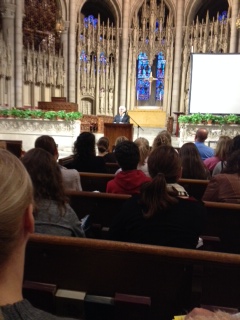
On the 87th Saturday Reunion at Teacher’s College, the author David Booth stood at the podium of NYC’s  Riverside Church admiring the mosaic of teacher faces staring back at him. It was 9:00 in the morning, and we numbered in the thousands.

David Booth“Look at you,” he softly intoned.
We quieted down.
“You look wonderful!” he continued.
We leaned in.
“I have a story to share,” his voice growing more audible as we settled in the echoing cathedral.
We leaned in closer, and his voice became clearer.
“I want to share a story that generated a thousand responses….the story of the Selkie.”

His Keynote Address was titled, “How One Story Can Generate One Thousand Responses” and on this Saturday morning, Booth was recounting to thousands of teachers how he had shared multiple versions of the Selkie with thousands of students in different countries from Kindergarten to grade 12.

Selkies are mythological creatures who live as seals in the sea, but who shed their skin to become human on land.  They are found in in Scottish, Irish folklore, and some Icelandic traditions.

Selkies can also be found in classrooms, according to Booth, who described the teacher who cheerfully greeted him in a “sealskin” of paper, replete with flippers.
“Imagine having her for a teacher,” he marveled, “just imagine,” and he paused allowing us to picture the kind of teacher who would greet an author in a seal suit fashioned after the picture book Selkie woman who shed her skin in order to love a fisherman.

The legend of the Selkie offered multiple versions that Booth could share with different grades over the course of a year:  a woman whose seal skin was held hostage by smitten fishermen, seal children adopted by lonely couples, or women cry seven tears into the sea for their seal men.

“When we read each humble folk tale,” he continued, “all of us, in the same room, reading the same event, we all had different responses.” He paused again, “We were making our own stories.”

Booth shared many of these different responses, beginning with the letters imagined by 1st grade Phoebe from the fisherman husband, James, to the wife, Emily.  “My darling, I love you. Take care of of our seal-son. I love, love, you.” Booth paused before asking, “How does a 7 year old know about such love?”

He told us of the 9th grader who sat, morose and silent, throughout a discussion about the meaning of the Selkie legend before finally contributing, “It’s about forbidden love.”

Booth shared the responses of students who had the chance to answer questions about the Selkie by posting their ideas on three wall charts labeled:

  • Our fierce wonderings…
  • Our answers to our fierce wondering answered and researched…
  • Further wonderings…

And he shared the a haiku penned by a middle schooler in a response to the legend of the Selkie:

“Never marry the
first naked lady you see;
she’ll swim away.”

“We share the need to be heard; the need to be a part need to be in the circle,” he said, and he paused long enough for us to consider how much we share in storytelling in our classrooms.

“Do you have enough courage to give the time to have the children grow and change?” he said, he paused again long enough for us to appreciate his modeling of “wait time” in teaching.

“It takes a lot of slow to grow,” he noted. “Have the faith to wait and not give them the answer.”

The paused for the last time before concluding, “Weave your blanket of words to cover your children. Hurray for story! Return to your children with word blankets.”

We stopped leaning.
We stopped being quiet.
Our thousands of hands clapped for the thousand responses  for David Booth and the Selkie legend.

12 graders during SSR

Our 12 graders during independent reading- SSR

How challenging is it for a teacher to run an independent reading program? Very challenging. That is the only thing thing that Newsweek reporter Alexander Nazaryan got right in his NYTimes op-ed piece The Fallacy of ‘Balanced Literacy’ (7/6/14).

His lack of success in having students choose their own reading for pleasure over the course of one school year, should not grant him the opportunity to decry the practice. His own failure to encourage students to engage in reading for pleasure should not dissuade other teachers from encouraging students to develop life-long reading habits. Had he the proper training and resources in balanced literacy, he would have witnessed how the challenge of implementing independent reading in a classroom can be met at any grade level and is a critical step to making students life-long readers.

If he had the training, he would recognize that teachers who are familiar with books for specific age groups and levels of interest can make reading recommendations to students or help facilitate highly successful peer to peer book recommendations. If he had the resources of high interest, low-level texts in jam packed classroom libraries for his students, he would have increased the level of engagement. If he had utilized the time for reading to individually confer briefly with students about their reading while other students read quietly, he would have established a classroom routine that would allow him to informally measure student growth as they read. Finally, if he had impressed upon students the importance of reading for pleasure, he would have helped their academic success in all other classes.

Research studies (compiled by the American Library Association) have determined that reading outside of the classroom is the best predictor for student success:

The amount of free reading done outside of school has consistently been found to relate to achievement in vocabulary, reading comprehension, verbal fluency, and general information. Students’ reading achievement correlates with success in school and the amount of independent reading they do (Anderson, Wilson, and Fielding 1988; Guthrie and Greaney 1991; Krashen 1993; Cunningham and Stanovich 1991; Stanovich and Cunningham 1993).

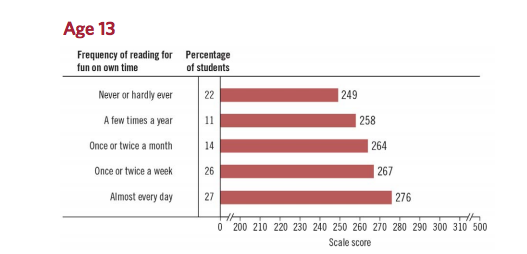
This research from the ALA is borne out by testing through The National Assessment of Educational Progress (NAEP) test, which has monitored the academic performance of 9-, 13-, and 17-year-old students  since the 1970s. Long-term trend assessments in reading are measured on a scale of 500 points. In taking the NAEP, students volunteered information on their reading habits. The results from this data in 2012 demonstrated that the average score for the 22% of those students aged 13 who never (or hardly ever) read independently was 25 points lower than students who read every day. By age 17, the difference had increased to 30 points.

Screenshot 2014-06-11 20.37.34

NAEP scores for 13 year olds who read for pleasure and the increase in standardized test scores

This data confirms what we have witnessed in our own classrooms. Our students are given SSR (silent sustained reading) time in class for independent reading in grades 7-12. Independent reading for our school means that students get to choose what they would like to read without having to take a quiz or a test on the book. The only “requirements” are that students keep a running record (we are using Shelfari) of their independent reading books. We ask them to share their recommendations with their peers. We talk to them about what they read.

Screenshot 2014-06-12 07.18.45

Holding up cards with the numbers of book read independently (included one world lit choice book)

Sometimes students are offered a choice from a length list of thematically connected books, and sometimes the choice must be in a particular genre (non-fiction, memoir, world literature). Other times, the choice is entirely open and students can read whatever books they want. Our block schedule allows us the luxury of offering students 15-20 minutes each period. A quick estimate means that over the course of the school year (40 weeks), meeting twice weekly (roughly 30 minutes minimum a week), students will be offered a minimum of 20 hours of reading time in class. They make very good use of that time.

read1

Holding up the number of books read in grade 9

The main goal of our independent reading program is to encourage students to read beyond the walls of the classroom; our 15 minutes spent in class is intended as a “hook” to connect students with books that they might want to read or as a “refresher” to reconnect a book already being read.

Seniors holding up the number of books read independently in a semester

Seniors holding up the number of books read independently in a semester

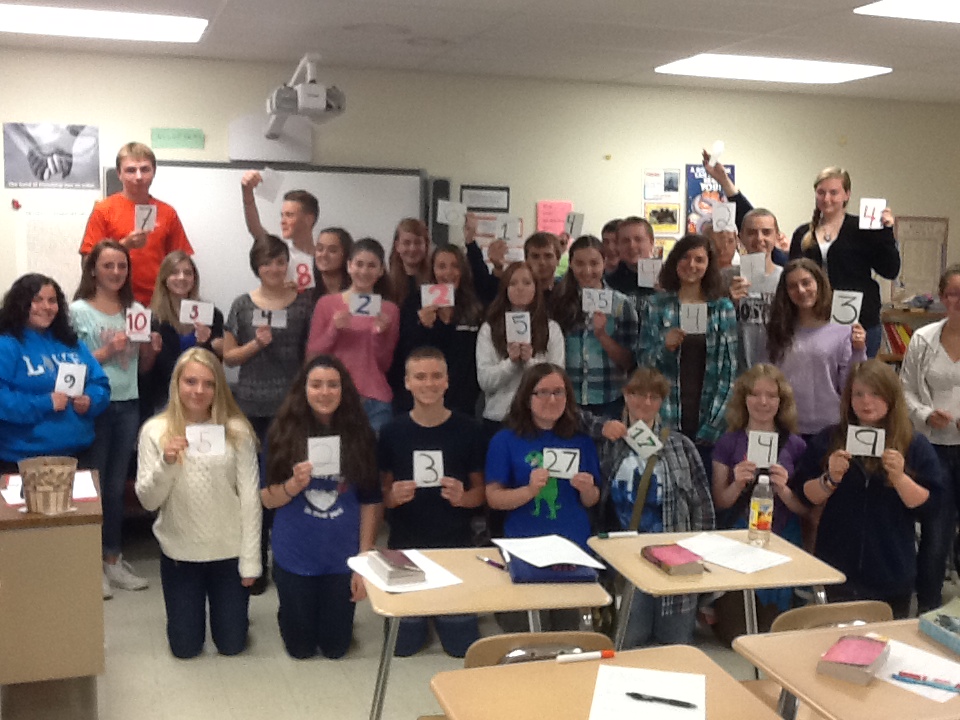
Encouraging students to read independently means practice, and the time we provide in class contributes to that reading practice. At the end of this year, we are celebrating the number of books read over the course of the year by taking group photos of students proudly holding up the number of books they have read independently over the past school year. So, rather than read a confessed failure in an op-ed piece that incorrectly characterizes independent reading written by someone who has left education, take a look at how the challenge of independent reading is being successfully met in our classrooms. The proof is in the pictures.

There are several reasons the short discourse between Hamlet and a captain from Fortinbras’s army at the end of Act Four has become my favorite scene in the play Hamlet. There are 22 lines spoken between the Captain and Hamlet, but they contain questions about military service that reverberate today. Shakespeare’s fascination with the role of the soldier in society is evident in many of his plays, but rarely does he spotlight such blunt conversation between a character from the military and a member of the royal class.

In the following quick analysis of the scene, Hamlet is being packaged off to England accompanied by the hapless duo Rosencrantz and Guildenstern. Even though he is Prince of Denmark, Hamlet can do nothing but witness what is happening; his Uncle Claudius is in charge of the kingdom.
hamlet96-4-4-1

Act IV. scene iv from Branagh’s “Hamlet”

Hamlet opens the exchange by asking the Captain what army is marching across Denmark.

HAMLET
Good sir, whose powers are these?
Captain
They are of Norway, sir.
HAMLET
How purposed, sir, I pray you?
Captain
Against some part of Poland.

To all observers, Fortinbras’s march through Denmark to Poland with an army is a potential threat to Denmark. Hamlet’s father had killed Fortinbras’s father in battle, and Fortinbras is one of the three sons looking to avenge a father in this tragedy.

HAMLET
Who commands them, sir?
Captain
The nephews to old Norway, Fortinbras.
HAMLET
Goes it against the main of Poland, sir,
Or for some frontier?

Hamlet is able to gather information as to Fortinbras’s intent, or at least the Captain’s orders. When the Captain speaks “truly,” he is unaware he is addressing royalty:

Captain
Truly to speak, and with no addition,
We go to gain a little patch of ground
That hath in it no profit but the name.
To pay five ducats, five, I would not farm it;
Nor will it yield to Norway or the Pole
A ranker rate, should it be sold in fee.

Here then, the Captain explains the soldier’s paradox. He has enlisted in the military, and in the military, he follows orders. The Captain knows the  “little patch of ground” is worthless to him personally, “To pay five ducats, five, I would not farm it…” That same land, however, has value to those who command the army, to those who engage in kingdom building, and to those who care for, “no profit but the name.” All land is valuable to those who desire to expand their holdings. Yet  that same land is as valuable to those who own it, and Hamlet learns from the Captain that the Poles have dug in, preparing for Fortinbras’s coming attack:

HAMLET
Why, then the Polack never will defend it.
Captain
Yes, it is already garrison’d.

Shakespeare uses Fortinbras’s “man of action” to contrast Hamlet’s “man of thought” throughout the play. While Hamlet spends almost four acts fuming over his Uncle Claudius, Fortinbras amasses an army to claim or to regain land lost by his father. Of course the Poles will be defending their homeland, an understandable reason to risk their lives, but the Norwegian soldiers are not being attacked; they are the attackers. Hamlet’s last words to the Captain shows him considering an unnecessary war that will cost many soldiers lives:

HAMLET
Two thousand souls and twenty thousand ducats
Will not debate the question of this straw:
This is the imposthume of much wealth and peace,
That inward breaks, and shows no cause without
Why the man dies. I humbly thank you, sir.
Captain
God be wi’ you, sir.
Exit

In the soliloquy that follows, Hamlet wonders why soldiers would enlist in such a venture when they risk their lives for an unknown cause:

“…for a fantasy and trick of fame
Go to their graves like beds, fight for a plot
Whereon the numbers cannot try the cause,
Which is not tomb enough and continent
To hide the slain?”

In offering this soliloquy, Shakespeare poses a universal question: Why does anyone become a soldier?

As the mother of two active duty Marine Corps officers, I think about this same question. I think about this question knowing that only .5% of Americans serve in today’s military as compared to 12% in World War II.

Shakespeare asks what “a fantasy and trick of fame” drives men and women to enlist and follow orders. Certainly full employment is a draw to the profession, but a military that enlists only for money is akin to a military of mercenaries. A report by the US Department of Defense issued by the American Forces Press Service points to another reason, that military service is a family tradition. In a 2011 survey, “79% percent of veterans surveyed reported that an immediate family member is serving or has served in the military. That compares to 61 percent among the civilian respondents.”

New York Times editorial (5/26/2013) Americans and Their Military, Drifting Apart by Karl W. Eikenberry and David Kennedy, also points out the growing disconnect between the general population and those who serve. Eikenberry is a retired Lieutenant General and former United States commander in Afghanistan (2009-2001); Kennedy is an emeritus professor of history at Stanford. They discuss family legacy as the reason young men and women enlist:

“So many officers have sons and daughters serving that they speak, with pride and anxiety, about war as a “family business.” Here are the makings of a self-perpetuating military caste, sharply segregated from the larger society and with its enlisted ranks disproportionately recruited from the disadvantaged.”

I often hear praise heaped upon my sons because sometimes they are the only direct connection to the military for friends and associates. My extended family includes brothers, nephews, and brothers-in-laws who have also served in some branch of service. We could be part of the military caste that understands the concerns of Eikenberry and Kennedy who recount a maxim of George Washington:

“The  [US Military] all-volunteer force may be the most lethal and professional force in history, but it makes a mockery of George Washington’s maxim: When we assumed the Soldier, we did not lay aside the Citizen. Somehow, soldier and citizen must once again be brought to stand side by side.”

Shakespeare presents the plight of the soldier to an audience of citizens by having the Captain speak to the “citizen” Hamlet. As the Captain bluntly assesses the coming attack, Shakespeare creates empathy for the soldier from the citizens who hear him speak. They hear Hamlet “humbled” in his thanks. In this short scene, Shakespeare illustrates the importance of Washington’s maxim: the citizen must stand with the soldier.

There is, however, another reason this scene from Hamlet has a special significance for me. My older son served his first tour (of three) in Afghanistan in 2011. In our mail one day was a small cardboard box top from an MRE box that he had used as a postcard. He indicated he was doing well, healthy and well-fed, and he asked us to thank those who had sent packages to him. He had carefully printed as much as he could on the box top, as if his writing would be sufficient to assure us of his safety. He signed off with his scrawly signature, but at the bottom of the card in a tiny line of postscript he had penned the quote:

“We go to gain a little patch of ground that hath in it no profit but the name.”


17 minutesI was researching websites for the Film and Literature class when I first heard about the “17 Minute Rule;” a rule that suggests the real plot is revealed to the audience 17 minutes into any film.  Todd Pack’s Messy Desk Blog uses a number of examples to illustrate  The 17 Minute Rule:

George Bailey tells his father he couldn’t face being cooped up the rest of his life in a shabby little office at his father’s building and loan 17 minutes into It’s a Wonderful Life.

The rest of the movie is about everything that happens that stops him from leaving Bedford Falls and drives him to consider jumping off that bridge on Christmas Eve.

  • Luke’s uncle buys the droids 17 minutes into Star Wars. The droids are what leads Luke to Obi-Wan Kenobi and Princess Leia and, ultimiately, the Death Star.
  • Buddy leaves the North Pole to find his real dad 17 minutes into Elf.
  • The shark eats the little boy on the raft 17 minutes intoJaws. It’s the second attack that forces the town to close the beach and go after the shark.
  • The Iowa farmer is thinking about plowing under the baseball field he built in his cornfield until Shoeless Joe appears 17 minutes after the credits in Field of Dreams.

This 17 minute phenomenon was corroborated on other blogs as well.  Writer and Director Nathan Marshall posted Screenplay Structure: Three Acts & Five Points Script Frenzy! blog where he also called attention to minute 17:

3) Page 17. Next time you watch a DVD, pause it 17 minutes into the film. Trust me—any film. What’s happening at that point in the story? Most likely, the essential character conflict has just been laid out. A teenage Indiana Jones runs to his father for help, but is shushed instead. Shaun convinces his girlfriend to trust him in Shaun of the Dead. Captain Renault asks Rick why he came to Casablanca. On page 17, your audience should realize what the film is really about. It’s not about finding the Holy Grail, Indy—it’s about learning to forgive dad!

The same was outlined on the  All About Screenwriting blog. In addition to explaining the rule, this post made the claim that the ratio of screenplay to minute of film is 1:1; and page 17 will be the 17th minute of a film. The site provides a basic outline for a screenplay of the average movie made today:

FADE IN: 

  • Between pages 1-5: The HOOK, something that grabs our attention and pulls us in.
  • Page 10: At this point in your script you should have the “MINI CRISIS”. The “MINI CRISIS” should lead us into…
  • Page 17: …The DILEMMA. Creation of the team and what the movie is about.
  • Page 30: The REACTION to the dilemma or situation.
  • Page 45: First “REVERSAL” of the 17 minute point. This point furthers the characters and pushes them deeper into the situation or the dilemma.
  • Page 60: The “TENT POLE” of the movie. Where the passive characters become active or vice versa.
  • Page 75: Second “REVERSAL” to the 17 minute point. To reaffirm what the story is about.
  • Page 90: The LOW POINT of action. The place from which our main character has to rise up from.

FADE OUT.

So when I noticed students picking up books for independent reading and discarding them after the first few pages, I wondered if they were giving the book a real chance. Could a 17 page rule apply to books student might choose to read? And, if the rule applied, would a student become more engaged once he or she reached page 17?

In a short experiment, I grabbed three books off the top of the book cart, and noted the following:

The Hobbit (The Dwarves and Gandalf invade Bilbo’s home)

“The poor little hobbit sat down in the hall and put his head in his hands, and wondered what had happened, and what was going to happen, and whether they would all stay to supper. Then the bell rang again louder than ever, and he had to run to the door.”

Little Women -Marmee gives  Meg, Jo, Beth, and Amy their Christmas gifts with her words of encouragement to survive the difficulties of life.

‘We never are too old for this, my dear, because it is a play we are playing all the time in one way or another.Out burdens are here, our road is before us, and the longing for goodness and happiness is the guide that leads us through many troubles and mistakes to the peace which is a true Celestial City. Now, my little pilgrims, suppose you begin again, not in play, but in earnest, and see how far on you can get before Father comes home.’”

Lord of the Flies-The boys Ralph and Piggy discover they are on their own in a hostile environment:

“They’re all dead,” said Piggy, “an’ this is an island. Nobody don’t know we’re here. Your dad don’t know, nobody don’t know—”
His lips quivered and the spectacles were dimmed with mist.
“We may stay here till we die.”
With that word the heat seemed to increase till it became a threatening weight and the lagoon attacked them with a blinding effulgence.”

Yes, the rule was working for books from the canon. Later that same afternoon, I was working with a “reluctant reader” who had selected James and the Giant Peach as a guided reading text. I glanced at page 17 and noticed the wonderful passage where James finds the entrance to the giant peach.

James and the Giant Peach 

“Almost without knowing what he was doing, as though drawn by some powerful magnet, James Henry Trotter started walking slowly toward the giant peach. He climbed over the fence that surrounded it, and stood directly beneath it, staring up at its great bulging sides. He put out a hand and touched it gently with the tip of one finger. It felt soft and warm and slightly furry, like the skin of a baby mouse. He moved a step closer and rubbed his cheek lightly against the soft skin. And then suddenly, while he was doing this, he happened to notice that right beside him and below him, close to the ground, there was a hole in the side of the peach.”

Not every text has a page 17 moment…sometimes the dilemma is posed on page 16 or page 18 or 19. I suspect the rule holds up because the 17 minute rule/page 17 is part of a pattern in storytelling, and stories always follow a pattern.  Sharing this rule with students gives me another “tool” in my teaching toolbox, so when I see a student toss a book aside after reading only a few pages, I casually remark, “Did you get to page 17 yet? There’s a rule about page 17…. on page 17, something important always happens.”
I may get a quizzical look, but several minutes later, I have seen that same student engrossed in the text.
“The book got better,” says the student.
“Well, you got past page 17,” I respond.

theatre-stage-81d434 copyShakespeare’s sonnets are little one-act plays.
I learned this one year when I was teaching drama to grades 9-12 and I discovered Will and WhimsySixteen Dramatically Illustrated Sonnets of Shakespeare by Alan Haehnel. The short comic/poignant skits in the collection are an excellent way for middle school and high school students to be exposed to the Bard’s 154 poems.
Consequently, when I began the study of sonnets with my Advanced Placement English Literature students, I thought they might benefit from a similar technique. In addition, I considered that this could be an opportunity for them to write a narrative as required by the Common Core State Standards:

CCSS.ELA-LITERACY.W.11-12.3
Write narratives to develop real or imagined experiences or events using effective technique, well-chosen details, and well-structured event sequences.

“Imagine a character in each sonnet is talking to you,” I explained, “you need to synthesize the ideas from the poem, and write that character’s story.”

Then, I handed out copies of Shakespeare’s Sonnet 29:

sonnet 29

When, in disgrace with fortune and men’s eyes,
I all alone beweep my outcast state,
And trouble deaf heaven with my bootless cries,
And look upon myself, and curse my fate,
Wishing me like to one more rich in hope,
Featur’d like him, like him with friends possess’d,
Desiring this man’s art and that man’s scope,
With what I most enjoy contented least;
Yet in these thoughts myself almost despising,
Haply I think on thee, and then my state,
Like to the lark at break of day arising
From sullen earth, sings hymns at heaven’s gate;
For thy sweet love remember’d such wealth brings
That then I scorn to change my state with kings.

On the bottom of the page I restated one simple direction, “Write the narrative.”

The results were unexpected. While my students are good at analyzing poems, I was unaware that a number of them are born storytellers. In their retellings, they captured the spirit, and sometimes the exact language, of the poem. They found ways to expand on the isolation and alienation of the speaker and incorporate the shift in the speaker’s attitude from despair to one of acceptance.

For example, Melissa used a pivotal moment in the lives of high school students…asking someone to go to the prom:

After weeks of preparation and endless nerves the day has come to ask her to come to prom with me!
I wrote her a poem listing all the things I liked about her and read it to her under the starlight sky just at sunset.
I ended the poem with “thy sweet love remember’d such wealth brings.”
My nerves ran through my body and I felt like I was going to pass out.
YES! SHE SAID YES!
I take her off to dinner and we planned for the night of prom. My dreams have come true! I am going to my senior prom with the girl of my dreams!

In contrast, Makayla began her narrative from the point of view of a frighteningly depressed teenager who observes others in a community park. The young girl’s attention is eventually drawn to one elderly couple, and their tenderness towards each other brings about an “epiphany,” a realization:

I inhale a summer thriving breathe and release the darkness out of my body. I turn to walk down the once sullen Earth path now as a gateway to sweet heaven’s gate. I take my phone out of the bag and dial my boyfriend’s number to make things right and explain myself to him. I pass the two elderly couple and smile.
In return I get a friendly, “Beautiful day, isn’t it?” and I respond, “Yes, yes ,it truly is, and I won’t beweep it again.”
As I near the running children, I pulled my bag off my shoulder and slipped it into a nearby trashcan. It’s time to change my state with kings.

Emma’s chose to use the point-of-view of an elderly woman suffering from Alzheimer’s in this poignant tale:

He doesn’t know that me is right underneath all of this forgotten memory. I’m right here, but I don’t know who I am. I bury my face in my wrinkled hands and trouble deaf heaven with my bootless cries. I can’t change. Curse my fate.
When I look up he’s standing over me. “Your appointment is at four.”
I swear I didn’t know. When I searched his face for recognition, I knew that he did not see me. He doesn’t know who I am and neither do I. He doesn’t understand that I can’t control my fate. But I am not my forgotten memory, I am his wife. That much, I know.

Finally, Jen’s story was humorous, told from the perspective of a jilted bride:

I’m sitting alone on altar steps in my once-worn Vera Wang wedding dress that’s as deflated now as I feel. My supposed-to-be husband left me for some California-toned, bottle-blond chick bustier than Dolly Parton. (Curses her and her awesome figure. I swear she was created by Russian scientists.) I all alone beweep my outcast state….

….That son-of-a-bitch should not be in my thoughts right now. Well, maybe he should considering he was a 10 thousand dollar mistake. Dammit I looked good in that dress.
Sullen Earth, why me?

What started out as an educated guess for an assignment on my part has yielded great results. Moreover, my students have written narratives based on  “this man’s art.”

“We loved writing these,” was their collective response.
Of course they did….hard to go wrong with Shakespeare as their mentor.

Continue Reading…

There is no surprise in reading the word “precision” in the language of the Common Core’s Mathematical Practice Standards. Mathematics requires precision:

CCSS.Math.Practice.MP6 Attend to precision.

Mathematically proficient students try to communicate precisely to others. They try to use clear definitions in discussion with others and in their own reasoning.

Writing requires precision as well. Proficient writers in every genre communicate precisely to others. Yet, one of the most difficult concepts to teach to students in recognizing the precision in an author’s craft. Word choice and punctuation are committed with intent by an author, yet, there are students who doubt these steps of precision made by an author. They believe that any text has stepped, as if full-formed or Athena-like, from the mind of an author. They think that novels pop into existence…unless, they are reading Toni Morrison.

Screenshot 2014-02-27 21.57.19

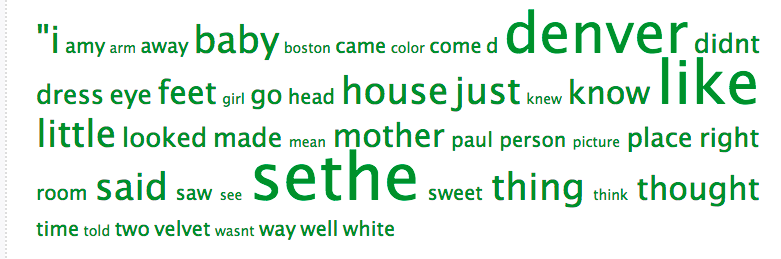
A “Wordsift” of precise language in Chapter 3 of “Beloved”; Denver and Sethe dominate as does the simile generator “like”.

My Advanced Placement English Literature students are currently reading Morrison’s 1988 Pulitzer Prize winning novel, Beloved. This story confronts the horrors of slavery by fictionalizing the true story of Margaret Garner who, in a failed bid for freedom, killed her baby daughter rather than have her returned to slavery.

A look at the opening two lines to Toni Morrison novel Beloved demonstrate her power as a storyteller and highlight her precision with language:

“124 was spiteful. Full of baby venom.”

An quick analysis of the specificity of language in these two short statements reveals:

  • 124 is the address (setting) where Paul D arrives looking for the run-away slave, Sethe.
  • 124 is also a combination of 1and 2 and 4…the first-born, the second-born, and the fourth-born children of Sethe. The third-born child (3), the child named Beloved, is missing numerically. That child chooses to make her presence known in more ghostly ways.
  • Morrison is exacting in her selection of word choice from her opening personification of the house as spiteful (“having or showing a desire to harm, anger, or defeat someone; malicious”) to the incongruous pairing of the words “baby” and “venom”.

So, when I asked students to write about the precision in word choice Morrison uses to craft imagery in the novel in the first 100 pages, they had much to choose from:

“In describing the choke cherry tree of scars on Sethe’s back, Morrison writes, ‘See, here’s the trunk it’s red and split wide open, full of sap and here’s the parting for the branches'(79). A history textbooks do not give details of slave wounds like that.”

“Sethe and Denver even accept ‘the lively spite the house felt for them'(3) …. Morrison utilizes this personification to show how objects took on the role of companionship when Sethe and Denver were ignored by their community.

“Sethe describes seeing the sunrise as menacing with ‘red baby blood’ with ‘pink gravestone chips'(34)  instead of seeing the colors as warm and inviting.”

In making these and other observations, students called attention to Morrison’s specific use of dialect, alliteration, hyperbole, synecdoche, repetition, smilies, symbols as well as the differences in syntax to serve her purpose in making the reader confront the irreparable harm of slavery. The closer the students read, and they were “close reading”, the more appreciative they became of Morrison’s style. They became more appreciative of her power to select specific words in creating a particular image. They had no idea they could have just as easily be applying a mathematical practice standard (“attend to precision”) in their literary analysis.

Morrison was awarded the Nobel Prize in 1993 in for her body of work that included the novel Beloved. In her acceptance speech, she addressed how precise language is used to describe; to depict [as if] by painting or drawing:

The vitality of language lies in its ability to limn the actual, imagined and possible lives of its speakers, readers, writers. … When a President of the United States thought about the graveyard his country had become, and said, “The world will little note nor long remember what we say here. But it will never forget what they did here,” his simple words are exhilarating in their life-sustaining properties because they refused to encapsulate the reality of 600, 000 dead men in a cataclysmic race war. Refusing to monumentalize, disdaining the “final word”, the precise “summing up”, acknowledging their “poor power to add or detract”, his words signal deference to the uncapturability of the life it mourns.

Morrison’s admiration for Lincoln’s precise language in the Gettysburg Address is a shared admiration. The speech is a suggested 9th/10th grade text for the Common Core Common Core State Standards for Literacy in History/Social Studies. Moreover, educators should note the literary connection between the president who led the nation to abolish slavery with authors like Morrison who use their craft in pressing the reader to face the horrors of slavery.

Finally, the Mathematical Practice Standard #6 states that by high school, students will “have learned to examine claims and make explicit use of definitions.” There could be no better claim on the damage inflicted on humans in bondage than Morrison’s story of Sethe and her Beloved.  The last lines of the novel, “This is not a story to pass on” communicates “You [reader] may not pass [or avoid] this story.” She explicitly defines the experiences of those “60 million or more” and captures their love and their longing for familial bonds by writing precisely what they could not.

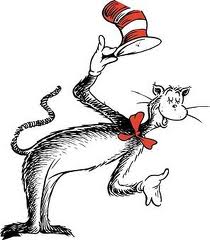
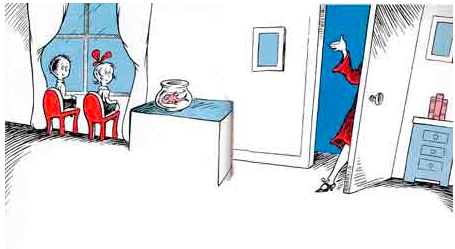
Cat in the HatMarch 2nd is Theodor Geisel’s (aka Dr. Seuss’s) birthday.

March 2nd is Read Across America Day as well, and Read Across America is an annual nationwide reading celebration sponsored by the National Education Association (NEA).

The impact of Dr. Seuss’s texts on young readers is enormous, but the impact does not stop there. Even at the high school level, I have made extensive use of Dr. Seuss’s classic The Cat in the Hat. I have posted about using this text to introduce Freudian psychology in I Wish I Had Thought of Id, Ego, and the Superego in Dr. Seuss’s “The Cat in the Hat”.

At the end of that lesson, my students have a clear understanding about the differences between the Id, represented by the wild Thing 1 and Thing 2, and the Superego, represented by the dutiful Fish. The also have one lingering question:

“Does the Cat want the kids to lie to their Mom?”

Their question encouraged me to look more closely at the text as a possible means to introduce other literary concepts. But I am not the only one who thought there were other lessons to be gained from this text. I recently found a series of philosophical topics and questions for The Cat in the Hat on The Teaching Children Philosophy Wiki

The home page states:

This website is dedicated to helping adults conduct philosophical discussion with and among elementary school children.Contrary to what many people think, young children are both interested in and good at discussing philosophical questions. Picture books are a great way to initiate a philosophical discussion with young children and this site will help you get started.

Along with a long list of picture books, there are a number of Dr. Seuss texts represented on this wiki including Green Eggs and Ham for educators to teach a lesson on arguing reason vs. experience by Taiba Akhtar or The Sneetches for lessons on defining differences and noting prejudice by Lena Harwood.

The lesson for The Cat in the Hat was posted by Joey Shaughnessy and includes five topics and related follow-up questions, some of which include:

Trust

The Cat reassures the children that what he is doing is okay and that their mother won’t mind…

  • Would have you trusted the cat?
  • When can you trust strangers? What if they’re a teacher, or a policeman?
  • How do you know that you can trust your friends?
  • What is trust?

Responsibility

The Cat, with all of his games, made quite a mess in Sally and Sam’s house…

  • Is it okay that the Cat made a mess?
  • Since the Cat cleaned up his mess, was it more okay that he made it?
  • When is it okay to make a mess?

Wrongness

In the story, Sally and Sam had a very different view on what is right and wrong than the Cat did…

  • Is it okay if the children were entertained by the Cat, even though what he was doing was dangerous?
  • Is it okay to do things that are wrong to try and impress people?
  • Is it more okay to do something wrong if it’s fun? Why or why not?

Social Expectations

In the story, the Cat invited himself in, and started taking action…

  • Was what the Cat did an okay way to act?
  • What are inappropriate things to do in a friend’s home?
  • What makes them inappropriate?

Lying

At the end of the story, the reader is left to wonder if they would tell their mom what had happened…

  • Would have you told your mother what happened? Why?
  • Is it okay to lie to hide something that you’ve done wrong?
  • If we lie and get away with it, can people still be hurt by what we’ve done?
  • Should we tell the truth, even if no one would believe us?
  • If you tell someone only part of what happened, is this lying?

Screenshot 2014-03-02 19.37.23The last question (If you tell someone only part of what happened, is this lying?) was easy to discuss. My students agreed telling someone only part of what happened was lying.

They also mentioned something about speaking from experience.