Archives For November 30, 1999

Let Them Make T-Charts!

January 25, 2015 — 1 Comment

Pity the copier.

Stuck in the windowless corner of the teacher’s room, churning out page after page of quizzes, newsletters, and course descriptions. Probed and shoved and slammed, the oft maligned copier needs a break.

What could teachers do to lessen the toll that results in the overheated roller or stapler malfunction?

Stop the madness….there is no reason to copy a graphic organizer!

The graphic organizer is meant to help students prepare for another activity…a discussion, a quiz, or an essay. Graphic organizers can be used at any grade level. Graphic organizers can be used in any subject. But, teachers, please…. most graphic organizers do not need to employ a copier.

t-chart image

Who cannot draw the T-chart?

Take the T-Chart here at left. The T-Chart consists of two lines, a long horizontal line that is bisected by a vertical line. Why does this need to be prepared and run through a copier? Students can draw a T-Chart easily, or fold a paper “hot-dog style” to get the same result. What part of the T-Chart necessitates the use of expensive toner?
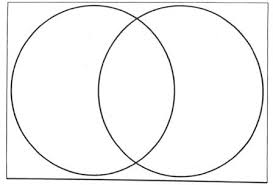
Venn

Venn Diagram-Perfect circles can be problematic

Consider next, the popular Venn Diagram used for compare and contrast exercises. Of all the organizers, this is one that may require students to have little practice to get perfect, however, is the symmetry of shape what teachers want students to notice about the Venn Diagram? That there are two perfect circles overlapping with a shared oval in the center? The problem with two perfect circles of equal size and shape is the implication that when an object or topic is compared and contrasted, the information is also equitable. On a prepared Venn Diagram, there is exactly the same amount of space on each side for the purpose of contrast, but there is a smaller, cramped center for comparable attributes. Perhaps a student can practice some freehand circle creation, find out how to use a protractor, or use some object -a water bottle? cup? paper plate?-to trace a circle. What students should not fret about is how to draw two perfect circles, because the Venn Diagram functions as an organizer even with lopsided ellipses.
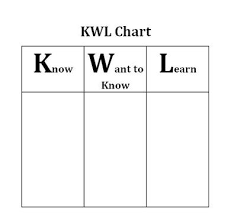
KWL imageThen, there is the popular K-W-L chart, where students list what they know, what they want to know, and what they learned. This graphic organizer is much like the T-Chart, and even the youngest student can draw vertical two lines on a page. Folding a paper into thirds is also an effective way to achieve a K-W-L organizer without have to wait for the teacher in front of you to finish copying next month’s math worksheets. Having students write the headings for this chart can reinforce the purpose of the organizer as well.
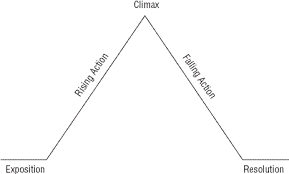
plot mountain

Plot Mountain diagram

Next, the “plot mountain” diagram is a staple in English Language Arts classrooms, but as a universal tool in deconstructing literature, the organizer has its flaws, so much so that the replication could make its use damaging. Some plots have long expositions (Return of the Native by Thomas Hardy comes to mind); some have short expositions (Shakespeare’s Romeo and Juliet‘s opening sonnet). One of arguably several climaxes for Harper Lee’s To Kill a Mockingbird is the courtroom scene which is followed by a long falling action (four  chapters)  before Bob Ewell’s climatic attack on Scout. There is no falling action in The Tell-Tale Heart by Poe which ends at the climax. These few examples demonstrate that each story has its own construction, its own mountain; plot is not a one size fits all, as this organizer would seem to claim. For this reason, teachers should allow students to sketch their own version of a story’s plot mountain, featuring all the little crags and mini-climax moments in rising and in falling.  Teachers should save the plot mountain as a flexible concept, one that is not enhanced by standardized reproduction.

foursquare imageFinally, there is the “four-square” organizer, used to provide attributes  on a topic that is printed in the center. The object is to think of details that fit specific categories or boxes in each of the paper’s four quadrants. Think of a big cross in the center of the paper, or a paper folded in half vertically, and then folded again horizontally. This organizer is often used in word study, as in the Frayer model, with a word in the center and each box used for a specific purpose: an illustration, an example, a definition,or an antonyms are all possible categories for this organizer.
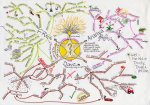
Guru_Mindmap

Guru Mind Map on Wikipedia

Using the copier to create these organizers not only is expensive in toner ink and valuable teacher time (spent trying to get that last crinkled bit of paper out of the feed drawer!), but these organizers limit critical thinking for some students.

Students should be given the opportunity to organize their ideas the way that best helps them understand a concept. They should be cognitively and kinesthetically active in creating and completing an organizer of their own design

Mind maps, for example, are original creations that are centered on a concept that is drawn or written on the center of a blank landscape or page. From this central concept or word, an individual can branch out on the page by adding using words or pictures that show other connections. No two mind maps are the same, and their use in improving student understanding is well documented. My favorite mind-mapping website is Daniel Weinstein’s The Creativity Core with variations on mind-mapping activities for his students.

So, teachers, step away from the overheated copying machine, and get out blank paper and markers. Let the students fold their paper to make graphic organizers,  trace shapes, or choose other patterns to list information.  Bring out the rolls of butcher block paper and let students try and map out their ideas. Let them pencil their thoughts in wobbly circles and uneven lines, because the use of the graphic organizer is not about the shape for the information, but the information that is organized in the shape.

And leave that copier for the more important duties….those field trip permission slips!

I just completed attending the ICT Language Learning Conference for Learning Language where ICT stands for “information communication technologies,” a term that encompasses both methods and technology resources. Here in the United States, the most appropriate synonym would be what we refer to as”IT” or information technology. (So, if you are in the US and see “ICT”, please read “IT”)

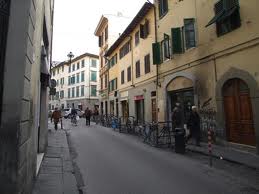
Florence side 3

The winding streets of Florence, Italy

This international conference was held in Florence, Italy, a city of amazing architecture, museums crammed with magnificent art, winding streets and incredibly narrow sidewalks. Finding the right path through the city maze was challenging.

While I was at the conference, I had an opportunity to compare my understanding of the education systems in the United States with several educational systems in other 54 countries. I was fortunate to share a presentation created with fellow educator Amy Nocton, a world language teacher at RHAM High School in Hebron, Connecticut. Our session (Blogging to Share, Exchange, and Collaborate)  highlighted how we use blogging in our instruction in grades 6-12.

Because of my own interests, I attended sessions that featured integrating technology in instruction. After a dozen sessions, I came to three important takeaways:

1. Students at every grade level are more motivated when content is integrated with ICTs;

2. Measuring the effectiveness of ICTs poses a challenge for all stakeholders;

3. Educators have limitations in integrating ICTs.

The issues in these three takeaways are the same issues that I see in the education systems in the United States. We educators know that the students enjoy using technology as a learning tool, but we are not sure which of these tools are the most effective in meeting the needs of students while delivering instruction. The concern of educators worldwide in accessing or “grading” students when they use ICTs is a major roadblock, a concern aggravated by individual comfort levels for educators using ICT. An individual educator’s aggravation may increase exponentially  against a rapidly changing technology landscape where platforms and devices change but educational systems and their filters and limitations appear to crawl towards the end of the 20th Century.

In short, we educators are never going to learn all this stuff.

I suppose it is comforting to see the same problems that American educators experience are playing out on a global scale. At the least, we are not alone.

On the other hand, it is frustrating to see that there are educators from other countries perseverating on the same problems. Everyone seems to recognize the excitement generated when ICTs are used in class, but there are choruses (and in many different languages at this conference), of “We still do not have access!” or “Are these ICTs really working?” or even “Many teachers do not know how to use the ICTs!”

Florence 4

When on this narrow path….

After several presentations, I also grew concerned that ICTs perceived as limited to assessment measurement.  A few presenters offered their research with highly scripted programs where students could be “interactive” by answering predictably scripted responses. While these scripted programs are a step more engaging than a curriculum prescribed textbook, they are only a small digital step above the pencil and (scantron) form type of response. Such controlled platforms are on the same path as the testing programs (SBAC, PARCC) being developed back in the United States to address the need, or the mandates, in measuring student understanding. Even at this conference, the message about the ability of ICTs to assess and grade may be drowning out the more creative possibilities that ICTs offer.

In contrast, I did hear a reference to student choice where a presenter, Feyza Nur Ekizer of Giza University, offered her students a chance to develop “knowledge envelopes” or portfolios to gather as much information on a topic so they would be prepared to answer with a written response on that topic. She gave her students choice in what they found on a broad topic (ex: love), and reported (not surprisingly) that the students wrote longer and more detailed responses than they ever had before in a response weeks later. Her use of technology was minimal, but the students had control over their paths of inquiry in gathering information for their “knowledge envelopes.”

Florence side 2

…or on this narrow path…

At this time in digital history, there are many platforms available for student to choose how and what to gather for information in authentic inquiry research.The presenters at this conference had done a great deal of work, and they shared their learning on the platforms they had chosen for their own inquiry. We were, as are our students, the passive recipients of information; we were on each presenter’s narrowed path.

Worldwide, our students (K-12) are far more comfortable working across platforms in gathering information (from websites, social media, blogs, and other visual/audio media) than their educators. Why would we want them to step backwards and use only what we require to prove their understanding? We should not limit the use of ICTs to assessment delivery systems when students can use ICT to create their own multi-media texts individually and collaboratively if they are given the opportunity.

...there may be little choice.

…there may be little choice.

In addition, students (worldwide!) should not have to wait for educators to become experts with ICTs when platforms are growing exponentially. Instead of trying to master the expanding field of ICTs, educators must see how the expertise they already have in a content area should be used to guide students through choice.

The role of teacher should shift to guiding students in developing content and understanding. Teachers who are skilled in a discipline’s content can help students determine the accuracy, relevancy, and legitimacy of information in developing student inquiry on topics.

ICTs must not be the exclusive means of measuring understanding, instead ICTs should be included in how students develop their understanding of content.

For students, there are many different paths (or platforms) to choose in learning content and there are certainly more paths to come. ICT should not be used exclusively to restrict students to the narrow paths of measurement alone. Based on my discussions with other attendees, there may be other educators from the conference who recognize how much this ICT path of student choice and inquiry may be narrowing unless we act to change it.

The amazing city of Florence, Italy!

The amazing city of Florence, Italy!

Students will encounter challenges in choosing ways to use ICTs as I did walking the narrow pathways on city streets of Florence witnessing amazing and magnificent sites. Through student choice in ICTs coupled with teacher guidance, students will also gain the freedom to explore those amazing and magnificent topics that interest them.

Not sure how November became so loaded with conventions, but Thanksgiving holiday plans have taken a side seat to presentations. I am fortunate to have the opportunity to present at International Conference ICT for Language Learning in Florence, Italy, (11/9-14) and the Council on English Leadership (CEL) section (11/23-25) of the National Conference of English Teachers in Washington, D.C.

These opportunities to present nationally and internationally have come as a result of this blog and connections I have made with other educators who use social media to connect and to collaborate. So, it is not surprising that the first session I will be presenting in Florence with world languages teacher Amy Nocton is titled “Blogging to Share, Exchange and Collaborate”. I met Amy through her husband, Jason Courtmanche Director of Connecticut Writing Project at the University of Connecticut. She is a world language teacher (Spanish and Italian) at RHAM High School in Hebron, Connecticut, and she needed help setting up her classroom blog, Perdidos en sus pensamientos. Her success with this technology in offering students an opportunity to choose topics as part of  is best summed up by the sentiments of one of her students who began posting more than a year ago. Her student Annie Maclachlan noted:

Screenshot 2014-11-12 04.44.15

Presenting on 11/13/14 “Blogging to Share, Exchange, and Collaborate”; student quote from the  on the right

“Instead of writing to a rubric, I wrote what I wanted, how I wanted. I wrote about what interested me, because I firmly believed that whoever took the time to go on the blog would love hearing what I had to say. And this was a good feeling. It was a feeling of complete intellectual freedom, a feeling that I believe everyone should experience at least once.”

Like Amy’s student, my students also enjoyed the freedom to explore a topic and publish for a world audience. Sharing how our students can connect with readers from all over the globe at a conference with teachers from all over the globe has an internal reverberation. We have the chance to see how others are guiding students so we can better prepare them to share their ideas and understandings with local and global audiences.

This opportunity has also given me the chance to visit the city of Florence with its amazing architecture and even more wonderful art collections.  To say that my jaw has dropped on more than one occasion is an understatement.

After this cultural saturation, I return home only to head out to the National Conference of English Teachers Conference in D.C. There I will be presenting “It’s Not the Math in the Literacy Standards; It’s the Literacy in the Math Standards” at the Council for English Leadership section of the program. I will be presenting with my former colleague Stephanie Pixley, from Wamogo High School in Litchfield, Connecticut.

I have already written about the Common Core Mathematical Practice Standards (English/Language Arts Can Persevere with Math Practice Standard #1and Author’s Craft Revealed Through Mathematical Practice Standard #7 ) on this blog, and this presentation will feature many of the ideas I outlined in these posts.

Screenshot 2014-11-13 01.57.03The NCTE Conference is usually so jammed packed full of sessions that my heads spins. I do not think I will be afforded any museum time there as I want to see many of the sessions. I especially want to see sessions offered by other bloggers who I have met socially and virtually, including one offered by Fran McVeigh, Vicki Vinton, and Mary Lee Hahn“It’s Not Just for the Kids: Stories of What Can Happen When Teachers Embrace Curiosity, Openness, Creativity and Wonder in the Teaching of Reading.”

Needless to say, I have not thought about turkey, stuffing, or any other side dish, but I am confident after these next two weeks that I will have plenty of photos to share and things to talk about and add to the conversation at the holiday table.

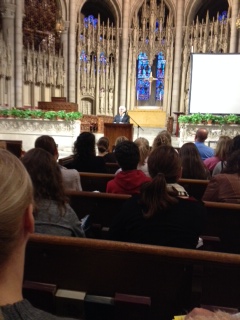
On the 87th Saturday Reunion at Teacher’s College, the author David Booth stood at the podium of NYC’s  Riverside Church admiring the mosaic of teacher faces staring back at him. It was 9:00 in the morning, and we numbered in the thousands.

David Booth“Look at you,” he softly intoned.
We quieted down.
“You look wonderful!” he continued.
We leaned in.
“I have a story to share,” his voice growing more audible as we settled in the echoing cathedral.
We leaned in closer, and his voice became clearer.
“I want to share a story that generated a thousand responses….the story of the Selkie.”

His Keynote Address was titled, “How One Story Can Generate One Thousand Responses” and on this Saturday morning, Booth was recounting to thousands of teachers how he had shared multiple versions of the Selkie with thousands of students in different countries from Kindergarten to grade 12.

Selkies are mythological creatures who live as seals in the sea, but who shed their skin to become human on land.  They are found in in Scottish, Irish folklore, and some Icelandic traditions.

Selkies can also be found in classrooms, according to Booth, who described the teacher who cheerfully greeted him in a “sealskin” of paper, replete with flippers.
“Imagine having her for a teacher,” he marveled, “just imagine,” and he paused allowing us to picture the kind of teacher who would greet an author in a seal suit fashioned after the picture book Selkie woman who shed her skin in order to love a fisherman.

The legend of the Selkie offered multiple versions that Booth could share with different grades over the course of a year:  a woman whose seal skin was held hostage by smitten fishermen, seal children adopted by lonely couples, or women cry seven tears into the sea for their seal men.

“When we read each humble folk tale,” he continued, “all of us, in the same room, reading the same event, we all had different responses.” He paused again, “We were making our own stories.”

Booth shared many of these different responses, beginning with the letters imagined by 1st grade Phoebe from the fisherman husband, James, to the wife, Emily.  “My darling, I love you. Take care of of our seal-son. I love, love, you.” Booth paused before asking, “How does a 7 year old know about such love?”

He told us of the 9th grader who sat, morose and silent, throughout a discussion about the meaning of the Selkie legend before finally contributing, “It’s about forbidden love.”

Booth shared the responses of students who had the chance to answer questions about the Selkie by posting their ideas on three wall charts labeled:

  • Our fierce wonderings…
  • Our answers to our fierce wondering answered and researched…
  • Further wonderings…

And he shared the a haiku penned by a middle schooler in a response to the legend of the Selkie:

“Never marry the
first naked lady you see;
she’ll swim away.”

“We share the need to be heard; the need to be a part need to be in the circle,” he said, and he paused long enough for us to consider how much we share in storytelling in our classrooms.

“Do you have enough courage to give the time to have the children grow and change?” he said, he paused again long enough for us to appreciate his modeling of “wait time” in teaching.

“It takes a lot of slow to grow,” he noted. “Have the faith to wait and not give them the answer.”

The paused for the last time before concluding, “Weave your blanket of words to cover your children. Hurray for story! Return to your children with word blankets.”

We stopped leaning.
We stopped being quiet.
Our thousands of hands clapped for the thousand responses  for David Booth and the Selkie legend.

“Ancora imparo. [I am still learning.]”

― Michelangelo, at age 87 in 1562

In the United States, students will spend 96 weeks or collectively about two years of their academic life in summer vacation days. Our 183 day (in Connecticut) school year became standardized not because of farming, but as a result of an industrial society that opted to let urban students out of the sweltering cities during the summer months.

Kenneth Gold, a professor of education at the College of Staten Island, debunked the myth of an agrarian school year in his book School’s In: The History of Summer Education in American Public Schools. He noted that if schools were following a true agrarian school year, students would be more available during the summer months while crops were growing but unavailable during planting (late spring) and harvesting (early fall).  His research demonstrated that before the standardized school year, there were concerns that too much school was bad for the health of students and teachers:

“There was a whole medical theory that [people would get sick] from too much schooling and teaching” (Gold)

Summer vacation was the solution to these medical concerns during the mid-19th Century. The result was a standardization of education has led to our present “summer leisure economy.” The 21st Century emphasis on  academic skills  necessary for success in life now contrasts with the mid-19th Century’s standards. There is a growing body of research on the adverse impact of summer vacation on learning.

A meta-analysis of 138 influences or “what works in education” was published (2009) in Influences And Effect Sizes Related To Student Achievement by John Hattie and Greg Yates. Their  results are posted on the Visible Learning website.  They ranked the effects of completed studies (international), and using data from these studies they demonstrated that an influence greater than .04 was a contribution to student achievement.

For their finding on summer vacation,  39 studies were used to rank the effect of summer vacation on student achievement. The findings using this data revealed summer vacation as having a negative effect ( -.09 effect) on education. They ranked summer vacation at the bottom of what works in education, a dismal 134 out of 138. Many researchers refer to the achievement damage done as the “summer slide.”

So what do some teachers do to counter this effect?

At the beginning of summer, students are sent home with work packets, reading lists, and other materials to counter the effects of what is commonly known as the “summer slide.” My school (grades 7-12) is no exception, and the objective for assigning this work is to provide students the practice in reading, writing, or math they need to maintain the skills they have developed during the school year.

The reality is that by mid-August, students and parents recognize they are in “crunch time,” and the summer work assigned as academic practice morphs into a contentious activity that looms large on the calendar. Parents remind/force/argue students to complete the work. Students may wait until the last possible moment to do schoolwork. Both parents and students see the work as an incursion into their summer break from school.

Meanwhile, on the teacher side, the knowledge that all those packets and reading responses will be submitted for assessment the first weeks back at school is daunting as well.

I believe I can safely say that no one-teachers, parents, students- likes summer work.

As an example, I recently received a note from a parent whose child is in enrolled in an honors level. This level is assigned more work to do, and she offered an impassioned plea that her children work hard to juggle their academics, athletics, jobs, etc. “They need a break,” she begged stating that they already can read and write well. “Why must we do this to students every summer?” she asked.

Must we? Do students who read and write well really need more practice? Do students need a break?

I wish I could make all stakeholders, including this one, happy by declaring that summer vacation should be an “academic-free zone”, but in my educator’s heart, I do not believe that students need a “break” especially when it comes to learning. I believe learning is ongoing, and those work packets and reading lists are designed at a minimum to keep students’ minds active. Granted, some of the assignments may be poorly designed, but they are based on a philosophy of maintaining skill sets.

While many students are fortunate to have the means to travel during summer vacation or indulge in firsthand experiences that benefit them academically, there are other students in their classes who do not. The work packets and summer reading equalize academic practice for all students during summer vacation.

Furthermore, learning individual responsibility to complete work assigned is another lesson at all grade levels. Students who choose other endeavors, namely athletics or jobs, must learn to be organized. In my experience as a teacher, the students who are the most successful are those who participate in multiple activities and learn to balance their academic responsibilities. How a student completes his or her summer work is also life lesson.

Consider again the 96 weeks that students have off for summer vacation during their academic career (K-12) because of a decision made in the mid-19th Century. Yes, I want students to have time to play and to travel and to relax, but why not have some assigned academic practice during their collective two years in the 21st Century that are afforded for summer vacation?learning never stops

I am happy to concede that the summer work packets and reading lists are a poor substitute for authentic learning, and I will continue to look for ways to encourage student minds throughout the entire year, not just from September to June. In considering the note from that parent, I am thinking that interdisciplinary summer work might prove successful in reducing the amount for students and in sharing the grading workload for teachers.

Summer vacation, however,  should not be an excuse to stop learning. The artist Michelangelo explained that he was “still learning” at the age of 87. Our job as educators is to encourage students to recognize they are always learning, year round. Whether there are work packets, reading lists, or other assignments, there is no summer break from learning.

A student’s mind should not be on vacation.

This morning I had to slow down in the children’s books section of the Friends of the Westport Library Summer Book Sale. I slowed to sort through the extensive offerings of books on tables in the big tent. I also slowed to keep an eye on three-year-old Pearl, my niece’s daughter, in the smaller tent. That slowing down resulted in a great payoff in picture books.

I shopped on the first day of the sale, Saturday, (7/19/14), prepared to haul away several bags of books for the classroom libraries. A check of the travel section did not disappoint. I quickly located seven copies of The Places in Between, a memoir by Rory Stewart who walked his way across Afghanistan in 2002. This memoir recounts how he survived:

 “…by his wits, his knowledge of Persian dialects and Muslim customs, and the kindness of strangers…Along the way Stewart met heroes and rogues, tribal elders and teenage soldiers, Taliban commanders and foreign-aid workers. He was also adopted by an unexpected companion-a retired fighting mastiff he named Babur in honor of Afghanistan’s first Mughal emperor, in whose footsteps the pair was following.”

This memoir is an assigned text for the Honors Grade 10 summer reading, a non-fiction selection to meet the World Literature focus. The seven copies would retail for $74.90; I got all of these copies for $13.00. There were other trade fiction paperbacks that I added: Little Bee; Cry, the Beloved Country; and The Things They Carried. There were also multiple copies of different episodes in the Bone series for students who enjoy graphic novels.

After shopping for the classroom libraries, the browsing through the children’s books tent felt like a bonus sale. Here was an opportunity to get books into Pearl’s hands, and the Westport donators did not disappoint. The tables were piled high, and the aisle wide enough for patrons with small children in tow.
The books were in excellent condition, so much so that my niece commented, “Look, these pop-up books can still pop-up!”
I located copies of books from the classic picture book canon, and we ended up with a small pile including:

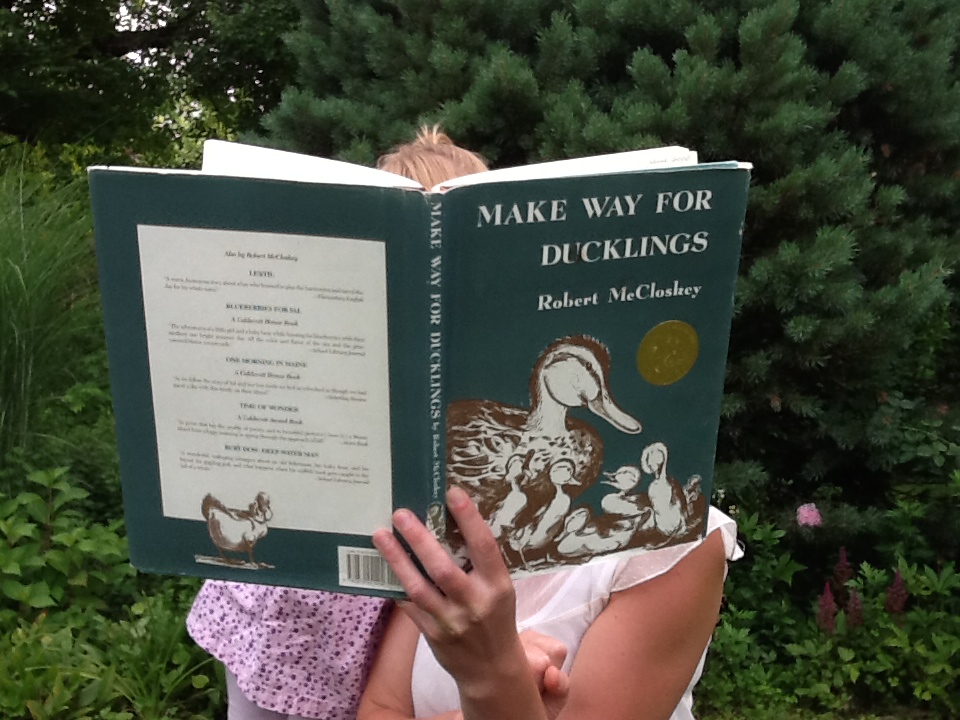
  • Make Way for Ducklings  by Robert McCloskey.
  • The True Story of the Three Little Pigs by Jon Scieszka and illustrated by Lane Smith.
  • Shrek by William Steig
  • Linnea at Monet’s Garden By Christina Bjork
  • Miss Rumphius  by Barbara Cooney
  • The Five Chinese Brothers by Claire Huchet Bishop and illustrated by Kurt Wiese.

We had to stop and read some of the books to Pearl to keep her engaged and were particularly grateful for the large areas roped off outside the children’s book tent. This space lets patrons check their selections before heading to the check-out tent. This space is critical for some of the patrons who stock up like I do with multiple bags and boxes.

Pearl and her mom enjoy "Make Way for Ducklings"

Pearl and her mom enjoy “Make Way for Ducklings”

In total, we spent an hour collecting books at the sale and fifteen minutes at the organized check-out tables. As they are every year, the volunteer who counted my five bags full was pleasant and well-trained. She was curious about where I taught, however.

“You are putting these into classrooms…where?” she asked.
I explained these were going to a middle/high school in Northwest Connecticut.
“Oh, I don’t know that area well…I guess I lean more to the New York area,” she offered.
“When possible, so do I,” was my response.

Totals spent? $96.00 for the classrooms, and $13.00 for Pearl who left the sale toting her “summer reading” picture books. From emerging to life-long readers, the Westport Book Sale offers a chance to stock up on picture books and memoirs and all the other genres in-between.

Teachers are looking to include informational text in their English Language Arts classrooms, but what about informational space?

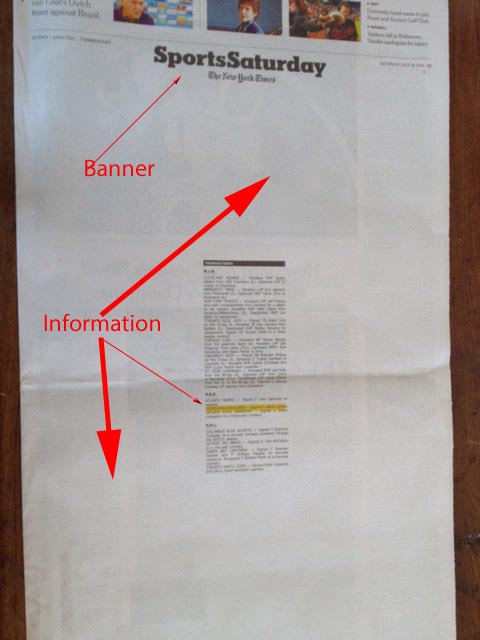
The hard copy of the NYTimes Saturday Sports section on Saturday, July 12, 2014, was an opportunity to teach how space can be information.

full page_edited-2-1

My photo; photo also featured in Deadspin blog

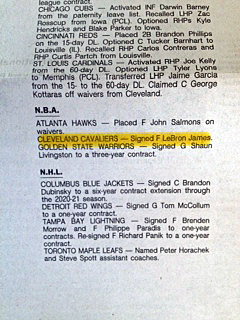
The photo above shows the front page of Sports Saturday. Students can note the banner is in the same location, floating at the top of the page with teaser photos for the content inside. Under the banner and centered on the page is  a feature that is usually on the inside of the sports section, a column of player trades and transactions in the different sports leagues for the day. The column is actual size, straddling the paper’s fold and surrounded by white space. Below the fold, one transaction in the column is highlighted in bright yellow. The rest of the page is blank.LeBraun trade(22)


Why the single highlighted line? What was the reason for all the white space? 

The Cleveland Cavaliers signed LeBron James.
Yes, during the same week when the semi-finals and finals for the 2014 World Cup riveted millions, the only news that mattered to sports fans was a short declarative sentence, “Cleveland Cavaliers signed F James LeBron.”

That was the purpose of the white space….to provide emphasis.

The other transactions listed from Major League Baseball, National Basketball Association, and the National Hockey League, however significant in the future, were not as significant at this moment.

That was the purpose of the yellow highlighted line, “Cleveland Cavaliers signed F James LeBron.”

In determining an author’s purpose, which in this case was the layout editor’s purpose, the Common Core State Standards (CCSS) offers a methodology to have student review the craft and structure of a text. Teachers use these these standards to frame questions about the text:

English Language Arts Craft and Structure Anchor Standards

CCSS.ELA-LITERACY.CCRA.R.4
Interpret words and phrases as they are used in a text, including determining technical, connotative, and figurative meanings, and analyze how specific word choices shape meaning or tone.
CCSS.ELA-LITERACY.CCRA.R.5
Analyze the structure of texts, including how specific sentences, paragraphs, and larger portions of the text (e.g., a section, chapter, scene, or stanza) relate to each other and the whole.
CCSS.ELA-LITERACY.CCRA.R.6
Assess how point of view or purpose shapes the content and style of a text.

The front page of this Sports Saturday provides multiple opportunities to discuss the difference between denotation (what is on the page) and connotation (what is implied). In helping students to consider the craft and structure of this particular layout, a teacher could use questions based on Webb’s Depth of Knowledge (DOK) that might be:

• How would you summarize what you read in the written text? (denotation)
• How would you summarize what you see in the white space in contrast to the written text? (denotation)
• What do you notice about where the highlighted information is placed? (denotation)
• What conclusions can you draw about the layout editor’s choice to highlight only one player transaction? (connotation)
• What is your interpretation of the use of the white space ? (connotation)
• Can you formulate a theory for the layout ? (connotation)
• Can you elaborate on a reason the editor used the small font in the player transaction column for this news? (connotation)

Of course, the story of the LeBron signing was also inside the Saturday Sports section. Michael Powell wrote the feature article  Star Reconnects With a Special Place in His Heart where the news of LeBron’s return was celebrated:

“The man knows his region, and his audience, and his life. Even as the news broke on television, you could hear out your window Cleveland residents loosening more or less random whoops. Car horns beeped. Strangers exchanged bro-hugs and palm slaps” (Powell-NYTimes)

Students could read Powell’s article to extend their thinking about the impact of this one player’s return to a team he left several years ago. Then, there is LeBron’s own essay, co-authored by Lee Jenkins, in Sports Illustrated. In this essay, LeBron explains the reasons for his return:

“But this is not about the roster or the organization. I feel my calling here goes above basketball. I have a responsibility to lead, in more ways than one, and I take that very seriously. My presence can make a difference in Miami, but I think it can mean more where I’m from. I want kids in Northeast Ohio, like the hundreds of Akron third-graders I sponsor through my foundation, to realize that there’s no better place to grow up. Maybe some of them will come home after college and start a family or open a business. That would make me smile. Our community, which has struggled so much, needs all the talent it can get”  (LeBron/Jenkins Sports Illustrated).

In this essay, LeBron anticipates (and connotes) the level of commitment that will be necessary for continued success:

In Northeast Ohio, nothing is given. Everything is earned. You work for what you have” (LeBron/Jenkins Sports Illustrated).

These other two informational texts could also provide opportunities to have students practice denotation and connotation:

  • How would you summarize what you read in these written texts? (denotation)
  • What conclusion can be drawn after reading these three texts? (connotation)
  • What is your interpretation after reading these texts? Support your rationale. (denotation/connotation)

A final exercise? Have students research the cost of a full page spread in the NYTimes ($70,000 non-profit; up to $200,000 for profit). Have students discuss or make arguments on the use of white space in this layout once they know the expense of the layout editor’s choice.

The best part of these exercises is that the reader does not need to know basketball to appreciate how this information is communicated: through layout, through a feature story, and through a personal essay.  I do not follow basketball, and I am only peripherally aware of LeBron’s role in the NBA. I was intrigued, however, about the use of white space to convey information. I also considered the different size of spaces related to the text. The size of a basketball court in the NBA is  94′ by 50′ or 4700 square feet. In another measurement, LeBron has a rumored vertical leap the size of 40 inches or so (the average NBA player can jump 28 inches). Finally, the size of the NYTimes page  is 24″ x 36″ or 864 square inches.

In each case, size matters. In this context, space matters as well.

Throwbacks in education are common.

This time, Robert Pondiscio, a Senior Fellow and Vice President for External Affairs at the Thomas B. Fordham Institution is itching for a fight to reopen old “reading war” wounds. He has taken umbrage with the NYTimes (7/2/14) opinion piece Balanced Literacy Is One Effective Approach by Lucy Calkins: Director of the Teachers College Reading and Writing Project at Columbia University and a proponent of balanced literacy.

Pondiscio’s op-ed (7/3/2014) titled, Why Johnny Won’t Learn to Read charges back into the heat of that fight as he referenced the 1997 National Reading Panel’s review of studies on the teaching of reading.

In reminding everyone that “phonics won,” Pondiscio jettisons the definition of the word “balanced” in the phrase balanced literacy. The Oxford Online Dictionary states that when “balanced” is used as an adjective, it is defined as:

  • Keeping or showing a balance; in good proportions:
  • Taking everything into account; fairly judged or presented:
  • having different elements in the correct proportion

Screenshot 2014-07-06 17.07.23Since 1997, the term “balanced literacy” has come to mean that the parts of the phonics approach should be in good proportions with other approaches for teaching reading and writing. Pondiscio however, recasts the phrase “balanced literacy” in mythological terms, as a hydra…“a new head for whole language.” His interpretation is unsupported by definition.

Pondiscio’s wish that the “win” by phonics would eradicate whole language’s contributions to teaching literacy is overstated as some of the recommendations by the NRP could be associated with whole language:

  • Teaching vocabulary words—teaching new words, either as they appear in text, or by introducing new words separately. This type of instruction also aids reading ability.
  • Reading comprehension strategies—techniques for helping individuals to understand what they read. Such techniques involve having students summarize what they’ve read, to gain a better understanding of the material.

Beyond his use of the NRP’s 17 year-old-study, there is another problem in his choice of evidence, a quote by Susan Pimentel, one of the “principal authors of the Common Core.” Pimentel lacks the academic credentials to qualify her as an expert in literacy  (BS Early Childhood; Law Degree) in her claims that balanced literacy is “worrisome and runs counter to the letter and spirit of Common Core.” In contrast, many early literacy educators find the ELA CCSS worrisome, running counter to the spirit of new and emerging readers.

Moreover, Pimentel’s on again/off again association with the other CCSS “architects” (David Coleman and Jason Zimba) from Student Achievement Partners (SAP) was laid bare by Mercedes Schneider in a February 27, 2014, post: Schneider Dissects Sue Pimentel’s Role in Common Core Drafting; Exposes How 3 People Were Main CCSS Architects. In a blog post, Schneider documents Pimentel’s role through SAP’s tax filings and marginalizes Pimentel’s contributions with a suggestion that her inclusion on the CCSS was gender-based, “a female speaking to an audience from a profession that is primarily female, and that is good public relations for selling the CCSS product.”

Further on in Pondiscio’s op-ed, there is a reference to a NY Department of Education study on the Core Knowledge Study (2008-2012) which demonstrated, “significantly stronger gains than comparison school students on nearly all measures was for 1000 students in grades K-2 in 20 schools.” The use of this study is no surprise. Pondiscio’s promotion of this Core Knowledge program is due to the leadership of E.D. Hirsch, Jr., a Fordham Medal of Valor winner. What is missing is information on the size of the study, which involved less than 1% of K-2 student population (1.1 million total student enrollment in 2013), and its methodology in comparison to other literacy programs. Hirsch himself concurs that, “The study was too small. We need a bigger one – and one that gauges long-term as well as short-term effects.”

But what is Pondiscio most damning complaint against balanced literacy?

 “While the Common Core focuses kids’ attention on what the text says, balanced literacy often elicits a personal response to literature.” (Pondiscio)

Let me repeat his concern.

Pondiscio is distressed that a student may respond emotionally to a work of literature.

How is this a problem?

I quite am certain that a personal response in a reader is exactly what any author of literature hopes to achieve.

Reading literature is more than a decoding exercise. Reading literature at any age, especially good complex  literature, is an exercise that connects the reader and the author in an intimate bond of empathy.

Balanced literacy does require a student use evidence from a text, but the advantage to balanced literacy is that it recognizes that students cannot be silenced on what they think or feel about their reading, whether the choice of texts is theirs or not.

Pondiscio’s issue with whole language is that it emphasized reading for meaning instead of spelling, grammar, and sounding words out. In making this final part of his argument, Pondiscio reduces words to data or things devoid of meaning.

Such thinking reminds me of a line from Al Pacino’s Looking for Richard, a film study on William Shakespeare’s Richard III.

While filming on the streets of  NYC, Pacino is seen asking passers-by what is their relationship to Shakespeare. One pan handler stops long enough to explain how he feels the words in Shakespeare “instruct us”:

If we think words are things  and have no feelings in words…then we say things to each other that mean nothing.

But if we felt what we said,  we’d say less and mean more.

The pan-handler shuffles off after offering his personal explanation on words and meaning.

Pondiscio claims he wants “students to grapple with challenging texts that are worth reading,” but grappling with what the pan-handler says about the meaning of words in those texts, challenging or not,  is even more important.

I teach students how to write. I do not make them writers.

There is a difference.

I have taught the writing process for over twenty years. I have taught students at different grade levels how to write for a specific audience in a specific format for a particular purpose. For example:

  • Write a letter to your principal asking for an extra 15 minutes of recess. (persuasive letter)
  • Research Shakespeare’s use of biblical imagery in Hamlet. (literary analysis)
  • Imagine you are a citizen of the ancient city state of Sparta. What would a typical day be like? (narrative)writing

I know how to teach students to incorporate evidence in their writing. I have lessons on how to find the best evidence, and I have lessons on how to use a “stem sentence” to incorporate their evidence. I have lessons on how students should cite their evidence.

I can teach students how to use order in establishing a position in an argument, how to expand their ideas in analysis, and how to use sequence in telling a story.

I can teach students how to use a “formula” approach if they get stuck by having them:

  • Start with a question, a quote, a definition, or example;
  • Write a thesis with three points and then develop each of these points into paragraphs;
  • Restate their best idea in the conclusion.

I teach the writing process: draft, edit, review, revise, (repeat), polish, and publish.

After all these lessons, I am confident that my students can write better.

I am not sure they are writers.

This past week, I went to hear the writer Dani Shapiro (Still Writing, Devotion: A Memoir) talk about her creative process as a writer. I thought I might hear some new ideas or inspiration that could help me teach my students to become writers.

Ms. Shapiro was composed as she ruined any notion that I could offer my students more than I already did in class. She was gracious as she crushed my hopes for easy solutions. I scrambled taking notes, but fortunately, what she said that night is posted on her blog:

Are there steps that lead the writer to the page? Steps that we can take, teetering one after the next, that will somehow get us into that longed-for state of the page rising up, the world receding?

I’m sorry to say that after all my musing I was unable to come up with a game plan, for myself or anyone else. Honestly, I never really thought I would, because every writer’s path to the page is unique and fraught in its own special way.

As she spoke, the issues I had with Michael, a student I had in class this year, came to mind.

All year, Michael was compelled to write, but not the writing I required. He would hang around after class asking me to “quick read” a story.  (Note: they were very dark short stories). After an assignment, he would ask me what was my favorite part of an essay he had handed in. Before I could speak, he would read aloud his favorite line from that essay.

He took umbrage when I made a critical comment. He could not write on demand. He dawdled with all sorts of technology while others scratched out a timed essay. He hated turning in his incomplete work complaining “I didn’t get to say what I wanted” or “I just couldn’t get started.”

After class, I would correct the essays. Michael’s papers could begin like any other student’s paper. Pronoun antecedent issues. Capitalization problems. Missing apostrophes. I would write the usual blunt comments,”Get to the point!” in the margins. But I learned to look for that sentence, usually somewhere about 2/3 through his essay, for that sentence….and I would have to stop.

Everything Michael wrote before that sentence in an essay was in need of revision, but everything after that sentence in the essay was different, shaded…altered. He could write something that silenced the teacher voice in my head.

“I knew that was good,” he would say looking for my approval.
“Yes,” I would agree, “that was very good. I have no suggestions.”
That would please him, until the next writing assignment he would be forced to write.

As Shapiro states, there are no prescribed steps I can devise to “lead the writer to the page.” She could not help me develop a game plan to get my students “into that longed-for state of the page rising up, the world receding,” just as there was no game plan that made Michael a writer. I know he is on a unique path, and I know I did not teach him this path.

His path illustrates the difference, a difference I recognize between my teaching writing and my teaching a writer.

Since I write to understand what I think, I have decided to focus this particular post on the different categories of assessments. My thinking has been motivated by helping teachers with ongoing education reforms that have increased demands to measure student performance in the classroom. I recently organized a survey asking teachers about a variety of assessments: formative, interim, and summative. In determining which is which, I have witnessed their assessment separation anxieties.

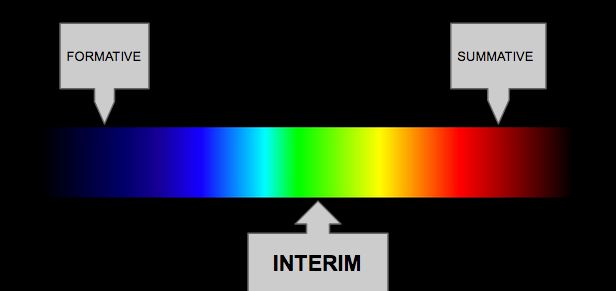
Therefore, I am using this “spectrum of assessment” graphic to help explain:

Screenshot 2014-06-20 14.58.50

The “bands” between formative and interim assessments and the “bands” between interim and summative blur in measuring student progress.

At one end of the grading spectrum (right) lie the high stakes summative assessments that given at the conclusion of a unit, quarter or semester. In a survey given to teachers in my school this past spring,100 % of teachers understood these assessments to be the final measure of student progress, and the list of examples was much more uniform:

  • a comprehensive test
  • a final project
  • a paper
  • a recital/performance

At the other end, lie the low-stakes formative assessments (left) that provide feedback to the teacher to inform instruction. Formative assessments are timely, allowing teachers to modify lessons as they teach. Formative assessments may not be graded, but if they are, they do not contribute many points towards a student’s GPA.

In our survey, 60 % of teachers generally understood formative assessments to be those small assessments or “checks for understanding” that let them move on through a lesson or unit. In developing a list of examples, teachers suggested a wide range of examples of formative assessments they used in their daily practice in multiple disciplines including:

  • draw a concept map
  • determining prior knowledge (K-W-L)
  • pre-test
  • student proposal of project or paper for early feedback
  • homework
  • entrance/exit slips
  • discussion/group work peer ratings
  • behavior rating with rubric
  • task completion
  • notebook checks
  • tweet a response
  • comment on a blog

But there was anxiety in trying to disaggregate the variety of formative assessments from other assessments in the multiple colored band in the middle of the grading spectrum, the area given to interim assessments. This school year, the term interim assessments is new, and its introduction has caused the most confusion with members of my faculty. In the survey, teachers were first provided a definition:

An interim assessment is a form of assessment that educators use to (1) evaluate where students are in their learning progress and (2) determine whether they are on track to performing well on future assessments, such as standardized tests or end-of-course exams. (Ed Glossary)

Yet, one teacher responding to this definition on the survey noted, “sounds an awful lot like formative.” Others added small comments in response to the question, “Interim assessments do what?”

  • Interim assessments occur at key points during the marking period.
  • Interim assessment measure when a teacher moves to the next step in the learning sequence
  • interim assessments are worth less than a summative assessment.
  • Interim assessments are given after a major concept or skill has been taught and practiced.

Many teachers also noted how interim assessments should be used to measure student progress on standards such as those in the Common Core State Standards (CCSS) or standardized tests. Since our State of Connecticut is a member of the Smarter Balanced Assessment Consortium (SBAC), nearly all teachers placed practice for this assessment clearly in the interim band.

But finding a list of generic or even discipline specific examples of other interim assessments has proved more elusive. Furthermore, many teachers questioned how many interim assessments were necessary to measure student understanding? While there are multiple formative assessments contrasted with a minimal number of summative assessments, there is little guidance on the frequency of interim assessments.  So there was no surprise when 25% of our faculty still was confused in developing the following list of examples of interim assessments:

  • content or skill based quizzes
  • mid-tests or partial tests
  • SBAC practice assessments
  • Common or benchmark assessments for the CCSS

Most teachers believed that the examples blurred on the spectrum of assessment, from formative to interim and from interim to summative. A summative assessment that went horribly wrong could be repurposed as an interim assessment or a formative assessment that was particularly successful could move up to be an interim assessment. We agreed that the outcome or the results was what determined how the assessment could be used.

Part of teacher consternation was the result of assigning category weights for each assessment so that there would be a common grading procedure using common language for all stakeholders: students, teachers, administrators, and parents. Ultimately the recommendation was to set category weights to 30% summative, 10% formative, and 60% interim in the Powerschool grade book for next year.

In organizing the discussion, and this post, I did come across several explanations on the rational or “why” for separating out interim assessments. Educator Rick DuFour emphasized how the interim assessment responds to the question, “What will we do when some of them [students] don’t learn it [content]?” He argues that the data gained from interim assessments can help a teacher prevent failure in a summative assessment given later.Screenshot 2014-06-20 16.50.15

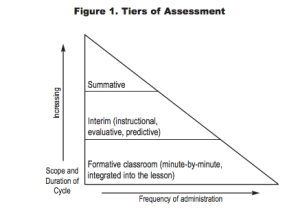
Another helpful explanation came from a 2007 study titled “The Role of Interim Assessments in a Comprehensive Assessment System,” by the National Center for the Improvement of Educational Assessment and the Aspen Institute. This study suggested that three reasons to use interim assessments were: for instruction, for evaluation, and for prediction. They did not use a color spectrum as a graphic, but chose instead a right triangle to indicate the frequency of the interim assessment for instructing, evaluating and predicting student understanding.

I also predict that our teachers will become more comfortable with separating out the interim assessments as a means to measure student progress once they see them as part of a large continuum that can, on occasion,  be a little fuzzy. Like the bands on a color spectrum, the separation of assessments may blur, but they are all necessary to give the complete (and colorful) picture of student progress.