Educational reform is on the minds of many business leaders and several have weighed in with their concerns:

“We know we are facing a transition, and we must take this opportunity to provide today’s students with the tools and the thinking that is required for the future” ( John Chambers, Cisco Systems).

“….our high schools – even when they’re working exactly as designed – cannot teach our kids what they need to know today,” (Bill Gates, Microsoft).

“The fact is, too many graduating seniors are unprepared for what will be required to succeed in college or in the workplace,” (William G. Jurgensen, CEO, Nationwide)

These business leaders have every right to express their interest in improving education for the nation. After all, their businesses will require an educated work force. However, too often business leaders speak about educational reform using a business model that is radically different from the public education model.

Funding-Private equity vs. Tax Dollar

A business is funded by an individual or a group of investors, and additional revenue for a business can be added through profits, loans, or the selling of additional shares. In contrast, public school education is funded by taxpayers at the local, state, and federal level; ultimately, politicians control the purse strings for school districts. This manner of funding can be grossly inequitable: On the blog CT news.com, in 2011, Ansonia, Connecticut, spent $10,520 per student while the nearby district Region 9 (Easton/Redding) spent $18,426 per student that same year. Funding can often be capricious as tax revenues depend on the general economy and political agendas; funding can change annually with revenue that cannot be transfered year to year or invested. There are always political promises to reduce taxes despite rising operating and capital costs in educating our nation’s youth to develop 21st Century skills for our future workforce.

Business Loss-Cutting Poor Performers?

Another problem with using the business model for education is the business loss. A clear definition of a business loss is on Investopedia.com:

A business practice that seeks to detect, identify, investigate and prevent events that cause a drop in value of any of an organization’s revenues, assets and services. Loss-management improvements may involve changes in a business’s operating policies and business model in order to limit instances of accidental and/or intentional loss.

A business with a business loss must be flexible. A business may change operating policies (hours, locations, retail policies, purchasing policies, etc).  In contrast, a public school system that deals with a loss in funding or facilities or student enrollment cannot change hours, locations, or policy arbitrarily or with the speed that business has to react to changes in the market.  Furthermore, a business is free to drop a product line or drop poor performing employees. In contrast, schools cannot drop specific programs (core subjects of math, language arts, science, social studies) or poor performing students. Dropping poor performing students would certainly help test score results but that is not the purpose of public education. In this nation we  educate every student.

Competition-Winners vs. Losers

Business is built on competition and products and services go head to head for the public’s dollar. Economists believe that the market will crowd out inferior products and services using this competitive model. However, employing this model of competition in education would result in a tiered system of inequity. Education reform efforts to introduce competition have included choice through charter schools, but the results of these competitive efforts have not been any more successful than the efforts expended by the public schools. In the inital pilot study (2003) The National Assessment of Educational Progress (NAEP), considered  population differences and reported that “the mathematics performance of White, Black, and Hispanic fourth-graders in charter schools was not measurably different from the performance of fourth-graders with similar racial/ethnic backgrounds in other public schools.” The study also reported that, “In reading, there was no measurable difference in performance between charter school students in the fourth grade and their public school counterparts as a whole.” What this means is that competition with other schools is not a factor in school success. Furthermore, the students cannot be part of a competitive market with winners and losers if the goal is to educate every student. Every student must be a winner.

The Single Metric Test

A business with a single product is limited, so many businesses diversify.  Businesses measure success on products or services with monthly, quarterly, and annually produced data through a variety of measurements. Education in contrast is being forced to measure student achievement through standardized tests. Each standardized test “snapshot” is taken one day during a school year, and the results establish a school as being a success or failure. Reform efforts fron No Child Left Behind and Race to the Top exploit this one test metric. Judging a school with this system of measurement is like measuring retail business’s success by one day of sales. Many states are using these single metric tests for teacher evaluations. Would a company’s CEO be judged by one day’s stock price or a salesman by one day of sales? Additionally, the calls listed above ask for “tools and the thinking” that our business leaders want for their future workforce; an increased focus on single metric tests is not a solution for 21st Century skill development and critical problem solving.

Business leaders should have a great deal to say about education since they will be hiring the product of the nation’s education system. But the tenets of business do not match the tenets of education, and business policy does not always have a comparative counterpart in education. Public education is a very specialized institution and the reform of education must come from those who have both the training and classroom experience, beyond the just “being in the classroom” experience of many successful business leaders.

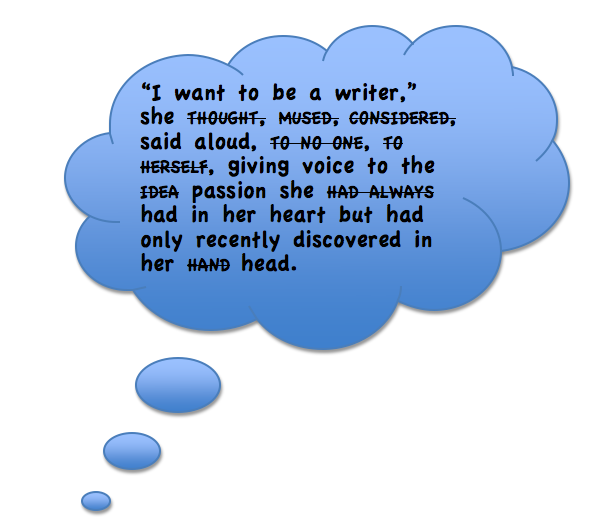
One of my favorite cartoons features a young woman, obviously nervous, seated next to a white-suited, white-haired caricature of Samuel Clemens. Above her head floats a thought bubble,“‘I want to be a writer,’ she thought, mused, considered, said aloud, to no one, to herself, giving voice to the idea passion she had always had in her heart but had only recently discovered in her hand head.”

I also always wanted to be a writer, but the responsibility of writing stopped me. Writing was a task that I took very seriously. I had to write papers for courses I took. I had to write letters-personal and professional- and I had to write memos for work. Writing was a product that needed to be perfect. As a result, my writing duties had stifled my writing passion.

However, sixteen months ago I started this blog to share the ways I had increased the number of books in school classrooms. During the first month of entries, I wondered if I would have enough materials to write about on a blog about used books in class.

I am almost embarrassed to admit that what I have discovered is that writing is less product and more thinking. Sadly, I was an English teacher who required writing and encouraged students to write regularly in class, but who did not cognitively understand that writing is really a recording of thinking. I was always interested developing (and assigning) the prompt and collecting (and correcting) the final product. I did not fully understand the necessity of thinking as the most critical part of the writing until I began to write myself.

Now, as a convert to writing as thinking, I am using this post to encourage others to write in order to think.

October 19-20th, 2012 will be the National Day of Writing. The National Writing Project (NWP) is encouraging people to contribute to “What I Write” on their website:

What do you write or compose? Blog posts? Poems? Videos? Grocery lists, computer code, or song lyrics? Whatever you write, on Friday, October 19, use the hashtag #whatiwrite to share your compositions with the world as part of this year’s National Day on Writing.

National Council of Teachers of English (NCTE) has  links on their blog for people to read what authors say about why they write. The NYTimes Learning Network also has a page on their blog asking, “Post what, you ask? Well, could be…

  • Thoughts about what you write, whether it’s poetry, short stories, school essays, computer code, love notes, song lyrics or Facebook updates.
  • A link to some writing you want to show others.
  • A photo or drawing that illustrates something about writing, or illustrates something you’ve written.
  • Thoughts about things you’d like to write someday.
  • Notes on your writing process.
  • Thoughts on the role of writing in your life in general.
  • Advice about writing.
  • Links to good pieces about writers or writing

So, on Friday, October 19th, I will have my students create lists of topics they want to “think” about, topics* they want to explore in writing over the course of the year. We will collaborate on a master list using a Google doc that we can revisit over the course of the school year. I want my students to learn how to write, but more importantly, I want my students to learn how to write so they can think. I want they to feel free to write without constant assessment. I want them to write and read what they write to understand what they think. Hopefully, in this process they will discover that writing is not an academic responsibility, and that good writing is really good thinking. And I will imagine  thought bubbles over their heads as they write.

Share the hashtag #whatIwrite.

*Topic list created 10/18/2012

“It’s the Minotaur vs. Fenris”, I announce as the pair is selected from a name randomizer on the BarryFunEnglish website.

 Students look at their playing cards.
“Agility?” I ask.
“Fenris…a 4,” one student responds.
“Minotaur…a 3,” another student adds.

“Round One to Fenris!” we agree.

This monster smackdown game is taking place in the Hero & Monster English IV elective class. There are 16 students in the class, several of whom who petitioned our department for a class on mythology, monsters, and heroes this year. The class was created in response to their petition. During the first week of school, they wrote the essential questions they will be studying

  • What is the difference between a hero or monster?
  • What criteria do we use to determine who or what is a hero?
  • What criteria do we use to determine who or what is a monster?
  • Created Monsters (serial killers) vs. Monsters created (Boogey man; Monsters, Inc.)
    • Is there a difference? Why or why not?

In order to quickly provide them with a pantheon of mythological monsters, I devised this monster smackdown game where each student was first assigned one mythological monster. The monsters on the list originated in different cultures: Norse, Algonquian, Greek, Roman, Persian.

  • Minotaur
  • Wendigo
  • Scylla
  • Fenris
  • Medusa
  • Kraken
  • Sphinx
  • Charybdis
  • Cyclops
  • Furies
  • Basilisks
  • Sirens
  • The Hydra
  • Cerberus
  • Leviathan
  • Jörmungandr
  • Chimera
  • Manticore

Each student had to research the monster and create a trading card. We used the template on the BigHugeLabs website. The student had to rate the monster on five qualities: agility, appearance, intelligence, strength, and a “special” or “hidden” talent on a scale of 1-5. One the cards were made, I printed them out on on card stock using a business card template (12 on a page). This was the most costly part of the exercise (time & ink). Before we played the smackdown, each student had one minute to “sell” the monster to the rest of the class, an advertisement for the proceeding game, and pass out that trading card to each classmate.

To play the monster smackdown, I placed each monster’s name into a randomizer. I used a virtual dice creator to call out the competitive quality being tested in the smackdown. What I did not tell the students was that they would be battling on a different location. These locations were also randomly selected and included:

  • nuclear power plant
  • frozen pond in a wilderness
  • aircraft carrier in the Indian Ocean
  • Wamogo High School’s senior parking lot
  • Drive-in movie theatre
  • Nevada Salt Flats
  • Mount Rushmore
  • Iceberg floating from the North Pole
  • Grand Canyon
  • Little Susie’s closet

Each monster had an opportunity to have his or her monster qualities tested against an adversary; students defended their individual monster’s abilities on different battlegrounds.

“Charybdis would so rule in the Grand Canyon,” yelled Jed, “He’s already a whirlpool!”
“But the Sirens would make him go mad with their singing,” Sam calmly replied, “he would swallow himself up.”
The class voted Sam’s as the better response.

There were contentious battles between Medusa and the Wendigo (malevolent cannibalistic spirit from Algonquian myths) and between the Scylla and the Kraken. My Sphinx was eliminated on round one (apparently being able to riddle is not all that great a monster power).

The winner of the monster smackdown was the Jormangandor, a “midgard” serpent that is so big he encircles the globe and holds onto his own tail.
“The world will end when he lets go of his tail!” proclaimed Eric.
“How can he fight then?” challenged Matt.
“I don’t know,” blustered Aaron, “but either way, he beats your Cerberus!”

The chief complaint about the game were from students who noted that some of their peers had not properly filled out their cards; spelling was not the only issue.
“This Medusa card is wrong. He has two ‘5’s rated -one for intelligence and one for appearance!” said Zach. He turned to confront the card-maker, “Look, if this game is going to work, you need to fill the card out properly.”
I said nothing; peer-to-peer correction is far more enduring than my suggestions.

There are a few changes I would make with regards to the scoring, but several of the students have offered to come up with a more complex system of rating and handicaps. I will also be investigating the Trading Card Creator on the Read,Write,Think website (NCTE) which allows for more detailed information on each subject; we still need to create our hero cards. Overall, the game received enthusiastic support, even from the principal who was found his way to the raucous activity that Friday morning. He left with a set of trading cards of his own.

We will be tackling “movie” monsters next. The list will include Dracula, the Balrog, Frankenstein’s Monster, Harry Potter’s Dementors, Godzilla, and King Kong. In keeping with that medium, students will make 30 second movie trailers using Animoto software. For that challenge, we will hold an Academy Awards of Movie Monsters.

The monster smackdown game provided students a quick review of monsters they encounter in literature, the allusions they need to comprehend complex texts. Already we have encountered the chimera in our reading of Frankenstein, “…because the powers of the latter were chimerical, while those of the former were real and practical, under such circumstances I should certainly have thrown Agrippa aside and have contented my imagination…” (ch 2).
“What does that mean?” I asked Steve, who had researched the Chimera.
“Changing and adding shapes to make something different? My monster changed shapes,” he replied hesitantly.
“Yes, to make something new and fantastic. Was your monster fantastic?”
“Of course,” he responded, “fantastic like me!”

These mythological monsters are the result of wildly imaginative stories from every culture; they are fanciful, fascinating, and fantastic…apparently, just like my seniors.

An interviewer can ask a question to get the answer he or she wants to hear. That may have been the case on September 2, 2012 when   CBS’s 60 Minutes  framed a question on educators and education. The interview featured Google chairman Eric Schmidt who was responding to questions about Sal Khan, founder of the Khan Academy. The educational enterprise Khan Academy began as a series of math video tutorials given by Khan for his nephew in 2004. Khan Academy expanded into its own YouTube channel to feature other disciplines including history, healthcare and medicine, finance, physics, chemistry, biology, astronomy, economics, cosmology, organic chemistry, American civics, art history, macroeconomics, microeconomics, and computer science. Schmidt was heaping praise on Sal Khan when he was asked, “He [Khan] was the guy to sort of make this happen? Why do you think it was him and not some person who was an educator, who had a background in this area?”

Schmidt’s response was incredibly disappointing:

“Innovation never comes from the established institutions. It’s always a graduate students or a crazy person or somebody with a great vision.”

With one sweeping over-generalization, Schmidt and the producers of 60 Minutes dismissed the efforts of our nation’s teachers as innovators inferring that outsiders, specifically outsiders from the business world, are better equipped to reform our education system.

Both Schmidt and the producers of 60 Minutes are wrong. Teachers are innovative.
Just look at the definition of “to innovate”:

1: to introduce as or as if new (as transitive verb)
2 (archaic) : to effect a change in
3: to make changes : do something in a new way

“To innovate” is conceptually connected to the verb “to teach”; teachers introduce content as new, effect a change in understanding, and encourage students to make changes in order to prepare for the future. Our nation’s public school system is an innovative effort; no other nation has so purposefully engaged in the enterprise of educating ALL children, regardless of ability or disability.

Apparently, Mr. Schmidt blanked on the relationship between his company and teachers who are familarizing students with Google’s mutiple applications. The Google Educator Academy is offered to teachers so they can better learn how to integrate Google products into classrooms. Of course, the Google Educator Academy also allows Google designers the opportunity to pick the brains of innovative educators as to what is needed in the classroom. For example, many teachers innovate with Google products in ways engineers did not anticipate. I doubt that when Google Maps programmers designed the software to provide directions on virtual maps that they anticipated teachers would use their program to create as virtual field trips to locations in literature. There are hundreds of these trips online including Jon Krakauer’s Into the Wild, Christopher Curtis’s The Watsons Go To Birmingham, or David Wiesner’s Flotsam. My own Grade 12 students have created their “journeys of life” dropping their pins and explanations on their own Google Maps. Everyday, teachers use the available technologies in ways the creators never imagined.

Teachers are not in the business of developing technologies. Developing technologies are in the purview of engineers, graduate students, or a Schmidt put it, some “crazy person”. Instead teachers innovate with creativity and flexibility everyday in the classroom to promote understanding for diverse learning styles. At any moment, a change in schedule (fire drill, student emergency) could require an immediate shift in plans, a demand for innovation. An elementary teacher needs to be prepared to walk into a classroom at any grade level armed with little else than a picture book and innovate a writing lesson for pen and paper or for an open software program. Subject area teachers need to be innovative in content areas: to deliver a memorable lesson on percentages with pizza (virtual or otherwise), or to implement a lesson on measuring area using nothing but paper clips (virtual or otherwise), or to create a lesson on character development using paper bag puppets or animation software. Before accepting the premise that teachers are not innovative, consider how you might engage 24 fifth graders right after a recess period. If you are not innovative, I can assure you that 45 minute period will be memorably exhausting and/or uncomfortable..

While I certainly appreciate Sal Khan’s innovative contributions of providing video tutorials, I would also like to point out that his method of delivering content takes place some distance away from the classroom. His Khan Academy is a great supplement or complement to education, but the Khan Academy cannot replace the role of the teacher in the classroom. Khan’s methodology of taping lectures is also not entirely innovative. Eric Mazur at Harvard developed Peer Instruction in the 1990s, and the birth of YouTube in 2007 saw a plethora of teachers providing lessons for students. The Flipped Classroom Movement, started by teachers, is currently adopting the practices and offering variations to Khan Academy. What does bear remembering is that Khan’s position as a hedge fund manager provided him the time, financing, and connections to develop and market his Academy’s method to deliver content. Teachers do not have those resources so readily available.

Finally, I would suggest to Mr. Schmidt that innovation most certainly does come from established institution of education, and that he need only look around the offices and boardrooms of Google to see how traditional education has directly benefitted his company. Every single person in these rooms has had an education from an established institution, yet they are considered innovators. The people at Google, however, are not under the same kind of pressure to innovate at least five (5) hours a day for a minimum of 180 days a year.  That grueling pace is what innovative teachers keep.

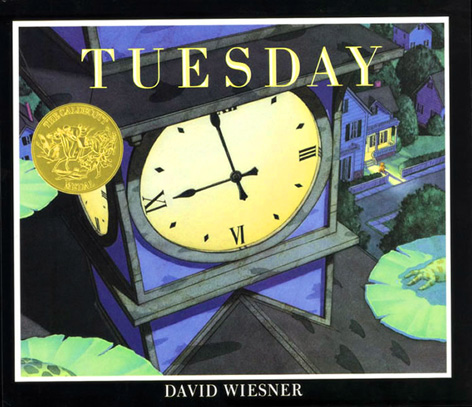
David Weisner’s Tuesday is one of the funniest picture books ever. Really. Watch the video. The funniest pictures, ever, hands down.  The few words in this picture book are only for context when an invasion of frogs floating on lily pads invade a small town on a Tuesday night.

I was so happy when I found a copy for $.25 at the New Milford Public Library book sale this summer. I have a well-worn hardcover of my own that I do not want to lose; this paperback will be perfect to share in class. Wiesner’s picture book is ideal to start the 9th grade mythology unit which leads up to students reading Homer’s Odyssey (Fitzgerald translation).

Our 9th grade curriculum centers on the idea that stories make us human, so our freshmen will spend the year studying the elements of stories and archetypes. For example, in each story they read, they will be able to identify the “call to action” and the moment the protagonist or hero “crosses the threshold”. They will recognize the “challenges” for the hero as being a repeated pattern, especially when the hero is confronted with “temptations”. The students will be familiar with the ideas of “redemption” and “atonement” as the hero travels on the journey from the comfort of the known world to the trials of the unknown world. They will develop an appreciation for the wisdom of the hero’s mentor and the importance of the “elixir” that helps the hero succeed.  They will look for these patterns in the stories they will read throughout high school.  They will review myths as traditional stories that are accepted as history which serve to explain a phenomenon. The flying frogs in Tuesday are most certainly a phenomenon.

We want the students to appreciate the “call to adventure” as demonstrated in the lily pads which lift the frogs from their “known” locale, the swamps and ponds outside the town to the “unknown” territories of living rooms. We want students to predict consequences as the  lilypads float the enthusiastic frogs literally “cross the threshold” of many of the homes.

We also want them to enjoy how Wiesner’s frogs cheerfully wave at disbelieving occupants or cavort using the lily pads as F-16s performing barrel rolls in backyard airspace, while other frogs sit comfortably and devise methods for changing channels in order to watch late night TV. We want them to note how all the frogs are “transformed” from their natural swampy state into comical caricatures.

The flight of the frogs is “challenged” by sheets hung on laundry lines or more directly by a slobbering guard dog. The frogs’ inexplicable journey is cut short when the “elixir” that made this incident possible mysteriously ends the spell. The frogs return to their “known” habitat. The mystery of the remaining lily pads scattered on the concrete roads and sidewalks all over town is wonderfully illustrated in the perplexed look on a detective’s face. Weisner uses a Orsen Welles look-alike in a rumpled raincoat who puzzles holding a dripping wet lily pad, a cadre of police officers and bloodhounds behind him ready to track down the invaders.

Tuesday, by David Wiesner (New York: Clarion, 1991)

Tuesday will provide the students an opportunity to “write  the myth” of what made the frogs fly. The student will need to reference the illustrations in the text as evidence in creating their own personal myth about the flying frogs. We are interested in the explanations the students will need to develop for why the lily pads floated so effortlessly from the pond.  How will the detective explain the limp lilypads strewn around the streets and sidewalks? What predictions do they have for the next possible phenomenon? Some early suggestions started in class are:

  • A new species of lilly pads grew legs and carried the frogs all over the town
  • The lily pads are lunar charged when the moon comes up, then when the sun comes up, the power wears off.
  • Lily pads were made radioactive when a battery fell off the space shuttle into their pond

David Wiesner’s picture book Tuesday provides my students an opportunity to identify universal story elements and create their own myths for the phenomenon of the hilarious frog invasion. This year is the year when they will recognize the elements of this story are the elements in all of literature.  Thus, the picture book Tuesday prepares students for the epic poem The Odyssey, where the equally magic flights and fantastic adventures of the hero Odysseus await their explanations.

But before we start out for Ithaca, we had to spend Tuesday with some frogs.

 David Coleman, incoming president of the College Board is staring out from the front cover of the October 2012 issue of The Atlantic . Actually, he is not staring. I think he is smirking…a Cheshire Cat smirk.

He has every reason to smirk. Coleman one of the architects of the Common Core State Standards has emerged as one of the more influential education policymakers to change what will be taught in classrooms and how this content will be taught without ever having spent time in the classroom himself.

Yes, Coleman has never taught in a public school classroom, although he was very successful as a student. He was educated in the Manhattan public school system, the son of highly educated parents, his father, a psychiatrist, and his mother, president of Bennington College. His privileged liberal arts credentials are immersive and include Yale, a Rhodes Scholarship, Oxford, and Cambridge.

His perspective on education has been informed by the business side of education which included pro-bono work at the management consulting firm McKinsey & Company. He developed and sold the assessment company Grow Network; co-founded and sold Student Achievement Partner; and most recently, accepted a position as president of The College Board.

Coleman has materialized, like Lewis Carroll’s enigmatic Cheshire Cat, as the cool outsider who surveys education as a Wonderland ruled by nonsense. He has promoted an agenda of close reading and an increase in non-fiction, to a ratio of 70% of all required reading by grade 12, from his perch high above the daily dust-ups of the average classroom.

Now, after developing the CCSS, replete with new batteries of state tests, he has moved on to the pinnacle of high stakes testing, the SAT. His arrival comes amid renewed concerns from studies about the SAT that demonstrate the unfairness of the test for minorities, females, and students living in poverty.

While I can embrace many of the standards in the English Language Arts Common Core State Standards (CCSS),  I remain unconvinced by Coleman’s sweeping claims that “close reading” lessons  of several days focused on a complex and difficult text is critical to improving understanding. I have practiced close reading, but not with the singular and tortuous focus Coleman advocates. There is little research as to how this approach will improve reading skills for all students. For 21 years, I have been a “boots on the ground” promoter of reading to a population of students who are reading less and less of the assigned materials, so I speak from experience when I state that Coleman’s emphasis on close reading can have an adverse effect on an already poor reader.

Furthermore, Coleman negates the effectiveness of the past 35 years of having students engage with a text using Louise Rosenblatt’s Reader Response Theory. His blunt charge “as you grow up in this world you realize people really don’t give a sh*t about what you feel or what you think” is simply not true. I cannot imagine any author who would not want to know what a reader thought. Writing is supposed to inspire; writing is an invitation to a dialogue. Furthermore, how will not listening to what students thought engage them in writing at all?

The question is how did Coleman get to place his large footprint on education, and why did teachers let him move into this position? Were teachers so preoccupied with teaching that they failed to see how the dynamics of education were moving from engaging leaders from public school institutions to accepting leadership from more commercial enterprises?

Dennis Van Roekel alluded to the rise of Coleman and others like him when he delivered an address to the National Education Association 91st Representative Assembly this past July:

Are we willing to assert our leadership, and take RESPONSIBILITY for our professions?
The demands of our work are changing as our students change, and the world around us is changing too – ever so fast.I say it is time for us to lead the next generation of professionals – in educating the next generation of students!

I’m so tired of OTHERS defining the solutions… without even asking those who do the work every day of their professional life.
I want to take advantage of this opportunity for US to lead – and I’m not waiting to be asked, nor am I asking anyone’s permission.

Because if we are not ready to lead, I know there are many others ready, willing, and waiting to do it for us. Or maybe I should say, do it “to” us.

Van Roekel’s quote echoes the question rhetorically posed by noted educator Lucy Caulkins at her presentation of the 82nd reunion at Columbia Teacher’s College, “Where is the proof, David Coleman, that your strategy works?”

Coleman’s ascent to the top of American education policy has been steady. He made contributions to the CCSS which will result in nationwide metrics for grades K-12. Add this testing to his new control of the SAT, and his influence on American education and the tests that measure learning will continue through the college level, all without his having the informative experience of teaching in a classroom. That any one individual without any teaching experience could have had this impact on the daily workings of the classroom is a commentary on the current state of madness that public education now finds itself.

At one point in in her Adventures in Wonderland, Alice comes across the Cheshire Cat in the hope of finding her way out:

‘But I don’t want to go among mad people,’ Alice remarked.
‘Oh, you can’t help that,’ said the Cat: ‘we’re all mad here. I’m mad. You’re mad.’
‘How do you know I’m mad?’ said Alice.
‘You must be,’ said the Cat, ‘or you wouldn’t have come here.’

Carroll’s Cheshire Cat character is a tease, an enigmatic riddler who offers judgments and cryptic clues but no  solution to the frustrated Alice. Coleman is education’s Cheshire Cat, offering positions in education but with no evidence to prove his solutions will work.

Curiouser and curiouser. David Coleman has become one of the most influential educational policymakers in our public school systems, but at this time, we have little else but his smirk.

One of my favorite units from the National Council of Teachers of English website (NCTE-http://www.readwritethink.org/) is the unit,“Id, Ego, and the Superego in Dr. Seuss’s The Cat in the Hat” by Junius Wright of Charleston, South Carolina. The lessons in this unit use The Cat in the Hat “as a primer to teach students how to analyze a literary work using the literary tools of plot, theme, characterization, and psychoanalytical criticism.” The unit is stretched over eight 50 minute sessions, complete with handouts and worksheets for grades 9-12. I have completed the unit with my Advanced Placement English Literature students, however, in a shorter period of time of two 80 minute sessions, since many of my seniors are taking psychology or took psychology as juniors, and they are already familiar with Freud’s seminal work The Interpretation of Dreams.

The premise is that students will read The Cat in the Hat and analyze the development of characters (Narrator, Cat in the Hat, Fish) from the picture book through the stages of id, ego, and superego or analyze the static nature of characters (Thing 1 & Thing 2) locked in one stage.

Wright provides student friendly definitions and commentary for each psychoanalytic stage in one of the handouts on the Read, Write, Think website:

Id
The id is the part of the personality that contains our primitive impulses—such as thirst, anger, hunger—and the desire for instant gratification or release. According to Freud, we are born with our id. The id is an important part of our personality because as newborns, it allows us to get our basic needs met. Freud believed that the id is based on our pleasure principle. The id wants whatever feels good at the time, with no consideration for the other circumstances of the situation. The id is sometimes represented by a devil sitting on someone’s shoulder. As this devil sits there, he tells the ego to base behavior on how the action will influence the self, specifically how it will bring the self pleasure.
Superego
The superego is the part of the personality that represents the conscience, the moral part of us. The superego develops due to the moral and ethical restraints placed on us by our caregivers. It dictates our belief of right and wrong. The superego is sometimes represented by an angel sitting on someone’s shoulder, telling the ego to base behavior on how the action will influence society.
Ego
The ego is the part of the personality that maintains a balance between our impulses (our id) and our conscience (our superego). The ego is based on the reality principle. The ego understands that other people have needs and desires and that sometimes being impulsive or selfish can hurt us in the end. It is the ego’s jobto meet the needs of the id, while taking into consideration the reality of the situation. The ego works, in other words, to balance the id and superego. The ego is represented by a person, with a devil (the id) on one shoulder and an angel (the superego) on the other.

I usually read the story aloud, although there are several websites that have The Cat and the Hat with audio read-aloud for teachers who do not want to get swept up in Seuss iambic rhythms and rhymes. I have collected about 30 copies of The Cat in the Hat at used book sales over the past two years; each copy has cost between $.50-$2.00, so the total investment has been $25.00. Making sure each student has a copy of the text is tremendously important, because it is through the illustrations that the students can successfully analyze the characters.

“So we sat in the house. We did nothing at all. So all we could do was to Sit! Sit! Sit! Sit! And we did not like it. Not one little bit.”

“Look how bland their faces are,” notes Alex, “I think this is really the ego stage.”

“I know some good games we could play,” Said the cat. “I know some new tricks,” Said the Cat in the Hat. “A lot of good tricks. I will show them to you. Your mother Will not mind at all if I do.”

“Now, that’s just creepy!” says Skye. “The Cat walks in and starts convincing them that their Mother won’t mind?”
“That Cat is in id,” replies Mike, “he’s going to do what ever he wants.”

 “No! Not in the house!” Said the fish in the pot. “They should not fly kites In a house! They should not. Oh, the things they will bump! Oh, the things they will hit! Oh, I do not like it! Not one little bit!”

“Look at the Fish,” laughs Nancy, “He is out of the water, risking his life for the kids.”
There is a chorus of “Superego.” Everyone agrees.

After the unit, and once the students have a clear sense of how to analyze the characters in this story, I ask them to take this idea and analyze a different piece of literature. My students have just completed a reading of Antigone, so I asked them to psychoanalyze the actions of one character. Not surprisingly, most of them chose to study Creon’s movement from ego on his first day on the job as the King of Thebes, through his dissolution into id when he fights with both Antigone and his son Haemon.

“But, isn’t he really in superego?” asks Tom, “I mean, Creon is trying to uphold the law as king; he is trying to do what is right, or at least what is politically smart.” Other students consider his point….and this is the reason I love teaching this lesson. The use of psychological criticism humanizes literary characters, and our discussions after this lesson are always more informed by our deepening understanding of human nature. Students will use their understanding of id, ego, and superego from this lesson and apply these understandings to Frankenstein, Paradise Lost, Dr. Jekyll and Mr. Hyde, Richard III, and other important works of literature.

So, thank you, Junius Wright, for a wonderful unit on psychological criticism, but more importantly, thank you, Dr. Seuss. Not only did you teach my students to read, but you continue to teach them to think. And what did they think of the ending of The Cat in the Hat?

Should we tell her The things that went on there that day? She we tell her about it? Now, what SHOULD we do? Well… what would YOU do If you mother asked YOU?

Not one would confess. Sadly, there is not one superego in the entire class.

Is this the Age of Enlightenment? No.
Is this the Age of Reason? No.
Is this the Age of Discovery? No.

This is the Age of Measurement.

Specifically, this is the age of measurement in education where an unprecedented amount of a teacher’s time is being given over to the collection and review of data. Student achievement is being measured with multiple tools in the pursuit of improving student outcomes.

I am becoming particularly attuned to the many ways student achievement is measured as our high school is scheduled for an accreditation visit by New England Association of Schools and Colleges(NEASC) in the Spring of 2014. I am serving as a co-chair with the very capable library media specialist, and we are preparing the use of school-wide rubrics.

Several of our school-wide rubrics currently in use have been designed to complement scoring systems associated with our state tests,  the Connecticut Mastery Tests (CMT) or Connecticut Academic Performance Tests (CAPT). While we have modified the criteria and revised the language in the descriptors to meet our needs, we have kept the same number of qualitative criteria in our rubrics. For example, our reading comprehension rubric has the same two scoring criteria as does the CAPT. Where our rubric asks students to “explain”, the CAPT asks students to “interpret”. The three rating levels of our rubric are “limited”, “acceptable”, and  “excellent” while the CAPT Reading for Information ratings are “below basic”, “proficient”, and “goal”.

We have other standardized rubrics, for example, we have rubrics that mimic the six scale PSAT/SAT scoring for our junior essays, and we also have rubrics that address the nine scale Advanced Placement scoring rubric.

Our creation of rubrics to meet the scoring scales for standardized tests is not an accident. Our customized rubrics help our teachers to determine a student’s performance growth on common assessments that serve as indicators for standardized tests. Many of our current rubrics correspond to standardized test scoring scales of 3, 6, or 9 points, however, these rating levels will be soon changed.

Our reading and writing rubrics will need to be recalibrated in order to present NEASC with school-wide rubrics that measure 21st Century Learning skills; other rubrics will need to be designed to meet our topics. Our NEASC committee at school has determined that (4) four-scale scoring rubrics would be more appropriate in creating rubrics for six topics:

  • Collaboration
  • Information literacy*
  • Communication*
  • Creativity and innovation
  • Problem solving*
  • Responsible citizenship

These six scoring criteria for NEASC highlight a gap of measurement that can be created by relying on standardized tests, which directly address only three (*) of these 21st Century skills. Measuring the other 21st Century skills requires schools like ours to develop their own data stream.

Measuring student performance should require multiple metrics. Measuring student performance in Connecticut, however, is complicated by the lack of common scoring rubrics between the state standardized tests and the accrediting agency NEASC. The scoring of the state tests themselves can also be confusing as three (3) or six (6) point score results are organized into bands labelled 1-5. Scoring inequities could be exacerbated when the CMT and CAPT and similar standardized tests are used in 2013 and 2014 as 40 % of a teacher’s evaluation, with an additional 5% on whole school performance. The measurement of student performance in 21st Century skills will be addressed in teacher evaluation through the Common Core State Standards (CCSS), but these tests are currently being designed.  By 2015, new tests that measure student achievement according to the CCSS with their criteria, levels, and descriptors in new rubrics will be implemented.This emphasis on standardized tests measuring student performance with multiple rubrics has become the significant measure of student and teacher performance, a result of the newly adopted Connecticut Teacher Evaluation (SEED) program.

The consequence is that today’s classroom teachers spend a great deal of time reviewing of data that has limited correlation between standards of measurement found in state-wide tests (CMT,CAPT, CCSS) with those measurements in nation-wide tests (AP, PSAT, SAT, ACT) and what is expected in accrediting agencies (NEASC). Ultimately valuable teacher time is being expended in determining student progress across a multitude of rubrics with little correlation; yes, in simplest terms, teachers are spending a great deal of time comparing apples to oranges.

I do not believe that the one metric measurement such as Connecticut’s CMT or CAPT or any standardized test accurately reflects a year of student learning; I believe that these tests are snapshots of student performance on a given day. The goals of NEASC in accrediting schools to measure student performance with school-wide rubrics that demonstrate students performing 21st Century skills are more laudable. However, as the singular test metric has been adopted as a critical part of Connecticut’s newly adopted teacher evaluation system, teachers here must serve two masters, testing and accreditation, each with their own separate systems of measurement.

With the aggregation of all these differing data streams, there is one data stream missing. There is no data being collected on the cost in teacher hours for the collection, review, and recalibration of data. That specific stream of data would show that in this Age of Measurement, teachers have less time for /or to work with students; the kind of time that could allow teachers to engage students in the qualities from ages past: reason, discovery, and enlightenment.


…..the little mermaid’s tongue was cut out by the sea witch.”

…..the stepsisters cut off parts of their feet in order to fit into the golden shoe.”

…..the prince’s eyes were pierced by thorns after he was thrown from the tower.”

…..the children will not find the way home again, and we shall be rid of them.”

“Eugh,” says Nick. “These are horrible stories”

“They are so bloogory, …a combination of bloody and gory!” exclaims Loghan.

“Really, really gory,” adds Cassie.

We are in the middle of a fairy tale unit for my 9th grade English class which was designed so that students can begin to identify patterns in classical stories and match those patterns to the contemporary stories they read independently.

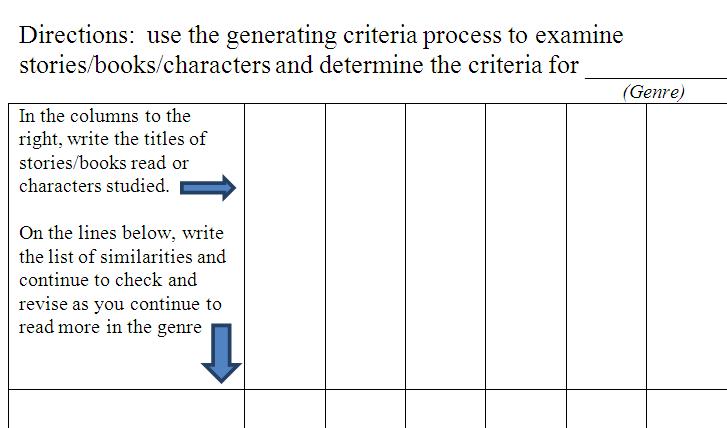
Each student has a “criteria” sheet to complete while reading the fairy tales in this unit. We share these lists of  repeated elements in fairy tales in class after reading.

Our form for generating the criteria for fairy tales


So far they have listed elements that would be expected from comparison by reading fairy tales such as castles, giants, and magic objects from their readings of Jack and the Beanstalk, Rapunzel, The Valiant Little Tailor, and Cinderella. They have also compiled a list of elements I did not expect: birds; thieves and lies; trees and bushes; and wives, not mothers. There is also a great deal of “love at first sight” discussion.

“Cinderella only saw the prince once!” says Casey. While Louisa notes that the prince is the only man Rapunzel has ever seen, “and the next time she sees him, she has a set of twins!”

Our fairy tale unit is a first exposure to the genre without the Disney treatment for many of my students, and a number of the students have commented how they think these original  fairy tales are too frightening for children. On the other hand, there are a few students who have enjoyed the dark and edgy nature of Grimms (aptly named) fairy tales. “At least the characters aren’t breaking out in song,” muttered Christopher reading The Little Mermaid.

We have no trade books or anthologies on fairy tales and have been using online texts only. Some of the texts are difficult, so we have posted resources such as the site Lit2go where most of the stories in the Andrew Lang fairy tale books and Grimm’s collection of stories have been recorded; clicking on links brings a student to the text and supporting audio.

Once the students have generated the criteria for the genre of fairy tales, we have asked them to match the fairy tale story plot to one of the  “Seven Plots in Storytelling.” Students need to explain why the fairy tale plot matches one of the seven plots in literature:

  • Overcoming the Monster
  • Rags to Riches .
  • The Quest 
  • Voyage and Return 
  • Comedy 
  • Tragedy
  • Rebirth

The “rags to riches” plot is easily understood by most students through the story of Cinderella. Similarly, they easily identify the “overcoming the monster” plot with Jack and the Beanstalk. The more tricky plots of “redemption” and “tragedy” challenge them to incorporate evidence from the story. For example, Michael suggested that the Giant’s fall from the beanstalk, “was tragic for the Giant”, but others in the class argued back that tragedy means the main character suffers the tragedy. Other students put The Little Mermaid into the “redemption” plot because, as Cassie noted, “she gave up her life to spare the life of the Prince, and she becomes immortal as a result.”

We have also had the students create original stories that address one of the seven plots using the software Storybird. The art on this website helps to inspire the story; according to the website, “Storybird reverses the process of visual storytelling by starting with the image and ‘unlocking’ the story inside.” The stories are quick to produce, but they do require Adobe Flash. So far, we have watched several “rags to riches” stories, but no student has written a “quest.” However, I am not worried about the “quest” plot because the conclusion of this fairy tale unit will bring us to the unit on Greek myths before we begin The Odyssey.

Michael was looking ahead at the syllabus and asked suspiciously, “Is The Odyssey any good?”

“Oh, yes,” I assured him, “the Odyssey is the ultimate quest!”

He looked unconvinced until I added,  “and there are parts that are really gory!”

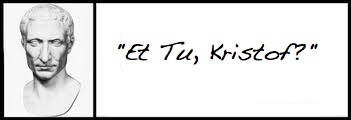
Et Tu, Kristof?

September 15, 2012 — Leave a comment

Dear Nicholas Kristof:

Not you too? I have always looked to you as the defender of just causes; a voice of reason in times of crisis. I agreed with your passionate opening in your New York Times column Students Over Unions, September 12, 2012, noting the role of poverty as a factor in “the most important civil rights battleground” and that “the most crucial struggle against poverty is the one fought in schools.”

In adding your opinion to the Chicago teacher’s strike, you considered that today’s inner-city urban schools, “echo the ‘separate but equal’ system of the early 1950s. In the Chicago Public Schools where teachers are now on strike, 86 percent of children are black or Hispanic, and 87 percent come from low-income families.”
In this opinion piece, you also made the good points that I look for in your columns:
  • The single most important step we could take has nothing to do with unions and everything to do with providing early-childhood education to at-risk kids.
  • Teachers need to be much better paid to attract the best college graduates to the nation’s worst schools.
However, you lost me at, “How does one figure out who is a weak teacher?”
Your solution is to have schools look at value added measurements (VAM) using test data. You suggest that researchers are improving the use of VAM and that, “with three years of data, it’s usually possible to tell which teachers are failing.”
Really?
Before you put your faith in VAM, you might have perused, John Ewing’s article “Mathematical Intimidation: Driven by the Data” in the publication Notices of the American Mathematic Society.  Ewing’s thesis in the article addresses a common misuse of mathematics that “is simpler, more pervasive, and (alas) more insidious: mathematics employed as a rhetorical weapon—an intellectual credential to convince the public that an idea or a process is ‘objective’ and hence better than other competing ideas or processes.”
As the president of the organization”Math for America”, Ewing disputes the use of tests to evaluate teachers, schools, or programs, and he short lists four of the most important problems:

1. Influences. Test scores are affected by many factors, including the incoming levels of achievement, the influence of previous teachers, the attitudes of peers, and parental support. One cannot immediately separate the influence of a particular teacher or program among all those variables.

2. Polls. Like polls, tests are only samples. They cover only a small selection of material from a larger domain. A student’s score is meant to represent how much has been learned on all material, but tests (like polls) can be misleading.

3. Intangibles. Tests (especially multiple-choice tests) measure the learning of facts and procedures rather than the many other goals of teaching. Attitude, engagement, and the ability to learn further on one’s own are difficult to measure with tests. In some cases, these “intangible” goals may be more important than those measured by tests.

4. Inflation. Test scores can be increased without increasing student learning. This assertion has been convincingly demonstrated, but it is widely ignored by many in the education establishment. In fact, the assertion should not be surprising. Every teacher knows that providing strategies for test-taking can improve student performance and that narrowing the curriculum to conform precisely to the test (“teaching to the test”) can have an even greater effect. The evidence shows that these effects can be substantial: One can dramatically increase test scores while at the same time actually decreasing student learning. “Test scores” are not the same as “student achievement”.

In pointing out the flaws of VAM in testing, Ewing concludes:

“Of course we should hold teachers accountable, but this does not mean we have to pretend that mathematical models can do something they cannot. Of course we should rid our schools of incompetent teachers, but value-added models are an exceedingly blunt tool for this purpose. In any case, we ought to expect more from our teachers than what value-added attempts to measure.”

Ultimately, Ewing determines the tool, the data from a single metric, used to measure teacher performance is fundamentally flawed. I ask you to consider what other profession evaluates on a single metric?

Evaluate performers in any other profession and note the number of metrics used to determine success. Athletes have pre-season games, games, playoffs all of which give important data to determine improvement over time. Multiple industries release profit statements quarterly while parsing through the tremendous amount of targeted consumer data now available. Lawyers, doctors, and other professions are ranked not by single cases, but by professional performance accrued case by case. Government agencies use multiple measurements to determine progress in various sectors (employment, demographics, investments,etc) and provide monthly reports to determine progress; even the presidential race has a primary before the election. Yet there are those who would want teachers to be evaluated using the metric of a single test, taken one day out of one school year.

The single metric test is given state by state to measure growth in skills and subject area content in reading, writing, math and science. Elementary school teachers and teachers at the high school in these subject areas receive the most scrutiny. Many state standardized tests are given at specific grade levels. In other words, in my state of Connecticut, teachers in 5th, 8th or 10th grade who teach one of the “core” classes carry a different evaluation burden; their test results are widely publicized as the school ranking against other schools. Elective teachers (art, PE, music, foreign language) or “off-year testing” teachers do not receive the same level of examination by the public.

However, I do not advocate increasing tests at every grade level or in every subject in order to even the playing field. You write that the reliance on tests and VAM “are stirring skepticism and anger among teachers” because the evaluation system is being created by those who do not have authentic or extensive classroom experience. Instead, the evaluation system is being handed over in large part to the testing industry, and that testing industry lives in an incestuous relationship with publishing and educational “support” developers. The testing industry proclaims a school system’s success by evaluating data from a test, but within that same industry are multiple businesses that profit from a a school system’s need to purchase programs and materials they promote as necessary to pass the standardized test. “Failing the standardized tests? You need our reading/writing/math/science program!”

Before you hop onto the bandwagon with those advocating a one-test metric, consider how this opinion piece “Students over Unions” differs in both research and sentiment from your columns that bring national attention to the poor and the disenfranchised. So different was the tone of this piece as to have a caught the attention of several other writers who called you out specifically: Sarah Jaffe from Truth Out Five So-Called Libreral Pundits that are Attacking Teachers; and Education Week contributor Larry Ferrlazzo on his blog “When Bad Ideas Happen to Good Columnists” to name two.Valerie Strauss from the Washington Post in Why Rahm Emanuel and The New York Times are Wrong about Teacher Evaluation  also found and incorporated the Ewing argument in explaining the lack of union support from your paper. You even got into a Twitter-tiff with education advocate Diane Ravitch http://Twitter.com/DianeRavitch

Ultimately, I am confident that you would not want one column, specifically this one column, to be used to define you for an entire year.  You would not want one metric to measure your success as writer for the New York Times. You would not want one single opinion piece be used as measurement in order to evaluate your annual performance.

Well, neither do teachers.