GOAL -School districts want to report their students to read great literature.
GOAL-School districts want to report good reading test scores.

Unfortunately, these two goals are currently incompatible; great literature’s complexity can be challenging to read, and schools can ill afford to have students get low test scores on reading because of great literature’s complexity.

Concerns about the removal of great literature from classrooms have been raised before, but NY public school English teacher Claire Needall Hollander passionately argues how intellectually damaging this practice has become in state testing. Her  op-ed piece in 4/21/12  NYTimes Teach the Books, Touch the Heart decries the elimination of great literature in the classroom in order to incorporate practice materials to prepare students to take the standardized tests. Hollander described her role as a reading enrichment teacher as an opportunity to provide great literature as academic equity for her students. She described several of her students as  the sons and daughters of immigrants or incarcerated parents; she noted some students lived in crowded, violent, or abusive homes. Great literature, she believed, was “cultural capital” that could help her students compete against more affluent peers. However, when the lackluster data from standardized reading tests came in, she felt pressured to abandon great literature and curtailed her efforts for the majority of these students in order to teach materials prescribed for the state test.  While the reading selections on the state tests did have some syntactical complexity, she eventually decided that these reading materials lacked the literary qualities that make literature great. Texts that are “symbolic, allusive or ambiguous are more or less absent from testing materials.” Hollander writes, “It is ironic, then, that English Language exams are designed for ‘cultural neutrality.'”
In one sense, great literature is already culturally neutral. The themes or characters in a great piece of literature are not limited to one decade or one millennium. The elements that make a work of literature great can transcend culture and context, can speak to a universal audience, can be read by any tradition and still connect to a reader. Ms. Hollander’s concerns about cultural neutrality are akin to concerns about cultural acceptability. Creators of standardized tests are particularly sensitive in selecting texts that are cultural acceptable because great literature  intentionally confronts morality, questions society’s rules, or challenges tradition. Great literature gives voice to the outsider, and authors of great literature are often on the margins of society or write to unsettle the status quo. For these reasons, selections from great literature may not be considered culturally acceptable.

I have some experience on what goes onto a standardized state test as I had a seat one year as a member of the text selection committee for the reading and writing sections of the Connecticut Academic Performance Test (CAPT)  given to grade 10 students. Much time was spent reviewing materials for inclusion on a future Response to Literature exam. Out of a number of mediocre short stories, the only selection given to educators that could meet some standards of great literature was a chapter from Lois Lowry’s Number the Stars, a young adult novel that is usually read in Grade 5.  That selection was eliminated not only because of the low reading level (5.1; Lexile 670) but because the manner in which Lowry portrayed the terrifying rounding up of Jews. One committee member actually wondered aloud if Lowry could be persuaded to “reword the chapter” to address the concern. Fortunately, that debate ended with the decision that the chapter was not “acceptable” for the committee.

One problem in great literature is difficult vocabulary; for example, the simple conversations between the Man and the Boy in Cormac McCarthy’s The Road (RL 4) are interspersed with diction describing the apocalyptic setting:  “rachitic “, “miasma”, “escarpment”, “crozzled”.  Another problem is vocabulary  considered vulgar or profane that has eliminated a number of literary pieces from standardized testing and even from school libraries. According to the American Library Association (ALA) website which  lists challenges to classic literature that Hollander might teach: To Kill a Mockingbird- “contains  racial slurs”;  Of Mice and Men – “takes God’s name in vain 15 times and uses Jesus’s name lightly.” Finally,  great literature almost always contains themes that can be considered dangerous  or offensive to someone in society:  The Color Purple is “sexually graphic and violent”;  1984 is “pro-communist”; and Catcher in the Rye– is infamously “blasphemous and undermines morality.”

Engineering English language tests in order to make them culturally neutral or culturally acceptable encourages intellectual dishonesty. Take the reading section on the Connecticut Academic Performance Test (CAPT)  where every 10th grader is required to read a short story and evaluate the quality of the story, “How successful was the author in creating a good piece of literature?” in a one page essay. I have spent over 10 years preparing students for this  question on the Response to Literature standardized test, and I know how students struggle with this question. Many students do not read challenging texts outside of the classroom, limiting their experience to develop critical evaluation skills. However, the more distressing problem is that year after year, the quality of the story on the CAPT pales in comparison to the classic short stories a student could encounter in even the most limited literature anthology. Classic short stories available in the public domain by Saki, Anton Chekhov, Kate Chopin, Stephen Crane, and Jack London, to name a few, are considered too difficult for independent reading by 3rd quarter 10th grade students. Copy-write requirements or an author’s unwillingness to truncate a story to comply with a maximum word requirement or to make textual changes to make the subject palatable to a text selection committee, prevents other literary materials from being used.   As a result, more recent selections have come from Teen Ink (stories written by teens) and Boy’s Life magazine, both publications not known for superior literary content. While some stories may meet a sentence complexity standard and have been vetted for acceptable content, most lack the literary depth that should generate thoughtful critical responses to a prompt that asks about “good literature.”

To further complicate the choice a student makes in a response, released materials from previous exams used to prepare students how to respond to “How successful was the author in creating a good piece of literature?” include student responses, and all of the exemplars, good and bad, argue that the story was “good”.  The  lack of reader experience coupled with the year to year see-saw quality of the text on the exam places  students in the uncomfortable position of defending a merely average quality story as good literature; therefore, the prompt promotes intellectual dishonesty.

Perhaps the problem of including good literature on a standardized test may be addressed with the adoption of the English Language Arts Common Core State Standards where text complexity is standard #10: “By the end of grade 9, read and comprehend literature, including stories, dramas, and poems, in the grades 9–10 text complexity band proficiently, with scaffolding as needed at the high end of the range.”

In other words, the use of good literature on a CCSS English Language Arts exam might be substantively different than the texts used on the Response to Literature section of the CAPT. This could make the response about the quality of text more authentic since a complex literary text can be analyzed as “good literature.” How this more complex literary text will be used in testing, however, remains to be seen since history demonstrates that cultural opposition to a story will often trump quality.

Comprehending and evaluating a text are desirable skills, and measuring those skills will still be difficult.  Multiple choice questions are quickly corrected, but they are limited to measuring reading comprehension, and a student essay response to a complex text will require considerably more time to write and correct. Anticipating this, Hollander calls for an assessment that is more reflective of student learning:

 “Instead, we should move toward extensive written exams, in which students could grapple with literary passages and books they have read in class, along with assessments of students’ reports and projects from throughout the year. This kind of system would be less objective and probably more time-consuming for administrators, but it would also free teachers from endless test preparation and let students focus on real learning.”

The CCSS should consider Hollander’s proposal as states develop assessments.  All stakeholders should also recognize that using anything less then quality literature to measure a student reading comprehension and evaluation skill on an English/Language Arts exam is intellectually dishonest.

In the film Looking for Richard, his tribute to Shakespeare’s historical play Richard III, Al Pacino asks a tourist standing on a street in Manhattan, “What do you know about Shakespeare?”

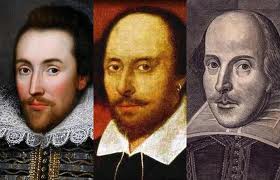
“Shakespeare? He’s our greatest export!” replies the Brit reaching into his wallet for a credit card. On the credit card was the Flower portrait of  Shakespeare as a security hologram. Rotating the card allowed the camera to pick up the image of Shakespeare, who appeared to be winking at the viewer.

Choose your favorite portrait for a T-shirt, mug, or I-phone cover!

As an export, Shakespeare sells. His image, in any one of three possible portraits, is plastered on mugs, teapots, coasters, coins, rugs, and notebooks. His verses are truncated to fit the length of garden stones, pens, bracelets, Ipad cases, and T-shirts.  I personally own six scarves with images from his plays or verses from his poems.

There are some more unusual, and certainly less dignified, items available as well for those bard-idolators:

Shakespeare Insult Gum-each box contains two gum balls and a wonderful Shakespearean insult;

Rubber Duckie Shakespeare: Celebriduck

A Shakespeare Celebriduck-Yes, Shakespeare has been turning into a quacking bard;

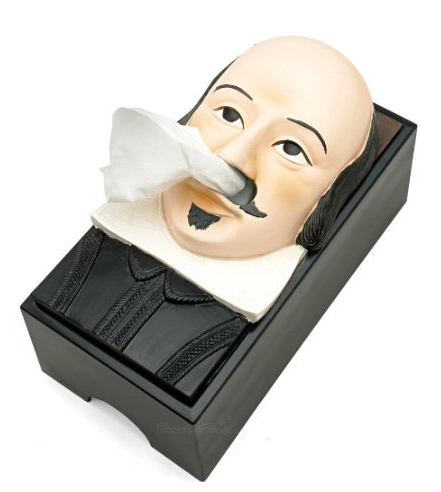
Shakespeare Tissue Box cover

A Shakespeare Tissue box cover-Tissue fly from his nose as fast as verses from his pen.

As a product, Shakespeare appeals to a niche market, but given the amount of Shakespeare paraphernalia on the web, that niche market must be very profitable.

Today marks Shakespeare’s 448th birthday. This past month, I have been sell-a-brating Shakespeare in each of my English classes.

Selling Shakespeare is one of the pleasures of teaching English at the high school level. This year, I have “sold” OthelloKing Lear, and Hamlet to the Advanced Placement English Literature class, and I am presently selling Macbeth to sophomores while at the same time selling Romeo and Juliet to freshmen.

Once students get past the Prologue; past witches meeting on a heath; past the Ghost’s appearance on the ramparts; past Act I, scene i;  I am on auto-pilot. English teachers accumulate Shakespeare materials in the form of lesson plans, essay prompts, quizzes, audio-tapes, film clips and activities that be pulled out at a moment’s notice. In addition, there are numerous clever resources or plans on the web to access. This past year, I added lesson plans from the websites that featured The Macbeth TangoRomeo and Juliet on Facebook, and  Stick Figure Hamlet.

Of course, the best way to sell Shakespeare to students is to have them attend a well-acted live performance . If there is no performance in the area, a DVD or video streamed production, and they are readily available on Netflix, Amazon, and PBS,  of one of the many adaptations of Shakespeare’s plays helps engage students. There are websites that list over 400 feature length films or TV shows that bear his name, so there are many options as to which versions might be used.

However, nothing can replace having students reading  and acting out the play in class. Without equivocation, all  students are initially  terrible at reading Shakespeare cold. Nevertheless, almost every student eventually wants  a chance to “strut and fret their hour upon the stage.” Even the brilliant Kenneth Branaugh, now instantly recognizable to my students as “that guy who plays all those characters” in film productions of Hamlet,Othello,  and Much Ado About Nothing, recalls in an interview how his first exposure to Shakespeare came in a class where everyone read from The Merchant of Venice. Kenneth remembered being terrified doing it, and that he “didn’t understand the language.” But having survived that experience, he quickly developed the acting bug.

All this exposure to Shakespeare in high school  does have an effect on his “brand” or name recognition. Recent reports estimate that Shakespeare’s brand is worth over $600 million, twice the amount of Elvis and Marilyn combined. According to the website Campaign Brief, Shakespeare is the best-selling author of all time, with book sales estimated between two and four billion. In contrast, J.K. Rowling’s unit sales are estimated to be less than 450 million. The company Brand Finance was commissioned to determine the commercial value of Shakespeare’s name. Tim Heberden, managing director of Brand Finance in Australia reported: “Not only do these figures make the Shakespeare brand one of the strongest in the world, but it also shows the potential commercial value the Shakespeare name has garnered.” His firm awarded Shakespeare a triple AAA rating noting that the brand could potentionally rise to 1 billion.

I believe that high school English teachers have had a direct hand in this industry. Shakespeare sells very well, because we have sold him very well. For us, the reward is spreading the poetry and drama of the bard, but for those who are literally selling Shakespeare, we have most certainly “put money in thy purse!”

Nothing beats a top-notch live performance for selling Shakespeare to students. While there are plenty of quality performances on DVD, streaming from  Netflix or the PBS website, or available piecemeal on Youtube, there is nothing quite like the collective heartbeat one experiences sitting in an audience. In live theatre, there is the moment of an audience-wide hypnosis; the palpable moment when the audience loses self-consciousness and synchronizes its breathing to watch and hear the play. The dramatist Shakespeare provided many opportunities for those moments.

Every year I try to organize a field trip so that my students have an opportunity to attend a live performance of one of Shakespeare’s plays.  Since our school is fortunate to be located an hour away from New Haven, CT, our students can attend matinees at Yale Repertory Theatre. For several years, I have arranged for field trips to see Shakespeare performed at the Yale Rep with Ruth Feldman, the Director of Education and Accessibility Services at the Yale School of Drama.  These plays are funded as part of the National Endowment for the Arts (NEA) initiative Shakespeare in American Communities:

“Yale Rep offers young people in the community two significant youth theater programs: WILL POWER! and the Dwight/Edgewood Project. WILL POWER! Arts-and-education initiative is designed to build on existing English and Theatre curricula for middle- and high- school educators and their students. The company continues as a leader for it community outreach and accessibility programs that promote audience diversity and participation. “

This year, 40 students attended Yale Rep’s production of The Winter’s Tale, one of the more difficult plays to teach, a “problem” play. On this particular trip, there were honors 9th graders who had been prepared for the production having used a prepared study guide sent in advance of the trip.  The 12th graders, in the throes of “senioritis”, came cold to the production.

No matter. The combination of elegant set and stage movement conveyed the plot-a jealous husband, a wronged wife, a betrayed friend in the opening scenes kept all students rapt. The famous stage direction, “exit pursued by a bear” was brilliantly executed with puppetry, and suddenly the audience was transported into the land of Bohemia with its rainfalls of tiny blossoms, colorful costumes, and infectious country dancing. One student leaned into me, “I would rather live in Bohemia,” she whispered.  The final stage trick of bringing the statue of Hermione to life was met with audible gasps-“She’s real?” The packed house of students cheered predictably louder for the “clowns”from the performance, and with nothing less than genuine admiration for the lead roles as the cast took their final bows. The Winter’s Tale was a hit!

Immediately after the performance, as they have for the entire WILL-POWER series, the cast and production team at Yale Rep offered a talk-back where students can ask questions for about 20 minutes after the show. Seeing the performers in street clothes, without costumes and make-up, sitting on the edge of the stage, tousled but charged up after the 3 hours of performing, is a bit unsettling…the illusion of theatre is laid bare. Awkwardly, for the first five minutes, students stammered out questions: How long did they rehearse? (8 weeks) How old are you (to a 10 year old actress)? Have you been on TV (yes)? Actors responded amiably enough.

Then, a teacher asked, “What was your first Shakespeare experience?” There was a momentary pause and then one actress offered her first memory of Shakespeare…a memory from  high school. “Shakespeare was supposed to be only for the smart kids, which really wasn’t fair,” she recounted, “He’s really for everyone, not just the smart kids.”  Another actor agreed, explaining that members of his class had acted out Shakespeare-very badly, stumbling over the words, but loving the experience. Then another actor spoke. “My mother took me to see Shakespeare when I was seven, so I was always around them[plays]. I grew up loving to watch the plays.” Another actor recounted his initial dislike of Shakespeare’s plays in high school,”I just didn’t get it,” but that an experience in college changed his mind, “Was this the same boring play? Yes! Why was it better now? I don’t know, maybe I was ready then.” Still another spoke of his love of the plays, his love of the language, and his ability “to speak the words really well because I understand them…which means that I have been able to stay employed!” One by one, each actor spoke of an initial Shakespeare experience, good or bad, and how each of them had been changed by that experience. There was such power in their personal stories, an English teacher could not have scripted better confessions. Their passion for Shakespeare and desire to pass that passion on to my students was inspiring; they were the better teachers!

A final question, posed again by an adult audience member, served  the play’s recap: “What was your favorite moment in the play?”she called out. The actors brightened and each took a turn, speaking about a favorite moment. One recounted a scene she could see from the wings, another a moment he shared on stage with another actor. The cast recapped the events of the play -out of sequence-the statue coming to life, the clown stealing the wallet, the dance, a set of choral lines shared between two actors, the moment when the newborn babe is brought before her dismissive father, and the magical transformation of the shepherd into Father Time. But it was the actor who spoke about the stage direction “pursued by a bear” that brought new understanding to one of my students as to how to look at one of Shakespeare’s seemingly improbable plot devices. “Why would Antigonus leave a baby alone on a beach unless he was trying to protect her?” asked the actor, ” Who would do that? Who would do that unless he was convinced he could save the baby? The bear chases him to his death, but the baby lives,” he continued, “I think amid so many acts of selfishness, this is one of the most selfless acts in the play.” Later, sitting at a local pizzeria, a student repeated his explanation word for word, “Seriously, who would leave a baby on a beach? Who would do that unless he was convinced…. That’s so true!”

Live theatre can engage students. Live Shakespeare -performed well-can enrich students. Talkbacks with actors and their experiences with Shakespeare can enlighten students. Perhaps one day my students may have the opportunity to share their first experience with Shakespeare. They may choose Yale Rep’s The Winter’s Tale.

A series of miscommunications left the eight members of the local Burnham Library Book Club wondering which book they should prepare to read for the next meeting. The month before, a decision was made to read a novel that shared the name of the next meeting; we would read a book titled  The March by E.L Doctorow for our March meeting date. How clever! Unfortunately, our plans went awry when the librarian posted the selection as March by Geraldine Brooks. Members arrived with copies of one or the other novel.

No matter. As it turned out, we could discuss both books easily, not only because of the similarity of each fictional story arc but because of the numerous historical references to people and the events in the Civil War.  What struck all members of the book club during the discussion was the amount of research that had gone into creating these works of historical fiction, since both contained a notable fidelity to events, customs, and manners of the Civil War era.

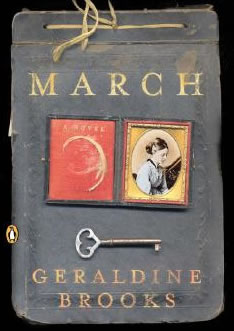
March-Geraldine Brooks

In March, Geraldine Brooks borrows her title character, Peter March, from Louisa May Alcott’s story Little Women. Her narrative is told from the alternating point of views of Marmee and the father of the March girls: Meg, Jo, Beth and Amy. In her explanation for his prolonged absence, the idealistic March enlists as a Union clergyman in 1861, at the beginning of the Civil War.

E. L. Doctorow’s The March is centered on real-life Union General William Tecumseh Sherman in his infamous “march to the sea”, as he burns Atlanta before pivoting north into the Carolinas. Multiple narrators are employed in this novel including a Union regimental surgeon, Colonel Sartorius; Emily Thompson, a daughter of a Southern judge; and Arly and Will, two soldiers who care little about loyalty and more about staying alive.  The scope of  this novel is epic as Sherman’s sixty thousand troops burn, pillage, and choke to death the final throes of the Civil War in 1864.

The similarity of major characters from each novel was uncanny: the mixed-race beautiful protagonist Pearl in The March and the strikingly attractive, educated slave Grace who captivates the title character in March. There were historical figures to people each novel: John Brown, the famous abolitionist; Henry David Thoreau; and Ralph Waldo Emerson make appearances in March. General Sherman, General Joseph E. Johnson, and Abraham Lincoln are present in The March. Both novels also extensively featured field hospitals as settings. March is a a Union chaplain who is wounded and ends up in a Civil War hospital; The March features a Union regimental surgeon, Colonel Sartorius  who curiously employs a number gruesome surgical procedures.

The novels reflected the tumult of a civil war, the hair-raising escapes from danger and the chaos and brutality that ensued from bitter and divided rivalries. Both novels highlighted the technological advancements that made each side more efficient killing machines, and Doctorow in particular noted the historical progress of mechanized warfare:

 “This in America was to be seen with one’s own eye’s. And as bloody and brutal were the contests of the Lancasters and York, they were hand to hand- battle-aves, pikes, maces. These chaps were industrial age killers: they had repeating rifles that could kill at a thousand yards, grape that could decimate an advancing line, cannon, field-pieces, munitions that could bring down entire cities. Their war was so impersonally murderous as to make quaint anything that had gone on before. (214)

Another element of comparison was the reflection in both novels on ancient wars that had preceded the Civil War. Brooks has her narrator, the cerebral Peter March, contemplate the historical continuum, from the Ancient World to the present, noting the how painful is the loss of loved one due to war:

“The waste of it. I sit here, and I look at him, and it is as if a hundred women sit beside me: the revolutionary farm wife, the English peasant woman, the Spartan mother-‘Come back with your shield or on it,’ she cried, because that was what she was expected to cry. And then she leaned across the broken body of her son and the words turned to dust in her throat.” (211)

In contrast, Doctorow uses a visiting English journalist in order to comment on how the echoes of  ancient conflicts are heard in the progression of battles he sees:

“Yet some of the ancient military culture endured. The brutal romance of war was still possible in the taking of spoils. Each town the army overran was a prize. In this village was an amazing store of wine, in that granary brimming to the rafters, a herd of beef here, an armory there, homes to loot, slaves to incorporate. There was something undeniably classic about it, for how else did the armies of Greece and Rome supply themselves? How else had Alexander’s soldiers made an empire? The invading army, when it camped, sat on the land as its owners, with all the elements of domesticity, including women, enlarging the purely martial function of their social order” (215)

The reasons for the Civil War are addressed more clearly in Brook’s tale. She incorporates the arguments offered by the real-life American Transcendentalist Branson Alcott in her creation of the  character of the naive March who is just beginning to doubt his involvement with the conflict he little understands:

“If war can ever be said to be just, then this war is so; it is action for a moral cause, with the most rigorous of intellectual underpinnings. And yet everywhere I turn, I see injustice done in the waging of it…”(65).

In contrast , Doctorow’s characterization of the West Point educated General Sherman suggests his weary recognition that while the physical act of war will run to its exhausted conclusion, the battlefield will move to another plane where the dispute will continue:

“And so the war had come down to words. It was fought now in terminology across a table. It was contested in sentences. Entrenchments and assaults, drum taps and bugle calls, marches, ambushes, burnings and pitched battles were transmogrified into nouns and verbs.  It is all turned very quiet, Sherman said to Johnson, who, not understanding, lifted his head to listen.

No cannonball or canister but has becomes the language here spoke, the words written down, Sherman thought. Language is war by other means” (348).

Ultimately, the members of book group determined that both books provided a fascinating blend of historical fact with fiction. As an educator, I was impressed about how much more effective both novels were in communicating the experiences of living through the Civil War from its beginning (1861) to its inevitable end concluding with Lincoln’s assassination in 1865. A textbook would have covered the information, but not provided the visceral quality a reader gains through a story….both novels succeeded in recreating history using a “his story” model. Both novels complement the study of the Civil War by blending each author’s thematic development and literary technique with historical fact. As a result, both novels will be placed on the 11th grade classroom shelves along with two other wonderful Civil War novels The Killer Angels by Michael Shaara (Gettysburg) and Cold Mountain by Charle Frazier.

All these books appeal to the imagination in recreating the  particulars in the  time and places of the Civil War. As a bonus,  how serendipitous that despite the near duplication of titles, both novels were so similar in subject matter as to allow for a great discussion? How surprising that the story of two “Marches” would ultimately be so similar?

The English Language Arts Common Core State Standards (CCSS) wants students to read in every discipline from elementary school through grade 12. The standards demand an increase in the reading of informational texts, the genre formally known as non-fiction. So where is the passage that concludes that English/Language Arts teachers will continue to teach fiction and literary non-fiction while other disciplines increase reading in informational texts? Where is the passage that dispels the notion that English/Language Arts teachers are not required to meet the 70%  required reading of informational texts in their classrooms?  Where is the passage that clarifies where students will read more informational texts across the curriculum by senior year?

Well, the passage is a footnote on page 5:

Footnote: 1 The percentages on the table reflect the sum of student reading, not just reading in ELA settings. Teachers of senior English classes, for example, are not required to devote 70 percent of reading to informational texts. Rather, 70 percent of student reading across the grade should be informational.

Why is an explanation of this magnitude only a footnote? By definition, a footnote is:
1. A note placed at the bottom of a page of a book or manuscript that comments on or cites a reference for a designated part of the text;
2. Something related to but of lesser importance than a larger work or occurrence.

This  footnote on page 5 of the CCSS functions to clarify that English/Language Arts teachers are not responsible for the increase in reading informational texts. Is this footnote, according to the definition,  “Something related to but of lesser importance than a larger work or occurrence”?  Why is this statement not given more importance in an English/Language Arts document? Why is this statement not written in bold? Why is this statement not a separate bullet point in Key Designs Considerations? Why is this statement relegated to be a footnote?

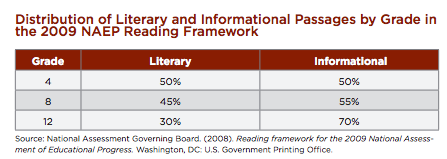
The specific ratio of how much reading students should do in in fiction and informational texts can be found in a chart in the ELA CCSS  taken from the 2009 reading framework of the National Assessment of Educational Progress (NAEP). This chart sets up the progression from an even split between fiction and informational texts in grade 4 to the 30% fiction and 70% informational text ratio expected by grade 12.

Chart with 30% fiction, 70% informational Text ratio

The chart is on the Key Designs Considerations page and addresses the demands to include informational texts because “a great deal of informational reading in grades 6–12 must take place in other classes if the NAEP assessment framework is to be matched instructionally.”

Really?  If the NAEP assessment framework is to be matched? Why “if”? The only way the ratio for 70% informational texts will meet the NAEP assessment framework is “WHEN” there is an increase of informational texts in classes other than English. Additonally, it is highly unlikely that English teachers will teach a reduced percentage of  fiction or literary non-fiction as students move from elementary (Grade 4) to middle (Grade 8) to high school (Grade 12), and there is nothing in the standards that specifies the ratio of fiction to other texts in an English classroom.

So, heads up History/Social Studies, Science and the Technical Areas teachers, the CCSS English/Language Arts Framework is looking at you!

While English/Language Arts teachers are developing curriculum to align with the CCSS, how many of the History/Social Studies, Science and the Technical Areas teachers are informed and cooperating in the incorporation of informational texts?  Are teachers in History/Social Studies, Science and the Technical Areas developing additional reading to their specific curriculum? Hopefully they are, but my sense is that these resources will take time to develop and integrate.

Already, I have heard the argument from teachers in disciplines other than English/Language Arts moaning, “what do I drop out of my course to include reading?” -which could be read as the reason why the authors of the ELA CCSS felt the need to develop reading and writing standards for History, Social Studies, Science and the Technical Areas teachers. A sidebar column in the document explains the need for other disciplines to increase reading:

“Reading is critical to building knowledge in history/social studies as well as in science and technical subjects. College and career ready reading in these fields requires an appreciation of the norms and conventions of each discipline, such as the kinds of evidence used in history and science; an understanding of domain-specific words and phrases; an attention to precise details; and the capacity to evaluate intricate arguments, synthesize complex information, and follow detailed descriptions of events and concepts…Students must be able to read complex informational texts in these fields with independence and confidence because the vast majority of reading in college and workforce training programs will be sophisticated nonfiction (60).”

The last sentence of this section should be in bold: “It is important to note that these Reading standards are meant to complement the specific content demands of the disciplines, not replace them.” 

While the teachers of History, Social Studies, Science and the Technical Areas are on notice to include more informational texts, these standards still fall under the English Language Arts Framework which begs the question, who will be responsible for enforcing these standards? Will the testing of a student’s comprehension of informational texts be assigned to a discipline other than English/Language Arts? Will overall reading scores reflect on an entire school, as it should, or will reading scores reflect on the English/Language Arts departments since the CCSS frameworks are designed under the heading English Language Arts frameworks?

Of course, many English teachers, fearing the removal of fiction and literary non-fiction (essays, memoir, etc), raised their concerns about the demand for informational texts. Responding to these concerns (among others), the  CCSS developed a page on their website titled Myths vs. Facts.
Here, the CCSS attempts to clear the confusion as to what reading will be done in English/Language Arts:

Myth: English teachers will be asked to teach science and social studies reading materials.

Fact: With the Common Core ELA Standards, English teachers will still teach their students literature as well as literary non‐fiction. However, because college and career readiness overwhelmingly focuses on complex texts outside of literature, these standards also ensure students are being prepared to read, write, and research across the curriculum, including in history and science. These goals can be achieved by ensuring that teachers in other disciplines are also focusing on reading and writing to build knowledge within their subject areas.

Unfortunately, the CCSS’s use of footnotes and charts to define the percentages in the increases in informational text reading leaves questions as to which exactly how each discipline will be held responsible.  The CCSS makes the assumption that other disciplines will  incorporate more reading under a English/Language Arts framework. The CCSS states that the English/Language Arts classrooms will not be required to replace their fiction and literary non-fiction with informational texts, but infers that there will be a mechanism “to ensure that teachers in other disciplines are also focusing on reading and writing to build knowledge within their subject areas.” The method of measuring the increase and the results of this increase is yet to be determined.  The process of how reading will be incorporated across the curriculum needs more than an assumption and an inference. For English/Language Arts teachers there is a footnote is where the “devil is in the details”, but only if all other stakeholders in this shift to a Common Core curriculum read that footnote.

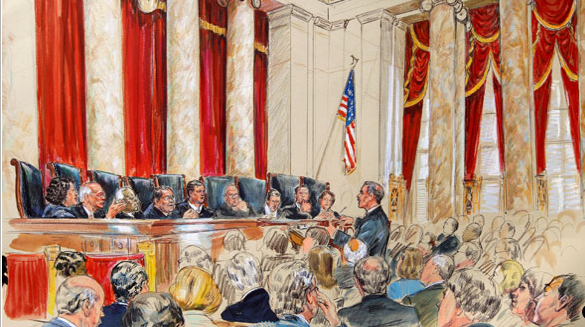
Deputy Solicitor General Edwin Kneedler was before the Supreme Court arguing on behalf of the Health Care Bill when he stated that the  Supreme Court Justices would need to look at “the structure and the text” of the 2,700-page law. Justice Antonin Scalia cut into his argument asking, “Mr. Kneedler, what happened to the Eighth Amendment?” Scalia asked. “You really want us to go through these 2,700 pages?” (audio-video link).

Artist rendering of Supreme Court listening to arguments about the Health Care Bill- from the Politico Website

Well, yes. Speaking as a citizen of the United States of America, yes, I do. Speaking as a high school English teacher, I want you, Justice Antonin Scalia, to do your homework. I expect no less from my 17-19 year old students enrolled in my Advanced Placement English Literature class. I want them to read at least 2,700 pages of the world’s great literature because I am trying to prepare them for the rigors of college. I know that reading  great literature is also critical to help prepare my student’s brains for real-life social interaction. Similarly, I want you, Justice Scalia, to read 2,700 pages to make a determination about the real-life Health Care Bill that will effect every citizen.

As I listened to the radio broadcast report of the court session, it was the number of pages, 2,700, that caught my attention.  2,700 pages sounded intimidating at first, but I began to mentally check off the number of books I require my Advanced Placement English Literature high school students to read. I decided to check, and determined that this school year, my students have read:

Hamlet, King Lear, Othello (roughly 80 pages each)=320 pages; The Handmaid’s Tale-312 pages; Beloved-275 pages; Paradise Lost (roughly) 200 pages; The Story of Edgar Sawtell-576 pages; The Grapes of Wrath-464 pages; Frankenstein-256 pages; Medea-50 pages; Antigone-46 pages; A Thousand Acres-384. Total? 2803 pages. A full 103 more pages than the legislation for the Health Care Act! My students will have read more pages than the bill that Justice Scalia or the other Supreme Court Justices would have to read, and that does not count the numerous poems, essays, and short stories they have also read in class. They have read more than 2803 pages for only one of their high school classes.

According to the transcripts, Scalia’s interrogation of Kneedler was interrupted several times by laughter from the gallery. “You really want us to go through these 2,700 pages?” Scalia interjected, “And do you really expect the court to do that? (*laughter*)  Or do you expect us to — to give this function to our law clerks? (*laughter*) Is this not totally unrealistic? That we are going to go through this enormous bill item by item and decide each one?”(*laughter*)

His rhetorical questions were met by comments by Supreme Court Jutice Elana Kagan, who chimed in, “For some people, we look only at the text,” she said. “It should be easy for Justice Scalia’s clerks.”

“I don’t care whether it’s easy for my clerks,” Scalia retorted,  channeling the spirit of the demanding Justice William O. Douglas, “I care whether it’s easy for me.”

The use of the law clerks-the youngest, best and the brightest lawyers-to do the bulk of the reading and preparation for each case is widely understood. In many ways, law clerks are to the Supreme Court Justices what Sparknotes are to students.

Sparknotes are written by top students or recent graduates who specialize in the subjects they cover. According to the SparkNotes website, their “writers approach literature with a passion and an enthusiasm that inspires students and has won over parents and teachers worldwide”,  which means they read the novels, poems, and plays they analyze- every single word. What is interesting about the Scalia-Keegan exchange is that many of the writers for Sparknotes have graduated from Harvard, as has Justice Scalia who received his LL.B. from Harvard Law School where he was a Sheldon Fellow of Harvard University from 1960–1961. Justice Elena Kagan is also a Harvard graduate; she earned  a J.D. from Harvard Law School in 1986, and was appointed the 11th dean of Harvard Law School in 2003.

How proud Harvard University must be to have six out of the nine current Justices as graduates. What must Harvard University think, however, when a graduate complains that he does not want to read the very legislation that he will rule on because it is too long.  To heap humiliation onto the the graduates of this prestigious university, Chief Justice Roberts, who also received his A.B. from Harvard College in 1976 and a J.D. from Harvard Law School in 1979,  acknowledged during the proceedings that he had not read the legislation either, “Where is this line?” he asked Kneedler, “I looked through the whole Act, I didn’t read …”Perhaps the graduates of Harvard who have successfully written for Sparknotes, and helped thousands of high school students in their hours of need,  could be called on to help these jurists in their hour of need.

Frankly, the idea that members of the Supreme Court have come to decide the fate of the Health Care bill  without doing the reading is as frustrating to me as when students arrive unprepared for a reading comprehension quiz. School is their job, their grades are how they are paid, so  students are paid for their lack of preparation with a bad grade. What will be the result of Justice Scalia and Justice Roberts’s lack of preparation, and moreover, what examples are they setting?

Students often complain about the reading they have been assigned. Mary Shelley’s Frankenstein is “hard to read”; John Milton’s Paradise Lost  has “too many footnotes in the poem”; Toni Morrison’s Beloved  is “confusing”. I push on despite the numerous complaints I hear everytime I bring out a text  forcing students to engage in difficult texts because I know each text will eventually hook the reader-Shakespeare has 400 plus years of success for a reason.  Unfortunately, this is the age of education where a literary work is too often judged by a student by its length, not by its content. How sad to have that thinking reinforced by some of the top minds in our judiciary.

The Health Care Act is certainly drier than Steinbeck’s Grapes of Wrath, but there will be sections that require an expert eye in order to make a fair judicial ruling. The Health Care Act will probably drive a reader into King Lear’s madness, but the fact that the document is too long should not be used as an excuse for completing the assignment.

So, Justice Scalia, and all other justices of the Supreme Court, show students everywhere that doing the assigned work is important before you write the paper. Do not whine or make jokes in public about the length of the assignment in the hopes of gaining sympathy. My students have already read 103 more pages than the 2,700 pages of the Health Care Bill for only one of their classes. Show them that you can read all 2,700 pages because that is your job.

It is high school musical season-the best of

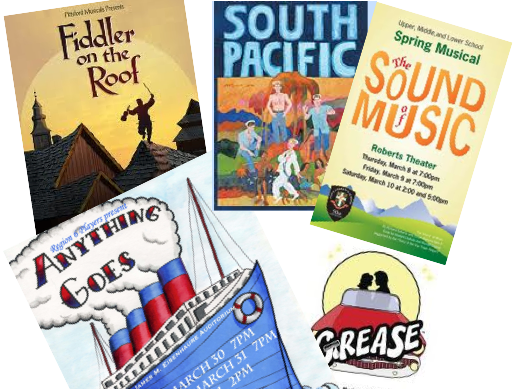
It’s the final act; the final musical number. It is 9:30 PM Eastern Standard Time and Reno Sweeney leads the chorus in the rousing reprise “Anything Goes”. It is  9:30 PM Central Standard Time, and Mother Superior exhorts the Von Trapps to “Climb Every Mountain”. It is  9:30 PM Mountain Standard Time, and the Pink Ladies and the Greasers be-bopp their rendition of “We Go Together”. It is at 9:30 Pacific Standard Time, and the fiddler plays the final wistful strains of “Anatevka” as the villagers sadly leave their homes as part of a great migration.

Across America, it is spring; it is high school musical season.

Just as the snowpack melts in some communities, or the holiday decorations are finally removed from front doors or trees, the lawn signs advertising the upcoming show at the local high school pop up like spring flowers.  The Pajama Game, Joseph and the Amazing Technicolored Dreamcoat, West Side Story, and Hello, Dolly! all have their turns gracing the stage in some auditorium, or maybe a cafe-a-torium. Students who have read The Wizard of Oz, Cinderella, Peter Pan or Beauty and the Beast take on the roles they once imagined. So popular is the idea of a high school musical that Disney created its own successful franchise based on the common high school experience of the High School Musical. 

Each winter, students go through the painful process of auditions. A select few will be thrilled, others will accept those thankless roles in the chorus or the nominal speaking parts. By the time ticket sales start, students will have had eight to twelve weeks in rehearsal, usually in the evenings, often after sports or other school activities. The lead roles will have rehearsed several days a week more than those with those cast in thankless chorus roles. Those with thankless chorus roles will have been working almost exclusively with the choreographer and rehearsal pianist. The set designers and construction crew will have drilled, nailed, and painted the sets; the technical crew will have laid out the miles of cables for sound systems and C-clamped the par-cans in place to highlight sections of the stage. The costume crew will have organized a wardrobe for easy backstage changes, while the stage manager(s) will have clearly labeled set pieces with “do NOT touch” signs. The musicians will have learned their individual parts with the ability to play softly under the spoken lines of dialogue.

Two weeks after those lawn signs advertising the show appear, the technical (lighting and sound) and dress rehearsals begin, and everyone associated with the production will be spending many more hours than anticipated rehearsing scene changes, re-blocked exits and entrances, and correcting dropped lighting or musical cues. The work is collaborative, the responsibility is shared-adult and student alike- and those thankless chorus roles are now critically important.

If authentic experiences are what educators want for students, then the high school musical, an extra-curricular activity for most school districts, is the ultimate project based learning experience. Everything a student does in a high school musical, from the start to the finish, is as authentic as a professional production-from audition through rehearsal to performance, from design to construction to set strike. Long after the set is struck, the pictures from the local paper fade on the bulletin boards, or the advertising lawn signs are removed, students remember their turn upon the stage in ways that defy the best classroom instruction. Everything about the high school musical- a wonderful blend of drama, music and dance- is “hands-on”.

A March 2012 study by the National Endowment of the Arts titled  The Arts and Achievement in At-Risk Youth: Findings from Four Longitudinal Studies finds disadvantaged students do better academically if they are intensely involved in the arts; music, dance, and drama are specifically targeted in the charts and data.  The report states that for low socio-economic status students,”Both 8th-grade and high school students who had  high levels of arts engagement were more likely to aspire to college than were students with less arts engagement.” But even students from high socio-economic status groups benefit:

“Arts-engaged high school students enrolled in competitive colleges —and in four-year colleges in general—at higher rates than did low arts-engaged students. Even among high-socio-economic status individuals, college-going rates were higher if students had engaged in arts-rich experiences in high school, according to a separate database. Ninety-four percent of the high-arts group went on to a four-year college, versus 76 percent of the low-arts, high-socio-economic status group.”

Years ago, I took a group of my 8th grade students who had recently completed three sold-out performances of The Apple Tree at their junior high school to Broadway to see How to Succeed in Business without Really Trying. At the conclusion, as Matthew Brodrick and the cast  lined up for curtain call, a student grabbed my arm in excitement, “They bow!” she stage-whispered to me, “just like us!” To her, there was no difference between their musical and the one they had seen, and in truth, outside of the quality of their performance and the quality of the Broadway set, costumes, lighting, and ticket price; there was no difference. The high school musical memorably combines learning with performance; the high school musical is an American tradition.

Imagine the synchnonicity -a sort of live streaming-  of one musical as performed by high schools across the United States…imagine South Pacific. While one East Coast high school male chorus is stomping and singing, “There is Nothing Like a Dame”, a West Coast high school cast is just opening their production with two of the smallest cast members singing “Dites Moi”.  While the Mid-west actress Nellie Forbush is “Gonna Wash that Man Right Out of My Hair”, the East Coast Cast actor  Lt. Cable is singing, “You’ve Got to be Carefully Taught.” Each production will have some variation of  dance numbers featuring Sailors, Seabees, and Marines. There will be a backdrop for Bali Ha’i . And, in the final scene of each performance, sometime around 9:30 PM, the student playing Emile will reach for the student playing Nellie Forbush’s hand, under the table, while the band swells with the strains of “Some Enchanted Evening”…. the enchanted evening of the ultimate “project based learning” …the high school musical.

For teachers who are looking for guidance on how to teach informational texts at the high school level, there is a model lesson on Lincoln’s Gettysburg Address at the EngageNY website. The text of the speech delivered by Lincoln on November 19, 1863, is short enough to fit on two pages or two bronze plaques on a memorial on the battles grounds in Gettysburg, Pennsylvania. With 272 artfully crafted words Lincoln reframed the objectives of the Civil War while restating the principles of the equality of man. The opening six words are iconic, the closing asyndeton, “and that government of the people, by the people, for the people, shall not perish from the earth” is inspiring. The choice of the Gettysburg Address is laudable and non-controversial as a selection as an informational text. However, this speech is nearing its 150th birthday, and while an understanding of this speech helps students understand who we were as a nation, there are more contemporary speeches that address who we are as a nation today. What other speeches can we offer our students to review for content and style?

I can think of two speeches that have impressed me this school year. One such speech is a commencement address to college students, the other an address of how the power of rock and roll “commenced” and what that meant to an artist. The first speech is formal, running a little under 15 minutes in length, and delivered by Steve Jobs on June 12, 2005, at Stanford University. The second speech is a full 50 minutes delivered on March 15, 2012, by Bruce Springsteen as the keynote address at the South by Southwest Festival in Austin, Texas.

While Jobs engineered his speech into three separate and distinct parts (“Connecting the dots”, “Love and loss”, “Death”), the “Bruce’s” rollicking retelling of his life as a musician is part-explanatory, part-stream of consciousness, and wholly poetic. While Jobs formally and frankly narrated his stories of failure and ultimate redemption in the computer industry, Springsteen peppered his observations with epithets and musical interludes. Both speeches should get a “look-see” by teachers looking to engage students with meaningful informational texts.

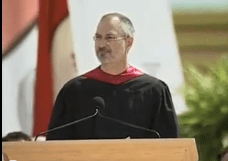
Steve Jobs’s commencement address received a great deal of attention after his passing in October 2011. Stanford University has a page on its website that has both the text of the speech and a video of Jobs reading the speech , standing at the podium with his black graduation robe swirling in the breeze. He opened with the story of his adoption and his bold admission that he had dropped out of college because he “didn’t see the point” –this before a crowd of parents and new graduates who had just completed four or more years at one of the country’s more expensive universities!

Shortly after this startling confession, Jobs deftly described how he followed the “dots”, crediting a calligraphy class at Reed College with being the inspiration in developing his sense of sleek design. These “dots” led him to the computer industry when “Woz and I started Apple in my parents garage when I was 20” and that “in 10 years Apple had grown from just the two of us in a garage into a $2 billion company with over 4000 employees.” He professed his failure, the subsequent firing from the company he had founded, as entirely necessary. “I didn’t see it then, but it turned out that getting fired from Apple was the best thing that could have ever happened to me. The heaviness of being successful was replaced by the lightness of being a beginner again, less sure about everything. It freed me to enter one of the most creative periods of my life.”
In contrast to Jobs’s formal delivery, the video of Springsteen’s speech (video with text link on the NPR website) shows him blinking at the cameras wondering why he is up so early (it was noon) gripping the podium and addressing other musicians saying, “Every decent musician in town is asleep, or they will be before I’m done with this thing, I guarantee you. I’ve got a bit of a mess up here.” Several minutes (and epithets and expletives) later, Springsteen states his thesis:

“So I’m gonna talk a little bit today about how I’ve put what I’ve done together, in the hopes that someone slugging away in one of the clubs tonight may find some small piece of it valuable. And this being Woody Guthrie’s 100th birthday, and the centerpiece of this year’s South by Southwest Conference, I’m also gonna talk a little about my musical development, and where it intersected with Woody’s, and why.”

Springsteen’ s “dots” began with Elvis and television:

“Television and Elvis gave us full access to a new language; a new form of communication; a new way of being; a new way of looking; a new way of thinking about sex, about race, about identity, about life; a new way of being an American, a human being and a new way of hearing music. Once Elvis came across the airwaves, once he was heard and seen in action, you could not put the genie back in the bottle. After that moment, there was yesterday, and there was today, and there was a red hot, rockabilly forging of a new tomorrow before your very eyes.”

Inspired by Elvis, the six-year-old Springsteen wrapped his fingers around a guitar neck for the first time, and when they wouldn’t fit, “I just beat on it, and beat on it, and beat on it — in front of the mirror, of course. I still do that. Don’t you? Come on, you gotta check your moves!”

Both of these speeches center on the importance of love and the love of one’s profession. Springsteen’s love of music, and his embrace of all musical genres, is lyrical as evidenced by his professed love for Doo-wop, a passage in the speech which aches for an accompanying melody:

“Doo-wop, the most sensual music ever made, the sound of raw sex, of silk stockings rustling on backseat upholstery, the sound of the snaps of bras popping across the USA, of wonderful lies being whispered into Tabu-perfumed ears, the sound of smeared lipstick, untucked shirts, running mascara, tears on your pillow, secrets whispered in the still of the night, the high school bleachers and the dark at the YMCA canteen. The soundtrack for your incredibly wonderful, limp-your-ass, blue-balled walk back home after the dance. Oh! It hurt so good.”

Jobs’s love of his work at NeXT, at Pixar, at Apple, is less descriptive but equally impassioned, and he challenged the graduates to recognize the importance of loving one’s work:

“Your work is going to fill a large part of your life, and the only way to be truly satisfied is to do what you believe is great work. And the only way to do great work is to love what you do. If you haven’t found it yet, keep looking. Don’t settle. As with all matters of the heart, you’ll know when you find it. And, like any great relationship, it just gets better and better as the years roll on. So keep looking until you find it. Don’t settle.”

Both speeches also focus on change. In the last portion of his speech, Jobs introduced death; in a moment of cheer and celebration, he bluntly talked about death. He was honest with his beliefs, stating how he did not want to die, and he described how the prognosis of pancreatic cancer drove him to seek surgery. His statement, “and I am fine now” is delivered with such confidence, a poignant moment now that he has passed away. However, Jobs was not trying to be maudlin in discussing his, and our own, imminent fate; he deliberately summed up his feelings about death as “the single best invention of Life. It is Life’s change agent. It clears out the old to make way for the new.” Jobs is right about death as a change agent, but as he stood before that crowd gathered for Stanford’s graduation in 2005, he was a live example of a change agent in our lives and the lives of our students.

Springsteen introduced the legacy of Woody Guthrie as his change agent. He explained how in his 20s he read Joe Klein’s Woody Guthrie, A Life, noting that, “Woody’s gaze was set on today’s hard times” and that “Woody’s world was a world where fatalism was tempered by a practical idealism. It was a world where speaking truth to power wasn’t futile, whatever its outcome.” Springsteen explained that although he would cover Woody’s infamous This Land is Your Land, he was never “going to be like Woody” because he was too fond of Elvis and the pop simplicity of his Pink Cadillac, that is until he and Pete Seegar stood up in front of the Lincoln Memorial in 2009 to sing (with the crowd) From California/ To the New York island/ From the Redwood Forest /To the Gulf Stream waters /This land was made for you and me:

“On that day Pete and myself, and generations of young and old Americans — all colors, religious beliefs — I realized that sometimes things that come from the outside, they make their way in, to become a part of the beating heart of the nation. On that day, when we sung that song, Americans — young and old, black and white, of all religious and political beliefs — were united, for a brief moment, by Woody’s poetry.”

Both Jobs and Springsteen ended their speeches with a clarion call. From the industrialist,” Stay Hungry. Stay Foolish. And I have always wished that for myself. And now, as you graduate to begin anew, I wish that for you.” From the musician: “Don’t take yourself too seriously, and take yourself as seriously as death itself. Don’t worry. Worry your ass off. Have ironclad confidence, but doubt — it keeps you awake and alert.”

Could these speeches be “informational texts”-the new CCSS term used to cover all manner of writing other than fiction? While these speeches are most certainly not equal to the eloquence of Lincoln’s Gettysburg Address, do they have a place in the study of contemporary history? Is the speech that details the development of the Mac with its sleek design and easily used graphic interface, as told by its founder, an informational text? Does the speech that chronicles a musician’s experience with the birth of American rock’n roll and the influence of pop culture qualify as an informational text? Could either speech be a springboard into student research? Could either speech be analyzed for rhetorical structures, word choice, and imagery? Do these speeches inspire the reader?

For students in the upper grades of high school, grades 11 and 12, for whom the CCSS suggests 70% of reading should be in the form of informational texts, the answer is a yes, yes, most assuredly yes!

Lucy Calkins

The difference between reading an article or a book by Lucy Calkins and hearing her speak in person is a difference that cannot be measured in nuances; the difference is measured in hearing the decibles of her passion.

On Saturday (3/24/12), at the 82nd Saturday Reunion held at the Teachers College at Columbia University in NYC, Calkins stood before a packed house of elementary and middle school teachers in the Nave at the Riverside Church to deliver her closing session, “Walking Courageously Forward in Today’s Common Core World: Literacy Instruction, School Reform and Visions of Tomorrow”.  Hours before the keynote address by children’s author Pamela Munoz Ryan, Calkins had been energetically wandering with a microphone to periodically announce the location of a second keynote address for K-1 teachers or explain a new voucher system for lunches to speed up the notoriously overcrowded lunch lines. She waved for  people to make room in the pews for others and directed her aides to circulate with pads of paper to gather e-mails of participants. (NOTE: Please, Ms. Calkins; get a Twitter account or just have us send our e-mails to a web address!)

According to the jam packed schedule of workshops, she then presented at 10 AM: “An Introduction to the Project’s Thinking About Common Core-Aligned Upper Grade Reading”. At 11AM she presented the workshop, “In the Complicated World of Today, What’s Changed and What’s Stayed the Same About the Teachers College Reading and Writing Project’s Ideas on Teaching Writing?”, and she was spotted checking in on other presentations during her “spare time”.  All this before delivering her final address back in the church at 1PM.  Calkins is already a one person educational seismic wave, which made her opening, a lifting of the lyric from a Carole King’s song, “I feel the earth move under my feet”, much more than metaphoric.

Lucy Calkins is the Founding Director of the Reading and Writing Project LLC and the  Teachers College Reading and Writing Project as well as the Robinson Professor in Children’s Literature at Teachers College where she co-directs the Literacy Specialist Program. She has authored several books about teaching writing, and she has recently co-authored a book, Pathways to the Common Core: Accelerating Achievement.

Much of the speech was directly lifted from her article, “Explore the Common Core” where she advocates for teachers to embrace the Common Core to be a “a co-constructor of the future of instruction and curriculum, and indeed, of public education across America.” She writes,

“As challenging as it must have been to write and finesse the adoption of the Common Core State Standards, that accomplishment is nothing compared to the work of teaching in ways that bring all  students to these ambitious expectations.The goal is clear.The pathway is not.”

In confronting one of the possible pathways, Calkins leveled her most serious criticism. She called attention to two of the Common Core State Standards (CCSS) authors who have emerged very publicly as spokespersons, David Coleman (Student Achievement Partners) and Susan Pimentel (Education First), and reminded the attendees that neither has been a classroom teacher. “What is alarming is that they feel empowered to continue to write the Common Core,” she declared. There are a growing number of CCSS support websites that illustrate her frustration, for example, Coleman’s well-documented lesson plans on the study of informational texts such as The Gettysburg Address with his explanations on videos are found at engageny.org.  Ironically, while most historians praise Lincoln for the brevity of this address and the precision of its language,  Coleman’s lesson design would have students spend six to eight sessions in a close reading of the speech. Calkins complained that  extended close readings like Coleman’s are “text dependent activities” and that there are “no questions that transfer to another piece” as well as the unreasonable commitment of time to one common text.

Her frustration also stems from the New York State’s Department of Education’s adoption of many of Coleman’s additions to the original CCSS in providing models for curriculum development. She sounded a loud chord of caution against Coleman and others who write “around the standards” in presenting their curriculum models. She rhetorically challenged Coleman, “Where is the evidence do you have,  David Coleman, that your method works? Where is the evidence that the close reading you describe is improving literacy?”

She then modeled a quick lesson on the poem “To a Daughter Leaving Home” by Linda Pasten, where she effectively refuted Coleman’s tedious approach of laboriously parsing every word in a text. She dismissed the notion that the discussion of any piece “ends at the four corners of the text,” adding that “one cannot infer or understand a metaphor without drawing from [one’s self].” Instead she recommended “sticking as CLOSELY to the text as possible, and in a response, have the student respond to the question ‘how do you know?'”.

Calkins also expressed concerns that in order to meet  CCSS “they [administrators] will add more…informational texts, more close reading. That will not work” she concluded emphatically.  Instead, “The problem facing schools is fragmentation and overload;” adding more to the teacher’s curriculum requirements will not be effective. Chiefly, she explained, the CCSS is, “not about a curriculum of compliance. This is about accelerating students, ramping up student achievement;” the CCSS is a “call for school reform.”

Because of CCSS, however, there will be enormous amounts of money spent on developing curriculum, resource materials, and testing. Authors of the CCSS, educational consultants, publishers, testing services are all looking to develop materials in order to help school systems meet the CCSS.  CCSS has spawned a new industry. Calkins detailed the anticipated expense of implementing the CCSS as $15.8 billion with $7 billion of the expense committed to technology so that students can complete testing online. When the “number one reason preventing student achievement is poverty”, in a time of shrinking budgets, Calkins described her discomfort with implementing  such costly programs and the inevitable auxiliary expenses that will be spent school district by school district in trying to meet the CCSS.

How can educators meet the CCSS in specific ways? “Students should have clear goals so they have a sense what is expected by gathering performance data,” Calkins advised, “Note what has changed with the student and [note] what changes are we expecting. A school should be able to identify [exemplars] what is expected at each grade level.” She also urged teachers to “embrace the call to nonfiction literacy” in order to build knowledge. “Change is hard,” she noted, “but research shows that fear will not make people change; the only effective way to change is through is support groups” suggesting that teachers need to collaborate in support groups to meet the CCSS.

Listening to Calkins was a more than a pep talk. Her reasoned approach to the CCSS was not born solely in the ivory towers of academia nor at a table of educational policy wonks. Her advice to read the CCSS as “gold” comes from her ongoing commitment to improving education coupled with her experience with  students and the teachers she supervises.

Had the audience the opportunity to respond to Lucy Calkin’s line of verse from the song “I Feel the Earth Move”, they could have easily chose another title from  from Carole King’s Tapestry album…”Where You Lead, I Will Follow.”

English teachers are seduced by literature. We fell in love with an author’s language, a fascinating plot turn, or a well-developed character, and we are bold in our love. While students may roll their eyes when we proclaim The Great Gatsby  or Great Expectations as  a favorite book, or snicker when we dramatically recite lines from Shakespeare’s Macbeth, we hardly pause in our attempts to introduce 1984 into 2012 brains. They may groan while we happily distribute Lord of the Flies and assure them they will “love” the book; they may find us positively deranged when we weep at the death of Lenny (Of Mice and Men), or the Man (The Road) or Willie Loman (Death of a Salesman). However, nothing makes an English teacher happier than the conversion of our reluctant readers into admirers of an author’s work. The teaching of literature as a record of man’s humanity sums up our purpose, our raison d’etre. For writing and grammar, we will roll up our sleeves and revise, and conference, and edit, edit, edit. For the newer standards in listening and speaking, we support presentations in class and incorporate technology when necessary, but the joy of teaching English is in the literature, in the wealth of stories told by others.

Now, the adoption of Common Core Standards has many English Language Arts teachers concerned. Why? According to one of a number of  Common Core websites, (NOT the Common Core State Standards website) the standards are designed around the “basic idea” of a “utilitarian education.” David Coleman, one of the architects of the Common Core, supports the expansion of informational texts, a genre formally known as non-fiction, into all disciplines, “For example, students are asked to read a variety of texts. In 4th grade, they must read 50% literary text and 50% informational texts; by high school, they read only 30% literary texts and 70% informational texts.” Of course, English teachers have always included exceptionally well written pieces of non-fiction into their teaching. For example, Jonathan Swift’s A Modest Proposal illustrates power of satire, Elie Wiesel’s Night is a haunting memoir, and Roger Rosenblatt’s The Man in the Water is a memorable personal essay, and all have found homes in English curriculums. But the disproportionate ratio of 30% fiction to 70% informational text? That ratio for lovers of literature is alarming.

In order to achieve the inclusion of informational texts, The Common Core of Standards for English/Language Arts includes a separate set of standards that address reading and writing in history, science, math and the technical areas. While these standards were developed to expand reading and writing in these disciplines in order to advance core knowledge, these standards still fall under the umbrella of the English/Language Arts Standards. Note that these standards have not been developed by the respective disciplines of history, science, math and the technical areas. Moreover, there is no mechanism for enforcing these standards through history, science, math and the technical areas except through the English/Language Arts Standards. English teachers are understandably concerned that they will ultimately be responsible for the increase in the reading of informational texts at the expense of the literature they so dearly love.

So, it is with great delight that I read in an informational text (aka news article) that science supports the reading of fiction.

According to an article in the New York Times, Your Brain on Fiction (3/17/12) by Annie Murphy Paul, neuroscience is riding to the English teacher’s rescue! The article is centered on research that demonstrates “Brain scans are revealing what happens in our heads when we read a detailed description, an evocative metaphor or an emotional exchange between characters. Stories, this research is showing, stimulate the brain and even change how we act in life.” Apparently, our brains cannot differentiate between the fictional experience and the real life experience, “in each case, the same neurological regions are stimulated.” Furthermore, the simulation of social experience in fiction through a character’s point of view  helps prepare our brains for real-life social interactions.

Researchers Dr. Oatley (University of Toronto)  and Dr. Mar (York University-Canada), in collaboration with several other scientists, reported in two studies, published in 2006 and 2009, that because of these fictional experiences, readers were more empathetic.

Fiction, Dr. Oatley notes, ‘is a particularly useful simulation because negotiating the social world effectively is extremely tricky, requiring us to weigh up myriad interacting instances of cause and effect. Just as computer simulations can help us get to grips with complex problems such as flying a plane or forecasting the weather, so novels, stories and dramas can help us understand the complexities of social life.’

Dear Common Core, take note. Science has the research to prove that the reading of fiction is equally critical to the development of our social life skills; fiction is not limited to a ratio of 30% importance. The usefulness of fiction in social development is not an arbitrary argument from the heart, but a means by which our brains experience our world.  Yes, informational texts can deliver content and support core knowledge, but fiction is what develops our humanity. Which is why we English teachers fell in love with stories in the first place.