Archives For November 30, 1999

The EDsitement website, funded by the National Endowment on the Humanities, offers lesson plans that are aligned to the Common Core State Standards.  I have modified several of these lessons; other lessons on this site are familiar fare in English classrooms. One example is the lesson on Carl Sandburg’s Chicago  which asks students to pick a location and respond to prompts such as, “If this place were a person, what kind of person would he or she be? What noticeable physical characteristics would this person have? How would he or she act? What would this person wear and do?”  The lesson on Arthur Miller’s Crucible is also familiar, “Have students answer the following questions: What is John Proctor’s dilemma in Act IV? What motivates Proctor’s initial decision to lie?”

While there is always a need for more resources and support for teachers, I have two complaints about theEDsitement site. The featured lesson on the site this month is  Vengeful Verbs  in Hamlet for grades 6-8. The targeted age group and the objectives for this lesson are inappropriate; Hamlet is not for middle school students. That leads me to question the appropriateness of lessons for other students as well.

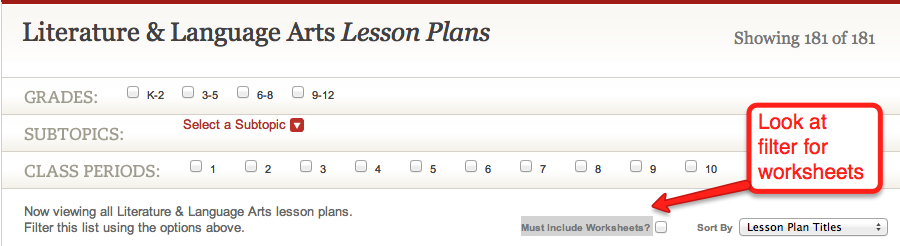
The second problem is a worksheet filter option on the site where lessons can be identified as offering worksheets or not.  Worksheets?  In the 21st Century, with all the digital possibilities, the National Edmowment for the Humaties is promoting worksheets? Why?

Many educators consider worksheets the “busy work” of education. Worksheets have correct answers; they are prescribed and limiting. Early childhood experts have pointed out that many worksheets do not allow the kind of problem solving that involves an element of risk, saying “if we want children to learn to solve problems we must create safe environments in which they feel confident taking risks, making mistakes, learning from them, and trying again” (Fordham & Anderson, 1992). Activities that require creative problem solving or critical thinking should be the goal of every teacher. The worksheet can limit both.

Additionally, worksheets are expensive. Paper and toner ink are the first expense, but the second expense is time. How familiar are teachers  with the number of hours that are wasted in front of copy machines copying worksheets?  Sadly, very familiar. What happens when the copier breaks down? Frustration. A teacher who relies on worksheets is forced to scramble when an unreachable tiny scrap of paper lodges into one of the copier’s feeders, or when the toner is low, or when code505 appears on the digital screen. In contrast, the increase of digital platforms in education allows teachers the opportunity to spend time more productively setting up documents that can be used by individual students or collaboratively.

Students have so many ways to record responses digitally, for example on Google docs or blogs or wikis, so why waste paper? The worksheet should be relegated to files of emergency backup lesson plans for a substitute.

The National Endowment of the Humanities should lead the way in weaning teachers off the worksheet. The emphasis on filtering lesson plans for worksheets should be eliminated. The availability of lesson plans aligned to the Common Core State Standards is a great resource that is cheapened with the pedestrian 20th Century tool of worksheets. EDSitement should not straddle  a 20th-21st Century divide. With funding support from  Verizon Thinkfinity, a foundation firmly in the 21st century,  EDsitement should lead.

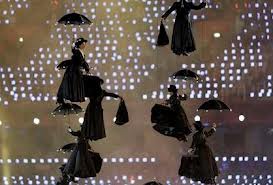
Mary Poppins to the rescue:
Photo from A Guide to the London 2012 Summer Olympics Opening Ceremonies
theblaze.com

The London 2012 Olympic Games Opening Ceremony was broadcast at 9pm on 27 July 2012 (EST). As a platoon of  Mary Poppins clones decended clutching their iconic umbrellas to vanquish the Lord Voldemort mid-ceremony, I was suddenly struck by an idea. How would the Common Core English Language Arts Standards view this production? The extravanganza developed by world-class directors Danny BoyleBradley Hemmings and Jenny Sealey and their teams was an eclectic mix of information  and fiction that “celebrated contributions the UK has made to the world through innovation and revolution.”

What grade, however, would the Common Core State Standards (CCSS) give London’s Olympic Games Opening Ceremonies? To make this assessment, a set of criteria needs to be established.  Informational texts are factual and real. Add a touch of whimsy or artistic interpretation and informational texts blur into that fuzzy blend of the literary genre of fiction. Lyrics in music are often considered poetry, so music also falls in the realm of fiction, and for the purposes of this assessment, so will an artistic dance that expresses a story.

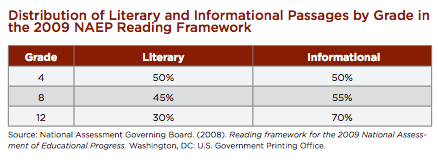
Recommended ratios of informational texts to fiction by grade level.

The CCSS suggest a decreasing ratio of fiction  to an increasing ratio of informational texts  for students in grade 4, grade 8, and grade 12. (see chart) This does not mean that English/Language Arts classes must drop literary fiction, but that other disciplines (History/Social Studies, Math, Science, Health, etc) should include more informational texts in their instruction in order to achieve the suggested ratios. The London 2012 Opening Ceremony was a blend of information and fiction (literally!).

Did London’s “Isles of Wonder” Opening Ceremony meet the recommended ratios of fiction to informational text according to Common Core State Standards?

A quick tally of the highlights as they appeared as either  fiction or informational text:
  • James Bond at Buckingham Palace escorting Queen and Corgis-fiction
  •  Skydiving Queen Elizabeth II-fiction
  • Thames River origin marker, Thames waders, Thames rowers, Thames boat traffic, Thames on a Google map -informational text
  • A flyby of Mr. Rat and Mr. Toad from Kenneth Grahame’s Wind in the Willows arguing in a boat on the Thames-fiction
  • The Pink Floyd Tribute pig  seen floating above the Battersea Power Station-fiction
  • London landmarks Big Ben and London Bridge-informational text
  • Big Ben’s hour and minute hand rapidly spinning and time traveling in London’s Tube- fiction
  • Posters of past Olympics contrasted with posters advertising 2012 Games-informational texts
  • Fluffy White Clouds held with string on a set of an English meadow –fiction
  • Tribute to the Agrarian Society featuring a very busy sheepdog with livestock -informational text
  • Tribute to the Industrial Revolution with Kenneth Branagh as Isambard Kingdom Brunel, the man who was responsible for England’s Industrial Revolution-informational text
  • Kenneth Branagh as Kenneth Branagh reading Caliban’s speech from Shakespeare’s The Tempestfiction
  • Forging of Tolkien’s “One Ring to rule them all” leading to the Forging of the Olympic Rings-fiction
  • Song by Scotland singer Emeli Sandé  and  dance British choreographer Akram Khan: fiction; their performance pre-empted by a silly interview by Ryan Seacrest of Michael Phelps-informational text
  • Tribute to National Health Service replete with backlit hospital beds filled with bouncy children, and dancing nurses and orderlies-informational text
  • Arrival of villainous characters from children’s literature (Including The Child Catcher from Chitty Chitty Bang-Bang, The Queen of Hearts Alice in Wonderland, and an inflated Voldemort from Harry Potter) chased away by PT Traver’s famous nanny, and all replaced by one giant sleeping baby-fiction
  • Rowan Atkinson’s,  (Mr. Bean), imagination running amuck in Chariots of Fire –fiction
  • A “Tube” made of tubes to highlight a contemporary romance: boy meets girl via cell phone-fiction
  • Musical hits from the 60′s, 70′s, 80′s, 90′s with unnecessary extended rap performance-fiction
  • Clothing from  the 60′s, 70′s, 80′s, 90′s (with the exception of the fictional Sgt. Pepper Costumes and Freddie Mercury Bobbleheads)  informational text
  • The big reveal of the creator of Sir Timothy John “Tim” Berners-Lee also known as “TimBL”, computer scientist, MIT professor and the inventor of the World Wide Web -informational text
  • Soccer great David Beckham arriving in a speedboat to hand the torch to Steve Redgrave, a five-time Olympic champion in rowing-informational text
  • The Olympic Cauldron, formed of 205 copper petals (one for each country) ignited by seven young torchbearers nominated by Britain’s past and present Olympic and sporting greats-informational text
  • Paul McCartney’s appearance for a British pound -informational text;  Lyrics of “Hey, Jude” sung by all athletes and audience –fiction
  • Pyrotechnics exploding from every conceivable platform in and around the stadium-informational text

My quick tally of 25 selected moments of the opening games comes to a total of 15 fictional texts (55% ) compared to 13 informational texts (48%)-(including two “blended information and fiction”). These percentages indicate that the production was too heavy in fiction. However, perhaps this high number of fictional texts is not really a surprise as Danny Boyle was hired specifically for his talents with stories (Slumdog Millionaire). According to a CNN report, Bill Morris, director of Ceremonies for the London Games said, “His ability as a storyteller, as a creator of spectacle, his background in both theater and film and the passion he has for this city and this project — they all just screamed at us. It wasn’t a difficult choice.”

Ultimately, London’s Opening Ceremony would not meet the suggested ratio of genres for the Common Core State Standards. According to my criteria and chosen highlights, the elements of the Opening Ceremony would not meet the suggested ratio of 50%  fictional texts to 50% informational texts in Grade 4, and certainly would not meet the ratio of fiction (30%) to informational texts (70%)  for students by grade 12.

There is one more informational fact that could be added to tilt the ratio.  The cost of the opening ceremonies was  27 million British pounds. That cold economic fact could be assessed against the joy of watching the Danny Boyle’s frenetic and spectacular celebration of Great Britain, both real and imagined. However, even this ratio would still not satisfy the recommendations for reading genres. When judging Olympic Opening Ceremonies, the Common Core is not the gold medal standard.

When I asked a question in class this year, I had to directly address a student: “Christina, what do you think….” or “Patrick, how does…”. I could not just toss out a question to the entire class. In fact, if I failed to individualize the Socratic method, the result was a chorus of dissonance, a cacophony of responses, a gabble of student voices directed towards no particular audience.  I also noted this year that a great number of students would reason aloud rather than think  before speaking.  This year my students did not discuss as much as transmit. What I was hearing was the  sound of student voices broadcasting as individual program streams. I needed to train my students in the art of discussion, when to contribute to conversation, and how to share communal air time.

I wondered how to account for this phenomenon and concluded my students had an “I” problem. They are the “I” tech pioneers students who grew up with multiple digital devices marketed to that 1st person singular pronoun.

Consider that the I-pod was released to the public on November 10, 2001. My 9th grade students who have proven incapable of clicking into a shared conversational stream were two or three years old at that time. My students have grown up listening to a self-selected soundtrack piped through earphones singularly and directly into their ears. They have had complete control over each musical track all of their lives. There has been no “B” side option to their playlist.

My students have been able to control all other forms of media as well, choosing to watch video content commercial-free selected  from multiple streaming websites. They watch TV shows from any  number of platforms (Hulu, Netflix, Amazon), yet few admit to watching TV during regular broadcasting on a TV screen at all.  They design their own video channels or post their own videos online. Pronoun marketing abounds for this generation: YouTube’s use of the 2nd person singular has been an invitation for them to post their content since they were 8-11 years old. How individualized my students’ experiences are from the collective experiences of their elder siblings, their parents, and their grandparents.

They have “friends” they have never met, they play games against people without regards to age or gender, and they cannibalize photos and files from other sources to create “personal” websites. They were 6-9 years old when My Space came online; now they now have a plethora of choices: Facebook, Tumblr, Pinterest, etc.

Yet, for all of their posting and tweeting, they are still communication-impaired. They have difficulty in developing or engaging in a discussion in class. Of course, students in previous years have required guidance on class discussion rules, but this past year was substantively different.  I believe all of this “I”-serving technology has led an increase in personalized content but a decline in knowing how to share “we”-time.

By way of contrast, I am a child of AM radio. I was one pair of the million ears that heard the DJ chatter of Harry Harrison or Cousin Bruce Morrow. I grew up to a prescribed soundtrack that would reverberate in pop record synchronicity on city streets, sidewalks, parks and beaches. In 1970 the air pulsed hourly with The Carpenters Close to You even though I hated the song. I was part of a collective experience whether I wanted that experience or not. I am a child of network television who remembers when one evening’s broadcast of Ed Sullivan or Walter Cronkite would be the following week’s discussion.  I played with peers I could touch; I could see my friends. We talked in person, and we had long extensive conversations. I was in an environment that conditioned me to wait my turn and share my time. I knew I was in a collective, and for good or for bad, I was connected but “unconnected.”

So when I read Sherry Turkle’s opinion piece “The Flight from Conversation” in the NYTimes on Sunday, April 12, 2012, I saw one line that described a symptom I recognize in my students, “A 16-year-old boy who relies on texting for almost everything says almost wistfully, ‘Someday, someday, but certainly not now, I’d like to learn how to have a conversation.’

 In the piece, Turkle describes how an increasing reliance on technology reflects the “I” centered experience:
“We want to customize our lives. We want to move in and out of where we are because the thing we value most is control over where we focus our attention. We have gotten used to the idea of being in a tribe of one, loyal to our own party.”

The daily environment for the “tribes of one”, my students,  in and out of school is filled with digitally enhanced communication, but there is little serious conversation.  My students have few opportunities outside of the classroom to practice the art of discussion without a digital device in hand. So I have been taking “baby steps” in the classroom by first asking them to respond to each other.

“Do you agree with Mackenzie?” ”
“Can you add to what Matt said?”
“Please restate what Breanne said.”

There are popsicle sticks with each name to insure I have each member of the class speak during the day. On some questions,  I also ask them to pause 30 seconds before responding and remind them they are graded on not only what they say but by the attention they give to others. These techniques have helped control the immediate response impulse- the noisy nonsense of 25 incomplete thoughts spark-plugging aloud in the room. Only recently, however, have  I asked them to look at each other when they respond. The first three exchanges were awkward, but Nick’s full on attention to Logan was so comical that  “making eye contact” became fun. I hope that continuing eye contact will help the interchange of ideas which is the basis for conversation.

Turkle’s concern is that, “We are tempted to think that our little ‘sips’ of online connection add up to a big gulp of real conversation. But they don’t. E-mail, Twitter, Facebook, all of these have their places — in politics, commerce, romance and friendship. But no matter how valuable, they do not substitute for conversation.”

I agree with Turkle and recognize that teaching the “I” generation requires changing the way we, teachers and students, communicate in the classroom. Successful participation in conversation and discussion are the critical skills students need to counterbalance the social media that Turkle says continually asks us what’s “on our mind,” but allows us  “little motivation to say something truly self-reflective.” Our students need to move from the digital ease of self-expression to a stage of self-reflection in order to demonstrate understanding and to share that understanding with others. To insure all student have these skills, the recently adopted Common Core Standards in English Language Arts will require teachers to improve the speaking and listening skills from K-12 grades. For example, requirements for grades 9 and 10:

CCSS  SL.9-10.1.Propel conversations by posing and responding to questions that relate the current discussion to broader themes or larger ideas; actively incorporate others into the discussion; and clarify, verify, or challenge ideas and conclusions.

Our students cannot continue the experience of dancing solo to the selected soundtrack of their own “I”-device in the classroom without learning how to either share that experience with others or reflect on how that experience defines them. Educators need to teach all students that they should appreciate the many ways we now communicate but learn to recognize that the limitations “I” center devices have in communicating. We need to encourage those who are like Turkle’s 16 year old student example,  a student who wants “someday”to participate in conversation “but, certainly not now,” to see themselves as social beings.They must learn that their use of technology’s social media can not replace the in-person interaction that happens in social and academic conversation. They need to practice the act of conversation now rather than “someday,” and the classroom is a great starting place. Oh, and we need to remind everyone  to make eye contact.

GOAL -School districts want to report their students to read great literature.
GOAL-School districts want to report good reading test scores.

Unfortunately, these two goals are currently incompatible; great literature’s complexity can be challenging to read, and schools can ill afford to have students get low test scores on reading because of great literature’s complexity.

Concerns about the removal of great literature from classrooms have been raised before, but NY public school English teacher Claire Needall Hollander passionately argues how intellectually damaging this practice has become in state testing. Her  op-ed piece in 4/21/12  NYTimes Teach the Books, Touch the Heart decries the elimination of great literature in the classroom in order to incorporate practice materials to prepare students to take the standardized tests. Hollander described her role as a reading enrichment teacher as an opportunity to provide great literature as academic equity for her students. She described several of her students as  the sons and daughters of immigrants or incarcerated parents; she noted some students lived in crowded, violent, or abusive homes. Great literature, she believed, was “cultural capital” that could help her students compete against more affluent peers. However, when the lackluster data from standardized reading tests came in, she felt pressured to abandon great literature and curtailed her efforts for the majority of these students in order to teach materials prescribed for the state test.  While the reading selections on the state tests did have some syntactical complexity, she eventually decided that these reading materials lacked the literary qualities that make literature great. Texts that are “symbolic, allusive or ambiguous are more or less absent from testing materials.” Hollander writes, “It is ironic, then, that English Language exams are designed for ‘cultural neutrality.'”

In one sense, great literature is already culturally neutral. The themes or characters in a great piece of literature are not limited to one decade or one millennium. The elements that make a work of literature great can transcend culture and context, can speak to a universal audience, can be read by any tradition and still connect to a reader. Ms. Hollander’s concerns about cultural neutrality are akin to concerns about cultural acceptability. Creators of standardized tests are particularly sensitive in selecting texts that are cultural acceptable because great literature  intentionally confronts morality, questions society’s rules, or challenges tradition. Great literature gives voice to the outsider, and authors of great literature are often on the margins of society or write to unsettle the status quo. For these reasons, selections from great literature may not be considered culturally acceptable.

I have some experience on what goes onto a standardized state test as I had a seat one year as a member of the text selection committee for the reading and writing sections of the Connecticut Academic Performance Test (CAPT)  given to grade 10 students. Much time was spent reviewing materials for inclusion on a future Response to Literature exam. Out of a number of mediocre short stories, the only selection given to educators that could meet some standards of great literature was a chapter from Lois Lowry’s Number the Stars, a young adult novel that is usually read in Grade 5.  That selection was eliminated not only because of the low reading level (5.1; Lexile 670) but because the manner in which Lowry portrayed the terrifying rounding up of Jews. One committee member actually wondered aloud if Lowry could be persuaded to “reword the chapter” to address the concern. Fortunately, that debate ended with the decision that the chapter was not “acceptable” for the committee.

One problem in great literature is difficult vocabulary; for example, the simple conversations between the Man and the Boy in Cormac McCarthy’s The Road (RL 4) are interspersed with diction describing the apocalyptic setting:  “rachitic “, “miasma”, “escarpment”, “crozzled”.  Another problem is vocabulary  considered vulgar or profane that has eliminated a number of literary pieces from standardized testing and even from school libraries. According to the American Library Association (ALA) website which  lists challenges to classic literature that Hollander might teach: To Kill a Mockingbird- “contains  racial slurs”;  Of Mice and Men – “takes God’s name in vain 15 times and uses Jesus’s name lightly.” Finally,  great literature almost always contains themes that can be considered dangerous  or offensive to someone in society:  The Color Purple is “sexually graphic and violent”;  1984 is “pro-communist”; and Catcher in the Rye– is infamously “blasphemous and undermines morality.”

Engineering English language tests in order to make them culturally neutral or culturally acceptable encourages intellectual dishonesty. Take the reading section on the Connecticut Academic Performance Test (CAPT)  where every 10th grader is required to read a short story and evaluate the quality of the story, “How successful was the author in creating a good piece of literature?” in a one page essay. I have spent over 10 years preparing students for this  question on the Response to Literature standardized test, and I know how students struggle with this question. Many students do not read challenging texts outside of the classroom, limiting their experience to develop critical evaluation skills. However, the more distressing problem is that year after year, the quality of the story on the CAPT pales in comparison to the classic short stories a student could encounter in even the most limited literature anthology. Classic short stories available in the public domain by Saki, Anton Chekhov, Kate Chopin, Stephen Crane, and Jack London, to name a few, are considered too difficult for independent reading by 3rd quarter 10th grade students. Copy-write requirements or an author’s unwillingness to truncate a story to comply with a maximum word requirement or to make textual changes to make the subject palatable to a text selection committee, prevents other literary materials from being used.   As a result, more recent selections have come from Teen Ink (stories written by teens) and Boy’s Life magazine, both publications not known for superior literary content. While some stories may meet a sentence complexity standard and have been vetted for acceptable content, most lack the literary depth that should generate thoughtful critical responses to a prompt that asks about “good literature.”

To further complicate the choice a student makes in a response, released materials from previous exams used to prepare students how to respond to “How successful was the author in creating a good piece of literature?” include student responses, and all of the exemplars, good and bad, argue that the story was “good”.  The  lack of reader experience coupled with the year to year see-saw quality of the text on the exam places  students in the uncomfortable position of defending a merely average quality story as good literature; therefore, the prompt promotes intellectual dishonesty.

Perhaps the problem of including good literature on a standardized test may be addressed with the adoption of the English Language Arts Common Core State Standards where text complexity is standard #10: “By the end of grade 9, read and comprehend literature, including stories, dramas, and poems, in the grades 9–10 text complexity band proficiently, with scaffolding as needed at the high end of the range.”

In other words, the use of good literature on a CCSS English Language Arts exam might be substantively different than the texts used on the Response to Literature section of the CAPT. This could make the response about the quality of text more authentic since a complex literary text can be analyzed as “good literature.” How this more complex literary text will be used in testing, however, remains to be seen since history demonstrates that cultural opposition to a story will often trump quality.

Comprehending and evaluating a text are desirable skills, and measuring those skills will still be difficult.  Multiple choice questions are quickly corrected, but they are limited to measuring reading comprehension, and a student essay response to a complex text will require considerably more time to write and correct. Anticipating this, Hollander calls for an assessment that is more reflective of student learning:

 “Instead, we should move toward extensive written exams, in which students could grapple with literary passages and books they have read in class, along with assessments of students’ reports and projects from throughout the year. This kind of system would be less objective and probably more time-consuming for administrators, but it would also free teachers from endless test preparation and let students focus on real learning.”

The CCSS should consider Hollander’s proposal as states develop assessments.  All stakeholders should also recognize that using anything less then quality literature to measure a student reading comprehension and evaluation skill on an English/Language Arts exam is intellectually dishonest.

The English Language Arts Common Core State Standards (CCSS) wants students to read in every discipline from elementary school through grade 12. The standards demand an increase in the reading of informational texts, the genre formally known as non-fiction. So where is the passage that concludes that English/Language Arts teachers will continue to teach fiction and literary non-fiction while other disciplines increase reading in informational texts? Where is the passage that dispels the notion that English/Language Arts teachers are not required to meet the 70%  required reading of informational texts in their classrooms?  Where is the passage that clarifies where students will read more informational texts across the curriculum by senior year?

Well, the passage is a footnote on page 5:

Footnote: 1 The percentages on the table reflect the sum of student reading, not just reading in ELA settings. Teachers of senior English classes, for example, are not required to devote 70 percent of reading to informational texts. Rather, 70 percent of student reading across the grade should be informational.

Why is an explanation of this magnitude only a footnote? By definition, a footnote is:
1. A note placed at the bottom of a page of a book or manuscript that comments on or cites a reference for a designated part of the text;
2. Something related to but of lesser importance than a larger work or occurrence.

This  footnote on page 5 of the CCSS functions to clarify that English/Language Arts teachers are not responsible for the increase in reading informational texts. Is this footnote, according to the definition,  “Something related to but of lesser importance than a larger work or occurrence”?  Why is this statement not given more importance in an English/Language Arts document? Why is this statement not written in bold? Why is this statement not a separate bullet point in Key Designs Considerations? Why is this statement relegated to be a footnote?

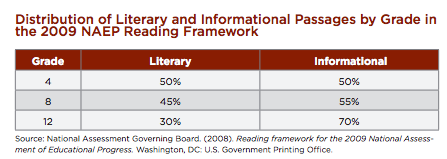
The specific ratio of how much reading students should do in in fiction and informational texts can be found in a chart in the ELA CCSS  taken from the 2009 reading framework of the National Assessment of Educational Progress (NAEP). This chart sets up the progression from an even split between fiction and informational texts in grade 4 to the 30% fiction and 70% informational text ratio expected by grade 12.

Chart with 30% fiction, 70% informational Text ratio

The chart is on the Key Designs Considerations page and addresses the demands to include informational texts because “a great deal of informational reading in grades 6–12 must take place in other classes if the NAEP assessment framework is to be matched instructionally.”

Really?  If the NAEP assessment framework is to be matched? Why “if”? The only way the ratio for 70% informational texts will meet the NAEP assessment framework is “WHEN” there is an increase of informational texts in classes other than English. Additonally, it is highly unlikely that English teachers will teach a reduced percentage of  fiction or literary non-fiction as students move from elementary (Grade 4) to middle (Grade 8) to high school (Grade 12), and there is nothing in the standards that specifies the ratio of fiction to other texts in an English classroom.

So, heads up History/Social Studies, Science and the Technical Areas teachers, the CCSS English/Language Arts Framework is looking at you!

While English/Language Arts teachers are developing curriculum to align with the CCSS, how many of the History/Social Studies, Science and the Technical Areas teachers are informed and cooperating in the incorporation of informational texts?  Are teachers in History/Social Studies, Science and the Technical Areas developing additional reading to their specific curriculum? Hopefully they are, but my sense is that these resources will take time to develop and integrate.

Already, I have heard the argument from teachers in disciplines other than English/Language Arts moaning, “what do I drop out of my course to include reading?” -which could be read as the reason why the authors of the ELA CCSS felt the need to develop reading and writing standards for History, Social Studies, Science and the Technical Areas teachers. A sidebar column in the document explains the need for other disciplines to increase reading:

“Reading is critical to building knowledge in history/social studies as well as in science and technical subjects. College and career ready reading in these fields requires an appreciation of the norms and conventions of each discipline, such as the kinds of evidence used in history and science; an understanding of domain-specific words and phrases; an attention to precise details; and the capacity to evaluate intricate arguments, synthesize complex information, and follow detailed descriptions of events and concepts…Students must be able to read complex informational texts in these fields with independence and confidence because the vast majority of reading in college and workforce training programs will be sophisticated nonfiction (60).”

The last sentence of this section should be in bold: “It is important to note that these Reading standards are meant to complement the specific content demands of the disciplines, not replace them.” 

While the teachers of History, Social Studies, Science and the Technical Areas are on notice to include more informational texts, these standards still fall under the English Language Arts Framework which begs the question, who will be responsible for enforcing these standards? Will the testing of a student’s comprehension of informational texts be assigned to a discipline other than English/Language Arts? Will overall reading scores reflect on an entire school, as it should, or will reading scores reflect on the English/Language Arts departments since the CCSS frameworks are designed under the heading English Language Arts frameworks?

Of course, many English teachers, fearing the removal of fiction and literary non-fiction (essays, memoir, etc), raised their concerns about the demand for informational texts. Responding to these concerns (among others), the  CCSS developed a page on their website titled Myths vs. Facts.
Here, the CCSS attempts to clear the confusion as to what reading will be done in English/Language Arts:

Myth: English teachers will be asked to teach science and social studies reading materials.

Fact: With the Common Core ELA Standards, English teachers will still teach their students literature as well as literary non‐fiction. However, because college and career readiness overwhelmingly focuses on complex texts outside of literature, these standards also ensure students are being prepared to read, write, and research across the curriculum, including in history and science. These goals can be achieved by ensuring that teachers in other disciplines are also focusing on reading and writing to build knowledge within their subject areas.

Unfortunately, the CCSS’s use of footnotes and charts to define the percentages in the increases in informational text reading leaves questions as to which exactly how each discipline will be held responsible.  The CCSS makes the assumption that other disciplines will  incorporate more reading under a English/Language Arts framework. The CCSS states that the English/Language Arts classrooms will not be required to replace their fiction and literary non-fiction with informational texts, but infers that there will be a mechanism “to ensure that teachers in other disciplines are also focusing on reading and writing to build knowledge within their subject areas.” The method of measuring the increase and the results of this increase is yet to be determined.  The process of how reading will be incorporated across the curriculum needs more than an assumption and an inference. For English/Language Arts teachers there is a footnote is where the “devil is in the details”, but only if all other stakeholders in this shift to a Common Core curriculum read that footnote.

For teachers who are looking for guidance on how to teach informational texts at the high school level, there is a model lesson on Lincoln’s Gettysburg Address at the EngageNY website. The text of the speech delivered by Lincoln on November 19, 1863, is short enough to fit on two pages or two bronze plaques on a memorial on the battles grounds in Gettysburg, Pennsylvania. With 272 artfully crafted words Lincoln reframed the objectives of the Civil War while restating the principles of the equality of man. The opening six words are iconic, the closing asyndeton, “and that government of the people, by the people, for the people, shall not perish from the earth” is inspiring. The choice of the Gettysburg Address is laudable and non-controversial as a selection as an informational text. However, this speech is nearing its 150th birthday, and while an understanding of this speech helps students understand who we were as a nation, there are more contemporary speeches that address who we are as a nation today. What other speeches can we offer our students to review for content and style?

I can think of two speeches that have impressed me this school year. One such speech is a commencement address to college students, the other an address of how the power of rock and roll “commenced” and what that meant to an artist. The first speech is formal, running a little under 15 minutes in length, and delivered by Steve Jobs on June 12, 2005, at Stanford University. The second speech is a full 50 minutes delivered on March 15, 2012, by Bruce Springsteen as the keynote address at the South by Southwest Festival in Austin, Texas.

While Jobs engineered his speech into three separate and distinct parts (“Connecting the dots”, “Love and loss”, “Death”), the “Bruce’s” rollicking retelling of his life as a musician is part-explanatory, part-stream of consciousness, and wholly poetic. While Jobs formally and frankly narrated his stories of failure and ultimate redemption in the computer industry, Springsteen peppered his observations with epithets and musical interludes. Both speeches should get a “look-see” by teachers looking to engage students with meaningful informational texts.

Steve Jobs’s commencement address received a great deal of attention after his passing in October 2011. Stanford University has a page on its website that has both the text of the speech and a video of Jobs reading the speech , standing at the podium with his black graduation robe swirling in the breeze. He opened with the story of his adoption and his bold admission that he had dropped out of college because he “didn’t see the point” –this before a crowd of parents and new graduates who had just completed four or more years at one of the country’s more expensive universities!

Shortly after this startling confession, Jobs deftly described how he followed the “dots”, crediting a calligraphy class at Reed College with being the inspiration in developing his sense of sleek design. These “dots” led him to the computer industry when “Woz and I started Apple in my parents garage when I was 20” and that “in 10 years Apple had grown from just the two of us in a garage into a $2 billion company with over 4000 employees.” He professed his failure, the subsequent firing from the company he had founded, as entirely necessary. “I didn’t see it then, but it turned out that getting fired from Apple was the best thing that could have ever happened to me. The heaviness of being successful was replaced by the lightness of being a beginner again, less sure about everything. It freed me to enter one of the most creative periods of my life.”

In contrast to Jobs’s formal delivery, the video of Springsteen’s speech (video with text link on the NPR website) shows him blinking at the cameras wondering why he is up so early (it was noon) gripping the podium and addressing other musicians saying, “Every decent musician in town is asleep, or they will be before I’m done with this thing, I guarantee you. I’ve got a bit of a mess up here.” Several minutes (and epithets and expletives) later, Springsteen states his thesis:

“So I’m gonna talk a little bit today about how I’ve put what I’ve done together, in the hopes that someone slugging away in one of the clubs tonight may find some small piece of it valuable. And this being Woody Guthrie’s 100th birthday, and the centerpiece of this year’s South by Southwest Conference, I’m also gonna talk a little about my musical development, and where it intersected with Woody’s, and why.”

Springsteen’ s “dots” began with Elvis and television:

“Television and Elvis gave us full access to a new language; a new form of communication; a new way of being; a new way of looking; a new way of thinking about sex, about race, about identity, about life; a new way of being an American, a human being and a new way of hearing music. Once Elvis came across the airwaves, once he was heard and seen in action, you could not put the genie back in the bottle. After that moment, there was yesterday, and there was today, and there was a red hot, rockabilly forging of a new tomorrow before your very eyes.”

Inspired by Elvis, the six-year-old Springsteen wrapped his fingers around a guitar neck for the first time, and when they wouldn’t fit, “I just beat on it, and beat on it, and beat on it — in front of the mirror, of course. I still do that. Don’t you? Come on, you gotta check your moves!”

Both of these speeches center on the importance of love and the love of one’s profession. Springsteen’s love of music, and his embrace of all musical genres, is lyrical as evidenced by his professed love for Doo-wop, a passage in the speech which aches for an accompanying melody:

“Doo-wop, the most sensual music ever made, the sound of raw sex, of silk stockings rustling on backseat upholstery, the sound of the snaps of bras popping across the USA, of wonderful lies being whispered into Tabu-perfumed ears, the sound of smeared lipstick, untucked shirts, running mascara, tears on your pillow, secrets whispered in the still of the night, the high school bleachers and the dark at the YMCA canteen. The soundtrack for your incredibly wonderful, limp-your-ass, blue-balled walk back home after the dance. Oh! It hurt so good.”

Jobs’s love of his work at NeXT, at Pixar, at Apple, is less descriptive but equally impassioned, and he challenged the graduates to recognize the importance of loving one’s work:

“Your work is going to fill a large part of your life, and the only way to be truly satisfied is to do what you believe is great work. And the only way to do great work is to love what you do. If you haven’t found it yet, keep looking. Don’t settle. As with all matters of the heart, you’ll know when you find it. And, like any great relationship, it just gets better and better as the years roll on. So keep looking until you find it. Don’t settle.”

Both speeches also focus on change. In the last portion of his speech, Jobs introduced death; in a moment of cheer and celebration, he bluntly talked about death. He was honest with his beliefs, stating how he did not want to die, and he described how the prognosis of pancreatic cancer drove him to seek surgery. His statement, “and I am fine now” is delivered with such confidence, a poignant moment now that he has passed away. However, Jobs was not trying to be maudlin in discussing his, and our own, imminent fate; he deliberately summed up his feelings about death as “the single best invention of Life. It is Life’s change agent. It clears out the old to make way for the new.” Jobs is right about death as a change agent, but as he stood before that crowd gathered for Stanford’s graduation in 2005, he was a live example of a change agent in our lives and the lives of our students.

Springsteen introduced the legacy of Woody Guthrie as his change agent. He explained how in his 20s he read Joe Klein’s Woody Guthrie, A Life, noting that, “Woody’s gaze was set on today’s hard times” and that “Woody’s world was a world where fatalism was tempered by a practical idealism. It was a world where speaking truth to power wasn’t futile, whatever its outcome.” Springsteen explained that although he would cover Woody’s infamous This Land is Your Land, he was never “going to be like Woody” because he was too fond of Elvis and the pop simplicity of his Pink Cadillac, that is until he and Pete Seegar stood up in front of the Lincoln Memorial in 2009 to sing (with the crowd) From California/ To the New York island/ From the Redwood Forest /To the Gulf Stream waters /This land was made for you and me:

“On that day Pete and myself, and generations of young and old Americans — all colors, religious beliefs — I realized that sometimes things that come from the outside, they make their way in, to become a part of the beating heart of the nation. On that day, when we sung that song, Americans — young and old, black and white, of all religious and political beliefs — were united, for a brief moment, by Woody’s poetry.”

Both Jobs and Springsteen ended their speeches with a clarion call. From the industrialist,” Stay Hungry. Stay Foolish. And I have always wished that for myself. And now, as you graduate to begin anew, I wish that for you.” From the musician: “Don’t take yourself too seriously, and take yourself as seriously as death itself. Don’t worry. Worry your ass off. Have ironclad confidence, but doubt — it keeps you awake and alert.”

Could these speeches be “informational texts”-the new CCSS term used to cover all manner of writing other than fiction? While these speeches are most certainly not equal to the eloquence of Lincoln’s Gettysburg Address, do they have a place in the study of contemporary history? Is the speech that details the development of the Mac with its sleek design and easily used graphic interface, as told by its founder, an informational text? Does the speech that chronicles a musician’s experience with the birth of American rock’n roll and the influence of pop culture qualify as an informational text? Could either speech be a springboard into student research? Could either speech be analyzed for rhetorical structures, word choice, and imagery? Do these speeches inspire the reader?

For students in the upper grades of high school, grades 11 and 12, for whom the CCSS suggests 70% of reading should be in the form of informational texts, the answer is a yes, yes, most assuredly yes!

Lucy Calkins

The difference between reading an article or a book by Lucy Calkins and hearing her speak in person is a difference that cannot be measured in nuances; the difference is measured in hearing the decibles of her passion.

On Saturday (3/24/12), at the 82nd Saturday Reunion held at the Teachers College at Columbia University in NYC, Calkins stood before a packed house of elementary and middle school teachers in the Nave at the Riverside Church to deliver her closing session, “Walking Courageously Forward in Today’s Common Core World: Literacy Instruction, School Reform and Visions of Tomorrow”.  Hours before the keynote address by children’s author Pamela Munoz Ryan, Calkins had been energetically wandering with a microphone to periodically announce the location of a second keynote address for K-1 teachers or explain a new voucher system for lunches to speed up the notoriously overcrowded lunch lines. She waved for  people to make room in the pews for others and directed her aides to circulate with pads of paper to gather e-mails of participants. (NOTE: Please, Ms. Calkins; get a Twitter account or just have us send our e-mails to a web address!)

According to the jam packed schedule of workshops, she then presented at 10 AM: “An Introduction to the Project’s Thinking About Common Core-Aligned Upper Grade Reading”. At 11AM she presented the workshop, “In the Complicated World of Today, What’s Changed and What’s Stayed the Same About the Teachers College Reading and Writing Project’s Ideas on Teaching Writing?”, and she was spotted checking in on other presentations during her “spare time”.  All this before delivering her final address back in the church at 1PM.  Calkins is already a one person educational seismic wave, which made her opening, a lifting of the lyric from a Carole King’s song, “I feel the earth move under my feet”, much more than metaphoric.

Lucy Calkins is the Founding Director of the Reading and Writing Project LLC and the  Teachers College Reading and Writing Project as well as the Robinson Professor in Children’s Literature at Teachers College where she co-directs the Literacy Specialist Program. She has authored several books about teaching writing, and she has recently co-authored a book, Pathways to the Common Core: Accelerating Achievement.

Much of the speech was directly lifted from her article, “Explore the Common Core” where she advocates for teachers to embrace the Common Core to be a “a co-constructor of the future of instruction and curriculum, and indeed, of public education across America.” She writes,

“As challenging as it must have been to write and finesse the adoption of the Common Core State Standards, that accomplishment is nothing compared to the work of teaching in ways that bring all  students to these ambitious expectations.The goal is clear.The pathway is not.”

In confronting one of the possible pathways, Calkins leveled her most serious criticism. She called attention to two of the Common Core State Standards (CCSS) authors who have emerged very publicly as spokespersons, David Coleman (Student Achievement Partners) and Susan Pimentel (Education First), and reminded the attendees that neither has been a classroom teacher. “What is alarming is that they feel empowered to continue to write the Common Core,” she declared. There are a growing number of CCSS support websites that illustrate her frustration, for example, Coleman’s well-documented lesson plans on the study of informational texts such as The Gettysburg Address with his explanations on videos are found at engageny.org.  Ironically, while most historians praise Lincoln for the brevity of this address and the precision of its language,  Coleman’s lesson design would have students spend six to eight sessions in a close reading of the speech. Calkins complained that  extended close readings like Coleman’s are “text dependent activities” and that there are “no questions that transfer to another piece” as well as the unreasonable commitment of time to one common text.

Her frustration also stems from the New York State’s Department of Education’s adoption of many of Coleman’s additions to the original CCSS in providing models for curriculum development. She sounded a loud chord of caution against Coleman and others who write “around the standards” in presenting their curriculum models. She rhetorically challenged Coleman, “Where is the evidence do you have,  David Coleman, that your method works? Where is the evidence that the close reading you describe is improving literacy?”

She then modeled a quick lesson on the poem “To a Daughter Leaving Home” by Linda Pasten, where she effectively refuted Coleman’s tedious approach of laboriously parsing every word in a text. She dismissed the notion that the discussion of any piece “ends at the four corners of the text,” adding that “one cannot infer or understand a metaphor without drawing from [one’s self].” Instead she recommended “sticking as CLOSELY to the text as possible, and in a response, have the student respond to the question ‘how do you know?'”.

Calkins also expressed concerns that in order to meet  CCSS “they [administrators] will add more…informational texts, more close reading. That will not work” she concluded emphatically.  Instead, “The problem facing schools is fragmentation and overload;” adding more to the teacher’s curriculum requirements will not be effective. Chiefly, she explained, the CCSS is, “not about a curriculum of compliance. This is about accelerating students, ramping up student achievement;” the CCSS is a “call for school reform.”

Because of CCSS, however, there will be enormous amounts of money spent on developing curriculum, resource materials, and testing. Authors of the CCSS, educational consultants, publishers, testing services are all looking to develop materials in order to help school systems meet the CCSS.  CCSS has spawned a new industry. Calkins detailed the anticipated expense of implementing the CCSS as $15.8 billion with $7 billion of the expense committed to technology so that students can complete testing online. When the “number one reason preventing student achievement is poverty”, in a time of shrinking budgets, Calkins described her discomfort with implementing  such costly programs and the inevitable auxiliary expenses that will be spent school district by school district in trying to meet the CCSS.

How can educators meet the CCSS in specific ways? “Students should have clear goals so they have a sense what is expected by gathering performance data,” Calkins advised, “Note what has changed with the student and [note] what changes are we expecting. A school should be able to identify [exemplars] what is expected at each grade level.” She also urged teachers to “embrace the call to nonfiction literacy” in order to build knowledge. “Change is hard,” she noted, “but research shows that fear will not make people change; the only effective way to change is through is support groups” suggesting that teachers need to collaborate in support groups to meet the CCSS.

Listening to Calkins was a more than a pep talk. Her reasoned approach to the CCSS was not born solely in the ivory towers of academia nor at a table of educational policy wonks. Her advice to read the CCSS as “gold” comes from her ongoing commitment to improving education coupled with her experience with  students and the teachers she supervises.

Had the audience the opportunity to respond to Lucy Calkin’s line of verse from the song “I Feel the Earth Move”, they could have easily chose another title from  from Carole King’s Tapestry album…”Where You Lead, I Will Follow.”

In order to familiarize English teachers with the Common Core Language Arts Standards, education policy expert David Coleman has been making the rounds with sample lessons and explanations. A video taken in NY , Close Reading of Text: Letter from Birmingham Jail, Martin Luther King, Jr. from EngageNY on Vimeo, has been posted on the English Companion Ning with the caption, “David Coleman leads a sample exploration of a complex text utilizing strategies outlined within the six shifts in instruction.” The text he discusses is Martin Luther King’s Letter from a Birmingham Jail; the video takes 15 1/2 minutes to watch. One point he makes about extended close reading is particularly alarming. But first, a quick bio on David Coleman (supplied for seminar):

David Coleman is a Founding Partner of Student Achievement Partners, a non-profit  organization that assembles leading thinkers and researchers to design actions to substantially improve student achievement. Most recently, Mr. Coleman and Jason Zimba of Student Achievement Partners played a lead role in developing the Common Core State Standards in math and literacy. Mr. Coleman and Jason Zimba also founded the Grow Network – acquired by McGr aw-Hill in 2005 – with the mission of making assessment results truly useful to teachers, school leaders, parents, and students. Mr. Coleman spent five years at McKinsey & Company, where his work focused on health care, financial institutions, and pro bono service to education. He is a Rhodes Scholar and a graduate of Yale University, Oxford University, and Cambridge University.

Coleman is also on the board of directors of The Equity Project Charter School (TEP), a 480-student middle school in the Washington Heights neighborhood of New York City that opened in September 2009. The school has received much attention because of the  $125,000 salaries paid to teachers. The 2010-2011 results of NY English-Language Arts Assessment given to 5th graders saw a passing rate of  31.3%, below average for comparable schools. The school, however, has moved up 127 ranking points from 2009-2010, and its current standing in ELA assessment is 1972 out of 2291 NY state schools.

I think it is important to note that Coleman is not a teacher. He has not taught in a classroom.
Back to Letter from a Birmingham Jail.

Coleman spends a great deal of time using a New Criticism approach, which is defined at the Bedford St. Martin VirtuaLit website as one that, “…stresses close textual analysis and viewing the text as a carefully crafted, orderly object containing formal, observable patterns…New Critics are more likely than certain other critics to believe and say that the meaning of a text can be known objectively.” This marks a shift from Reader Response Criticism, defined by proponent Stanley Fish as recognizing that the reader is active, and that “Literature exists and signifies when it is read,and its force is an affective one. Furthermore, reading is a temporal process, not a spatial one as formalists assume when they step back and survey the literary work as if it were an object spread out before them.”

Paragraph by paragraph, Coleman analyzes the language and structure of King’s letter, occasionally suggesting  that the letter can be a jumping off point for further study into historical injustice or to Socrates. Exactly how a teacher positions the students to make the intellectual jump to recognizing the strategies of King’s moral argument is not explained in Coleman’s video.  Instead, Coleman offers his possible interpretations of King’s letter. He models a lesson he would give, but he is not providing a strategy. Strategy is a plan of action designed to achieve a vision; Coleman provides an example, not a plan of action. To be clear, critical thinking is a strategy and students need to have critical thinking skills. For example, at the Critical Thinking Community, there are eight elements of reasoning that could serve as strategy, a plan of action, for analyzing King’s letter:

  • What is the text’s purpose?
  • What questions does the text generate or try to answer?
  • What information is contained in this text to answer these questions?
  • What inferences are being made in the text?
  • What key concepts does the reader need to know when reading the text?
  • What assumptions can the reader make about the text (and its author, purpose)?
  • What are the consequences of having read this text?
  • Whose point of view is seen in the text? Whose point of view would be different?

I have not taught King’s letter, but I have taught challenging texts of similar length and complexity. I have taught Elie Wiesel’s 1999 speech to Congress The Perils of Indifference and George Orwell’s 1946 essay, Politics and the English Language. Both pieces were taught in conjunction with a work of fiction rather than “stand alone” pieces. Both texts took one or two periods to have students understand the purpose of the text and the information in the texts. I did not take students through all of the elements of reasoning; these were supplemental texts I chose to support fiction were we studying.

So when I heard Coleman’s position that a teacher should spend six to eight days on this letter, I was taken aback. Really? Six to eight days is two weeks in “school time”, the same amount of time I usually spend teaching the entire memoir Night by Elie Wiesel. Six to eight days represents the class time used for several grammar mini-lessons and two polished essays. Six to eight days represents a unit on (8) sonnets, or a unit on (5) short stories, or the in-class reading of three acts of Shakespeare’s Macbeth.

Again, I must reiterate that Coleman is not a teacher. He has not taught in a classroom.

Back to Letter from a Birmingham Jail.

The genius of King’s letter is how he combines the political and moral argument in an emotional appeal that is, like all great literature, immediately evident. I see the protracted dissection of his letter as akin to tearing a delicious muffin apart in order to reduce the muffin to its ingredients, all that is left are the (still delicious) crumbs. Furthermore, focusing so much attention on this one letter  could be construed as a little insulting to King. I sense he, like any author, did not intend for his work to be parsed in classrooms for such extended periods of time. Close reading is important, but inspection is another. Students generally are not interested in the minutiae of rhetorical composition. I also envision a cadre of dead American authors similarly frustrated rolling in their graves as students are forced to slog through weeks upon weeks of literature study…”Once upon a  midnight dreary…” .

In my classrooms, Coleman’s suggested time of processing extended reading over six to eight days would be met with frustration by many of my students, regardless of reading level. I speak from experience in the classroom where three days (reading, responding, discussing, and writing) in a 9th grade classroom spent on Edgar Allen Poe’s Cask of the Amontillado is sufficient; a fourth day would make them as mad as Montresor. Furthermore, his blithe remark that extended time will better allow all students to participate and make contributions again places the emphasis on time rather than on the engaging strategies that need to be in place.Yes, close reading is a skill, but that skill must be practiced with a multitude of texts. The application of close reading skills from one selection to another is where many students falter.  Strategies that improve a student’s close reading skills from one selection to another, from one genre to another, from one discipline to another should be the focus of teachers implementing Common Core standards. The disproportioned allotment of time to one text reduces the amount of time practicing with other texts. While Coleman could argue that a close reading of six to eight days would be taught only once in order to model close reading skills, the likelihood that students would replicate that lengthy  process on their own is unlikely.

A student’s level of appreciation of a text is still often tied to personal experience. Deep engagement with a text for student is,  as with many adults, a personal experience that cannot be forced. Coleman’s six to eight day formula may make a student aware of elements in a text but not necessarily personally engage in the same manner he espouses. His personal engagement with King’s letter is obviously one of reverence; his video explaining King’s letter borders on proselytizing. In comparison, King did that better-and he didn’t take six days.