Archives For November 30, 1999

Of course, I received multiple links to the NY TimesMacbeth Mashup“from fellow English teachers, and yes, I thought that Claire Needell Hollander wrote a very funny piece. Yes, I believe students should be exposed to Shakespeare regularly, with or without the recommendations of the Common Core State Standards (CCSS). But, Macbeth for seventh and eighth graders? No!  That is just wrong. Wrong on theme, wrong for content, and very wrong for 11 and 12 year olds.

Hollander began her feature article making a great point about classroom dynamics:

“We say the classroom, as if an ideal classroom exists that somehow resembles every other classroom in America. In reality, every classroom has its own dynamic, and every class I’ve ever taught looks different from every other class. Perhaps more important, they also sound different.”

She is right. A chemistry of personalities creates a different dynamic in every classroom. The age of those personalities is also a factor. As I read the piece, however, I grew more and more frustrated. Macbeth features witches, warfare, murder, and, like most Shakespeare plays, sexual language. The word “blood” is repeated 41 times over the course of the play. Even the play itself is cursed; actors will not say the name of the play in the theatre. Many critics consider this Shakespeare’s “darkest play”.

Hollander herself questioned the appropriateness of this play for middle school students. She writes:
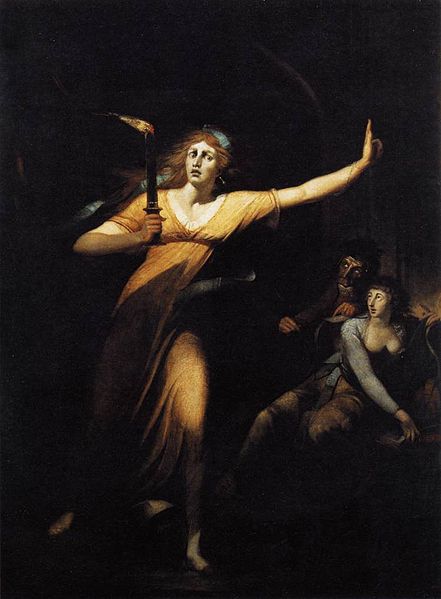
Lady Macbeth

John Henry Fuseli/ Johann Heinrich Füssli, Lady Macbeth Sleepwalking. Musée du Louvre, Paris Date: 1784. Creative Commons. Lady Macbeth driven to madness and suicide because her guilt in participating in the murder of King Duncan which leads to the murder of the guards, Macduff’s family, Banquo, and others…the stuff that nightmares are made upon.

“The kids have copies of the play with a modern English version on one side, but this isn’t easy either.”

“Tears of hilarity. Maybe middle school is too young for “Macbeth.”

Maybe? Definitely! So, why choose Macbeth?

Apparently, Hollander was attempting to satisfy a recommendation for archaic language for the secondary level in the English Language Arts Common Core. This is explained in Appendix A Language Conventionality and Clarity:

Texts that rely on literal, clear, contemporary, and conversational language tend to be easier to read than texts that rely on figurative, ironic, ambiguous, purposefully misleading, archaic, or otherwise unfamiliar language (such as general academic and domain-specific vocabulary).

In other words, the CCSS state that students should be exposed to complex diction, and the CCSS has made specific recommendations for grade 8 including:

  • Little Women by Louisa May Alcott (1869)
  • The Adventures of Tom Sawyerby Mark Twain (1876)
  • “The Road Not Taken” by Robert Frost (1915)

Hollander could consider the how the wording in CCSS Reading Standard 8  should guide her in selecting material for her combined seventh and eighth graders:

Analyze how a modern work of fiction draws on themes, patterns of events, or character types from myths, traditional stories, or religious works such as the Bible, including describing how the material is rendered new.

So many students come to high school without the necessary content to understand many of Shakespeare’s allusions. Perhaps the students know little about King Arthur and the Knights of the Round Table; why not Malory’s Morte d’Arthur? Or understanding the Pantheon of Greek Gods and Goddesses would be helpful; why not Edith Hamilton’s Greek Mythology?  Beowulf is usually taught in grade 10; the opening begins, “He was spawned in that slime, /Conceived by a pair of those monsters born/ Of Cain, murderous creatures banished/ By God, punished forever for the crime/ Of Abel’s death” (Raffel). Student should know this Biblical story of Cain and Abel. Students must come to high school prepared with the content needed to understand increasingly complex texts.

So why choose Macbeth? In fact, why choose Shakespeare at all? Ultimately, by not considering the recommendations of the CCSS to saturate students with the grade appropriate texts in our rich literary tradition, Hollander leaves them ill-prepared for Shakespeare at the high school level, when they are more mature to appreciate his themes.

So please, leave Macbeth, with his nihlism, his “...tale/Told by an idiot, full of sound and fury,/Signifying nothing” for older students.  Please leave Lady Macbeth with “…the smell of the blood still” where “all the perfumes of Arabia will not sweeten this little hand”, and leave Macbeth for high school. Besides, if Hollander is trying to meet the recommendations of the Common Core, she should leave Macbeth where the Common Core placed it, as a complex texts for 9th and 10th grades. The noisy mashup of Macbeth will still be crude and rowdy and demanding; but the students will be older, and these few additional years of maturity are necessary for dark tragedy in “the Scottish play”.


Three years ago, I was a part of a team of teachers and several administrators, including our current superintendent of schools, who attended the Florida Educational Technology Conference Screen Shot 2013-02-02 at 5.59.23 PM(FETC) as professional development to meet the coming demands for the 21st Century skills of communication, collaboration, critical thinking and creativity. Our rural Regional School District #6 is small (under 1000 students total) tucked away in the pastoral splendor of the Northwest Corner of Connecticut. The regional high school (Wamogo Middle/High School) is a vocational agricultural school that brings in one-third of the population from surrounding communities. We have a cow, pigs, lambs, and fish on the high school campus at any given time of the year. Despite our rustic roots, we had a committed technology team that was willing to support early adopters of technology in the classroom.

When we attended this FETC in 2010, we were overwhelmed with the amount of educational technology that was competing for our attention; the exhibit floor was awash in hardware and software. We came home laden with flyers, booklets, and pamphlets. We took notes. We followed up links and websites. The experience was mind-boggling and exhausting.

This January (2013), several of us returned to FETC. The exhibit floor was still awash with hardware and software, but we were far more savvy. That is because in three short years our district invested in the necessary hardware and training for 21st Century educational skills. There are Smartboards in every classroom, a netbook 1:1 initiative in the elementary and middle schools, and iPads for faculty and staff. The high school is in its first year of a “bring your own digital device” policy. For two years now, we have had an EDCamp style professional development for our faculty and staff (K-12) to share what we have learned individually and collectively.

Consequently, during this FETC conference we were already familiar with the technologies featured in many of the sessions, and we could add to our knowledge base without feeling completely overwhelmed. In three years we learned the basics for wikis, blogs, podcast, vodcasts, screencasts, and websites. So, when we attended this FETC, we were prepared for the presentations and concurrent sessions that featured platforms we use daily such as Livebinders, Edmodo, WordPress, and Google apps. We were reassured that the open source software platforms we chose to use three years ago are still major players in education. We learned new ways to use technologies to help us assess, organize, and deliver content.

We attended keynotes that discussed the future of education:

  • Google Global Education Evangelist Jaime Casap spoke on “Unleashing the Power of the Web in Education”. His presentation focused on the power of collaboration and the rapidly changing way our students access and use information. “Your Smartphone?” he predicted with a laugh, “one day will be in a thrift store, purchased by some hipster as a nostalgic decorative touch.” The standardized test did not have a place in his vision of education.
  • Educational Consultant & Author, Dr. David Sousa, (How the Brain Learns, How the Brain Learns to Read, How the Brain Influences Behavior, and Brainwork: The Neuroscience of How We Lead Others), gave an address titled “Designing Brain Friendly Schools in the Age of Accountability”. His talk emphasized the importance of physical movement in learning, the needs for sleep for healthy cognitive processing, while dismissing the notion that anyone can “multi-task” effectively. “Multi-tasking three or four things means doing three or four things poorly,” he admonished those in the tech-connected audience who raised their hands as multi-taskers. He dismissed the standardized test as unnecessary.
  • Executive Director, Institute of Play, Katie Salen (Professor in the School of Computing and Digital Media at DePaul University) spoke on “Connected Learning: Activating Games, Design and Play”. This keynote offered video from students engaged in designing and playing games in different content areas. She explained that games allow students to “learn how to fail up” using immediate feedback and experience to reengage in a game. She dismissed standardized tests as “unimportant and that’s ok.”

While each keynote speaker addressed the role of technology in education differently, none of them saw the standardized test as a means to access what students were doing. There was no standardized tests in their visions of education. They rejected the idea of standardization entirely, speaking instead of collaboration and individual exploration. In contrast to the speeches, however, the exhibit floor was filled with software and hardware from the giants of the standardized testing industry: McGraw-Hill, Pearson, and Global Scholar. The juxtaposition of what was being said in the keynote speeches about standardized testing with the marketing of materials by testing companies on the exhibit floor illustrates a huge conflict in the use of technology in education today: How will our schools systems be measured in this age of information? What will be important for our students to know? How will we measure these skills? The economic implications for testing companies cannot be ignored; they want a place at the local, state, and federal table where the education budget is being discussed.

Of course, our small district does not have the solutions to these questions, but what we do have is a sense of confidence in the tools of education technology. The attendees at this year’s FETC conference are confident that our school district is on the right track in providing an education with an emphasis on the 21st Century skills. We will be collaborating with our fellow faculty members, communicating what we learned, critically thinking about how to use technology in our classrooms in order to enhance our students creativity.

While we were attending, we met members of a neighboring school district who were attending FETC for the first time. We recognized the glassy-eyed look of a first visit; they claimed to be “overwhelmed.” They also told us that they were attending because, “we saw what you all had done. We are here because of you!”

In three years, the teachers in Regional School District # 6  have achieved competence and confidence in the use of technology because of our administration, our regional Board of Education, and the Superintendent’s commitment to the future of education. As one science teacher tweeted during a session he was attending, “Don’t mean to brag, but I’m lighting this social media seminar up. Props to Region 6 for giving me the freedom to communicate.”

Busines_heroThe association of midterm exams with freezing is both literal (I teach in the Northeast) and figurative  (many students “freeze up” during an exam), so at the end of this semester, I took one of the writing standards from the Common Core State Standards  hoping at the very least to stop the “freeze” in the classroom during the exam. Instead of a multiple choice exam with essay questions, I prepared my 12th grade students to write an inquiry paper that would be due the morning of the exam. Yes, even those seniors who had repeatedly assured me that they will never go to college would be tasked with a three to five page paper academic paper that touched on the material that we had read over the course of the semester.

The Common Core State Standard I had in mind was ELA Literacy Standard W.11-12.7:

Conduct short as well as more sustained research projects to answer a question (including a self-generated question) or solve a problem; narrow or broaden the inquiry when appropriate; synthesize multiple sources on the subject, demonstrating understanding of the subject under investigation.

I admit, the draw for me was the “self-generated question”. We had started the “Hero or Monster” English elective brainstorming the following questions:

  • What is the difference between a hero or monster?
  • What criteria do we use to determine who or what is a hero?
  • What criteria do we use to determine who or what is a monster?

We read about monsters in Louis Stevenson’s  Dr. Jekyll and Mr. Hyde and Mary Shelley’s Frankenstein. We read excerpts from Milton’s  Paradise Lost, and we  studied the monsters of mythology (Cyclops, Widiego, Fenris, Leviathan).

We read about heroes in the Iliad and in Roger Rosenblatt’s essay The Man in the Water. We looked at Joseph Campbell’s study of The Hero’s Journey, and we created our own superheroes. Students also read an independent book and determined the hero (or anti-hero) in that text. Finally, we used current events to discuss the monsters and heroes in everyday life.

As the quarter came to a close,  each student had to come up with a “self-generated” question. I was happy to see how these texts had served to inform their line of inquiry. Questions included:

  • Was the hero really a hero before the monsters came along? Does the Hero need a Monster to be a hero?
  • How does our exposure to monsters when we are children inform our views of monsters when we grow up?
  • How does “bad parenting” figure in the development of a monster?
  • How has the criteria of strength in a hero changed since ancient times?

The students had two weeks to frame their questions and find evidence that would support their positions. Our “Bring Your Own Digital Device” (BYOD) policy was an important part of the organization and writing of the paper. Students had access to e-texts, and they had links to sources or discussions that we had placed on the class wiki during the semester. I created a Google doc folder and their papers were available for peer editing or for my comments as they worked. One night, I popped in on a few papers to see their progress. As I was leaving comments on one paper,  I saw the following text appear, “Mrs. Bennett, you are on my paper as I am writing….this is creeping me out.”  Creeping them out or not, I was able to provide guidance as they incorporated citations from the texts we had read in class into their arguments.

I am pleased to write that my gambit for this midterm exam worked. The papers are in, and many exceeded my expectations, proving that the writing standard 7 for grades 11 and 12 that requires a self-generated question is appropriate for this grade level.The self-generated question kept them more engaged because this was their inquiry, and as they wrote,  they came to conclusions that they incorporated into their papers:

Throughout the course of writing this paper, I have come to a surprising realization. It has come to my attention that the heroes that we idolize and fawn over (Hector, Achilles, etc.) are not always as heroic as the everyday, ordinary people who rise to the occasion when chaos ensues.

When Hector went into battle in the Iliad in ancient times, he may have had the same thought as the “Man in the Water” in 1982, the thought that “I might die doing this.” That thought did not stop either of them, and both men are still talked about; they are held high and admired. Time does not change our appreciation of heroes.

Some of these true monsters, (Satan of Paradise Lost and Victor of Frankenstein) have used their cunning ways to confuse or deceive the reader so they cannot be seen as the monsters they are.

The inquiry paper, which does permit the use of the pronoun “I”, has been a much easier way to teach academic research and improve a student’s understanding of an author’s intent. Furthermore, the research students included in their papers reflected a wide range of texts; papers were longer, and the evidence was organized according to information rather than the ubiquitous five-paragraph framework.  More than one student remarked how their fingers seemed to know what to write; more than one told me how the inquiry gave them ideas they found surprising.

While I may not yet know the impact of all the standards from the Common Core, I will state unequivocally that the self-generated question allowed me to successfully measure what students learned about heroes and monsters in both literature and in real-life. Correcting these papers has been less of an “ARRRG!” (insert monster voice) and more of a “Hurray!” (insert heroic cheer!).

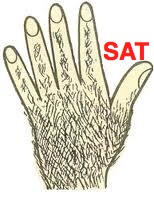
hairy handSince many college applications are due between January 1 and February 1, I know that many of my students are fretting about their SAT scores. I wish I could tell them to relax, that the score is just a score, and that they will never have to hear the words SAT again, but that would not be telling them the truth. The hairy hand of the SAT can reach far forward into their future. An SAT score is a brand, locking academic potential in a data point where we are forever 17 years old.

When I took the test, it was known as the Scholastic Aptitude Test, and that was before it became known as the Scholastic Assessment Test. At that time, the top score was a 1600, and there was no writing section. There were no pre-tutoring sessions from pricey tutors available after school or on Saturdays to practice for the SAT. I think I glanced through a practice book.

That Saturday morning, I was dropped off by my father in our 68 VW van along with hundreds of equally bleary-eyed seniors. I think I paid that day because I waited for him to write out a check. About two hours later in the middle of the math section, I remember thinking “Whoa…maybe I should have studied for this.” I had approached this milestone in my life with a little too much confidence and too little breakfast. I came out of that ordeal exhausted and starved.

Some 38 years later, I am still reminded about the results from that day. For example, on applications to graduate school, there is always a question on my score on the SATs taken back in 1974.

“Really?” I think to myself, “I am so much better a student today. I have two graduate degrees, and I am gainfully employed in the field of education. I am a very differently educated person from my 17 year old self. Then I was financially strapped, working part-time in a pizza restaurant, and I had yet to attend my first rock concert. Yet, you still want to know what my high school SAT score was?”

While I am not ashamed of my score, I am not posting it, either. Fortunately, because of my SAT score, I have been able to waive out of other standardized tests, for example, the Praxis I in Connecticut which requires a combined minimum score of 1000. You can be content to know I met this minimum standard with several hundred points to spare. I did very well on the verbal, but in retrospect, I probably could have done better had I prepared for the math section a little more.

So when I come to that question on an application, I think how that score taken when I was 17 one cold spring morning cannot accurately reflect who I am today. Nor do I think that an SAT score accurately reflects who my students are either. At this time of year, I hear them discuss numbers as they explain why they may or may not, or did or did not, get into a college of their choice. Sometimes I am surprised to hear particularly high or low scores, however, this information never changes my opinion of the student I have seated in my class. A student with a particularly high SAT score may never turn a paper in on time and have a failing grade while a student with a low SAT score may have an “A” in my class because every assignment is done on time or revised when recommended. The SATs may be an “indicator”, but these are students, not numbers. The score on an SAT can still fall subject to human error.

I do not think at age 17 that I fully understood how far forward into my future the hairy hand of the SAT would travel. I doubt my students understand, but I hope they know that their future will not depend on their 17 year old academic selves.

I suppose I should be grateful that when I am asked for my SAT score, that there is not also a request for   additional identification, say, a picture of me in that decade. That thought is chilling. The hiphuggers, bell bottoms, velvet jackets, and ubiquitous leotards of my high school decade are positively comical.My yellow chiffon prom dress is particularly hilarious. On the whole, I’d rather they see my SAT score.

"Dawn spread her rosy fingers..."

“Dawn spread her rosy fingers…”

Our 9th grade classes have been reading Robert Fitzgerald’s excellent translation of The Odyssey. At the beginning of every book, “young Dawn spreads her fingertips of rose to make heaven bright”. My students have heard this phrase so often that they chorus back to me “fingertips of rose” when we read aloud. One morning this past week, I raced up the hill to school to get my iPad so I could capture this picture of the “rosy fingers” and put it on the class wiki.

We dutifully started The Odyssey with the “Invocation to the Muse” and Books 1-4, but the Telemachus “coming of age” story did not really capture their interest. Meeting Odysseus in Book 5 did not improve their respect for the “worthy man of twists and turns.” Once we read Book 9,  the meeting with the Cyclops, Polyphemus, their interest was revived. Apparently, they enjoy a good story of man-eating monster as much as previous generations from 2020 years ago.

I have only been able to locate about a dozen copies of this translation in the secondary market, so we did have to buy a class set. These replaced a worn set of the Richmond Lattimore translation. There will be an audio version of the Fitzgerald translation available in November 2013 I will be ordering so I will finally be able to hear how to pronounce all those Greek names!.

Our final project for the Odyssey is a narrative that students complete called “The Wamogossey: A Day in the Life of a Freshman at Wamogo High School.” Happily,  writing narratives are once again favored in curriculum aligned to the Common Core State Standards:

CCSS.ELA-Literacy.W.9-10.3 Write narratives to develop real or imagined experiences or events using effective technique, well-chosen details, and well-structured event sequences.

The inclusion of the narrative confirms what most writing teachers recognize, that writing a narrative gives a students a better appreciation for reading a narrative.

In writing The Wamogossey, we allow students to organize themselves as individual narrators or in groups of two or three. Our instructions to the students are based on the following premise:

You and your partners are to create a modern equivalent of The Odyssey. The setting is Wamogo High School; the hero a 9th grader – Fresheus or Freshiope.

Your character must make their way through a day at school, facing modern equivalents of the Lotus Eaters, Cyclops, Sirens, and all that Odysseus encountered. The goal is simply to get home alive, where the or she can relax and feel safe.You must mirror Odysseus’ adventures, including how he solves the problems (trickery, patience, skill, self-control, etc).  The essential nature of the obstacles must be the same, in the same order, but set in modern Wamogo.

Each student in a group working on The Wamogossey is required to write three adventures: a single narrator needs three (3) adventures; two people writing the Wamogossey need six (6) adventures; three members of the group need nine (9) adventures. This organization assures that there is an equal sharing of responsibilities regardless as to the size of the group. They compose the narrative on Google Docs; each narrator writing in a different color ink.

In addition, to assure fairness in grading, we allow students to have some feedback on the distribution of points. The project is assigned a base grade (EX: 40 points) Once the project is graded based, that number is multiplied by the number of students in group. For example a project worth 40 points may be awarded only 34 points. If there were three members of the group, then there are 34 X 3 points available, or a total of 102 points. The members of the group then determine a fair distribution of points; slackers are usually “outed” by members of their group. We rarely need to intervene.

The Wamogossey narratives must begin with an invocation to their muse. These are usually very personal and often reflect that we have a vocational agricultural program. For example, from this year’s submissions:

Sing in me, Brandon,
and help me tell the story of tractors, you, skilled in all ways of contending,
the fixing, harried for hours on end,
after the break downs and endless driving in the field.
I saw the end of the last row of corn
and learned that good crops come slowly
and weathered many bitter days
in the early morning cold, while I fought only
to save my life, to get home to the barn.
But not by will nor valor could I save all the gas I use,
Of these adventures, Brandon, tell about me in my school day, lift the great song again.
Begin when the alarm rang, calling me to adventure, when all I hungered for was for home, my  Farm All tractors, and being ready…

In addition to the modernized twists of Homer’s plot, each adventure needs an epithet (“grey-eyed goddess”) and one Homeric simile. My students call these similes “enough already; we get the point” similes.There is also extra credit for using vocabulary from The Odyssey.

So far, several of The Wamogossey entries parallel Odysseus’s adventure very nicely. One student’s encounter with “Eaganphemus” (the Cyclops/our principal) is clever:

Encounter with the Cyclops- Book 9
I was hurrying to class, I was going so fast, I felt like I was in a race car, and the people around me are in a fuzz.  All of a sudden, I saw the huge Eaganphemus standing in my way. I almost slammed into him, my wheels spinning so fast. I tried to get around him, but I couldn’t  But, I happened to have M&M’s in my pocket, so I threw them at him. He seemed overwhelmed! He tried to catch all of them at once!! Once he was trying to gobble them down I raced past, now that he was distracted. I somehow survived getting past him.

As the semester ends next week, the students will have finished their hero’s journey. Odysseus will return to Ithaka and to Penelope, and, yes, another “Dawn will spread her rosy fingers…”.  I may get to run up the hill again to snap another picture.

Screen Shot 2013-01-09 at 4.41.58 PM

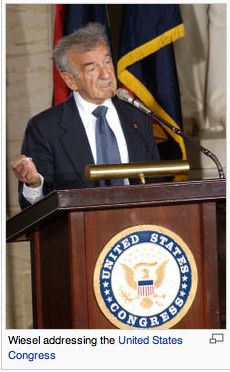
Wikipedia photo -Elie Wiesel

By my calculations, at the mid-point of the school year, many World History classes are studying World War II. Should these classes want to increase their use of an informational text in English or Social Studies curriculum, I suggest Elie Wiesel’s noteworthy speech The Perils of Indifference.

Wiesel delivered this speech to Congress on April 12, 1999. The speech is 1818 words long and connects Wiesel’s experience at the concentration camp at Aushwitcz with the genocides of the late 20th Century using a single powerful word: indifference.

In his speech, Weisel states clearly:

Indifference, then, is not only a sin, it is a punishment. And this is one of the most important lessons of this outgoing century’s wide-ranging experiments in good and evil.

Our English Department has used this speech in the past as a complement to Wiesel’s memoir Night which has been a used as a whole class read.  This year, we are giving Night to the Social Studies classes. They will adopt this memoir in order to increase the assigned informational text reading in their discipline mandated by the Literacy Common Core State Standards in History and Social Studies (CCSS). The English Department will still offer supplemental texts  that students can choose to read independently.

When he gave this speech, Wiesel had come before the US Congress to thank the American soldiers and the American people for liberating the camps at the end of World War II. Wiesel had spent nine months in the Buchewald/Aushwitcz complex. His mother and sisters had been separated from him when they first arrived: “Eight short, simple words… Men to the left, women to the right”; these family members were killed in the ovens. He and his father survived starvation, disease, and the deprivation of spirit. His father eventually succumbed, and Wiesel guiltily admits at the end of the memoir that at his father’s death he felt relieved.

Eventually, Wiesel felt compelled to testify against the Nazi regime, and he wrote the memoir Night to bear witness against the genocide which killed his family and six million Jews. His speech was delivered 54 years after he was liberated by American forces.

His gratitude to these American forces is what opens the speech, but after the opening paragraph, Wiesel seriously admonishes America to do more to halt genocides all over the world. By not intervening on behalf of those victims of genocide, he states clearly, we are indifferent to their suffering:

Indifference, after all, is more dangerous than anger and hatred. Anger can at times be creative. One writes a great poem, a great symphony, one does something special for the sake of humanity because one is angry at the injustice that one witnesses. But indifference is never creative.

My students have always been struck by Wiesel’s juxtaposition of anger and creativity. More than one has agreed pointing to making a “good” creation: an amazing song about an ex-boyfriend or a painting slapped together with passion. They also do not want to be treated indifferently. Yet, Wiesel makes them think beyond themselves:

Indifference is not a beginning, it is an end. And, therefore, indifference is always the friend of the enemy, for it benefits the aggressor — never his victim, whose pain is magnified when he or she feels forgotten. The political prisoner in his cell, the hungry children, the homeless refugees — not to respond to their plight, not to relieve their solitude by offering them a spark of hope is to exile them from human memory. And in denying their humanity we betray our own.

I remember several years ago, one student in my English 10 class, Rick, was particularly bright, fun, and full of daring. He also had an exceptional understanding of math and statistics. That January, I introduced the memoir Night as I had in previous years by providing a little background information.

“Six million Jews were killed during the Holocaust,” I recited off from my list of facts.

“What?” a startled Rick looked up. “Six million?” He was aghast. “That can’t be right.” He looked around at his classmates. “Six million?” They looked at him blankly. “Come on,” he was looking for some support, “That can’t be right.”

“Why?” I asked.

“Do you know how many six million things are?” He was indignant.

“Six million people,” I responded.

“People, yes. People, six million is a lot of people….” Rick was clearly operating with a different level of understanding from his more placid classmates. He understood six million as quantity; he did understand what six million things would look like if stacked up. Other students stirred in their seats.  “No way….six million,” he repeated growing more agitated. “How? How did anyone let this happen?” he asked; he was half-rising out of his seat. “Did we know?”

“Yes,” I remember saying. I do remember explaining that, yes, America did know that Hitler had concentration camps, and that more documentation collected after the war indicated that many of our military and political leaders knew about these camps. That is one of the points from Wiesel’s speech.

I pointed out to the class that the Holocaust was only one example of genocide; that there were others. In fact, that there was recently a genocide in Darfur. Rick sat down; he was overwhelmed. He was capable of understanding numerically the devastation of the Holocaust, and he was clearly upset. “Why do we let this happen?” he asked. I remember his voice was so sad, so full of disbelief.

In The Perils of Indifference, Wiesel asks

Does it mean that we have learned from the past? Does it mean that society has changed? Has the human being become less indifferent and more human? Have we really learned from our experiences? Are we less insensitive to the plight of victims of ethnic cleansing and other forms of injustices in places near and far?

Wiesel’s rhetorical questions echo Rick’s “Did we know?” In trying to respond, Wiesel makes the reader uncomfortable the way Rick was uncomfortable. Creating this kind of emotional impact on a reader is the reason Wiesel’s speech should be taught.

The Common Core State Standards (CCSS) demand that students read informational texts but does not require specific texts. Wiesel’s The Perils of Indifference contains the information and rhetorical devices that meet the text complexity criteria of the CCSS. More specifically, Wiesel’s message is necessary if we want our students to confront the conflicts in this new 21st Century. Our students must be prepared to question why “deportation, the terrorization of children and their parents be allowed anywhere in the world?“

Our humanity should demand nothing less.

brainwith contentThis winter, I am discontented. I see less of the “click” of recognition in a student’s eyes when he or she “knows something”. At the risk of sounding like a fuddy-duddy (“old-fashioned person,” 1871, American English, of uncertain origin), my students used to come to class pre-loaded with information; they had a predictable set of stories in their brains. These were often fairy tales such as Cinderella or Jack and the Beanstalk or folktales such as Rip Van Winkle or Johnny Appleseed. And speaking of apple seed, students used to know many of the Biblical stories as well. They may have been misinformed that the fruit of the Tree of Knowledge in the Garden of Eden was an apple and did not know that they could thank John Milton’s Paradise Lost for that substitution, but at the very least students used to be familiar with the Garden of Eden stories, the genesis of multiple allusions.

Today’s students’ lack of content, specifically story content, means that a good deal of class time is spent on a “back story” so they can better understand all the allusions or references in a particular text. Allusions are critical to understanding almost anything taught in English: Chaucer, Shakespeare, Bronte, Hawthorne, Faulkner, Steinbeck, etc. For example, our 10th grade is beginning Beowulf this week, and we read the Burton Raffel’s translation. He opens with the monster Grendel down in his cave howling at the sound of men singing the song of creation. Grendel swears vengeance against the “Almighty” for the exile of his ancestor Cain:

He was spawned in that slime,
Conceived by a pair of those monsters born
Of Cain, murderous creatures banished
By God, punished forever for the crime
Of Abel’s death.

“Can anyone tell me who Cain or Abel is?” we ask.
This year, only two out of 27 students had any idea about the story of Cain and Abel. Cain’s relationship to Grendel is part of the monster’s motivation, and so we were forced to do a little “Bible as literature” storytelling. Unfortunately, the number of students who have no information about the most basic Old Testament stories, which happen to be the same stories in Torah and the Koran, grows every year.

Fortunately, we are a 1:1 district and our students are equipped to quickly use their devices to learn who Cain and Abel are, so we can stop and have them quickly research any allusion, but this immediate research on a digital device disrupts the flow of the story of Beowulf. Moreover, the need to constantly look up information ultimately turns every text into a hyper-text.

This constant researching could be reflected in measuring the lack of information our students have when they approach a task. Last December (2012), the results of the Trends in International Mathematics and Science Study were released and, despite significant improvements,  students in the United States did not rank as high as did students from other countries. The results were discussed at a forum at the Washington Post where  David Conley, CEO of the Education Policy Improvement Center noted,

“One of the great ironies is that we are headed into an age where students can get almost any piece of information off their phones, yet, what we are doing is getting more and more information into their heads. The goal is to go beyond that and make them understand that they have to own their own learning.” (Conley, Ed Policy Improvement Center)

I agree; students need to own content for successful recall and application. I have no objection to students improving their research skills; even Wikipedia is acceptable for quick textual reference research, but students must understand the content in their brains in order to apply that information when they encounter a text. Employing content and applying information is different from employing the skill of accessing information. Owning content is critical to understanding an author’s use of allusions or references. Owning content contributes to fluid reading and better understanding. However, not all owned content is equal.

My admiration for the plethora of animated cartoon sources that do provide story content with a modernized twist is a bit mixed. For example, the popular Shrek series is riddled with storybook allusions. Unfortunately, students often do not understand allusions in these modern re-tellings as parodies. Students need to be disavowed from a belief that Puss ‘n Boots is fat and wears a pink bow or that Snow White is very proud and vain. One could argue the same modernized treatment was done for the original Grimm’s Fairy Tales which have been made more palatable and child-friendly. However, these gruesome original stories were the allusions for writers in earlier centuries. When the Common Core State Standards suggested reading list is filled with the literature and informational texts from centuries past, the recently released cartoon parodies of the originals may not be particularly helpful in understanding these allusions.

While the students today are exposed to information from a myriad of sources, they need to own information to be educated. Students need content, stories and information that they understand, to apply to a text or problem without relying on a digital device. So, this winter, the heightened level of my discontent is measured by the increase of fingering for information on devices. I miss the light that would go off in the students’ eyes when they “knew something,” particularly if that “something” was a story.

I miss content.

forbesFobes recently published a feature article/photo spread, 30 Educators under 30:The Millennials Overhauling Education And Leaving No Child (Or Teacher) Behind by Meghan Casserly, 12/7/2012. The lead in for the article read:

The 30 Gen-Yers on our list are innovators, advocates, thought-leaders and reformers. Through outreach initiatives and engineering they’re committed, like my mom, to giving kids everywhere the best chance at success. They’re committed to making the lives of teachers like her just a little bit easier, whether through technology that saves them precious minutes communicating with parents or helps them use data analytics to track performance more efficiently than traditional paper grade books ever could.

A series of slick, glossy photos of well-dressed, smiling bright-eyed entrepreneurs and CEOs followed. Readers were advised to, “Click through the gallery for the 30 men and women who are disrupting education from top to bottom.” Disrupting? Is that what needs to happen to education? To disrupt? To disrupt means:

1. To throw into confusion or disorder;
2. To interrupt or impede the progress, movement, or procedure of;
3. To break or burst; rupture.

Disrupting is a perplexing choice if the purpose of the article is to praise the contributions these individuals are making to the business of education. When students disrupt a class, they are given detentions. The choice of the verb is contradictory because in the next sentence readers are encouraged “to visit their websites and reach out to congratulate them, to give them well-deserved credit for their hard work.” Are we being asked to congratulate disruption?

I did visit some of the websites mentioned in the photospread, and I do want to express my thanks to the CEOs who provide free and well-designed software programs. Specifically, I noted the photos of  Nic Borg, 26, Cofounder and CEO, Edmodo; Sam Chaudhary, 26, and Liam Don, 26, Co-founders of ClassDojo; and Andrew Sutherland, 23, Founder, Quizlet.  I will agree that these products contribute positively to my classroom environment. None of their products are “disruptive”.

The photos of these four product founders and their 26 smiling cohorts confirmed that all were vibrantly under 30, so I concede the “30 under 30” part of the headline. And yes, all 30 individuals are associated with the business of education, but they are not educators. These 30 individuals are educreators. The difference? Educators are in classrooms….Educreators are not.

Educators are in the classroom designing lessons, developing assessments, grading papers, contacting parents, posting bulletin boards, collecting data, analyzing data, meeting with teachers, collaborating with special education teachers, organizing supplies, selecting resources, and adjusting plans every minute of ever school day, and in most cases, for hours before or after school. In short, educators teach.

All Edu-creators have been in classrooms…as students. One edu-creator featured in the article spent three years in a classroom for Teach for America, one year more than the required two years of service. Each of the edu-creators has a product to improve education, but that does not make them educators. They are not in the classroom teaching; many are marketing a product for the classroom.

There has been an explosion of educreations that parallels the expansion of technology in the classroom. Many of these educreations from educreators are offered free or in “lite” versions. Ultimately, these products will make money for their founders and CEOs; there will be subscriptions or advertisements that generate revenue for these ’30 under 30″, and that is how capitalism works. A good product will sell, and many of these are good products. However, these products are tools for educators to use, not replacements for educators themselves.

Other members of the “30 under 30” are contributing to education policy by serving on boards, writing books, or being advocates for non-profits. These roles are also important, but again, these educreators have little practical experience to anticipate the problems that even the smallest changes in policy can have in the classroom. For example, a change in a state endorsed teacher evaluation system can result in thousands of hours for training evaluators and teachers  to meet new requirements, and those new requirements will be modified numerous times until an evaluation system proves effective. The effect of policy on the individual teacher or classroom is rarely witnessed; instead, policymakers are focused on the collection of “data”, not the hundreds of personal stories policy creates.

Comments under the article decry the lack of teachers. As Becky D succinctly  states:

I think it an egregious oversight that this list doesn’t include a single practicing educator.

Meghan Casserly’s response?

Educators obviously impact hundreds if not thousands of students over the course of their careers–and I looked for ways to weigh that against some of the other people on this list. Particularly for teachers under 30, it was extremely difficult to compare them in any apples-to-apples way. That said, there were some amazing teachers nominated who I was sure fit the bill—only to find out they were already 30!

So, are we to take from this comment that there are no real educators under 30 who are overhauling education and leaving no child behind? Perhaps there are no “amazing teachers” under 30 immediately visible to Casserly because they are so busy designing lessons, developing assessments, grading papers, contacting parents, posting bulletin boards, collecting data, analyzing data, meeting with teachers, collaborating with special education teachers, organizing supplies, selecting resources, and adjusting plans every minute of every school day that they simply do not have the time to create new educational software programs, run advocacy groups, or write educational policy. They are teachers, and they are real educators. They will not be featured in a Forbes magazine article about overhauling education because they are engaged in the time-consuming and productive activity of building skills and improving understanding for students of all ages.

What did Casserly get right with this article? She suggests that if the reader does get to meet one of the featured “30 under 30”, that the reader should ask, “…what teacher they have to thank for helping them land on our pages.” I agree;  their educators would be proud of the success of their former students, their own educreations.

Screen Shot 2012-12-02 at 10.44.58 AM

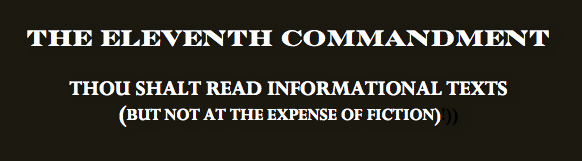
What SHOULD be a tenet of the Common Core State Standards.

The 11th Commandment from Common Core State Standards (CCSS)? Thou Shalt Read Informational Texts.

This edict from on high, from current College Board President and co-architect/promoter of the CCSS David Coleman, has had a seismic shift in curriculum at all grade levels. English/Language Arts Curriculum directors and teachers are jettisoning fiction from their lesson plans in the mistaken belief that they alone are responsible for addressing this new found commandment. For the uninitiated, informational texts in the CCSS replaces the genre previously known as non-fiction and includes many other genres including essays, speeches, and reports.

Columnist Joel Stein exposes the foolishness of this effort in his commentary “How I Replaced Shakespeare” in the 12/10/12 issue of Time Magazine when he discovered that his writing was being analyzed by students. (Note: Diane Ravitch, education activist has the full post on her blog) His response to students who were assigned his articles and who were parsing them for literary devices or thesis?

“Transfer high schools immediately! To one that teaches Shakespeare and Homer instead of the insightful commentary of a first-rate, unconventionally handsome modern wit! Also, don’t do drugs!”

Stein readily admits that students should have some exposure to different genres and explains that he learns how to write in different genres by looking at examples. Similarly English/Language Arts curriculum require students to write in various genres as well through models as well; for example, students are taught with models as to how to write in the genres of essay, business or friendly letter, book review, and poetry.

However, Stein refutes one of Coleman’s most quoted talking points. Coleman said, “It is rare in a working environment that someone says, ‘Johnson, I need a market analysis by Friday, but before that I need a compelling account of your childhood.’” Stein’s response? “I agree with this, but only because no one has ever asked me for a market analysis.”

Stein points out that fiction provides the models that makes writers better. “No nonfiction writer can teach you how to use language like William Faulkner or James Joyce can,” he continues. Stein also mentions how the themes in fiction, and he mentions Shakespeare specifically, prepare students for real life choices. Othello, he notes, can help students make better choices about choices in working partnerships.

Instead, the shared blame for students not knowing how to write well or be able to read non-fiction lies with other disciplines such as history and science, a charge echoed by Gene Wilhoit, executive director of the Council of Chief State School Officers who, along the National Governors Association, created the Common Core. Stein quotes Wilhoit saying, “History class assignments tend to be short textbook summaries, not primary sources.” Indeed the CCSS anticipated that reading across the disciplines is the most effective way to increase student understanding, so the CCSS made clear that a student’s diet of reading should be 70% informational texts and 30% fiction. Unfortunately, the explanation as to how this percentage would play out in the average student’s school day was relegated to two footnotes. On page 5 of the CCSS English Language Arts (down load) is the footnote that illuminates the 11th commandment of how Thou Shalt Read Informational Texts:

1
The percentages on the table reflect the sum of student reading, not just reading in ELA settings. Teachers of senior English classes, for example, are not required to devote 70
percent of reading to informational texts. Rather, 70 percent of student reading across the grade should be informational.
2
As with reading, the percentages in the table reflect the sum of student writing, not just writing in ELA settings.

When the CCSS were announced, the misreadings of this the English/Language Arts standards began immediately. The footnote was largely ignored. Instead, the movement to jam informational texts into English classes began. Literature was dumped in order to meet the set ratio in English classes alone rather than a move to increase the reading of informational texts in all other disciplines.Stein recounts how Wilhoit highlights the reaction of the small, vocal group who objected. “It (CCSS) upset people who love literature. That happens to be a lot of high school teachers,” Wilhoit said.

In How I Replaced Shakespeare, Stein adds his voice to the small vocal group who love literature.  He is a former writer for the Los Angeles Times and now is a regular contributor to Time. He is a good writer who recognizes that all students would be far better served to read great literature (Shakespeare,Faulkner, Joyce)  rather than his column of “informational texts.” The loss of literature at every grade level in an attempt to serve ratios-50% fiction/50% informational text in elementary and 30% fiction/70% in high school- is too great a price to be paid to meet the goals of the yet unproven Common Core.

In the classroom, the authors of children’s books are celebrities; the authors of young adult literature are rock stars. So when the National Conference of English Teachers (NCTE) and associated independent organizations the Council of English Leadership (CEL) and the The Assembly on Literature for Adolescents (ALAN) converged on Las Vegas last week, publishers made sure their authors were front and center, delivering keynote addresses and personally meeting and signing books for some of their greatest fans-teachers.

Highlights of the convention included Sherman Alexie (The Absolutely True Diary of a Part-Time Indian) delivering a keynote address to an enthusiastic audience of readers who know how he can reach their reluctant readers. Scott Westerfield (Uglies, Pretties) was there representing the oh-so-popular dystopian fiction. Nicholas Sparks (The Notebook) was there for the older readers, including the teachers themselves, with new educational materials for high school classrooms. Newbery Award winning Lois Lowery (The Giver, Number the Stars) spoke to an enthralled crowd of middle school teachers at ALAN.

The convention had invited many authors; book publishers arranged to bring even more to the exhibition hall. There were over 200 “signing” stations in exhibitor booths advertised in the conference program to alert teachers where to purchase and get books autographed.

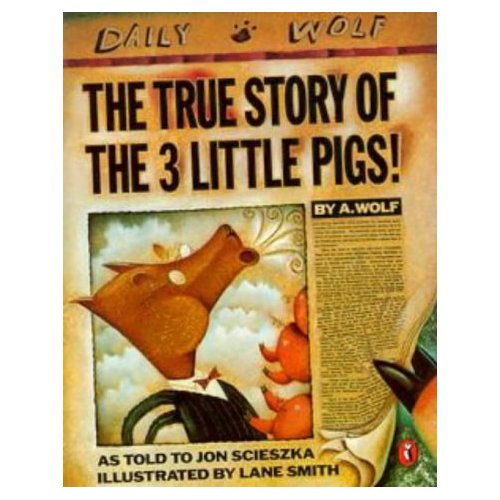
Most booths were mobbed, but on Sunday morning, I came upon a table where a solitary Jon Scieszka sat with a exhibitor. I could not believe my luck. For those who do not know, Scieszka is the author of  Math Curse,  The Stinky Cheese Man and Other Fairly Stupid Tales,and the series The Time Warp Trio, which was made into a TV series. His retelling of the The Three Little Pigs is told from the point of view of A.Wolf. The True Story of the Three Little Pigs was my first Scieszka book experience.In the book, A. Wolf explains how his requests for a cup of sugar from each of the pigs eventually led to his “sneezing” not “huffing and puffing” which sets off the unfortunate demise of the pigs. Illustrated by Lane Smith, this book was one of the “Top 100 Picture Books” of all time in a 2012 poll by School Library Journal. I concur, and I use the book to explain literary point of view to all grade levels. In 2008, Scieszka was named the National Ambassador for Young People’s Literature by the Librarian of Congress.

There Jon Scieszka sat, and there was no teacher in sight!

“Jon Scieszka!” I exclaimed, ” I can’t believe you are alone!”
“Neither can I,” he grinned.
“Me either,” said the exhibitor with him, much more uncomfortably..
“Well, now that I have you all to myself,” I was ready with a question I had asked so many times in my head, “Can I ask how you know so much about my brothers?” I was referring to his hilarious YA memoir Knuckleheads in which Scieszka relates his

experiences growing up. The publisher’s review:

“Growing up as one of six brothers was a good start, but that was just the beginning. Throw in Catholic school, lots of comic books, lazy summers at the lake with time to kill, babysitting misadventures, TV shows, jokes told at family dinner, and the result is Knucklehead. Part memoir, part scrapbook, this hilarious trip down memory lane provides a unique glimpse into the formation of a creative mind and a free spirit.”

The book is almost a mirror reflection of watching my younger siblings compete with each other, set fire to things, and survive Catholic school (with fewer nuns). “I swear you must have been watching my three brothers grow up!” I babbled on.
“You’d be surprised how many people say that,” he chuckled.
“And your short stories in Guy’s Read?” By this time, I was positively gushing, “they are exactly what I need for my 9th grade boys who only want a short read.”
“That’s why we wrote them,” he nodded appreciatively, “for short reads. Now, what name do you want in this book?”
Yes, I got a signed book Spaceheadz by Jon Scieszka! For free. A conversation and a book.

20 minutes later, I passed by the table again, but I caught only a glimpse of him. He was surrounded by a throng of teachers,the serpentine line of fans waiting to talk to him went down the long aisle. My brief and personal moment was obviously a fluke. That’s because he’s Jon Scieszka, children’s book author. Jon Scieszka, Rock Star.