Archives For November 30, 1999

Since I write to understand what I think, I have decided to focus this particular post on the different categories of assessments. My thinking has been motivated by helping teachers with ongoing education reforms that have increased demands to measure student performance in the classroom. I recently organized a survey asking teachers about a variety of assessments: formative, interim, and summative. In determining which is which, I have witnessed their assessment separation anxieties.

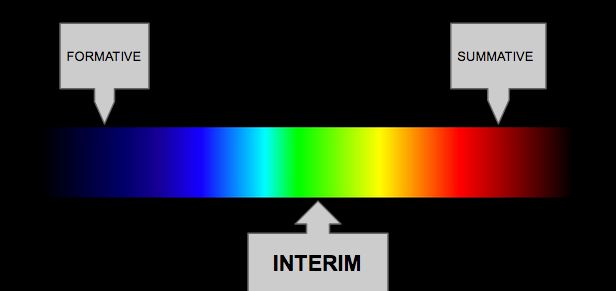
Therefore, I am using this “spectrum of assessment” graphic to help explain:
Screenshot 2014-06-20 14.58.50

The “bands” between formative and interim assessments and the “bands” between interim and summative blur in measuring student progress.

At one end of the grading spectrum (right) lie the high stakes summative assessments that given at the conclusion of a unit, quarter or semester. In a survey given to teachers in my school this past spring,100 % of teachers understood these assessments to be the final measure of student progress, and the list of examples was much more uniform:

  • a comprehensive test
  • a final project
  • a paper
  • a recital/performance

At the other end, lie the low-stakes formative assessments (left) that provide feedback to the teacher to inform instruction. Formative assessments are timely, allowing teachers to modify lessons as they teach. Formative assessments may not be graded, but if they are, they do not contribute many points towards a student’s GPA.

In our survey, 60 % of teachers generally understood formative assessments to be those small assessments or “checks for understanding” that let them move on through a lesson or unit. In developing a list of examples, teachers suggested a wide range of examples of formative assessments they used in their daily practice in multiple disciplines including:

  • draw a concept map
  • determining prior knowledge (K-W-L)
  • pre-test
  • student proposal of project or paper for early feedback
  • homework
  • entrance/exit slips
  • discussion/group work peer ratings
  • behavior rating with rubric
  • task completion
  • notebook checks
  • tweet a response
  • comment on a blog

But there was anxiety in trying to disaggregate the variety of formative assessments from other assessments in the multiple colored band in the middle of the grading spectrum, the area given to interim assessments. This school year, the term interim assessments is new, and its introduction has caused the most confusion with members of my faculty. In the survey, teachers were first provided a definition:

An interim assessment is a form of assessment that educators use to (1) evaluate where students are in their learning progress and (2) determine whether they are on track to performing well on future assessments, such as standardized tests or end-of-course exams. (Ed Glossary)

Yet, one teacher responding to this definition on the survey noted, “sounds an awful lot like formative.” Others added small comments in response to the question, “Interim assessments do what?”

  • Interim assessments occur at key points during the marking period.
  • Interim assessment measure when a teacher moves to the next step in the learning sequence
  • interim assessments are worth less than a summative assessment.
  • Interim assessments are given after a major concept or skill has been taught and practiced.

Many teachers also noted how interim assessments should be used to measure student progress on standards such as those in the Common Core State Standards (CCSS) or standardized tests. Since our State of Connecticut is a member of the Smarter Balanced Assessment Consortium (SBAC), nearly all teachers placed practice for this assessment clearly in the interim band.

But finding a list of generic or even discipline specific examples of other interim assessments has proved more elusive. Furthermore, many teachers questioned how many interim assessments were necessary to measure student understanding? While there are multiple formative assessments contrasted with a minimal number of summative assessments, there is little guidance on the frequency of interim assessments.  So there was no surprise when 25% of our faculty still was confused in developing the following list of examples of interim assessments:

  • content or skill based quizzes
  • mid-tests or partial tests
  • SBAC practice assessments
  • Common or benchmark assessments for the CCSS

Most teachers believed that the examples blurred on the spectrum of assessment, from formative to interim and from interim to summative. A summative assessment that went horribly wrong could be repurposed as an interim assessment or a formative assessment that was particularly successful could move up to be an interim assessment. We agreed that the outcome or the results was what determined how the assessment could be used.

Part of teacher consternation was the result of assigning category weights for each assessment so that there would be a common grading procedure using common language for all stakeholders: students, teachers, administrators, and parents. Ultimately the recommendation was to set category weights to 30% summative, 10% formative, and 60% interim in the Powerschool grade book for next year.

In organizing the discussion, and this post, I did come across several explanations on the rational or “why” for separating out interim assessments. Educator Rick DuFour emphasized how the interim assessment responds to the question, “What will we do when some of them [students] don’t learn it [content]?” He argues that the data gained from interim assessments can help a teacher prevent failure in a summative assessment given later.Screenshot 2014-06-20 16.50.15
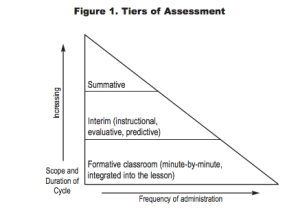
Another helpful explanation came from a 2007 study titled “The Role of Interim Assessments in a Comprehensive Assessment System,” by the National Center for the Improvement of Educational Assessment and the Aspen Institute. This study suggested that three reasons to use interim assessments were: for instruction, for evaluation, and for prediction. They did not use a color spectrum as a graphic, but chose instead a right triangle to indicate the frequency of the interim assessment for instructing, evaluating and predicting student understanding.

I also predict that our teachers will become more comfortable with separating out the interim assessments as a means to measure student progress once they see them as part of a large continuum that can, on occasion,  be a little fuzzy. Like the bands on a color spectrum, the separation of assessments may blur, but they are all necessary to give the complete (and colorful) picture of student progress.

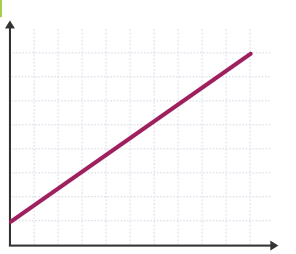
Screenshot 2014-05-31 14.25.03As the school year comes to a close, the buzzphrase is “student growth.” All stakeholders in education want to be able to demonstrate student growth, especially if student growth could be on an upwards trajectory like the graph at left.

Last week I had an opportunity to consider student growth with a different lens, and that lens was provided by a graduating senior who was preparing a presentation to a group of 7th & 8th graders.
I had assigned Steven and his classmates the task of developing  TED-like-Talks that they would give to the middle schoolers. The theme of these talks was “The Most Important Lesson I Learned in 13 Years of Education.” The talk was required  to be short (3-5 minutes), to incorporate graphics, and to make a connection between what was learned and the outside world. I asked students to come up some “profound” idea that made the lesson the most important lesson in their academic career. I gave them several periods to pitch ideas and practice.

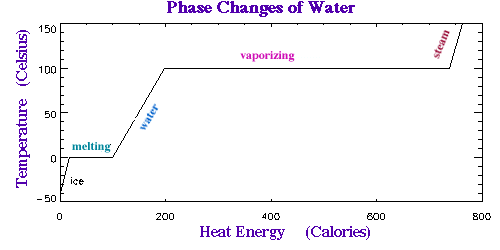
Steven’s practice presentation was four slides long on the lesson “Phase Changes of Water.” There was a graphic on each slide that illustrated the changes of water from solid ice to liquid to vapor. The last slide illustrated the temperatures at which water underwent a change and the amount of heat energy or calories expended to make that phase change (below):

phaseplot

“What you see in this graph,” Steven explained, “is that there is a stage, a critical point, where the amount of energy needs to increase to have water change from solid to liquid. The graph shows that stage of changing from solid to liquid is shorter than the stage where the amount of energy needs to increase to change water into steam.”
He pointed to the lines on the graph, first the shorter line labeled melting and then longer line labeled vaporizing.
“So how is this a profound idea?” he asked. “Well, this chart is just like anything you might want to improve on. Sometimes you are working to go to the next level, but you hit a plateau, a critical point. You need to expend more energy for a longer period of time to get to that next level. Thank you.”

We clapped. Everyone sitting in class agreed that Steven had met the assignment. He met the time limit. He had graphics. He made a connection.
I saw something even more profound.

In less than three minutes, Steven had used what he had learned in physics to teach me a new way to consider the learning process. I could see phase changes or phase transitions to illustrate the relationship between energy expended over time and academic performance. I could relabel the side marked heat energy to a label of “energy expended over time.”  Some phase changes would be short, as in the change from ice to a liquid state. Other phase changes would be longer, as in the change from liquid to gas. Each line of phase change would be different.

For example, if I applied this idea to teaching  English grammar, some student phase changes would be short, as in a student’s use of pronouns to represent a noun. Other phase changes could be much longer, such as that same student employing noun-pronoun agreement. Time and energy would need to be expended to improve individual student performance on this task.

But whose energy is measured in this re-imagined transition? Perhaps the idea of phase changes could be used to explain how a teacher’s energy expended in instruction over time, or during a critical point, could improve academic performance. The same idea could be used to demonstrate how a student must expend additional energy at a critical point to improve understanding in order to advance to the next level.

At the end of the school year, teachers need to provide evidence of individual student growth, but perhaps a student is in a transitioning phase and growth is not yet evident?  The major variable in measuring student achievement is the length of the critical point of transition from one level to another, and that length of that critical point could extend for the length of a school year or maybe even longer. Growth may not be measured in the time provided and more energy may need to be expended.

What was so interesting to me was how Steven’s use of phase changes had given me another lens to view the students I assess and the teachers I evaluate. Because measuring academic progress is not fixed by the same physical laws where 540 calories are needed to turn 1 gram (at 100 degrees Celsius) of water to steam, each student’s graph of academic achievement (phase changes) varies. Critical points will be at different levels of achievement measured by different lengths of energy expended. Despite the wishes of teachers, administrators, and students themselves, “growth” is rarely on that 45º trajectory. Instead, growth is represented by moving up a series of stages or critical points that illustrate the amount of energy, by student and/or teacher, spent over time.

Energy matters, in physics and in student achievement. Steven’s TEDTalk gave me a new way to think about that. He was profound. I think he gets an A.

Across the pond, British students studying for the General Certificate of Secondary Education (GCSE) will no longer experience a narrative on growing up in the Jim Crowe South or reenact the witch hunts of Salem, Massachusetts, or be immersed in stories of The Great Depression’s impact on itinerant laborers. A recent decision by the United Kingdom’s Department for Education means that British students will no longer be reading Harper Lee’s To Kill a Mockingbird, Arthur Miller’s The Crucible, or John Steinbeck’s Of Mice and Men.  The Education Secretary of the United Kingdom, Michael Gove, has recommended a syllabus that favors British texts exclusively for students to “swot up” for their exam boards. In order to make more room for the strictly British diet of Eliot, Dickens, at least one of the Bronte Sisters, these 20th Century American classics are being dropped in favor of British texts. According to The Guardian, when Gove took office he told his party’s conference:,

 “The great tradition of our literature – Dryden, Pope, Swift, Byron, Keats, Shelley, Austen, Dickens and Hardy – should be at the heart of school life.”

A number of responders have noted Gove’s concern that the American texts come with “ideological baggage” that is not relevant to British students. The controversy was sparked when the new syllabus for OCR, one of the biggest UK exam boards, was released. A statement by UK’s Department for Education noted that in the revised syllabus, specific (American) books are not banned, but rather:

In the past, English literature GCSEs were not rigorous enough and their content was often far too narrow. We published the new subject content for English literature in December. It doesn’t ban any authors, books or genres. It does ensure pupils will learn about a wide range of literature, including at least one Shakespeare play, a 19th-century novel written anywhere and post-1914 fiction or drama written in the British Isles. (“To Kill a Mockingbird and Of Mice and Men axed as Gove orders more Brit lit” Guardian)

Michael Gove, Britain’s Education Secretary, recommends removing American texts

Michael Gove, Britain’s Education Secretary, recommends removing 20th C American texts by Steinbeck, Miller, and Lee.

The news is not all bad, however. Instead of considering the removal as a literary slight to the multitude of authors who write in English -but who do not serve the Crown- perhaps Americans should be grateful that those discomforting moments of U.S. History are being hidden or systematically expunged from the prying eyes of young British readers. Students do not need to be exposed to the effects of prejudice, intolerance, and poverty through the lens of an American culture when British culture already has a plethora of masterworks that focus on their own brand of bigotry, bias, and destitution. Why would British students need a global perspective as they enter the 21st Century workforce?

Consider how wonderful for Americans that Gove has eliminated the need to explain the real inditement of our judicial system through the fictional violation of Tom Robinson’s civil rights despite the dramatic evidence provided by his defense attorney, Atticus Finch. How brilliant that British students will never have the opportunity to connect the fictional fraud in the trial of John Proctor to the real terror of the McCarthy Hearings and Communist witch hunts of the 1950s. How fabulous that readers in the United Kingdom will not be forced to read how the myth of the American Dream is often unattainable, especially when a scientifically confirmed climate change associated with the Dust Bowl contributed to harsh economic realities.

So, thank you, Secretary Gove, for keeping America’s literary exposés on dirty secrets hidden. Now, a schoolchild’s positive image of an American 20th Century will not be tarnished by the likes of those upstarts Lee, Miller, and Steinbeck.

Yes, Mr. Secretary, for British students everywhere, ignorance will be bliss!

Continue Reading…

“I find people confusing.” 

That particular quote is spoken by Christopher John Francis Boone, the 15-year-old narrator of The Curious Incident of the Dog in the Night-Time, who describes himself as “a mathematician with some behavioral difficulties.” Christopher lives in Swindon, England, and his behavioral difficulties are more along the lines of Asberger’s or high functioning autism or savant syndrome. This diagnosis explains his attitude towards his peers, 

“All the other children at my school are stupid. Except I’m not meant to call them stupid, even though this is what they are.” 

Or his obsession with truth:

“Metaphors are lies.” 

Or his appreciation for math:

“Prime numbers are what is left when you have taken all the patterns away. I think prime numbers are like life. They are very logical but you could never work out the rules, even if you spent all your time thinking about them.”

Christopher’s observations are also what make him interesting to our students who read the novel in literature circles in grade 10. Students at this age connect with the author, Mark Haddon, and his belief that the novel is not about a character with Asperger’s Syndrome, but rather,

“…a novel about difference, about being an outsider, about seeing the world in a surprising and revealing way. It’s as much a novel about us as it is about Christopher.”

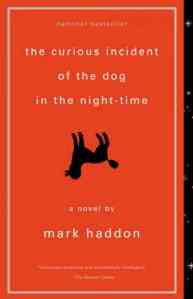
CIDNT coverWe have well over 100 copies of The Curious Incident of the Dog in the NightTime in our book room. They are a collection of books purchased at book sales ($1-$3 a copy) throughout the state of Connecticut for the past five years. These copies are most likely the discards from book club members who, 10 years after its original publication date (2003), donated their used copies. The only problem in locating  copies of the text at a book sale is determining on which genre table the copies will be shelved. The novel is classified as a mystery, but it is also considered a young adult novel or trade fiction, and was published in England simultaneously in separate editions for adults and children.

Fortunately, I can see that iconic bright red cover from a distance, the same one with the dog cut-out onto the shiny black cover underneath. When I distribute the texts, no matter how I threaten to make sure the book comes back in pristine condition, there are students who will trace and retrace that cutout until the die-cut shape of the dog becomes the shape of a blob.

The students read the novel independently first, usually during a unit on Shakespeare’s Macbeth, before coming together in literature circles. I would like to think that the character of Christopher would enjoy being paired with Shakespeare’s murder and intrigue since he is uncovering a sinister killing of a neighborhood dog. Students are given time in class to read the novel as SSR, and the literature circles begin once the play is concluded. The students are organized into smaller groups, where they work together to choose a “big idea” that can be found in the novel. The “big idea” can center on large concept words such as bravery, fear, change, determination, trust, or belief. Once a big idea is selected for the day, each group has several tasks to complete, with each member of the group completing one task. The students receive one grade for the completion of these assignments, and disputes are resolved through peer review feedback sheets. The roles for the literature circles are fairly traditional:

  • Group leader/discussion director/writer: leads the discussion and writes the response that answers the question with contributions from the other members.
  • Notes taker/quote maker: keeps notes during the discussion, finds, and writes the passages that support the group’s conclusions about the big idea.
  • Artist: draws a series of cartoons or a particularly important scene that represents the big idea.
  • Poet: creates a found poem of at least 20 lines that supports the group’s conclusions.
  • OrganizerGets the paper, plans the poster, keeping everyone on task and contributing to the overall success of the assignment!

Because we are a BYOD school, we have on occasion also included some “digital” tasks where group members can use a software platform to create an Animoto or a Voice Thread as a way to illustrate the big idea.

The literature circles usually meet four or five times covering different sections of the book depending on the big idea selected. At the end of each meeting, students their findings to the class with each member explaining the contributions from his or her role.  The rubric is centered on Common Core State Standards that require the inclusion of evidence to support a position. For an exemplary rating, a group will produce the following:

POSITION: clearly addressed task, purpose, and audience

  • One page that answers question about the big idea
  • Found quotes in novel to support a group’s position; wrote them on the chart paper
  •  a cartoon or illustrated scene that supports big idea
  • Creation of a “found” poem of at least 20 lines, using words from the novel.

COMPOSITION:

  • Response answers the question; it has a thesis, and at least two quotations for support.
  • Poster displays the quotations you have found; they are written carefully & cited.
  • Art work is neat and colorful and expresses the big idea
  • The poem is of required length and is expressive and creative.

STANDARDS of the DISCIPLINE

  • Response has no more than two errors in mechanics, spelling, capitalization.
  • Quotations are blended.
  • Quotes have no misspellings, etc.

As they read, many students become curious about Aspergers and autism, so we have incorporated video supplemental materials including a speech on the inspiration for the novel by Mark Haddon; a film on autism activist Temple Gradin; and a quick 6 minute video on another savant Stephen Wiltshire: The Human Camera.

Sometimes, if time allows, we have included mysteries from Christopher’s idol, Sir Arthur Conan Doyle. For the honors students, we have added the text of the Sherlock Holmes mystery “The Hound of the Baskervilles” for independent reading (audio text) . On other occasions we have used adaptations of Sherlock Holmes mysteries in short audio texts (Story Nory site).

While the addition of The Curious Incident of the Dog in the Night-Time has richly enhanced our curriculum of World Literature, the price was not expensive, roughly $250 for the entire set of books. This contemporary novel by a British writer allows us to connect the reading to other fiction (mysteries) and informational texts including speeches and documentaries. In the beginning of the novel, Christopher explains,

“In a murder mystery novel someone has to work out who the murderer is and then catch them. It is a puzzle. If it is a good puzzle you can sometimes work out the answer before the end of the book.”

By the end of the novel Christopher comments on the mystery as a “good puzzle” saying, “I solved the mystery…and I was brave and I wrote a book and that means I can do anything.” That assessment is a powerful reason to share Haddon’s novel with students…if they can draw from a character like Christopher the inspiration that they too can do anything.

Yesterday, Scott, the social studies teacher, brought an eighth grader into my office to recite a poem. He had arrived unannounced, and the young girl looked uncomfortable standing in front of teachers and 12th grade students. But, she had Scott by her side, and he encouraged her with small nudge. She took a breath, and holding a copy of the poem before her, she began to recite:

In Flanders Fields the poppies blow
Between the crosses row on row,
That mark our place; and in the sky
The larks, still bravely singing, fly
Scarce heard amid the guns below.

We are the Dead. Short days ago
We lived, felt dawn, saw sunset glow,
Loved and were loved, and now we lie
In Flanders fields.

Take up our quarrel with the foe:
To you from failing hands we throw
The torch; be yours to hold it high.
If ye break faith with us who die
We shall not sleep, though poppies grow
In Flanders fields.

No one said anything after she muffled the last line, and there was an awkward pause.  So, I asked her to read the last line again, and Scott pointed to the last sentence in the poem.

“Start here,” he told her, and she reread: If ye break faith with us who die /We shall not sleep, though poppies grow/In Flanders fields.

Only then did we all clap. Her relief was evident, and I noted just as they left, “That last line is the most important in the poem.”

Equally important is what Scott did when he supported this student in having her practice reciting a poem aloud to a group of people. Moreover, this Memorial Day weekend is the appropriate time to hear this particular poem read aloud.

Screenshot 2014-05-23 09.48.29

autographed copy from Arlington National Cemetery website

 In Flanders Field was composed by John McCrae, a poet and a physician who served in the Canadian army in World War I.

The most common account of the poem’s origin is that McCrae was sitting in the back of an ambulance after the Battle of Ypes in Belgium, when he scripted the poem on May 3, 1915, as a eulogy for his close friend Alexis Helmer, who was killed during the battle the day before.

There are other accounts that McCrae was unhappy with the poem and crumpled the paper before it was retrieved by another soldier who was so impressed that he committed it to memory. Another story is that McCrae had worked on the poem for months after the Battle of Ypes. Most stories about the poem agree, however, that McCrae was struck by how quickly poppies quickly grew around the graves of those who died, and he used this striking image that dominates the poem.

So powerful was this image of a brilliant red poppy that American professor Moina Michael promoted the wearing of red poppies year-round to honor the soldiers who died in the war.

By 1922, the Veterans of Foreign Wars (VFW) adopted the poppy as its official memorial, and when fresh poppies could not be found to sell as tributes, artificial poppies were made by veterans groups. These poppies are called “buddy poppies” and, according to the information on the VFW website, the proceeds from their sale,buddy poppy

“provides compensation to the veterans who assemble the poppies, provides financial assistance in maintaining state and national veterans’ rehabilitation and service programs and partially supports the VFW National Home for orphans and widows of our nation’s veterans.”

I appreciate Scott encouraging his student to share the poem. Hearing her read, “If ye break faith with us who die/We shall not sleep” reminded us listening to remember those who made the ultimate sacrifice for their country. The image of those red poppies, those blooming on Flanders Field or those buddy poppies taken from the hand of a veteran this coming Memorial Day, remind us as well.

Continue Reading…

capt As the 10th grade English teacher, Linda’s role had been to prepare students for the rigors of the State of Connecticut Academic Performance Test, otherwise known as the CAPT. She had been preparing students with exam-released materials, and her collection of writing prompts stretched back to 1994.  Now that she will be retiring, it is time to clean out the classroom. English teachers are not necessarily hoarders, but there was evidence to suggest that Linda was stocked with enough class sets of short stories to ensure  students were always more than adequately prepared. Yet, she was delighted to see these particular stories go.
“Let’s de-CAPT-itate,” we laughed and piled up the cartons containing well-worn copies of short stories.
Out went Rough Touch. Out went Machine Runner. Out went Farewell to Violet, and a View from the Bridge.
I chuckled at the contents of the box labelled”depressing stories” before chucking them onto the pile.
Goodbye to Amanda and the Wounded Birds. Farewell to A Hundred Bucks of Happy. Adios to Catch the Moon. We pulled down another carton labeled  “dog stories” containing LibertyViva New JerseyThe Dog Formally Known as Victor Maximilian Bonaparte Lincoln Rothbaum. They too were discarded without a tear.
The CAPT’s Response to Literature’s chief flaw was the ludicrous diluting of Louise Rosenblatt’s Reader Response Theory where students were asked to “make a connection:”

What does the story say about people in general?  In what ways does it remind you of people you have known or experiences you have had?  You may also write about stories or other books you have read, or movies, works of art, or television programs you have seen.

That question was difficult for many of the literal readers, who, in responding to the most obvious plot point, might answer, “This story has a dog and I have a dog.” How else to explain all the dog stories? On other occasions, I found out that while taking standardized test in the elementary grades students had been told, “if you have no connection to the story, make one up!” Over the years, the CAPT turned our students into very creative liars rather than literary analysts.


The other flaw in the Response to Literature  was the evaluation question. Students were asked,  

How successful was the author in creating a good piece of literature?  Use examples from the story to explain your thinking.

Many of our students found this a difficult question to negotiate, particularly if they thought the author did not write a good piece of literature, but rather an average or mildly enjoyable story. They did manage to make their opinions known, and  one of my favorite student responses began, “While this story is no  Macbeth, there are a few nice metaphors…”

Most of the literature on the CAPT did come from reputable writers, but they were not the quality stories found in anthologies like Saki’s The Interlopers or Anton Chekhov’s The Bet. To be honest, I did not think the CAPT essays were an authentic activity, and I particularly did not like the selections on the CAPT’s Response to Literature section.

Now the CAPT will be replaced by the Smarter Balanced Assessments (SBAC), as Connecticut has selected SBAC as their assessment consortium to measure progress with the Common Core State Standards, and the test will move to 11th grade. This year (2014) is the pilot test only; there are no exemplars and no results.  The SBAC is digital, and in the future we will practice taking this test on our devices, so there is no need to hang onto class sets of short stories. So why am I concerned that there will be no real difference with the SBAC? Cleaning the classroom may be a transition that is more symbolic of our move from paper to keyboard than in our gaining an authentic assessment.

Nevertheless, Linda’s classroom looked several tons lighter.

“We are finally de-CAPT-itated!” I announced looking at the stack of boxes ready for the dumpster.

“Just in time to be SBAC-kled!” Linda responded cheerfully.

An ad supporting the Common Core State Standards posted by the Bill and Melinda Gates Foundation featured a Missouri Teacher of the Year, Jamie Manker, saying, “I support the Common Core because it’s asking kids to think.”

Screen Shot 2014-05-03 at 7.31.27 AM

My immediate reaction was, “Good Heavens! What did Manker’s students do before the implementation of the Common Core? Thinking should have been happening all along!”

Of course her students had been thinking or she would not have been a teacher of the year. Her statement may have been truncated to fit on on the #SupporttheCore poster. Yet, she is not alone in making such statements. There have been a number of teachers of the year who state that their students are doing better work because of the Common Core:

From Nancie Lindblom Arizona 2013 Teacher of the Year, The new standards provide the opportunity to do this by increasing the expectations for all students, allowing me to challenge my students to think analytically.”

From Ms. Sponaugle 2014 West Virginia Teacher of the Year, “My students are engaged, they’re motivated, and they’re learning, and that’s what the common core standards are all about-preparing our children to be confident and capable in an ever-more competitive world.”

Again, these admissions are puzzling. Why would a teacher whose credentials and instructional practice are exemplary enough to warrant a state award wait for an “opportunity” to challenge students to think analytically? Or how would a teacher of the year not already be engaging students in order to prepare them for an ever-more competitive world? Did they not already use a set of standards before the Common Core in their classrooms?

Without context, these teachers’ statements make them appear less competent. In an ironic twist, the Bill and Melinda Gates Foundation’s use of teachers of the year as promotional tools has the unfortunate effect of leaving them open to the following line of criticism: What kind of teachers were they B.C.C.(Before the Common Core) when they admit their students were not being challenged?

Their overstatements on behalf of the Common Core contribute to the unfortunate generalization that B.C.C.(Before the Common Core) students were not engaged. They were not being prepared for a competitive world. They did not think.

Collectively, their statements open up a single tricky question for these teachers of the year…..Why not?

April is Poetry Month. What should you do about this?
Take advice from Sir Philip Sidney and “Look in thy heart and write.”

Sidney composed “An Apology for Poetry”  (Defence of Poesie) in 1575, and in this essay maintains poetry combines the liveliness of history with philosophy, and this combination is more effective than either history or philosophy in inspiring readers. According to Sidney, poetry acts in a way that “awakens and enlarges the mind itself by rendering it the receptacle of a thousand unapprehended combinations of thought.”

Sidney himself was an accomplished poet who wrote a sequence of 108 English sonnets known as “Astrophil and Stella” where Astrophil is the star lover, and Stella is his star.

The first sonnet in the sequence sets the conceit; the meaning embedded in the last line (bolded):

Loving in truth, and fain in verse my love to show
That she (dear She) might take some pleasure of my pain:
Pleasure might cause her read, reading might make her know,
Knowledge might pity win, and pity grace obtain;
I sought fit words to paint the blackest face of woe,
Studying inventions fine, her wits to entertain:
Oft turning others’ leaves, to see if thence would flow
Some fresh and fruitful showers upon my sun-burn’d brain.
But words came halting forth, wanting Invention’s stay,
Invention, Nature’s child, fled step-dame Study’s blows,
And others’ feet still seem’d but strangers in my way.
Thus, great with child to speak, and helpless in my throes,
Biting my truant pen, beating myself for spite–
“Fool,” said my Muse to me, “look in thy heart and write.”

writeMeaning? Stop thinking about writing a poem and start writing a poem. Your heart will guide your pen.

So, what to write during Poetry Month?

  • Write a poem and share on a website. There are hundreds of sites. (ex: poetry.com)
  • Write about your favorite poem and share the poem.
  • Write about a lesson on poetry you remember.
  • Write about a lesson on poetry you taught.
  • Write a post for #PoetryFriday, a platform where poets and readers of poetry share their writing.  Each week, a blogger is tasked with rounding up the #PoetryFriday posts around the blogosphere and hosting posts on his or her website.

As Sidney suggests, the best way to know what you think about poetry is to sit and write about poetry.
It’s April.
It’s Poetry Month.
Your muse is impatiently waiting.

Write!

Continue Reading…

The 4th period senior Advanced Placement Literature class watched Hamlet die four times on Friday. Four times was all the time we had.

These students have been reading and annotating the great soliloquies in Hamlet, but since this is a drama, they have benefitted much more from watching scenes from several film versions of the play. The closed caption feature is on so the students “read” the play while the actors in each cast attempt to, “Fit the action to the word and the word to the action,” per Shakespeare’s directions.

Watching the different film productions complements the study of literary critical theory. These students have been analyzing works of literature through a psychoanalytic, historic, or Marxist lenses, and they are familiar with New Criticism which is so similar to the Common Core State Standards. They know there is more than one way to read a text. Watching the different versions of Hamlet illustrates there are different ways directors and actors interpret and act the text as well.

Moreover, watching the different versions meets the Common Core State Standard:

CCSS.ELA-LITERACY.RL.11-12.7
Analyze multiple interpretations of a story, drama, or poem (e.g., recorded or live production of a play or recorded novel or poetry), evaluating how each version interprets the source text. (Include at least one play by Shakespeare)

This year, I used the 1996 Franco Zefferelli version, which stars Mel Gibson as Hamlet, as the “spine” of analysis for the class. His version is also the shortest, but that is what happens when Zefferelli’s interpretation means he rearranges the order of scenes and drops Fortinbras from the plot entirely.

For “speaking the speech trippingly on the tongue,” I showed  selections from the Kenneth Branagh version (1996) in which he plays the title role. I also used scenes from the much praised 1948 classic starring and directed by Laurence Olivier, as well as the most recent BBC production directed by Greg Doran with David Tennant as Hamlet. To provide contrasts to these versions, the students also watched short scenes from the Hallmark production directed and acted by Campbell Scott and Michael Almereyda’s 2000 modernization with Ethan Hawke as Hamlet.

The scenario of film clips went in this order:

Act I; scene i: The “Who’s there?” opening:

  • Branagh (Note: Jack Lemmon as Marcello is woefully miscast)
  • BBC (Patrick Stewart plays both Ghost and Claudius)
  • Olivier (students thought the graphics and set were amazing for 1948)

Act I; scene v: In order to have students appreciate the complexity of the Ghost’s request, I showed different versions of the Ghost scene with Hamlet. I started with Zefferelli, and then moved to the Branagh version.  I added two more versions to the line-up: short clips from the 1964 Grigori Kozintsev‘s version and a nightmarish version (2007) by Alexander Fodor. To have a sense, here are some clips to compare of the Ghost meeting Hamlet:

Kenneth Branagh
Grigori Kozintsev

Alexander Fodor

I had asked the students to consider the origin of the Ghost-from Heaven (“spirit of health”), from Purgatory (“till my sins were purged”), or Hell (“goblin damned”). Where did they believe the Ghost originated? After watching the clips, they decided:

  • Zefferelli: Heaven or Purgatory (“The ghost looks so sad..”)
  • Branagh: Hell (“there’s fire coming out of the ground! it’s Hell unlashed,” said one.)
  • Hallmark: Hell (“there is a hand that comes from the ground!” “He’s wounded by the Ghost!”)
  • Fodor: Hell (“That’s an abusive dad!”)
  • Grigori Kozintsev: Hell or Purgatory (“Darth Vadar!”)

Act III; scene iv: The students also watched the stabbing of Polonius in Gertrude’s bedchamber where Zefferelli’s version veers into a disturbing Oedipal psychoanalysis akin to Olivier’s version. Students compared that version with the more toned down version from Branagh before moving onto Act IV.

Finally, when we arrived at Act V; scene ii, I lined up the five different versions moving between the Smartboard and a small projector. This year, I followed this order and have summarized the student responses:

  1. Starting with Zefferelli’s authentic combat, Hamlet is both clown and avenger. The three bouts are elaborate and full of suspense; my students were amazed at the hand-to-hand combat that would have been for “entertainment.” Glenn Close’s Gertrude dies in pain with wonderful contortions, and one student noted hearing “a satisfying “crunch” when Claudius is finally stabbed. As the camera pulls away, four bodies litter the stage, and the “rest is silence.”
  2. Branagh wisely kept Fortinbras in the play (all four hours of it!) using the setting of Blenheim Palace in England, which could serve as a substitute for the Russian Winter Palace of the Tsars in his Marxist take on the play. The students did not care for the elaborate staging in the death of Claudius who is “fed” poison after he has been lanced by a foil and crushed by a falling chandelier. They did, however, give “thumbs up” to the editing which juxtaposes the combat between Laertes and Hamlet with the invasion of the palace by Fortinbras. One of the open-ended questions I had asked was to choose “Fortinbras or Hamlet: The soldier or the scholar?” This film put most student squarely in Fortinbras’s corner as the man of action.
  3. The BBC version switches between security camera feed and with a single-camera setup giving the impression that the action recorded will be later viewed in some criminal investigation. Patrick Stewart returned to the BBC as Claudius where played the same role in 1980 with Derek Jacobi as Hamlet. In the final scene, confronted by Hamlet, Stewart’s Claudius takes the cup and with a resigned shrug, drinks the remaining poison and falls dead a few inches from his beloved queen. My students thought this version was hilarious, a dark and cynical twist on justice.
  4. The Almereyda version suggests that Gertrude, played by Diane Venora, willingly drinks from the cup in order to protect Hamlet and that Laertes played by Liev Schreiber is not Claudius’s dupe. As Hamlet remarks to Laertes, “You do but dally. I pray you, pass with your best violence,” Schreiber’s brutish and vengeful son of Polonius stands up with a concealed weapon and, in the scuffle that follows, shoots Hamlet in the abdomen before being wounded in the same way himself. My students reacted in shock:”didn’t see that coming!”  Once avenged, Schreiber’s next act is one of brotherhood towards Hamlet as he hands the weapon off for Hamlet to kill Claudius. Viewers should note that Horatio has something useful to do in this version, as he holds the dying Hamlet upright to hunt Claudius.  

Watching these four Hamlets die took all the time we had in our block schedule (80 minutes). A few more minutes, and I could have offered a fifth? Which one? I never did get to Kevin Kline’s Hamlet (1990), or Richard Burton’s (1964) filmed rehearsal.  There are so many excellent choices from directors, and each has a different way “to draw thy breath in pain. To tell my story.”

Die again, Hamlet, please, die again.

Screen Shot 2014-04-06 at 11.16.51 AMNot so long ago, 11th grade was a great year of high school. The pre-adolescent fog had lifted, and the label of “sophomore,” literally “wise-fool,” gave way to the less insulting “junior.” Academic challenges and social opportunities for 16 and 17 years olds increased as students sought driver’s permits/licenses, employment or internships in an area of interest. Students in this stage of late adolescence could express interest in their future plans, be it school or work.

Yet, the downside to junior year had always been college entrance exams, and so, junior year had typically been spent in preparation for the SAT or ACT. When to take these exams had always been up to the student who paid a base price $51/SAT or $36.50/ACT for the privilege of spending hours testing in a supervised room and weeks in anguish waiting for the results. Because a college accepts the best score, some students could choose to take the test many times as scores generally improve with repetition.

Beginning in 2015, however, junior students must prepare for another exam in order to measure their learning using the Common Core State Standards (CCSS). The two federally funded testing consortiums, Smarter Balanced Assessments (SBAC) or the Partnership for Assessment of Readiness for College and Careers (PARCC) have selected 11th grade to determine the how college and career ready a student is in English/Language Arts and Math.

The result of this choice is that 11th grade students will be taking the traditional college entrance exam (SAT or ACT) on their own as an indicator of their college preparedness. In addition, they will take another state-mandated exam, either the SBAC or the PARRC, that also measures their college and career readiness. While the SAT or ACT is voluntary, the SBAC or PARRC will be administered during the school day, using 8.5 hours of instructional time.

Adding to these series of tests lined up for junior year are the Advanced Placement exams. There are many 11th grade students who opt to take Advanced Placement courses in a variety of disciplines either to gain college credit for a course or to indicate to college application officers an academic interest in college level material. These exams are also administered during the school day during the first weeks of May, each taking 4 hours to complete.

One more possible test to add to this list might be the Armed Services Vocational Aptitude Battery (ASVAB test) which, according to the website Today’s Military,  is given to more than half of all high schools nationwide to students in grade 10th, 11th or 12th, although 10th graders cannot use their scores for enlistment eligibility.

The end result is that junior year has gradually become the year of testing, especially from the months of March through June, and all this testing is cutting into valuable instructional time. When students enter 11th grade, they have completed many pre-requisites for more advanced academic classes, and they can tailor their academic program with electives, should electives be offered. For example, a student’s success with required courses in math and science can inform his or her choices in economics, accounting, pre-calculus, Algebra II, chemistry, physics, or Anatomy and Physiology. Junior year has traditionally been a student’s greatest opportunity to improve a GPA before making college applications, so time spent learning is valuable. In contrast, time spent in mandated testing robs each student of classroom instruction time in content areas.

In taking academic time to schedule exams, schools can select their exam (2 concurrent) weeks for performance and non-performance task testing.  The twelve week period (excluding blackout dates) from March through June is the nationwide current target for the SBAC exams, and schools that choose an “early window” (March-April) will lose instructional time before the Advanced Placement exams which are given in May. Mixed (grades 11th & 12th) Advanced Placement classes will be impacted during scheduled SBACs as well because teachers can only review past materials instead of progressing with new topics in a content area. Given these circumstances, what district would ever choose an early testing window?  Most schools should opt for the “later window” (May) in order to allow 11th grade AP students to take the college credit exam before having to take (another) exam that determines their college and career readiness. Ironically, the barrage of tests that juniors must now complete to determine their “college and career readiness” is leaving them with less and less academic time to become college and career ready.

Perhaps the only fun remaining for 11th graders is the tradition of the junior prom. Except proms are usually held between late April and early June, when -you guessed it- there could be testing.