Archives For November 30, 1999

Here is an educational policy riddle: How much background knowledge does a student need to read a historical text?

According to New York Engage website: None.

The Common Core State Standards (CCSS) are being implemented state by state, and there is an emphasis from teaching students background knowledge to teaching students skills, specifically the skill of close reading.

The pedegogy is explained by The Partnership for Assessment of Readiness for College and Careers (PARCC):

Close, analytic reading stresses engaging with a text of sufficient complexity directly and examining meaning thoroughly and methodically, encouraging students to read and reread deliberately. Directing student attention on the text itself empowers students to understand the central ideas and key supporting details. It also enables students to reflect on the meanings of individual words and sentences; the order in which sentences unfold; and the development of ideas over the course of the text, which ultimately leads students to arrive at an understanding of the text as a whole. (PARCC, 2011)

There are many lessons that strongly advocate the use of close reading in teaching historical texts on the EngageNY.com website, including a set of exemplar lessons for Lincoln’s Gettysburg Address promoted by CCSS contributor and now College Board President, David Coleman. The lesson’s introduction states:

The idea here is to plunge students into an independent encounter with this short text. Refrain from giving background context or substantial instructional guidance at the outset. It may make sense to notify students that the short text is thought to be difficult and they are not expected to understand it fully on a first reading–that they can expect to struggle. Some students may be frustrated, but all students need practice in doing their best to stay with something they do not initially understand. This close reading approach forces students to rely exclusively on the text instead of privileging background knowledge, and levels the playing field for all students as they seek to comprehend Lincoln’s address.
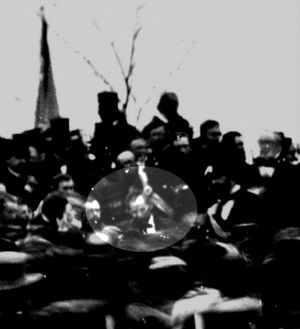
Photo of Lincoln delivering Gettysburg Address- (www.wikipedia.org)

Photo of Lincoln delivering
Gettysburg Address- (www.wikipedia.org)

The lesson plan is organized in three sections. In the first, students are handed a copy of Lincoln’s Gettysburg Address and perform several “cold” readings, to themselves and then with the class.

Lesson Plan SECTION 1 What’s at stake: a nation as a place and as an idea

Students silently read, then the teacher reads aloud the text of the Gettysburg Address while students follow along.

  • Students translate into their own words the first and second paragraph. 
  • Students answer guiding questions regarding the first two paragraphs

Please note, there is no mention of any historical context for the speech. Students will come to this 273-word speech without the background knowledge that the Battle of Gettysburg was fought from July 1 to July 3, 1863, and this battle is considered the most important engagement of the American Civil War. They will not know that the battle resulted in “Union casualties of 23,000, while the Confederates had lost some 28,000 men–more than a third of Lee’s army” (History.com). They will not know how the Army of Northern Virginia achieved an apex into Union territory with “Pickett’s Charge,” a failed attempt by General George Pickett  to break through the Union line in South Central Pennsylvania, and that the charge resulted in the death of thousands of rebel soldiers. They will not know how the newly appointed Major General George Gordon Meade of the Army of the Potomac met the challenges of General Robert E. Lee by ordering responses to skirmishes on Little Round Top, Culp’s Hill, and in the Devil’s Den. They will not know that Meade would then be replaced by General Ulysses S. Grant in part because Meade did not pursue Lee’s troops in their retreat to Virginia.

Instead of referencing any of this historical background, the guding questions in the lesson’s outline imagine the students as blank slates and mention another historical event:

A. When was “four score and seven years ago”? B. What important thing happened in 1776?

The guiding responses for teachers seem to begrudge an acknowledgement that keeping students bound to the four corners of a text is impossible, and that, yes, a little prior knowledge of history is helpful when reading a historical text:

This question, of course, goes beyond the text to explore students’ prior knowledge and associations. Students may or may not know that the Declaration of Independence was issued in 1776, but they will likely know it is a very important date – one that they themselves have heard before. Something very important happened on that date.  It’s OK to mention the Declaration, but the next step is to discover what students can infer about 1776 from Lincoln’s own words now in front of them.

In addition, there are admonishments in Appendix A of the lesson not to ask questions such as, “Why did the North fight the civil war?”

Answering these sorts of questions require students to go outside the text, and indeed in this particular instance asking them these questions actually undermine what Lincoln is trying to say. Lincoln nowhere in the Gettysburg Address distinguishes between the North and South (or northern versus southern soldiers for that matter). Answering such questions take the student away from the actual point Lincoln is making in the text of the speech regarding equality and self-government.

The lesson plan continues:

Lesson Plan SECTION 2  From funeral to new birth

  • Students are re-acquainted with the first two paragraphs of the speech.
  • Students translate the third and final paragraph into their own words.
  • Students answer guiding questions regarding the third paragraph of the Gettysburg Address.

Please note this does not provide the context of the speech that was given that crisp morning of November 19, 1863, at the dedication of the National Cemetery on a damp battlefield that only months before had been dampened red with the blood of tens of thousands of soldiers from either side. The students would be unaware that Lincoln had taken the train from Washington the day before and was feeling slightly feverish on the day of the speech. There is some speculation that he may have been suffering from the early stages of smallpox when he delivered the speech reading from a single piece of paper in a high clear voice. The students would not know that Lincoln’s scheduled time at the podium followed a two hour (memorized) speech by Edward Everett, who later wrote to Lincoln stating, “I should be glad if I could flatter myself that I came as near the central idea of the occasion in two hours as you did in two minutes.” The students would not know that many of the 15,000 crowd members did not hear Lincoln’s two minute speech; the 10 sentences were over before many audience members realized Lincoln had been speaking. The students would not know that this speech marked Lincoln’s first public statement about principles of equality, and they would not know that he considered the speech to be a failure.

Lesson Plan SECTION 3  Dedication as national identity and personal devotion

  • Students trace the accumulated meaning of the word “dedicate” through the text
  • Students write a brief essay on the structure of Lincoln’s argument

The lesson provides links to the five handwritten copies of the text, in the “Additional ELA Task #1: Comparison of the drafts of the speech” so that students can see drafts of the speech and the inclusion of “under God” in the latter three versions. There is also an additional Social Studies task that incorporates the position of respected historian Gary Wills from his book Lincoln at Gettysburg: The Worlds that Remade America. This activity suggests students use excerpts from Wills’s book and an editorial from the Chicago Times (November 23, 1863) to debate “Lincoln’s reading of the Declaration of Independence into the Constitution”. One excerpt from Wills’s book includes the statement,”The stakes of the three days’ butchery are made intellectual, with abstract truths being vindicated.” Finally, here is information about the battle itself; the battle lasted three days and soldiers died.

The enterprise of reading the Gettysburg Address without context defeats PARRC’s stated objective of having the students “arrive at an understanding of the text as a whole”. The irony is that in forwarding their own interpretation of the speech, David Coleman and the lesson plan developers have missed Lincoln’s purpose entirely; Lincoln directs the audience to forget the words of the speech, but never to forget the sacrifices made by the soldiers during that brutal conflict:

The world will little note, nor long remember what we say here, but it can never forget what they did here.

Lincoln wrote and delivered the Gettysburg Address to remind his audience “that these dead shall not have died in vain”. Analyzing the language of the address isolated from the Civil War context that created the tone and message is a hollow academic exercise. Instead, students must be taught the historical context so that they fully understand Lincoln’s purpose in praising those who, “gave the last full measure of devotion.”

“It is altogether fitting and proper that we should do this.”

Continue Reading…

Stephen King scares me. I have read only a handful of his books: Christine, The Green Mile, Carrie, but those have left a residue in my brain. My fear, created by the gruesome images in his fiction, would probably please him: he likes to tell stories that unsettle the reader.

I have, however, become a fan of his non-fiction book On Writing. While I am not as rabid as Annie Wilkes of Misery, I push this book on as many readers as possible. When I mention King’s name, however, I recognize the same uncomfortable flicker in their eyes. King scares them.

“No, really,” I urge, “this is nothing like the Stephen King books you don’t like. This is the Stephen King book you will like.”

On the surface, On Writing: A Memoir of the Craft is King’s memoir mixed with writing tips. The book is divided into three parts; the second part has two subsets of witty literary criticism.

In section one, the reader learns about King’s childhood, the history of his writing career, and the inspiration for several stories. He discusses his addictions, his stories, and his marriage to Tabitha, an author and his chief literary critic. In the second section, King discusses the craft of writing, first through the use of a “toolbox” of grammar  and then with application of these tips in various works of literature. The third and final section of the book covers his near death experience in June of 1999 when he was hit by a motorist on a side road in Maine.

We assign this book to our juniors who are taking the Advanced Placement English Language class, a course in familiarizing students with rhetoric and argument. The critical commentaries he offers in his “toolbox” section are especially helpful in helping students develop a style of writing.

He lectures the reader in a voice that is informal and wise. He gets the respect that English teachers struggling to impart the importance of subject-verb agreement crave to have from students. Plus, he swears; he swears a lot:

“You’ll also want grammar on the top shelf of your toolbox, and don’t annoy me with your moans of exasperation or your cries that you don’t understand grammar, you never did understand grammar, you flunked that whole semeste rin Sophomore English, writing is fun but grammar sucks the big one. Relax. Chill. We won’t spend much time here because we don’t need to. One either absorbs the grammatical principles of one’s native language in conversation and in reading or not.”

Some of his other observations include:

“Remember that the basic rule of vocabulary is use the first word that comes to your mind, if it is appropriate and colorful. If you hesitate and cogitate, you will come up with another word — of course you will, there’s always another word — but it probably won’t be as good as your first one, or as close to what you really mean.”

“Bad grammar produces bad sentences.”

The adverb is not your friend. … Adverbs, like the passive voice, seem to have been created with the timid writer in mind.”

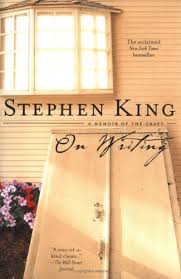
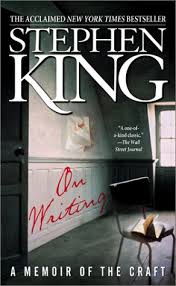
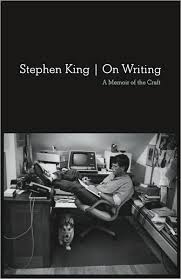
I have had some success in locating used copies of the book in its various editions. There are hardcovers and paperbacks in the secondary markets of thrift stores and library book sales, but I need to look close at the book spines since they are different in size and appearance. Our class set is a mish-mash of all editions.  The most frequent edition’s cover art is a picture of the cellar door, and if there was a book cover design that was dead wrong for the contents, this cover gets my vote. The cellar door may mean entrance to the “foundation” of writing, but the cream colored clapboards, bright window, and potted plant are an odd chice for King. The cover art with the letters of rejection nailed to a wall is macabre, perhaps a better choice for King and the contents. My favorite cover, though, is the most recent and centers on a photo of King working at his desk.

Cover simply did not match content!

Cover disconnect from content.

The macabre cover with rejection letters nailed to the wall

The macabre cover with rejection letters nailed to the wall; blood red title.

The most appropriate cover; one that matches the content

The most appropriate cover; one that matches the content-King writing On Writing

Last week, I offered this book to my own book group, an adult group of educated readers. Our discussion led to the question, “What is good writing?” We failed like so many others to come up with a definitive answer, but we did appreciate KIng’s four pages of suggested titles listed at the end of the memoir to read as examples of good writing. This list brings me to a major point in On Writing, King likes to read. This is repeated many times in the text:

“If you don’t have time to read, you don’t have the time (or the tools) to write. Simple as that.”

“If you want to be a writeryou must do two things above all others: read a lot and write a lot.

King’s dedication to the craft of writing is inspiring; the final paragraph captures his passion:

“Writing isn’t about making money, getting famous, getting dates, getting laid, or making friends. In the end, it’s about enriching the lives of those who will read your work, and enriching your own life, as well. It’s about getting up, getting well, and getting over. Getting happy, okay? Getting happy.”

On Writing has changed how I write. Because of On Writing, I hesitate to add an adverb (see? I consciously did not use “frequently hesitate”). I hear his voice say “I believe the road to hell is paved with adverbs” when I craft sentences,

My favorite part of the “toolbox” deals with his disdain for the passive voice. King tells the writer to “energize your prose with active verbs. … good writing is often about letting go of fear and affectation.”  My students tell me they write in write in passive voice to sound smart, so I need to counter with a clear example of why the use active voice is more powerful. King provides me a hilarious example:

“Everyone’s entitled to his/her opinion, but I don’t believe ‘With a hammerhe killed Frank‘ will ever replace ‘He killed Frank with a hammer.’”

“But how do you know when you are using passive voice?” my students ask. I offer my new “tool” to test, a tool I found on a Facebook post.

“If you can put ‘by Zombies’ after the verb, then you have passive voice,” I respond.

“Frank was killed…by Zombies?”

“Passive voice. To make the sentence active, you would have to write, ‘The Zombies killed Frank’. Much clearer, don’t you think?”

Passive voice and Zombies? I think Stephen King would enjoy that discussion.

60 of my students met their first Hamlet on stage at Yale Repertory Theatre in New Haven, Connecticut, this past week. Their Hamlet was the actor Paul Giamatti, who after speaking 40% of the play’s 4,042 lines (roughly 1,440), came out onto the stage for an audience talkback to speak a few more words to them.paul giamatti

“He looks tired,” on student remarked to me. The play had begun at 10:15 AM, and we were still sitting three and a half hours later as the actors and crew began to respond to questions.

If we thought they looked tired, the actors seemed surprised to see us still sitting there.
“Wow!” Polonius (Gerry Bamman) said as he sat, “You stayed!”

Students were curious about how the sets moved (“The stage has a large fly space.“). Students wondered how long the cast had rehearsed (“Eight weeks, a real luxury…”). Students wondered who was most like his or her character (“I understand Gertrude much more since I have a son”). Students asked about the creation of set pieces including a large portrait (“That’s an oil painting from a  photograph”).

Of course, there was no stopping the students from calling attention to Giamatti’s role in Big Fat Liar, a film from their youthOne student stood to ask, “Did Hamlet remind you of Marty Wolf?” Giamatti laughed in response, “Well, maybe,…a little… except for the blue crap!”

Hamlet is a 12th grade text, and I asked students to take a survey after they returned to the school to see what they thought of this production. While the survey indicated that the teachers in our English department had done their job, the students indicated that seeing the play performed was very different that studying the play in class:

Shakespeare was meant to be live. Although the “perfection” of a movie is enhancing to the performance, it is unrealistic. I believe that watching a play live is important to seeing the different styles and methods possible.

It was fun and a lot better than just reading it in class, it made it come alive.

I did not think it was going to be as entertaining as it was. I also did not think I would find parts humorous, but I did.

This Hamlet was part of the WILLPOWER! series (funded by the National Endowment of the Arts). The website states:

WILL POWER! is Yale Repertory Theatre’s annual educational initiative in conjunction with one of its productions and features specially-priced tickets and early school-time matinees for middle and high school student groups. The program also includes free professional development for educators, study guides and post-performance discussions with members of the company.

One of the objectives of the WILLPOWER! series is to create new audiences, specifically younger audiences, for Shakespeare. Students who have attended a Shakespeare play may be more willing to attend another play when they are older; in other words, a favorable dramatic experience will yield future audiences for Yale Drama School graduates!

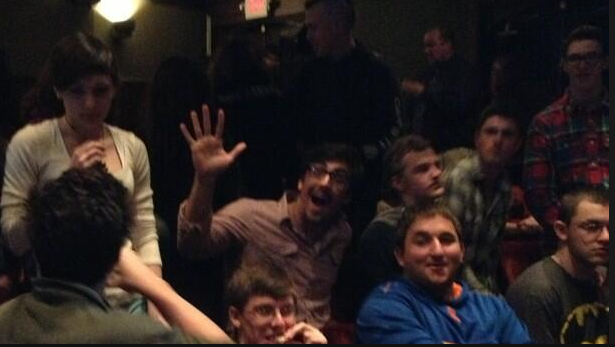
Seniors at intermission watching Hamlet at Yale Rep

Seniors at intermission watching Hamlet at Yale Rep

The survey indicated that this goal is being met with the WILLPOWER! series; my students are certainly willing to try another play:

The performance was a wonderful experience, especially since it was my first time to see Shakespeare.

I wouldnt mind going to another because it was so enjoyable that I didn’t even realize the 4 hours passing by.

I like the way that a play has a certain kind of vibe. It’s like a live concert, where there’s a certain kind of energy. It was like seeing a live performance of a film. I would especially like to see another Shakespeare because it is the way that he intended his works to be portrayed.

After seeing Hamlet so well done, it would definitely be worth going to see another one whether it be Shakespeare or a different kind of performance.

Perhaps the most satisfying moments of the actor’s talkback for teachers is hearing the actors say things that we wish our students would pay attention to in class. When Giammati was asked about how he felt about memorizing all those lines, he explained that he enjoyed learning the lines and playing on the open space of the stage.

When one student asked, “What part of the play did you like best?” Giamatti responded, “I enjoy the end, when Hamlet returns to the graveyard, until the end.” Then, thoughtfully, he added, “Shakespeare’s words begin to come through you if you let them.” (Honestly…you could hear the teachers in the audience swoon!)

But nothing was better than hearing the young Remsen Welsh (Player Prologue) explain how the director, James Bundy, had prepared her for her role. “It’s simple,” the actress gestured enthusiastically from the front of the stage. Facing the crowd of students twice her age, she cheerfully acknowledged, “He told me, ‘Suit the action to the word, the word to the action..’ and I did!”

Exactly.

A first Hamlet they will remember.

Six years ago, the video “Shift Happens” (2007) was featured at our school’s professional development day. I clearly remember one take-away:

We are currently preparing students for jobs that don’t exist using technologies that do not exist in order to solve problems we don’t even know are problems yet.

The video was created by Karl Fisch, and modified by Scott McLeod. The slides provided statistics on the rapid exponential growth in population and in information, highlighting the differences between the present and what was successful in the past, specifically England’s position on the world stage in 1900. Several slides are alarming in calling attention to the building tsunami of information available to students with examples such as ” there is more information in a week’s worth of the The New York Times than what an average person knew in the 1700s”. Since 2007, there have been several updated versions of “Shift Happens” uploaded to YouTube; there have also been many imitations.

I thought of this video this week when I drove past a sign on a large office building: Strategic Information Technologies.

“What does that mean?” I asked my friend Catherine, “Is the technology stategic because of geography? Strategic because of a choice of software or hardware?” I continued, “I don’t know what a ‘strategic information technologist’ does…Is this one of the unknown new jobs were are ‘preparing’ our 21st Century students to take?” I referenced the video.

“That’s ridiculous!” Catherine responded, “The people who ‘prepared’ us for the 21st Century were not worried about what new jobs would be available in our future. In fact,” she continued, “they taught us what they knew…what they thought we should know, and we are doing just fine.”

I was startled. Could a “Shift Happens” video place a misguided emphasis on adjusting skills and content in order to prepare students for the unidentified problems they don’t even know are problems yet?

“After all,” she continued, “We are the generation that created these new technologies that we didn’t know would exist today.”

When I reflect on her statement I think about how my favorite teachers in grades K-12  (Sister Ella, Mrs. Rowland, Miss Montessi) were not obsessed with preparing me for some unidentified job in the future. Instead, their collective obsession was to prepare me with basic skills and content so that I could be a productive member of society  I was taught to think, to read well, write well, speak well, know math, appreciate history, recognize science, and, since I attended Catholic school, recite my Catechism.

Perhaps, educators cannot predict the future for their students, but educators can address trends. For example, in 1957, the American public began to reconsider how the role of public education may contribute to winning the Space Race with the Soviets once Sputnik had been released. The investments in education made as a consequence resulted in increased scientific advancements and many spin-off technologies. In contrast, however, predictions such as those at the 1964 NY World’s Fair of a future with flying cars, jet packs, vacation trips to Mars and beyond, underwater cities, and robot laborers have never came to fruition.

Similarly, Karl Fisch’s video alerted educators to the rapid changes in education and the global implications in preparing students for the real world. He wrote:

“…it’s a different world out there. A world whereanyone’s ideas can quickly spread if they happen to strike a chord.”
This was certainly true of the “Shift Happens” video which had great success without “a large company or a huge public relations effort to make an impact.” Fisch continued:
This is just one of the reasons that I believe our schools need to change. They need to change to reflect this new world, this flatter world, this information-abundant, globally connected, rapidly changing, technology super-charged world that they are going to spend the rest of their lives in.

Fisch made no silly “predictions” like those at the NY World’s Fair. Instead, his video served to bring attention to trends that require an increase in the skills of  communication and sharing information.

In order to communicate and to share, students from grades K-12 must think, read well, write well, and speak well regardless as to what predictions are being made about new industries or technologies. In trying to anticipate the future, educators must not discount how the generations of students who learned these important skills became the graduates who are now responsible for evolving changes of the present.

Shift is not an entirely new enterprise on the world stage, for example,  the Renaissance, the Enlightenment, the Reformation, the Industrial Revolution are all examples of global “shifts”. In the six short years since the “Shift Happens” video, Facebook has replaced MySpace as the world’s most formidable social network; Twitter has evolved into a powerful communication tool. The role of educators is not  to predict the next Steve Jobs or Bill Gates or company that will spawn new jobs or dominate an industry or the next “shift”. Instead, the role of educators must be to continue to teach those skills of thinking, reading, writing, and speaking well that contributed to the “shift” that is happening for our students.

There is no surprise that “Shift Happens”, and the students who are prepared to think, to read well, to write well, and to speak well will not be surprised either.

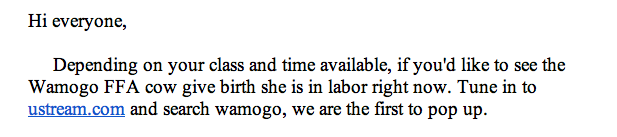
“[WamogoAll] If you want to see our cow give birth right now..” was the tagline for the e-mail in my in box last Thursday afternoon. I teach in a “Ag-ed” or  agricultural education school in the Northwestern Corner of Connecticut, so the contents in the e-mail were not surprising:

Screen Shot 2013-03-21 at 12.00.48 PM

The ability for me to watch the live birth of this calf from my office in another part of the building was certainly an example of how 21st Century learning is fully integrated for students and staff alike. Under the direction of our administration and with the support of our Board of Education, our small district has taken the integration of technology very seriously, and in four short years, we have gone from chalkboards to Smartboards, from pencil to netbook, and from worksheets to flipped classrooms. There is technology used in every classroom in every discipline every day.

One of the buzzwords in education is the work authentic, and teachers work hard to make connections from the content in class to the real world.

In order to be accredited as a school offering 21st Century skills, a school must offer authentic experiences. The schools are rated on:

The curriculum emphasizes depth of understanding and application of knowledge through:

  • authentic learning opportunities both in and out of school
  • informed and ethical use of technology.

Teachers’ instructional practices support the achievement of the school’s 21st century learning expectations by:

  • applying knowledge and skills to authentic tasks
  • integrating technology.

The Wamogo High School program with its chapter of the National FFA Organization and Agricultural Education accomplishes both with authentic educational experiences supported with technology.

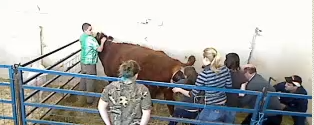
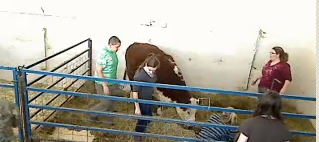
I paid closer attention to the video monitor as the noise from the barn came over the computer’s speaker.  I watched as students gathered around the stall, and then saw Lori, the animal science teacher, jump in to calm the cow and rearrange the straw for bedding. Suddenly, three or four students and the culinary arts teacher  formed a line behind the cow, and in an unrehearsed routine, began helping Lori with the birth. I took a screen shot.

Screen Shot 2013-03-21 at 12.35.50 PM

The first “pull”!

“Pull,”Lori urged, and I saw there was a gentle movement from the line-up behind the cow. I took another screen shot.

Screen Shot 2013-03-21 at 12.35.37 PM

The second “pull!”

“Pull”, Lori cried again, and the movement became more obvious.

Suddenly there was a jostle, and the gap between the cow and the line of helpers became larger. All eyes were on the calf laying slick and newborn on the hay. I took another screen shot.

Screen Shot 2013-03-21 at 12.36.28 PM

…and the new calf sits in the hay.

A few minutes later, there was came a breathless and garbled announcement over the speakers from a student about “… here”; there was no need for clarity. Given our students’ familiarity with texting, everyone knew what had happened anyway.

The combination of technology (Ustream, screenshots) in broadcasting and recording the birth of the newest member of the agricultural program with old-fashioned “hands on” physical labor illustrates 21st Century authentic learning.

I posted several of the screen shots on Twitter. Almost immediately I was retweeted by UStream; in seconds, Wamogo had gone viral!

Cow and calf meeting for the first time.

Cow and calf meeting for the first time.

There has been a seamless integration of technology into the vocational agriculture program at my high school. The students who participate in the program are involved in a time honored occupation, an occupation responsible for civilization as humans moved from roles of hunter-gatherers to farmers. They just know how to Tweet, post, email, blog, Instagram, Facebook, Tumblr, or stream a live TV feed to show what they know as well!

Wamogo's newest "student"

King Philippe III – he is her 3rd calf and this is a royal names themes year.

PS: Oh, and the maple candy made by the students is ready to sell; they just tweeted a picture:

pic.twitter.com/urOTXJpaUK


If I had a choice of vanity license plates, I might consider one that marked my recent experience as a volunteer on an educational accreditation team.

NEASC PlateEducational accreditation is the “quality assurance process during which services and operations of schools are evaluated by an external body to determine if applicable standards are met.”

I served as a volunteer on a panel for the New England Association of Schools and Colleges (NEASC), an agency that provides accreditation services  – Pre-K through university for more than 2000 public and private institutions in the six state region.  NEASC  Panels are composed of experienced chairpersons and volunteer teachers, administrators, and support staff who visit schools according to a set schedule. According to its website:

In preparation for a NEASC evaluation, all member schools must undertake an exhaustive self-study involving the participation of faculty, administrators, staff, students, community members, and board members.

The key word here? Exhaustive.

Exhaustive in preparation for a NEASC visit. Exhaustive in being hosting a NEASC visit. Exhaustive in being a member of the NEASC team that visits.

But first, a little background. In order to serve as a volunteer, I had to leave several lessons on Hamlet, my favorite unit, with my substitute. So, when I understood the level of professional discretion required for a NEASC visit, I felt a curious connection to the Ghost, Hamlet’s father, who likewise abides by an oath.  On the ramparts of Elsinore, he tells Hamlet:

But that I am forbid
To tell the secrets of my prison-house
I could a tale unfold whose lightest word
Would harrow up thy soul, freeze thy young blood,(1.5.749-752)

I may not say what school I visited nor may I discuss any part of the actual accreditation discussion by members of my team. So this post will speak only as a self reflection of the process and a few moments of recognition on how accreditation works.

List, list, O, list! (1.5.758)

Sunday morning at 9:30 AM, the team members were already hard at work organizing piles of documents prepared for our visit. We were organized into pairs, two members to work on each of the seven standards, 14 members of the team and two chairpeople.

There was a working lunch before the entire team went to the school for a prepared presentation. This presentation was the high school’s opportunity to quickly familiarize us with their school’s culture and present their strengths and needs that they had determined in the (exhaustive) self study.

Madam, how like you this play?(3.2.222)

Returning to our hotel, the lodgings provided by our hosting school, the work began in earnest. We looked through bins of student work to see if they met the standards set by NEASC.  We looked at all forms of assessments, lesson plans, and student responses. We recorded our findings well into the night, and finally left the work room at 10 PM.

…to sleep;/To sleep: perchance to dream (3.1.65-66)

On both Monday and Tuesday, the team was up early to return to the school (7:00 AM), and the team split up individually or in groups to spend a school day conducting interviews with faculty, staff, and students. Facility tours, lunches shared with students in the cafeteria, and opportunities to “pop-into” classes were available. There simply was no “unobligated time” as we worked steadily in the work room at the school. Here we would record our findings before returning to the school hallways.

Were you not sent for? Is it
your own inclining? Is it a free visitation? Come,
deal justly (2.2.275-276)

Both Monday and Tuesday evening sessions were long as team members furiously documented their findings into a report that will still need editing and revision.  We had worked from 6AM-10:30PM with time allotted for meals and one hour respite in order to call home or check on my own school’s e-mail.  Closing my eyes, I thought how much,

My spirits grow dull, and fain I would beguile
The tedious day with sleep. (3.2.226-227)

An early Wednesday morning work session let us polish the report and present our final conclusions to other members of the team. Finally, the votes as to whether the team would recommend accreditation or not to the school were tallied, and we marched into the school library to meet the faculty and staff a final time. We were leaving a report for them to:

suit the action to the word, the word
to the action; (3.2.17-18)

The chair gave a short speech indicating the tone but not the contents of our report, and then, according to protocol, we left as team, not speaking to anyone from the school, nor to each other. Staying silent, I thought

Farewell, and let your haste commend your duty. (1.2.39)

The experience provided me with insights into the strengths and weaknesses in the educational program of my own school, and I am eager to share ways that can improve instruction with my fellow faculty members. Our school is scheduled for a visit in the spring of 2014 by a NEASC accreditation team.

As professional development, the experience was positive but physically demanding and intellectually challenging. The chairs’ use of technology (Google docs, Livebinders, Linot) allowed for efficient sharing of information on seven standards: Core Values and Beliefs, Curriculum, Instruction, Assessment, School Culture and Leadership, School Resources, and Community Resources. Awash in papers and digital materials for 16 hours a day, I wondered how any previous teams using only hard copies had collaborated successfully.

Additionally, as I looked at the various standards of instruction, I also found myself wondering about the consequences of implementing Common Core Standards (CCSS) and the growing reliance on standardized testing in evaluating teachers and assessing student understanding. Will the current form of regional accreditation adjust to measurements that will be implemented nationally? The United States is broken into five regional accreditation districts, however, if students meet the national standards, how will these regional accreditation panels be used?

Finally, our four day “snap shot” coupled with a the school’s own exhaustive self-study could not address all of the arbitrary elements out of a school’s control, but the process is far more informative and meaningful than any standardized test results that could be offered by the CCSS. Consider also that the financing of a school seriously impacts, for good or for ill, all standards of measuring a school’s success. The intangible “culture” surrounding a school and the fluid landscape of 21st Century’s technology are other arbitrary factors that impact all standards. We even encountered a “snow-delayed” opening as if to remind us that a capricious Mother Nature refuses to allow for standardized measurement!

I only hope that my experience in informing another school in order to improve their educational program will prove beneficial. I know that when the team comes in the spring of 2014, that that they will do as I have tried to do:

 report me and my cause aright…(5.2.339)

The rest I now need requires silence.

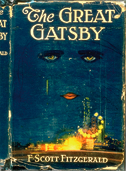
003-Great-Gatsby

Charles Scribner’s and Son issued the first hardback edition in April 1925, adorning its cover with a painting of a pair of eyes and lips floating on a blue field above a cityscape.

The Great Gatsby film is coming out soon….” the English teacher said to me, “Can you believe Gatsby is almost 90?”

Wait, 90? The Great Gatsby is almost 90? That debonair, handsome American icon we met in his 30’s could be well over 100 years old?

“He had one of those rare smiles with a quality of eternal reassurance in it, that you may come across four or five times in life. It faced, or seemed to face, the whole external world for an instant and then concentrated on you with an irresistible prejudice in your favor. It understood you just as far as you wanted to be understood, believed in you as you would like to believe in yourself.”

F. Scott Fitzgerald began writing his great American novel in 1922, with some of the elements surfacing in the story “Absolution” in the June 1924 issue of the magazine The American Mercury.  During the years 1923–1924, Fitzgerald, his wife Zelda, and their baby daughter, Frances “Scottie”,  traveled from New York to the French Riviera, where the novel was finished. Fitzgerald went through several revisions between 1923 to 1925 before the  novel was finally published.

According to Brant Mangum in a publication from Virginia Commonwealth University: 

Fitzgerald’s ambitious goal as he approached the composition of The Great Gatsby was to “write something new–something extraordinary and beautiful and simple + intricately patterned.”

The reaction of the critics was harsh; one early review ran with the headline:

 “F. SCOTT FITZGERALD’S LATEST DUD.”

Praise, however came from recognized writers T. S. Eliot, Edith Wharton and Willa Cather. Ten days after the book came out, Maxwell Perkins, Fitzgerald’s editor, sent the telegram: “SALES SITUATION DOUBTFUL EXCELLENT REVIEWS.” The first printing of 20,870 copies was a slow seller; Scribner’s printed another 3,000 copies four months late and finished the run. According to an article Living on $500,000 a Year: What F. Scott Fitzgerald’s tax returns reveal about his life and times by William J. Quirk in American Scholar over 12 million copies have been sold, with approximately 300-400 hundred thousand sold annually. However, Fitzgerald never did match his famous protagonist’s wealth:

“Royalties from The Great Gatsby totaled only $8,397 during Fitzgerald’s lifetime. Today Gatsby is read in nearly every high school and college and regularly produces $500,000 a year in [F. Scott Fitzgerald’s daughter] Scottie’s trust for her children.”

Fitzgerald died young, age 44, in December of 1940.

“His estate was solvent but modest—around $35,000, mostly from an insurance policy. The tax appraisers considered the copyrights worthless. Today, even multiplying Fitzgerald’s estate by 30, it would not require an estate tax return.”

He did write other novels, stories, essays, but The Great Gatsby remains his most important addition to the canon. So why call this work the great American novel?

Jonathan Yardley makes his case by calling attention to the distinctively American elements in the novel in the Washington Post book review Gatsby”: The Greatest Of Them All (1/2/07) writes:

In an extraordinarily compressed space — the novel is barely 50,000 words long — Fitzgerald gives us a meditation on some of this country’s most central ideas, themes, yearnings and preoccupations: the quest for a new life, the preoccupation with class, the hunger for riches and “the last and greatest of all human dreams…”

Our contemporary American obsession with celebrity and wealth is obvious to students who are assigned The Great Gatsby. Our nation’s economy  from boom through a recent recession, echoes the experience the heady times of the  Roaring 20’s before the Great Depression. The narrative style is engaging and packed with imagery. Anyone who spent time in a high school literature classroom over the past 50 years can recall taking notes on Fitzgerald’s metaphors and complex symbols. Mangum discusses these in his essay:

 The green light, which carries meaning at every level of the story–as Gatsby’s go-ahead sign, as money, as the “green breast of the new world,” as springtime–is strategically placed in chapters one, five, and nine. The eyes of T.J. Eckleburg “brood on over the solemn dumping ground,” which is the wasteland that America has become (514).

The appeal of Jay Gatsby’s character is explained in a chapter in America: A Self-Made Country by political commentator Chris Matthews. He writes:

“The reader, like Nick Carraway, comes to like this guy. We love his dream  because we have, all of us, shared something very much like it. Gatsby for me is undeniably the great American novel. We celebrate its hero and his “heightened sensitivity” to the promise of life. his “extraordinary gift for hope”, his “romantic readiness” because we as a country share every bit of it” (20).

The final passage of the novel is Fitzgerald’s commentary on the American dream. Nick’s final stream of consciousness:

“Gatsby believed in the green light, the orgastic future that year by year recedes before us. It eluded us then, but that’s no matter—tomorrow we will run faster, stretch out our arms farther. . . . And then one fine morning—
So we beat on, boats against the current, borne back ceaselessly into the past.”

Such imagery naturally lends itself to the movie screen, and The Great Gatsby has had more than its fair share of remakes:

  • 2000:  Mira Sorvino, Toby Stephens, Paul Rudd (made for TV)
  • 1974: Robert Redford, Mia Farrow, Bruce Dern
  • 1949: Alan Ladd, Betty Field, Macdonald Carey
  • 1926: Warner Baxter, Lois Wilson, Neil Hamilton 

Now, the latest version is coming May (2013), when the Australian film director Baz Lurhman will put his spin on this American story:

Once more, Jay Gatsby will be glamorously immortalized in his youth; this time digitally mastered rather than in celluoid.

However, should someone want to try an even newer genre in order to experience a 21st Century Gatsby, there is the Nintendo Great Gatsby Game that can be played on a computer. While Gatsby is fixed forever as young and ambitious, he now is also amazingly spry for his years! ( “to jump, move arrow keys together right and left”)

For an “Old Sport”, Gatsby wears his age well.

This post completes a trilogy of reflections on the Connecticut Academic Performance Test (CAPT) which will be terminated once the new Smarter Balance Assessments tied to the Common Core State Standards (CCSS) are implemented. There will be at least one more year of the same CAPT assessments, specifically the Interdisciplinary Writing Prompt (IW) where 10th grade students write a persusive essay in response to news articles. While the horribly misnamed Response to Literature (RTL) prompt confuses students as to how to truthfully evaluate an story and drives students into “making stories up” in order to respond to a question, the IW shallowly addresses persuasive writing with prompts that have little academic value.

According to the CAPT Handbook (3rd Generation) on the CT State Department of Eduction’s website, the IW uses authentic nonfiction texts that have been:

“… published and are informational and persuasive, 700-1,000 words each in length, and at a 10th-grade reading level.  The texts represent varied content areas (e.g., newspaper, magazine, and online articles, journals, speeches, reports, summaries, interviews, memos, letters, reviews, government documents, workplace and consumer materials, and editorials).  The texts support both the pro and con side of the introduced issue.  Every effort is made to ensure the nonfiction texts are contemporary, multicultural, engaging, appropriate for statewide implementation, and void of any stereotyping or bias.  Each text may include corresponding maps, charts, graphs, and tables.”

Rather than teach this assessment in English, interdisciplinary writing is taught in social studies because the subject of social studies is already interdisciplinary. The big tent of social studies includes elements of economics, biography, law, statistics, theology, philosophy, geography, sociology, psychology, anthropology, political science and, of course, history. Generally, 9th and 10 grade students study the Ancient World through Modern European World (through WWII) in social studies. Some schools may offer civics in grade 10.

Social studies teachers always struggle to capture the breadth of history, usually Western Civilization, in two years. However, for 15 months before the CAPT, social studies teachers must also prepare students to write for the IW test. But does the IW reflect any of the content rich material in social studies class? No, the IW does not. Instead the IW prompt is developed on some “student centered” contemporary issue. For example, past prompts have included:

  • Should students be able to purchase chocolate milk in school?
  • Should utility companies construct wind farms in locations where windmills may impact scenery or wildlife?
  • Should ATVs be allowed in Yellowstone Park?
  • Should the school day start later?
  • Should an athlete who commits a crime be allowed to participate on a sports team?
  • Should there be random drug testing of high school students?

On the English section of the test, there are responses dealing with theme, character and plot. On the science section, the life, physical and earth sciences are woven together in a scientific inquiry. On the math section, numeracy is tested in problem-solving. In contrast to these disciplines, the social studies section, the IW, has little or nothing to do with the subject content. Students only need to write persuasively on ANY topic:

For each test, a student must respond to one task, composed of a contemporary issue with two sources representing pro/con perspectives on the issue.  The task requires a student to take a position on the issue, either pro or con.  A student must support his or her position with information from both sources.  A student, for example, may be asked to draft a letter to his or her congressperson, prepare an editorial for a newspaper, or attempt to persuade a particular audience to adopt a particular position.  The task assesses a student’s ability to respond to five assessed dimensions in relationship to the nonfiction text: (1) take a clear position on the issue, (2) support the position with accurate and relevant information from the source materials, (3) use information from all of the source materials, (4) organize ideas logically and effectively, and (5) express ideas in one’s own words with clarity and fluency.

The “authentic” portions of this test are the news articles, but the released materials illustrate that these news articles are never completely one-sided; if they are written well, they already include a counter-position.  Therefore, students are regurgitating already highly filtered arguments. Secondly, the student responses never find their way into the hands of the legislators or newspaper editors, so the responses are not authentic in their delivery. Finally, because these prompts have little to do with social studies, valuable time that could be used to improve student content knowledge of history is being lost.  Some teachers use historical content to practice writing skills, but there is always instructional time used to practice with released exam materials.

Why are students asked to argue about the length of a school day when, if presented with enough information, they could argue a position that reflects what they are learning in social studies? If they are provided the same kinds of newspaper, magazine, and online articles, journals, speeches, reports, summaries, interviews, memos, letters, reviews, government documents, workplace and consumer materials, and editorials, could students write persuasive essays with social studies content that is measurable? Most certainly. Students could argue whether they would support a government like Athens or a government like Sparta. Students could be provided brief biographies and statements of belief for different philosophers to argue who they would prefer as a teacher, DesCartes or Hegel. Students could write persuasively about which amendment of the United States Constitution they believe needs to be revisited, Amendment 10 (State’s Rights) or Amendment 27 (Limiting Changes to Congressional Pay).

How unfortunate that such forgettable issues as chocolate milk or ATVs are considered worthy of determining a student’s ability to write persuasively. How inauthentic to encourage students to write to a legislator or editor and then do nothing with the students’ opinions. How depressing to know that the time and opportunity to teach and to measure a student’s understanding of the rich content of social studies is lost every year with IW test preparation.

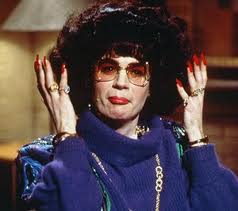
coffeetalkMaybe the writers of the CAPT IW prompt should have taken a lesson from the writers of Saturday Night Live with the Coffee Talk with Michael Myers. In these sketches, Myers played Linda Richmond, host of the call-in talk show “Coffee Talk”. When s(he) would become too emotional (or feclempt or pheklempt ) to talk, s(he) would “give a topic” to talk “amoungst yourselves”.  Holding back tears, waving red nails in front of his face furiously, Myers would gasp out one of the following:

“The Holy Roman Empire was neither holy, Roman, nor an empire….Discuss…”

“Franklin Delano Roosevelt’s New Deal was neither new nor a deal…. Discuss…”

“The radical reconstruction of the South was neither radical nor a reconstruction…. Discuss…”

“The internal combustion engine was neither internal nor a combustion engine…. Discuss…”

If a comedy show can come up with these academic topics for laughs, why can’t students answer them for real? At least they would understand what made the sketches funny, and that understanding would be authentic.

As the Connecticut State Standardized tests fade into the sunset, teachers are learning to say “Good-bye” to all those questions that ask the reader to make a personal connection to a story. The incoming  English Language Arts Common Core Standards (ELA- CCSS) are eradicating the writing of responses that begin with, “This story reminds me of…..” Those text to self, text to text, and text to world connections that students have made at each grade level are being jettisoned. The newly designed state assessment tests will tolerate no more fluff; evidence based responses only, please.

sunsetPerhaps this hard line attitude towards literacy is necessary correction. Many literacy experts had promoted connections to increase a reader’s engagement with a text. For example,

 “Tell about the connections that you made while reading the book. Tell how it reminds you of yourself, of people you know, or of something that happened in your life. It might remind you of other books, especially the characters, the events, or the setting” (Guiding Readers and Writers Grades 3-6, Fountas and Pinnell) 

Unfortunately, the question became over-used, asked for almost every book at each grade level. Of course, many students did not have similar personal experiences to make a connection with each and every text. (Note: Given some of the dark literature-vampies, zombies- that adolescents favor, not having personal experience may be a good sign!) Other students did not have enough reading experience or the sophistication to see how the themes in one text were similar to themes in another text.  Some of the state assessment exemplars revealed how students often made limited or literal connections, for example:”The story has a dog; I have a dog.”

The requirement to make a connection to each and every story eventually led to intellectual dishonesty.  Students who were unable to call to mind an authentic connection faked a relationship or an experience. Some students claimed they were encouraged by their teachers to “pretend” they knew someone just like a character they read about. “Imagine a friend had the same problem,” they were told.   Compounding this problem was the inclusion of this connection question on the state standardized tests, the CAPT (grade 10) and the CMT (grades 3-8). So, some  students traded story for story in their responses, and they became amazingly creative in answering this question. I mentioned this in a previous post when a student told me that the sick relative he had written about in a response didn’t really exist. “Don’t worry,” he said brightly after I offered my condolences, “I made that up!”

Last week, our 9th grade students took a practice standardized test with the “make a connection question” as a prompt. They still need to practice since there is one more year of this prompt before ELA CCSS assessments are in place. The students wrote their responses to a story where the relationship between a mother and daughter is very strained. One of the students wrote about her deteriorating and very difficult relationship with her mother. I was surprised to read how this student had become so depressed and upset about her relationship with her mother. I was even more surprised that afternoon when that same mother called to discuss her daughter’s grade. I hesitated a little, but I decided to share what was written in the essay as a possible explanation. The next day, I received the following e-mail,

“I told M___that I read the practice test where she said I didn’t have time to talk and other things were more important. She just laughed and said that she had nothing in common with the girl in the story so she just made that up because she had to write something. We had a good laugh over that and I felt so relieved that she didn’t feel that way.”

After reading so many student “make a connection” essays, I should have seen that coming!

Good-bye, “Make a Connection” question. Ours was an inauthentic relationship; you were just faking it.

Screen Shot 2013-03-10 at 11.08.07 AMMarch in Connecticut brings two unpleasant realities: high winds and the state standardized tests. Specifically, the Connecticut Academic Performance Tests (CAPT) given to Grade 10th are in the subjects of math, social studies, sciences and English.

There are two tests in the English section of the CAPT to demonstrate student proficiency in reading. In one, students are given a published story of 2,000-3,000 words in length at a 10th-grade reading level. They have 70 minutes to read the story and draft four essay responses.

What is being tested is the student’s ability to comprehend, analyze, synthesize, and evaluate. While these goals are properly aligned to Bloom’s taxonomy, the entire enterprise smacks of intellectual dishonesty when “Response to Literature” is the title of this section of the test.

Literature is defined online as:

“imaginative or creative writing, especially of recognized artistic value: or writings in prose or verse; especially writings having excellence of form or expression and expressing ideas of permanent or universal interest.”

What the students read on the test is not literature. What they read is a story.

A story is defined as:

“an account of imaginary or real people and events told for entertainment.”

While the distinction may seem small at first, the students have a very difficult time responding to the last of the four questions asked in the test:

How successful was the author in creating a good piece of literature? Use examples from the story to explain your thinking.

The problem is that the students want to be honest.

When we practice writing responses to this question, we use the released test materials from previous years: “Amanda and the Wounded Birds”, “A Hundred Bucks of Happy”, “Machine Runner” or “Playing for Berlinsky”.  When the students write their responses, they are able to write they understood the story and that they can make a connection. However, many students complain the story they just read is not “good” literature.

I should be proud that the students recognize the difference. In Grades 9 & 10, they are fed a steady diet of great literature: The Odyssey, Of Mice and Men, Romeo and Juliet, All Quiet on the Western Front, Animal Farm, Oliver Twist. The students develop an understanding of characterization. They are able to tease out complex themes and identify “author’s craft”. We read the short stories “The Interlopers” by Saki, “The Sniper” by Liam O´Flaherty, or “All of Summer in a Day” by Ray Bradbury. We practice the CAPT good literature question with these works of literature. The students generally score well.

But when the students are asked to do the same for a CAPT story like the 2011 story “The Dog Formerly Known as Victor Maximilian Bonaparte Lincoln Rothbaum”, they are uncomfortable trying to find the same rich elements that make literature good. A few students will be brave enough to take on the question with statements such as:

  • “Because these characters are nothing like Lenny and George in Of Mice and Men…”
  • “I am unable to find one iota of author’s craft, but I did find a metaphor.”
  • “I am intelligent enough to know that this is not ‘literature’…”

I generally caution my students not to write against the prompt. All the CAPT released exemplars are ripe with praise for each story offered year after year. But I also recognize that calling the stories offered on the CAPT “literature” promotes intellectual dishonesty.

Perhaps the distinction between literature and story is not the biggest problem that students encounter when they take a CAPT Response to Literature. For at least one more year students will handwrite all responses under timed conditions: read a short story (30 minutes) and answer four questions (40 minutes). Digital platforms will be introduced in 2014, and that may help students who are becoming more proficient with keyboards than pencils.
But even digital platforms will not halt the other significant issue with one other question, the “Connection question (#3)” on the CAPT Response to Literature:

 What does this story say about people in general? In what ways does it remind you of people you have known or experiences you have had?  You may also write about stories or books you have read or movies, works of art, or television programs you have seen.  Use examples from the story to explain your thinking.

Inevitably, a large percentage of students write about personal experiences when they make a connection to the text. They write about “friends who have had the same problem” or “a relative who is just like” or “neighbors who also had trouble”.  When I read these in practice session, I sometimes comment to the student, “I am sorry to hear about____”.

However, the most frequent reply I get is often startling.

“No, that’s okay. I just made that up for the test.”

At least they know that their story, “an account of imaginary or real people and events told for entertainment,” is not literature, either.